Category: Travel & Drive

  • Why Leaving One Car Organizer Spot Empty Boosts Daily Driving Ease

    You can cram a car with organizers, trays, pockets—yet it takes only a few days of real driving for the system to start slowing you down. What looked streamlined on day one quickly shows cracks: cables vanish below crowded compartments, small essentials wedge beneath stacked inserts, and a phone tossed “anywhere” bounces to the least reachable spot. The interior looks under control but daily routines grind against hidden barriers you didn’t design for. Suddenly, everyday basics—charging, quick drop-offs, loading up, cleaning out—become a quiet juggling act, not the smooth reset you pictured.

    When a Packed Car Feels Less Usable

    If you’ve ever lined a car with bins and pockets, you know the drill: Monday’s setup looks tight, but by Thursday you’re breaking your own flow. What starts as control turns into unexpected friction:

    • Have to move a tray just to grab a parking stub at the window.
    • Charging becomes “untangle the cable” before plugging in, every single drive.
    • A well-meaning storage bin near the seat now blocks your foot or catches your bag on the way in.

    None of these slowdowns make headlines, but over back-to-back errands and rushed mornings, the drag is real. Every stop is a quick test: does your setup keep pace, or do you catch yourself hesitating, shifting, or forcing a workaround?

    Spotting the Real Trouble Zones

    The friction always surfaces where your hands expect freedom: beside the charger, next to the seat edge, or front and center. Real weak spots stand out over repeated use:

    • Charging ports blocked by storage: Cables snake underneath or around, so you juggle organizers to power up your phone. The cord stretches, connectors fatigue faster, and a quick plug-in now takes attention.
    • The reach zone clutter: The area from seat edge to shifter fills with keys, cards, sanitizer, transit passes. Clean lines turn to a rush-hour scramble as you fish for the one item that’s always out of reach.
    • Cargo and trunk corners overloaded: One oversized box or cargo divider cuts the loading angle, forcing you to tip bags or reposition every grocery run—making unloading slower, not easier.

    A car that photographs as “organized” can, in practice, slow every instinctive move. Those seconds stack up, wearing out your patience and making car time feel less in sync with your actual routine.

    The Case for Leaving One Spot Empty

    Counterintuitive but true: intentionally leaving a key area open near the charge port or the center console often unlocks the biggest relief. When this zone is kept free—

    • You can drop your phone or badge in one motion, not a shuffle.
    • Cables have space to flex, so there’s no daily ritual of untwist and adjust.
    • Rush handoffs—groceries, knotted cords, paperwork—land on an open pad, not crammed beside or under trays you have to slide out of the way.

    The gain shows up in the unnoticed: sliding into the seat without sidestepping bins, reaching to charge in one clean arc, picking up paperwork without first clearing obstacles. The interruption fades—and that’s when the organization actually helps you keep moving.

    Where the Daily Grind Proves the Point

    The pattern repeats: you jump in mid-errand, arms full, and immediately hit an obstacle. Every flat surface is “claimed” by a tray or charger, so items you need most end up balanced on piles or dropped into cupholders. If you lose a work pass or receipt, odds are it’s slipped under another insert before you can react. The design you built to fight clutter quietly blocks your own routine—what’s clean in theory is clumsy in motion.

    Leaving one space open lets the car flex with your week: bulky deliveries Monday, extra shoes Thursday, dog leash and wipes on Saturday. The empty slot absorbs the overflow, protects access, and lets the routine bend without constant rearrangement. Function stops fighting flow.

    Organization as a Living System—Not a Finished Picture

    In cars, “tidy” and “easy” rarely line up for long. A setup that’s bliss on unboxing can gum up after a few cycles of drive, load, park, repeat. The spots that look best at rest often become bottlenecks when you move fast. A cargo grid makes bags stand up, but can slow unloading when you’ve got three more stops. Seat-side organizers trap trash, but block a smooth exit and pinch your leg every re-entry. Features that seem helpful on day one can turn into silent sources of friction after a few laps around town.

    How One Clear Section Changes the Rhythm

    Real feedback comes fast: leave just a small area open near your charger or seat—suddenly there’s less “fighting” with your storage. No more bumping a tray to lay down your phone, no more digging for keys through a nest of bins at a red light. On high-pressure days packed with errands or family pickups, that open spot becomes a pressure-release valve; it’s where clutter pauses, where the quick items land, where cleanup doesn’t involve first unblocking organizers.

    Over time, your routines smooth out—clutter can’t bounce back into active zones, and you fit loading, unloading, and re-entry into fewer steps. The car stops resisting and starts responding.

    Adjusting for Real Routines—Not Just Static Order

    Skip the temptation to fill every gap. Instead, find the pinch-point—the spot where you fumble, pause, or mutter every week. That’s the place to leave clear. You’ll see it when busy mornings stop tripping you up, and when shared rides stop involving a mini cleanup.

    Order isn’t about packing every space; it’s about what keeps working under daily pressure. Leave a section intentionally untouched, and you’ll discover the most valuable zone in your car isn’t an extra bin—it’s the open patch that soaks up overflow, cuts friction, and recovers smoothly. With each drive, that small absence becomes the biggest difference.
    Shop practical car-use solutions at DriveWellSupply

  • Why Carry-On Organization Can Slow You Down During Travel

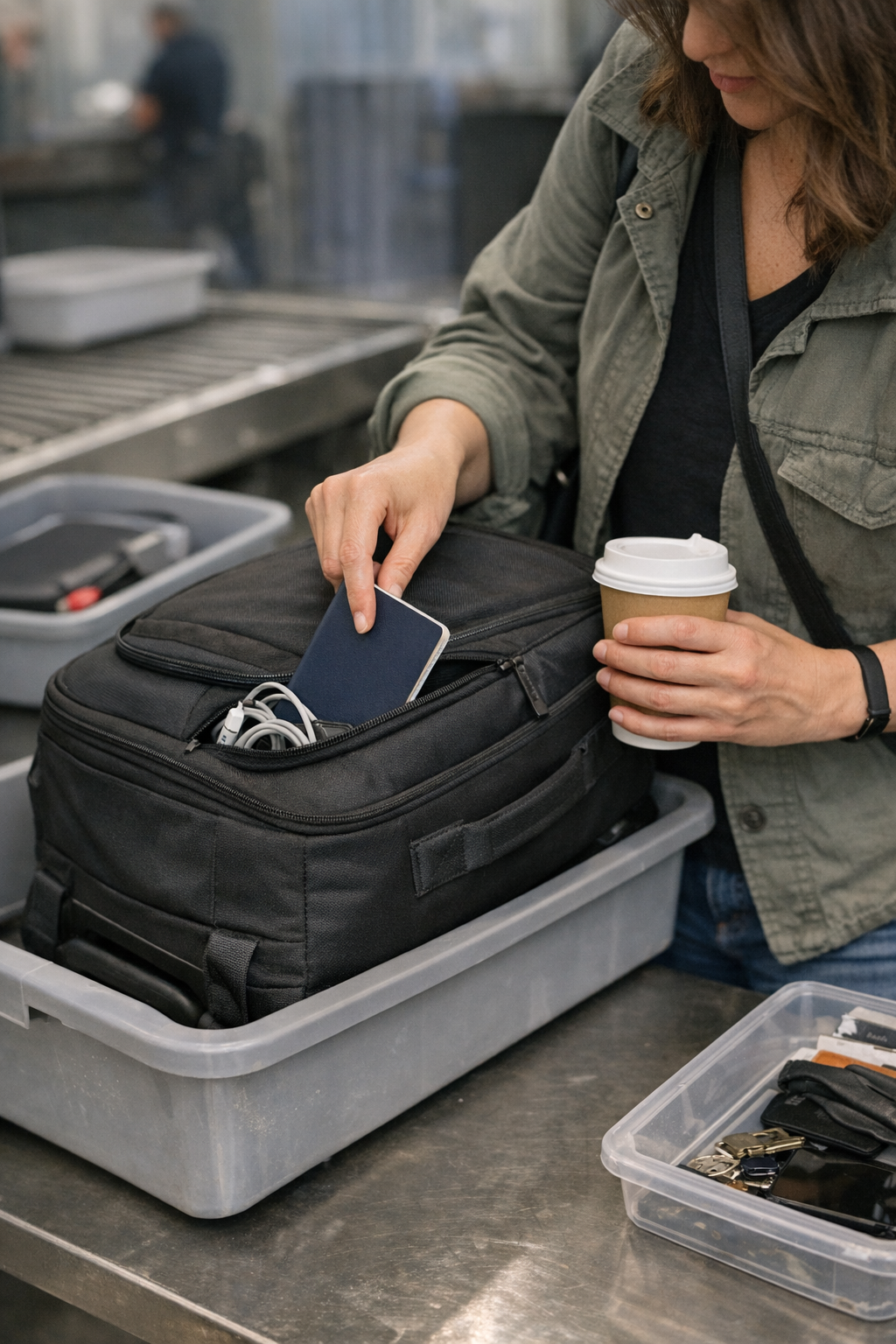
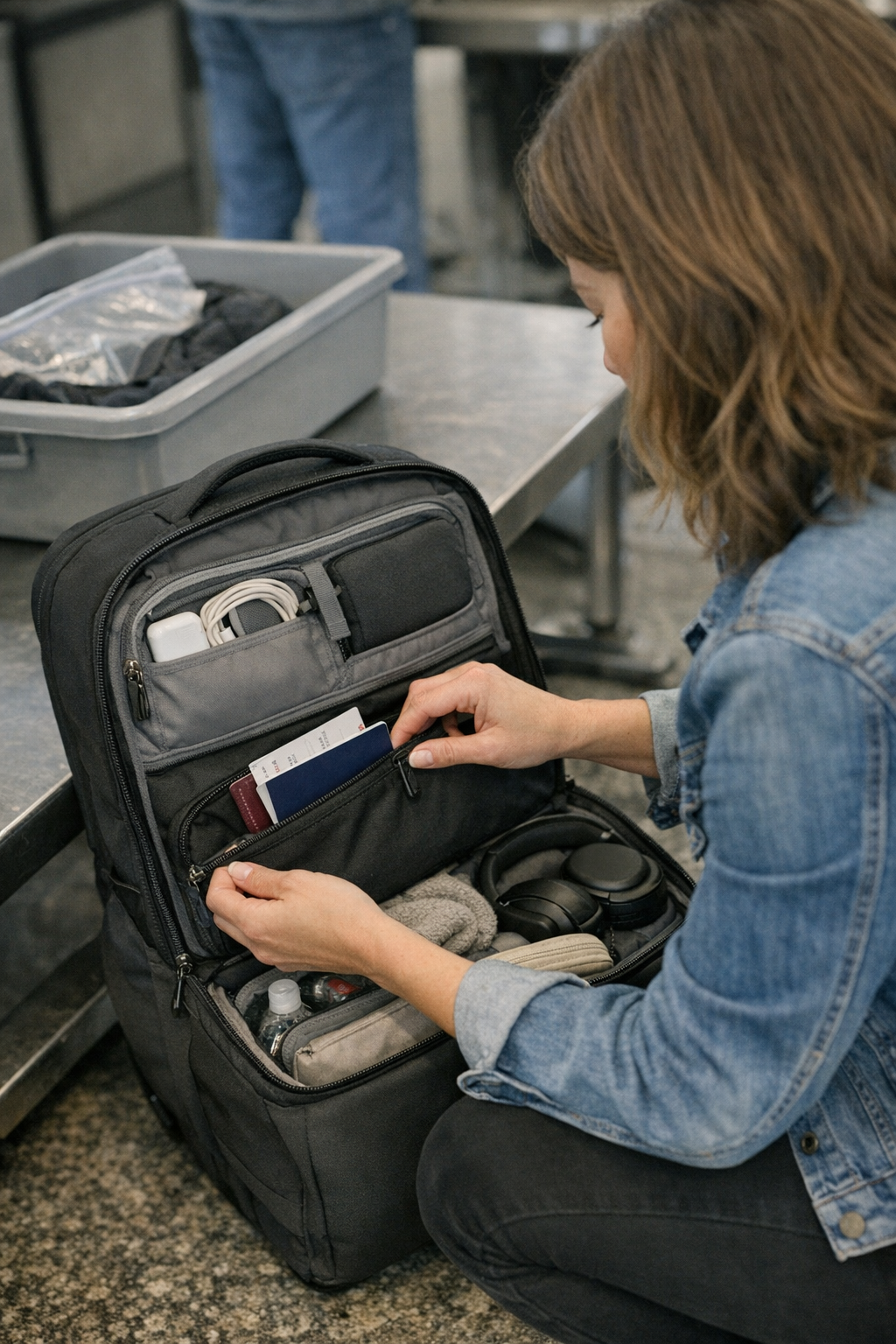
    No matter how perfectly organized your carry-on looks at home, real airport movement exposes its weak points fast. The difference shows up immediately: you hit security, and that easy-access pouch now means contorted reach with someone waiting behind you. Boarding, your boarding pass hides an extra layer deep. Jostling through the gate, your “sorted” organizers stall you by a few seconds at every check. The frustration isn’t theoretical—it’s the drag you feel when a bag designed for order quietly blocks you in motion, forcing slow retrieval, awkward reach, and stop-and-start repacking at exactly the wrong moments. The picture-perfect setup suddenly becomes a series of micro-interruptions that only get louder as airport pressure builds. This is where so many carry-on routines break under repeat friction—just when you need the smooth flow you thought you’d packed for.

    Why Order Breaks Down in Repeated Travel Routines

    Pouches and slots give a sense of control in the calm of a bedroom or hotel, but the airport turns that order inside out. First pass: your passport is easy enough to extract. But after a flight or two, with the rhythm of unzipping, quick-stowing, and stacking organizers, you notice it slipping—literally—deeper into the pouch, or winding up behind something you just repacked. Grab the wrong slot, and you’re suddenly fumbling in line, one hand on the bag, the other searching for a document while agents nudge you forward.

    This isn’t an isolated hassle. With each leg, friction builds: zippers catch at the wrong angle, pouches slide so neatly past each other you pull out two by mistake, a boarding pass is one layer down from where it should be. The inner order survives in appearance only. Your setup—which made sense in stillness—now undermines you in speed, each access step requiring just enough extra motion or thought to break your flow when you should be moving forward.

    Static Structure vs. Moving Access

    Most packing advice obsesses over keeping every item slotted and lined up for visual peace. But transit isn’t calm or controlled. Nested pouches, aggressively sorted compartments, or double-zipped organizers look sharp until you’re balancing in a queue, one arm on a tray, eyes tracking the next checkpoint. Suddenly each choice—Which pouch? Which zipper?—becomes costly: more seconds lost, more chance of dropping something, more internal voice saying, “this should be faster.” The static idea of order clashes with the real movement pattern of airport life, where a setup that’s tidy at rest creates friction in use.

    The Hidden Cost of “Perfect” Organization

    A carry-on bag that appears organized tricks you into thinking the problem is solved—until actual pressure moments reveal the cost:

    • Security trays: You need your laptop, but a trio of tech pouches require a mini unpack, increasing your odds of missing a cable or rushing the repack with items out of sequence.
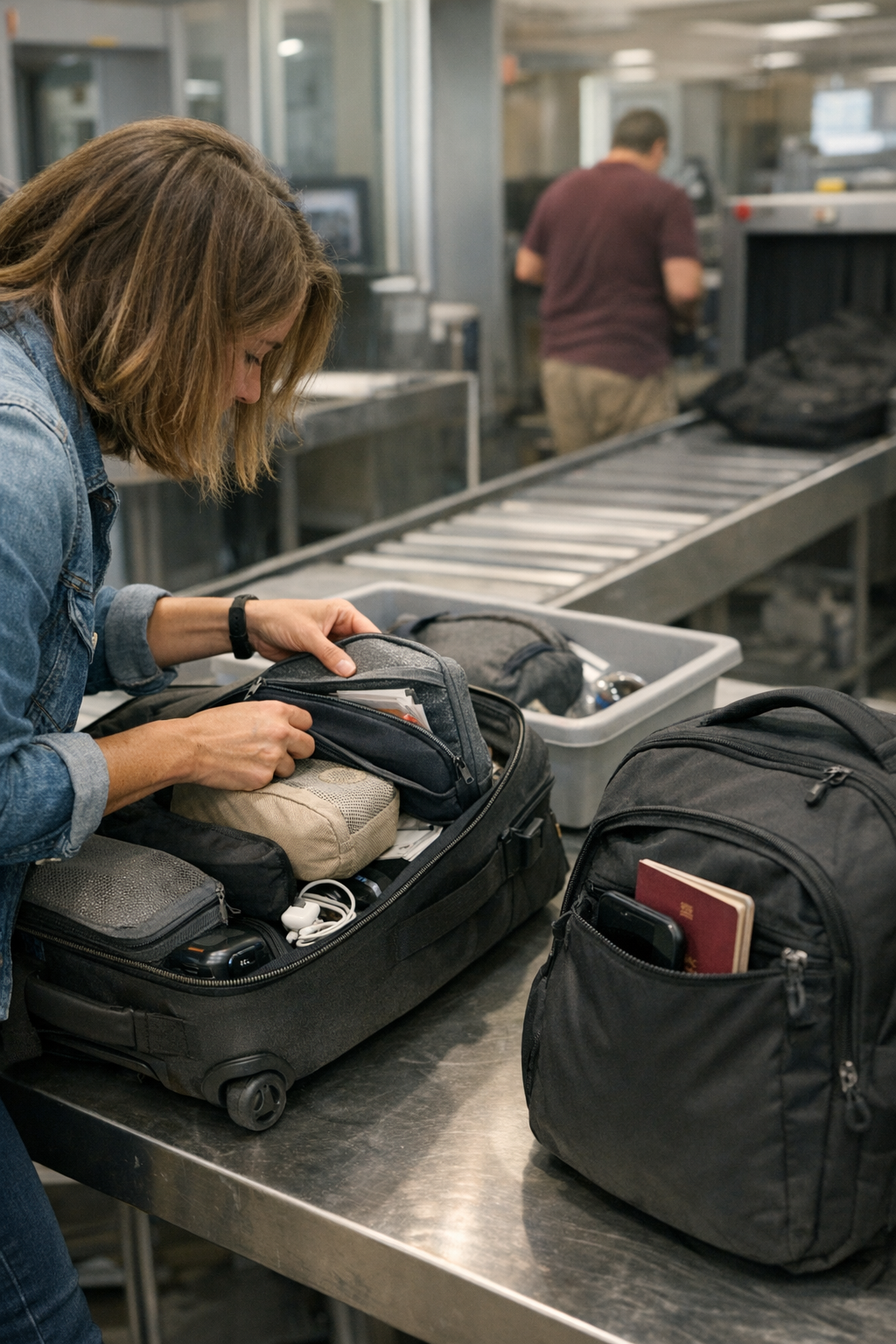
    • Boarding lines: The “sorted” document pouch lives deep in the main compartment, so getting at your passport means a slow zip, dig, and reshuffle as the line inches. After the third check-in, this small lag begins to wear.
    • Overhead bins and aisle entry: Anything marked “quick-grab” but living under more layers turns every retrieval into a multi-step pause—either you hold up the aisle or you’ll need to reopen the bin mid-flight.
    • Repeated access mid-trip: Each time you return headphones or documents to “their place” under movement, the odds of a misplaced item grow. That order you rely on now creates confusion the next time you need something in a hurry.

    Pressure escalates: what looked like a well-designed system in a quiet room turns into a series of tiny, repeated hurdles every time travel gets less predictable and hands get busier.

    Real Moments Where Friction Shows Up

    Airport conditions punish tidy but impractical layouts:

    • Standing in security, you reach for your passport only to find the outer compartment stuffed with too many “quick access” pouches. Main compartment unzip: wrists collide, delays begin, and the line behind you grows.
    • Post-security, gate info changes—your phone is buried under a toiletry kit, thanks to nesting everything to stay “organized.” What felt clever now feels like unpacking on the floor to answer a simple text.
    • At boarding, your ticket takes longer to extract because it drifted under a loose pouch during the last hurried repack. Instead of a swift reveal, it’s a fumble at the plane door.

    No one of these moments feels disastrous, but together they erode your confidence in your setup—especially as crowds increase the cost of every hesitation. The minutes add up, along with the tension of knowing your layout keeps slowing you down instead of smoothing things over.

    The Difference Between Looking Packed and Moving Smoothly

    There’s a gap between a bag that passes the “photo test” at home and one that handles actual airport chaos. You almost never have a clean surface, both hands available, and zero distractions in transit. Instead, the real world is trays in one arm, an impatient line, a narrow aisle, or a carry-on pressed between your hip and a trolley. “A place for everything” isn’t enough if every retrieval becomes a drawn-out motion, or if putting something back means disrupting two other compartments. What works for stillness fails in motion—real usefulness depends on setups that survive actual use, not ideal rest.

    How Small Tweaks Shift the Entire Carry-On Experience

    After too many cramped pouch dig-outs, I stopped sorting for neatness and started packing for speed. One trip in, I stripped it back: primary documents and phone in a single, uncluttered outer zip. No stacking, no sub-pouches, just what I touch at every checkpoint. Every time I needed to show ID at security or hand over a ticket, there was no second-guessing or layered retrieval—the motion was straight, quick, and uninterrupted.

    The less space I gave to less-used items in that zone, the fewer interruptions at each access point: no more passport behind a power bank by accident, no scrambled zipper pulls, no repacking confusion. The seconds I saved returned as less stress, especially mid-transfer or when fighting for overhead space. The difference is visible not in how the bag looks, but in how little thought or repositioning it demands every time a gate agent checks my documents or I need to plug in headphones before takeoff.

    Observation: Not All “Quick Access” Zones Are Equal

    Packing guides talk up “outer pockets,” but it’s what lives there that counts. If you let that zip fill with chargers, receipts, sanitizer, and old mask wrappers, you’re back to multi-stage retrieval in disguise. The trick: protect your outer zip for the passport, boarding pass, and one or two other highest-frequency items—nothing else. Every extra object reintroduces friction. Fewer mixed uses mean smoother movement, and far less fumble to fix after every access.

    Balancing Visual Order With True Movement Ease

    It’s almost automatic to respond to travel friction with more organizers, more slots, or the promise of “perfect” order. But that logic breaks in motion: every extra segment adds a moment of retrieval drag, a small repacking stumble, or another pause at the wrong time. Instead, chase setups that sometimes look less composed but move with you—ones that trade a bit of visual neatness for true in-transit freedom. Travel exposes structure; only the setups that work while moving are worth copying, especially when seconds and hands are at a premium.

    Find practical carry-on tools designed for real access at CarryOnSupply.

  • How Organized Pet Travel Bags Reduce Friction on Every Stop

    A pet-travel bag that looks organized in the driveway often collapses into chaos by the second or third real stop. The first time you reach for wipes or treats, everything is where you placed it. But once the bag hits the daily loop—seat to sidewalk, drive to curb, repeat—preparation starts losing to awkward overlap, tangled essentials, and that creeping sense of not knowing where anything actually is. Anyone who’s rushed to grab cleanup supplies while a leash knots around their arm or who has dug past their own keys to find a snack for a restless dog at stop four knows: “packed” doesn’t always mean “ready.” The real test of your setup isn’t at launch—it’s how it resets after your third interruption, your fifth reach, your seventh little mess.

    Prepared—but Only Until Real Movement Begins

    Carry a pet bag that seems sorted—carrier in one hand, wipes tucked, treats zipped away—and it lasts until real-world repetition hits. One smooth grab for a leash is all it takes to begin unraveling that early neatness. By midday, wipes are twisted in leash clips, your keys have joined the treat packet, and what started as compartmentalized dissolves into a muddle that blocks every quick seat-side reach. Each stop multiplies small setbacks, turning basic transitions—exit, re-load, next errand—into hesitation and scramble.

    What looks tidy isn’t always built for continual movement. A bag that shines in a pre-trip checklist rarely holds up to seat-side use, especially once your stops run back-to-back.

    The Hidden Cost of “All-in-One” Packing

    Most pet-travel bags capture buyers with a deep center space and a few loose pockets. But movement throws everything off balance. Bowls crowd comfort blankets, wipes vanish under hardware, and treat pouches run loose. With each ride, you lose a little more structure. By the third or fourth stop, every grab is a guess—one extra reach here, a handful of items shoved aside there, wipes suddenly buried just when you spot a puddle on the sidewalk. It’s rarely a meltdown, just a low-level scavenger hunt that slows down every pet-handling reset.

    This friction isn’t dramatic, but it sticks: sliding a harness aside again, nudging a comfort toy out of your reach, or fumbling for owner items under dog gear. The afternoon’s errands start to drag. It’s not about disaster, but about the slow drag in every repeated motion—a bag that looks like it could save you time actually steals it, stop after stop.

    Overlap: The Repeated Weak Point

    The hidden flaw isn’t a messy bag; it’s the silent overlap at critical access points. Put wipes and comfort toys together just once and you’ll chase both at every stop. Share space between pet and owner items and keys migrate to the wrong corner. Those overlaps create jams—not just in big moments, but in every reach when you want a quick cleanup, a leash swap, or a treat for a bored dog at the curb. Packing “together” guarantees distraction and delay, multiplying interruptions the longer your trip lasts.

    Real-World Scenes: When Repeated Use Exposes Every Flaw

    • Stop one: The leash is exactly where you stashed it. You’re in control, for now.
    • Stop two: Wipes, now twined around your water bottle, make one-handed cleanup clumsy. Your keys drop into the wrong pocket chasing a snack.
    • By stop four: Comfort toys have slipped under owner gear. The treats have drifted—soothing your restless pet means emptying half the bag just to dig them out. Momentum stalls at every access point; you shuffle, reshuffle, and reset on the fly.

    The issue isn’t a single mix-up, but the feedback loop—each lost second on cleanup or comfort starts compounding, making every restart less smooth. Overlap and slide turn a bag that looked “prepared” into a fumble zone, especially when every reach is a fresh interruption and new friction stacks onto the last one.

    Dividing by Function: Where Real Travel Improvement Happens

    Organizing by checklist fails under pressure. The breakthrough? Separate what you use, not just what you own. Dividing by real travel moments means:

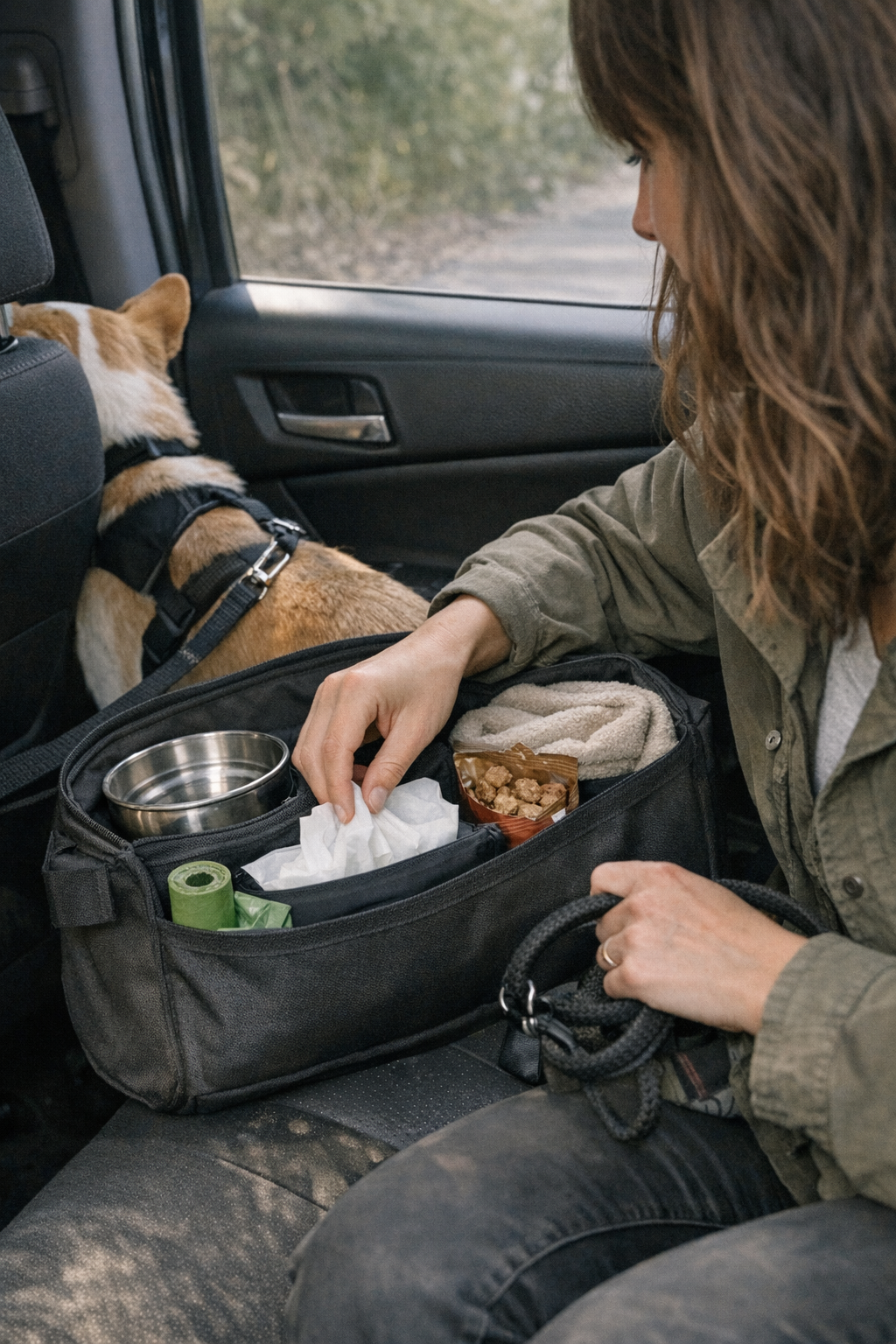
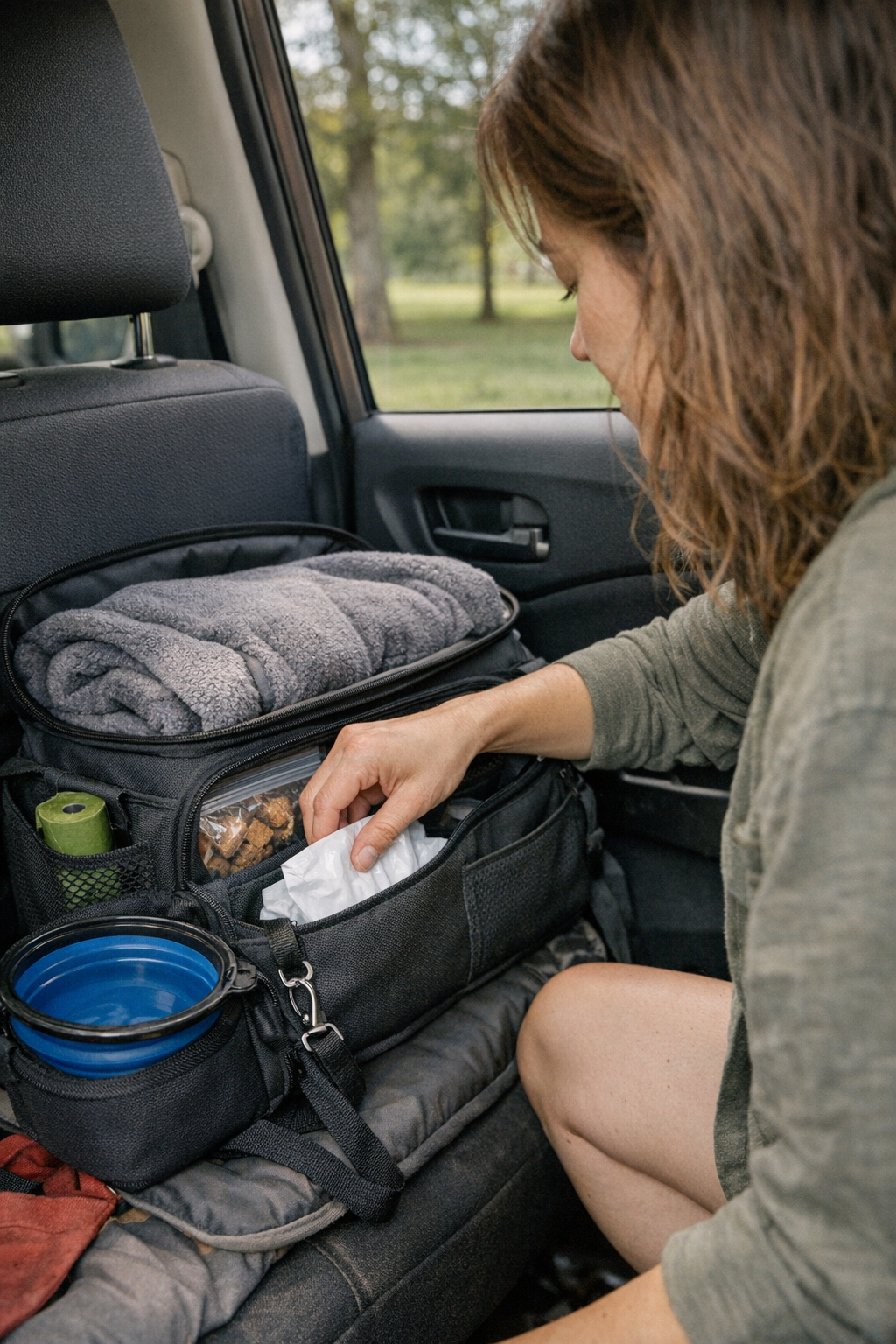
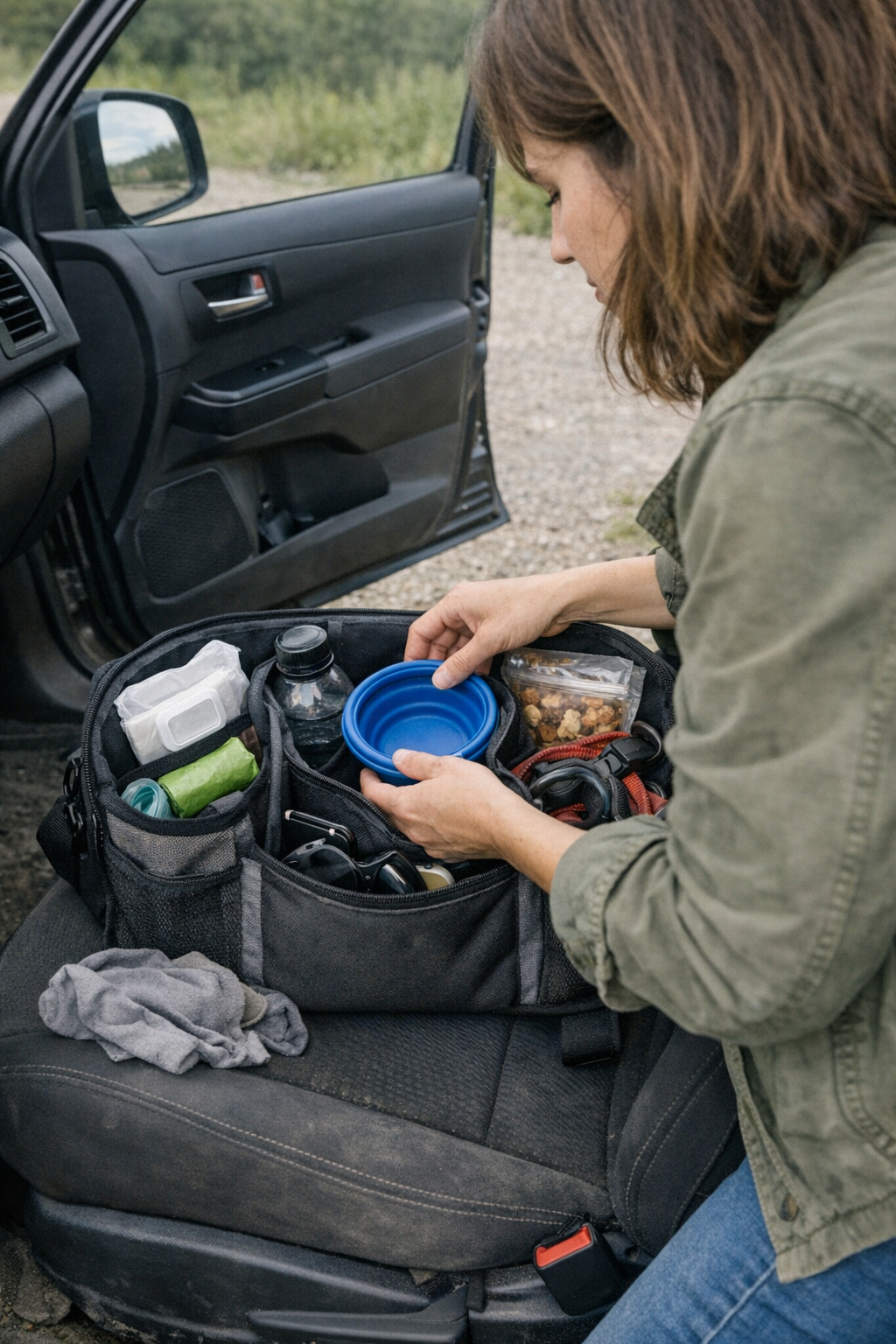
    • Cleanup: Wipes and waste bags each in a side pocket, always ready at the car door—never competing with bowls or leashes.
    • Comfort, hydration, and treats: Grouped together, not buried or floating next to your wallet or phone. Water bowls stop sliding, chew toys are held in place and remain accessible.
    • Owner essentials: Wallet, phone, keys—isolated, never stranded under pet supplies. No more accidental pet hair stuck to your money or delays with your hands full and no key in sight.

    On paper, it’s a minor change. In practice, it works: each item’s job fits its pocket, every stop gets easier. The bag resets after each use, not against you but with you. Your most-used travel essentials sit at the edge, not buried. Cleanups happen on time. No more hunt-for-treats while your dog pulls at the leash or wipes lost the moment you actually need them. The tempo of pet travel—quick stops, seat returns, leash transitions—finally flows with less interruption.

    Repeated Reach, Real Relief

    The payoff isn’t some magical “never messy again” promise. It’s small, real advantages: fewer repeated grabs to get essentials, less time spent digging for wipes at curbside, steadier handoffs between errands. The pet stays calmer. Restarting the trip feels less like hitting reset on a puzzle and more like picking up exactly where you left off. Structure, not just storage, lifts the friction out of daily movement rhythms—and you notice the difference with every reach that just… works.

    Recognizing the Difference: Looking Organized Vs. Moving Smoothly

    Initial neatness fools almost everyone. The difference between a “showroom-ready” pet-travel setup and one that survives a busy afternoon boils down to this: does it keep friction away after your fifth repetitive seat-side stop? The real value of a bag shows up in how little it interrupts the flow, not just in tidy packing layers. Visual order is great for a single photo—but only a structure built for repeated movement lets you make stops, quick pivots, and cleanup without dragging out every restart.

    Packing for pet travel isn’t about assembling a perfect-looking kit. It’s about a setup that resists mess, spillover, and overlap—even after repeated reaches, pit stops, and in-motion resets. If you’re tired of a bag that gets heavier, messier, or slower with each use, it’s time to rethink what “prepared” actually means. Sometimes, what you need isn’t more gear—but a better structure behind every stop.

    Visit PawGoTravel for practical, real-world pet travel solutions: http://www.pawgotravel.myshopify.com

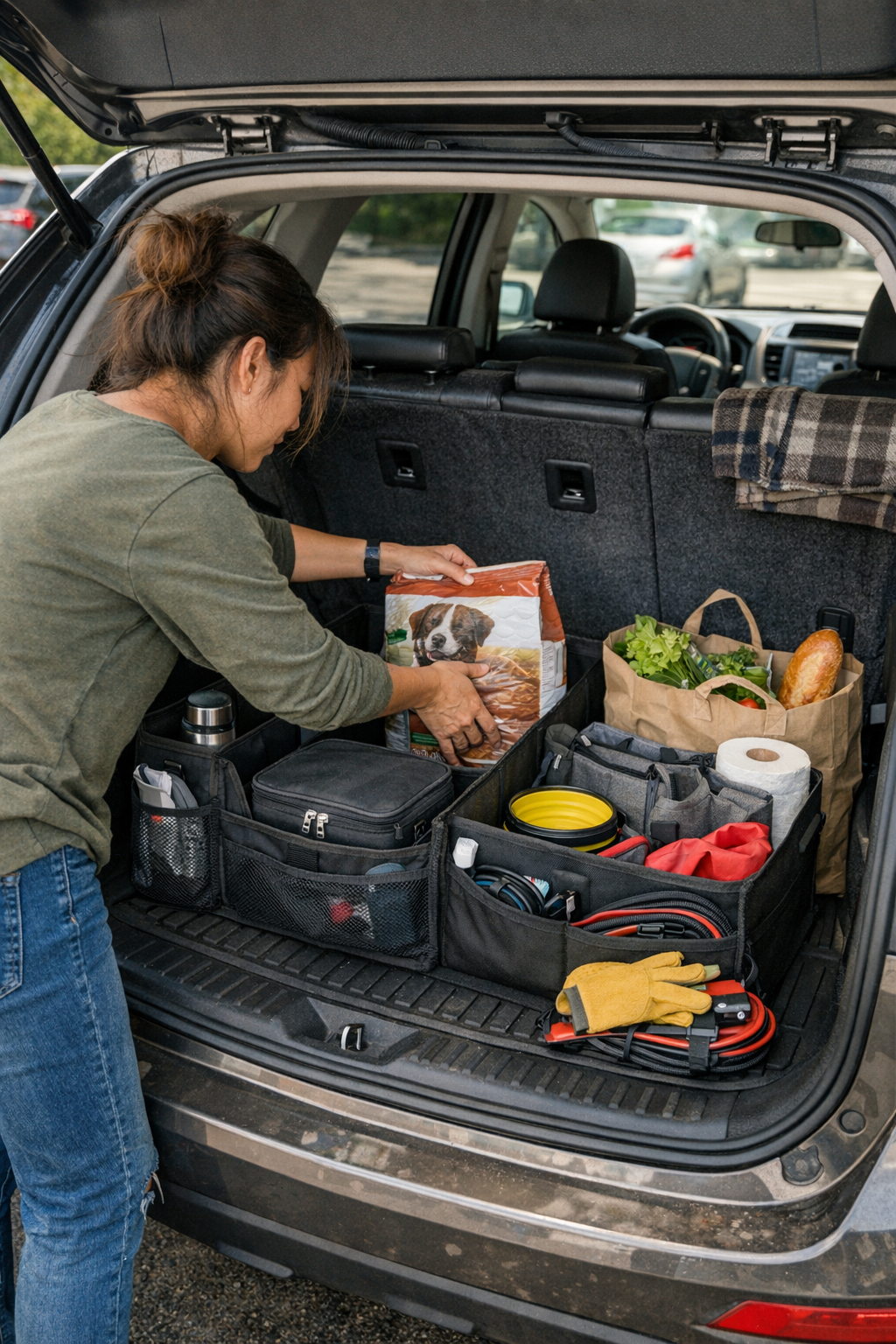
  • How Flexible Trunk Organizers Transform Everyday Car Storage Challenges

    Open your trunk after a week of driving, and you’ll see what actually holds up—not in the first tidy glance, but in the repeated returns for one charger, a stray bag, or the umbrella that’s always moved. Every “organized” setup looks fine on Sunday. By Thursday, bags topple, wires tangle under the next bag in line, and reaching for what you need means digging or shifting something in your way. In real use, the cracks show fast: a neat trunk can quickly become a slow obstacle course the more you move, shop, load, or clean. And that’s where the right organizer—flexible, not just pretty—starts to matter in the DriveWellSupply world.

    Why “Clean Once” Organization Can Leave You Stuck

    What makes a trunk setup fail isn’t chaos—it’s the slow drain of speed and sanity from routines that don’t fit the container. A simple bin or net is fine after a single reset. But after two grocery runs, one late return, and a random pet food stop, those “efficiencies” quietly unravel:

    • Grocery bags and boxes drift, rolling cans find their path under seats.
    • Emergency kits end up buried under this week’s new haul.
    • Chargers and cords slip beneath piles, forcing a trunk dig just to charge your phone.
    • Protective liners bunch near the latch, catching on keys or shoes every time you grab a bag in a rush.

    Every short trip adds friction. Loading and unloading stretch out. Cleaning becomes a process, not a quick sweep. The worst part isn’t making do with a messy trunk—it’s when “organized” makes things slower, not faster. A charger lost beneath a heavy bag, a spill demanding relocation of half your cargo: that’s when most drivers realize their setup isn’t keeping up.

    How Flexible Trunk Setups Survive Real-Life Chaos

    Rigid organizers trap gear in a shape that rarely matches your week. After setup, everything feels settled. But the moment your plans swerve—a big return, a heavy sports bag, grocery overload—those fixed bins resist real change.

    Rigid Systems: Stable for a Day, Frustrating All Week

    Take one typical week: you pick up bulk pet food, drop off a large return, and bring home everyday groceries. The hard bin or fixed side organizer can’t stretch:

    • Oversized cargo wedges in, stressing seams or sliding at turns.
    • Every new item shoves “essentials” closer to the back wall—precisely where you hope you never have to reach in a rainstorm.
    • Lighter things slide below, poking out at corners or gathering by the wheel well.
    • That “organized” emergency kit? Pinned under a box you can barely move without leaning all the way in.

    Suddenly, fast access takes two steps. Each re-entry means delay—sometimes just a second, sometimes a full repack.

    Flexible Organizers: Adapting Instead of Interrupting

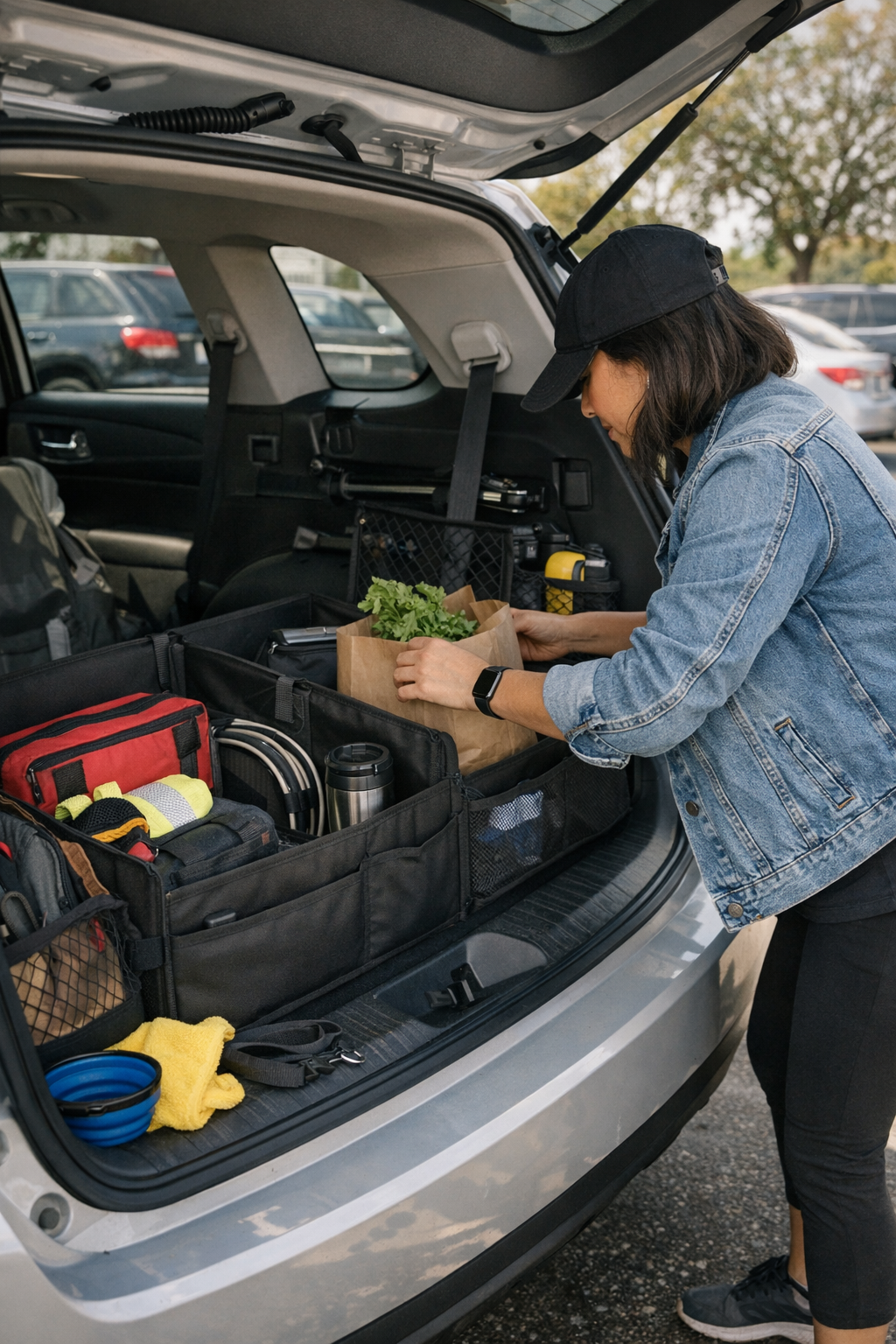
    This is why setups that flex—Velcro panels, shifting pockets, quick-move dividers—quietly outperform rigid gear in the real world. They aren’t about decoration. They’re about moving panels aside for a grocery hauler, slotting chargers up front for morning commutes, and stretching a liner into a catch zone for the messy spill you never planned on:

    • Movable dividers clear section space for whatever enters the trunk—big or small.
    • Stretch pockets keep keys, cables, and emergency gear findable in seconds, not minutes.
    • Adjust-and-stick panels slide with routine changes, so you never have to empty the trunk just to stash a sports bag or grab a charger.

    The difference becomes visible by the end of each week: fast unloading, less shuffling, and gear that’s still in sight. Sudden stops don’t scatter cans. No more grocery bags pressed sideways under a leaking bottle. The setup proves itself not by staying perfect—but by getting less chaotic, even on unpredictable days.

    What Repeated Use Really Looks Like: Mess, Cleanup, and Speed

    Real car use breaks any setup that only survives single days. Routines bend: quick errands turn long, new bags hide old tools, and every after-parking re-entry tests accessibility in ways a perfect photo never shows.

    • One quick trip turns into two, so bags stack up in the “good” grab zone.
    • That umbrella or charger you placed in reach now sits under two new bundles, exactly out of reach.
    • Cleanup stretches longer, as every protective cover also needs adjustment, shifting, or re-smoothing after normal loading and unloading.

    When trunk organizers can’t flex, these minor moments add up. Bags slide. Must-grab items retreat. Simple cleaning means moving and replacing half your setup. Even floor liners—meant to help—can bunch or shift, forcing you to wiggle things just to get a clean exit.

    Real Fixes That Change the Everyday Flow

    Switching to a segmented, adjustable organizer with Velcro panels is less about looks and more about stopping the friction points you notice most. The true shift comes when a single push lets you collapse space for unpredictable cargo, pockets swing to hold your always-missing charger, and a side panel finally blocks items from drifting without trapping your fast-access gear.

    Over a month, what stands out isn’t a picture-perfect trunk—it’s realizing you’re not shuffling, reaching, or re-cleaning after normal days. Groceries stay put. First-aid kits stay visible. And speed returns, because unloading one thing doesn’t mean touching every other item “just in case.” Not a revolution; simply a trunk that catches up to your real routine, not just the ideal one.

    Should Everyone Use a Flexible Organizer?

    Not everyone needs flexibility. If you only haul boxes that never shift, a rigid bin serves you well. But if your week splits between errands, shopping, work bags, and family gear, a flexible structure isn’t extra—it’s basic. The gain isn’t in more pockets or maximum compartments; it’s in letting your gear and reach points adjust as life does, without adding new slowdowns or requiring constant resets.

    Signs Your Trunk Setup Isn’t Matching Real Use

    • You’re digging for a charger or kit that was “perfectly placed” yesterday.
    • Loose items creep into the same corner after ordinary driving, no matter how neatly you started.
    • Loading, unloading, or cleanup now takes longer, even though the clutter looks tamed.
    • A recurring spot—near the back seat, by the latch—always catches something, blocking you after every park-and-grab.

    If these sound familiar, your trunk’s structure isn’t adapting—it’s just hiding slowdowns under a neater look.

    Staying Organized Isn’t an Event—It’s a Routine

    The real win isn’t a spotless trunk for show, but a setup that makes everyday parking, loading, and cleaning less of an obstacle course. Fewer slowdowns, faster access, and shrinking cleanups; that’s when you know your organizer is working with your routine, not just sitting pretty for a single tidy day. In the end, the best car organization holds up to constant use—so your next week feels less like starting over, and more like picking up right where you left off.

    Visit DriveWellSupply for practical trunk and cargo solutions built for real car routines.

  • Why Carry-On Organization Should Prioritize Quick Access Over Perfect Order

    The real airport test isn’t how neat your bag looks at home—it’s how fast you can pull a passport when the line behind you starts shifting. You close your carry-on in your living room, everything perfectly sectioned into pouches and zipped away, but that control dissolves the first time a gate agent asks for your ID and you’re bent, awkward, peeling back layers you packed just an hour ago. Travel friction isn’t the mess you see; it’s the seconds lost fumbling with order that only holds up when you’re standing still. That’s the core challenge: the tidy structure that made you feel ready at home becomes a liability as soon as you need fast, single-motion access—exactly when every other traveler on your route is crowding closer, watching you unpack and repack what you thought was “organized.” CarryOnSupply lives at that intersection: where something looks under control, but the real difference is how smoothly it works when you actually have to move, retrieve, and reset, again and again, in real airport time.

    Order Isn’t Access: When Tidy Packing Becomes a Trap

    The zipped pouches, wrapped cables, and stacked organizers promise order—but every layer adds a step between you and what you actually need in motion. That “everything has its place” system breaks down with your second retrieval: you open the main compartment, unzip a small pouch, and still have to fish past other organizers to get your charger. Meanwhile, you’re blocking half the security tray, and what looked streamlined this morning now feels like a slow-motion rerun of the same struggle, repack after repack.

    The friction isn’t random: Travel isn’t about losing items, it’s about repeated friction points stacking up—dragging over zippers, pulling pouches, making each retrieval feel slower and more public the more you repeat it. Grab your boarding pass at security, ID at the gate, headphones at the next layover—every motion exposes how “packed right” gives way to “packed away.”

    Multiplying Slowdowns: Stacked Calm Turns into Sequential Delay

    If your setup depends on everything staying in its precise spot, small problems multiply. Three-layer pouch logic means every urgent document check forces a main-compartment unzip and pit-stop repack, no matter how short the line. When pressure builds—like at a fast-moving security line or busy terminal checkpoint—the difference between visual calm and access fatigue isn’t theory. You only need to dig for a buried cable or a wayward passport once for the tension to spike: you’re either holding up the queue or sacrificing order for speed, every time you reach in and don’t immediately come out with what you need.

    Security Trays: Where Setup Weakness Shows Fast

    Think of the tray transfer: your laptop is up top, but your ID just got nudged below another pouch. Suddenly, “main compartment tidy” means your essentials are deeply nested, and every extra retrieval adds up—items shift, organizers bunch, and your bag’s control system works against you instead of with you. Everyone behind you can feel it: you repack hastily or, worse, shove everything in and lose the structure altogether for the rest of the trip segment.

    Main Compartment vs. Outer Pocket: The Practical Shift

    The biggest upgrade is often the simplest one: a wide, interruption-free outer zip pocket at arm’s reach. Shifting the critical items—passport, ID, charging cable, small tech—from main compartment to an edge position means you’re no longer undoing layers just to survive an ordinary checkpoint. From above, it might look more “in use” than “on display”—but that’s honest: three retrievals in thirty minutes shows you which design is slowing you down and which is letting you keep pace, especially when the line moves or a sudden call for documents drops in mid-queue.

    What matters isn’t how “clean” your packing looks after the first leg; it’s how quickly you can move without breaking your system. A dedicated outer pocket makes routine retrieval—boarding pass, ID, headphones—a two-second motion, not a production. Those small time savings stack up, especially when you’re boarding, transferring, or sidestepping in a crowded terminal with only one free hand. On a second or third trip, you don’t just remember the convenience—you rely on it, and you stop dreading every required check.

    Hidden Friction Reveals Itself Over Every Segment

    Every airport checkpoint is another chance for perfectly arranged packing to become a nuisance. Each retrieval—passport, charger, headphones—is a repeat test. A pouch system with too many nested layers promises security but delivers inefficiency. The illusion of order fades as soon as your bag has to move repeatedly, or when you’re forced to expose and rearrange three sections just for a single document. The longer the trip, the more this friction becomes obvious; every time you have to pull or re-layer, you’re burning time, focus, and patience. What looked “secure” on the rug becomes pure drag when you’re called to show a boarding pass with one hand while the other holds your coffee or flight snack.

    Boarding, Seat Entry, and Micro-Delays That Stack Up

    See the usual failure point: You’re in the boarding line, bag on your shoulder, cup in hand, and the gate agent calls for boarding passes right now. Your main compartment is zipped, your order intact—until you have to slide the whole bag off, unzip, sift past two organizers, and pull what you need from inside. You either hold up the line for an awkward second or do a sloppy grab-and-stash, immediately disrupting the organization you spent time building. Meanwhile, the traveler beside you, with passport and pass in a slip pocket, just steps forward—no pause, no reshuffling. Revisiting this problem on short, crowded flights is where the gap between “visually organized” and “actually usable in motion” widens with every segment and every micro-delay.

    Making Carry-On Structure Match Real-World Movement

    Moving must-grab items—documents, phone, headphones—from deep layers into a clean, always-accessible outer pocket isn’t just a cosmetic change; it fundamentally shifts how often your bag structure fails or holds up. A wide, side-panel zip; a shallow tech zone; a direct-slip passport pocket: these design choices mean you can retrieve what matters most in seconds, even after multiple uses. The main compartment stays almost untouched, your system doesn’t collapse after five retrievals, and on your fourth gate of the day you’re not rebuilding from scratch.

    Main-portion order survives, while outer pocket activity absorbs the friction of repeated access. After five flights or thirty retrievals, the setup that trades a bit of “packing symmetry” for ongoing function consistently comes out ahead—not just in time saved, but in the energy you don’t spend managing your carry-on’s order between segments, lines, and unexpected delays.

    Will Your Setup Survive Real Travel? The Fifth-Trip Test

    Packing “for looks” and packing for repetition will produce completely different outcomes by trip number five. True, it’s satisfying to stack pouches and wrap every cord, but those setups struggle the most when quick access is forced under pressure. Over time, even one slow document retrieval or poorly placed slip pocket can make you question the whole system. The best test isn’t the first journey, but the one where you’ve run your bag through thirty segmented uses, ten repacks, and several moments where order needed to be rebuilt—not just preserved. The structure you trust is the one that stays low-friction, usable, and intuitive move after move, even as conditions change and patience thins. If your carry-on makes those retrievals disappear into routine, not friction, then it’s doing the real work—not just looking organized on your bedroom floor, but performing in every travel moment that counts.

    Find practical carry-on solutions at CarryOnSupply.

  • Simplify Your Pet Travel Setup for Faster, Stress-Free Trips

    Why “Organized” Pet-Travel Bags Slow You Down When It Matters

    The promise of an organized pet-travel bag fades the instant you hit real-world chaos. You grab your kit, confident it’s all set—treats, wipes, waste bags, even a comfort blanket. But the moment your dog lunges at the leash near traffic or you’re juggling keys in a busy lot, that sense of order cracks. Instead of quick access, you’re fighting through overlapping pockets, shifting pouches, and blocked zippers—trying to find one wipe while your dog twists and the car door lets in cold air. Preparedness turns messy, not because you packed wrong, but because your bag’s very structure works against you in motion. This isn’t an occasional hiccup; it’s a repeat friction anyone who travels with pets recognizes, especially once stops and movement start stacking up. PawGoTravel exists for pet owners who have outgrown setups that only look neat at home.

    When Extra Features Turn Into Everyday Friction

    Adding more compartments, pouches, and clever pockets seems smart until you’re on your third roadside break and realize you’re always opening the wrong section first. Treats now wedge under a folded mat; the leash knots in a layered pocket; wipes fall behind a travel bowl. Each “just in case” section costs you time just when patience runs thin—yours and your dog’s. What felt organized in your living room actually slows down every grab-and-go during travel. Real problems start small: one extra zipper, one pouch too deep, and you’re left shifting aside comfort items just to reach the cleanup gear you actually need. In stressful moments—muddy paws, sticky accidents, anxious dogs waiting with clipped leashes—over-organization becomes its own obstacle.

    Gradually, you feel it: every minute spent fishing for a wipe or digging out waste bags is a minute your pet grows restless and your car seat grows messier. Your repeated stop-and-go rhythm now comes attached to repeated bag reshuffling, turning short pauses into preventable headaches.

    Over-Organization’s Real Cost: Lost Seconds, Visible Stress

    Pet travel isn’t built around perfect conditions. You face messy weather, a restless pet, a rushed snack, or an awkward refueling stop. Need a wipe? It’s slipped beneath the treats again. Waste bags? Buried under something you didn’t use last time. These blocked moments don’t just slow you—they break your travel flow, multiplying stress both for you and your pets.

    You don’t notice the real problem at home when you’re calm and everything’s in its place. It becomes obvious the third time you fumble for a leash clip with a squirming dog and realize the only way to get to it involves unzipping, shifting, or unpacking other things first. The “prepared” kit turns into a seat-side scramble, every time.

    Cleanup Isn’t Optional—and Organization Can Get In the Way

    Most cleanup moments leave you zero time for fumbling. Muddy paws, quick accidents, leftover food stuck to fur—these demand instant wipes and bags right where your hand goes first, not nested under another pouch or zipped behind something else. Every extra motion means muddy pawprints climb further into your seat, or a restless pet grows harder to control. The wrong bag layout leaves you managing pouches and mess with traffic moving, doors open, and stress rising.

    Direct Access: The Real-World Advantage

    A setup that looks streamlined on your home bench often buckles under the pressure of repeated movement. The real test? Can you grab your wipes or bags in one motion, without shifting other items aside? Direct-access setups—single-layer pockets, open at the seat edge, facing out every time—cut down delay to nearly zero. No double-zipper interference. No detour through a treat bag to reach the essentials. You go from “where did it go?” to “done” in one grab, even as your dog tugs and your hands are cold or full.

    This is the difference: neatness that means nothing in repeated real use versus a bag whose structure actually keeps up when you can’t slow down. If you’ve ever restuffed and reorganized the same bag twice in an hour, you know exactly how much smoother direct access feels.

    Ordinary Stops—Consistent Weak Links

    Most pet-travel stress isn’t about rare emergencies. It’s quick stops—stretching legs at a gas station, a bathroom break, a roadside snack when the dog is restless. In these ordinary scenarios, layered organization becomes the silent tripwire. Bowls wedge beside treats. Wipes slip behind blankets. Even a “just in case” pouch becomes the section you dread opening. The friction is real and predictable: small delays, small messes, and the same minor reset after every use.

    Multiply these by three stops, five restarts, and a drive that’s already running long, and the frustration leaks into the rest of your trip. Each mishandled pocket isn’t just a moment lost—it’s a bit more fatigue, a bit less readiness for the next step.

    When Less Actually Means Faster and Calmer

    Once you remove the extra layers—nested pouches, triple zippers, pockets-within-pockets—you finally see the benefit of “just enough.” With the few essentials—wipes, bags, treats—lined up in a simple, open outer pocket, you reach what you need the first time. No shuffling. No blind search. Even with one hand managing a leash and a dog bouncing halfway into the front seat, your cleanup or reward takes seconds, not minutes.

    The result is hard to ignore: stops don’t lag, tension drops, repeated reshuffling disappears, and you don’t come home frustrated by the kit you thought would help. What remains are only the essentials you now trust, always where you need them, ready even on the messiest days. It’s the real difference between travel that looks organized—and travel that actually flows.

    See more practical pet-travel solutions at PawGoTravel

  • Why Rigid Car Organizers Fail During Busy Driving Days

    An organized car interior can look flawless at 8 a.m.—and feel unworkable by noon. The dash-mounted phone stays in place, cargo bins line the trunk, floor mats lock down, and everything seems ready for a streamlined day. But as soon as your routine launches—quick store runs, passenger shifts, urgent stops—the “right” setup keeps getting in your way. Compartments that promised order start resisting real use, cables catch on rigid dividers, and bags thrown into the trunk bounce off hard sides onto the floor. The friction isn’t immediate; it creeps in as small interruptions: cables forced across gearshifts, blocked chargers, loose items sliding, and hard plastic mats digging at your heels after every entry. Suddenly, every trip back to the car highlights what looks organized but functions like a series of small blockades.

    When “Organized” Turns Into Everyday Obstacles

    Maybe you installed a secure phone mount, invested in a heavy-duty trunk organizer, and installed fitted floor mats expecting a mess-free ride. On paper, it’s the ideal build. By midday—after errands, school runs, and a caffeine break—each feature starts to bite back.

    Repeated re-entry exposes the flaws: The phone mount straddles your only usable charging port, forcing an awkward cable stretch every time. The trunk organizer is so rigid that bulky grocery bags get stranded on the back seat, sliding off at every turn. “Tidy” becomes the problem, with you improvising around your own setup just to make the day work.

    The Downside of Too Much Structure

    The main trouble with rigid car gear isn’t the single tangled cord or a wayward cup. It’s the drag of repeating the same small workaround—again and again—whenever your driving day goes off-script. These issues don’t stand out during a static inspection. They accumulate when you’re:

    • Jamming an extra grocery bag into a trunk bin that refuses to flex
    • Searching for your charger, only to find a solid phone mount pushing the cable out of reach
    • Catching your shoe on that mat edge every single time you sit down
    • Scrambling for somewhere to stow a snack wrapper but finding only blocked slots and tight pockets

    “Organized” becomes a set of small barricades. You lose time and energy not because of real mess, but because the setup keeps demanding new tricks just so you can use your own car smoothly.

    Busy Days Demand Gear That Bends, Not Blocks

    On a calm day, rigid organizers and fixed mounts seem fine. As soon as life speeds up—more errands, passengers, or unpredictable loads—their limits start stacking up:

    • No flexible space for an odd-sized package or a squishy gym bag—just hard constraints
    • Charging setup locked to one device, so anything else forces cable gymnastics
    • Clean-up after each quick stop means unpacking and repacking bins, not simply tucking items in as you go

    Suddenly, you’re juggling gear with one hand, fighting brackets with the other, and wishing your “solved” storage would just let you drive. The difference is stark when a rigid solution creates a last-second scramble—juggling coffee in the rain, or shifting a kid’s backpack because nothing gives.

    The Real Test: Return-to-Car Scenarios

    Every urgency—coffee in one hand, groceries in the other, or wrangling a dog plus toddler—makes the car’s true setup painfully obvious. The smallest inefficiency compounds under pressure:

    • Trunk bins won’t flex, so an unplanned stop means tossing bags on seats or risking a tip-over in the footwell
    • A phone mount perfectly placed for navigation now blocks your quick-grab charger every time you’re in a rush
    • Fixed dividers jam up the loading process, turning each return to the car into a forced reset

    These are the moments where “neat” becomes “slow”—or “in order” becomes “out of step.” You notice the cost with every stumble, reach, and item that won’t fit back in.

    Everyday Moment: The Never-Right Charging Cord

    Consider grabbing your phone to charge, only to snake the wire awkwardly around the gearshift because the mount’s position blocks a simple path. Or losing seconds detangling the cord after a bag has caught on it. By the third errand, this isn’t just wasted time—it’s repeated background irritation. These seconds remind you that a seemingly minor setup flaw doesn’t stay minor in routine use; it becomes the one friction you resent most.

    Pretty Setups That Drag Down the Routine

    Rigid organization looks calm until you attempt to live with it. Every added step, every forced re-arrangement, is a sign the system works against your real-world routines:

    • Tough cargo bins block trunk flexibility, so you risk loose loads— or leave things behind when space runs out
    • Seat covers bunch if bumped by bags, forcing quick fixes while passenger doors are open in the rain
    • Floor mats that trap more mess at the corners, turning simple cleanups into awkward puddle management

    These aren’t occasional annoyances. They’re the markers of a setup that looks in control but adds a daily drag to getting out the door and back in the seat.

    Flexible Gear: Adapt or Get Stuck

    The answer isn’t lowering standards—just bending them towards what you actually need. Adaptable gear cuts friction by keeping up with the day’s random turns:

    • Swap a rigid trunk tray for a collapsible organizer, and sudden extra bags squeeze in without you reloading the whole trunk
    • Seat-side soft pouches and Velcro adapters become instant drop zones for receipts or cords—no more jammed, overstuffed slots
    • Soft-secured charging cables stay where you reach, even if seats move or passengers swap devices

    It’s the contrast between daily resets and seamless continuity. Instead of forcing your gear and routine to square off, you let the car’s setup flex quietly in the background, so you can just drive.

    Small Switch, Noticeable Difference

    Personal switch: replacing a hard-edged trunk bin with a foldable organizer stopped the daily shuffle—no more unloading everything for a single awkward item. The sides compressed to fit groceries plus a thermos, with spare space for receipts and snacks that used to end up on the floor. Adding a Velcro loop for my charging cable killed the recurring “where’s the end?” search. The result? Every car return took fewer steps, and getting moving again lost the background strain of constant re-setups. The “small adjustment” wasn’t cosmetic—it unclogged the flow I use every single day.

    How to Spot a Car Setup That Actually Works

    What marks a truly practical car setup isn’t ornamental tidiness—it’s whether the system flexes with your day. Flexible organizers curve around awkward shapes instead of freezing you out. Soft cable holders nudge with you, not against you. Collapsible bins or stretch covers disappear for simple loads and expand when your routine explodes. The point isn’t a perfect appearance; it’s skipped hassle—fewer steps, less interruption, easier flow in and out on the busiest days. The car no longer forces you to reset your organization every few hours. Instead, it steps aside and lets your real routine lead.

    For flexible, practical solutions that keep up with your driving—not just your car’s appearance—visit DriveWellSupply.

  • How Organized Carry-Ons Can Slow Your Travel Flow and What to Do Instead

    There’s a gap between how your carry-on looks at home and how it actually works the second you’re forced to dig for a passport in a crowded security line. What looked organized—color-coded pouches, tight stacks, empty outer pockets—turns fumbly fast when a document vanishes under a tangle of chargers, or an ID check interrupts your “perfect” packing logic. Travel exposes packing choices that seemed smart until you watch yourself open, search, and repack the same bag—over and over—while others move past you.

    When “Neat” Doesn’t Mean Efficient: The Dilemma of the Organized-But-Slow Bag

    It’s easy to believe that a lined-up, tidy carry-on guarantees a smooth airport experience. But the first time you’re up against a moving security tray, that layout cracks: a passport ends up beneath headphones, an emergency pen slides under toiletries, and pockets that looked empty overflow into confusion. Even with a neat “system,” you catch yourself unzipping, retracing, or shuffling, just to dig out what should have been instantly reachable.

    These moments aren’t big disasters, but they slice into your travel rhythm. Each pause to fish out a gate document, or each unnecessary search for a charger, eats into your speed. That invisible friction builds—soft at first, then quietly relentless.

    Travel Movement Reveals the Weak Spots: Common Repeated Friction Points

    Security lines punish poor access in seconds. Maybe you started out organized, but now your boarding pass is under two pouches. As security trays move, you’re juggling layers, pulling what you need from the bottom, then awkwardly rebuilding on the fly. One misplaced cable pouch can force you to repack right in front of strangers—shuffling your way back to “order” while the line presses on.

    Then, at the gate, your bag is half-open, revealing a puzzle of stacked cases. A boarding pass check means unzipping what made sense at home…but blocks you now. Even one wrongly buried item slows the whole line, turning your setup into a source of stress instead of speed.

    It’s not just about raw speed—travel flow breaks down when the bag forces you to reach, dig, and reset while space and time shrink around you. Enough small interruptions, and even an “organized” bag starts dragging you back.

    Stacking and Overlapping: When Order Becomes Obstacle

    The classic mistake? Stacking: chargers on top of wallets, cables beside documents, everything layered for visual neatness. At home, this compresses well. But at the airport, the stacking logic fails. The moment two essentials are in the same zone, you’re force-pulling one out, only to awkwardly repack in mid-conversation or in cramped conditions.

    Repetition exposes the flaw. The third time you go for ID, it now means: unzip, sift, extract, zip, and immediately realize you’ve missed the next item. Even a slim, orderly setup backfires when every retrieval blocks the next movement. The more items you stack, the more you disrupt your own trip.

    The bag stays tidy in theory, but the real test is how much overlap you have to undo on each reach. Perfection at home becomes friction during use.

    Small Delays Add Up: The Cumulative Drag of a Flawed Setup

    One misplaced boarding document won’t ruin your day. But the time cost isn’t obvious until you add up each small hassle: sliding out a pouch for headphones, digging past snacks to reach cables, shifting comfort items to retrieve travel paperwork. Each repeated micro-delay silently accumulates, breaking your flow with every segment, every checkpoint, every gate.

    That drag isn’t dramatic—but when your trip includes a layover, or your final connection is tight, you feel the weight grow. Even if you pull it together at the next gate, by trip’s end there’s a sense of lost rhythm—and you’re weighed down by invisible extra steps that started small but multiplied with every round.

    Repacking After Each Use: An Invisible Burden

    Ask frequent travelers about real pain points, and “repacking” comes up fast. It isn’t the initial setup—it’s the cycle that repeats: open, retrieve, reshuffle, restore, only for another checkpoint to force the sequence again. At a busy TSA checkpoint, a single out-of-place pouch becomes a tray-side repack while others crowd in, raising the pressure and pushing your flow further off balance.

    It doesn’t end at security. No traveler wants to pull three things out just to grab a snack or earbuds in a cramped aisle seat. Yet an overloaded main compartment or mismanaged outer pocket means exactly that—rummaging, re-stacking, and starting the whole retrieval cycle all over, no matter how organized you thought you were.

    Building a System Around Movement, Not Just Aesthetics

    The real breakthrough isn’t a visually flawless bag, but a system built around access in the real world: pressure, time crunch, and awkward space. That means separating what you need in motion from what can stay out of the way. Assign a “never buried, always-reachable” spot for your boarding pass. Give tech and cables their own separate pouch, not cohabiting with travel docs. Comfort gear—eye masks, balms, small snacks—live in their own section, routed for one-handed grabs instead of hidden beneath other gear.

    After running the same bag through three TSA checks, it’s obvious: only setups where every high-use item has its own ready spot keep your trip flowing. It’s not about how nice it looks packed—it’s about reaching what you need, in the moment, without breaking stride.

    Prioritize Access Over Visual Slimness

    Travelers often don’t want to “bulk up” their slim, neat carry-on by moving essentials to outer pouches. But the tiny cost of a less sleek shape pays off—no more digging for zipped-away key items while the line waits. A slightly fuller exterior is nothing compared to the hassle of invisible essentials blocked by perfect order. Faster reach means less stress, fewer zipper passes, and less visible anxiety, whether you’re squeezing into an aisle seat, shifting for overhead bin access, or standing mid-cabin with others waiting behind you.

    Practical Adjustments for Real Repeat Use

    Group only what travels together in use, not just in theme. If you genuinely grab your passport and charger at the same time every trip, fine—keep them paired. Otherwise, separate urgent-retrieval gear from comfort items, so nothing unnecessary blocks your next move. Even one less double-reach or stop-and-repack leaves you less scattered, more clear-headed, and moving through transitions instead of stumbling through them.

    Setting Up for the Real Travel Rhythm

    The right carry-on setup isn’t about “packing well”—it’s about building for actual travel rhythm: security trays, back-to-back boarding checks, in-flight moments when you need something now. Stacked, overlapped layouts look beautiful but cost more every time you move. Instead, create obvious zones for documents, tech, and comfort. Try a home test: pack your usual way, then run live quick-access drills. See what causes hesitation, where hands retrace, where order falls apart. Adjust until every frequent-use item is accessible without a puzzle, even on your third pass through security.

    The real value of your carry-on system isn’t how stress-free it seems at the start, but how much lighter and smoother it feels with every repeated use—as you loop back through the rhythms of travel again.

    CarryOnSupply — practical tools for smoother carry-on travel

  • How Smart Pet Travel Organization Eases Every Stop on the Road

    The difference between a pet-travel bag that works and one that only looks organized becomes brutally clear on your second or third stop. At the start, supplies are packed, pockets zip up, and you feel prepared. But as soon as you pull into that first parking lot and snap open the door—one hand on the leash, your knee blocking a jumpy dog—order gives way to small setbacks. The wipes you thought you’d grab in a heartbeat have vanished under a blanket. The leash, tucked “safely” just moments before, tangles with a pack of treats. Bowls for water are sideways, pressed beneath sliding pads. Each short stop doesn’t just add mess; it multiplies the little barriers you thought you’d beaten with a neat setup. If this sounds familiar, you already know looks mean little if your bag stalls you every time you try to move.

    When “Well-Organized” Turns Into Work

    It’s a classic trap: thinking a zipped-up, tidy bag is ready for travel when it’s really just “ready” at home. The first sign shows up on your first real retrieval—wipes mixed into the wrong layer, leash trapped in the wrong pocket, treats now in the deep zone. Suddenly, every “quick” reach becomes a hunt. Cleanup that should be easy now means juggling soft gear just to reach a single item. Each stop, the friction grows. You adjust, reorganize, shuffle again, but the flow breaks down: a supply for comfort blocks a supply for speed, and your “preparation” turns into a redo at every restart.

    Repeated Stops Expose the Weak Points

    The real test isn’t how your bag looks before you leave—it’s how it holds up through seat swaps and surprise stops. Weak points appear fast when you need:

    • One-handed leash release with a twisting, impatient dog
    • Quick bowl access for a drink after a dusty walk
    • Wipes or towels for muddy paws before they hit the back seat
    • Instant cleanup after a spilled treat or drool spot

    During these in-between moments, gear that once felt so contained now jams your reach. Blankets or padded inserts cushion your pet, but now block your wipes. Even essentials purposely “separated” keep shifting into the path just when you need them. Organization—if it means slow access—becomes just another obstacle between you and a calm, fast reset.

    How Friction Builds Across Movement

    Reshuffling a pad, fixing a pocket, or digging for wipes once seems minor. By the third or fourth stop, those seconds stack up. You go to grab, pause, reshuffle, then reach—again. The most ordinary step in your travel routine demands a fresh workaround, making each stop that much slower. The strain is less in the mess and more in the repeated breaks; the flow feels stuck on repeat hurdles you didn’t see on the porch.

    The Seat-Side Struggle: Ordinary Setups in Real Motion

    Picture a park lot pull-up: engine off, dog alert, one hand steering, the other ready for a leash. You’ve parked for a “quick” break, but your gear works against you. To clean a muddy paw, you wedge an arm past a rolled blanket, fish under a chew toy, and pry at a side zipper. What should be a smooth two-second reach turns clumsy, your attention split between a squirming dog and a supply that’s technically “organized” but buried. These are the moments when ordinary setups forget the chaos of repeated use—trading visual tidiness for interrupted movement, costing you both speed and actual calm.

    Comfort Items: Helpful Until They’re in the Way

    Padded pockets, collapsible bowls, and plush blankets are meant to help—until the search for wipes or a leash means moving them every time. Soft gear that keeps a dog settled can block the very supplies you’ll always need first. After one or two stops, you start dreading the next fetch: shift a pad, dig under a blanket, waste seconds just looking for basics. Every comfort built in for the pet starts to ask for a trade—less friction for your dog, but more for you.

    The margin for error tightens after a few restarts. Rush, and you drop or forget something. Go slow, and each transition drags. Either way, you’re never just moving—you’re remaking order on the fly, every time.

    The Setup That Breaks Down: Overlapping Pet and Owner Items

    Shared pockets seem smart until motion ruins the divide. Your leash winds around shopping bags, water bowls wedge with your own drink, wipes drift behind earbuds and snacks. That neat line between “pet stuff” and “your stuff” lasts about a block before it all runs together. By the third pit stop, every reach becomes another repacking moment—simple division undone by the real-world shake and squeeze of the road.

    How to Keep Essentials in True Reach

    For trips with more than one stop, nothing beats genuine edge access. Seat-side pockets, unburied shallow pouches, and top-load points turn “organization” into functional stop-and-go. The basics—leash, wipes, bowl—belong where your hand finds them first, not under layers or locked in the main compartment.

    Breaking old habits means giving up the visual prize: don’t bury quick-use items in deep stacks, don’t let the leash settle under comfort pads, and don’t accept primary storage as good enough for repeated grabs. Every return or pause, if you still have to move soft gear to get a wipe or clip a leash, you’re resetting that friction all over again.

    One shallow side pocket, easy to reach while balancing a leash or steering a dog, will outperform any well-packed inner bag. The difference shows quickly: single-handed grab, no reshuffling, and, at last, genuine pause instead of a clumsy restart.

    Fifteen Seconds Might Not Sound Like Much—Until Every Stop Counts

    After a few trips like this, watching those lost seconds disappear, the trade is clear. Each stop is shorter. There’s no “forgotten” supply buried where it can’t be reached under pressure. By the third or fourth cycle, you stop muttering and start moving—picking up the pace because your essentials actually stay where they should. Those quiet fifteen seconds at every stop add up, not just for speed, but for finally getting a break that feels like a break.

    A Better Setup Makes Every Restart Smoother

    No setup stays perfect after three or four seat-side pivots. Something will shift, and there will always be a bit of re-ordering. But after real use, your test is simple: does your bag slowly collapse into chaos, or does it keep essentials right where you expect them, again and again? Smooth pet-travel isn’t a myth—it’s a matter of where gear lands after repeated use, how fast you reset, and whether you finally stop thinking about the supply puzzle and just move.

    Shop practical pet-travel organizers, quick-access carriers, and road-ready comfort gear at PawGoTravel.

  • How Anchored Trunk Organizers Simplify Repeated Errands and Reduce Clutter

    A trunk that looks dialed in on Sunday night can spit chaos back at you by Tuesday morning. The neat lineup—bags wedged, bins pressed flat, cables tucked—rarely survives a week’s real errands: sudden stops, parking-lot pivots, half-hour grocery loops. Fast-forward three days, and you’re prying a shoe out from under collapsing boxes or tracing a charging line snagged under the spare tire. If your trunk looks clean but feels like work every time you reach in, you’re not alone. This is where “good enough” setups are exposed—every missed cable, tipped bag, or drifting emergency kit just proof that appearance and actual utility live further apart than most give credit.

    When “Organized” Isn’t Enough: The False Promise of Visual Order

    The illusion starts as soon as you pull out of the driveway. Organization that photographs well unravels quickly on a real commute—one short stop, a rough turn, and the flaws start surfacing. The open bin nudges a couple inches. The cable you wound up slides under a case of water. The umbrella you set handily upright two drives ago tumbles sideways, wedging where you least expect it.

    Every re-entry brings a signal: something’s always just a little off. You pick up a frozen bottle, find a roadside kit half-buried, or waste minutes untangling cords before plugging in your phone. Early on, it’s a small annoyance. After the third or fourth repeat, you’re resetting as often as organizing. The pattern’s hard to ignore: setups that only look organized start sliding, literally and metaphorically, the moment you use your car like a working tool and not a showroom.

    Real-World Friction: How Weak Setups Get Exposed

    Try running three errands—groceries, supply shop, quick stop at recycling. If your trunk is just loose bins, soft mats, or a pile of reusable bags, the illusion of order breaks down fast. Removing a single bag lets the system go slack. Dividers tilt, light items roll into uncovered patches, and the charging cable that started out clear of everything drifts under a shifting suitcase. Corner hard once, or hit the brakes for someone backing out, and the well-planned trunk turns into a mixed pile by the second stop.

    The main trap: mistaking tidy for functional. When a packed trunk holds its shape, it feels like the problem is solved—but one removed basket or dog kit creates empty floor sections where bottles and cables slide into new tangles. Two stops later, you’re elbow-deep digging out a first-aid kit, or chasing an umbrella that’s slipped under the rear seat, instead of just grabbing and going.

    This mess doesn’t wait until the weekend to stack up. For anyone driving daily—errands, gym, drop-off, supply run—the breakdown is fast: small failures multiply, time spent rearranging cuts into any feeling of routine.

    Why Anchored Structure Outperforms Loose Bins

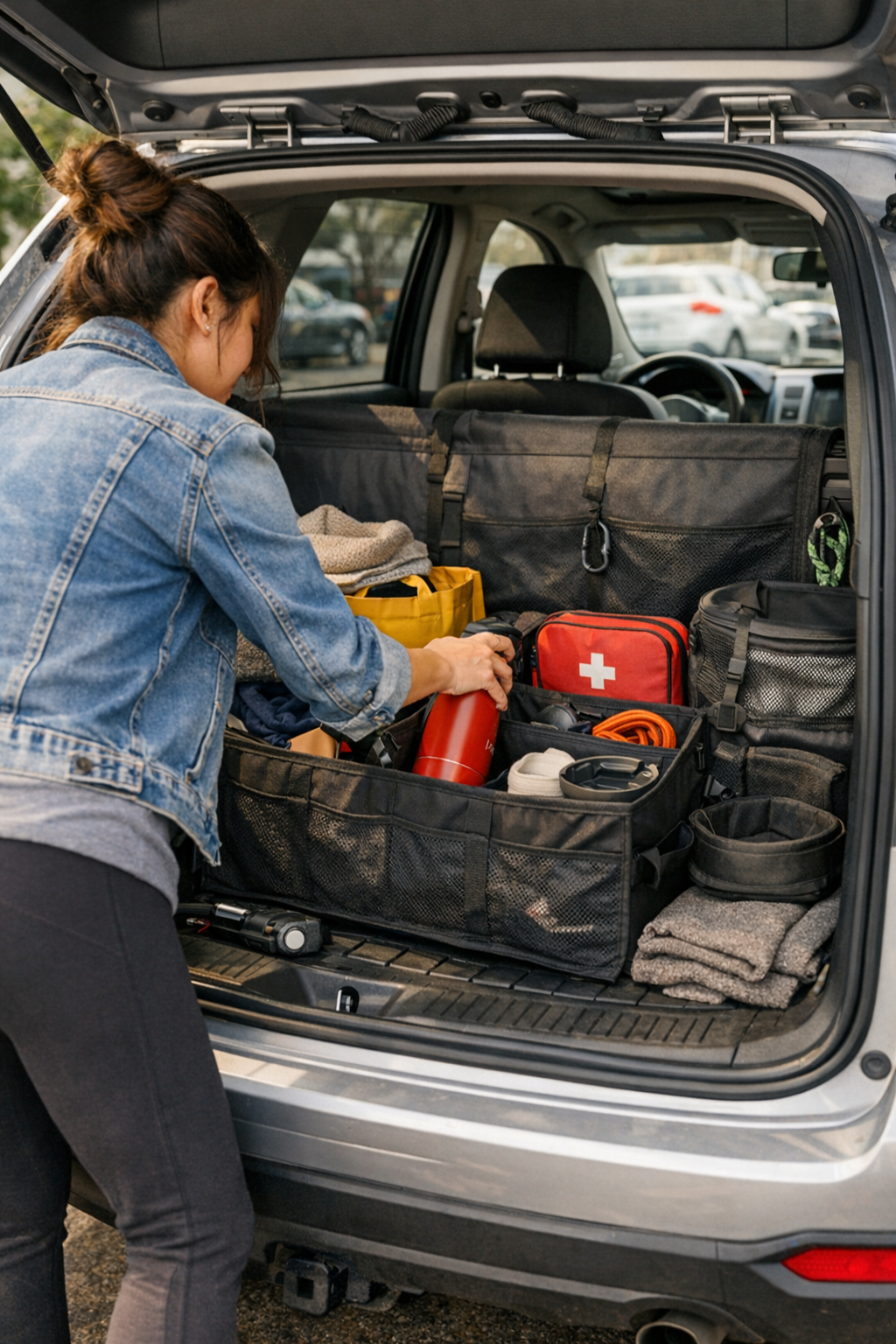
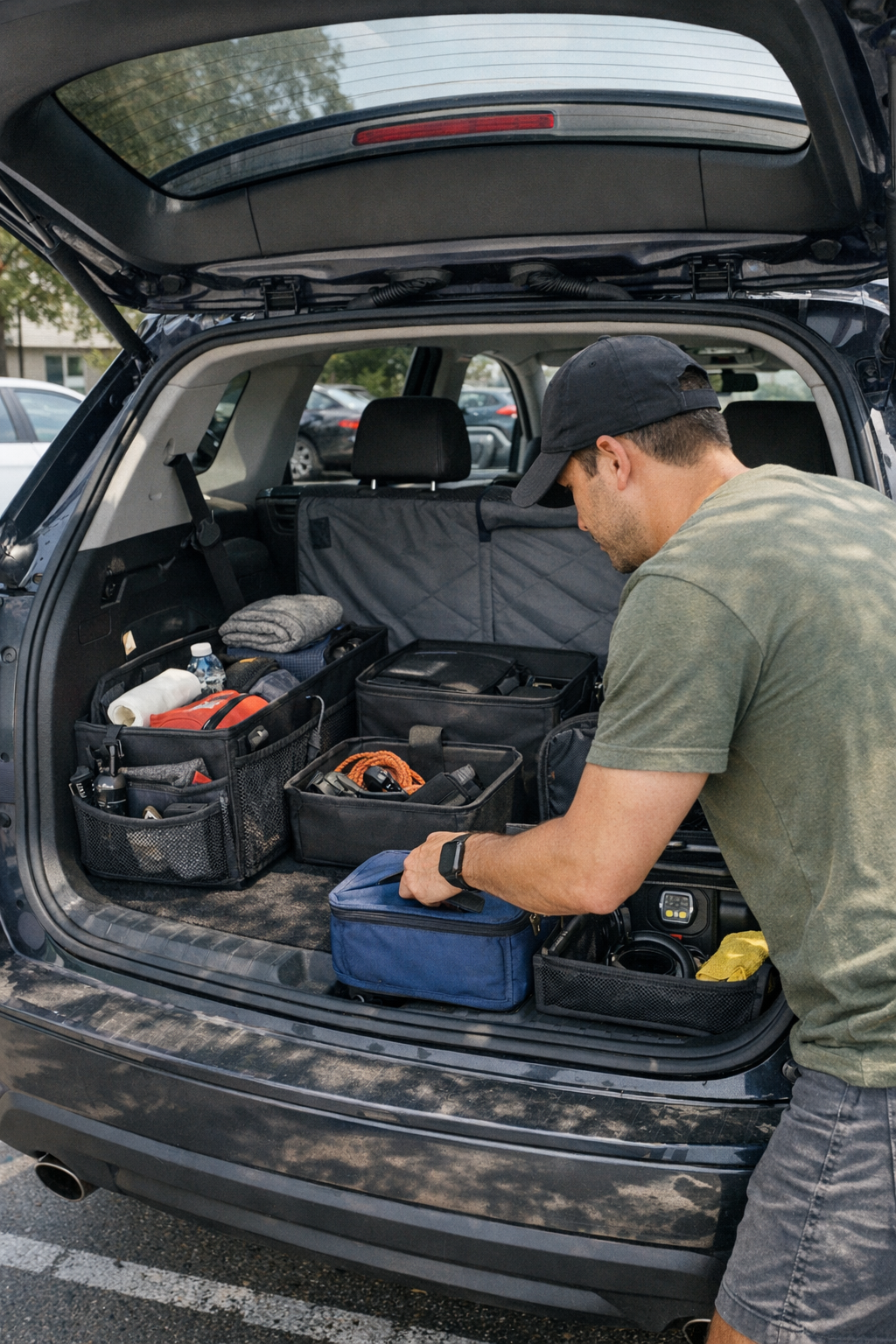
    The problem isn’t solved by more baskets or one big “cargo mat.” It’s solved by rigid structure that adapts as the trunk fills and empties across daily use. Anchored organizers—think separators fastened near wheel wells or sturdy Velcro-backed dividers—hold gear steady through stops, turns, and even quick reloading. A solid divider at the right edge blocks sideways migration. Fixed points at trunk corners mean your emergency kit, charger cables, and tool bag don’t swap places every other trip.

    This is about more than just keeping stuff in one spot. Prioritizing layout—sectioning out quick-access items (charger lines, poncho, small groceries) from heavier or sometimes-used gear—means in real use, especially open-trunk-in-the-rain moments or quick reloads at night, you’re not pawing through layers to find what matters. Instead of guessing where the fire extinguisher migrated, it waits at its anchor point, regardless of who else shared the trunk that afternoon.

    And tiny improvements count: clipping charger cables to an anchored sleeve along the trunk edge keeps them out from under a shifting ice scraper, stopping the usual cycle of cords yanked, pinched, or buried. When everything has a fixed spot—especially things that get used often or need to stay instantly accessible—the trunk isn’t just tidier, it’s ready for real-world chaos and recovery.

    Frequent Re-Entry: The Real Test of Your Trunk Layout

    The real breakdown doesn’t happen during setup—it happens when you return to the car, open the trunk, and realize that every trip means fixing yesterday’s mess. If you’re restacking groceries, digging for collapsed tote bags, or fishing lost cables from dark corners, you’re spending more time correcting than actually using the space. These moments repeat: post-work groceries, midday gym runs, last-minute store swings. Weak structure makes every interruption a reset on your own system.

    Shared cars amplify the friction. One person reorganizing for a stroller or pet gear leaves the next trip starting at a disadvantage. Only a trunk with clear anchor points, repeatable sectioning, and visible cable management lets multiple drivers recover quickly. If your setup falls apart with every new hand, it isn’t just less convenient—it costs real time and patience weekly.

    From Looks Good to Works Well: Designing for Real Routines

    A trunk that lasts past the first big errand loop isn’t built on surface order—it’s anchored by stable points, adjustable dividers, and cable routes that hold up through daily churn. Place organizers at the natural shift points—where bags always slide when the trunk’s half full, beside the wheel arch, or across the back when a box is removed. A solid divider in high-traffic zones blocks knock-on drift. Anchored bands or clips on the edge stop cables from getting underfoot or knotted after three reloads.

    The result isn’t just a prettier space. It’s a trunk where flipping open the hatch after a downpour or late-night run means everything’s still where you need it—no scramble, no wasted reach, no surprise tangles. On rushed schedules, in low light, and especially with gear that rotates out weekly, structure beats surface order every time. Even imperfect routines get easier, because the system expects the churn and recovers faster after each disruption.

    One adjustment, real relief

    Sometimes the difference is just one anchored divider, one routed cable sleeve, one moment of friction finally removed. Separating weighty gear from quick-grab essentials, clipping down the constant cable offender, and giving each kit a “home” at a tied-off corner all chip away at the wasted minutes and repeated fixes. You start noticing less chaos—and fewer reflexive resets—proving your trunk is more than just “organized.” It’s use-ready, no matter how many loops, hand-offs, or speed bumps your week delivers.

    If you’re ready to set up your trunk so that it finally holds up to actual errands, see the practical options at DriveWellSupply.