Blog

  • Why Modular Storage Needs Clear Boundaries to Stay Organized

    The first day with a fresh modular storage system fools you. The bins nestle perfectly along the garage wall, the rolling cart tucks under the workbench, and every hook and rack gleams with possibility. You stand back, satisfied by order and newfound potential. Then, within a week, reality creeps in. Tools are returned just a little askew. A cordless drill is jammed at the end of a rail, because that’s faster than finding its original spot. Carts edge further from the wall, walkways press inward, and the utility zone you thought you solved becomes a maze of tripping hazards, overlapping gear, and improvisational storage that takes longer to use each time you walk in. The setup looks modular, but the routine feels stuck.

    When “Flexible” Storage Becomes Friction

    The sales pitch is always about control: rearrange, reconfigure, adapt to your needs. And at first—after installing a rail or rolling in a new cabinet—you do feel in charge. For maybe a week, every socket returns to its place. The shop vacuum rolls out and disappears in minutes. But the nature of real work cuts against the optimism of setup day.

    Start a quick repair, and tools scatter onto bin edges instead of being put away. Tight on time? You shove gear to corners “just for now.” By Friday, the cart meant to glide easily along the wall blocks two feet of walking space. The drill bits migrate from their labeled drawer to a catch-all tray, simply because the label is easier to ignore than to respect. The invisible logic that made setup satisfying dissolves under the real tempo of a busy week.

    The weak spot isn’t the system—it’s the lack of boundaries. Flexible layouts don’t keep gear from drifting. Rail ends invite piles. Flat-top cabinets turn into landing zones for whatever you can’t deal with immediately. Drawer organizers without clear dividers become jumbles of mismatched hardware. Each small shift edges you closer to the same chaos you set out to fix, only more annoying because you can see how neatly it could be—if only it would stay that way.

    Overflow at the Margins, and a Slowdown with Every Use

    Take a narrow garage or workshop: in theory, every inch gets used. But once flexible storage loses discipline, you’re stuck nudging the cart sideways just to pass. The wall space you thought you’d maximized now hides random handyman extras from past projects, shoved to the far end because that section is “open.”

    It’s the repeated detours that grind you down. Need a wrench? It’s behind three spray cans and a tape measure that rolled away from its zone. Want to plug in the battery charger? The outlet is blocked by the mobile toolbox you left a few inches off-target after the last reset. Every visit to the space becomes a low-level obstacle course that sometimes isn’t obvious until you’re in the middle of a job and lost fifteen minutes looking for the right attachment. The modular plan remains—on paper—but in action, boundaries blur and every task takes longer.

    Dead Corners: Where Flexibility Falters

    Worst are the corners and nooks left over after the main install. Flexible racks never quite fill them, so they become dumping grounds: a broken clamp here, leftover tile grout there. At first, you promise to come back and organize it. But over time, these dead spots grow into minor junk zones. They aren’t really useful, but you can’t reclaim them without disrupting everything else. The space is technically “used,” but never in a way that helps.

    Boundaries: The Quiet Fix for Daily Flow

    The key change comes when limits get added back into all this freedom. Boundaries—bumper strips at shelf ends, painted place markers on the floor, labeled zones in drawers—restore just enough structure to keep the arrangement serving you, not working against you.

    Suddenly, the rolling cart stops inching forward because its wheels have a painted box to park in. Bins don’t fill with random odds and ends, because their slots are sized and labeled. A stop strip at the end of a rail keeps batteries from migrating into the next “category.” It’s not a full lockdown, just a real-world nudge that asks every tool: “Do you really belong here?”—and keeps your return flow brisk and automatic.

    The improvement isn’t showy, but it’s felt: no more pausing to recall which bin the wire strippers belong in, no more slow creep of overflow into walkways. Cleanups shrink from a weekend project to a fast sweep. Most importantly, your workspace feels as organized in mid-use as it does when you first set up—because the system tells you, at a glance, when things stray.

    Real-World Routines: Where Boundaries Prove Themselves

    • Blocked by the classic cart drift: You roll in to grab a chisel and find the cart off its mark, boxed in by tool piles. The cart with a marked parking spot and clear zones? You’re in and out—no detour, no juggling.
    • Overflow always finds the same spots: The end of the workbench rail, once pristine, becomes a logjam of tape rolls and loose hardware. A simple label or physical stop forces a category reset—if it doesn’t fit, it doesn’t stay. Finding gear is straightforward again.
    • The permanent “big sweep” shrinks: Without boundaries, resets balloon into unmanageable chores. With marked zones and limits, restoring order becomes a set of small, predictable actions. It takes minutes, not a half-day, to get back to clear pathways and categorized shelves.

    Making Flexibility Last Through Real Use

    Modular looks neat on day one, but the real test comes after weeks of heavy use. Can you walk the aisles without shifting tools out of your way? Does the wall space help you work, or does it slowly swallow your organization?

    The right boundaries make flexibility something you can actually count on.

    • Add end stops or bumpers on rails and shelves so gear has a reason to stay in-bounds.
    • Label bins and drawers—especially those you share with others or use for mixed categories—so tools remember their home, even if you forget.
    • Mark floor “parking zones” for mobile units. If a cart wanders, you know exactly where to return it—instead of guessing where it belonged.
    • Pay extra attention to those high-traffic transition spots—the tops of carts, edge shelves, the open end of racks—where overflow wants to collect first.

    The difference is practical: less time shuffling gear back into place, fewer surprise blockages in tight aisles, no “mystery zones” of random hardware collecting at the edges. The footprint stays predictable. You move around easily. And the area finally works in flow with your routines instead of throwing up new obstacles every week.

    Boundaries Build Dependable Spaces, Not Just Organized Ones

    The appeal of modular and mobile storage is real—but only when guided by real limits. It’s not about getting showroom perfection or maximizing visual impact. It’s about whether your setup lets you work, move, and reset—without stalling on clutter or wondering where things should go next.

    Create boundaries, mark your zones, and protect easy movement. That’s how you reclaim every square foot—and keep your area working through daily use, not just on setup day.

    Explore practical, adaptable storage solutions at StackNest.

  • How Closed Bins Transform Entryway Clutter Into Calm Efficiency

    The difference between open and closed storage in a busy entryway is obvious at 7:58 a.m.—when the neat zone you set up last weekend unravels in a single rush. That open shoe basket you placed by the door? By Wednesday, it’s packed sideways, shoes jutting into the walk path, and bags slouching just far enough across the bench to snag anyone in a hurry. Every “just until later” drop turns temporary clutter into semi-permanent obstacles. The transition space isn’t just about looking organized; it’s about whether your setup actually keeps up when people move through on repeat, especially when drop-offs run headlong into hurried exits.

    The Creep of Clutter: How Open Storage Loses Control

    Open bins and shelves sound flexible: toss shoes, sling a bag, drape a jacket—no steps, no fuss. But let even one more person pass through, and the cracks appear fast. Shoes, hats, and gloves stop sorting themselves. Bags find their way onto the bench edge or the last empty square of floor. By midweek, your “fast access” system is full of slowdowns: the right glove buried behind shoes, mail stacked under a backpack, and a walking line that narrows each time something new is added “just for now.”

    This isn’t about careless habits—it’s about friction stacking up. The easier it is to dump an item, the quicker the flow jams. Open storage soaks up overflow until it’s visibly overflowing. Each rushed drop raises the odds that tomorrow’s reset will take longer, or worse, never quite happen. Finding a missing shoe under a sideways bag, or clearing a path before heading out, becomes a built-in part of the weekly routine you never planned for.

    Blocked Thresholds: The Real Impact of Overlap

    Pressure points show up when multiple routines overlap at the door. Picture the threshold at peak: one person returning groceries, two kids scrambling for backpacks, another grabbing a raincoat. Last night’s shoes scatter further, backpacks multiply at the far edge of the bench, inside-out jackets cling to door handles. In seconds, the most-used entry is choked by overlapping stuff—the traffic lane narrows, and the odds of tripping or losing time spike.

    Open bins may be quick, but they become stalls for lost items and forgotten bits. Need the right set of keys or one missing glove? That’s a stop-and-search moment that blocks anyone following behind. Each missed reset, each “deal with it on the weekend,” tightens the threshold until the space barely matches how people really move through it. What started as a catch-all morphs into a collection point for everything that doesn’t make it further inside.

    Closed Bins: Small Extra Step, Big Routine Payoff

    Closed bins and boxes force a small but crucial pause between drop and abandon. One extra motion—lifting a lid or sliding a drawer—draws a subtle line around your categories. Shoes are either inside the bin, or they’re not. Bags have a single home that doesn’t migrate into the walkway. There’s no slow ooze of items stretching toward the door, even if you don’t reset daily.

    The tradeoff is direct: you invest an extra second, but gain a routine that stays reset longer. Overflow can’t quietly drift out, and the habit of tossing things “for now” starts dying out. Instead of battling the edge of a messy pile, you notice that what gets put away actually stays away. Entry remains functional for more pass-throughs before you’re forced into a weekend cleanup. With closed storage, there’s a clear signal: use it, or it blocks the loop—removing the gray zone of items stuck “almost” put away.

    Reset Patterns After Switching to Closed Storage

    The effect of switching is practical, not pretty. Assign a closed bin for each person’s shoes. Keep the bench top for bags only—no mixed piles. After a typical week, the zone holds its shape: no shoes sprawled across the floor, no guesswork about where to hunt for a lost hat, no slow creep of bags edging onto the path. No more morning shuffle to clear a route; the walking line actually holds. It’s a difference you feel when you’re already late—grab-and-go works without sidestepping clutter.

    When Setup Fights Routine: Real-World Friction Points

    Most entry setups look sorted the day you finish them, but cracks show in real use. Wall-mount cubbies tidy shoes, but bags still drop onto the nearest surface. Shoe mats hold ordered pairs that only last until the second rush in or out. The easier it is to toss things, the less likely it is they’ll stay sorted. Open setups become correction zones: every return is an invitation for overflow, every pass-through another chance for a small slip to stack up into bigger blockages.

    The friction builds quietly: one pair of shoes placed beside the bin instead of inside. Day after day, “just until I can deal with it”—until moving through the entry means twisting around piles that used to have a place. Energy spent negotiating clutter eats the margin you need to actually get out the door on time.

    Making Closed Bins Work (and How to Keep Them From Hiding More Mess)

    Closed bins don’t erase friction, but they channel it to a controllable spot. The move that matters: assign bins by person or clear category, and make sure they’re right in the path of movement—not off to the side, not buried under another box. Build in one mini-reset per week: five minutes, Sunday night, pulling out stray socks or outgrown shoes before they vanish into the back of the bin for good. Skip the reset and even the best closed storage turns into a blind spot, hiding mess instead of controlling it.

    Two details that help cement the habit: use visible labels (“kids’ shoes,” “school bags”)—nothing fancy, just obvious—and keep bins tucked under benches or at knee height for easiest reach. The less work to drop something in, the more likely it gets used. Closed bins should reduce hesitation, not add another step that family or guests ignore.

    Choosing Lasting Calm Over Temporary Neatness

    Closed bins don’t make clutter invisible—they quarantine it before it spreads. They hold the boundaries steady so the entry lasts through five or seven quick exits, not just the slow moments between resets. The goal isn’t showroom perfection; it’s a threshold that keeps working when routines overlap, when shoes outnumber cubbies, and when real life gets messy.

    Your entryway should recover with you—not lag behind, demanding a full sort every time the flow resets. Want more walkable floors, fewer last-minute shoe hunts, and less routine spent shuffling piles? Closed bins deliver a quieter, steadier edge that open storage can’t hold under pressure. They absorb the chaos, block category creep, and—crucially—let your entry zone finally do its main job: helping everyone cross in and out with less friction, no matter how messy the week gets.

    http://www.betweenry.myshopify.com

  • Streamlining Pet Travel Gear for Faster Access During Stops

    The promise of a perfectly packed pet travel bag fades fast once you’re actually on the move. A setup that looked ready—zippers smoothly sealed, compartments filled, every item “in its place”—can quickly turn into a slow-motion scramble when you stop, reach, and realize you need the same leash, bowl, or cleaning wipe you buried under your earlier attempt at neatness. By the third stop, “organized” can feel like a trap: every reach becomes slower, every reset more frustrating, and your pet’s restlessness only underscores how travel-ready doesn’t always mean travel-easy. In the PawGoTravel world, this isn’t new—it’s the difference between a bag that looks sorted and one that actually keeps pace with you and your pet’s constant, seat-side adjustments.

    When Organization Turns Into a Roadblock

    Arranging wipes with wipes and toys with toys might look brilliant in your hallway. But the trip exposes what home packing hides: easy access isn’t the same as “well-organized.” The first sign? Grabbing the leash from under a mound of folded blankets—and noticing your one-handed reach makes the whole bag collapse sideways. A bowl, crammed in for tidiness, vanishes behind a spare harness. Suddenly, a water break for your pet becomes a puzzle with extra moves. The “neat” setup falls apart under real travel speed, its order gone after just a couple of unplanned stops.

    Small Delays Add Up at Every Stop

    Picture a basic routine: a drop-off, a quick park walk, a coffee run. Each time the car stops, a repeat performance—stretching, poking at zippers, digging for the right pocket. The wipes you need for a muddy paw are stuck behind three stacked toys that were supposed to “stay tidy.” You unzip for the leash, but reach a bowl first, tangling with fabric you just repacked. Meanwhile, your dog stares out the window, getting antsy with every second lost. What started as small snags multiply, turning “organized” into an invisible line of friction that blocks your flow, not just your access.

    The Hidden Friction in Repeated Travel Moments

    It doesn’t take long to see a pattern: the same delays, the same stuck points, the same low-level frustration building as the stops add up. Certain signals show up again and again:

    • Wipes are packed, but never in hand—they always need three steps to extract during cleanup.
    • The leash is safely tucked away, only to require a full unzip and contorted reach every outing.
    • Pet treats mix with your coffee thermos, so pockets reshuffle and spill, every single time you park.
    • Blankets—meant for comfort—end up hiding seat-side essentials or blocking the door-side access you need most.

    This isn’t about poor organization. It’s the wear and tear of actual travel: short stops, grab-and-go demands, a pet pulling at the end of the seat. The weakness isn’t mess—it’s blocked movement in the moments when you don’t have time to reorganize.

    Seat-Side Surprises and The Cost of Calm

    The best-looking bag can blow up when you’re jammed in traffic and the carrier’s “easy” zipper is wedged behind a seatbelt buckle. On the ground, those clever layouts lose their magic if your cleanup pouch doesn’t open with one pull. That mess-free, contained look often comes with hidden cost: delays, awkward fidgeting, and a rising sense of being stuck. Your pet catches on, too—extra patience lost every time your hand disappears into a pouch, instead of back on the leash where it belongs.

    Recognizing Where Setups Break Down on Real Trips

    Repeated movement exposes familiar snags:

    • You grab for a leash, but fingertips catch the mesh lining or pull out a shape-shifted toy instead.
    • A “comfort” item blocks the wipes when you least want to dig for them—great for calm, bad for cleanup.
    • Fast-clean supplies live in the right section but just deep enough to make you pause and rethink the effort.

    The trouble isn’t dramatic—it’s the repeated five-second glitches that slow your restart, especially at short hop stops. The initial calm of an ordered bag thins out, replaced by a running battle between what you packed and how you have to move.

    One Weak Link Keeps Returning

    No matter how neatly you arranged things back at home, the same weak spot returns: the thing you need right now is always the thing blocked by “organization.” After a couple of cycles—hoisting, reaching, re-zipping—you start bracing for that awkward pause, the sigh, the extra shuffle you never accounted for. Rarely a full disaster, always an extra drain. It stacks, silently, until you wonder why a ready-looking bag somehow feels harder every trip.

    Restructuring for Flow Instead of Just Neatness

    The setups that actually work on the road throw neatness under the bus when needed. The difference isn’t another compartment—it’s rerouting the items you need mid-trip to the fastest path. That means: bowl in an outer mesh sleeve for a one-swipe grab; leash clipped to a carry loop, not zipped away; wipes in a front pouch, visible before you even sit. Now, water breaks, leashing, and cleanup all become single-move actions. Instead of reorganizing after every stop, you only reset the essentials—and skip the bag-wide fidgeting after just a few uses.

    Real-World Relief: Fewer Moves, Less Frustration

    After a few real trips using this layout, the payoff isn’t just visual. The repetition breaks: no more juggling between seats, no more balancing an armload of gear as your pet twists the other way. A leash and bowl are in hand when needed, not on a scavenger hunt. Resetting the kit for the next stop takes seconds, not minutes, and you drop fewer things. Your pet picks up on your steadier moves—and the quiet, invisible tension of juggling “organization” just stops showing up in your routine. The change isn’t flashy, but the effect builds with every interruption you avoid.

    A Setup That Keeps Up—Not Just Keeps Order

    Packing your pet’s travel kit isn’t just about appearances—it’s about engineering flow into your reality. If a sleek setup asks you to do too many contortions for every grab, it loses its value where it counts most: during all those tiny, repeated moments between stops. Real structure means the bag, bowl, wipes, leash, and backup treats stay in position for the moves you actually make—not for a photo, but for a dog paw streaking over the upholstery or a spill you need to handle while on the clock. The real upgrade? Turn every trip into fewer “almost” moments and more seamless transitions—even if your travel day remains as unpredictable as your co-pilot.

    Ready to rethink your pet travel routine with gear that’s set up to move with you? Explore practical, repeated-use options at PawGoTravel.

  • How Physical Boundaries Transform Desktop Organization and Reduce Visual Noise

    Most desks don’t stay as neat as they look after a reset. By 11:30am, a setup that started out “clear” can feel crowded again—just from unplugging a laptop, dragging a cable over your keyboard, or shifting a notebook into a strip of empty space. The difference between a streamlined workstation and an energy-draining one isn’t a single pile of cables or pens—it’s how small interruptions multiply every hour: cords nudging forward, charging blocks blocking reach, a drawer unit forcing you to readjust your leg at every sit-down. Visual order doesn’t always mean practical flow. That friction costs time and focus, especially when you’re switching tasks or moving fast.

    Why Tidy-Looking Desks Still Interrupt Your Workflow

    Smart organizers, cable trays, or desk bins might promise a permanent solution, but repeated use exposes the gap between display tidiness and real-world ease. If cable trays run through your main reach zone, or organizers sit right where you drop your hand, the “cleared” surface becomes an obstacle course all over again. A visually minimal setup can still force you to nudge a cable aside every time you move the mouse or bump an accessory while writing notes. Under-desk boxes hide the mess but add new annoyances—like digging for a charger and hitting your knee on the tray mid-task.

    Reset routines break down fast when:

    • Cables, even when clipped, keep sliding into your elbow space during device swaps.
    • Weighted cord clips hold the end in place, but the length still snakes across where you type or reach.
    • Open-topped organizers situated in your arm’s path collect clutter right where your hands need to land.
    • Adding a neatly mounted under-desk tray means you’re crouching to swap a cable—trading surface mess for access hassle.

    The desk reads “minimal,” but task after task, micro-frustrations surface and slow you down. A false sense of order becomes more distracting than scattered tools you can actually see and reach.

    Small Decisions That Shape the Work Day

    Long mornings test every desk setup. After just a few hours—sketching, juggling emails, jumping into a video call, scribbling a quick note—the good intentions from your 9:00am lineup are already worn thin. Is the charger always under the notebook, forcing you to reach across? Are cables hanging just low enough to catch your knee? Did your drawer unit that saved surface space now jam your chair, or make you lean awkwardly to access a needed adapter?

    These breakdowns show up not on a spreadsheet, but in real seconds spent every time you:

    • Plug in a device and realize the cable box blocks half your legroom and covers part of the power strip you need.
    • Drop your keys or mail in a “catch-all” tray, only to have it overflow by lunch, crowding out your notepad or phone.
    • Swing your chair out, discovering the cable loop now tangled around the seat base—turning every adjustment into a minor battle.

    The difference between a setup that’s fit for display and one that’s fit for actual work is what happens when you have to adapt mid-flow. Clean lines mean nothing if the minute you switch tools, the resistance returns.

    Drawing a Line: The Small Boundary That Changed Reset Routines

    The turning point wasn’t a full desk overhaul, but one boundary: every cable travels flat along the rear desk edge, not the working middle. Chargers, adapters, and extra plugs push just past your normal reach, kept beneath or behind a rigid tray or dock. Only rarely used items (old drives, a backup notebook) stay at the far side—accessible but never crossing the main action zone. The middle, where you write, type, and move, is cleared by default and resets automatically between cycles.

    Holding this line physically—about 7 centimeters from the desk’s back edge—did two things: daily drops (like a phone or closed notebook) landed with space to spare, and deliberate grabs for a charger or unusual accessory never left cords drifting across prime workflow. The difference was quiet but constant: fewer pauses to shift something aside, fewer interruptions to your hands, and a desk that actually stayed “reset-ready” even as you switched between keyboard, sketchpad, and screen all day.

    Daily Use: The Real Differences That Add Up

    • No more repeated clearing: After every task switch—writing, calling, sketching—the working zone is clear, not stuck in a perpetual mid-reset.
    • No cable creep: With the rear edge marked, cords can’t crawl forward; you stop nudging chargers out of your way just to open a notepad or adjust the mouse.
    • Instant access—without desktop overflow: A bin just past reach holds spares and rarely touched tools—far enough to prevent pile-up, close enough not to derail your routine.

    This isn’t about pristine perfection. It’s about killing the micro-friction—restoring flow and making quick resets a background reflex, not a new daily chore.

    FAQ: Pinpointing Real-World Desk Noise Friction

    How do I keep cables anchored without always adjusting them?

    Secure every cable along the very back edge using a tray, clip sleeve, or routed box. Open trays alone let cables wander back into view within days. It’s the fixed boundary—whether adhesive or physically rigid—that keeps the working zone clear and the cable paths out of reach.

    Will open-top organizers help or hurt my desk clarity?

    They work only when placed well outside your daily reach zone and reserved for items you seldom use. Put them close or make them a catch-all, and clutter piles up directly where you work—ruining your flow and your original plan.

    Why does visual noise seem to come back just hours after a tidy?

    Without a hard boundary, loose items and stray cables inch back into your main sightline and sweep zone each time you shift posture, move your chair, or switch tasks. Every unstructured cycle invites new spillover—each small interference quietly slowing your ability to focus or switch gears.

    Defending the Desk: Real Setup, Not Just Display

    Keeping visual noise in check is a constant fight with how your desk actually fills and empties—session after session. Lasting workstations don’t just look minimal; they keep core work zones free, cables pegged at the edge, and rarely-used items stored a little out of reach but always accessible. Less fatigue on a busy day comes not from a “styled” setup, but from friction-free resets that never build into a midday chore. Sometimes it’s a few centimeters of enforced boundary—between the keyboard and cables, or side bin and workspace—that turn a pleasant-looking desk into one you can actually rely on between task changes, call after call.

    Explore the full WorkBasic collection

  • How Modular Yard Storage Cuts Cleanup Time and Clutter Daily

    Most outdoor setups don’t collapse all at once—they slowly choke themselves, box by box, until even basics like walking through or putting things away become a problem. What started as a clear side yard or utility strip morphs into a gridlock of bins hugging every fence and scattered stacks narrowing every route. The pain isn’t usually a lack of bins or storage—it’s the constant push and pull against a layout that can’t handle daily, real-life mess. The real question: can your setup bounce back after a normal, messy day? Or is it designed for a routine nobody actually lives?

    When Floor Bins Turn Into the Slowdown

    Rows of bins seem like the obvious fix. Each scoop and soccer ball technically has a slot. For about two days, walkways stay open. Then someone slides a rake between bins because the lid’s awkward, a boot piles up sideways by the edge, gardening gloves get tossed on top. By Friday you’re sidestepping a jungle of bags, reaching over clutter, having to pull two bins forward just to get to the shovel you need. Every return turns into its own mini Tetris round.

    What’s really happening? Floor bins soak up everything—including everything that doesn’t fit anywhere else. The more people dip in and out, the faster the domino effect—one person’s fast drop-off jams the next. Soon, bins are hidden by spillover gear and that “organized” row has become a buried obstacle. What should be a 30-second reset now means hauling, shuffling, and rediscovering what’s even under the top layer.

    Dead Corners, Lost Wall Space, Lived-In Frustration

    The problem isn’t just too many floor bins. Try adding a modern storage cabinet, and you’ll still end up with corners that gather overflow, tools balanced on fence rails, and “dead zones” that quietly stash every stray. Little by little, the gap between that back wall and the fence fills with stragglers: the ball pump nobody claims, a watering can balanced on top of a box, garden tools wedged in any open space. Wall hooks, if they’re not set for the things people grab daily, end up hosting random odds and ends—shoelaces, half-used seed packets, forgotten hats. The shed footprint technically fits the yard. But clearing a path through it feels like negotiating with debris that’s multiplied since last weekend.

    It plays out like this: you go to return a bike, but the main shortcut is blocked by a canvas bag that’s toppled off a shelf, or someone’s left a bag of mulch smack in the walkway. The setup may look perfect on a cold morning, untouched. But by week’s end, most movement routes are a zigzag, each shortcut interrupted and every reset a slow negotiation with the heap you didn’t plan for.

    Why Walkways Close In—and Resets Take Longer

    The whole difference between “neat for a picture” and “usable every day” is in how return flow gets handled. If your setup doesn’t steer gear back to visible, reachable spots, overflow will always win. Maybe you buy more stackable bins or another stand-alone rack, but when multiple routines converge—kids, adults, guests—the congestion piles up right where people actually move: the edge of main paths, the tip of each corner.

    Pretty soon, the most direct path is buried. Resetting means running detours, squeezing sideways, wondering if you even have time to put things away “properly.” Chaos doesn’t announce itself—instead, reset times just quietly double. The burning issue isn’t storage size, it’s the ripple of tiny interruptions: a rake leaning into a walkway, boots blocking a storage bin, each misplaced item slowing the whole area down.

    The Five-Minute Trap: Real Use, Real Delay

    It’s a scene that repeats everywhere: you’re coming in after work, clippers in hand, while someone else wheels a bike past. Hooks overhead look great, but three bags and a pair of rain boots have reclaimed the floor, muddling access to the storage door. Someone sidesteps the pile; a bag topples, spilling seeds or charcoal splinters. Now you’re hunting a dustpan, shifting a garden fork out of the way, just to sweep up and get back to where you started. Five minutes gone—nothing really resolved, and the “big cleanup” just got put off again. Each micro-delay stacks up, until the task of keeping order outweighs the payoff of using the space.

    The Shift: Build for Fast Returns and Automatic Absorption

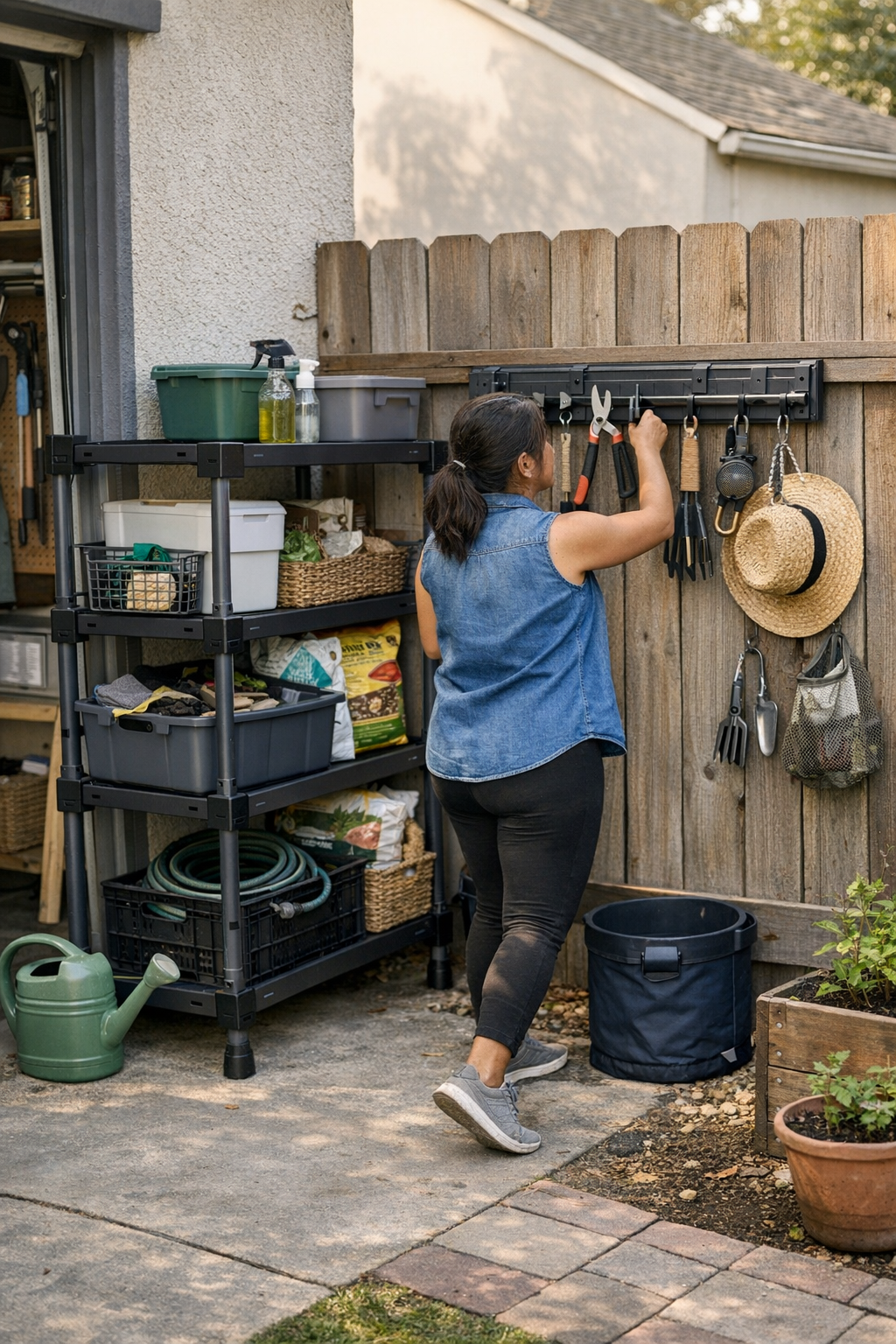
    Real yard setups don’t penalize normal use—they anticipate it. One overlooked lever is the buffer: dedicate the first foot or two above ground along your main wall or fence purely for “fast return” items. Think open hooks for garden gear right at reach, shallow shelves for toss-and-grab gloves or toys, and a deliberate empty strip between storage and any walkway. The effect isn’t flashy, but it’s immediate: a clear return zone, visible and unavoidable, that subtly cues everyone to put things back where speed—not perfection—matters.

    Just a one-foot gap between storage and the walking path acts like a buffer zone, absorbing the messy, last-second returns that would otherwise jam your main route. Kids, guests, whoever—no more guessing where that soccer ball or bag should land. In days, default chaos points disappear. You’re not battling piles or blocked doors every time you walk through. Resetting becomes the habit itself, not a separate chore to dread.

    Modular Wall Systems: Built to Flex, Not Just Store

    Adjustable wall systems don’t just increase storage—they shape how chaos flows (or doesn’t) in your yard. With hooks, bins, and shelves you can move seasonally, high-use gear floats above floor level. Overflow finds its way up the wall instead of sprawling across your feet. Modular doesn’t mean showroom neatness; it means setting up defaults, so even the rushed returns have somewhere obvious to go. Floor bins become backup, not bottleneck. Trips through the yard become smoother, quick returns stop disrupting the next person, and resets are done before you even realize you’ve started.

    Test It: Leave a Buffer, Watch the Change

    Does one stretch keep eating clutter? Try leaving a deliberate foot of clearance, even if your area is small. Just that much breathing room transforms movement. In a narrow side yard or busy garage edge, a visible, intentional gap makes routes simpler and resets automatic. No extra bins, no expensive upgrades—a practical yard tweak that keeps proving itself every day.

    Stop Settling for “Filled”—Start Demanding “Works”

    If your yard always feels full but never feels easy, the problem is flow, not just storage. Organization that flexes with the week—buffering random returns, revealing clear drop points, resisting the slow drip of blocked movement—outperforms any system that just soaks up more stuff. You know a setup works when you can walk out, put something back, and head in—without moving anything else or clearing a path first. Not because you tidied for a photo, but because you set up the space to reset itself, again and again, after real use. That’s organization that proves itself every time life gets messy—clear routes, visible homes for gear, and a layout that makes order feel almost automatic.

    See more practical organization options at TidyYard.

  • How a Simple Pause Transforms Indoor Cat Feeding Cleanup Routine

    A cat feeding area can fool you. The mat looks clean, the bowl is where it should be, and nothing stands out as wrong—that is, until your socks catch a stray puddle or you kneel down and find a trail of crumbs hiding behind the bowl. The first setup might work for a week, maybe two, but the real test is not whether it looks tidy at a glance. It’s whether the design holds up under repeated use—refills, resets, half-done wipe-downs—and daily habits that never seem to line up with “just once and done.” StillWhisker’s world is full of these quiet frictions: the feeding corner that seems stable, then quietly spills into the rest of the room, the mat that claims ‘containment’ but spreads work into your routine instead of reducing it.

    When “Tidy Enough” Turns Into Trouble

    A feeding station that appears calm on day one rarely stays low-maintenance. Quick sweeps may push mess out of sight, but after a few routines—top-up, cat circles back, water slops—the flaws begin to show. Crumbs edge toward the cabinet base, cling to the textured mat, or get mashed into the grout underfoot. Water bowls with lower rims mean splash marks creep outward; they aren’t obvious until you cross the kitchen, socks suddenly damp. Mats with patterns disguise debris, but don’t keep it localized. Every supposed improvement—a more “grippy” surface, a mat with a raised perimeter—tends to shuffle the mess rather than solve it. Instead of staying easy, every setup you try starts feeling like a setup for extra work.

    That’s the trap: a space looks calm, but the quiet drift of debris multiplies the job. You’re not cleaning a single spill, but tracking the same stubborn spot from morning to night—usually because a “tidy enough” setup lets invisible mess radiate outward, only to become impossible to ignore when it finally crosses into main home space.

    Minor Messes, Major Repeats: The Endless Loop

    Lift the bowl, and you’re just as likely to drag crumbs as to clean them. Poke at a corner, and kibble slips further out of sight. The feeding routine spawns its own repeat tasks: a crumb chase under the fridge, damp patches connecting hall to kitchen, or a quick rescue run for a toy that ricocheted off the bowl and now rolls into a clean zone. Most owners find this annoyance routine—every time you skip a reset, the radius of the mess increases. Damp prints appear along threshold lines. The “just a little” wipe becomes a series of hand vac runs, spot fixes, and half-hearted promises to deep-clean—later.

    Especially when the food station sits near a shared path, every skipped step comes back: a few crumbs picked up on the way to refill water, a sticky patch rediscovered at dinnertime, another tiny mop-up that interrupts whatever else you were doing.

    Real Use Friction: Feeding Area vs. Daily Movement

    No feeding setup is neutral. Each layout either adds or subtracts friction every time you touch it. Maybe you reach for the bowl and have to wiggle it free, dragging mat and crumbs together. Maybe you try to pour in food without blocking the footpath, but shoes and bags pile up and leave you stretching awkwardly just to pour. Bowls that promise anti-splash effects become pointless the moment the mat beneath them soaks up a spill and starts smelling by day two. “Grippy” mats keep the bowl in place—until those same features cause crumbs to wedge themselves just out of reach, so quick resets turn into full cleanups later.

    The problem isn’t just one of looks; it’s the lived experience—scattered debris by late afternoon, unexpected sticky patches, detours to grab wipes or vacuums you wish were closer. Even the visually neatest spot quickly demands extra attention as everyday movement—yours and your cat’s—pulls mess back into the shared space.

    Mat and Bowl Details: Not All Solutions Are Equal

    Every detail changes maintenance. A blended-pattern mat looks clean while dirt quietly accumulates, forcing deeper scrubbing later. Lipped edges on mats might hold in bigger spills, but also force you to pry out hidden clumps. Textured surfaces trap grime, while slick mats let splashes escape. Bowls with higher rims limit spill—unless refilling means shoving the bowl, loosening crumbs, and pushing moisture under the edge. Some fixes just mask mess for longer; others shift the work to a different part of the routine.

    No “miracle” layout exists—the right answer for one household might create headaches in another. A mat that solves one overspill issue in a small kitchen might create sticky corners in a bigger space. If the bowl sits near a main walkway, you either block human movement or end up reshuffling the setup after every feeding. Perfection is impossible, but some setups shrink the cleaning burden, while others only spread it wider.

    The Hidden Margin: Where Mess Hides

    Mess piles up along the invisible borders: in a ring just beyond the bowl, or the outer inch of the mat—precisely where quick passes always miss. These margins collect both crumbs and moisture, then launch the problem the moment feet or paws brush past. Mats that “trap” debris very often simply disguise the inevitable: sooner or later, that buildup bursts into visible space, multiplying cleanups and interruptions.

    Reset Scenes: One Extra Step is the Game Changer

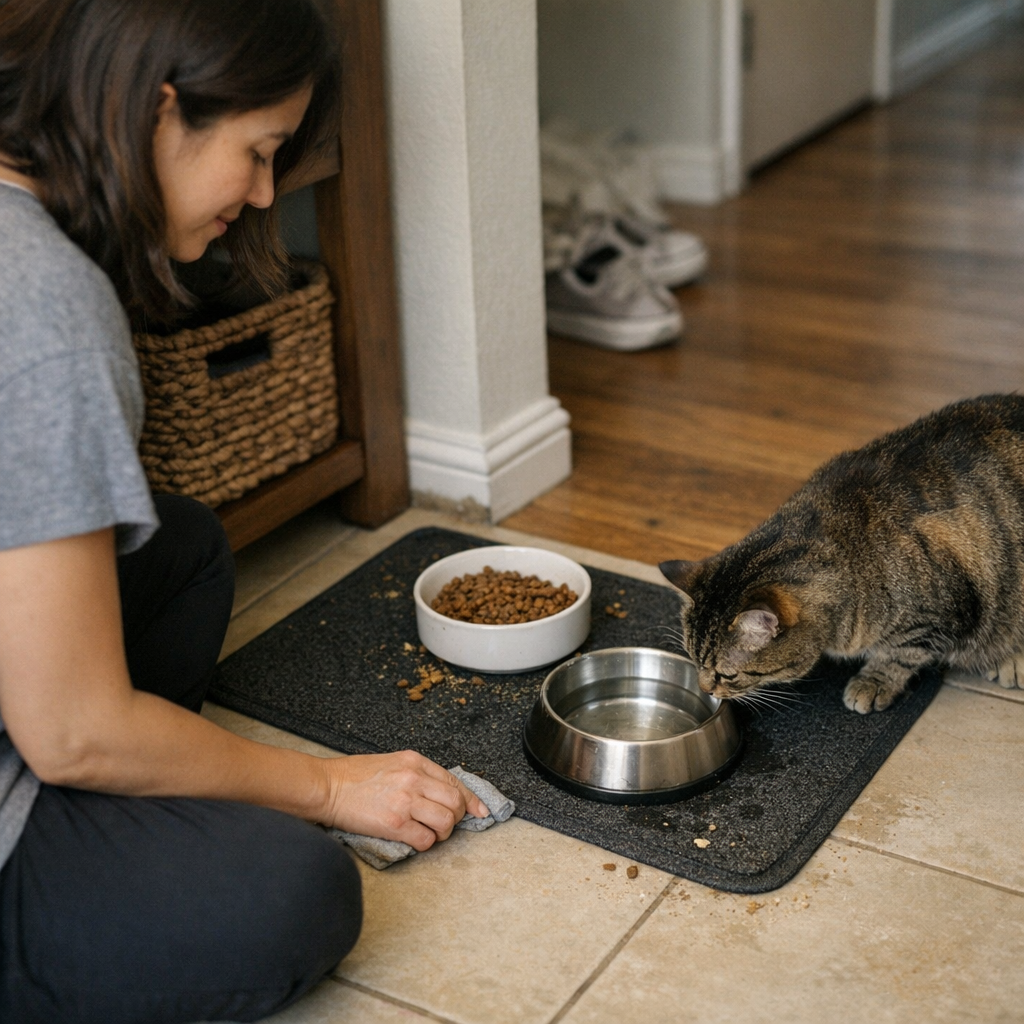
    Adding a short, direct reset after each feeding is the small habit that keeps mess local. Instead of automatic refills and forget-it, a single swipe around the bowl’s base and mat’s outside line—the three-inch buffer that soaks up most strays—delivers disproportionate impact. No need for special scrubbers: just a nearby towel or wipe, used before you walk away. Missing this pause lets crumbs spread; landing it keeps cleanup tightly contained.

    Over a week, that single margin pass means fewer drop-to-the-floor moments, fewer trips for the hand vac, and much less run-on work bleeding past the feeding station. Homeowners don’t notice the effect as a sparkling mat, but as fewer annoying interruptions, less stress over “where did that sticky spot come from?” and faster resets between routines. Skip the habit, and even the best setup leaks back into chaos by Friday.

    Less Drama, Fewer Interruptions

    The payoff isn’t dramatic but shows in the cracks: not in spotless looks, but in routines that stay contained and don’t drag chores into the rest of your day. That margin reset shrinks disruption, buys time, and stops mess from hijacking the energy meant for something else. Optimized bowls, lipped mats, and easy-clean surfaces all help, but without that repeatable pause, every system backslides. Even strong gear can’t outpace a shortcut cleanup habit for long.

    Real-Life Tweaks That Reclaim the Day

    • Cleanup within reach: If wipes or towels live across the room, you’ll delay the reset and let the mess travel. Locating supplies within arm’s reach of the feeding area blocks this excuse and keeps resets automatic.
    • Focus on borders, not just surface: Most debris slips out around the edges. A quick margin check beats a bulk clean every single time and actually shrinks the radius of each chore.
    • Placement trumps perfection: If the station lives right in a traffic lane, you’ll keep tracing debris deeper into the house. Nudge it just outside the main path so resets don’t collide with daily movement.
    • Frequent small resets over rare big ones: More frequent, minimal cleanups keep mess from compounding and make deep cleans rare—not weekly punishment.

    The biggest weak point is how many return trips you have to make within a single day. If you’re circling back to the same corner two or three times—because a mat dragged, a bowl stuck, or you missed the outer edge—it’s a sign your “contained” zone still leaks work into the rest of home life. That’s the margin worth closing.

    How an Intentional Setup Changes the Routine—But Stays Imperfect

    No feeding area eliminates work, and no layout—no matter how clever—stays effortless for more than a few cycles. But upgrading the setup and the habit together narrows the chore field. An intentional arrangement isn’t about picking the fanciest accessory; it’s about choosing a bowl, mat, and spot that not only look better, but make the daily margin swipe faster. Every system reverts if you let resets slide. Ordinary indoor-cat setups don’t need to be flawless, but the right structure plus a short, reliable post-feed reset can contain the spread and keep interruptions from taking over the day.

    This isn’t about buying the fanciest accessories or adopting a complex cleaning ritual.

    Explore more practical feeding setups and containment ideas at StillWhisker.

  • How a Thoughtful Carry-On Reset Improves Every Airport Experience

    A carry-on can look perfectly restocked after a trip—until real airport movement shows you what’s still wrong. The cycle is familiar: you return home, drop your bag, and “reset” every item, snapping chargers into a pouch here, travel docs into a sleeve there, snacks lined up at the top. Visually, nothing’s out of place. But the next time you reach for your passport during security, you’re fumbling under a toiletry bag. The charger you need at the gate is, again, sandwiched behind a power bank and a half-zipped snack pack. Organized at home, tangled in use—the hidden cost becomes obvious as soon as airport flow takes over. Most carry-on setups only reveal their real strengths or failures under pressure: tray transfer, boarding rush, or the first repack at a busy terminal. This is where CarryOnSupply’s product world enters—centered on setups that hold up in motion, not just in the hallway.

    When “Tidy” Still Trips You Up

    The illusion of readiness is powerful: a neat bag promises an easy trip, but routine use exposes the same snags, trip after trip. Documents that always slip down one layer deeper, tech getting tangled with last-minute additions, snacks instantly out of reach just when you need them. Packing on autopilot—repeating the old home arrangement—means dragging yesterday’s hassles into every new airport line.

    You notice it in the same places, every time:

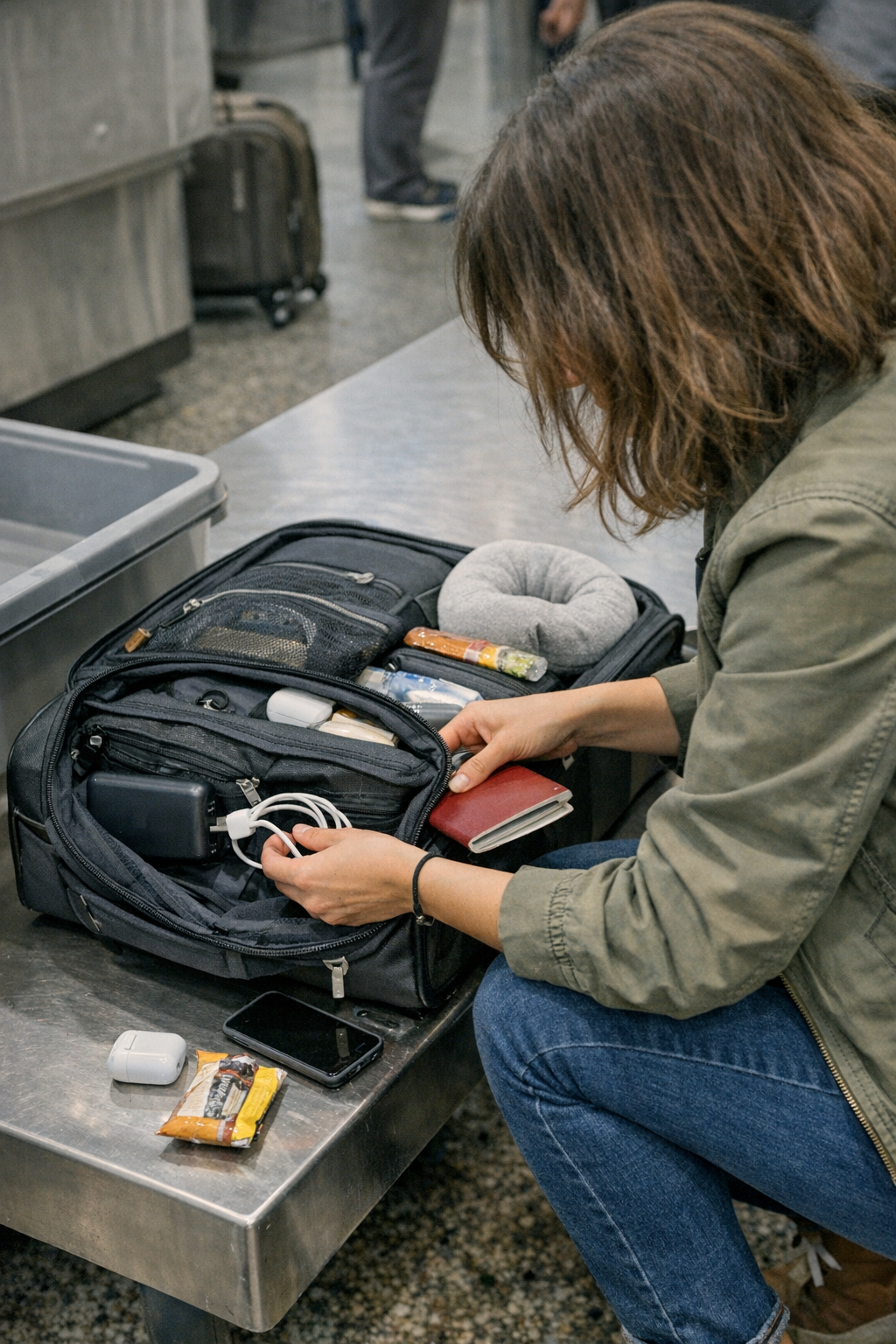
    • Outer pocket packed “for quick access,” but always needing to move wet wipes to grab your passport.
    • Chargers that slip behind toothpaste, so you’re kneeling on the terminal floor, digging.
    • Boarding pass you thought was up front now wedged flat under a power bank as the line surges forward.

    The Gentle Reset: Rethinking Instead of Repeating

    The fix isn’t just laying things out “like new”—it’s quietly tracking which spots caused a stumble last time. A real reset means unpacking far enough to spot what you actually grab first and what slows you down. Did the doc pouch get blocked at security? Was tech access awkward mid-boarding, or did you have to move three items for a snack? Each stall is the bag’s way of telling you something in the layout is breaking at speed—not just a random mishap, but a pattern waiting to trip you up again.

    Spot the repeat interruptions:

    • Two zipped pouches and one tray transfer just to find the charger you always use between gates.
    • Fumbling into side pockets while managing boarding passes, jacket, and the nudge of thirty other travelers.
    • Struggling with a stuck zipper at your seat—fastening your belt, only to realize your headphones are still out of reach.

    True-to-Flow Packing vs. At-Home Precision

    A bag that’s tidy on your bed may turn on you instantly at the terminal. Pouch-based, maximally “organized” setups break down when the essentials are layered, not sequenced by when and how you actually use them. Time after time, you see which sections break first under pressure—especially at points where the environment is moving faster than you are:

    • Security: Toiletry case on top of documents looks sharp at home, blocks everything when the tray comes up.
    • Boarding: Tech pouch hiding headphones behind snacks. Quick at home, slow when everyone’s shifting forward.
    • Seat entry: Neatly packed pillow in front, but now you’re kneeling in the aisle nearly unloading the whole bag just to fish out an e-reader.

    Static “order” doesn’t survive active transit. If you have to stop, juggle, or shuffle just to reach your go-to item, it’s not just a preference issue—it’s a breakdown waiting for your next busy airport.

    Airport Moments Reveal What Home Packing Conceals

    The real cost of a bad setup isn’t a lost item, but lost time and constant interruption from bad pocket and pouch sequencing—seconds that become a hassle in line or at your seat. These issues grow sharper and more visible the more times you move through a checkpoint or repack under pressure:

    • Security trays: Passport under a loose battery equals an awkward pause and impatient glances from behind.
    • Boarding lines: Forced pouch search with too many layers—just as the gap closes toward the gate.
    • Overhead bins: Items layered the wrong way force last-second reshuffling, stranding you mid-aisle when all you needed was one quick grab.

    After two or three travel legs—and just as many quick repacks—what felt like a small snag at home starts to stretch each transition. A clumsy charger pouch or doubled-up outer pocket can add grind with every checkpoint.

    Real-World Fixes: Small Shifts, Big Relief

    Every real improvement starts with observing where the sequence breaks down—not just what looks neat. I kept tripping over the same bottlenecks: passport, charger, travel snack. Rebuilding true first-grab access, not just front-pocket theory, cut out most in-motion delays. After one quick adjustment, my next security tray shift ran smooth, and boarding became less of a scramble—because nothing blocked those three key items anymore.

    The trick wasn’t overfilling outer pockets or squeezing every pouch tight, but building in a little breathing room: just enough for a fingertip to reach and retrieve without shifting other items. That made “crowded” sections feel open and repeat grabs nearly automatic.

    Spotting the Weak Links in Your Reset

    A silent check after every trip: if you hesitated once—or double-checked a pocket more than needed—your bag is flagging a misfit between what’s visible and what’s workable. Pay attention to where your hand slows, curls awkwardly, or returns to the same spot after missing the item. Usually, one or two friction points can be fixed before the next trip without touching the whole setup.

    A partial unpack beats a blind reset. If the snag keeps coming from tech or docs, start there. Sliding the power bank to the pouch edge, keeping snacks unblocked, or giving travel docs a solo slot—even if it breaks visual symmetry—can unclog the sequence for the whole trip. Often, switching the order of two or three high-traffic items transforms daily frustration into plain, frictionless access.

    One Reset Doesn’t Solve Everything—But It Starts the Right Cycle

    No “perfect” organization lasts more than a few trips. Each new travel leg stress-tests your choices. The real edge: build your setup for the way you’ll move through airport checkpoints, not just for home neatness. What matters is how access flows at speed, in real time, with real stakes—a carry-on that isn’t just reset, but re-sequenced for motion.

    Carry-ons that work for you adapt after every checkpoint—refined by each pause and retrieval, not just packed for the start. If your bag works better each trip, not just looks better on your bed, you’re ahead of the cycle.

    For practical organizers, travel pouches, and carry-on tools that help you set up for actual airport conditions, visit CarryOnSupply.

  • Why Repeatable Storage Outperforms Aesthetic Bins in Daily Use

    The truth about home storage hits fast—usually right after that first rush of satisfaction fades. Maybe you stack your new bins along the top closet shelf, shoes arranged in perfect pairs below, scarves neatly folded in matching baskets. For a moment, everything looks under control, ready for the ideal morning routine. But the second you’re late, digging for gloves while balancing a mug, the weak spots in the system are exposed. Suddenly you’re pushing aside a jumble of hats and scarves to get what you need, and yesterday’s order is already slipping.

    Why Matching Storage Systems Fall Short

    Coordinated storage feels like progress—and it is, for the first week. A row of identical baskets or bins brings a quick surge of calm. But as soon as those bins face the pressure of real life, neatness gives way to subtle chaos. It starts with a single shortcut: you toss spare keys in with socks “just this once” or wedge shoes into whatever space is left. The next morning, you’re shifting stacks to find sunglasses lost in the mix. Each small compromise chips away at the system, until the matching bins are stuffed, categories blur, and grabbing anything starts to slow you down.

    Daily Friction: Where Style Masks Mess

    Uniform storage promises simplicity. But the design disguises the mess as it builds beneath the lid. Socks spill under hats, scarves tangled under gloves. By midweek, bins sag; stacks slide sideways; one container gets suspiciously heavy and hard to sift. End result? Instead of being invited to tidy, you start avoiding the area—opening the closet with a sigh because access means another reshuffle.

    Clarity Over Cosmetics: Defining Categories That Last

    When categories lose their edges, friction invades every routine. True organization means you can reach for what you want without moving a pile or running a mental checklist. Storage that’s only about appearances sets traps: every time you retrieve a winter hat, you half-upend a pile, and each return is a guess where things should land. Resets take longer, and you notice clutter creeping into corners—a sneaker at the foot of the stairs, an umbrella perched on a shelf where it doesn’t belong.

    Closet in Practice: The Cumulative Effect

    Picture a narrow coat closet. Monday morning: you’re holding a coffee, grabbing your tote—except the tote is buried behind yesterday’s gym bag and a half-unpacked paper grocery sack. To get it, you shimmy a stack of scarves to one side, tip a basket, and—at last—rescue your bag. Returning home, you know “right bin, right spot” matters, but exhaustion takes over. The gym bag drops wherever, and a minor mess begins its weeklong sprawl.

    This isn’t a matter of messiness—it’s about systems that require too much effort. Without firm boundaries between categories, bins get too full too soon, folded stacks unravel, and by Thursday, the closet’s order collapses. Left unchecked, the domino effect spreads: shoes edge into the hallway, lightweight bags stack on the floor, stray hats pile up where they shouldn’t. Each workaround is a drag on your time and mental bandwidth.

    Practical Structure: The Real Secret of Durable Order

    What reliably keeps a closet or shelf in shape? Not color coordination, but a system where separation is obvious and consistent. Storage works best when it reduces the need to think: this bin, always scarves—never mittens; these hooks, only for bags. Every item has a role and a slot, so resets are frictionless and don’t steal your time (or your patience) every morning or night.

    Dividers and Small Tweaks with Outsized Impact

    The answer isn’t always “buy more bins.” Sometimes, a single divider transforms daily experience. For example: slim an oversized basket into two smaller compartments, trading symmetry for utility. Suddenly gloves and scarves, once mixed, each have a clear home. No morning tug-of-war or nervous stacking. Or repurpose vertical space: add a shelf insert for small purses, or a simple rail for umbrellas—now each item is in view and easy to reach. Little changes like these keep piles from collapsing and make it obvious when something’s out of place, speeding up the reset, not making it harder.

    Recognizing the Warning Signs

    The signals are always there if you look: a stack that never stays straight, a bin growing heavier and less predictable each day, or new piles collecting on the edge of your hallway. If you’re moving three things to get one, or if “quickly putting it back” never seems feasible, your system’s failing silently. Don’t ignore slumping bins or containers that double as general catchalls—they’re signs your categories are blurred and that routine is on the verge of breakdown.

    Pause and diagnose: Is every item in this space still in the right place? Which category has grown beyond its boundaries? Are you using all the vertical or side space you could, or letting it go to waste? Sometimes, the best fix is splitting up a bin or labeling a section so you see, at a glance, what goes where—instead of spending time rearranging, hoping “this time” it stays sorted.

    Real Fixes for Real Life

    If you’re constantly re-stacking or second-guessing a bin’s purpose, try letting your daily actions lead the reset. Notice where your hands go first when you’re in a rush. If you always fish for keys in the middle of a mixed tray, give keys a slot near the door — not buried with everything else. If folded stacks fall apart by midweek, swap one big basket for two shallower ones. Most important, structure your storage for speed: categories with a clear home make quick resets possible, even at your busiest.

    What Lasting Storage Success Really Looks Like

    Effective storage isn’t how polished a closet looks on Sunday night—it’s how easily you can keep it together by Friday afternoon. Accessible bins, clear categories, visible items, and divisions that hold up to repeated use—these shape a system that feels stable. When each thing naturally returns to its place, clutter doesn’t have a chance to sprawl. The win isn’t showroom perfection; it’s not tripping over shoes in the entry or wasting five minutes looking for a glove as you run out the door. Instead, you reclaim calm corners and make every reset quick, confident, and almost automatic.

    Shop ClosetWorks for practical storage solutions to help your space work better—every day.

  • Choosing Air Compressors That Deliver Consistent Pressure for Remodeling Jobs

    Some problems don’t announce themselves—they creep in. You start a remodel with every tool sharp and the plan clear, but by mid-morning, your saw is dragging through soft plywood. The blade bites, stalls, and suddenly a straightforward cut becomes rough enough that the seam won’t close. That slow grind? It’s not just the saw. It’s your air compressor running out of breath, quietly turning a fast install into hours of frustration, sanding, and redone joints that never look quite right. If you’ve ever spent the last hour on site dead-leveling a run of baseboard just to hide uneven cuts, you know what underpowered airflow feels like—both in your hands and your timeline.

    Compressor Specs vs. Jobsite Pace

    On paper, choosing an air compressor feels simple—tank size, horsepower, CFM ratings line up in neat rows. But jobsite rhythm isn’t built in the spec sheet. It’s what happens when your tools face real, repeated work: window retrofits with sashes lined up, cabinetry runs where a slip costs a door, or crown installs that punish every missed millimeter. Plunge, cut, and reset—all depend on the compressor keeping pace, not just for the first cut but while you punch through boards all day long.

    The earliest sign of trouble is subtle—a hint of the saw vibrating or biting at the wood, a rhythm lost as air pressure drops. Ignore it, and minutes later the pile of splintered offcuts starts to outpace your progress. By late afternoon, you’re fighting both your tools and your backlog, all because a compressor couldn’t keep up with your everyday routine.

    Don’t Be Fooled by Tank Size—Consistent CFM Is What Counts

    Big tanks and bright horsepower stickers draw attention, but the field reality is simple: delivered CFM at your working PSI runs the job, not the tank sticker. For saw reliability and finish quality, steady airflow is the silent backbone. Two compressors may both claim 6-gallon tanks, but when cuts come fast and frequent—switching between circular saws and brad nailers, or jumping between miter and portable table saws—the slower-recovering unit loses steam fast. Even a brief pressure dip can cause:

    • Blades dragging mid-bevel, leaving rough or swollen edges on trim
    • Finish cuts that splinter in hardwoods or laminate
    • Extra sanding on every door, jamb, or fascia
    • Stalled tools while you wait on pressure, hands idle

    Every pause to let pressure recover throws off workflow. If you’re halfway down a line of window casings and the saw starts choking, that lost momentum ripples through your entire day—bit after bit, cut after cut, the falloff is visible in your stack of corrections.

    The Tell-Tale Signs of Compressor Lag On Site

    Picture a three-room window replacement, or back-to-back kitchen installs: In the morning, your saws hum, but by the second or third hour, you feel hesitancy on longer cuts, especially in denser materials. The sound shifts—saws get loud as motors strain, or worse, start stuttering mid-cut. As pressure falters:

    • Straight lines turn wavy, and blade marks show up in every plywood sheet
    • Fatigue sets in as you muscle through drag, increasing the risk of slips and slightly-off measurements
    • The team starts double-checking joints, recutting or sanding repetitively—small mistakes multiplying as patience thins

    When the compressor falls behind, your crew slows, not from poor planning but from battling unreliable air on every pass.

    The Difference After Upgrading to 5.1 CFM @ 90 PSI

    Switching to a compressor that reliably delivers at least 5.1 CFM at 90 PSI isn’t about hitting a bigger number—it’s about restoring rhythm and control. On sites that run tools hard, high-output portables keep saws cutting cleanly, from subfloor crosscuts to precision detail work. Suddenly, those chip-outs and wavy lines disappear. Edge sanding drops off the punch list. The saw feels responsive—not laboring, not pulsing—just steady, so you stay on your marks and keep your wrists fresh.

    The most telling change? At the end of the day, there’s no backlog of should-have-been-easy corrections. Crew morale lifts. Install stacks line up, and you’re wrapping a site, not looking for problems you created because your gear couldn’t keep up.

    Tank Size Isn’t a Shortcut

    Buying the biggest tank in stock can seem like insurance, but if recovery lags, the advantage is short-lived. High-frequency tool work—multiple saws running, swapping from cutoff wheels to nailers—demands sustained CFM, not just stored air. The tank empties after a flurry, and the inevitable pressure sag creeps in, throwing off accuracy and making every pass harder than it should be.

    Hard-Learned Signs Your Compressor Isn’t Enough

    Field experience says it all: when airflow drops, you don’t need a spec sheet to notice—it shows up in your work:

    • Cutting speed slows first. Pushing through each board gets awkward, control wobbles, and risks of blade wander go up.
    • Edges get ugly. Splinters, micro-tearing, and ragged cut lines force extra sanding or recuts—bit sharpness doesn’t matter if the airflow is off.
    • Stop-and-start rhythm ruins momentum. Instead of gliding from trim to trim, you’re stuck waiting for the tank to catch up or running idle drills just to burn time.

    Reliable airflow doesn’t just save your back; it conserves precision, pace, and keeps your focus where it matters—on the next measurement, not another repair.

    Field-Tested Tips for Choosing Compressors

    • Replicate job pressure, not just single cuts: Before you settle on a compressor, plug in your main tools and run several cuts or drill cycles in a row. See if blade or bit performance shifts as the tank drains.
    • Study the cut, not just the tool: Tiny splinters, burnt edges, or tool chatter often hint at lagging airflow before performance takes a nosedive—watch for these cues before relying on a spec alone.
    • Frequent pauses are a warning. If you find yourself rerunning lines, changing blades, or constantly cleaning up cut edges mid-project—question your compressor’s output. Upgrading CFM can reclaim hours from your day.

    What Seasoned Crews Pay Attention To

    The best crews ignore shiny new tanks and brand names in favor of results. They choose compressors that keep saws cutting straight and drills delivering consistently—even as batteries fade, air thickens with dust, or projects drag into overtime. Day after day, site after site, that consistency shaves time off every task: cleaner fits, fewer recuts, and energy left over for the details that make an install bulletproof.

    Payoff comes not in glossy marketing, but in cut stacks that slide tight and clean, no extra sanding, no covering up errors. It’s a standard anyone who works with their hands recognizes—the job’s done right the first time, from first cut to final fit.

    Find practical, jobsite-ready air compressors and more at Gumboll.

  • Why Repositioning Indoor Lights Improves Safety and Daily Use

    The real test of indoor lighting isn’t how a fixture looks on installation day—it’s what happens every time you need to access it. If you’ve ever stood halfway up a stairwell, shifting your weight with one foot angled on a step, hand stretched for a flush mount ceiling fixture that always seems just out of reach, you’ve felt how access failures turn convenience into a hassle. The wrong location doesn’t just create a maintenance headache; it can be a silent safety risk, and a steady drag on how you use your own space. These are the decisions that don’t show up in showrooms—and they’re exactly where the payoff or penalty of your lighting choice reveals itself, one awkward reach or ignored dust patch at a time.

    When Good Light Meets Bad Access

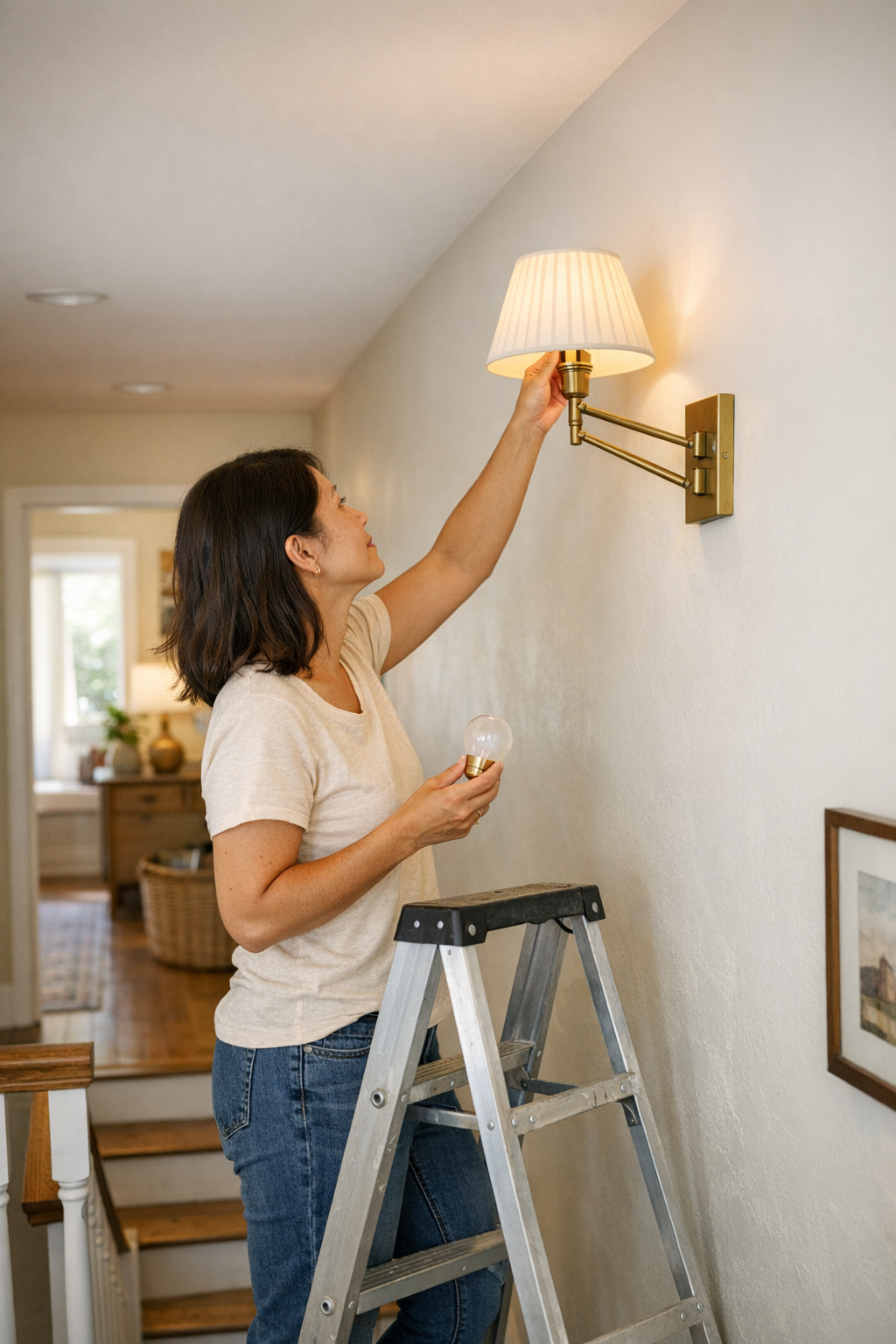
    Standing below a stair landing, squinting upwards, you might notice the lighting feels balanced on paper—or in a listing photo. But routine use tells another story. Every time you stand on tiptoe, ladder wobbling, just to replace one stubborn bulb, spatial design clashes with daily reality. Fixture placement that forces you into weak footing or awkward stances is a structural inconvenience baked into your routine.

    You see this disconnect in nearly every room: a wall sconce over a laundry counter that glows perfectly until you need to reach over the washer—straining each time just to clean the glass—or a snug vanity light that serves the sink’s edge, but leaves your hand brushing a mirror when it’s time for upkeep. These aren’t dramatic flaws, but they quietly push routine tasks off your list or make you delay them until the shadow and dust become impossible to ignore. The problem is rarely brightness or coverage. It’s the subtle misfit between where the light is, and where your hands can safely reach.

    Structural Choices Shape Daily Movement

    Ceiling lights, wall sconces, and task fixtures all shape how you move through—and maintain—your space. Their mounting points aren’t just about balance or symmetry, but how your body interacts with the room, again and again. Centered flush mounts above a stair void or behind a door might look “right,” but demand awkward ladder setups or unsafe reaches. A semi-flush pendant meant to anchor a small hallway lands directly above a traffic pinch point—now every bulb change means dragging furniture or contorting around it. Repeated, these micro-mismatches chip away at any sense of lighting as support for actual living.

    Stairways: Where Access Meets Hesitation

    In staircases, visual balance often demands ceiling fixtures up high or at mid-landing turns. But when the first burnt-out bulb forces you up a ladder, torso twisted over the handrail, it’s clear the architect never hung the light themselves. That minor misplacement doesn’t just add five extra minutes—it turns a simple swap into an avoidable risk. Soon, overdue maintenance becomes routine, not the exception.

    Utility Spaces: The Illusion of Completion

    Try loading laundry at dusk, only to find the wall sconces create tidy brightness on top of appliances—but veer just far enough from the edge of the counter that wiping down or swapping bulbs means stretching or moving an entire washer. Utility room “completion” is a mirage when access isn’t planned against real obstacles like low ceilings, stacked machines, or narrow zones. Getting the light working isn’t the same as making it work for you.

    Public Paths: Corridors and Hallways

    A flush ceiling light in the hall may look architecturally perfect, but if it hovers above a sideboard, or the only solid spot for a ladder is behind a traffic knot, the day you need to service that fixture, friction multiplies. Instead of a quick job, you’re pivoting furniture or risking a slip. The room “reads” as well-lit but never really fits how you move and maintain it. That gap gets larger with every missed cleaning or delayed repair.

    The Real Cost of Awkward Lighting Placement

    Ignore the subtle toll, and maintenance becomes the chore you plan to avoid. Dust layers build into glare that alters the character of a flush mount’s light. A bulb burns out in a stair turn, and you find yourself navigating darkness until the hassle feels justified. The system slowly becomes less reliable—and your willingness to interact with it fades, one unresolved issue at a time.

    • Unreached fixture glass collects dust, spreading glare and undercutting clarity—especially in task or stairway zones.
    • Delayed bulb swap-outs mean key surfaces—laundry counters, hallway turns, vanity mirrors—can fade into shadow.
    • Small, persistent access barriers breed unsafe workarounds—too-short ladders, unstable stepping—quietly upping daily risk.

    Practical Improvement: Shifting to Safer, Smoother Routines

    Improvement starts with honest fixture placement—small adjustments that transform every future maintenance step. For example: moving a stair fixture by eighteen inches so it lands directly above a landing with stable footing. Suddenly, changing a bulb is as simple as standing upright—not dangling over the rail. The lighting outcome is identical; the routine effort is not.

    The same goes for laundry alcoves: shift a linear wall light closer to the edge of the work zone, not above the hardest-to-reach spot. In hallways, avoid centering flush mounts directly over immovable obstacles—place them above the safest, accessible stretch of floor. When day-to-day cleaning and repairs no longer feel like a gamble, you reclaim both time and safety. The room isn’t just finished—it’s functional by design.

    Is It Time to Rethink an Awkward Fixture?

    If any of these ring true—

    • You’re dragging the ladder back and forth to the same corner every few weeks;
    • Appliances or mirrors must be shifted just to change a bulb;
    • Certain routine fixes keep getting skipped because the light is always just out of true reach—

    —your setup isn’t supporting you. No special tool compensates for a fixture installed beyond practical access. The best location is the one where you can stand safely, reach with both hands, and finish the job without improvising safety or delaying maintenance.

    Small Tweaks, Lasting Improvements

    Lighting that lasts isn’t just bright—it’s placed for real hands and real movements. Swapping perfect symmetry for accessible placement is a quiet but powerful upgrade, noticed every time you finish maintenance in moments instead of dragging it out. Less risk, less hassle, fewer unaddressed flaws. Lighting should serve the routines you repeat—not just the appearance you admire once.

    Quick Tip for Next Time

    When planning a new light or repositioning an existing one, stand exactly where you’d go to clean or change it. Is there stable floor beneath? Can you safely reach the fixture? If not, shift location before installing—function trumps forced symmetry every time, especially when access affects everyday safety.

    Lighting is only as good as its real-world fit. If your setup lines up with your own daily movement and maintenance—over the right stair tread, along the reachable counter, away from congested corners—staying safe and keeping your lighting at its best becomes automatic. Fix the practical mismatch, and every room proves its worth over time.

    http://www.lighthelper.myshopify.com