Category: Tools & Workshop

  • Rearranging Heavy Items Improves Garage and Workshop Efficiency

    Every garage or workshop user knows the moment: You walk in, already picturing the tool or bin you need, only to freeze in your tracks. On the surface, the shelving looks organized—a place for everything and everything in its place. But as soon as you go to haul down a heavy box or reach for a container you actually use, the problems show themselves: a muscle-straining reach overhead, a cart wedged into your walk path, or an overloaded spot you have to reshuffle just to get to what you want. Items pile up “just for now” because putting them away is a hassle, and before long, order gives way to slowdowns and shortcut stashes. The setup that seemed smart is now quietly getting in your way.

    Heavy Items Up High: The Hidden Drag on Everyday Flow

    On day one, most storage looks perfect. Floor-to-ceiling shelves, modular wall panels, racks that make the most of every square foot. But then, the daily routine settles in. The biggest, toughest storage bins—bags of sand or seed, bulky power tools, overflow tubs of hardware—get nudged upward to make way for small, often-used gear in the “prime real estate.” It’s not intentional; it just happens, shelf by shelf, as you live with the setup.

    Before you know it, every big lift means:

    • A clumsy, careful reach or a stretch that leaves your shoulders and wrists aching
    • Piling awkward bins on already stuffed upper shelves, risking a dangerous wobble or spill
    • Shifting carts out of the way just to get to one edge of a unit—then having to move them again to reset
    • Workbenches and corners filling with “temporary” overflow that lingers for days

    When Inefficiency Becomes the Routine

    These small delays—the slow retrieval, the avoidance of putting things back, the sidesteps and stacks—stop feeling temporary. They become how you use your garage. What once looked organized now feels like it’s working against you. You catch yourself stacking bins on the floor to avoid the awkward reach, or leaving a heavy toolbox mid-walkway because its “home” is now too much trouble to access.

    When an ‘Organized’ Setup Starts Interrupting Your Projects

    It doesn’t take long for these layout issues to pile up. Picture a garage with tight vertical storage or a workshop wall fitted with smart-looking shelves. Everything has its slot—until it becomes clear the system is backward. You’re crouching to snag a lightweight tarp but have to hoist a dense case above your head, or notice the cart meant to roll away never gets put back because the aisle keeps narrowing. Every trip for a tool becomes a shuffle-and-shift routine: slide a bin off a stack, twist around a bulkhead, nudge the cart, just to get your hands on a daily-use item.

    The Cycle of Clutter and Reshuffling

    This is how corners become dumping grounds: a few rushed returns, a bin set aside “just until later,” and a growing pile-up as heavy items end up anywhere there’s a gap. The floor space gets tighter. Resets slow down. You find yourself doing a dance—one box off, two boxes on—just to close up for the day. That well-planned shelf system now invites crowding, not clarity, and blocks the quick movement that fueled the original layout idea.

    Breaking the Cycle: Anchoring Heavy Storage Where It Belongs

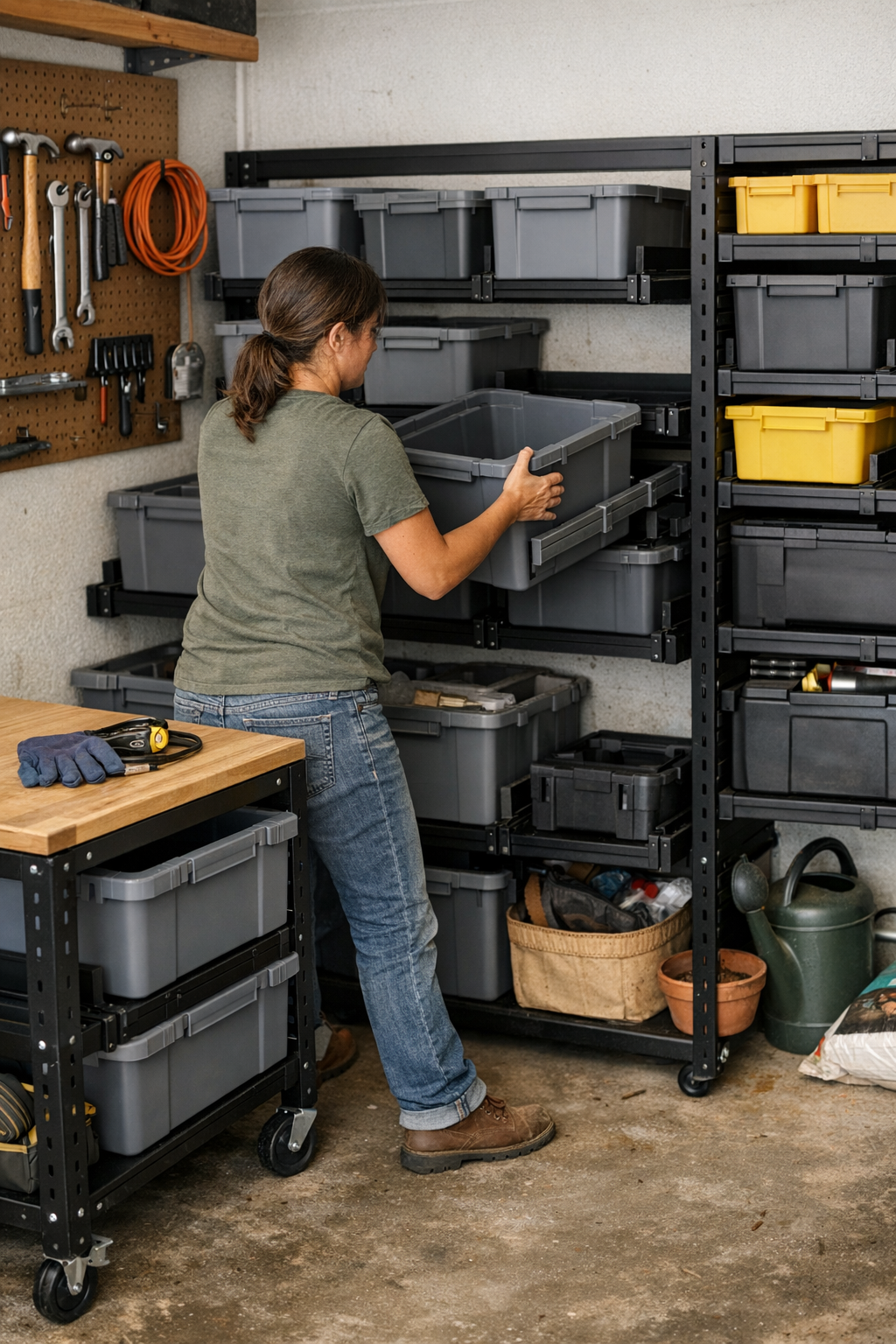
    The real breakthrough? Give every heavy, high-demand bin and toolbox a prime spot between knee and waist height. Shift the lightweight, rarely used gear up and out of the way, but keep bulk and weight firmly in your natural reach zone. Suddenly, what took three steps or an awkward lift is just a straightforward drop or pick-up. There’s less hesitating, less balancing, and no question of where things go after use.

    The Immediate Upgrade: How Realignment Feels in Practice

    This isn’t theory—it’s a dramatic shift in daily function:

    • Heavy bins now return to a shelf you can actually reach, without overthinking the grip or bracing for a twist
    • No more stacking overflow at the very spots you need to keep clear—like the ends of your workbenches, or right where you park a cart
    • Mobile gear slides into place, instead of being stuck out or blocked by bins that should never have left the “easy zone” in the first place

    Once the big stuff lives down low, the resets speed up. You stop making “temporary” piles by the door or halfway across the garage. No bin looms overhead, waiting to tip. Each shelf’s job becomes obvious—and you stop treating the room as a puzzle to solve every single day.

    The Look and Feel of a Zone That Actually Works

    No, you won’t win showroom points for design minimalism. That’s not the goal. A functional garage or shop with correctly placed heavy storage lets you:

    • Move end to end without detours, even when every zone is in use
    • Finish fast—return big items to their place in seconds, not minutes
    • Keep odd-shaped gear and overflow out of the way, with high and corner shelves holding only what’s truly light or seasonal
    • Walk in tomorrow ready to start—not steeling yourself to restack yesterday’s “good enough” returns

    Visual order matters, but what really keeps you coming back is function. That’s the difference you feel: a quick, instinctive drop onto the right-height shelf versus a tired, reluctant stack “anywhere it fits.” Work becomes smoother because the setup finally matches how you actually move, not just how the storage units look on a diagram.

    Tip: Protect the Prime Real Estate for Heavy, Daily-Use Items

    Every time you redo or expand, lock in this one habit: keep the zone from knee to waist open and reserved for your heaviest, most-used gear. Put light, awkward, or “occasional” stuff up high or deep in corners. Check that carts, bins, and top-offs can be returned in one step, not four, so the whole area works every time you use it—without a round of Tetris just to get started or finish up.

    The Real Payoff: From Packed to Purpose-Built

    Over weeks and projects, the benefits stand out: no more blocked aisles, no more slow starts, and no frustration at the end-of-day reset. The setup doesn’t just hold more—it frees you to keep using the space, season after season, without the low-grade battle against your own storage choices.

    So if you’re planning a modular update, a tracked wall, or a rolling bay, aim for access. The best feeling isn’t a storage area that just looks “full and finished,” but one you can actually use again and again—right in the middle of your real life.

    Find practical storage solutions built for repeated real use at StackNest.
  • Why Impact Drivers Lose Power During Cold Outdoor Projects

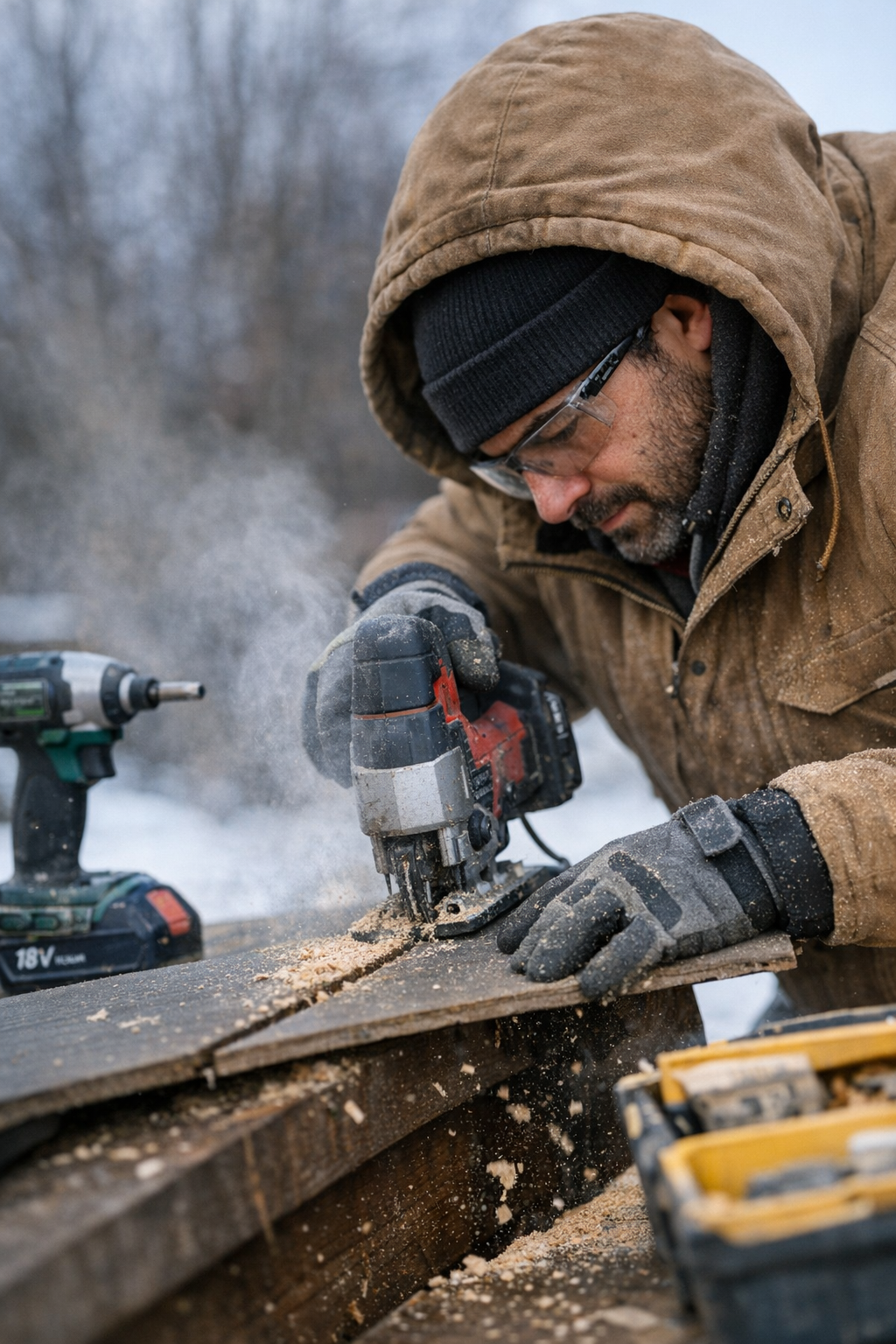
    Winter doesn’t just cool the air—it tests your tools, your grip, and your patience from the first cut. Step outside with your impact driver or jigsaw while frost still lingers on the boards, and the job feels different almost immediately. The machine’s usual rhythm is thrown off: a gritty vibration in the handle, edges that start to feather and chip, maybe an engine note that drops into complaint halfway through a plank. Every task—whether you’re ripping fiberboard under a bare bulb or driving anchors into cold vinyl—puts your setup on notice. In this weather, small mistakes in tool or accessory choice aren’t hidden; they get amplified every hour you work.

    Where Winter Problems Begin: The Cut That Shifts

    Say it’s 7am. Tools charged, fresh blades slotted in, you dig into the day’s first stack of siding or sheet stock. The initial passes are crisp—lines hold clean, effort is predictable. But by board three or four, the lag creeps in. Battery output slips as the cold eats at lithium chemistry. A blade that felt sharp now drags slightly, leaving stringers behind. The sawdust turns sticky, riding the teeth longer. You find yourself leaning harder into the work, correcting as you go, burning up energy just to keep cuts straight.

    Miss these early warnings—slowed drive, ragged kerf edges, a muted pitch from your power tool—and you’re suddenly facing sanding chores, fudge lines, or seams that don’t close without a fight. The drag on your wrists and elbows sneaks up, long before your bucket of bits runs empty.

    Why Power Tools Fade Faster in the Cold

    Chill doesn’t just numb your hands. Inside your impact driver, cold temperatures bog down battery performance and thicken lubricants. Your jigsaw blade flexes less on each pass, amplifying friction where the teeth should be clearing chips. That drag isn’t imagined: a metal blade that glides in July can smoke or bind before lunch in January, especially in poplar, MDF, or pressure-treated lumber.

    Sometimes the clues are immediate: the blade scorches during a simple crosscut, or the driver stalls halfway through a fastener. Other times, it’s cumulative—more force needed for every plunge, until your control slips just enough to scar the workpiece or lose your intended line.

    The False Confidence of the First Few Cuts

    Don’t trust a tool just because it opens strong. Warm batteries fade quicker, and steel dulls faster when each cut is a battle against cold. The first five passes can be smooth, but by the time you’re halfway down a plank or repeating a sequence, the noise changes—a harshness, a buzz that builds in your palm. This is when cleanup doubles and your margins shrink. Savvy tradespeople don’t wait for a total stall; they watch for the moment control softens, and make the pivot before the tool falls behind the material.

    Cold Jobsite Reality: What Really Happens

    Picture a February morning siding install. You’re cutting out 200mm window reveals—a tight plunge, repeated ten dozen times. At first, the saw tracks true, each pass almost routine. By board six, though, the tool’s shoes skip, jigsaw dust gathers in clumps, and suddenly that battery warning feels much closer. The blade, once snappy, hesitates at the start of each pierce. Your cutlines blur, squares go crooked. Are you tired? Maybe. But more often, it’s the combination of a chilled blade losing bite and a depleted battery stumbling under strain that throws your control off course.

    This is where practical routines beat brute force. Swapping to blades made with extra cold flex holds speed and shape longer. Taking 20 seconds every couple boards to brush out the kerf keeps things moving, and a deliberate slowdown—say, cutting at 120mm/minute instead of rushing—prevents particles from packing. The payoff is clear: fewer chewed-up edges, less tool bounce, less end-of-day hand fatigue.

    Reading the Small Stuff: Signals Before Trouble

    Catastrophic failures—broken tips, jammed drivers—are rare. What really undermines your session are the stealthy cues: your grip grows tense by board ten, the cutline wobbles mid-plunge, extra dust hangs up and scorches as the blade passes. Each is a nudge: the tool is struggling, its accessories losing pace. Experienced crews tune into these details early, shifting course before the job turns into a slog of corrections.

    Picking Tools That Don’t Quit (and Habits That Matter)

    Shop shelves can make every blade and bit look equal. They aren’t. Two identical-looking jigsaw blades can have wildly different stamina by noon; one meant for warm shops, the other reinforced for cold, abrasive cuts. When you hit denser stock, the wrong blade burns hot, leaves fuzzy lines, and makes you fight with every inch. A blade meant for the chill keeps its flex and bite, holding straighter and cutting cleaner through cycles of dive, back, and repeat.

    Same for drivers—bits that handle fine indoors can start to slip, chew, or cam out in frozen fasteners. Cold-adapted accessories keep predictable performance, especially with repeated battery swaps and heavy use. The difference, across a project, is a handful of easy finish panels instead of another hour spent reworking corners.

    Quick Routine Shift: Cleaner Cuts, Less Strain

    Keep a stiff nylon brush in your pocket. Give every kerf a swipe out after two or three cuts—especially when chip-out or dust buildup gets obvious. Combined with a slight slowdown in your feed rate, this keeps jaws from clogging and blades from overheating, which means less smoke, less vibration, and steadier control until the day’s done.

    Spotting the Early Drop: How to Catch Power Fade

    Your driver won’t beep out a warning, but you’ll feel it:

    • A newfound coarseness as the blade stutters across a cut
    • Unexpected vibration in materials that were smooth an hour ago
    • Sawdust piling along cutlines instead of clearing clean
    • The tool’s tone deepening under pressure, especially in thicker or colder stock

    Catch these signs early and adjust: swap in a winter-rated blade, clear your kerf between passes, keep your cut pace steady and responsive. Don’t chase yesterday’s tempo—match your rhythm to what the work and tool tell you right now.

    Staying Ahead of Winter Wear

    Cold weather exposes every weakness—in your routine, your gear, and your patience. Ignore the small adjustments, and you’ll be repairing chipped corners, reaching for batteries faster, or rubbing sore wrists before shift’s end. Pay attention early: change out blades before they stumble, clean your path, drop your run speed a notch. The reward is visible—fewer splintered edges, cleaner seams, and less fatigue crossing the finish line. In a winter jobsite, the difference is clear not in the first pass, but in how much energy and time you save when it’s time to pack up.

    Visit Gumboll for tools, accessories, and cold-ready jobsite gear.

  • How Divided Closet Storage Transforms Your Morning Routine Efficiency

    The real test of your closet isn’t in a photo—it’s staring you down on a bleary Monday morning. That’s when the setup either saves your routine or eats up precious minutes. You slide open the door: is today another rush of digging through sock heaps and unraveling lopsided shirt stacks, or do you reach straight for what you need? Every morning answers that—and reveals if your “organization” is really working.

    When “Organized” Isn’t Enough—Closets That Stall Your Routine

    Neat rows and visible stacks look satisfying, but by midweek, reality sets in. Shirts creep into pants territory. Socks vanish to the back, or surface doubled up with T-shirts. Accessories sink between piles, quietly shifting out of reach. What starts as a tidy tableau quickly turns into a puzzle—especially when you need to get dressed fast.

    Organization breaks down the instant you’re in a hurry. If grabbing a single item means rummaging, lifting half a stack, or untangling yesterday’s choices, your system isn’t saving you time. It’s just hiding the struggle until you’re pressed.

    The Cost of Blended Storage: Micro-Delays and Daily Clutter

    Most closets don’t erupt in chaos overnight. Clutter creeps in subtly, with small inefficiencies multiplying each day:

    • Grabbing for that tee tucked behind jeans—toppling the front stack, then spending a minute reshuffling it all.
    • Digging through a pile of gym shorts to rescue a lost pair of socks from the shadows at the back.
    • Staring at a shelf mid-routine, trying to decode if those folded stacks are for work or weekends—because category lines have disappeared.

    Each of these looks harmless, but across a week, they add up. The “organized” shelf keeps stealing moments—and mental bandwidth—that you never intended to lose.

    Where Open Shelving Fails: Boundaries Make the Difference

    Open shelves promise flexibility but quietly encourage chaos. With no clear borders, every reach or return lets stacks bleed together. It’s effortless at first, but maintenance grows exhausting—one category seeps into the next until you’re left with an indistinct pile-up where retrieval is a gamble every time.

    Segmented storage changes the equation. Simple dividers, bins, or dedicated shallow drawers cut the drift. Each category claims a defined space, so shirts actually stay in their lane, socks don’t vanish under sweaters, and accessories don’t free-float into oblivion. You start reaching with confidence—no unstacking, no guesswork, no mental rerouting. The system resets itself every evening when you put things back, not just on big cleaning days.

    The Real Impact of Boundaries: Routine vs. Reset

    Perfectly folded stacks rarely survive contact with real life. One hurried morning is all it takes for clothes to sprawl across old category lines. Add in roommates, partners, or kids—each with different ideas of “putting things back”—and your system deteriorates even faster.

    Physical boundaries—however simple—shrink these gaps. The hesitation vanishes. Each grouping stays visible. Even after a hasty grab, you know exactly where the next shirt or belt belongs. The system is more forgiving, making resets a near-automatic part of your nightly routine rather than another chore you avoid.

    Real-World Reset: Four Zones, One Shelf, No Second-Guessing

    This isn’t a closet makeover. It’s a targeted swap. Take a broad shelf and split it into four functional zones: shirts, pants, athletic gear, accessories. Slide in dividers or line up a handful of bins—suddenly, every item is either in place or obviously out of it. Mornings become one-move decisions. At night, even if you toss things back a bit scattered, broad borders wrangle them into order without extra effort or a weekend overhaul.

    Some days will be messier than others. That’s the point—segmenting doesn’t demand perfection, just gives you guardrails that reset every time you put something away. You don’t need a labelmaker or a new closet—just an honest look at where your system lets clutter sneak in.

    Warning Signs: How Crowding and Confusion Take Over

    Most people spot trouble only when it’s already annoying them. Signs your closet’s boundaries have blurred:

    • Socks wedged under jeans or shirts, vanishing for days.
    • Shirt piles slumping or spreading sideways after a few quick pulls.
    • Baskets that were meant to “organize” have merged—now everything’s mixed in one low-visibility bin.
    • You find yourself scanning every shelf for a missing belt, then rifling through three categories for a single item.

    If any of these sound uncomfortably familiar, a couple of well-placed dividers or bins can put boundaries back in play—often without needing to blow up the whole closet and start over.

    Build Zones That Actually Survive Daily Use

    • Think broad, not fiddly. Use wide segments—shirts, pants, accessories—so you can quickly toss and retrieve. Micro-compartments are high-maintenance and invite friction.
    • Keep prime real estate for daily essentials. Eye-level space should go to what you reach for most. Overflow and seasonal pieces can live up top or down low, where access matters less.
    • Stop before you over-divide. Too many boxes and boundaries become another organizing chore. Make it obvious, not labor-intensive, even for someone sharing the closet.
    • Leave room to breathe. Don’t max out every inch. A bit of empty space makes stacks less likely to tip and helps small items stay reachable instead of getting squashed or hidden.

    It’s not about buying more. It’s about designing storage that handles real life—rushing, resetting, and all the messiness between.

    What “Works” Looks Like: Effortless, Not Flawless

    The goal isn’t a show-home closet; it’s one that stays clear even on brutal mornings. You shouldn’t be thinking about “organization” at all. You should be pulling out your shirt and socks, barely noticing the mechanics because each thing lands in its own spot—routine, repeatable, and resilient when you’re running five minutes late.

    Check yourself: Are you hesitating before grabbing? Are the stacks becoming shapeless blobs by Wednesday? Do you dread putting laundry away because it messes up what you just “organized”? If so, try adding one blunt boundary—a divider, a container, a wide bin. Let the improvement show in your speed and calm, not just in the visual tidiness you snap for social media.

    http://closetworks.myshopify.com

  • Why Your Garage Storage Fails After Repeated Use and How to Fix It

    Tidy at a glance tells you nothing about performance in real life. Garages and workshops fill up with wall-mounted kits, rolling carts, and shelf grids that look sharp after setup. Everything appears under control: hooks aligned, bins stacked, paths clear. But walk in after an actual project, when tools have been dumped in a hurry, bins are halfway out, and you’re jogging between tasks—and that sleek first impression shatters. Order that works in theory can dissolve the moment you’re working against the clock. Does your setup help you bounce back to ready, or does getting organized become another mini-job every time you finish?

    Where Neatness Fails: The Repeated-Use Backslide

    The early satisfaction—rows lined up and tools “put away”—lasts only until you go through a few tough days of real use. Suddenly, you’re moving a bucket just to wedge the drill back where it “belongs.” Each handled tool seems to require a two-step process: one back, another jostled, a third about to topple. What looks like overflow is really evidence of broken flow. That bin left in the walkway? It started as a quick fix when you couldn’t find space mid-task and now lingers, an obstacle for every return trip.

    Overflow happens in predictable hot spots. Park a ladder a few inches too close to a wall rack, and suddenly your sports gear zone is inaccessible. A bike temporarily leaning by the tool shelf morphs into a permanent barrier. The aisle you swore would stay open slowly narrows as “just for now” items migrate. Every tiny compromise—an extension cord dropped, a tote slid halfway, a toolbox at the edge—builds up to real blockages. The zones you planned lose their edges, and you find yourself constantly sidestepping, reaching awkwardly, or just leaving things out.

    Everyday Friction: How Good Layouts Slip

    Blocked In—When Footpaths Become Storage

    Picture coming in with arms full: you want to slide the rolling cart back to its spot or stash a bag by the workbench. But the shelf zone is flush to the wall and just snug enough that any extra item forces you to shimmy things around. You nudge the cart, but it brushes a ladder, which bumps a bin—movement becomes a chain reaction. After a few return trips, the cart ends up abandoned wherever the path is clearest, never quite making it “home.” Freestanding chests and bins become semi-permanent headaches, nagging you every time you try to clear even simple access.

    Serial Shuffle—Losing Minutes on Every Reset

    After a long session, you’re ready to reclaim space and shut the garage. But the wall zone needs to be rearranged before handled tools will fit, and the bucket that holds rags must move just to put the drill away. Repetition sets in: shift, return, reshuffle, then repeat. Reset time balloons from “two minutes” to five, ten, sometimes longer if you’re tired or racing daylight. Soon enough, the temptation is strong to just pile things up somewhere and promise yourself you’ll fix it next time.

    Blurring the Lines—Zones Lose Their Meaning

    The lines you drew—garden on the left, project tools up front, sporting gear down back—fade each week. Repeated use pushes overflow into the nearest empty zone. What began as “organized” soon lets handled tools pile in the paint bucket, cords drape from hooks meant for rakes, and heavy hedge trimmers jut into the walking route. The original organization is still there, technically, but the space no longer works smoothly—everything’s present, nothing’s easy.

    Reset by Design: Small Tweaks, Noticeable Results

    Return flow beats shelf count every time. Improvement rarely boils down to just adding hooks or shoving in a bigger rack. Real change begins with making it easier to put things back—especially when you’re tired, distracted, or in a hurry. For most, that means lowering your most-used options to within arm’s reach (no need to tiptoe or crouch), and ensuring your clean-up path isn’t a tight squeeze between obstacles. If the tools you grab daily are positioned for a quick drop-off on the way out, friction fades; if not, small annoyances pile up fast.

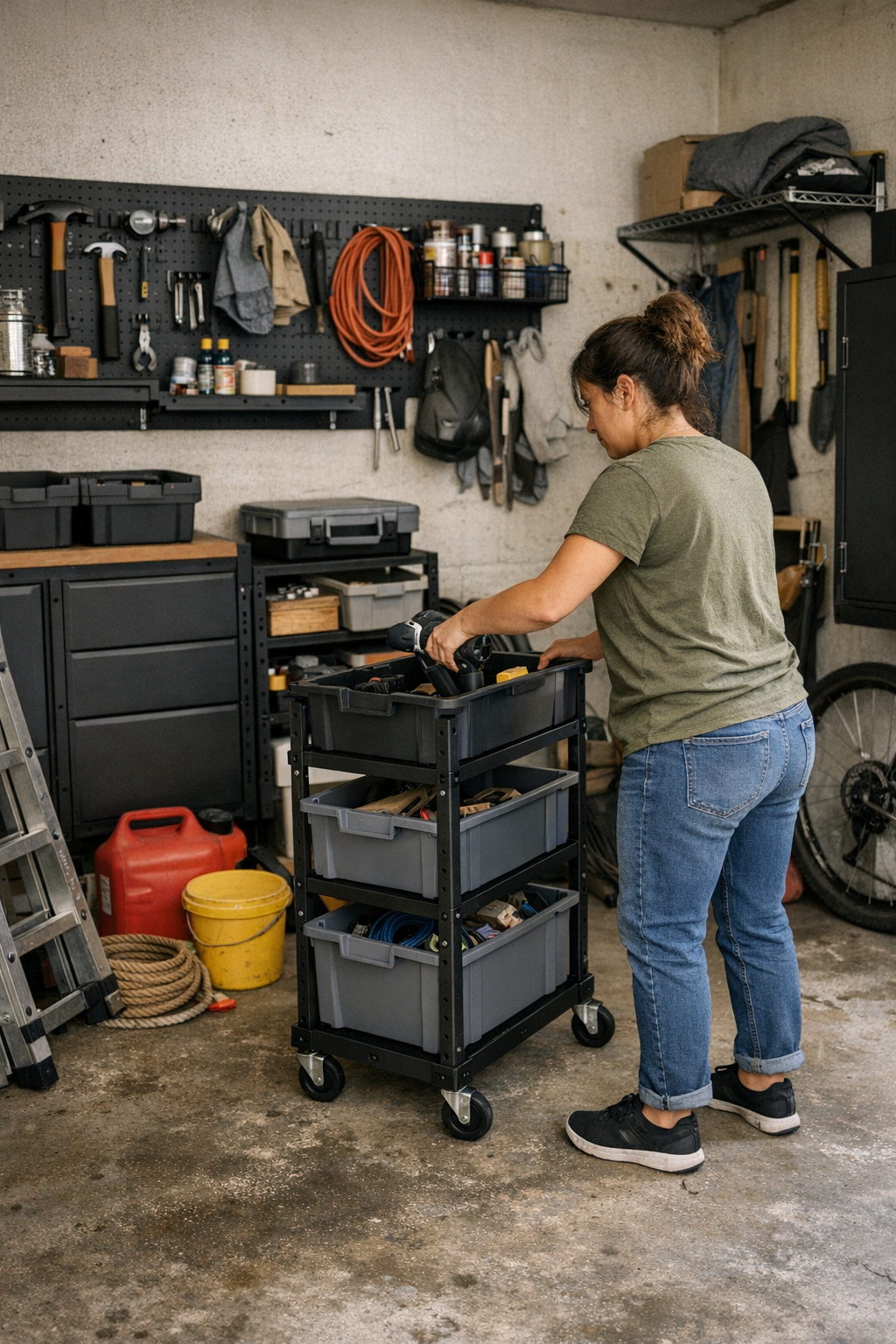
    Treat rarely-used gear like seasonal storage and get it up and out of your main workflow. Meanwhile, claim “prime” space near entry points and major work zones for handled items and daily-use gear. One of the simplest, most underrated fixes: keep a mobile cart or bin as a reset staging zone. During a project, it collects everything in motion—wrenches, cords, clamps—without forcing you to stop and return each piece as you work. At the end, a single trip with everything in hand keeps you from scattershot clutter and blocked footpaths. Less reshuffling. Fewer missed returns. More predictably clear zones.

    Signal Flares: Know When Your System’s Giving Way

    Watch for slow-creep mess. Do half a dozen handled tools gather in corners or on shelves “for now”? Do path edges fill with toted-in gear by the end of every busy week? These are not random accidents—they’re signs that your layout isn’t matching how you move and work. Pay close attention to spots that collect the most overflow or spark the most annoyance. The “just slide it over” problem reveals exactly where a shelf height, wall hook, or reset path needs an upgrade—or where a mobile staging solution could save daily steps.

    More shelves don’t help if resets keep getting slower. Whenever added storage doesn’t ease the return flow—especially for fast-access items—clutter just redistributes itself. The mark of a better system is not a higher storage count, but fewer pauses, less backtracking, and open movement even when the space feels crowded. The faster you reset without shuffling, the longer your setup holds out against daily chaos.

    Real Payoff: Resets That Don’t Wear You Down

    When routines get busy, a well-designed setup makes itself invisible: no blocked wall access, no squeezed-in carts, no hesitation about where things go. Handled tools land in their spots almost by habit—no extra thought, no urge to pile them “out of the way.” When you rarely have to reshuffle, reach around a cabinet edge, or drag bins just to clear a path, you know the layout is pulling its weight. Ignore looks; the real measure is smooth, repeatable motion, and fast, low-effort resets every time.

    Design around your real routine, not just storage targets. When your system flows with your habits—easy returns, open paths, visible zones—it survives seasons and stress. When it doesn’t, no amount of clean lines or matching bins can save you from blocked movement, pileups, and lost time. Build for use, not just for display, and your space will stay useful—and ready—week after week.

    Find more practical storage ideas and tools for better resets at StackNest.

  • Choosing Dynamic Harnesses to Prevent Indoor Angle Grinder Kickback

    The shortcut on the jobsite is painfully familiar: You’re gearing up for a messy round of indoor grinding, maybe tight drilling overhead, maybe a long haul of sanding awkward seams. Gear selection turns into an afterthought—grab whatever harness and lanyard are closest. “Any PPE is better than nothing,” you mumble. But the first real cut exposes that lazy logic fast: steel meets hidden rebar, the bit bucks, or the wheel bites and jerks. Now, every tool kickback rattles through your body. Safety gear that felt routine becomes friction: tension in your shoulders, a jolt to your back, lost precision, a cutline wandering off target while gloves fill up with grit. Instead of fighting the material, you’re fighting your own equipment, and the job gets slower, sloppier, and more exhausting with every pass.

    How the Wrong Harness Turns Minor Misses Into Major Rework

    You know the cycle: The first cut or fastener feels right enough. But as you move down the run—grinding edge, nailing anchor, swapping to a new battery—the little mismatches in your harness start to add up. Stiff, static harnesses don’t cushion tool vibration or re-center after a binding cut. Every shock travels through unforgiving webbing straight into your hips and shoulders. It’s not just discomfort; your grinder drifts sideways, your drill skips the mark, and even sanding edges starts to require more force and micro-adjustments. By day’s end, “good enough” gear means extra sanding, patching, and sometimes retracing your entire cut—lost time you’ll never bill for.

    The Difference: Dynamic Harnesses for Active Tool Use

    Harnesses all look roughly the same—heavy straps, big buckles, no-nonsense rings. But a grinder-ready harness actually works with your body’s movement. Dynamic designs allow enough flex at the hips and shoulders to absorb quick shocks, pivot naturally, and keep you balanced instead of tipping you off-line with every unexpected rebound. Look for abrasion-resistant materials built to withstand repeat tool motion, not just idle “fall arrest” claims. It’s these small design differences—flex zones, shoulder articulation—that add up hour after hour when your arms are stretched above your head or you’re reaching for that last awkward fastener.

    Lanyard Choice: The Unseen Saboteur

    Most harness complaints come mid-task: When a drill snags or a grinder stalls, a cheap, static lanyard becomes the silent problem. Shock-absorbing lanyards rated at 1.2 kN or better make bites and skips manageable—not a full-body wrench that throws you off your line. The difference is subtle: Instead of feeling every minor bind twice, once in the tool, once in your core, shock absorption smooths out the job, giving you control to correct and keep the pace steady. Over a long shift, those hard checks on static webbing sap your stamina—and precision—far more than any one big slip.

    Real Spaces, Real Strain: Grinding Where It Counts

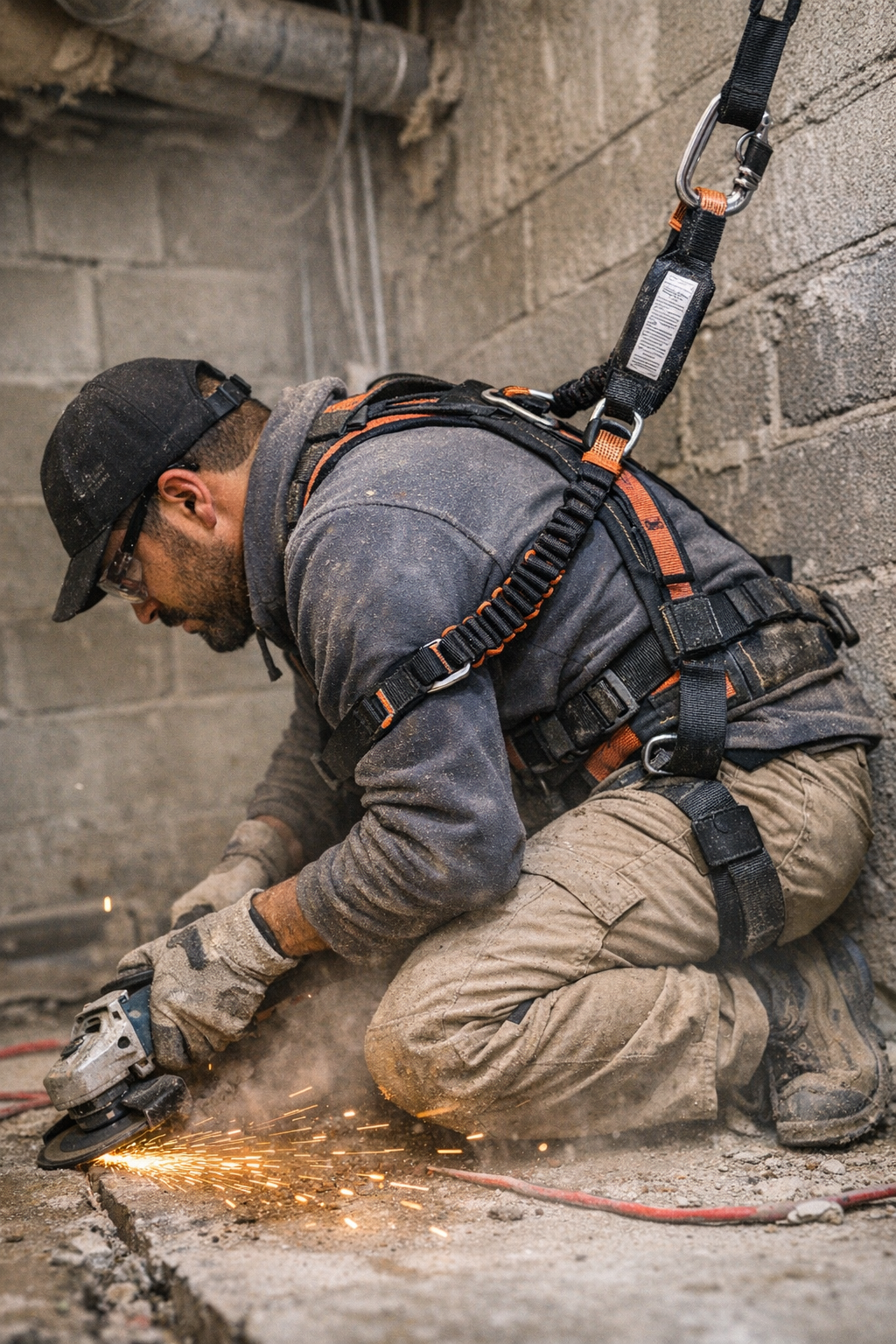
    Picture the job that won’t let you stand upright: crawlspace, furnace closet, elbow jammed against cold pipe, sander howling in your ear. It’s not just a one-off—it’s a regular Tuesday. Every new pass means adapting posture, ducking wires, and your cut path changes as soon as your stance does. When your harness rebounds every tool kickback straight into your spine, your hand slips, lines meander, and the finish starts looking amateur midway through. The right gear—shock-damping harness, dynamic lanyard—lets you regain steadiness when you shift position, not punish you for moving at all. With a static setup, fatigue and tool drift compound fast: after six or seven passes, you’re looking at real cleanup work, not just a quick brush-off at the end.

    When Fatigue Takes Over: The Hidden Cost

    It’s rarely just a single mistake that trashes your finish. Usually, it’s the cumulative effect of a dozen small jolts: a lanyard tug every time the saw binds, fresh resistance halfway through a long drill, awkward torque with each battery change. Dust and sweat make you clumsy, but it’s the unseen friction in your PPE that erodes your edge, both physically and in the cut. Each time the harness drags you off-center, your focus narrows—and the more you push, the messier the result. Dynamic gear doesn’t promise perfection—it just keeps those tiny mistakes from snowballing into hours of late rework.

    The Real Impact: What Changes When You Choose Right

    Switching to a dynamic-force harness and a quality, 1.8-meter shock-absorbing lanyard (rated to absorb at least 1.2 kN) delivers changes you can count by the clock and by the square foot:

    • Cleaner, more consistent tool control on long, repetitive cuts—even when material density shifts or you’re forced into awkward reaches.
    • Noticeable drop in shoulder and hip fatigue, so you’re not dragging yourself through the last hour or switching hands just to manage the ache.
    • Tighter edges and fewer off-line gouges, keeping touch-up sanding and patchwork to a minimum instead of stacking up at the end of each job.
    • Freedom to pivot mid-task: no more wrestling your body around equipment just to get a better angle. The gear moves with you, not against you.

    It’s less about buying “the best” and more about spending sixty seconds at set-up: adjust every strap for active fit, focus slack in your workspace, buy lanyard and harness as a team rated for repeat, real-world tool abuse. Ignore “one-size” PPE or generic fall arrest claims. The best spec: Look for dynamic load language and mentions of repetitive tool use.

    Red Flags: How to Know Your Gear’s Slowing You Down

    You don’t need to wait for a nasty mistake to realize your kit’s holding you back. Real-world warning signs speak up across a single shift:

    • Your grinder or sander drifts more often as the hours tick by—or you keep adjusting grip mid-cut just to stay on line.
    • Strange aches at the end of routine days, body tension you’d expect after falling, not after normal work.
    • Unfinished edges demand double the cleanup—when your PPE fights you, so does the finish.
    • Any moment you catch yourself wrestling with the harness, not the tool, you know it isn’t working for you.

    Good PPE fades into the background—you barely think about it as you move. If it’s on your mind for the wrong reasons, that’s a sign the frustration probably isn’t your fault.

    Easy Fix: Prep Right, Work Clean

    Get ahead of tool rebound and fatigue by tuning your PPE before the first cut—not after the first slip. Before starting, give yourself one minute: check for unrestricted movement in hips and shoulders, verify visible absorption specs, and adjust straps so you’re not flailing for range mid-job. If your lanyard or harness is “fall-only,” leave it for static work—using it on active, repetitive tool runs is a shortcut to frustration and wasted time. The small prep on the front end is the trade-off for controlled, predictable work by the end of the day.

    Even when the jobsite won’t pause for personal comfort, paying attention to your kit upfront earns you cleaner results, fewer aches, and less time fixing yesterday’s mess.

    Find more practical safety gear and grinder-ready PPE at Gumboll.

  • Why Drawers Quiet Visual Clutter Better Than Open Shelves in Closets

    The difference between a closet that just looks organized and one that actually works gets painfully obvious after a few weeks of real, messy life. You start with orderly stacks and labeled bins, but day after day, it gets harder to find what you need, put things back where they belong, or face the closet at all. That quiet, everyday struggle usually comes down to one choice: drawers or shelves. It sounds trivial—until every rushed morning and tired evening depends on how easily you can grab, stow, and reset your space.

    The Subtle Chaos of Shelf Living

    Open shelves are seductive when they’re empty. You imagine clean stacks of shirts, everything visible, zero effort to grab what you need. But the first time you reach for a T-shirt under last night’s gym shorts, the pile above slips, suddenly nothing fits right, and socks tumble to the floor. What started neat turns soft around the edges—by midweek, jeans are half-folded on top of sweaters, and a belt has vanished behind piles you stopped reshaping days ago.

    Every reach on an open shelf risks unravelling order. The more you hurry—or the more people dip into the same closet—the faster categories blur. Socks merge with tees. That stack of shorts you kept so nice on Sunday now leans, threatening to collapse every time you brush by. And anything you don’t use daily? It somehow drifts further out of sight, pressed to the back, forgotten until next season’s cleanup.

    When Overflow Isn’t About More Stuff

    The first real trouble isn’t running out of space—it’s running out of clarity. Half a shelf can look overstuffed after just a few imperfect grabs. Once one category slips into another, you waste time untangling shirt from shirt, or restacking after a single wrong move. This isn’t a slow road to chaos; a couple of rushed mornings, a partner’s hurried change, and your “easy-access” shelf is now a minor daily headache.

    If you’re coordinating laundry, flipping clothes for a new season, or sharing the closet with kids, the disorder spreads faster. One off-pattern day and suddenly the whole system feels harder to fix than just shutting the door and ignoring it.

    Drawers: Hidden Order, Faster Function

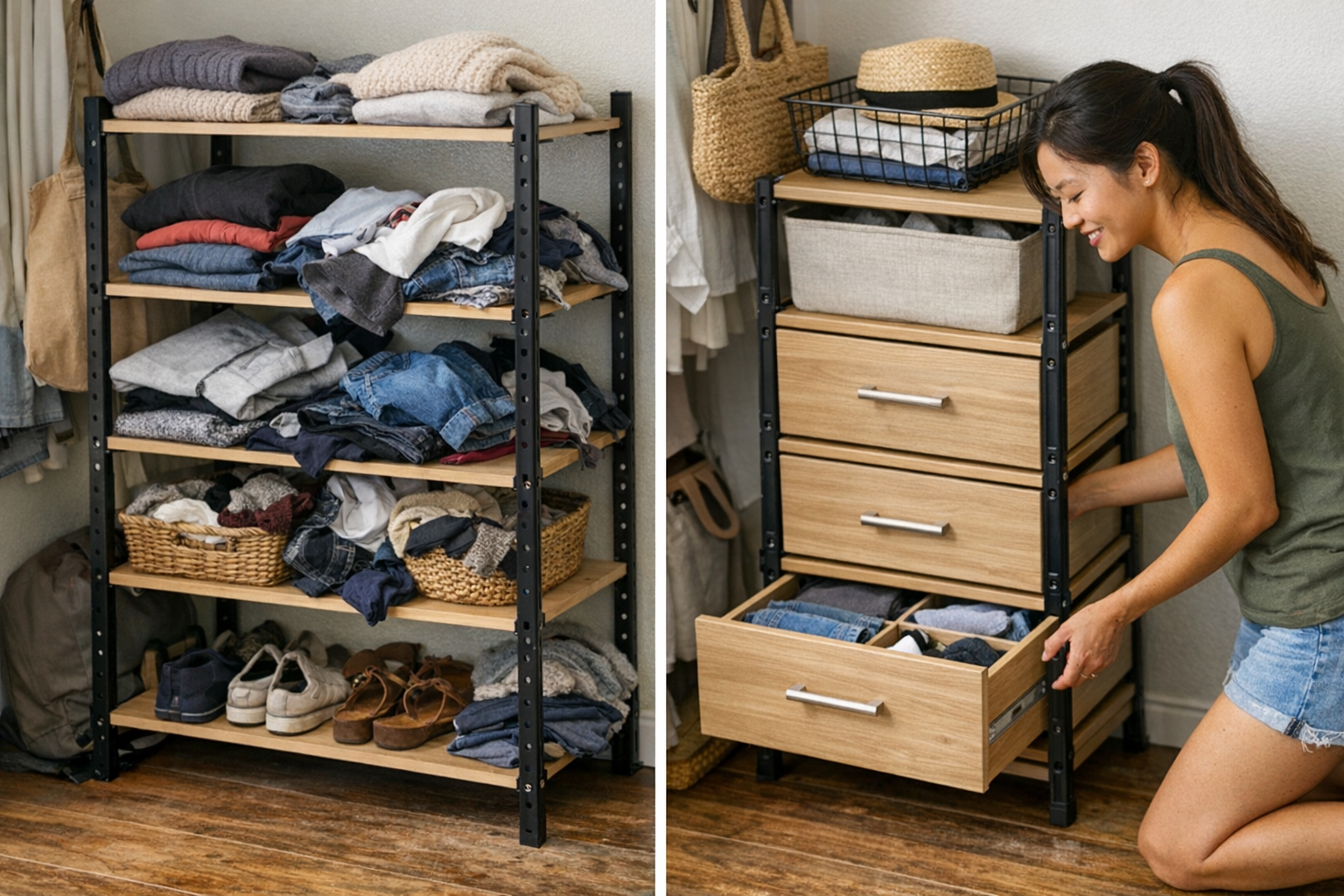
    Drop a drawer into the mix, and everything changes. Suddenly, grabbing a tee or pair of socks takes a quick pull—not a careful restack. That semi-messy pile? It’s out of sight, out of mind, letting you reset only when you choose, not every single day. Drawers absorb life’s imperfection; the exterior stays neat, no matter how jumbled the inside might get after a wild week.

    Drawers mute the mess. The outside stays serene, even as the categories inside inevitably swirl together. Your closet feels under control—even on a weeklong laundry delay.

    The One-Minute Reset

    Think of the pre-drawer routine: To find a shirt at the bottom, you’d lift three stacks, knock over socks, and probably refold the top layer just so you can close the door without shame. With drawers, you slide out, grab or return, and slide shut—the mess never travels out into view. You get back precious minutes, and the closet looks freshly arranged long after the folded piles inside have taken a beating.

    The longer you live with drawers, the more you realize you’re less anxious about “finding time” for a reset. Imperfect isn’t visible—so you don’t feel the pressure to reorganize with every little slip. That energy returns only when you actually want to do a full tidy, not at the sight of sliding stacks every morning.

    When Open Shelves Still Earn Their Keep

    Shelves aren’t always the villain. For capsule wardrobes, shoes on display, or entryway jackets you grab daily, open access works. Just limit the number of categories—shelves handle five pairs of shoes, not two dozen, and those tidy rows of baskets only work if you keep sorting to a minimum.

    But the moment you add more—scarves with hats, gym clothes with sweaters—the shelf can’t keep up. You either spend precious time every week reshuffling, or the shelf blurs into a landscape where categories die and clutter wins. With drawers, you can let your categories multiply. The chaos stays hidden, and you’re free from that nagging tally: “I have to do something about this tonight.”

    Fewer Messes, Smarter Fixes

    The real advantage isn’t picking sides—it’s combining the right features for your habits. If you find yourself constantly rescuing lost socks or separating tangled belts, add drawer-dividers to create micro-zones. These invisible fences let one drawer handle five things without a weekly avalanche. For shelves, shallow bins or baskets help, but only up to a point—too many categories, and even the best bin loses purpose as items migrate with each hasty morning.

    If your shelves always get crowded at the front while the back sits empty, or if every category seems to wander by midweek, a single deep drawer with internal dividers often outperforms a row of shallow bins. The secret is breaking up chaos before it happens, not after.

    Are You Stuck with the Wrong Setup?

    How do you know if your closet is working? Simple: if restoring order takes longer than thirty seconds, or if staring at the shelves fills you with dread, something in the setup is doing you a disservice. The best systems—drawers, well-placed dividers, limited open shelving—don’t just look good for guests. They quietly eliminate clawing for the socks behind your sweaters, keep rush-hour reshuffles to a minimum, and let you get in and out without that familiar sigh.

    For practical, hard-won ideas on closets and every other home storage challenge, visit ClosetWorks.

  • Why Reliable Docking Transforms Modular Storage Efficiency

    The rush of pride after overhauling your garage or workshop is real. For an hour, maybe even a weekend, every shelf lines up, bins sit flush, and the floor feels wide open. It looks perfect. But the honeymoon fades the moment you actually get to work: dragging the hose in, returning a heavy drill, steering the rolling cart with one hand while keeping an eye on a batch of fasteners in the other. This is when the true shape of your layout reveals itself—not when everything’s pristine, but when things need to slide back into place, fast, usually with only half your attention left. Suddenly, the question isn’t how tidy the setup looks—it’s whether it can handle the churn of real use without turning into chaos all over again.

    The Hidden Weak Spots That Creep Up on Busy Weekends

    At first, even a flawed system hides its faults. But in action, little hiccups repeat—bins that never seem to seat right the first try, carts that always seem to block just enough aisle to make every passing trip a squeeze. Where storage fights the return, the whole space starts to resist your routine. Movement turns clumsy. You’re nudging bins, shifting carts diagonally, or detouring around the one cabinet edge always jutting out past the work zone.

    This slow slide into disorder doesn’t explode in one big mess; it happens in increments. A wayward bin lingers out of its spot “just for now.” The end of one row quietly becomes an overflow pile—gloves, odds, and the shovel you’re too rushed to squeeze back between other gear. Dead corners fill with what doesn’t fit elsewhere. Eventually, every new task means first reshuffling the last task’s leftovers.

    Docking: The Physical Difference Between “Tidy” and “Effortless”

    When every storage piece docks instantly and reliably, you stop thinking about storage entirely. The best setups let you return a hammer, a set of gardening shears, or an armful of odds and ends with a one-handed slide or a blind push in passing. There’s no fiddling, no extra turns, no checking if things lined up. Your whole flow stays intact, even when your hands aren’t empty or your mind’s on the next step.

    Everyday Setbacks You Don’t Notice Until They Add Up

    Picture this: Mobile bins stacked on plain shelves. On paper, there’s a place for everything. But try unloading after an afternoon outside—your hands are dirty, you’re juggling a few tools, and one bin refuses to dock. It’s crooked, maybe backwards, and needs a second fumble to sit right. The cart you rolled out earlier? It never returns flush to the wall, leaving an annoying wedge of lost floor space right where you want to walk. Pretty soon, routines stall: you sidestep, nudge, and on the third trip your patience wears thin. The setup can store things, sure, but it forces workarounds at every turn.

    How Minor Friction Becomes Major Disorder

    These minor struggles might seem harmless, but they snowball. Over time, tools start to gather in piles—closer to the workbench or on the nearest surface, because getting them “home” feels like another task. You keep shifting one rolling cabinet back and forth, just to clear enough room to open a drawer or access what’s behind. Overflow becomes routine; zones meant for flow turn into dumping grounds. Every movement through the space involves squeezing past something not quite where it belongs.

    A truly resilient setup shrugs off sloppy returns and quick drop-offs. If you can’t rediscover order without slowing down or using both hands, the system will always settle back into clutter. Clear aisles get pinched as carts drift, bins sit askew, and your carefully mapped-out zones blur into catch-alls. That sense of control you chased with the reorganization begins to unravel in slow motion.

    Real-World Example: When Optimization Backfires

    Imagine a single-car garage, squeezed for space but maxed out with two lines of modular bins and a rolling tool chest. On paper, every inch works. By the end of week one, reality intrudes. Bin rails call for a two-handed dance to dock each return. The tool chest, always meant to tuck aside, starts to wedge out on an angle after every use, blocking access to a corner shelf. A shovel, forced into a gap, jams the rest of the lineup, so it gets abandoned in the only free corner. Within days, every pathway demands another awkward step, every retrieval triggers a reshuffle, and routine maintenance—sweeping the floor, clearing a spot to work—takes twice as long. The garage isn’t full; it’s just functionally blocked.

    Why Physical Guides Outperform Good Intentions

    What keeps order isn’t discipline, but design. Physical guides—rails, channels, bumpers, or defined stops—quietly enforce alignment no matter how rushed or careless the return. You slide a bin and it locks into place; roll a cart until it clicks against a bumper and suddenly the aisle’s clear again. Footpaths don’t shrink. Wall zones stay usable. Every return is a single, mindless motion, not another puzzle to solve at the end of the task.

    Without these guides, even the sharpest visual layout unravels with regular use. Bins drift off center, carts wedge at odd angles, wall space fills with random leftovers until you’re digging to find what’s next. But add a few effective rails or channel stops, and you can reset the whole area with a handful of casual returns. The difference isn’t in how it looks but in how it performs—especially when working fast or under distraction.

    Fast Upgrades: Docking That Fixes Routine Clutter

    Restoring flow doesn’t require a total rebuild. Retrofit add-ons—like adhesive rail strips, magnetic guides, low-profile channel kits, or bolt-on stoppers—can turn any shelving or rack system from decorative to dependable. Many commercial storage units and rolling cabinets have options for add-on docking hardware. Even a simple tactile end-stop on a shelf keeps bins in check and stops the slow sideways drift. The impact is real: no more re-centering after every use, and no more micro-adjustments just to keep the zone clear. A 10-minute tweak can give back hours of hassle across the month.

    Spot the Choke Points—Then Solve Them for Good

    If you’re repeating the same shuffle every week—a cart half-blocking the walkway, bins always askew, and overflow zones always growing—a missing docking solution might be why your space feels harder to keep tidy than it should. Instead of fighting to maintain order, smart layouts work with your habits. A system built to absorb hasty returns stays orderly regardless of the pace of life, freeing you to actually use your garage or workshop, not just clean it.

    Day after day, that’s the upgrade that matters most: clear movement, fast resets, and storage zones that actually stay clear. With the right guides in place, order becomes automatic—never a project, just what happens next.

    Explore modular storage systems and docking solutions designed for real, repeatable routines at StackNest.

  • Preventing Angle Grinder Overheat During Extended Remodeling Tasks

    If you’ve ever ripped through a full day of drywall cutting, tile trimming, or metal sanding, you know the shift: the job starts crisp, but progress quietly grinds down. The angle grinder that flew through grout lines an hour ago is now fighting you—edges chip, lines wander, and your hands ache from the tool’s growing warmth. You try to muscle through, and suddenly you’re stuck: a simple project hijacked by an overheated grinder you thought could handle more than it actually can.

    The Slow Creep of Overheating—And How It Shows Up

    No one feels the problem out of the gate. On a fresh start, even bargain grinders cruise through thin steel or tile backer with satisfying control. But stretch an afternoon replacing a backsplash or resurfacing a bathroom—dust thickening in the air, handle slick against sweat—and you start losing the fine touch. Clean cuts demand brute force. The casing radiates heat. Instead of shavings, you get clumpy, sticky dust. Every grip feels heavier.

    It’s easy to chalk this up to tough material or a long workday—until your seams turn ragged and your patience starts leaking away. Repairs that should be five-minute fixes balloon into full re-cuts or desperate edge-sanding. All because the grinder started fighting you, not helping.

    The Tool’s Limits—Not Just Yours—Set the Pace

    Heat sneaks up, quietly changing how your tool behaves. On most job sites, it shows in repetition—grind, adjust, drill, repeat. That’s when you see the split: run two similar grinders side by side, and they feel identical until you hit the third or fourth stubborn tile or start sanding flush through rusted plate. Suddenly, one holds its RPMs and remains cool, delivering sharp lines and steady control. The other lags—RPMs dip, the handle warms ominously, and vibrations buzz through your grip. Cut quality nose-dives as resistance builds, and the motor’s smooth hum gives way to a strained, sluggish churn. Dust turns grainy and heavy. What’s really happening? The tool’s fighting its internal heat more than it’s working the material.

    Little Warnings That Add Up Fast

    Seasoned hands spot trouble sooner: dust clogging in odd places, vent slots hot enough to notice, a faint drag as you drive a screw or slice through a joist. A blade or bit that wandered easily now grabs and snarls, chewing up more board than you wanted. The finish falls apart: chipped tile, burned drywall edges, screw heads that strip rather than bite. It’s a domino effect—fatigue in the tool multiplies fatigue in you, and what should be an hour’s work stretches into two.

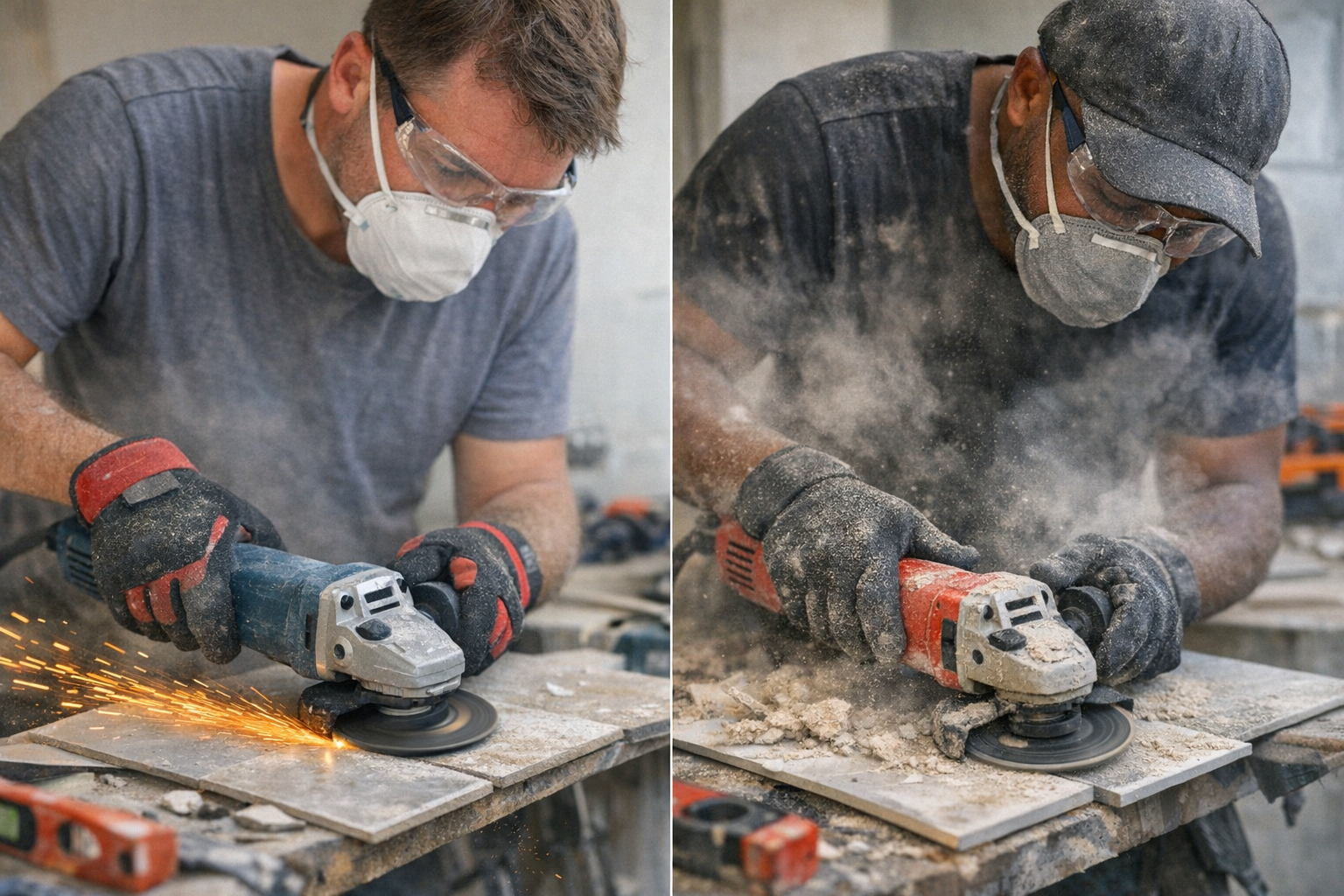
    Picture grinding away at a kitchen renovation. By midday, your dust mask clogs with heavy powder, and control slips—cuts that started straight now require two-handed correction. Every blade swap and disc change feels more desperate. By late afternoon, the workspace is thick with debris and you’re cleaning more than cutting, wishing you’d stopped ten minutes earlier for airflow or a longer tool break.

    Why Heat Sabotages Your Workflow

    It’s more than just hot handles. Overheated grinders burn out soft-start circuits, chew through brushes, and dry bearings until every movement stiffens. That means sudden stall-outs or safety shut-offs when deadlines are tight. Missed heat cues force you into last-minute cleanups, or worse—blown tools that need downtime or, bluntly, replacing before the job is done. Trying to speed up by ignoring the warning signs nearly always adds extra hours, not fewer.

    Build Smarter Routines—Not Just Bigger Muscles

    This isn’t about pampering your tools, but about respecting the limits you only discover through real work. Switching to a grinder rated for at least 1,200 watts isn’t a luxury—it’s self-defense. The upgrade isn’t just raw power: it’s steadier RPMs under load, cleaner cuts deeper into the day, and discs that run cooler and last longer. But the real shift comes from changing your habits. Forced cooldowns—even five minutes every half hour—pay off more than one last rush to finish before lunch. Keep vent slots clear. Alternate heavy grinding or cutting with lighter prep work or fastening. Swap out a worn blade for a fresh disc before you notice the slowdown.

    On a recent tile demo, sticking to a timer—twenty minutes on, five off—kept the tool’s chassis cool enough to touch. Every detail went smoother: lines stayed straight, cuts stayed crisp, and by 5 p.m., there were no ugly surprises or frantic touch-ups. PPE was less of a chore, and fatigue slacked off instead of building up by the hour.

    Simple Hacks for Hot Jobsite Days

    If your routine still leaves your grinder gasping for air, improvise. Run a box fan across your bench or clamp a desk fan nearby to move hot air through the body. It’s not high-tech, but a steady breeze spares the tool—and your nerves—on sweltering afternoons or in tight corners where heat just lingers. Swap bits and blades quickly; don’t wait for smoke or that scorched, metal smell.

    Catch the Signals—Or Pay Double on Cleanup

    Blown finishes almost never start with an obvious failure. Instead, it’s sticky dust, rough seams, guide lines going off-track, or a suddenly aggressive blade. Catching these moments early isn’t fussy; it’s practical. It spares you evening recuts and helps you hand off a job that looks professional from start to finish.

    Big claims and technical specs matter less than how the grinder actually behaves hour after hour. Trust how the tool feels in your hands and set your workflow accordingly. Every grinder hits its limits—ignore the warning, and the tool will decide when you’re done, not the other way around.

    See all practical power tools and jobsite equipment at Gumboll.

  • Why Open Shelving Feels Overwhelming Without Proper Containment

    In theory, open shelving should make life easier. Everything visible, nothing buried, zero digging—just a quick glance and you’re set. But a few days into real-world routines, that same “everything in sight” setup turns out to be a different kind of trap. Suddenly, your quick-scan shelves aren’t just open—they’re exposed. The neat surface starts to blur with clutter, and you’re not just seeing what you want. You’re seeing everything out of place, all at once.

    The Real Trade-Off: Easy Access, Loud Mess

    Open shelves look immaculate right after you organize. Each item has its place. But daily living never stays still: breakfast rushes, late-night cleanups, coats dropped, groceries pushed aside to make space “just for today.” All that visibility quickly becomes a liability. Every half-empty pasta box, slouched stack of towels, or wandering phone charger pulls your shelf a little further from that streamlined start. There’s no hiding spot for the grit of everyday life.

    Clutter: Slow Drip, Sudden Surge

    At first, the system feels almost perfect. But skip a single nightly reset, or let one category drift, and the decay is instant. Cabinets and baskets can disguise their secrets. Open shelves announce every sideways snack bag, every towel that’s lost its folded edge, every bottle leaning out of line. You see it all—the fraying stacks, the items inching out of their lane—until you’re not reaching for what you need; you’re sorting through the aftermath.

    Everyday Storage Friction You Actually Notice

    The pain isn’t just visual—it interrupts the flow of your day. Grabbing cereal in the morning suddenly means moving two bags of chips and an open box of granola bars, each reshuffle threatening another slide. By midweek, categories bleed into each other: spices mixed in with soup cans, lids and stray packets scattered everywhere. Instead of “see it, grab it, go,” every task tacks on extra shuffling, restacking, or rerouting.

    Bedrooms and closets aren’t immune. Shoes creep off their shelf, spilling into stacks of folded sweaters. Scarves and hats multiply in the entryway tray, becoming a mountain you must dig through for car keys or a single glove. One busy afternoon and the boundaries are gone—each section loses its purpose, and clutter quietly spreads from shelf to floor to everywhere else.

    The Ruthless Feedback Loop of Open Shelves

    Open shelving doesn’t forgive. You miss a reset day, and the shelf broadcasts it instantly: a closet shelf half-collapsed, a pantry with snack piles tumbling over, a garage shelf whose “miscellaneous” bin now means “look here only if you have time to untangle a jumbled mystery.” Every time you pause to hunt, rearrange, or restack, you feel the friction—an organized shelf that quickly becomes background stress instead of daily support.

    Containment: The Small Shift That Actually Works

    Containment isn’t about hiding—it’s about boundaries. Even on open shelves, adding low-profile bins or trays gives each group of items a place to belong, and a reason to stay put.

    Try this in a kitchen: Swap a row of loose snack bags for a shallow bin. Now, refilling snacks means one slide in, one slide out—no more shifting four other items just to reach a granola bar. Bins corral awkward or rolling items, making resets far less tedious. The shelf still looks open and accessible—but the chaos is contained before it can spread.

    Quicker Resets, Longer-Lasting Clarity

    Containment changes the shelf math. Resetting stops being a full-on reorg and becomes a two-minute tidy. Instead of nudging ten boxes and hoping nothing falls, you just slide, lift, or swap out a grouped bin. Categories hold their shape. Even in an entryway, a single tray or basket can anchor hats, gloves, and keys—preventing that runaway sprawl that greets you every time you head out the door.

    Physical boundaries reinforce routine habits. A simple divider keeps snacks from invading breakfast, cleaning products from wandering across laundry shelves, towels from slumping into shoe territory. When every group has both a visual and physical marker, resets feel faster and the system holds—even after a week of real use.

    When Open Shelves Signal It’s Time for a Change

    Does this sound familiar? You’re refolding the same shirt stack for the fifth time, untangling a pile of misfiled mail, or—again—moving three boxes just to find the soy sauce hiding behind random pasta. These are all signs your open shelves are missing containment. If keeping things orderly takes more work than actually using what you store, the system’s not serving you—it’s slowing you down.

    Daily Fixes That Actually Last

    Give every shelf a clear job. Use shallow bins or trays for loose, drifty items—snacks, cleaning supplies, all the one-offs that love to roam. Reserve wide, open shelf space only for what stacks solidly and stays put: books, baskets, or neatly folded linens. When (not if) things shift out of place, the fix should be a quick tap or toss, not a forty-minute reset.

    And forget the showroom fantasy. Functional storage doesn’t penalize daily use. It bends for busy mornings, late nights, and every mess in between. Sometimes, it’s the smallest shift—a few bins, a label, a better section break—that keeps your system steady through real life, letting you get in, get out, and move on.

    See all practical shelving and containment solutions at ClosetWorks.

  • Why Modular Storage Outperforms Traditional Portable Carts Every Time

    Roll in another bin, add a cart with wheels, and suddenly your workshop or garage looks under control. The promise: portable storage makes everything flow. The reality—at least by week two—is messier. Carts stray into walkways, bins slip off their marks, and what seemed flexible starts blocking your every move. That “easy” storage upgrade turns into another round of shifting, nudging, and working around your own organization—especially where every project starts and ends with hands full in tight quarters. In spaces that get daily use, friction creeps in quickly, and the smallest roadblocks repeat until they slow you down without you noticing why.

    When “Moveable” Means Constant Rearrangement

    The first day with new rolling units feels great—everything aligned, clear floor space, all your gear in arm’s reach. It’s only after the routine sets in that you spot the cracks. The cart that drifts six inches into the center of the walkway. The bin wedged tight under a workbench. That moment when you twist around a sharp cabinet edge yet again, running out of patience along with elbow room. One shelf blocks another, or you’re forced to shuffle three carts just to get to the socket set you needed in the first place.

    These repeated speed bumps—nudging carts out of the way, sorting bins that have migrated, climbing over low-rolling obstacles—turn your setup into a series of slow-motion detours. By week’s end, you’re spending as much time resetting as you are working, with “portable” units adding complexity instead of cutting it.

    The Drift Effect: Why Storage Stops Staying Put

    Real flexibility needs real boundaries. Without any anchor points, every move you make gradually undoes your original order. You finish a landscape project on a muddy day, and now one cart sits at an angle, its wheels gummed up, blocking part of the shed door. Or you return from a supply run, wheel in an extra bin, and realize you’re stacking it awkwardly in a dark corner simply because nothing else fits. Every small misalignment compounds: the rolling shelves you loved at first now have to be corralled before any real work can start.

    This is the drift effect—the subtle, repeated movement of each unit, scattering your organizational effort. At a certain point, you’re not accessing storage; you’re managing where your storage goes and how to get it back in line, each time you need a tool or want to sweep the floor.

    Looks Organized, But Gets in the Way

    That crisp row of bins looked perfect on set-up day. But now, you break stride to pull the wrong one, or you’re elbow-deep in reshuffling just to reach one tucked behind another. The layout seemed right on paper; in practice, bins overlap, catch on coarse mats, or must be unstacked in a specific order or nothing fits.

    The day-one footprint rarely holds up to actual use. You start sliding overflow into the nearest “dead corner.” Carts left parked halfway across the room mark your path like traffic cones. The result: a zone that appears tidy, but forces you to move more things more often, adding hidden work to every routine cleanup or start.

    Outdoor and Workshop Setups: Where Surfaces Sabotage You

    Backyard and shed storage raises the stakes: weather and tough surfaces fight you with every return trip. Rain brings in mud, and soon wheels grind or stop dead over a lump of dried grass. Uneven pavers trip bins up; a rack shifted by one storm now blocks the mower’s path. By Wednesday, your cart is twisted just enough to catch on the shed doorframe, and the bins that rolled out for tools have settled wherever you left them—requiring a full restack just to find the shovel or hedge clippers.

    The constant reshuffling isn’t just a nuisance. Each interruption—bending for a stuck wheel, restaging bins for access, clearing the way after wind or rain—steals a bit of momentum. Portability without reliable return just means more chaos moving around the room, less time getting anything done.

    Get Real: Why Anchoring Makes Everything Easier

    The real fix isn’t bolting everything down—it’s guiding every piece back exactly where it works best, every time. Swap out loosely parked carts for those with anchoring systems: lockable wheels, low-profile guides, or simple docking rails. Suddenly, you stop chasing bins across the room. Each unit returns to its mark—usually without even thinking—so you navigate through clear, predictable paths. That click of a wheel lock or the subtle guide of a rail does more than prevent drift; it resets your zone after every use, snapping storage back into alignment automatically.

    It sounds like a small change, but the effect is outsized. Fewer detours, fewer scattered overflow piles, fewer stalls when you should be working. Resets become almost invisible: you push a cart back and it locks in, your walkway stays open, and you stop managing your storage and start using it. The right anchor points—however simple—turn a roaming stack of bins into a genuine system you don’t have to babysit.

    How to Know Your Storage Is Failing Your Routine

    Ask yourself: are you sliding the same bin around just to access something behind it, every single time? Are awkward stacks building up in the corners you meant to keep clear? Has your work zone gradually narrowed, pinched by mobile units that never seem to return to their exact slot?

    If the answer is yes, your storage is now in your way—forcing you to constantly adapt the flow to work around the solution. Even mounting some shelves to clear space helps only if everything is sized for actual repeated grabs. Too many non-matching bins or carts inevitably means friction returns: overlapping units, forgotten tools, oddball footprints breaking up a usable wall. Consistency, not variety, is what keeps things working. A zone that can be reset in seconds always beats one that just looks neat after a three-hour cleanup.

    Building a Setup That Lasts Beyond Day One

    The only test that matters is how the setup handles routine, not just reset. The right portable storage keeps your main zones clear, lets you put things back fast without puzzle-solving, and means you’re not rearranging bins just to do simple jobs. When carts dock where you expect, when units stop drifting and routine resets happen almost by muscle memory, your storage finally fades into the background—supporting your pace, not slowing it.

    In practice, that means less reshuffling, fewer overflow piles, easier movement, and a shop or backyard where you spend more time doing, less time managing around dead corners and wandering bins. It pays off every day you don’t think about it—because the setup now fits your flow, not the other way around.

    Find modular storage solutions for real working spaces at StackNest.