Blog

  • How Wall-Mounted Storage Transforms Yard Cleanup Efficiency

    Walk outside after a long day. Your yard is almost clear—except for the cluster of hand tools dropped by the fence, that folding chair wedged in the side strip, and drink bottles under the table from last night. No matter how often you tidy, these same dead zones soak up clutter over and over. What looks like a minor mess is actually a setup flaw you trip over daily: storage that slows you down and quietly invites the same splatter of items to stack, wedge, and spill back into your path. When every reset means wrestling with containers or coaxing items out from behind bulky bins, “putting things away” turns into a cycle of moving clutter from one trouble spot to another—and the clutter wins more often than not.

    Where Clutter Really Starts: The Setup That Fights You

    You can straighten up after every activity, but when the storage doesn’t fit the rhythm of actual use, your ritual grinds down fast. Family projects overflow the patio. Hand tools scatter by the garage. Guests drag over folding seats that never quite make it back to where they belong. The first cracks show up in the pinch points—garage thresholds buried under bins, utility shelves crammed onto narrow paths, or side-yard chests that jam shut with a single unexpected addition. You keep ‘just setting something down’ for a second, already knowing what happens next: the system is too clumsy to keep up, and each trip adds a friction point you end up dodging rather than fixing.

    Floor bins look organized just after a major cleanup. But in daily use, they break down. The lid sticks; you wedge it closed. You want the soccer ball, but it’s lost under cables and last season’s gardening gloves. With no dedicated return spot, everything turns into a mini scavenger hunt, especially after busy weekends. The floor gets jammed, corners fill up, and soon you’re shuffling pieces just to clear a walkway.

    Wall Systems vs. Hidden Piles: Why Visibility Changes Everything

    Wall-mounted storage isn’t just about neat lines—it’s about real, visible accountability. Open racks and shelves make it impossible to hide the stragglers. Missing rakes, lopsided loppers, stray gloves—all stand out. The storage tells on you: every misplaced item gets noticed fast, pushing you (and everyone else) to return things properly before the chaos starts rolling.

    Closed bins and big containers promise instant order, but the calm doesn’t last. Little things drop to the bottom, heavier tools crush the smaller ones, and eventually you end up stacking things awkwardly on top or even beside the closed lids. Footpaths disappear. One return blocks another. It becomes clear in practice: wall systems force problems to the surface—and force you to keep the system moving. Bins let disorder disappear until it boils over and the old shuffle resumes.

    Reset Friction: Seeing Setup Weaknesses in Real Use

    After a cookout, the usual: half the yard is a grid of cushions, tools, and bottles waiting to be collected. If your only storage is that main patio bin, you’re stuck—one overloaded box and now items pile up outside it, or right in the traffic lane to the door. The next time you need something, you yank the whole bin out, paw through yesterday’s leftovers, and hope you spot what you’re after.

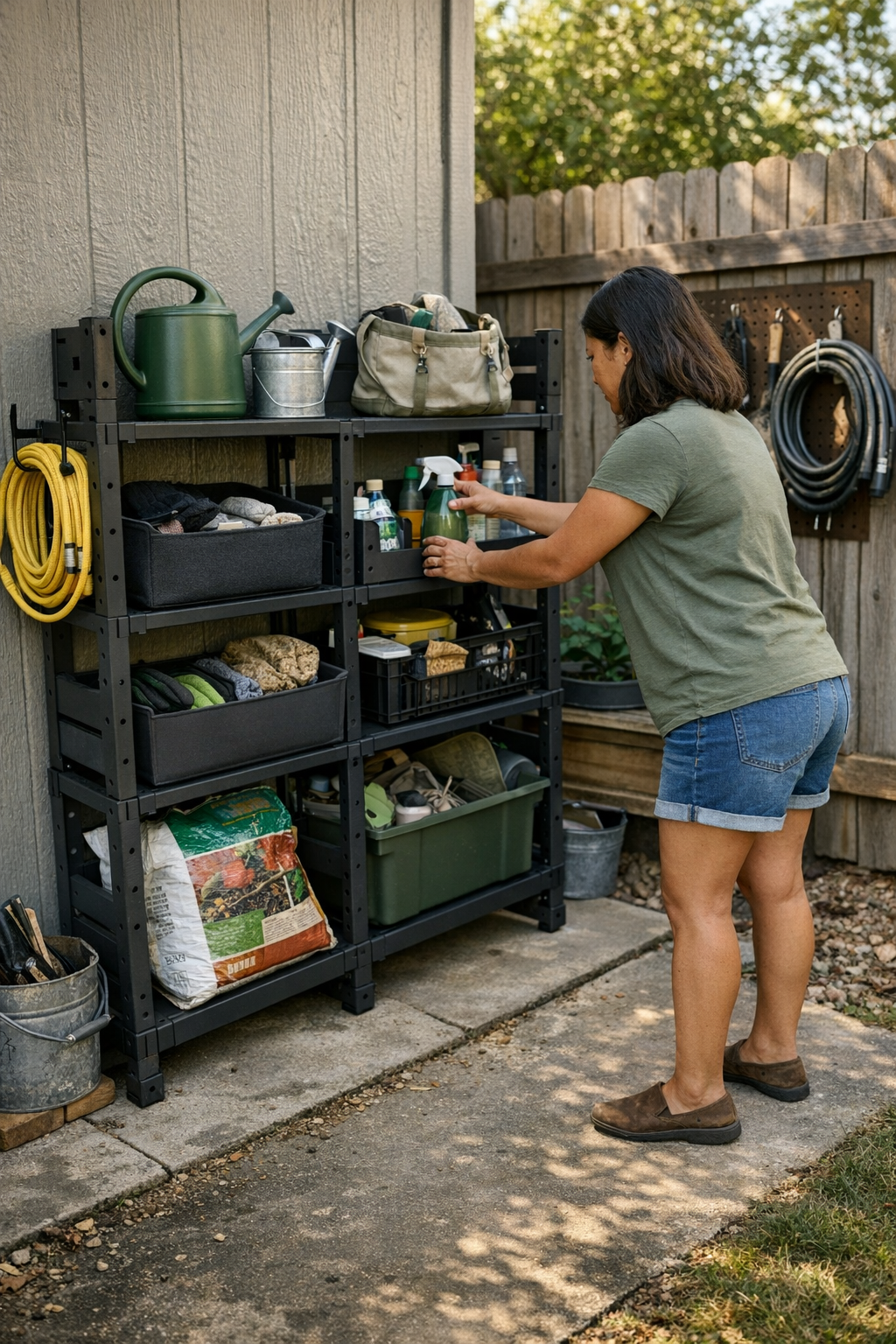
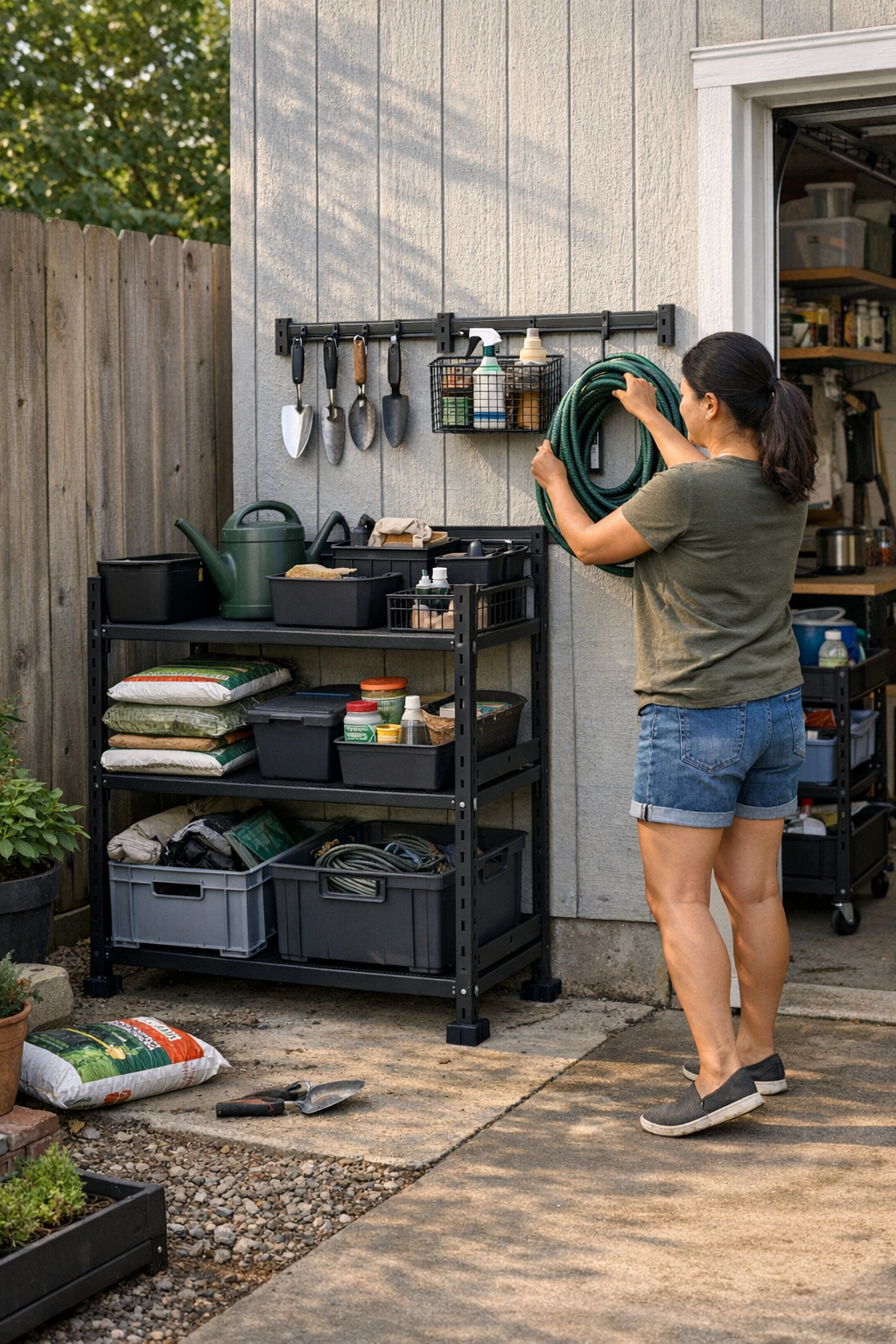
    Wall racks along the garage edge or side yard break this loop. Each tool has its spot, visible by default. Anyone coming in from the yard instantly knows where the shovel or the garden fork goes. Resetting isn’t about digging—just returning everything to its line. Overflow doesn’t build up when the route back is so clear and frictionless. Even on hectic days, you’ll notice resets take less time, and nothing blocks your way.

    Small Tweaks, Big Shifts: Altering Setup Flow

    Sometimes it takes a simple, physical change to break an old routine. Swapping out a ground-level bin for a wall rack along the garage did more than clear the walkway—it turned a clutter trap into a default parking zone. Mount shelves and racks at just above waist height, and suddenly tools can be hung and grabbed by anyone, without stretching or stooping. Hooks stop the slow drift of tools collecting at ground level, because it’s suddenly awkward to leave them anywhere but their spot.

    Stubborn problem corners improved once there was nowhere left to casually stash junk. The back-of-garage wasteland, the unreachable strip down the side—they both changed once racks forced a decision: return it, rehome it, or admit it doesn’t belong. Instead of hiding the mess, the setup pushed you to fix it up front. It was less about storing clutter out of sight and more about stopping it from forming at all.

    Real-World Tip: Visibility Wins Over Capacity

    Outdoor organization only sticks if the return path is obvious enough to beat old habits. Put wall racks and baskets where you naturally finish up—at the garage, by the entry, along the main path. If kids always dump gear in one zone, hook a small basket or pegboard where their routine ends, not where you wish it started. The more you engineer these choke points for visual clarity, the less likely temporary clutter becomes tomorrow’s obstacle.

    Clutter Creep: Catch Trouble Before It Grows

    Watch for the spots that refill first: that puddle of shoes clustered at the back door, the tool bag that sits “just for now” at the end of a storage bench, the corner beside the plastic cabinet that keeps catching everything with nowhere else to go. These aren’t minor quirks—they reveal where the system doesn’t serve the rhythm of your return flow. Every moment you detour, hesitate, or walk a tool around a blockage is a sign that something isn’t matched up.

    Wall-mounted storage clears out floor space and prevents one returned item from becoming tomorrow’s blockage. In the side-yard strip, remember the jam of bins that choked off passage? A simple rail transformed that stretch: now, brooms and tools hang up, and even with surprise storms or new visitors, resets are snappy and the path stays open. Assigning visible homes for each tool means less double-handling and fewer lost pieces buried in piles, because bottlenecks can’t hide.

    Modular Doesn’t Mean Effortless

    It’s tempting to chase modular bins or rolling carts for flexible storage, but these can turn into roaming clutter-magnets without strict routines. Too often, carts drift off course, bins collect stray items “for now,” and the entire storage zone becomes a reshuffling relay. Even the most adaptable setup fails if you’re just pushing piles from spot to spot.

    The Real Test: Can Your Setup Survive a Busy Week?

    Wall-based and clearly zoned storage is about habit, not just looks. If there’s only one possible place to hang the hose or stash the gloves, the reset pathway becomes muscle memory. You stop making decisions and just do the return. When every return is automatic and nothing “temporarily” blocks the flow, the yard is ready whenever you want it—not just after a weekend deep clean.

    It’s not about picture-perfect order. It’s about setting up friction so that clutter almost can’t gather. That’s how a yard stays open for movement, for family projects, or for a surprise get-together—even when no one has time for a full reset.

    Visit TidyYard for storage ideas that make outdoor routines less frustrating.
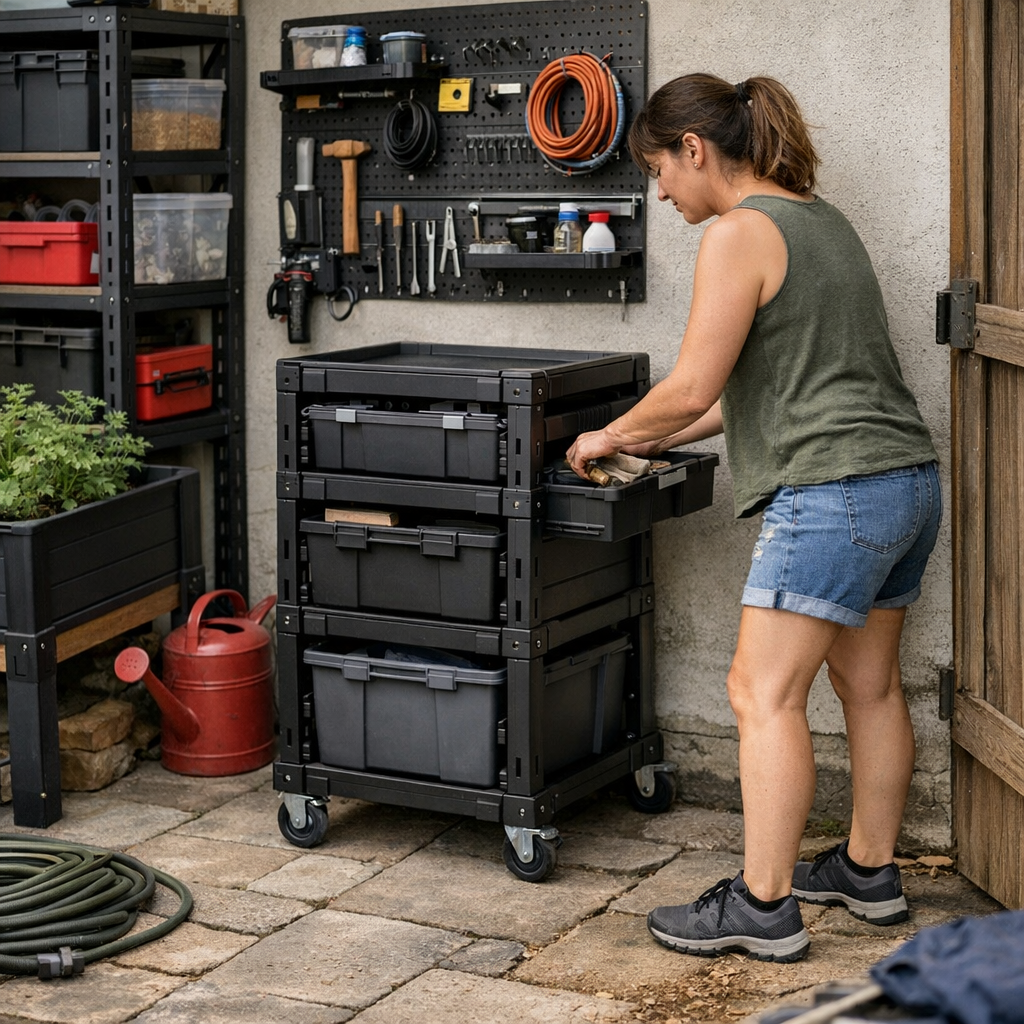
  • Why Modular Storage Outperforms Traditional Portable Carts Every Time

    Roll in another bin, add a cart with wheels, and suddenly your workshop or garage looks under control. The promise: portable storage makes everything flow. The reality—at least by week two—is messier. Carts stray into walkways, bins slip off their marks, and what seemed flexible starts blocking your every move. That “easy” storage upgrade turns into another round of shifting, nudging, and working around your own organization—especially where every project starts and ends with hands full in tight quarters. In spaces that get daily use, friction creeps in quickly, and the smallest roadblocks repeat until they slow you down without you noticing why.

    When “Moveable” Means Constant Rearrangement

    The first day with new rolling units feels great—everything aligned, clear floor space, all your gear in arm’s reach. It’s only after the routine sets in that you spot the cracks. The cart that drifts six inches into the center of the walkway. The bin wedged tight under a workbench. That moment when you twist around a sharp cabinet edge yet again, running out of patience along with elbow room. One shelf blocks another, or you’re forced to shuffle three carts just to get to the socket set you needed in the first place.

    These repeated speed bumps—nudging carts out of the way, sorting bins that have migrated, climbing over low-rolling obstacles—turn your setup into a series of slow-motion detours. By week’s end, you’re spending as much time resetting as you are working, with “portable” units adding complexity instead of cutting it.

    The Drift Effect: Why Storage Stops Staying Put

    Real flexibility needs real boundaries. Without any anchor points, every move you make gradually undoes your original order. You finish a landscape project on a muddy day, and now one cart sits at an angle, its wheels gummed up, blocking part of the shed door. Or you return from a supply run, wheel in an extra bin, and realize you’re stacking it awkwardly in a dark corner simply because nothing else fits. Every small misalignment compounds: the rolling shelves you loved at first now have to be corralled before any real work can start.

    This is the drift effect—the subtle, repeated movement of each unit, scattering your organizational effort. At a certain point, you’re not accessing storage; you’re managing where your storage goes and how to get it back in line, each time you need a tool or want to sweep the floor.

    Looks Organized, But Gets in the Way

    That crisp row of bins looked perfect on set-up day. But now, you break stride to pull the wrong one, or you’re elbow-deep in reshuffling just to reach one tucked behind another. The layout seemed right on paper; in practice, bins overlap, catch on coarse mats, or must be unstacked in a specific order or nothing fits.

    The day-one footprint rarely holds up to actual use. You start sliding overflow into the nearest “dead corner.” Carts left parked halfway across the room mark your path like traffic cones. The result: a zone that appears tidy, but forces you to move more things more often, adding hidden work to every routine cleanup or start.

    Outdoor and Workshop Setups: Where Surfaces Sabotage You

    Backyard and shed storage raises the stakes: weather and tough surfaces fight you with every return trip. Rain brings in mud, and soon wheels grind or stop dead over a lump of dried grass. Uneven pavers trip bins up; a rack shifted by one storm now blocks the mower’s path. By Wednesday, your cart is twisted just enough to catch on the shed doorframe, and the bins that rolled out for tools have settled wherever you left them—requiring a full restack just to find the shovel or hedge clippers.

    The constant reshuffling isn’t just a nuisance. Each interruption—bending for a stuck wheel, restaging bins for access, clearing the way after wind or rain—steals a bit of momentum. Portability without reliable return just means more chaos moving around the room, less time getting anything done.

    Get Real: Why Anchoring Makes Everything Easier

    The real fix isn’t bolting everything down—it’s guiding every piece back exactly where it works best, every time. Swap out loosely parked carts for those with anchoring systems: lockable wheels, low-profile guides, or simple docking rails. Suddenly, you stop chasing bins across the room. Each unit returns to its mark—usually without even thinking—so you navigate through clear, predictable paths. That click of a wheel lock or the subtle guide of a rail does more than prevent drift; it resets your zone after every use, snapping storage back into alignment automatically.

    It sounds like a small change, but the effect is outsized. Fewer detours, fewer scattered overflow piles, fewer stalls when you should be working. Resets become almost invisible: you push a cart back and it locks in, your walkway stays open, and you stop managing your storage and start using it. The right anchor points—however simple—turn a roaming stack of bins into a genuine system you don’t have to babysit.

    How to Know Your Storage Is Failing Your Routine

    Ask yourself: are you sliding the same bin around just to access something behind it, every single time? Are awkward stacks building up in the corners you meant to keep clear? Has your work zone gradually narrowed, pinched by mobile units that never seem to return to their exact slot?

    If the answer is yes, your storage is now in your way—forcing you to constantly adapt the flow to work around the solution. Even mounting some shelves to clear space helps only if everything is sized for actual repeated grabs. Too many non-matching bins or carts inevitably means friction returns: overlapping units, forgotten tools, oddball footprints breaking up a usable wall. Consistency, not variety, is what keeps things working. A zone that can be reset in seconds always beats one that just looks neat after a three-hour cleanup.

    Building a Setup That Lasts Beyond Day One

    The only test that matters is how the setup handles routine, not just reset. The right portable storage keeps your main zones clear, lets you put things back fast without puzzle-solving, and means you’re not rearranging bins just to do simple jobs. When carts dock where you expect, when units stop drifting and routine resets happen almost by muscle memory, your storage finally fades into the background—supporting your pace, not slowing it.

    In practice, that means less reshuffling, fewer overflow piles, easier movement, and a shop or backyard where you spend more time doing, less time managing around dead corners and wandering bins. It pays off every day you don’t think about it—because the setup now fits your flow, not the other way around.

    Find modular storage solutions for real working spaces at StackNest.

  • Achieving Lasting Calm with Slim Lighting and Smart Cable Support

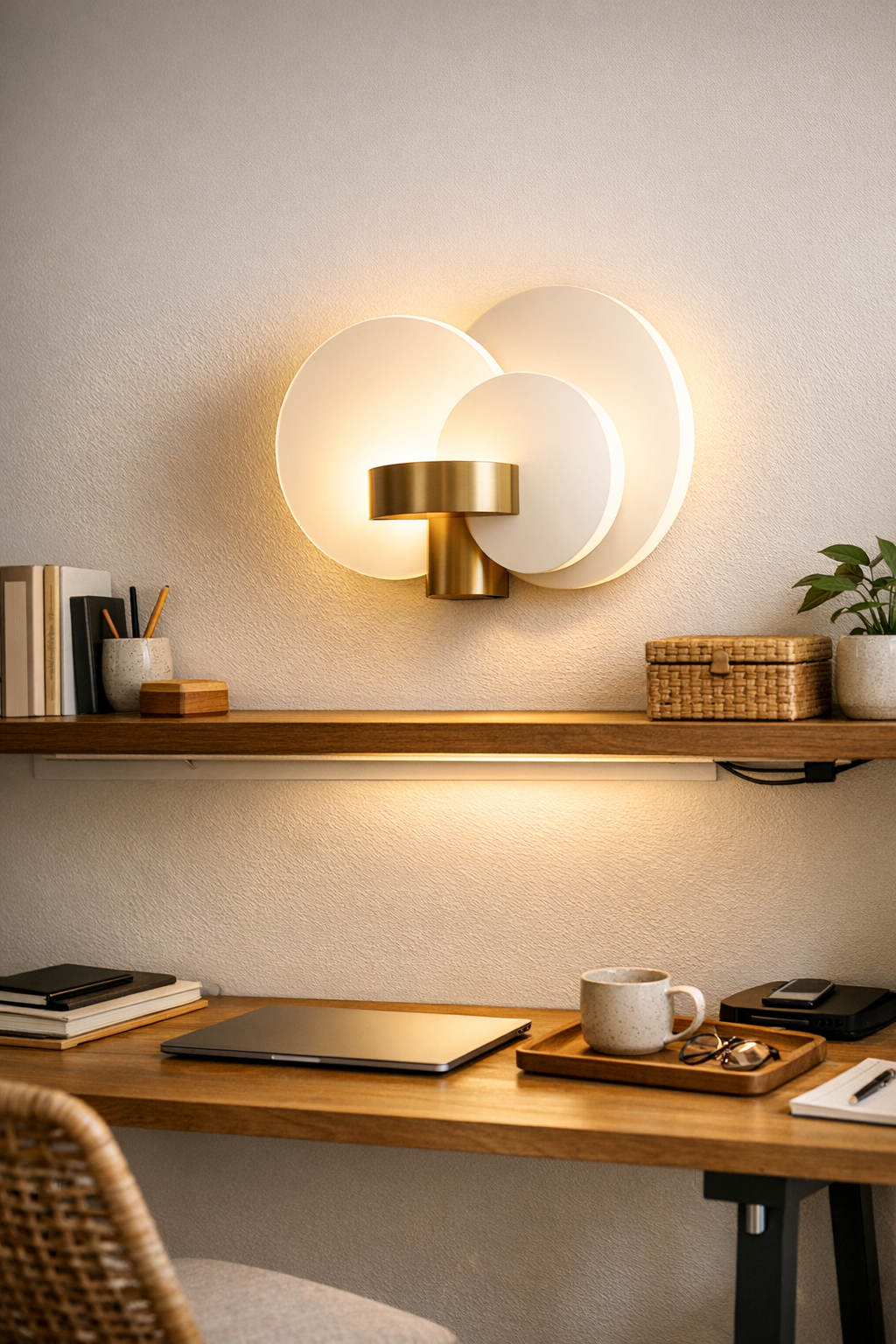
    Your shelf or desk can look surgically clean with slim LED strips, hidden cables, and “invisible” mounts—until real use exposes the cracks. What seems minimal on install day often unravels: glare lines appear, cables droop where your hand lands, and the outer desk edge stays dim no matter how much you nudge the fixture. The difference between a lighting setup that quietly does its job and one that sabotages your routine lies entirely in the support details: the routes, anchors, and brackets most people skip right past.

    Where Friction Creeps In: The Problem with Quick Fixes

    That tidy light bar under the shelf or plug-in edge panel looks like a solved problem—until the second or third day of use. The cable you meant to hide starts poking out between books. By the end of the week, you’re shifting your chair to dodge an unexpected glare angle, or finding your workspace half-lit, the front edge still in shadow.

    Loose cables, soft mounting, and ignored fixture alignment never look urgent at first. But in any setup that sees traffic—actual work, cluttered surfaces, or just repeated arm sweeps—these small gaps turn into constant irritants. Shared desks, hallway shelves, or kids’ zones especially expose how quickly “clean” lighting degrades into visual mess or daily hassle.

    Why Low-Profile Lighting Needs High-Attention Support

    Blending a fixture into the background only works if its support disappears just as well. The three fast ways a minimal lighting plan breaks down:

    • Dangling or drifting cords: Unanchored cables slowly work loose, get caught on objects, or become the thing you notice first—breaking the whole minimalist illusion.
    • Lighting pushed too far back: Light aimed at the wall leaves the active zone—where you write, swipe, or drop your keys—in consistent shade.
    • Mounting that obstructs or interrupts: Even slim brackets, if placed wrong, snag elbows, clash with stacked books, or become dust catchers right where you reach.

    These breakdowns get worse with every touch, plug-in, or quick rearrangement—making the “minimal” setup feel messier than what came before.

    Real Scenes: The Difference in Day-to-Day Use

    Picture two shelf lights, identical in type:

    • The first stays flush against the rear wall, cable left dangling out of reach, mount clips visible where you set down your bag.
    • The second routes its cable flat and hidden along the shelf’s back, with the light itself nudged forward to throw coverage directly over the day’s work zone.

    Within a week, the first setup is a small minefield: books push against loose wires, glare catches your eye at odd angles, tablet cables knot themselves with lighting cords, and a persistent streak of shadow stays along the work edge. With the second setup, the light just works—no tugged wires, no frustrating dimness at the shelf’s edge, no hardware interrupting routine motion. The difference shows up not in photos, but in the absence of daily distractions or half-conscious tweaks.

    This isn’t about add-ons. It’s the disciplined use of support details—tight cable runs, low-profile brackets, practical placement—that keep a clean install from collapsing into visible, lived-in disorder.

    Beyond Appearance: Where Lasting Setup Stability Comes From

    Most lighting stays perfect for a day or two. Then support weakness creeps in:

    • Cables that migrate: If you don’t guide wires firmly along the rear or down a well-defined path, they creep forward, getting caught or becoming another source of dust and interruptions.
    • Fixtures that flex or tilt: Adhesive or magnetic strips survive a few days’ use, then start sagging—the light bar doesn’t sit flat, and the “straight line” turns crooked the tenth time you open the cabinet.
    • Lighting that misses target zones: Even a couple inches off with placement and the edge you work or read on turns into a lingering dark spot, obvious halfway through every use session.

    Ignored, any of these can become a small but fixed annoyance—one that’s always present, even after the novelty of a new fixture vanishes.

    Making “Invisible” Lighting Actually Work—For The Long Haul

    Real improvement comes from small, targeted adjustments:

    • Anchor cables completely flat, not just out of sight. Adhesive guides let wires stay pressed to the surface—reducing both accidental pulls and the habitual “cable in your sightline” effect.
    • Shift lighting to where activity actually happens. Don’t center by habit. Shift the fixture toward the front third of a shelf, or directly above the tools or devices that get daily friction. That inch of difference pulls the shadow line off your workspace.
    • Scale support to the hardware you’re using. Too-large clips create slack; overly small ones strain or pop off. When bracket and fixture fit together, the whole setup remains tight and unobtrusive over time.

    What feels like a tiny improvement at install becomes the reason you forget about the lighting at all in everyday life—a sign you actually got it right.

    Reality Check: Common Support Weak Points You’ll Notice Only After Living With Them

    Plenty of support issues hide until a week of living with the setup loosens them:

    • Magnetic fixtures on metal: Quick to install, but door vibration or even a warm day weakens the grip—until the bar sags or tilts, breaking the look and the lighting line. A near-invisible screw or secondary bracket fixes it for good, but most skip the step early on.
    • Long cable paths with nothing to hold them down: The longer an unanchored cable runs along a surface, the more likely it is to creep, curl, or catch. Small, spaced anchors mean less tugging and no surprise cable clusters by week two.

    The setup that “looks perfect at install” is almost always the one that drifts into distraction after a few rough days. It’s only after a few hundred quick reaches, plug swaps, or surface cleanings that the true weak points show, right at the edge, the corner, or the unsupported run you barely noticed at first.

    One Good Adjustment Lasts Longer Than Ten Quick Fixes

    The setups that survive—across desks, shelves, and hallway drops—aren’t the ones you tinker with every few days. One perfectly guided cable, a bracket aligned exactly where it’s needed, or a light that finally extends to the active edge buys more calm and stability than a pile of temporary workarounds. The difference, weeks or months down the line, shows in whether you actually use the whole space without pause—or catch yourself dodging, adjusting, or fixing what should have stayed invisible from the start.

    No lighting fixture hides repeated-use problems by itself. But when cable paths are precise, brackets scaled right, and lighting actually hits the areas you touch, even a slim, nearly unseen setup stays friction-free long after install day. Clean lighting isn’t just a look. It’s the quiet, ongoing absence of daily interruption—and support details are the only way to get there in real rooms, not just in photos.

    LightSupport: Indoor lighting and support that actually stays functional, not just tidy at install.

  • Mastering Jobsite Tool Shutdown for Consistent Performance and Precision

    If you’ve ever wrapped a day on the job site by snapping the battery off your drill, letting a saw blade coast as you toss it down, or yanking a grinder’s cord before it stops spinning, you’re not alone. Rush is constant—deadlines, weather, just wanting the shift to end. But the next time your first cut starts rough, your drill strains right out of the gate, or your sander leaves more swirl than finish, you’re feeling the silent toll of a hasty shutdown. In the real world, the way you power down your gear doesn’t just save a few seconds—it shapes every pass, cut, and fastener you drive tomorrow.

    Why That Last-Minute Grab-and-Go Trips You Up

    End-of-task shortcuts are second nature, especially when time’s short. Picture this: you’ve just ripped through the last joist. Instead of waiting for your saw to stop, you unplug or pull the battery while the blade’s still spinning. Five minutes later, on the next board, it bogs on startup—precision goes out the window, and you’re fighting the tool instead of working with it. Same story with the cordless drill that hesitates before biting, or the oscillating tool that jitters instead of gliding.

    Every rushed shutdown carves a mark into performance. At first, it’s subtle: a sticky cut here, a bit that wobbles, a battery that just can’t hang in a full shift. Leave it unchecked, and you’ll start to feel the drag—more sanding, more corrections, and more time fixing what should’ve been right the first pass.

    Corded vs. Cordless: Why the Shutdown Process Matters

    Pulling the trigger and unplugging feels universal, but how a tool winds down—corded or cordless—matters more than you think.

    Corded Tools: Predictable, Forgiving Shutdown

    Corded gear is built for the abuse. Once unplugged, it shuts down cleanly—motors cool at their pace, and next morning, you’ll get the same snap when you fire up. It’s rarely a corded tool that “forgets” its bite after a hurried power-down.

    Cordless Tools: When Speed Kills Battery and Control

    Battery tools are another animal. Yank the battery while a circular saw is still whining or the internals are hot, and you’re cutting short the battery’s controlled discharge. The result? Motors that stutter, batteries that feel weak halfway through a job, and that sinking feeling when “fully charged” equals barely enough torque to drive a fastener flush.

    The Real Annoyances of Rushed Shutdowns

    Spend enough days drilling, cutting, or sanding, and you pick up on the difference between a tool that just works, and one that needs coaxing. Fast shutdowns breed:

    • Jagged, uneven cuts: Saws that lurch on startup or blades that grab fiber instead of slicing cleanly—especially ugly on plywood or melamine.
    • Sluggish drills and drivers: Instead of snappy torque, you get lag or “cam-out” as the bit chews up screw heads.
    • Fine dust clinging to guards and plates: It cakes up, making every pass rough, and leaves finish sanders swerving instead of smoothing.
    • Blade and bit wander: Each “correction” mid-cut means wasted material and more hand-sanding later.
    • Batteries that lose punch before your shift does. One battery swap turns into three, and you start dreading big sheets or lag bolts.

    Ignore shutdown discipline, and the lost productivity sneaks up: five minutes smoothing out splinters or removing stuck chips, multiplied by every task, every day. That’s not just inefficiency—it’s a tool life and finish quality penalty that stacks up fast.

    What’s Actually Happening Inside: The Cost of Skipping Cooldown

    When you skip the wait and pull the battery hot, lithium cells bear the brunt: faulty memory, uneven charge distribution, and a sudden dip in output. A cordless impact driver that once set screws flush with ease now hesitates or chews battery faster, even with a fresh pack. Multiply that by a shop full of saws, sanders, and grinders bouncing between cuts—each tool gets a little less crisp, a little more resistant, and a lot more prone to unexpected stall-outs when you least need them.

    • Motors that stutter on the first cut, making you hesitate before even starting.
    • Steady torque loss, so every fastener or flush-trim demands more pressure from you.
    • More frequent battery swaps—cells age noticeably faster under rough shutoff patterns.

    Three Seconds to Sharper Cuts and Smoother Workflow

    It’s not magic—just discipline. Stopping for three seconds after your last trigger pull, letting the accessory spool down and checking for excessive heat, does more than keep the warranty intact. You instantly notice:

    • Immediate response on startup: Motors jump, bits and blades glide—less fighting, more control.
    • Straighter, cleaner cuts: Less need to baby the tool or revisit jagged edges afterwards.
    • Batteries that go the distance: Start-of-day voltage drop falls by nearly half, so you squeeze every useful minute from each pack.

    Stacked up over a day of fitting baseboards or installing hardware, it’s fewer tool swaps, steadier finish quality, and no “surprise” breakdowns during late shifts or installs on deadline.

    What Pain You Dodge by Building the Habit

    This tiny pause pays you back over and over. Just by running a smooth, full shutdown and letting tools rest, you’re avoiding:

    • Tools kicking or grabbing on re-engagement—so you control the cut, not the other way around.
    • Extra hours of sanding or rework just to correct rough starts or wandering lines.
    • Torque that fluctuates when precision matters, as with pocket holes or finish screws.
    • Burned-out batteries and the mounting cost of chasing “full power” one new pack at a time.

    It’s not just about tool lifespan. It’s about controlling the process—so your gear delivers precision and reliability, not unwelcome surprises.

    Making It Stick: Shutdown Habits That Last When Pressure Rises

    Some days, you’ll skip the ritual—rain closing in, overtime looming, and fatigue setting in by noon. That’s reality. But most of the time, that three-second check is easier to build into your routine than chasing finish flaws or troubleshooting dead cells mid-project. Dust the baseplate. Feel for heat. Let the tool come to rest instead of forcing it. The result? Cleaner edges, batteries that last, and tools ready to lock in accuracy from the first pass to the last drive.

    This isn’t about wasting time—it’s about keeping every moment sharp, every line true, and every battery change predictable. Next shift, before you reach for the battery or cord, take the pause. The payoff is in the cut, the finish, and the extra hour you get back at the end of the week.

    http://gumboll.myshopify.com

  • Why No-Drill Storage Works Best for Lightweight Daily Items Only

    You hang a new rack, peel-and-stick a row of hooks, and for one day your entryway looks pulled-together. But real life walks in and pushes back—coats pile up, shoes drift off the mat, bags get dropped harder, and the “easy install” setup starts to sag, tilt, or even rip off the wall just as you’re heading out the door. Suddenly you’re dodging a pileup at the threshold every morning, wondering if your no-drill solution is solving clutter or just delaying it by a week.

    Where No-Drill Entry Storage Holds Up—and Where It Falters

    No-drill storage earns its stripes with genuinely fast setup: hooks that promise zero holes in the wall, tension rails that wedge into narrow entry corners, and adhesive strips that look clean and easy. These work for what barely shifts weight—one ball cap, a key ring, a scarf that never tugs. For actual routine—work bags, umbrellas fresh from the rain, a kid’s backpack swung carelessly—these light solutions only buy time.

    Real friction appears not with what you planned for, but the extra: an overstuffed tote on Monday, a waterlogged coat on Friday. Hooks list sideways, the tension rail strains against the doorway, and adhesive edges curl away where hands grab at speed. It often unravels quietly—a slow droop you half-ignore until a single casual pull strips hooks off the wall or sends a lineup of shoes sliding into the path. The gap between “install easy” and “hold daily” widens every time your routine flexes.

    The Difference Shows Up Fast in High-Traffic Entryways

    If your entry doubles as a thoroughfare—kids scraping past, groceries on repeat, deliveries squeezed through—no-drill fixes start to give themselves away:

    • Hooks lose their bite and hang askew under real use
    • Adhesive peels where the heaviest gear is wrestled off in a rush
    • Coats slip toward the ground, nudging every new drop closer to chaos

    Narrow apartments and closetless spaces become a test zone. Wedge one adhesive rail by the door and wait: as soon as one change in schedule loads it up—swapping a briefcase for a gym bag, or a heat spell for rain gear—the margin crumbles. Instead of a pass-through, the threshold bottlenecks. Now you’re side-stepping loose shoes and brushing past racks that lean further each day. You notice the frustration only when it reroutes your movement or blocks the door’s swing.

    The Tipping Point: From Tidy Drop Zone to Daily Friction

    One misstep is all it takes to flip the switch from organized to avalanche. Stormy weather hits, and suddenly half the household is dripping through the door with canvas totes, muddy trainers, and jackets that double their weight. A bench fills fast, then the spillover edges onto every slim hook and rack. The adhesive loses its fight, shoes creep into the walking lane, and what was meant for order now slows every entry and exit.

    This change rarely shouts. The “lean” starts as a few degrees; by the end of the week, bags brush your knees just for walking in, and a hurried tug at a coat can send hooks sailing. When a kid yanks down their jacket, the whole row gives. Resetting becomes a chore you repeat daily—and half-complete every time. Instead of a drop zone, you inherit a semi-permanent pile that hovers in your path and resets itself to messy the moment you exhale.

    How Lightweight Limits Show in Daily Use

    Look past the packaging: most no-drill hooks promise support for 5–8 pounds, but routine flex tells the truth. Hooks wear out fastest wherever weight lands most, and repeated motion exposes the weak spots: grabbing a loaded work bag each morning, stacking umbrellas, or kids tugging down from below. It takes only a week of hurry and habit before adhesive slides, tension releases, and the planned organization slips into the floor space you need clear.

    It’s rarely a clean break. Stress accumulates at the anchor points: where you rush, reset, bump with an elbow. One day the rail drops mid-reach; another, the sagging line of bags kicks shoes sideways into the threshold. The result is a space that looks arranged after cleaning but resets to friction the next morning—clutter moving from rack to floor to bench, never quite leaving.

    When “Looks Neat” Doesn’t Equal “Works All Week”

    The difference between a controlled entry and an emergency reset isn’t just how sleek it looks on day one; it’s if that clarity survives a family week. Repeated use reveals the flaws:

    • Does tossing a bag send the hook array lurching sideways?
    • Are shoes and coats staying clear, or slowly reclaiming your main walking path by Tuesday?
    • Is your “reset” a one-minute fix—or does clutter drift back before dinner?

    True storage handles real routine, not just the staged photo. Most no-drill setups tidy the “light” stuff until you break their rhythm: a winter coat lands, or two bags share a hook, and stability unravels. Looks still matter, but lasting function means your reset effort stays low even as habits shift or weather throws a curveball.

    Mixing Storage Types: A Realistic Solution that Absorbs Routine Drift

    The setups that endure don’t over-assign the stick-on fix. Instead, they divide by real weight and frequency: lightweight, quick-grab items (keys, lanyards, masks) live on the no-drill edge, while dependable, anchored or modular pieces absorb bags, boots, and anything likely to land with a thump. This layered approach absorbs chaos: gloves and hats stay grab-ready, but bench overflow finds a solid place before it takes over. If coats or backpacks start shifting balance, anchored storage keeps the load from dragging the whole system down. The difference isn’t just order—it’s a routine that drops clutter where it belongs without a daily restart.

    Common Points of Breakdown in Real Entryways

    With daily pressure, the cracks always show at the thinnest point: the adhesive struggling with the heavy backpack, the tension rail flexing after another rushed morning. Sometimes it’s a slow slump, sometimes a sudden collapse—either way, you’re forced to clear the hall on a bad day instead of keeping movement smooth. The clutter doesn’t disappear. It rotates: off the wall, onto the floor, squeezed onto the bench, always on the edge of your reset zone and your nerves.

    No-drill everywhere means your storage fate hinges on the weakest link—a flexed rail, a tired hook—guaranteeing at least one reset lands at ground level, with shoes and bags taking over your path at the worst moment.

    Entryway Clarity That Lasts: Anchored Where It Matters

    The setups that last mix convenience with confidence: tool-free for pocket items, solid for everything with bulk. The point isn’t to toss your stick-on hooks—they’re built for light, high-traffic access—but to stop relying on them to hold the weight of everyone’s week. Anchored entry benches, vertical shelves, and wall-mounted units turn overflow into order and let resets shrink to seconds, not minutes. A tiny structural change, and the surprise mess stops reappearing. You’re not just keeping up—you’re finally making that narrow threshold work for you, run after run.

    http://www.betweenry.myshopify.com

  • How Anchored Cat Bedding Transforms Rest and Reduces Daily Upkeep

    If you’re tired of fixing your cat’s bed or untwisting a blanket that keeps creeping off its corner, you’re not just fussy—your cat’s rest area is failing at its one real purpose: staying put through daily use. Instead of simply resetting each morning, you’re pulled back into the same minor mess by afternoon—blanket halfway off, mat curled, rest setup blocking the walkway or collecting fur where it shouldn’t. These aren’t harmless habits—they signal a structural problem that slows you down and quietly pushes your cat into less comfortable, less stable rest. Most setups start to show their weakness not on day one, but once you’ve repeated the same tidy-up routine for the third or fourth day in a row. Each interruption compounds: you lose minutes in correction, your cat gets a lighter nap, and the “tidy” area keeps adding invisible work to your week.

    Why Do Rest Areas Drift Out of Place?

    Standard cat beds, mats, and throw blankets often look fine after a quick fix, but they’re rarely built for the way cats actually use them. Cats circle, dig, and paw until their spot feels just right, and each movement tugs at lightweight bedding until it edges across the floor or bunches up against a table leg. If the rest zone isn’t anchored or is too light, every adjustment sends the entire setup sliding—within hours, the corner you straightened is undone and the mat is curling again. The area might look “fine” when nobody is watching, yet by evening, fur gathers in new places, the bedding’s underfoot, and the rest zone that should be static drags you back into another quick fix before you can even relax.

    Small Shifts, Big Distraction

    Correction isn’t just a five-second job—in practice, you find yourself breaking your own routine to fix lumpy corners or to push mats back out of walkway zones. It’s easy to ignore the early signs. But repeated resets add up quickly: straightening bedding, nudging out a mat blocking a closet, or even hunting for that missing toy hidden under a drifted blanket. Meanwhile, your cat’s supposed “settled” nap gets shallower, because the ground keeps shifting. Even with a tidy setup at noon, by night you’re back to the same starting point—interrupted, again.

    The Missed Difference Between “Tidy” and “Actually Stays Put”

    It’s the classic routine trap: you make a setup look right, but by the time your cat reclaims the space a few times, all your minor corrections unravel. It only takes a single jump or a late-night dig to send lightweight bedding sliding into a walkway or overturn a carefully placed mat. The gap isn’t about neatness—it’s about stability. A rest corner that “looks” ready but collapses on contact forces you into a loop of cosmetic fixes, slowing your own pace and undermining any sense of lasting order.

    How It Disrupts Daily Flow

    A loose bed or mat doesn’t just look sloppy—it expands its mess and gets in the way. Mats slip into shared walkways. Blankets land underfoot when you’re carrying groceries. Fur clusters appear along seating or near doorways. Over and over, you dodge around a shifted corner on your way to refill a bowl, or reroute just to avoid a wrinkled rest setup that was “fixed” only hours earlier. Every minor misalignment adds a pause, breaking your flow and eating into whatever little free time you did have.

    Spotting the Underlying Friction

    If you keep bending down for the same realignment, or your cat skips its old spot to curl up behind the couch, you’re seeing the lived cost of a setup that can’t stand up to repeated use. Displaced bedding pushes cats into odd, less-cleanable corners—under tables, behind doors—turning a simple reset into a multi-step process each week. When the right spot won’t stay put, fur and dander migrate where you least want them, and you spend more time re-chasing mess than actually improving comfort or order in the room.

    Recognizing When a Setup Is Failing

    • You catch yourself fixing or repositioning bedding almost every day
    • Your cat naps in new, less convenient (even awkward) places
    • Mats and beds keep reappearing in paths where they get stepped on
    • Resets take longer than a simple straightening—sometimes you’re refolding, moving furniture, even vacuuming extra spots
    • Rooms stay “photo-tidy” but never actually feel predictable or easy to use in daily movement

    If any of these keep repeating, it isn’t clumsiness—it’s a setup that’s costing you time and your cat comfort.

    How to Anchor Rest Setups That Actually Stay in Place

    Solving this isn’t about clever folding or more frequent resets. You need setups that stand up to repeated use, not just one “good” photo. Simple changes that add stability—either through weight, anchoring, or placement—cut routine interruptions and prevent drift from becoming a daily side job.

    Use Heavier Mats or Beds

    Ultra-light mats and fluttery blankets are a top culprit. Cats digging in instantly move them. Opting for a mat or bed with extra weight means it resists paw tugs and recovers after circling or jumping. This basic physical change means the setup doesn’t travel every time your cat tries to settle—so you straighten less, and your cat gets a genuinely “fixed” spot.

    Anchor Bedding with Nearby Furniture

    Blankets and covers don’t need complex solutions—just tuck one edge under a table leg, shelf, or couch foot. The difference is immediate: even one anchored side keeps everything in place, so routine corrections drop, sometimes to zero for days at a time.

    Real-World Example: When the edge of a mat was anchored beneath a reading chair in a shared living room, the blanket stayed put for a full week—no more creeping into doorways or collecting fur where guests sit. It didn’t just look better; routine wipe-downs got simpler, and naps weren’t cut short by a moving bed.

    Pick the Right Rest Zone—Avoid High-Traffic Paths

    Location matters far more than it seems. Place the setup in a corner or alcove where it gets “supported” on multiple sides by walls or furniture. Avoiding walkways keeps mats from migrating and eliminates half the reset work—fewer interruptions for both you and the cat, with less fur creeping into main room zones.

    Reducing Repeated Corrections in Real Use

    The target isn’t permanent perfection—it’s less wasted energy. The best setups aren’t just “clean-for-now”—they remain functional after a normal, messy week. Anchored, stable bedding means you get back your time and your cat gets true consistency.

    Side Effects of Anchored Rest Areas

    • Fur stays localized—less scattered across main floors or furniture
    • You’re not hunting for a missing cat bed under the coffee table
    • Cats nap longer in one place, instead of relocating after the setup slips
    • Shared spaces look calm and function predictably, even on chaotic days
    • You’re not circling back to redo the same five-second “tidy” every time you walk past

    Common Pitfalls—and Why Minor Adjustments Matter

    It’s tempting to let a “good-enough” setup stay, but every day you spend correcting or detouring around a drifting bedding area is another day starting at a disadvantage. Even routine extra steps—bending to unroll a mat, vacuuming where fur shouldn’t be, detouring with a laundry basket—wear down your routine and attention. Fixing the true anchor point turns a repeated labor into a background non-issue: you hardly notice, but your week gets measurably smoother.

    Stability over Surface Tidy-Up

    Lasting difference comes from setups that actually resist movement: a denser mat, an anchored corner, a rethought nook that doesn’t compete with home traffic. When the rest corner stops wandering, everything around it—cleanup, routines, cat comfort—feels easier and less chaotic. Practical stillness, not just a neat look, is what smooths out the living-with-a-cat routine for good.

    Explore practical setups for easier indoor cat life at StillWhisker.

  • Why Drawer Modules Outperform Fabric Bins for Everyday Closet Organization

    Closet storage often fools you: the setup can look calm and effortless—until you actually live with it. Those neat fabric bins, color-matched and precisely stacked, seem like control. But the real test is what happens on a busy morning: trying to grab the right socks, digging for a single tee, or stuffing back a scarf without derailing the “order” you thought you had. The friction isn’t about appearances—it’s about repetitive annoyance. You reach in and entire categories collapse, socks tangle with belts, accessories slip behind a row, and your system resets itself, usually in the wrong direction. The setup that hides clutter ends up hiding the items you need most.

    When Bins Start to Break Down

    Bins promise quick order: everything tucked, the closet picture-ready. But dip into a bin twice and limits spill out fast. Bins can’t hold a firm line—especially when you’re in a rush. Grab something low and you nudge a pile, tip out small items, and shuffle categories without meaning to. Repeated access means categories blend, edges bulge, and that “sorted” look collapses with everyday use. Instead of quick retrieval, you’re re-stacking bins just to see what’s hiding underneath.

    The real trouble is hidden accumulation. Bins conceal mess until it grows impossible to ignore. By the time a bin looks full, socks have drifted into underwear, old receipts wedge underneath, and the hunt for any single item gets slower. If you’re reshuffling bins midweek, it’s already a sign the system is asking for too much maintenance—unless you want to spend every reset untangling invisible piles stuffed out of sight.

    The Hidden Cost of Tidy-Looking Bins

    Small delays add up: rifling for a belt and pulling out mismatched socks, opening one bin only to realize what you need is buried at the bottom of another, or having to lift, stack, and unstack containers because the category lines disappeared days ago. The cost isn’t just inconvenience—it’s the slow erosion of your routine. When the reset feels like a project, you start putting it off, letting overflow pile up somewhere out of view. “Tidy” becomes a surface act; daily use just unravels it from beneath.

    Why Drawers Behave Differently

    Switching from bins to real drawer modules isn’t a material upgrade; it’s a structural change. Drawers enforce boundaries: thin walls block drift, the base keeps everything in view, and the clear front gives you instant feedback. Even in high-traffic storage—the socks, the scarves, the stuff you’re always grabbing—those boundaries quietly prevent chaos. Instead of buried layers, you get predictable flows, where each category has a stable, visible home.

    Open a drawer, and there’s no suspense. One pull shows you each group—no guessing, no needing to upend anything. And when a drawer won’t close cleanly, it’s your built-in signal to pare down, not an afterthought. Unlike bins, drawers don’t let backlog grow unnoticed. The reset is in the motion: close the drawer, and you have to fit everything back into line. The design stops invisible buildup before it starts.

    Everyday Scenes: The Drawer Advantage in Real Use

    Picture the actual routine. It’s dark, you’re half-dressed, and you need to grab tights from a stacked bin. The first nudge collapses everything. Soon, the system is guessing—bin two or bin three? You pull at both, spill contents, and now everything is out of order for next time. By Thursday, your “organized” bins hide as many problems as they solve. Multiply this by a week and the system itself becomes tomorrow’s mess.

    With drawers, every step shortens: one motion, immediate visibility, no need to remember which hidden layer to lift. The rigid boundary forces you to confront overflow instead of delaying it. “Just shove it in for now” doesn’t work—if you try, the drawer jams, flagging it instantly. Restoring order becomes a quick, natural reaction, not a big job postponed for the weekend. Drawer logic means you deal with small disorder before it multiplies.

    Structure That Signals—And Holds—a Reset

    Drawers aren’t about perfection; they just reveal what’s going wrong faster. Overflow or drift doesn’t hide for weeks. Instead, every overfilled or mixed-up section is a direct visual cue—forcing a quick sort or a swift discard. Categories hold because you see them, and the habit loop closes each time you use the zone: find, use, return, reset. The annual overhaul isn’t replaced with magical self-sorting—but with routine, ten-second resets you don’t dread.

    This isn’t just cosmetic. It’s practical structure that sustains itself. The act of closing a drawer gives you a boundary and a standard; bins invite backlog, drawers expose it. Every close returns the system to a baseline—a line items have to cross to become a problem.

    Real-World Adjustments That Last

    Effective systems don’t ask you to fight your routine. For small items with frequent turnover, drawers simply hold up better. Assign a zone, keep it within reach, and use that daily visibility to spot low supplies or creeping overflow. With bins, you won’t see trouble until it’s out of control. With drawers, the limit is obvious the moment you hit it.

    After months of using modular drawers, you realize the big resets go away. The mess gets handled the moment it appears—tidying as a side effect of normal movement, not as a separate project. The drawer’s design keeps maintenance from snowballing, silently resisting the chaos bins so easily hide.

    Practical Tips for a Sustainable Setup

    Store only what fits flat—don’t wedge or force. A stubborn drawer is a built-in warning: time to pare down or rethink what belongs in the zone. Cramming overloads the system, no matter the design.

    Return items fully before closing. Use the pause at the drawer as your daily reset—every item back to its spot prevents slow meltdown into bulk disorder. These small habits make big overhauls mostly unnecessary.

    Does This Work for Every Closet?

    Most closets can handle the upgrade. Low-profile drawers fit almost everywhere bins do, especially when you use shelf height or reclaim dead vertical space. Slim modular drawers make neglected gaps usable, turning lost corner depth into zone clarity—no more digging through deep piles or letting “miscellaneous” swallow whole categories. Always measure first, and start with one drawer-based traffic area before building out the whole closet system wall-to-wall.

    Surface Order vs. Real Function

    Beneath the photo-ready calm, bins can’t hold up to weekday traffic. Drawers install real structure—rigid boundaries, direct visibility, and a feedback loop that forces category discipline. The “order” isn’t only for show; it survives the week, leaving you with storage logic you can trust and a routine that resets itself naturally. When daily movement tests your setup, drawers make the contrast obvious: less surface drama, more daily clarity, and far less wasted time in the closet loop.

    See more practical storage ideas and modular options at Gridry.

  • How Baskets and Dividers Transform Cluttered Shelves into Organized Spaces

    The “I’ll put it away later” zone is real—and almost every shelf, closet, or entryway is haunted by its spread. Scarves tossed midweek, unread mail that lingers, gym bags wedged into open corners—these floaters pile up precisely where boundaries are missing. One day you glance up and the shelf that once looked streamlined is now an awkward mash-up of half-handled routines and quick drop-offs. Every shelf left open is an invitation for small messes, and over time, those messes multiply—even in spaces you swore you’d keep clear.

    Open Shelves: Showroom on Monday, Chaos by Friday

    The allure of open shelving is immediate: everything visible, everything in its place—for now. On day one, you might line up shoes in a crisp row, fold towels into a sharp stack, or assign a corner to your work bag. But real life rarely respects these invisible lines. By Wednesday, last night’s scarf is tossed in with the hats, today’s mail is slid behind an umbrella, and one stray water bottle hijacks prime space. With nothing to hold categories in check, it takes only a couple of rushed evenings before “temporary” turns permanent and the shelf’s logic unravels.

    It sneaks up quickly. Folded shirts lose their edges as you dig for a favorite tee. Shoes creep sideways as you reach for a pair in the back, knocking others out of order. By the weekend, the vision of order has collapsed into overlapping piles, and one quick grab means moving a whole stack just to access the thing you actually need. It’s not dramatic—just subtly draining, every single time you reset.

    Containment: Where Boundaries Make Every Item Easier to Find

    Bring in baskets or slim dividers and the entire shelf dynamic shifts. Now, mail lands in its own tray instead of wandering, scarves claim a basket instead of drifting off the edge, gym shoes finally stay in their appointed lane instead of squishing the lunch bag. These aren’t just cosmetic barriers—they’re physical reminders of what goes where, saving you from micro-decisions and pointless shuffling every time you add or retrieve something.

    The effect isn’t just visual neatness—it’s functional clarity. Instead of negotiating for extra space or reshuffling every pile, resets become instinctive: toss the charger in one bin, sunglasses in another. The boundaries do the work automatically—no mental effort required to restore order, because clutter can’t sprawl where there’s nowhere left to sprawl.

    Entryway Reality: Two Approaches, One Obvious Winner

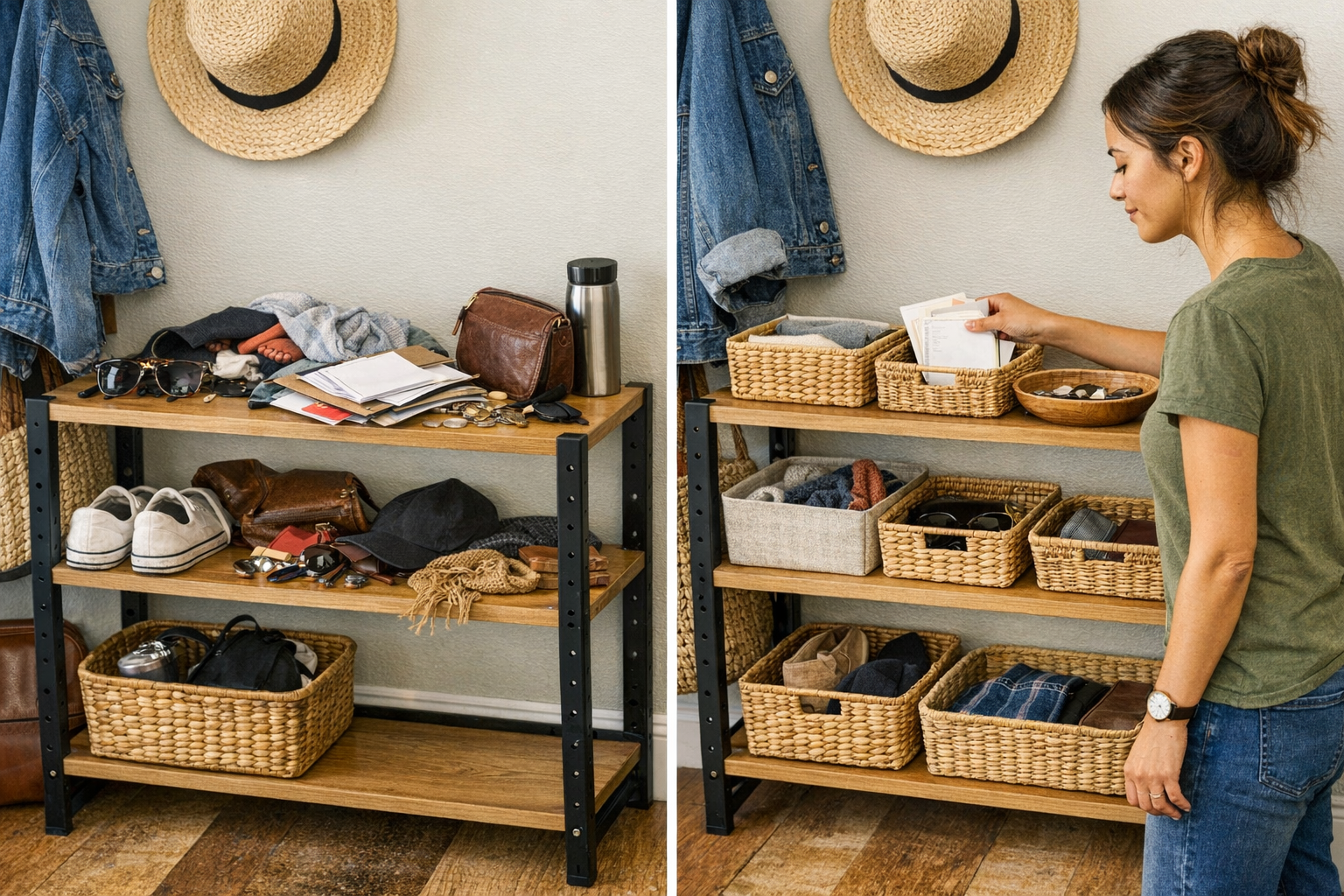
    Picture the classic entryway shelf. Throughout the week, you drop off keys, mail, sunglasses, the bag you promised yourself you’d repack. On an open surface, all of these blend into one slippery layer by Thursday. Now you’re shuffling mail just to reach your spare keys, chasing after a missing glove crushed beneath a flyer, or rummaging through a tangle of cables for the garage remote. The shelf is “organized”—but only in theory. Daily access is clumsy, resets are slow, and “just put it back” never quite works.

    Try the same routine, but insert two baskets and a divider: mail is immediately corralled, keys stay visible up front, sunglasses and other small essentials have their own zone. Suddenly, nothing stacks or gets buried. Grabbing what you need takes seconds, not minutes, and after a week the category boundaries remain intact. Resets aren’t a big project—just a matter of straightening a basket or tossing an item into the right bin before you head out the door.

    The Hidden Cost of Missing Boundaries

    The slow spread of clutter on open shelves rarely feels urgent—until the mess stacks up. Uncontained items sneak into any available gap, turning a space meant for shoes or books into a dumping ground for everything without a home. Before long, you’re shuffling stacks just to free up usable surface, hunting for the lost sock or missing charger wedged behind unrelated items. Restocks take twice as long because every pile needs to be moved, and vertical space goes wasted as stacks tip and expand horizontally instead of upward.

    Categories quietly dissolve: folded shirts end up in the towel pile, one loose belt migrates into active-wear, and soon you’re not sure where to look for anything. Instead of single-step retrieval, you’re always reaching around, moving something else first, or giving up and letting the pile grow. The cost isn’t just visual—it’s wasted minutes and repeated irritation every single week.

    Clear Categories, Quicker Resets: Why Containment Wins

    Physical barriers change the daily rhythm. When bins are full, you notice—and edit. When dividers keep small items separate from bulky ones, you clear or tidy a specific group without everything sliding together. Each reset is a fast nudge, not a time-consuming overhaul.

    Practical tip: For items you reach for every morning, opt for open, low-sided baskets that make spotting and grabbing quick. Reserve solid dividers for categories prone to chaos—cords, hats, belts, or small accessories that disappear in deep bins. This way, you sidestep buried clutter and prevent those “where did I put that?” scrambles.

    How Quickly Does Clutter Return?

    Most open shelves start strong, only to backslide in less than a week if boundaries are absent—especially in high-frequency areas like entryways, bedroom corners, or closet shelves. The moment daily items lack a true, contained spot, new clutter sneaks in and categories blur. In contrast, contained setups reveal their value every day: quick retrieval, intact groupings, and a surface that resists the usual creep toward mess.

    Looking Organized Isn’t Enough—Function Keeps It That Way

    You can’t will away “later piles” with good intentions. After every big reset, it’s tempting to tell yourself this time will be different, but lived-in open shelves rarely hold their order without help. Bins and dividers aren’t shortcuts—they’re insurance. They create default boundaries that keep storage functional during real-world use, so your routine speeds up instead of hitting friction every time something is added or retrieved.

    No single fix turns a shelf into perfection, but these adjustments move the dial from chronic reshuffling to long stretches of calm. Instead of bracing for another tedious reset, you fix what you need in seconds—and get on with the rest of your day.

    http://closetworks.myshopify.com

  • Creating a Calm Dog Walk Routine with Smart Gear Placement

    Why Small Gaps in Pet Care Setups Add Up

    Every daily pet routine looks manageable—until small gaps in setup turn simple care into constant backtracking. You reach for the water bowl, but a bottle or stray bowl blocks the way. The leash that should be on the hook is buried under mail. No towel ready for muddy paws, so dirt tracks in while you scramble for a substitute. Over time, these missed basics turn every “quick” cleanup or feeding reset into a string of avoidable delays, making routines heavier and more tiring, even before the rest of the day begins. The CalmPetSupply approach starts here: not with new gear, but with decisive changes that cut out these routine friction points for good.

    These persistent hassles aren’t rare flukes—they return with every repeat. Dirt still gets tracked in when wipes are out of reach. Trays and tools “put away” often migrate until they’re not at hand. A supposedly organized setup, left unchecked, quietly decays into a routine that’s slow, frustrating, and harder to reset after every dog walk or cat feeding.

    The Hidden Friction in Daily Routines

    Efficient routines depend less on last-minute fixes and more on setups that resist drift over time. Breakdown always shows up first at the worst moment—when you try to refill the water and the bowl is missing, or reach for wipes that are now behind the treat jar. Even “reward” moments falter as treats wind up forgotten in a different coat, stalling the flow mid-walk.

    As these patterns repeat, the small slowdowns multiply. Monday’s shelf turns chaotic by Thursday, tangled with bags and leashes. The towel finally surfaces—just after the floor collects muddy prints. These aren’t just minor annoyances. Each skipped reset or missing step stacks up, forcing longer cleanups or more awkward reshuffling precisely when you need simple, reliable flow.

    Scenes from Real-World Care

    Imagine coming home with your dog on a drizzly day. You stop at the door, quickly realizing the towel isn’t on its usual hook. While your pet waits, you track muddy paw prints through the hall, already bracing for double cleanup. Or you find the water dish nearly empty—again—and a cluster of other items blocks the sink, slowing a rushed refill while dinner waits.

    Another morning, the leash you always hang by the door has slipped into clutter with grocery bags, turning a 30-second grab into a search party. Even after re-organizing, the “neat” setup hides wipes and towels just enough to interrupt any post-walk cleanup. These aren’t dramatic failures—it’s the slow drag, the daily strain when supplies wander just far enough to add extra work where there shouldn’t be any.

    When Tidy Isn’t Enough: The Need for True Function

    A tidy space doesn’t guarantee a smooth care routine. If core supplies end up out of sight, steps get skipped as easily as when things look messy. Whenever everyday tasks—feeding, refilling, wiping paws—require an extra search or shuffle, stress and dropped resets return fast. The delay isn’t dramatic at first, but daily, the extra seconds and extra cleanup drag routines down—especially during the busiest hours.

    Organization alone rarely holds up under real use. If the leash changes spot every week or the food mat blocks quick wipe access, the routine breaks down where you need it most. That’s the difference: true function requires each thing to be grouped and reachable, not just neatly hidden or visually tidy. CalmPetSupply’s world is built for that: access and readiness before appearance.

    One Simple Change: Grouping Essentials for Repeat Ease

    The turning point is shrinking the care zone and making escape for the basics impossible. A dedicated hook at shoulder height beside the door means the leash can’t drift or tangle. The paw towel hangs underneath—always visible, never back in the laundry pile at the wrong time. Daily-use wipes and cleanup tools rest on an open tray, not wedged behind treat jars. Keep a refillable water bottle in the same zone, grabbed every time the leash is. This isn’t about buying more—it’s about anchoring what the routine actually uses.

    Small, physical changes make routines feel lighter almost immediately. You retrace fewer steps. Dirt lands where you can handle it, not where it spreads. After a few days, the interruptions shrink—less idle cleanup, less hunting for basics, and resets become a nearly automatic part of the flow instead of a side project you keep putting off.

    The Practical Outcome: Resetting Calm by Design

    The reward isn’t showy, but you notice it in the daily rhythm: fewer supply roundups, less mess that sneaks past the entry, and setups you can count on no matter how rushed the day feels. Routines settle into place, even when the schedule turns unpredictable. Instead of repeating little breakdowns—like missing wipes or lost leashes—every return point gathers what matters where you need it, ready for the next round, not hiding in a cabinet or drifting into a pile.

    That shift isn’t about looking tidy; it’s about building a setup that makes care simpler at every step, even as repetition tries to wear things down. When the routine resists drift, daily pet care stops being a drag and starts running quietly in the background.

    See our solutions for better daily routines

  • Why Carry-On Organization Can Slow You Down During Travel

    No matter how perfectly organized your carry-on looks at home, real airport movement exposes its weak points fast. The difference shows up immediately: you hit security, and that easy-access pouch now means contorted reach with someone waiting behind you. Boarding, your boarding pass hides an extra layer deep. Jostling through the gate, your “sorted” organizers stall you by a few seconds at every check. The frustration isn’t theoretical—it’s the drag you feel when a bag designed for order quietly blocks you in motion, forcing slow retrieval, awkward reach, and stop-and-start repacking at exactly the wrong moments. The picture-perfect setup suddenly becomes a series of micro-interruptions that only get louder as airport pressure builds. This is where so many carry-on routines break under repeat friction—just when you need the smooth flow you thought you’d packed for.

    Why Order Breaks Down in Repeated Travel Routines

    Pouches and slots give a sense of control in the calm of a bedroom or hotel, but the airport turns that order inside out. First pass: your passport is easy enough to extract. But after a flight or two, with the rhythm of unzipping, quick-stowing, and stacking organizers, you notice it slipping—literally—deeper into the pouch, or winding up behind something you just repacked. Grab the wrong slot, and you’re suddenly fumbling in line, one hand on the bag, the other searching for a document while agents nudge you forward.

    This isn’t an isolated hassle. With each leg, friction builds: zippers catch at the wrong angle, pouches slide so neatly past each other you pull out two by mistake, a boarding pass is one layer down from where it should be. The inner order survives in appearance only. Your setup—which made sense in stillness—now undermines you in speed, each access step requiring just enough extra motion or thought to break your flow when you should be moving forward.

    Static Structure vs. Moving Access

    Most packing advice obsesses over keeping every item slotted and lined up for visual peace. But transit isn’t calm or controlled. Nested pouches, aggressively sorted compartments, or double-zipped organizers look sharp until you’re balancing in a queue, one arm on a tray, eyes tracking the next checkpoint. Suddenly each choice—Which pouch? Which zipper?—becomes costly: more seconds lost, more chance of dropping something, more internal voice saying, “this should be faster.” The static idea of order clashes with the real movement pattern of airport life, where a setup that’s tidy at rest creates friction in use.

    The Hidden Cost of “Perfect” Organization

    A carry-on bag that appears organized tricks you into thinking the problem is solved—until actual pressure moments reveal the cost:

    • Security trays: You need your laptop, but a trio of tech pouches require a mini unpack, increasing your odds of missing a cable or rushing the repack with items out of sequence.
    • Boarding lines: The “sorted” document pouch lives deep in the main compartment, so getting at your passport means a slow zip, dig, and reshuffle as the line inches. After the third check-in, this small lag begins to wear.
    • Overhead bins and aisle entry: Anything marked “quick-grab” but living under more layers turns every retrieval into a multi-step pause—either you hold up the aisle or you’ll need to reopen the bin mid-flight.
    • Repeated access mid-trip: Each time you return headphones or documents to “their place” under movement, the odds of a misplaced item grow. That order you rely on now creates confusion the next time you need something in a hurry.

    Pressure escalates: what looked like a well-designed system in a quiet room turns into a series of tiny, repeated hurdles every time travel gets less predictable and hands get busier.

    Real Moments Where Friction Shows Up

    Airport conditions punish tidy but impractical layouts:

    • Standing in security, you reach for your passport only to find the outer compartment stuffed with too many “quick access” pouches. Main compartment unzip: wrists collide, delays begin, and the line behind you grows.
    • Post-security, gate info changes—your phone is buried under a toiletry kit, thanks to nesting everything to stay “organized.” What felt clever now feels like unpacking on the floor to answer a simple text.
    • At boarding, your ticket takes longer to extract because it drifted under a loose pouch during the last hurried repack. Instead of a swift reveal, it’s a fumble at the plane door.

    No one of these moments feels disastrous, but together they erode your confidence in your setup—especially as crowds increase the cost of every hesitation. The minutes add up, along with the tension of knowing your layout keeps slowing you down instead of smoothing things over.

    The Difference Between Looking Packed and Moving Smoothly

    There’s a gap between a bag that passes the “photo test” at home and one that handles actual airport chaos. You almost never have a clean surface, both hands available, and zero distractions in transit. Instead, the real world is trays in one arm, an impatient line, a narrow aisle, or a carry-on pressed between your hip and a trolley. “A place for everything” isn’t enough if every retrieval becomes a drawn-out motion, or if putting something back means disrupting two other compartments. What works for stillness fails in motion—real usefulness depends on setups that survive actual use, not ideal rest.

    How Small Tweaks Shift the Entire Carry-On Experience

    After too many cramped pouch dig-outs, I stopped sorting for neatness and started packing for speed. One trip in, I stripped it back: primary documents and phone in a single, uncluttered outer zip. No stacking, no sub-pouches, just what I touch at every checkpoint. Every time I needed to show ID at security or hand over a ticket, there was no second-guessing or layered retrieval—the motion was straight, quick, and uninterrupted.

    The less space I gave to less-used items in that zone, the fewer interruptions at each access point: no more passport behind a power bank by accident, no scrambled zipper pulls, no repacking confusion. The seconds I saved returned as less stress, especially mid-transfer or when fighting for overhead space. The difference is visible not in how the bag looks, but in how little thought or repositioning it demands every time a gate agent checks my documents or I need to plug in headphones before takeoff.

    Observation: Not All “Quick Access” Zones Are Equal

    Packing guides talk up “outer pockets,” but it’s what lives there that counts. If you let that zip fill with chargers, receipts, sanitizer, and old mask wrappers, you’re back to multi-stage retrieval in disguise. The trick: protect your outer zip for the passport, boarding pass, and one or two other highest-frequency items—nothing else. Every extra object reintroduces friction. Fewer mixed uses mean smoother movement, and far less fumble to fix after every access.

    Balancing Visual Order With True Movement Ease

    It’s almost automatic to respond to travel friction with more organizers, more slots, or the promise of “perfect” order. But that logic breaks in motion: every extra segment adds a moment of retrieval drag, a small repacking stumble, or another pause at the wrong time. Instead, chase setups that sometimes look less composed but move with you—ones that trade a bit of visual neatness for true in-transit freedom. Travel exposes structure; only the setups that work while moving are worth copying, especially when seconds and hands are at a premium.

    Find practical carry-on tools designed for real access at CarryOnSupply.