
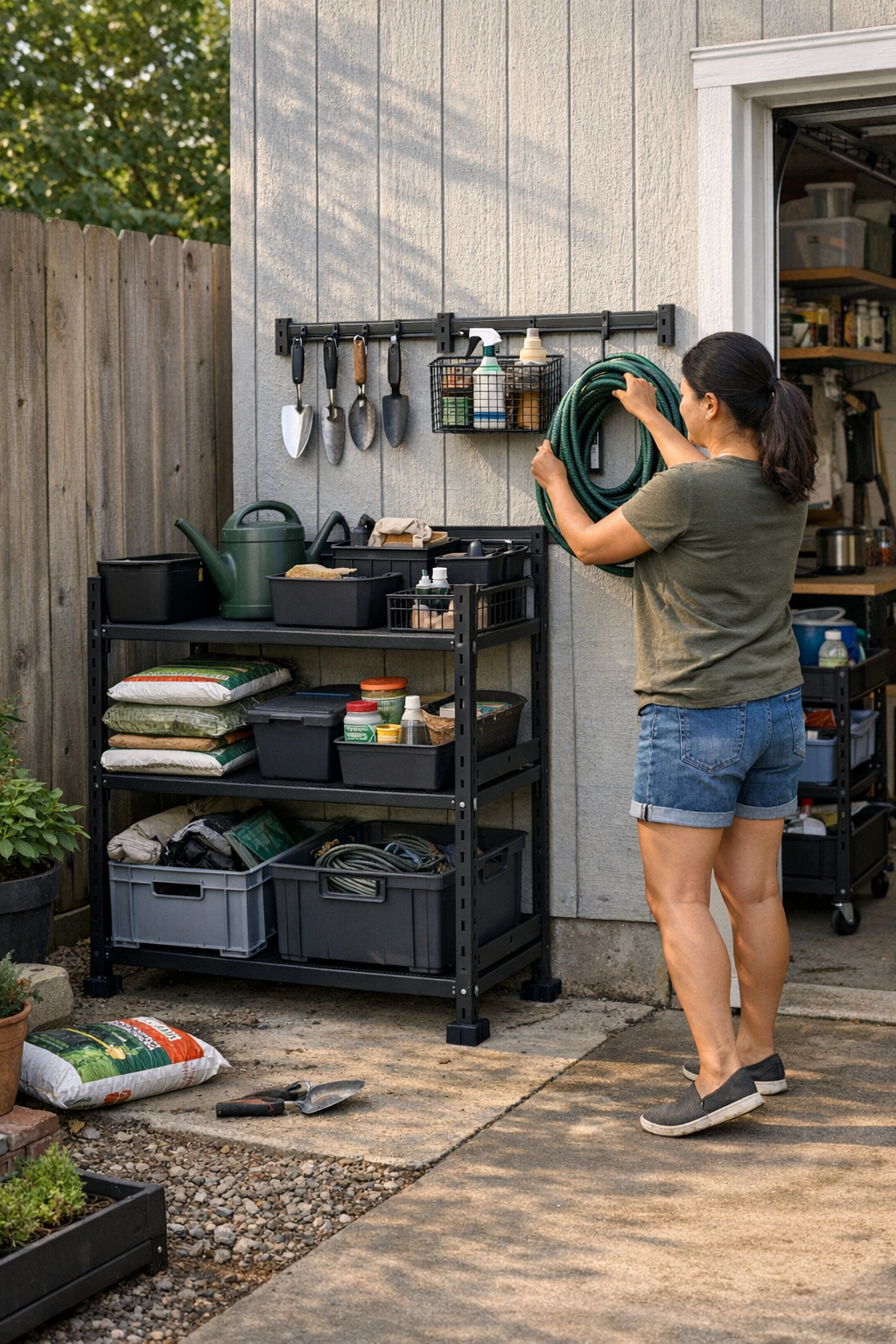
Walk outside after a long day. Your yard is almost clear—except for the cluster of hand tools dropped by the fence, that folding chair wedged in the side strip, and drink bottles under the table from last night. No matter how often you tidy, these same dead zones soak up clutter over and over. What looks like a minor mess is actually a setup flaw you trip over daily: storage that slows you down and quietly invites the same splatter of items to stack, wedge, and spill back into your path. When every reset means wrestling with containers or coaxing items out from behind bulky bins, “putting things away” turns into a cycle of moving clutter from one trouble spot to another—and the clutter wins more often than not.
Where Clutter Really Starts: The Setup That Fights You
You can straighten up after every activity, but when the storage doesn’t fit the rhythm of actual use, your ritual grinds down fast. Family projects overflow the patio. Hand tools scatter by the garage. Guests drag over folding seats that never quite make it back to where they belong. The first cracks show up in the pinch points—garage thresholds buried under bins, utility shelves crammed onto narrow paths, or side-yard chests that jam shut with a single unexpected addition. You keep ‘just setting something down’ for a second, already knowing what happens next: the system is too clumsy to keep up, and each trip adds a friction point you end up dodging rather than fixing.
Floor bins look organized just after a major cleanup. But in daily use, they break down. The lid sticks; you wedge it closed. You want the soccer ball, but it’s lost under cables and last season’s gardening gloves. With no dedicated return spot, everything turns into a mini scavenger hunt, especially after busy weekends. The floor gets jammed, corners fill up, and soon you’re shuffling pieces just to clear a walkway.
Wall Systems vs. Hidden Piles: Why Visibility Changes Everything
Wall-mounted storage isn’t just about neat lines—it’s about real, visible accountability. Open racks and shelves make it impossible to hide the stragglers. Missing rakes, lopsided loppers, stray gloves—all stand out. The storage tells on you: every misplaced item gets noticed fast, pushing you (and everyone else) to return things properly before the chaos starts rolling.
Closed bins and big containers promise instant order, but the calm doesn’t last. Little things drop to the bottom, heavier tools crush the smaller ones, and eventually you end up stacking things awkwardly on top or even beside the closed lids. Footpaths disappear. One return blocks another. It becomes clear in practice: wall systems force problems to the surface—and force you to keep the system moving. Bins let disorder disappear until it boils over and the old shuffle resumes.
Reset Friction: Seeing Setup Weaknesses in Real Use
After a cookout, the usual: half the yard is a grid of cushions, tools, and bottles waiting to be collected. If your only storage is that main patio bin, you’re stuck—one overloaded box and now items pile up outside it, or right in the traffic lane to the door. The next time you need something, you yank the whole bin out, paw through yesterday’s leftovers, and hope you spot what you’re after.
Wall racks along the garage edge or side yard break this loop. Each tool has its spot, visible by default. Anyone coming in from the yard instantly knows where the shovel or the garden fork goes. Resetting isn’t about digging—just returning everything to its line. Overflow doesn’t build up when the route back is so clear and frictionless. Even on hectic days, you’ll notice resets take less time, and nothing blocks your way.
Small Tweaks, Big Shifts: Altering Setup Flow
Sometimes it takes a simple, physical change to break an old routine. Swapping out a ground-level bin for a wall rack along the garage did more than clear the walkway—it turned a clutter trap into a default parking zone. Mount shelves and racks at just above waist height, and suddenly tools can be hung and grabbed by anyone, without stretching or stooping. Hooks stop the slow drift of tools collecting at ground level, because it’s suddenly awkward to leave them anywhere but their spot.
Stubborn problem corners improved once there was nowhere left to casually stash junk. The back-of-garage wasteland, the unreachable strip down the side—they both changed once racks forced a decision: return it, rehome it, or admit it doesn’t belong. Instead of hiding the mess, the setup pushed you to fix it up front. It was less about storing clutter out of sight and more about stopping it from forming at all.
Real-World Tip: Visibility Wins Over Capacity
Outdoor organization only sticks if the return path is obvious enough to beat old habits. Put wall racks and baskets where you naturally finish up—at the garage, by the entry, along the main path. If kids always dump gear in one zone, hook a small basket or pegboard where their routine ends, not where you wish it started. The more you engineer these choke points for visual clarity, the less likely temporary clutter becomes tomorrow’s obstacle.
Clutter Creep: Catch Trouble Before It Grows
Watch for the spots that refill first: that puddle of shoes clustered at the back door, the tool bag that sits “just for now” at the end of a storage bench, the corner beside the plastic cabinet that keeps catching everything with nowhere else to go. These aren’t minor quirks—they reveal where the system doesn’t serve the rhythm of your return flow. Every moment you detour, hesitate, or walk a tool around a blockage is a sign that something isn’t matched up.
Wall-mounted storage clears out floor space and prevents one returned item from becoming tomorrow’s blockage. In the side-yard strip, remember the jam of bins that choked off passage? A simple rail transformed that stretch: now, brooms and tools hang up, and even with surprise storms or new visitors, resets are snappy and the path stays open. Assigning visible homes for each tool means less double-handling and fewer lost pieces buried in piles, because bottlenecks can’t hide.
Modular Doesn’t Mean Effortless
It’s tempting to chase modular bins or rolling carts for flexible storage, but these can turn into roaming clutter-magnets without strict routines. Too often, carts drift off course, bins collect stray items “for now,” and the entire storage zone becomes a reshuffling relay. Even the most adaptable setup fails if you’re just pushing piles from spot to spot.
The Real Test: Can Your Setup Survive a Busy Week?
Wall-based and clearly zoned storage is about habit, not just looks. If there’s only one possible place to hang the hose or stash the gloves, the reset pathway becomes muscle memory. You stop making decisions and just do the return. When every return is automatic and nothing “temporarily” blocks the flow, the yard is ready whenever you want it—not just after a weekend deep clean.
It’s not about picture-perfect order. It’s about setting up friction so that clutter almost can’t gather. That’s how a yard stays open for movement, for family projects, or for a surprise get-together—even when no one has time for a full reset.
Visit TidyYard for storage ideas that make outdoor routines less frustrating.