Category: Yard & Utility

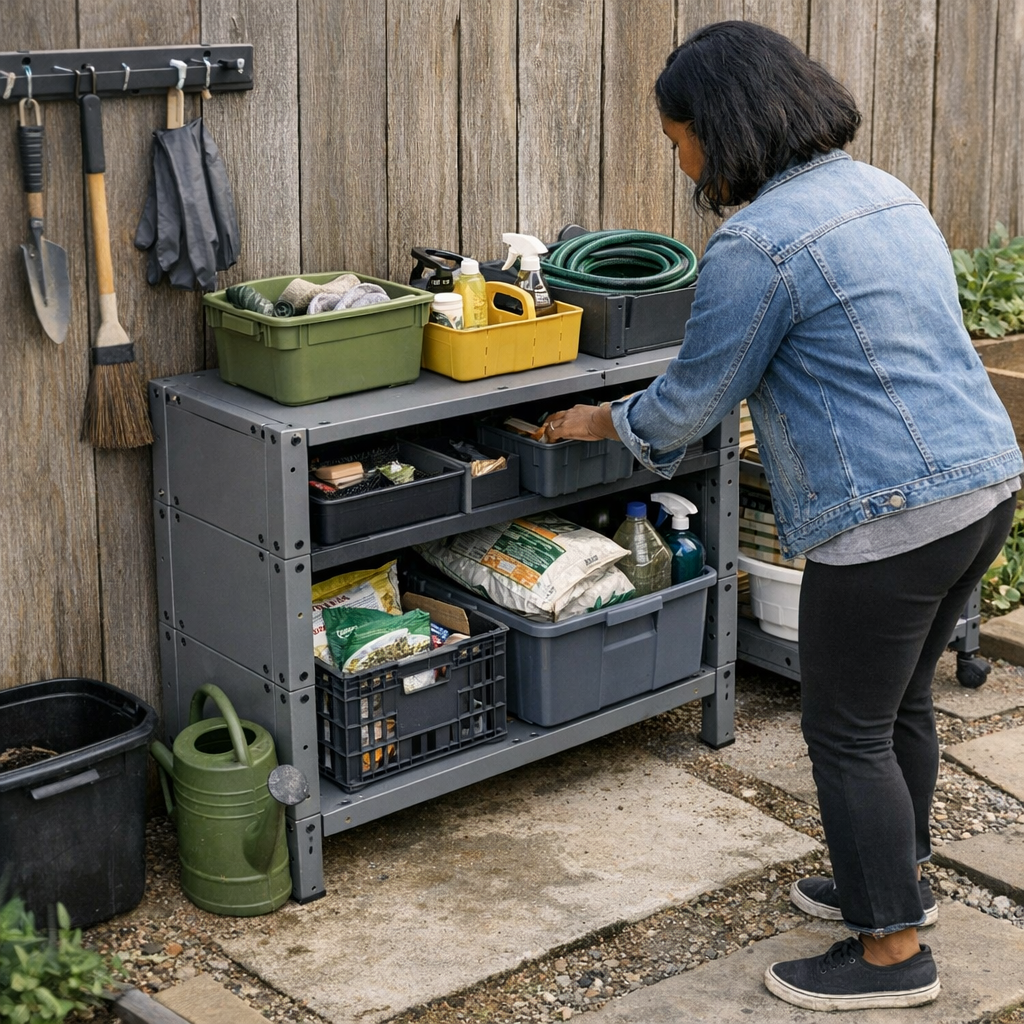
  • How Visible Tool Storage Can Boost Efficiency and Prevent Clutter in Your Garage

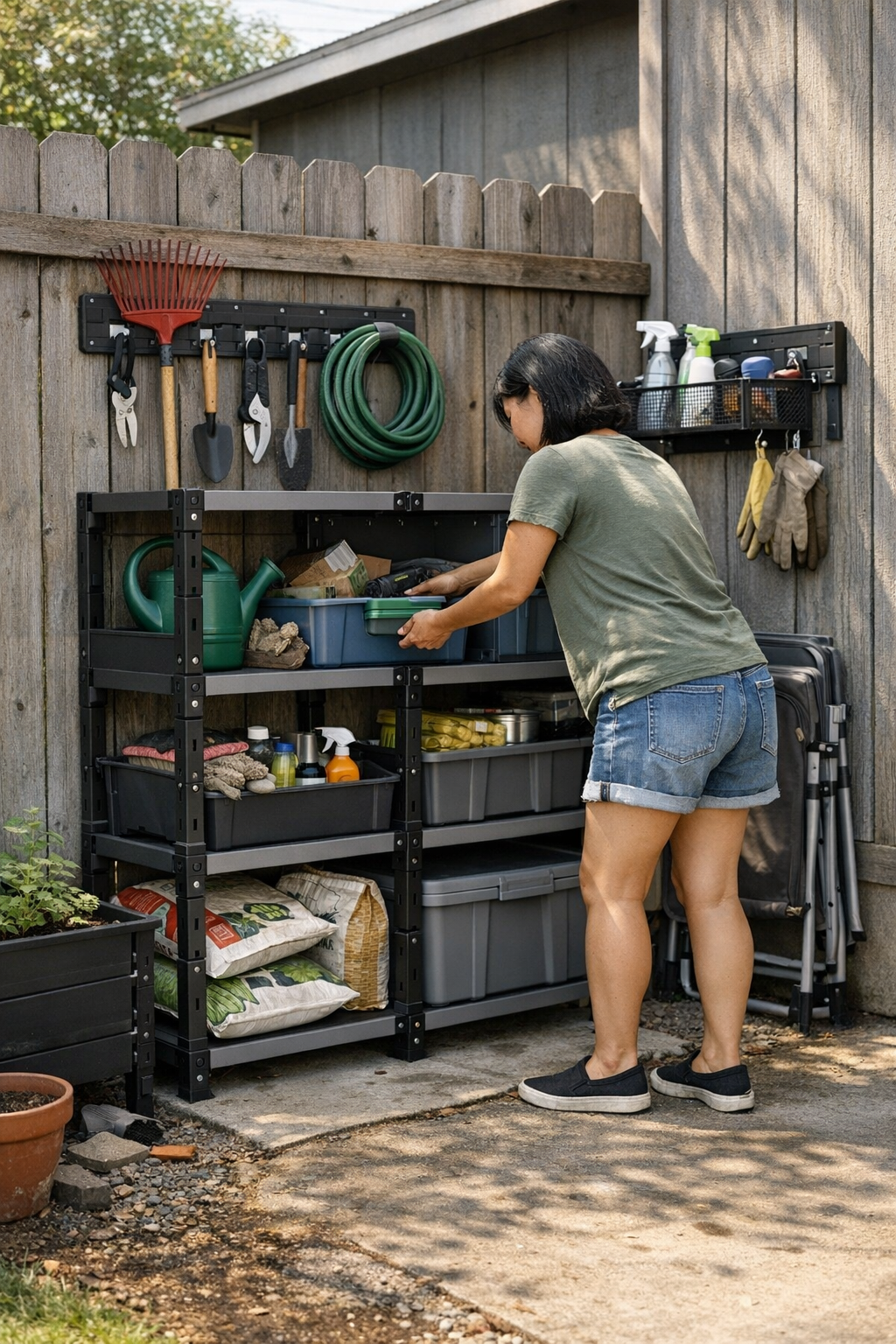
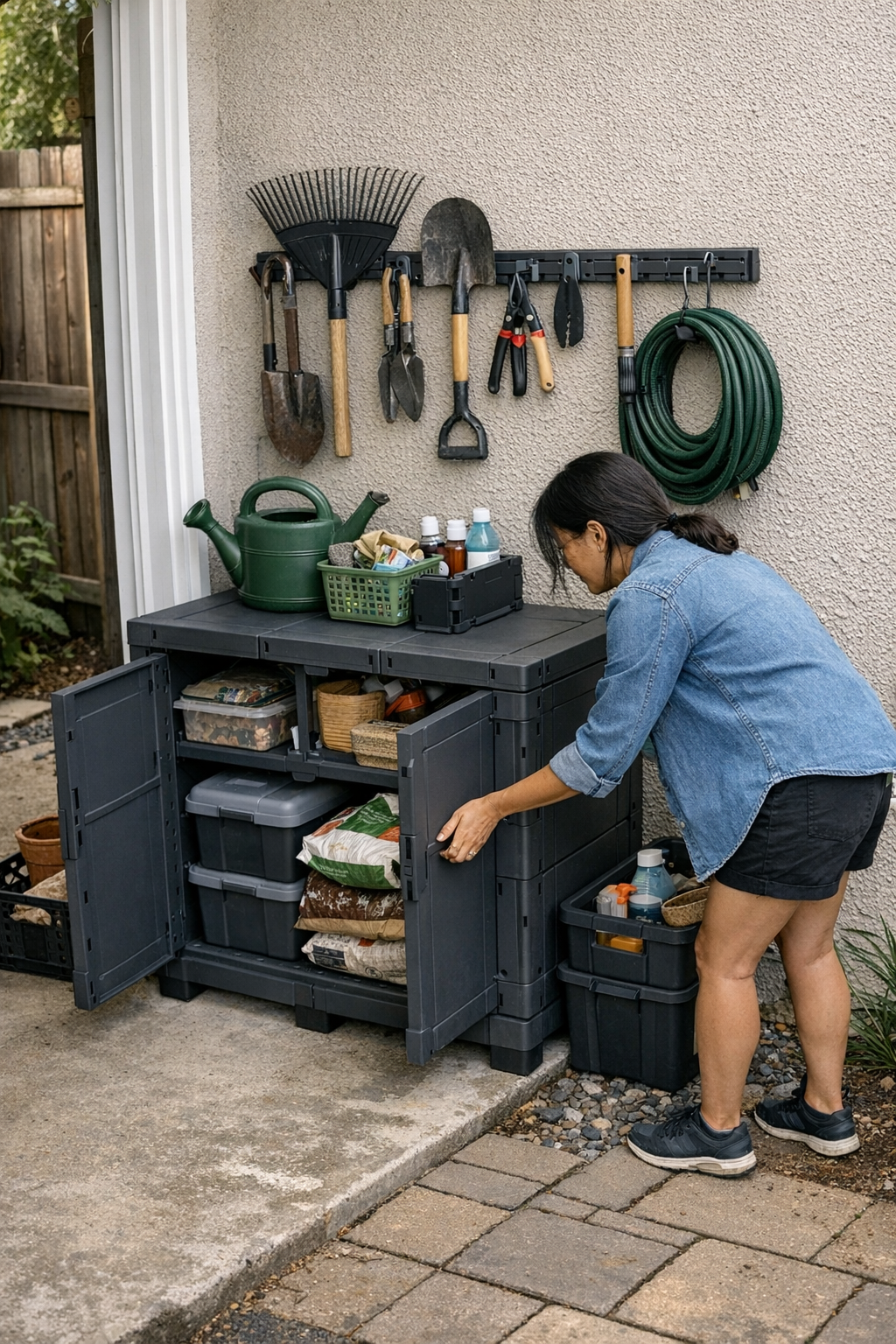
    It starts with barely a shift: one rake slides out a few inches on the garage wall, a trowel gets dropped within toe-stubbing distance of the door, a shovel leans—almost asking to fall—into the everyday walkway. At first, these tiny out-of-place moves go unnoticed. But by Thursday, the entry’s been choked narrow enough that you’re squeezing sideways, tools silently multiplying into the footpath, and what was meant to be effortless “grab-and-go” has turned into a recurring shuffle—move this, dodge that, hope nothing topples. Suddenly, the entire garage edge or fence-line feels less like a storage solution and more like a slow-motion collapse into clutter.

    How Setup Friction Becomes the Daily Obstacle

    Hang everything up. Keep the floor clear. Done, right? That’s the myth most outdoor wall storage starts with. For a few days, maybe a week, your system works—the pruning shears are in the open, the rake hooks are empty when you need them. But then routines kick in, family members return gear in the rush, and one by one, small tools crowd the edges while buckets wind up camped next to the exit. You don’t notice an immediate mess—just an invisible drag: pausing to sidestep a shovel, glancing around for space to hang something, swinging a wheelbarrow wider to avoid a gnarl of tool handles. A once-open route morphs into a slalom course, costing you steps every trip.

    When “Organized” Wall Storage Fails the Real Test

    Wall-mounted racks and open utility hooks look clean in setup photos, every piece spaced in crisp formation. But the minute you skip a reset—just once—it slips. One pair of awkward loppers shoves a broom aside. That hand trowel lands on a random hook because the usual spot is blocked. Maybe you squeezed a hedge trimmer against the last open space after wrestling with hoses out back. Within a week, what started as “every tool in its place” turns to “just make it fit somewhere,” and you’re back to foraging. Movement narrows, storage intent blurs, and the wall that’s supposed to make things faster now demands constant reshuffling. Efficiency doesn’t get lost all at once; it unravels, almost invisibly.

    Scene: One Return, Three Problems

    Picture the Sunday cleanup. You head for the garage to hang a hoe, but the rack’s jammed—pruners left crooked from yesterday, broom slid half out, shovel barely clinging. To hang your tool, you have to nudge two others aside, cramming handles tight and blocking your next grab for a rake. Later, you’ll spend extra seconds untangling the pile—or worse, knock something down reaching in a hurry. That original, effortless return flow? Gone. Instead, every drop-off is its own Tetris game.

    Side Yards and Tight Zones: Small Slips Turn Critical

    In the side path or at the edge of a narrow driveway, a few inches make or break the space. The first day, your shovel hangs flush. By the second week—after two rushed returns and a late-night garden tidy—it sticks out at shin height. That hand spade, “temporarily” left at the end, stays there until the next drip of tools fills in around it. Without strict routines, a five-foot-wide walkway halves itself, forcing each person to pivot, twist, or nudge something aside just to pass. Looking organized isn’t enough; the real-life use test is whether the zone keeps movement free—and most wall setups fail by the time the weather’s changed twice.

    Practical Tweaks that Keep Floor and Wall Clear

    Throwing up more hooks just means more room for mess. What actually restores usable space? Limiting what gets wall space and giving overflow a clear, confined home. Put a sturdy, covered bin just below the rack. Set the rule: fast-use, grab-first tools go on the wall; everything else—odd-shaped diggers, off-season hand tools, stuff you reach for twice a month—goes in the bin, no exceptions. With even one enforced reset per week, overflow lands in the bin instead of leaking into walking space. Monday’s sweep stays quick: pull the bin forward, drop the extras, restore actual movement room. The difference with this small shift? You can still move naturally through a busy zone two weeks after a hard-use weekend; wall and floor don’t morph into one blended obstacle.

    Real Habits: What Stays Working, What Falls Apart

    Most people cycle through the same handful of tools a dozen times before touching the others. An open rack is a time saver if you guard the boundaries. The second you let rarely used, bulky, or “maybe tomorrow” items sit out, the whole setup reverts to mayhem. Here’s what actually works: Every major use (not just the end of the month), scan the rack. Anything that didn’t move this week gets binned. No mercy, no exceptions. The small effort prevents the slow creep where less-used gear dominates, and guarantees your main rotation always has an open slot— so you never face a wall jam five minutes before rain hits or before the last mow of the evening.

    The Gradual Mess vs. The Quick Reset

    Disorder rarely explodes overnight. One tool too many—left just once, place uncorrected—trains everyone else to lower their own standards. “Just for now” becomes “always here.” Piles build quietly: a power tool box tucked beneath hooks, last month’s bulb planter sidestepping the sweep area, a spare stake that never makes it to the corner bin. Then, when you need real motion—a fast run to grab gloves, a kid fetching a soccer ball—every step includes another lift, shift, or risk of knock-down. Fixing this doesn’t mean rigid perfection. It means honest boundaries: “wall is for dailies, overflow has its bin.” Keep your system visible, contained, and open for real resets, not just for looks. Function returns; resets stop eating your afternoons; traffic lines clear up.

    Find practical outdoor storage that matches your routine: TidyYard
  • Why Open Storage Beats Moisture Absorbers in Entryway Design

    Closed shoe benches and sealed cabinets look clean—until the first slush, rain, or muddy boots hit. The real test for entryway storage isn’t how it hides mess at a glance, but how it handles moisture, overflow, and the daily repeat of feet and bags coming through. If you’ve ever popped open a bench after a wet week and caught the smell of trapped damp, or found shoes sticking instead of drying, you’ve seen how quickly the wrong setup turns “organized” into high-maintenance. A neat facade collapses fast under real entryway pressure—when one drop zone becomes the bottleneck between outside, inside, and whatever mud or motion just arrived. In most homes, it’s not the weather that wins; it’s the routine that exposes every hidden flaw in storage design.

    When “Contained” Spaces Quietly Collect More Than Clutter

    Closed benches and cabinets promise order—until daily use proves otherwise. After just a couple of rainy afternoons, open the lid: shoes are soft and musty, gloves still damp, and the inside smells worse than the sidewalk. The moment you shut moisture in, you break the reset routine. For households with even moderate traffic—think two quick arrivals before dinner—the so-called tidy storage becomes a slow-moving trap for sweat, rain, and forgotten gear. Items pressed together stay wet, not just unseen.

    Miss a day? The pile grows. Now it’s not just one soggy pair—bags, jackets, umbrellas, and gym kits stack up, and air barely circulates. Lids and doors might hide the buildup, but inside, dampness turns into a backlog. Instead of staging the next morning’s launch, the storage becomes a graveyard until someone digs it out, wipes it down, and starts over.

    The Real Signs of Storage Struggling on a Normal Day

    These problems don’t just show up in storms—they creep in through everyday routines:

    • The shoe line mushrooms sideways: After one muddy drop, the neat row pushes outward; clutter that used to be invisible starts spilling into walkways.
    • Bags don’t make it in, they land near: The so-called bench becomes a parking lot—what was supposed to “contain” overflow now collects it on top and around, shrinking usable space each day.
    • One return blocks the zone: Slide in an umbrella or backpack and you’ll find yourself reshuffling three other things, blocking the path for anyone following. The passage narrows every run.
    • Reset times balloon: Even after a quick wipe or grab, things feel damp or carry a stale odor. It may look passable, but every entry feels slower and less ready for real use.

    Moisture Hides Easily—But So Does Routine Friction

    It’s easy to miss how quickly friction builds. A typical weekday: early risers stash wet coats and boots in a cubby; a couple more arrivals stuff in backpacks and extra shoes. By the evening, the storage is sealed and full, looking orderly from the outside but inside, everything is damp, clammy, and starting to smell. The next day, you reach for “dry” shoes—still cold and wet. Crowded setups trap humidity, so instead of drying between cycles, the whole entryway accumulates a low-level stickiness that never fully resets. The threshold, instead of flowing, starts to jam.

    The harder you work to make things look neat, the slower it feels. Moisture absorbers max out. Clutter slides out as you add one new drop. The entryway swings from clear to bottleneck overnight—and the room’s “reset” only completes when someone does a hands-on rescue, pulling soggy gear out for emergency drying or a hard reset that interrupts the whole routine.

    Why Airflow Is the Quiet Hero in Everyday Entry Zones

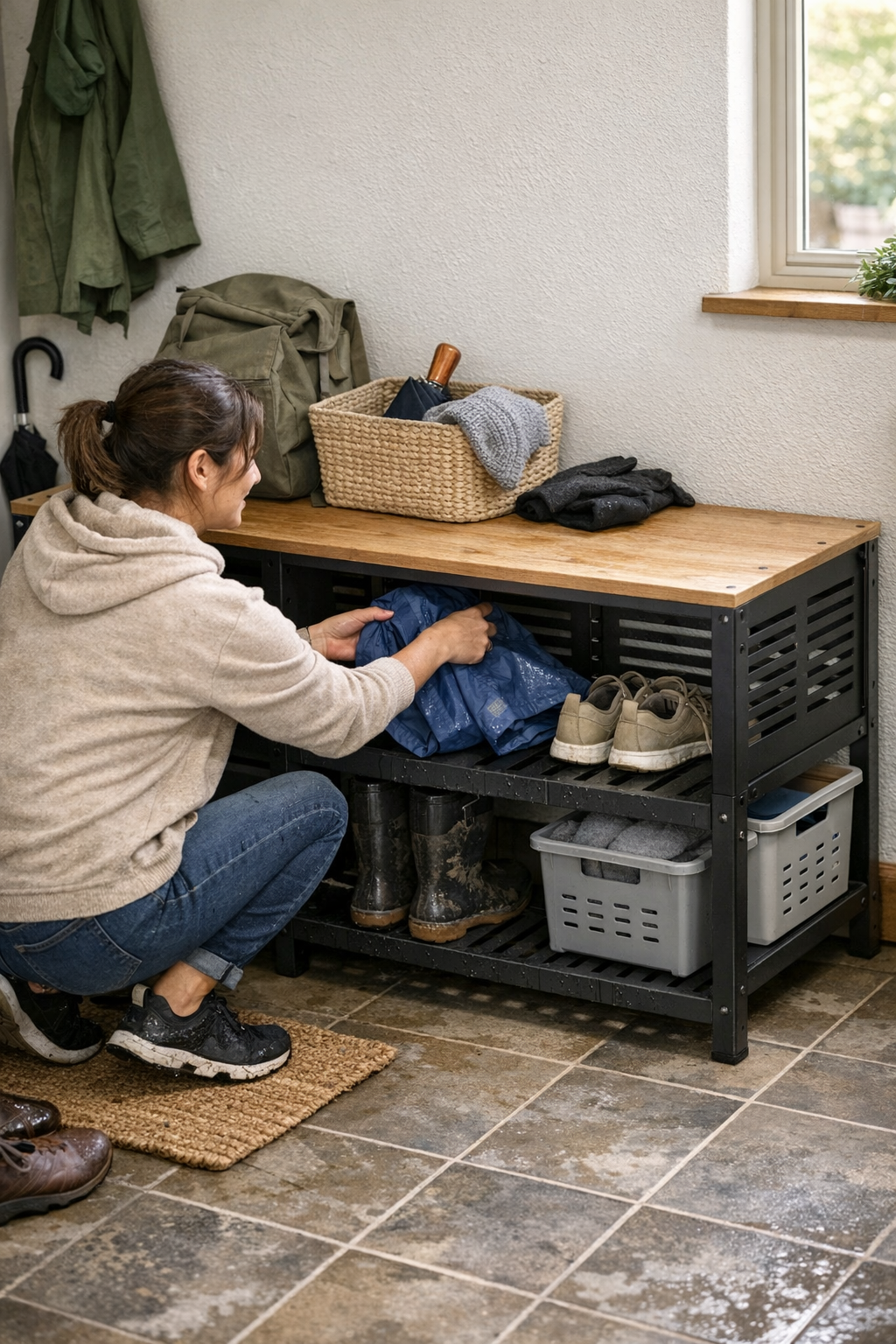
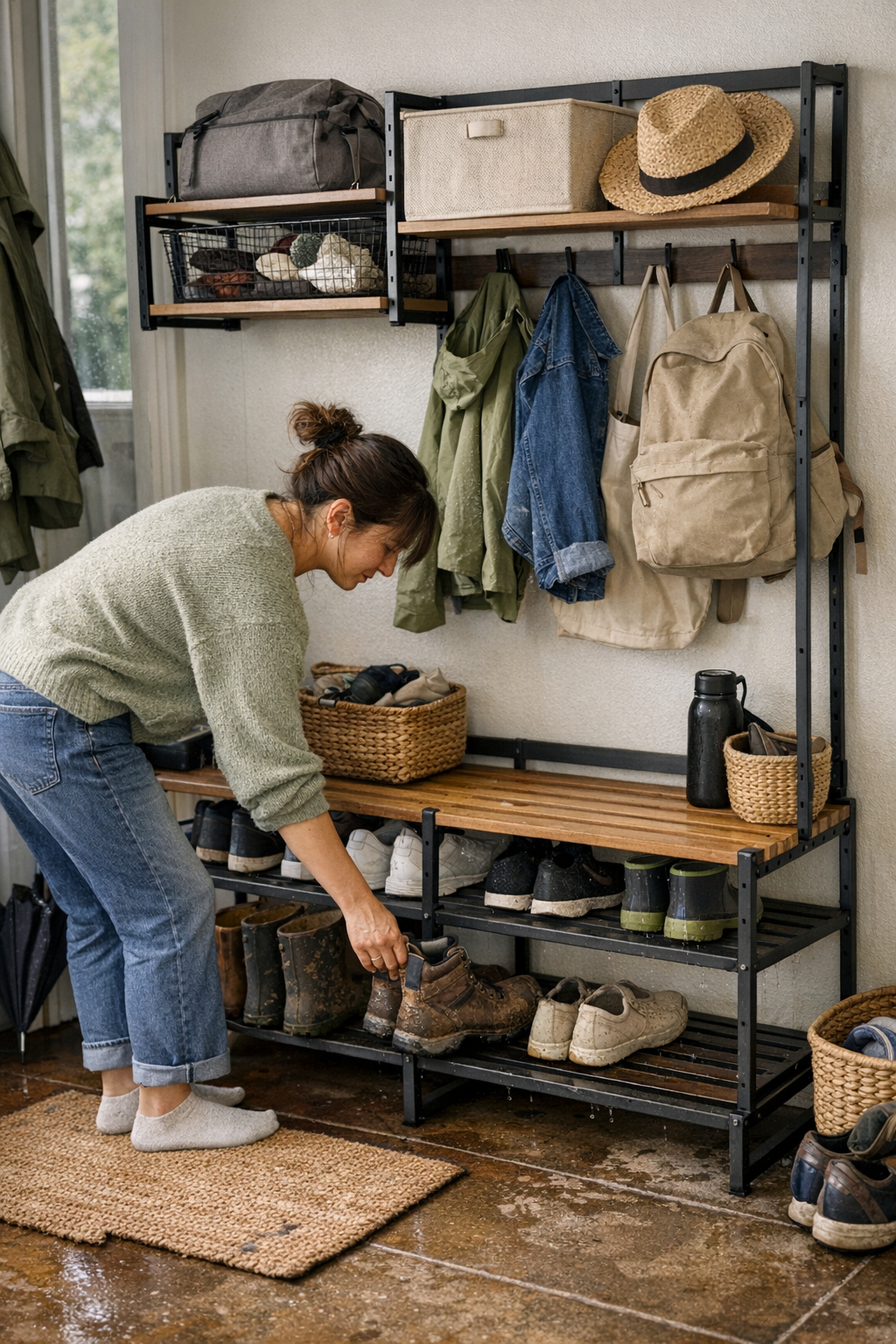
    Airflow is the real difference-maker—not just for order, but for fast recovery. Storage that lets air circulate—slatted benches, open racks, vented cubbies—doesn’t just look different: it keeps shoes from stewing and gear from going stale. This matters even more in tight entryways, narrow apartment halls, or shared transitions where every inch faces repeated pressure. With the right structure, gear dries in hours—not days—and overflow can’t hide or build up off your radar.

    Reset moves from chore to routine. Drop wet boots on a slatted bench: by dinnertime, they’re dry underneath and ready by morning. If more gear crowds in, you see it right away—no surprises, no invisible backlogs. Reset isn’t just an occasional rescue; it’s a quick, visible scan as you walk through, making clutter management automatic instead of reactive.

    A Practical Example: Slatted vs. Sealed Bench

    Swapping a solid-lid bench for one with airflow slots changed everything. No more damp stink or surprise sticky patches pooling inside. Shoes and gear actually finished drying before the next use—especially after busy weekends. It meant no last-minute rescue operations, no mental inventory checks, and one less threshold stall with arms full of bags and umbrellas. The difference wasn’t just cleaner air—it was less mental drag and faster flow.

    Common Solutions and Where They Fall Short

    Moisture absorbers: They work for the occasional puddle but fail during routines with regular wet gear or multiple people. One rainy week, and you’re back to swapping out packs or ignoring the silent mold risk. They keep up only when real movement doesn’t.

    Sealed bins/cabinets: Great for hiding piles, lousy for handling water. They slow you down, trap damp, and demand full resets more often. Over time, they make the whole entryway feel like it’s stuck—clean on the surface, but behind schedule underneath.

    Tips for Reliable Entryway Flow

    • Choose storage that breathes: Look for slatted or open racks, wall cubbies with gaps, or benches that dry as they hold. Every shoe and bag should touch air, not just each other.
    • Let mess and backup show: With open fronts or ends, you spot crowding the moment it starts—reset is a single motion, not a periodic deep clean.
    • Keep reset intervals short: In busy seasons, empty overflow daily or every other day. Quick turnaround beats slow air-out and keeps odors down.
    • Go vertical when crowded: Wall-mount solutions and vertical cubbies preserve floor space and keep the airflow route open instead of blocking the threshold.

    How Better Structure Changes Everyday Movement

    The entryway isn’t just a spot to stash and forget. The real standard is how easily you cross it on a messy day—shoes dry, bags accessible, nothing slowing the route from door to next room. Closed setups hide mess, open and vented ones keep action moving. The difference appears the twentieth time you run through, not just the first. Does your threshold reset, or does it stall out?

    If your storage system leaves things looking “ok” but never truly ready, it’s time to move beyond the contained-and-clogged stage. Airflow and order work together to turn that tight entryway from a slow-motion disaster zone into a daily flow point. For more ways to make your entryway or threshold zone genuinely easier to use every day, see Betweenry.

  • Why Easy Return Storage Transforms Outdoor Organization Efforts

    Most outdoor setups don’t fail because they’re too small—they fail because the reset breaks down. In the real world, side-yard strips and patio corners look organized for about a week. Then you hit the slow part: gloves draped over the hose reel, the trowel from Tuesday left on the grill ledge, that one rake you meant to return but never quite did. Every awkward return, every tool perched where it doesn’t belong, every slow shuffle through a too-deep bin—this is where “organized” quietly unravels into another edge pile nobody claims. It isn’t a lack of space; it’s the way reset friction turns each lived-in corner into clutter’s favorite hiding place.

    The Real Test: After the Job, Where Does Everything Go?

    The freshest setup always looks full of promise: tools lined up, bins labeled, wide walkways cleared. Then a normal Saturday hits. You pull a weeder, reach for a pair of gloves, toss the hose aside to run after a kid or finish lunch. That fast, the first items stall just outside their proper spots. A week later, they haven’t moved. Why?

    Because return friction is built into the details. The lid’s too heavy. The bin’s just deep enough to require digging. You have to move a bag of soil just to make space. Nothing dramatic—just enough micro-hassle, every time, that the fastest route becomes “leave it here for now.” One “later” at a time, the clear path around the garage or fence line turns into a sidestep course over abandoned tools and bags that never got put back.

    Closed Boxes: Tidy Promise, Hidden Trouble

    Closed bins tempt with the look of control: toss whatever inside, close the lid, no mess in sight. It works until you need one pruning shear lost under extension cords—so you dig, unstack, reshuffle—and the next time, that tool lands on the patio instead. The heavier or fussier the setup, the more likely the return just gets skipped. By Sunday, the “overflow” sits quietly outside the box, blocking the same path the box was meant to clear.

    Closed bins can hide a mess—but they can’t prevent the reset from breaking down. The area looks staged only at first. Give it two busy weekends, and the same gloves, empty pots, or tangled hose ends show up in the footpath, begging for another round of tidying that takes longer every week.

    Open Racks: Never Perfect, Always Easier

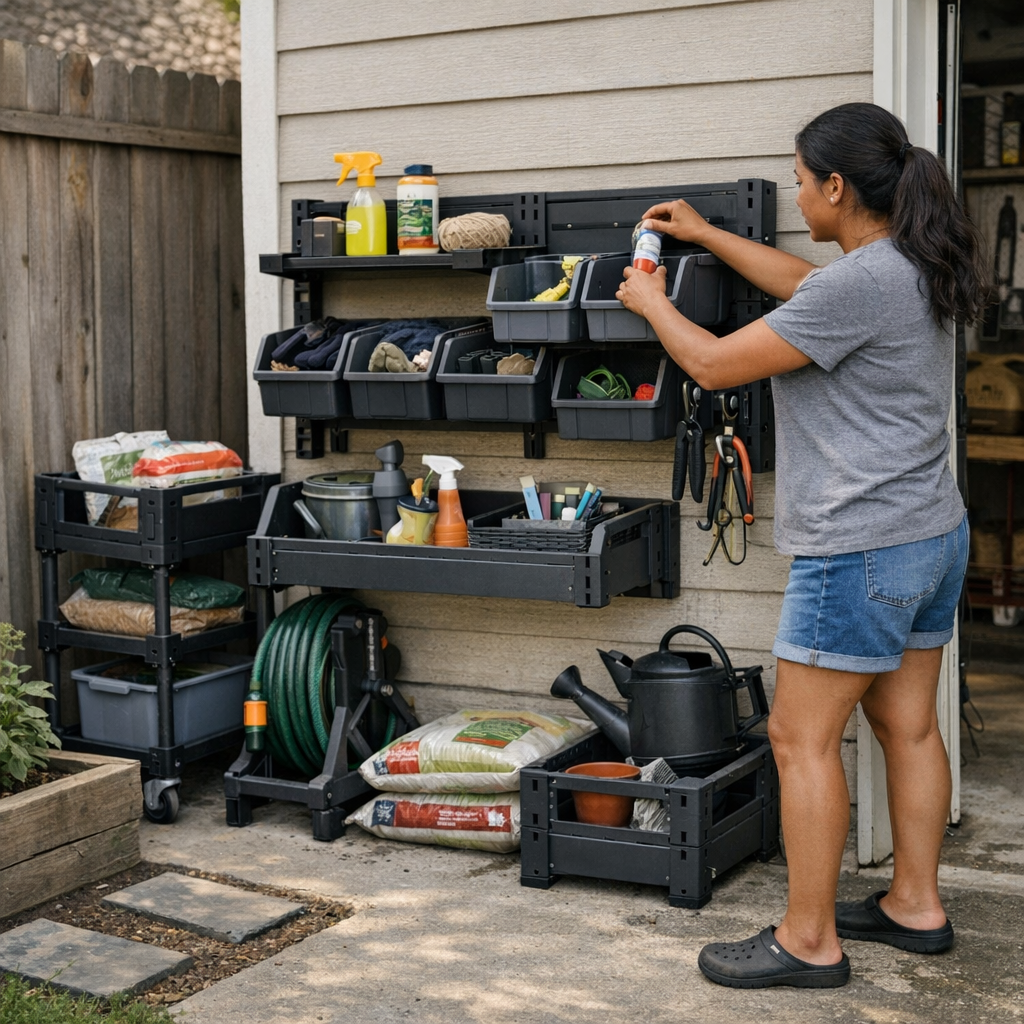
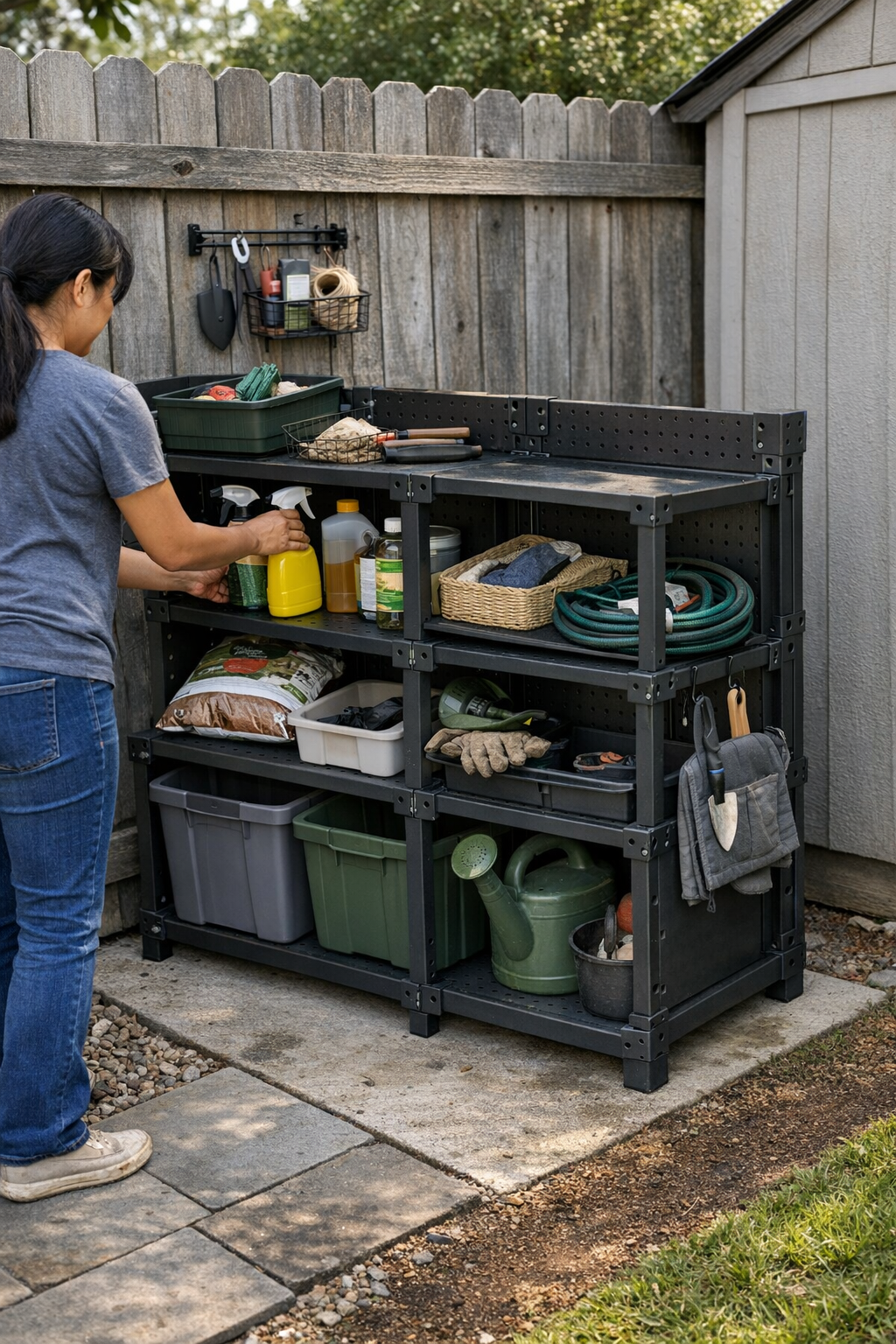
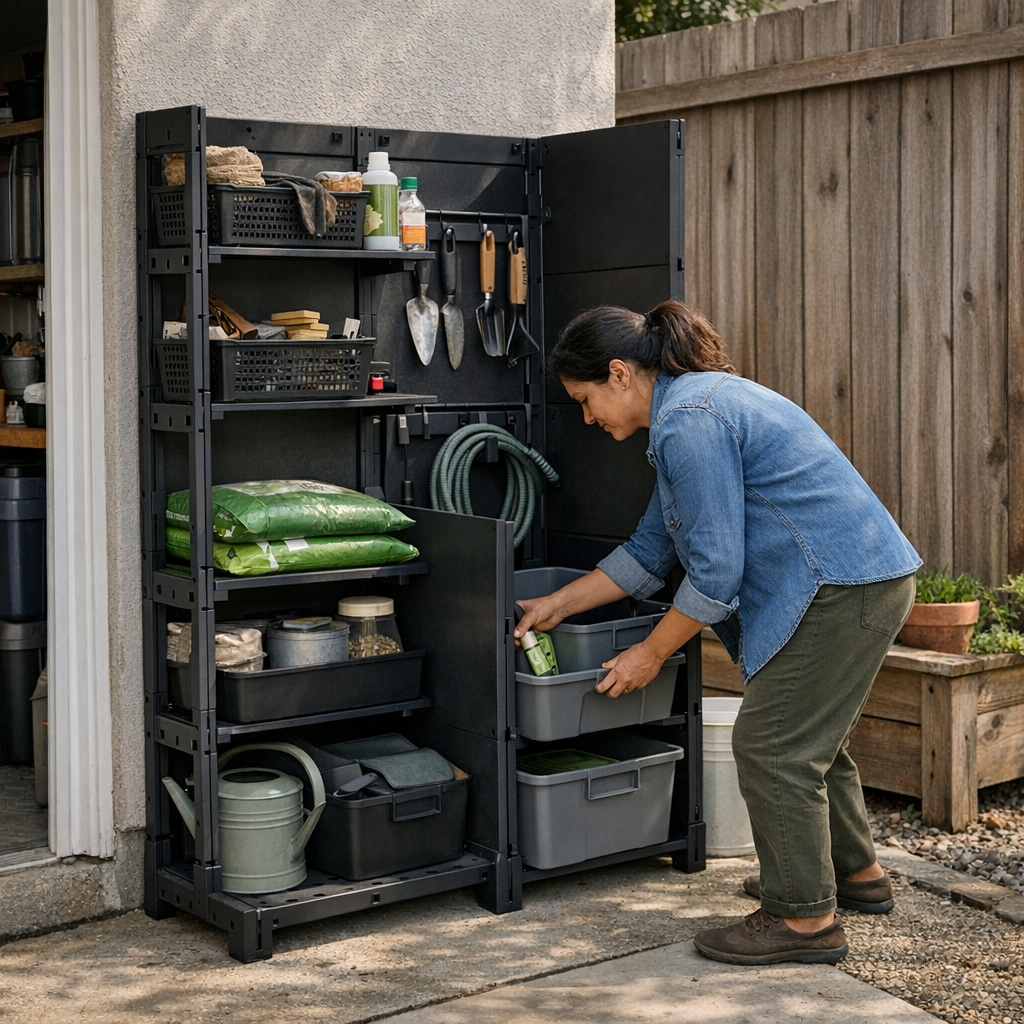
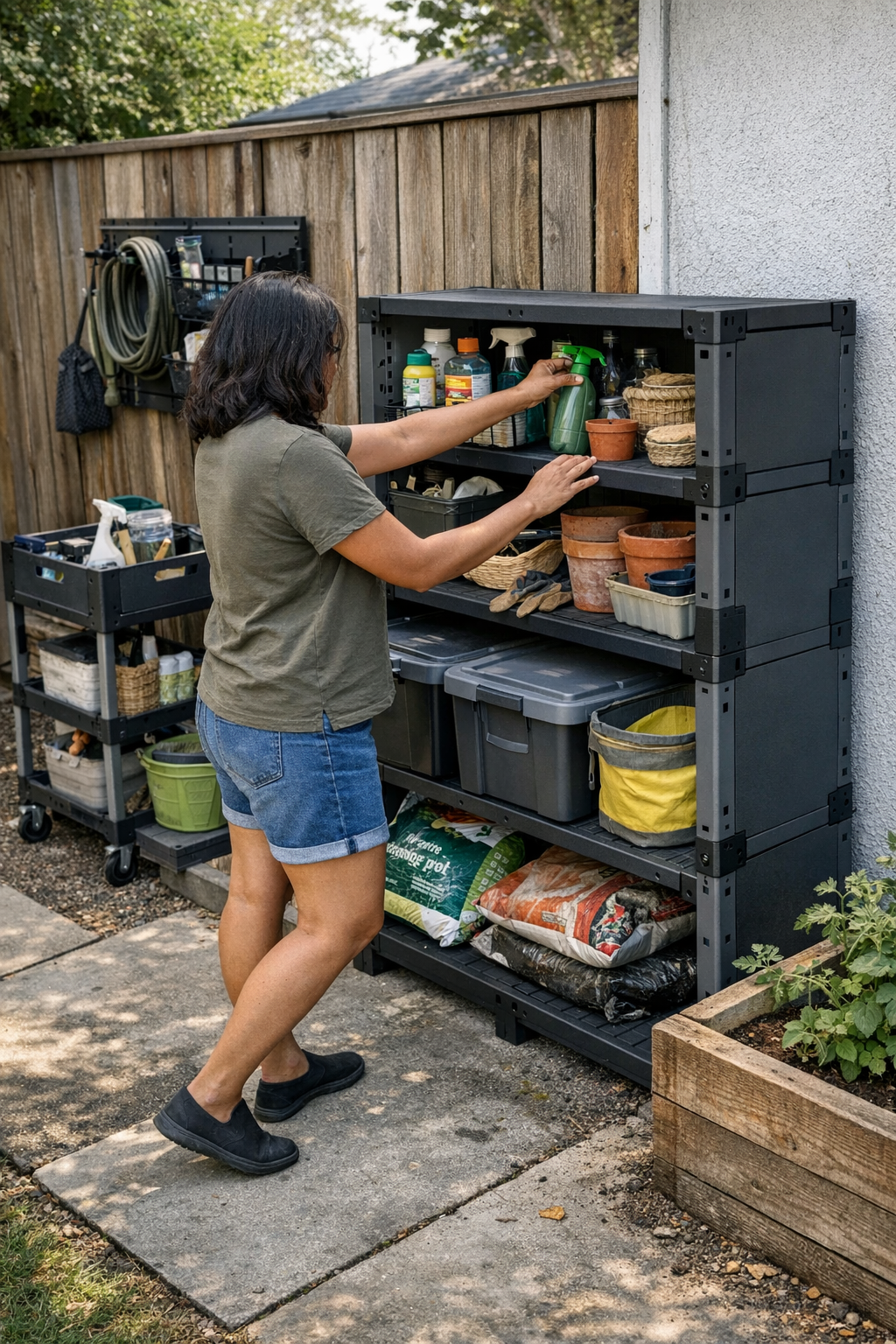
    Open racks and cubbies look exposed—hooks with garden snips, wall baskets holding spray bottles, open slots along the garage edge. But when the reset is just drop-and-go, clutter has fewer places to collect. Return a trowel? One motion, back on the hook. Grab gloves? Toss them on the open shelf as you leave the yard. No lids to fumble, no stacks to move, no out-of-sight layers. You see what’s out and what’s missing, so nothing quietly rots in a dark box for a season. It isn’t a catalog spread, but it’s workable and fast enough that the system holds even on the messiest days.

    This “mess visible, friction low” balance is what makes the open setup more than a compromise—it’s a live counter to the way outdoor zones want to slide right back to blocked movement and quiet spillover.

    Raise It to Elbow Height, Cut the Excuses

    The reset gets even smoother when open cubbies sit at elbow height—right where your hand already travels. Mount a row 16–20 inches up along your garage, fence, or patio wall. There’s no extra bending, stacking, or reaching over packed bins on the ground. Dropping clippers in a cubby or hanging the hose sprayer takes the same effort as abandoning them on the lawn—and with the right reach, the excuses disappear. Daily-use gear runs on muscle memory, the “leave it here for now” pile shrinks, and the path stays open without conscious effort.

    How Setups Turn Against Themselves

    • Floor bins that become blockers. The big storage cube against the fence seemed smart until quick-grab gear covers its lid and you quit opening it entirely.
    • Items orbit their homes instead of returning inside them. If it takes more than one step to put something away, the “just for now” pile becomes a permanent speed bump by the door or along the garage threshold.
    • Every reset begins with reshuffling. Moving three items to get to one? That’s a friction point. The more you have to clear a path, the less likely you’ll keep clearing at all.

    These aren’t accidents—they’re symptoms of setups designed to look organized, not to survive a real day’s movement. The setup isn’t the problem. The layout—where the work actually happens—isn’t matching the routine that needs to flow through it.

    Real Scenes: When the Routine Meets the Reset

    Visualize an average weekend. A set of hedge clippers hangs on the open rack just inside the garage door. Ten seconds, they’re back up after use—you keep moving. Shift that same hook too high, or tuck it behind a stack of reused planters, and suddenly the “temporary landing zone” becomes the real final stop. Four days later, you’re working around an obstacle you made by accident. Multiply this pattern by every tool and bottle you touch, and the zone goes from frictionless to blocked, fast.

    The classic deck box tells the same story. It fits the footprint, but the lid’s heavy, inside is a scramble, and the nearest tool always ends up living outside, easy to grab but never quite put away. The box doesn’t fix the clutter—it just pushes the reset further down the line. Once you’re tripping over overflow, you’re not storing smarter, you’re just shifting the pile.

    Tweaks That Actually Shift the Routine

    • Raise open storage off the ground—hung racks or wall cubbies don’t eat into floor space, so walkways stay open and gear doesn’t slide underfoot.
    • Push daily-use zones to your entry points—store gloves, pruners, and hoses by the gate, the patio edge, or just inside the garage so you’re not crossing the whole yard to reset.
    • Put quick-grab gear on the wall, not the floor—if the first thing your feet hit is a pile of loose items, the setup is already losing to clutter.

    If items pile up in front of a container or a bin goes unopened for weeks, that’s not a user error—it’s the setup sending a clear signal of friction. Shorten the reach, cut the busywork, and the overflow shrinks because there’s no labor barrier. This isn’t about impressing with order or matching magazine shots. Practical storage is about setups that run themselves between resets, not setups that demand one giant fix every Saturday.

    Choosing Systems That Match What Happens, Not Just What Looks Good

    Open storage belongs in high-turnover zones: toys, hand tools, gloves, gear that moves in and out. Closed bins make sense for bulk or off-season—cushions, holiday lights, bags of seed you use twice a year. But if a system slows you down, even by a few seconds, the clutter will work around it, and you’ll spend more time bending, stacking, or searching than actually using the space. Judge the setup by the return: When the burst of activity is over, did putting things away help you move forward, or did it just add another step to the next reset?

    The Real Difference Is in the Return Flow

    You don’t need more containers. You need setups that clear the path. Most outdoor spaces drift into chaos not from lack of storage but from layouts that ignore daily movement. Build for return flow and resets become invisible. Over time, open racks and elbow-high cubbies end up “unstaged” but quietly functional—the gear moves in and out, nothing stalls, and the zone doesn’t demand your Saturday just to look reasonable. When the setup reduces effort instead of shifting it, the space stays usable, even when it’s not picture-perfect. That’s what lasting organization looks like in practice.

    Find setups built for real return flow and weekend momentum at TidyYard.

  • How Clear Sideboard Storage Rules Transform Household Organization

    A sideboard looks organized only until real life rewrites its rules. The smooth, closed doors promise control—a clean dining area, a reset entryway, a place for everything. But by week two, the flaws leak out over the edges: chargers creep onto the wine shelf, last week’s mail piles in the napkin corner, and the broad top is a magnet for everything you couldn’t decide on putting away. What felt like an upgrade quickly becomes a slow friction—retrievals that stall, drawers that catch, and clutter that hides better than it disappears. Suddenly, your storage solution is part of the daily reset problem.

    The Slow Fade: When Organized Looks Don’t Hold Up

    The promise is classic: sideboards tuck clutter out of sight and free up your routine. But closed storage without clear category boundaries turns fast into a catch-all. The cost shows up when you’re in motion—needing dinner napkins now but finding receipts, or reaching for a charger and sending a spill of menu cards across the drawer. You’re opening two sections to get one item, moving stacks to close what should shut easily, and each small hassle compounds. Organization doesn’t decay loudly; it just interferes quietly, until you’re spending mornings untangling cables or forgetting where the spare keys wound up last.

    This breakdown sharpens in busy, high-traffic areas. Mixed-use sideboards—trying to absorb dishes, tech, linens, mail, and the chaos of family life—lose their lines fast. With no enforced categories, anything becomes fair game, and it takes only a few rushed weekdays to blur the original setup. What was supposed to be “hidden order” becomes blind drift, with every search slowing and surfaces refilling just as quickly as you clear them.

    Beyond the Showroom—Practical Friction In Real Use

    If you’ve hesitated in front of a sideboard, mentally replaying moves—where’s the charger, which drawer for remotes—you’ve seen the danger in trusting good looks over good logic. Closed doors aren’t a fix; they’re a delay. Well-arranged shelves mask the problem until a quick retrieval turns into a block: drawers that need shuffling, a stack of folded cloth pinching a hidden pile, items wedged deep enough that “out of sight” means “as good as lost.” Supposedly smooth routines jam on the smallest snags, turning resets into scavenger hunts.

    It’s not just about missing things. When boundaries blur, every return becomes negotiable. What once stopped you from spreading out becomes its own overflow zone—mail gravitates to the kitchen or gets stacked on top, napkins float to the hallway instead of returning below, remotes land wherever there’s less hassle. Out-of-place items spark workarounds. Soon, the system’s logjam reroutes your habits: shortcuts get taken, drawers fill up unevenly, and the door becomes a physical barrier in your path rather than a helper.

    Category Drift: The Real Source of Blocked Flow

    Category drift quietly unravels any sense of order. That “miscellaneous” drawer? A symptom of fading boundaries. At first, it’s only an extra minute spent searching or shuffling. But by the end of the week, drawers resist closing, bundles wedge in corners, and items you needed for tonight’s dinner or task are unretrievable without a full reshuffle. Each convenience becomes a slow tradeoff—less time spent on initial sorting means much more lost in daily disruption.

    In family or shared rooms, this drift shows up fast: a flat surface that stays clear only until the next drop-off, sideboard doors blocking paths because no one wants to empty the pile behind them, guests slowing down the evening as they fumble to help. The true cost isn’t visible mess—it’s lost flow, blocked motion, and habits that change only to work around the latest jam.

    Giving Every Section a Role: Where Structure Beats Storage

    Resilient sideboards assign each drawer or shelf a strict single use. “Top left: chargers and daily mail only. Lower right: extra linens. Center tray: keys.” Not a loose intention, but a visible limit. The difference is sharp: clutter stops accumulating, flips and shortcuts get blocked, and the time to retrieve or return drops fast.

    In one clear reset, a dining room sideboard went from tangled catch-all to stable helper. By stripping a central drawer of its floating contents and reassigning it—one category per section, a shallow tray to stop tech from wandering—morning logjams vanished. After a week, no double-searches, no blocked drawers, no hidden piles. The upgrade wasn’t about gadgets or more organizers; it was pure rule structure fitting real-life traffic, and it held up when things got busy, not just when freshly sorted.

    Reset Routines: Keeping Structure Alive Beyond Day One

    Even the right categories slip without a reset pattern. Regular, fast resets—not deep cleans—hold the boundary. Think end-of-day shuffles: chargers to tray, mail to the assigned slot, napkins to their shelf. The repeat matters more than decorations or labels. With hidden storage, “muscle memory” is the true guide—always the same hand to the same spot, the same action building internal coordination so anyone can help, even without a label or list.

    This isn’t about stricter rules; it’s about keeping friction out of the daily path. Location reliability—reaching once, returning easily, not thinking twice—is how sideboards become assets, not obstacles.

    Signs the Setup Works—And Where It Usually Breaks Down

    When the categories make sense, you don’t notice the sideboard at all—you move through, grab what’s needed, close what was opened, and space stays open without a second thought. One-touch access, flat surfaces that don’t re-pile, and the ability for guests or family to help without searching: these are the side-effects of a working structure.

    When it’s off, the signs are impossible to ignore: paths blocked by open doors, retrievals that send you shuffling from end to end, and clutter climbing the top edge as each “just for now” turns permanent. These aren’t just aesthetics gone wrong; they’re the cost of too little structure and too much drift. The right storage doesn’t add steps, it removes friction—first, in motion, then in memory.

    Simple Tweaks That Last Through Real Life

    Small, structure-first corrections keep a sideboard in service, not in the way:

    • If a drawer keeps jamming, strip it bare and go back to one clear purpose. Only then add a divider or tray—never before categories are sharp.
    • If mixed-use pressure is high (tech, papers, keys), the top drawer needs hard limits: set it to just what’s handled and returned daily, veto overflow.
    • Try a nightly “one-minute reset”—not a full sort, only what’s needed to return stray items, smooth out napkins, and clear the landing zone. The impact is noticeable: less stalled movement, faster access, rarely a need to “fix” the whole cabinet at once.

    Most sideboards don’t fail on size—they fail when their layout fights real usage. Baskets and containers help only if you first walk through categories that survive your routine: a return flow as simple as the retrieval, not crushed by the first busy week.

    See Gridry’s full range of practical sideboards and storage systems to build your own lasting setup.

  • Sealed Storage Boxes Prevent Dust Build-Up During Home Renovations

    Renovation dust resets the rules at your entryway—fast. It only takes a few days of ceiling patching or drywall sanding before the usual setup falls apart. The spot that should smooth out comings and goings—bench, bins, row of shoes—starts turning against you. Dust drifts in no matter how careful you are, settling on open benches, working deep into shoe seams, and making every dropped bag a new dust magnet. Where you once breezed through the door, now you pause, weigh options, and wonder if this “quick drop” will mean another full reset tonight. Open layouts lose their edge the second airborne grit arrives—and what worked for fast routines now multiplies the cleanup load instead of reducing it.

    How Open Storage Falls Short When Dust Moves In

    Baskets and benches promise calm at the threshold—until the first week of renovations. By midweek, the illusion is gone: powder lines every exposed edge, coats bag handles, invades shoe linings and slinks into pockets. There’s no being careful enough. Drop a work bag on an open bench or leave shoes in a neat row and you’ll see it—one day of dust, maybe two, until organization turns to mess. Every surface you meant to keep clear becomes storage for debris instead.

    If you have to move quickly—hanging a jacket on a wall hook, dropping a backpack in a bin—there’s no buffer. Dust wins instantly. Soles, laces, zippers, even the bench frame start accumulating a gray film. The “grab-and-go” routine stalls; you choose between cleaning every piece in the evening or chasing grimy buildup that never really stops. The work isn’t just visible. Grit works deep into leather, sticks to bag linings, and waits in places you don’t have time or patience to clean. The look of control lasts less than a day; the extra cleaning duties last the whole renovation.

    When the Fastest Storage Becomes the Messiest

    Open setups excel—until they collide with ongoing contamination. That line of shoes near the door works for a few hours, but as dust settles and routines repeat, everything starts to blur. Every new trip—one more bag, a pair of rain boots, loose keys—leans into old debris. There’s no threshold maintenance, just slow fade: open shelves and shallow baskets hold the shape, but they don’t protect the habits. The organized look holds maybe a morning; then, everything is touched by the same unfiltered mess. Each use turns “temporarily stored” into “slowly compromised.” Shoe insoles turn gritty, bag linings taste like drywall, and even a slim bench gets drafted into overflow—without ever feeling cleaner or clearer.

    Movement and Reset Friction in Dusty Conditions

    The real friction is cumulative. You start brushing off shoes every morning, vacuuming around the bench at night, and wiping out bins you never needed to clean before. Resets get longer, not shorter. Every time you need to move through the threshold, you’re interrupted: pause to clean, move a pile, dust off a “clean” tote. The daily reset that used to take seconds now stretches—because the entryway keeps pulling outside mess inside, without slowing it down or containing it.

    The Sealed Box Solution: Slower But Stronger

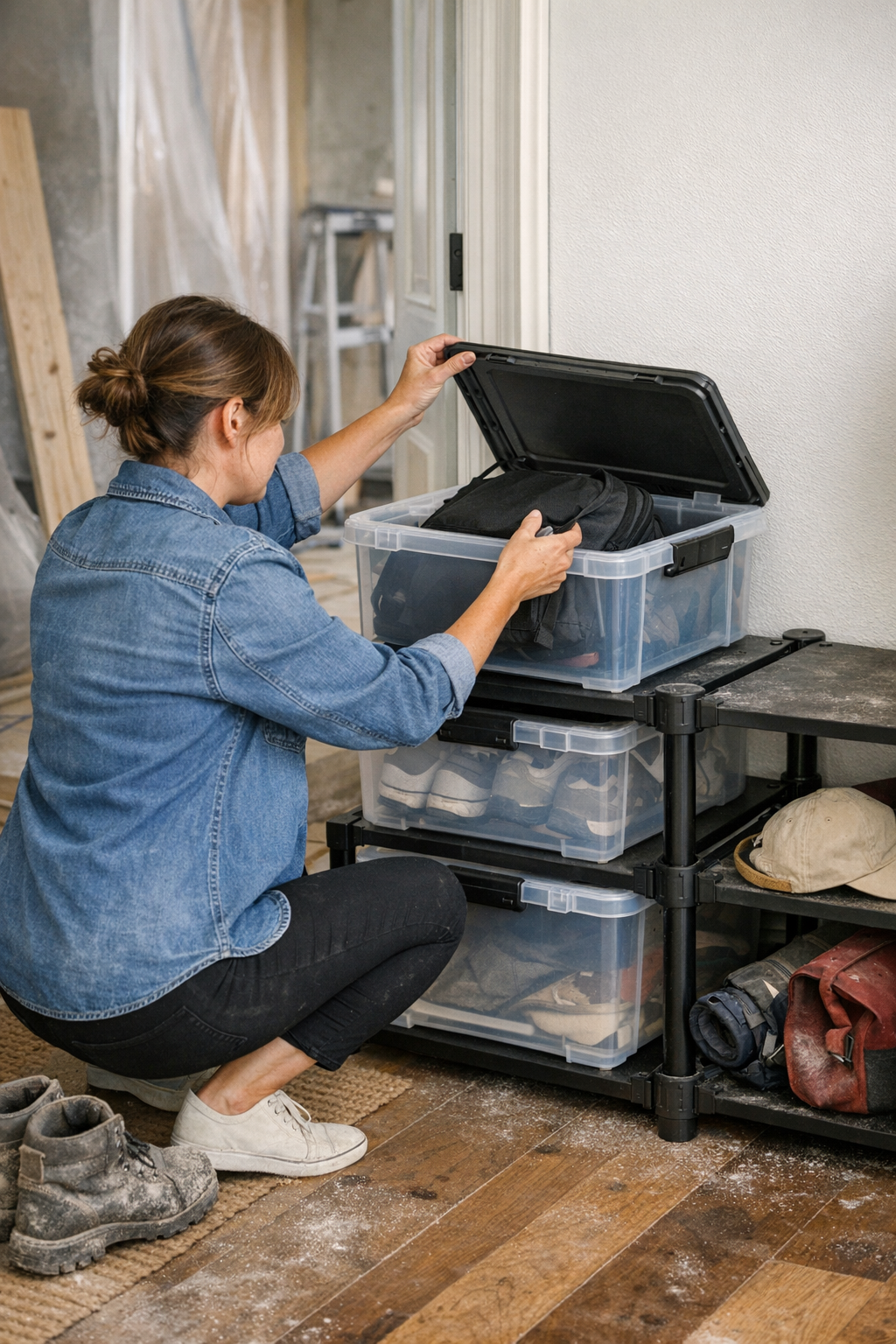
    Sealed storage shifts the odds back in your favor. At first, bins with tight lids or weather-resistant cabinets feel like overkill. But when every drop zone is coated in airborne grit, that single degree of separation makes all the difference. Shoes, daily bags, and sports gear stay shielded—dust can drift past, but not in. The floor may be powdery, but what you open up stays ready to use.

    This is not perfection—it’s breaking the lose-clean-repeat trap. The price is one more step: open a lid, slide out a bin, maybe knock your shoes together first. What you save is measurable—no more nightly full-surface resets, just a check and a quick wipe when needed. You notice the difference on the first morning you reach for running shoes and don’t have to shake debris out of the insoles. It’s order you feel in movement, not just in appearance.

    Real Setup, Real Relief

    Place a sealed box along the wall and watch the routine re-stabilize. Shoes go in, lids go down, dust stays out. The bench doesn’t become a second floor. Bags get their own enclosure instead of taking on every particle in the air. With each pass through the space, clutter creep halts. The nightly reset shrinks to a minute instead of forty-five. It’s not an abstract fix—you see it each time you leave and come back: what you rely on is still usable, not disguised under a new layer of grit.

    Hard Tradeoffs: Accessibility Versus Containment

    Sealed storage slows down access, and in shared or tight households, even a five-second delay can matter. But in renovation conditions, every shortcut that saves a minute at the door costs ten on the back end. The equation shifts: a little inconvenience up front buys back your evenings. There are side effects: stacked boxes tighten the path, too, and fast storage risks trapping moisture or odors—especially if shoes go in wet. Vented boxes or a quick wipe-down help, but the main tradeoff remains: open setups are easier until dust arrives, then they pile on the work.

    Clarity Where It Matters Most

    The entryway isn’t just a picture of order—it’s either a working barrier or a weak channel between outside mess and indoor routine. A space can look minimal, even controlled, but fall apart under repeated dust intrusion. Sealed units, well-placed next to the door, create a zone where clean gear survives the weekly grind. You only realize it the first time you open a bin after three days of sanding and find your running shoes untouched. No more “looks organized, feels dirty.” Just a visible division: the chaos stops at the lid, not at the doorway.

    Everyday Scenes: Recognizing the Right Change

    You drop a gym bag after work—the bench looks clean, but by morning, there’s a pale print marking the spot. Shoes multiply in a careful row, but each return pushes them wider, debris staging a slow invasion toward living space. You come in late, muddy boots in hand, and realize your only option is to set them right on top of yesterday’s dust pile. The once-minimal setup now forces you to step around clutter, move bins just to open the door, and spend more time shifting obstacles than moving through the threshold itself.

    Switching to sealed storage doesn’t make the space flawless. It gives you back time, resets, and the ability to move without cleaning after every entry. Fewer surfaces to dust, fewer regrets after a hurried drop, and gear you don’t have to de-grit before putting on. When the renovation is dragging on, the only practical fix is a setup that outlasts the dust—and once the work fades, you’ve already built yourself a better way to handle whatever drifts in next.

    http://www.betweenry.myshopify.com

  • How Clear Zones Transform Shared Outdoor Storage Efficiency

    Real outdoor setups start to break down as soon as more than one person tries to use them—especially in tight corners, garage edges, or those slim backyard strips that already feel too crowded. You think you’ve got it organized, then Saturday hits: sports gear, garden tools, folding chairs, all coming and going in random waves. Suddenly, putting one rake away means dragging out half a bin, or worse, stepping sideways because the aisle you cleared last week is jammed with new overflow. Setup friction isn’t just possible—it’s guaranteed.

    Where Shared Bins Fall Apart

    Take a simple backyard chest or open bin. It’s easy on day one: clear, accessible, a blank slate for everyone’s gear. Then real routines kick in. Someone comes home late and tosses in a bike helmet. Someone else jams a shovel in at an angle, blocking the crate underneath. By midweek, folding chairs teeter right where the walkway narrows, and every return becomes a reshuffle. The “just stick it anywhere” habit takes over instantly.

    Shared bins and open shelves do one thing well—they collect. But they don’t guide. Here’s how the cracks start to spread:

    • Drop-off is fast, pickup is slow: It’s easy to throw things in, but every retrieval means digging through a layer cake of stuff.
    • Walkways shrink: Gear bleeds past the bin, edging into walking space, until your only path is a zigzag around obstacles you didn’t plan for.
    • Responsibility vanishes: No one knows who left what, or who should clear the mess—so no one does. Pileup is the default.

    What looks like a minor search—just a few seconds to move a soccer ball or a watering can—compounds into routine gridlock. Cleaning up feels thankless, so resets get skipped until the next big block forces an hour-long overhaul.

    Overflow Isn’t Just Ugly—It Changes How You Move

    The difference between “organized” and “works when busy” hits hardest when the space fills up. That garage-side zone where bikes land after school, or the utility strip behind the house: after a rush of use, the setup reveals exactly where it fails.

    • Paths disappear beneath stray bags and gear, forcing you to step over piles or tilt past a rake just to get out the back gate.
    • Returning a single broom means first extracting a stack of balls or relocating a heap of chairs—every “quick fix” slows the whole routine.
    • Small tools disappear to the bottom, buried beneath “temporary” dumps that linger for weeks.

    This isn’t just about neatness. Clogged return paths quietly kill motivation. If it takes effort to stash one thing, odds are you’ll just set it down somewhere visible, repeating the cycle. Over a few weeks, clutter escapes to every corner, until the whole setup feels like a trap.

    Why Zone Clarity Changes Everything

    The biggest difference isn’t shelf size—it’s assignment. Systems with no clear zones teach everyone to freestyle. Soon, balls migrate to tool piles, and overflow ends up wedged in the deadest corner. What starts as shared space drifts into a mishmash you “work around” instead of use. Only when every main function gets its own lane does the setup start to breathe again.

    What the Shift Looks Like

    One side-yard tested the default approach last spring: one bulk chest, one open crate, all tight against the fence. For a few weeks, the system held. Then summer routines landed, guests brought their gear, kids dumped toys in waves. Pretty soon, every reset meant untangling a folding table just to get to a spade, or digging for balls through a wedge of chair legs. By July, it was faster to carry yard tools through the house than risk the outdoor pileup.

    Things changed only after splitting zones:

    • Wall hooks went up for small tools—high, visible, and impossible to bury under other gear.
    • Sports balls landed in a single open bin, not mixed with anything else.
    • A taped square on the floor now signals exactly where to stack folding chairs—never in the path.
    • Big items get their own corner or vertical rack, so walkways stay open and returns fast.

    The setup isn’t perfect, but the difference in day-to-day hassle is huge. Overflow doesn’t spill everywhere; it finds the nearest end of its own zone, never blocking the whole route.

    Assigned Zones = Faster, Less Annoying Resets

    • Parking a shovel takes one motion: grab the hook, hang, done.
    • Returning rackets or balls is obvious: their bin is the only logical place, no matter who’s cleaning up.
    • Bulkier items have a boundary: chairs fit one place and don’t drift into walkways, so movement never chokes off completely.

    The pressure point isn’t perfect alignment—it’s survival. As long as things land in the right zone, the system flows. The bar for “good enough” drops. Echoes of real use—hasty returns, mixed habits, one-off dumps—don’t trigger catastrophe resets. The setup stays functional even when life gets messy.

    When Trouble Spots Don’t Become Sinkholes

    Sure, odd days still mean finding a missing ball under the hose or bumping a forgotten chair. But now, those moments are speed bumps, not weekend projects. Overflow stops short of infecting every area. The more defined the zones, the more “acceptable mess” stays contained and resets don’t spiral.

    Is Your System Actually Working?

    • If you layer-shift (move three things to grab one), your zones are leaking.
    • If one wall or bin always overflows, your categories are muddled, not just your capacity.
    • If corners quietly become junk magnets, your footprint isn’t guiding traffic—it’s inviting clutter.
    • If you avoid the area because reset is a chore, your flow is broken—and daily use is paying the price.

    Notice who’s constantly “fixing” things and why. A solid setup makes even a sloppy return frictionless. Without that, the mess comes back faster than anyone can keep up.

    Practical Tweaks That Stop the Creep

    • Dedicate wall space for rapid-grab tools—even a couple hooks make a difference above the pileup zone.
    • Give sports and kid gear their own open bin—not to tidy, but to make the next drop and grab smoother under pressure.
    • Mark a landing strip for bulk items—use tape, a mat, whatever breaks the habit of dumping chairs in the path.
    • Break up known clutter magnets—if a corner always eats abandoned stuff, rearrange its boundaries or split storage load with a second bin.

    Most of all, keep routes navigable. Looks don’t count—a tidy layout means nothing if you’re dodging bins or squeezing past gear every normal day. If your setup lets you reset in seconds after a rush, it’s working. If it just looks good on Sunday but collapses by Tuesday, it’s time to rethink how the space is mapped.

    The Real Difference: A Setup That Handles You, Not the Other Way Around

    No storage system is immune to real life. When routines collide and mess creeps in, assigned zones reveal their value: resets shrink from an hour to a few unthinking motions. You might still see stacks and scatter, but they don’t block movement or demand constant vigilance. The space helps you reset on autopilot—and actually invites repeat use, not avoidance.

    Showroom perfection won’t last. But a setup that organizes itself in the middle of real use is far more valuable than one that just sits neat and empty. Test yours. Pay attention to the problems that keep coming back. The solutions aren’t complicated, but the difference between friction and flow is impossible to miss.

    Find outdoor storage setups that fit the way your routines actually work at TidyYard.

  • Optimize Hallway Storage with Smart Console Cabinet Placement

    Every hallway promises order; most deliver a pile-up. That low-profile cabinet near your door looks right—until shoes clutch the wall, bags drift off target, and mail camps out on the only surface meant to stay clear. The setup feels organized at first, but by midweek, you’re walking around the very cabinet that was supposed to control entryway chaos. The inconvenience isn’t dramatic—it’s the drained momentum, the detour for every drop-off, the constant low-level reset that gets ignored until the floor is crowded again. It’s the high-traffic, low-reward friction that shows what “good on paper” actually misses about real hallway storage.

    When Good Storage Isn’t Really Good Enough

    The appeal of a hallway console cabinet is strong: hide mess, tidy up, greet guests coolly. In use, though, the same hiding spots start working against you. When putting away shoes or bags means side-stepping or reaching past the cabinet’s frame, it keeps tripping your routine. If quick storage is a hassle, you catch yourself shoving sneakers sideways and stacking mail on top, bypassing doors that now feel like extra work. It’s the difference between a room that looks organized once and a setup that stays usable every morning, with no time to stage.

    The signal is subtle but persistent: items gather at the cabinet’s edges instead of inside. You or your family start dropping things wherever’s easiest, training the “storage” to serve the furniture layout—never your real routine.

    The Foot-Traffic Test: Placement Makes or Breaks It

    Movement drives what succeeds in a hallway. A cabinet positioned against the flow turns everyday storage into a workaround. Shift it even a single step out of the drop zone and you’ll find shoes trailing toward the door instead, with backpacks piled where the shortest path wins. Resetting—putting everything where it’s intended—goes from invisible habit to weekend project, and visible piles edge back in. The missed detail? Every reach, twist, or pause is a repeated hurdle, not a one-time inconvenience.

    Flow beats “tidy” every time. When the cabinet interrupts your natural rhythm—whether that means crouching awkwardly, twisting to open a too-low door, or avoiding a blocky corner—little frictions multiply. Over a few days, micro-inconveniences become patterns that undermine the order you bought the cabinet for in the first place.

    How Cabinet Design Shapes Daily Clarity (or Chaos)

    On the showroom floor, a slim closed-door cabinet ticks the “minimal” box. In living use, it traps friction inside: shoes jammed sideways in the dark, bags sliding into every available gap, keys lost behind stacked mail. The more you share the entry, the louder this design flaw gets. The after-work scramble turns into a cross-cabinet search, just to recover one shoe or a tossed ingredient list. Categories blend, and small things vanish until someone finally dumps it all out to reset.

    Switching to a bench-top or cabinet-with-surface solves nothing if the catch-all habit returns. “I’ll deal with it later” becomes a magnet for loose papers, jackets, sports gear, and whatever didn’t fit before. Instead of one clear reset, you’re stuck untangling mixed-up piles by the end of each week.

    Real Use: When Sharing the Space Puts the Setup to the Test

    The weak spots show up fastest during shared routines. Think: school mornings or everyone in the door at dinner. If the cabinet’s a step out of the way—too distant from the pause where shoes come off or too cramped to share—a single person might adapt, but the group won’t. Most give up on the slow process of finding a free shelf, opening two doors for one action, or sorting through a black hole of mixed items. Soon, the floor fills up again, as convenience wins over system, every time.

    Practical Tweaks That Change the Routine

    Distance matters most: Move the cabinet into actual reach of your first step inside—the moment shoes hit tile or hands find the closest surface. In a day, you’ll notice bags landing where they belong, not drifting off-course. No forced detours. People use what’s closest and quickest, so the storage system should map directly onto those movement lines.

    Inside, avoid black holes: Deep undivided shelves eat organization, turning neat ideas into messy reality. Sectioned, shallow trays or simple pull-outs—one for essentials, one for shoes, one for mail—keep retrievals quick and prevent small things from vanishing beneath bigger items. With each category clearly defined, the weekend panic clean becomes a lost habit. Everyone knows where things go—and, crucially, where to put them back, even in a rush.

    Form and Footprint: Why Raised-Leg Cabinets Outperform Bulky Bases

    Choose a piece with raised legs and you’ll see the change right underneath. Floor stays visible, wall space feels lighter, nothing blocks your stride or collects dust in shadow. Unlike a blocky base, raised-leg designs give feet and bags an honest path. Less hidden clutter. Fewer near misses with sharp corners before work. Resets speed up, and you’ll get the cues right away if the flow is blocked—no guessing at what’s gone missing until you trip on it later.

    The Reset: Measuring if Your Setup Holds Up, Not Just Looks Good

    Fine-tuned storage isn’t about perfection. It’s about whether your hallway can handle a full week without morphing back into a holding zone. When setup matches movement and category boundaries are built in, resets shrink from “roll your sleeves up” events to moments you barely notice. The real signal? You can find the right pair of shoes, the mail’s off the bench, and nothing stalls the path out the door—even when schedules stack up or habits slip.

    No cabinet stops mess forever. But if your storage supports repeated real use—a week’s worth of arrivals and exits, not just a morning’s quiet—you’ll know it. The difference isn’t surface-level tidy; it’s in the time you save, the steps you don’t waste, and the patterns that finally stick for more than a day.

    Find storage setups that keep pace with real movement at Gridry.

  • Why Vent Gaps in Entryway Storage Prevent Mildew and Odors

    No entryway setup truly gets tested until wet gear collides with routine. The transition from outside to inside isn’t just about arriving—it’s the moment when rain-soaked jackets, dripping bags, and soggy shoes command the threshold. Every decision at that drop zone carries a cost: stash the gym bag out of sight, and you risk must; leave wet shoes sealed away, and tomorrow’s reset is already compromised. When the forecast turns unpredictable or entry points absorb high foot traffic, the wrong storage setup isn’t a minor hassle—it’s a fast-moving bottleneck that multiplies work and blocks flow in everyday life. Betweenry’s world of transition-space storage exists because matching finishes doesn’t solve the churn. Organization that looks resolved once, but breaks down after two wet days, isn’t holding up under real use.

    When Closed Cabinets Hide More Than Clutter

    At first, sealed benches and tightly lidded cabinets appear to solve chaos. They wipe away the mess—visually—leaving the entryway “finished.” But after a week of wet re-entries, the limits show. Moisture doesn’t quit at the door—it gets boxed in. Shoes closed from airflow stay damp through the next morning. Jackets zipped into hidden cabinets feed a cycle: the interior air hangs thick, damp patches linger, and soon, trapped humidity evolves into the telltale sour scent of mildew. Even neatly lined storage turns into a closed loop—every reset piles dampness onto itself.

    These setups unravel fast in actual traffic: shoes jammed in bins remain cold and wet, gym clothes tucked away are musty by the weekend, and “one quick store” quietly turns an entire threshold into another cleaning project. Instead of containing mess, these routines push the cost downstream—now you’re spending Saturdays unboxing, airing out, wiping slouching cabinet corners that never quite dry.

    Vented Storage: Airflow as a Daily Reset Button

    The everyday cure isn’t visibility—it’s ventilation. Vented storage (open shelves, louvered panels, raised benches) gives damp gear a route to dry, breaking the buildup before it takes hold. Every vent, slat, or open edge is a release valve for trapped moisture. After heavy rain, shoes on vented racks feel touch-drier by evening. But their sealed-off counterparts—shut behind doors—still come out clammy or sour, and the cycle repeats.

    On high-traffic days, this difference multiplies: three rounds of arrivals, layers of wet stuff, and yet the vented storage bounces back with ordinary air movement. No full “air-out” session needed, no reshuffling in the morning. It isn’t about making the threshold photogenic. It’s about keeping pace, so the reset is a quick sweep, not a burdensome overhaul.

    Real-World Friction: How Wet Gear Pushes Back

    Here’s what breaks down in actual entryway flow:

    • Shoes in a closed cabinet are still damp at sunrise; the row cracks wide, pushing onto the hallway path as new pairs join, and the controlled look unravels.
    • A backpack dropped “temporarily” on a bench lingers wet; soon, the bench edge accumulates hats, homework, rogue socks, and the whole seat disappears under overflow, muting any hope of sitting down.
    • Crossing the threshold with groceries becomes an obstacle course: sidestep puddles, dodge hoodie piles, catch a whiff of hidden mildew. Order holds, but movement slows, and each pass-through tightens the bottleneck.

    Small Changes That Shift the Threshold Routine

    Most improvements don’t require new furniture. Tweaks work: swap a solid bench for a slatted one, drill a few vent holes behind shoe storage, or elevate units to let air circulate underneath. One real-world fix—a two-inch gap beneath a bench—broke the repeat offense of damp shoes refusing to dry. Even propping cabinet doors open for an hour during rushes, though inelegant, cuts the humidity load and keeps cleanup smaller.

    The goal isn’t total dry perfection—after a storm, even the best-vented bench can’t magic away puddles—but to cut routine dampness. Prevent gear from stacking wetly on itself and the reset shrinks to a few minutes, not a lost half-day. Entryways that allow airflow resist turning daily arrivals into rolling maintenance projects.

    What Vented Storage Can—and Can’t—Do

    Keep expectations real: vented storage reduces—not erases—moisture headaches. It buys time, especially in back-to-back wet entries, but heavy coats or waterlogged boots will sometimes still need the mudroom or a drier’s blast. Still, for daily-use shoes, bags, and jackets, even small airflow upgrades lower the maintenance curve and shrink the risk. The point isn’t a staged photo finish—it’s a zone that resets naturally despite the churn, with less creeping clutter or hidden work under the surface.

    Why Looks-First Setups Can Fall Short

    The visual calm of a spotless cabinet breaks apart once daily reality starts pushing back. A storage area can look “done” on day one, but without breathing room for wet returns, those same shoes and bags start appearing in new, uncontrolled lines along the floor, and the bench turns into a shifting mound of “temporary” overflow. Movement through the zone becomes a sidestep dance. In contrast, vented setups end the cycle: resets are short, spillover retreats, and routine chaos stops taking over the edge of every surface.

    Adapt What You Have: Easy Upgrades for Real Gains

    Most entryways start with what’s already there. Upgrading doesn’t mean replacing everything—it means diagnosing weak flow and adding pressure relief:

    • Drill vent holes in the rear panels of shoe cabinets for airflow without exposing clutter.
    • Swap out a solid bench seat for a louvered one, or install a modular slatted top for better drying action.
    • Prop up furniture feet—an extra inch is sometimes all it takes for air to circulate and for water to escape.
    • Prioritize high-turnover surfaces: wherever wet shoes, backpacks, or coats land first, keep one side open or raised for faster drying by day’s end.

    These adaptations shrink the reset burden. The entryway returns to neutral without a domino of chores—even in string after string of rainy arrivals.

    The Payoff: A More Workable Transition Space

    The only test that counts: does your entry hold up after five days of repeated, wet use? Vented storage creates a baseline that quietly resets itself—moisture clears, movement stays open, and clutter is less likely to colonize corners overnight. The proof isn’t in a glossy photo, but in the pattern: less odor, less mildew, and fewer “deep clean” weekends spent scrubbing what should have dried out on its own.

    If your hallway collapses back into clutter after just a few wet entries, or the return path turns into shuffle-and-dodge with every bag drop, it’s not style you’re missing—it’s breathing room. An entryway that dries and resets fast can actually keep up with real life, instead of silently multiplying messes under the surface.

    http://www.betweenry.myshopify.com

  • How Partial Containment Transforms Outdoor Storage Maintenance

    There’s a moment every backyard or side-yard setup hits—not the obvious crisis of “I can’t fit anything else,” but the slower grind where even your best outdoor storage can’t keep little gear and tools from drifting loose. In the real world, shelves and open bins always seem like the answer. You start with trowels hooked at arm’s reach, gloves clipped in sight, seed packets lined up, every item visible and ready. It feels under control—until the second week, when order collapses with barely a sound. The trowel buries itself beneath a bag of soil. Gloves slip behind boots, then vanish for days. Resetting turns into shuffling piles just to clear a walking path. Suddenly, the zone you counted on for smooth movement and easy storage is the one spot that slows you down, blocks your step, and makes you wonder where all the “efficiency” went.

    Where Outdoor Efficiency Collapses: The Real Return Friction

    The truth is, it’s not about square footage—it’s about the return. Not “Can I fit this?” but “Can I put it back, without blocking something else or derailing my next trip in?” Wall racks and open bins might look like a system built for ease. But after a handful of uses, what’s supposed to be simple access turns into chase-and-reshuffle. You grab the rake, toss it back five minutes later, but now it’s blocking the spade. By the weekend, every reset takes longer. Storage goes from fluid to fussy, never quite matching the rush and repetition of actual backyard routines.

    This is the real test: After a week of working in the yard—watering, weeding, rearranging pots—can you return tools without shifting an entire row of supplies just to open space? If not, the system isn’t broken, but it’s quietly failing. One cluttered barrier at the edge, one pileup in a corner, turns functional setups into new snag points—forcing you to move leftovers out of the way, over and over, just to keep regular paths clear.

    Open Systems: When Visibility Turns Into Scatter

    Open racks and bins promise speed. Everything visible, nothing forgotten, every tool within reach. But spend a week with them in an actual side-yard or garage edge and the cracks show up:

    • Hand pruners get tossed on top of seed trays, forcing you to rearrange both the next time you need either one.
    • Light gloves slide behind taller shovels and don’t come out again until you empty the whole shelf.
    • A giant fertilizer bag ends up collecting three unrelated trowels and a hose—blocking access and hiding daily-use gear.

    The hardware isn’t the issue. It’s the way routines take advantage of every tiny opening. Without clear physical boundaries, “putting it back” just means dropping it anywhere there’s a gap. The more open the system, the more things start to scatter and drift—until the zone’s main job is hiding what you need, not presenting it.

    The Pileup Zone: When Good Storage Becomes a Blockade

    Picture it: that garage threshold you finally organized, a fence-line stacked with modular bins, spray bottles on hooks, extra planters in neat rows. For three days, it works—everything in its zone, every tool where you want it. But fast-forward another week. You’re tiptoeing around seed packets that slipped behind planters, stepping over trowels that somehow migrated to your walking path, ducking to retrieve gloves from underneath a crate. Bins with lids, instead of containing the mess, start swallowing it. Once something drops in, it stays there until you lose patience and dump the whole box to fish it out. The cost? Every trip in or out of the zone slows down, and the setup that was meant to keep things easy is now the thing you’re working around.

    Partial Barriers: The Overlooked Fix That Holds the Line

    Most outdoor storage failures have nothing to do with layout—they blow up when the return flow falls apart. Small, odd-shaped gear drifts, fills corners, and fills the first open “edge” it can find. The eye can see everything, but the hand still has to dig or move something else just to make use of the space. The fix is usually not sealing everything away, but putting up just enough of a barrier to catch the loose ends.

    Swapping one open shelf for a partial vertical block—a simple 28-inch board along the edge—cuts down migration instantly. Small tools and slippery packets can’t wander past the soft edge. Strays land where they can be scooped up together, not hidden across scattered piles. Your most-used piece still stays grab-ready, but the daily mess clusters instead of spreads.

    You’ll notice the change immediately: less stuff creeps across the floor, drop-offs gather in one manageable place, not all over your traffic lane. Cleanup shifts from half an hour of hunting under bins to a single-pass reset. The corner that gobbled up gear now becomes the holding zone you actually use, not avoid.

    Let Routine Dictate Structure—Not the Other Way Around

    Pay close attention to exactly where things pile up after a week outside. If you’re routinely stepping over the same drop zone, install a side barrier there. If the fence-line shelf always collects loose gloves and packets, slot an open-top crate right into the drift path. Make your storage stop and hold clutter at the cutoff, not invite it to leak into dead corners. No outdoor setup needs to look perfect—it just needs to steer your mess where you can find and fix it fast.

    Closed Bins: Useful for Some Things, Frustrating for Others

    On bad days, it’s tempting to shove everything into a closed bin or cabinet and call it done. For rarely-touched gear, that works. But anything you grab or put back more than a few times a month? Closed bins only trade visible clutter for invisible, slower resets. Layers build up—one quick drop, then you forget until it’s time to dump everything out. If you keep high-traffic tools sealed away, you’re just hiding the next scavenger hunt.

    The trick is blending both approaches. Store seasonal, backup, or bulky gear tightly closed. Use partial barriers and open access for everyday hand tools, gloves, and the gear you handle most. This way, you never have to unearth last week’s mess just to hit today’s routine.

    The Difference You Notice: When Setup Starts Helping You Back

    You don’t see a storage system’s weak spots when it’s freshly cleaned. You spot them after a week of actual movement: pushing past a bucket in your path, having to free buried gloves, noticing one wall section keeps collecting more than it should. Setup isn’t about the “organized” look—it’s about function that survives repeated real-world resets. When structure gently pushes each tool and supply back toward where it belongs—and lets you clear the way in seconds, not hours—you’ve hit the sweet spot.

    Outdoor storage is alive. It gets tested the minute you start slipping back into old habits—dropping gear, skipping perfect placement, working against weather and time. The systems that last aren’t the ones with the slickest layout, but the ones that shape your routine as much as the other way around. Look for structures that block drift, keep your highest-use sections open, and make regrouping a fast, visible move. That’s the difference between storage that “fits outside” and storage that actually works outside—day after day, reset after reset.

    See outdoor storage and setup options built for real use at TidyYard.

  • How Buffet Sideboards Transform Dining Storage for Everyday Efficiency

    A buffet sideboard signals calm, but under repeated use, calm quickly unravels if the storage isn’t built for real routines. The difference between a dining room that works and one that only looks organized shows up fast: a sideboard might look neat after a weekend reset—doors closed, surfaces cleared—but by Wednesday, you’re stacking plates at risky angles, nudging glassware aside, or searching for a tool that vanished into a crowded compartment. The friction isn’t visible at first. It builds as dinner-to-dinner movement slows, hidden storage traps what should be within reach, and the reset drags out—making “looks fine” and “actually works” drift further apart with every use. For most dining zones, the core issue isn’t the amount of storage but whether the structure matches how often—and how awkwardly—your own routines push against it.

    Where Hidden Storage Falls Short in Real Life

    Closed doors and tidy surfaces feel orderly, but inside, hidden storage often creates new problems. The main struggles stand out after a few real meals—moments where the sideboard’s internal setup gets in the way instead of helping:

    • Grabbing a plate but finding it buried under bowls you didn’t intend to stack there.
    • Returning glassware, only to see the shelf is just slightly too low, and you’re left juggling—should you shuffle the whole row or leave the glass stranded?
    • Trying to fit serving utensils but every space is blocked, forcing you to balance them beside a tilting tray or dump them elsewhere for now.

    Each time you put something back, hesitation creeps in. Instead of a smooth routine, returns become a shuffle—squeezing, restacking, or resorting to any open space, even if it’s not where things belong. Surfaces get extra piles “just for now,” internal categories blur, and by week’s end, hidden overflow slows every step. The zone stays visibly tidy but feels bogged down whenever you try to move quickly or keep things sorted.

    Looks Organized—Until Everything Moves

    There’s a visible difference between a calm facade and storage that stands up to daily churn. Sideboards that rely on large, undivided spaces tend to fall apart under pressure: plates tip, utensils wander, and serveware drifts into places reserved for something else. Reset becomes a guessing game after each meal—one shelf fills up, so the next piece gets wedged in at an odd angle. You spot it most when a routine slips: suddenly, opening a door means contending with half-stacked items or moving overflow that never found a home. The entire area remains “neat” on the outside, but under the surface, every category quietly loses its boundary.

    The earliest warning sign is hidden overflow. When shelves or compartments aren’t matched to specific categories—when a shelf is too tall, too shallow, or open-ended—random pieces creep in. That one-off holiday platter never returns to deep storage and lingers all month; gadgets or “occasional use” items muscle into daily-use slots. Soon, every reset takes longer, and you’re left weighing whether to put things away correctly or just get it done. The zone starts missing its own purpose: visible order masks slowed movement and rising frustration.

    How Internal Structure Shapes Everyday Flow

    What fixes the day-to-day bottleneck isn’t more storage but smarter use of what you have. The shift comes from sharply assigning each segment—one shallow shelf fits just your main plates with no scraping; glassware stands upright without overlapping; utensils and servers go in a defined slot or divider, not a loose bin. When every return and grab matches how you actually use things, movement speeds up, and surprises drop. The worst trap? Dedicating a “miscellaneous” section. It absorbs every leftover, becomes impossible to clear, and quickly turns into the new friction point that ruins reset flow. The turning point is always the same: separate categories win, while blended or undefined storage triggers the delays and reshuffling.

    Repeated Friction in Real Use

    Real-world sideboard headaches are rarely dramatic, but they repeat until the area feels like an obstacle course. These patterns make the difference:

    • Doubling back for the same item, since drifting piles have buried what you need or forced it into an unintended spot.
    • Shifting overflow between compartments, instead of confidently returning an item to its own place.
    • Flipping open several doors, just to carve out a spot for one extra plate or bowl—a sign the structure isn’t holding up.

    Individually, these moments are small, but together, they steal time and block routines. What should be a simple after-dinner flow turns into constant adjustment. You may even delay cleaning up or start stacking things elsewhere “temporarily.” A sideboard that requires more thought to return items than to retrieve them signals the setup, not the user, is at fault.

    Tuning Your Setup for Repeatable Order

    Solving these issues isn’t about adding more sideboards or cabinets—it’s about committing to clearly defined zones within what you already have.

    Start by declaring rigid categories. Use shelf heights, riser inserts, and dividers to give each group—dinnerware, glassware, serveware—its own non-negotiable space. Track what repeatedly overflows. Ask: does this piece really belong in the dining zone, or could long-haul and “sometimes” items move to a utility shelf or wall unit elsewhere? Visible separation holds the line against clutter drift.

    If your hosting needs or routines shift, modular sideboards and adjustable interiors buy flexibility. Moveable components can help you reset compartments on the fly—but only if you keep internal categories strict. Flexibility without clear boundaries just enables a more elaborate shuffle, not a better flow.

    Real test: If you notice clutter build up by week’s end, try a “one in, one out” cleanup—remove a single non-essential piece and see how much smoother return and retrieval become. Often it’s volume, not frequency, that sabotages usable order.

    When Structure Matches Routine, Resets Get Lighter

    The most reliable sideboards aren’t those that only look perfect after a deep clean. They’re the ones that make the right compartment so obvious you can put things away half-asleep and still get it right. Every shelf and drawer tells you, by what fits and what doesn’t, what belongs where. No cramming, no shifting piles, no guesswork. Return flow becomes as frictionless as grabbing the item in the first place—no special angle, no hidden balancing act, no stalled cleanup.

    When structure truly matches routine, the dining space is ready as soon as the last meal ends. The next prep begins with everything in the right place—no hunt for a missing server, no silent accumulation of “just for now” clutter. You move through the room, not around bottlenecks. The outside order matches the inside logic, and every repeated cycle—grab, serve, return, reset—feels lighter, even when energy is low or time is tight.

    Sideboards and storage cabinets that fit these patterns—clearly separated zones, easy return paths, capacities that match what you actually use—quiet the lingering friction dining areas often collect. It’s not about a prettier setup, but a structure that stays transparent and responsive as real routines change and pressure builds.

    Find sideboards and inside-storage solutions that support real routines at Gridry.