Category: Yard & Utility

  • How Closed Bins Transform Entryway Clutter Into Calm Efficiency

    The difference between open and closed storage in a busy entryway is obvious at 7:58 a.m.—when the neat zone you set up last weekend unravels in a single rush. That open shoe basket you placed by the door? By Wednesday, it’s packed sideways, shoes jutting into the walk path, and bags slouching just far enough across the bench to snag anyone in a hurry. Every “just until later” drop turns temporary clutter into semi-permanent obstacles. The transition space isn’t just about looking organized; it’s about whether your setup actually keeps up when people move through on repeat, especially when drop-offs run headlong into hurried exits.

    The Creep of Clutter: How Open Storage Loses Control

    Open bins and shelves sound flexible: toss shoes, sling a bag, drape a jacket—no steps, no fuss. But let even one more person pass through, and the cracks appear fast. Shoes, hats, and gloves stop sorting themselves. Bags find their way onto the bench edge or the last empty square of floor. By midweek, your “fast access” system is full of slowdowns: the right glove buried behind shoes, mail stacked under a backpack, and a walking line that narrows each time something new is added “just for now.”

    This isn’t about careless habits—it’s about friction stacking up. The easier it is to dump an item, the quicker the flow jams. Open storage soaks up overflow until it’s visibly overflowing. Each rushed drop raises the odds that tomorrow’s reset will take longer, or worse, never quite happen. Finding a missing shoe under a sideways bag, or clearing a path before heading out, becomes a built-in part of the weekly routine you never planned for.

    Blocked Thresholds: The Real Impact of Overlap

    Pressure points show up when multiple routines overlap at the door. Picture the threshold at peak: one person returning groceries, two kids scrambling for backpacks, another grabbing a raincoat. Last night’s shoes scatter further, backpacks multiply at the far edge of the bench, inside-out jackets cling to door handles. In seconds, the most-used entry is choked by overlapping stuff—the traffic lane narrows, and the odds of tripping or losing time spike.

    Open bins may be quick, but they become stalls for lost items and forgotten bits. Need the right set of keys or one missing glove? That’s a stop-and-search moment that blocks anyone following behind. Each missed reset, each “deal with it on the weekend,” tightens the threshold until the space barely matches how people really move through it. What started as a catch-all morphs into a collection point for everything that doesn’t make it further inside.

    Closed Bins: Small Extra Step, Big Routine Payoff

    Closed bins and boxes force a small but crucial pause between drop and abandon. One extra motion—lifting a lid or sliding a drawer—draws a subtle line around your categories. Shoes are either inside the bin, or they’re not. Bags have a single home that doesn’t migrate into the walkway. There’s no slow ooze of items stretching toward the door, even if you don’t reset daily.

    The tradeoff is direct: you invest an extra second, but gain a routine that stays reset longer. Overflow can’t quietly drift out, and the habit of tossing things “for now” starts dying out. Instead of battling the edge of a messy pile, you notice that what gets put away actually stays away. Entry remains functional for more pass-throughs before you’re forced into a weekend cleanup. With closed storage, there’s a clear signal: use it, or it blocks the loop—removing the gray zone of items stuck “almost” put away.

    Reset Patterns After Switching to Closed Storage

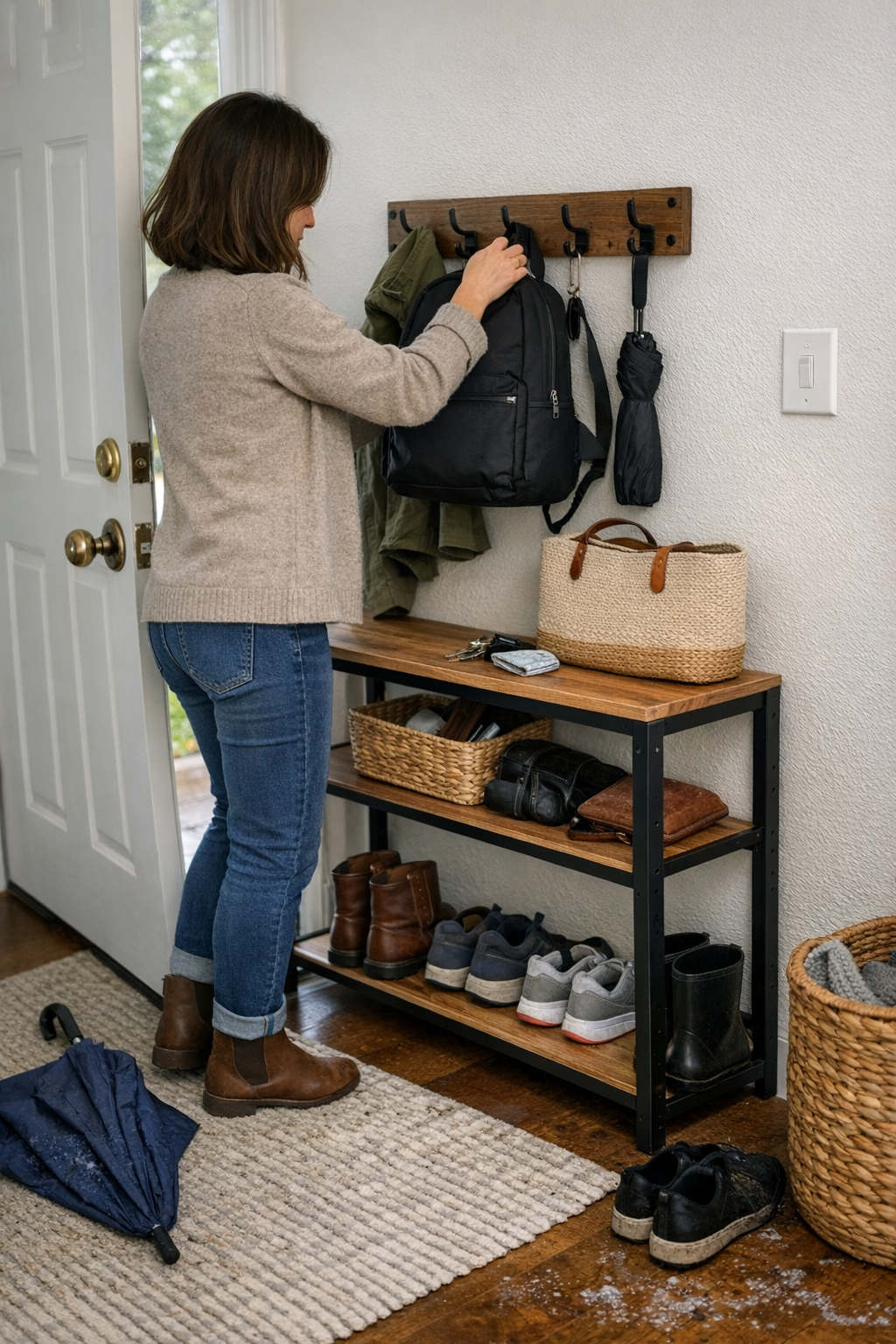
    The effect of switching is practical, not pretty. Assign a closed bin for each person’s shoes. Keep the bench top for bags only—no mixed piles. After a typical week, the zone holds its shape: no shoes sprawled across the floor, no guesswork about where to hunt for a lost hat, no slow creep of bags edging onto the path. No more morning shuffle to clear a route; the walking line actually holds. It’s a difference you feel when you’re already late—grab-and-go works without sidestepping clutter.

    When Setup Fights Routine: Real-World Friction Points

    Most entry setups look sorted the day you finish them, but cracks show in real use. Wall-mount cubbies tidy shoes, but bags still drop onto the nearest surface. Shoe mats hold ordered pairs that only last until the second rush in or out. The easier it is to toss things, the less likely it is they’ll stay sorted. Open setups become correction zones: every return is an invitation for overflow, every pass-through another chance for a small slip to stack up into bigger blockages.

    The friction builds quietly: one pair of shoes placed beside the bin instead of inside. Day after day, “just until I can deal with it”—until moving through the entry means twisting around piles that used to have a place. Energy spent negotiating clutter eats the margin you need to actually get out the door on time.

    Making Closed Bins Work (and How to Keep Them From Hiding More Mess)

    Closed bins don’t erase friction, but they channel it to a controllable spot. The move that matters: assign bins by person or clear category, and make sure they’re right in the path of movement—not off to the side, not buried under another box. Build in one mini-reset per week: five minutes, Sunday night, pulling out stray socks or outgrown shoes before they vanish into the back of the bin for good. Skip the reset and even the best closed storage turns into a blind spot, hiding mess instead of controlling it.

    Two details that help cement the habit: use visible labels (“kids’ shoes,” “school bags”)—nothing fancy, just obvious—and keep bins tucked under benches or at knee height for easiest reach. The less work to drop something in, the more likely it gets used. Closed bins should reduce hesitation, not add another step that family or guests ignore.

    Choosing Lasting Calm Over Temporary Neatness

    Closed bins don’t make clutter invisible—they quarantine it before it spreads. They hold the boundaries steady so the entry lasts through five or seven quick exits, not just the slow moments between resets. The goal isn’t showroom perfection; it’s a threshold that keeps working when routines overlap, when shoes outnumber cubbies, and when real life gets messy.

    Your entryway should recover with you—not lag behind, demanding a full sort every time the flow resets. Want more walkable floors, fewer last-minute shoe hunts, and less routine spent shuffling piles? Closed bins deliver a quieter, steadier edge that open storage can’t hold under pressure. They absorb the chaos, block category creep, and—crucially—let your entry zone finally do its main job: helping everyone cross in and out with less friction, no matter how messy the week gets.
    http://www.betweenry.myshopify.com

  • How Modular Yard Storage Cuts Cleanup Time and Clutter Daily

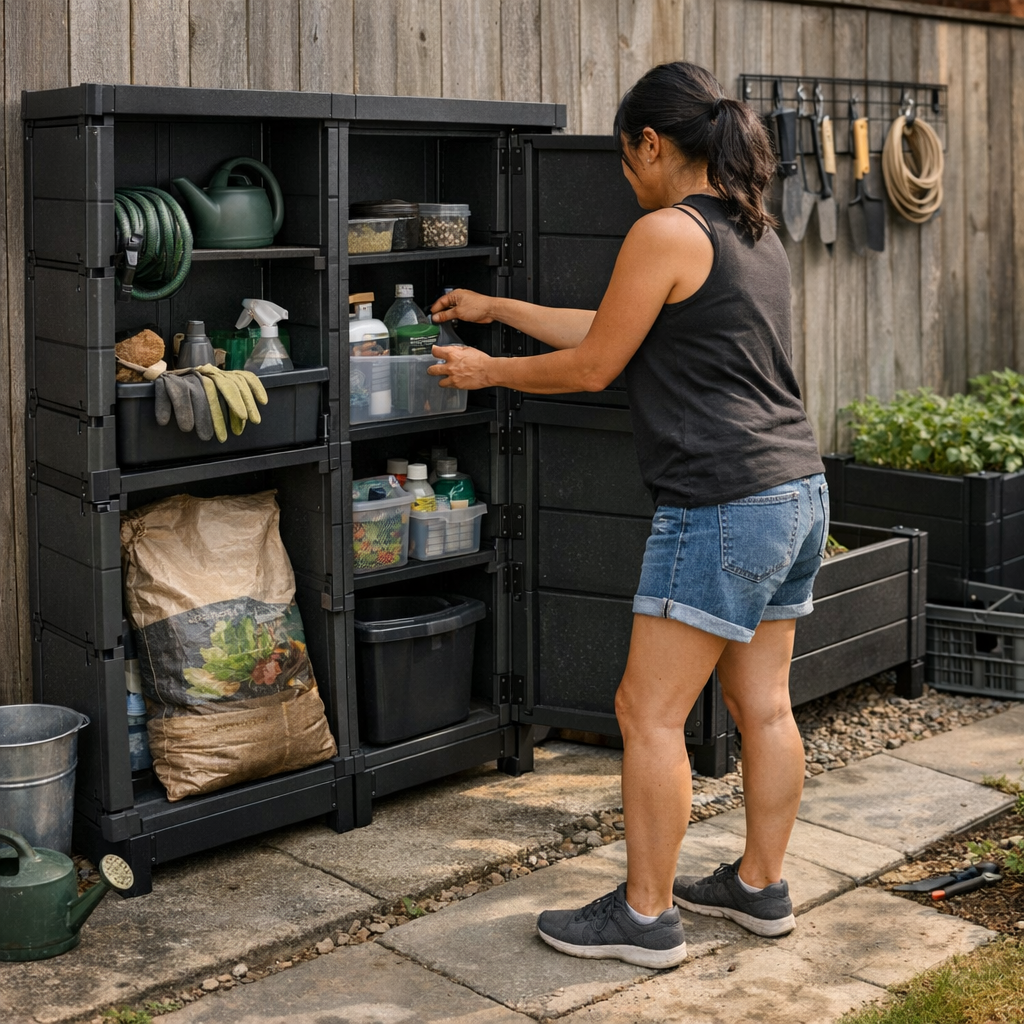
    Most outdoor setups don’t collapse all at once—they slowly choke themselves, box by box, until even basics like walking through or putting things away become a problem. What started as a clear side yard or utility strip morphs into a gridlock of bins hugging every fence and scattered stacks narrowing every route. The pain isn’t usually a lack of bins or storage—it’s the constant push and pull against a layout that can’t handle daily, real-life mess. The real question: can your setup bounce back after a normal, messy day? Or is it designed for a routine nobody actually lives?

    When Floor Bins Turn Into the Slowdown

    Rows of bins seem like the obvious fix. Each scoop and soccer ball technically has a slot. For about two days, walkways stay open. Then someone slides a rake between bins because the lid’s awkward, a boot piles up sideways by the edge, gardening gloves get tossed on top. By Friday you’re sidestepping a jungle of bags, reaching over clutter, having to pull two bins forward just to get to the shovel you need. Every return turns into its own mini Tetris round.

    What’s really happening? Floor bins soak up everything—including everything that doesn’t fit anywhere else. The more people dip in and out, the faster the domino effect—one person’s fast drop-off jams the next. Soon, bins are hidden by spillover gear and that “organized” row has become a buried obstacle. What should be a 30-second reset now means hauling, shuffling, and rediscovering what’s even under the top layer.

    Dead Corners, Lost Wall Space, Lived-In Frustration

    The problem isn’t just too many floor bins. Try adding a modern storage cabinet, and you’ll still end up with corners that gather overflow, tools balanced on fence rails, and “dead zones” that quietly stash every stray. Little by little, the gap between that back wall and the fence fills with stragglers: the ball pump nobody claims, a watering can balanced on top of a box, garden tools wedged in any open space. Wall hooks, if they’re not set for the things people grab daily, end up hosting random odds and ends—shoelaces, half-used seed packets, forgotten hats. The shed footprint technically fits the yard. But clearing a path through it feels like negotiating with debris that’s multiplied since last weekend.

    It plays out like this: you go to return a bike, but the main shortcut is blocked by a canvas bag that’s toppled off a shelf, or someone’s left a bag of mulch smack in the walkway. The setup may look perfect on a cold morning, untouched. But by week’s end, most movement routes are a zigzag, each shortcut interrupted and every reset a slow negotiation with the heap you didn’t plan for.

    Why Walkways Close In—and Resets Take Longer

    The whole difference between “neat for a picture” and “usable every day” is in how return flow gets handled. If your setup doesn’t steer gear back to visible, reachable spots, overflow will always win. Maybe you buy more stackable bins or another stand-alone rack, but when multiple routines converge—kids, adults, guests—the congestion piles up right where people actually move: the edge of main paths, the tip of each corner.

    Pretty soon, the most direct path is buried. Resetting means running detours, squeezing sideways, wondering if you even have time to put things away “properly.” Chaos doesn’t announce itself—instead, reset times just quietly double. The burning issue isn’t storage size, it’s the ripple of tiny interruptions: a rake leaning into a walkway, boots blocking a storage bin, each misplaced item slowing the whole area down.

    The Five-Minute Trap: Real Use, Real Delay

    It’s a scene that repeats everywhere: you’re coming in after work, clippers in hand, while someone else wheels a bike past. Hooks overhead look great, but three bags and a pair of rain boots have reclaimed the floor, muddling access to the storage door. Someone sidesteps the pile; a bag topples, spilling seeds or charcoal splinters. Now you’re hunting a dustpan, shifting a garden fork out of the way, just to sweep up and get back to where you started. Five minutes gone—nothing really resolved, and the “big cleanup” just got put off again. Each micro-delay stacks up, until the task of keeping order outweighs the payoff of using the space.

    The Shift: Build for Fast Returns and Automatic Absorption

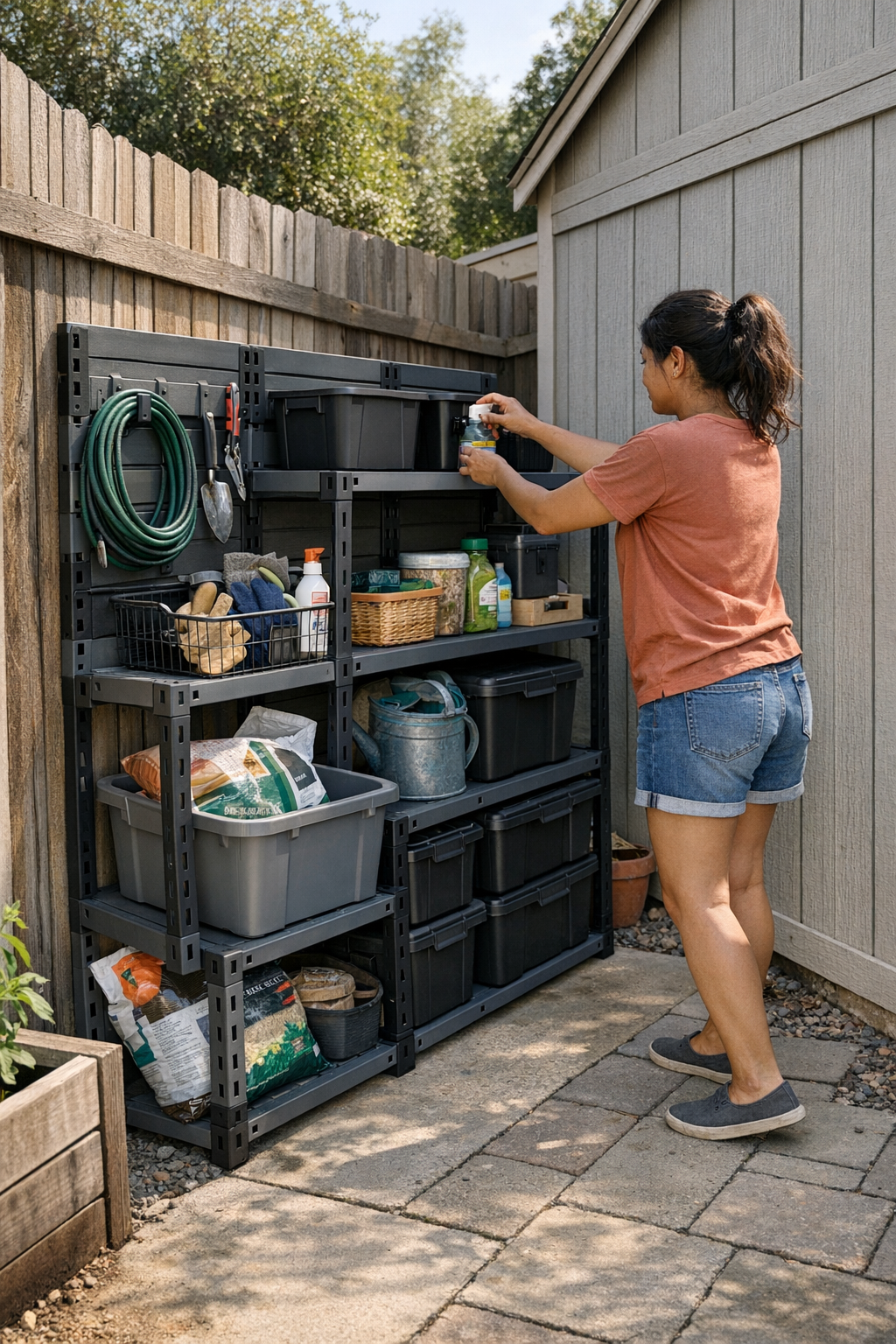
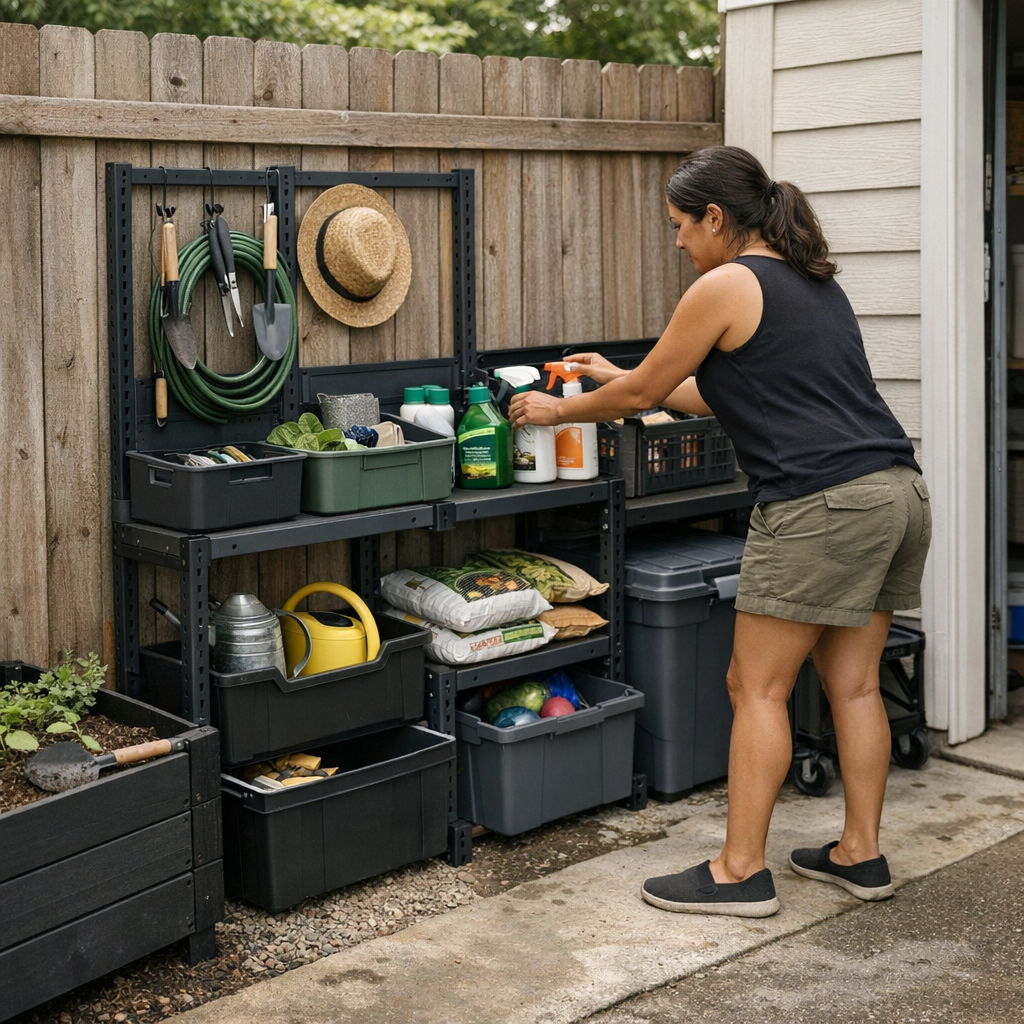
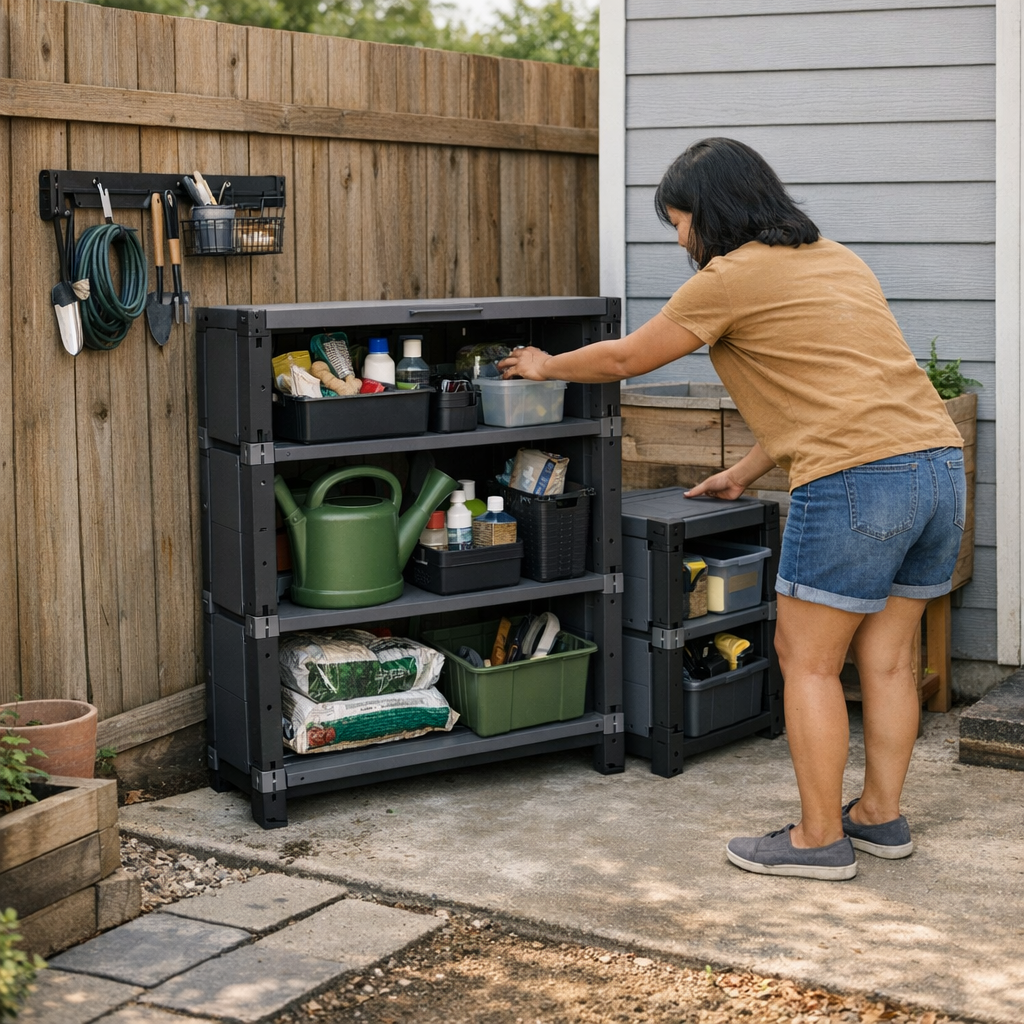
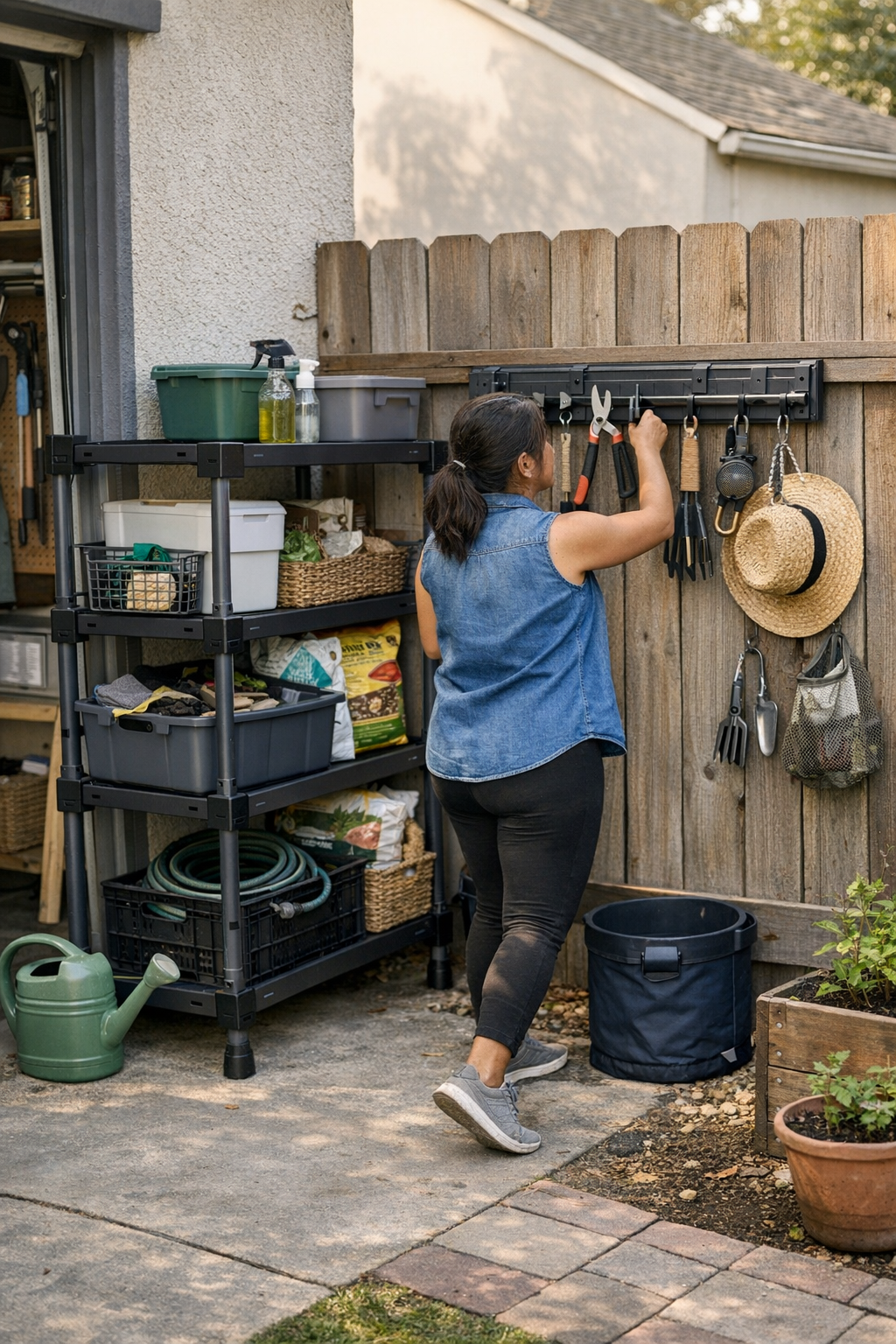
    Real yard setups don’t penalize normal use—they anticipate it. One overlooked lever is the buffer: dedicate the first foot or two above ground along your main wall or fence purely for “fast return” items. Think open hooks for garden gear right at reach, shallow shelves for toss-and-grab gloves or toys, and a deliberate empty strip between storage and any walkway. The effect isn’t flashy, but it’s immediate: a clear return zone, visible and unavoidable, that subtly cues everyone to put things back where speed—not perfection—matters.

    Just a one-foot gap between storage and the walking path acts like a buffer zone, absorbing the messy, last-second returns that would otherwise jam your main route. Kids, guests, whoever—no more guessing where that soccer ball or bag should land. In days, default chaos points disappear. You’re not battling piles or blocked doors every time you walk through. Resetting becomes the habit itself, not a separate chore to dread.

    Modular Wall Systems: Built to Flex, Not Just Store

    Adjustable wall systems don’t just increase storage—they shape how chaos flows (or doesn’t) in your yard. With hooks, bins, and shelves you can move seasonally, high-use gear floats above floor level. Overflow finds its way up the wall instead of sprawling across your feet. Modular doesn’t mean showroom neatness; it means setting up defaults, so even the rushed returns have somewhere obvious to go. Floor bins become backup, not bottleneck. Trips through the yard become smoother, quick returns stop disrupting the next person, and resets are done before you even realize you’ve started.

    Test It: Leave a Buffer, Watch the Change

    Does one stretch keep eating clutter? Try leaving a deliberate foot of clearance, even if your area is small. Just that much breathing room transforms movement. In a narrow side yard or busy garage edge, a visible, intentional gap makes routes simpler and resets automatic. No extra bins, no expensive upgrades—a practical yard tweak that keeps proving itself every day.

    Stop Settling for “Filled”—Start Demanding “Works”

    If your yard always feels full but never feels easy, the problem is flow, not just storage. Organization that flexes with the week—buffering random returns, revealing clear drop points, resisting the slow drip of blocked movement—outperforms any system that just soaks up more stuff. You know a setup works when you can walk out, put something back, and head in—without moving anything else or clearing a path first. Not because you tidied for a photo, but because you set up the space to reset itself, again and again, after real use. That’s organization that proves itself every time life gets messy—clear routes, visible homes for gear, and a layout that makes order feel almost automatic.

    See more practical organization options at TidyYard.

  • How Divided Storage Ottomans Transform Your Living Room Routine

    Living room storage fails faster than anyone admits. Even a well-meant coffee table reset barely lasts: by week’s end, surfaces fill with drift—remotes, chargers, books, a tangle of small tech—while your “hidden” ottoman storage just hides a new kind of mess. The more you try to keep things under control, the more routines stall. The inside looks empty at first, but three days later you’re rooting through a soft pileup to find a missing charger or fishing for the TV remote under a heap of throws, wondering where your last cleanup actually went wrong. Almost every so-called solution—the ottoman with storage, the basket under the side table—makes the room look neat, but quietly restarts the cycle: hidden bulk for one night, surface clutter by morning.

    The Hidden Trap of Deep, Undivided Ottomans

    Most ottomans claim to offer “hidden storage,” but the reality is a deep, single chamber under a bulky lid. Drop in a blanket, shift a magazine, toss in chargers; close the lid with a sense of order. But repeated use shows the problem: items settle into layers, and every retrieval pulls everything else out of alignment. Remotes disappear below throws, glasses slip to corners, and even getting out a book for the night means digging through yesterday’s cleanup. By midweek, you stop opening the ottoman altogether—and start leaving key items out again, right back on the coffee table or in the nearest chair pocket. The storage hides the mess only until it slows you down enough that you abandon the system.

    Friction compounds with every attempt to reset. Play out one real evening’s routine: you need a charger for your phone. The heavy lid refuses to open quietly, or you’re forced to lean across someone’s legs to access the compartment. Pulling out a charger means three other things spill out, and reshuffling them back is annoying enough you skip it “just for tonight.” By the weekend, the ottoman is overstuffed, the lid sits slightly ajar, and the surface clutter is back. Real storage failure isn’t one big moment; it’s a dozen small abuses adding up until your living room becomes harder to use, not easier.

    When Storage Interrupts the Routine

    Most living rooms aren’t short on storage—they’re short on storage that actually matches real, daily use. Surfaces that stay clear do so because two friction points are handled:

    • Ease of access: Can you grab what you need instantly, or do you have to shift people’s feet, clear off the top, or move the piece entirely just to open it?
    • True category separation: Does each nightly-use item have a predictable, single-purpose spot, or is everything blended in a deep bin where you regularly reach twice or three times for the same thing?

    Without both, every storage solution eventually becomes just another obstacle. You waste time hunting for a remote that shifted under a blanket, you find your tech cord bound up with board game pieces, and, with every failed reset, motivation to “put things away” drops off. In tight living zones, every access problem magnifies: stepping around a lid, blocking a path, or slowing down family traffic as someone rummages through a pile.

    Divided Storage: Why Category Clarity Matters

    Switching to an ottoman or storage unit with divided, shallower compartments shifts the entire cycle. The difference is visible by midweek: instead of a bottomless pit, you get clear lanes—one compartment for throws, one for tech, one for books. The contrast is immediate when you’re in a hurry: the remote gets returned to its bay, chargers stop drifting, and throws don’t bury smaller objects. The reset process isn’t all-or-nothing. It becomes a set of two-second actions, not a fifteen-minute dig.

    Think about repeated, real retrieval: you want reading glasses right now, but you don’t want your hand tangling in toys or sliding under slippery throws. With category separation—a small bin, divider, or even a marked section—you find and return items without friction. Kids learn where the game controllers always go. Nightly use flows without the whole storage unit turning inside out. Return flow improves; fewer things get left out because putting them away takes no effort and does not require rebalancing the pile.

    The Real-World Test: One-Week Pattern

    Pay attention for seven days: every object that fails to return to its right spot signals a glitch in the system. If your coffee table keeps capturing the same remotes and notebooks, or if a key charger or pen migrates nightly, your storage isn’t matching the real routine. Divided, clearly marked compartments prevent “category drift.” Suddenly, the refresh process feels plausible—not a once-a-week ordeal, but something that holds up after two movie nights, three rushed mornings, and a game session with kids. Miss this, and clutter rebounds as soon as routines get even slightly off-track. The storage looks organized only when untouched and stops working once real life resumes.

    Floorspace, Movement, and the True Cost of Awkward Access

    Storage should clear space, not claim it. Yet, an ottoman or trunk that blocks a traffic path or demands heavy lifting slows everyone down. You notice this the third or fourth time you have to sidestep an open lid, or when you can’t slide the unit aside for vacuuming without moving half the living room. A clever floor plan alone isn’t enough—if your storage forces detours or creates “dead spots” where people stack overflow, you lose usable square footage. One flawed access point—lid too heavy, compartments too deep, awkward reach—multiplies over a week until resetting feels like a burden.

    Look for solutions that can shift with a foot, open with one hand, or allow fast access to divided compartments even with limited room. Especially in zones shared with others, the ability to access storage without rearranging the whole area is a daily gain—not just a design win. A living room that flows beats one that freezes up every night around a storage bottleneck.

    Absorbing “Everyday Overflow” Without Slowing Down

    No living room escapes overflow. But the true test for storage isn’t how much it can hold once; it’s whether each typical item—two throws, a couple books, multiple remotes, loose charging cases—can be dropped in and later fished out without creating a gantlet. Push the system past a practical limit or leave categories blended, and reset time stretches. For families, a single undivided space means kid toys, wrappers, remotes, and odd notebooks all pile together, breeding frustration by night three. When you fix the internal lines—even with cheap dividers or small bins—reset friction drops. The storage actually “holds the line” rather than just concealing one-night clutter that turns sour with actual use.

    A Few Small Tweaks That Make a Big Difference

    • Use removable bins or baskets inside deep ottomans to separate tech from textiles, or books from toys—even if your unit didn’t come with built-in divisions.
    • Line bottoms with grip mats or felt pads so small essentials don’t vanish beneath denser blankets or heavy books.
    • Discreetly label sections—especially in shared homes—so everyone can do their own quick reset without guesswork. Fewer questions, faster routines.

    Forget aiming for showroom perfection. The real goal is functional, friction-free resets: storage that matches how you actually use your space under pressure, night after night. A setup that works on day three, not just for staging a photo. Choose better lines, purposeful compartments, and simple tweaks—and you’ll see surface clutter stop rebounding, the reset turns into an afterthought, and your living room finally works for real people, not just a clean picture.

    If you want storage that works for your zone—not against it—find more options for divided, accessible indoor storage at Gridry.

  • How a Dedicated Mail Tray Transforms Entryway Clutter Management

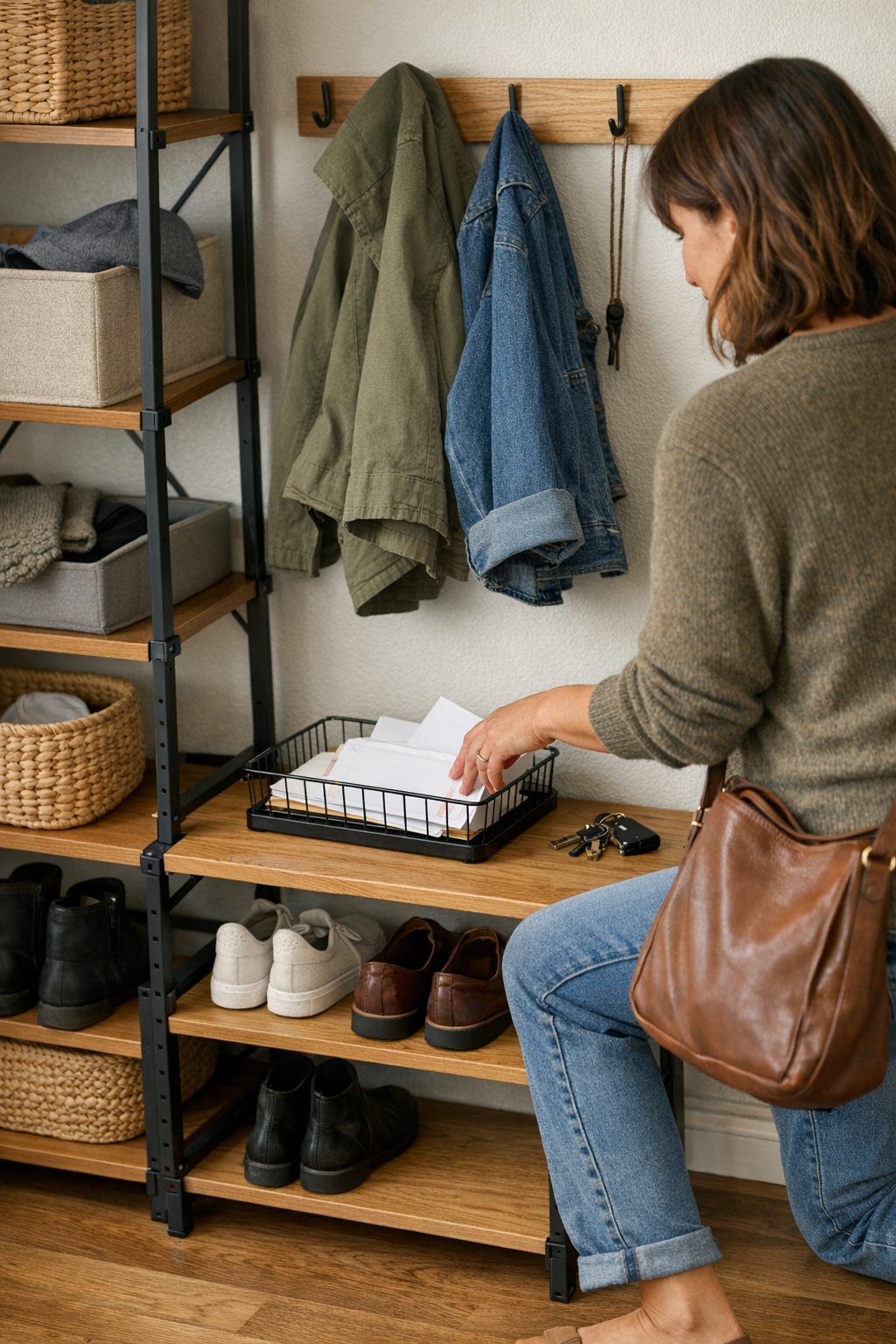
    Paper rarely invades your entryway all at once—it seeps in, claim by claim, until walkways close and essentials vanish. One afternoon, a single envelope lands at the bench’s edge. Within days, flyers drift across the shoe row, bills wedge under bags, and forms scatter near the coats. The problem isn’t a minor eyesore—it’s blocked seating, drowned-out storage routines, and the frustration of hunting for paperwork that slid away the very moment you meant to act. If your entry setup seems organized on Sunday only to clog by midweek, it’s likely because mail and loose paper migrate further every time someone cuts through, drops off bags, or tosses a coat—setting off a slow-motion takeover that resets the whole point of your transition zone.

    How Fast Paper Drift Breaks Down Routines

    Setting today’s mail on the bench never feels disruptive—until you come back and find last week’s flyers layered beneath new arrivals and crushed beneath a laptop bag. Add one after-school backpack or a wet jacket tossed carelessly aside, and the ripple spreads: paper clings to shoes, piles creep into seating, and a single missed recycling pick-up turns small drop zones into congested no-man’s-lands. You thought you only needed to clear the surface once a week, but now every return triggers half-hearted shuffling, blocking both the walk path and the reset you keep planning to do.

    This isn’t just mess—it’s friction on repeat. Each threshold pass means a new interruption: shifting piles to find the bench, stepping around a glossy flyer while reaching for shoes, realizing your keys disappeared beneath a delivery insert. Entryways—especially narrow or high-traffic ones—suffer the quickest. Any surface without a true boundary is an open invitation for paper to sprawl and hide what matters, leaving you one forgotten envelope away from missing a bill or stepping on a soggy postcard where you expected clear space.

    Why a Defined Mail Tray Changes the Pattern

    A mail tray isn’t decorative—it’s triage for paper sprawl. The difference is sharp: when every envelope drops into a fixed, bounded tray in reach of your real landing zone, paper stays contained. In routines built on quick entries and faster exits, the tray turns a chaotic stream into a manageable stop. By day five, the absence of drift becomes obvious. Papers hang together, shoes stay accessible, and you no longer need to rescue mail that slipped off a slanted bench or hunt for appointment letters under a pile of grocery ads.

    The Subtle Threat of Improvised Order

    Benches, shelf corners, and ledges seem to corral mail at first. But mixed-use surfaces always lose to the crush of bags, wet coats, and daily exits. Even a neat row of envelopes unravels after a single heavy bag drop or a hurried grab-and-go. The bench meant for shoe-tying becomes an overflow tray. Within days, paper flares out—half under bags, half dissolving into unrelated piles—often at exactly the time nobody has energy for sorting. Improv containment never keeps up with actual traffic.

    Realistic Arrival Scenes

    Picture coming through the door with three envelopes, a grocery tote, and a muffled ringtone. There’s no pause to sort; the mail gets nudged onto the bench. By evening, someone lines up the shoes, only to find a flyer wedged into the middle pair. By week’s end, important documents have slid toward the mud trail or merged blindly into the recycling bag. Every arrival presses clutter further, each exit making the reset slower—and sitting down to clear it means unpiling layers that never meant to be together.

    Placement is Everything: Where the Tray Should Actually Go

    Function beats appearance, every single time. For the tray to break the drift, it must absorb paper at the natural drop point—where you drop keys, bags, or today’s sunglasses. Wall units placed behind the door or awkward shelf nooks just recruit more clutter; anything that forces you to bend past bike helmets, reach across shoe cubbies, or move a row of umbrellas won’t be used. The right spot is within arm’s reach of your main pass-through—a location you hit with your elbow or hip without thinking. When the tray lives where paper already tries to land, it finally wins the territory back.

    Why Decorative Containers Can Backfire

    Baskets and bowls promise to catch everything—so they do: pocket change, pens, lanyards, hair ties, and two weeks’ of receipts. Paper, meant to be visible and short-lived, gets buried in the mix, avoided until a deep clean turns into a dreaded, hour-long purge. A flat, clearly-bounded tray with sharp edges shouts a single rule: “Mail only.” It stops paper from getting sucked into the tide of everyday debris, keeping each sort quick and forward-moving—never lost to the jumble you meant to deal with “soon.”

    The Repeat Benefit: Resetting Without the Hassle

    What actually shifts? Not just less stuff, but less resistance to clearing it. Those minutes spent scraping up flyers from the boot path or sorting damp letters off the bench vanish. Instead, the tray turns “resetting” into a two-second sweep: a one-hand drop as you enter, a one-hand clear each week. Busy stretches don’t spiral into multi-step recoveries—access stays open, and routines don’t stall every time the mail is late or someone dumps their gym bag on the fly. The system serves your habits, not the other way around.

    How Often Should You Empty the Tray?

    Weekly works for most—unless you’re bombarded by mail. Don’t let the tray become long-term storage: once it’s full, that’s your cue to process or toss. Leaving overflow means the drift tries to escape again, sneaking back to anywhere that isn’t the tray. Reaching the reset while it’s easy—when you see paper start to stack—is the real preventative, not just for mess, but for momentum.

    Visible Difference: Controlled, Not Just Neat

    The tray’s job isn’t perfection—it’s daily containment. Mess happens, movement is constant; what matters is that shoes, bags, and gear can shuffle around while paper stays strictly boxed in. The fifteen-minute nightly shuffle collapses to a quick paper sort. Over weeks, you gain hours—plus a threshold zone that actually works for repeated in-and-out, not just for show. The clarity isn’t just visual; it’s felt by everyone pushing through, especially on the days when routines barely hold together.

    Seeing the Difference Over Time

    Setups fool you when they look tidy day one but fail by day five. The grind starts when groceries fill the floor, muddy boots edge into the path, and flyers try to join both. Over time, a bench or shelf without real boundaries can’t defend itself—a misplaced bag or a random flyer on a rushed Thursday, and the reset shatters. A well-placed, flat mail tray stays useful, because its role is obvious and easy to follow, even when arms are full, zones are tight, and the drift is relentless. It works with the pressure, not against it.

    A mail tray isn’t a miracle cure. It’s a quietly stubborn fix that matches how entryways are actually used: quick drop-offs, jumbled returns, constant incoming clutter. Habits and hardware finally team up, letting your threshold zone work with normal life—not just in theory, but in every repeated, everyday pass-through.

    betweenry.myshopify.com

  • How Clear Outdoor Walkways Improve Movement and Reduce Clutter

    If every step outside means skimming past a rake or dodging dropped bags, the issue isn’t your gear—it’s a storage setup built for looks, not for the chaos of real outdoor routines. The narrow run beside your house or that side-yard squeeze might look organized after a weekend reset, but it takes just two days of actual use for things to pile up. A kid’s stray soccer ball, a still-damp garden glove, a bucket meant to be put back “later”—one by one, escapees crowd in. Suddenly, your only throughway demands a shuffle, a sidestep, or a flat-out obstacle course sprint just to reach the gate.

    When Your Route Turns Against You

    The gap between what looks organized and what stays usable under pressure becomes obvious fast. Sliding bins and racks up to the very edge of the walkway feels efficient—until you’re forced to tiptoe past a shovel jutting out or squeeze around a “temporarily” parked bag of mulch. Every off-schedule return chips away at that neatness, and before you know it, the main passage is always one dropped item away from blocked. Storage you can’t truly access, and pathways you can’t truly use, add up to one thing: you’re running a reset loop every time you need to get by.

    The Real Toll of Tight Quarters

    After a rainy weekend, what started as a clean walk zone has shrunk to a shoulder-width slot. Even simple tasks grow complicated. Carrying out the recycling means shifting a bin with your knee, bumping into a crooked rake handle, picking up gloves that have fallen (again) onto the path. Side-yards and fence-line trails morphed into holding pens slow down everyone—suddenly, what used to be five seconds out the back is a whole mini reorganizing session just to keep moving forward.

    Overflow Doesn’t Ask Permission

    What breaks most outdoor setups isn’t mess, but overflow— the sneaky, accumulating stuff that arrives with good intentions and never leaves. That one-time hedge trim? It launches a string of gloves, clippers, and twine abandoned at the path’s edge. The weekend project with extra bags? Now there’s a half-filled planter and a stack of pots edging their way onto valuable floor space. Very little of this comes from “too much stuff”—it’s the slow strangling effect when there’s no margin or buffer for returns out of sync with your tidy-up rhythm.

    It shows up with bins too close to the route, wall racks stretching into walking space, or corners that seem designed to attract overflow. The first item sits. Then another gets balanced on top. By next week, dead space is back, and the “organized” plan didn’t hold up to even basic weekend use.

    How Normal Routines Break Things Down

    Picture real Saturday-to-Monday life: you finish gardening, and the tools land by the gate “just for now.” The main storage box is stuffed, so a bag of mulch gets wedged against the fence. Two days later, the whole row’s a lineup of late returns that nobody wants to tackle. Morning routines now mean steering around clusters, moving something just to get the trash bin through—or worse, leaving the clutter because running late trumps tidiness.

    Organize So You Can Keep Moving

    The setups that actually work are shaped for movement, not just for stacking stuff. That means resisting the urge to fill every inch. Leaving a passage—even just a few extra inches—does more for daily life than adding another bin up against the edge. One real-world fix: pushing a storage crate flat to the far fence instead of half-blocking the walkway opened enough space to roll a wheelbarrow and haul yard waste without scraping knuckles or rerouting around stray returns. You barely notice—until a chaotic week goes by and the main path is still a path, not a barricade.

    Real-World Rule: Guard 20–24 Inches of Open Route

    In side-yards, patio edges, and narrow backyard passes, protecting a genuine 20–24-inch-wide stretch, start to finish, is the difference between flow and friction. Squeeze it tighter and backup is guaranteed—return anything off-schedule, and old piles reappear. A functional open space cushions you from the burst of gear, extra garden scraps, or post-party clutter. Give the route enough breathing room, and the reset job shrinks instead of snowballing.

    Too Much Visibility, Too Little Access

    Wall storage seems clever, until the wall hooks fill up and the overflow creeps back onto your main route. The handy rack for tools? It invites more last-minute returns, then another bag, then a stack of buckets, all bleeding into your walking lane. Out-of-sight storage has its own problems: if it’s tucked too far away, nobody actually uses it for fast drop-offs—new piles simply form in the spot that’s easiest to reach. The real friction isn’t just mess, it’s a mismatch between where things actually land and where the setup expects them to go.

    The zone that sits ready for resets is never the one that collects clutter. Storage has to match the busy, lived-in version of your space, not the one right after cleaning. Pathways need to stay routes, not overflow landing pads.

    Testing If Your Setup Holds Up

    Here’s where you know: does your main route stay passable at the end of a real week, or does it need a rescue every time? A use-proof arrangement lets you fetch the shovel, grab a ball, or haul out bulky bags without first shifting piles or clearing a gauntlet. When your walking route holds open through rushes, lazy days, and busy stretches, you’ve made the difference between organized-for-appearances and organized-for-use.

    Set up for movement first. Leave space for the routine to get messy without breaking down. When next week’s returns hit, you’ll nudge something once—not reset everything—because the real path still works. That’s the difference between storing outside and actually living with outdoor storage.

    Visit TidyYard for practical outdoor storage solutions.

  • Why Open Cubby Storage Benches Outperform Closed Lids in Busy Entryways

    That entryway bench looks sorted—until it isn’t. You set one up to keep bags and coats off the floor, but within days, the illusion cracks: the lid is blocked by junk mail, backpacks, and a tangle of jackets. Swapping shoes becomes a shuffle. Family members, aiming for speed, toss their gear wherever there’s space—often right on top of the bench or straight onto the floor beside it. The so-called “landing zone” turns into a slow-motion pileup, and the very system meant to anchor your entryway ends up ignored, its surface crowded and its storage hidden behind a barrier you rarely bother to clear. The problem isn’t lack of effort. It’s a storage setup that mismatches the way people actually move in and out of the house.

    When “Storage” Collides with Real Movement

    Every week brings the same pinch. You reach for your bag, but it’s buried under outerwear or wedged behind a heaped shoe pile. That storage bench, meant to streamline entry and exit, becomes yet another obstacle. Resetting the space—clearing the top, restoring order—slowly turns into a recurring project rather than a quick habit. By midweek, the floor is scattered again, “order” has drifted, and every retrieval asks for extra steps. The bench may be substantial, but it isn’t working with your movements; it’s slowing them down.

    Closed Benches: Why the Surface Always Fills Up

    Closed-lid benches promise instant order and a clean top. But inside access relies on a routine few actually follow. In daily use, the flat lid becomes a target for drop-offs—a school bag, today’s grocery tote, whatever didn’t make it to its real home. Need to retrieve something stored inside? You first clear the surface or juggle bags in one hand while opening the lid with the other. That tiny friction adds up: bags and coats return to the floor, and the “hidden” storage is hidden in the sense that it’s too much work to access routinely. What’s left is a bench that looks organized only before breakfast—then becomes a bottleneck for everyone.

    Open Cubby Benches: Every Bag Visible, Every Move Quicker

    Contrast that with open cubby benches. Each item has a clear slot—nothing sits on the lid, because there isn’t one. The exposed structure may sacrifice a little polish, but it delivers on everyday usability: step in, drop a bag in its cubby, slide shoes in below, and move on. There’s no confusion over where things go, and nothing blocks quick retrieval during peak hours. Even more, the presence of open slots discourages random stack-ups; school bags land in a defined place, not wherever there’s room. The “reset” becomes automatic—each return is just another step in the flow, not a separate chore.

    The friction vanishes: grab-and-go takes one step, not two or three. Reclaiming the baseline order isn’t a weekday project; it’s embedded in the way the space is used, so there’s nothing extra to maintain mid-chaos.

    Real Costs of a Mismatched Setup: Slowdowns, Overflow, and Clogged Paths

    Multiply this across a household, and the effect compounds. Mornings turn into small traffic jams: someone’s duffel is half-blocking the bench, another’s basketball leaves only a corner for seating, and to get your own things you displace a small avalanche or sidestep into the hall. Blocked access means lines form, people dodge around each other, and overflow migrates—first to the nearest open patch, then to secondary “temporary” drop zones down the corridor. Instead of solving clutter, the wrong bench scatters it further and erodes the entryway’s role as a usable hub.

    What Actually Keeps an Entryway Bench Working?

    The only systems that outlast the first few days are those that align directly with lived patterns. Benches with divided open cubbies for each person or bag keep flow visible and eliminate the need to “clear the lid.” No hidden layers means no one wastes time searching or re-stacking. Unlike a closed box, cubby layouts reinforce where things go—making it harder for rogue items to land off-target. Retrieval and return become the same simple motion, and the habit sticks because it matches what’s already happening. When categories blur and floor space fills up again, it’s a clear sign the structure—or the placement—is out of sync.

    A flat lid, on the other hand, always demands discipline: surfaces attract stuff, categories blend, and resets start taking longer. In most homes, visible cubbies win not just on accessibility, but on staying power during rushes, resets, and everything in between.

    Placement: Where Setup Fails Even When the Bench is Right

    Even the best design loses impact if the bench itself is trapped behind a swing door, wedged into a wall corner, or sitting where laundry baskets and pet beds choke off the main access path. For friction-free use, the entry bench must line up with the natural route from door to room—so each slot is easily reachable, no awkward side-stepping required. If a rug buckles underfoot or a side table always gets in the way, they become silent friction points. Often, the fix is moving a single piece or clearing a walkthrough, not buying something new. Because if using the bench isn’t easier than the next-nearest floor patch, it will just be ignored.

    Practical Use: Track Your Routine, Not Your Plan

    Start by watching: after the first week, is the bench filling as you imagined, or is overflow piling up in new places? Are you reaching twice for the same bag, or sidestepping obstacles that “shouldn’t” be there? A storage setup that nudges people to invent workarounds is already giving you feedback on what needs to change—ignore that, and you’re only buying time before chaos resets itself. The real test isn’t how it looks on day one, but what happens after repeated school runs, grocery loads, and weekend dumps. Fix what fails in use, not on paper.

    Beyond “Looks Organized”: Storage That Actually Supports the Rush

    You can see the difference in a lived-in entryway:

    • No wasted seconds fishing for bags under extra layers.
    • One-step grab-and-go access, even with everyone moving at once.
    • Resets that finish themselves, not projects you put off.
    • Floor stays clear because the system absorbs returns at speed.
    • No more lost gear under lids or behind a pile of “temporary” items.

    That happens when the bench, zones, and traffic paths match the reality—not the ideal—of daily use. Most households get further with open cubby benches because they keep anchor categories visible, speed up return flows, and absorb movement instead of slowing it. The proof isn’t in the first photo, it’s in the second or third week: less spillover, fewer blocked steps, and an area that holds its shape under real pressure. If you want an entryway storage system that actually keeps up, build for the motions you repeat, not just the appearance you set at the start.

    Find more practical inside-storage systems at Gridry

  • How a Floating Shelf Transforms Entryway Clutter into Calm Order

    The entryway is a pressure zone, not neutral ground. Each time you step inside, hands full or arms loaded, whatever you’re carrying lands on the first available surface. One day it’s the bench corner, next day it’s a shoe rack edge, or the sliver of space left on a crowded side table. The setup you trust to “catch the drop” quickly turns uncertain: miss the right drop zone, and by midweek you’re wading through scattered keys, stray mail, and half-sorted gear. What felt controlled on Sunday is already slipping—resetting turns into a repeat search, and walking through the threshold feels more like dodging obstacles than coming home. One misplaced item grows into a pile that blocks the way and slows your return to order.

    When Every Surface Is a Landing Zone, Clutter Follows

    The logic is almost automatic: drop whatever you’re holding, keep moving. But when any free spot becomes the default landing pad, you don’t just drop your keys—you set off a chain reaction. By midweek, keys share space with pocket change and sunglasses, while the bench hosts yesterday’s bag and today’s mail. The path narrows as every “just for now” item lingers, and resetting the entry feels like tipping over a slow domino run of misplaced and multiplying things.

    The shoe row tells the whole story: heels drift, boots fan outward, and in a few days what was a slim walkway becomes a maze. Your mail-and-key console transforms into a catchall tower: coasters, stray masks, folded bills all staking claim until the original purpose—the quick grab, the clear reset—gets buried with each new loop. The time lost and the small irritations add up, not just for you, but for anyone sharing the threshold.

    The Floating Shelf: Designated Drop, Not Decorative Display

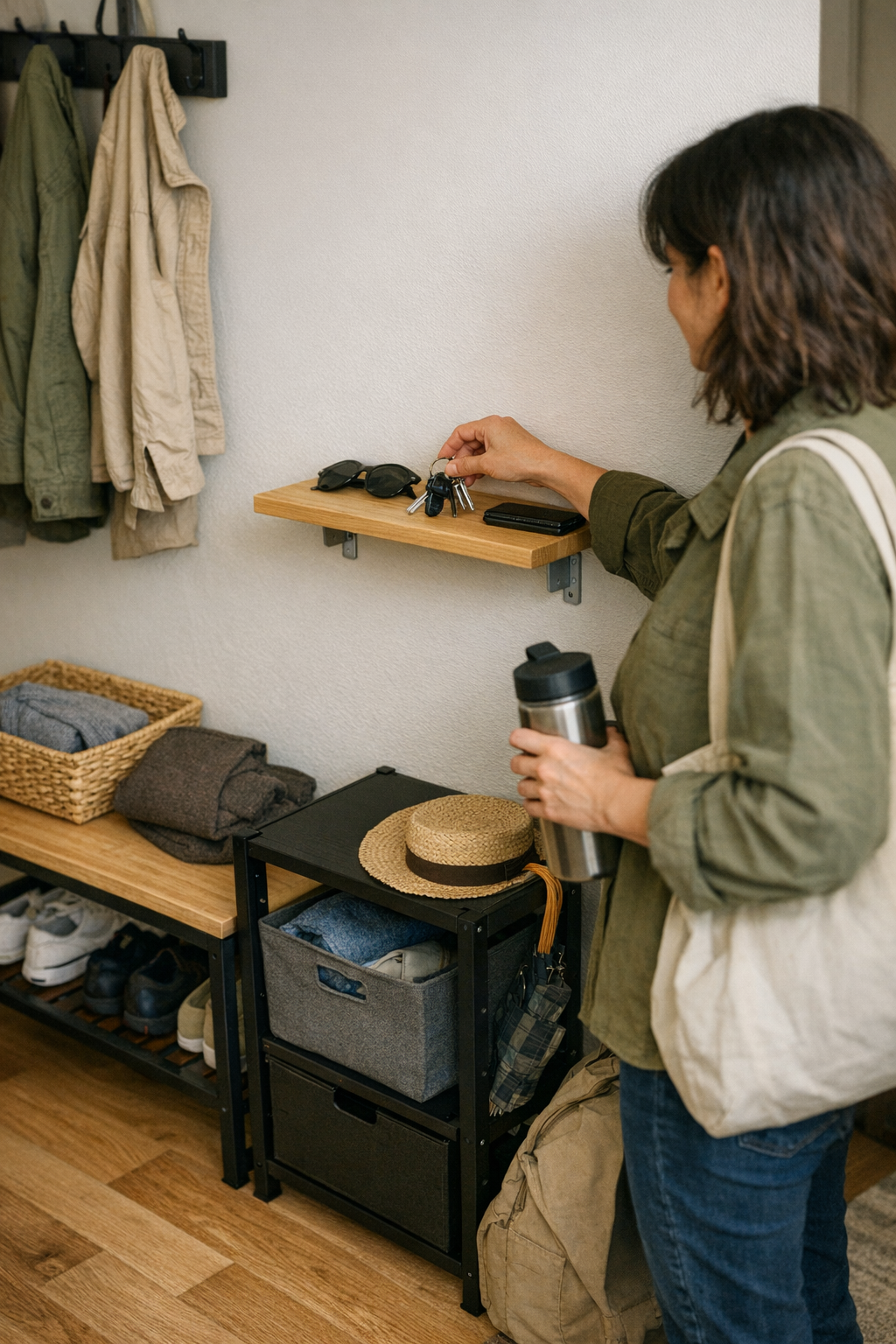
    The floating shelf isn’t about looking tidy—it’s about breaking the cycle of diffuse landing and semi-permanent mess. Visually, it fades in; functionally, it stands out by forcing a new habit. Placed above bench chaos and below shoulder reach, the shelf becomes a target: every key, card, or daily essential finds its place before it disappears into clutter’s sprawl.

    That separation is what makes the difference in real pressure zones—narrow hallways, tight corners, busy doors where two people and three bags barely squeeze through together. Overflow—snow-damp jackets, extra shoes, or unclaimed parcels—spreads along the floor, piling up fast. The floating shelf escapes that crush: it doesn’t get buried by coats or swamped by bag drop drift. Instead of becoming another cluttered horizontal, it creates a “no-mix” zone where essentials resist the gravitational pull of daily buildup.

    Not All Shelves Work in Real Use

    This isn’t about putting up any shelf and calling it a win. A poorly placed shelf—up too high above an already crowded cabinet, or tucked outside the main pass-through—answers the wrong problem. If it’s outside the default re-entry path, it gets ignored. If it’s too wide, it turns into a mail mountain; too stingy, it’s useless after the second item. The honest test: at week’s end, is the shelf still cleanly holding the essentials, or has it disappeared under piles, fading back into the background noise of entryway clutter?

    Entry Benches, Overflow, and the Downward Slide

    The “catchall” is never just theory—most homes try it. Maybe it starts with a tidy bowl or tray on the console, and for a day or two, surfaces look clear. But then real patterns reassert:

    • The collection bin quietly overflows
    • Bench seats become lost to gloves, grocery bags, and half-remembered mail
    • The bench’s entire top turns into a stacked buffer zone—where you’re supposed to sit is now another surface you have to clear just to use

    Floating shelves sidestep this ground-level crowding. By pulling keys and main essentials up and away, they reassign benches and racks back to their real jobs: shoes, gear staging, loading for the door. You spend less time shifting loose items just to find somewhere to sit or set down a bag, and the bench survives as useful seating rather than overflow storage.

    The shelf’s benefit appears subtly at first, but becomes obvious as the week cycles: where trays and bowls become indistinguishable from their contents, the floating shelf interrupts this slow-slide before it gains momentum. The clear drop point disrupts the pileup, sparing you from the endless shuffle of clearing, re-clearing, and crowding out your own entry.

    Real Use: Threshold Pressure and Easy Resets

    The advantage sharpens in the messiest moments: a grocery haul lands, or muddy shoes plus umbrellas eat up all the bench space in seconds. The usual reflex—to toss keys onto any open patch—leads right back to chaotic spread, and before long, tracking a single item means reshuffling half the entry.

    Add a floating shelf, and the process splits:

    • Keys, lanyards, and cards ride above the churn, untouched by bags, jackets, or boot clusters
    • Mail, packages, and shoes may still amass below—but what you need to leave stays reliably in reach, unmixed and unburied
    • Every reset gets easier: lifting a pile to grab keys stops being a daily routine

    After a few weeks of use, the friction falls away. The shelf remains steady—one spot you never have to dig for, even when the rest of the space is pulled into overflow and reset loops by rushed mornings or high-traffic evenings.

    Placement Details That Matter

    Exactly where you install the shelf reshapes how long its benefits stick. Shift it just above the usual bag drop zone—and still within arms’ reach on your direct path—and the routine transforms. In one everyday fix, this single adjustment stopped morning key hunts. The shelf stayed visible and open, never hidden behind coats or half-sat bags, and reset friction dropped because the entry’s main access path stayed clear. The shelf wasn’t just present; it stayed functional, holding the line even when the threshold was tested at its busiest.

    Threshold Storage That Works With You, Not Against You

    There’s no magic trick—no floating shelf resets a cluttered room by itself. But it does collapse the micro-delays and daily reshuffles that frustrate entryway routines. Instead of multiplying flat spots that only collect more clutter, the shelf sharpens the transition: one purposeful drop, one easy reset, one predictable flow in and out.

    For homes that want transition spaces to back up their routines—not get in the way—a floating shelf brings a visible advantage. It turns the regular return from “looks organized” to “stays usable,” showing where structure decisions really pay off after repeated, imperfect days. Every time you cross the threshold, you get one moment of function that doesn’t vanish the first time life gets chaotic again.

    Shop Betweenry transition-space storage

  • Why Smart Placement Beats More Outdoor Storage Every Time

    Here’s how outdoor organization usually promises to work: load up a new storage box, hang up some wall hooks, and finally clear your side yard or patio edge for good. But in any real setup—from a garage threshold packed with bins to the narrow strip running along your fence—order falls apart not when you run out of space, but when getting in and out feels like a dreaded reset. It’s never just about what you store. It’s how often you’re forced to lift, shift, or block everything else, just to grab a single tool, hose, or set of gloves—and how fast that “orderly” corner slides back into chaos despite your effort.

    When “More Storage” Means More Steps

    Add another chest, another rack, another tall wall unit—the corner looks conquered for maybe a week. Then daily reality resets the story: you reach for pruning shears and instead slide out half a stack to get to them, shifting a shovel just to reopen your exit. One misplaced tote means you’re balancing bins on the lawn, playing Tetris with garden tools, or shifting a folded chair that now blocks the hose. Suddenly walking a clear path means awkward sidesteps, ducking around handles, tripping over a loose soccer ball that never really had a home.

    The real pressure isn’t overflow. It’s friction: storage that fills the space but turns every basic grab or return into a multi-step effort. Corners clog, access points get pinned by yesterday’s gear, and the walk you intended to make quick becomes another reorganization.

    Why Access—and Not Just Capacity—Matters Most

    Diagrams and storage calculators love to promise, “Look how much fits!” But outside, effort kills motivation faster than any lack of space. The difference is clear after a few uses: the “clean” setup that lets you move straight through, grab what you want, and reset without reshuffling will always outlast the lineup that packs every inch but slows you down. Take a side-yard wall with racks and chests packed tight—it looks sharp until you need something at the back, and that means pulling out everything up front, one by one. Or the garage-edge nook stacked two rows deep: you’re never just grabbing, you’re quietly undoing your own work, every single time.

    Order that only works on paper crumbles in repeat use. As family routines collide—kids reaching for floats, you needing gloves, pool gear tangled with garden supplies—the neatly organized footprint becomes a daily blocker. What started as “maximum storage” quickly reads as “maximum reshuffling.”

    Spotting Weak Return Flow and Hidden Problem Zones

    Most setups crack under return flow—not because you’re lazy, but because the system asks too much just to put things back. Maybe the patio bench is always swallowing loose shoes and pool nets by the weekend. The garage wall hooks are full, but the snow shovel’s always unreachable, hiding behind off-season tools. Overflow doesn’t start as mess; it starts as work you quietly defer: “I’ll sort that later”—and every “later” lands in the same awkward corner or on the closest open step.

    When just dropping something off is its own project, bottlenecks and clutter collect in your fastest-access spots. Over time, the most convenient edge of your setup quietly becomes the “spare pile”—a symptom your layout slows you down instead of backing you up.

    Real Reset Scenes: Where Organization Breaks Down

    The breaking point is almost always a reset moment. You come back after mowing or planting, hands full, and realize the only way to stow the gear is lifting out that tangled hose first—or repiling half a stack just to give the extra potting soil a home. Before a grill night, you’re sorting through buckets of chemicals and forgotten sand to reach tongs you meant to keep within arm’s reach. As soon as return flow stalls, the system unravels: bins stack in front of other bins, gear leans wherever there’s floor, and each “I’ll get to that later” sets up tomorrow’s block.

    The longer the reset takes, the more you leave out. Lawn edges crowd with overflow, and back corners fill with “can’t quite reach” odds and ends. It’s not disorder—it’s the system quietly creating extra work instead of saving it.

    One Real-World Shift: Moving the Wall, Splitting the Flow

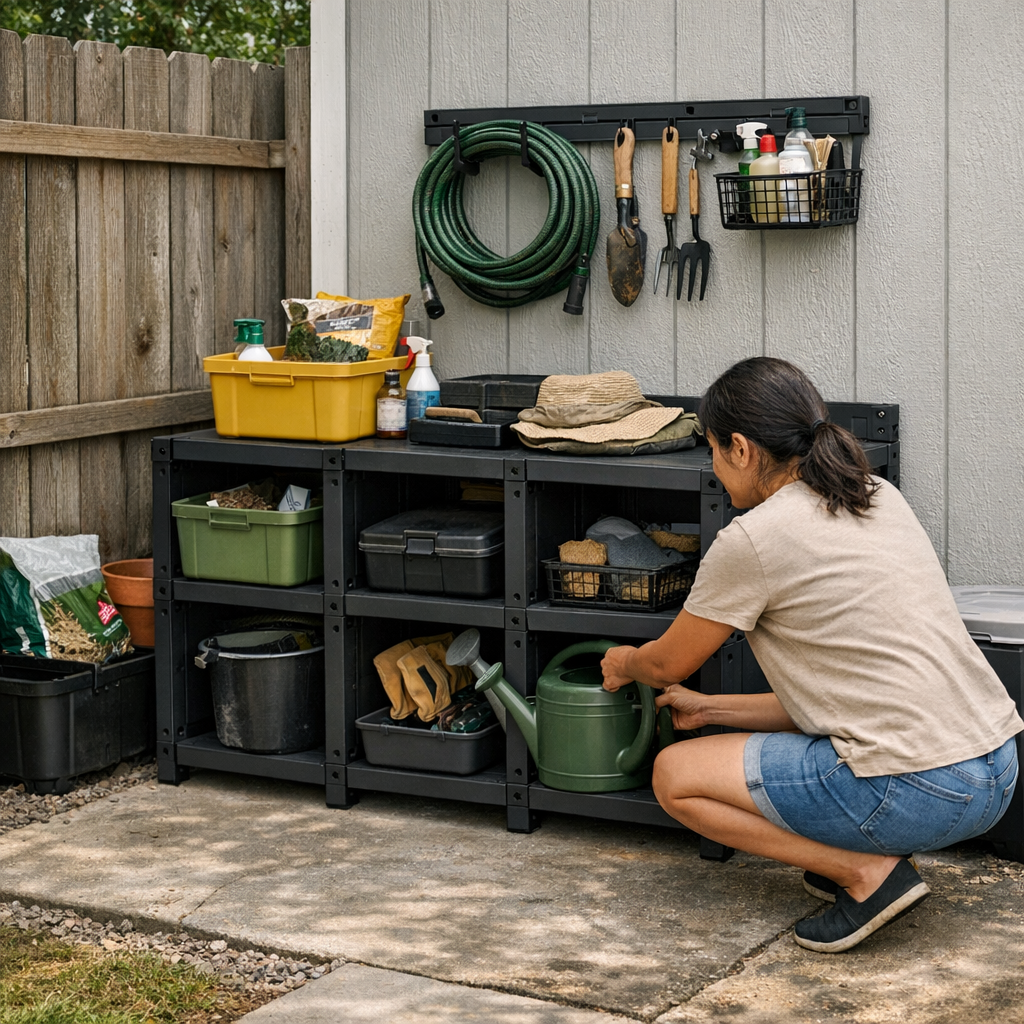
    Improvements rarely mean buying more. In one side yard, just shifting a wall organizer two feet forward and breaking it up at waist height changed everything: a clear separation for garden, grill, and kid gear, shelves left open between sections, a narrow strip of open floor in front. Suddenly there was no reason to stack or overlap—every return was one move, never two. Hose, trimmer, gloves, ball—their homes never blocked each other, resets stayed quick, and nothing migrated out to the walkway.

    The fix wasn’t more capacity, but more natural movement and separation. With each project and return, the area soaked up change. Tools left out less often. Corners stayed open, not jammed. A tiny reconfiguration transformed the “always tidying” zone into a background that just worked.

    Practical Tactics for Smoother Outdoor Organization

    Leave Breathing Room—Even Just 18 Inches

    Open floor trumps packed-in storage. If you can step, reach, and shift without hitting or moving another bin, your setup can breathe. Even a single narrow access path in front of wall units or along a fence makes blockages—and excuses—not stick. Double-stacked bins guarantee daily reshuffling: skip the overlap, or the routine will never last.

    Divide Storage by Activity, Not Just by Category

    Zones beat categories every time. Use open shelves for gardening, a distinct hook for grill tools, clear open space for kids’ gear. When every item has a destination tied to a use, “returning” isn’t just wherever you find a gap. That visible clarity is what gets even rushed resets really finished, not left half-done.

    Watch for Recurring Overflow Zones

    Does the same step, bench, or back corner always absorb random overflow? That’s your setup warning you: its placement, reach, or footprint is off. Sliding a unit out to create better access, switching a chest for open hooks, or reclaiming a blocked corner can shift enough pressure to keep clutter from settling—or returning right away after every use cycle.

    The True Test: How Your Yard Moves With You

    What marks a setup that actually works? Not that it stores more, but that it stays out of your way. The real test is flow: how often you have to move one thing to reach another, and how quickly resetting actually gets done. If it takes more steps to put things back than to use them, or your clean-up is slower than the project itself, your system is setting you up to fail.

    The best arrangement is the kind you nearly forget: open enough to absorb use, tough enough to resist daily breakdown, and practical enough to keep the reset short—even when life gets busy and outdoor projects pile up.

    For practical, tried-and-tested outdoor organization setups that actually handle daily use, visit TidyYard.

  • Maximizing Living Room Order with Footrest Storage Ottomans

    The living room tells on your storage setup every evening: remotes wedge themselves beneath couch cushions, phone chargers snake across the coffee table, and by tomorrow morning, whatever didn’t get put back will be lost, buried, or tripped over. A footrest ottoman with storage promises instant calm and hidden relief—until you’re actually living with it. The contrast is sharp: a room that looks reset from the outside, but inside, every grab for a remote or charger turns into a hunt through cables, wrappers, and things you forgot you even put there. The difference between a neat surface and a truly usable room comes down to what happens beneath the lid, night after night.

    Hidden Storage: Calm on the Outside, Chaos Beneath the Lid

    Storage ottomans sell the dream of clean surfaces, open walkways, and a clutter-free living zone. But real use exposes the flaw: without inner structure—just one big compartment—each reset only piles up what was already buried. End-of-day routines become slow-motion reruns. You lift the lid looking for a controller and end up sifting past tangled chargers and last night’s mail. The mess disappears, but next time you reach for something, the “hidden” system means digging, shuffling, and untangling rather than a quick grab-and-go reset.

    Beneath most ottoman lids, the first week feels smooth—everything slides in, nothing visible. But by the third or fourth reset, the system is slowing down: remotes drift under a drift of cords, headphones tangle into yesterday’s receipts, items crowd corners you forgot existed. The more general-purpose the space, the faster it turns against you, quietly turning every return or retrieval into a minor project.

    Repeated-Use Friction: Convenience Degrades Quickly

    The real test is repeat use—especially in shared or high-traffic spaces. Consider just one ordinary weeknight routine:

    • You go for the remote. It’s there—today. Tomorrow, after it’s tossed back with a pile of chargers, wrappers, and stray game pieces, someone else needs to dig past everything to find it again.
    • Chargers unravel in a rush to tidy; by midweek, they’ve lassoed headphones into an uncooperative ball under last night’s empty snack plate.
    • The ottoman itself becomes blocked—the lid’s covered by a stack of magazines or an off-duty tray, so “easy storage” now starts with moving things just to access anything inside.

    Every micro-delay adds friction: what was once “open, grab, resume movie,” turns into “open, assess pile, shuffle aside, untangle, hunt, close.” The room still presents as organized, but each reset costs a few extra minutes and a little more patience, night after night.

    Internal Order: Why Structure Inside the Ottoman Matters

    The difference between an ottoman that helps and one that frustrates comes down to internal organization. One open compartment invites category drift—remotes bury themselves, headphones vanish, papers and wrappers migrate until finding anything requires a small sort every time. There’s no visible system, so no memory-cues for what you keep inside or where anything goes.

    Add simple dividers, dedicated bins, or small trays—now there’s a spot for each category, and routines change. Remotes go back in their one slot, charging cables coil in their section, controllers or notebooks each get a defined home. The result is visible on first open: resets snap back into place, nothing hides for long, and a missing item gets noticed before it’s lost for days. Perfection isn’t expected—rough days still happen—but if the structure forces just a little order, nightly frustration drops sharply. With one small change, time spent searching shrinks, and the temptation to just leave things out goes down.

    Overcrowding: When Storage Backfires

    The urge to store “just one more thing” is strong, but it’s the fastest way to sabotage an ottoman’s usefulness. Each paper, spare battery, coaster, or leftover device that doesn’t belong makes the inside messier and resets longer. Before long, the hidden pile is as much a nuisance as visible clutter—just one you have to look at up close, bent over, and running late. Storage that collects overflow you’re unwilling to sort becomes storage no one wants to use, and every retrieval pushes more items to the edges, untracked and unclaimed.

    Practical relief means enforcing boundaries: restrict the ottoman to daily-use items, and actively prevent it from swallowing overflow. If you’re sorting mail or storing backup batteries, that’s a sign the main zone is compromised—reset flow is gone, and retrieval will only get slower over time. Storage must do more than conceal; it must make the reset easier, not just the surface cleaner.

    Access Details: The Role of Design in Daily Flow

    Not all ottomans are equal on access. Hinged lids that prop open with one hand let you operate without a second thought—even in the dark or with a tray on top. If accessing storage means shifting furniture or dealing with a heavy cushion, the path to “reset” gets blocked before it even begins. In these cases, the system forces you into short-term shortcuts: piling items on surfaces, leaning devices against table edges, or simply giving up and letting the clutter migrate back out again.

    When Slower Resets Signal It’s Time for Change

    The giveaway is simple: if you or anyone else notices a longer hunt for daily items—chargers, remotes, headphones—or if the lid collects more things on top than get put inside, the storage isn’t working for your real routine. Use this as the cue to clear non-essentials, restore internal order, and re-draw category lines. With just five minutes of reset, the room moves from crowded to usable, and the night’s routine flows instead of stalls.

    From Hidden Storage to Real-Time Usability

    The best inside-storage works with the rhythm of repeat use: not just for presentation, but for the small, constant handoffs—watching a movie, charging a phone, surviving a game night without missing pieces. Ottomans only deliver on their promise when the inner structure fits your living routine: enough compartments to prevent category drift, but not so many that it turns tidy-up into a chore. When the inside mirrors your habits, clutter stays visible only long enough to be returned—no more repeated digging, fewer interruptions, and a living room that remains usable, not just tidy-for-show.

    For practical storage systems made for real rooms and routines, visit Gridry.

  • How Narrow Consoles Keep Entryways Clear Near Inward-Swinging Doors

    Every entryway exposes its setup the moment routines collide—especially when you’re carrying too much or everyone arrives at once. If you’ve ever tried slipping through a door and found yourself pinned between an inward swing and a row of shoes, you know the pain of a bad threshold. The problem isn’t just about clutter; it’s about movement. The first thirty inches inside your door become triage: drop your bag, hop over last night’s boots, realize the bench meant for order now pinches the pathway even tighter. Choose the wrong storage and you’re not organizing—you’re slowing yourself down, every single time you come and go.

    The Hidden Cost of Deep Storage by the Door

    The setup usually starts optimistically—a chunky bench or deep cabinet promising to finally contain the family’s pile. But in an everyday entry, extra depth cuts into exactly the zone you need clear: the patch where everyone turns, pauses, or passes each other. Each extra inch drags shoes, bags, and stray coats farther into your step path. Before long, the stuff you’re trying to tidy collects right in the landing zone. Dropping one item means blocking the next person. Resetting once turns into resetting three times a day, especially with overlap—two people crowding the doorway, a late bag tossed carelessly, or umbrellas dripping into the narrowest spot. Instead of relief, there’s friction—micro-jams and sidesteps pile up, and “deep storage” just means more to dig out of the way.

    The “Slow Creep” of Clutter

    Maybe you start with everything lined up. But as the days pile on—so do the shoes. Row edges drift diagonally. Bags meant for hooks slide down to bench level, then slide off entirely. The open lane narrows, unpredictably, until a single run for the mail turns into a clumsy shuffle. You notice it most with arms full: returning groceries after work, or coming back with muddy boots and a trailing pet. All it takes is one or two things left out of line, and suddenly, the clean reset from Monday morning feels lost by Tuesday night. Messy weather multiplies the problem—wet boots arrive in clusters, crowding out any order for the rest of the day.

    Narrow Consoles—Why Less Depth Works Harder in a Real Entryway

    Switching from deep to narrow isn’t just cosmetic—it directly preserves threshold space where you feel the squeeze most. A slim console, just 10–12 inches deep, creates a nearly invisible barrier; it lines the wall, hugs past the door’s swing, and minimizes overhang so nothing protrudes into the step path. It doesn’t promise to eat every pile, but it reliably protects movement. Shoes line up—parallel, not perpendicular. Bags perch above, not in the center of the floor. Even with simultaneous drop-offs, the walkway survives. Resetting is literally a matter of nudging a row straight, not excavating a hidden drift of gear. The difference isn’t storage capacity, but daily function—thresholds stay crossable, even when exits and arrivals stack up.

    From Photo-Ready to Everyday-Ready

    Magazine photos show wide benches basking in empty entryways. Real life comes at a rush: muddy boots scattered mid-floor, two bags half-falling, the raincoat you needed dumped audibly onto the nearest surface. Wide storage might look inviting uninhabited, but only slim setups hold up once routines start crowding the zone. Slim consoles keep shoe lines tight to the wall. Even when the system slips—everyone rushes in at once—overflow stays obvious and contained. You reset by straightening, not by starting from scratch. The pass-through rarely jams. If it does, it’s traceable: you see what drifted, you fix it in seconds, and you’re back to crossing cleanly.

    Real-Life Scenes: How Entry Storage Plays Out Over a Week

    Monday Morning: Rushing Out, Shoes on the Move

    Morning rush, shoes off, door swings wide. If you’ve got a deep bench, displaced shoes pile up and wedge further into your only open lane. The door catches, you grunt, and the “organized” storage becomes new clutter blocking every escape. By midweek, the pile invades so much floor that walking through means weaving around your own stuff.

    With a slim console, you step out and the line of shoes stays to the side. If the row grows, overflow spreads forward—clearly visible and easy to correct. Even on chaotic days, you aren’t pushing a pile out of the way just to get the door open. Quick resets mean a sideways nudge, not a five-minute dig-out. Routine chaos stays manageable; you can see which row needs discipline before it blocks the whole entry.

    After Wet Weather: Entry Reset Under Pressure

    Rain hits, the whole family barrels in, and suddenly the entry is flooded with wet boots, soggy socks, and dumped raincoats. Deep storage turns into a hidden stash—items migrate to the back until the front fills and the threshold jams solid. Now, the reset is heavy: you have to dig, sort out soaked layers, and haul everything back just to secure one clear spot to step through.

    With a slim console, boots stack beneath where you see them, not in muddled layers. If the walkway narrows, it’s obvious; each extra pair signals its own removal. Overflow doesn’t disguise itself. You aren’t left wondering where things piled up—you’re prompted to address it in real time. No one steps over forgotten bags or week-old sports gear just to find the floor. The entry stays transparent about its limits, and you stay ahead of chaos by responding before it escalates.

    Sizing the Console: Finding the Threshold That Fits

    Check the swing of your door—does anything, even a shoe, jut into the arc? The true test isn’t the storage’s capacity but what it does to your passage. Saving even one inch can reopen a space that’s been pinched closed all season. A 12-inch-deep console is a discipline: enough to fit daily-use shoes and essentials, not enough for overflow to hide or stack up out of sight. This slim footprint pushes you up, not out—inviting wall hooks for bags, floating shelves for mail and keys, narrow trays for gloves. Whenever you claim wall space over threshold floor, you slow the creep of clutter and keep the entry clear at the moment you’re most likely to jam it.

    Give Every Item a True Landing Spot

    Where the narrow zone wins is in boundaries. Shoes get a true row, not a scatter. Bags go above, not ambiguously “nearby.” There’s no wishful, undefined drop zone—every item lands somewhere exact, or it signals overflow instantly. Even during failed resets or chaotic departures, a narrow setup means you’re never reshuffling the whole area—just nudging a few things back. Less time spent fixing means more space for just coming home, and the pain points stay small before they pile up.

    Coping With Trade-offs: When Storage Is Too Deep, Function Fades

    The urge to choose a deep cabinet for “just in case” storage rarely pays off in the real grind of arrivals and exits. Extra space behind closed doors fills with orphaned extras you don’t use—until eventually, the entry itself chokes on the backlog. Grab for a shoe in a hurry, and you’re blocked by a row of castoff pairs or a bag wedged in after a frantic morning. Every attempt to fix it becomes a mini-project; fast movements turn slow, and sudden needs derail the whole day.

    If your threshold never stays clear more than a few days, even after a deep clean, the setup is probably working against you. The best clue isn’t how tidy things look after a reset, but how little you have to fuss with them before the next rush. Storage that works only for snapshots isn’t serving your routine—it’s creating new places for clutter to lurk.

    Practical Tips for Lasting Threshold Clarity

    • Trace your door’s full arc before adding anything. Even a single inch jutting past can jam movement when traffic picks up.
    • Favor narrow, stable consoles that commit to the wall. Thickness is the enemy here—choose form factors that protect width over capacity.
    • Use wall hooks or upper shelves to keep bags and accessories clear of shoe traffic. Don’t let “temporary” bag drops turn permanent.
    • Limit shoes to a single parallel row. If more appears, rotate older pairs out before they sprawl and block flow.
    • Reset fast, reset often. The right setup lets you straighten up in seconds, not force you into full reorganizations every weekend.

    The Everyday Difference: Passing Through with Purpose

    Entryway storage isn’t about perfect rows or magazine layouts—it’s about guaranteeing a clear path when day-to-day life hits max volume. A narrow console draws the real line: this is the crossing, this is where the gear stops. You can tell when overflow starts nudging back into your space, and you have leverage to fix it before the pile wins. Over time, less shoe-dodging, fewer missed steps,