Author: jaesoon_admin

  • Why Cable Sleeves Transform Travel Workstations Into Stress-Free Zones

    If you depend on a travel workstation—think hotel desks with shallow depth, airport charging counters already crowded at the edge, or another reshuffled co-working table—your approach to cable control isn’t just about appearances. It’s a repeated test of how fast you can actually reset, pack up, and get working again when routines aren’t stable. Loose cables and “temporary” solutions might seem flexible, but after three or four cycles, the reality is slower: cords snag under power bricks, twist around bag handles, and always seem to block your reach for a notepad or charger, even on a desk that still looks technically clean. Setup friction piles up in small, annoying ways—each time you break down or restart—until getting organized isn’t just about how your workspace looks, but about cutting the minutes lost to hunting, untangling, and fixing what repeatedly slips out of place.

    The Real Cost of “Looking Organized”

    A tidy surface often hides a cycle of small slowdowns and missed details. Maybe your setup looked flawless on day one: every cable wrapped and laid flat, phone charger tucked out of the way. But by day four, the story changes. Cables ride up over the desk edge, the HDMI cord disappears behind your keyboard tray, or your phone charger gets pulled tight around a notebook, making it harder to reach both at once. “Streamlined” starts to mean “guesswork under time pressure,” especially if your desk space doubles as last-minute storage—crowded, unpredictable, and just awkward enough to keep you distracted during quick work pivots.

    Even a carefully rolled cord won’t stay put for long. Every time you plug and unplug, cables inch toward pockets, snag on zippers or seams, and wedge into the gaps in your bag. Reach across for a pen and you feel one drag around your elbow or ride up onto the keyboard tray. No matter how often you reset, if the routine doesn’t change, the underlying disorder returns: tidy desk, tangled access, and that creeping sense your cables are in the way even when they seem “put away.”

    The Moment Setup Decisions Make Themselves Obvious

    If you push through even a few rapid-fire setup cycles, cable management stops being cosmetic and turns into the real bottleneck. Picture the third hotel desk of the week—there’s a call to join, notes to review, cords tumbling out. With cables grouped in a sleeve, the routine shrinks: one bundle out, charger and video cable ready, desk edge cleared, and nothing hanging loose or stuck behind the lamp base. Plug in and work begins within seconds, not minutes.

    Without a sleeve, the pack-up and teardown spiral. One cable hangs behind, another gets jammed under the corner of a notebook, a third slips off the side and vanishes under the desk. You sweep a hand to clear space, but the cords rearrange themselves into new obstacles. Repeating this chaos—after each new session or or trip back to your bag—turns “desk ready” into a source of low-grade stress. It isn’t the time lost in one move; it’s the fact that every session gets slower and more scrambled, dragging down momentum, especially when meetings or deadlines line up back to back.

    Cable Control in Real Use

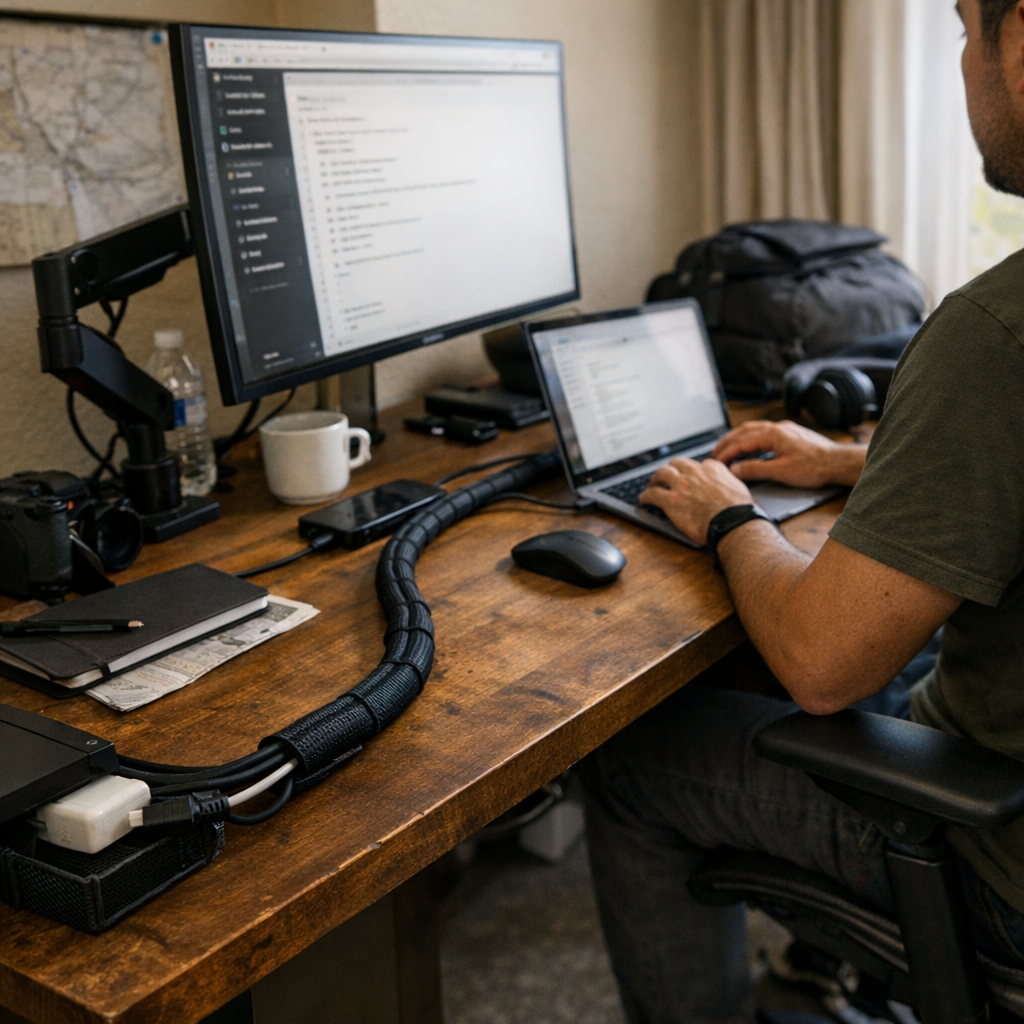
    The hidden snag with leaving cables loose is wear—the kind that never shows up in the desk photo. Each rushed unplug leaves connectors twisted, tips bent, persistence wearing thin. By the fifth or sixth setup, at least one cable feels softer or starts failing right where it bends. Bundling them in a sleeve does more than declutter the look; it shields weak points, absorbs abrupt pulls, and keeps the whole set together when fast breakdowns and resets are part of the job. The result is visual: a single line stretched across the desk instead of four separate cords, two always escaping just beyond reach.

    Adapting the Desk for Actual Repeat Use

    Your tolerance for cable chaos usually cracks after a week of constant moves. For most, the breaking point isn’t the mess itself—it’s the moment you miss something crucial because a cord is stuck, or realize you’re spending more brainpower untangling than actually working. My own fix: a braided sleeve, trimmed just to fit the primary device cords without excess. Not too tight, no leftover tangle, no wasted movement.

    Now the cables swing off one side with a single motion. No mistaken grabs. No frayed wire catching midway into a bag. Instead of thinking about cords, my hand follows the same setup path automatically—a physical routine quietly built by repetition, not by willpower. That kind of hidden upgrade doesn’t show up in the first hour, but after a dozen sessions, it’s the difference between steady focus and small, regular slowdowns you barely notice until they’re gone.

    What the Right Sleeve Changes for Routine Work

    With the sleeve in place, cables drop onto the desk at the same point, every time. My hand knows where to reach—no guesswork, no rerouting loops under a pile of notebooks, no digging to find the right connector. It fixes the specific friction that slips below notice: the seconds lost every single cycle to cables that do not land where you need them. Some quirks stay; it won’t solve every workspace flaw. But for repeated work, it strips away one slow reset you don’t need to keep fighting.

    Direct Answers for Real Travel Desk Scenarios

    Are Cable Sleeves Better Than Clips for Packing?

    If your setup moves more than two or three times a week, sleeves win every time. Clips pin cables in place for static desks but don’t unify them for quick changeovers. A sleeve gathers every cord, holding the entire set as one unit for instant pack-up, so you can shift workstations without forgetting, crossing, or leaving any cable behind. For mobile work, sleeves cut error and reset time, not just clutter.

    What If I Need to Swap Devices or Reposition Cables?

    The right sleeve matters. If you pick a sleeve that’s too short or too stiff, the bundle fights your movements—and you’re back to awkward, fiddly swaps. A flexible sleeve, cut exactly to the combined cord length, lets everything move naturally. Leave just enough space inside so you can pull or slide cables as needed—overpacking traps them and loses the modular feel. Fit the sleeve to your actual device layout, not a one-size-fits-all solution.

    Is Leaving Cables Loose Really That Bad?

    It’s tempting to shrug off for a day or two, but each loop left exposed will twist, bunch, or flex at the weak point by the connectors. Every extra bit of sorting—especially when you’re tired or in a hurry—adds unnoticed stress, and that’s when cables fail. If you’re breaking down fast and often, the risk isn’t just clutter; it’s silent wear and surprise breakdowns when you need reliable gear most. Active control stops the hidden damage before you realize it’s begun.

    When “Calm” at the Desk Is More Than Surface-Level

    The gap between appearances and actual ease-of-use appears after the fifth or sixth repeat. Cable sleeves don’t exist for looks—they’re a minor adaptation that reduces one of the quietest, most persistent interruptions in the real travel-desk routine. A sleeve cut for the way you use your gear simply fades into muscle memory, letting you focus on shifts that matter instead of routine repair.

    If your setup feels a little off after each reset—even when it “should” be organized—a proper sleeve might be the single unglamorous fix that sticks. It won’t perfect your workflow, but it erases the friction that keeps a workstation from being as reliable as it looks.

    Explore the full WorkBasic collection

  • Choosing Between Wall Systems and Storage Units for Outdoor Organization

    Right after you set up new backyard storage, it can feel like you’ve solved the chaos for good. Side-yard walkways are clear, rakes perch on hooks, and patio cushions finally have a home. But it only takes a couple of weekends—a forgotten garden glove near the compost bin, a pile of soccer balls wedged against the fence, the trash bin blocked by a hastily dropped bucket—for the slow creep back to clutter to begin. The storage looked efficient on install day; a few cycles of real life show what the setup can’t quite handle.

    When Storage Solutions Start to Block Your Routine

    The first big shift isn’t lack of space. It’s everyday movement getting more awkward. A tool bin encroaches on your path to the gate. Floor space, which seemed ample, tightens up as hoses or outdoor toys migrate from their original spots. Suddenly, returning one thing—like finding a place for the pruning shears—means shifting buckets, lifting bins, or sidestepping piles you meant to sort out “later.” Storage starts demanding constant rearrangement just to keep the walkways usable.

    The friction builds quietly. No one plans for that “temporary” overflow zone behind the garage or for the cluster of items waiting by the back door. Corners you imagined would stay empty become the default parking zone for whatever doesn’t fit or is too much trouble to return “properly.”

    Wall Systems: Everything Exposed, Nothing Hidden

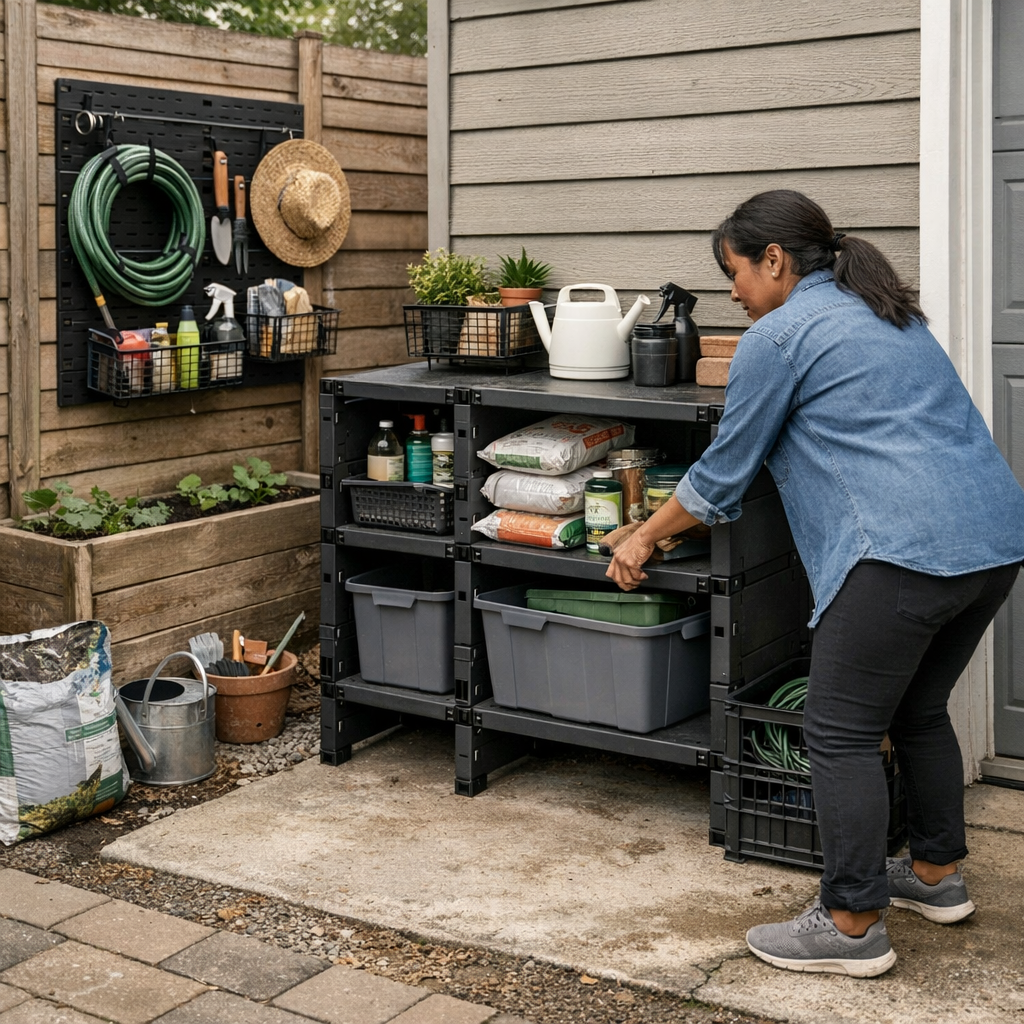
    Wall-mounted setups promise one big advantage: clutter can’t hide. Rakes and hoses either hang up or immediately betray themselves as out of place. The best wall systems are obvious in their demands—if someone leans a shovel instead of mounting it, the blocked path or lopsided tool rack nags until it’s fixed. In a narrow side yard or garage threshold, this visibility tightens the reset loop, pushing faster corrections and making the difference between an accidental obstacle and a clear walkthrough.

    The tradeoff: when you’re tired, dropped items stand out even more. Wall storage leaves no room for “just for now.” A forgotten pair of gloves or a stray soccer ball turns instantly into visual static, a reminder that the system only works if you cooperate every single time. There’s no door to mask drift—mess is either fixed or on display, never quietly swept aside.

    Closed Storage Units: The Trap of Hidden Piles

    Sheds and big outdoor bins sell the dream of a clean slate—tuck it out of sight, shut the lid, and the job is done. Over weeks, their practical flaw becomes clear: returning items gets slower and less appealing every time. Putting a hose back means dealing with whatever got tossed in front last. Restacking, reaching, bending—and the next time you’re in a rush, it’s easier to leave things sitting just outside, telling yourself you’ll put them back properly next time.

    Classic scene: you open the bin to drop in garden tools and discover folding chairs (delivered by a helpful neighbor) wedged in sideways, a broken watering can wedged behind, and last week’s pool toys blocking any hope of a clean return. Over time, the system that hid clutter just migrates it—first inside, then spilling out again in a line of overflow that clutters the fence or walks the storage unit’s footprint out into your movement path.

    Every square foot matters in compact zones. Space blocked by a box or shed is space you walk around. As the contents get jumbled, the “out of sight” solution just means outsized inconvenience the next time you try to use the area for anything else—retrieving, returning, even just passing by turns into a little project each time.

    Mixed-Use Zones: Where Setups Fall Apart

    Most real outdoor spaces play double—or triple—duty. The patch behind the garage handles gardening, sports, pets, extra chairs, and whatever needs cover this week. This is where storage plans get stress-tested. Toys blend with tools. The hose coils on soccer balls. An old bike blocks the compost fork. Wall systems make these mistakes obvious and annoying, while closed units let them pile up out of mind—until the spillover reemerges in new trouble spots along your fence line.

    You’ll know your setup’s unraveling if every reset seems to spill “temporarily” into some awkward clearance zone you never intended to use. Those piles aren’t clutter—they’re visible proof your system hasn’t met the reality of mixed use or the demands of quick, unplanned returns.

    Modular and Mobile: The Treadmill of Adjustments

    Mobile bins and modular cubes offer flexibility up front. But in practice, they introduce a maintenance tax. A rolling unit hits a paving stone and gets left askew. Stacked cubes “just for this week” block each other after one hurried swap. Every clever reconfiguration adds friction. Movement through the area slows, resets get sticky, and modular “solutions” become another set of puzzles to solve every time your routine changes.

    It’s easy to spot a modular zone that’s lost its balance: bins half-moved, cubes half-stacked, the whole setup answering last week’s problem while quietly creating this week’s fresh obstacle. The question to ask isn’t “how many arrangements are possible?” It’s “how many resets does it take to keep this path truly clear?”

    Setup Strain: Real-World Warning Signs

    • The walk from the back door is now a zig-zag through shoes, buckets, or stray bags.
    • Every attempt to put away a tool means moving two other things first.
    • Overflow forms in the quietest corner—like the fence next to the compost—because nothing else feels easy to access.
    • Seasonal gear lingers in awkward limbo, never returning to deep storage or finding a real spot outside.
    • You catch yourself dreading the simple act of picking up or returning a single item.

    Even the most orderly wall grid sags under too many non-matching items. Closed storage units start as hideaways and end as blockades if what goes in never cycles out. Friction isn’t a fluke—it’s the day-to-day sign your setup needs a new map.

    Real Fixes: Match Storage to Movement

    The real test isn’t how your setup looked on day one—it’s what stays easy months later. If you’re endlessly nudging, reshuffling, or working around awkward bulk after simple routine tasks, the system is failing the space. Wall racks pay off when fast access and instant return matter; they’re best for narrow strips, laundry cut-throughs, or garage edges where every pass counts. Closed bins and sheds handle off-season or backup gear, but they make everyday returns slower. Modular setups have their place—but only when you’re willing to keep up with their demands, or risk swapping one type of clutter for another.

    Test Your System: Walk Back Just Once

    If you’re unsure what’s not working, do a simple walk-through after a real outdoor task. Return each item to its assigned spot. If you have to move something else, detour, or settle for a halfway “temporary” resting place, you’ve caught the exact spot where your organization and real habits don’t line up. Usually, that spot keeps pulling clutter back in no matter how tidy things look after a big reset.

    Improvement almost always starts with granting honest space for the one tool or supply that defies all routines, or carving a lane that stays permanently open, no matter what shifts elsewhere.

    Storage That Survives Real Life Outdoors

    The difference isn’t decorative—it’s practical. Outdoor storage that keeps up with the messes, short-cuts, and adaptations of daily use feels different in motion: fewer pauses, less bumping, faster corrections, and almost no reason to step over a pile that wasn’t there the day before. If your side yard or patio edge keeps falling back into slow-motion disorder, it’s not a personal failure. Usually, it’s a sign the storage doesn’t match the movement—and there are solutions that can change that pattern for good.

    Find backyard storage solutions at http://www.tidyyard.myshopify.com

  • How Treat Placement Shapes Calm or Noisy Cat Behavior Indoors

    That tidy treat jar by the food mat feels smart—until day three, when your cat’s meows hijack your entire morning routine. In theory, a visible snack spot should streamline everything: you reach, reward, move on. But indoor cat life isn’t theory. That jar may match your kitchen, yet after a couple of mornings, you’re refilling it earlier and bracing for relentless reminders. You bend to wipe spilled kibble or grab a napkin, and the sound triggers a rush: paws on counters, eyes locked, volume up. What looked organized now builds friction—more interruptions, more vocal demands, less actual calm. Too accessible, and a single setup tweak keeps splintering your day in small, persistent ways. The promise of tidy storage slips into another maintenance headache you didn’t need.

    When Treats Stop Rewarding Calm (and Start Fueling Vocal Demand)

    It starts quietly. You want treats ready at hand—maybe beside the food tray, maybe on a reachable shelf. Simple enough, until the routine turns. By day four, the treat jar becomes a signal, not just a container. The cat starts treating the spot as a trigger—a slight clatter or hand motion sparks urgency, not patience. Early risers notice first: the kitchen’s rhythm is dictated by meows before the coffee even starts. Those reminders ramp up; a visible jar teaches the cat that demand, not silence, gets results. Instead of the treat being a rare reward, you end up reinforcing every prompt. It’s not personality. It’s a feedback loop built into your living space.

    This shift isn’t just about noise. A setup that felt efficient turns the room into a negotiation zone. You lose control over timing. Every time you pass the jar or reach across the counter, you’re drawn into a new standoff. Quiet anticipation gets replaced by habit-formed interruptions—your after-work reset, your short pause between chores, even your evening routine. Normal movement becomes bargaining. One setup choice sets a pattern: accessible treats, in plain sight, mean the day starts breaking before the first real task is finished.

    The Hidden Cycle: Visibility Breeds Interruption

    This is pure cause and effect. Cats notice every micro-movement: did you open this jar right after picking up your mug? Did you drop treats last time you walked by? They log these patterns fast. Soon, the treat container isn’t just a background object—it’s a cue that warps the entire room flow. Instead of mealtimes, you get opportunistic reminders every time you cross the kitchen. It’s a hidden cycle: the more visible and handy you make the treat zone, the more you teach your cat that anything can be turned into a snack request.

    The supposed convenience costs you peace. The treat setup calls the shots: louder reminders, more interruptions, tasks sliced into smaller segments because you’re managing the next round of begging. Usually, it takes three countertop sweeps—or just one late-night treat session—to realize your own routine is being run by a container. Instead of structure, you get a schedule shaped by interruption. “Organized” turns out to be a temporary look.

    Setup Friction in Real Rooms: Small Choices, Big Consequences

    No, it’s not your cat “acting out.” The problem is the setup—a practical home structure that backfires. Visual placement matters more than style. A spotless jar in a busy visual line (by walkways, on top of food mats) turns organization into a magnet for disruption. It’s the home flow that suffers: quick stops for water, reaching for a cleanup cloth, or just passing the fridge start launching new demands every time. The treat system reprograms routines, even when everything looks put together in the morning.

    Consider the reset cycle: You’re prepping breakfast, hand darts past the treat jar, the cat yowls—now you’re pausing, negotiating, scrambling for quiet. You didn’t plan a snack break, but the accessibility of the jar has just written one in. One movement, two minutes lost, three minor tasks derailed. That’s the self-reinforcing part: the easier the reach, the more disrupted your regular steps. Organization can mask a loop of micro-interruptions that only become obvious after the third—or fifth—reset.

    The False Sense of “Organized”

    At first glance, the jar by the food mat sells a picture of order—clean, coordinated, within reach. For three days, it almost is. Then the cat parks itself in the kitchen, watching, tracking your every gesture. A quick hand toward the counter sparks a call; leaning for coffee summons a stare. In theory, the room’s tidy; in lived reality, you’re stuck in a loop of shuffling the jar left, right, back behind something, hoping you can trick the system back into silence. The “tidy” corner becomes a moving target, impossible to settle.

    The Evening Reset: When Treat Placement Hijacks Quiet Time

    And it doesn’t stop with breakfast. You’re ready to stop for the day—drop into a chair, reach for a blanket—and the jar, still visible, sets off a whole new round. One tap, a chirp, a yowl: your reset hour flips into a soft-motion bidding war. Evening calm gets split by one physical cue left in the wrong sightline. Your attention shifts from unwinding to managing the next expectation. Instead of peace, you get small rations of focus, traded again and again for quiet that never really lands.

    The problem isn’t even the volume—it’s the chronic adjustment. Your routine bends to the placement, the interruption, the attention shift. What was supposed to be a neutral background item now runs the room’s tempo. Cat and person both shape their habits around a misplaced jar, until every break and pause is a chance for a new demand.

    Breaking the Cycle: Hiding the Jar, Restoring the Rhythm

    In real homes, breaking the demand cycle comes down to changing one structural detail: visual control. Shift the jar out of direct sight—into a drawer, a high cabinet, a spot behind something less cat-enticing. You’re not locking away the treats forever; you’re cutting off the reflex chain. Suddenly, a meow gets no echo. No jar periphery, no quick hand flick, no predictable shake. After just a few tries, the cat’s reminders lose their edge. Instead of pausing your routine each time, you move through the kitchen cleanly. By the end of the week, the new normal is less pressured, the old loop broken. Treats are still there for real rewards, but not on the cat’s constant terms.

    The benefit isn’t just quiet—it’s a smoother day. Now, a routine is just that: not a series of negotiations, but a flow you actually control. The little friction you add—an extra step to reach the jar—pays out in hours free of repetition and distraction. The home doesn’t just look calmer. It stays that way, for both sides of the food bowl.

    The Slightly Inconvenient Drawer (and Why It’s Worth It)

    Sure, stashing treats in a drawer turns a quick grab into a short pause. But the change flips the room’s dynamic. Less noise, fewer mealtime shadowings, and a treat ritual that regains its status as a reward—not a standing negotiation. One changed physical cue is enough. After a week, the cat waits during meals instead of every step. You control the rhythm, not the jar. The minor extra reach is real; the payoff is space for everything else that matters in your day.

    Room Flow, Clutter, and Treat-Driven Interruptions

    This treat tension is only one part of the broader setup cycle in indoor-cat homes. Leave litter scoops too close to beds, or water bowls tucked behind towels, and clutter trades places with daily flow. Every “neat” corner can be a stress point if its placement invites the wrong use at the wrong moment. The best setups aren’t just visually ordered—they’re tested by how little they interrupt you. The difference isn’t in how things look after a reset, but how the space behaves after you’ve repeated your routine twenty times. Convenience that triggers constant action is a hidden cost; structure that guides calm, easy resets holds up better in real use.

    The practical rule: a better home setup isn’t just about what’s tidy—it’s about structures that make less friction, less reshuffling, fewer reminders, and more room for genuine quiet. The setups that feel easy after the first week are the setups that quietly reduce pressure, restore forgotten calm, and let you own your routine again—without a new interruption every time you cross your own kitchen.

    You can find practical, real-world setups for every daily cat-and-human routine at StillWhisker.

  • Why Defining Boundaries Transforms Garage Storage Efficiency

    Any garage or workshop can look “organized” for a few hours—rows of matching bins, everything lined up, floors swept. But there’s a familiar moment, usually by the end of a busy week, when you start to realize: it’s not working. You’re nudging a rolling cart for the third time in the same afternoon just to get to the outlet. A hose is pinched behind a bin that wasn’t there yesterday. The corner that should be empty has quietly become a dumping ground for overflow, and every routine involves a few extra, unnecessary steps.

    Why More Storage Doesn’t Mean More Usability

    The first instinct is to add containers—a new stackable bin, a bigger tote, maybe a taller shelf. On install day, it looks great. A single row of containers along the floor, all perfectly matched, seems like the answer.

    But in practice, that order is fragile. You reach for something at the bottom of the pile, and suddenly bins are poking into walkways. The cart that’s supposed to help winds up blocking access to the very tools you use the most. That seasonal box—never quite empty at the right time—wanders further from its zone every time it’s pulled down, eventually occupying the only stretch of wall where you could actually move around.

    The real problem: more storage doesn’t solve the constant low-level disruption of a space that can’t keep itself in line. Each extra container delays mess but also spreads it.

    Unanchored Containers: The Enemy of Open Flow

    Loose bins and gear on the floor don’t know their place. The “tidy” footprint drifts: containers inch into traffic lanes, blocking that one spot you use to turn with a full armload. The empty-for-now tote quietly migrates to the center of the room. What was a clear corner becomes a tangle where nothing is immediately accessible. Floorspace that feels open one day becomes a minefield the next.

    The repetition is relentless: three moves just to put back a wrench, every cleanup session a mini Tetris marathon. A mobile chest finds its way into the path every single Saturday—you move it, mutter, and think about doing a real reset… but know it’ll happen again. Unanchored storage never stays put, and the gap between “organized” and “quickly usable” gets wider every week.

    Overflow: The Unseen Clog

    Overflow isn’t a dramatic avalanche—it’s silent, slow, and steady. An awkward lamp, a leftover bag of potting soil, or a single unfamiliar tool slips into the system and the regular bins start drifting. Suddenly, the path to the back wall takes a detour. The corner under the window feels permanently blocked. Outlet access, once simple, now means awkward reaching or hauling containers aside—not just once, but every single use.

    The daily impact is small but cumulative. Every reset takes longer. That little resistance—annoyance here, a few extra seconds there—turns into wasted time and mounting frustration. The space looks “neat enough,” but it can’t keep up with the way you actually work.

    Anchoring Order: What Physical Boundaries Actually Do

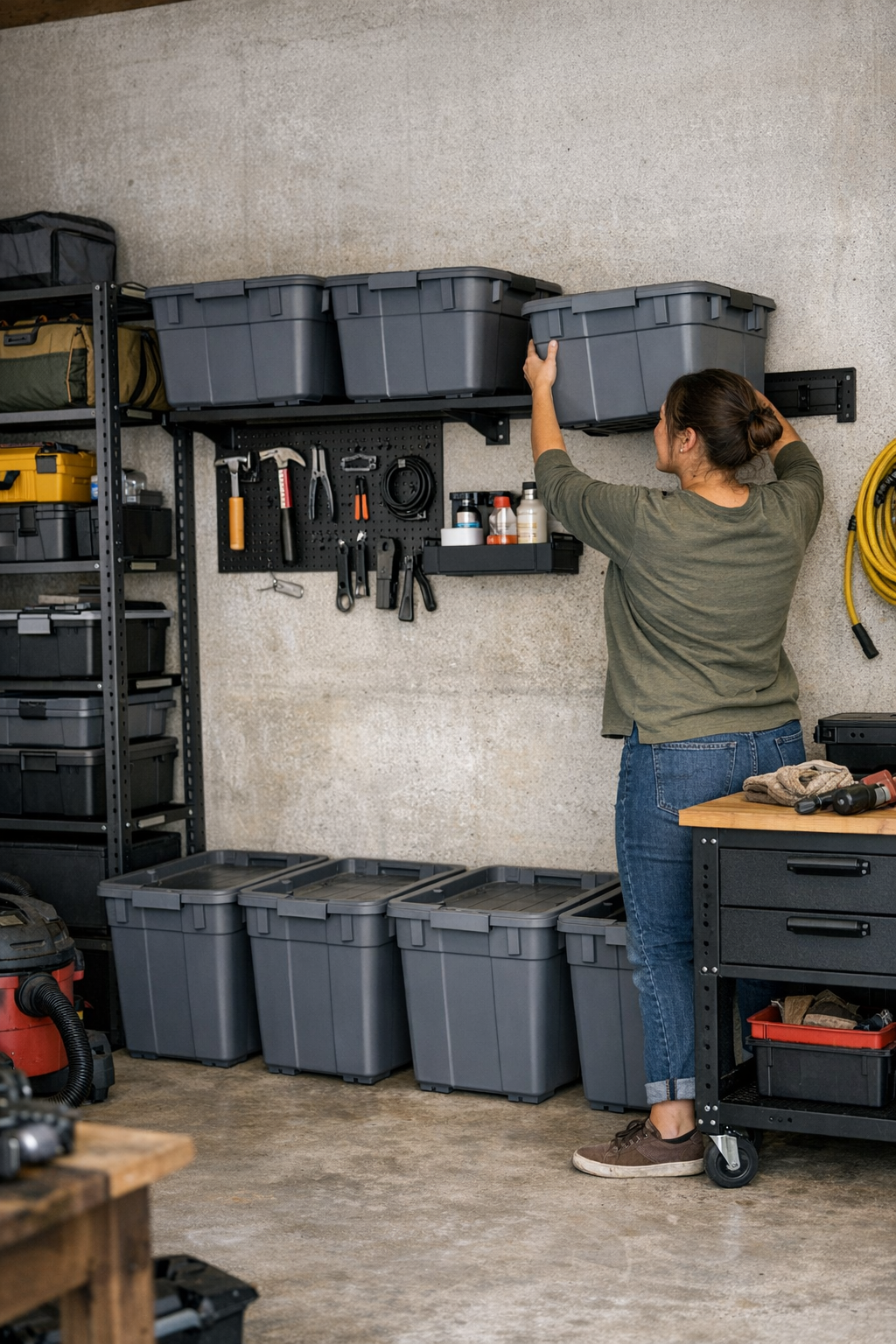
    Boundaries transform storage from cosmetic to functional. Wall rails, anchored shelves, and modular panels force the layout to obey real limits. A boundary isn’t just about keeping bins from sliding; it’s a hard rule for where gear belongs, how much will fit, and—crucially—where routines don’t get blocked by drift. Even with messy use, things can’t wander far from their rightful spot.

    Try swapping out a third of your floor bins for truly wall-mounted options. Overnight, the main path stays clear. Returning a power tool stops being a three-step shuffle. You know exactly where the overflow can and can’t go. Seasonal containers can live overhead or inside a defined bay, not wherever gravity lands them. Cabinets stop jutting into walkways, and the area once clogged by “temporarily” parked gear finally stays open.

    Reset Speed: The Unseen Value

    What’s most striking after creating real boundaries? Reset routines shrink. Instead of shoving rogue bins aside or reverse-engineering your original layout, you put the item back and move on—done. Spotting an out-of-place tool becomes so obvious you fix it without thought. There’s no wrestling the same rolling cart back into line, no detouring around congestion points. On even the busiest days, order survives. Cleanup stops being a project and becomes a single, automatic motion.

    With boundaries, overflow can’t quietly colonize new ground. You see clutter instantly. The system stops needed policing, and you start actually using the area the way you intended: more making, less rearranging.

    Why “Looking Organized” Still Disrupts Real Routines

    Walls of labeled, evenly measured bins look good at a glance, but they fool you. Every week, the same old pattern returns: one cabinet always off the wall by a few inches, one corner with a mystery pile that never moves, and that one spot by the door that collects everything that doesn’t quite fit anywhere else.

    If it feels like every project ends with a pile of “to deal with later,” you’re not alone—it’s a sign your storage system can’t withstand real life. The difference shows up in the lost seconds and the low-key annoyance of constantly nudging, shifting, or hunting for what should be two steps away. Weak boundaries are invisible thieves of time and energy, making every return-to-order more tiresome than it needs to be.

    Setting Your Own Boundaries: Practical Tweaks That Work

    Target your bottlenecks, not your bins. Is the path to your workbench always a zigzag? Does gear constantly pile up near the back door or the outlet wall? That’s where a rail, sturdy panel, or defined shelf should live—not just “more storage,” but something with a clear limit.

    Give your setup a reality check: after a regular task, time your reset. How many times do you move something just to put another thing away? Where do you have to reach awkwardly—every time? Those are signals your layout needs a real boundary, not another container.

    Try simple tests—assign a slot for each bin using a modular wall, or mark a “home base” spot for a tool chest. Watch whether it holds its ground after several days, or if things drift back into chaos. The right experiment is the one that makes cleaning up as automatic as the mess itself.

    The Everyday Test: Will It Work Next Week, Too?

    Truly functional garage setups aren’t just about the install—they show up in the way you use the space at actual speed. Are walkways still open, or is access shrinking every week? Do you have to reshuffle four things to get to your main supplies? When the day ends, does reset happen quickly—or does a “quick cleanup” turn into a frustrating rearrangement?

    The best boundary-driven setups take a stand: movement stays clear, overflow is contained, and routines stay direct even after heavy use. The proof isn’t in perfect labels or matching colors—it’s whether the space helps you keep moving, hands full, without dreading the return. If your system can survive three messy Saturdays without collapsing, you’ve set up more than storage. You’ve given yourself a workspace that works—today, next week, and far beyond install day.

    http://stacknest.myshopify.com

  • Why Labeling Alone Fails to Keep Your Storage Organized Over Time

    Labels Are Not a Cure—They’re Symptom Management

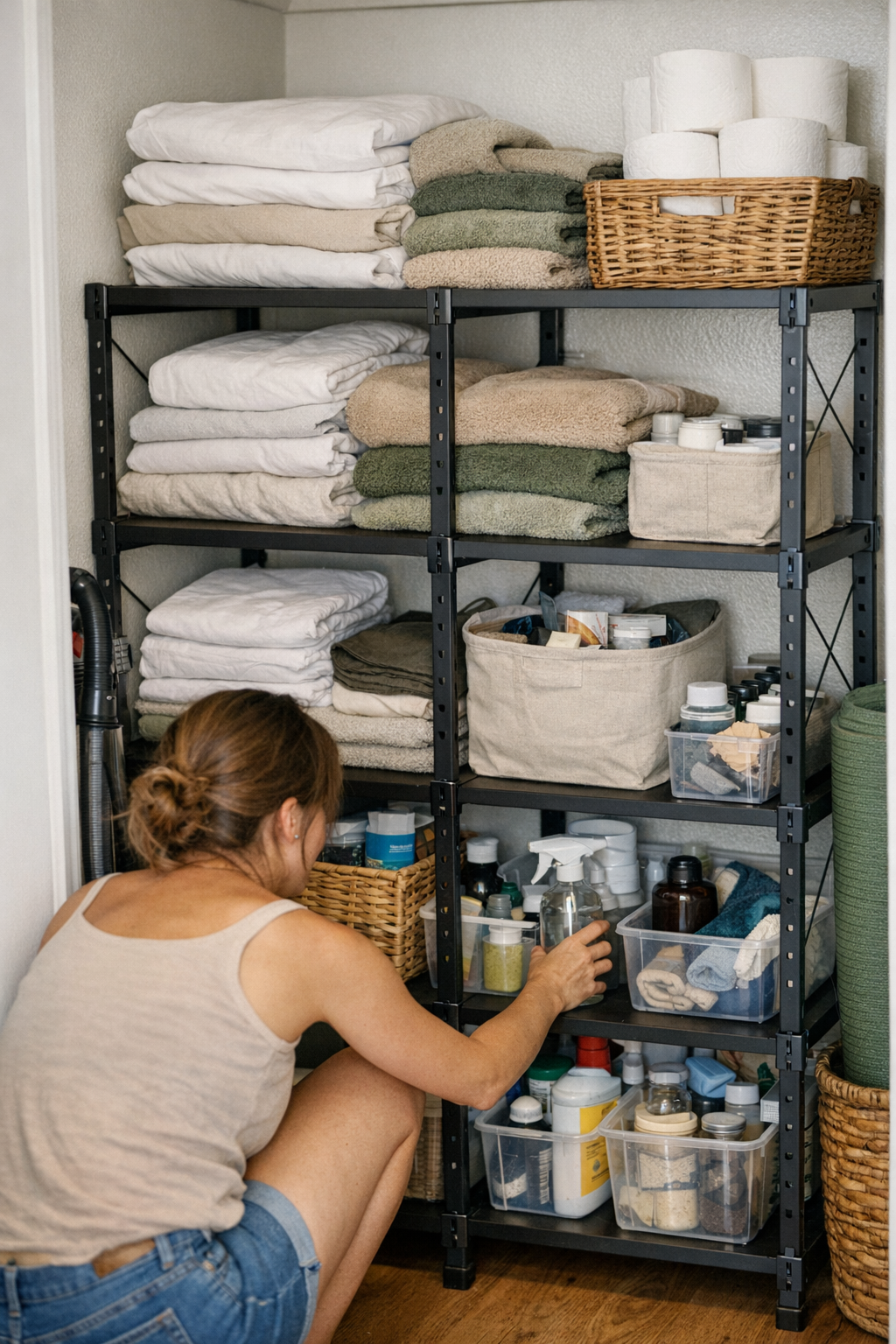
    Walk into nearly any hallway closet, pantry, or bedroom storage wall and you’ll spot them: the ambitious row of sticky-backed labels, the perfect handwriting on baskets, the hopeful arrows pointing to “Towels,” “Snacks,” “Seasonal.” We chase that first satisfying click of order—the sense that if everything is labeled, disorder will finally loosen its grip. Yet by the end of the week, the familiar patterns creep back in. Labels are suddenly wrong, ignored, or so specific they don’t match the real contents. That earlier surge of control? Replaced by the quiet suspicion that you’re no longer keeping organized—you’re just managing a game of label-and-relabel.

    When Labels Only Add More Work

    The breakdown isn’t theoretical. It’s what you feel in the rush of living. Midweek, you open a bin marked “Sheets” and find a tangle of socks and nightshirts. You lift every basket looking for a missing pillowcase, or stop and squint at a fading “Snacks” label before realizing the bin holds oatmeal and canned beans now. Instead of quick access, you’re in maintenance mode: editing categories, rotating items, peeling off labels to make room for new ones—just to stay afloat.

    This frustration spikes in the spaces that see real action. In the hallway closet, everyone dumps towels wherever there’s space. In the pantry, groceries fill and empty unevenly, so the “Breakfast” shelf ends up mixed with crackers or soup. Even the front door cubby, meant to keep shoes and bags apart, descends into a heap by Friday. The problem isn’t that you lack discipline. The problem is a system that demands you work for it, not with it—rigid bins, labels for things that change daily, corners no one can reach without crawling.

    The False Promise of Perfect Order

    Those first few days, a new labeling scheme looks unbreakable—baskets lined up like a catalog photo, every item in its painted lane. But real life erodes surface order quickly. The “Towels” stack bulges sideways, blocking the next bin. The “Seasonal” basket starts hiding birthday candles with garden gloves. Miscellaneous clutter finds its way into every available gap, regardless of what the label says. Soon, frustration becomes routine—reaching behind crumpled stacks, stacking baskets on the floor, bulldozing through one bin to reach something in another.

    Watch what actually happens: the “Snacks” box drifts toward baking supplies after one grocery run; folded towels uncoil past their boundary into another category; the label for “Misc” slides out of reach behind a pile of winter hats. You realize the container isn’t the problem—the daily realities never matched the label’s tidy fantasy.

    Shared Spaces Create Label Blindness

    Add a second set of hands (or five) and the system degrades even faster. In the bathroom, “Guest” bins fill with everyone’s contact solution and razors. Laundry zones labeled “Delicates” and “Whites” collapse into one after a hurried wash. Labels become hopeful reminders, not actual guides. After a few days, nobody trusts them. Everyone navigates by memory or guesswork, shoving items wherever they’ll fit.

    Where Storage Systems Fail—And Why

    Picture the reset after laundry day. “Sheets,” “Towels,” and “Cleaning” bins are theoretically separated. But the shelves are just deep enough that extras spill into the nearest bin. Pillowcases land atop towels. Searching for one set, someone pushes other contents forward, unseating the stacks. By week’s end, the categories are shot—a haphazard blend of items requiring a full scan and multiple basket-pulls to find anything.

    Half the battle isn’t about tidiness, but about the design itself. Too-deep bins swallow things out of sight. Overly narrow baskets overflow while bulky “storage” bins sit empty. Shelves set at awkward heights mean stacks quickly collapse, sliding into neighboring spaces. Vertical room is wasted above, while horizontal zones self-destruct under pressure. Almost every retrieval turns into a slow-motion excavation.

    Reset Speed: The Real Test of Your System

    The truest measure? How quickly can you restore order after a normal, hectic day—not a staged cleaning session. If your system only looks organized in photos but becomes a puzzle to reset, you burn time and energy every time you restock. Do you have to drag out half the closet to sweep up stray socks? Are you re-labeling or shuffling bins with every change of season or new bulk buy? If your shoes and hats keep creeping into the entryway—or if the kitchen’s “Overflow” bin is perpetually a mix of everything—chances are, your categories are fighting your habits.

    The most livable storage setups aren’t strict—they’re forgiving. They create “good enough” boundaries you can refill in seconds, not with a checklist and a label maker.

    Lean Into Flexibility: Improvements that Actually Last

    If your resets keep getting slower or more complex, it’s time to look at how your storage set up, not just what the label says. Are your bins the right size for the real amount of stuff—are you always cramming extras on top? Can you reach what you need without moving other baskets? Do your categories reflect how you actually use the space, or how you wish things would work?

    Try this: swap out universal labels and mismatched bins for simple, open shelving—just define a visual rule, like “don’t stack above the second shelf.” When items are visible and distances are short, you reset faster. No digging, no guessing, no rearranging every time someone tosses in a backpack or seasonal coat. Clarity improves, and minor everyday clutter never snowballs into a full afternoon of re-sorting.

    If you want to keep labels, be ruthless about their purpose. Only label what must truly be separated (“First Aid,” “Holiday Decorations”), and use adjustable tags or wipeable markers. When routines shift, so can your categories—no peeling, no guilt, no system overhaul required.

    Storage Should Disappear Into Your Day

    By the end of a long Tuesday: the last towel is hung, the backpacks are dropped just inside the door, the weekly groceries are shifted into reach. If your system fades into the background—if you can reset it in under a minute, without a sigh or a scavenger hunt—you’ve found something functional, not just photogenic.

    Don’t ditch labeling entirely—just recognize its limits. The best storage fits your actual rhythms, not showroom rules.

    Discover storage options built for real life—messy, busy, imperfect—at ClosetWorks.

  • Why Heat Guns Overheat During Paint Removal and How to Avoid It

    The truth about heat guns is this: the real differences emerge long after the first layer of paint curls away. Stripping one window frame can make any budget tool feel identical—but stack up a dozen sashes, spend a Saturday battling stubborn casement grooves, and the illusions fall apart. On the surface, every heat gun looks the same in the aisle: similar power, comfortable grip, maybe a few nozzles rattling in the box. But when you’re still on your knees, five hours deep and the paint is barely lifting, you realize it’s the invisible choices—insulation, endurance, airflow—that decide whether you end the day ahead or with a headache and scorch marks everywhere you look.

    Where Real-World Pressure Reveals Weakness

    Paint-stripping isn’t a test you do in a vacuum. The jobs that push you—cramped ledges, endless trim, old house quirks—pile up fast. You knock out one section just to reveal four more, each one rougher than the last. In the beginning, almost any heat gun feels up for the challenge. But when you’re chasing detail after detail and pushing through whole rooms, small flaws quickly become mission failures:

    • Uneven airflow stalling your workflow. What started as a steady, predictable stream becomes erratic mid-task. You press the trigger and instead of that easy, skin-lifting peel, you get cold patches and stubborn stripes that demand extra scraping—and kill your rhythm.
    • That sharp, plasticky stench isn’t nostalgia—it’s meltdown. The moment insulation falters, a whiff of burnt plastic hangs over the job. It’s the canary in the coal mine for tool failure: by the time you spot deformation, you’ve already scalded paint—or worse, the underlying wood.
    • Nozzle warps before your eyes. Extended sessions expose which guns substitute bargain plastics for quality. Overheated, the nozzle necks down, narrowing the airflow, so you linger in one spot, extending scorch risks and draining energy.

    This isn’t rare. Every overworked heat gun eventually exposes its shortcuts. What’s “good enough” on the first test run often becomes the friction that kills your momentum across a job, stretching hours into days, and forcing you to mask charred seams with extra sanding or primer later.

    Spec Sheets Don’t Measure Fatigue—or Failure

    The sales copy won’t save you when the job drags on. Power ratings and temperature stats sound solid, but in real workshops, tool survival lasts longer than any printed number. You don’t notice the difference on a quick demo, but move window to window, day after day, and the fakes start to falter:

    • Can it keep heat at the nozzle, panel after panel? What sounds like “2000W” is meaningless if you’re hovering, waiting for the tool to recover, re-soften, reheat—over and over.
    • Does the grip stay cool or cook your hand? With junk insulation, the tool becomes hot and clumsy, increasing fatigue and making precise scraping difficult fast.
    • Is airflow reliable or sputtering? Consistency directly affects your control and speed; surges and stalls make clean removal near impossible.

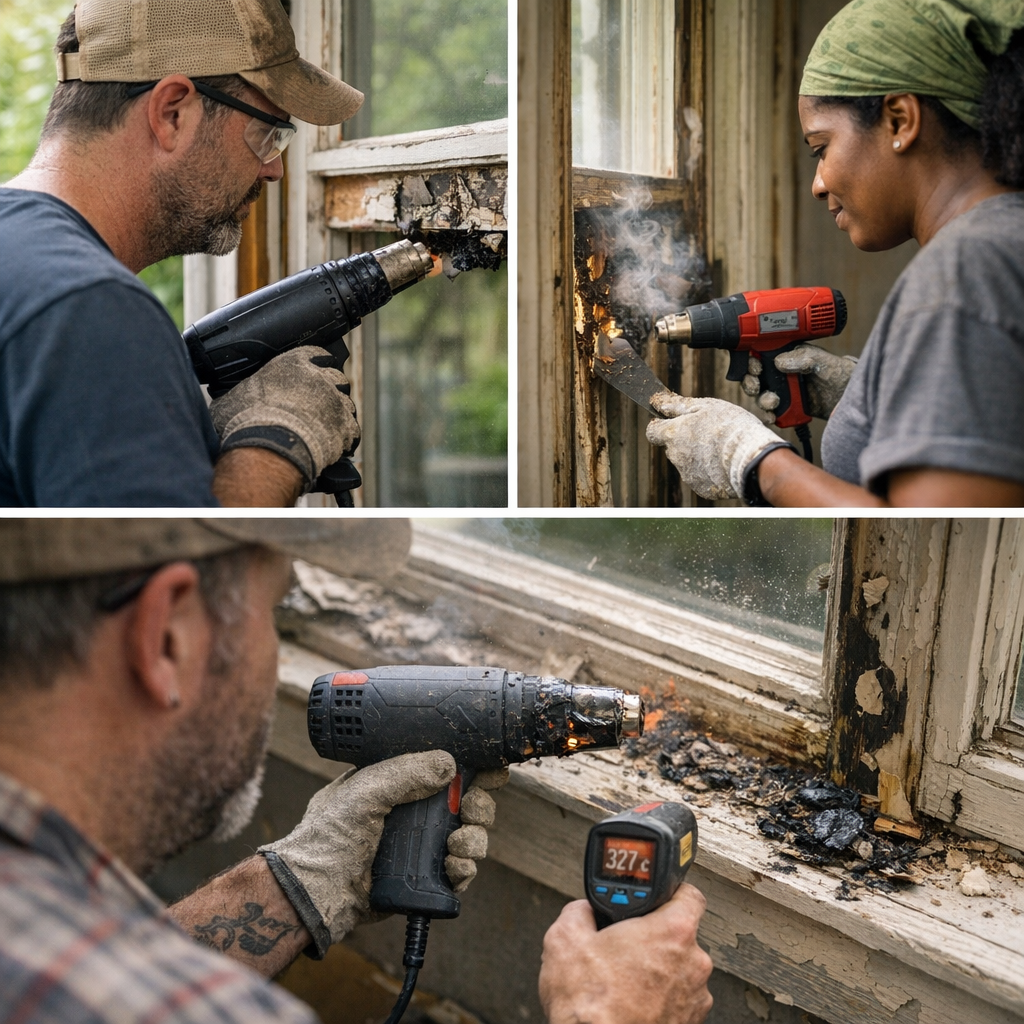
    I gambled on a popular “workhorse” once—on paper, it matched the ceramic-insulated leader watt-for-watt. Three hours later, thermal cutout, paint half-bubbled, I was forced to stand there and wait. Swapping to the better-insulated gun let me finish not just that sash, but room after room, with working temps below 290°C and zero interruptions. The stats were the same—but only one performed beyond a quick demo.

    Fatigue Sets In When Tools Falter

    Short tests tell you nothing about cumulative stress. Any heat gun will peel a sample patch, but full-house stripping exposes the weak spots. Common failure points you’ll run into:

    • Paint that crumbles instead of cleanly lifting, creating a mess you sand for hours.
    • Handles so hot you can’t grip them, forcing unplanned breaks or awkward gloves.
    • Edges and corners that char, especially as airflow grows unpredictable, demanding multiple passes and careful sanding just to save the wood underneath.

    The right gun keeps you working—steady, predictable, and less physically spent. The wrong one weighs your hand down, bloats cleanup time, and kills your focus at exactly the moment you need control.

    From Frustration to Flow: Two Guns, One Jobsite

    Picture the start of a long restoration day—sashes lined by the bench, tools at the ready. Both heat guns, fresh from the box, promise the same performance. After an hour, only one is holding up: the first staggers as heat cycles wear it down, airflow gets choked, and you waste minutes rehitting stubborn spots. Your sanding block never leaves reach. The other, its nozzle still shape-true and grip manageable, keeps a strong, even peel, so you spend the end of the day actually finishing, not just fixing.

    What Really Drags Down Tools—And How Insulation Makes or Breaks the Job

    The biggest culprit in real failure: bad insulation and bargain plastics. A heat gun that cuts corners here rapidly becomes a liability for jobs with any scale or repetition.

    • Spiking nozzle temperatures. Subpar insulation can’t keep temps stable—jumping past usable 290°C ranges and surging up over 330°C. Suddenly you’re juggling not just failing paint lift, but scorched wood and deformed nozzles as well.
    • Heat-fatigued internals. The plastic and wiring inside a cheap gun can’t handle repeated cycles. Expect mid-job thermal shutdowns, dropouts in airflow, or worse—a dead tool when you need it most.

    Switching to a well-insulated, ceramic-nozzle model is less about numbers, more about maintaining pace. There’s a rhythm to paint removal: check, heat, scrape, rotate, repeat. Flimsy guns drop out, strong guns let you keep moving, scraping, sanding, and painting with fewer tool-caused delays.

    Practical Shop Wisdom: Don’t Ignore Cooling Intervals

    Even the right tool benefits from respect for the process. Every 60 minutes or so, give your gun a break while you sweep up or prep your next sash. If you sense pulsing airflow, pause and eyeball the nozzle—slight warping is a warning to avoid pushing further. Upgrading to ceramic insulation and rated duty cycles doesn’t replace common sense, but it does mean your stops are about the job, not saving the tool from itself.

    What Survives the Job—Choosing for Endurance, Not Hype

    Gimmicks and specs fade under real workload; only build quality endures. Across workshops, attics, or hundred-year-old porches, it’s the hidden insulation and reliability that quietly cut fatigue and let you end a project a day sooner. Bargain models might limp through a test strip but will double your cleanup and sanding once the flaws show up on the third or fourth frame.

    If you’re staring down room after room, detail after detail, it pays to choose tools with ceramic-insulated nozzles and actual duty cycles—not hobby-grade promises. The end result? Fewer accidental burns, less wasted sanding, and a workflow that keeps you active, focused, and ready to move on instead of stuck fighting the tool.

    http://gumboll.myshopify.com

  • How Smart Carry-On Organization Reduces Travel Delays and Stress

    The first time your carry-on setup gets dragged through airport reality, its true strengths—and weaknesses—show up fast. At home, everything looks disciplined: pouches stacked neatly, chargers coiled, documents slotted for easy reach. But that tidy order almost never survives real airport movement. The minute you hit the security queue, watch as “organized” turns into a slow-motion scramble—repeated digging for documents, shifting pouches, re-zipping. What looked efficient becomes friction you can feel: a bag that feels less accessible every time you reach for the same item again.

    When “Neat” Isn’t Fast: Travel Turns Order into Obstacles

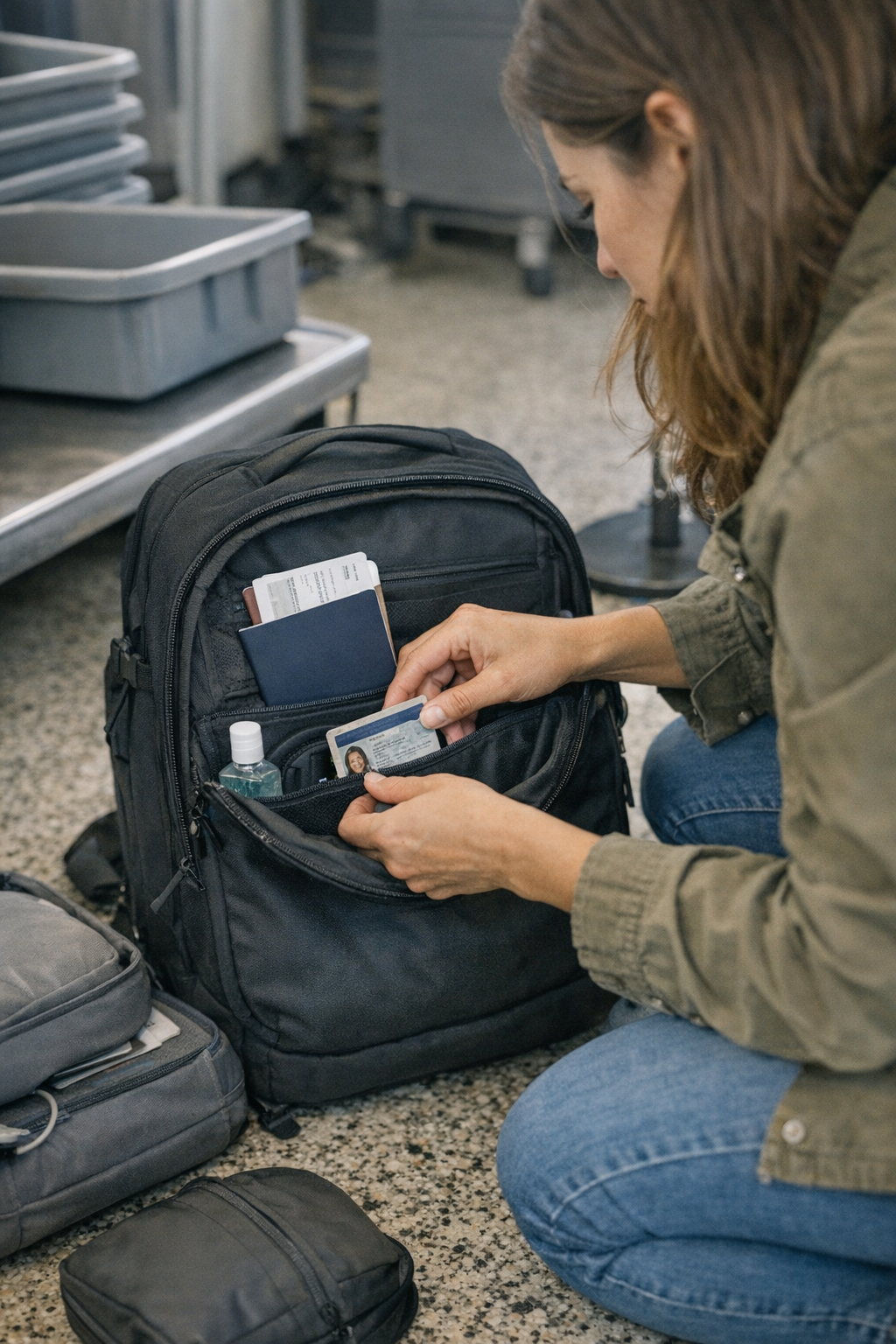
    Real friction surfaces the moment you’re pressed by lines. You’re in security, blocking the lane as you fish out your ID. Suddenly, your passport is hiding below the charger pouch, sanitizer is wedged under headphones, and the quick zip you relied on at home now catches on something you stashed “just for this trip.” Each delay multiplies: five seconds lost retrieving a document, another ten spent repacking after everything shifts. Organized at first glance, but in real use, every reach exposes a new snag.

    These aren’t one-offs; they stack up. The first fumble is just a hiccup. By the third, your rhythm’s broken and your sense of control fades. You start noticing you’re the one holding up the queue or rushing to close zippers before boarding is called. A “well-packed” carry-on that turns against you drains more than time—it draws your focus away from what actually matters in transit.

    Spotting Friction in Your Setup: What Hidden Slowdowns Cost

    The difference isn’t about how pretty your bag looks when fully zipped. It’s whether you can actually get to what you need, when you need it—without disrupting the whole system. Pouch categories that made sense on your bed become dead weight at the gate if items get buried under layers. Most travelers don’t spot the weak link until they’re forced to reach past two barriers just to get a boarding pass. On a day with three security stops, that slow crawl becomes a visible liability: each time, digging deeper, pulling out what you already packed away once, and quietly losing a beat in the flow of everyone around you.

    Quick Example: When Minor Setup Gaps Go Major

    Picture this real sequence: first checkpoint, you’re delayed as your card’s trapped at the bottom of an “organized” sleeve. Next round, your headphones pouch blocks access to your pouch with liquids—forcing you to unpack mid-line. By the third stop, your quick-access system has turned into a repacking routine, with every reach inside a reminder that the neat layout at home doesn’t match the order you need under pressure.

    This isn’t just an airport thing. Friction follows you: reaching for headphones at takeoff, sliding a bag into the overhead but catching on a misplaced strap, or stopping in a crowded aisle to hunt for sanitizer. Each event is a direct result of overlooked setup weaknesses.

    Visual Order vs. Movement-Ready: Judging Setups That Don’t Keep Up

    Looks don’t tell the story. A flawless grid of gear inside your carry-on is only as good as its ability to serve you on repeat. Most initial packing systems curb visible mess without accounting for live movement—how you’ll actually need to grab, repack, and retrieve in quick succession. If your layout requires a “hunt” each time you want your passport or headphones, it’s just another form of friction wearing on your progress.

    Too many setups focus on compartmentalized organization—three pouches for three categories, all zipped and stowed. On the ground, this can mean dumping out half of what you organized just to grab hand sanitizer as people flow around you. Moments like swapping boarding passes or re-upping on comfort items don’t wait for you to decode your own layout.

    The Value of Effortless Pauses: How True Organization Feels

    Real order is found in the split-second pauses between movement. When you stop at a gate or ease into a seat and don’t need to scramble through layers, your setup proves its worth. The simplest setups put repeated-use items—travel docs, sanitizer, comfort gear—within a single, direct path. If your bag lets these small tasks happen smoothly, stress fades and the airport rhythm changes; if not, the “pause” is lost to another repacking session.

    Real Travel Example: Shifting from Buried to Immediate Access

    Notice the change when you assign all high-frequency items to one external pocket or easy-grab path. The improvement is visible: quick retrieval at security, no more unzipping three sections for ID checks, faster seat entry. Instead of navigating a padded pouch maze, you run your hand along a known zipper track and move on—no mental inventory required. Movement isn’t frictionless, but interruptions now pass as flickers instead of full stops.

    The real difference: your carry-on goes from being a delicate puzzle to a reliable tool under pressure. The moment you stop hovering over your layout and simply move, you’ve found the structure that works for repeated use.

    Finding Hidden Friction: Are Repeated Stops Draining Value?

    Start tracking how often you pause for the same reason: fishing under pouches, spinning your bag to reach a pocket, or hesitating while someone waits behind you. If entry into your seat means a shuffle to clear blocked zippers or if you find your documents stuck behind “more secure” organizers, your setup is quietly costing you time and energy with every cycle. Strong carry-on systems leave almost nothing to multi-layer hunts, especially under streaming travel conditions.

    The signal isn’t frequency of travel—it’s the feedback of each retrieval. If grabbing a passport creates hesitation, or if headphones require a full unpack, your organization isn’t tuned for movement—it’s tuned for static display. The best setups beat repetition by working with, not against, airport patterns and in-flight routines.

    Adjusting for Real Use: Practical Fixes That Actually Change Flow

    Start by mapping your must-grab items—passport, ID, sanitizer, headphones—into the zone you can access with one smooth motion, even when your bag is upright or squeezed between seats. With every movement (security, boarding, aisle slide), notice the moments your hand lingers or reverses step. If the new layout cuts the drag and drops your retrieval time, you’ll feel the difference immediately.

    Tested over a couple of trips, these changes reveal where good intentions bottleneck in real use. Rethink what you pack where—switch pockets, reduce pouch depth, use travel-specific organizers built for repetition—and let repeated exposure, not just initial order, shape each upgrade.

    Luggage Structure That Keeps Up: Moving Past One-Time Display

    Effective carry-on structure survives real travel interruptions: repeated document checks, tray handoffs, boarding-lane bottlenecks, or aisle-seat shuffles. When things get tight, the highest value comes not from how the bag looks under your bed, but from how it responds to rapid retrieval and repack routines. The carry-on that’s movement-ready shrinks every point of friction from “small delay” to “barely noticed pause.”

    Every setup has its limits, but shrinking each friction point keeps you moving forward. If your carry-on is shaped for movement—not just neatness—real organization means the bag adapts to your pace, not the other way around. That’s how structure becomes support, not a subtle drag you only find out about after your third security line.

    Find gear designed for repeated-use ease at CarryOnSupply.

  • How Simple Storage Changes Keep Pet Care Counters Neat All Day

    Most pet-care corners look orderly—for a moment. Food bowls lined up, wipes stacked, scoops tucked away. But repeat the daily cycle a few times—morning feed, midday water refill, after-walk cleanup—and new friction points show up: scoop left on the counter because the drawer is blocked, towels half-draped over chairs after cleaning muddy paws, water bottles set “to the side” and never fully away. The issue isn’t a shortage of space or lack of effort. What actually makes a setup low-stress is how effortlessly every tool can be put back to its home, immediately, in the middle of ordinary care routines. If a setup looks calm at first but turns cluttered by noon, something in the repeat cycle is always breaking down—and you notice it every extra time you move an item out of your own way.

    The Daily Reset—and Where It Breaks Down

    A care space only stays clear if resets happen at real speed, not just in theory. That’s where daily routines hit invisible snags: returning the brush means opening a crowded drawer, the scoop’s home is across the kitchen, or storage means stacking supplies in ways that block each other. These extra steps don’t matter on the first round, but by the third feed or refill, anything not instantly reset stays out and drifts into the wrong spots. Surfaces start as clean landings. By late afternoon, every “I’ll do it in a second” becomes a new pile to deal with.

    Picture this: breakfast is over, but the scoop goes back on the counter—it’s easier than digging through a drawer packed with treat bags. When it comes time to refill water, you find the brush lying across the bottle; last time, there wasn’t mental space for the extra shuffle to store it. Each neglected reset adds to the next. The feeding area that started out clear now requires navigation just to set down a bowl or grab a wipe.

    Realistic Moments That Slow the Day

    The “I’ll handle it in a minute” promise is a constant trap. A used paw towel lands on the closest chair instead of the hook by the door. It lingers for hours, becoming both a visual drag and a trip hazard. During a rushed grooming, wipes and brushes pile up on the side table. No one plans for clutter; it happens because every “temporary” stop is easier than a slow, inconvenient return.

    These detours creep beyond the pet area. By midweek, kitchen counters double as holding spaces for grooming tools. Water bottles block prep space. Shared living areas get filled with orphaned scoops or supply packs, so every person—including guests—ends up working around evidence of repeated, incomplete resets. The daily care cycle slows, not because the system is truly complex, but because the setup makes quick, one-move returns impossible.

    When “Tidy” Isn’t Enough: Function vs. Appearance

    A spotless-looking area can betray you the second you try to actually use it. Essentials disappear behind closed cabinets or end up buried under last night’s gear. If reaching to store a brush means lifting a heavy lid or bending awkwardly, the “just for now” pile almost always wins out—items resurface on counters and tables, making the space feel busier than it should. The same tools you hid to reduce mess are back out, this time even further from where you need them.

    A functional setup—the kind that lasts past those first neat minutes in the morning—relies on tools having open, immediate homes. Open trays beside the food area mean even the most chaotic feedings end with one real reset move. Wipes land where you wiped last, not where you need to remember hours later. Nothing requires a mental checklist or extra shuffle. The only difference between persistent clutter and mostly invisible order is whether returns happen with one hand in the flow of care, not as their own delayed project.

    Smoothing Out the Routine With Specific Fixes

    If putting a brush away makes you hesitate, your setup’s telling you where the next glitch will be. The fix isn’t more containers—it’s frictionless placement that matches your actual footsteps. Try a low-sided bin right near the feeding area, or place a hook for towels directly at paw-level by the door. Anything that gets left out more than twice a week usually needs a new home within arm’s reach of where you use it. “Clutter” is often just a reaction to storage that’s too far, too closed, or too slow.

    These small adjustments break the cycle of surface crowding and slow resets. Most-used tools go back instantly, so you stop hunting or giving up halfway through. Daily resets shrink to the natural pause at the end of a task—a wipe, a scoop, one clean motion to return. What matters isn’t how organized it looks at first, but whether your pace never stalls even when care happens twice as often or faster than planned.

    From Repeat Reshuffling to Reliable Calm

    Find your main bottleneck: does water refilling always get delayed because the bottle’s out of reach? Is grooming a hassle because the brush floats between rooms, or gets mixed into a pile of unrelated supplies? Pet towels crowding the laundry? Each recurring frustration points straight at a reset step that’s too complicated, too far away, or too disconnected from your natural path through the day. If your setup interrupts your ordinary kitchen or hallway use, it’s stealing time with every shift and shuffle.

    Real calm isn’t about perfect appearances—it’s about having every tool, towel, or bottle land back in one reliable place the moment you finish. Test your setup by seeing how many steps it takes to return each item right after use, not during a deep-clean. If you don’t need repeat reminders, and nothing piles up after a busy day, your care zone is doing its job. When the setup matches the pace of real, repeated care, calm isn’t something you have to restore—it sticks around by design.

    The goal isn’t to win at tidiness—it’s to build a setup that stands up to real life. Start with fast returns, one-move resets, and supplies that don’t spread past arm’s reach. When your routine works at its worst—not just its best—the space stays manageable, even in the middle of actual, daily chaos.

    Find everyday fixes that match your daily care pace at CalmPetSupply.

  • Why Consistent Bedding Scent Matters for Your Dog’s Nighttime Comfort

    Night after night, you watch the same stall unfold: your dog circles their bed, noses blankets, paws at a corner that should be familiar. Instead of curling up, they hesitate—spending just a little too long trying to make sense of their “spot.” What looked like a small quirk starts to reroute your own routine, stretching out bedtime, leaking minutes you can’t get back, and leaving everyone more restless than rested. The setup seems fine, but something about the arrangement keeps breaking the flow. This is a classic DogPile moment—a tidy scene that hides a slow, repeated snag in real daily use.

    When “Restlessness” Isn’t Random: Recognizing Repeated Pre-Bed Friction

    Ending the day with your dog should be easy: last walk, fresh water, lights low, a calm switch into sleep. But real dog-life routines often stall long before that switch. Instead of settling, your dog lingers at their bed, repositions a blanket, or circles while the rest of the house waits. What feels like a harmless pause is really a clear signal: for your dog, something in the setup is off. The culprit? It’s usually not softness or size—it’s scent, placement, or a shifted detail that only shows itself at the very moment you expect the routine to work.

    How Small Bedding Changes Disrupt the Whole Nighttime Flow

    Swap a familiar blanket for a freshly washed one after laundry—maybe flip it by accident or line things up slightly differently—and suddenly, your dog’s habit short-circuits. That night, your dog sniffs, circles again, and stalls; finally dropping into a partial, restless sleep. It’s a subtle interruption, easy to ignore on a busy day. But break the familiar pattern and the friction keeps repeating. Beds look organized, rooms look ready, but your dog’s sense of home is buttoned out by just a shift in scent or spot. The difference between “looks done” and actually smooth, on-the-ground flow is sharpest right when you need the routine to behave.

    Routine Nighttime Interruption: What It Looks Like, Night After Night

    You see the pattern: after a hectic evening, you call your dog to bed—only to watch them sidestep, drag their blanket, or pick another spot completely. Maybe they pause at the edge, paw a corner, sniff for an old marker, then turn away, making you repeat the whole coaxing cycle. These aren’t just quirks. Each disruption grabs a few more minutes from the part of the day meant to power down. Over time, the hassle compounds, and bedtime stops feeling like release, instead taking on the dull ache of repeated mediation between “organized” and “usable.”

    Why Scent Matters More Than Softness

    Beds and blankets may all look equally plush once cleaned—but your dog reads them by scent and trust, not appearance. Every wash, every slight realignment, every swapped-out layer, wipes part of the scent-map they use to mark comfort and territory. Change the lineup, and your dog circles, pauses, and reestablishes their place, night after night. The real trade-off isn’t just a moment of fuss—it’s measurable: lost minutes, broken transitions, less restorative sleep. And because you only notice when fatigue and routine pressure add up, the fix is easily overlooked.

    Settling Delays Aren’t Just Quirks—They’re Feedback Loops

    Ignore these signals, and the consequences multiply. The more irregular the scent or placement, the more the sleep cycle erodes. What starts as a few extra laps around the bed ends with mornings that begin off-kilter—your dog slow to rise, less focused, and you chasing after a schedule already undermined before coffee’s made. The real tension is this: a setup that looks freshly reset can block the very routine it’s meant to streamline, turning the simplest comfort point into a repeated sticking point.

    Examples From Real-Life Routines

    Post-Laundry: Clean, but Less Comfortable

    You do a full bedding reset, return blankets to their “place”—but your dog stalls at the threshold, unsure. A main blanket shifted an inch, or an unfamiliar “fresh” layer, and suddenly the wind-down becomes drawn-out negotiation. The more you swap or rotate, the more each night veers off course, often until you cave and restore the old scent cue. Efficiency in cleaning turns into drag during actual use.

    During the Busy Week: Convenience vs. Familiarity

    Maybe you move the dog bed to vacuum, then forget to return it. The next bedtime, your dog hesitates, noses the new location, and claws at bedding—trying to recapture whatever reference point made sleep feel automatic. One night’s disruption ripples over several days, stealing energy and time from everyone, all because the routine “looked” in order but wasn’t restored where it mattered.

    Visible Order, Hidden Complications

    Beds can look crisp, toys and blankets aligned—but if the core scent cue is missing, your dog’s memory of restful sleep collides with a setup that now feels off. That is the gap: a home that visually signals “settled” but interrupts the routine every night in small, accumulating ways. The cost is quiet but relentless: more resets, more owner-side interruption, and less flow during the very routine that should restore it.

    How Tiny Changes Accumulate Into Bigger Nighttime Friction

    No one piece feels like a big deal—until the pattern repeats. A slight shift, a washed-off scent, or a bed moved midweek adds friction night after night. By day three, you’re both more sluggish; settling is slower, and the “quick” bedtime routine is gone. When the setup breaks, the inefficiency shows in small delays that repeat until you adjust—or stop pretending the tidy look is enough.

    The drag extends into mornings: a dog that clings to the wrong spot, a routine that fights back instead of helping you move forward. In homes where tight schedules, before-work walks, and evening fatigue stack up, these repeated frictions steal focus you need elsewhere.

    Restoring Flow: Consistency as an Everyday Fix

    Usually, the solution isn’t more gear or a bigger bed—it’s discipline: keep the same core blanket, replace it the same way every time, and leave beds where your dog expects them, not just where they look best. Don’t rotate bedding between rooms unless it’s essential, and resist swapping familiar layers for the sake of the “freshest” look. Let scent, not just tidiness, anchor your dog’s sense of routine.

    • Choose one core comfort layer and stick to it.
    • Return bedding to the same orientation—even after cleaning—every time.
    • Avoid shifting the dog’s rest spot or cycling items just for appearance.

    When you hold the line, your dog’s willingness to settle returns. The circling fades, the pre-bed pawing stops, and you win back the flow that always seems just out of reach on disorganized nights. In practical DogPile terms, this is the difference between a rest area that only looks ready and one that actually resets your daily cycle on the first try.

    Routine Improvements You Can See (and Feel)

    After a few nights of sticking with one reliable setup, your dog stops hesitating—approaches their bed, curls up, and the whole routine accelerates. Settling happens in seconds, not a drawn-out stalemate. You recover several minutes each night, and the improvement shows in mornings that let you move on schedule, not start by untangling another leftover delay. The “fix” wasn’t another accessory—just an end to invisible, repeated resets.

    When the Smallest Details Shape the Whole Routine

    The routines that look organized don’t always work when you need them most. True dog-life setups hold up to actual repetition: busy evenings, tired mornings, shuffled cleaning, and the errand-pull that makes shortcuts tempting. Every routine that falls apart—even when things look neat—usually carries the same flaw: what’s tidy isn’t always what works with real, repeated use. The quiet improvement is visible when your dog returns to the same spot and settles on the first try—not just because it’s clean, but because it’s familiar, unshifted, and truly theirs.

    See the setups that keep your routine moving at DogPile.

  • Why Plastic Light Fixtures Fail Quickly in Humid, High-Traffic Areas

    Why does a ceiling light that looks bright at installation become a daily annoyance in kitchens, bathrooms, hallways, or utility rooms? It only takes months for a plastic lens overhead to turn from “clear and even” into a source of glare, shadow lines, and uneven, fatiguing light. The surface may look clean from a distance, but pause by the mirror in the morning or step onto the stairs at night, and the weak spread and muddled clarity start to interfere—forcing you to angle your head to dodge a streak of glare, or reach for the edge of a counter that fades into shadow. The room might check the box for “lit,” but navigating, working, or even glancing at your own reflection in that light shows every limitation. This is the quiet reality of routine indoor lighting failure.

    The Real-World Downside of Plastic-Lens Lighting

    Plastic flush mounts and wall fixtures appeal for their low price and promise of bright, diffuse light—at first. The problem sets in with real, repeated use. Within the first stretch of humid weather or a few cleaning cycles, hairline cracks start to form, almost invisible but multiplying quickly in steamy bathrooms, kitchens after pasta boils over, hallway corners where warm air meets the draft, or laundry rooms hammered by wet loads and temperature swings. Daily movement, frequent door openings, and simple surface wipes become forces that split and cloud the lens, changing how the light moves through your space.

    From “Looks Bright” to “Feels Dim:” When Cracks Take Over

    The shift isn’t instant, but it’s obvious once it starts. Micro-fractures in the lens scatter beams off-target—the result is room light that looks “on” but sends the counter edge plunging into gray shadow, or throws a sharp glare strip across a stair step right when you need to see your footing. Cracked plastic doesn’t just disrupt evenness; it catches dust and moisture, compounding the problem as every cleaning leaves behind a dull haze. Normal tasks—chopping at the kitchen island, folding laundry, finding a dropped item in the hallway—get undercut by streaky patches, unpredictable shadows, or a flicker that won’t wipe away.

    Workhorse Rooms Reveal the Flaws First

    Certain spaces accelerate the problem. Hallways between entry and kitchen—the corridor you cross all day—see constant temperature change and abrasive, wet traffic. Bathroom mirrors, used at both rush and rest hours, show every lighting mistake as a shadow under the jaw or a band of reflection refusing to cooperate. In busy rooms, the supposed “uniform” glow is gone fast. You end up with:

    • Harsh glare points where cracks magnify bulbs into hot, narrow flares
    • Shadow stripes breaking up long countertops or showing up across every other stair
    • Clouded mirror edges that hide or distort detail regardless of cleaning
    • Staggered movement as your foot hesitates on a darkened patch or your eyes flick past another inconsistent band of light

    This is more than an aesthetic gripe. Late-night trips through a dimmed corridor feel off-balance, morning routines at the mirror turn into a game of shifting angles, and kitchen workspaces demand extra caution or time just to keep up with the basics.

    Scene: Hallway Crossings and Daily Disruptions

    Picture the hallway between your main entrance and kitchen: a single ceiling light, passed under a dozen times a day. Six months in, each cold blast or running shoe adds a bit more wear to an ordinary plastic fixture. Suddenly, you can’t help seeing the kink of light breaking along a fracture—every step throws a glare into your eye or leaves one side of the path dim and ambiguous. At night, it’s not just unpleasant; it actually slows you down, makes you test where your next step will land, or leads to a quiet flare of frustration you didn’t expect from a plain overhead lamp.

    Bathroom Routines: Glare, Shadow, and the Unfixable Haze

    In the bathroom, lighting imbalance announces itself every time you use the mirror. One side of your face falls away in shadow, the other lights up with an intrusive reflection off a fine crack. Wiping the lens can’t restore clarity—scratches and moisture have settled in, so every morning you find yourself fighting fog, hunting for the best angle, or wishing the light were just a little smarter, a little more even, a little stronger.

    The Hidden Cost: Extra Cleaning, Less Trust

    Every new fracture or scratch drags down more than just appearance—plastic fixtures demand constant maintenance yet never deliver their original quality again. Drag out a chair and wipe the lens as much as you want; dust stays caught inside the cracks, and that shadow behind the cabinet or quirk in the stair lighting never clears up. You start accepting awkward workarounds: moving kids’ shoes closer to the center, shifting recipe prep to the one guaranteed lit spot, waiting extra seconds in the hallway to be sure of your next move. The lighting is a reminder, not a solution.

    What Actually Changes When You Upgrade to Stronger Fixtures

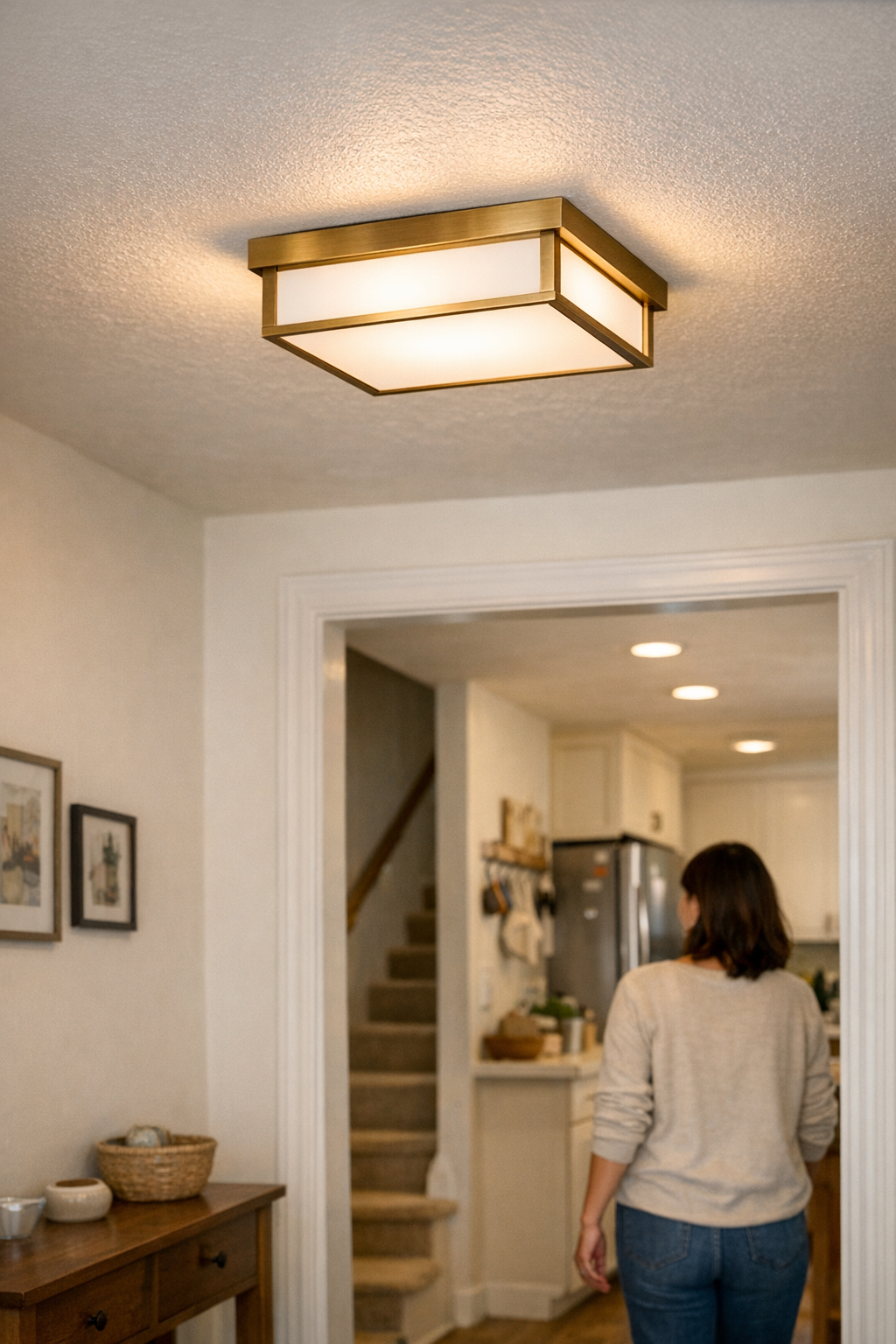
    Swap out that aging plastic lens for glass, metal, or a damp-rated fixture, and the contrast is immediate and sustained. Glass or metal fixtures resist moisture and scratches—they keep their clear, even spread through the roughest use cycles. You see stair treads outlined cleanly, the mirror in the bath reflects skin tones accurately on both sides, and kitchen counters are simply usable, every edge and surface visible without mental effort. The job of “seeing clearly” fades into the background—replaced by smooth routines that don’t force you to adapt to bad coverage or fix your own lighting on the fly.

    Easier Upkeep, No Compromises

    A stronger fixture is about more than avoiding problems—it’s about not thinking about them anymore. Glass and metal don’t trap grit, don’t develop a layer of streaky haze, and wipe clean in a moment with no permanent scarring or stubborn dust shadows. You skip the weekly wrestling with a lens, and your rooms stay reliable, even when the shower steams or the laundry cycles stretch late into the evening.

    Quick Troubleshooting: Should You Replace That Plastic Fixture?

    • Cracks along wiring or across much of the lens? Replace promptly—especially where humidity is high or fixtures see heavy use.
    • Still hazy after cleaning? If embedded dust and streaks remain, the material is beyond restoring, and the “good enough” light is gone for good.
    • Regular glare or lost visibility in your key routes? When lighting balance breaks your stride or skews your mirror, the root is structural, not just cleanliness. A damp-rated or glass fixture restores what cleaning and adjustment can’t.

    Real signal: Wait until late at night or open the bathroom after a shower—faulty plastic reveals itself most clearly when lighting matters most. Don’t judge midday, judge when you actually use the room.

    Choose Fixtures for Real Routines, Not Just Cost

    Cheap plastic looks passable out of the box, but exposes its limits everywhere routines expose its flaws—low ceilings where dust hangs on cracks, utility corners where a flush lens never quite recovers, mirror walls where every small scratch multiplies. Glass, metal, or damp-rated indoor lighting fixes the problem you actually feel day to day: predictable, usable light that endures repeated friction and leaves every surface, mirror, or movement path as reliable as you first expected. What you pay up front is measured every day in returned confidence—no more working around your lighting’s failures, no more silent frustration marking your routine.

    Lighting that Matches the Real Demands of Use

    Compromising on lighting is not a victimless choice—it quietly disrupts your steps, distracts your attention, and delays every small task you repeat. The real upgrade isn’t about aesthetics; it’s about reclaiming rooms that simply work as intended, at every hour, in every condition. Reliable fixtures mean reliable routines—no more silent detours, no more fighting the light itself.

    LightHelper practical lighting solutions