
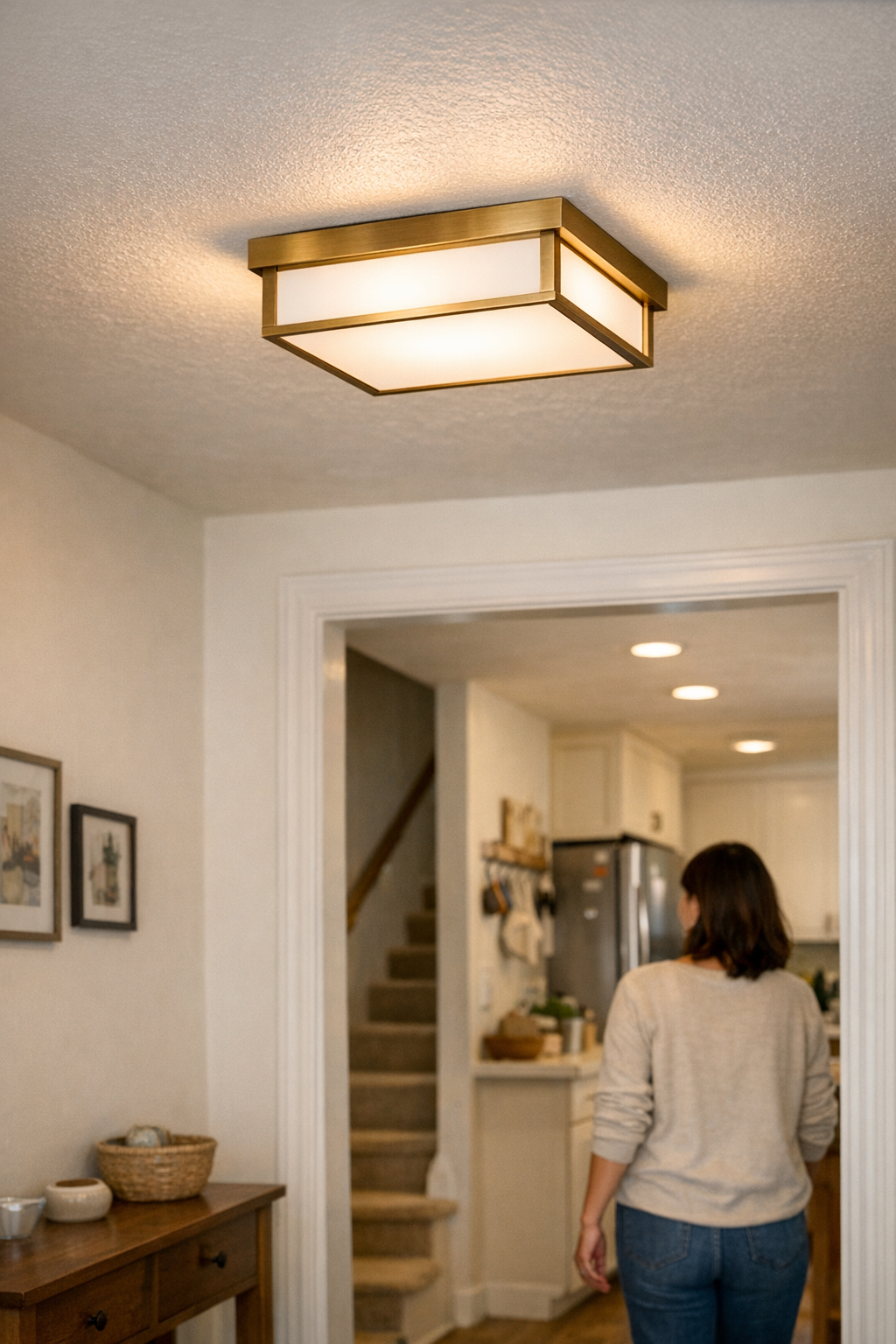
Why does a ceiling light that looks bright at installation become a daily annoyance in kitchens, bathrooms, hallways, or utility rooms? It only takes months for a plastic lens overhead to turn from “clear and even” into a source of glare, shadow lines, and uneven, fatiguing light. The surface may look clean from a distance, but pause by the mirror in the morning or step onto the stairs at night, and the weak spread and muddled clarity start to interfere—forcing you to angle your head to dodge a streak of glare, or reach for the edge of a counter that fades into shadow. The room might check the box for “lit,” but navigating, working, or even glancing at your own reflection in that light shows every limitation. This is the quiet reality of routine indoor lighting failure.
The Real-World Downside of Plastic-Lens Lighting
Plastic flush mounts and wall fixtures appeal for their low price and promise of bright, diffuse light—at first. The problem sets in with real, repeated use. Within the first stretch of humid weather or a few cleaning cycles, hairline cracks start to form, almost invisible but multiplying quickly in steamy bathrooms, kitchens after pasta boils over, hallway corners where warm air meets the draft, or laundry rooms hammered by wet loads and temperature swings. Daily movement, frequent door openings, and simple surface wipes become forces that split and cloud the lens, changing how the light moves through your space.
From “Looks Bright” to “Feels Dim:” When Cracks Take Over
The shift isn’t instant, but it’s obvious once it starts. Micro-fractures in the lens scatter beams off-target—the result is room light that looks “on” but sends the counter edge plunging into gray shadow, or throws a sharp glare strip across a stair step right when you need to see your footing. Cracked plastic doesn’t just disrupt evenness; it catches dust and moisture, compounding the problem as every cleaning leaves behind a dull haze. Normal tasks—chopping at the kitchen island, folding laundry, finding a dropped item in the hallway—get undercut by streaky patches, unpredictable shadows, or a flicker that won’t wipe away.
Workhorse Rooms Reveal the Flaws First
Certain spaces accelerate the problem. Hallways between entry and kitchen—the corridor you cross all day—see constant temperature change and abrasive, wet traffic. Bathroom mirrors, used at both rush and rest hours, show every lighting mistake as a shadow under the jaw or a band of reflection refusing to cooperate. In busy rooms, the supposed “uniform” glow is gone fast. You end up with:
- Harsh glare points where cracks magnify bulbs into hot, narrow flares
- Shadow stripes breaking up long countertops or showing up across every other stair
- Clouded mirror edges that hide or distort detail regardless of cleaning
- Staggered movement as your foot hesitates on a darkened patch or your eyes flick past another inconsistent band of light
This is more than an aesthetic gripe. Late-night trips through a dimmed corridor feel off-balance, morning routines at the mirror turn into a game of shifting angles, and kitchen workspaces demand extra caution or time just to keep up with the basics.
Scene: Hallway Crossings and Daily Disruptions
Picture the hallway between your main entrance and kitchen: a single ceiling light, passed under a dozen times a day. Six months in, each cold blast or running shoe adds a bit more wear to an ordinary plastic fixture. Suddenly, you can’t help seeing the kink of light breaking along a fracture—every step throws a glare into your eye or leaves one side of the path dim and ambiguous. At night, it’s not just unpleasant; it actually slows you down, makes you test where your next step will land, or leads to a quiet flare of frustration you didn’t expect from a plain overhead lamp.
Bathroom Routines: Glare, Shadow, and the Unfixable Haze
In the bathroom, lighting imbalance announces itself every time you use the mirror. One side of your face falls away in shadow, the other lights up with an intrusive reflection off a fine crack. Wiping the lens can’t restore clarity—scratches and moisture have settled in, so every morning you find yourself fighting fog, hunting for the best angle, or wishing the light were just a little smarter, a little more even, a little stronger.
The Hidden Cost: Extra Cleaning, Less Trust
Every new fracture or scratch drags down more than just appearance—plastic fixtures demand constant maintenance yet never deliver their original quality again. Drag out a chair and wipe the lens as much as you want; dust stays caught inside the cracks, and that shadow behind the cabinet or quirk in the stair lighting never clears up. You start accepting awkward workarounds: moving kids’ shoes closer to the center, shifting recipe prep to the one guaranteed lit spot, waiting extra seconds in the hallway to be sure of your next move. The lighting is a reminder, not a solution.
What Actually Changes When You Upgrade to Stronger Fixtures
Swap out that aging plastic lens for glass, metal, or a damp-rated fixture, and the contrast is immediate and sustained. Glass or metal fixtures resist moisture and scratches—they keep their clear, even spread through the roughest use cycles. You see stair treads outlined cleanly, the mirror in the bath reflects skin tones accurately on both sides, and kitchen counters are simply usable, every edge and surface visible without mental effort. The job of “seeing clearly” fades into the background—replaced by smooth routines that don’t force you to adapt to bad coverage or fix your own lighting on the fly.
Easier Upkeep, No Compromises
A stronger fixture is about more than avoiding problems—it’s about not thinking about them anymore. Glass and metal don’t trap grit, don’t develop a layer of streaky haze, and wipe clean in a moment with no permanent scarring or stubborn dust shadows. You skip the weekly wrestling with a lens, and your rooms stay reliable, even when the shower steams or the laundry cycles stretch late into the evening.
Quick Troubleshooting: Should You Replace That Plastic Fixture?
- Cracks along wiring or across much of the lens? Replace promptly—especially where humidity is high or fixtures see heavy use.
- Still hazy after cleaning? If embedded dust and streaks remain, the material is beyond restoring, and the “good enough” light is gone for good.
- Regular glare or lost visibility in your key routes? When lighting balance breaks your stride or skews your mirror, the root is structural, not just cleanliness. A damp-rated or glass fixture restores what cleaning and adjustment can’t.
Real signal: Wait until late at night or open the bathroom after a shower—faulty plastic reveals itself most clearly when lighting matters most. Don’t judge midday, judge when you actually use the room.
Choose Fixtures for Real Routines, Not Just Cost
Cheap plastic looks passable out of the box, but exposes its limits everywhere routines expose its flaws—low ceilings where dust hangs on cracks, utility corners where a flush lens never quite recovers, mirror walls where every small scratch multiplies. Glass, metal, or damp-rated indoor lighting fixes the problem you actually feel day to day: predictable, usable light that endures repeated friction and leaves every surface, mirror, or movement path as reliable as you first expected. What you pay up front is measured every day in returned confidence—no more working around your lighting’s failures, no more silent frustration marking your routine.
Lighting that Matches the Real Demands of Use
Compromising on lighting is not a victimless choice—it quietly disrupts your steps, distracts your attention, and delays every small task you repeat. The real upgrade isn’t about aesthetics; it’s about reclaiming rooms that simply work as intended, at every hour, in every condition. Reliable fixtures mean reliable routines—no more silent detours, no more fighting the light itself.