
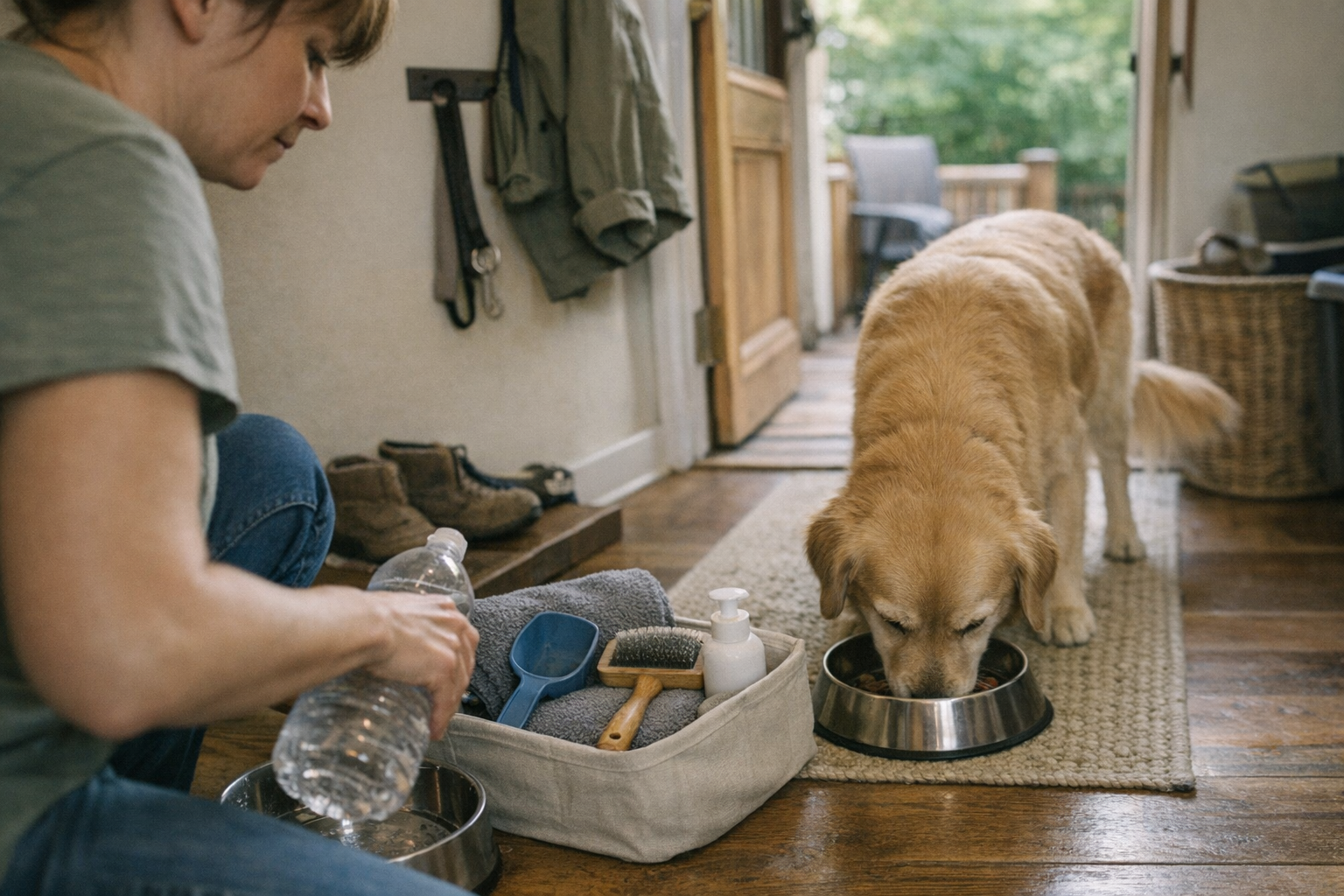
Most pet-care corners look orderly—for a moment. Food bowls lined up, wipes stacked, scoops tucked away. But repeat the daily cycle a few times—morning feed, midday water refill, after-walk cleanup—and new friction points show up: scoop left on the counter because the drawer is blocked, towels half-draped over chairs after cleaning muddy paws, water bottles set “to the side” and never fully away. The issue isn’t a shortage of space or lack of effort. What actually makes a setup low-stress is how effortlessly every tool can be put back to its home, immediately, in the middle of ordinary care routines. If a setup looks calm at first but turns cluttered by noon, something in the repeat cycle is always breaking down—and you notice it every extra time you move an item out of your own way.
The Daily Reset—and Where It Breaks Down
A care space only stays clear if resets happen at real speed, not just in theory. That’s where daily routines hit invisible snags: returning the brush means opening a crowded drawer, the scoop’s home is across the kitchen, or storage means stacking supplies in ways that block each other. These extra steps don’t matter on the first round, but by the third feed or refill, anything not instantly reset stays out and drifts into the wrong spots. Surfaces start as clean landings. By late afternoon, every “I’ll do it in a second” becomes a new pile to deal with.
Picture this: breakfast is over, but the scoop goes back on the counter—it’s easier than digging through a drawer packed with treat bags. When it comes time to refill water, you find the brush lying across the bottle; last time, there wasn’t mental space for the extra shuffle to store it. Each neglected reset adds to the next. The feeding area that started out clear now requires navigation just to set down a bowl or grab a wipe.
Realistic Moments That Slow the Day
The “I’ll handle it in a minute” promise is a constant trap. A used paw towel lands on the closest chair instead of the hook by the door. It lingers for hours, becoming both a visual drag and a trip hazard. During a rushed grooming, wipes and brushes pile up on the side table. No one plans for clutter; it happens because every “temporary” stop is easier than a slow, inconvenient return.
These detours creep beyond the pet area. By midweek, kitchen counters double as holding spaces for grooming tools. Water bottles block prep space. Shared living areas get filled with orphaned scoops or supply packs, so every person—including guests—ends up working around evidence of repeated, incomplete resets. The daily care cycle slows, not because the system is truly complex, but because the setup makes quick, one-move returns impossible.
When “Tidy” Isn’t Enough: Function vs. Appearance
A spotless-looking area can betray you the second you try to actually use it. Essentials disappear behind closed cabinets or end up buried under last night’s gear. If reaching to store a brush means lifting a heavy lid or bending awkwardly, the “just for now” pile almost always wins out—items resurface on counters and tables, making the space feel busier than it should. The same tools you hid to reduce mess are back out, this time even further from where you need them.
A functional setup—the kind that lasts past those first neat minutes in the morning—relies on tools having open, immediate homes. Open trays beside the food area mean even the most chaotic feedings end with one real reset move. Wipes land where you wiped last, not where you need to remember hours later. Nothing requires a mental checklist or extra shuffle. The only difference between persistent clutter and mostly invisible order is whether returns happen with one hand in the flow of care, not as their own delayed project.
Smoothing Out the Routine With Specific Fixes
If putting a brush away makes you hesitate, your setup’s telling you where the next glitch will be. The fix isn’t more containers—it’s frictionless placement that matches your actual footsteps. Try a low-sided bin right near the feeding area, or place a hook for towels directly at paw-level by the door. Anything that gets left out more than twice a week usually needs a new home within arm’s reach of where you use it. “Clutter” is often just a reaction to storage that’s too far, too closed, or too slow.
These small adjustments break the cycle of surface crowding and slow resets. Most-used tools go back instantly, so you stop hunting or giving up halfway through. Daily resets shrink to the natural pause at the end of a task—a wipe, a scoop, one clean motion to return. What matters isn’t how organized it looks at first, but whether your pace never stalls even when care happens twice as often or faster than planned.
From Repeat Reshuffling to Reliable Calm
Find your main bottleneck: does water refilling always get delayed because the bottle’s out of reach? Is grooming a hassle because the brush floats between rooms, or gets mixed into a pile of unrelated supplies? Pet towels crowding the laundry? Each recurring frustration points straight at a reset step that’s too complicated, too far away, or too disconnected from your natural path through the day. If your setup interrupts your ordinary kitchen or hallway use, it’s stealing time with every shift and shuffle.
Real calm isn’t about perfect appearances—it’s about having every tool, towel, or bottle land back in one reliable place the moment you finish. Test your setup by seeing how many steps it takes to return each item right after use, not during a deep-clean. If you don’t need repeat reminders, and nothing piles up after a busy day, your care zone is doing its job. When the setup matches the pace of real, repeated care, calm isn’t something you have to restore—it sticks around by design.
The goal isn’t to win at tidiness—it’s to build a setup that stands up to real life. Start with fast returns, one-move resets, and supplies that don’t spread past arm’s reach. When your routine works at its worst—not just its best—the space stays manageable, even in the middle of actual, daily chaos.
Find everyday fixes that match your daily care pace at CalmPetSupply.