Blog

  • Why Following the Right Cutting Order Improves Safety on Demolition Sites

    Ask anyone who’s lost rhythm on a job: demolition isn’t about swinging harder—it’s about making the right cut, at the right moment, every single time. But there’s nothing like that sudden stall: your reciprocating saw lurches and jams in mid-swing, all because you chased what was fastest, not what was smartest. Miss the correct sequence and it snowballs—blades dulled early, wires clipped blind, extra trips for fresh batteries. That ripple of slowdowns is the real drag on every shift.

    Cut Order Mistakes: Where the Day Starts to Unravel

    You feel the friction right away. The saw chatters, your blade binds against unseen metal, visibility disappears under piles of insulation fluff. Dive into framing out of impatience, hit a hidden flex line, and suddenly you’re mopping up leaks or swapping out blades while the rest of the crew waits. Get the sequence wrong, and demolition turns into a stop-start slog—always five minutes behind, always reaching for another tool.

    It’s a familiar pattern: the temptation is real—tackle the exposed pipe, buzz through that loose framing. But five minutes in, the saw kicks sideways as it snags something unseen. You squint through dust to find what you missed: a twisted wire, a hidden run of conduit, or insulation blown straight into your face. There’s always an easier way, but you have to set it up from the start.

    Reading the Wall: Why One Layer Hides a Dozen Surprises

    Walls are never as straightforward as they look. That tidy diagram in your head? Forget it—real walls are a mess of crisscrossed lines, oddball repairs, and layered materials dating back decades. Rushing to attack the “biggest” piece first—whether it’s framing or plumbing—usually means dealing with headaches you can’t see:

    • Hidden wiring may slip behind framing, looping where you’d least expect.
    • Stacked materials throw off your blade, turning a clean cut into a battle with embedded grit, stubborn metal, and unpredictable resistance.
    • Skipping drywall removal means guessing what’s behind—and when your blade finds something it shouldn’t, you’re left retracing steps, clearing debris before you can continue.

    How Experienced Crews Choose Their First Cut

    The rule you hear onsite again and again: don’t go for the meat until you clear the skin. That means outer panels and drywall come off first—always. Why?

    • Actual visibility: Removing the surface lets you spot the real hazards: abandoned BX runs, rogue Romex, or that trickle of water from a line nobody mapped.
    • Controlled progress: With hidden risks flagged, the saw runs smoother, vibration drops, and blade life stretches. You’re not fighting to control a saw bouncing off mystery metal.
    • Cleaner workflow: Debris drops where you expect—never clogging an outlet or soaking the floor below the cut.

    This isn’t just tradition. It keeps the work steady—cuts stay deliberate, tool fatigue is lower, and you aren’t stuck improvising fixes after surprise messes. On churn-and-burn jobs where every wall is different, this sequence is pure insurance.

    Onsite: Uncovering Trouble Before It Finds You

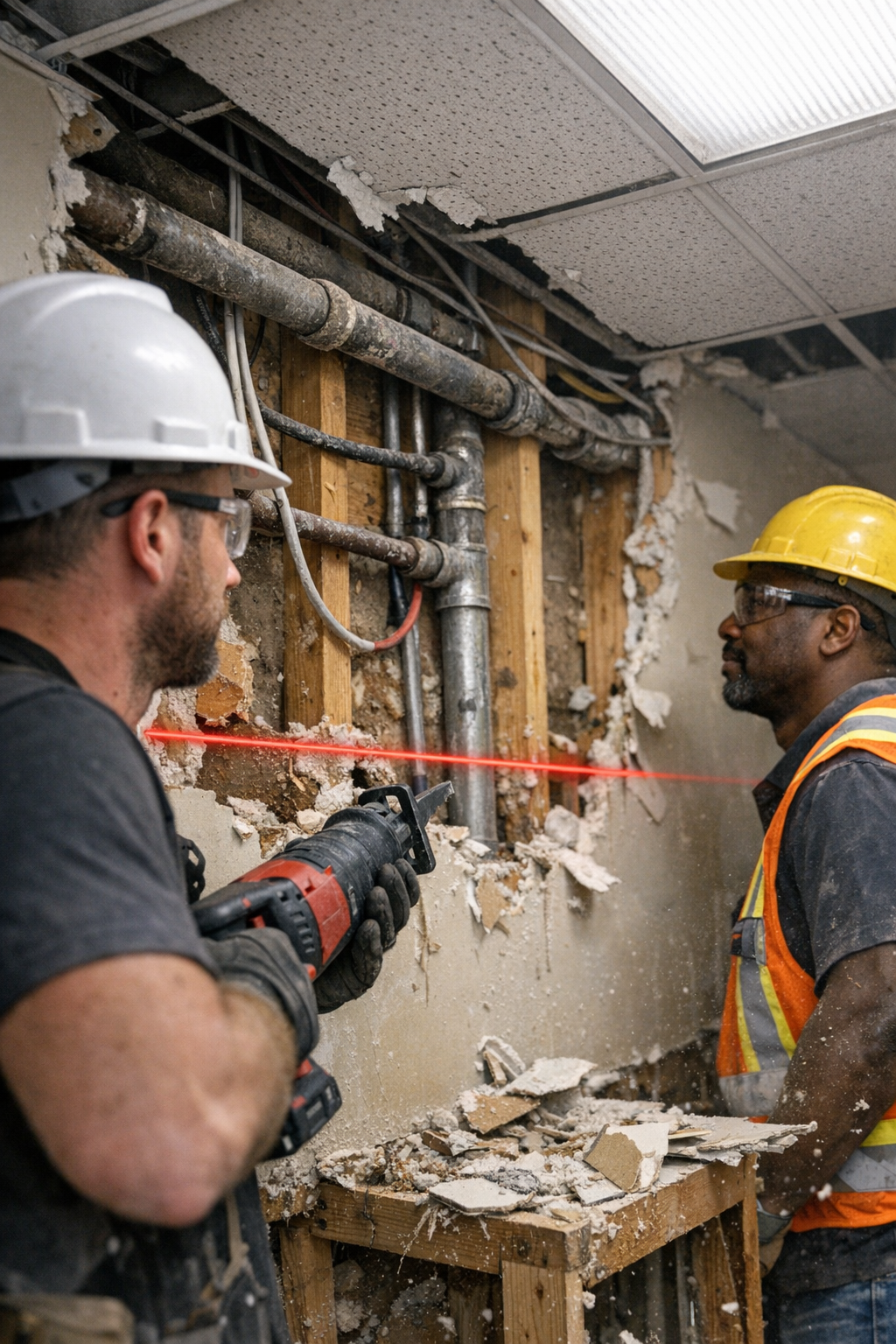
    You’re in a cramped shop, demoing the old drop ceiling. Framing is patched, pipes swerve between every stud, and the wiring is any year but recent. Instead of chasing the jumble behind, you start by slicing the drywall—carefully, not rushed. As the board drops, you reach for the laser and run a line at 48 inches; suddenly two electrical cables jump into view, running a course that would’ve intersected your first cut if you’d gone for the pipe.

    That’s the moment you remember why you don’t cut blind. If you’d gone for speed, metal and drywall dust would be showering down onto hot wires—and you’d be hoping nothing shorts before break. Because you exposed the layers first, you sidestep the hidden hazards entirely. It’s not just about safety; it means you stay in control, adjusting your plan as soon as new lines pop up. Workflow smooths out. You actually get ahead instead of constantly pausing to play detective.

    What Blind Cuts Actually Cost

    Ignore the sequence, and you pay for it. Not just in ruined blades—though you’ll burn through a box—but in the way fatigue creeps into your hands, in wasted trips back for new bits or batteries, in sudden slowdowns as every cut turns into a gamble:

    • Blades wear out at triple speed scraping unseen nails or hissing through sand-caked wood.
    • Precision collapses; the saw kicks, lines wander, and you spend more time making “fix-up” cuts than actual progress.
    • Risk ramps up fast—a wrong slice into a live wire or wet pipe, and everyone’s off task again patching problems that could’ve been predicted.

    Smarter Habits: Laser, Mark, Sequence

    If there’s a single habit that saves time and sweat: Before going structural, grab the laser level. Snap it at 48 inches—a line everyone knows, nobody forgets. Use that baseline to flag wires, pipes, and mystery lines. From there, you always peel back outer layers first, working inward, never skipping steps. That minute spent paying attention means your blade sees a full shift, and you set the job’s pace instead of rushing through avoidable jams.

    Hazards marked, sequence locked in, you don’t just cut—you glide. The mess is routine, the saw feels lighter, and the workspace stays manageable instead of spiraling into chaos. End of day, clean-up is a breeze instead of another long chore.

    The Most Frequent Pitfalls—And How Pros Bypass Them

    Under the gun, even experienced crews can slip. The biggest fumbles?

    • Cutting blind into concealed pipes or wires—water damage and lost breakers as the all-too-common prize.
    • Skipping visual checks—ignoring the laser line, letting hidden lines creep into your demo zone and costing hours later in patchwork.
    • Forcing a worn blade—because “just one more cut” can’t hurt, until it jams, shreds, or chews a ragged edge you’ll have to recut and re-clean.

    If the saw kicks harder or emits that scorched-smell warning, don’t muscle through. Swap blades, reset, and stay ahead of trouble—it’s faster than pretending the problem will fix itself.

    Kit That Keeps the Pace

    Fresh blades, a sensible laser, and a trusty marker—these aren’t nice-to-haves, they’re how you actually make progress. The real secret? Building a work rhythm: mark, check, sequence, then cut. Bring the crew in on that formula and the wall comes down faster, cleaner, and with less fatigue at the end of every day.

    Find jobsite-tested power tools, blade packs, laser levels, and more at Gumboll.
  • How Organized Carry-On Setups Prevent Travel Delays and Frustrations

    The real test hits after the first flight: An organized carry-on that looked efficient in your room can turn chaotic with just a few airport hurdles. The zippers close, the pouches stack, but twenty minutes into real movement—boarding lines, sudden security checks, or a scramble for documents—neatness starts breaking down. What looked set for effortless access actually delays you at every grab point: the passport you thought was “in the easy pocket” is now buried under chargers, and reaching in for one thing drags out three more. If you’ve felt the drag of a too-compact setup in a live airport sprint, you know the visual order means nothing if retrieval fails when pressure rises—especially across multiple movement cycles.

    The Carry-On Illusion: Organized Yet Clumsy Under Pressure

    Packed pockets should mean smooth travel, but the illusion fades fast after just a few real-world document checks. You unzip expecting to grab your boarding pass—only to meet a headphone cable tangle or a zipper blocked by an awkwardly wedged power bank. The real slowdown isn’t because you forgot something, but because you keep having to rescue the same items that slid or drifted after each movement.

    Repeat friction is the true penalty: Instead of a single fix, you face a pattern of small interruptions—hunting for your ID in a hurry, restacking items at security, or jamming essentials back into an already overstuffed pouch as impatient travelers collect behind you. The order you built at home drains away in airport time.

    How Repeated Friction Surfaces in Real Travel

    Airport routines are ruthless at exposing weak carry-on setups. Here’s how real problems show up again and again:

    • Security checkpoint fumble: In the tray line, you realize your passport slid out of its “spot”—now chargers and snacks topple out as you dig, and that careful system collapses by the first scan.
    • Overhead bin shuffle: Needing headphones or a tablet mid-flight could mean unloading half your bag, because the outer pouch shifted and now blocks a document you need to show.
    • Seat entry slowdown: The pen you want is tangled with boarding passes, or earbuds migrated to a random corner—the clean categories at home blur at every turn and repack.

    Looking tidy only gets you so far—the real question is what happens on reach number fifteen, when repetition has erased every visual plan. Movement exposes flaws fast: quick-access design has to survive constant slide, repack, and unexpected checks, not just look neat before you leave.

    Why Zone Separation Outperforms Compactness

    It’s tempting to believe an “everything in its place” layout will guarantee speed, but unless you have a true dedicated quick-access zone, friction returns fast. The most common failure: What started as sorted ends up cross-contaminated after two checkpoints or a single seat change. Your earbuds and boarding pass now sit in the same pouch; your charger is folded into your document slot.

    • Unzipping the wrong section—every time you hurry
    • Spreading gear across a tray to unearth one lost ID
    • Replacing items just to have them drift by next use

    When the “quick-access” idea breaks, so does your flow—minor mishandling compounds during boarding rush, random checks, or a last-minute change of gate. Instead of a tidy first impression, you get a series of rediscoveries that stall movement just when you need to keep moving with minimal thought.

    Classic Setup Shortfalls: Overlap, Drift, and Rediscovery

    • Pocket overlap: Looks fine until travel starts—high-use and low-use items blend in the same slot, so your passport shares space with gum and tossed receipts. Every grab re-shuffles the mix.
    • Unsorted pouches: Compact, but you end up reshuffling gear multiple times by the first gate, with order never quite rebuilt.
    • No fixed home: Without an always-known spot for documents, tech, or comfort gear, retrieval turns into a guessing game at every checkpoint.

    Reducing visible mess is not enough. If your carry-on still forces the same repeated search or reshuffle after each move, order isn’t real—it only looks the part.

    Stress-Testing Real Solutions: One Pocket, One Job

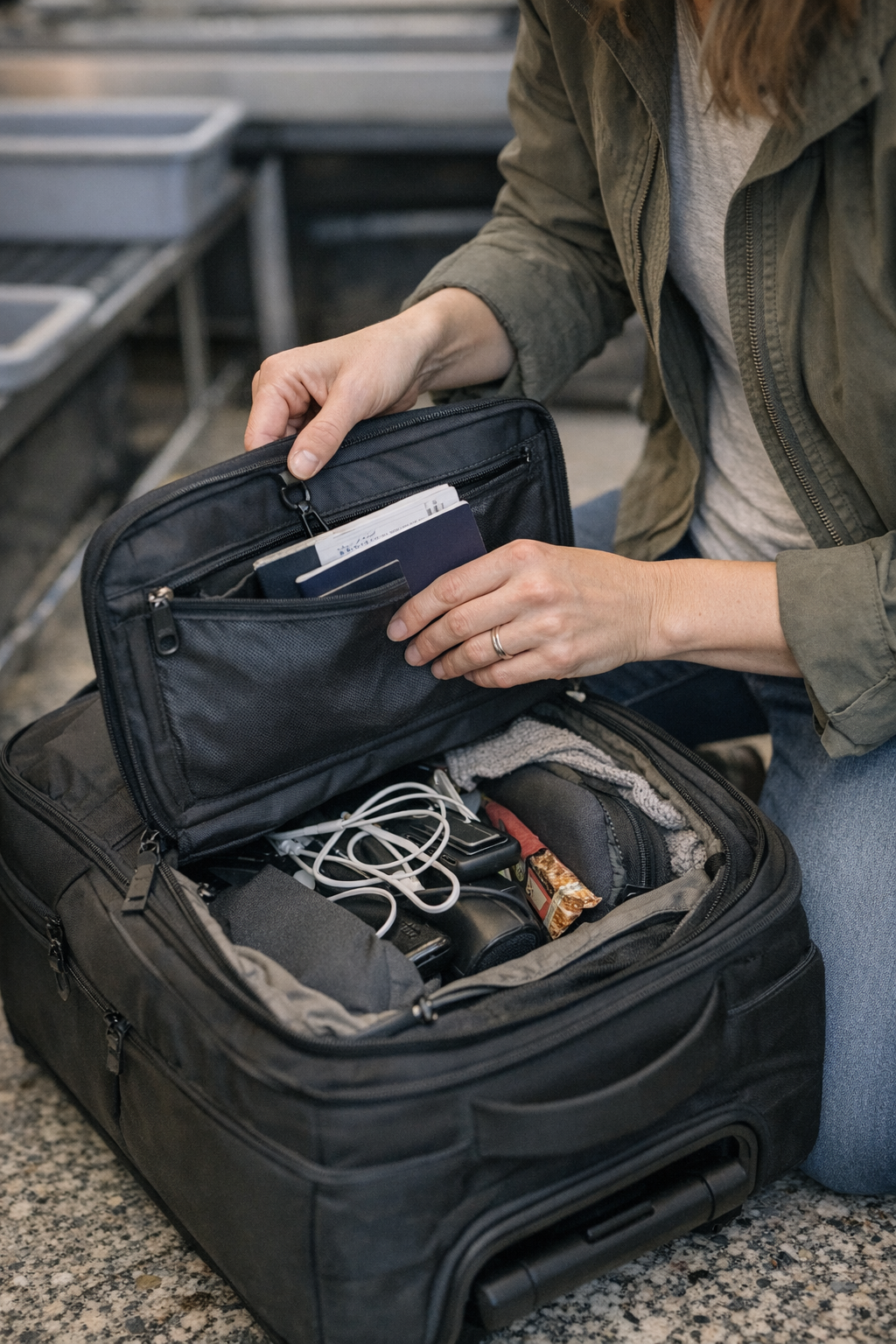
    The shift that actually holds up: Assigning a non-negotiable, single-use spot—usually a stand-alone zip pouch high in the main compartment—for must-grab travel essentials. No overlap. Passports, boarding passes, and IDs go into this anchored pocket only. Tech cables, chargers, and comfort items get their own separate organizers or zones further apart, so they never drift into the document flow.

    • Every document check is done with one grab—no more searching, stacking, or accidental drops.
    • Headphones, chargers, and pens stay put, not sliding into your document zone mid-journey.
    • Security and in-seat access are faster—no awkward reach-around, no rushed transfer, and no splitting your attention across badly mixed pockets.

    Nothing eliminates every travel pause, but crossing over essentials loses its power to throw off your rhythm. Line blocks become rare. Repacking mid-trip shrinks to a minimum. The difference is sharpest in the scrambles—when a single misplaced ticket once meant a trayful of gear, now it’s one zip and move on.

    Small Wins, Real Impact—The Ongoing Difference

    • No more hunting for lost items after each flight segment—especially when fatigue sets in late in the day
    • Faster transition through gates and checks, since you’re not patching up scattered pouches with every stop
    • In-seat access feels smooth; you can pull what you need without disturbing everything else

    It’s the difference between quietly keeping pace with airport flow and feeling a step behind at every critical moment. Travel doesn’t get less complex, but your carry-on stops fighting you every time you move or repack.

    If you’ve felt your carry-on order fail by the second airport or third boarding call, it’s not your habits—it’s the missing structure for repeat-use travel. Build for real movement, not just tidy looks.

    For carry-on travel tools, organizers, and repeat-use essentials that hold up under movement pressure, visit CarryOnSupply.

  • How Small Routine Changes Can Preserve Calm Moments with Your Cat

    Small Interruptions: Where Daily Pet Care Quietly Breaks Down

    Every pet owner has faced it: you reach for the brush or food bowl, only to discover it’s nowhere in sight—or it’s damp, buried under yesterday’s mail, or blocked behind kitchen clutter. These aren’t just irritations; they grind away at your routines day after day. What should be a quick refill or cleanup is hijacked by missing basics, extra steps, or shifting piles around just to reach what you need. Moments like these, where a simple water top-off is derailed by a missing towel or a food scoop hidden behind groceries, don’t just slow you down—they chip away at the household rhythm and pile up into a cycle of repeated interruptions. The CalmPetSupply world lives in the tension between setups that look organized and those that actually hold up during real-life, repeated routines.

    When “Ready” Isn’t Reality

    Picture sitting with a guest and your cat signals calm, but your mind’s pulled sideways when you notice the food dish is still by the sink, half-dry, or the water bowl—emptied hours before—still waiting to be refilled out of sight. You interrupt the moment, hunting for the right bowl or drying an edge on your shirt. This isn’t just lost conversation; it’s a signal that the setup you thought was “ready” can’t survive actual daily use. The missed reset surfaces at the least convenient time, forcing a scramble when you’d rather be present.

    Common Scenarios That Break Momentum

    Tidy surfaces hide a different reality under pressure. You reach for the food scoop, but it’s wedged behind a stack of mail or tangled up in shopping bags. You want to wipe the food mat but realize the spray bottle never made it back from the kitchen after last night’s dinner. A pet towel you meant to dry is now a damp bundle under a mountain of laundry, turning a two-minute cleanup into five. None of these blockages are dramatic, but they return over and over—each missed storage return or blocked item creating unwanted micro-tasks you can’t see until the next care moment.

    Instead of one smooth sequence, the routine dissolves into scavenger hunts and small workarounds. Missed resets and misplaced storage points turn every water refill, feeding, or grooming task into a chain of detours. The effort you make to “make do” is invisible to others but adds real drag. By the end of the week, the routine that once felt manageable now means retracing steps, improvising, and spending more time on upkeep than on your pet itself.

    The Hidden Cost: Cumulative Distraction

    Setups that look tidy for a day or two fail when every item isn’t in reliable reach. Routines become fragile: the clean bowl is only clean if you remember to rinse it before company arrives; the brush is only handy if it doesn’t disappear with a pile of magazines. Over time, you realize you’re always double-checking—did someone put the scoop back, is the water bowl missing again, will I have to dig through drawers for wipes?

    Each incomplete reset adds ambient friction: stepping over pet toys that never return to a bin, shifting clutter to reach basic supplies, and getting delayed by a missing item at the wrong moment. These aren’t one-offs. The third evening in a row that you run out of ready towels or have to sidestep a feeding mat still waiting to be wiped, you notice a low-level distraction threading through the day—even if the room still looks picture-perfect to a visitor.

    Real Use: How Flow is Interrupted

    Routines don’t collapse all at once—they stall at pressure points. After a walk, you take off your dog’s collar and reach for the grooming brush, but it’s no longer on its hook. It’s half-buried under the day’s clutter. You remember to refill the water dish just before bed, but realize the bottle is now at the back of an overstuffed pantry because putting groceries away displaced it. These are not emergencies; they’re friction points that force resets and physical detours again and again.

    Cleanup gets tangled when the right supply is present but not within easy reach. Wipes stuck too deep in a drawer, a spray nozzle clogged because it isn’t used routinely, or a trash bin wedged by laundry—these stalls halt momentum where you most want ease. The surface may look calm, but interruptions keep creeping in. This is the real split: what seems organized can actually disrupt the flow you need for daily pet care.

    Reset, Repeat, and Routine Stability

    There’s a difference between a setup that looks finished and one that resets cleanly every time. Anchoring items to a fixed hook, shelf, or bin closes the gap—one less bowl to search for, no more drying dishes mid-routine, no improvising with a spare towel because the regular one vanished. When the bowl and brush always return to their place, the cycle recovers: routines go faster, there’s less mental drag, and the weak spots that used to unravel your momentum start to disappear.

    The effect isn’t instant perfection. But once you tie each basic supply to a reachable home, you lose less time, especially at the transition points: settling in after a guest leaves, heading out for a walk, or doing the last check-in before bed. What once triggered repeated mini-interruptions—the hunt for basics, the slow wipe-down, the missing refill—begins to fade. It’s not about deep cleaning or a full overhaul; it’s about making even one essential step reliable, every single run.

    Practical Observations for a Calmer Space

    – Attach essential items (bowls, brushes, towels, scoops) to a visible, always-reachable spot—never hidden or shared with unrelated storage.
    – Guard against drift: keep pet tools from mixing into general household clutter, preventing supply hunts at key moments.
    – Don’t trust “clear” surfaces; check if you can reach everything needed without shifting unrelated items or backtracking during a reset.
    – Pick off one recurring friction point at a time—fix the towel that’s always damp, the bowl that goes missing—so the next steps run smoother automatically.
    – At each care step (feeding, water, grooming, night check), pause to return items right then—so the next time isn’t a repeat of the same avoidable extra work.

    Function Over Appearance

    Pet care routines that survive repeated use are built for low friction, not just for a clean look. Function means calm becomes automatic—even as traffic through shared spaces stays high and daily life reshuffles priorities. When every item has an anchored spot and is easy to reach, routine breakdowns lose their grip, and those minor interruptions fade into the background.

    Small improvements—better placement, easier access, deliberate resets—stack up fast. The aim isn’t spotless perfection. It’s about fewer slipups and less wasted effort for you and your pet, routine after routine, without falling into the same unfinished-reset traps.

    Explore practical pet care solutions and create routines that adapt for you, your household, and your pet’s comfort—without the drag of unfinished resets.

  • How Anchored Dog Beds Improve Sleep Quality and Daily Routines

    You push your dog’s bed into its “right” spot—then, less than a day later, you’re nudging it back with your foot while dragging a leash, a towel, or lunch bags through the same tight spot. The bed drifts: subtle overnight, more obvious during the morning rush, always a half-step away from blocking the door or tripping up the kitchen flow. One sliding pet bed turns a calm rest corner into a slow-moving obstacle course—exactly in the part of the house you’re trying to keep clear for daily routines. If a dog bed keeps wandering and forces repeated resets, you’re seeing more than a minor annoyance: it’s a friction point that keeps snapping routines out of sync and signals a setup that can’t actually keep up with dog life’s real pace.

    How a Drifting Bed Becomes a Real Problem—One Small Shift at a Time

    Most owners don’t notice at first. A bed scoots a few inches as your dog flops down, or quietly migrates as you cross the floor half-awake. Over time, it’s always right where you don’t need it—blocking the bottom of a closet, jamming the path to the feeding bowls, or wedging itself so tightly beside a chair that grabbing a leash or towel is never smooth. You start compensating: sidestepping, stepping over, or nudging with your knee while juggling other dog gear, just to clear your own route. Every little drift means another micro-interruption—especially when one misplaced bed ends up entangled with clutter, bowls, or wipes meant for easy reach.

    It’s not just untidy. Every scramble to fix the bed costs a step you don’t need to spend—amplified when you’re working with full hands, wet dogs, or a dog circling impatiently at the door. As weeks go by, the repetition stacks up: adjusting, correcting, or climbing around something that keeps moving back out of place, no matter how neat the setup looked the day before. It’s a setup that drags against you, at the exact moments you’re supposed to be winding down or speeding up.

    Dogs Notice—Even If They Don’t Complain

    The problem doesn’t always look messy; it lives in movement and hesitation. Watch your dog turn and circle three times instead of settling once, spend extra seconds scratching or nuzzling the edge of the bed to line it up again, or pause and stare when their usual corner has shifted just enough to be cramped. These tiny adjustments aren’t just quirks—they’re a dog quietly troubleshooting a setup that won’t stay reliable after every nap, walk, or commotion. A drifting bed turns familiar comfort into a puzzle. Dogs that “adjust” often seem restless, slipping into lighter sleep or repositioning whenever their space feels shrunken or misplaced. Sometimes the change is so gradual, the only real signal is how many times you both stop for a reset—straightening the bed after the dog does, or calming repeated shuffles during late-night routines that used to be seamless.

    The Real Impact: Routine Friction Builds Up Over Days and Weeks

    Setups that slide don’t just blur routines—they slow them down, right when time and focus are tight. The classic example: leash in one hand, coffee in the other, and suddenly the bed is blocking your way to the door. Or the post-walk moment—wet towels, messy paws, and now the bed is nowhere near the usual wipe-down zone, forcing you to carry everything across the room and trail drips where you don’t want them. These aren’t rare breakdowns; these are daily routines getting tripped up by cleanup triggers and misplaced dog items, all because the anchor that should have kept your space ready keeps leaking friction into every reset.

    Each detour isn’t just a lost second—it’s a mental interruption. When you’re weaving around the bed, bumping other supplies, or flipping back to correct “just one more thing,” your setup isn’t operating as designed. For busy households—morning chaos, multiple dogs or kids, high-speed transitions—a single sliding dog bed spools up more low-level delays than most people expect. You spend extra time managing, and the space never truly stays ready for whatever comes next.

    Blocked Pathways and Awkward Access

    Dog gear is supposed to stay out of the way. But when a bed creeps into walking paths, hides under tables, or lodges by laundry piles, even “organized” setups erode: sudden challenges where hands are already full, and muscle memory fails because nothing’s where it belongs. The physical scramble—reaching, leaning, shifting other items to pull the bed back—keeps dragging attention to a friction point that should have been solved once but seems to reappear every few days.

    The Constant Reset: Why Small Shifts Add Up

    Correction becomes its own routine: foot-nudging the bed after breakfast, resetting at bedtime, straightening after each dog nap or grooming burst. What feels minor in isolation stacks into repeated friction. Pay attention to how often you fix this issue, or how often you quietly take a longer route instead of dealing with the disrupted space yet again. The silent wish is always the same: that the bed would just hold its ground through a week of real use, not just during one Instagrammable moment right after cleaning.

    Looks Decent, But Doesn’t Work: The Hidden Weakness of ‘Mostly’ Fixed Beds

    It’s not always chaos. Some beds only drift a few inches a day—just enough to look okay but still block a door, trap a stray toy, or make the rest corner shrink until your dog hesitates. Surface fixes—spot cleaning, quick fluffing, lining up with masking tape—give a neat impression that dissolves when the morning sprint begins or when you realize the water bowl’s harder to reach than it was yesterday. Clean looks hide functional weak spots: it’s the everyday detours, not visible mess, that reveal an unstable setup.

    That’s the tension: organized in theory, but not in use. When a “tidy” area still creates detours, bumping and blocked hands become the daily feedback. Inching movement accumulates into a steady, low-grade frustration that no amount of superficial straightening covers for long.

    How Anchoring Changes the Routine—For Both Dog and Owner

    Actually anchoring the bed—usually with a working non-slip mat—breaks the pattern. Suddenly, everything starts staying put: dog, bed, and daily rhythm. You get back hands-free transitions and stop factoring in “bed drift” when planning where to stand, towel off paws, or grab grooming wipes. The difference plays out quickly: dogs settle with one turn, not four; you stop circling back to nudge the setup; post-walk resets don’t devolve into a fishing expedition for the right spot. The rest corner stops swallowing attention and goes back to just working—all day, every day, without backup plans.

    Noticeable Difference: Measurable Change by the End of the Week

    Give it a week with an anchored bed and the reset tally drops to almost nothing. Instead of sliding two or three feet, the bed stays in a near-fixed spot—even through rush-hour mornings, food-bowl collisions, and bouncy play. The daily dog routine closes its gaps: transitions at the door happen without side-stepping, resting is predictable, and that tension in the house—searching, fixing, or tiptoeing around a moving target—just drains away. No more living room dirt trails on the way to a missing bed, or blocked doors slowing down the whole household.

    What Disappears—and What Stays

    Shoving friction out of your routine gives back real time and attention. You stop wasting seconds re-centering, re-clearing walkways, or pulling the bed out from under your own chair. Bedtime arrives faster and easier. Mornings run with a bit less stumble and correction. Cleanups, from muddy paw wipes to bowl resets, now follow a load-reducing flow because the rest setup finally supports—not competes with—routine speed. The upgrade isn’t just visual. It’s mechanical: the routine click that marks a setup finally holding up in real life, instead of asking for more hands to keep patching it together.

    Why This Quiet Fix Keeps Paying Off

    After a few cycles, the anchor fades from notice. What stays is the missing hassle: a dog that settles quickly, a routine that runs without built-in detours, less energy spent on tiny corrections. No one romanticizes a bed that just stays put, but if you know the micro-frustrations of a sliding one, the upgrade is obvious. If you keep nudging, unblocking, or reshuffling gear in what should be a quiet corner, you’re still missing the stable foundation the routine actually needs.

    See how DogPile can quiet the daily routine

  • How Fixed Task Lighting Transforms Home Workspaces and Reduces Eye Strain

    A “bright” workspace can still leave you squinting, frowning, or restless after an hour. Step in, flip on the overhead light—everything looks officially lit. But ten minutes into reading or sorting papers, shadow bands stretch across your desk, glare bounces from polished surfaces, and the outside edges fade into gray zones. You start shifting left, leaning closer, or stacking paper just to chase a clear spot. Every small movement feels like compensation for a ceiling fixture that claims the room, but loses your workspace detail—the difference is not subtle after a week of returning to the same chair.

    When the Ceiling Light Isn’t Enough

    Most home offices and work corners fall for the simple idea: a single ceiling light checks the “bright enough” box. Plenty of rooms hit technical brightness targets, but real use makes the cracks obvious. Every day you notice:

    • Shiny desktops flaring up when overhead beams hit the wrong angle
    • Your hands or a laptop edge suddenly casting deep shadows on the page
    • The far corners of your surface dropping into murky half-light
    • That ritual of dragging your chair or supplies, chasing the one spot that’s just usable enough

    It feels minor until the interruptions stack up. You end up fighting unpredictable daylight, uneven spread, and a constant need to “work around” the lighting instead of through your routine—every trip to the desk means a new round of workaround habits.

    The Hidden Cost of Shadow and Glare

    Unlike hallway or entry lighting, work-area lighting proves its worth only when the task in front of you gets easier—not just brighter. Rely solely on the ceiling, and the consequences multiply:

    • Half-finished tasks because eye fatigue sneaks up fast
    • Paperwork and screens shifted back and forth, searching for a clean spot with no shadow
    • Unconscious hunching and squinting that turn into tension headaches by the end of the week

    No single moment is dramatic, but every small stretch, squint, and shuffle is a sign that the “official” lighting is quietly underperforming. All those micro-adjustments slowly build a workspace people avoid instead of use smoothly.

    How Fixed Task Lighting Changes the Everyday Use

    Adding fixed task lighting shifts the room from “bright in theory” to actually workable—all day and night. A well-placed task light—whether wall-mounted, under a shelf, or set beside your usual reach—aims the beam onto your work zone directly. You stop compensating; the light covers your surface, not just the room at large.

    Immediate, Practical Changes

    • The far side, corners, and edges of your desk stay equally clear, not just a spotlight circle in the middle
    • Your notes and printouts read sharp at 9 PM, not only when the sun is out
    • No reflex to push your chair or laptop “into the light”; the whole zone works without shifting aimlessly
    • Shadow lines from hands and screens shrink or disappear, especially for detail or craft work

    Task lighting doesn’t just make the space brighter—it stops the routine loss of focus caused by poor coverage, restoring the desk to a tool, not a blind spot.

    Real Use: The Subtle Comforts

    The first week with a true task light, the difference is easy to test: you catch yourself sitting back instead of hunched; you aren’t dragging papers to the strip of light in the middle. Finishing a project doesn’t fall apart just because an overcast afternoon made the corner unreadable. The best cue? You stop noticing the light at all and just get on with the job.

    Getting Task Lighting Placement Right

    Mounting matters as much as the fixture. Precision beats power:

    • Positioning just above eye line shines cleanly across the surface with less glare
    • Angling at 30–45 degrees knocks out harsh shadows that would otherwise cross your work or notes
    • Running light side-to-side—from the far edge to your reach—means that even with papers or tools scattered, everything stays visible without searching for lost edges

    If you’re tight on space or sharing the surface, a slim under-shelf or edge-mounted strip stops the “one user at a time” compromise. The setup follows your use—not the other way around.

    Avoiding Old Frustrations

    If you see yourself moving piles, hunching, or rotating your work to line up with the best patch of light, that’s a direct signal the current structure is failing. Task lighting solves this at the source: no more habitually working from the least-worst spot of the desk because the lighting forgot your real routine.

    What About General and Task Lighting Together?

    A ceiling fixture alone is never enough for real work—no matter how “bright” it looks at first glance. Overhead lights handle walking, cleaning, or general movement. But any pattern that involves reading, sorting, or making a decision at your desk exposes the ceiling-only limit. The common cycle: move back and forth, get frustrated by shifting shadows, and end up stacking more bulbs without solving the real problem.

    General lighting gives broad coverage. Task lighting brings focus and comfort to repeated, precise activity. Getting both working together means the simplest job—like checking one invoice or jotting a note—never gets derailed by your own workspace.

    Everyday Signals That Your Lighting Set-Up Needs a Change

    • You shuffle papers or drag your laptop, but never find a spot where everything’s equally clear
    • Eye strain creeps up on gray days or after longer sessions, not just late at night
    • Headaches and irritability fade only when you leave the task area
    • The work surface “looks” bright until you try to use its last inch—then the clarity drops off fast

    If these habits repeat, it’s a lighting structure shortcoming, not simply a need for more wattage. Upgrading bulbs or swapping fixtures without rethinking the light’s direction and spread only postpones the frustration.

    Why Lighting Structure Outweighs Decorative “Finishing”

    The most “finished” workspace isn’t always the easiest to use. Reliable surface clarity—at any hour—beats decorative edits or cosmetic tweaks every time. A truly functioning lighting structure means the full desk is usable, predictable, and interruption-free, with no hourly rearranging or squinting just to keep momentum going.

    Functional lighting disappears from your attention. If you keep fighting shadow, glare, or awkwardly bright spots just to work in what looks like a well-designed space, the fix is rarely one more decorative touch. A simple, fixed lighting change—like adding a wall-mounted or under-cabinet fixture—solves shape and reach issues design alone will never touch.

    Removing the Invisible Obstacles

    Whether you’re sorting bills, typing late, fixing a broken hinge, or finishing craft projects, the right structure takes lighting from background annoyance to invisible support. A better routine doesn’t waste energy adapting around light—or lack of it. The best setups turn the workspace into something you use by choice, not endure by habit.

    If you want to make your workspace—and the rest of your home—less frustrating and genuinely easier to use, LightHelper is focused on practical, reliable indoor lighting for every real-world zone.

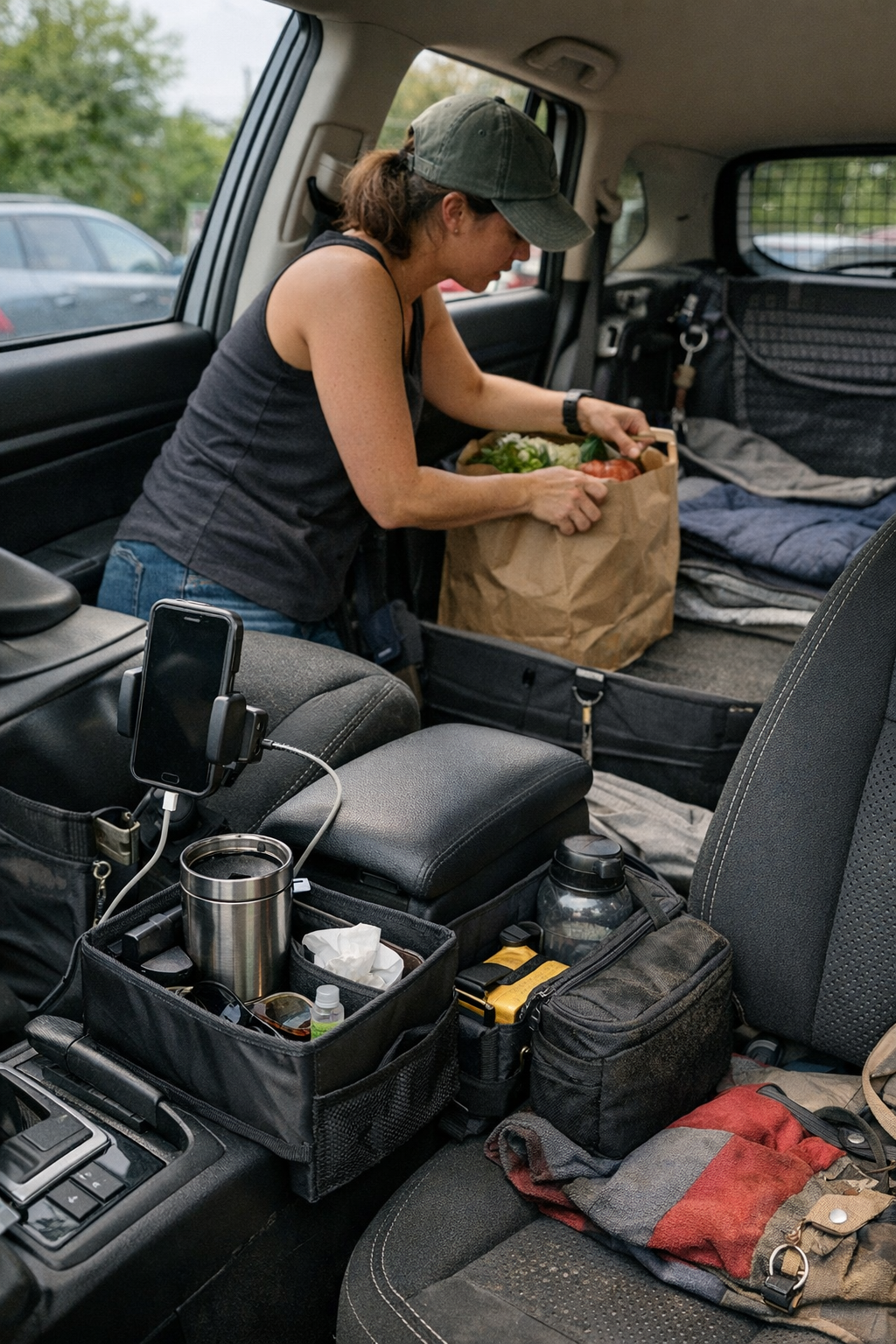
  • Why Your Car Organizer Slows You Down and How to Fix It

    There’s a difference between a car that looks organized and one that actually works under pressure—most drivers only notice once the routines start to break down. You finish a cleanup: dashboard wiped, phone chargers hidden, pockets lined up. It feels like order—until your third short trip, when you’re groping under the seat for a charging cord again, or nudging the seat bin back into place so your bag will fit. The setup you admired in calm moments keeps slowing you in motion: a charger out of reach, wipes shifted just out of sight, organizers that block what you need when you need it most. Tidy isn’t the same as usable, and it rarely holds up once errands, re-entry, and actual driving routines start exposing every shortcut.

    How Surface Tidiness Hides Real Friction

    Neat setups look perfect at rest, but start a week of pickups, quick stops, or commutes, and you’ll hit the hidden frictions. The phone mount that’s flush on the dash means an awkward twist at the green light. That thin organizer pressed tight to your seat? It’s fine while parked—until a rush of bags or drinks knocks it just enough that you’re hunting for it on the floor. Hide the charger cable for the photo, and by your second errand, it’s trapped under another accessory or tangling underfoot. These aren’t one-time hassles. Every extra motion—finding a cord, shifting an organizer, rearranging a cover—breaks your focus at the exact moment when you need your setup to work, not just look “done.”

    The real test isn’t a calm, clean interior—it’s how your car handles mid-errand, mid-reach, or mid-rush. If you’re pausing to search, realign, or fix something every drive, the structure is serving appearance, not usability.

    Return-to-Car Moments: Where Structure Breaks Down

    Picture returning after a grocery run. Hands full, keys wedged, drinks unsteady, bags grazing the door. Your muscle memory should land on a charger or wipes, but—nope—cord slipped off the console, mount angled wrong, cleaning wipes buried behind the door pocket’s curve. The “organized” setup felt right in a quiet garage, but now it fights you, turning a simple grab into an awkward hunt. You wedge bags, fumble for what’s lost, and sink into the seat already slowed. Multiply it: post-school chaos, night shift returns, or loading sports gear. With every return, the same problem appears—neatness fades, but friction repeats. In a shared car, or one that juggles routines, today’s logic is tomorrow’s annoyance, and your best system becomes another obstacle under actual pressure.

    Organized Isn’t Always Easy Access

    Every organized car risks the same trap: hiding what you need, just to keep surfaces clear. That seat-edge bin? Great until cables trap underneath and you’re straining for the missing cord. Door pockets solve one mess but create a dipping/searching routine that adds seconds on every drive. The hesitation builds: you know it’s there, but you have to glance, pause, and reach—at exactly the wrong time. If you’re catching yourself in the same repeats—grabbing at the floor, checking the bin again, pausing before pulling out—your system’s fighting your routine. The real evidence isn’t clutter, but the split-second stalls and mis-grabs. In a car, function is tested not by stillness but by how the structure helps (or blocks) your hands under normal, hurried, or cluttered return-to-car pressure.

    Testing Setups Under Real-World Pressure

    Where do these “looks right” setups keep failing? Always in those routine, repeated-use cycles:

    • Chargers vanish under a stack of organizers after the first reload.
    • Phone mounts force a twist or odd reach after every activity.
    • Protective seat covers keep the mess off but steal your usual spot for a bag or water bottle.
    • Cargo organizers tame rolling groceries, but suddenly, reloading is slower or bags catch on the dividers.
    • Each drop-off or pickup knocks a cable out of position, so you’re always resetting it before plugging in.

    The more you use the “organized” car, the more subtle inconveniences creep in. Soon, you don’t question them—you re-fish, re-set, re-align, and accept it as just part of driving. But those friction points are signals: your setup is working against how you actually use your car.

    Redefining What “Works” in a Car Setup

    True car organization doesn’t mean hiding every item or lining up every pocket. It means arranging chargers, wipes, keys, and dog leashes so they’re always in your natural reach zone—without digging or detouring.

    • Keep charging cables anchored and visible along the center or seat edge, so the grab is always smooth—not tucked and tangled under accessories.
    • Trade deep, narrow containers for shallow, open caddies that let you grab top-down, not elbow-deep.
    • Pick low-profile holders or clips that float in the natural hand path after sitting—instead of “cleaning up” until nothing is accessible in motion.
    • Reserve some visible spots—maybe not perfectly styled—where wipes, chargers, or keys reset in plain sight, ready after every return or rushed start.

    These aren’t sweeping changes. They’re small physical shifts that let you reload, connect, or wipe down in a single motion—no pause, no search, no reset ritual before you even start driving.

    Finding the Balance: Visibility Versus Visual Calm

    The instinct is to hide every cord, close up every cubby, and keep the cabin spotless. But real driving—errands, loading, kid pickups, heat, re-entry—is less forgiving than a showroom. The right test isn’t “does it look calm?” but “does it actually make each drive, return, and reach simpler?” If the answer is always a split-second pause or a new mini-hunt under the seat, the structure is wrong for your real routine. Visual calm that disrupts access is a trade that costs you—daily, not just occasionally.

    In practice, a car stays truly usable not by what’s hidden, but by what’s habit-ready—essentials where your hand expects them, resets that survive a week of stops, and setups that don’t demand extra cleanup just to feel under control. Test your routine this week—see which setups actually cut out the pause, the hunt, or the repeated fix. The improvement is obvious: not a prettier interior, but a friction-less grab, reload, or drive every time real life interrupts your plans.

    Shop DriveWellSupply for practical car-use solutions that hold up to real routines.

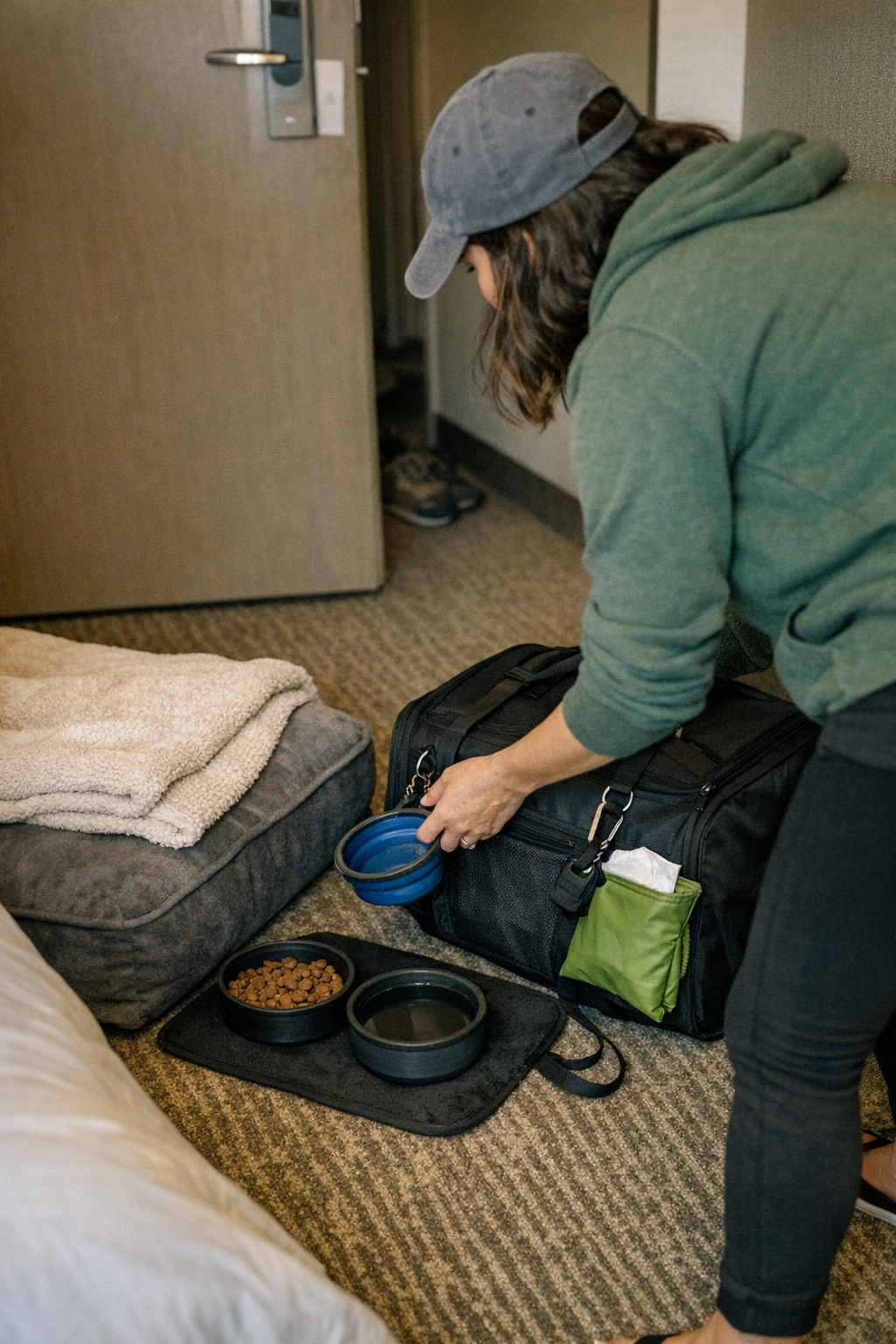
  • How Thoughtful Pet Corner Setup Transforms Hotel Travel Experience

    Looking prepared in a hotel room with your pet is easy—until you actually start moving in and out, over and over. The first setup always seems organized: bowls stacked by the door, wipes tucked in a pouch, leash coiled beside a bedroll. On the first run, that order holds. But after three quick exits, or your pet’s second muddy re-entry, the “neat” layout gives way to awkward grabs, blocked pouches, and the slow drag of repeated reshuffling. Suddenly, that organized corner reveals its weak spots—not in what’s packed, but in how fast you can get at it when your routine kicks into high gear. This is where true pet-travel setups get tested—under repeated strain, not first glances.

    Why “Looking Prepared” Isn’t Enough for Repeat Hotel Pet Routines

    The surface calm of most hotel setups masks deep friction the moment you move at speed. Neat rows and zippered bags hide their faults until you try grabbing wipes with one hand, leash in the other, and realize the pouch you need is pinned under a folded bed. It’s not about initial tidiness—it’s about staying functional after the third or fourth outside dash, when energy and patience both run short. One misplaced item sends you digging; one overlapping bag layout means the right pouch becomes the hardest to reach.

    This isn’t about “making it look nice”—it’s about surviving repeated handling without slowdowns. When every trip out the door means unstacking half your kit, annoyance builds. Fatigue piles up fast—especially when your pet’s energy spikes late in the day. A good hotel setup should let you reset fast, not make you dread the next trip outside.

    Common Hotel Pet Setup Frustrations: Seeing the Same Weak Point Return

    The real test comes after that fourth, fifth, or sixth hallway round-trip. That’s when hidden flaws resurface, no matter how polished things seemed at check-in:

    • Reaching for the wrong compartment: Leash tucked with toys, wipes stuffed under the travel bed. Everything’s packed, but nothing’s accessible in the right order.
    • Cleanup gear buried just when you need it: The wipes pouch exists, but grabbing it means dropping the leash or juggling your pet mid-mess. One slowdown, and paw prints march across the tile.
    • Comfort blocking essentials: Bed or blanket solutions keep things tidy—until they cover the food bowl or block your quick reach, making snack time one more obstacle course.
    • Reset friction with every stop: Even a five-minute pop outside turns into another round of “unpack, dig, repack,” tangling your routine more with each repeat.

    If you catch yourself thinking, “I had this perfect five minutes ago,” you’re seeing the real cost of setups that only look ready. The pain isn’t from big emergencies, but from small stresses multiplying every time you return.

    Access Beats Arrangement: The Real Test of a Functional Pet Hotel Corner

    Reliability is about fast access, not ornamental symmetry. Strong setups hinge on motion: can you complete cleanup, resets, or re-leashing without pausing, searching, or reshuffling? The difference jumps out after repeated cycles. You remember which setups let you move in 30 seconds and which make you groan. True improvement arrives when:

    • Wipes are clipped or hooked up high. One-hand grab, no rummaging. No buried pouches.
    • Bowls ride in a grab slot or outer sleeve, right by the leash clip. One reach, two problems solved. No cross-room scavenge.
    • Your essentials move together. No redraw, no item dance—your cleanup, walk, and feed tools stick as a unit, following you in or out.

    This changes the routine: instead of dreading the next walk, you cut the doggie midnight dash from a two-minute ordeal to half a minute—less stress, less mess, tighter control.

    Scene from the Real World: When the Setup Breaks Down

    It’s midnight; your pet just raced through damp grass outside. You throw the hotel door open, aim to clean up—then realize the wipes are wedged under bedding, the bowl’s stuck behind cushions, and the leash is somewhere in the layered bag. While you shuffle and dig, your pet twirls fresh mud into the entryway. Not chaos—just another pile of slowdowns, each one extra movement you’d hoped to skip.

    These aren’t rare events; they’re the norm across five or six stops in a single short hotel stay. Every layer that looks “organized” becomes one more step between you and clean, fast reentry. When tools you need vanish under extra layers, friction returns. Each repeat exit loads more hassle onto what should be a basic routine.

    Small Fixes, Big Wins: Reducing Reset Friction in Tight Hotel Spaces

    It’s the tiny adjustments that pay off in pet-travel. Clipping the wipe pouch outside the bag or right to the door handle buys back seconds with every pass. Bowls that live at seat-edge height—not under the foldable bed—mean you never pause or crawl for dinner time. When leash, wipes, and bowl cluster together as a mobile kit, you stop “reorganizing” with every round-trip and start moving as one, even when you’re tired or the night gets hectic.

    The real metric: Can you reach and restart instantly, or do you always pause to re-sort and untangle? Strong setups mean less hesitation, faster resets—the payoff multiplies when you’re repeating the cycle all day.

    It’s About Lasting Use, Not Just First Impressions

    The myth is that hotel pet organization is a single hurdle. But every walk, return, and quick cleanup is a new chance for weak setups to slow you down. Durable systems that survive five or ten repeated uses—without constant refreshing—beat anything that only looks sorted right after check-in. It’s not about matching an Instagram “before” shot, but about being able to grab, clean, and go in one motion, even on the sixth muddy paw run. The real win: when your travel corner quietly erases hassle, holds up under repeated pressure, and lets you trust your setup despite the grind of travel routine.

    Explore practical hotel pet-travel solutions at PawGoTravel

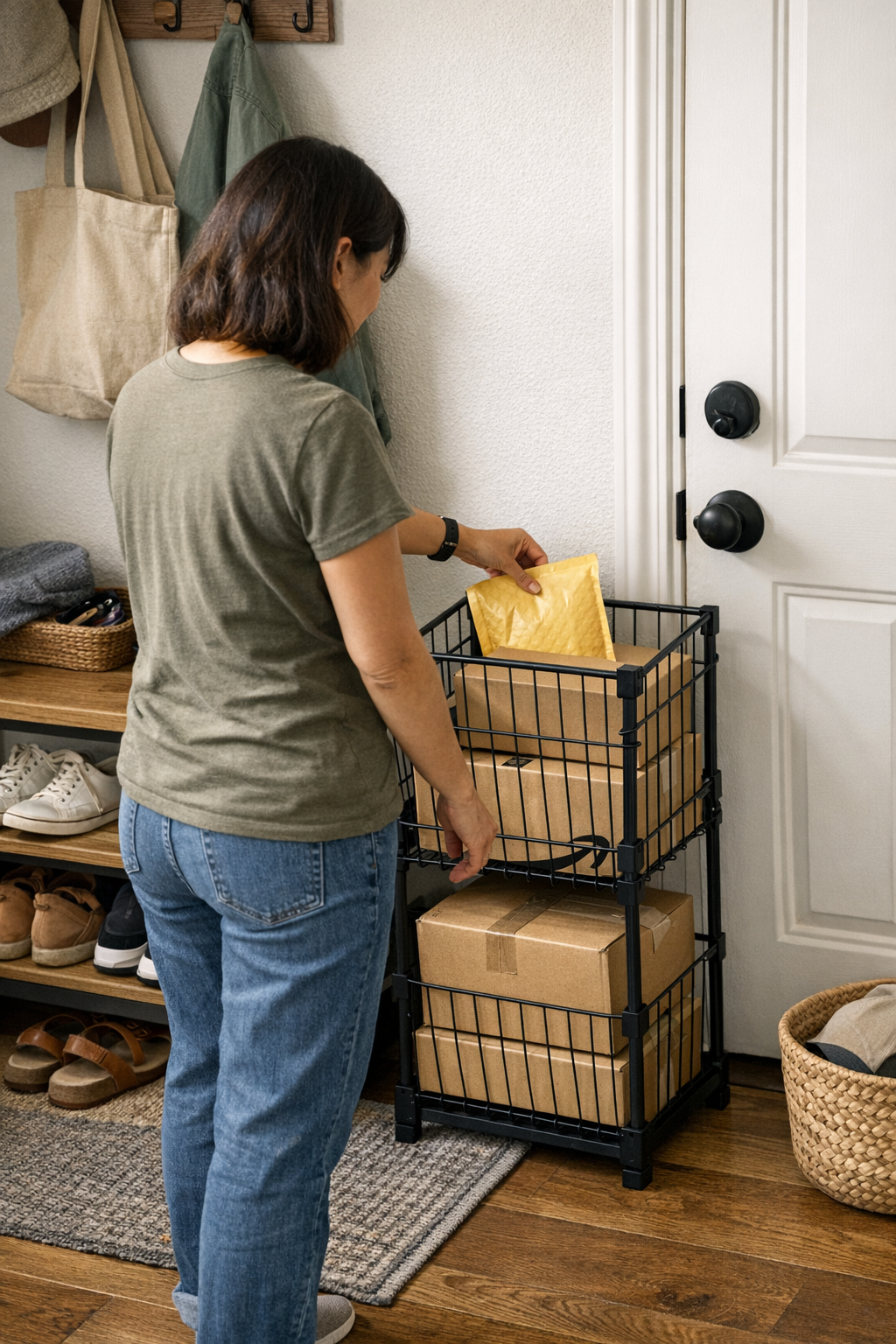
  • How a Package Basket Transforms Entryways Into Organized Spaces

    Step through your front door and see what really greets you: a maze of dropped bags, kicked-off shoes fanned wide, and packages wedged anywhere there’s a gap—not a clear path, but an accumulation zone. That newly delivered box pushes yesterday’s shoes off the rack; a bench becomes overflow, not a seat. What divides a passable entryway from a routine-blocking bottleneck? It’s simple: the instant a package or bag arrives, does it land in a dedicated spot—or does it drift and multiply, squeezing your threshold a little tighter with every crossing?

    Threshold Tension: Why Entry Clutter Happens Over and Over

    Your entryway isn’t just for show—it’s ground zero for every item you bring in, and every shortcut or “just for now” drop off builds up friction fast. When bags, boxes, and shoes mix together without structure, routines grind down. The signs are easy to recognize: parcels spill onto shoe mats, bag straps tangle in the path of the door, shoes that started in a neat row splay out to make room for whatever just arrived. Even one week of “wherever fits” deliveries, and that threshold becomes slow: not just cluttered, but a real obstacle every time someone comes or goes.

    This friction doesn’t stay invisible. Overflowed drop zones force you to sidestep, reroute, or hesitate—micro-delays that add up. Each “just put it there” decision quickly fossilizes into routine, so the open floor at the threshold quietly fills. Every new item is pulled into a pile that gets harder to resolve, until the line between “put away” and “in the way” disappears entirely.

    Why “Open” Entryways Break Down During the Week

    Minimal entryway setups look promising: slim shoe racks, an uncluttered bench, a narrow console or shelf. But open surfaces attract “temporary” use like magnets. Today’s delivery lands on the bench; tomorrow’s box stacks behind the door; bags cluster in front of the shoe rack. These spots were supposed to create space, but instead they become collection points for anything unsettled—every item that’s awkward to put away right now.

    Small parcels are the repeat offenders. They wedge under benches, push shoes aside, and break the line of whatever system you started with. If there isn’t a fixed basket or bin, every morning sees more friction: the floor gets visually crowded by midweek, and by Saturday, weaving around unsorted piles is second nature.

    Real-World Friction: How Clutter Spirits Itself Across the Threshold

    Picture a busy Tuesday: packages left at noon and again in the afternoon, with no container near the door. One box gets nudged onto the shoe mat; another squats beside the bench. Later, someone drops a bag right over both, locking up the clear path. By evening, shoes go missing, movement slows to tiptoeing, and the act of coming home takes more navigation than it should. These are not theoretical problems—resetting now requires gathering scattered items, restacking, bending, unblocking, and questioning why the bench is never clear when you want to sit.

    Over time, reset chores expand. What could be a minute’s tidy-up stretches into ten. If drop-offs are random or shared—think roommates with staggered schedules, kids, or neighbors leaving parcels—confusion multiplies, not just at the surface, but in every step through the space.

    The Power of a Defined Package Basket

    Containment isn’t about hiding mess—it’s about protecting flow. Place a waist-high basket right inside the door’s swing, and every arrival is directed upward, not spread outward. Instead of parcels claiming every spare surface, they funnel into one visible, vertical queue. Shoes stay lined up, benches remain available for sitting, and the transition zone starts acting like a controlled access point rather than a lost-and-found. Suddenly, coming or going happens with fewer hesitations—you’re no longer juggling where to step or put things down in the rush of entry.

    Stacked, Not Spread: How a Basket Changes Daily Use

    For active households or anyone with busy weeks, the effect is clear: you build a drop-off habit that targets one spot. Boxes go in the basket, shoes hold their line, and overlooked clutter can’t invade the floor. In tight or shared entryways, the vertical space of a basket stops the threshold from shrinking under clutter pressure—it buys you floor freedom, even when there’s not much floor to begin with.

    Neglect the basket for a day and the drift returns instantly—overflow spreads to bench edges, under racks, behind the door. This isn’t about visual style, but routine survival. When the container disappears from the sequence, friction and pile-up are back by evening—proof that transition storage isn’t an “extra” feature, but the structure holding your routine together.

    Close the Loop: Reset Speed and Lasting Order

    Efficient setups aren’t about perfection—they’re about making resets so fast and so obvious they barely become tasks at all. A visibly placed package basket takes the randomness out of drop-offs. Instead of playing daily catch-up, new arrivals are quarantined before they invade your path or shoe zone. When you used to waste five minutes clearing space, now thirty seconds does the job—and that time is reclaimed, not just on cleaning day, but every single time you walk through the door.

    This keeps the rest of your setup honest. Shoes don’t get blocked by surprise packages, the bench is free for sitting not stacking, and bag hooks or cabinets avoid turning into a graveyard for delayed pickups. The “clear” look comes not from hiding things, but from never letting clutter settle.

    Practical Pointer: Match Container Size to Your Volume

    If you catch your basket regularly overflowing midweek, adjust: add another container for returns or scale up to a stackable model that takes the real pace of deliveries. Choose based not only on floor space, but on how much comes in and how often it moves out—your storage shouldn’t lag behind your routine.

    Recognizing the Signs: When Your Setup Isn’t Working

    Even with a storage solution, cracks appear. Watch for these signals:

    • Detouring or pausing to move something blocking the way—again
    • Items hopping from floor to bench to shoe mat in endless rotation
    • Resets dragging out beyond a quick minute’s work
    • The task of “just keeping up” turning into its own source of frustration

    If you see these cues, it’s time to rework your drop zone placement or container fit. Sometimes, the right unit in the wrong spot is just as ineffective as no unit at all—and every skipped use invites the friction right back in.

    The Everyday Difference: Less Shuffling, More Flow

    At the threshold, even a few saved steps—or seconds—multiply over a week. A single, visible package basket isn’t a miracle fix, but it quietly stops the slow creep of daily detours, bench spillover, and shoe spillways. The difference isn’t style; it’s ease. Shoes don’t sprawl; benches stay clear; resets don’t eat into your evening—and movement through your entry regains a sense of flow, even on the busiest days.

    Find entryway and threshold storage that makes your routines easier at Betweenry.

  • Choosing Storage Ottomans That Keep Blankets Neatly Hidden and Accessible

    The day you bring home a storage ottoman, it’s all promise—a clean room, every blanket and throw tucked out of sight, surfaces finally free from clutter. But as soon as routines settle in, the real test starts. You fetch the same blanket three nights running, reach for the lid with full hands, and suddenly that “solution” becomes a source of friction that doesn’t show up in the catalog photos. The disconnect between showroom order and day-to-day use is where most living room storage makes or breaks itself.

    Where a Storage Ottoman Begins to Slip

    The trouble rarely appears in the first week. You watch a movie, toss a blanket back when you’re done, close the lid. It works until it doesn’t: a lid that won’t stay propped up, a box that swallows blankets in a single tangled heap, or an interior that’s just deep enough to make folding pointless—but never deep enough for your thickest throw. Returning items starts taking more effort than grabbing them did. Soon, the put-away step gets skipped, and the ottoman’s “hidden” storage turns into a half-reset pile, one that grows a little messier with every day’s cycle.

    Real-world breakdowns show up on ordinary evenings—arms stuffed with throws, one hand free, and a hinged lid that lurches shut or needs balancing on a knee. You end up wedging the lid against the wall, trying not to drop three things at once. Eventually, a blanket lands on the sofa edge with the silent intention to put it away “next time.” After a month, the ottoman’s clean look depends less on your storage system and more on your willingness to keep hiding the evidence.

    The Tidy Illusion vs. the Everyday Cycle

    From across the room, two ottomans can look equally sorted. Wait a week, and only one stays that way through real use. In one, blankets stack flat—each one reachable, foldable, and replaceable without moving the rest. In the other, evening resets mean shoving and refolding as the pile bulges, lids catch, and eventually overflow migrates to armrests and chair backs. The pristine surface is just a lid over silent category chaos, and the time it takes to restore order quietly increases until the organization isn’t worth the extra step.

    This breakdown isn’t dramatic; it’s incremental. Each failed return means the flow of your system slows, and the ottoman becomes a staging zone for items that don’t have a real home to return to. Surfaces fill up around its edges. Instead of controlling clutter, the ottoman rebrands it: not gone, just moved out of sight—for now.

    Design Choices That Change the Routine

    Lid design is the dividing line between a system that keeps pace and one that wears you out. An ottoman with a counterbalanced or soft-close hinge—one that props open and stays put—means that even with full arms, you can drop in covers one-handed, and it closes without drama. When the lid’s loose, heavy, or refuses to stay open, you end up juggling or skipping the reset altogether. Small failures multiply: one extra step, one more reason not to bother.

    Interior depth matters just as much. If the internal space gives you a two-inch margin after stacking your largest blanket, you can toss in bulky throws without cramming. If the cavity is too shallow or awkwardly proportioned, every return feels like wrestling laundry into a too-small drawer: folds come undone, things catch under the lid, and closing up leaves the pile uneven or the lid half propped. It’s not just about storage volume—it’s about whether you can use it at real-life speed.

    Typical Real-World Friction

    • Reaching twice for the same blanket because everything inside gets twisted or buried
    • Shifting stacks of covers to dig out the one you actually want
    • Spillover builds up fast—blankets on sofa arms, pillows migrating out, the ottoman almost always partway open
    • Category drift: toys or chargers stashed inside “just until tomorrow,” then never restored
    • The area feels more blocked, less open, with every week—extra storage that quietly tightens the path

    Small Adjustments, Lasting Improvement

    Category discipline is the key to clarity. Locking the ottoman to just blankets and throws—and ruthlessly ejecting stray items as soon as they show up—cuts off the slow drift into “miscellaneous storage.” The first time a remote, headphones, or magazine lands inside, it’s the sign to reset before the system blurs. That’s when the hidden clutter starts taking over.

    If resets get slower, or you find yourself leaving items outside the ottoman more often than not, don’t ignore it. Usually, it means one piece of design isn’t keeping up with reality: either the lid is a fight every night, or the box is too cramped for your current habits. Sometimes the fix is as simple as sizing up to gain a crucial couple of inches, or swapping out the hardware so the lid finally moves at the same speed you do.

    Inside-Storage Meets Daily Flow

    The right ottoman isn’t just a box—it’s infrastructure that makes the rest of the room work smoother without anyone thinking about it. When you can store throws with one hand and never pause to wrestle the lid, you reduce both clutter and effort. The visible cues: room pathways stay clear, no backup piles form, and there’s no last-minute clutter grab before guests arrive. If your storage interrupts more than it streamlines, the real problem isn’t your willpower—it’s a design mismatch with your daily routine.

    Whether you’re comparing ottomans, fighting with reset overflow, or simply tired of abandoned piles each weekend, pay attention to the small mechanics: a lid you don’t have to fight, enough surplus space to skip folding marathons, and a single-purpose policy that keeps clutter from drifting in. Get these right, and inside storage actually pays off—by being invisible, not by making you work harder just to keep up.

    Browse more daily-tested storage solutions at Gridry.

  • Why Avoiding Tight Cable Bends Improves Your Desk Workflow

    A desk can look perfect—every cable hidden, every surface clear—until you actually work at it. The moment you shift your monitor to find a better angle, reach for your tablet charger mid-call, or try pulling your keyboard closer, friction emerges. Hidden cable paths that seem tidy on day one can quickly turn routine actions into mini-struggles: cables snag under trays, bend sharply behind drawer units, or tug unpredictably against a monitor arm. The setup appears organized, but the cost shows up in every slow reach, subtle resistance, or disrupted flow. This is the difference between a desk that’s only clean in appearance and one that supports how you actually move hour after hour.

    When a Tidy Desk Interrupts the Flow

    The frustration builds quietly: a charging cord tugs as you slide your laptop forward, or a monitor refuses to swivel without extra force. Maybe your phone cable vanishes beneath a cable tray and reappears only after awkward fishing every morning. By Wednesday, the work rhythm is chipped away by these interruptions—each snag slowing a task, each stiff cable pulling you half out of focus.

    This isn’t just daily inconvenience. Drag a notebook beside your keyboard and catch on a cable edge, or find your monitor arm suddenly “snaps back” because a tight cable underneath is resisting the move. Over time, you notice you’re thinking about the hardware, not the work. The line between a desk that adapts to your routine and one that demands constant correction gets sharper as the week wears on.

    Why Hard Cable Bends Create Invisible Problems

    You win on looks when you tuck every cord out of sight, but hard angles and clamped turns create trouble beneath the surface. Each sharp bend in a power or HDMI cable presses the wires closer to their breaking point, weakening the strands hidden inside. You might not see it immediately, but the warning signs start stacking up:

    • Devices disconnect with the smallest nudge, or plugs need adjusting just to stay on
    • Laptops only charge if you hold the connector at exactly the right angle
    • Display flickers or “no signal” errors after moving a monitor arm
    • That run-down feeling every time you have to fight tangled or stiff cables to reset your space

    What’s driving these failures? Cables routed to fit a tidy plan—not the natural way you move, plug, and adjust every day. Over weeks and months, this makes every small reset—plugging a charger back in, sliding a chair forward—feel heavier and more distracting.

    Recognizing Real-World Friction—Not Just Surface Clutter

    People often hunt for clutter, but real trouble comes from blocked flow: the moment-to-moment freedom to move hands, devices, and screens without thinking. In a short-depth desk or if you layer in under-desk organizers, that easy reach disappears fast. If you need to pause and remember where a charger’s routed or if shifting the monitor makes you wonder if the cables will resist, the cleanliness is only skin-deep—and actual efficiency suffers.

    Where does this gap between appearance and use become unmistakable?

    • Switching between laptops, phones, and tablets in a single morning—each device forced to share tight cable routes or access points
    • Changing your desk from “work mode” to “personal mode” every evening—only to find the cables don’t flex with the new setup
    • Adding under-desk storage that hides mess, but eats up all the space your power strip or charging brick needs to shift naturally

    If every minor adjustment is a fight or a pause, the space works against your routine—even as it looks pristine to a visitor.

    What Actually Changes When You Give Cables Room

    The fix isn’t about buying the bulkiest cable tray or boxing everything twice over—it’s about giving every cable permission to curve instead of forcing it to bend. After switching to a cable sleeve and a tray with open space underneath—leaving about a hand’s width for slack at each major turn—the improvements were immediate. Cables stayed where they belonged. No more “memory” from past sharp angles or unexpected tension when grabbing a plug under the desk.

    • Monitor arms glided without that “snap” of cable recoil, making quick screen shifts feel natural again
    • Chargers plugged in smoothly, no more hunting for the only position where they’d work
    • The desk still looked sharp, but finally moved at the speed of daily habits—no extra friction

    The benefit isn’t just appearance—it’s that, for once, every movement feels expected. The space fits the routine, rather than the other way around.

    Typical Scenarios Where Cable Flow Matters Most

    Moving Between Keyboard, Notebook, and Screen

    Trying to take a handwritten note or flip to a second device? That’s where trouble shows up: a cable hidden under your notebook tugs the keyboard off-balance, or a tight monitor wire pulls the whole screen off-center. Each pause breaks your task flow.

    Under-Desk Storage Helping—But Also Hurting

    Stashing drawers and boxes under the surface feels smart—until you find that every under-desk move is grinding against the edge of a hidden cable tray. The more you fill the space, the less “give” is left for power cables or hubs, turning a simple port access into a hidden battle.

    Adding or Removing Devices Midday

    Plugging headphones or charging a second phone should be mindless. If the cable path involves dodging storage, bending around corners, or working against resistance, this one-second chore adds up over a week—turning reset time into a repeated frustration point.

    How to Spot Trouble—And Fix It Without Overcomplicating

    Cut through the guesswork: Run your real routine at full speed—adjust the monitor, slide the chair, fetch a charger behind a lamp. Any spot where a cable feels rigid or pulls back, stop. Trace the line: are you forcing wires through an awkward hairpin under a tray, or forgetting to leave slack where cables drop behind the desk?

    Quick fixes that actually work:

    • Use a cable tray or sleeve with a gentle curve, not cramped corners; cables should rest, not fold
    • Make sure there’s actual slack (about a hand’s width) at every turn, especially where cables enter or leave the desktop
    • Skip tight, rigid anchors—one too many cable clips can break natural motion
    • After every change, swing the monitor and run through normal plug routines—nothing should pull back or resist

    Even for clamp lamps and task lights, a free cable path means you can pivot and reposition the light without pinching the cord or risking a blackout at the socket. Small resistance turns into big annoyance once it repeats.

    FAQ: Pinpointing Cable Friction Before It Becomes Device Trouble

    How much slack is enough?

    Think a hand’s width (about 8 centimeters) for every bend and each spot cables drop under trays or along the desk. It’s enough to avoid forced angles and stops cables from “learning” the wrong path over time.

    Are all cables equally sensitive to tight bends?

    No—thicker cables and those carrying more wires, like HDMI, charging bricks, or USB-C, wear out faster when bent hard. Lighter audio cords tolerate more, but still fail early if they’re twisting against plugs constantly. Ignore thickness at your own risk.

    How do I know if a cable is already damaged?

    If a device only works when you hold the connector just right, or a cable’s outer sleeve looks creased or thin, you’re already in the danger zone. Random disconnects, heat at the plug, or stiff “memory” bends mean the route or the cable itself needs a reset—sometimes both.

    The Desk That Works With You, Not Against You

    The best desk setups aren’t just clean—they move with you, not against you. When cables drag, stiffen, or force you to rewire your routine every day, the surface order is an illusion. True usability comes from accessories—trays, arms, storage—that respect movement and avoid the little traps: blocked elbow paths, stubborn cables, unreachable ports.

    Let form follow motion: give cables room to curve, keep slack wherever you switch tasks, and use desk solutions that flex as your workday does. The shift is real. Friction fades away, small irritations disappear, and the space finally feels like an ally, not a daily test of patience.

    Explore the full WorkBasic collection