
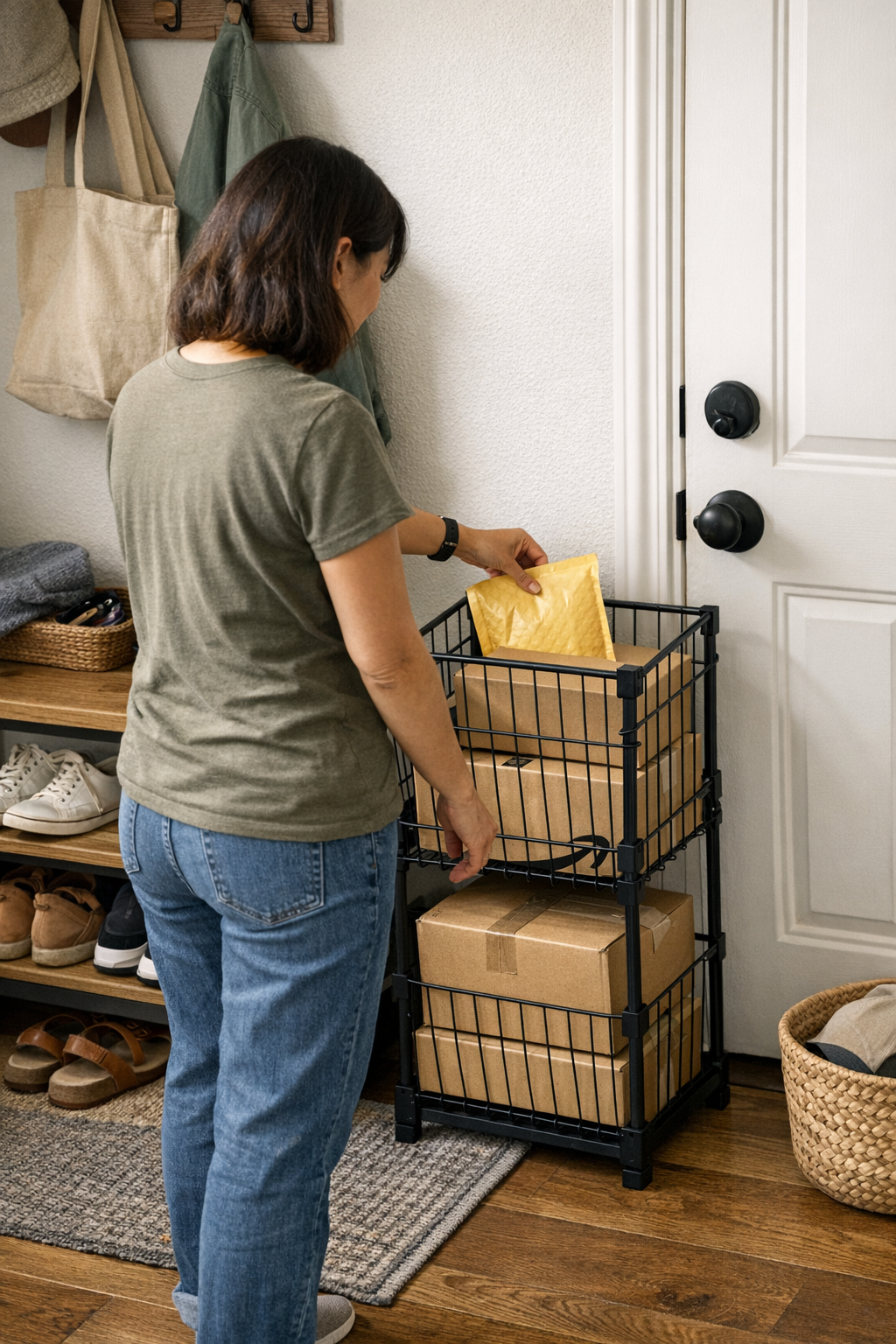
Step through your front door and see what really greets you: a maze of dropped bags, kicked-off shoes fanned wide, and packages wedged anywhere there’s a gap—not a clear path, but an accumulation zone. That newly delivered box pushes yesterday’s shoes off the rack; a bench becomes overflow, not a seat. What divides a passable entryway from a routine-blocking bottleneck? It’s simple: the instant a package or bag arrives, does it land in a dedicated spot—or does it drift and multiply, squeezing your threshold a little tighter with every crossing?
Threshold Tension: Why Entry Clutter Happens Over and Over
Your entryway isn’t just for show—it’s ground zero for every item you bring in, and every shortcut or “just for now” drop off builds up friction fast. When bags, boxes, and shoes mix together without structure, routines grind down. The signs are easy to recognize: parcels spill onto shoe mats, bag straps tangle in the path of the door, shoes that started in a neat row splay out to make room for whatever just arrived. Even one week of “wherever fits” deliveries, and that threshold becomes slow: not just cluttered, but a real obstacle every time someone comes or goes.
This friction doesn’t stay invisible. Overflowed drop zones force you to sidestep, reroute, or hesitate—micro-delays that add up. Each “just put it there” decision quickly fossilizes into routine, so the open floor at the threshold quietly fills. Every new item is pulled into a pile that gets harder to resolve, until the line between “put away” and “in the way” disappears entirely.
Why “Open” Entryways Break Down During the Week
Minimal entryway setups look promising: slim shoe racks, an uncluttered bench, a narrow console or shelf. But open surfaces attract “temporary” use like magnets. Today’s delivery lands on the bench; tomorrow’s box stacks behind the door; bags cluster in front of the shoe rack. These spots were supposed to create space, but instead they become collection points for anything unsettled—every item that’s awkward to put away right now.
Small parcels are the repeat offenders. They wedge under benches, push shoes aside, and break the line of whatever system you started with. If there isn’t a fixed basket or bin, every morning sees more friction: the floor gets visually crowded by midweek, and by Saturday, weaving around unsorted piles is second nature.
Real-World Friction: How Clutter Spirits Itself Across the Threshold
Picture a busy Tuesday: packages left at noon and again in the afternoon, with no container near the door. One box gets nudged onto the shoe mat; another squats beside the bench. Later, someone drops a bag right over both, locking up the clear path. By evening, shoes go missing, movement slows to tiptoeing, and the act of coming home takes more navigation than it should. These are not theoretical problems—resetting now requires gathering scattered items, restacking, bending, unblocking, and questioning why the bench is never clear when you want to sit.
Over time, reset chores expand. What could be a minute’s tidy-up stretches into ten. If drop-offs are random or shared—think roommates with staggered schedules, kids, or neighbors leaving parcels—confusion multiplies, not just at the surface, but in every step through the space.
The Power of a Defined Package Basket
Containment isn’t about hiding mess—it’s about protecting flow. Place a waist-high basket right inside the door’s swing, and every arrival is directed upward, not spread outward. Instead of parcels claiming every spare surface, they funnel into one visible, vertical queue. Shoes stay lined up, benches remain available for sitting, and the transition zone starts acting like a controlled access point rather than a lost-and-found. Suddenly, coming or going happens with fewer hesitations—you’re no longer juggling where to step or put things down in the rush of entry.
Stacked, Not Spread: How a Basket Changes Daily Use
For active households or anyone with busy weeks, the effect is clear: you build a drop-off habit that targets one spot. Boxes go in the basket, shoes hold their line, and overlooked clutter can’t invade the floor. In tight or shared entryways, the vertical space of a basket stops the threshold from shrinking under clutter pressure—it buys you floor freedom, even when there’s not much floor to begin with.
Neglect the basket for a day and the drift returns instantly—overflow spreads to bench edges, under racks, behind the door. This isn’t about visual style, but routine survival. When the container disappears from the sequence, friction and pile-up are back by evening—proof that transition storage isn’t an “extra” feature, but the structure holding your routine together.
Close the Loop: Reset Speed and Lasting Order
Efficient setups aren’t about perfection—they’re about making resets so fast and so obvious they barely become tasks at all. A visibly placed package basket takes the randomness out of drop-offs. Instead of playing daily catch-up, new arrivals are quarantined before they invade your path or shoe zone. When you used to waste five minutes clearing space, now thirty seconds does the job—and that time is reclaimed, not just on cleaning day, but every single time you walk through the door.
This keeps the rest of your setup honest. Shoes don’t get blocked by surprise packages, the bench is free for sitting not stacking, and bag hooks or cabinets avoid turning into a graveyard for delayed pickups. The “clear” look comes not from hiding things, but from never letting clutter settle.
Practical Pointer: Match Container Size to Your Volume
If you catch your basket regularly overflowing midweek, adjust: add another container for returns or scale up to a stackable model that takes the real pace of deliveries. Choose based not only on floor space, but on how much comes in and how often it moves out—your storage shouldn’t lag behind your routine.
Recognizing the Signs: When Your Setup Isn’t Working
Even with a storage solution, cracks appear. Watch for these signals:
- Detouring or pausing to move something blocking the way—again
- Items hopping from floor to bench to shoe mat in endless rotation
- Resets dragging out beyond a quick minute’s work
- The task of “just keeping up” turning into its own source of frustration
If you see these cues, it’s time to rework your drop zone placement or container fit. Sometimes, the right unit in the wrong spot is just as ineffective as no unit at all—and every skipped use invites the friction right back in.
The Everyday Difference: Less Shuffling, More Flow
At the threshold, even a few saved steps—or seconds—multiply over a week. A single, visible package basket isn’t a miracle fix, but it quietly stops the slow creep of daily detours, bench spillover, and shoe spillways. The difference isn’t style; it’s ease. Shoes don’t sprawl; benches stay clear; resets don’t eat into your evening—and movement through your entry regains a sense of flow, even on the busiest days.
Find entryway and threshold storage that makes your routines easier at Betweenry.