
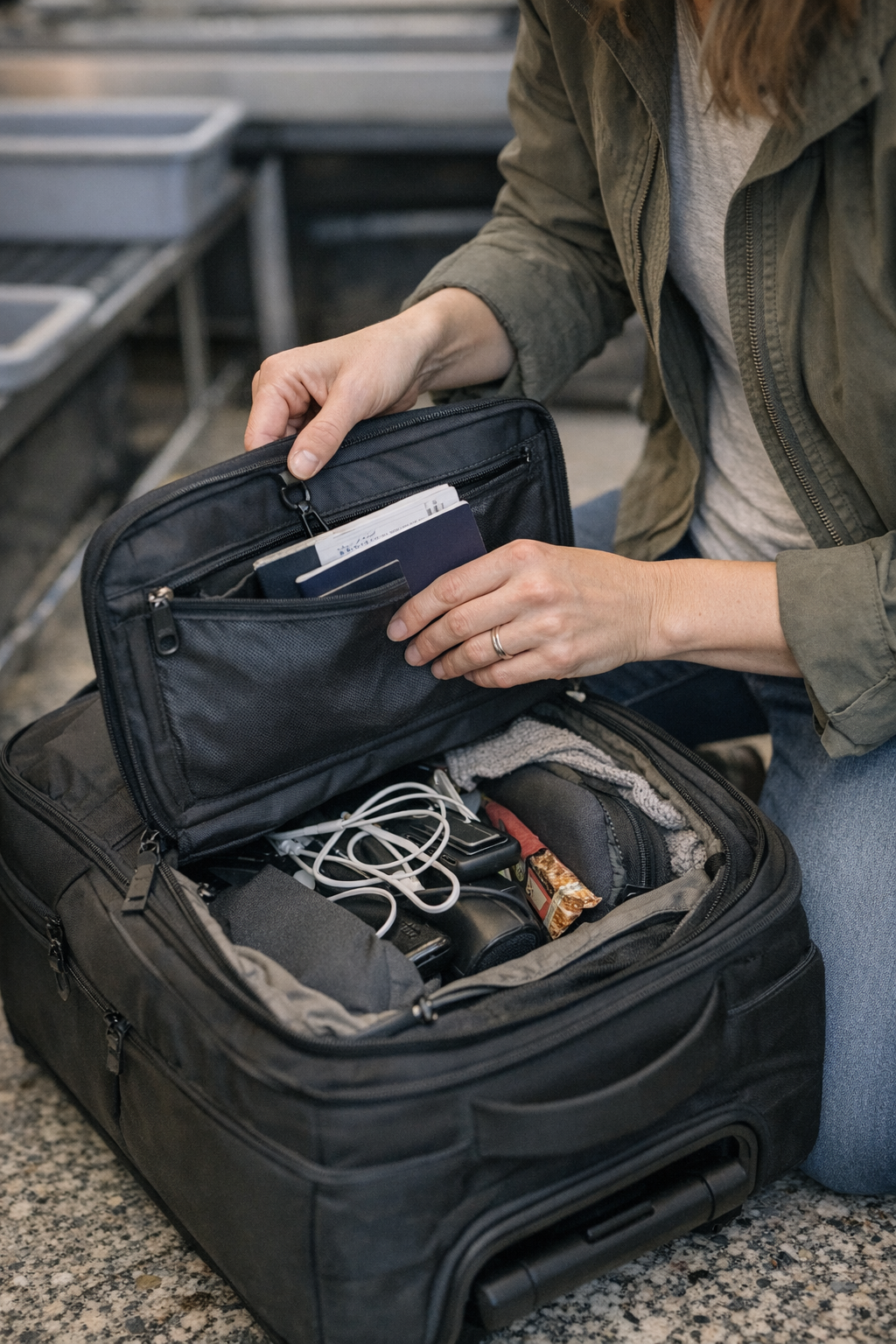
The real test hits after the first flight: An organized carry-on that looked efficient in your room can turn chaotic with just a few airport hurdles. The zippers close, the pouches stack, but twenty minutes into real movement—boarding lines, sudden security checks, or a scramble for documents—neatness starts breaking down. What looked set for effortless access actually delays you at every grab point: the passport you thought was “in the easy pocket” is now buried under chargers, and reaching in for one thing drags out three more. If you’ve felt the drag of a too-compact setup in a live airport sprint, you know the visual order means nothing if retrieval fails when pressure rises—especially across multiple movement cycles.
The Carry-On Illusion: Organized Yet Clumsy Under Pressure
Packed pockets should mean smooth travel, but the illusion fades fast after just a few real-world document checks. You unzip expecting to grab your boarding pass—only to meet a headphone cable tangle or a zipper blocked by an awkwardly wedged power bank. The real slowdown isn’t because you forgot something, but because you keep having to rescue the same items that slid or drifted after each movement.
Repeat friction is the true penalty: Instead of a single fix, you face a pattern of small interruptions—hunting for your ID in a hurry, restacking items at security, or jamming essentials back into an already overstuffed pouch as impatient travelers collect behind you. The order you built at home drains away in airport time.
How Repeated Friction Surfaces in Real Travel
Airport routines are ruthless at exposing weak carry-on setups. Here’s how real problems show up again and again:
- Security checkpoint fumble: In the tray line, you realize your passport slid out of its “spot”—now chargers and snacks topple out as you dig, and that careful system collapses by the first scan.
- Overhead bin shuffle: Needing headphones or a tablet mid-flight could mean unloading half your bag, because the outer pouch shifted and now blocks a document you need to show.
- Seat entry slowdown: The pen you want is tangled with boarding passes, or earbuds migrated to a random corner—the clean categories at home blur at every turn and repack.
Looking tidy only gets you so far—the real question is what happens on reach number fifteen, when repetition has erased every visual plan. Movement exposes flaws fast: quick-access design has to survive constant slide, repack, and unexpected checks, not just look neat before you leave.
Why Zone Separation Outperforms Compactness
It’s tempting to believe an “everything in its place” layout will guarantee speed, but unless you have a true dedicated quick-access zone, friction returns fast. The most common failure: What started as sorted ends up cross-contaminated after two checkpoints or a single seat change. Your earbuds and boarding pass now sit in the same pouch; your charger is folded into your document slot.
- Unzipping the wrong section—every time you hurry
- Spreading gear across a tray to unearth one lost ID
- Replacing items just to have them drift by next use
When the “quick-access” idea breaks, so does your flow—minor mishandling compounds during boarding rush, random checks, or a last-minute change of gate. Instead of a tidy first impression, you get a series of rediscoveries that stall movement just when you need to keep moving with minimal thought.
Classic Setup Shortfalls: Overlap, Drift, and Rediscovery
- Pocket overlap: Looks fine until travel starts—high-use and low-use items blend in the same slot, so your passport shares space with gum and tossed receipts. Every grab re-shuffles the mix.
- Unsorted pouches: Compact, but you end up reshuffling gear multiple times by the first gate, with order never quite rebuilt.
- No fixed home: Without an always-known spot for documents, tech, or comfort gear, retrieval turns into a guessing game at every checkpoint.
Reducing visible mess is not enough. If your carry-on still forces the same repeated search or reshuffle after each move, order isn’t real—it only looks the part.
Stress-Testing Real Solutions: One Pocket, One Job
The shift that actually holds up: Assigning a non-negotiable, single-use spot—usually a stand-alone zip pouch high in the main compartment—for must-grab travel essentials. No overlap. Passports, boarding passes, and IDs go into this anchored pocket only. Tech cables, chargers, and comfort items get their own separate organizers or zones further apart, so they never drift into the document flow.
- Every document check is done with one grab—no more searching, stacking, or accidental drops.
- Headphones, chargers, and pens stay put, not sliding into your document zone mid-journey.
- Security and in-seat access are faster—no awkward reach-around, no rushed transfer, and no splitting your attention across badly mixed pockets.
Nothing eliminates every travel pause, but crossing over essentials loses its power to throw off your rhythm. Line blocks become rare. Repacking mid-trip shrinks to a minimum. The difference is sharpest in the scrambles—when a single misplaced ticket once meant a trayful of gear, now it’s one zip and move on.
Small Wins, Real Impact—The Ongoing Difference
- No more hunting for lost items after each flight segment—especially when fatigue sets in late in the day
- Faster transition through gates and checks, since you’re not patching up scattered pouches with every stop
- In-seat access feels smooth; you can pull what you need without disturbing everything else
It’s the difference between quietly keeping pace with airport flow and feeling a step behind at every critical moment. Travel doesn’t get less complex, but your carry-on stops fighting you every time you move or repack.
If you’ve felt your carry-on order fail by the second airport or third boarding call, it’s not your habits—it’s the missing structure for repeat-use travel. Build for real movement, not just tidy looks.
For carry-on travel tools, organizers, and repeat-use essentials that hold up under movement pressure, visit CarryOnSupply.