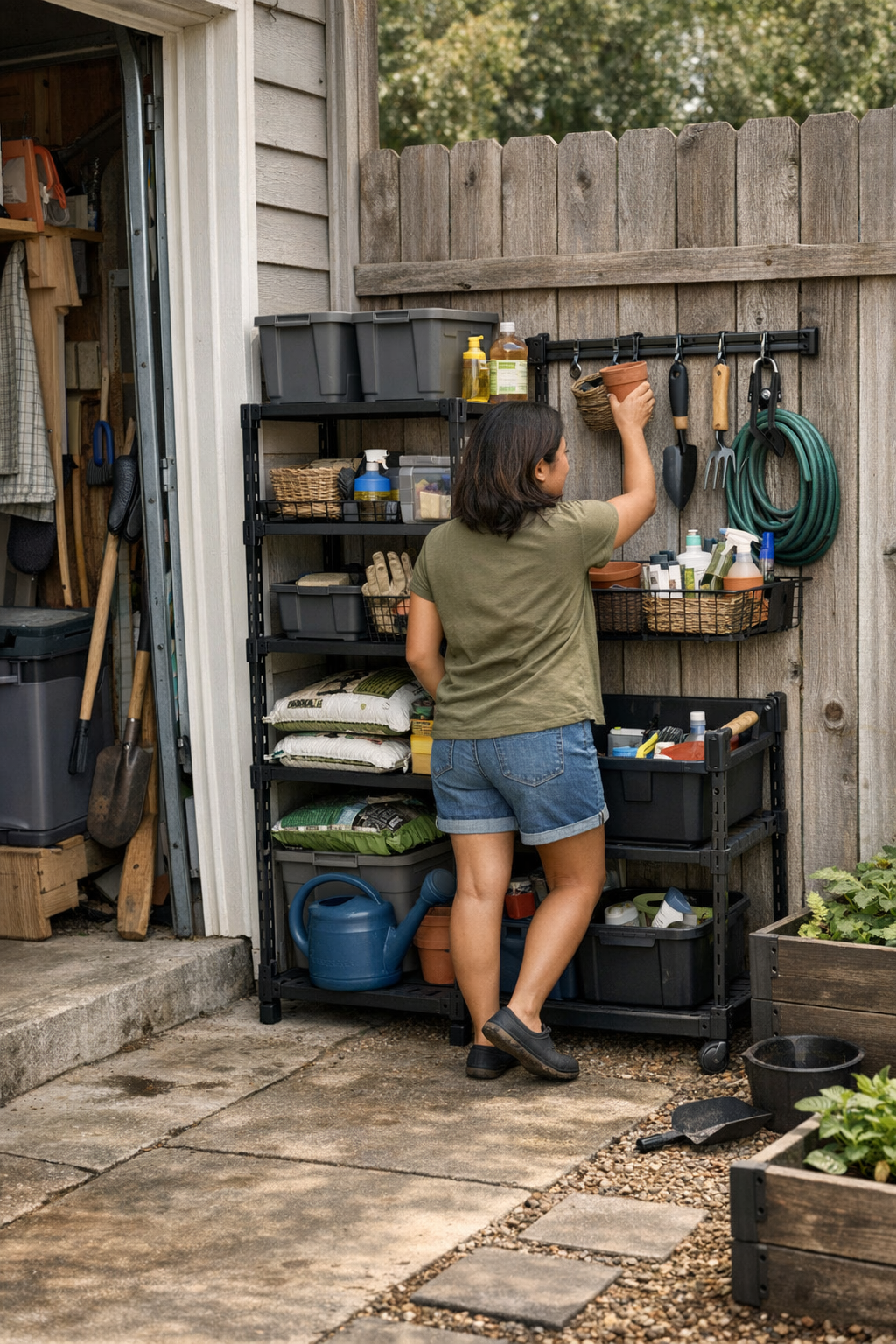
Category: Yard & Utility

  • Why Outdoor Storage Systems Fail When Real Use Begins

    Most outdoor storage feels solved until you actually start using it, week after week. At first, the side yard or patio-edge looks squared away—lidded bins snapped shut, lawn chairs stacked, rakes out of sight. But reach for a shovel after a rainstorm, or try to put away muddy boots when your hands are full, and the setup shows its cracks. That clean, organized surface quickly demands shuffling, stacking, and constant quick fixes. There’s a real difference between a backyard that looks tidy and one that actually lets you move, work, and reset without interruption.

    Clutter Moves Into Your Path, Not Just Your Pile

    The drive for a minimal fence-line or neat shed pushes everything into bins and boxes. Gloves wedged in totes, secateurs buried under hoses, soccer balls smothered by lawn bags: it’s organized until you need the third item down. One gardening session, and suddenly you’re peeling open heavy lids just for a misplaced trowel, or moving bins so you can grab the rake without knocking over the hose cart. That crisp, stacked look doesn’t last past the second or third use—friction creeps back in with every task.

    The mess rarely explodes all at once. Instead, you get walkways filling up with “just for now” piles—boots left near the shed door, garden bags dropped at the fence, tools that never quite make it home because their “home” is too buried. Every small detour signals it: the system isn’t out of space, it’s set up for surface calm and hidden hassle. The smooth footprint is an illusion; the more you use it, the more awkward the flow becomes.

    Where Tidy Setups Break Down—In Actual Motion

    Think about a typical setup: storage bins stacked along a garage wall or tucked into a side-yard cabinet. Leaving gear out of sight keeps the yard pretty, but only until you hit a wet stretch or a week of projects. That’s when the bottom container needs unloading, or the last-used tool ends up exiled somewhere in the stack. It takes just a couple of hurried drop-offs before the original “system” turns into a tangle—lidless containers, tools sprawled at the cabinet base, boots abandoned at the threshold, blocking the rest of the walkway.

    These are the choke points that shrink what should be open routes. Suddenly you’re shifting lawn chairs just to free the path for the mower, or nudging camping tables aside to clear access to the hose. Once piles gather along a wall, every quick return—“just leave it here for a minute”—invites more overflow. Days later, the area officially “organized” feels as clogged as before.

    The Modularity Shift: Open Use Beats Hidden Clutter

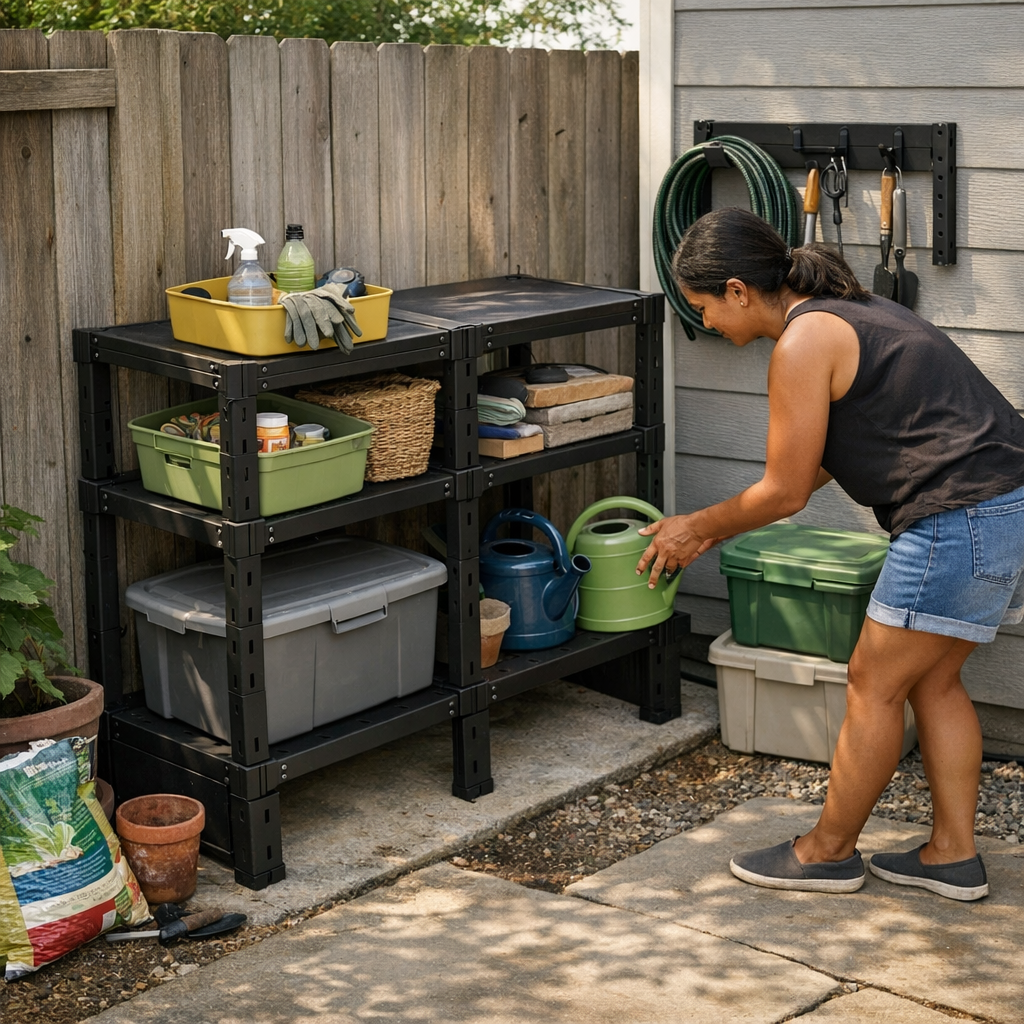
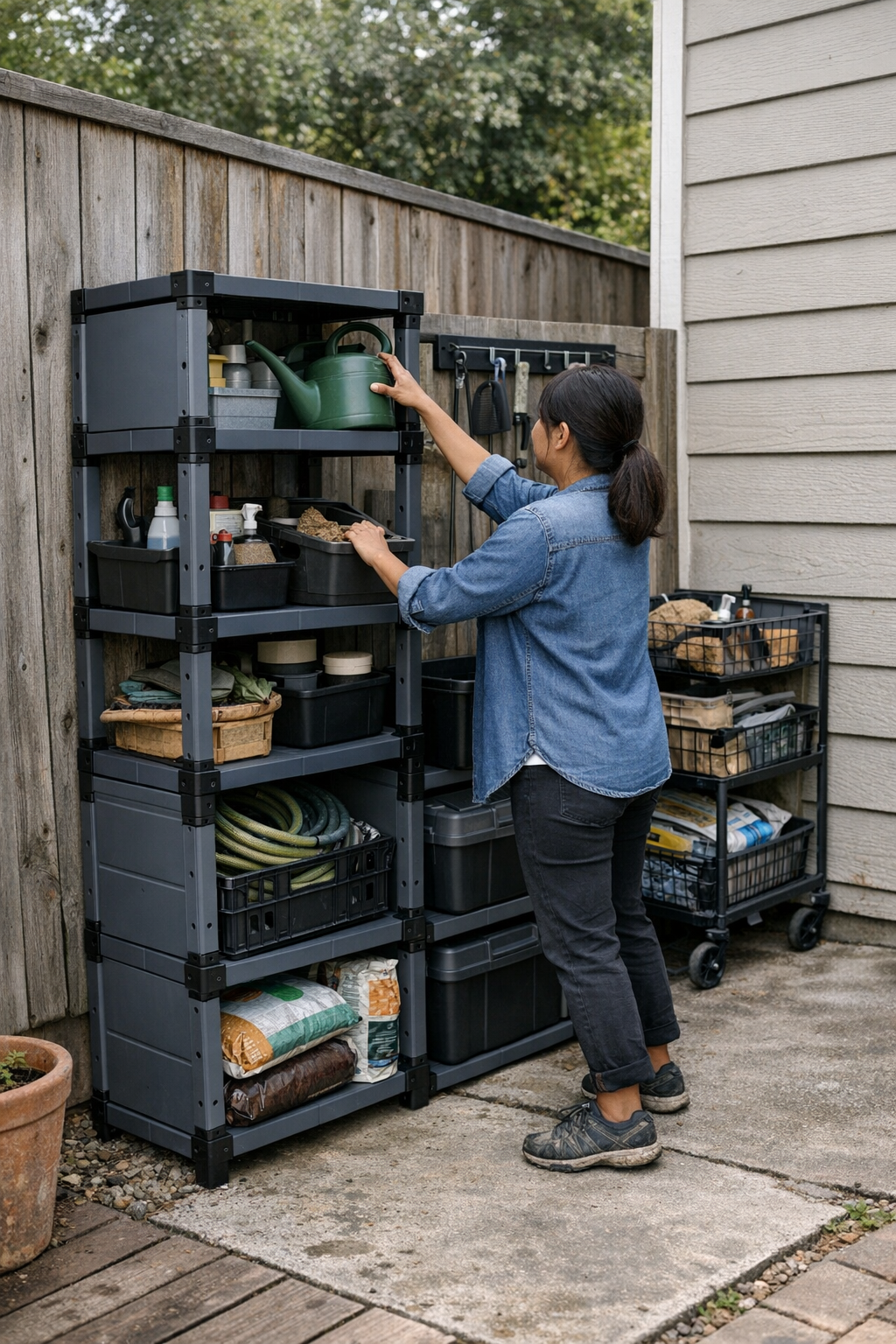
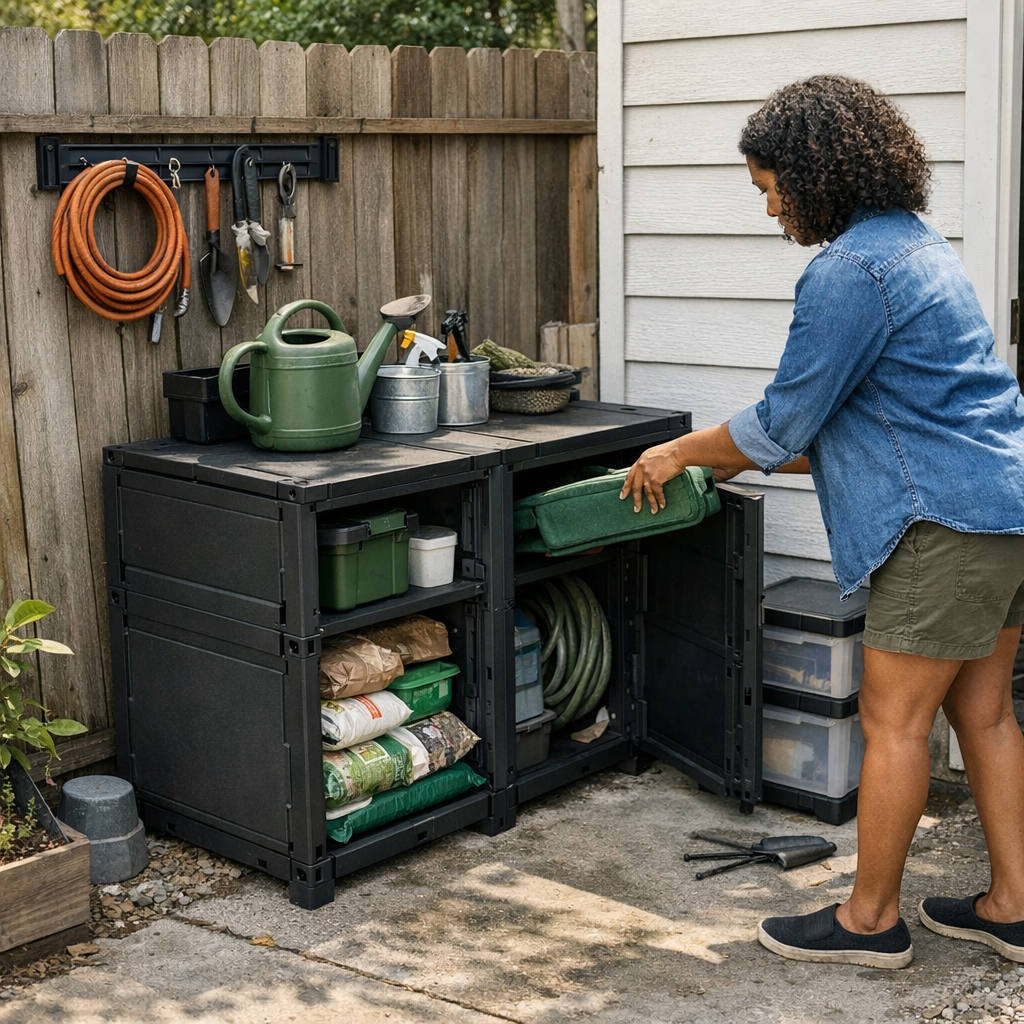
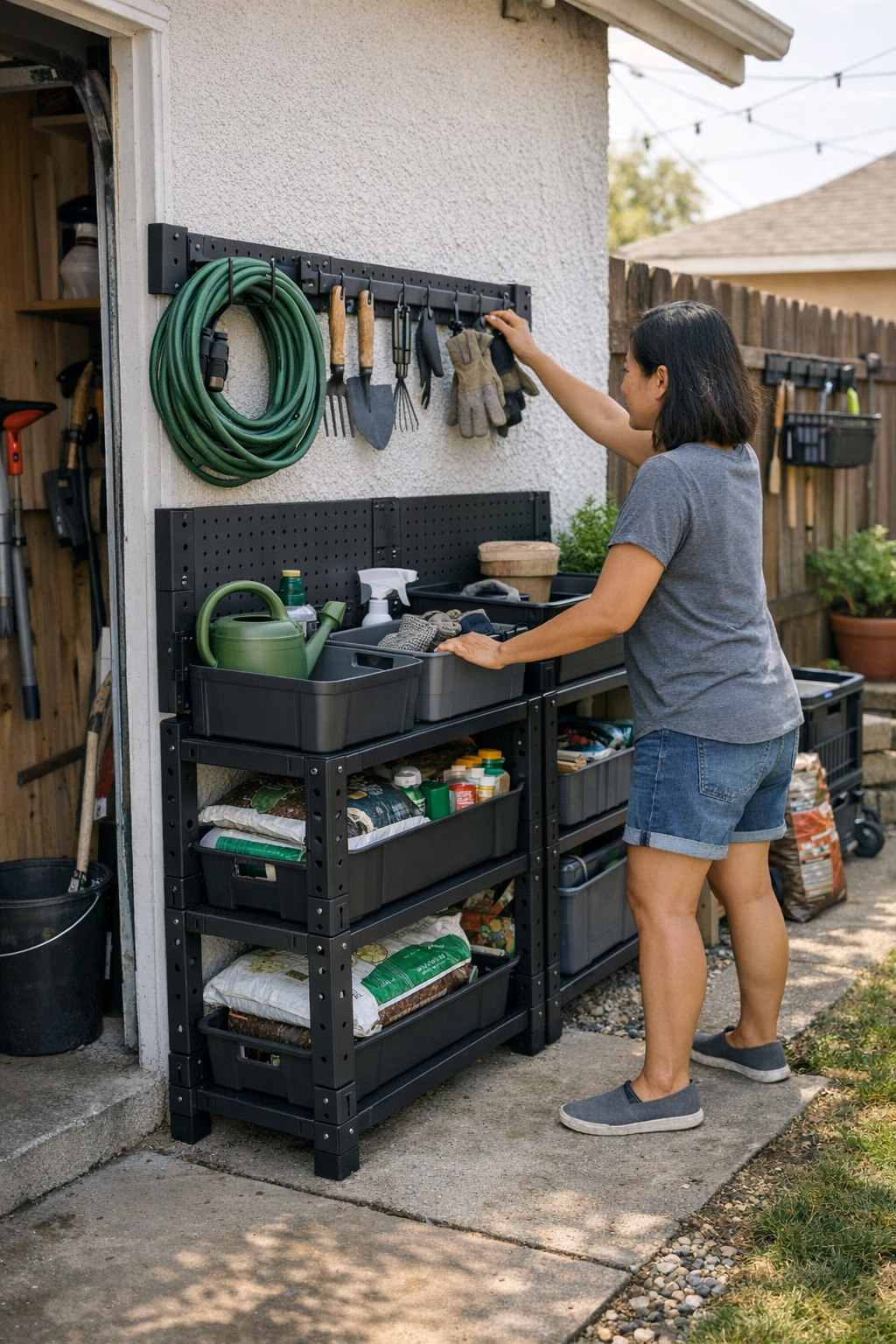
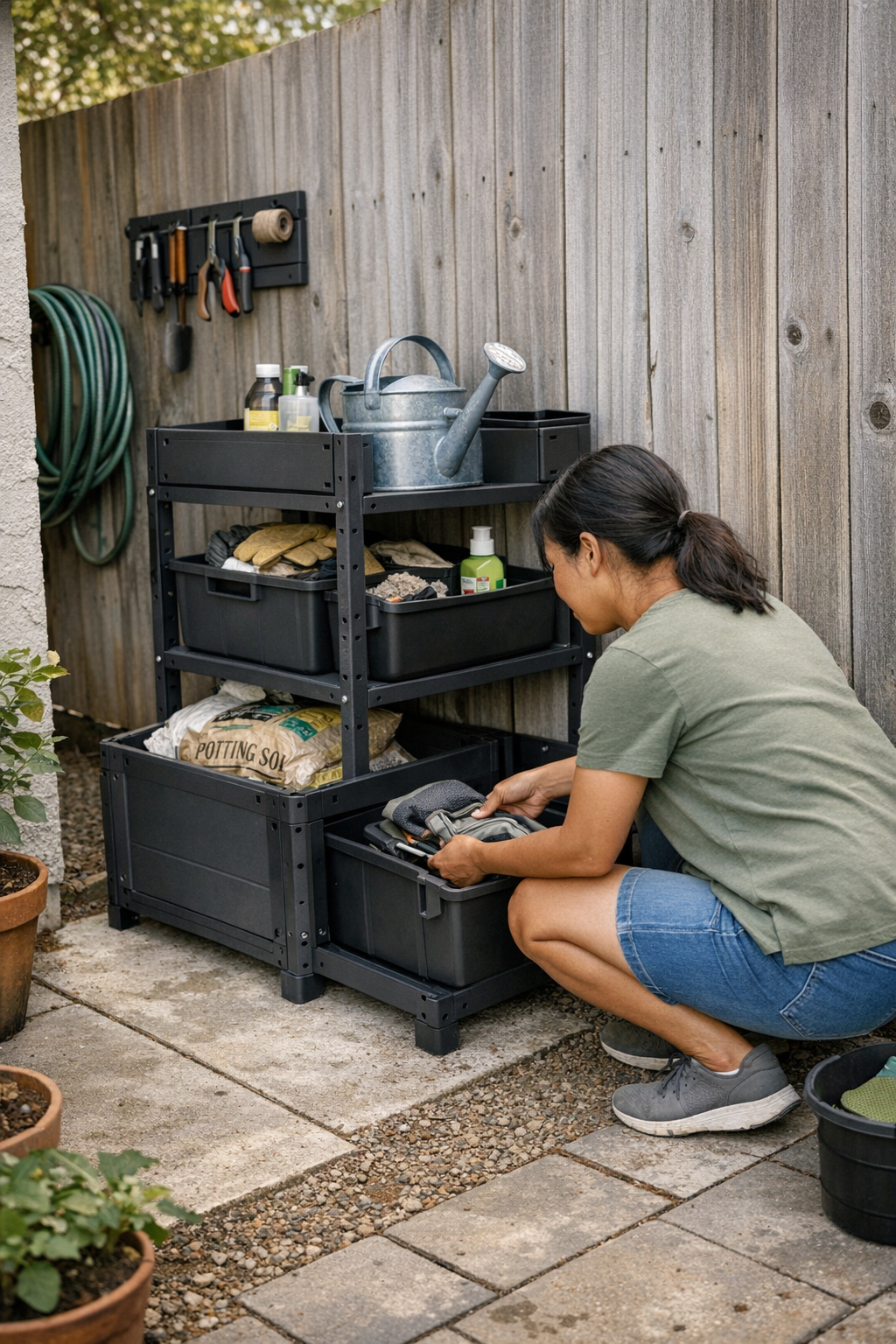
    Stacked bins try to keep order by hiding gear. Modular wall strips, open rails, or shelves shift order into motion: everything sits uncluttered, visible, ready to grab. At first, the wall rack full of shovels or pegs lined with gloves can seem busy—less visually tidy than matching tubs. But once outdoor tasks ramp up, the setup doesn’t unravel. You use one item, you return one item—no reshuffling, no leftover pileups.

    After a round of planting, you drop the trowel right onto its peg, hang up the gloves, and move on. Even with dirty hands or arms full, you can reset the area in seconds. The system doesn’t just look organized; it actually stays that way. Shared spaces suddenly work for everyone: no more decoding which bin holds what, no more “I’ll fix it later” dumps in the path, no more depending on whoever set the system up in the first place.

    Real-World Reset: Garage Edge Revisited

    This shift only feels real after you’ve lived the before-and-after. My patio cabinet, once packed with lidded tubs, lasted a few weeks before weather and routine opened the floodgates. Each trip meant digging through the bottom bin just to grab one bag of soil. Rain turned the ground around the cabinet into a catch-all: garden tools, boots, and empty planters crowding up the path. By May, my supposedly space-saving stack had doubled its footprint—but made moving through the zone a headache.

    Switching to an open rail and shelf, easy to reach and no stacking involved, changed the reset entirely. I could shove boots back onto an open rack and hang trowels straight from the door—no bins to open, nothing to move out of the way first. Even on wet days or with the pace of group cleanup, returns never clogged the entry. There wasn’t more storage; there was just less buildup, fewer obstacles, and an ease that stuck through the season. No more shifting two bins just to put one tool away—and no more micro-clutter dragging down every routine.

    Small Changes, Big Difference to Movement

    The worst blockages start right by the access points. Whenever you need to step around a bin, unstack a tub, or sidestep a jammed-in chair just to return one tool, clutter wins. Corners meant for easy passage quietly transform into overflow zones—the hidden graveyard of “temporarily” stranded boots and project leftovers. Even the least-used spot can become a dead space, a magnet for mess as soon as normal routines speed up.

    Modular wall systems or visible shelf zones flip that routine. Movement through the area stays clean; putting items back doesn’t trigger a domino effect of tidying. The next person in doesn’t face a mess from yesterday. Instead of warning kids, guests, or partners to “watch the pile by the door,” the area handles itself—a frictionless reset instead of a reluctant chore.

    From Dead Corners to Real Utility

    Some trouble zones never look “messy” until you see how they work. The side of the garage or a fence-line often collects stray gear: sports balls rolling into the open, tools set aside for “later,” garden supplies after a busy weekend. Closed bins claim to solve the problem, but the minute someone needs the lone basketball or hedge clipper, it resurfaces—forgets to get put away—and starts blocking the path. That one spot becomes a vortex for overflow, and the awkwardness spreads to every other border zone.

    The simplest fix is to make these corners accessible for real use: hang a low wall rail, mount a pegboard, or install a one-row shelf—just high enough for anyone to grab and to return what they need without ever stacking. Small layout tweaks—dropping a pegboard by six inches, adding a ledge by the backdoor—change how quickly gear comes and goes. Every step toward open movement is time gained for actual yard work, not just cleaning up last week’s clutter.

    Stop Hiding: Choose What Actually Works

    Shoving everything out of sight is the most tempting version of order, but relief comes from never having to move three things just to use the fourth. It’s not about perfect optics—it’s about not being interrupted by your own storage system. If you can return a rake, tuck a chair, or put back boots without a chain reaction of shifting, your space works. If you need to unbury bins or stack lids after every use, it’s time for a reset.

    See where your setup stalls, what triggers overflow, and which corners become the unofficial dumping ground. Lean into open, modular options that match how your yard gets used—not just what fits the space at rest. The right storage zones clear movement, cut down on daily reshuffling, and keep your outdoor area ready, no matter how many hands use it or how often the routines shift.

    See setups and outdoor storage solutions focused on real utility at TidyYard.
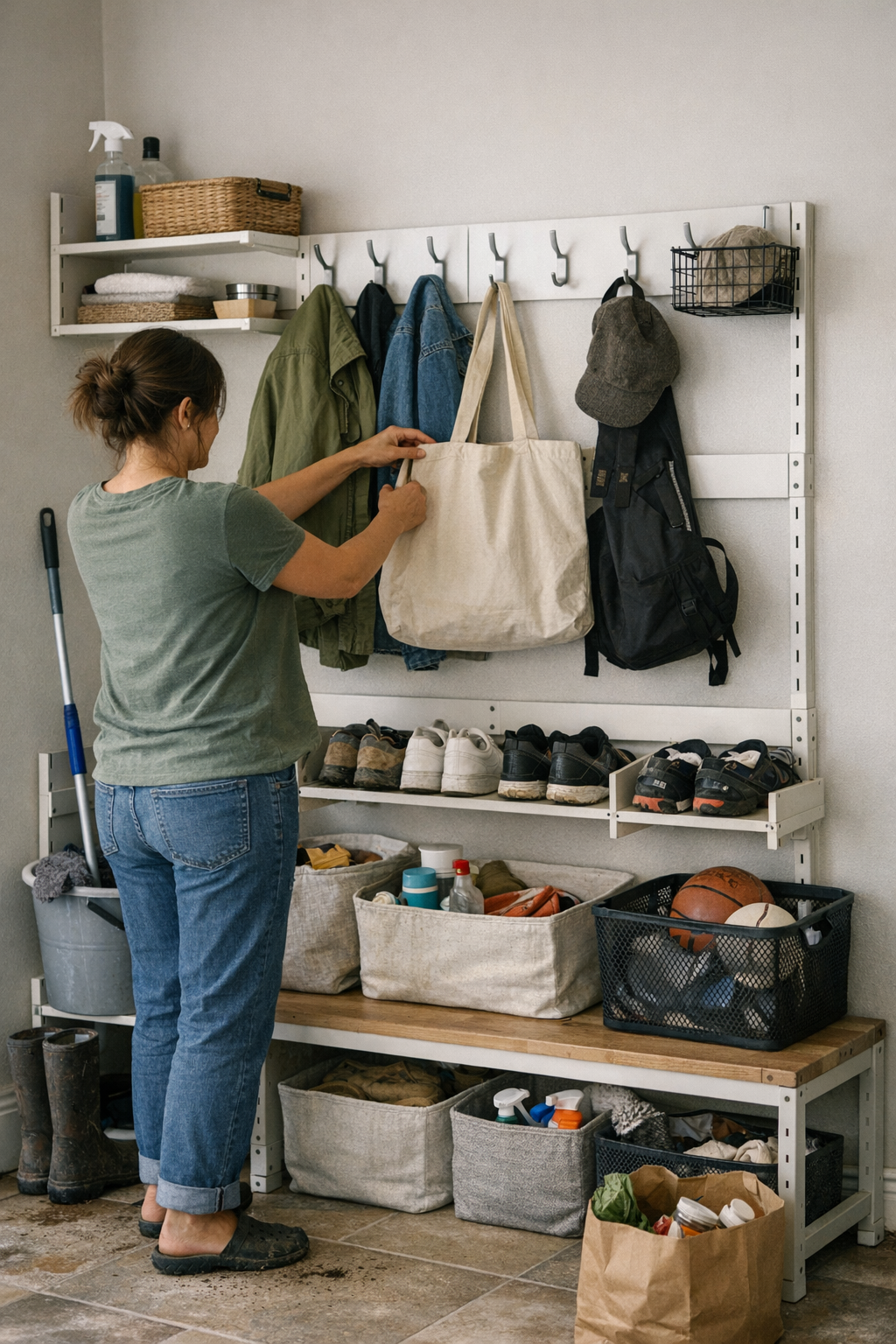
  • How Wall-Mounted Storage Transforms Utility Room Flow and Order

    The breakdown always starts right at the threshold. In a utility room or any entry area forced to double as a landing zone, storage “systems” unravel quickly under real use. One rushed arrival, and the lineup—shoes, bags, coats, cleaner bottles—immediately overruns what seemed like enough space. The bench, if it exists, shifts from a spot to sit to a magnet for overflow. By midweek, the entry “setup” doesn’t keep up. A space can look organized from the doorway and still turn into a maze of shoe piles, toppling bags, and too-narrow walkways almost overnight. The real divide isn’t between tidy and messy—it’s between zones that absorb daily routine, and those where each reset just buys you a couple more days of crowding and detours.

    When Clutter Quietly Takes Over

    Clutter doesn’t barge in; it seeps through the cracks of weak storage. The shoe rack somebody thought would corral boots until spring fills up by the second wet day. Hooks mounted at the “ideal” height seem clever until a heavy bag shares space with two backpacks, and the whole cluster ends up slumping off the rack onto the bench. That tall basket intended for hats and gloves? It morphs into a dumping spot for whatever nobody wants to deal with right now—leashes, delivery packages, a stray grocery bag. The result is slow-motion takeover: every quick drop-off leaves behind another layer to work around. A pair of wet sneakers multiplies by Thursday, pushing clear paths into obstacle course territory.

    Everyday Movement Becomes Negotiation

    Function breaks down before looks do. A utility room or threshold zone isn’t just storage—it’s traffic flow. When overflow creeps onto benches and blocks the floor, returning with groceries or laundry turns into a series of minor evasions. Setting anything down becomes a calculation—will this trip someone, will it dry, will it even stay put? Every detour adds friction that nobody planned for. Before long, just getting out the door means pausing to reshuffle or sidestep someone else’s earlier detour.

    Why Single-Solution Setups Break Down Fast

    Sleek hooks in a row, that fresh bench beneath… they settle in nicely for about a week. Then the real routine begins: kids latch onto the lowest hook, oversized jackets overflow, and heavy totes never hang up. Shoe rows, so satisfying when empty, break formation and edge out past the bench limits, wet treads spreading wherever there’s bare floor. “All-in-one” baskets hide the mess instead of sorting it—what was a glove bin now eats mismatched gear no one can find later. The neat setup becomes a scene of category drift and failed boundaries, fast.

    Visual Calm vs. Mixed-Use Reality

    The quiet order of a newly set bench evaporates at crunch time. Garden shoes, rain gear, and rogue totes pile up, joined by bags of groceries and sports equipment. Cleaning supplies lose their assigned spots and migrate to wherever there’s a gap. Unclear boundaries—like a bench edge not sharply separated from shoe storage—invite a steady overflow. The difference isn’t subtle: what looks organized out of use collapses as soon as the routines overlap. Predictable chaos returns if your storage can’t make mixed use obvious and easy.

    Designing for Repeated, Overlapping Routines

    Storage isn’t universal—routine differences expose weak systems. What can look “organized” in a photo rarely fits the mixed flows of real use, especially when several people are coming and going. Wall-mounted racks free up floors, but if they’re set too high or the sections are vague, people bypass them. Drop zones blur: a bag lands on the bench instead of a hook, a muddy boot gets left on the edge instead of the shoe slot, and slowly everything creeps toward the easiest open surface. The moment three categories hit the room at once—mop bucket, school stuff, muddy gear—your original plan collapses into catchall chaos.

    Segmented Storage Makes Return Flow Easier

    A wall panel split by use—shoes low, bags and coats above, side rails for tools—provides a self-explaining map. Each section signals what goes where. The difference is practical: someone dumping a stray tote on the bench stands out immediately, so a quick grab puts it back in slot and the flow resumes. It’s not just a tidier look; it’s a friction reduction—less lost time, fewer late-night resets, and visible signals when the routine gets off track. Well-marked slots cut down how often you need to “start over” just to make the room passable again.

    Practical Scenes: Stress Tests in Daily Use

    Typical afternoon crunch:

    • One person drops muddy shoes and a garden tote at the edge because no slot is clear; existing shoes compress, and the bench is half-blocked again.
    • Another hauls laundry and groceries, finds the upper hooks out of reach during a rush, and everything lands on the nearest flat surface.
    • A wet mop bucket, left even briefly, blocks the path so everyone detours through tight gaps rather than a clean pass-through.
    • Sports gear—helmet, pads, a rogue water bottle—spills into the walk zone, nullifying any hope of keeping the entry clear.

    When temporary placements harden into blockages, routines unravel. Each makeshift stop reinforces the mess. The slow squeeze—extra minutes cleaning, returning, or just escaping the house—becomes daily background noise.

    Making Utility Storage Actually Work: Small Shifts, Stronger Flow

    Replacing baskets and guesswork with a segmented wall panel at reachable height can flip the pattern. Place shoe slots low—no bending or confusion over whose go where. Space coat hooks just enough to stop bags merging into a single tangle. The bench returns to its original job: a brief stop for putting on boots, not a graveyard for overflow. Preserve a visible sweep zone under the lowest rack—no more emptying half the floor before you can vacuum. Every design tweak fights clutter drift and forced reshuffles.

    Category Drift and Slot Discipline

    If shoes or bags start creeping sideways into new territory, that’s the system giving up boundaries. Assign each person a row, and don’t let unused pairs or random bags settle in for the long haul—rotate them out. Visible, divided slots keep categories from blending and from turning the routine into maintenance work by Wednesday.

    Mounting Height Matters

    Vertical storage can be your strongest tool—but misplace it, and it barely gets used. Anything mounted too high gets ignored on busy days. Hooks and racks should meet people at their real, not theoretical, reach. If unloading groceries means dropping bags on the floor because a hook is too high, the system invites failure. Make every access point match real daily movement.

    Blocked Thresholds vs. Open Movement

    The core question: Can you move through, even when it’s busy? Storage that works preserves a clear threshold even after the third messy arrival. If shoe rows crawl into the aisle or bags crowd the bench, the setup is failing under real pressure. Segmented, wall-mounted panels limit spillover—open baskets and unsorted benches just soak up clutter til they’re full, then leak into the walkway. A single bench edge collecting all “last stop” items is your red flag: your layout isn’t absorbing pressure, it’s just staging it for the next reset.

    The Subtle Impact of a Better Setup

    The real payoff isn’t visible after a one-time reset—it shows in how little you have to fix each night and how soon you notice something drifting out of place. If the clear zone near the door holds up even on muddy, gear-heavy days, you’re not just tidier: the utility space runs quieter, smoother, with less late-night maintenance. Tuning boundaries, accessibility, and separation over time steadily reduces the drag of nightly re-sorting. The difference isn’t just order—it’s less friction in every pass-through and fewer obstacles to leaving and returning at speed.

    If your entry area depends on improvisation and constant reshuffling, the tradeoff is daily: more friction, more lost time, and more frustration. A better foundation—segmented storage mapped to your home’s actual return flow—restores order not just for looks, but for movement and routine. See Betweenry’s practical storage options designed for real transition-space routines.

  • Why Breathable Underbed Storage Bags Keep Linens Fresh Longer

    Underbed linen storage looks like the obvious answer for tight bedrooms—until the hidden tradeoffs start stacking up. That underbed zone promises clear shelves and easy resets, but in real use, it can turn into a cycle of musty sheets, baffling slowdowns, and extra laundry. What’s sold as a low-profile solution quickly becomes one more system to fight: bedding packed away clean re-emerges slightly stale, resets take longer than they should, and the space you “freed up” ends up pushing new clutter to other corners. The difference between just hiding bedding under the bed and actually making everyday resets smoother only shows through real routines—especially when fresh backup linens are supposed to be ready at short notice, not just tucked out of sight.

    The Hidden Drift: When Linens Go Stale in Storage

    Pulling the storage bag out the first time feels like progress. Everything’s zipped away, shelves look clearer, and there’s even room in the closet again. But weeks later, friction reappears: the bedding that went in crisp and clean comes out oddly flat—sometimes with a faint, stale smell. The outside’s still tidy, but the next swap stalls at the first sniff-check. You’re left with an unpleasant choice: use linens that don’t feel fresh, run an unplanned late-night wash, or start reshuffling other storage zones to find a better set. This isn’t a one-off nuisance; it quietly repeats, turning quick resets into a new kind of slog.

    That extra rewash is a real cost. Shared rooms or multi-use setups especially can’t afford slow reset cycles. Instead of a grab-and-go swap, you’re stuck airing sheets in the hallway or scrambling through layers of storage you were supposed to avoid. “Stored and ready” rarely lives up to the name when underbed setups don’t actively keep linens usable.

    Breathable vs Airtight: Where the System Fails First

    The everyday difference between airtight bins and breathable underbed bags isn’t about looks—it’s about how well routines hold up. Airtight plastic bins or vacuum bags feel efficient and promise dust protection. But sealed storage traps even trace moisture, especially if bedding gets packed away before it’s bone dry or if the weather’s humid. After only a few weeks, that sealed environment turns crisp sheets dull. The first attempt at a quick reset often reveals a wall of invisible setbacks: linens need re-airing or rewashing, and your “organized” storage is actively slowing you down.

    Breathable bags—especially those with dense cotton or mesh panels—let air circulate just enough. They rarely look showroom-sharp, but you can grab sheets without a pause: no stale odors, no lost minutes to extra prep. The payoff is subtle but immediate during changeovers: bedding is ready when you are, not held hostage by the storage choice.

    Real-World Reset: Where Airflow Makes or Breaks It

    Picture a normal weeknight. You reach under the bed for guest linens ahead of a late arrival. If airtight bins have locked in must and condensation, your options shrink: run a last-minute wash, settle for less, or scramble for a backup buried in another zone. The friction of a delayed reset only gets worse when you have multiple beds or frequent guests. A setup that promised more calm just passed the work along to you, one slow reset at a time.

    How the Wrong Setup Becomes a Hidden Time Sink

    Neat stacks and dustproof bins can disguise the real failure: storage that requires too much interference. If you find yourself dodging the bottom layer, pulling sets early to air them out, or avoiding the underbed stash entirely, the system isn’t working. Quick grabs become a hassle. The “organizational win” that looked so sharp—lined-up bins, hidden clutter—quietly adds up to shuffling, decision fatigue, and stray backup sets drifting anywhere there’s open space.

    In small rooms or shared spaces, every inch is supposed to serve a function, not just a visual ideal. Repeated micro-delays—wrestling out bins, checking for freshness, dodging damp in the corners—multiply until your storage is a source of friction, not relief. You lose time, linen availability, and any sense of routine flow.

    Breathable Bags: The Imperfect Edge That Makes Resets Work

    Switching to zippered, breathable underbed bags may mean giving up those razor-straight lines. But the difference in actual use is immediate. Linens stay fresh for weeks—not just shielded from dust, but actively ready to use. Instead of sniff-testing, airing, or returning to re-sort, you pull out bedding and go. The shape may sag and shift, but the workflow stops tripping over itself. The best setups are the ones you barely think about: when beds can be made in a single motion, and storage stays neutral instead of hijacking your reset routine.

    Practical Underbed Linen Storage: Real Tips, Not Just Theory

    • Pick breathable bags with tightly woven or mesh panels. They block dust but let enough air through to keep linens fresh, even during long gaps between uses.
    • Always pack linens bone dry. Even slight dampness triggers must or mildew—wait those extra minutes for cool, dry fabric.
    • If dust keeps breaking through, line the bag with a washable cotton layer rather than switching to plastic, which traps more humidity than it blocks dust.
    • Build in a gentle reset: Every 4–6 weeks, open the bags, shake, and refold. This low-effort move prevents stale buildup and flagging freshness.
    • For humid rooms, a brief monthly airing is often enough—don’t wait for a problem before acting. A missed refresh only gets noticed when it’s too late.

    The “Organized” Look vs. a Setup That Actually Works

    The line between order and function shows up in how easily you can keep the system running—not how perfect it looks after you set it up. Airtight, stackable bins push clutter out of sight, but keep you coming back to troubleshoot. Breathable bags trade style for reliability: access is faster, resets flow without extra steps, and hidden friction fades away. Over months, what matters isn’t dustproof perfection, but the hidden cost of organizing that can’t keep up with daily use.

    Practical underbed storage isn’t a one-shot improvement—it’s a quiet difference you feel every time you change the sheets, or don’t have to. See more practical storage ideas at Gridry

  • Choosing Outdoor Storage Structures That Keep Your Yard Organized Over Time

    The difference between a good outdoor storage setup and a bad one isn’t just space—it’s what happens the fifteenth time you try to move through it. The side yard that looked “sorted” two weeks ago is now an obstacle course of half-returned gear, stray bins wedged just out of reach, and a shovel that’s back in your way, again. You know the drill: you meant to create order, but each rainy day, extra trash bag, or spontaneous clean-up exposes where your system quietly breaks down. In real backyards, garage thresholds, and narrow utility strips, the gap between “fits your stuff” and “fits your routine” shows up fast—and the friction piles up even faster.

    The Real Impact of a Storage Mismatch

    No one buys a shed or organizes a utility corner expecting daily annoyance. But layouts chosen mainly for looks, or by measuring boxes instead of habits, almost guarantee slow-motion trouble. What begins as one tool out of place becomes a sequence: bins blocking the path, bikes leaned against the wrong wall, and overflow that never finds its way home. The big clue isn’t the mess after a busy Saturday—it’s how many steps you add to put anything back on a regular day.

    • Walkways that pinch down as tools compete for wall space, refusing to fit hooks meant for something else.
    • The gate area earning a permanent pile of yard waste bags, “just for now” until next week slips by.
    • Bins supposed to hold tools filling with unrelated clutter, because actually opening the shed for a small return feels like overkill.

    Individually, these moves are small. But over a month, the structure starts dictating where you step, what gets used, and how much energy you spend redoing what you “fixed” last time.

    Wall, Modular, or Fixed: What Happens Over Time?

    In almost every backyard, side strip, or garage edge, storage fits into one of three worlds—in theory. In practice, each fails and flexes differently when real-life use stacks up:

    Wall-Mounted Systems

    Good wall systems pull brooms, bikes, and hoses out of the walking path. But the strength is measured by return flow. If your most-used rake is forever half off its hook, or fat rails eat up wall space without matching your actual stuff, you haven’t gained ground—you’ve created new dead zones. Over time, “I’ll just lean this here” becomes a small heap that grows whenever you’re busy.

    Modular or Movable Setups

    Bins and caddies promise flexibility. Movable units seem perfect for changing seasons or adjusting after a cleanup. But watch the edges. When the boundaries between bins fade, the clutter migrates—tools and toys spill onto the floor or cluster in tight walkways. Mobility is only an upgrade if the parts actually defend their zones instead of blurring them.

    Fixed or Traditional Sheds

    Sheds hide piles and keep patios tidy—until you need anything from the back. Boxes bury each other, “occasional use” supplies eat up reachable space, and simple swaps (move the mower, grab the hose) become mini-projects. Post-storm or after big jobs, the slow, sweaty reset means more is left outside “just until tomorrow,” and the cycle sets in.

    Where Return Friction Shows Up Fastest

    Return friction always reveals the weak link. You notice it in these moments:

    • Finishing up outside and realizing every “quick return” turns into a stash pile by the back door.
    • Finding hoses and hand tools leaning against the fence because the storage bin is too far, too buried, or too annoying to open.
    • After a busy weekend, seeing the garage or side yard threshold jammed with stuff no one wants to carry back “all the way.”

    Most small-yard or side-area layouts already feel tight. When bins and hooks start repelling more returns than they absorb, your outdoor routines pay the price: detours around fresh clusters, squeezing past overflow, or forgetting what’s stored where until the next forced tidy.

    How Setup Choices Really Shape Routine

    It’s not just about dust or clutter—it’s about the rhythm you’re forced to adopt. If bike hooks are angled wrong, bikes end up parked on the mat. When “modular” bins have no clear purpose, tools migrate off-base and play musical chairs across the patio. In classic sheds, the row of things left out after the first seasonal shuffle tells the real story: resets are draining, and staying “organized” costs more energy than it saves. Suddenly, every walk through the zone is an obstacle course of yesterday’s quick fixes.

    Scene: The Daily Blockage Loop

    Picture the side yard: wall rack lined with small tools, while the big rake leans (again) in the walkway because nothing fits. Muddy gear after rain? Too much hassle to hang, so it joins the stack. Each messy day pushes you further off-track, until walking to the gate requires sidestepping a melting cluster that grows rain by rain.

    The Reality of Overflow and Awkward Zones

    Some outdoor corners just won’t play along. A bin shaped for balls and scoops doesn’t fit a folded chair, so both end up awkwardly off to the side. When garden gear invades general storage, neither routine works well—each grab-and-go needs a shuffle, and every tidy-up reroutes tomorrow’s movement. A spot that should make the yard smoother becomes a trap, only looking organized after a big reset, while the real-life routine keeps wearing uneven paths through the area.

    Everyday Example: Reset Fatigue

    You haul the trimmer out to mow, but later, the bin’s already overloaded. Lean it against the shed “for now.” Within weeks, a ragged row of “temporaries” claims the footpath. The frustration isn’t just lost space—it’s realizing every chore ends with an extra round of navigating the unintended obstacle course you didn’t plan for.

    When To Rethink—and What to Look For

    If a space gets reset more than it gets used, something’s off. The clues are everywhere:

    • Paths narrowing until you walk sideways.
    • Garage or shed doors that can’t swing open because overflow blocks access.
    • Unused wall hooks while pathways get packed.
    • Every attempt at “putting things away” becoming an all-Saturday event instead of a simple step.

    These are not minor frictions—they’re setup failures that ask too much in exchange for so little order.

    Fixes That Actually Change Flow

    A truly workable setup puts movement—not just capacity—first. That usually means a few key changes:

    • Switch in heavy-duty, right-shape hooks—solve for your gear, not for someone else’s list.
    • Break one overcrowded zone into smaller wall units or modular bins, each with a clear “home base,” ending the pile-up of everything at once.
    • Shift the drop spot for overflow bins away from routine paths, so stray returns don’t choke the walkway every time the weather turns.
    • Stop combining seasonal storage and daily-use gear in one traffic jam—let each zone serve one purpose clearly so routines don’t compete.

    Quick tip: After any “busy” outdoor day, walk the area. Which items always get left out? Which bins or hooks get skipped? Target the fail points next—not the place that merely looks the cleanest after a round of sorting.

    The Payoff: A Space That Actually Works With You

    The right setup doesn’t make you work to keep it working. You feel it in little wins: nothing blocks the gate after guests leave, the sidewalk stays open even after a kid’s game, and returning a tool doesn’t mean moving four others or sidestepping a pile. Boundaries stay predictable. Resets shrink to a sweep, not a project. Function outlasts the “just organized” look; the space supports your rhythms, instead of resetting after every busy day.

    Find real-world storage ideas—from wall racks to modular bins—built for actual backyard, side yard, and patio utility, at TidyYard.

  • Why Entryway Storage Placement Makes or Breaks Daily Clutter Control

    Every entryway reveals the same pattern within days: shoes pile up by the threshold, bags drift out of immediate reach, and “temporary” piles tighten the very path meant to stay clear. The promise of entryway storage is control—but the reality depends on where your key storage actually lands. If your shoe rack or bench sits even a step or two too far from the actual flow, the chaos returns, fast. The wrong setup quietly overloads the edge zone, forces awkward detours, and turns simple routines into repeat obstacles you never planned for.

    When Storage Lives Too Far from the Action

    The instinct is classic: keep the entry picturesque by pushing storage deeper—stacking racks, benches, or cabinets beyond immediate sight, lining up hooks on walls past the landing zone. For a day, maybe two, the front feels open. But as soon as daily life resumes—a fast in-and-out, arms full, kids darting through—the separation breaks. Here’s where friction gets real:

    • Shoes stall right beside the mat, never making it back to the distant rack.
    • Bags cluster around the path “for now,” waiting for a reset that gets bumped by the next arrival.
    • Mail lands on the nearest surface, rarely migrating beyond the entry until habit or schedule allows.

    What starts as rare slippage turns quickly permanent. Those extra few feet kill the reset. Instead of order, you inherit a rolling obstacle course no one claims, but everyone works around. The myth of a tidy, far-off storage zone dissolves the second repeated use exposes the drift.

    A System that Breaks Down Under Real Traffic

    Peak hours reveal the cost. Mornings mean frantic exits; evenings bring tired arms, wet boots, and the familiar traffic snarl. Here’s what actually happens in homes that push storage too far away:

    • Overflow squeezes the threshold where room is tightest, not in the controlled “storage” area.
    • The bench lost by the far wall sits empty as shoes erupt around the door.
    • Bags and jackets drape over chairs, pile up at corners, or hang awkwardly from door handles—visible stopgaps, not systems.

    Instead of fixing clutter, remote setups move the overflow to the worst spot. The entryway clogs. “I’ll clear it later” becomes a nervous refrain. The cleanup backlog grows—and with each reset deferred, the clutter forms a semi-permanent blockade at the only space that can’t afford it.

    Near vs. Far: It’s Not About Looks—It’s About Routine

    Compare these two setups:

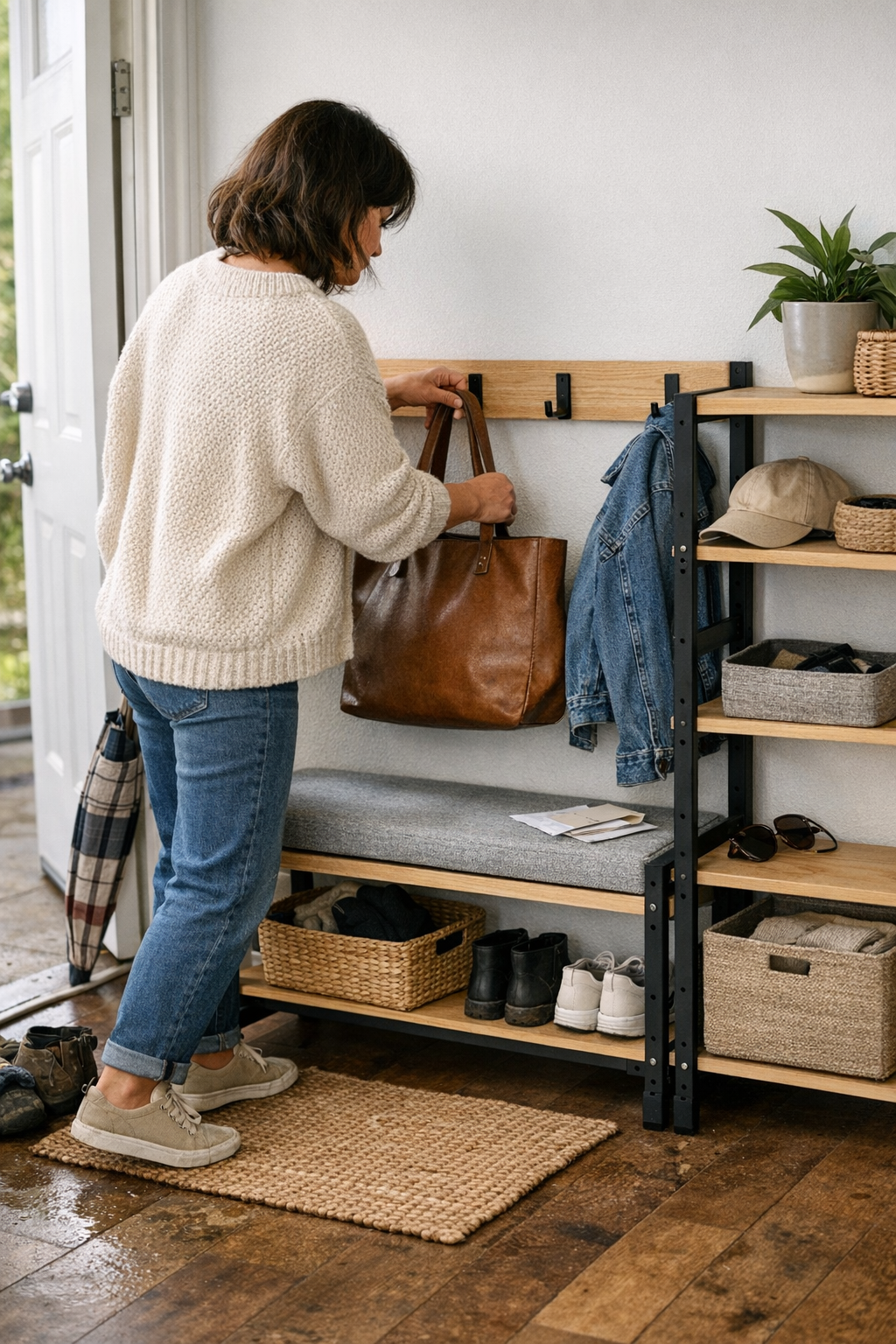
    • A wall-mounted bench anchored just inside the threshold.
    • A slim vertical rack further down, out of the initial path—neater in photos, harder to reach.

    Both seem neat on day one. By week’s end, the contrast is sharp. The distant rack collects only what someone bothers to carry; the bench by the door becomes the actual reset point. Shoes, bags, coats—everything lands on the closest available surface. Reaching deep for storage turns into an exception, not a habit. The result? The “for now” pile stakes its claim right at the boundary, growing with every return.

    The near-bench option does something crucial: it makes reset almost automatic. Entry storage only works if it’s impossible to miss in real-life flows. Too much distance, and the micro-reset collapses. Annoyance trumps intention, and clutter wins by default.

    The Reality of Clutter Creep

    Small moments expose the system. Picture three people coming home on a wet day:

    • Boots too soaked for the rug get abandoned at the door—forming a ragged wall after just two arrivals.
    • Grocery bags demand an immediate drop, turning the nearest open floor into a clutter magnet.
    • Backpacks, gym gear, and jackets cluster at the pinch point, forcing each newcomer tighter into the pass-through.

    This isn’t about laziness; it’s about friction at the margin. When the most-used storage isn’t right at hand, “temporary” fixes repeat until the path jams up and resets feel punishing. Entryways built for clean lines but not real behavior trade functional flow for short-lived appearances.

    What Actually Changes When You Move Storage Close

    Shift your core storage—bench, hooks, shoe rack—just inside the threshold and the effect is immediate:

    • Shoes and bags drop naturally during entry, not after a forced trek past the action.
    • Small resets—straightening shoes, sweeping grit, restoring order—become near-automatic because they’re on the way, not out of the routine.
    • Overflow shrinks. It’s easier to return things right where habit forms, so piles don’t take over.

    The simplest diagnostic: for one week, watch where things actually end up. The “official” storage zone is whatever surface captures daily use—not the one that looks best when staged. Every unintended cluster tells you where the friction lives. If dealing with shoes, bags, or coats is still awkward, the storage is too far.

    Using Far Docks Wisely

    Remote cabinets, large vertical racks, corner benches—they have a job: off-season boots, extra gear, overflow for items you rarely touch. But for everyday shoes, coats, and bags, the only zone that works is the one you walk through with full hands and zero patience. If it’s not within the path of entry, reset never becomes routine.

    Put distance to work by reserving the farthest spots for rarely-used items. Force daily essentials to live on the front line—so returning them is easier than avoiding the reset. Storage should help your default, not add steps to every start and finish.

    Recognizing When Your Setup Isn’t Working

    Watch for the signals: stepping over repeat piles, promising “I’ll sort it tonight,” or fighting with a buildup that undermines your open space. If your storage makes you work around stuff instead of with it, you’re resetting the wrong problem. The cost isn’t just mess—it’s everyday drag, path congestion, and the steady stress of never quite catching up.

    Choose storage just one stride too far and frustration compounds. The zone stays tidy in theory but fails in daily practice—a universal hurdle, not a personal flaw. Most layouts are built for how a transition looks, not how it holds up under repeated, untidy use. Routine, not appearance, is the axis that matters.

    Entry Storage That Works With You, Not Against You

    Every transition-space setup fails or succeeds by how it handles imperfect, repeated entries—not by the order captured in a single tidy moment. Storage that sits where the pressure is sharpest—within reach as you come through the door—carries the flip: resets happen by default, not effort. Even a small shift—a bench moved closer, a wall rack added at the edge—can break the cycle between intention and overflow for good.

    If you’re caught in a loop of constant reacquisition, reset, and never-quite-clear passage, don’t just clean harder—move your storage to where your habits insist on landing. The right setup isn’t invisible: it works because it puts the fix in your way, not out of it.

    http://www.betweenry.myshopify.com

  • Why Dustproof Underbed Storage Cases Are Essential for Quilt Care

    Underbed storage looks like the simplest way to fix quilt and bedding overflow—until the shortcuts start costing you time. One poorly chosen case or flimsy bin is all it takes to turn a smooth bedding swap into a dusty, awkward reset. Instead of grabbing a fresh quilt, you find yourself dragging out boxes that look organized from the edge but guarantee another round of rewashing, shaking out, or delayed changeover—all because the underbed zone never actually stays closed, clean, or easy to use when seasons shift.

    The Invisible Cost of “Nearly” Organized Storage

    Sliding neat bins under the bed gives an immediate sense of progress, but even a week or two of real use exposes quiet failures. Lids pop halfway open after a single tug, plastic bins flex and gap as you nudge one aside, and even “sealed” containers collect lines of fine dust or pet hair by the next swap. Those steps you thought would shrink the bedding project—slide the bin, flip the lid, grab the quilt—get interrupted by the need to check for debris, shake out dust, or worse, rerun laundry for things that just sat too long in a not-quite-closed case.

    The breakdown is subtle but relentless. The first time you put off putting away a comforter because the box isn’t actually clean, it feels minor. By the third or fourth cycle, the underbed area creates its own friction. You end up stacking overflow at the edge, finding hidden lint stuck to new corners, and moving the same bins around with growing hesitation. What you pictured as sorted storage now steals time from every reset.

    When Visual Order Fades Into Hidden Hassle

    The gap between looking organized and staying usable grows with every bedding change. Open bins and matching boxes deliver a clean underbed line, but daily reality cracks through after a month. Stack or pull a case, and the slip of a lid or popped corner lets dust creep in unnoticed. The next time you want to swap a quilt, you’re opening three bins just to find a set that feels clean enough. That promise of a streamlined system fades fast—replaced by extra sorting, stalled resets, and the visible creep of things you meant to solve for good.

    Take a typical weekend: after a determined deep clean, you line up bins perfectly, telling yourself this time the storage routine will last. But within the season, the cycle returns: you stand on the balcony shaking out a quilt because fine dust worked straight through the case. Bin by bin, the time you thought you’d saved leaks away—and that illusion of control quietly gives way to another round of blocked movement and half-done returns.

    Long-Term Use: Where Real Storage Choices Show

    Underbed storage setups don’t break down on day one—they wear thin by the fifth bedding change, or the first time a pet sneaks under the bed, or after an unplanned cold snap. The wrong case starts to sag, shift, or leak dust at the seams; what seemed like a “dustproof” bin loses the fight after a few moves, while anything soft-sided warps after a season of bumping cases around. When the system stumbles, your routine starts collecting friction: laundry piles up, resets get delayed, and the underbed area turns into storage you dread touching instead of a functional extension of the room.

    One design change—switching to a zippered, rigid-edged, tightly sealed case—alters the flow immediately. The minute the case doesn’t collapse or leak, you skip the air-out, shrink the laundry queue, and pick up the reset without second-guessing. That change in the underbed zone isn’t just about keeping things neat; it finally lets you move bedding in and out without the multi-step hassle that cheaper solutions always promise to solve but never do.

    The Surprising Pitfalls of Skipping Measurements

    Even the best case fails if you skip the setup basics. Bin only a half-inch too tall? You scrape it every time, wearing through slats and destroying the floor finish. Cases crammed too slim lead to flattened, lifeless quilts—nothing feels ready for use, and the bedding you swap in never restores its shape. More than one “fits-most” solution ends up parked sideways or half-pulled out, blocking movement and making you wish you’d just left everything in a closet instead.

    There’s no shortcut: measure your underbed clearance and check the folded dimensions of your thickest quilt. A good case glides straight to the wall and pulls out clean, no awkward shuffling, no jammed corners, and no daily temptation to pile overflow somewhere else.

    Sealed, Zippered Cases: Less Work, Not More Steps

    The myth: open bins make for quick access. The reality: every open edge or snap lid is one more breach for dust, humidity, or pet hair. Long-term, those “convenient” entry points bleed slow chaos into your routine. Lids warp, plastic shifts, and each nudge turns the whole system more fragile, more out-of-sync. Every time the seal drifts just a bit, small failures build—by the end of the season, the system you built for efficiency now creates extra maintenance instead of saving effort.

    Switching to a fully zippered, reinforced storage case brings visible difference. Rigid sides prevent collapse, seals finally hold, and resets don’t get interrupted by cleaning or sorting. What seems like a small hardware tweak quickly shows up as fewer laundry days, faster bedding swaps, and less time lost to troubleshooting a “solution” that keeps almost working, but never quite does.

    Breathability: The Key Detail Behind Dust Control

    Kicking out dust can’t mean locking in moisture. Store quilts or down bedding in airtight plastic, and you trade dust for that stale, closed-in smell. Look for zippered cases that balance tight, dustproof panels with breathable fabric sections or vents—especially in zones prone to humidity. That detail makes the difference between bedding that feels fresh after a month under the bed and bedding that needs a forced air-out before the first use.

    The Real Payoff: Storage That Reduces Reset Friction

    Tidy surfaces count for nothing when every bedding swap adds to your to-do list. The actual value of a dustproof underbed case: it lets your storage vanish from daily thought. There’s no pause to shake out bedding, re-clean, or hunt for new hiding spots—resets become single-move, repeatably frictionless. Suddenly the underbed area works as an extension of your actual routine, not as a zone you keep rearranging or cleaning around. The benefit isn’t subtle the fifth time you reach for a quilt and it’s ready, shape intact, no lint to shake out, no laundry added—just grab, remake, and move on.

    Explore more practical indoor storage solutions at Gridry.

  • Why Modular Wall Systems Transform Outdoor Storage Efficiency

    Outdoor clutter rarely explodes all at once—it seeps in, one mislaid shovel or lopsided bin at a time. You organize your side yard or garage edge, snap the lids shut, and stand back with relief. But give it three weeks: a rake abandoned outside the chest, a bin jammed half-open near the gate, a narrow route made tighter by something that never quite finds its way back. Even with a picture-perfect setup, the wrong system turns routine cleanup into a slow-motion obstacle course.

    Why Even Neat Setups Collapse Under Real Use

    The confidence of installing a fresh rack or shiny new bin fades quickly once daily life gets rolling. At first, you’re careful: tools get returned, gear tucked away. Then one rushed morning, the hand trowel lands on the floor instead of inside the chest. Later, the mower wedges awkwardly beside a bulky bin you swore would stay out of the path. Each retrieval means another shuffle—the subtle start of storage that resists, rather than supports, your routine.

    These tiny detours don’t seem urgent at first. But when you’re bending over to pull items from behind a trunk or inching sideways past an overflowing tub, efficiency evaporates. By the middle of summer, all those small interruptions form a single grind: your storage looks passable, but moving through it is work.

    How Floor Storage Puts Your Routine in Reverse

    Picture your most-used outdoor corner—a side-yard strip lined with standing bins, or a patio edge with a deck chest. It holds everything, so it must be working, right? Until the next weekend when the kids’ boots collect near the threshold, the coiled hose stays slouched in the walkway, and you step over a garden fork blocking a bin you can’t quite reach without moving something else.

    This is how a “solution” thickens into a new set of problems: Returning the trimmer means sliding a bin out with your foot. Hanging up a rake is delayed by a stray tarp atop the chest. Corners gather random piles because actually accessing the main trunk feels tedious. Organizing by type or squeezing in extra bins just creates more surfaces for the next overflow—and the movement path you need is choked by the very system meant to organize it.

    What Changes When the Walls Carry the Load

    Now swap that bin cluster for a chest-high wall rail along your fence or garage edge. Hooks and mounts stage every daily tool—broom, shovel, clippers—exactly where your arm expects them. The ground isn’t just visible, it’s clear. No lid-lifting, no pile-shifting, no side-stepping around a chest angled too close to the walking line.

    • Returning clippers? Two steps up, done. No bending or skirting past obstacles.
    • Broom missing? It’s right there—not buried, not displaced, not interfering with anything else.

    This isn’t about overloading the fence—it’s about transforming the essential movement zone. The wall system pulls gear off the floor, so returns become a smooth, natural reach, not a ritual of moving things just to get through. What looks like a small layout shift actually unlocks “reset power”—gear returns are frictionless, and movement through the area stays wide open, not rerouted by overflow.

    Small Shift, Huge Return: An Everyday Test

    It’s one thing to imagine: here’s what happens after the change. Swapping a bulky deck chest for a wall-mounted rail instantly opened up nearly a foot of cramped side-yard space. The difference landed on the first busy Saturday—clutter stopped sneaking back into the walkway, and routine gear returns required zero step-over or reshuffle. No more fishing for stuck handles mid-task, no more closing the lid atop a tangle of misplaced stuff.

    Over a month, the improvement held. Bikes came and went; spades back on hooks after use; footpaths stayed passable. Overflow didn’t drift into corners. The new boundary was physical, not wishful—movement and storage started reinforcing each other instead of generating friction with every reset.

    Spotting (and Fixing) Return Friction in Your Setup

    The best outdoor storage is invisible when rushed, not just tidy when staged. So ask yourself:

    • Does putting away a rake trap a bucket behind a flipped bin?
    • Are you shifting containers every time you reopen the main path?
    • Is there a corner that magnetically collects piles despite “systems”?
    • Is your normal return slowed or derailed by one awkward holdout?

    If yes, it’s the system’s routine, not just its order, that’s failing. Labels and categories don’t rescue a layout that keeps the ground busy and the core route in flux. Even color-coded bins mean nothing if you’re caught untangling the same traffic jams after every project.

    Wall Real Estate Beats Floor Real Estate—Every Time

    Ground you don’t have to cross is value you feel instantly. Open floor space means fewer stumbles, cleaner lines, and a real path even in high season. A wall rail or rack lets every tool move separately—no shifting the domino row if you need something in the middle.

    And unlike “discipline-dependent” systems, this method doesn’t falter the first time you skip a perfect reset. Good wall setups hold the line, quietly shaping your returns and routines for weeks—while floor bins, however pretty, turn into storage speedbumps as soon as life speeds up.

    Practical Tip: Walk the Reset—Don’t Just Map It

    Before calling your setup done, physically act out your busiest reset. Grab the usual mess: shovel, bucket, rake, boots. Set them down, put them back, retrace your steps. Does the system slow you or make you adjust to it? If you’re looping or hopping over obstacles, keep refining. The best setup is the one you barely notice once real life resumes.

    The True Goal: Storage That Disappears Into Your Routine

    Functional outdoor organization isn’t hidden, it’s harmonious: the side yard, the fence line, the garage threshold—all work together, not against your daily paths. The right setup earns its keep by keeping movement clear and reset simple, no matter how many times you use the area. When your path stays open—and storage quietly stays aligned—you stop fighting the corner, and your space starts making sense for how you actually live outside.

    Visit TidyYard for practical outdoor storage solutions.

  • Placing a Vacuum Dock Near Entryways Boosts Daily Cleanup Habits

    You know an entryway’s real limits the instant things start going wrong: one muddy dog loop, a rain-soaked backpack, or the first cascade of grit after soccer practice—suddenly the “clean zone” collapses. Not because of lack of storage, but because the one tool that could erase the mess is out of reach. A vacuum or broom stored even just a room away turns every small cleanup into a delay, and that delay—day after day—means shoes grind sand deeper, benches hide pet hair, and a so-called landing zone fills up with debris waiting to be dealt with “some other time.”

    The Entryway Battle: Mess Arrives Sooner Than You Think

    Most of your home’s dirt and clutter doesn’t sneak in—it gets dropped the moment someone walks through the door. Shoes leave a chalky trail while bags and wet jackets collect on whatever bench stands closest. That “reset” feeling after cleaning fades fast; within hours, you’re back to stepping over sand, tracking grit, and nudging a bent row of shoes out of the traffic lane. The issue isn’t the quantity of storage, but the practical distance between dirt and the tool that reverses it. Stash the vacuum behind a closet, and even small reset moments vanish. You feel the friction each time: pause to fetch the broom, or let the debris linger and grow. The entryway is never still long enough for one good clean to last.

    One Room Too Far: When Access Delays Action

    If a cleaning tool isn’t within reach of the drop zone, it might as well be off-limits. Shoes don’t get a quick brush-off; wet leaves get ignored rather than swept away; that easy, “just a minute” vacuum pass becomes something you put off until the buildup is visible. The routine argues against interruption—nobody, in the middle of returning home or heading out, wants to detour to a back cabinet just for a spot fix. By the time you do, debris has found all the seams: under the bench, behind the cabinet, right at the edge of the mats. Entryways don’t reward good intentions. They only respond to what’s actually within arm’s reach during the rush in and out.

    Clutter Drift: When Clean Zones Slip to Chaos

    Even the best storage setups—custom benches, nested cabinets, carefully measured cubbies—lose against daily drift if they don’t keep a cleanup tool in play. Here’s what happens in real homes:

    • Shoes line up tight, but as crumbs and sand collect, the row spreads and loses its order. The mess underneath quietly expands the zone.
    • Bags and gear land neatly on a bench, but edges collect pet hair, dried leaves, and loose grit. The once-clear surface turns into overflow storage and sheds debris onto the floor below.
    • The narrow gap between wall and cabinet becomes an unintentional holding area for every bit of dirt that goes unaddressed because no one wants to fetch the vacuum for “just a little pile.”

    Once the cleaning tool is out of sight, the drift accelerates. Delay becomes habit. Shoes, bags, and daily clutter push further into living space, all because the reset isn’t immediate.

    Back-to-Back Arrivals: Entryways Under Pressure

    Entryway order isn’t a single event—it’s tested every time someone walks through, especially in homes with overlapping routines. One person dumps muddy boots as the next piles in with a dripping backpack. Protective mats reach their limit fast, and anything left, like sand or wet grit, migrates under benches or into tight corners. If instant cleanup isn’t an option, the next arrival just steps around yesterday’s mess, compounding it. Over a weekend or even a single rainy day, that line between “organized” and “overrun” gets razor-thin.

    The Docking Difference: Moving Cleanup into Reach

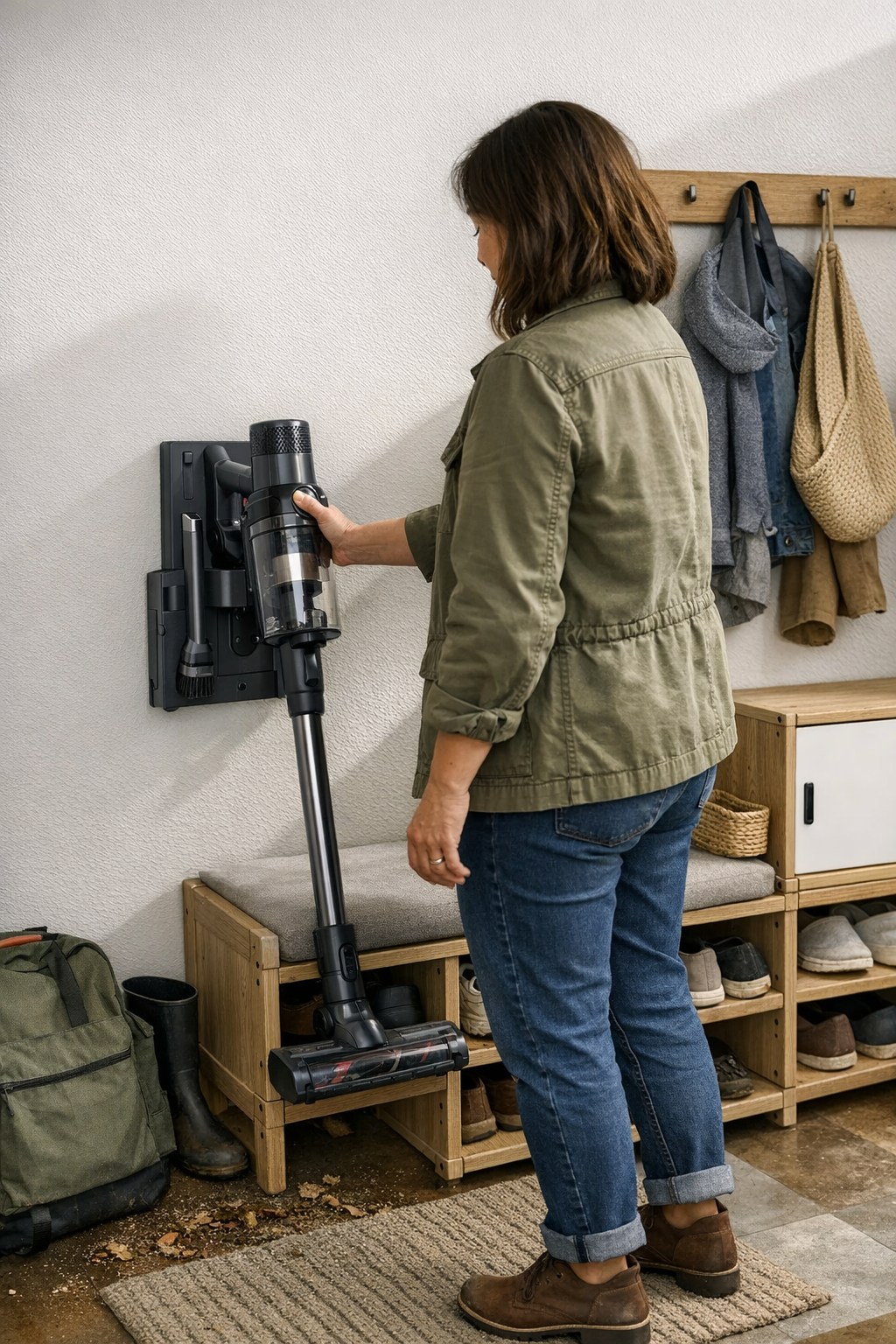
    Wall-mounting the vacuum dock right by the entry zone—no doors to open, no closets to dig through—changes the reset from project to habit. It isn’t about storage volume, but about proximity. Drop your bag, slip off your shoes, and in the same movement, a quick 90-second sweep catches what would have stayed hidden for a week. New messes don’t get time to settle and multiply. Instead, you catch sand, grit, and leaves before they become part of your daily scenery—and before “cleaning day” feels inevitable.

    Real-World Placement: Offsetting for Utility and Movement

    Placement shifts the whole dynamic. Mount a compact vacuum on the wall adjacent to the bench or main drop zone—not dead in the path, but not hidden around a corner. The goal: close enough for true convenience, far enough to avoid blocking the flow. This solves two real frictions at once:

    • Resets happen in stride, without making you re-route or reach awkwardly.
    • Paths stay open, eliminating the cluttered feeling of a storage “stage” that’s been overfilled or misplaced.

    The space stops being a showroom and starts working as a utility zone tuned to your actual exit-and-return pattern. Not always prettier, but less frustrating—the difference between starting the day organized and playing catch-up with clutter every evening.

    How Immediate Cleanups Change the Entire Routine

    With a docked vacuum visible and ready, spot cleaning becomes instinctive. You sweep before problems pile up, not as a rescue mission days later. Each micro-reset as people switch shoes, drop keys, or switch bags means dirt barely gets a chance to settle. As a result:

    • Shoe cubbies stay cleaner, not instantly filled with sand or pebbles after a single walk.
    • Benches stop becoming backlogs for crumbs, leaf fragments, and pet hair that used to spread via stray bags and gear.
    • Flow stays workable—there are fewer days where everything needs to be dumped and reset from scratch and fewer awkward bottlenecks trying to get out the door.

    The improvement isn’t about perfection, but about shrinking mess before it becomes a cycle.

    Tip: Use a Compact, Rechargeable Dock

    Only a slim, cord-free vacuum dock survives the real test: daily demand in tight, high-traffic entryways. Mount it at standing height, just next to but never blocking the bench. The best setup is always “in reach, out of the way”—present enough to become part of your return and departure routine, but never so prominent that movement gets pinched or pathways tighten and clog after a few arrivals.

    The Line Between Looking Organized and Staying Organized

    Style or storage alone cannot hold the line if resets require effort or detours. Entryways that only look neat on the first day slip quickly once real use resumes. Storage and gear that join the natural traffic pattern—visible, reachable, and offset for movement—eliminate the silent drift toward chaos. When the vacuum dock lives in the zone, resets shrink to seconds and mess never has a chance to become structural.

    Those tiny, repeated frictions—one extra step, one more thing to move, a single delay between seeing dirt and lifting it—add up to whether your entryway works for you or quietly works against you every single day. The right transition-space setup turns the difference into daily routine, not wishful “later.”

    Practical transition-space storage for entryways and daily drop zones is at Betweenry.

  • How Divided Underbed Organizer Totes Keep Shoes and Cords Neatly Separated

    Underbed chaos doesn’t start big—it creeps in one item at a time. The setup is familiar: a wide storage bin slides under the bed, holding shoes, cords, travel pouches, and odds and ends that have no other home. For a day or two, everything fits and even looks organized. Then real use begins. Chargers get pulled midweek and tossed back on the wrong side. That one missing sock ends up twisted around spare cables while shoes trade places every morning. Suddenly, finding anything means digging sideways, kneeling longer, and moving stacks just to get to the bottom. The promise of easy, hidden storage unravels faster than it’s set up. What looks like order on day one usually devolves into search-and-rescue by day five—especially in bedrooms with limited space, where underbed storage isn’t backup, but the main staging ground for daily items.

    Why Wide, Open Bins Fall Short in Daily Use

    Open underbed bins trade visible clutter for hidden disarray the moment routines collide. You start with everything in place—morning hits, and grabbing a charger means fishing through loops of cord and wayward shoes, bumping into items you didn’t intend to move. Each time you grab or return something, the contents shift, categories mix, and one loose pouch becomes a wedge that splits up shoe pairs. The bin doesn’t lose capacity—it loses all sense of boundaries. Within days, searching for a single cable or missing shoe turns into a full-bin shuffle, the original lines between categories erased by daily use. What should save time and space now creates extra friction: you hesitate to put things back, hope the mess won’t grow, and eventually avoid the bin unless absolutely necessary. The wrong setup isn’t a one-time nuisance; it repeatedly slows your next move.

    Where Category Drift Starts—and Why It Matters

    The underbed bin’s flaw is subtle but steady—“category drift.” On day one, every item has a vague zone; by day four, those lines are gone. Shoes get scattered as bags slide over them and accessories wedge in new corners. Cords slip out of neat coils and wander. Small everyday items—the earbuds, a spare watch strap—inevitably vanish beneath bigger pieces. This drift isn’t an accident; it’s what happens every time two categories collide when you’re in a hurry or resetting late at night. In rooms where the bin is the main storage, each retrieval eats away at order until “reset” means dumping everything out just to re-sort.

    Scene: The Slow Creep of Daily Disorder

    You reach under the bed for a charger and drag out half a cluster of cables by mistake. One shoe comes out with another tangled behind it, a wrist pouch slides out and bursts halfway across the floor. What started as a small grab now means re-stacking contents, pushing things back in, and generating a few more floaters with every use. Over time, this delay piles up: the “quick tidy” morphs into a five-minute session nobody wants, especially in shared spaces or if you rotate items for each season.

    Divided Underbed Totes: Small Change, Real Impact

    A divided underbed tote disrupts this mess by making boundaries physical, not just wishful. Instead of one big well, you get dedicated zones—each a hard stop for different items. Shoes stack together and stay paired. Cords get a section where they lie flat and untangled. Small accessories remain corralled, not swallowed. The outside view changes little, but inside, reset is a snap: returning an item means dropping it into a marked space, not shoving and hoping for the best. There’s less friction in both daily grabs and nightly resets. Categories stick—so quick drops don’t turn into tomorrow’s tangled hunt. What shifts is the feeling of control: you’re no longer negotiating with the bin every single time.

    Setting Up for Real Use, Not Just a Clean Look

    Initial neatness is meaningless without daily resilience. The best-packed open bin looks great on setup day, but by the first rushed morning, small items drift and reorder the whole space. Divided totes keep the little objects—stray adapters, single socks, loose batteries—from triggering a full-bin cascade. When each type of item is anchored in place, bigger things remain easy to spot and reach. The time spent on your knees searching and reshuffling is replaced by quick, single-motion retrieval. The setup isn’t just tidy—it actually lowers the barrier to staying organized in real time.

    Design Details That Matter During the Week

    Dividers only help if the bin invites fast resets and zero digging. Depth is critical: a shallow profile (six or seven inches max) ensures items stay visible and accessible instead of buried. Overly deep bins force stacking, which undoes the clarity you’re seeking. Bin placement also matters: keep the tote close to the bed’s edge and away from furniture legs, so you can pull and replace things in one motion. In tight bedrooms or when the zone sits near a desk or dresser, every obstacle turns a quick grab into a slow awkward reach, quietly discouraging real use.

    Limitations: When Dividers Don’t Fit the Bill

    Not every item works with divided bins. Big or odd-shaped objects—boots, puffy blankets, luggage—crush sections and flex dividers until they break down or block access. For anything oversized, purpose-built open bins are less frustrating—else dividers become one more obstacle rather than an improvement. Use divided storage where mid-size and small items actually benefit from a stable category line.

    Making the Switch: Reset Speed and Low-Level Maintenance

    With a divided underbed tote, the daily reset shrinks from a chore to a habit. Cords drop into their slot without tangling. Shoes slide back as pairs, not as a mixed pile. Accessories can be tossed in and still found a week later—no need to upend the whole bin. The difference becomes most obvious during transitions: seasonal swaps, shared use, or back-from-travel chaos. What once triggered reluctant overhauls now takes seconds and actually sticks, even when two people are tossing things in or pulling things out at different times. You’re not just storing—you’re keeping control, almost without thinking about it.

    One Tip: Mark or Color-Code Your Sections

    Dividers work harder when they tell a story at a glance. A quick label or colored tag on each section means less second-guessing—especially if your household has blurred boundaries between what’s yours, what’s shared, and what’s spare. This way, even rushed routines respect the category line, and tomorrow’s reset isn’t another full-bin rescue.

    Organization That Lasts Past the First Cleanup

    Staying organized isn’t about how a setup looks after your first pass—it’s about what holds up through ongoing, real-life use. Divided underbed storage keeps boundaries stable, even when pressure is high and access is constant. That’s the gap between storage that only fits your stuff and storage that truly supports your routine: fewer resets, less category drift, and more visible calm where you need it most.

    Find practical storage solutions at Gridry.

  • Balancing Hidden and Visible Storage for Efficient Entryway Organization

    The entryway never stays controlled for long—especially if your “solution” relies on hiding daily chaos behind closed doors or under lid-covered benches. In real homes, setups that look neat after cleaning almost always buckle by midweek: shoes spill past their row, bags drift from hooks to the floor, and key gear vanishes behind shut cabinet doors. You notice the friction not as visible clutter at first, but as a missing glove, a misplaced umbrella, or the backup light buried somewhere unreachable—right when you’re about to leave and time is short. The moment the system interrupts your path or adds another search step, you’re feeling the hidden cost of a layout that isn’t keeping up with daily re-entry pressure. Every “out of sight” item risks becoming “out of circulation” when the threshold crowds up under real use.

    When Hidden Storage Turns into Bottleneck

    Cloaked organization—closed cabinets, covered drawers, cushioned benches—promises control, but often trades off immediate access. The more steps it takes to store or retrieve the things you use most, the faster temporary placement becomes a default: shoes abandoned outside the cubby, bags left on the floor near the bench, hats and gloves piled on top of closed bins because opening them slows the routine. The subtle trap is delay by concealment—a routine item quietly drifting out of reach until that familiar crunch: you’re blocked at the door, trying to remember where you stashed the spare keys as the clock keeps moving.

    Neat Surfaces, Slow Movement

    The visual calm of shut storage rarely survives everyday pressure. Test it on a rainy Tuesday, not just after the weekend reset: The bench that looked controlled is collecting undone mail and gym bags. Drawers hide a missing glove, while an umbrella, once folded away out of sight, never finds its way back. The real signal is always in the interruption—a last-second hunt, a blocked threshold, one more delay that turns a “neat” entry into a morning bottleneck.

    Open Storage: Clutter You Can Actually Control

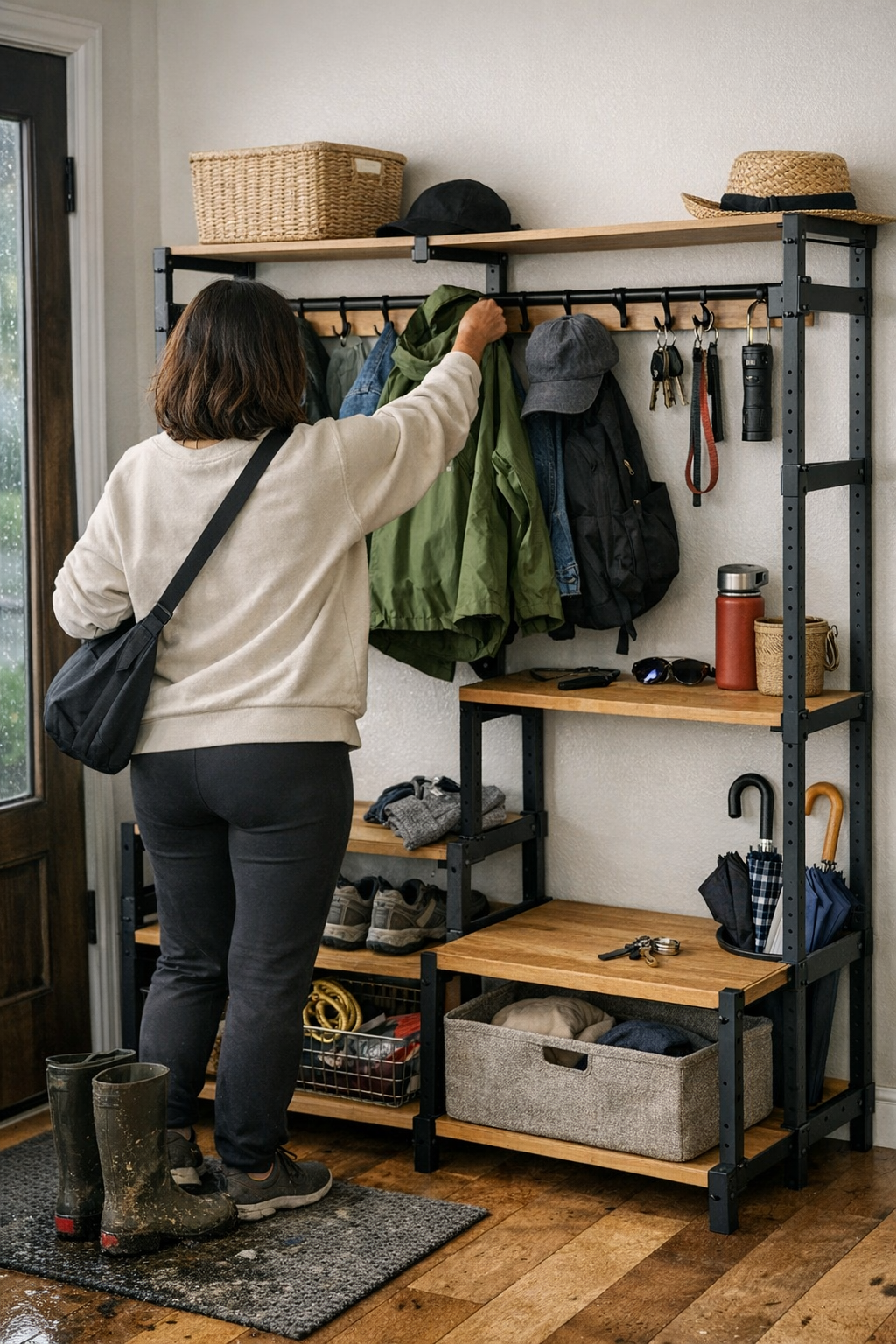
    Visible storage systems—wall rails, open shelves, exposed hooks—can look a little more crowded, but they produce a useful kind of pressure: you see exactly what’s missing the moment something slips away. There’s no silent drift. A single glance answers: are there six shoes or seven? Is the flashlight back or still missing? Swapping one deep drawer for a wall rail or bench-top tray rewires the whole reset—what’s being used stays in circulation instead of slipping into dead storage. A row of shoes directly on a rail stays roughly contained—even as use increases—because correction is immediate. Overflow doesn’t sneak up: it’s right there, nudging you to fix it instead of hiding until everything grinds to a halt.

    Overflow at the Edge—Where the Real Battle Is

    No system is immune to drift. Open setups shift the problem from invisible delay to visible nudge. Benches morph into catchalls: bags land “just for now,” mail piles up, coats edge their way across the line. But with visible storage, this edge clutter signals reset points. You notice right away when a bag blocks the path or shoes spread past their zone. Instead of silent failure, these setups make every misstep correctable, and help keep the entry moveable, even when routines slip.

    What Breaks Down Under Real Pressure

    Most entryway solutions fail during stress, not during setup. When your hands are full, the dog’s leash tangles, and the door sticks, do your things return smoothly, or is “putting away” another mini project? The closed bin swallows gloves until none are matched in a hurry; the stylish bench traps a week’s worth of mess. By Thursday, umbrellas are still missing in action—and one muddy pair of boots blocks the entire space. The patterns are clear: if your system needs two steps just to return something, that “later” pile is only going to grow. Quick access and direct return flow determine whether the area works for the actual family cycle, not just during Sunday resets.

    Return Flow vs. Buildup: How to Spot the Real Trouble

    Every threshold zone is a test of how easily things move in and back out. Systems that slow down restocking—requiring lids to be lifted, bins shifted, or doors opened—quietly train everyone to drop gear wherever, breaking down the intended order. The more your entry setup demands, the steeper the drop-off between “put away perfectly” and “dump it somewhere for now.” If you find yourself shuffling piles or re-clearing the same spot every week, your system isn’t matching the pressure of repeated use. Open racks and fixed spots let you spot the moment a basket overflows; closed systems make it easy for items to vanish, only to resurface when the season changes.

    Small Upgrades, Big Differences

    It doesn’t take a remodel to restore flow—sometimes a single swap is enough to make problems visible and correction automatic. The day you replace a deep, slow-drawer with a short wall rail near the door, the contrast hits immediately: keys, leashes, and flashlights cycle in and out, instead of getting lost in “storage.” Family members gravitate toward the open spot—a sixteen-inch rail becomes the in-and-out command center, exposing anything missing before it becomes a snag that slows everyone down. Resets take seconds, not another round of opening, shifting, or sorting what’s supposed to stay ready.

    Entry Routine Tweaks That Actually Stick

    • Expose your high-frequency grab-and-go items. Put hooks and baskets where they’re most needed for shoes, bags, keys—everything that circulates daily.
    • Limit closed storage to overflow or low-rotation gear. If it’s not touched this week, it can live behind a lid—but retrieval still needs to be easy, not a project.
    • Watch for benches turning into “edges.” Repeated landing spots signal your system is missing a needed touchpoint—use a wall pocket or rail to intercept those drops before they build up.
    • Test your reset faster—midweek, under pressure. The real stress test is whether you can restore order in under a minute, not just after a deep clean. If it doesn’t pass, your flow probably needs redirecting.

    Know When to Adjust—Not Just When to Clean

    The biggest red flag in threshold storage isn’t always a mountain of clutter. Sometimes it’s that single repeated slow-down: detours for a missing hat, awkward steps to dodge a bag that’s in the way, a narrow path getting blocked earlier in the week than you expect. If you’re sliding gear around just for the door to open, shuffling piles off a bench midweek, or repeatedly dealing with the same clogs, your setup is asking for a new strategy. Pay attention to where you’re improvising, not just where things “look” off—daily, visible access usually trumps forced neatness if the goal is to keep everyone moving in and out with a minimum of resets and reroutes.

    Transition Spaces That Actually Keep Up

    An entryway only counts as organized if it works under pressure—not just after staging. Systems that build in visible feedback (and make stray items harder to ignore) correct themselves, using open cues to nudge resets before disorder spreads. Real organization lets you notice what’s broken sooner—before the next trip out the door costs you another three minutes hunting for an umbrella or clearing a bench. The right mix of open and closed storage doesn’t stop at “tidy”—it keeps up with shifting routines, absorbed clutter at the edge, and the true test: day-to-day traffic that never moves in perfect order.

    Find more transition-space storage ideas and solutions at Betweenry.