Category: Pet Life

  • Solving Indoor Cat Mess by Rethinking Your Daily Setup

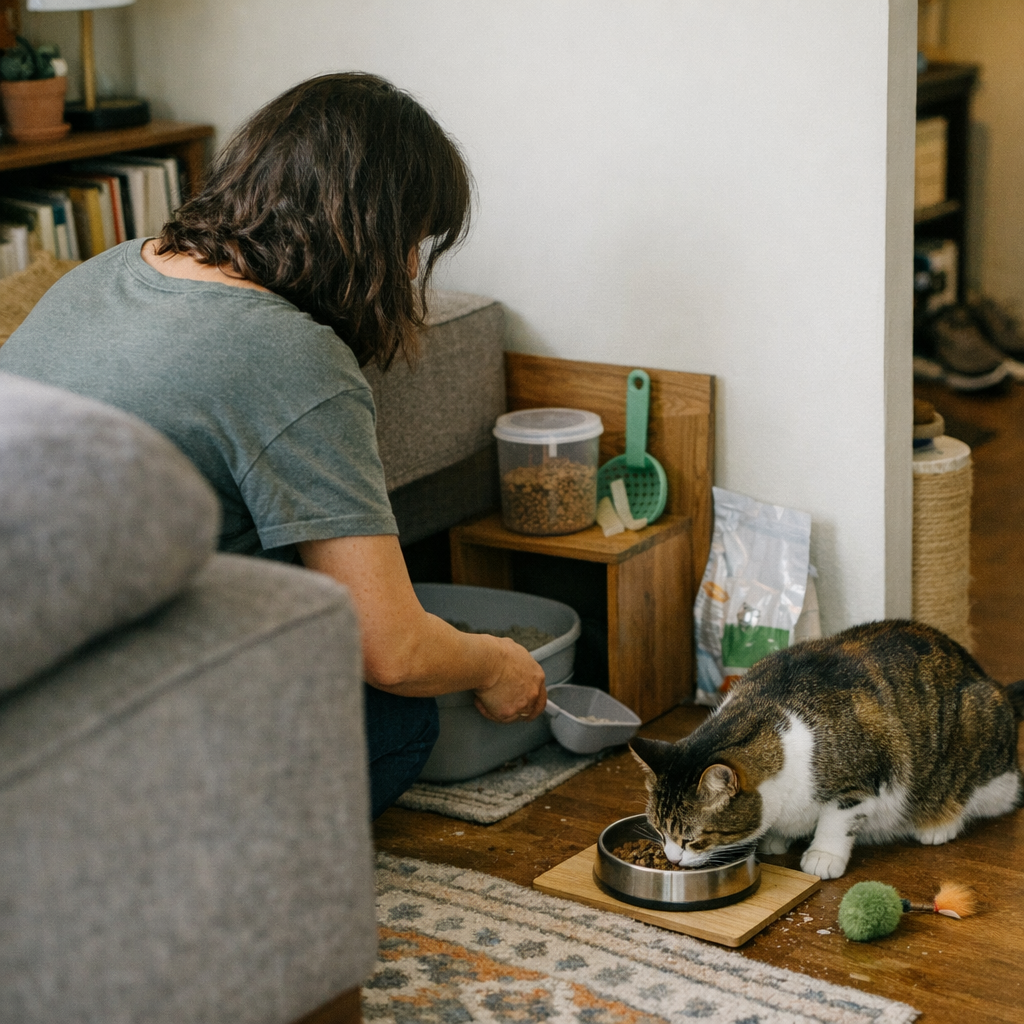
    The real test for any indoor-cat setup shows up by the third day—not in how tidy the space looks, but in how the routine keeps fighting back. What runs smooth once can turn tedious fast: you refill water, but the counter is already streaked before breakfast is over; you swear the scoop had a home, but by midweek it’s gone wandering again. Routines slow, cleaning repeats, comfort setups start to sprawl, and the neat look you created on day one starts leaking messes and extra steps everywhere. That repeated drag is the StillWhisker world’s focus: not just looks, but setups that don’t crumble under real, repeated use.

    Why the Real Mess Sticks Around

    A space can look organized—bowls perfectly lined up, scoop tucked away—but if every refill or wipe-down makes you zigzag for supplies, you’re feeling friction that builds with every round. Mess appears wherever routines stall, not just after big cleaning sessions. The gap isn’t about decluttering; it’s about how each setup reacts when real habits test the limits.

    In tight apartments, every extra walk to a distant faucet or a hidden scoop adds strain. Leave gear scattered for “easy access” and the whole corner starts to block itself: hand bumps bowl, mat won’t lie flat, or you end up nudging the cat’s food station every time you just want to pass through. The surface says organized, but daily resets get slower and less satisfying—making “clean” feel more like a performance than a condition you can count on.

    The Hidden Costs of a “Clean” Setup

    Out-of-sight storage promises relief: scoop in a top cupboard, toys stashed deep in a side bin. On the first day, the floors are clear and breathing room is real. But every longer detour breeds “I’ll wipe it later”—those little interruptions that become new sources of stray litter, crumbs, and grit. Messes start creeping outside their zones, building up in places meant to stay clean, with the “not quite done” feeling sinking in every day the right tool isn’t close enough. Tidiness starts to hide deferred work, not reduce it.

    The Other End: When Everything Lives in One Spot

    Stacking it all together? Now the friction flips. The scoop is reachable, but the setup crowds in, forcing you to move a toy to wipe the mat or shift bowls just to reach underneath. Every action is blocked by something else—meaning a two-second reset grows into a longer round of awkward reshuffling. Instead of feeling equipped, you find yourself stepping over curled mats and guessing which pile holds what you need next. Easy access becomes its own mess trap.

    Where Setup Friction Sneaks In: Common Indoor Cat Scenarios

    The real weak spots aren’t obvious on day one—they reveal themselves after a few cycles of feeding, scooping, refilling, and clearing space. Practical examples:

    • Refilling water means carrying a heavy jug back and forth—one spill darkens the carpet edge, and you end up tiptoeing over slow-to-dry spots for days.
    • The scoop drifts behind a leaning board, so now there’s a trail of grit right through the main walkway, while the litter area only gets cleaned when you finally go searching.
    • Wiping surfaces gets postponed because the cloth or brush isn’t within reach, letting food dust and water tracks circle the bowls for hours.
    • Supplies “temporarily” stacked aside for company leave small piles that block the morning reset and slow down the next round of cleaning.
    • Mats or blankets for comfort take twice as long to put back—now you’re smoothing curled corners around other supplies, letting dust or stray litter cling until the next deep sweep.
    • Cat stations drift into walking zones: bowls edge out, mats curl, and scoops stray just far enough that both people and cats now trip over the fallout.

    None of these are disasters. But together, they’re the reason recycled mess and slow routines become the rule, not the exception. The difference between an “organized” space and one that actually feels easy only shows up when you’re back in the loop, doing it all over again.

    Questions to Diagnose Setup Trouble

    If your routine breaks down fast, the structure itself is likely the weak point—no matter how well you tidy up. Ask yourself:

    • Are you moving things just to start cleaning, instead of actually cleaning? If you spend more effort on the setup shuffle than the job, chances are essential items are out of daily reach, leaving real messes to linger “for later.”
    • Do you always have to nudge, juggle, or restack supplies to reach what matters? If every wipe, scoop, or reset comes with a mini dance, too much has crowded into too little space—or key clear space is gone.
    • Is your sticking point too many steps, or too much congestion? Whichever repeats most is your main friction—spreading out and slowing movement, or clustering and blocking every reset.

    The setup challenge isn’t about which cat gear you own, but where and how it fits into routines you repeat dozens of times a week. The best area isn’t the cleanest on camera—it’s the one that survives second and third rounds without forcing you into a loop of extra work or regret.

    Practical Scene: Real Repeated-Use Friction

    Picture a week in a cramped living room. The water fountain and litter tray share a corner behind the armchair—the only outlet forces them over a ragged strip of carpet. To refill water, you haul a jug past two obstacles and mop up drips from a greyed mat edge. By Wednesday, the bowl hasn’t been wiped in days; mentally, it drops down the to-do list because the trip itself feels like a bother.

    Toys scatter across the floor, creeping under furniture without boundaries. Come Saturday morning, the scoop turns up behind a leaning board, with a band of litter grit claiming the main walkway. Now, try the other extreme: every supply within arm’s reach of the sofa. Feeding, scooping, wipes—nothing demands a trip. But by Friday, you’re picking up toys with every step, guest traffic means bowls and mats break ranks, and every corner is a new obstacle course. The room looks unchanged, but resets drag and both humans and cats sidestep low-level mess fatigue.

    Smoother Reset: The “Route” Fix That Actually Works

    Most breakthroughs don’t come from another bin or a new round of deep cleaning. They come from mapping daily moves and matching placement to flow. Locate what you use most right where your route takes you—feeding or cleaning shouldn’t require detours or shuffling through a pile just to finish one job.

    This can mean putting the food bowl a foot closer to the water fountain—so wiping, refilling, and feeding happen in one pivot, not a room-crossing lap. Store the scoop in a slim cabinet near eye level, with just the daily basics—not the full supply spread. Extras that keep blocking movement or migrate into shared space probably need a new home or a less demanding spot. These are small, structural shifts—not photo-ready “after” shots, but changes that noticeably reduce repeated work.

    When every reset doesn’t require tracking down supplies or fighting congestion, fewer messes linger past their moment. The biggest sign of improvement isn’t how the area looks at a glance, but how much less you have to keep fixing the same problem.

    Worth Noting: Tiny Shifts, Big Difference

    This kind of practical adjustment won’t erase all setup friction—some tension between comfort and cleanup is part of real life. But by shrinking routine obstacles and keeping quick resets available, you start to gain ground. Mess loses its grip, and the space feels less like a repeating project and more like part of daily life you don’t have to dodge. The point isn’t “perfect”—it’s fewer moments spent circling the same frustration, and more time with a setup that survives the week without falling apart.

    Browse practical indoor-cat solutions at StillWhisker.
  • How Small Pet Mess Habits Drain Energy and Disrupt Your Day

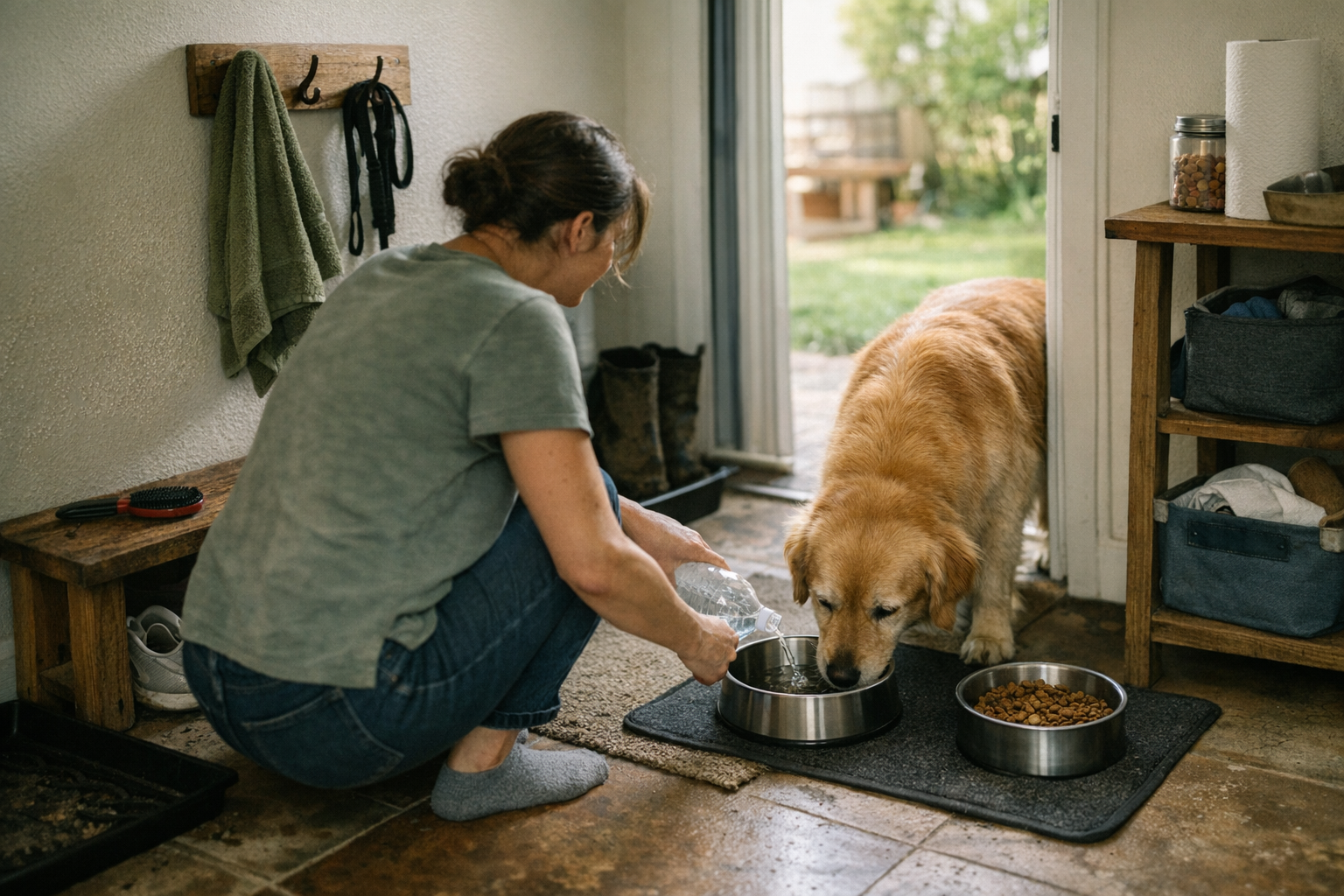
    You can wipe a countertop and pick up scattered toys, but a home only works for real daily pet care if the setup matches what actually happens—where things get messy, where your hand reaches by default, and where supplies save or waste your energy. The letdowns don’t start with a disaster. They start when you kneel to refill the bowl and a tote bag’s in the way, or when you rush to wipe muddy paws and the one decent towel is across the hall, not by the door. One thing out of reach means the mess sits until later—or spreads. Those gaps add up: every time you hit friction, cleanup slows, resets get missed, and your setup stops helping you.

    Small Gaps, Big Friction: Where Pet Care Routines Break Down

    Routine drag almost never announces itself. You go to scoop food and find mail piled on the bin. The water bowl’s dry, but you only notice after you’ve finally sat down. That brush you left out for quick use? It’s tucked away, so the quick fix gets skipped yet again. What should be automatic turns into a repeat search—and eventually, a silent drain that makes each extra step feel heavier than it should.

    These friction points blur into the background. The feeding spot made sense by the door, until you’re dodging shoes and chasing the mat every meal. A towel is “right there” in theory, but it’s never waiting when muddy paws actually cross the threshold. What started simple quietly builds into a string of minor resets—postponed wipes, missed wipes, fetch-the-brush, detour-for-the-bottle—stacking until the end of the day feels cluttered no matter how often you regroup.

    Real-Life Reset Struggles: Scenes From Everyday Use

    Morning: You toss kibble in a rush, knock crumbs to the floor, reach for a paper towel—and remember they’re nowhere nearby. Crumbs stick as the hours pass. By the time you’re back, it’s a bigger, dryer mess—and cleanup is now a chore, not a quick swipe. Damage clicks in long after the moment.

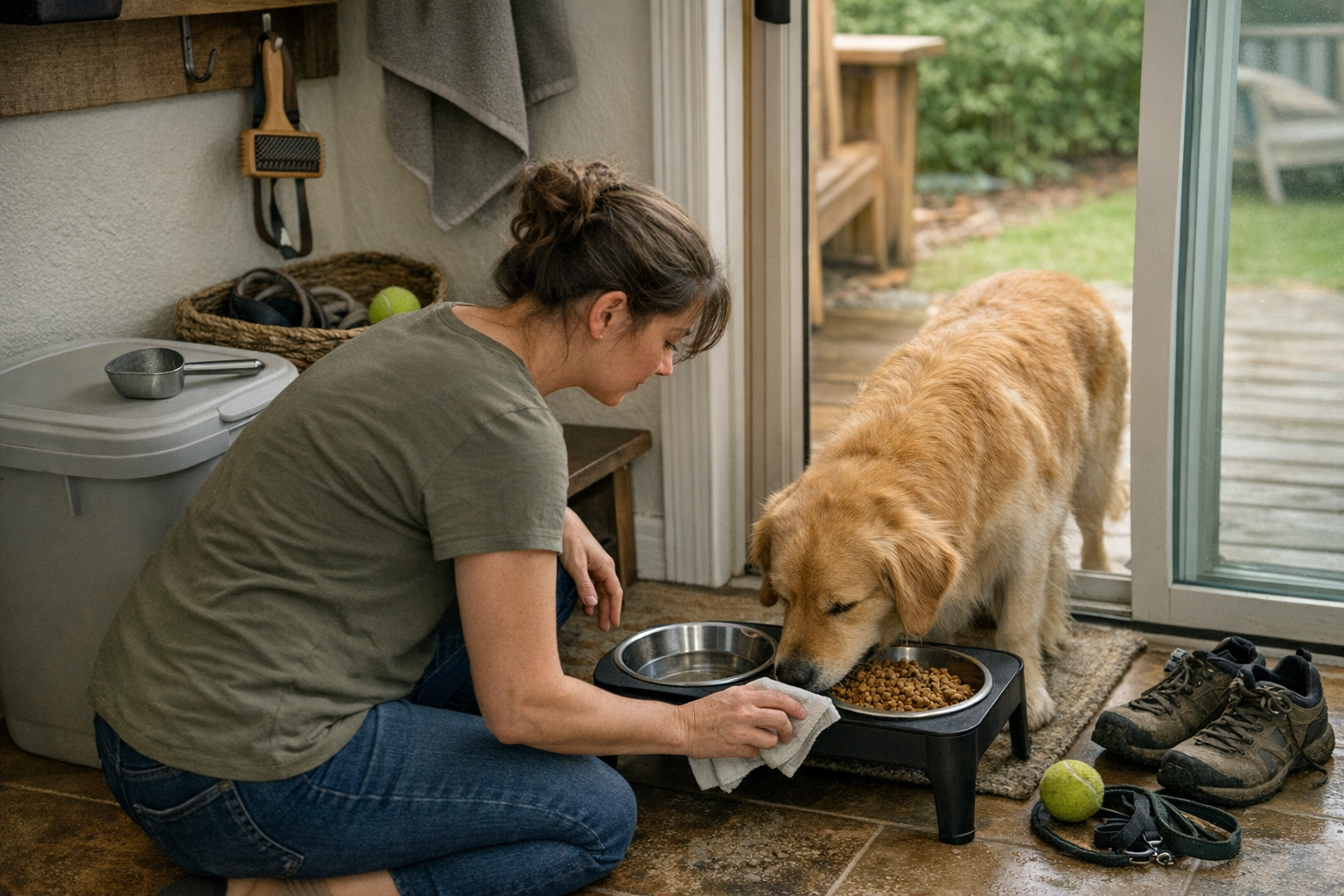
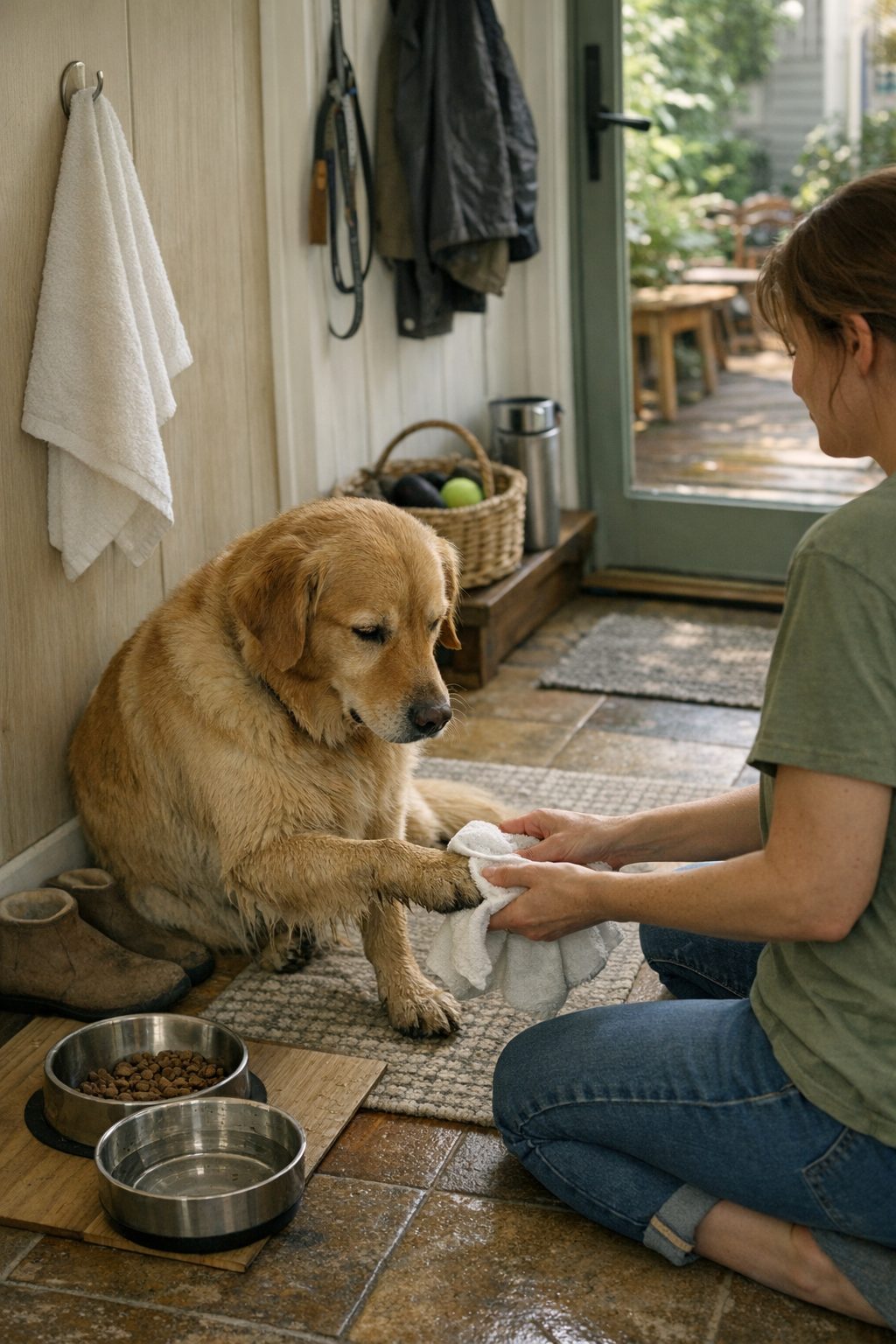
    After a walk, damp paws hit tile. Last week you kept a towel at the door; now someone has tidied it away, and you’re tearing down the hall as mud hits both carpet and kitchen. The reset wasn’t missing so much as out of reach—which, when you’re tired or pressed for time, is the same difference.

    These aren’t just lapses—they’re signals that your routine design asks too much. A refill bottle out of sight puts off water changes until dry bowls cause a scramble. Grooming tools placed “tidily” instead of conveniently get skipped at bedtime. The gap between “looks good” and “works right now” is sharpest on the busiest days, when you realize your routine only held up when nothing else went wrong.

    The Spreading Effect: When Pet Gear Takes Over Shared Space

    Pet care gear doesn’t just collect around feeding areas—it spreads. A bowl nudged to avoid kitchen foot traffic soon ends up wedged behind table legs, forcing awkward reach and repeated reshuffling. Toys dropped in the living room become sudden obstacles when you’re carrying groceries. An area that feels orderly at noon can turn into a new circuit of clutter by dinnertime, triggering repeat interruptions.

    The headache isn’t always the pile itself. It’s the moments your hand hesitates: searching behind shoes for a brush, stopping mid-step to locate a refill bottle, or circling back when the only clean towel is at the other end of the house. Friction peaks at the worst times—late at night, as you’re rushing out, or after work—slowing you down just when you’re least willing to deal with it.

    Why “Tidy” Isn’t Always Enough

    Visual calm can be an illusion. You can line up containers and tuck away every bin, but if feeding means walking to another room for the scoop, or if every wipe-down means bending or dragging supplies into reach, you quickly stop bothering. A sealed food bin that’s “out of the way” gets skipped for refills. A mat that slides underfoot means more time repositioning than cleaning. Friction lives in the gap between what looks organized and what helps when you’re running out of patience.

    These small weaknesses reliably return: a towel never left at the threshold, a water basin that has to be checked constantly, a mat that never stays flat, supplies that migrate back out of reach. One minor inconvenience is tolerable; three or four mean you’re always a step behind and pet care never feels quite effortless.

    Shape Your Space for Real Life, Not Just A Clean Snapshot

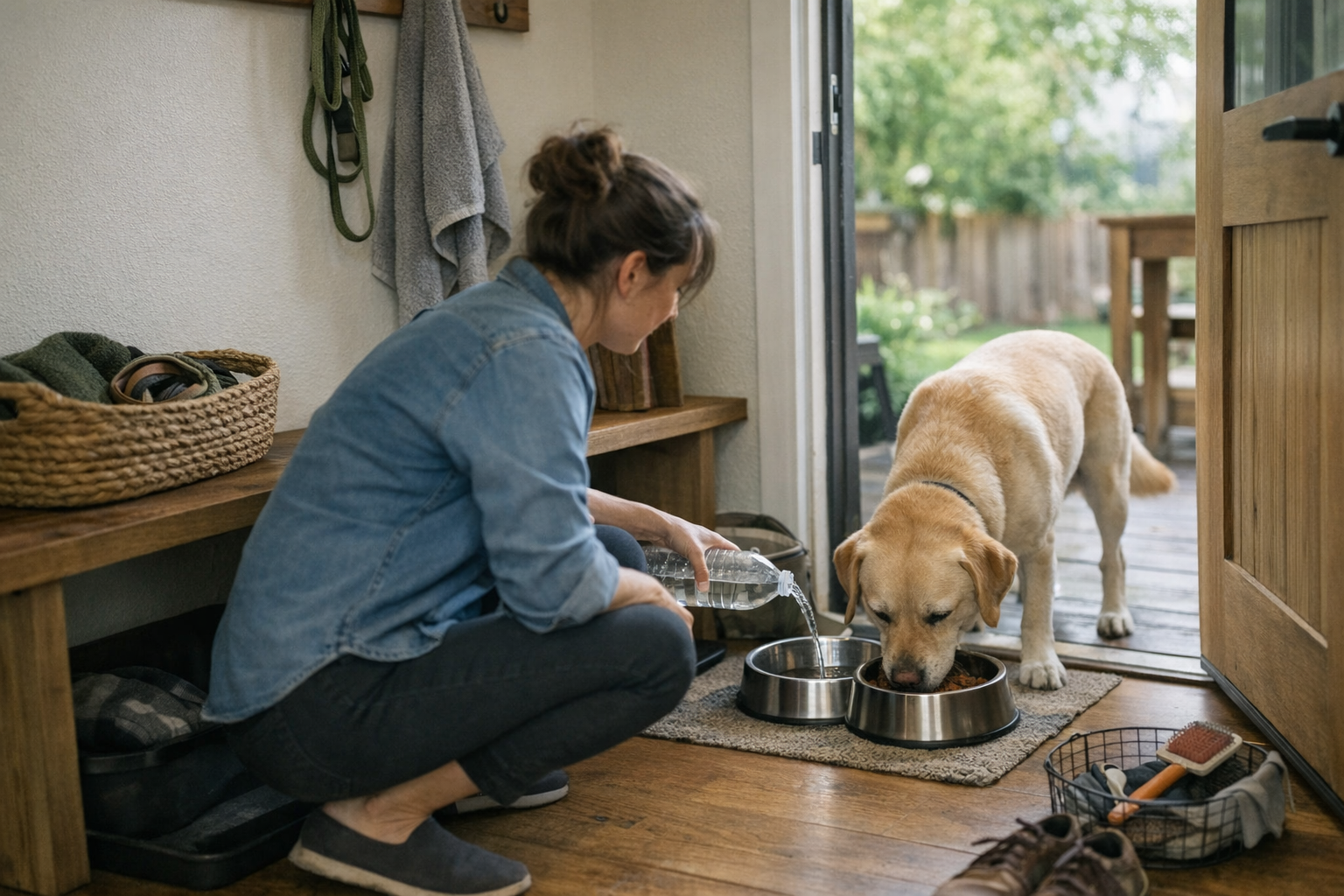
    The real fix is not a dramatic overhaul—it’s placing basics where you always reach in a rush. Put a water bottle right by the mat so you pour without thinking; hang a towel at pet height on the spot where paws enter, not three steps away; stash a brush at the main traffic point so last-minute grooming isn’t another trip. These shifts make resets part of your routine, not add-ons that fall off on busy days.

    Watch your own friction points. Stopped mid-routine to hunt for gear? Postponed a task because tools were “put away” instead of on hand? Those are the gaps slowing you down. Fix the placement, and the whole system starts running itself—because the setup finally matches your actual flow, not just your highest-effort days.

    Reduce Reset Friction: Keep Basics Within Reach

    The real test of any pet setup isn’t Sunday-deep-clean perfection—it’s how much it interrupts you at your most distracted. Store towels, refills, and brushes exactly where spills and tangles happen. If you can clean up every mess with a single reach—no detours, no digging, no retracing steps—you cut the routine drag before it multiplies. That’s a care setup that actually backs you up when you run low on energy.

    Place the essentials where you naturally pause: at the entry, by the bowls, along traffic paths. Every obstacle removed and every reach shortened means less drag, less resentment, and fewer repeats. Routines that soak up messes and allow quick resets don’t just save time—they absorb chaos so you can return to what actually matters.

    Lasting Calm: A Routine You Can Rely On

    Most pet routines don’t collapse because you missed something huge—they slip because basics are misplaced, supplies are separated, or cleanup asks too many extra moves. Store the tool where the problem happens—at the point of entry, right on the usual path—and watch daily mess become a two-second reset instead of a multi-step hassle.

    Everyday, a setup that’s correctly aligned means your care actually matches your energy—especially on hard days when a single delayed reset can undo your best intentions. The difference is visible: less friction, more time, and a home that looks calm because it’s easier to keep that way, not because you scramble to maintain the illusion.

    See which small realignments make the biggest daily difference at CalmPetSupply.

  • How Small Changes in Your Dog’s Rest Area Improve Daily Routine Flow

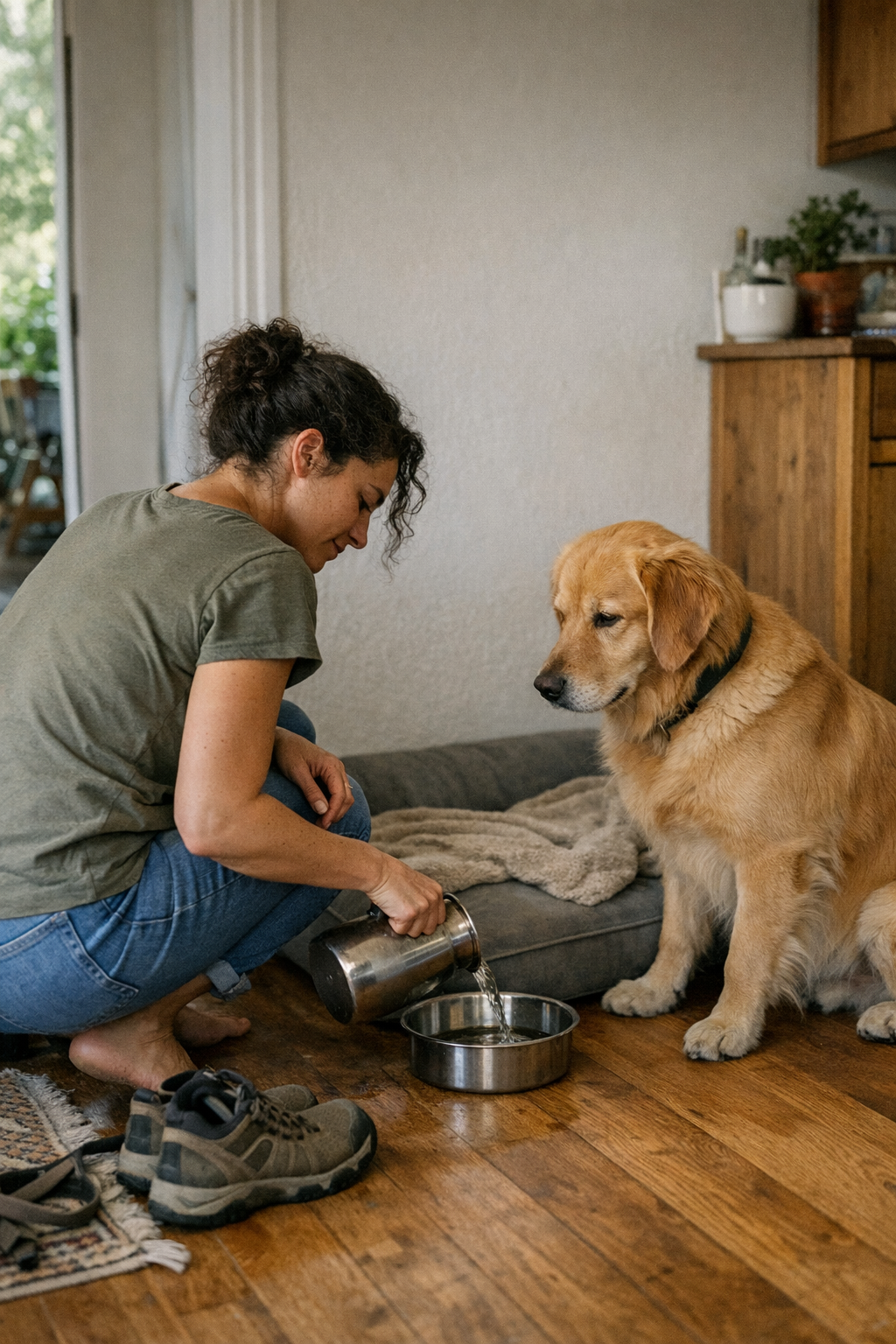
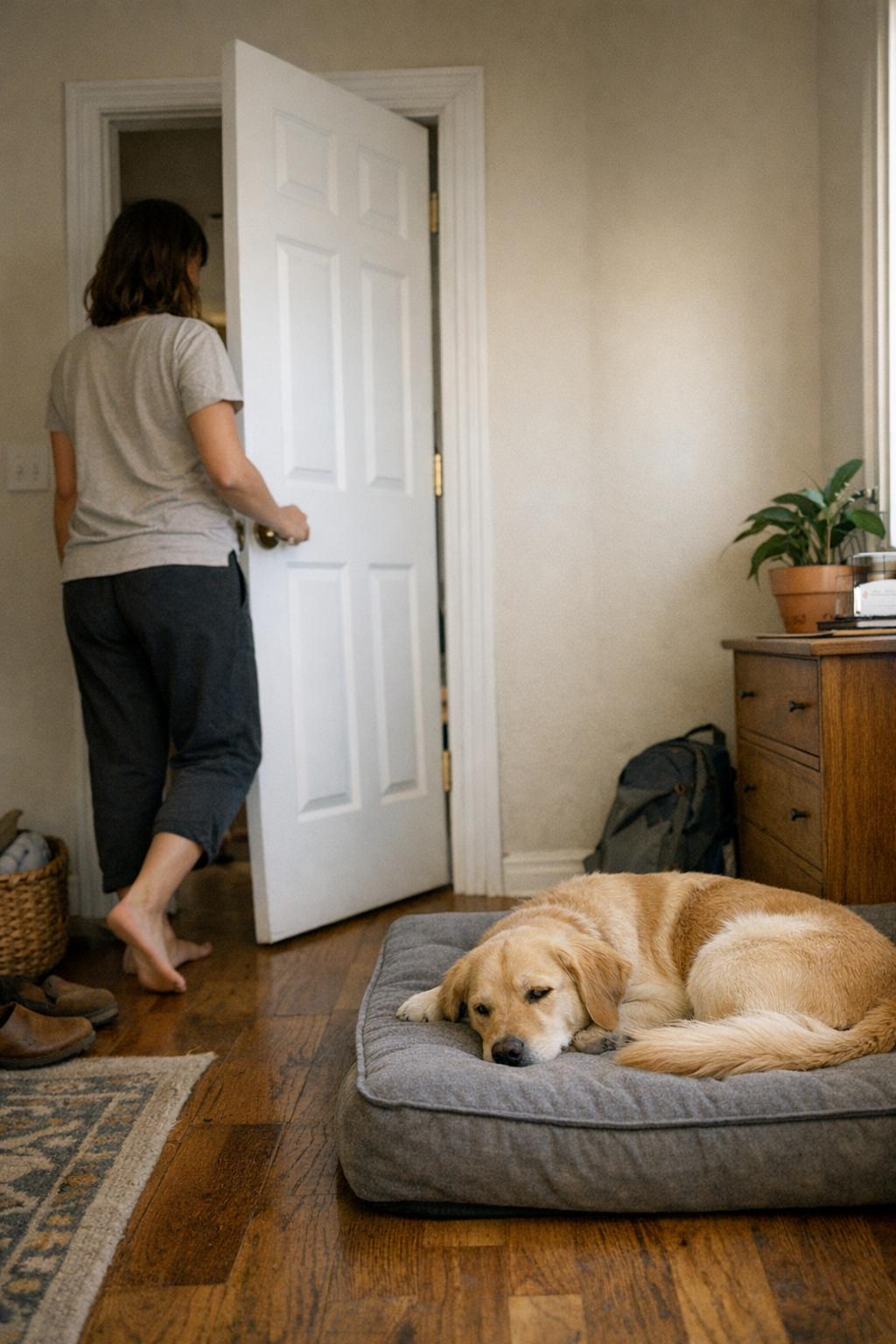
    The reality of living with a dog is that “tidy” doesn’t always mean “easy.” That plush bed in the corner looks perfect the first night. Two days later, you’re sidestepping it as you carry in bowls, nudging it with your foot when your hands are full, or finding your dog awkwardly blocking the hallway just as you reach for the leash. The rest area that promised comfort now adds a minor detour to nearly every routine—reminding you, in small ways, that what looks organized on day one can turn into a low-grade obstacle after a week of real use. The solution usually starts with a shift in layout, not ordering more supplies.

    Why a Tidy Rest Area Isn’t Always a Functional One

    Pinning the dog bed to a “safe” quiet spot may feel organized, but it’s rarely friction-free. As days stack up, the bed drifts toward the bowl or pokes into the walkway. It isn’t dramatic—just an awkward angle here, a block for your foot there. Those small delays—dodging the edge with a filled water bowl, pausing so your dog can clear the entrance—don’t announce themselves, but they slowly turn routine steps into awkward pauses. Orderly corners are easy to admire, but it’s those invisible snags that keep routines from feeling smooth.

    Hidden Slowdowns: When Small Obstacles Stack Up

    Real friction shows up in micro-moments: the bed lines up too close to feeding, your dog hovers, uncertain if she can reach the bowl. Or she circles, confused about whether it’s time to eat or settle. You’re left shifting her bed with an elbow—never quite in the way, but never fully out of the flow. Each individual pause is easy to ignore, but over a week, repeated shuffles chip away at routine speed and make the simplest transitions feel heavier than they should.

    Repeated Routine Friction in Real Life

    The post-walk return is the pressure test: leash in one hand, towel awkwardly caught beneath an arm. You approach the corner to dry paws—except the bed blocks your path, again. Either you move the bed one more time, or you try to stretch over it and nearly miss your mark. Your dog waits, half in her spot and half out, neither comfortable nor truly out of your way. This is where “looks neat” collides with “doesn’t actually work.”

    When Comfort Conflicts with Convenience

    Most people design for comfort—thick bedding, soft blankets, close to some daily activity zone. But a plush bed creeping into a walkway, or overlapping the water bowl by just three inches, isn’t just a visual annoyance. It means extra adjustments for you and waiting hesitations for your dog, especially in busy moments: prepping food, heading out, or coming in after muddy walks. By midweek, you both reflexively work around the obstacle, accepting slowed movement as normal. Comfort and ease drift apart, and the setup never quite stops interrupting the flow.

    The Cost of Static Order: Calm on the Surface, Chaos in Motion

    Freezing the layout might look responsible, but it ignores how routines really unfold. Over time, a visually neat corner becomes a background irritant. Both you and your dog start hesitating in the same spots. She learns to pause at the bottleneck; you learn to preemptively nudge the setup, sometimes without even looking. More people or dogs in the home just multiply the impact—a space that seemed “put together” on Sunday turns into a slow collision course by Thursday evening.

    The Difference Between Looking Neat and Feeling Smooth

    Clean lines and tucked-away beds are satisfying, but a rest area that forces you to side-step, pause, or double-check is working against your day. When you realize you’re bracing for another slow shuffle after every walk, the illusion of order fades—routine performance, not visual neatness, reveals where the real bottleneck lives. The setup that tidied your floor now quietly taxes your patience.

    Small Shifts, Big Changes: Testing and Observing Micro-Adjustments

    The fix usually isn’t a full rework. Moving a bed twelve inches away from bowls or out of a walkway can dissolve the bump in routine almost instantly. Try shifting a corner just beyond the kitchen entry, or along a wall that doesn’t see direct foot traffic, and notice if water refills or towel grabs become automatic, without shoulder-squeezing detours. When routines—like drying paws, prepping meals, or letting your dog settle—start happening without pause, you know the adjustment worked. It’s not just about eliminating mess; it’s about removing micro-hurdles that make daily life drag.

    What to Watch For in Your Own Setup

    Start by tracking where you and your dog slow down. Do you find her stalling inside a doorway, waiting for clearance to move? Are you always shifting bedding with your hip, or carrying bowls high to avoid a plush corner? If the same friction repeats in the same spot, your layout’s not fitting your routine. It often takes a single busy rush—throwing down keys, wiping paws, or juggling dinner prep—to reveal the silent pull of a misaligned rest area.

    Everyday Reset: When and Why to Move the Rest Area

    Nothing about a dog’s home setup should be frozen. The purpose isn’t constant rearranging, but recognizing when friction recurs and letting layout evolve. Look for:

    • Stacked hesitations: Dog pauses or spins before meals and bedtime.
    • Blocked quick access: Bed positioning slows you from getting to a bowl or door.
    • Routine detours: The same sidestep, shuffle, or mental brace every day.
    • Cleanup drag: Wiping, sweeping, or picking up toys becomes a repeat hassle because the bed sits in the path.

    If you spot these triggers in your rhythm, it’s time for an adjustment—no matter how tidy the corner looks.

    The Relief of Fewer Pauses

    After moving the rest zone just outside the main route, the difference shows up in the pace, not just the picture. Dinner prep runs straight—not in a zigzag. Grabbing wipes or drying paws becomes one step, not three. Your dog slips in and out without stalling, and you stop noticing the bed because you’re never bumping it. A “quiet” setup isn’t about how it photographs; it’s about how little attention it now demands.

    When One Weak Point Keeps Returning

    Even with smart adjustments, the same snag sometimes comes back. Maybe bowls move, or a shortcut you didn’t think would matter starts drawing traffic again. Routines change, dogs change, and what once worked gets clunky. The difference between “looks organized” and “stays easy” comes down to whether you stop thinking about the corner, or keep having to work around it. One repeated stumble is more telling than a week of neatness.

    Perfection’s not the goal. Instead, aim for a rest, play, and feeding setup that gets easier—not harder—the more you repeat it.

    Toward a Home That Moves With You (and Your Dog)

    Order should work in motion, not just on display. Every micro-move—leash grab, food refill, towel pull, quick nap—needs space to happen without a thought. If a rest area keeps slowing you down, don’t wait for friction to pile up. Sometimes shifting a bed just six inches reroutes the whole week’s routine back to smooth.

    Track which moments keep asking for another workaround, and don’t hesitate to let your setup adjust when the signal’s clear. Removing small slowdowns is how you reclaim real calm in a dog-filled home—one plain, daily task at a time.

    Explore everyday dog-life setups at DogPile

  • Small Nightly Resets Prevent Mess Build-Up at Cat Feeding Stations

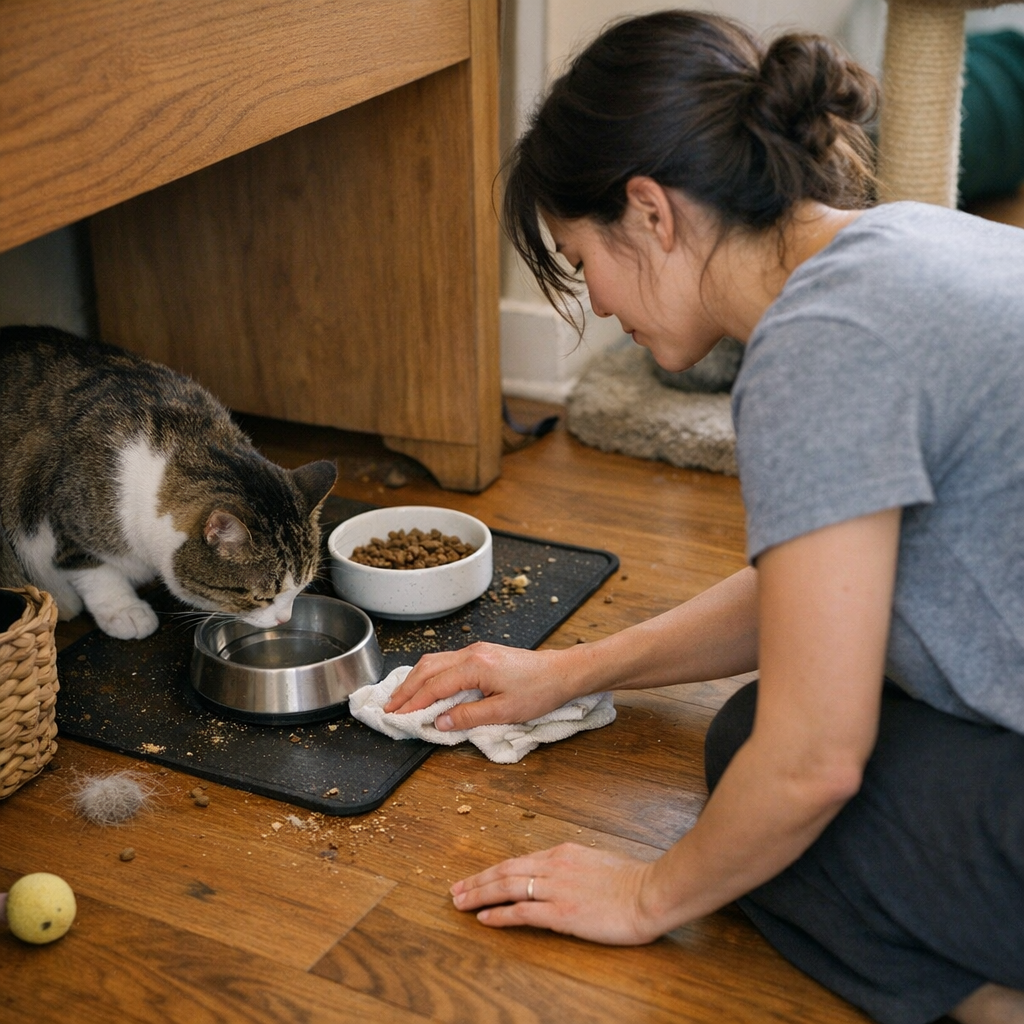
    A feeding area that looks organized on Monday morning can turn into a source of extra work by Friday—even if you never see a dramatic mess coming. For most indoor cat owners, the feeding setup is less a solved space and more an ongoing adjustment: bowls shift, mats creep, stray pellets migrate, and what started as “tidy enough” quietly becomes a small but persistent hassle. Walk by midweek and things might seem fine. But after a few skipped resets, unnoticed drips, and crumbs tucked just out of view, that low-key corner demands a full scrub and drains the energy you meant to save.

    When Visual Order Masks Real-World Mess

    The catch isn’t obvious—until it is. Bowls lined in a row and a mat sitting straight can hide an invisible buildup: grit settles under edges, water seeps behind seams, and debris drifts where you rarely look. Cleanup feels simple day-to-day—until you kneel down and realize most of the mess never showed up until the weekend reset, when you’re forced to dig it out. Visible order doesn’t equal easy upkeep; a setup that looks calm on the surface can still pile up the next big chore underneath.

    This problem goes past looks. The setup that appears “fine” can lull you into skipping quick wipes or failing to re-center the mat. Every shortcut after work quietly hands off residue to the next day—until, days later, one “easy” corner has hardened edges, stuck bowls, or that unmistakable gritty feel underfoot. The burden shows up all at once, not as a crisis, but as repeated work you thought you’d avoided.

    A Familiar Scene: When “Neat” Isn’t Actually Clean

    It’s easy to do a quick check after feeding: refill, glance, move on. But the mat picked up crumbs near its farthest edge, the back rim of the bowl collected a film after the last water refill, and that cluster of kibble near the wall hasn’t moved all week. On Thursday evening, nothing looks urgent. By Saturday, your foot snags a rough patch near the cabinet, toys from a late-night game carry bits of food into another room, and sticky spots resist a basic wipe. All the skipped “two-second” resets compound until you’re stuck resenting the corner you carefully organized.

    The Hidden Consequences of Skipping Real Resets

    Most indoor-cat cleaning is less about mess explosions and more about friction that accumulates—quietly, relentlessly—until it slows you down. A mat once good at trapping debris now has an immovable border. A bowl with “just a little” residue suddenly won’t wash clean. The headache isn’t the initial mess—it’s how invisible layers build up in places you thought were under control, forcing a bigger job you never scheduled.

    This is where appearance blindsides real function. Nightly good intentions fade; crumbs drift under the mat, dust combines with fur, and water sneaks between the mat and wall. When the “contained” zone seeps into shared space, you get reminded—you’re not just managing a feeding area, but chasing its creep all over your home, especially by the end of the week.

    What Actually Happens in Real Repeated Use

    Reaching for a Quick Fix—and Finding It’s Not So Quick

    Anyone who’s bent down expecting a fast bowl reset, only to brush old crumbs, knows the reality: supplies aren’t always handy, and grabbing that wipe from the next room is enough reason to put it off. The cleaning cloth lives in the drawer, not beside the bowls—so a two-minute task becomes a ten-minute chore on Saturday, when grit has set in and the whole area feels layered with missed details.

    The Human-Cat Dance: How Cat Life Complicates the Routine

    Small changes make a big impact. Slide the bowl closer to the wall to stop scatter, and feeding gets neater—but now the bowl blocks a cabinet or makes reaching awkward. Use a softer mat for comfort, and it cushions paws—yet it also hangs onto crumbs, making a one-wipe reset impossible. Every improvement for the cat can introduce one more friction point for you, slowing resets you wish stayed quick.

    Movement Patterns that Multiply Mess

    Cat routines don’t respect boundaries. One paw flick sends dry food moving; a tail swipe launches water past the mat. Toys rolling through the feeding area turn into debris couriers, redistributing dirt into living spaces. These slow interruptions aren’t accidents—they’re the pattern that guarantees even “contained” zones spit extra work into other rooms, bite by bite, swipe by swipe.

    Practical Tweaks That Shift the Whole Experience

    The difference between a once-a-week time sink and an easy daily upkeep boils down to what your setup allows you to do without thinking. In many homes, bowls are pushed tight together, the mat crowding the wall, and the most accessible path blocked by a stray item that “belongs” but complicates the reset. A setup that’s hard to move or clean locks mess in the same problem zone, every week.

    Move and Lift—Don’t Just Wipe What’s Visible

    Instead of only wiping where you see crumbs, get in the habit of shifting bowls and mats an inch or two after meals. That quick lift exposes where buildup starts: the seam behind the bowl, water that escaped the mat’s edge, crumbs hiding under the rim. Interrupting the layer before it hardens means resets don’t pile up—the weekend never surprises you with fossilized messes.

    The One-Inch Rule for Rim Grime

    The first spot to trap stubborn mess is the last inch along the back of the bowl. A single damp cloth pass here, right after dinner, stops sticky buildup before it becomes a chore. When you handle this each evening, bowls rinse clean, mats lose that tacky feel, and you avoid the musty end-of-week smell that signals skipped resets.

    Keep Cleanup Tools Handy—But Not in the Way

    A stash of cleaning wipes or a designated cloth right next to the station—within hand’s reach but clear of the feeding path—makes fast resets normal. Out-of-sight means out-of-mind; too close means blocked access and causes you to skip it anyway. Placement matters: if grabbing the tool is automatic, daily cleaning is too.

    The Real Test: How Setup Choices Play Out Through the Week

    The risk isn’t that the feeding area explodes into disaster—it’s that tolerable clutter silently becomes overwork because the system needs more daily intervention than it gets. What repeated use actually reveals: If you’re pushing bowls aside to chase old mess, you’ve already let the friction build up. If crumbs and dust travel past the “feeding zone,” the setup isn’t just holding pet life—it’s creeping into yours.

    Accept That Some Spill Happens—But Stop It from Settling

    No matter how carefully you arrange things, some food escapes, some water drips. The smart move is giving yourself a structure that lets you recover easily: quick resets, fast moves, nothing blocked or buried. If you notice Saturday is always the rescue day, your system is passing all the invisible work to the weekend—and the work always grows.

    Why Most Setups Need One More Adjustment

    A perfectly arranged feeding area is only as effective as its resetability. If it can’t be moved quickly, wiped underneath, or checked for stray debris in seconds, small messes become lasting friction. The real difference isn’t how straight things look, but how many times you find yourself re-setting the same items after the fact.

    Final Takeaways: The Difference Between Looking Fine and Feeling Easy

    Anyone can stack bowls in a row and smooth a mat. A truly workable feeding zone is one that lets you reset in real time, not one that quietly hands off stray work to your future self. The most livable setups don’t chase perfection—they make it normal to shift, lift, wipe, and get on with the day, saving every weekend from a project you didn’t plan.

    For more practical indoor cat setups and tested home-life solutions, visit StillWhisker.

  • Small Daily Resets That Keep Your Pet Care Routine Running Smoothly

    How Small Details Shape the Success of Daily Pet Care

    Every daily pet routine depends on tiny resets most owners barely notice—until they start going wrong. The cracks don’t show with a single missed wipe-down or a brush dropped wherever. But as days stack up, the fallout becomes hard to ignore: food bowls with hardened crust, towels nowhere near the porch after a late walk, water dishes empty when you’re already in a rush, grooming tools lost under stray laundry. What begins as a passable setup quickly turns into a slow drag on every care habit, each missed step multiplying hassle while the area outwardly looks “fine.” The difference isn’t in dramatic mess, but in those silent moments where the system you thought was simple quietly stops working. This is the practical world behind every CalmPetSupply setup—where ordinary feeding, quick cleanup tools, and visible storage make or break the flow.

    The Cascade of Missed Resets

    Reach for a pet bowl in the morning and you might find a ring of dried food that could’ve been wiped away last night. Look for the brush after a quick groom, and it’s wedged behind toys or mail instead of a known shelf. With each “I’ll do it later,” seconds turn into sidetracks: bowl rims collect buildup, water top-ups require an extra trip to find the refill bottle, grooming supplies drift deeper into the closet, and basic tools disappear from where you actually need them. After a week, routines that looked smooth on paper now include regular detours, with slowdowns settling in around every corner.

    Real-Life Roadblocks in Daily Routines

    It’s easy for a pet-care setup to look organized but create its own snags. You wrap up an evening walk and reach for a towel—only to find it missing from its hook, leaving you juggling a damp leash and tracking water into the room. A nighttime water refill gets derailed when the bottle’s already empty, forcing you to break focus and hunt for a backup. These routines don’t fall apart all at once. Routine friction builds in tiny ways: a bowl stacked just out of reach, a tool buried under clutter, or a necessary item stranded in the wrong room. Over time, what should be quick turns into a series of half-finished handoffs and chores that start bleeding together until even basic care feels unwieldy.

    The Invisible Drift: Tidy Enough, Still Not Easy

    An area that looks “cleaned up” can keep letting you down in real use. You might gather everything to one side of the room, only for the brush or towel to wander off again three routines later. Toys find their way back into high-traffic paths. Food bowls end the day half-full, left to dry out and get crusty by bedtime. Beneath the appearance of order, weak links keep resetting your efforts: a refill bin just far enough away to be skipped, a towel never dry or nearby, a grooming tool that’s always missing when needed. These small breaks mean the routine demands repeat corrections instead of quietly helping you move through care without a second thought.

    Effortless Routines Start at the End of Each Task

    A reliable pet-care flow happens when resets are built in right as the task ends, not as a forgotten afterthought. Hanging up the towel the instant you finish the wipe. Topping off bowls or water as you set them back. Stashing brushes or nail clippers in one open bin by the main traffic zone rather than anywhere with an open space. The effect is immediate: one dedicated hook on the porch keeps the leash from migrating indoors, while a simple caddy by the litter box means no backtracking for wipes. Even the smallest improvement—a drawer just for treats, a matching towel next to the door—might not seem like much, but in practice, it deletes a headache before the problem even appears.

    What Happens When Resets Slip?

    Skip one reset and the slowdown isn’t obvious—wait three or four routines, and the accumulation turns invisible mess into avoidable time loss. Miss a single nighttime bowl wipe and that sticky crust becomes a project in the morning. Delay a water refill and suddenly you’re interrupting your day for a task that should have taken seconds. Items without a real home spread out—forcing repeated shuffling of toys, hunting for towels, or navigating around leftovers that block actual cleaning. Pet care turns from a contained routine to a drawn-out string of interruptions, easy to put off and even easier to let pile up until the whole area feels off-balance.

    Practical Fixes for Everyday Care

    What actually works isn’t piling on new organizers or going for spotless. It’s establishing real signals and placements where your routine breaks down. Put a towel hook where you always exit, even if it only holds one towel. Keep the water station along your natural path, not tucked away. Make the grooming bin easy to open and always returned to the same spot. These are the setups that solve tomorrow’s scramble before it starts—with one brush consistently right where it’s needed, one leash never drifting, and resets so frictionless they blend into the end of your habit rather than becoming their own task.

    Conclusion: Keeping Routines Ready

    Pet-care routines rarely fail in one big moment. They unravel through every small reset skipped, every tool not returned, and every refill delayed “until next time.” The only routines that keep pace are the ones with built-in, nearly automatic resets: a wipe always within reach, a storage spot that never changes, a towel that actually dries by the door. Line up your setup for this kind of follow-through, and you make staying on track nearly effortless—while each shortcut costs you with real, repeated inconvenience. The right basics, placed where the friction happens, keep daily care simple and ready.

    See everyday solutions at CalmPetSupply.

  • How Changing Your Dog’s Leash Unclip Spot Improves Daily Routine Flow

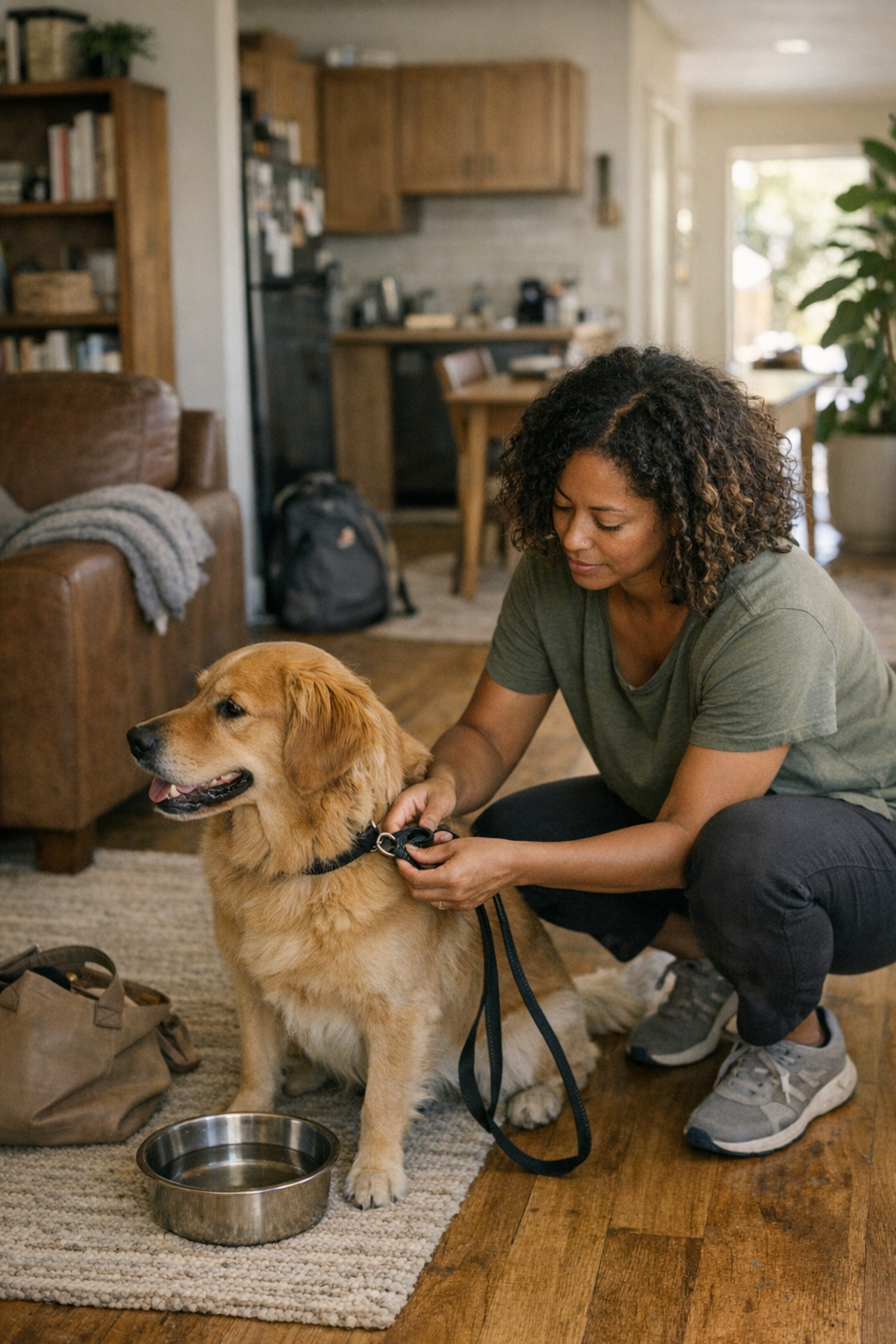
    The real after-walk pause isn’t about manners—it’s about the logjam. Whether you’re returning from a walk with bags on one arm, leash in the other, and keys wedged between your fingers, that calm sit or stand by the door stops feeling like structure and starts acting like a blockade. The first few days, unclipping right at the threshold seems efficient. But week after week, what was a brief, tidy checkpoint quietly becomes the spot where your routine breaks down: shoes still on, hands juggling, critical dog gear just out of reach, and a dog left glancing for a next step that never lands. The entryway stays clear, but the flow of home life snags here—again and again. This is the kind of overlooked daily friction DogPile is built to diagnose—where practical setup, not just discipline, makes the real difference.

    When Calm Turns into a Bottleneck

    On paper, that door-side pause looks organized. Your dog’s waiting; you’re unclipping; the process seems controlled. But reality pushes in: one hand on the leash, the other arm loaded with bags and keys, and now you’re fumbling because the water bowl or wipes are nowhere within reach. That moment of order cracks fast the second you realize you have to stretch or backtrack for the next step. Instead of a move into home mode, you get a standoff: you, the dog, the door, frozen in place as your workflow stalls.

    No leash yanks or barking—just a jammed entry zone where you need the space to act. Typical signals pile up:

    • You’re half in, half out, stuck balancing on the mat, unable to step free until all hands are empty.
    • Your dog waits for something more, hovering uncertain while you dig for a towel or drop a bag to find keys.
    • Trying to grab one item blocks access to another, so nothing gets put away smoothly.

    After a dozen cycles, this silent hold eats up your mornings and clutters your evenings. Every post-walk reset feels bogged down, and the transition to “home” never quite clicks—you remain mentally outside, even while standing halfway in.

    The Lingering Effect of Entryway Pauses

    It’s easy to mistake this routine as good practice; the dog is calm, after all. But repetition reveals what first felt orderly soon forces both of you to wait pointlessly for some secondary “go” cue. The hidden cost? Routine momentum grinds out, second by second, cue by cue.

    • Shoes stay on, trapping dirt at the door and stacking clutter in the space you’re about to need.
    • The water bowl sits empty while your dog paces, waiting for relief that never arrives at the right step.
    • Bags and gear pile up at the choke point, blocking easy access to both dog space and human space.
    • Transitions swell into a string of half-completed tasks, never really letting you move on.

    Looking tidy doesn’t guarantee living ease. You notice the drag only after the rhythm is broken by too many friction points, and what felt managed proves itself unworkable under real, repeated use.

    Real-World Friction: Where Small Holds Up Big

    This isn’t chaos—but it’s a mounting stack of micro-holds. Maybe you kneel to unclip and realize you still have damp grocery bags on your wrist. Maybe you step inside and reach reflexively for a towel, only to find it’s still drying in the hallway. Keys hang off your finger; the wipes are at the far end of the bench; your phone buzzes from your jacket in a heap by the leash. Meanwhile, your dog stands in limbo, taught to wait but never actually released into comfort or food. The artificial “pause” becomes a friction point you both start to hesitate around, especially at the end of a long week of broken transitions.

    The Subtle Crunch as Schedules Tighten

    The trouble compounds on days when you’re squeezed for time: you rush in, mentally juggling your next call or meal prep, but get stuck anyway—shoes still on, bowl empty, bags clustered, dog stuck by the door. The “official” pause point eats up precious minutes without ever earning its keep. By Wednesday or Thursday, the sense that your system is sabotaging you—not helping you—becomes unmistakable.

    What Actually Helps: Moving the Unclip Deeper

    The most practical reset? Shift the leash-off spot away from the threshold and into the next real action zone. Unclip not by the doormat, but beside where the day actually continues—dog bed, feeding corner, or water station. It doesn’t require a major overhaul; just restructure the “release” to align with your actual next step.

    • Set down the water bowl where you plan to stop, fill it, then unclip—so the dog flows straight to what matters.
    • Kick shoes off as you walk in, before hands are needed elsewhere, and before gear blocks movement.
    • Drop bags in a spot that keeps them out of the path—not at the narrow door—while the leash is still in range to control the dog for another few steps.
    • Stash cleanup items where you pass naturally, so you’re set up for quick use, not a delayed scramble back to the door.

    This single adjustment erases the “threshold freeze.” Home becomes a sequence, not a stutter. The silent waiting game at the door disappears, replaced by a smoother, less interrupted handoff into daily life.

    How Threshold Pauses Become Cracks in Your Routine

    Boundaries work—up to a point. Dogs cue off repetition. When you teach “leash off at the door,” you train a checkpoint that holds everyone there, regardless of what’s practical. The longer you use it, the more it becomes an anchor point that needs another cue to resolve. It’s not calming; it’s a pause that outlives its usefulness and traps you in a cycle neither of you actually enjoy.

    • You repeat a dozen versions of “okay, go ahead” just to get both feet inside.
    • Meanwhile, gear oscillates between human and dog zones, never finding a home until after extra effort or laps in and out of the entry zone.
    • The rest of the layout can look organized, yet this stuck point quietly sabotages you day after day.

    Even a clear floor doesn’t equal a solved routine. When the one sticky spot at the door keeps holding things up, the consequence stretches into every other part of the home’s flow, growing more obvious the longer it’s left unaddressed.

    The Difference Between Looking Organized and Living Organized

    Setups that seem orderly on first glance can reveal their limits in use. Shoe bins, leash hooks, or gear baskets by the door help—but if they force you to double back, shuffle hands, or block easy dog access, the neat look quickly proves hollow. Organization should oil the routine, not stall it midstream.

    • That convenient leash hook may actually encourage resets at the wrong spot, forcing you to retrace steps before you can settle in.
    • The “waiting spot” for your dog can create more standoffs if it’s not paired with what happens next—water, food, or comfort.
    • Splitting pause points means you check (and re-check) both dog and human essentials against each other, slowing the day every single time.

    The proof is in the feel of the routine’s reset. Shift the action to the dog’s destination, and both sides—dog and owner—get relief from repeated, low-level stall-outs. The home starts working with you, not against you.

    Small Change, Noticeable Improvement

    This isn’t about buying your way out of friction. One targeted tweak—moving the unclipping or cleanup moment to where the next task naturally starts—breaks the stutter without creating new hassle or clutter. For most routines, that’s as simple as leading the dog to their bowl, bed, or rest corner before you drop the leash, or rearranging one towel or bag zone to catch you on the way in, not after the pause. Over the next week, you’ll spot fewer repeated calls, walk back less often for missed wipes, and dodge the low-level irritation of a “door moment” that never quite ends—even if the space itself looks unchanged.

    Putting the Fix to Work: A Day-in, Day-out Perspective

    The proof comes through the ordinary mess: a muddy walk, arms full of groceries, shoes dripping on the mat. When the gear is staged a single zone further in, your home routine unjams and neither you nor your dog waste time in the entryway—reset flows into the rest of the day without dry runs, repeated cues, or the nagging sense you’re fighting the space you just organized. The door doesn’t need to be a checkpoint if the rest of the setup is finally working with your real, repeated use.

    See more setup

  • How a Single Basket Transforms Cat Care and Keeps Counters Clear

    The counter looks under control after a Sunday reset—bare, supplies stowed, nothing in the way. But by Wednesday, the refill bag is rubbing elbows with the coffee maker, the grooming brush has drifted to food prep territory, and the kibble scoop hides behind a bowl. Even neat setups quietly turn into an obstacle course: one errant spoon, one pouch in the blind spot, and breakfast runs straight into a reshuffling tangle you didn’t plan on. With every reset, the same silent pattern returns—cat-life tools spreading into every open space, stalling your morning, and erasing any sense that “tidy” means easy upkeep.

    Invisible Build-Up: The Counter Clutter Loop

    A tidy setup at a glance doesn’t mean it will stay workable midweek. You fill water, grab treats, brush fur, and keep parking each tool “just for now”—creating small blockades for next time. By Wednesday night, the scoop’s vanished behind wipes, treat packets edge under the placemat, and grooming tools wedge near the sink. The buildup isn’t just visual; it grinds down every routine—reaching for a can opener only to bump a sticky brush, nudging a toppling refill bag, or trying to fish a litter scoop out from a wonky gap behind the stove. Every step gets a little slower, every fix a little less satisfying, and the friction quietly returns just when you need the area to go on autopilot.

    Flat Surfaces: A Magnet for Micro-Mess

    Cleared counters look like order but double as magnets for mess within two days of real use. Most setups cluster feeding, care, and cleaning tools along the flattest, most available stretch. After reset, everything lines up. But within hours, feeding scoops overlap with half-used bags, a water additive bottle inches into the wrong zone, and by Thursday, a supposedly quick breakfast demands five minutes of shuffling around misplaced items. The warning sign? When a treat pouch starts sliding under the mat’s edge or a brush edges too close to prep space. Flat surfaces attract “temporary” drop-offs until the real fix—one big counter sweep—gets delayed again and again.

    The mess doesn’t show up with catastrophe. Instead, it leaks in: a toy under the dish rack, feeding tools trailing behind prep spaces, and slow creep as regular routines overflow into the same free space. Every delay—refilling, wiping, hunting for a lost scoop—signals a structure problem, not just a tidiness lapse.

    Routine Friction: When Function Doesn’t Follow Form

    Clutter changes daily rhythm fast. Suddenly, you’re sidestepping wipes to fill a water bowl, relocating a stray brush before you can prep food, or trying to clean up breakfast only to find yesterday’s toy jammed against the litter scoop. What looked like order after reset becomes a pattern of detours and repeat-mess. Instead of your setup supporting you, you’re working around its blind spots—and the backup builds with every feed, refill, and “just leave this here” moment.

    This tension stays background but real, making each task slightly slower and more frustrating. Cat care areas don’t just look less pleasant—they take more time, more movement, and sometimes more mess, quietly working against the feeling that your space fits your routine.

    The Open Basket: Turning Chaos into Containment

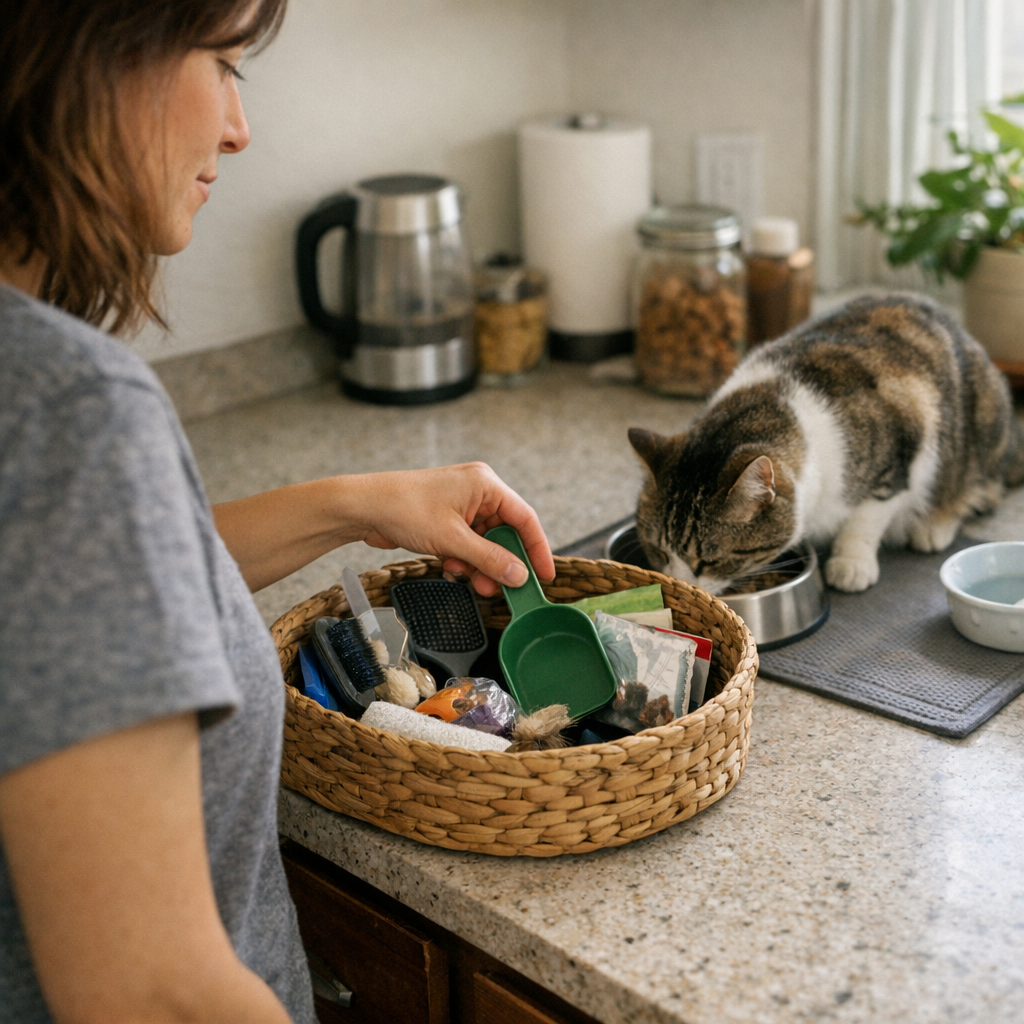
    One open, heavy basket near your cat care setup changes the problem. Rather than micro-clutter spreading across the counter, the basket corrals the high-turnover tools: treat pouches, feeding scoops, water additive, the lint roller, the timer for water refresh. Each used item lands in the same zone, not scattered through prep, coffee, and sink areas. The routine changes—mealtime ends, scoop gets dropped in, brush returns straight in after a quick use, refill pouches drop into a single spot. When it’s time to actually reset, one glance tells you everything: nothing’s hidden behind, everything’s out and visible, and the cleanup at the end of the day doesn’t spiral.

    What Happens Without the Basket? Daily Memory Leaks

    Drop the basket, and every routine leaves an invisible trail. After a few rounds, you’re searching for the scoop (it’s under the kettle again), chasing a treat pouch that rolled behind something, picking a brush up from the floor because a quick cat paw sent it flying. Tidy looks fade as each use secretly undoes the last reset. The weak point? Every object that’s not anchored returns as a friction point—until the only solution is starting over from scratch.

    Choosing the Right Basket: Function Over Flair

    The best basket is practical, not pretty—shallow but with weight. If it’s too light, your cat can shove it onto the floor with one swipe; too deep, and daily tools disappear into the pile. It should be easy to grab from, hard to accidentally tip, and visible at a glance so you never wonder if an essential’s gone missing. Test for real use: does a wet scoop drop straight in, or does it tip the basket? Can you find the brush without digging? Does it absorb clutter or just add another thing to trip over?

    Location matters. If the basket lands right in your cat’s main sprint zone, it’s just another thing to scatter—or for a playful swipe to send rolling. Move it close enough to your care area to stay useful, but out of the lane of cat traffic and kitchen chaos. Actually run through your routine with it in place and see if it survives the first day’s cycle.

    Only the Essentials: Defeating Overflow Before It Starts

    Most basket systems fail by trying to pack in everything “just in case.” Extra medicine droppers, back-up bags, spare collars, and dried out sprays do nothing but clog up fast grabs. The more you stuff in, the more every reset adds time and guesswork, as low-turnover supplies pile on top of true essentials. The easy fix: keep only the things you use in a single day’s cycle in the basket. If you’re staring at three types of water additive or digging under an old pill container for a treat, something’s ready to rotate out. Overflow turns “organized” into another routine roadblock.

    Hands pausing mid-grab are the early-warning system—if you stop to sort, you’ve lost the supposed speed advantage. Reset is about quick, repeatable flow, not storage for every possible need.

    The Pitfall of Multiple Containers

    Trying to separate feeding, litter, grooming, and toys into different bins feels organized but usually multiplies steps. Each extra container adds a round trip, a new spot to check, and stacks of “sorted” things that in practice just fragment the clean-up and make quick resets more complicated. For most setups, a single, visible, open absorber is faster, more honest, and tougher for real-life clutter to defeat than a set of neat, semi-empty containers that still slow you down.

    Signs Your Maintenance System Is (Finally) Working For You

    • Reset takes one minute, not five. The scoop, brush, and wipes are all right where you expect—not scattered or stuck behind appliances.
    • Nothing blocks human or cat movement. Chaos gets absorbed in the basket; tools no longer detour into meal-prep zones, walkways, or risky ledges.
    • Cleanup tools land where they’re supposed to. No hunting for a missing brush or scoop—they’re always in reach when needed, not halfway across the room.
    • Overflow is obvious, not sneaky. As soon as things outgrow the basket, it signals a cull—no more slow creep or stealthy pileup.
    • Essentials stay in real rotation. At a glance, you can spot what’s low, what needs replacing, or what’s overdue for a reset—no more lost tools or extra purchases because something slipped past your mental list.

    Real Changes, Not Just Visual Improvement

    Looking tidy isn’t the same as moving smoothly through routines. A good basket system does more than clear visual mess—it keeps feeding, cleaning, and reset cycles easy, even after the fifth run of the day. When clutter creeps back in—basket overflow, or too many “just in case” extras slowing grabs—a quick purge restores speed. The system should be flexible enough to absorb disruptions but firm enough to keep basics visible. The payoff? Less wasted motion, fewer forgotten tools, and a setup that’s actually use-ready, not just good-looking after a reset.

    Resetting Your Indoor Cat Life—One Reach at a Time

    A basket isn’t magic, but it anchors your routines. Routine friction drops, resets stop ballooning, and your home keeps pace with every daily cycle—without making you repeat the same old cleanup work.

    Explore the StillWhisker world for practical indoor-cat-life upgrades.

  • How Small Daily Habits Prevent Pet Care from Becoming Overwhelming

    Where Pet Care Routines Start to Strain: Small Slips, Big Friction

    It’s easy to think your daily pet care setup is working—dishes set out, towels folded, everything apparently in reach. But the daily routine proves otherwise. The first sign? You reach for the scoop and it’s not in the bin; you wipe up yesterday’s water ring only after the bowl sticks to the mat; toys are stashed in a basket, yet you still step around a stray ball that rolled where you need to walk. These are the routines that look controlled but feel slow. Tiny slips—one open lid, one towel misplaced—create double work and constant interruptions. Over time, the setup you thought would save effort starts building up friction you can’t ignore.

    Seeing It Happen: How Tiny Gaps Erode Routine

    Picture the reset: feeding spot wiped, water bowl emptied, toys stacked away. It looks finished—until next morning. The kibble bin’s lid, left cracked open for one distracted minute, lets in a stale smell. A towel dropped “for now” is missing when muddy paws appear. Suddenly, feeding is tangled with clearing laundry or searching for a clean cloth. The mess isn’t headline-worthy, but the routine slows: small gaps mean you circle back, make substitutions, or hunt for basic tools just to keep up with simple care. Momentum breaks, and even a clean area turns into a hard-to-keep habit.

    Quick Fixes That Don’t Always Stick

    A setup can look tidy—dishes in order, storage bins handy, tools nearby. But if you go to refill water and have to clear toys from in front of the cabinet or wrestle a scoop out from behind a sack of treats, surface order hasn’t solved real use. Over and over, you wipe bowl residue that’s now crusty, dig out a brush caught in a drawer, or try to scoop food with a kitchen mug because the actual scoop is lost in the morning rush. The lost time isn’t dramatic—just one more repeated hassle every day. Underneath, it’s not clutter; it’s a routine that quietly gets harder with each missed reset.

    When “Good Enough” Turns Into Constant Reshuffling

    Day one, it’s manageable. But let one round of cleanup slip: the towel for paws is damp and out of reach, so you improvise with a random rag. The scoop is in the sink, so you guess at portions. Afternoon means stepping over toys to refill the bowl, or clearing the counter of yesterday’s crumbs before prepping dinner. Every shortcut opens another: what started as “fine” turns into a series of stutters—detours, retracing steps, and more resets just to complete the basics. Over a few days, this pile-up replaces flow with friction, as every chore drags behind the last one.

    Small Habits, Tangible Impact

    The real fix isn’t an overhaul or fancy organizer—it’s hitting the reset as you go. Seal the food bin every time, even with one hand full. Place essentials where you actually grab them, not just where there’s room. Run a damp cloth over bowls right after use to stop buildup before it starts. Hang up the towel even if you’re headed out the door, so grabbing it isn’t a side quest next time mud tracks follow you in. Each of these micro-resets blocks a future interruption and puts your real routine back within easy reach.

    Making the Routine Self-Sustaining

    The best pet care setups don’t just cover the mess—they cut the time you spend stopping, searching, or correcting. Keep cleaning cloths where feeding happens, not just with the mops. Drop a small basket for toys right by the main living zone so you’re not collecting balls from every corner. Parking a spare hook for towels or leashes by the door isn’t about decorating—it means you avoid delays when a walk or post-yard cleanup should take seconds, not minutes. Each small action, done immediately, keeps care flowing and every next step lighter.

    What Consistent Resets Actually Feel Like

    The difference isn’t just visible. It’s having the right tool in hand on the first try—no clearing space, no searching for a missing cloth, no workaround because the scoop is missing. As these pauses disappear, the job shrinks from a list of chores to a sequence of fast, repeatable motions. You’re not chasing order—you’re maintaining it as part of the flow. Over time, this is what makes a routine not just look better but feel genuinely easier each time you use the space.

    Closing Gaps for Everyday Flow

    The real trick to stress-free pet care isn’t chasing after tidy appearance. It’s tying off those micro-gaps—every lid snapped shut, every towel rehung, every tool placed where you reach for it—in real time. Each reset predicts the next interruption and blocks it before it returns. That’s how a routine designed for daily life keeps pace with real mess, real clutter, and real energy. One setup might look calm. The one that works better—CalmPetSupply style—cuts the drag down and gives you room to keep up, day after day.

    Find setups that help you keep your care routine steady at CalmPetSupply.

  • How Simple Cloth Placement Transforms Your Daily Pet Care Routine

    The weakest link in any daily pet-care routine is rarely a missing product—it’s a towel not where you need it, a brush buried under clutter, or a wipe-down delayed because cleanup supplies are too far from the daily path. The real drag shows up after meals, water refills, or muddy returns from outside: you reach for a cleaning cloth or scoop and run into a block—something left in the way, or the needed item still damp or missing. These small missteps don’t look like failure, but over a week they chip away at the routine, turning quick resets into slow ones, and leaving messes to grow in corners nobody wants to deal with later. CalmPetSupply lives in this territory—refining the difference between setups that only look tidy and those that actually, reliably keep pace with real daily care.

    Where Routines Slow: The Cost of Out-of-Reach Basics

    Picture the usual start to morning feeding: dog eager, bowls stacked, but the food scoop’s behind a water jug and the cleaning cloth is MIA—maybe damp on the counter from last night, maybe in the wrong room altogether. Before you finish, a stray nudge scatters kibble. No towel within arm’s reach? The crumbs stick around. You tell yourself you’ll get them later, but later rarely comes. What should take seconds now drags out, and the next meal starts on top of yesterday’s mess.

    Initial order fades quickly. Supplies meant to be close migrate: towels left in the laundry, brushes parked on a random shelf, or a backup cloth that’s walked to the living room and stranded there. Each recovery costs movement. Once a setup forces you into even one extra lap for a basic item, that friction repeats. Shared spaces make it worse—cleaning supplies drift, chores get interrupted, and every grab for a simple tool turns into another sidetrack.

    Small Gaps Build Up: Delays and Overlooked Messes

    Every time a cleaning cloth, fresh towel, or grooming tool isn’t right at the care spot, two frictions multiply: more small messes are left behind—water by the bowl, scattered food, paw prints into the hall—and every would-be quick reset becomes a job you hesitate to start. Searching for the right towel leads to grabbing a paper napkin or skipping upkeep; midnight wipe-downs get put off when you realize the only available cloth is still drying or out of sight.

    The pattern repeats: at bedtime, you plan to clean up the feeding mat, but the towel’s still in the laundry and you wave it off till morning. One missed reset turns into dried buildup that needs scrubbing later—and the cost is more effort, not just more time. None of this signals a broken routine, but every out-of-place tool creates another small gap that compounds through repetition.

    Visible vs. Functional Organization

    There’s a test for whether setup works: can you grab the cleaning cloth without moving three things or opening a bin? “Looks organized” is shallow if the actual cleanup step is slowed by baskets, closed shelves, or towels buried behind other supplies. Entry shelves hide backup cloths, but right after a soggy walk—when you need a dry towel in two seconds—that tidiness breaks. Muddy footprints spread further every time you hesitate at the point of use.

    The real fix is basic and visible—hang a clean towel on a wall hook at the care zone, not hidden away “for neatness.” When supplies stay in plain sight and in arm’s reach, there’s nothing to search for, nothing to dig out, and resets shrink to a swipe instead of a scavenger hunt. It’s less about storage, more about flow—the setup should put every basic right in the path, not behind one more barrier.

    Real-World Use: From Repeated Pause to Routine Flow

    Compare two setups: One hides the towel in a kitchen drawer, an extra detour every meal. You walk past the pet, dodge a stray toy, and break the flow just to clean up—the routine gets slower, and soon the messes linger because “I’ll do it next time.” In the sharper setup, the towel hangs beside the bowl, always dry, always visible. Spills are wiped as they happen, no buildup, no catch-up days later.

    This logic applies everywhere: keep grooming brushes where you actually brush, waste bags at the door, water refills just above the bowl. When nothing needs to be fetched from another room, late-night checks, after-walk wipe-downs, and midday resets blend into regular movement instead of breaking stride or getting postponed. Not every step vanishes, but repeated stops do.

    The real gain: invisible to outsiders, but in your week, fewer interruptions, no stalled resets, and pet areas that hold their order with less decision fatigue.

    The One Weak Point: When Efficiency Loses to “Acceptable Enough”

    There’s always a snag. Maybe clean towels are well placed, but they only get swapped out once laundry is done—so you reach for one just to find it damp. Toys pile on top of cleaning cloths and block them mid-routine, or a bin looks tidy but buries daily-use items under rarely-used backups. Each slip saps speed. Cleanliness that seems “good enough” starts letting chores slide, with resets only happening when you finally run out of workarounds.

    The steadiest routines keep fundamentals close, visible, and dry—no digging, no delay, no ambiguity. Even when life gets busy or the week is messy, the core supplies don’t migrate or vanish, and skipped resets don’t become chronic. Order isn’t just for show; it’s for unbroken use.

    Practical Placement: Steps to Smooth, Repeatable Care

    Hang a clean towel or two right at every care point—beside the bowls, at the main door, in the laundry zone, or next to the litter box. Ditch deep bins and closed cabinets for daily-use basics; hooks or open shelves let you see at a glance what needs restocking before a damp or missing towel ruins the next reset.

    Rotate towels after each heavy mess—mud, wet paws, sticky spills—and allow dry-food crumbs or simple wipe-downs to go a little longer if needed, but always keep backup cloths within one step of use. A generic kitchen towel works in a pinch, but only if it’s equally accessible—not folded away with the linens.

    The split between routines that keep up and routines that fall behind isn’t the gear—it’s the reach. Every supply that lives right in the line of use shrinks the daily drag. Nothing fancy, just a structure that works even when everything else is too hectic to think about.

    Find daily-ready cleaning cloths, storage basics, and quick-access care goods at CalmPetSupply.

  • How Small Changes to Door Setup Can Smooth Your Dog’s Morning Routine

    Most dog owners know the sound of a door clicking shut doesn’t just mark leaving or entering—it marks a change in the whole flow of the day. Your routine might look organized from a glance: leash on the hook, bowl in its spot, floor mostly clear. But if your dog stands frozen near the door, circles the entryway, or waits for permission that never comes quickly enough, the weak point is obvious. Every morning, small annoyances stack up: reaching for the leash and finding toys in the way, returning after a wet walk only to discover the wipes are across the room, squeezing past a bed that sits too close to the threshold. Tidy in theory, but each step gets snagged by invisible friction built into the setup. The slower your transition, the more each day makes you feel it. Here’s what actually starts to drag—before you’ve even poured your coffee.

    The Unseen Morning Bottleneck

    The trouble isn’t just where the door is. It’s how every routine is forced to pivot around it. Most owners don’t really clock what’s off until their dog hovers at the door, stalling for cues in that blank space after it shuts. Instead of a clean shift to feeding or walks, you get a clutter of circling, sniffing, or just hanging by the entry, never quite moving on. These aren’t just lost seconds—they slow the whole chain. By the time you’re done nudging your dog forward, grabbing supplies from two spots, and untangling the leash from under the bed, the “quick morning” turned into a waiting game you didn’t intend to play.

    You catch it in little signals: a dog reluctant to leave the doorway, that glance back at the closed door, or hesitation between steps. Once you notice, it’s impossible to ignore—your setup isn’t smoothing the way, it’s quietly training both of you for delays.

    Routines That Stall Before They Start

    Picture the pattern: you close the door, ready to start the next thing, but your dog hovers in the entry—still on standby. You reach for the leash, but it’s tangled with a toy or partly pinned under a stray mat. After a wet walk, the wipes are across the threshold, so you’re forced to cross the dirty floor twice—wasting time, adding mess. One inconvenience is nothing. But every repeat makes this stop-start rhythm the new normal. Instead of entering the day, you and your dog rehearse the same shuffle: waiting, moving things, pausing at the bottleneck until everything is reset for the next round.

    How a Closed Door Becomes a “Wait Here” Cue

    Dogs know patterns. Door closes, energy stalls—soon, the entryway becomes a holding zone instead of a passage. It’s a checkpoint where your dog waits for a signal that comes too late or not at all. Again and again, the closed door prompts lingering, double-backing, circling, and hesitation even after obvious “go ahead” cues. The result: every transition gets stretched, not because of training but because the space pushes your dog into a “wait here” loop instead of a clear move-on.

    This is how routines turn sticky. The entryway may look calm, but each repetition builds stop-and-go habits. The dog’s presence at the threshold keeps things on hold, making the difference between routines that flow and those that stall right out of the gate.

    Repeated Friction in Real Time

    This isn’t just a morning phenomenon. When beds or mats overlap with the door’s path, every return home forces awkward negotiation—careful not to pinch the edge, careful around the dog, careful stepping over scattered toys. The doorway fills with tiny obstacles. One extra step, one bed push, and you’re slower every time. Even in a tidy setup, too much within reach becomes the enemy of quick, predictable movement—especially when you’re rushing to reset the space before work or guests.

    The Difference Between “Looks Fine” and “Works Smoothly”

    You organize the entryway: hooks for leashes, bed flush against the wall, bowl not blocking the door. On paper, nothing’s wrong. But the friction hides in plain sight:

    • Bed just close enough to turn the doorway into a default hangout—so your dog waits in limbo rather than resting elsewhere.
    • Towel for muddy paws placed nearby, but awkward enough to grab that the floor gets tracked anyway.
    • Water bowl close enough to trip over during a quick exit or return—making a “good” setup one more thing to dodge when time is tight.

    It’s the routine that feels slow, not the room that looks messy. Each step back from a walk or meal becomes a mini project: move this, shift that, call the dog again, then finally start the real next task. The drag isn’t visible—but you feel it in every delay and repeated correction.

    The Impact of Small Frictions Stacking Up

    Every return is a test: bed still in the swing path means you sidestep or nudge it each time; dog pauses at the entry, so you’re giving repeat instructions instead of moving forward. Over days, these patterns train both owner and dog. Your entire morning starts to stretch, your patience wears, and the “new routine” is built around waiting by the door. The weak point sticks, no matter how good the rest looks.

    Tweaking the Setup: Simple Changes, Real Differences

    The answer often isn’t complicated. The most effective change? Rotating the dog’s bed lengthwise against the wall, with space clear of the door’s swing—suddenly, no more indecision at the entry, no more door checks, no need for repeated reminders. The dog’s path is direct: door closes, bed is right there, and lingering at the threshold quietly disappears. Cleanup after walks? Now supplies are next to the exit, instead of requiring backtracking across the floor.

    A New Pattern That Reduces Waiting

    This small shift replaces a “wait for action” zone with a settle-and-reset cue. Instead of using the doorway as a holding pattern, the dog sees a clear space away from foot traffic—the cue is to move on and relax. That new routine bluntly reshapes everything: feeding starts faster, you get out the door sooner, and “wait by the door” fades into the background. The same space does more; the invisible drain is gone.

    Seeing the Routine From the Dog’s Point of View

    To a dog, that bed or mat near the door is a signal: “Don’t relax yet, action is still coming.” Even if the area looks organized, rest doesn’t happen until the physical layout actually clears a path forward. Every pause at the threshold is really the setup talking back—reminding your dog to hang tight, circle, or hover close, instead of dropping into a true reset. That hesitation repeats, rooting a pattern that’s hard to undo just by rearranging items visually.

    Making Calm an Easy Default, Not an Exception

    The best signal isn’t about enforcing “good behavior.” It’s about making rest easy and obvious—clear, physical permission for your dog to quit waiting and let you continue the routine. Once the bed, bowl, toys, and supplies actually support flow instead of crowding it, repeat interruptions fade without you having to micromanage. The day runs quieter, and the difference—less circling, fewer reroutes, no extra steps—shows up fast.

    Spotting the Weak Point—And Addressing It Early

    Letting the “door hover” slide is like accepting a yellow traffic light that never switches. The cumulative effect: meals get nudged later, walks start less smoothly, downtime becomes about managing delays rather than actually resting. The weak point isn’t dramatic, but it multiplies—quiet, persistent drag until the whole routine feels one notch rougher than it should.

    The actual fix is deliberate, not elaborate. Give the rest spot its own clear, inviting zone—no crowding the door, no waiting in the way. Reinforce calm there after each return or door close, and watch as the bottleneck at the entry gives way to a smoother, more reliable rhythm.

    What’s Actually Changing in the Day-to-Day Flow?

    Soon, you’re giving fewer reminders, dodging fewer obstacles, and actually moving on right after the door shuts. Cleanup between walks is easier: towel is by the threshold, wipes are within reach, bowl isn’t the first thing your heel hits coming in. The space stops demanding little corrections and actually helps you reset—one move per step, not a cascade of minor interruptions. Visitors may not notice the difference, but your routine will.

    Paying Attention to Where Friction Hides

    Most setups get organized to look right, not to work right. “Bed here, bowl there, toys in a bin”—but the invisible roadblocks only clear out when the entire daily path runs smooth for both human and dog. The problems—waiting in the doorway, slow resets, item-blocking—disappear only once the arrangement sends a clear signal. Instead of letting the threshold decide what happens, design your setup to tell both of you what step comes next—no room for uncertainty or pause.