Category: Pet Life

  • How Separating Cat Bowls Ends Mealtime Stress and Mess in Multi-Cat Homes

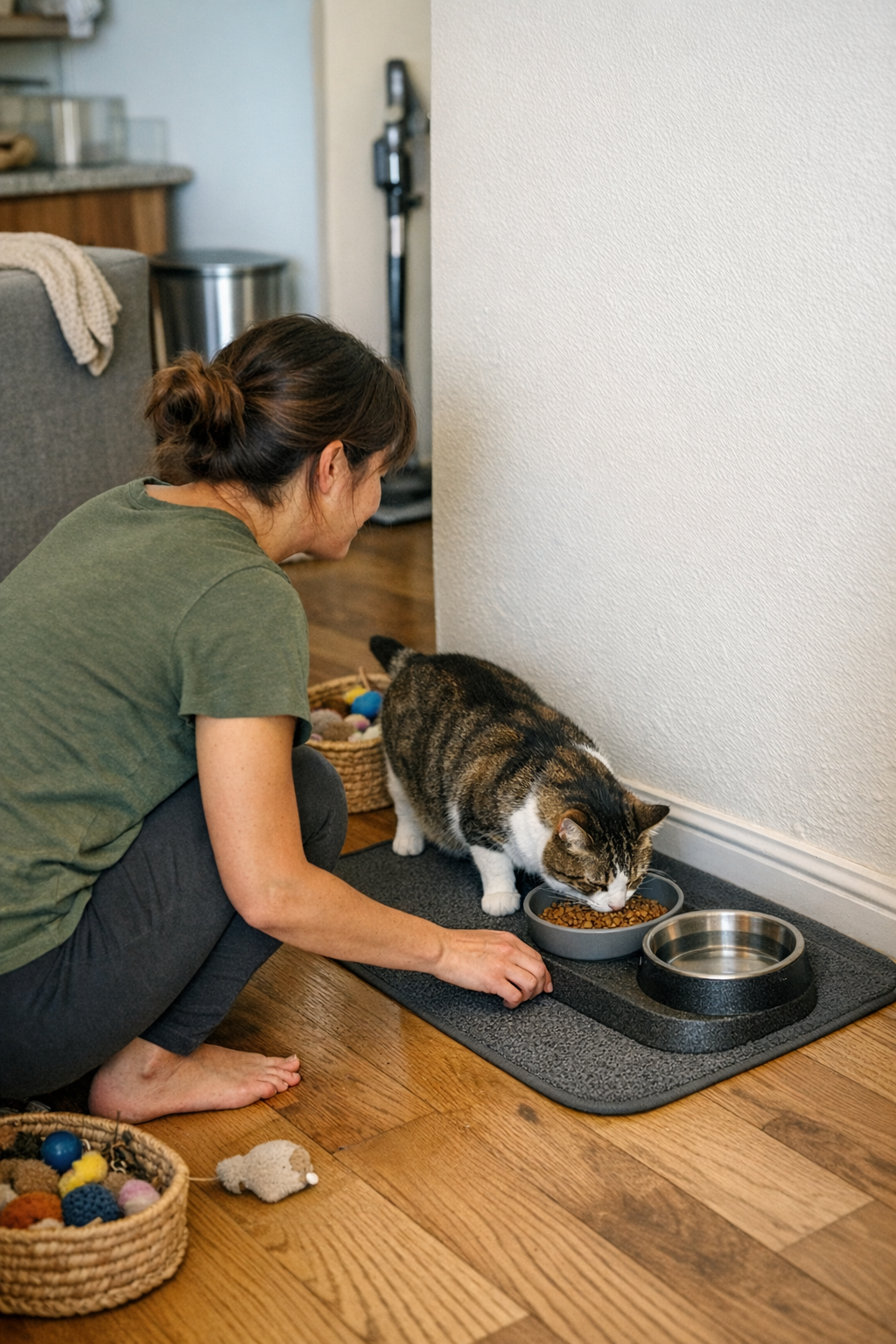
    Most multi-cat households discover this the hard way: your feeding corner looks organized for a few days, but the mess, tension, and repeat cleanup keep exposing its weak points. At first, neat bowl rows and matching mats promise an easy routine—a simple refill, one quick wipe-down, and the sense that you’ve contained the chaos. But by the end of the first week, order cracks. If one cat eats faster, you’re left policing every breakfast, scraping extra crumbs from hallway seams, and watching your “clean” feeding area sprawl out, meal by meal, into the rest of your living space. The setup that felt solved on day one turns into a friction point you can’t ignore, especially if your cats have different paces or personalities. That’s what starts to separate the setups that only look tidy from the ones that actually reduce your daily burden—the difference is obvious once you live with it.

    When “Organized” Falls Apart: The Repeated Friction of Lined-Up Bowls

    The classic approach—lining all cat bowls on a single mat—seems practical: one spot to refill, a single cleanup zone, and a tidy look. That illusion usually breaks as soon as your cats’ rhythms diverge. The fast eater plows through their portion and zeroes in on the slow cat, starting a routine that barely changes day to day:

    • The quick cat crowds the slow feeder or hovers right at their bowl’s edge.
    • Slow cats pick up the pace awkwardly or back off, leaving more food (and more anxiety) behind.
    • Displaced food and stray crumbs jump the mat border, spreading under the nearest furniture or halfway across your floor.
    • What began as a self-contained corner now means extra wiping, more frequent floor checks, and a routine interruption that sneaks up every single meal.

    The first meal or two won’t reveal the problem. But by the end of the week, cleanup covers more space, one bowl is always picked clean while another sits half-full, and the “easy” reset gets more annoying to keep up with.

    Why Shared Bowls Trigger Stress—and Cleanup You Can’t See in Photos

    Side-by-side bowls create a direct visual prompt for territorial eating. The speedy cat doesn’t need to wander—they just swivel and see another helping waiting. In the daily cycle, that means:

    • Early meal finishing leads straight into hovering or bowl stealing.
    • Meals turn into flashpoints—tension at the bowls, rushed finishes, sometimes half-abandoned servings.
    • Instead of peaceful feeding, you scramble to intervene, just to stop this cascade of stress and spillage from repeating itself.

    If you’ve ever caught yourself standing over a feeding area while one cat tries to finish in peace, you know how quickly the “neat” routine unravels. The bowls stay lined up, but calm mealtimes and easy resets get crowded out by tension, scattered kibble, and extra cleaning—the hidden costs of a setup that’s only visually organized.

    Containing Mess Shouldn’t Mean Spreading Mess—But That’s What Happens

    One mat, one spot, one wipe-down: it sounds like minimal work. But in practice, bowl edges overlap, cats angle for space, and food migrates. What you actually see is:

    • Kibble clumps nudged under baseboards or wedged behind the fridge feet.
    • Cats bumping bowls against table legs or tracking bits through a high-traffic hallway.
    • What should be a two-minute reset expands as you chase crumbs around shoe racks, mat edges, and low corners you weren’t planning to clean today.

    The daily interruption isn’t just about what’s on the mat—it’s about how far the mess, and the frustration, travel. The original “efficient” zone keeps asking for more of your morning, while the actual convenience drifts farther from what got planned at setup.

    Why Bowl Separation Changes the Everyday Cleanup Game

    Breaking the line—moving bowls apart—brings instant, practical relief even in cramped spaces. You don’t need remodels or spare rooms. Instead, you pause and look for places to borrow a little privacy:

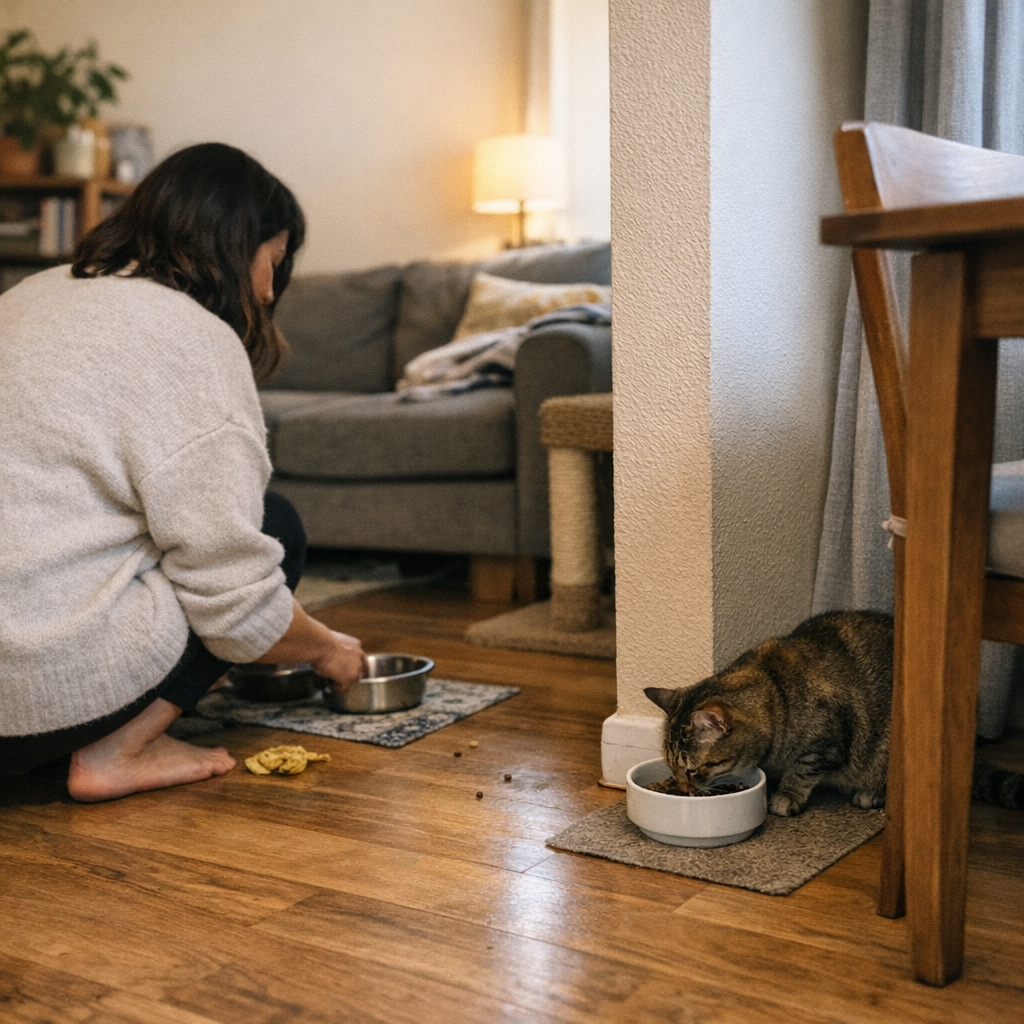
    • Slip the slow eater’s bowl behind a chair, beside a low shelf, or half-shielded by a potted plant so sightlines break and pressure drops.
    • Let furniture edges, curtain corners, or a room’s natural nooks create feeding spots that keep one cat’s meal out of the other’s view and easy reach.
    • Place bowls across the logical path of the room—cat A by the sofa end, cat B in the reading nook—so each location belongs to its own eater and not to opportunistic scavenging.

    The change isn’t just that you see fewer standoffs. It’s that each reset gets simpler: the slow cat can finish undisturbed, the quick cat is less tempted to “double dip,” and every bit of spilled food lands where you actually expect to find it. If a reset takes more than a couple of steps, it’s the sign of a system still letting chaos sneak in.

    Real-World Shift: A Week After Pulling Bowls Apart

    Picture a narrow city apartment: two bowls under the kitchen counter, one feeding mat, both cats eating side by side. Within minutes of every meal, the fast cat hovers; the slow cat either bolts down bites or leaves half the food untouched. Resetting the mat involves moving shoes, bending to sweep errant crumbs, and wiping beyond the planned zone—the “tidy” setup only holds together in theory.

    Three days after shifting the slower cat’s bowl behind a living-room chair, patterns change. The slow cat settles in beside the window, eating in a kind of privacy, unhurried. The fast cat finishes and loses interest—the second bowl is out of sight and out of reach. Cleanup becomes only what’s right there, next to each bowl. Refilling for the next meal means a two-step process and a single wipe. The routine stops expanding into the rest of your day, and the setup starts holding its boundary again.

    Small Spaces Don’t Need Big Fixes—Just Smarter Dividers

    Trying to separate feeding areas in a small home feels counterintuitive, but the fix is rarely about more distance—just better blockages. In most multi-cat homes, you get practical success by blocking the direct view, breaking habitual overlaps, and letting each cat stake claim to a personal space, even if it’s just a chair’s width apart. Examples that work in real-world apartments:

    • One bowl tucked behind the end of a couch or set flush by a curtain, breaking visibility.
    • Furniture pieces—bookshelves, side tables, storage bins—used as low barriers to define zones.
    • One cat’s dish moved to an entry alcove or hallway bend—not dramatic distance, just a line cats don’t routinely cross at meal times.

    The goal isn’t isolation; it’s giving each cat enough privacy to eat calmly. Shifting a mat or bowl a couple feet off the old line, or nudging it against a piece of structure already in the room, creates a change you notice every day. The space stays livable—your reset gets lighter, not heavier.

    Does Splitting Bowls Double the Mess? Here’s Where Reality Breaks Expectations

    A common worry: scattering bowls means more zones to manage, more crumbs to find. But when feeding is interrupted less often, the cleanup contracts, not expands. Here’s what shows up once you separate:

    • Crumbs and spills stick to their source—no more food trails meandering out of bounds.
    • Referee duties drop off: less need for mid-meal intervention, more predictable wipe-downs.
    • Cleanup is local and fast—you know exactly where the problem zone will be and how big it gets (much smaller once the stress drops).

    The prettiest, most symmetrical bowl lineup doesn’t always win on speed or stress. Once you’re through the week with a split setup, you’ll find less littering, fewer tense standstills, and a routine you can reset without supervising every move. The feeding corner stops spreading into the rest of your living area—not just visibly but in terms of repeated work.

    Practical Cleanup: When the Overlap Disappears, So Does the Repeat Labor

    Pinterest-ready rows mask the real work in multi-cat homes. You want a layout you don’t need to micro-manage—a setup where you can refill, check, and wipe up in one run, with no detour for missed crumbs or leftover stress by the sofa. The strongest setups work because they keep the next step predictable:

    • Bowl refills don’t come with surprise double-clear-outs from sneaky eaters.
    • You spot almost no “mystery” crumbs in the hall—just a minor sweep at each spot.
    • Resets mean one motion—pick up, wipe down, prep for the next round—without
  • Reducing Indoor Cat Feeding Conflicts with Separate Zones

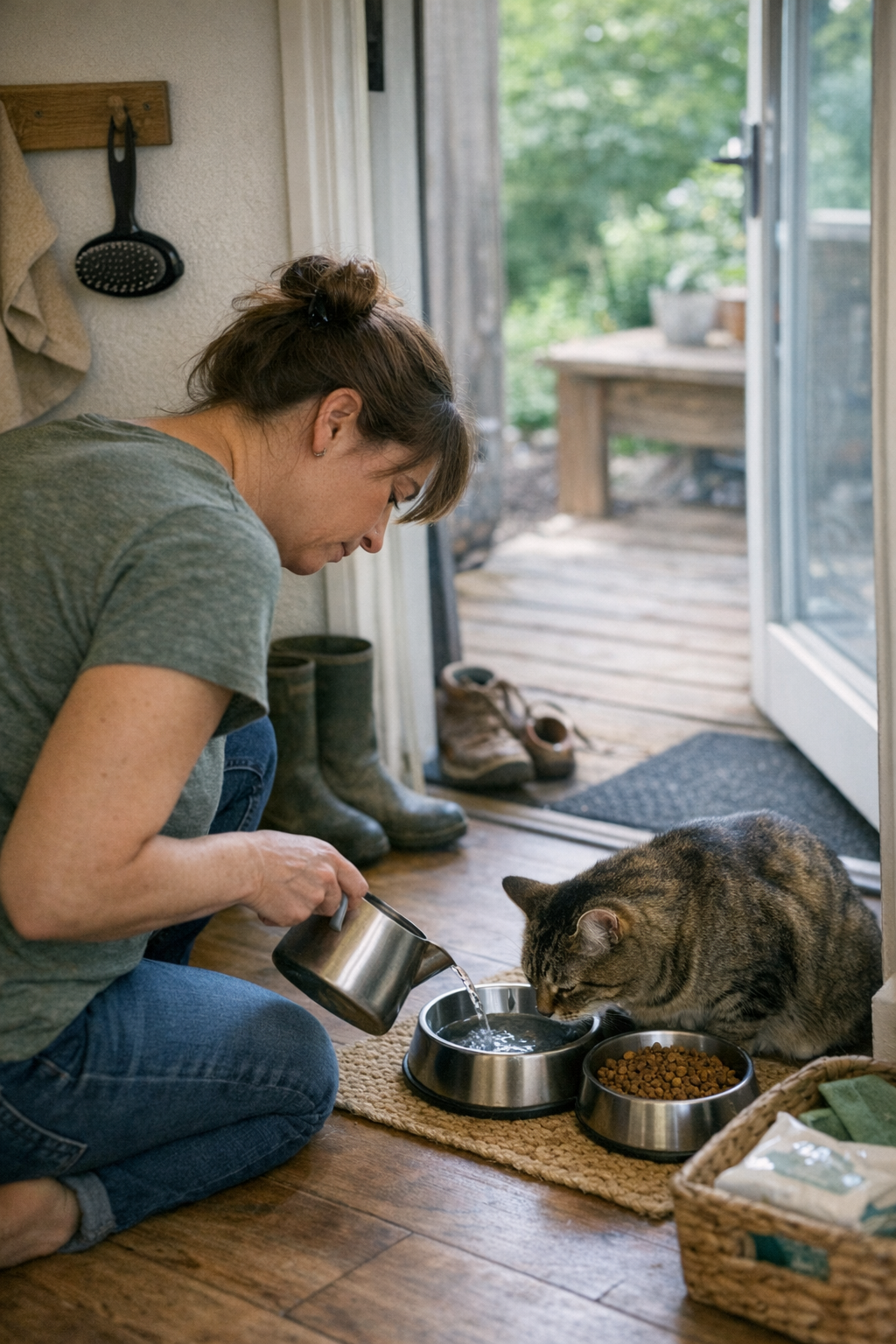
    The promise of a “neat feeding station” for multiple indoor cats collapses quickly under real, repeated use. By meal three, the mat that once looked organized is already betraying you: bowls drift until one wedges under the cabinet, kibbles scatter into unreachable cracks, and at least one cat is left hovering, waiting for a clear spot that never lasts. Crouching for escaped food or blotting up a fresh water spill becomes part of your actual routine—no matter how perfectly you set it up the night before. Tidy at a glance, messy in lived reality: the friction doesn’t just return, it spreads. You notice, every day, that a single “feeding area” is quietly working against you—and against your cats—in a way the packaging never admits. StillWhisker owners see this gap again and again: setups that clean up okay, but never keep the room or the routine on your side for long.

    When One Feeding Area Is Too Many Problems

    It seems rational: all bowls together, one compact mat, mess contained. But the close-corner solution breaks down as soon as routines collide—particularly when your cats have different eating speeds or want space. Real-world problems surface fast:

    • Bowl drift: The bold cat shoves, bowls slide and overlap, and both become unstable. Bowls might hitch halfway under the furniture or block each other like it’s a contest, not a meal.
    • Kibble leak: Crunchy food bounces or gets batted past mat edges, hiding along baseboards or vanishing under appliances, just out of reach until it starts attracting ants or dust.
    • Crowded restlessness: One cat stalls while the other looks on, unwilling to share close space, or abandons the meal entirely, returning to pick at leftovers after the bottleneck clears.
    • Mound of mess: By mid-morning, the mat shows a perimeter of ground-in crumbs, water rings, and sticky paw prints that seem to wander farther each day.

    Every “quick reset” is wishful thinking: you wipe a surface, only to spot a pellet under the cupboard two hours later; you nudge bowls back, but every serving shifts things out of place again. The gap between what looks fine and what actually works deepens with each reset that takes longer than it should.

    How Close Feeding Zones Start to Disrupt the Whole Room

    The mess is not just local. Cramming all feeding gear into one spot quietly turns an organized feeding corner into a room-wide interruption:

    • You find yourself side-stepping bowls while heading to the fridge or stepping in crusted-over puddles you didn’t see at first.
    • Litter dust and stray toys creep into the feeding zone, then get tracked further, compounding mess in places you never meant to manage.
    • The right cleanup tool (wipes, hand vac, broom) is close, but not within grab range—so you “do it later,” and little messes accumulate until later is much too late.
    • Resetting after mealtime isn’t a two-second fix anymore—it becomes a separate task, often rushed or skipped, leaving you behind on the next round before you’ve cleared the last.

    These aren’t isolated flaws—they’re the reliable signals that surface-only setups ignore. A system that hides daily interruptions under a veneer of visual order turns ordinary upkeep into ongoing hassle. If you find yourself bending for the same fix twice a day, the “organized” look is holding you back.

    Reading the Real Signs: When a Feeding Setup Needs a Change

    If your cats are blocking, waiting, or circling off before meals are over, the setup is delivering its own form of feedback. Patterned disruptions tell you exactly where the structure fails:

    • One cat edges along the mat or stands behind another, unwilling to eat without space—leaving half the bowl untouched.
    • The quieter cat finds an exit route instead of finishing, giving priority to distance rather than food.
    • Unfinished meals are left as an open invitation for pests, not a convenience.
    • You’re repositioning (not just refilling) bowls at almost every meal—no matter how well you thought you arranged things last time.

    Repeated scuffles, leftovers, and cleaning delays aren’t quirks—they’re warnings that friction is baked into your routine. As every “reset” gets later and takes more out of you, the setup keeps adding invisible work to what should be a simple process.

    Why Splitting Feeding Zones Lightens the Load for Cats and Humans

    Actually separating feeding spots—not just sliding bowls a foot apart, but creating distance—changes the story overnight. Instantly:

    • Bowls stay anchored. No more midnight migration to the baseboard or disappearing under the kitchen cart.
    • Cats each claim a space without the constant side-eyes and strategic blockades. They eat directly, not defensively.
    • Kibble fallout drops. Mess stops recurring on the same tiles or baseboard cracks.
    • Cleanup turns into a single, knowable step—no crawling for lost food, no surprise puddles that sour the mood.

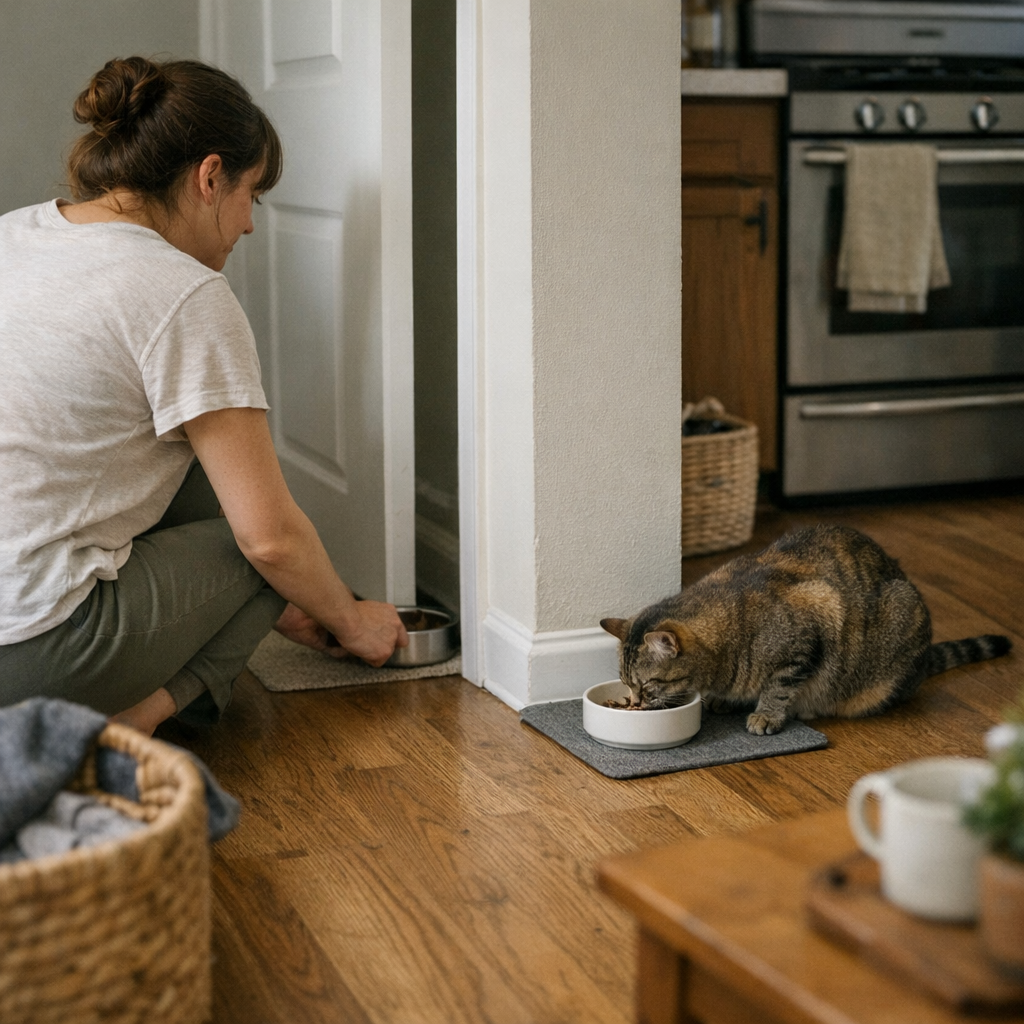
    Set up a secondary feeding spot—even just a few rooms away—and you lose the tedious patchwork of fixing the same mess. The strain shifts from endless repair to quick, shallow upkeep. A bowl behind a hallway door stays clean till bedtime. That trouble-mat in the kitchen finally looks (and feels) low-maintenance, needing less kneel-and-sweep attention.

    Less Stress for Cats Means Smoother Flow for You

    With real separation, low-level tension drops away. No one guards. There’s no drama before every meal, and no lingering worry about late or uneven eating. Cats drift in and out of their own zones, leaving the rest of the room calm and unmarked. The one who eats slow and the one who eats fast both get what they need—without the human side having to play traffic cop or run interference.

    Choosing the Right Spots: Quiet, Clear, and Out of Conflict

    Location shapes outcome, not just appearance. The best feeding splits are not accidental but calculated:

    • Out of sight: A corner behind a door or in a nook—places cats won’t meet eyes while eating—quickly reduces pushy attempts and boundary testing.
    • Side access: Space on both sides of each bowl lets cats come and go without being trapped or blocked, ending the passive standoff.
    • Avoid the litter zone: Convenience isn’t worth crossover mess or extra stress. Keep food far from where the litter box lives.
    • Steer clear of major walkways: If your usual route crosses a feeding spot, you’ll collide with bowls or step in the mess, making the routine more stressful for everyone.

    Look for trouble signs: If you’re always cleaning the same patch or redirecting traffic around a certain spot, don’t accept it. Rearrangement fixes outcomes, not just appearances.

    New Setup, New Habits: What to Expect in Day-to-Day Use

    The real benefit isn’t superficial tidiness—it’s friction finally dropping from repeated use. When feeding points fit natural movement and cat behavior, everyday pressures visibly lessen:

    • Rarely do you see abandoned kibble or water pooled beneath the stove, waiting for a late rescue mission.
    • Cleanup shrinks to a glance and a swipe. Deep cleans become rare instead of routine.
    • Cats move freely, habits realign. No more pausing, pacing, or sneaking food after hours.
    • The border between cat space and human walking space stops blurring; no more adjusting your route to avoid bowl drift or puddles in main pathways.

    Instant resets fade away. The feeding area no longer demands reactive fixes every few hours. Instead, the setup stands up to real rhythms—matching the morning’s calm even after a long, busy day of repeated use.

    Practical Tips: Keeping the Routine Easy to Maintain

    • Spot-check after main meals: Fast scans catch stray crumbs and let you avoid bigger, later mess. Most days this becomes a matter of seconds.
    • Keep supplies in reach: Wipes or a hand vac need to be within arm’s reach, not just nearby. If grabbing cleanup tools is its own step, old messes will get skipped—then circle back as work later.
    • Flag any new friction fast: If a setup starts tugging at your time or feels tense again, shift locations a few feet or around a corner. Small changes can eliminate repeated stress entirely.

    Above all

  • How Recognizing Your Dog’s Doorway Pause Improves Leash Walks

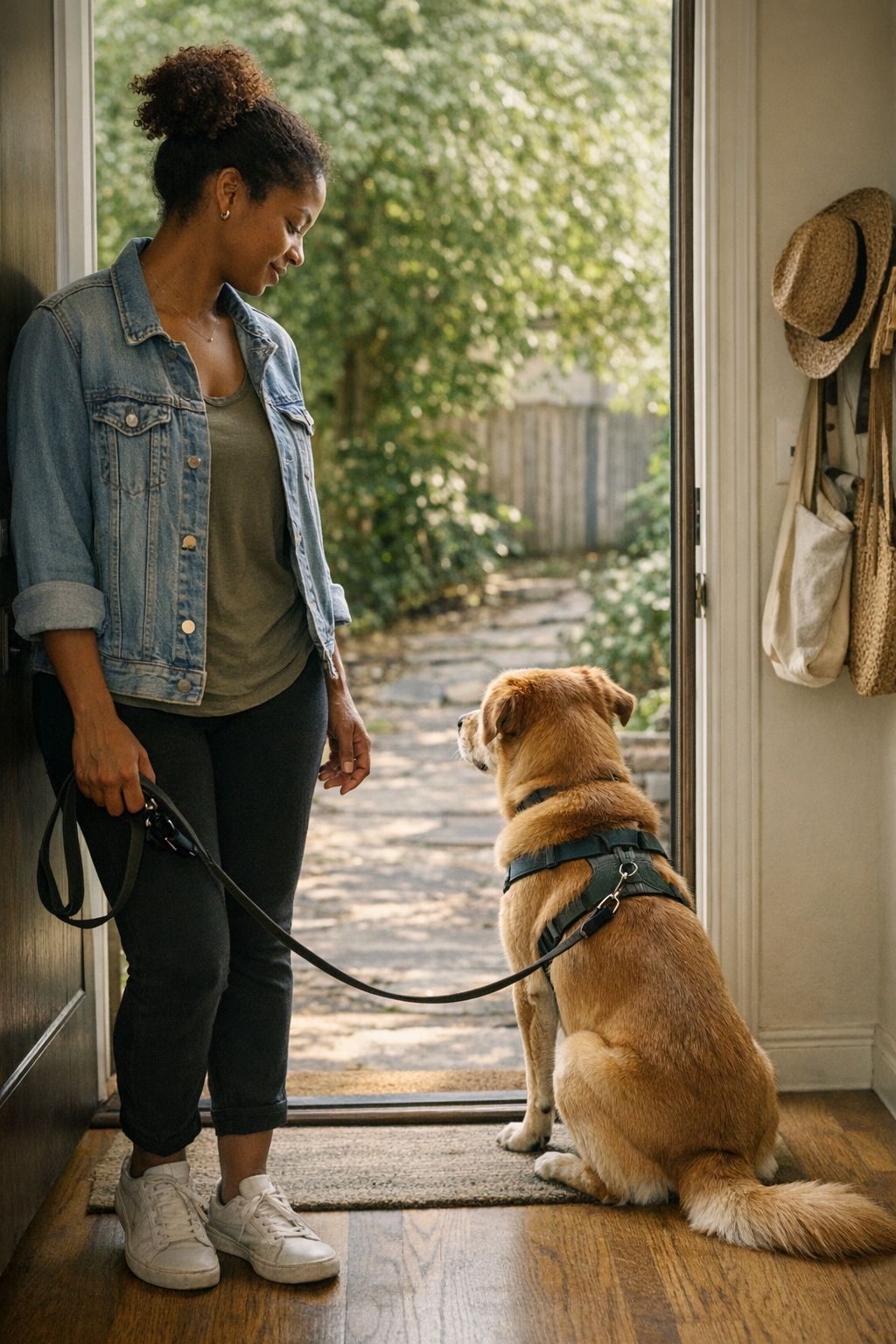
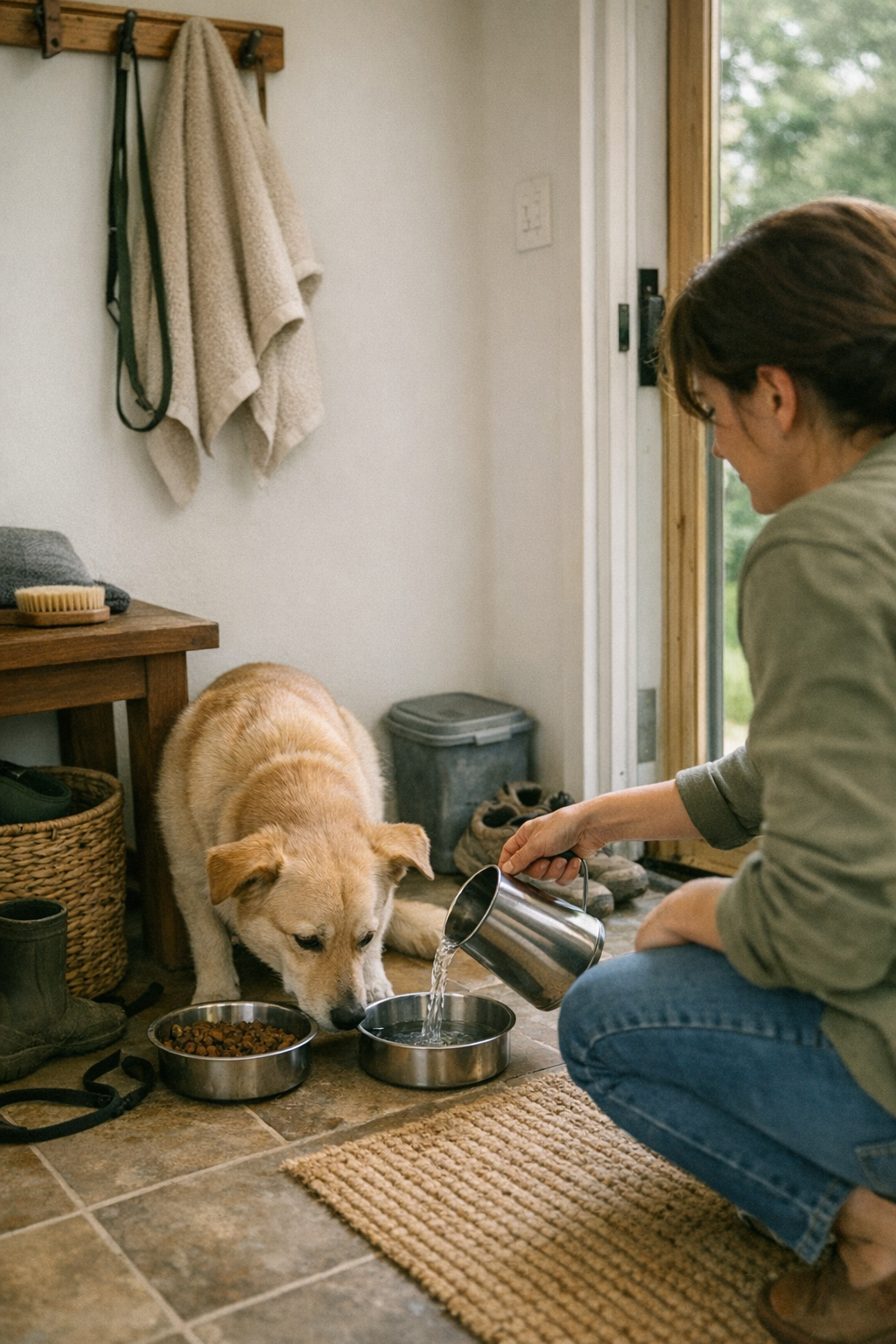
    The difference between a smooth dog walk and a routine that grinds every morning often comes down to those 15 seconds at the door. You reach for the leash—only to find it half-hidden behind the coat rack. Your other hand tries to fish out the wipes because someone (maybe you) piled a muddy towel on top of the entry bench. The dog hovers at the frame while you shuffle shoes and keys and coax her out, but the leash snags, your knee bumps the bin, and already the walk feels like something you’re working against instead of for. These doorway pauses and gear bottlenecks aren’t random. They’re small signals that add up fast—and show exactly where a daily setup isn’t quite working. It’s the difference between a home that just stores dog supplies and a DogPile-ready zone where walk routines run smoother, not slower.

    When the Doorway Pause Isn’t Just a Pause

    Call it stubbornness or confusion, but most delays at the door start when dog supplies drift into paths meant for people—or when routines keep tripping over the same misplaced towel, leash pile, or rogue toy. The pause at the threshold stops being brief. You’re mentally ticking off missing items, trying to clear a strip of floor space, while your dog reads your tension and hangs back. That little hesitation isn’t neutral; it’s the first crack in the routine. Clumsy setups—gear edging into walking space, wipes buried under treat bags—turn doorway pauses from forgettable moments into slow buildups of irritation.

    Each trip through the threshold with a tangle or a missing item reinforces the friction, not just for you but for the dog. You nudge; she resists. The walk starts with correction and tension. Over time, neither of you launches cleanly: leash tension replaces momentum, and anticipation gives way to correction. Walk energy drags before you’re out of sight of home. If every morning stumbles over the same five-second snag, eventually the walk itself feels like a series of corrections—right from the first step.

    How Small Friction Grows into Habitual Snags

    Rarely does dog routine friction blow up in a single flash; it builds from small, repeatable annoyances. Your dog hesitates because yesterday, her leash yanked sharply—because the harness was at the bottom of the pile, or you had to sidestep water bowls that always crowd the threshold after breakfast. Wiping muddy paws gets delayed because the wipes slid behind the shoes. The “cleanup zone” is technically there, but it never seems to be close enough when the actual mess happens. Eventually, daily prep devolves into a series of micro-recoveries—fetching, rearranging, and subtly hurrying through steps that should be simple.

    Every repeated urge to keep moving—every “let’s go” said with growing impatience—adds a thread of tension that compounds with each walk. Watch for how quickly your leash snags now versus a week ago, or how often your dog turns back or pulls away before you’re halfway down the block. A walk interrupted at the threshold rarely gets its flow back. The speed bumps aren’t just at the door; they echo until you’re home again—and next time around, the cycle repeats, usually in the exact same spot.

    The Walk Starts at the Threshold—Literally

    Picture the weekday rush: keys wedged between your fingers, leash jammed under yesterday’s raincoat, and a vague sense you’re forgetting something. Your dog stands at the frame, bracing her paws, glancing back to see if you’re ready, even as your hands are busy untangling the gear mess that seems to remake itself daily. If every walk starts with this scramble, the result is obvious: a launch that feels late before it begins, a dog more alert to your frustration than to the world outside, a leash under tension before the first step.

    This isn’t about a single step—it’s about your readiness and your dog’s. Rushed starts show up as more frequent leash corrections, zig-zagging at the curb, and failed attempts to find a rhythm. Owners notice it most when routines snarl: towels out of reach post-mud, harnesses MIA under a toy heap, bags buried behind other chores. Entryways that pass the “look neat” test in photos can still fail in live use, hiding obstacles that cost time and focus. Dogs feel these missed beats faster than you might notice—they know the difference between a settled launch and a scramble.

    Turning the Pause Into a Useful Reset

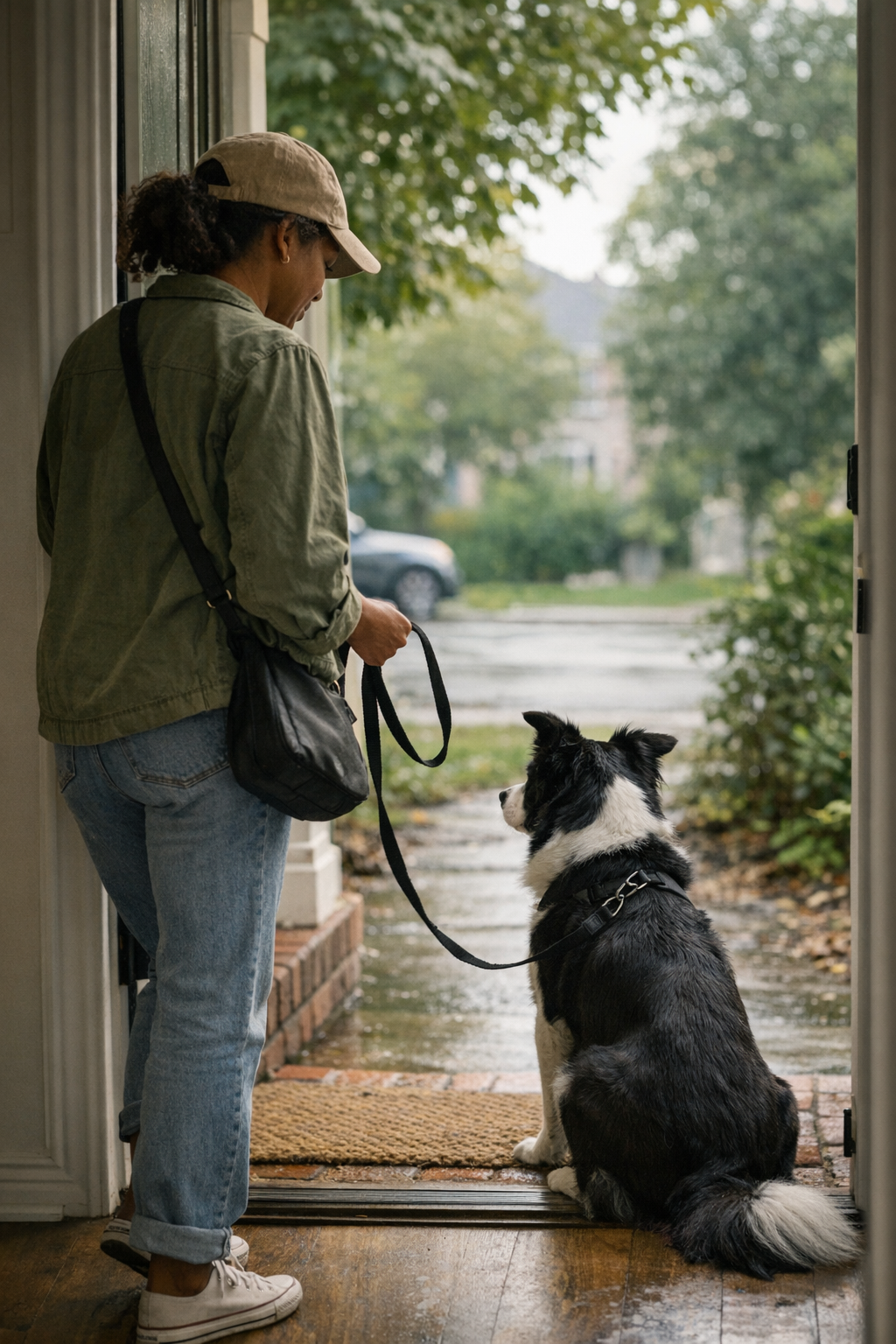
    After enough fumbled starts, some owners finally try a different approach: What if that threshold pause isn’t just tolerated, but used? Instead of dragging your dog or shuffling impatiently, both of you wait—feet and paws square, leash loose. You watch for the real sign of readiness: your dog’s body angles forward, attention shifts outside, and the hesitation melts. Sometimes you catch a tail wag, a sigh, or a subtle shift that tells you she’s unplugged from the hallway tangle and plugged into the moment outside. It’s not a trick; it’s a reset—brief, simple, and more powerful than most commands.

    Add this reset to your walk prep and you’ll see the pattern change: the leash stays calm over those first ten steps, corrections fade, and the back-and-forth tension drops. Over repeat use, the threshold becomes less a battleground and more a shared launchpad. Dogs learn; so do people. The pause transforms into a clear signal, not a moment to rush or ignore.

    Spotting True Readiness: What To Look For

    Posture tells the story. A relaxed, upright dog—tail soft, shoulders loose, steady glance forward—signals true readiness at the threshold. If your dog averts her eyes, stiffens her stance, or fidgets every few seconds, she’s not with you yet. Owners who learn to wait (by seconds, not minutes) start to see the contrast: less rushing, more focus, fewer leash fights on the sidewalk. There’s no need for elaborate cues or endless patience. The takeaway is simple: allow a pause for both parties to sync up before heading out.

    Practical Obstacles: When Setup Still Gets in the Way

    Even if you master the pause, real-life setups keep testing you. Some days, you reach for the leash but grab a tangle of jackets instead. On return, the wipes you always mean to have close are lost behind a pile you rearranged just yesterday. The dog comes in muddy, tail wagging, while you’re patting down bins or digging in drawers—attention lost, mess spreading. Even “organized” spots sabotage you if the right gear isn’t right where you need it, at exactly the right moment. Cleanup supplies look accessible until it matters; bowls look tidy until your hands are full and a shoe rack breaks your stride; re-entry stalls because the towel is always just out of comfortable reach.

    This is where most setups fail their real test—not that they look messy, but that they demand micro-adjustments mid-routine. The reset gets rushed, the flow stalls, and dog energy rebounds unfocused. However much the area looks “ready,” friction returns whenever actual need meets delayed access or tangled gear.

    Making the Most of the Pause: Real-World Tweaks

    To fix the routine, don’t just declutter—rethink reach and placement:

    • Keep essentials truly at hand, not tucked away. Place leashes, towels, and pickup bags where your fingers touch them—no bins to dig behind, no awkward sideways shuffle. The most usable spot is just before the physical threshold, where you pause anyway.
    • Add a joint reset cue. A mat, corner rug, or even a strip of tape can mark exactly where both you and your dog pause together—making the habit easier to repeat by design, not just luck.
    • Check your body language for slippage. If you start to lean, fidget, or multitask at the door, your dog will mirror the distraction. Stand square, breathe, and watch how your dog settles faster with a calmer lead-in.
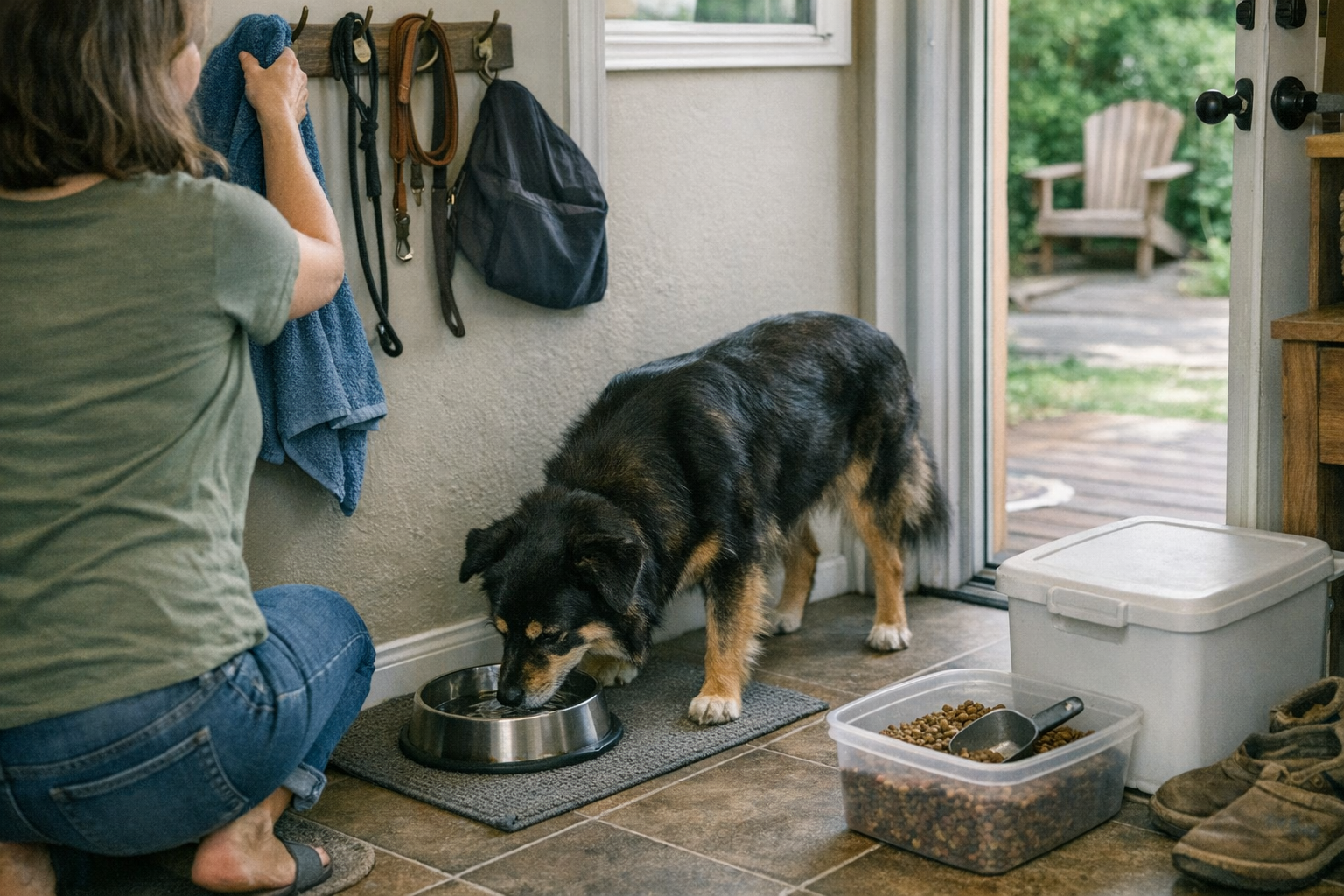
    • Stage for the return, not just the exit. After muddy walks or scattershot outings, place towels and wipes in arm’s reach of the door—visible and ready, not buried under laundry or forgotten in another room. The right setup cuts time lost to scrambling and keeps your dog with you for the whole return routine.

    The Long-Game: Less Tension, More Usable Trust

    Repeating the threshold reset doesn’t solve every snag overnight. Some days you’ll backslide—reshuffling gear, losing wipes, fumbling through clutter you thought you’d fixed. Yet, over the weeks, the entry zone gets easier to use, the pause becomes a cue instead of a delay, and you’ll notice your dog checking in with you instead of resisting. The walk flows out the door, not against it. The post-walk reset gets easier, not harder, and the cycle of tension starts to break.

    Routine friction hides in the little things—a leash in the wrong bin, a towel just out of reach, gear that spreads back into your space when you’re not looking. A setup that looks tidy but still makes daily flow harder signals exactly where DogPile thinking starts:

  • How a Simple Doorway Pause Shapes Your Dog’s Leash Behavior

    You know the drill: leash clipped, hand on the knob, dog at your side—and still, you’re not out the door. The leash snags, a tote catches your shoulder, your dog hangs back, and the clean “out-we-go” never quite clicks. That tiny doorway pause gets dismissed as nothing, but it drags on the whole routine—nudging every walk to start with a hitch instead of a flow. Stack those snags over a week, and you’re not just losing seconds—you’re battling a routine that feels clumsy, one frustrated reach at a time. The friction isn’t always where you expect: that supposed “quirk” at the threshold signals a breakdown you can feel long before you hit the sidewalk. Efficient routines don’t come apart in obvious ways; it’s the slow grind of a stubborn pause that sours repeated use.

    The Hidden Costs of Doorway Pauses: Beyond the Two-Second Delay

    Most dog routines aim for smooth exits, but the first problem often happens before you even step outside. That initial hitch at the threshold isn’t just a delay—it pulls the air out of the whole outing. At first it’s just a small check: dog’s ears up, one paw lifted, nose scanning for what’s new. You stand there, leash slack, already feeling yesterday’s awkward launch. By the third day of door-edge fumbles, you barely notice the buildup—but now you and your dog depart out of sync, walking with tension instead of stride. The pause becomes routine, and “quick exit” slides into recurring bottleneck. The worst part? You stop noticing how much drag it adds to every attempt at a fresh start.

    Letting these doorway hurdles fade into the background means accepting mismatched walking rhythm and more leash tangle—problems that didn’t start on the sidewalk, but right at the door.

    Routine Stumbles: Why the Pause Creeps Into Everyday Walks

    Leash-up routines look simple—clip, reach, go—but real life scrambles the choreography. Most owners are wrangling keys and bags with one hand, leash with the other, eyes on the dog, and a quick scan outside for distractions, all at the same time. The dog’s pause isn’t just a hiccup; it flags a transition that’s jammed before anyone takes a step.

    The hitch flares up during rush hour or bad weather. You’re late, trying to hustle, but a hanging leash or bunched-up mat blocks your flow. Or your dog sniffs the air for half a beat longer in the rain, making your patience stretch thin. That initial hesitation doesn’t just slow you down—it sets the tone for the next block: choppy, start-stop movement, leash snagging on corners. Frustration builds because neither end of the leash is fully ready—and both of you sense it.

    Missed Signals: Not Every Pause Means Stubbornness

    It’s easy to call any doorway slowdown “stubbornness” or a weird quirk. But door pauses almost always mean your dog is gathering themselves—not plotting resistance. Most dogs stall to process what’s new, or to transition from inside calm to outside stimulus. If you respond by yanking or rushing, the pause morphs from gentle check-in to everyday standoff—and the cost shows up in jerky walks, more leash tension, and zig-zagging from step one.

    The “problem” isn’t random; it’s a feedback loop. Pulling through a hesitant pause plants seeds for the next tangled leash or off-beat stride before you leave the porch.

    How Everyday Setups Can Make Things Smoother—Or Trickier

    The struggle starts well before your dog hesitates—usually with a snagged reach or cluttered grab. If your leash tangles around a hook, a toy blocks the walkway, or a bin sits just out of reach, a calm exit is wrecked before it begins. “Organized enough” sometimes means: not actually workable. Over a week, shoes drift, bags pile, a crate jams the exit, or the treat pouch goes missing—and each tiny obstacle inches up your frustration and your dog’s uncertainty. That’s how five-second pauses stretch into a haze of hurry, shuffling, and apologizing to your own routine every morning.

    Real entry setups shouldn’t just hide clutter—they should cut invisible barriers. The difference shows up in those urgent moments: can you actually grab, clip, and step out with one hand, or are you forced into reshuffle mode every time? The gap between “looks tidy” and “works under pressure” grows with every repeated use.

    Resetting the Start: Routine Adjustments that Respect the Pause

    Most threshold struggles don’t come from bad gear or a difficult dog—they stem from routines that snap instead of flex. When the pause repeats, so does the urge to hurry, tighten the leash, or force momentum. But precise, repeatable tweaks can reset the pattern.

    Whenever you hit that doorway pause, pick one steady cue—maybe a quiet “let’s go”—and hold still, leash loose. Resist the urge to urge. If your dog lingers, stay neutral. The “fix” is in predictability, not force: a pause that gets the same response every time loses its edge as a source of tension.

    Change won’t thunder in overnight. But as you stack outings, you’ll feel the pivot: the doorway becomes a checkpoint, not a blockade. The routine gains elasticity—you’re not fighting your own setup, or your dog’s instincts. Outings pick up flow. Friction that lived at the beginning gets crowded out by a smoother launch, and the rest of the walk follows suit.

    The Ripple Effect: How Doorway Friction Shapes the Whole Walk

    Don’t underestimate that two-second doorway stall—it can define the walk’s next fifteen minutes. A clumsy start infects momentum: leash tangles, dog lunging off-pace, owner attention jumpy. Most of this isn’t “bad dog behavior”—it’s energy stuck at the threshold, bleeding into every block. Remove the awkward entry and you nudge every other sticking point downstream—less need for reset mid-walk, fewer strained corrections by the curb.

    A smoother start pays back at other pinch points too. Coming back inside, you’re less likely to scramble for a towel buried behind the crate or to trip over gear that multiplied since you left. What was only “neat” is now reliably ready—less shifting, more doing. Function rises as micro-obstacles fall.

    Real-Life Tweaks from Repeated Friction: What Actually Works Over Time

    You don’t need a fresh build or a showcase entryway. What matters is repeat viability. Keep every walk tool—leash, bags, wipes—within immediate reach. If you can’t grab it without a shuffle, it’s in the wrong spot. Do a reality-check after a standard week: what are you always stepping over, moving, or losing track of? Does your dog have true standing space, or does each movement send you both off-balance at the door?

    Watch out for these creeping friction points:

    • Hooks that look smart but need twisting or two hands to unclip the leash.
    • Dog gear or toys leaking into the walkway, forcing awkward sidesteps at go-time.
    • Cleanup wipes easy to find, but never right when you need them for muddy paws at the exit.
    • Household clutter flowing into the threshold zone, making “waiting” blend into chaos instead of action.

    What trips you up most days? That’s where setup should adjust. The right fix isn’t a one-time reorg—it’s a reaction to repeated friction. Reshuffle with routines in mind and weak points fade—not just in appearance, but in actual, daily function.

    When to Worry (and When Not To) About a Doorway Pause

    The standard doorway pause is rarely a refusal—it’s a moment to check in before the next environment. Typical hesitations mean the dog is deciding, not dreading. Only when you see your dog back away, shrink, or flat-out avoid the threshold do you need to dig for bigger causes—too-tight harness, real anxiety, or a trigger outside deserving more attention.

    For almost all ordinary, repeated pauses: don’t yank, don’t rush. Hold the space, offer a steady cue, and set the stage for smoother movement right at the start. These adjustments aren’t about training—they’re about design, attention, and building a daily flow that doesn’t crumble under repeated use.

    For setups that actually match real routines, and gear designed to reduce silent friction before you step out, see what’s new at DogPile: DogPile.

  • Managing Subtle Pet Care Challenges After Calming Doorbell Barking

    Doorway barking might be gone, but daily pet care doesn’t get quieter—it just moves. A water bowl left rim-deep in foot traffic, gnaw marks on a misplaced scoop, or towels living three steps from the latest drip—these silent hiccups start stacking up. Pet supplies that look organized in the morning can turn into afterthoughts by night: a water area that wipes down too late, scattered kibble where you walk, a missing towel when your hands are actually wet. CalmPetSupply’s world isn’t about eliminating chaos; it’s about noticing where ordinary routines keep veering off track, even when things look calm on the surface.

    When Pet Routines Quiet Down, Friction Just Relocates

    Calmer entrances don’t end daily work—they shift the target. Instead of dragging a barking pup away, you’re suddenly dealing with a water bowl that has wandered halfway into the hall, or picking up a storage bin lid left askew from a rushed refill. Crumbs migrate under chairs; bunched towels for emergency wipe-ups end up just out of arm’s reach. Instead of one noisy interruption, you get a patchwork of small, avoidable delays: reaching for a leash tangled with a grooming brush, nudging supplies that have drifted, or realizing the food scoop is buried under everything except food.

    These aren’t big obstacles, but they chip away at routine flow. The mess shrinks and goes quiet, but it reappears as a circuit of minor interruptions. Resetting after every feeding, wiping, refill, or grooming becomes slower—not harder, just more scattered and easier to ignore, until the pressure adds up.

    Repeated Interruptions Are Easy to Miss Until They Repeat

    Picture what actually piles up: the water dish now sits in the way every time you pass, damp patches seem random but stubborn, and food bits reach further out past pet mats with every distracted pour. Entryway drips don’t get wiped because the towel’s across the room, not on a hook by the door. By late afternoon, yesterday’s brush is still hogging shelf space, shoving the leash aside one more time.

    These aren’t unusual moments; they’re signs a setup that seems tidy keeps lagging behind how you really use the space. A scoop leaning out from an opened bin is a small but growing signal: if your gear is always “almost put away,” your routine is quietly doubling back on itself. Each unnoticed micro-mess is routine drag that compounds by week’s end—never dramatic, but never quite out of the way either.

    The Gap Between Looking Tidy and Flowing Smoothly

    A neat home can still create workarounds. That water refill is now a nuisance: nudge the bowl from a walkway, wipe twice instead of once, reset after the fact. Surfaces look nearly set, but you keep reshuffling tools—brushing past a food container, displacing a towel to grab the scoop, stalling each next step. Feeding, grooming, and cleanup all bleed together—not because they’re hard, but because the setup keeps rerouting your process.

    “Looks organized” isn’t the same as “works without friction.” A towel across the kitchen does nothing as drips form at the porch entry. Storage items sneak back into shared walkways, bowls migrate to wherever the last refill left them, and tools that help today wind up as tomorrow’s new obstacles. These small, repeated motions erode the supposed calm. If you’re always moving one thing to reach another, the calm is cosmetic.

    Adjustments that Break the Cycle

    The shift comes from setups that match your repeated use—not just the first tidy-up. Move water bowls back from walkways, hook towels directly where water lands, not “nearby.” Supplies that work aren’t just in the room; they’re in the right hand’s reach at the right time, not hiding among clutter or across the floor. Tools like closed-lid bins, wall hooks, and leash racks only help if they actually put each item where you’ll grab it—today and tomorrow.

    Every time a cleanup supply sits almost in place but not quite, or a scoop is blocked by something else, the routine slows. Pet care setups that ignore these details just create quieter friction. If the feeding path is clear and storage closes easily, the day moves. If a brush’s “convenient” spot gets loaded down or a bin lid never closes all the way, that micro-routine needs an update—not new products, just better fit to real habits.

    For most people, the solution isn’t dramatic—it’s a shift in how you position the basics. Each item needs to work at speed, from bowl to bin to towel, without blocking the next reset or stacking up more micro delays.

    Making Calm Last: The Role of Micro-Correction

    The most persistent obstacle is the difference between what looks calm and what actually delivers calm. Bowls out of traffic but hard to refill simply move the pause, not remove it. Towel hooks too far from where drips appear lead to skipped wipes. Supplies that migrate into shared home space end up being nudged, moved, or bypassed in each round of care.

    Lasting relief means setting up each supply for the way it’s really needed: keeping the bowl in one predictable place (and easy to reach), anchoring cleanup right where the first spill forms, and keeping storage lids and grooming supplies clear of each other. If small annoyances reappear after a few days, it’s a sign the routine is fighting the setup—not your effort.

    Most pet care routines won’t stay photograph-ready. The goal is simple: reset, feed, refill, wipe, and put away in one round, without doubling back for what’s not where you need it. Calm doors are good—but the real shift happens in the micro-corrections you make between feeding, cleanup, and quick care. Routine calm isn’t about perfection. It’s about a setup that’s always slightly ahead of the next interruption, not scrambling to keep up.

    Find the setups that keep your next cleanup, refill, or feeding from turning into another repeat hassle: CalmPetSupply

  • Optimizing Multi-Cat Litter Box Placement to Reduce Daily Cleanup Hassles

    The first sign a new litter box setup isn’t working isn’t disaster—it’s slowdown. Monday looks neat: boxes lined up, cats inspecting, an “extra” for good measure, and the floor briefly calm. But by Wednesday, friction pushes in. Litter starts escaping the edges, scoops are stranded on the wrong side of a mat, and the job of a quick reset turns into backtracking: stacked boxes mean you’re wiping and sweeping the same patch twice, all for a setup that promised less work. The extra box, supposedly insurance, crowds your shared space or sits ignored—and the trap becomes clear: surface order hides inconvenient routines. StillWhisker setups exist for exactly these moments when everyday cat life reveals what looked “organized” now feels unsustainable.

    Why Box Count Alone Doesn’t Solve the Indoor Cat Setup Problem

    The standard advice—“one box per cat, plus one”—collapses the real struggle down to a number. In reality, the math only works in a spreadsheet. What upends the routine isn’t too few boxes, but how these boxes disrupt the tasks you repeat every single day. Wedged behind a laundry door, or forced along a tight hallway, clustered boxes mean a feed-refill-spot becomes a cleanup gauntlet: elbows jammed under shelves, mats bunched up against the wall, a scoop left balancing somewhere inconvenient. Litter you swept ten minutes ago resurfaces by the kitchen threshold. The theory of enough boxes skips the bigger issue: once boxes collide with feeding, water, or daily movement, the whole flow clogs up.

    The moment a box backs up against a food station or gets buried in a joint traffic route, the effort piles on: twice the mop jobs, toy cleanup blending into bowl rinse, and a “plus one” that cats treat as invisible. The right number in the wrong spots only guarantees more mess reshuffled, not solved.

    The Early Calm: Why Day One Is the Easy Part

    Initial setups flatter you with calm—a lineup that looks logical, every box apparently in the right place, minimal scatter in sight. Fast-forward two days. Now, one cat claims box A, leaving box B untouched and box C a graveyard for effort: you realize, midway through scooping, that half the lids are unused. Cleaning turns into a loop—back and forth, chasing the same sandy patch that leaks just beyond the mat, moving the water bowl (again) to reach the box, picking kibble pieces out of old litter trails. What looked like a solved problem on Monday now eats minutes every morning, the “simple” zone overloading the same edge of your routine. By Friday, you’re doubling back to catch what the first pass missed, with more friction than you started with.

    Where Placement Fails: Recognizing When the Setup Isn’t Working

    “Enough” boxes don’t matter when placement builds new pressure points. Cats aren’t fooled by numbers—they’ll avoid boxes that spill over into high-traffic, visible, or crowded spots. You end up performing the same contortions: reaching past a cushion to dip the scoop, bumping into feeding trays just to pull a lid, or discovering that the storage bin for wipes is now buried behind stacked boxes. Suddenly, the area feels less like a setup and more like an obstacle course.

    • Bottleneck cleaning: Cleaning three boxes in a cluster magnifies the mess. Litter clings to every floor seam; you double-wipe the same corner. Scooping multiplies the scatter instead of taming it. The “backup” adds nothing except another surface to clean, even when it’s routinely skipped by cats.
    • Shared-space competition: Place a box near bowls, water setups, or play tunnels and you start a routine of constant interruption. The scoop handle catches on a water dish, a toy ends up half-buried in litter, and routine resets stall. You’re backtracking for the hand sanitizer, pausing mid-task just to clear a path.

    These aren’t minor glitches—they’re the interruptions that change a five-minute tidy into a job you start putting off.

    How Clustering Triggers a Loop of Mess and Maintenance

    Cluster all your boxes in one busy area—think laundry zone, entry alcove, or tight kitchen pass-through—and you create a mess bottleneck that grows with every cycle. The cats switch boxes in quick succession right as you’re trying to handle breakfast, streaming new pawprints through your just-wiped tracks. By midday, the dust and bits stretch beyond the intended boundary; by dinner, you’re facing a second round, with supplies already scattered and fresh litter invasions visible in the shared walkway. Resetting each box only seems to unleash new drift: wipe, scoop, resweep, repeat. The routine you imagined gets tangled, forcing you to chase flaws across rooms instead of controlling a single, contained spot.

    The problem isn’t too few boxes or too little cleaning—it’s the energy wasted crossing the same pointless divide. Repeated resets become repeat interruptions, undermining the whole setup’s reason for existing.

    What Real-World Changes Show When a Box Moves

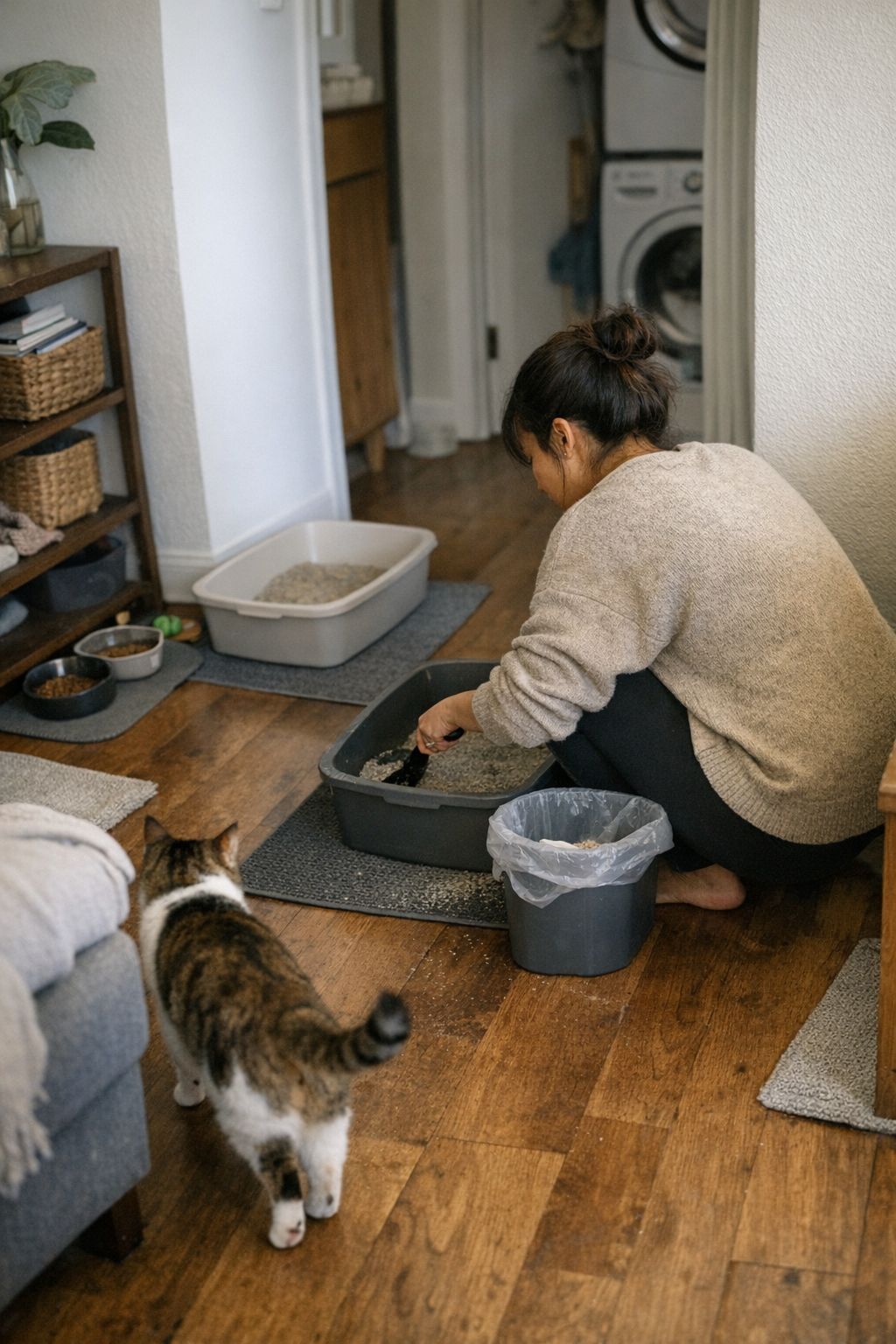
    Moving just one box out of the cluster changes the pattern immediately. Shift a box further from the main “traffic triangle”—maybe beyond a doorway, or behind a small divider—and you cut tracking and scatter by half. The cats use both boxes, but the heavy-use one stops carrying all the burden. For you, that means one core box needs a midday check-in, while the relocated box—now away from food, water, and toys—only needs a single, less urgent scoop. The loop of scatter shrinks, the overlap with feeding or resting zones eases, and you gain actual breathing room in cleanup supplies. It’s a practical, visible improvement: fewer double-backs, less mat overlap, and one less thing in the way when you reach for a bowl or restock the scoopable. The rhythm recovers from frustrating back-and-forth to a clear, finishable reset.

    • No more multi-box scatter zones that demand double mop duty.
    • Scoop, check, and refill cycles can finally be split—less repeat handling, less overlap with other routines.
    • Cleanup tools (bags, wipes, sanitizer) no longer sink out of reach behind stacked trays.
    • Most of all, the routine feels controllable instead of trapped in a spinning cycle.

    Small tweaks have visible effect—by week’s end, you might spend five minutes a day, not a quarter hour dreading the whole job for one more cycle.

    Spotting When “Backup” Boxes Become Wasted Space

    Adding an “extra” box gets pushed as a universal rule, but shoehorn that box into the wrong spot—a narrow alcove, next to the water fountain, behind a furniture leg—and it simply turns into wasted effort and floor space. If a box sits untouched for days but you’re still fighting tracked litter and urgent midweek cleanups at the main box, the layout needs a hard look. Unused boxes aren’t insurance—they’re a visible sign of poor placement and setup creep.

    Pull that “backup” away from the crowded zone: get it out of feeding sightlines, off the edge of a shared mat, and into a calm, low-traffic corner with clear access for the cats. Even a modest move can trigger quick changes—less ignored maintenance, fewer retraced steps, and a more balanced use pattern. When cats finally split their visits, you split your labor: it’s a reset that sticks instead of a band-aid that joins the mess.

    Understanding the Underlying Friction: Not Just Mess, But Lost Routine

    The deeper problem rarely looks dramatic—it’s the slow leak of routine efficiency:

    • Reaching for the scoop and having to shift a bed or blanket first, risking a spill in a rush.
    • Finding litter in a food bowl zone you thought was protected from scatter, so cleanup collides with meal prep.
    • The need for a second mop pass because a box in a choke point scattered diagonally across the hallway after one early-morning use.
    • Pushing off a refill because the only path is blocked by a tucked-away box or because the scoop spot is now under a table.

    These aren’t “setup failures” in the sense of chaos—but they transform mild daily upkeep into a job that’s easy to delay, resent, or rush through sloppily. Good design in cat setups isn’t about how tidy the corner looks, but how rarely you trip over an interrupting detail. The right setup feels invisible because reset, refill, and cleanup simply happen—few interruptions, no avoidable repeats.

    Practical Patterns for Spacing Boxes (and Easing Your Life)

    Homes and cats vary, but certain principles cut through clutter:

    • Don’t cluster—spread: Give each box a distinct spot, not just a new position in the same room. Avoid side-by-side lines unless you have no other choice.

    For more real-world solutions that survive daily resets—and don’t trade easy looks for harder upkeep—StillWhisker’s setups are built for indoor lives that test practical routines.

  • Creating a Cat Feeding Area That Stays Organized Through Daily Use

    The true test of any indoor cat setup isn’t how neat it looks the day you finish arranging it—it’s what happens three days later, when your routines meet real frictions. You notice not the calm of a “settled” space, but the creeping hassle as bowls migrate out of reach, mats curl underfoot, and crumbs reappear in the far corners. Feeding, litter, or play areas that seem well-designed can still cost you time and patience as you find yourself wiping, dragging, or reshuffling the same items again and again. What feels organized at first often turns into repeat work you didn’t plan for—and those micro-failures quietly multiply each week unless the structure actually holds up to daily use. StillWhisker setups are built for this lived-through pressure—the difference is immediate when you stop pausing or rerouting for the same slip, spill, or snag.

    When a Tidy Setup Quietly Invites More Work

    At first, every feeding or litter corner feels “done”—until normal routines expose what slips. You refill the water bowl and find it’s finished another slow journey across the mat, half under the shelving now. Litter, neatly boxed yesterday, starts clumping around mat edges by midday, leaving a sandy trail into the hallway. Toys that started visible and reachable are already back under the same impossible-to-sweep sofa, just out of sight but always in the way. None of it feels dramatic, but each small disruption sets you up for more fixing than using.

    It’s constant, low-grade resistance. A mat that unrolls itself just enough to block the broom. A bowl that inches outward every meal, leaving puddles you find only once you step in them. The annoyance isn’t the mess—it’s the repeated reset. Three sweeps in half a day chips away at any sense that the space really works for both you and your cat. The real challenge is stopping these micro-jobs from stacking up day after day.

    The Real Test: Will It Hold Up to Repeated Use?

    A cat zone only proves itself by how much hassle it removes from your routine, not by how beautiful it looked before the first refill. Any setup can feel fine on day one—a little less fine by midweek, when the lines between “tidy” and “reliable” get sharp. The difference is in how often you find yourself pausing, grabbing, or contorting just to keep everything in place.

    Maybe it’s Tuesday and the litter mat already needs its fourth reset. Or the water bowl, glossy and light, that seemed clever at first but now slips behind the kickboard by Thursday, forcing you to clean beneath the cabinets after every enthusiastic drink. The slim feeding mat that curls after a few trips across, snagging crumbs beneath its edges and flipping up right where you walk. These are not design “features”—they’re near-daily reminders of overlooked friction that add up over time.

    Repeated use exposes the weak points. A mat that flattens but never stays put just hands the stray litter right back to you. Bowls that skate or tilt force you to mop and reset, not just pour or scoop. If your cat space serves up more small jobs as the week goes on, it’s your energy—not the setup—doing the heavy lifting.

    Common Friction Zones: Where Setups Start Falling Short

    The Feeding Area and the Case of the Drifting Bowl

    The classic: a bowl, a mat, and a patch of floor that starts simple but quickly gets awkward. Lightweight bowls drift with every meal, running from your reach the next time you pour water. That journey doesn’t just inconvenience you—each move leaves water rings or puddles creeping into kitchen paths, disrupting cleanup when you least expect it. And slim mats? After a few days of use, they curl or twist underfoot, causing more tripping, more resets, and a buildup of crumbs you never find on day one. The only setups that fade into the background are those anchored against both movement and mess—something you only realize after six consecutive meals without needing to correct anything.

    Litter Edges and the Ongoing Grain Trail

    Litter control looks solved after the first scoop, but every day adds pressure. Ineffective mats crumple and slide, letting litter escape just where your feet and socks can pick it up—or worse, track it out to visible walkways. Resetting these mats turns from fix to routine, but the real change comes from a shaped, grippy boundary that forces mess to stop where the zone ends, not halfway across the house.

    Toy Spread: The Migration That Never Ends

    Toy areas start appearing organized—until play begins. Without a clear edge or container, toys inevitably roll into the main walkways or under low furniture, blocking your vacuum and tripping tired feet on busy mornings. It’s not the cleanup that’s worst; it’s the endless hunt-and-retrieve, made harder when toys end up behind or beneath things you don’t want to move daily. A bin or basket stationed at the edge of the action breaks this cycle, making pickups as fast as the day started and letting the vacuum finally pass uninterrupted.

    When the Setup Looks Right But Doesn’t Feel Right

    This is the gap between staged order and real daily flow. Mats might match the room, but curl, bunch, and snag. Bowls that looked “streamlined” suddenly slip every time your cat lunges to eat. Supplies like the scoop or wipes are there—but not within easy reach, just behind a tangle of shifted bedding or wedged tight between awkward storage. The effect: you find yourself improvising every sweep, shuffle, reset—never quite out of “fix mode.”

    There’s always a “looks fixed” moment, but the stress test is whether your routines get easier. Are you actually refilling without pushing mats and bowls back into line first? Can a quick sweep cover the whole area, or do you have to coax mats flat, hunt down toys, and dig the scoop from its hiding place before getting started? If daily resets become a habit, not a fallback, the setup is working against you, not with you.

    The Real World: Recognizable Moments of Slowdown

    Reaching for the Bowl, Finding It’s in the Way

    Picture this: arms full, you reach to top up the water, but the bowl’s migrated just far enough to wedge under a low shelf. You pause, empty, and drag it back out—a three-second reroute that starts as minor, but as it repeats, it becomes a daily signal that the setup’s failing you. A bowl held by a weighted, shallow-welled mat erases this friction completely—no under-shelf rescue, just pour and move on. The difference is felt most when you don’t have to think about it anymore.

    Carrying Out the Quick Sweep That Isn’t

    The intent: two minutes, one sweep. The reality: hands and knees, dustpan fighting grains and crumbs that have slipped beneath an unanchored mat or too-narrow edge. It’s not just about time—it’s the constant, unwelcome extra effort added to otherwise simple jobs. Weighted, wider mats—set along the actual cat traffic paths, not just the “pretty” spot—change the reset from three times a day to once, or even less.

    Returning to Find the Blanket Shifted, Again

    Soft rest corners work for your cat, but not always for you. A blanket or cushion, neatly placed, ends up bunched beneath the cat or nudged across the walk path, making morning resets feel necessary even when you’re in a hurry. Heavier, low-profile mats hold position, meaning comfort for your cat without a daily reshuffling bonus for you.

    The Trouble with “Invisible” Friction

    Most small misalignments don’t announce themselves—they slowly eat away at your time. What starts as a quick nudge or wipe slowly becomes five, then ten interruptions per week. The mess isn’t dramatic, but the repeat labor is. If your setup keeps leading to the same detour, pause, or fix, it’s not just inconvenient—it’s a flaw in structural logic.

    Solving friction takes more than moving objects—it’s rethinking the zone itself: Is the mat truly wide and heavy enough? Does the bowl resist sliding, even when attacked by an eager eater? Are containers actually within reach and out of the way, or do they drag you back to hunt-mode every few days? If you keep correcting the same miss, it’s time to upgrade the foundation.

    Small Changes, Big Relief: Real Fixes That Last

    • Weighted, low-lip mats and stable bowls: A denser mat that slightly overlaps daily cat paths does double duty—it blocks stray food and anchors the bowls, letting every refill happen without secondary adjustments.
    • Defined, reachable edges: Storage bins and boundary containers at the true fringe of play or feeding zones halt the toy and supply migration—making retrieval as fast as routine demands.
    • Arrange for flow, not only looks: Setup isn’t about the perfect catalog photo—it’s about bowls, mats, and containers sitting where you actually use them, with margin for error built in upfront so resets come less often and with less fuss.
  • How Consistent Cat Care Creates Calm Visits with Guests

    The True Test of Daily Pet Care: When Guests Visit

    Nothing reveals the cracks in a daily pet care setup like a guest standing in your doorway. As soon as someone unfamiliar enters, the smooth appearance of your routine faces real pressure: stray fur that escaped notice, a water bowl half-blocked by shoes, a litter scoop suddenly missing when you need it. Whether your cat hovers with curiosity or disappears down the hall, it’s not personality alone at work—it’s the ripple effect of repeated, often invisible, daily choices. When repeated steps break down, both your stress level and your pet’s calmness show the impact. CalmPetSupply’s routines make this difference visible not by promising perfection, but by reducing the places where friction piles up and flare-ups are triggered.

    Everyday Details, Under Pressure

    What looks guest-ready—a swept floor, bowls cleaned early, clutter shoved aside—often crumbles under actual use. Unexpected rings around the water dish, a grooming brush wedged behind a bag by the door, fur suddenly illuminated by daylight as someone finds a seat: these details jump out at the worst time. A drawer that holds pet wipes seems practical until you’re juggling guests, a needy cat, and a ticking clock. Care delayed becomes stress exposed, and a cat that pauses on the threshold is already reacting to that pressure.

    When supplies are tucked away for appearance but not for reach, every shortcut becomes a future stumble. The wipes you meant to keep handy are blocked by litter, and a grooming tool—neatly “stored”—is two rooms away when fur starts drifting toward shared cushions. The setup worked until it needed to work twice in an hour.

    Routine Interruptions: Small Gaps, Big Impact

    In daily life, pet care tasks stack up next to everything else competing for your attention. Answer the door, and the half-cleaned bowl is forgotten. Drop laundry near a perch, and suddenly it’s blocking the cat’s route. These aren’t failures—they’re gaps that, when added together, turn into awkward moments: fur floating into the conversation area, a water refill delayed longer than you thought, a go-to toy slipping out of sight as furniture gets shifted for guests. Each missed reset grows more visible the minute someone else is in the room.

    Try refilling a water dish while dodging a pile of shoes or stepping around a carrier you meant to store yesterday—and see how fast a “temporary” item becomes a repeat hassle. Add brushing to the mix and, unless the brush is truly at arm’s reach, routine drags: you think “later,” and later means visible hair right where your guest’s hand lands. When the basics aren’t right where you walk, it takes only a little resistance for care to be deferred.

    From “Looks Tidy” to “Works Seamlessly”

    Straightening up before visitors only covers surface clutter. The same weak points—bowls in the walkway, brushes hidden from reach, perches blocked by bags—almost always resurface the moment routines restart at full speed. Looking organized isn’t the same as keeping up with what real use demands. When something is just out of place, you spend more time resetting: feeding spills into the rush before work, water puddles under the mat, grooming happens away from where the cat actually relaxes, and fur returns even after a visible cleanup.

    A routine that leaves you searching, moving, or pausing in mid-flow isn’t finished—even if things look lined up for a photo. Interruptions pile up as missed opportunities: a wipe that’s still sealed in a pack you can’t reach, a bowl always nudged an inch further toward mess, a perch no cat would actually return to with shoes stacked underneath.

    Solving for Repeated Flow, Not Just Cleanup

    Improving pet care isn’t about achieving spotless order. The goal is a setup that survives the day’s full cycle: a brush on a hallway hook, not hiding with winter gear; water checked before guests, not just when you notice the bowl is dry; wipes that live within reach, not buried behind the litter or cleaning supplies. When each action is built into how you move through the home, repeated care becomes low-maintenance instead of one more chore that invites delay.

    Think in scenarios: wiping up fur as you cross a threshold, not as an afterthought; arranging food bowls where hungry cats can reach without blocking the main footpath; keeping a cleaning towel near the window perch, not the other side of the house. Processes that help themselves—by location, by habit—reduce shuffling, late fixes, and that creeping sense that you’re still one step behind.

    Daily Use: The Real Stress Test for Setup

    Hosting doesn’t usually unravel pet care with a single crisis; it’s the small hitches that repeat and compound. If each basic supply—feeding bowl, water dish, brush—requires an awkward reach or extra step, the system breeds routine drag. The most sustainable arrangements turn maintenance into muscle memory. If the same towel, scoop, or bin continues to get in your way or forces double-handling every day, you’re being told it doesn’t really fit—and that’s what surfaces during back-to-back use.

    Making Calm the Default, Not an Occasion

    Consistent access to care basics—quick wipes, a stable water routine, cleaning tools within one movement—does more for a cat’s confidence than any amount of last-minute effort. Small, location-driven tweaks—using the right hook, placing the bowl out of the busiest cut-throughs, storing wipes where you actually pass—work not by magic, but by reducing what interrupts you. This is when a cat feels safe exploring with guests, and you’re not left apologizing for a hair tumbleweed or bolting out to find cleanup supplies.

    Daily calm isn’t built in a rush before the doorbell rings—it rides on how every small care step fits your true routine. Minimize double-work and rework, and the space becomes genuinely ready, not just photo-ready. A setup that keeps asking for extra effort isn’t sustainable. One that fits repeated, real use, is.

    For more practical ideas and supplies designed for everyday flow, visit CalmPetSupply.

  • How Crosswalk Beeps Interrupt Dog Walks and What Owners Can Do

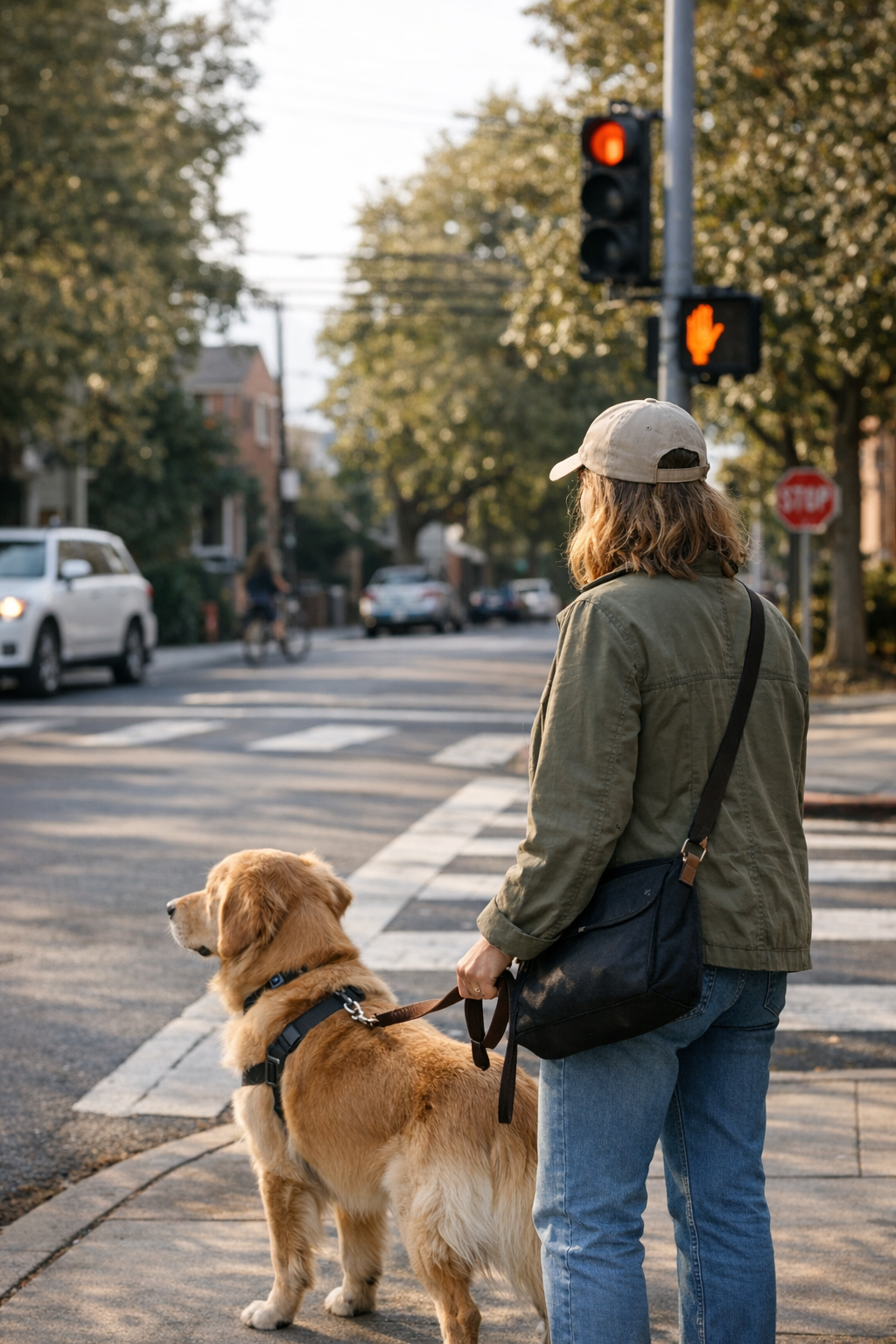
    There’s a sharp interruption creeping into ordinary dog walks: You’re moving at your usual pace, leash light in your hand, and then the crossing beeps hammer out—jolting your dog into a full stop, ear cocked, routine snapped. What used to be a single, forgettable moment now repeats every other block. If your routes have picked up new signalized crossings, those beeps keep stacking up: another pause, another leash check, another jag in the rhythm. Before long, what felt like a smooth, predictable walk now gets carved up by friction points both you and your dog can’t ignore. Even before you’re home, you’re already feeling that pinched hold on the leash and the cost of another awkward disconnect in your routine. That’s DogPile territory—where friction in one daily dog task doesn’t stay isolated, but keeps bleeding into the next.

    How Crosswalk Beeps Disrupt the Real Everyday Walk

    Crossing signals read as just “background noise” until they don’t— not on paper, but the way they wedge into actual movement with a sharper spike than you expect. A dog used to walking with steady confidence hits the beep and balks, leash tension flicking at the wrong second. Maybe you first think it’s a stray distraction. Squirrel? Footprint? But it’s not a one-off: your dog’s ears flatten at the next intersection, your own hand tightens on approach, and what was an easy glide turns into a subtle battle. Three crossings in, the “walk” now has a stutter built right in: silent blocks fractured repeatedly by noise, hesitation, and owner correction—walking turns into micro-negotiation. The old, loose leash is missed each time you’re forced to pause or drag forward, yet the beeps are locked into your new routine.

    Spotting the Build-Up: Why “Minor” Beeps Start to Undermine the Routine

    This isn’t meltdown drama— It’s the accumulation of split-second stalls. Instead of refusing to move, your dog just half-pauses—barely noticeable until the leash goes taut. You’re pressed to make a choice you didn’t have before: force it, wait, try to coax. The flow of the route starts to break down quietly; what should feel automatic now needs you reset again and again. Crowds and other dogs pass, and you’re stuck wrestling timing and attention because of an invisible stutter on every main corner.

    By midweek, you’ve unconsciously started building extra margin into the walk: expecting pauses, anticipating the beep, bracing every approach. Even your dog—usually the picture of routine—looks to you for signals, feeding off your hesitation. Each repetition reinforces the new pattern: your joint confidence underscored by small setbacks, the routine shredded not by major events, but by the drip-drip of interruptions you can’t quite work around.

    Routine Hesitation: How You Notice When the Setup Fails

    Every micro-pause at a noisy crossing chips away at what used to be automatic. Description isn’t distraction—it’s erosion: you notice earlier leash tension, more frequent glances, a growing sense of “restart” at each curb. After a week, the busy-beep route feels heavier, less “walk” and more slog—identical on a map, but far slower and clumsier in every attempt to keep up the old flow you took for granted. The misfit is practical and immediate, not just theoretical.

    Why Noisy Crossings Hit Dogs Harder Than You Expect

    Most dogs track pattern disruptions long before humans catch on: the overlapping beeps aren’t just sound—they signal “something new is about to happen.” On streets peppered with two, three, or four signalized corners, a dog that once breezed by now slows or digs in. Suddenly you’re alternating between slack and tight leash—never smooth, never predictable. Owners often hope the friction will fade, and sometimes it does, but just as often the edge stays sharp: tension lingers, everyone braces for the next awkward beat, and the stroll you counted on downgrades to a series of forced resets.

    Cumulative Walk Stress: More Than a Mood Shift

    Hesitation, dropped tail, extra glances, arms sore from steering—it creeps up steadily. Instead of flowing from block to block, you move defensively, prepping for the next interruption. The change is measurable in time lost, corrections made, emotional wear. The routes you once handled on autopilot now demand your full attention just to keep things together, and every extra beep or stall spreads through the rest of your dog-life pattern.

    How Walk Friction Seeps Into Every Other Dog Routine

    The chaos never stops at the sidewalk—it trails through the door: You finish a disrupted walk, and the fallout keeps echoing. Leash and gear get dumped in random spots, towels and wipes you used to keep handy are now misplaced, and cleanup grinds to a halt as you try to regroup. Your dog—caught between tension and uncertainty—hovers in the entryway, not sure whether to settle or stay alert for the next command.

    This disorganization ricochets: next outing, you reach for the leash and yank up something else first. Water bowls stay shoved to quieter corners—not always where they need to be for drinking, but wherever your dog feels off-balance and wants cover. Toys migrate into the walk path, leftover from earlier, less-settled energy. Even once you’ve picked up, smoothed things over, and restored surface order, handling stays slower—friction renews itself, gear clogs movement space, and that same weak point keeps resurfacing behind what looks “clean.”

    Route Swaps: The Small Fix with Outsized Impact on Routines

    Real improvement rarely means a total reboot. For many, the first real win comes from the simplest swap: detour to quieter blocks, sidestep the clusters of noisy crossings. Even if the route is longer or awkward, you gain instant contrast: three or four signalized stalls traded for a stretch of smooth movement. The leash hangs loose again—and just as quickly, a day built around interruption shifts back into one where you and your dog flow without anticipation or micro-management. Those quieter blocks buy back routine: less leash bracing, less tension, less dog clutter scattered blindly during the post-walk reset.

    The physical cues flip: instead of a dog hyper-focused on every roadside beep, you see heads up, ears relaxed, steady progress that follows your lead. Your own movements recover—you grab the leash, drop gear where it actually belongs, and catch yourself not bracing for trouble. The route may curve now, but the difference is visible the moment you return home: loose leash stays loose, towels and wipes actually ready when needed, and feeding or cleanup regains its pace rather than lagging behind yesterday’s tension.

    Beating Friction by Reworking the Setup, Not Just the Walk

    What slows you at the curb drags the whole routine, if you let it. Owners willing to keep tolerating crosswalk beeps as “just one more inconvenience” keep dragging out the same slowdowns every day. A better setup comes not from re-organizing for looks, but by snipping away at friction points—rerouting, reaching for gear faster, setting supplies within actual arm’s reach and not just stacked neatly. The payoff is subtle—never picture-perfect—but you’ll feel it in less gear underfoot, a neater leash drop, supplies ready at the moment they matter, and a routine less jammed by repeated weak spots.

    Measuring Real Routine Recovery: What to Watch For

    • Pause shrinkage at trouble-streets: Is that three-second curb stall now a barely-there hitch?
    • Leash slack: Is the leash actually loose over more of the walk, or do you keep correcting?
    • Cleanup and reset efficiency: Are wipes and towels close at hand—or still just “somewhere” after every walk?
    • Pre- and post-walk friction: Are you spending less time fighting the setup and more time letting routines run?
    • Return to baseline: Are you and your dog settling sooner, not just after the walk but as the day goes on?

    The difference doesn’t show up in big gestures, but in how seamlessly you manage the ordinary: reaching for what you need without shuffling piles, cleanups that start as soon as you open the door, leashes and toys staying put instead of tripping you on the way to feed. When you trim the friction at street level, every other reset gets quicker—your day spends less time circling the same weak point.

    Dog-Life That Actually Works: No Fairy Tales, Just Less Grind

    DogPile is built for the routines that actually make up dog-life—not the glossy snapshots, but the annoying parts you want to sand down. Crosswalk beeps are just one example of a small signal mutating into a major routine problem. Fixing these weak spots isn’t about a spotless “after” photo; it’s about winding up with a looser leash, a faster reset, and a home where

  • How Small Interruptions Disrupt Your Dog Care Routine and What to Fix

    How Small Disruptions Turn Daily Pet Care into a Chore

    Daily pet care routines break down fast when basic tools drift out of place. Reaching for a dog bowl at feeding time and finding only an empty spot—or grabbing for a towel after a muddy walk and realizing it got left in the laundry—costs momentum you don’t get back. Each missing piece turns an ordinary step into a pause, forcing search, reshuffling, or last-minute substitution. The result isn’t just one lost minute; it’s a routine that takes more effort, with small annoyances stacking up until daily care feels like a string of minor setbacks rather than a smooth, ordinary reset. Even when a space looks tidy, these gaps keep calm out of reach.

    Unlike an obvious mess that motivates a full clean, small disruptions stay hidden and keep repeating. You tidy the kitchen or corral dog gear with the right intent, but if the water bowl gets left to air-dry on the counter, or if wipes are buried behind other supplies, you’re running an obstacle course every time. The friction isn’t just about one missing item. It’s the way routines stretch, resetting in slow motion as you track down basics, repeat trips, and get interrupted by your own system.

    Everyday Scenarios Where Pet Care Slows Down

    Most routine drag shows up during basic transitions. After a walk, with leash and keys in one hand and your dog halfway through the door, the search for a towel adds visible stress. Do you drop everything and go looking, or let muddy paws trail across the floor? The same scramble happens during feeding if the bowl’s not back in its slot—meal prep stalls, and the easy automatic loop turns into a stop-and-start shuffle. The intention might be order, but if your storage habit means clean wipes are always in the third drawer or a grooming brush is blocked by yesterday’s shoes, “organized” isn’t much help.

    Even small layout flaws repeat their cost. A wipe packet just out of arm’s reach, a brush stored for looks instead of reach, or hooks so high you have to stretch every evening—these all slow you down, forcing small workarounds you start to dread. Over time, the daily reset turns from a two-minute check to a five-minute wander, with friction hiding inside ordinary moments.

    Hidden Delays Add Up Over the Week

    One lost towel or bowl feels forgettable—until you realize the same snag returns nearly every day. After walks, late-night water top-offs, or a quick brush before guests, the same gaps delay you. Each time, you make a mental “fix it later” note, but the fix rarely sticks if the system doesn’t change. As days stack up, these little inefficiencies grow, weighing down the routine you meant to keep simple and quick.

    Shared spaces make drift worse. Pet gear wanders between the entryway, kitchen, and living room as everyone moves things for convenience, but no one locks in a true anchor point. Soon, it looks tidy but functions slow: a towel always needing rescue, a bowl never on standby, a grooming tool that ends up everywhere except where it’s needed first.

    Why Tidy Doesn’t Always Mean Efficient

    A neat space can hide a cumbersome routine. Folded towels inside a closet look orderly but stall every walk with an extra trip. Bowls stacked by the sink look clean but force a detour before every meal if not proactively returned. What seems like calm is often just delay in disguise. In pet care setups, a system that “looks good” but breaks at the core action—the grab, the refill, the wipe—is a slow routine in disguise.

    Making Routines Resilient with Simple Resets

    The strongest setups let action flow, not just the look of order. Anchoring a towel by the door, not tucked away, means muddy paw problems get solved instantly and don’t trail through the house. A bowl returned to its counter spot right after washing means meal prep never starts with an empty search. Essential tools earn a daily-use place—in reach, at transition points. Even a basic reset at night, checking that towel, bowl, and wipes are realigned for tomorrow, prevents most friction from repeating.

    A five-minute reset at logical pauses—after the last walk or before bed—closes the loop, so the following return feels ready, not chaotic. That’s the difference between pet care feeling manageable and pet care feeling like another round of catch-up.

    Consistent Placement = Consistent Calm

    Consistency, not just tidiness, is what lifts hidden pressure from daily care. When a hook always has its towel, when basics always return to anchor points—not just wherever there’s a gap—interruptions dissolve. Over the week, steady return wins out over appearances. Real calm shows up not when the mess is hidden from sight, but when a routine delivers without last-minute improvisation or unintended scavenger hunts.

    In everyday pet care, it’s the steady rhythm—not the one-off deep clean—that makes homes easier to live in. Each time a basic reset lands a tool or bowl back in place, it cancels tomorrow’s friction and keeps the system working. The payoff isn’t just control, but a lighter, more workable daily flow that doesn’t fall apart when life runs busy.

    Learn more about simplifying pet care at CalmPetSupply.