Category: Pet Life

  • How Adjusting Your Grooming Setup Can Ease Indoor Cat Stress

    If grooming your indoor cat feels like a small battle each week—tense shoulders, cat inching away, fur clinging everywhere—it’s rarely about the brush or the cat’s “mood.” The real friction starts with the setup itself: a spot that looked convenient at first, but puts you and your cat at odds every time. Most owners repeat the same pattern without seeing the structural trap—awkward height, tight space, slippery floor, and tools just out of reach. This isn’t just about organization; it’s about how much extra reaching, shifting, and cleanup you accept as “normal” until it wears you down. The StillWhisker world isn’t about showpiece cat areas—it’s about spotting where repeated home setups quietly slow you and turn routine grooming into maintenance that lingers long after the brush is down.

    When a “Tidy” Grooming Spot Turns Into a Repeating Headache

    An armchair by the window or a small patch of hard flooring can look polished in a photo, but these “tidy” setups often hide daily friction. The cat grows wary well before you sit down. Each session, you nudge a chair, reach around a lamp, slide a bin closer with your foot—minor moves that stack up. Your cat, sensing your shifting or looming posture, starts tensing or ducking away right from the approach. Suddenly, something that looked controlled at first now takes longer, leaves more mess, and feels more draining every week you repeat it.

    The posture you fall into—twisted, half-standing, or always reaching over something—creates invisible pushback. Each session, that strain leaks out: a hand steadying the supply basket while holding a squirmy cat, fur drifting toward the hallway, cleanup supplies buried behind yesterday’s attempt at “swift reset.” The tidy look disappears as each awkward reach or incomplete wipe-down adds to the residue you spend weekends fighting off.

    How Setup Choices Quietly Derail Cat Grooming Routines

    It’s easy to miss how much surface and posture shape a grooming session. Sit on a chair, and almost every move becomes an “overhead” gesture—your cat shrinks away or bolts at the hint of your shadow. That two-foot height gap is all it takes to flip a calm brushing into a standoff. When the setup pits gravity against you, fur escapes under couches, brushes tumble off laps, and you find yourself running cleanup along baseboards days after “finishing.”

    These patterns aren’t random. Over weeks, you notice your cat sidestepping the supplies, or holding a tense posture the moment you approach the “grooming corner.” You clean up fur in odd corners, notice the brush is never where you left it, and spend more time prepping or resetting than actually brushing. The session now feels like a two-part job—get through the struggle, then sweep up the aftermath.

    The Accumulated Burden of an Almost-Right Setup

    Almost right is where the pain accumulates. Your cat won’t settle, so you keep “fixing” by shifting towels, moving baskets, or tackling stray fur a day late. Little by little, grooming starts to invade the rest of your space, spilling fur into entryways, storing supplies in random corners, and demanding repeat cleanups. Finishing the session doesn’t clear the slate—you’re still tripping on hair or tools hours later, staring at a supply bin wedged next to the TV stand because it never quite has a stable spot. Over time, this slow friction feels heavier than a simple reset ever should.

    Changing the Pattern: The Impact of Sit-Down Level and Surface

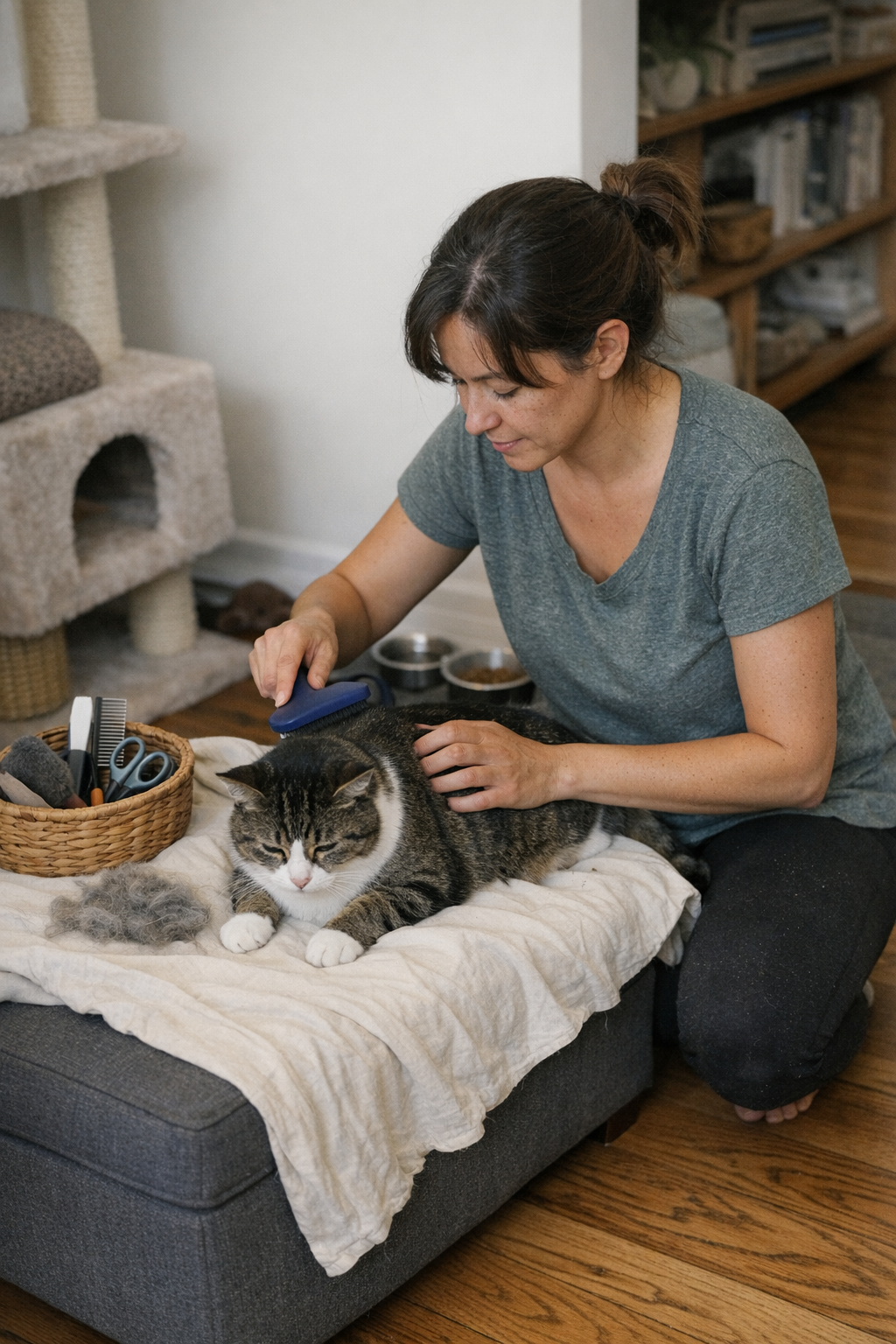
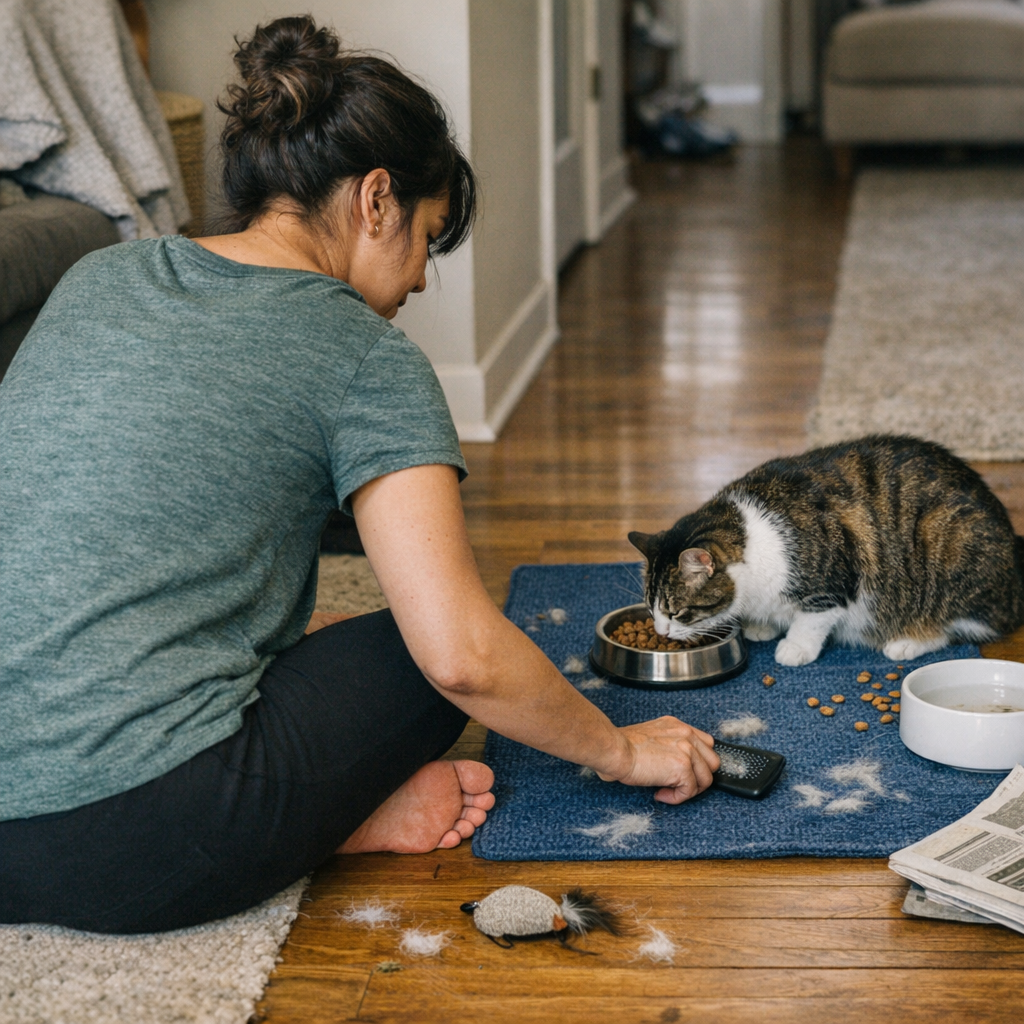
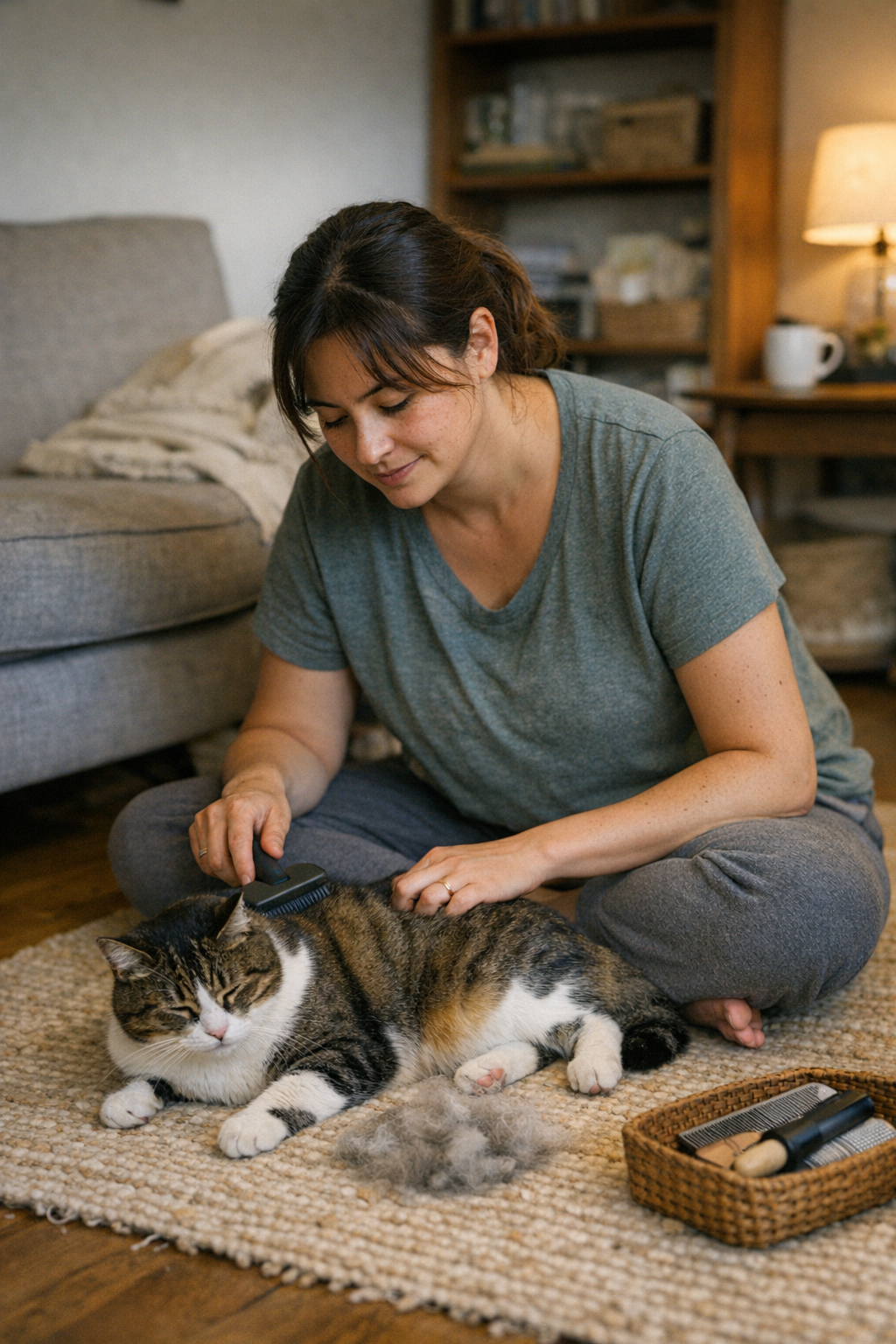
    The routines that work long-term share one pattern: your posture lets you meet your cat at their level, and the surface under you supports a clean finish. Dropping from a chair to the floor isn’t just symbolic—it removes the looming threat, halves the reach, and hands back control of the moment to you both. A proper mat or rug breaks up floor chill, keeps fur contained, and makes cleanup part of the session—not a separate hassle an hour later.

    At floor level with a stable mat under you, several changes hit immediately:

    • No more looming overhead—your cat stays calmer, less triggered by sudden reach-ins
    • Fur lands on the mat, not across the whole floor or under every leg of furniture
    • Shorter, direct reach—steadying and brushing is easier for both sides
    • Cleanup becomes one movement—shake out the mat, tools back to caddy, session finished

    This adjustment—low, stable seating with a surface that contains mess—often flips grooming from “get it over with” to a quick, low-stress part of the day that doesn’t bleed into every other room.

    Routine in Real Life: A Typical Grooming Scene, Improved

    Picture the standard scramble: your cat’s on the sofa, you climb a chair, tools balanced on one knee, hoping for cooperation. What actually plays out? Twisting, reaching, the brush slipping, your cat repositioning before you can finish, fur falling everywhere but the spot you intended. Now picture: you pull over a solid mat, sit cross-legged on the floor, align at eye level. Suddenly, your hands move naturally, the session runs quietly, and fur stays on the containment surface—not the wooden floor or halfway under a cabinet. Your cat’s tail stays soft, body uncoiled, and you don’t need five “almost done” resets as the session drags on.

    Clean up? The mat collects it all. One shake, done. The tools tuck away without a scavenger hunt. You’re not rerouted by stray hair or a supply pile later in the day. The difference isn’t dramatic until you repeat it for a few weeks—and then it’s hard to go back.

    What Routine Strains Really Tell You

    The warning sign isn’t in dramatic resistance—it’s in the tiny cues: the cat weaving away from your reach, fur gathering under the spot you “fixed” last weekend, the supply bin never truly finding a home. Each workaround—throwing down a towel, moving the ottoman, leaving out the brush—works for one day, but multiplies the cycle of micro-fixes. Every small inefficiency grows in weight because it keeps coming back, making each session harder to start and slower to finish. This is the real cost of a setup that looks fine but works badly when routines repeat.

    How Lowering Yourself Changes Cat Comfort—and Your Maintenance

    Sitting lower with your cat—kneeling, cross-legged on a solid mat—does more than calm them. It also shrinks the radius of cleanup and resets maintenance into a simple step. There’s no more chasing fur under bed frames or fishing for a lost brush; everything lands where you and your cat are aligned. The “looming” effect that made each approach a new struggle simply fades, and the post-session burden is now a quick shake, not a hidden project for later. This split-second reset is the difference: setup and finish are finally part of a cycle you don’t avoid.

    The Difference Between Presentable and Livable

    A basket of supplies sit neatly by the chair. The mat looks fresh. But if you’re untangling tools, repositioning yourself three times, or sweeping up fur in every corner, then the setup is passing for “presentable” and failing at “livable.” Setup isn’t just what looks good after a reset—it’s what doesn’t disrupt routine every time you repeat it. True grooming comfort shows up in the aftermath: cat relaxed, quick reset, no lingering project left behind, and nothing out of place in the rest of your home. That’s the StillWhisker setup—minimum friction, repeat-use payoff.

    Small Shifts, Lasting Effect: Rethinking the Grooming Zone

    If you’re stuck in a grooming routine that always leaves you adjusting, look for structural sticking points. Don’t hunt for more gear—trace the cycle instead: where you sit, what’s beneath you, where fur ends up, and how easily everything packs away. Watch the small resistances—a restless cat as you loom, a mat that slips out from under you, a caddy that never lands within arm’s reach. Change these, and routine maintenance shrinks down. Over a few weeks, you’ll find cleanup simpler, your cat calmer, and no slow-creeping supply pile invading joint space.

    The best sign? Your cat doesn’t bolt when the brush comes out. You handle what’s needed, reset in a single movement, and your space doesn’t betray every session with fresh little messes. It’s not about perfection or single-session magic—it’s about setups that vanish friction, session after session. That’s where practical indoor-cat life shifts from small defeats to quiet, lasting comfort. See more practical setups at StillWhisker.
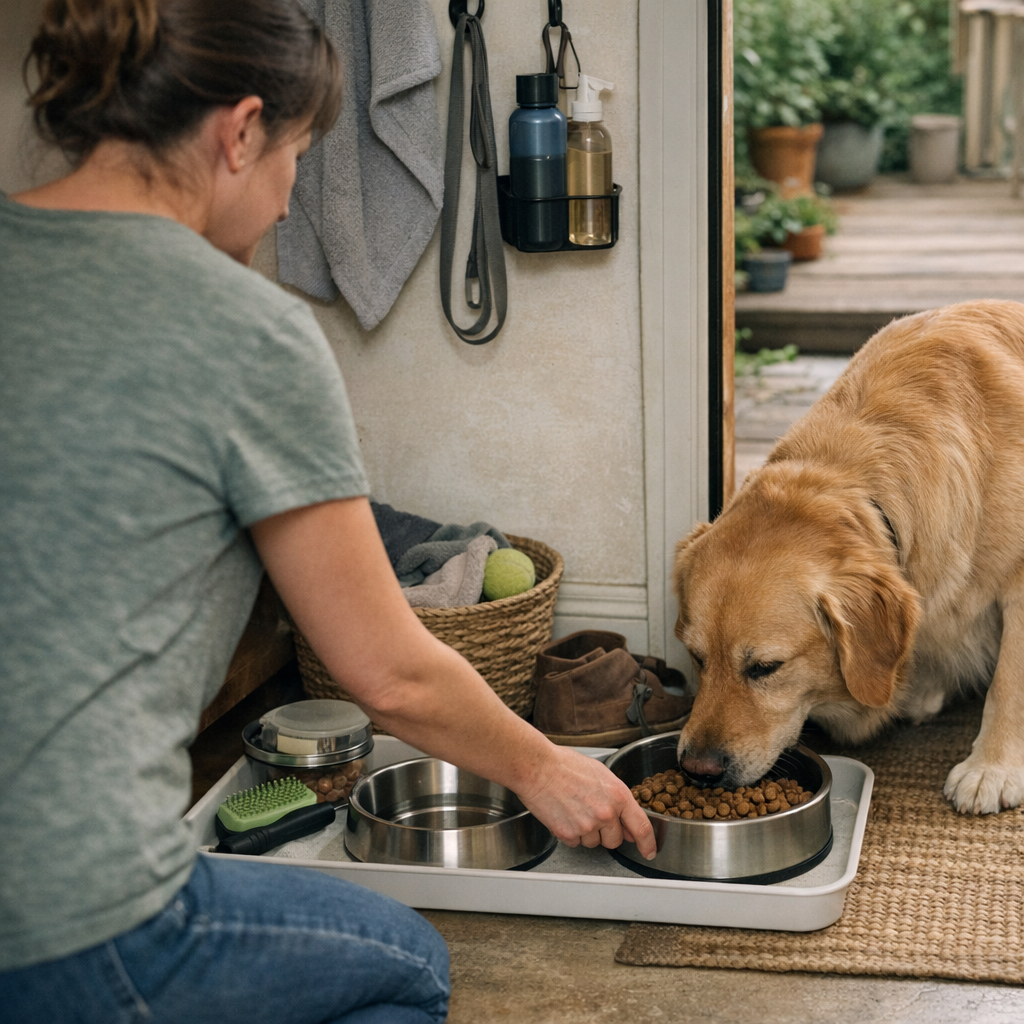
  • How Small Changes in Dog Routines Can Transform Evening Calm

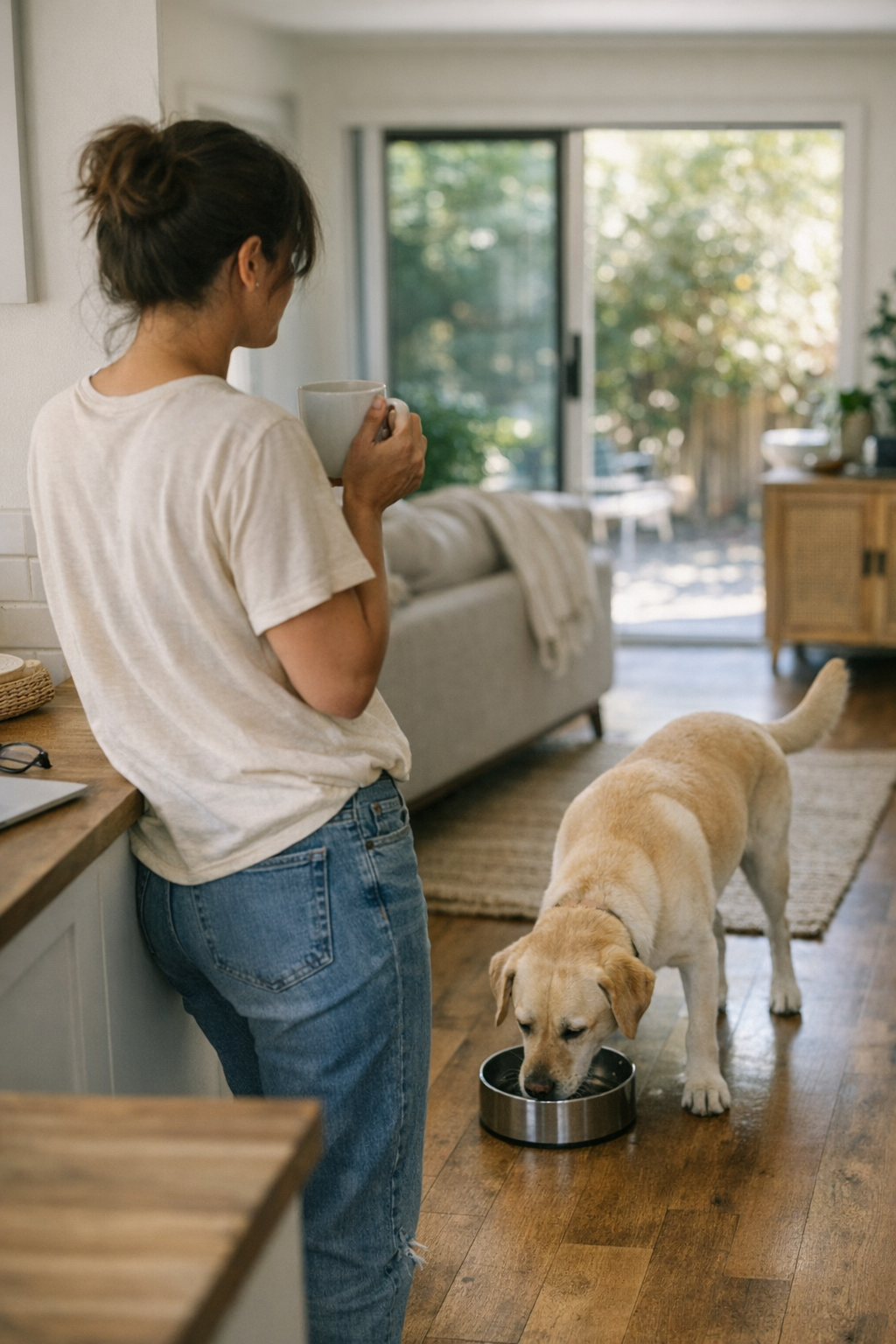
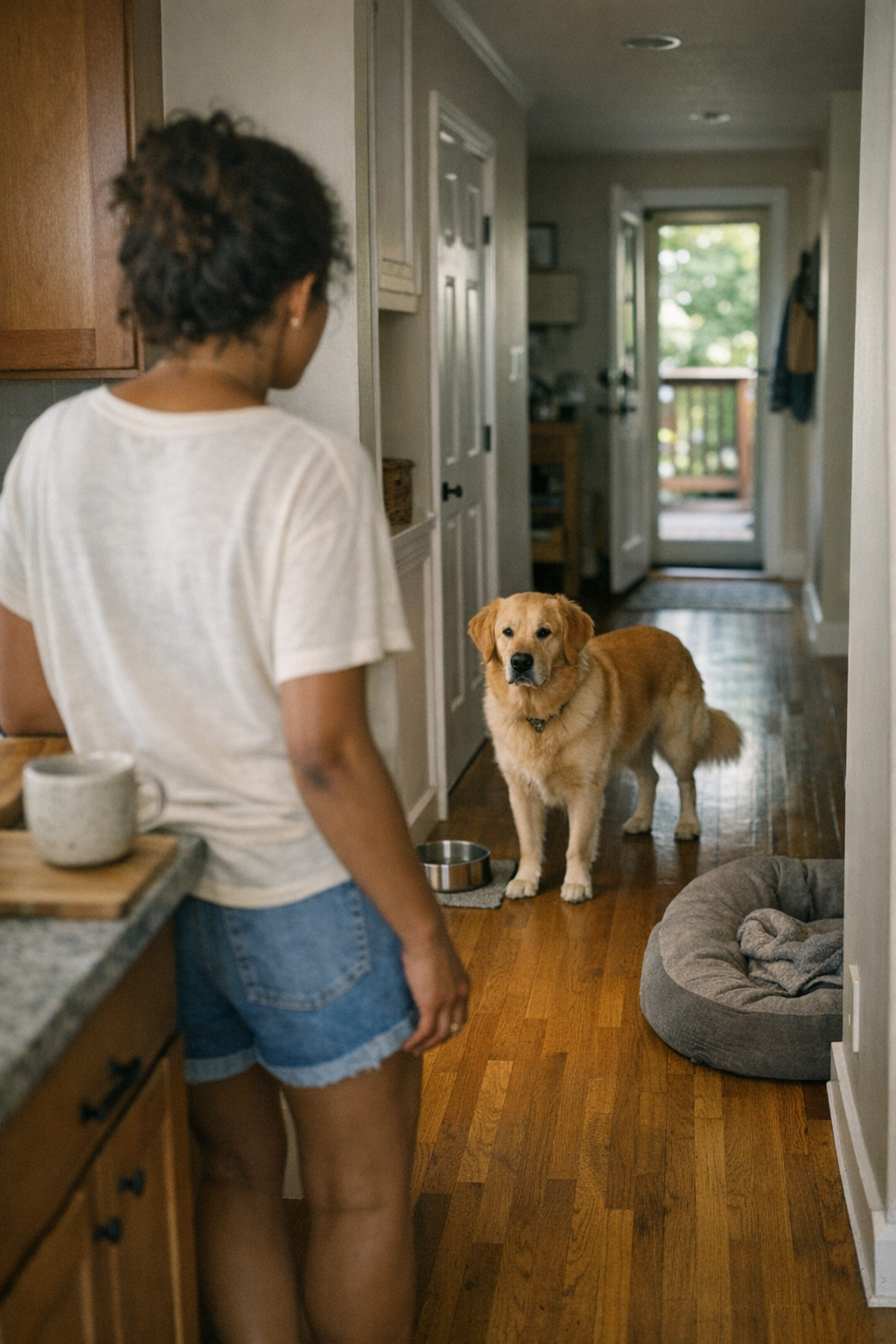
    Your dog stands stranded between rooms. Not in the kitchen, not on their bed—just in the way, halfway to water, waiting for a signal you didn’t realize was missing. What starts as a routine afternoon—leash off, shoes kicked aside—spills into awkward pauses: blocked by bowls shoved near the cupboard, towel draped out of reach, toys tangled underfoot. That five-minute stall at the hallway threshold doesn’t just eat time; it ripples through every step: feeding, cleanup, even winding down at night.

    A Common, Overlooked Slowdown in the Dog-Owner Day

    The friction isn’t dramatic—it’s the slow drag of misalignment. Each day your dog stalls in the same spot; each time you hesitate, caught between nudging them to the mat or recalling if you prepped the water bowl. These everyday micro-pauses chase each other through the schedule: dinner lands later, walks feel rushed, and nothing resets fully before bedtime.

    It’s a scene you start dreading in repeat: You try to slide smoothly from walk to water to rest, but instead, you find a leash hooked on a drawer blocked by a food bowl, your dog circling as if waiting for a new plan. While you debate between feeding now or toweling off first, the window for a calm transition closes. The next thing you know, pre-bed feels scrambled, your energy frays, and your dog’s cues get harder to read.

    Why These Pauses Don’t Go Away on Their Own

    The hesitation slides under the radar because it’s subtle. Day after day, you adjust: a little nudge here, a quick reshuffle there. But when the same slowdown shows up every evening—hallway circles, toy roadblocks, a water bowl “just out of the way” actually in the way—it starts costing you. The dog stakes out territory in high-traffic zones, bowls get left awkwardly placed for the next reset, and every handoff—walk to towel, food to rest—gets five minutes slower.

    • Perpetual pacing before the dog truly settles
    • Toy stashes where you least need them—under the path from door to bowl
    • A dog locked in indecision, watching you for a cue you haven’t given
    • Cleanup supplies visible but never actually reachable at the right second

    The more you shuffle, the more the house drifts out of sync. That’s how you wind up cleaning up after feeding, only to find bowls in your walking path, towels somewhere inconvenient, and dinner sliding later into the evening—again. The cost isn’t obvious mess; it’s the steady drain of time and flow.

    Spotting the Pattern: Small Pauses, Big Disruption

    This is not “once in a while.” A pattern emerges: your dog stops just short of the kitchen, hovers at the water bowl, stares down the hallway instead of moving through it. The gear all looks right—leash, hooks, towels lined up, bowls at attention—but the routine snags at the same junction every night.

    The routine exposes its weak point every single day: You reach for the leash to hang it up, but a food bowl is blocking the drawer. The hallway collects toys meant for play, now tripping hazards. The noise isn’t energy—it’s indecision: claws on the floor, bowls shifting, your own path bent around dog and gear that should have cleared five minutes ago. You clean, you arrange, but the friction remains.

    The Impact on Routine: Pacing, Clutter, and Missed Cues

    Once hesitation creeps in, every step jams up behind it. Instead of: walk, wipe paws, water, bed—each action gets tangled:

    • You try to grab a towel but find it trapped behind a kitchen chair moved “to look neater.”
    • Your dog hovers in limbo—not ready for bed, not asking to eat, just shifting uneasily between corners.
    • Beds and mats migrate from resting zones to walkways, turning easy resets into sidesteps and obstacle dodging.
    • You realize, too late, that looking organized hasn’t made the routine easier—because nothing is in reach at the right moment anyway.

    By bedtime, a “put-together” setup has quietly spun into clutter, dog agitation, and you second-guessing what needs moving again tomorrow. What you thought was a small delay now loads up tomorrow’s routine with the same sticky friction, one misaligned piece at a time.

    What’s Actually Causing This Routine Weak Point?

    At its core, the problem hides under the surface: organized-looking setups that fail under real use. Water bowls are placed for aesthetic neatness, not flow; comfort mats are tucked away, blocking the dog’s path from door to rest; toys drift into high-traffic spots, just where you’ll want to stand while toweling muddy paws. Or it’s a timing miss—walk ends, but there’s no obvious first step back inside.

    The frictions aren’t about tidy vs. messy—they’re about repeated-use breakdowns at actual pressure points. You catch yourself moving bowls a foot back, toys a foot over, bed a foot out—only to circle the problem a day later because the pause, and the uncertainty, just shift locations.

    Looks Neat, but Still Feels Slow

    There’s a stubborn frustration when the dog area “looks” good, but you still hit snags. Water sits ready, towel rolled just so, yet the transition from outside to true settle keeps dragging. The pain point isn’t storage or appearance—it’s whether actual access lines up with your real, repeated traffic and hesitation zones.

    Everyday Home Scenes: Where the Routine Breaks Down

    See if these feel familiar:

    • Post-walk return: You come in juggling a muddy leash and a fidgety dog, but the towel you need is blocked by a chair moved for tidiness. You scramble; the pause stalls both you and the dog, slowing the entire reset.
    • Evening feeding: Your dog shadows the water bowl but lingers—your reach for the food bin is blocked by a rogue toy. A five-minute meal becomes a drawn-out, back-and-forth shuffle.
    • Transition to rest: Your dog circles the food area, unsure whether to stay or settle. The bed is in the corner, but it jams the space so neither you nor the dog can actually stretch out. Bedtime inches later, energy lingers long after lights-out.

    None of this is accident—it’s the echo of an almost-right setup that looks fine but keeps kicking up friction where you move and need immediate, repeated access.

    How a Small Adjustment Can Break the Cycle

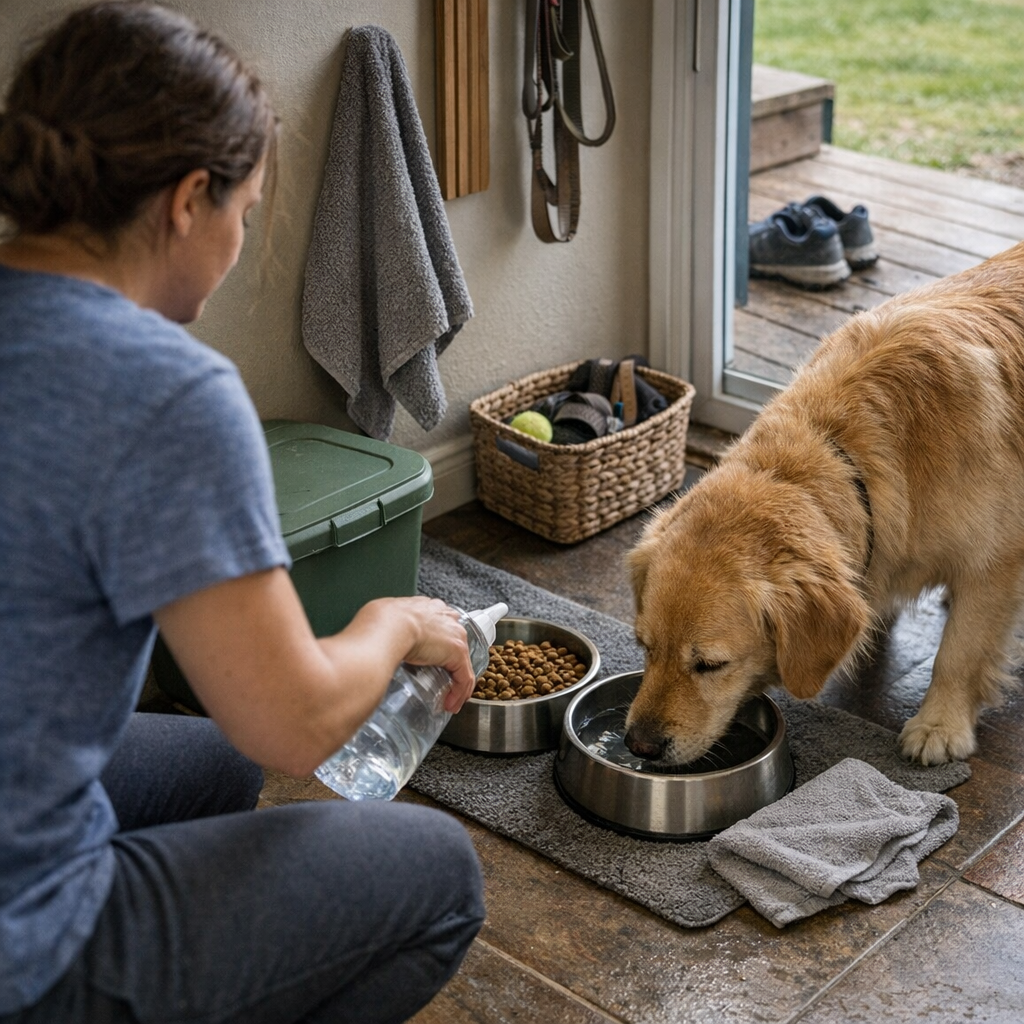
    You don’t need a design overhaul. A focused adjustment—paying attention to where the pause repeats—resets far more than you expect. If the water bowl moves two feet closer to the hallway stall point, or if the rest mat slides into direct line from door to kitchen, the routine changes immediately. The win isn’t about looks—it’s about flow.

    Real fix, real shift: After three nights of hallway pacing, you test moving the water bowl to the edge of the pause zone. Next walk, your dog pauses, drinks, then takes your cue straight to their mat—no circling, no waiting, no toy detours. What took thirty agitated minutes collapses into three calm ones: walk in, towel off, settle. You see it again each night: less mess, less backtracking, more predictable, usable calm—even with the same gear, just in better reach.

    Testing Changes: Don’t Ignore the New Weak Point

    But no fix is forever. Adjust one sticking point, and another may reveal itself—a towel now blocks the drawer, or the toy bin slides into a new traffic path. The trick is watching for that next pause, adjusting again, and letting real-life feedback lead. A couple days spent noticing where routine resistance returns will show you the true sticky spots worth moving.

    Week by week, the loop gets smoother: Once the stall point aligns with actual reach and dog traffic, you recover time and headspace. Cleanup resets easily; your dog finds flow. The rest of your evening, and the next morning after, move faster—with less gear-tidying and less dog-side confusion.

    From Tidy Looking to Truly Usable: Guiding the Flow

    Don’t get fooled by the appearance of organization. The only thing that matters: where the repeated friction hits and whether your setup actually clears it. Any setup—bowl placement, toy stash, towel hang, crate shift—that keeps you from smooth motion is worth rethinking. The difference is real: fewer mid-hallway stalls, faster reset after walks, easier reach for cleanup, and a dog who “gets” the routine cue from a setup that finally fits how both of you move.

    That’s the real reward—not neatness, but less friction tugging at every

  • Why Single-Layer Storage Transforms Your Daily Pet Care Routine

    The Hidden Slowdown in Daily Pet Care

    You think you’ve set up a neat spot for your pet’s bowls, water bottle, brush, and scoop—but by midweek, your so-called “tidy” corner turns into a daily obstacle. Each time you hurry to grab the bowl or refill the water, something is in the way: a treat bag flopped over the scoop, a brush jammed under a container lid, the water bottle tucked behind a stack. The minutes lost don’t seem obvious at first. But as every basic care step starts with a quick reshuffle, the difference adds up fast. Instead of smooth, in-and-out resets, you get repeated snags that slow you down and nudge your routine off track. What you lose isn’t just time—it’s the expectation that your setup will actually keep up with the pattern of real pet care.

    Real-World Example: The Morning Feeding Cascade

    Before the coffee’s brewed, the dog is pacing or the cat is already at full volume. You reach for the food bowl but there’s a treat bag flopped over the top. Moving the bag sends the scoop rolling to the floor. You manage a one-handed rescue, but now the brush, half-stuck in the stack, slides down as you swap items. Feeding your pet takes longer, hands are already full, and the brush is now somewhere you can’t find it if you need it. What’s supposed to be fast turns into a clumsy cascade—every meal, every refill. Over a week, this isn’t just “a couple minutes here and there”—it’s built-in drag that you start to resent.

    Why “Organized” Doesn’t Always Mean “Ready”

    Layering pet supplies seems responsible until it quietly backfires: each extra item stacked or overlapped adds a new friction point. What looks put away is actually a cluster of micro-barriers—every time you pause to wipe, you’re hunting for the cleaning spray under the scoop. The water bowl goes unfilled until the bottle resurfaces. Grooming tools slide down the pile and get skipped. Surfaces you meant to spot-clean stay sticky until the next pass, and food sits out because the reset takes too many steps.

    When the Weak Point Returns

    Even after you reorganize—sorted bins, an added shelf, a thorough reset—the familiar problem creeps back in. Bowls end up stuck behind clutter, the brush finds its way under another loose item, and the water bottle disappears until you need it most. The mess isn’t the main issue. It’s how one item blocks the next, over and over, turning every grab-and-go moment into one more round of frustrated searching.

    The Difference: Open and Single-Layer Storage

    The friction only really disappears when you assign each basic item a single, always-visible spot. Bowls sit in a low tray, not on top of the treat bag. Scoops and brushes attach to the side of a bin, instead of living under a lid. Water bottles hang from an open wall hook or stand upright—never buried. Suddenly, meal prep and cleanup involve no stacked shuffling, no one-hand juggling act, and no mental tally of items going missing mid-routine. Every grab is direct, every basic care motion gets done with one step.

    Day-to-Day Flow: Less Mess, Smoother Routine

    When you physically separate feeding tools, cleanup gear, and toys by actual use—food and scoop here, brush and towel there—you block the silent bottlenecks. No more leash tangled under kibble packs on the way out. After a walk, you reach for the towel or brush without digging. Late at night, the water bottle is right where you expect, not MIA under clutter. It’s not just about looks; your routine now helps you move instead of making you clean up twice before you’ve even started.

    The Real Payoff: More Calm, Less Reset

    The routines that last aren’t the ones that look pristine—they’re the ones that never get in your way, even when care-work piles up. When bowls, brushes, and bottles always have a clear place and you stop overlapping the basics, delayed resets disappear. Tiny pauses and hunt-for-it moments stop piling up, and you stop feeling like you’re forever catching up in your own home. What changes isn’t spotless surfaces, but the energy and time you save: no more repeated searching, no extra steps to get back to zero, and fewer interruptions on packed days.

    Setting Up for Success: Small Adjustments, Big Results

    One small change is enough to see the difference. Switch to an open tray for feeding essentials or put the refill bottle on a wall hook, and you instantly cut down repeat reshuffling. Less hunting, less digging, fewer late resets—the daily pressure drops, even when the space is tight or the day is running long. The goal isn’t perfect order. It’s consistent reachability: every tool and supply genuinely ready, every time you need it, whether you’re prepping breakfast, wiping paws after a walk, or doing a midnight check-in.

    Find more practical pet-care solutions and routines that last at calmpetsupply.myshopify.com.

  • How Adjusting Grooming Posture Transforms Indoor Cat Care and Cleanup

    Grooming an indoor cat isn’t just a one-off chore—it’s the start of a cycle that can quietly push your patience and disrupt the flow of your home. The first brush-throughs seem harmless enough: a towel thrown down, tools lined up, and a cat who doesn’t mind the extra attention. But by the third week, the routine reveals all the cracks. Kneeling in uncomfortable corners, fur slipping past flimsy towel edges, brushes migrating from feeding area to couch—your living space slowly gives way to scattered bits of the last session. Suddenly, that easy grooming setup starts interfering with quick feeding resets, clean water refills, and every other shared routine that matters in a small home. It’s not just a stray hair here or a misplaced comb there—the real cost shows up as extra work and a cat that keeps dodging the spot you’ve picked out.

    Grooming as a Repeated Home Routine—Not a One-Off Tidy-Up

    A true indoor-cat setup means grooming never ends with one session. Finish a brush-out, and flecks of undercoat drift to the edge of the rug; miss a spot, and tufts appear days later in the very rest corner your cat claims next. Tools meant to be “put away” can easily end up blocking a water bowl or cluttering up the entryway to your feeding zone. Instead of a few tidy minutes, small disruptions creep into places you never intended—where food gets delivered, where toys usually pile up, or where you just want to sit without a new layer of fur.

    The idea that one cleanup keeps things ordered is a trap. Even if the towel folds neatly and the brush slides back into a basket, the reality is this: indoor-cat grooming setups only work if they’re built for constant, repetitive use. Otherwise, every session multiplies friction—in more cleaning, slower routines, and a home that feels just a little less your own.

    When Setup Friction Builds: Real-Life Cat and Human Signals

    It sneaks up. You reach for a grooming brush, only to shove aside a box of wipes that has drifted from last time. One careless toss and both hit the kitchen floor. Or you finish brushing, confident you’ve contained the mess, only to find a film of fur bordering the play mat or clinging to the napping blanket, needing another round of cleanup that delays a simple feeding reset. The “quick cleanup” never stays quick—fur rides out to litter-adjacent corners, under seating, and even across the shared walkway.

    The strain isn’t dramatic, but it doesn’t let up. You start scouting for spots that won’t punish your knees, or you simply avoid grooming unless absolutely necessary. Cats, always tuned to your patterns, circle wide around your turf or only approach once everything has been packed away. That hesitance adds minutes to every session—not because grooming got harder, but because the setup failed under actual repeated use.

    Uncontained Mess: From One Spot to the Whole Room

    The difference between what seems “tidy enough” and what’s actually easy to live with becomes loud after a few cycles. Maybe you start on a towel in the living room center. Not long after, stray fur finds gaps at the towel’s edge, then clings to table legs, chair rails, or makes a home under the adjacent couch. Tools slip into odd spots—one brush under the water stand, a comb under the litter cabinet, nail clippers that somehow end up on the windowsill. The true cost? Every tool put away is a little further from next use, and the next reset feels longer—rest zones, food mats, and water bowls all picking up fuzz you never meant to share.

    That meant-to-be-quick grooming gradually crowds out regular routines. Wiping down mats takes two steps, blankets need an extra shake, and your own favorite spot starts to feel like a landing zone for everything you thought you’d cleared.

    How Grooming Setup Undercuts (or Supports) Daily Flow

    It’s easy to accept a little extra fur or the annoyance of reorganizing after a grooming session, until you see how those weak points ripple into the rest of your routine:

    • Refill friction: The feeding mat or water bowl sits clean—until fur and loose wipes, left wandering post-grooming, turn a fast refill into another cleanup job.
    • Slow reset zones: Wiping down what should be an easy-clean mat now means fighting embedded fur after every session. Cat blankets show new layers of hair, never fully clear even with extra effort.
    • Tools always off target: You need a specific brush; it’s buried behind a tangle of old grooming mitts, extension cords, or unopened mail in the all-purpose basket you hoped would keep things neat.

    Individually, each friction point seems small. But the buildup shapes every attempt to keep up. A spot that’s “clean” on the surface may be slow to reset—or worse, make your cat less willing to return. Every shortcut in the setup quickly makes something else in your routine harder or less predictable.

    Spotting (and Breaking) the Bad Setup Cycle

    The real break point arrives a few weeks in. The room looks almost like before, but routines feel heavier. Why? Because:

    • Uncomfortable bends and stretches linger after every brush-through
    • Resilient flecks of fur migrate to feeding stations, resting corners, and busy walkways
    • Grooming tools scatter—never where you left them, rarely within reach
    • The cat, once curious, now circles the periphery or flat-out ignores calls to the “official” grooming area

    If you’ve swept fur from beneath the couch minutes before guests arrive or gathered up a pile of mixed grooming and unrelated household items for the third time in one week, setup friction is dictating your pace—and attitude—toward your own space.

    When “Neat” Stops Working: Visual Order Versus Real Containment

    It’s straightforward to create a scene that looks organized—a folded towel, a lined-up tool bucket, a quick pass with the lint roller. But if the next cycle feels slower or you end up pushing fur and misplaced tools from place to place, the illusion fades. By week two or three, towel edges can’t contain drifting hair; brushes slide off “designated” spots; and the cat leaves the old grooming zone, choosing somewhere you didn’t prep, leaving you to chase down fur across half the living room. Resetting takes longer and even a room that looks under control keeps adding steps to daily life.

    What Actually Changes the Routine: Firm, Bounded Grooming Zones

    What makes the difference isn’t a better-looking grooming area—it’s a real structure that preempts repeat mess and failed resets before they take over. Leaving grooming to “wherever’s open” means the problem follows you. But shifting from a loose towel to a bounded, physical grooming zone changes things right away. Replace wandering layers with:

    • A firm, wipeable bench or ottoman that doubles as seating (and stays stable)
    • A washable pad tightly anchored at the edge, easily shaken out outdoors and re-laid in minutes
    • A corner blocked off to define the zone, keeping cat and mess from leaking into shared walkways or rest corners

    The visual doesn’t have to be perfect—what matters is how much lighter cleanup and resets become. No more fur drifting into food prep, no tools lost under the couch, and cleanup that ends where it started. Cats begin to recognize the new boundary, choosing to linger or settle rather than immediately hunt for an escape route. The cycle breaks—not because the area looks showier, but because the entire home routine starts to run faster, with less resistance in everyday movement.

    Human and Cat Comfort: Less Movement, More Trust

    A grooming setup that doesn’t demand you constantly shift positions, clear access paths, or kneel in drafty corners isn’t just a “nice-to-have”—it minimizes the interruptions that wear you down. With fewer abrupt moves, your cat watches more, resists less, and might even settle by habit. The risk of blocked doorways, cold floors, or off-limits rest mats disappears. Both of you adapt: less chasing of mess, more willingness from the cat, and less friction bleeding into the rest of your daily rhythm.

    Grooming and the Rest of the House: Why Containment Matters

    It’s easy to treat grooming as a self-contained task, but in reality, every loose edge lets the mess spread and slows down otherwise routine resets. Fur finds its way to bowls, blankets, walkways, and play mats—right when you need the area clear to prep meals or relax. The switch from a drifting setup to a clear, contained grooming zone brings sharper differences:

    • Containment is visible: Less fur shows up in feeding areas or shared spaces because everything is edged in, not loosely defined.
    • Tools return automatically: Each time, brushes and combs land in the same reachable spot—no forgotten cache in a different corner.
    • Routine, not randomness: The cat learns where grooming happens and where it doesn’t—help
  • Understanding Midday Dog Pacing to Improve Home Routine Flow

    The signal is small, but persistent: your dog’s paws cross the kitchen tile, cut through the hall, then repeat—again and again. No whining, no mess—just an unmistakable pattern that interrupts your routine and theirs. For many owners, this kind of midday pacing has a simple root: a single weak point in the setup that keeps blocking a normal dog-life flow. If you keep seeing your dog trace the same loop at the same time, it’s not random energy. It’s a routine failing to match up with real, everyday needs—a leash wedged under mail, a food bowl sidestepped by a recycling bin, or a towel out of reach at the exact wrong moment. Miss the fix, and both you and your dog pay for it in lost calm, repeated interruptions, and a constant reset that drags down the rest of the day.

    The Hidden Message in Midday Pacing

    Pacing at predictable hours isn’t mysterious or dramatic. Nearly always, it marks something simple but important missing in your dog’s routine flow. Midday loops are not noise. They’re a direct signal that a friction point has crept into the handoff between dog and home.

    Your dog doesn’t resort to outbursts—they hesitate by doors, circle thresholds, and hover without settling. Meanwhile, you’re halfway through an email or moving laundry, catching the moving shape, lap after lap. Each pass slips in under the radar but quietly breaks focus, slicing up what should be a routine stretch of the day. The surface looks organized, but the underlying pattern gets more jagged with each ignored circuit.

    Routine Gaps Hide in Plain Sight

    Daily home rhythms run on habit—walks, water, feeding, quick resets, then back to work. But midday exposes any setup gap with zero warning. It’s the moment you’re busiest: counters crowded, video calls live, laundry half-sorted. Your dog drifts to the margin until pacing is the only thing you notice.

    This isn’t an accident. Most midday pacing starts after a tiny routine slip: the last walk was late, the water bowl is edged behind a chair, or a leash is buried under outerwear. “Tidy” setups can hide these weak points—quick to look neat, slow to actually reach when needed. Bowls in the corner turn out blocked by stools, towels are across the room when paws are muddy. Each one zaps twenty seconds per day, but stacked together they unravel your dog’s flow.

    The Familiar Friction of Midday Loops

    Common scenarios:

    • Leash misplaced or buried: You lunge for a midday let-out, only to dig past bags and coats. Your dog circles, feeling the delay.
    • Cleanup supplies not ready: A towel’s in the laundry instead of by the door. Paw prints multiply while you scramble for wipes.
    • Food and water access blocked: Bowls slip behind stools, beds, or bins; your dog paces and hesitates, never quite settling back down.

    These hiccups aren’t disasters, but routine friction compounds quickly—turning small misses into a louder midday drag. If your dog’s pacing comes back again after toys, treats, or a hurried let-out, it’s the setup waving for attention.

    When “Organized” Still Doesn’t Work

    It’s tempting to believe that an organized space is a solved routine. But tidy surfaces aren’t proof of a frictionless setup. Problems tend to hide where you only notice them under pressure.

    Take the feeding station that looks perfect in the breakfast nook: mat lined up, bowls precise, nothing to trip over. But every midday rush, your dog starts that same restless path. Why? At peak activity, reaching the bowls means weaving around chairs, stepping over resting legs, or dodging laundry piles. Order on paper collapses if access is slow, blocked, or awkward in motion.

    This mismatch repeats all over: crates you can’t close without moving a vacuum, wipes stored deep behind a laundry basket, toy bins out of the dog’s line of travel. What looks set is exposed as unworkable with every repeated interrupt.

    Repeated Friction—Not Just a One-Off

    Most owners end up reshuffling: pushing bowls up front, moving bins, unblocking the walkway, tossing quick chews to stall the routine. But if the same snag keeps coming back, even right after tidying, it’s not occasional mess—it’s a warning from your setup. The routine demands keep nudging against a structure that drags you, and your dog, into a familiar loop of frustration.

    What Happens When Pacing Goes Unchecked

    Let pacing linger and it becomes built-in: meetings fracture, hallways clog, and true rest becomes a memory instead of a daily feature. Your dog won’t explode or destroy—they’ll just hover, neither fully in one space nor another, never settling. The dog’s calm fragments as the day stretches and small roadblocks never really move out of the way. Ignore it, and you’ll find afternoons become a series of small, confusing jolts that leave both of you more restless and less able to reset.

    Signals to Watch For

    • Daily pacing at the same hour and spot
    • Dog resumes pacing soon after a let-out or quick fix
    • Hovering near water or food but not using it
    • Blocking thresholds or hallways with nowhere to rest
    • Rest is interrupted and replaced by wandering

    These aren’t complaints—they’re structural gaps showing up as visible daylight friction between your routine and the home’s real life flow.

    How Small Shifts Change the Routine

    Most fixes don’t need an overhaul; a single adjustment in setup can reset the whole pattern.

    Shifting a major water bowl a few feet away from a traffic pinch-point, for example, can turn frantic laps into a single direct trip, then a return to rest. In real use, the moment access is clear, the dog’s pattern changes—not because the surface got tidier, but because routine resistance disappeared. Sometimes moving towels to a wall hook by the door, rotating the crate so the door isn’t blocked, or setting a toy basket within reach is all it takes to reroute the afternoon loop.

    The result is more than convenience. It’s the difference between frantically plugging holes and having a routine that stops demanding constant correction. The flow becomes readable: you catch when pacing really signals thirst, pre-walk energy, or boredom—and you can stop it before the friction builds.

    Real-World Observations from Daily Use

    • Access wins over order: even well-placed gear is useless if it’s tough to grab under time pressure.
    • Visibility matters: if the bowl or bin can’t be seen from the path, the dog keeps circling.
    • High-functioning setups sometimes fall apart only during busy transitions, not at rest.
    • If you keep moving the same item repeatedly, the underlying structure needs rethinking, not just a fresh tidy.

    You don’t need perfection. What you need is lower friction, faster returns to calm, and a space that works as hard as you do at settling the routine.

    Making the Pacing Loop Work For You

    Don’t battle the pacing—use it to diagnose the weak spot the routine keeps revealing. When the loop starts, ask: what’s missing? Is access blocked, or is a needed item out of practical reach? These are not minor style choices; they’re signals about how your home setup is shaping every afternoon’s flow, for better or worse.

    Try a single practical change before the loop becomes baked-in background. Sometimes moving the rest mat, shifting the wipe caddy, or putting a bowl in a high-traffic line makes the friction stop feeling inevitable—and gives both you and your dog a routine that’s easier to repeat, not endure.

    Explore practical daily-dog setups here.

  • Streamline Your Daily Pet Care with an Organized Reset Routine

    Resetting your pet’s food and water setup each morning looks simple—just a quick switch, a spot wipe, and a refill for the bowls. But in real daily use, what should be a two-minute reset often turns into a stop-and-go routine: one missing scoop, a towel gone walkabout, or a refill bottle out of reach, and now you’ve started your day with a half-finished chore, a confused pet hovering, and your own coffee getting cold. The real issue isn’t big messes—it’s tiny supply gaps and small delays that pile up when the basics aren’t where you need them, right when you need them. CalmPetSupply is made for exactly this kind of repeated routine friction—the difference between a setup that’s ready for use and one that stays stuck in “almost.”

    The Slippery Slope of Small Misses

    Ever walk up confident you’re set to feed and water your pet—only to halt, mid-task, when you realize the towel’s in the laundry or the scoop has disappeared again? It doesn’t seem like much. But the second you pause to hunt down a missing item, that quick reset unravels. Multiply a few “where’s the refill bottle?” moments across a week, and now breakfast involves more steps, extra trips, and a pet idling by the bowl. Your morning momentum takes the hit.

    Picture this: feeding done, you go to refill water—except the refill bottle is behind yesterday’s mail, and the counter now has crumbs because the towel isn’t there to catch them. Every extra detour, even a short one, slowly eats away at your routine until you start rushing through steps or skipping basic wipes just to move on. These aren’t single-day headaches. The drag shows up over weeks as small inefficiencies that steal time and energy from the rest of your morning.

    When “Tidy” Doesn’t Mean “Easy”

    Setups can look neat: bowl edges aligned, towels on hooks, everything stowed out of sight. But organizing to look tidy often means you end up putting tools out of easy reach, tucked behind bins or inside pantry drawers. If you’re shifting another kitchen item every time you need to grab a towel or food scoop, that surface-level order just hides new frictions underneath. Instead of helping, appearances now create extra steps you feel every single reset.

    It’s not just feeding. Maybe your dog returns from a damp walk, paws needing a quick wipe. The towel? Out of the way, blocked by bags. With a restless pet at the door, you dig around for a cloth. That “quick” cleanup drags—adding five minutes, tracking water through the hall, interrupting your routine yet again. Your floor stays clean, but the effort behind the scenes keeps climbing.

    When One Weak Point Keeps Coming Back

    Plug one gap and another crops up. You finally keep the refill bottle by the mat—but later, it gets moved behind kitchen clutter. You hang a towel within arm’s reach, only to find it borrowed and never returned. The setup always looks fixable, yet keeps breaking at random steps. You only notice the cracks when you’re trying to finish up quickly—late at night, at lunchtime, or right before work.

    Imagine the late-evening water check: if the cleaning towel is present, it’s done in seconds; if not, you stall or consider leaving the mess for morning. Visually, the feeding station reassures, but in action, you end up searching, stepping around clutter, or skipping a needed rinse—all because the “easy” part failed on its third repeat.

    The Flow of Daily Routines

    These disruptions don’t just haunt feeding time. Grooming, litter pickup, toy cleanups, and after-walk resets—all rely on tools that rarely stay perfectly in place. One missing brush, a linen bin stuck behind storage, or a scoop left in the wrong spot triggers fresh interruptions. Suddenly, the reset isn’t so “quick.” These layered delays bleed into the rest of your day, pulling your focus and slowing even unrelated tasks.

    A bowl may look fine from the doorway, but the real indicator is a pet loitering nearby, nudging an empty dish, or sniffing around for a missing treat. Reliable routine depends on having all essentials—within reach, always returned, always visible. The moment supplies drift further from the work zone, the mental load and step count climb. Running a smooth routine means the station resets itself: one container, one towel, one scoop—all anchored at the point of use, not migrating back and forth from storage.

    What Actually Helps—Simple Tweaks

    You don’t need a full overhaul. Improving daily care often comes from nudging each tool closer to where it gets used—bottle beside the mat, towel on a side hook, scoop parked in the container (never wandering to another room). Use, reset, return—same place, every day. Slowed down by the same snag twice? Don’t tweak the whole system. Isolate the step that blocked you and move just that tool into the work zone.

    Over a few weeks, you’ll spot when your setup shifts from “looks fine” to “works every time”—the proof living in routines that stop breaking down under pressure. The difference is no guesswork, no backtracking, no searching for basics when you’re already in a rush. The feeding zone finally keeps up, not just with your standards, but with real repeated use.

    Find practical feeding setup solutions right where routine friction starts at CalmPetSupply.

  • Why Ending Cat Grooming Early Reduces Fur Mess and Cleanup Time

    Indoor cat grooming routines rarely collapse during the brushing itself—it’s the aftermath that trips you up. You end a session a minute early because your cat twitches or squirms, thinking you’ve dodged a meltdown. But by morning, there’s new fur hugging the feeding mat, a shedding drift across the water corner, and your cleaning supplies just out of reach thanks to a grooming comb left “for next time.” A session’s real stopping point shifts everything: cleanup, reset, and how many fixes you have to make mid-routine. That difference is the line between a setup that works and one that quietly falls apart inside your everyday StillWhisker zones.

    Why Your Stopping Point Matters More Than You Think

    Stopping a grooming session isn’t just about your cat’s patience—it’s a fork in tomorrow’s routine. The moment you quit early, loose fur clings to mats and corners that look tidy now but become cluttered in the next reset cycle. Delay too long, and the grooming tools, wipes, and leftover hair migrate into places you’ll trip over. Most routines hide the cost for a day or two, but soon you’re finding fur stuck in crevices around feeding bowls, stray clumps where water mats meet tile, and that familiar pause when you have to wipe down surfaces twice before the room feels “done.”

    Waiting for dramatic signals—a tail flick, a sudden leap away, a pointed glare—feels safe. But those forced finishes add friction everywhere else. Fur lingers in the high-use paths between feeding, water, and your own living space. The brush never makes it back to its shelf, and resets after meals or rests require double the effort. Over time, the “just finish later” compromise becomes a chain of longer, harder cleanups and a routine that drags.

    Real-World Ripples: How Mess Travels After Grooming

    Cat fur spreads by inches and interruptions. Stop brushing at your cat’s first hint of restlessness and you think you’ve contained the mess—only to find, days later, strands camping in every home zone. A missed session means every bowl top-up and water refill becomes a mini-trawl for shed fur stuck to dish rims, mat edges, or flooring gaps. You go to pour fresh water and end up detouring for the lint roller, or a meal becomes another cleanup circuit when you discover a line of fur baked into the floor next to the feeding mat.

    Feeding and Water Areas: The Unplanned Scattering Zone

    The feeding zone is where small grooming slips show up first and worst. A single unfinished session leads to fur edging around the bowl, crumbs clinging to stray hair, and water dish rims that gather shed like magnets overnight. These aren’t one-off annoyances: they turn each refill, each reach for a dish, into a frustrating two-step—wipe, then feed. If supplies aren’t close, you juggle damp wipes through a morning rush, or realize halfway through meal prep that the brush is missing from where you expected to find it.

    The visual mess is only half the problem. Loose hairs join with whatever else collects near food and water, making every zone feel like it needs “just a quick fix” that spirals into a reset loop—extra wipe-downs, more tool searches, and a feeding area that never seems to stay clean past the next meal.

    Shared Walkways and Reset Effort

    Resets slow down not just at the edge of the mat, but along every shared home path. Small misses add up: fur lines edge down baseboards because you paused brushing at an inconvenient moment, or the grooming comb lands near the sofa and stays there. Each run through the living room means cleaning socks, nudging fur clumps with your foot, or squeezing in a mini-vacuum before company arrives. The more often you cut grooming short in favor of convenience, the more the chore grows—not just messier, but slower to catch back up. The routine stops feeling contained…and starts leaking into every other indoor-cat corner you use.

    Short, Calm Sessions: The Subtle Advantage

    Stopping grooming while your cat stays calm—before tension shows up—builds a cleaner, more predictable chain reaction. The session is short, but the benefits stack up where they matter:

    • Less fur in food and water zones. Cleanup finishes in one sweep, not as a multi-area scramble.
    • Tool reset is automatic. The brush returns to its spot; supplies don’t scatter from room to room.
    • Future resets speed up. No wipes stashed mid-way through breakfast, fewer midday surprises when you kneel on stray hair.
    • Cat cooperation holds up. The routine stays neutral territory, not a game of “who leaves first.”

    Even if the session ends before you’ve “finished” every patch, daily flow improves by the end of the week. Feeding areas don’t track fur, water dish rims stop grabbing loose hairs, and the usual search for the missing brush disappears. Instead of persistent, low-grade cleanup, you get a true reset space—one that survives both heavy shed weeks and lazy evenings without backup wipes buried under the mail pile.

    Patterns That Sneak Up: When “Still Acceptable” Isn’t Good Enough

    Most grooming setups look fine until the background fixes stack up. The “acceptable” routine—one extra brush, one more tool left within arm’s reach—creates a nearly invisible workload. Instead of one midday pass, you’re now correcting after every feeding, every lounge, every walkway. Shed fur skips the mat and lands on the baseboard; combs travel from one room to the next, never quite back to storage; cats get twitchier with each session that overstays their patience. The setup seems organized, but function sags with each extra adjustment you have to make on the fly.

    Skip a tool return, stretch the brushing time, or keep the wipes too far out of reach, and you’re trading neat surfaces for constant, low-level work. It doesn’t turn into a mess overnight, but routines creep—more chores, less ease, and an underlying sense that every reset has gotten heavier.

    Grooming Tools and Spaces: Keeping Mess Contained

    Initial setups feel promising—a brush on a washable mat, a quiet corner, the expectation that fur will stay put. But “just a minute more” sessions rarely respect boundaries. Mats migrate, tools drift into shared spaces, and before long, the feeding path or rest areas begin picking up the overflow. The signs aren’t dramatic: a brush abandoned near the kitchen, a pile of wipes stacked on top of other supplies, or a cat rerouting her walkway because her preferred grooming zone is now always occupied or two steps from the litter corner.

    Small Fixes That Help

    Habits that break this chain show up in details:

    • Use a shakeable or washable mat parked out of key walkways. Fewer resets, slower mess travel.
    • Keep wipes or a hand vac within true reach. If you have to search, you’ll forget them or skip cleanup entirely.
    • Pick times that don’t overlap with other resets. Post-dinner works—but not if it butts up against your own tidy-up or feeding prep, turning one routine into an extended juggling act.

    And the most useful rule: end as soon as you see unrest. Delay and the whole room inherits the fallout threefold. Early shutdown means faster home recovery and a setup you don’t have to rethink two days later.

    Cleanup and Reset: The Cycle You Actually Live With

    The real test isn’t the evening after a brush—it’s the next morning, when you move through the space on autopilot and the defects show up. “Looks clean” at a glance means nothing when breakfast prep reveals fur trailed past the mat, the tool in the living room, wipe-downs skipped until lunch, and tangle-ups you didn’t catch last night. Each missed grooming exit means starting your next cleanup half a step behind. Instead of one routine, you’re patching together three—and the satisfaction drops.

    With the right stopping point and a habit of closing before tension hits, grooming and cleanup become a short, contained cycle. No tool hunt. No need for a stack of backup wipes lurking by the water dish. Even on busy weeks, the routines pull back to one reset, not a spiral of mini corrections every time you pass through the cat’s space or prep a meal.

    Choosing Consistency Over Perfection

    There’s no static, showcase-perfect indoor-cat zone—and chasing it guarantees disappointment. Strong setups judge by lived friction: less repeated work, faster resets, and comfort that doesn’t saddle you with after-effects. Ending grooming on a calm note, with tools parked and fur contained, trades the myth of a flawless day for a cycle you can repeat. Meals, water, and shared corners stay clean by default, not just by effort. You get space that asks less extra of you—and a cat who meets new routines without bracing for disruption.

    It’s that small, early decision—choosing the right stopping point over squeezing in just one more brush—that separates a manageable routine from a messy

  • How Consistent Signals Transform Your Dog’s Daily Routine Experience

    Some dog routines look perfect—everything arranged and seemingly out of the way—yet daily use keeps exposing the same weak spots. The leash is easy to find until you need it fast and find a bag in the way. The bowl sits in its tidy corner, but your dog stalls, caught between a misplaced mat and a slightly blocked path. What sounded like ‘good setup’ in theory starts to drag: small delays, awkward pauses, one more fumble right when you need a smooth step. In dog life, a routine that only looks right but doesn’t move right keeps slowing you down—and your dog rarely waits quietly for you to catch up. This is the real gap DogPile exists to close: setups that actually match what happens when routines repeat—not just how things look after you tidy.

    When the Routine Looks Right But Feels Wrong

    You set up a neat feeding zone, map out a rest spot, and hang the leash by the door. Yet, every feed, walk, and rest keeps exposing micro-delays: the dog paces the bowl but doesn’t start eating, hesitates at the entrance while your arm snakes past dropped mail, or refuses to settle in a spot where a stray laundry pile keeps intruding. Quickly, the pattern shows—meals stretch longer, walks start slower, and rest becomes another round of nudging and shifting. It’s a routine designed on paper that starts grinding once it hits the real pace of daily life.

    Most of the drag comes not from chaos but from mismatched timing and awkward reach. Move the food bowl slightly to mop up after breakfast and don’t return it exactly; watch eagerness drop in small ways. Hang the leash in a convenient spot, but then one busy morning a bag spreads over the hook, and you’re untangling handles while your dog’s excitement curdles into restless waiting. Each glitch isn’t a crisis, but the sum of these friction points pulls the whole routine out of alignment, making everything feel just a little bit more work than it should be.

    The Compounding Cost of Missed Signals

    Dogs don’t need perfection, but they do build habits from cues you give—timing, placement, repeatability. When signals go ignored or setups change slightly, pace shifts: the dog circles before eating, pauses at the door, or tries to rest only to find comfort blocked by toys or random piles. Often, owners don’t see the human-side friction piling up—unexpectedly late walks, calling the dog back to a bowl moved just an inch off the usual spot, or re-inviting the dog to settle after resetting the rest spot three times in 20 minutes.

    These interruptions rarely announce themselves loudly, but their effect is concrete. The wipes meant for post-walk cleanup? Present, but stacked behind shoes—so you chase a muddy dog across clean tile. The bed positioned perfectly at noon? By bedtime, it’s boxed in by two extra baskets and last night’s sneakers. Every “almost ready” routine means another subtle, steady drain—the setup appears organized but keeps making room for new tiny obstacles.

    Everyday Scenes That Reveal Weak Points

    • Feeding stalls: Bowl is down, but your dog hesitates—waiting for your signal or a clear space that never quite feels ready.
    • Doorway block: The leash is visible but tangled beneath a jacket or caught behind a grocery bag, slowing both you and your dog’s exit.
    • Rest interrupted: Nighttime rest turns into circling and pausing, dodging a toy basket or moving a laundry pile before finally settling.
    • Muddy entrance: Fresh from a walk, you reach for wipes only to realize they’re across the room, so wet paws plant prints on the clean floor you thought was already handled.

    It’s not about missing big steps; it’s about how much constant “just fixing” sneaks in when the setup needs invisible corrections every time. That quiet, repeated drag is the hidden enemy of smooth routines.

    Consistent Structure: Quiet Fixes with Big Effects

    You don’t have to accept routines that constantly ask for another adjustment. The real fix isn’t fancier gear or stricter timing—it’s a structure that anticipates repeated use. Line up cues, keep items reliably accessible, and pay attention to which behaviors your dog repeats just before something goes wrong. When the bowl returns to the same spot every meal, and supplies stay truly within reach, the dog’s approach shifts: steadier walks to the bowl, less stalling, and a clear transition when you pause and actually notice your dog’s readiness before acting.

    The difference isn’t in how neat the setup looks at 11 a.m., but in how little rearranging you need to do after every routine runs its course. When comfort isn’t blocked by clutter, and cleaning gear lives at the entry instead of somewhere “tidy,” your routine finally starts to flow on its own momentum.

    Walk and Doorway Flow: Fewer Blocks, Quicker Moves

    The leash scenario says it all. An obvious hook or bowl works until your next rushed morning or hurried return. The moment gloves or bags fill the entry zone, leash retrieval slows to a shuffle—your dog stuck between anticipation and confusion. It takes one unblocked, visible leash to remove the stall and get straight from cue to action. Add wipes or a towel in the same easy-snag spot, and you’re no longer choosing between muddy floors and ten extra steps while your dog bounces or stalls waiting.

    Rest Spots and Self-Resetting Corners

    Dogs will find the same rest area if it’s open—but “open” shrinks fast under normal home drift. A resting place that requires clearing out toys, lifting boxes, or moving shoes each time isn’t a rest area; it’s an obstacle course. The setups that last are built to reset automatically: nothing to shove aside, nothing to move back, nothing that creeps into the dog’s landing space. If you find yourself silently reshuffling the spot more than once, the fix isn’t another round of tidying, but a layout that stays clear by design.

    How Small Mismatches Create Big Interruptions

    It’s not the huge mistakes—it’s the ongoing, small mismatches between the expected setup and the lived routine. That slightly shifted bowl means the dog waits, then hesitates, then finally starts eating with less enthusiasm. A tangled leash means three steps of fumbling instead of one clean click and go. A bed pinched by laundry means more circling, less rest, and a routine that keeps asking for do-overs. When this happens every meal, every walk, and every bedtime, the cumulative interruption becomes the new routine—one that always feels just out of sync.

    Often, owners misread these moments as random or assume, “He’ll just settle when he’s really tired.” But dogs repeating the same standing point, circling gesture, or pacing behavior are making a clear ask: notice me here, now, with this setup. Structures that match those cues make routines easier for both sides; setups that miss those signals require more fixing and more patience, every time.

    Building Better Routines: Observable Shifts That Really Stick

    Practical changes come from watching where your routine stalls, then making that fix stick:

    • Set one dependable bowl spot. Feed at the same place, every meal. Your dog’s approach firms up, hesitation drops, and meals start and end on time.
    • Time your response to behavior, not the clock. See your dog waiting by the crate, food, or door—pause for their signal, then act. This syncs the routine and uncovers points where you’ve been rushing (or lagging) without realizing it.
    • Keep transition gear within arm’s reach. Wipes, leash, towels—tucked in the entry, not the hall or the closet. Each item you can grab without shifting other things helps avoid the repeated reset loop that creeps into every “neat” setup.

    The biggest upgrades aren’t visible in a photo. They’re found in how much less you scramble and how few times you correct the same spot in a single day. DogPile’s focus is the small, lived breakpoints—turning “just fixed” areas into friction-proof ones that actually feel easier with every repeat.

    Recognizing Your Dog’s Real Signals: Pattern, Not Guesswork

    Dogs repeat their moves for a reason—pacing, hovering, or camping out just before walks or meals is a kind of request, not just passing time. The more consistently you notice these patterns, the easier it is to diagnose misfires. If you see your dog always doing a last-minute lap or waiting at a certain point, something about the setup isn’t quite matching their expected flow. Each time you dismiss these small signals, the pace of your whole day slows—and you end up working around from behind instead of letting the pattern run forward on its own.

    From Tidy Looks to Smooth Routines: How to Tell When Structure Works

    A truly functional setup stops making you fix the same spot again and again. The layout that seemed “good enough” at first—bowl near the rug, leash hung on a shared hook

  • Streamline Your Automated Pet Feeding with Smart Setup Adjustments

    Why Daily Pet Care Gets Harder When Details Are Missed

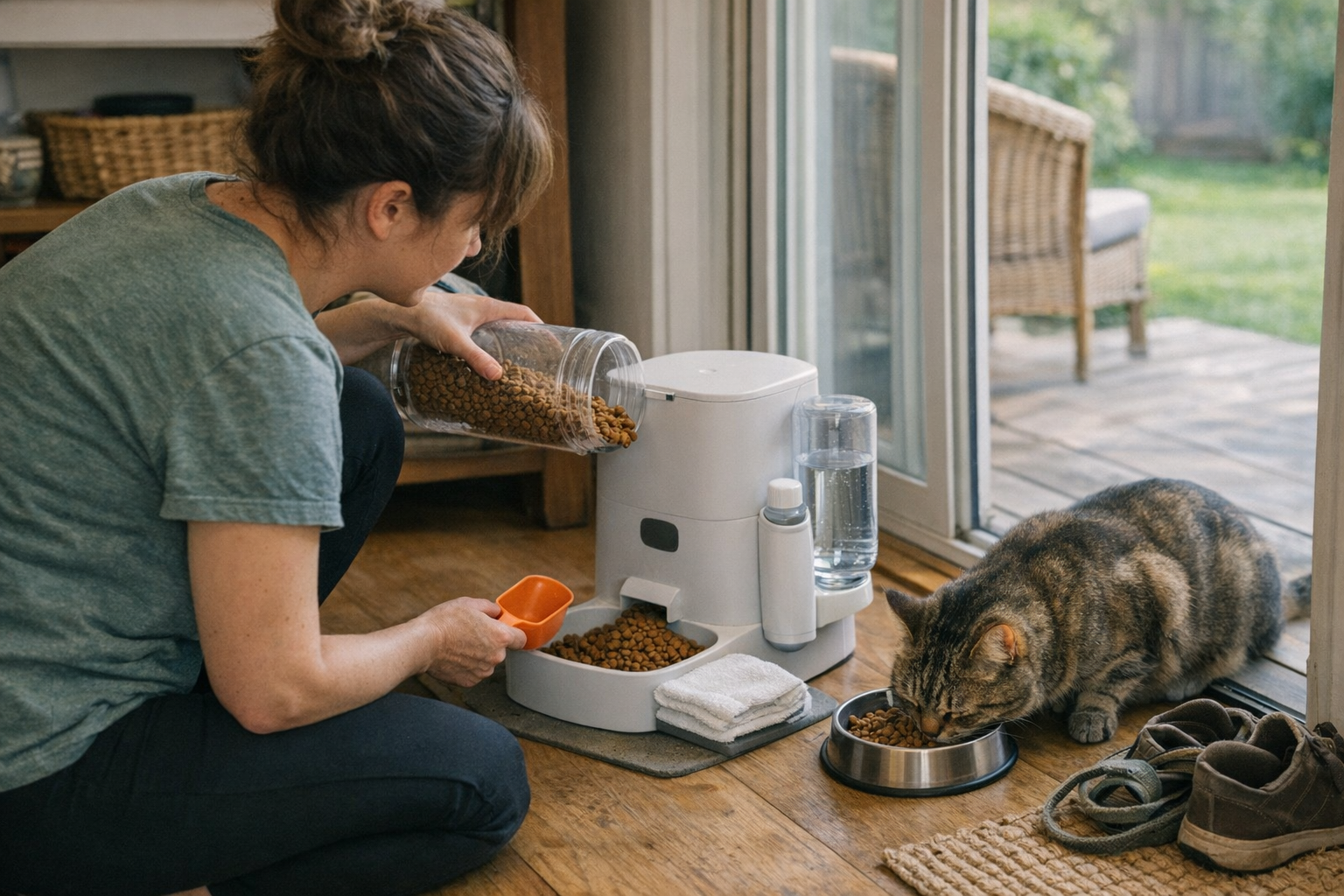
    Daily pet setups can look organized for a day or two, but real problems creep in when essentials aren’t always right where you need them. An automatic feeder clicks on—releasing food like clockwork—but the scoop’s vanished under yesterday’s mail, the refill bottle’s across the kitchen, and a sticky film lingers in the bowl because the wipes aren’t nearby. Instead of a routine on autopilot, you’re thrown into a scramble: one more search, one more trip, one more cleanup left for later. A setup that feels simple turns demanding when a single supply goes missing or ends up just out of reach. This is where the CalmPetSupply world comes in: setups built for real daily use, not just for show.

    The Hidden Friction: When “Effortless” Routines Slip

    Out of the box, it all works: feeder in place, scoop and bottle arranged, surface wiped—ready to go. But real-life routines don’t stay clean on their own. Small gaps appear, piling up fast:

    • The scoop drifts under paperwork or ends up in another room entirely.
    • The refill bottle circles the kitchen, never at the feeder when you need a quick top-up.
    • Misdirected wipes disappear, and crumbs, smudges, and old kibble build up, just beneath notice until it matters.

    Suddenly feeding means crossing rooms, moving piles, or improvising. A feeder that should save time turns into a chore hub. Skip a wipe-down and the next feeding sticks; hunt for a bottle, and you lose flow just because one step got out of sync. The illusion of “automatic” cracks the first time a missing item turns a quick task into a sideline that lingers past breakfast.

    Repeated Interruptions: Real-Life Use Scenes

    Most mornings become a series of detours: refilling the bowl means shifting a grocery sack aside, crawling behind the feeder to find a hidden scoop, or realizing your cleaning wipe is missing—again. The water top-up, supposedly a five-second job, requires backtracking to another counter or even another room. The feeding corner that looked manageable now slows down your whole hallway every time you pass through.

    Evening resets tell the same story—ready to prep for tomorrow, but you hit a snag right away: a wipe nowhere in sight, the refill bottle dry, hands overloaded with other items. Each micro-delay chips away at whatever calm you hoped your setup would save. Even the basics leak back into shared family spaces, tripping up the day’s flow with one more fragment of stray pet gear or spill.

    These aren’t one-time slip-ups. One misplaced refill or missing scoop can keep draining minutes and attention, stretching what should be a pause for your pet into just another household pressure point. Even when the area stays visually tidy, you find yourself pausing to reshuffle, stepping away from kitchen tasks, or mapping a route around half-blocked access. A routine that once looked under control starts consuming space, time, and headspace—especially if you share it with others.

    The Difference Between Tidy and Truly Functional

    A neat appearance always seems like enough at first: supplies lined up, no loose kibble, everything out of sight. But function trumps form when routines repeat. A feeding corner can seem picture-perfect, but if your essential tools aren’t exactly where your hand needs them, every step is an interruption waiting to happen.

    For example, spotless floors don’t save you a step if the refill bottle lives somewhere else. A well-wiped bowl still means an extra walk if your scoop wanders away or gets piled under unrelated clutter. What looks reset and organized often conceals the next snag—and you only notice when you’re stopped in the middle of some other job.

    Practical Shifts Make Care Friction-Proof

    The game-changer is always simple, concrete placement: the refill bottle actually mounted beside the feeder, a scoop and wipe caddy anchored at arm’s reach, not drifting off elsewhere. No extra storage; no wait-until-later reshuffling. Putting each supply back during the actual routine—not just at the end—means every part of the care loop stays in sync, even when time is tight or you’re juggling five things at once.

    Try tucking a refill bottle holder at feeder level and dropping the scoop into a visible tray beneath—not off to the side. Suddenly, feeding resets flow in seconds, wipes aren’t an afterthought, and you don’t break stride walking away. What used to be a hidden job now fits right into your everyday schedule, saving invisible cleanup later.

    Daily Details That Make Care Consistently Calm

    Keep every supply—food, scoop, refill bottle, wipes—anchored at the actual point of use. Replace and return items in real time instead of falling back on a weekend clean. A quick swipe after food drops means later bowls don’t stick or clog; water bottles left on-site mean top-ups aren’t a scramble. Routines hold steady not through complicated systems but by letting the right tool meet your hand exactly when you reach for it, every day.

    Real-World Proof: Convenience Isn’t Automatic

    “Set-and-forget” only lasts as long as your arrangement genuinely serves repeat use. One missing or badly placed supply can slow you down every single time—whether that means backtracking, improvising, or letting clutter drift, the cost builds with every repetition. The routine that seems solved after one good reset slips fast when core details don’t stay put.

    There’s real difference between a visible reset and an actually friction-free routine. The CalmPetSupply approach is about anchoring the basics where they’re needed—so no hunting, no sidesteps, no extra resets. The payoff is immediate and visible every time you refill, feed, or tidy up. The right setup does more than look tidy: it frees up real space and calm at home, with less repeat-work in your day.

    Find setups for feeding, water, cleanup, and daily calm—purpose-made for real routines—at CalmPetSupply.

  • How Adjusting Evening Playtime Transforms Indoor Cat Behavior and Home Order

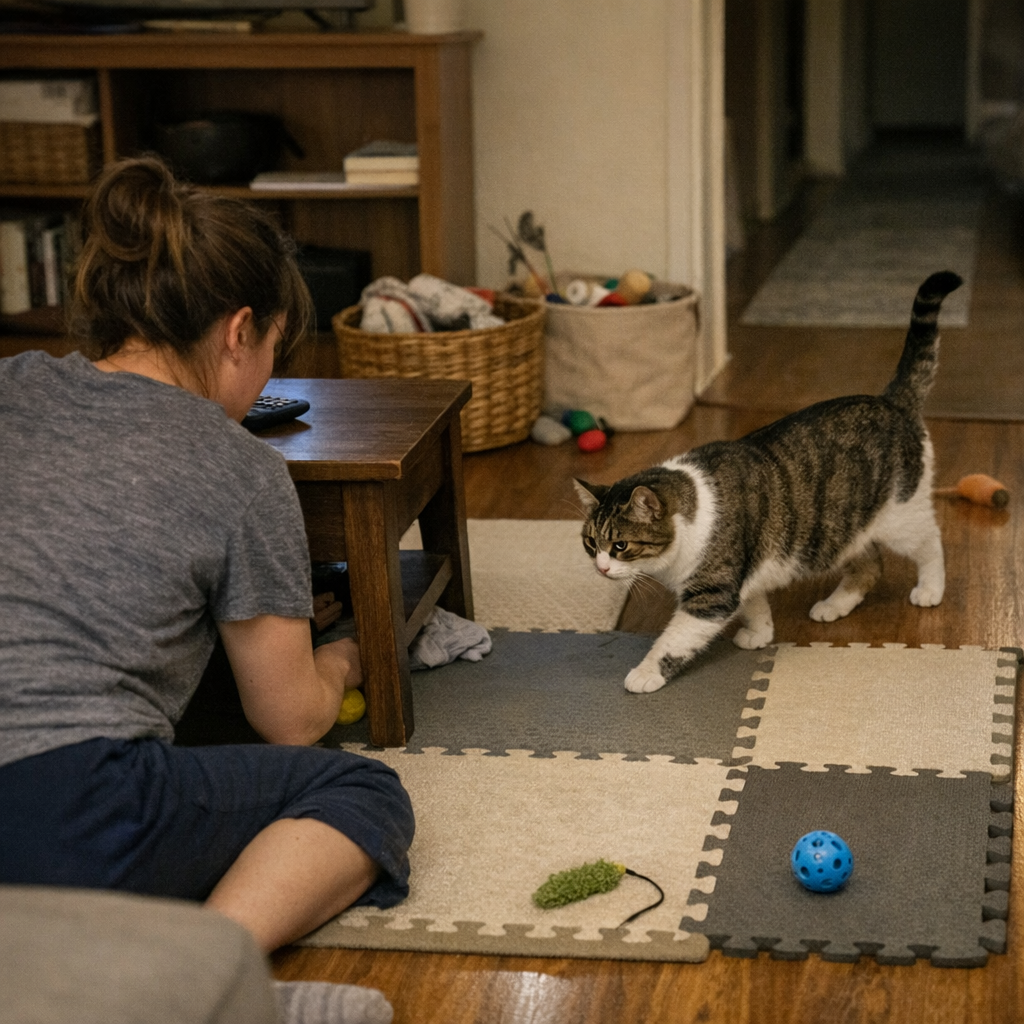
    If you live with an indoor cat, you know the friction: at night, the living room looks set—basket in the corner, toys in their spot, mats roughly aligned. But every morning, cleanup feels pointless. Fabric mice reappear under furniture, that mat is crooked again, and balls you thought corralled are scattered in new places. It’s not just about things looking messy—it’s about reset work piling up, tiny resets you didn’t expect to become a daily tax. The difference between “looks fixed” and “actually under control” shows up after a few days, not just one cleaning. Every evening starts more scattered, but the root problem isn’t obvious until you’re hunting for the same toy or straightening the mat mid-coffee, again.

    When Evening Play Backfires—On Day Three, Not Day One

    The first night, most setups feel fine. You set a post-dinner play window, probably around 8:30 PM, and everything resets easily—cat content, toys gathered, routine feels organized. But by the second or third night, frayed routines show up. The “night surge” repeats just as you want calm. Instead of toys stopping at the play area, you’re now retrieving them from doorways or under furniture corners. Mats drift out into the living space, making even a late walk for water involve an ankle catch or sidestep. Routine tasks—‘just a two-minute pickup’—stretch out when you spot a stray catnip mouse or ball across the hall as you’re turning off lights. The setup that looked practical on night one reveals its limits when you’re repeating the same resets every night, slowing down when you meant to wind down.

    The Real Friction Isn’t Mess—It’s Repeating the Same Reset

    The giveaway isn’t the level of mess, but the cycle you can’t break. By the third or fourth night, you notice:

    • Toys needing to be retrieved from under the TV stand or deep under the couch—sometimes requiring an awkward reach, or a flashlight you didn’t expect to need
    • The play mat never quite where it belongs, so every morning includes a lopsided quick-fix—usually while your hands are full or you’re still waking up
    • Your bedtime constantly interrupted by “one more” burst of cat energy right as you’re closing the house down

    The result? Less enjoyment of the setup you planned, more micro-adjustments and stray cat items slowing your transition from work mode to rest. The room’s visible order fools you—until repeated small chores keep resurfacing, draining energy at the end of every day.

    Why Tidy Looks Don’t Equal a Working Routine

    The real signal isn’t how it looks after a single cleanup—it’s whether the setup holds up without constant returns. Patterns emerge fast:

    • Toys are outside their basket again before sunrise
    • You revisit the living room post-bedtime just for a quick retrieval or shuffle
    • The play area keeps spreading into shared walking space, taking up more of the floor every day

    The problem isn’t clutter—it’s a cycle that keeps breaking your evening flow. If your routine keeps making a lie of your own ‘final’ cleanup, the solution won’t come from one more storage container.

    The Real Fix: Adjusting Play Timing, Not Adding Baskets

    The reflex is to look for a new storage fix—a bigger basket, new mats, furniture shifts. But most setups collapse not from lack of storage, but from timing that bleeds into your rest period. Shifting play 20–30 minutes earlier resets the home’s energy curve. Cat play winds down earlier, so the last cleanup marries with your active hours instead of encroaching on relaxation, and the resets don’t chase you around late at night.

    When owners actually push playtime earlier, these shifts become obvious:

    • Cats settle before people wind down—no late-night zoomies just as you dim the lights
    • Toys stay closer to their zone, making reset a two-minute job, not a drawn-out hunt
    • The last round of organizing happens before tiredness sets in, so you don’t wake up to yesterday’s work
    • Mornings start with less interruption—no detour for toy rescue or mat realignment before breakfast

    The payoff is direct: you’re not spending the last minutes of your evening relocating things you already put away, and you start your day without the feeling you’re stuck in a clean-reset loop.

    How Timing Reduces Not Just Mess, But Cleanup Friction

    Picture the routine play zone: basket by the wall, foam mat, an assortment of toys. If play always begins close to your own bedtime, chaos bleeds into late hours. By the time you reach for your water glass or move toward the bedroom, you’re sidestepping balls, picking up toy scraps, or nudging the mat away from the hallway, just to keep a clear path. The “full reset” never happens, because interruption always wins.

    Move play up by just half an hour. Cleanup happens as you’re still awake—resetting the area isn’t another tired chore. By the time your routine shifts to winding down, the cat is already in rest mode. The room holds overnight; you aren’t starting every morning with yesterday’s unfinished business.

    Spotting If Structure Is Helping or Quietly Adding Work

    Perfect order won’t hold, but the pattern should change. When timing fits household flow, you stop chasing the same cleanup battles. A good basket or mat works with the routine—not as another hurdle between you and the first coffee. You notice quickly whether a chosen setup holds for days, or introduces new, sneaky work each night.

    Diagnosing Real Weak Points: Watch for Patterns, Not One-Off Messes

    Patterns reveal breakdowns, not one-time episodes. Three or more nights in a row of:

    • Toys lost to other rooms or under hard-to-reach corners
    • Late-night cat surges disrupting your sleep transition
    • Cleanup getting pushed later and later into your evening

    …signals that the schedule—not just the setup—could be feeding the friction. Recognizing this can spare you the endless double-reset cycle that pulls you out of rest mode.

    Small Adjustments That Actually Shift Your Routine

    You don’t need a total overhaul, nor more gear, to break the pattern. Instead, try:

    • Shift play slightly earlier: Start 10 minutes ahead of usual. If late-night interruption remains, adjust again. Matching play timing with your evening low-energy point reduces stray sprints and scattered cleanup jobs.
    • Anchor new timing with the best toy: Set the most-loved item out earlier as a start cue—and stick with finishing before your own wind-down begins.
    • Use clear end signals: Blanket down, a favorite treat, or something as simple as a light or sound can mark the end, making it clearer for both you and the cat.
    • Tweak item placement, not just item count: If baskets keep drifting, move them slightly closer to natural walkways; if the mat always blocks a path, try the opposite wall. The goal isn’t prettiness, but fewer after-hours corrections.

    Each tweak lets structure—placement, timing, and signals—do more of the heavy lifting, reducing how much you have to intervene just to maintain basic order.

    When “Looks Fine” Fails: Surface Order vs Real-World Ease

    Even after rescheduling, some flaws will still show through. Examples:

    • A basket looks organized, but toys keep migrating as soon as you’re not watching
    • The mat is aligned with the couch, but ends up inviting launches into shared space—so clutter moves rooms, not just corners
    • Cleanup tools are technically “right there,” but awkward to reach at the real moment of need, stretching the process or influencing you to skip a reset

    This is why visible order is just a starting point. The setups that last aren’t hidden or spotless; they keep maintenance low, retrieval easy, and interruptions minimal—making repeated routines bearable even when your own energy is stretched thin at the end of the day.

    A Stronger Setup Isn’t Perfection—It’s Routine That Stops Dragging You Back

    Living with an indoor cat means friction will always find a way in—mats shift, toys wander, timing slips. But when your setup and scheduling work together, the pattern stops demanding the same tired fixes and lets both you and your cat settle faster. The difference isn’t in “looking controlled,” but in needing fewer late-night resets just to keep pace. Small shifts—especially in when you play, not just how you store—break up the repair loop that makes every evening slower. A practical setup is the one that’s easier