Author: jaesoon_admin

  • How Headlamps Solve Hidden Lighting Problems in Indoor Workspaces

    A room can look bright and still make every routine harder. Flush mount ceiling lights, semi-flush fixtures, and wall sconces all promise “full-room” illumination—until you’re hunting for a lost washer under the cabinet or fighting a shadowed corner at the end of the hallway. The real test isn’t how a fixture looks the first day; it’s whether you still need to drag your phone flashlight out after the third time a glare hits your eyes just as you lean over the work surface. That’s when the failings of ceiling-only setups and even new wall lights become obvious: glare kicks up near mirrors, corners stay dim, and a bright room still interrupts the flow of basic tasks.

    When Everyday Tasks Reveal the Gap in “Even” Lighting

    A routine week doesn’t test your fixtures when you’re standing in the middle of the room—it’s when you’re down low by the washing machine, tracing a pipe in a bathroom corner, or stretching across a kitchen run. The first day, a flush-mount ceiling panel looks like it covers every inch. But try wiping under a cabinet edge or fixing a bolt near the wall, and you’ll find yourself shifting for a better angle, only to be handed more shadows or sharp glare exactly where you need clarity. That’s when the showy spread of a ceiling fixture collapses into work-arresting guesswork and you start keeping a flashlight nearby just to finish what should be routine.

    Shadowed Corners and Blocked Sightlines: The Quiet Culprits

    Rooms rarely feel “too dark” overall—it’s the steady friction at the edges that wears you out. A kitchen looks brilliant standing at the doorway, but the counter’s front edge vanishes once you lean in with a cutting board. A bathroom vanity’s twin sconces balance the mirror…until you turn sideways and one cheek disappears into uneven shadow. Hallway lights spread outward but leave the moulding along the floor pale and the corners cold. Each time your body, a shelf, or a tool blocks the beam, you get a visible streak of uncertainty—a line between what’s merely lit and what’s actually usable when your routine moves off center.

    The Reality of Repeated Use: Why Fixed Fixtures Hit a Wall

    The trouble isn’t a single dark spot—it’s the way every small flaw stacks up. Sorting laundry under shallow cabinets exposes the same blind angle, week after week. Each shadow means a slower search, a missed stain, a pause to aim your phone light. Chores stall out mid-step not because you lack a fixture, but because the placement was designed for an empty room, not an occupied task. As soon as natural light drops or your hand breaks that fixed beam, you move from “looks bright” to “routine interrupted.” Few rooms feel balanced for both appearance and movement.

    Movement Makes All the Difference

    Static lights force you to fit their narrow conditions. Step toward the edge of a hallway or shift position at a vanity and the lighting changes beneath you: glare at eye-level, sudden shadow on the counter, the stair landing dropping into dimness right as you take the turn. The catch is always location—what’s lit for show is rarely aligned with your hands, your eyes, your next step. That’s why a bright-looking space can leave you redirecting, ducking, or hunting for better light rather than simply finishing the task.

    How a Headlamp Breaks the Cycle of Frustration

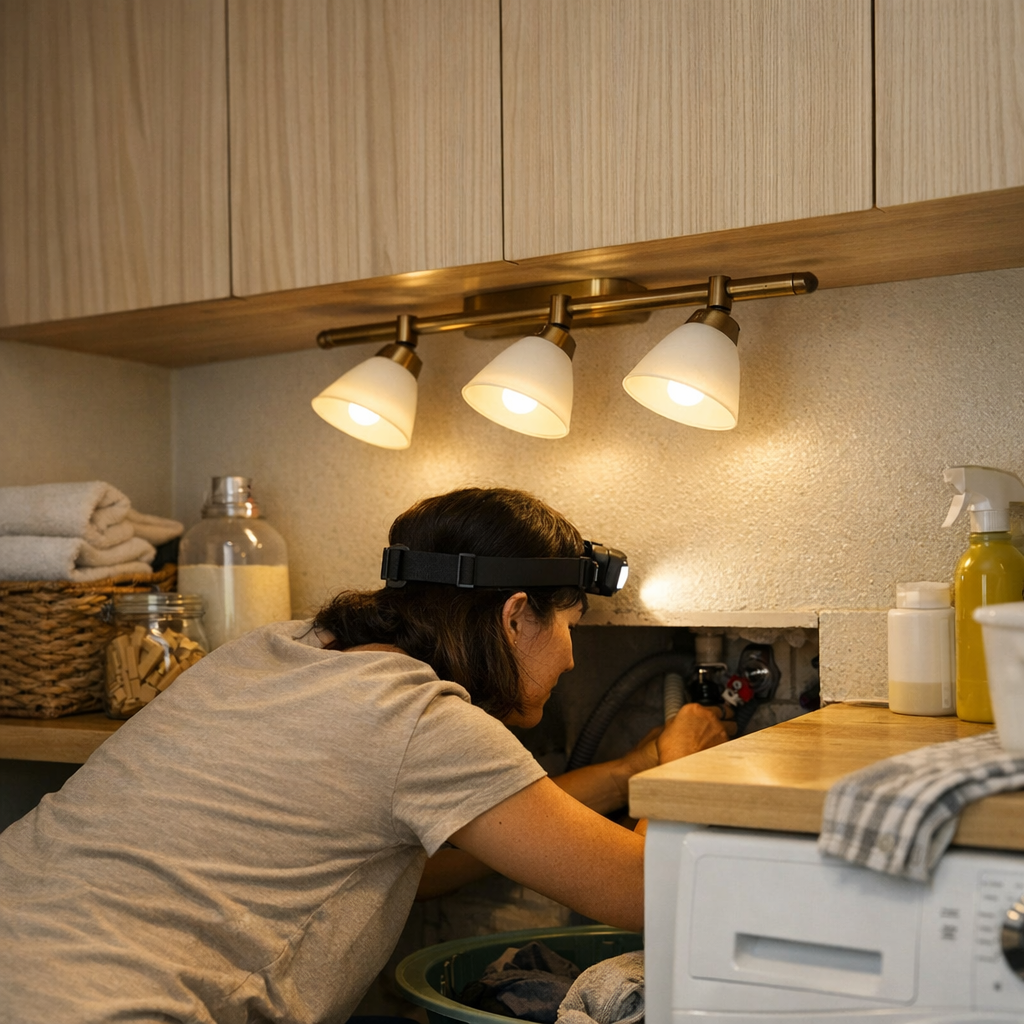
    Adding a headlamp solves what static fixtures cannot reach. Instead of flooding the whole room with more watts, a headlamp tracks your gaze, flipping the usual search for clear light: wherever you need focus—an appliance label, a jammed clamp, a stripe of grime on tile—the light arrives. Suddenly pointing, twisting, and tracing under a cabinet or around a corner stop involving acrobatics or extra gear. The best improvement isn’t cosmetic, but practical—wherever your vision goes, the light keeps pace, and the friction vanishes.

    Real Impact in Real Spaces

    No overhaul required: placing a headlamp by the laundry machines or on a shelf in the utility zone means usable, targeted light on demand. In repeated use, the differences aren’t about style, but flow and function:

    • Instructions on appliances stayed readable, even as evening light failed.
    • The back corner under the cabinet—once always missed—became visible through the entire cycle.
    • Working with both hands free, tool tips didn’t disappear behind your arm or produce surprise glare.

    In one laundry area, this simple fix eliminated the usual pattern: no more groping for dropped bits under a shelf, no more guesswork finding a misplaced stain. Tasks sped up not because the room seemed brighter, but because the old mistakes—missed dirt, lost screws—slipped away.

    Why Mobility Matters in Task Lighting

    Even “task” fixtures like under-cabinet strips or wall sconces only win if nothing gets in the way. Their impact drops fast if an arm, object, or shelf runs across the beam. That’s the real annoyance of fixed solutions: the angle you need is never quite lined up, and rerouting your routine slows progress. A headlamp breaks that trap by tying the beam to your movement. You get two free hands, zero shadow surprises, and the flexibility to shift without losing clarity—key differences when a job repeats over and over.

    Useful Tip: Keep Lighting Tools Where the Friction Is

    Place your lighting where frustration repeats. Store your headlamp on a hook inside the utility cabinet, clipped to a shelf by the washer, or right above the hallway kink where shadows ambush your eyes. Don’t bury the solution; put it at the heart of the problem zone, right where the edge of routine blurs into inconvenience.

    The Practical Payoff: Fewer Mistakes, Smoother Routines

    This is not just about adding brightness—it’s about clearing invisible obstacles that ceiling and wall setups leave behind. With mobile, targeted lighting, time spent readjusting, double-checking, or retracing steps drops fast. The basement corner and laundry cupboard may never glow like a catalog photo, but on a weeknight, the change is obvious in what goes right, not how things look. When friction drops, tasks actually finish, and the space finally keeps up with the pace you need.

    For real solutions to the most persistent indoor lighting annoyances, see what works in actual homes at LightHelper.


  • Why Twice-Yearly Car Kit Checks Keep Your Gear Ready and Reliable

    Every organized car setup eventually hits the same wall: it doesn’t stay organized once real routines take over. Gloveboxes, center consoles, and trunks can look dialed-in on day one—chargers lined up, wipes within arm’s reach, trunk bins snapped shut. But by the second week of commutes, errands, and backseat scrambles, that tidy system buckles under actual use. Chargers slip behind cupholders. Emergency kits get buried. The wipes that were “right here” last Sunday vanish just when someone spills their coffee. An interior that looks calm in a photo still trips you up when you’re rushing, juggling groceries, and reaching for the item you always need fast.

    Where Organization Fails in Real Driving

    The real difference isn’t appearance—it’s how your setup stands up to daily motion and surprise needs. Most car organizers and storage kits work fine while the vehicle is parked. But as soon as your week kicks in, their weaknesses show up where it counts. Consider:

    • End of a double shift: Reach for a charger and find nothing but a tangle of cords, snack wrappers, and yesterday’s receipts jammed in the console you “just tidied.”
    • Grocery run with a half-full trunk: One sharp stop sends your trunk bin sliding; first aid gear and mail scatter across the floor in a second.
    • Repeated pickups: That last bottle of sanitizer drops to the floor and stays there, always out of hand when needed, until you find it wedged under the seat during a rushed cleanup weeks later.

    It’s not that storage failed on day one; it’s that most organizers can’t handle the churn: kids shoving bags, grocery loads hitting floor mats, random dog leashes tangling with seatbelt buckles. Every repeat trip pokes holes in your “system” until quick access collapses and routine use becomes a series of workarounds.

    Friction During Quick Stops and Busy Weeks

    The pain points show up when you least expect them—most obviously during those quick re-entries or after-work stops when you don’t have patience left. A storage system that made sense on a slow Sunday becomes a mess when:

    • You’re diving into the car with arms full, but the trunk organizer blocks quick unloading
    • Phone charging cables are always underneath something else, and untangling them eats up your next five minutes
    • Wipes are “in the car” but buried under a hanging sunshade or pressed behind a seat cover, forcing an awkward reach as someone waits

    At first, these are quick irritations—an extra six seconds here, a mild scramble there. But with every repeat, small annoyances stack into real obstacles. By the tenth reach or the next time you brake hard, you’re not just delayed—you’re reminded that this setup actually interrupts your day. What started as a fix becomes just another source of scramble. Unseen clutter creeps back, coverage shifts off target, and those daily frictions keep you from trusting your own layout.

    The Cost of Drift and Invisible Mess

    Car organization fails slowly—then hits all at once, always when it matters most. Under real pressure (late morning, pouring rain, dying phone battery) things go missing, slide out of reach, or clog up what should be quick access. Typical pressure points:

    • Chargers slip down door pockets or beneath seats, never there when the battery dips red
    • First aid kits blend in with manuals and shopping bags, invisible when you’re in a hurry
    • Floor mats bunch at the pedals or trunk bins pitch over in a fast turn, leading to everything spilling into corners you don’t clean for months

    The real hazard isn’t one huge mess, but a repeated breakdown: floors crowded with wrappers, charging cables twisted around gear levers, or cleaning wipes lost until the season changes. The earlier sense of order just converts your mess into a new obstacle, and fixing it now means dismantling yesterday’s “solution.”

    Spring and Fall: The Simple Reset with Real Impact

    Rebuilding access isn’t about chasing some perfect state—it’s about regular, realistic resets mapped to your actual driving rhythm. A smart twice-yearly check—in spring and fall, like maintenance—matters more than the most detailed first setup. When you put these resets on the calendar, you catch:

    • Lost or drifted items tucked in odd places
    • Supplies that expired or wore out under real use
    • Where daily-use items bottleneck your flow, and which “essentials” can move to lower-access zones

    Example: The “front seat stash” often mutates into a dump zone for tape, receipts, old snacks, and forgotten cables, crowding out actual must-haves. Shift anything used less than weekly to the trunk or a cargo bin—yes, even if it means stretching an extra few inches at the back on rare days. Suddenly, you restore reach for wipes, cords, and chargers that really earn a spot up front. The payoff feels small the first morning—faster access, fewer double-checks on entry—but after a month, the difference is obvious every time you jump in or pack up at speed.

    What a Functional Reset Looks Like

    The reset itself is quick, but it pays off daily. The pattern:

    • Toss out dead batteries and dried-out wipes—most of us carry at least one expired pack or useless spare
    • Pull every charging cable, test them, and toss/reorganize the ones that never seem to work in the rush
    • Empty pouches and pockets; what gets used weekly stays, the rest moves or goes—no matter how tidy it looked in theory
    • Pull containers from the trunk, shake them out, vacuum underneath, and re-anchor anything that slid or tipped during sharp driving
    • Repack strictly by routine: high-access items in arm’s reach, rainy-day or “just in case” stuff back by the spare tire

    You don’t win a magazine-cover interior—but you regain trust in your car’s logic. The glovebox might still be crowded, floor mats might show wear, but you actually find the things you reach for. Chargers are alive when you need them. The old “where did that go?” scramble becomes a once-a-season nuisance, not a twice-a-week frustration.

    Closing the Gap Between Order and Use

    The tipping point isn’t more gear—it’s matching layout to what you really grab, move, clean, or charge in real weeks, not in a staged photo. Cars only stay “organized” when the work matches use: items that matter in reach, less-used kits packed deep, cables routed where they get used, not just where they look good. If you stop at “looks tidy,” drift always returns and friction follows. Give yourself two real structure checks a year, and you’ll spot hiding spots, failed pockets, or cable snarls before they slow you down on a bad day.

    With practice, resets become less about chasing order and more about defending your own routine. Mess still returns—just not as a sneak attack. You stop feeling surprised when supplies slide or chargers vanish, because you correct for those patterns before they cost you during crunch time. That’s what separates a car that looks finished from a car that actually keeps up, even when life doesn’t slow down.

    Find more gear and practical car-use solutions at DriveWellSupply.

  • Balancing Visibility and Containment in Pantry Storage Solutions

    The first day after a deep pantry reset gives you a real, fleeting thrill. For a moment, the shelves look calm. Mesh baskets or solid bins sit lined up in quiet ranks, everything in its place—a scene that feels almost suspiciously neat. But the illusion rarely lasts. Within a week, after morning scrambles for cereal, rushed dinner preps, and a new haul of groceries, that crisp order unravels: shelves overcrowd with bags-on-bags, snacks vanish from sight, and you’re back to hunting—with frustration—for the item you swore you just bought.

    Why “Freshly Organized” Rarely Lasts More Than a Few Days

    Choosing mesh baskets or solid bins can feel like an obvious upgrade during a single afternoon’s overhaul. Both tame the initial chaos, but daily life exposes the gaps—literally and figuratively.

    Mesh baskets win for visibility. You spot what’s running low in seconds. Need another peanut butter cracker pack? It’s right there—until it isn’t. Small packets slip through the mesh, collecting in odd corners or falling out of reach. Crumbs settle in a silent layer below, and stray snacks wedge themselves just out of sight.

    Solid bins promise containment. Nothing leaks, nothing escapes, all the tiny bits stay wrangled. But that sense of control comes at a cost: every bin is a guessing game. Pull out the big plastic bin—it’s heavy, double-stacked—and realize you already had the quick rice you just bought, buried beneath a wall of boxes. “Organized” dissolves into “unfindable.”

    Where Pantry Systems Start to Break Down

    Clutter sneaks in quietly, not in big messes, but in the daily habits between full resets.

    It starts after a grocery run. One bag of trail mix goes here, another where there’s just enough space. No one wants to reshuffle bins, so new items land wherever they fit. Over the weeks, categories dissolve—snacks with grains, breakfast bars lost among canned soup, and favorite chips exiled behind pasta. Mesh baskets let the smallest items drift beyond reach, or slip out entirely. Solid bins hide forgotten packets, turning “grab and go” into “dig and debate.”

    The true friction shows up when you’re short on time: grabbing lunchbox snacks and watching a cheese stick fall through the mesh to the dark recesses behind the shelf. Hauling down a heavy bin, only to wonder, “Why does everything important end up at the very bottom?”

    Obstacles Multiply—The Slow Spread of Clutter

    It doesn’t take long for even a neatly sorted pantry to feel like an obstacle course. Too many containers jammed onto a shelf, or bins overflowing with mixed items, force you to move four things to reach the fifth. Baskets and bins, overloaded or oversized, invite the “I’ll just grab it for now” syndrome—an open bag or stray box gets left on the counter, inching its way into the kitchen routine. Clutter isn’t just shelf-bound; it migrates, one misplaced item at a time.

    Before you notice, category lines fade. The “snack” section swallows soup cans, breakfast shelves hide dessert, and even visually perfect pantries turn slow and awkward to use. Resetting the order takes more effort, and the cycle repeats, one snack rescue at a time.

    Real Solutions: Match Container to What You Store

    The best pantries aren’t all-mesh or all-solid—they’re thoughtfully mixed to fit what you actually have:

    • Mesh baskets give instant visibility on mid-size snacks, produce, and grab-and-go staples. Airflow helps, and you’ll always spot the last granola bar before it’s gone.
    • Solid bins lock down loose packets and tiny items—seasoning pouches, drink mixes, snack packs—so nothing escapes through a wire bottom or gets wedged somewhere weird.

    Pro move: If mesh is letting crumbs or snacks disappear, lay down a shelf liner or drop the tiniest packets into a small solid bin before adding to the basket. Don’t mix the smallest things with anything bulky; separate them and you’ll prevent the “lost and found” shuffle every single restock.

    How the Right Setup Changes Your Week

    Switching from a one-style-fits-all approach to a mix that matches your pantry’s real lineup changes everything. Crowded shelves stay clear longer. Post-grocery resets shrink from a full overhaul to a quick touch-up. When each container suits its load—and your routines—fewer things drift, and the line between “snacks” and “dinner” doesn’t vanish overnight. That means faster finds, steadier categories, and a pantry that feels as good on Saturday morning as it did on day one.

    Over time, instead of constantly shifting or reshuffling, your shelves hold their boundaries. Less rummaging, fewer lost items, and less time wasted moving stacks to uncover a stray sauce packet. The initial calm becomes a quieter, more lasting rhythm.

    Two Must-Do Pantry Checks

    • Only put items bigger than the mesh holes in mesh baskets. Losing snack bars or finding crumb trails? Rethink what goes where.
    • Clearly label every solid bin. Vague or worn-out labels lead to lost time and forgotten food. Even if you can’t see inside, you’ll always know where to look first.

    Most importantly: the real value of mesh versus solid isn’t style—it’s about how often you have to interrupt your routine for a reset, a search, or a rescue. Build your setup to fit what actually happens on your shelves. Adjust as your routines or grocery habits shift. Organization should feel easier to maintain the longer you live with it—not harder.

    Your shelves—and your routines—will work better for it.

    Shop ClosetWorks storage solutions

  • Why Fixed Joints Make Entryway Storage More Reliable Over Time

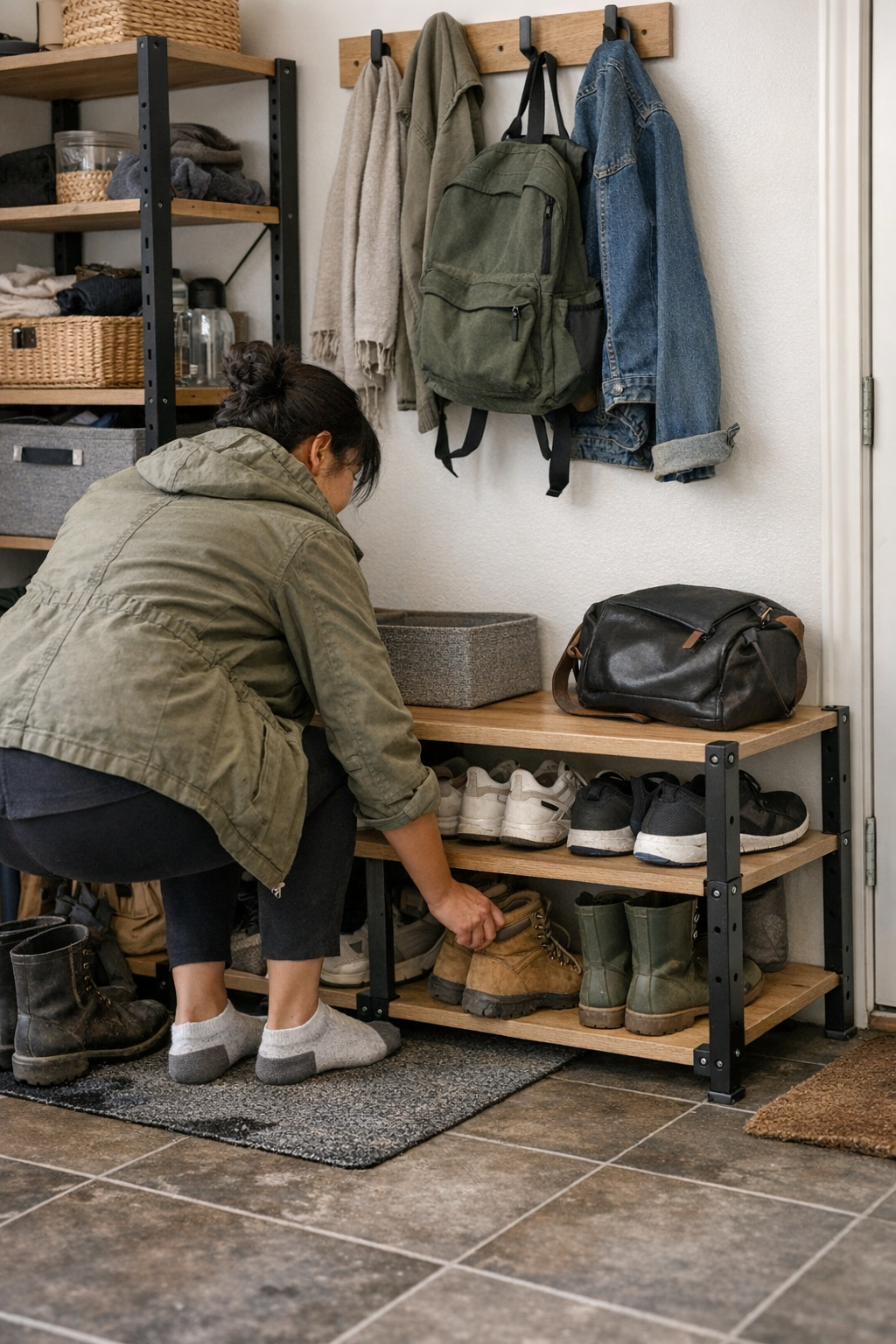
    Every household with an entryway bench or shoe rack knows the cycle: The system looks sharp for a few days—until real routines hit. Bags go up, shoes come off, hooks handle more weight, and by week’s end, movement through the threshold starts to jam. A bench edge wobbles. Shoe racks loosen, rows blur, and hooks tilt as backpacks pull harder than the hardware wants to handle. It’s not just mess—it’s daily disruption. The underlying issue: storage joints drift or fail when exposed to the sideways pressure and constant motion of real, repeated entryway use. That first moment something shifts, the promise of a controlled transition zone starts slipping away, turning reset into repair.

    The Problem Hiding in Plain Sight: Shifting Joints and Daily Drift

    The subtle creep of loosened storage is easy to miss—until it turns keeping order into extra work. The typical rundown: you drop your bag, toss your shoes aside, hang a coat, and hope the setup absorbs the shock. But transition-space storage built to be modular or tool-free rarely stays rigid. Each sideways shove and quick drop—barely noticed in the moment—forces joints to flex. What starts level and aligned goes off-plumb. One morning the rack has a gap; one evening the whole bench feels tilted. This slow drift collects: shoes spill into the path, lines collapse, and resets drag on as you realign what was supposed to save you time.

    The Visual vs. the Actual: When Looks Backfire

    Easy-assemble benches and mobile shoe racks grab attention on day one. They fit against any wall, slide into open corners, and promise instant organization. But real use exposes a different story. Over a week or two—sometimes after just a weekend of real traffic—you’ll notice:

    • The bench nudging too close to the swing of the door, forcing a shuffle at entry.
    • Shoe racks creeping outward, shoes scattering past their line and into walkways.
    • Hooks or shelves pulling at their anchors, breaking up categories and feeding clutter instead of containing it.

    Once storage flexes or drifts, temporary items linger—one pair of boots left out becomes a magnet for bags or coats, and what was meant to be a staging zone collapses into a semi-permanent pileup. The threshold doesn’t just look untidy; it slows everyone down, breaking the promise of a quick reset.

    Real Moments: Where Threshold Storage Breaks Down

    The shift from anchored storage to mobile units reveals itself in daily friction, not at unboxing. The cracks appear in the ordinary moments:

    1. The After-Work Pileup

    Weeknights bring repeat pressure. Everyone piles shoes, slings bags, and drapes outerwear—quickly crowding a portable bench. Sit to tie a shoe and the unit shudders, sometimes shifting so much that you have to stop, drag it back, or restack the fallen row before the aisle clears again. What looked like a neat solution now trips up the routine.

    2. The Weekend Reset Spiral

    What used to be a two-minute clear-and-restore turns into a multi-step shuffle. You realign the shoe rack, nudge the bench, pick up scattered items, and still find that things look off—because the storage itself can’t hold its ground. Sweeping or mopping becomes awkward as units skate across the floor, undoing any order gained just moments earlier. Cleanup that should be automatic now depends on wrestling drifting furniture back into place.

    3. Door Blockage and Traffic Jams

    The most persistent culprit is subtle migration: a bench inching into the door’s path, forcing each person to sidestep—or worse, nudge shoes deeper into the walkway. In tight entryways, losing even a half-inch turns passage into a test of patience. Over a few days, misalignment multiplies: stored items spill wider, foot traffic narrows, and the quick in/out flow is quietly interrupted by stuff that will not stay in its place. The whole point of the organizing effort—making movement smoother—gets erased by stealthy drift.

    Why Anchored Storage Holds Up Under Real Routine

    Stability in transition spaces depends on real connection. Wall-anchored benches, doweled cabinets, and bracket-mounted shoe racks take more effort to install, but they change the stakes for everyday use. Anchored storage stands up to repeat stress: bags land hard, shoes scrape forward, kids push or pull, and the structure absorbs the force instead of passing it along as wobbles or gaps.

    Example in Practice: Replacing a loose bench with a wall-mounted, bracketed unit changed the cycle overnight. Shoes stayed put even during family rush-hour, bags held their zone, and quick resets became routine—no more detours to straighten sliding storage or untangle shoe rows. The anchored structure kept its line, giving everything else a chance to return where it belonged no matter the weather or how crowded the threshold got. Resets were about actual tidying, not recovering from slow system failure.

    Testing for Trouble: How to Spot Weak Joints Early

    Most new storage feels steady, but repeated use tells the truth. To find weak points, run a check: press down or wiggle the edge of a bench or rack. Pay attention to:

    • Wobbling or rocking? Indicates play at the joints that will worsen with use.
    • Creaks or joints needing monthly tightening? Hardware is giving out under normal load.
    • Gaping where joints once fit flush? Ongoing stress is bending the structure beyond its limits.

    Anchored units almost never show these issues under daily use, and if they do, it’s usually a quick fix—not a cycle of constant repair or adjustment.

    When Mobility Makes Sense (and When It Backfires)

    Mobile or modular storage has its place—temporary setups, light use, or situations that change often. But in real entryways with multiple users, kids, weather cycles, or gear-heavy days, mobile units shift the reset burden directly to you. The flexibility that feels smart at first becomes upkeep you never signed up for: more resets, more straightening, more time spent fixing the zone between living space and everywhere else. Anchored storage may cost an extra hour to install, but wins it back dozens of times in skipped hassles and stable order.

    Toward Smoother Routines: Anchoring for Real-World Use

    Entryway storage shouldn’t measure its success by how clean it looks when nothing’s happening. The test comes during a week of actual life—bags flying in, shoes changing daily, guests crowding the space, rain or grit underfoot. Storage that creeps or slips just adds to the routine’s friction; storage that holds its line quietly resets itself. The payoff is speed, predictability, and a zone that works with you instead of asking for constant correction. Don’t settle for a setup that only looks right once. Choose the version that handles reality—so you don’t have to rebuild order after every use.

    Shop Betweenry transition-space storage solutions

  • Why Keeping Familiar Cat Bedding Helps Your Pet Settle Faster Indoors

    Swapping your cat’s bedding too often feels like the right move—tidy corner, clean texture, nothing out of place near the food bowls or litter lineup. But beneath that fresh layer, a strange inconvenience creeps in: your cat’s “rest spot” starts to scatter elsewhere. One week you’re refolding laundry; three days later you’re crouching in socks, picking cat toys from unexpected places because your cat avoids her official bed completely. The payoff for clean bedding? Repeated friction: roaming naps, more clutter in shared spaces, and a setup that never fully settles—for you or your cat. This is indoor cat life where real comfort and actual upkeep keep missing each other, and where StillWhisker setups matter more than a stack of clean throws.

    When Cleanliness Backfires: Rest Area or Revolving Door?

    An overwashed blanket can make a rest nook look pristine but strips away what anchors your cat. Change the bedding three times in a week and the pattern often flips: instead of curling up, your cat paces, circles, or skips the bed to annex a mat, a patch of rug, or any soft spot—no matter how inconvenient its location for you. She stretches under the table leg, plants herself by the litter mat, or slides into the walkway where her fur ends up tracked across spaces you thought were “off-limits.”

    This isn’t just a minor adjustment. It becomes obvious on your next pass with the water refill or vacuum—her “designated” corner sits empty, bedding crisp but unused. What’s missing is scent: laundering too often wipes away the odor and texture marks that say “safe zone.” Instead of inviting rest, that clean bedding says “not yours” in cat logic, and the territory game plays out in every other corner of the room.

    Where Scent and Routine Collide: Shared Zones Get Complicated

    The problem intensifies in smaller rooms or shared zones—the exact places most cat setups are forced to live. Her bed shares airspace with feeding bowls, a litter mat, or the edge of a play corner crowded by stray mouse toys. Here, swapping bedding isn’t a silent upgrade. It erases your cat’s map and restarts the routine for everyone: your shortcut turns into another detour, her comfort move triggers new clutter. You tidy; she claims new ground—right where you’ll walk, vacuum, or wipe later. The invisible price for “freshness” is rest lost, friction gained, and a cycle of chasing after the problem each time comfort migrates out of bounds.

    The Real Difference: “Looks Clean” vs. “Feels Right”

    What seems like visual order rarely equals real comfort for either side. A setup meant to be quick to refresh and guest-ready can backfire if it’s too sterile: your cat seeks a familiar scent, not a showroom. You notice the cost first in micro-annoyances: an extra round of moving the bowl to reach the mat, a surprise pile of toys away from their bin, fur tracked onto places you just cleaned. If every reset means hunting for your cat and inviting her “back,” the room isn’t working—it’s just keeping up appearances.

    Real friction shows up fast in daily habits:

    • Bumping a food bowl, only to find the rest mat shifted from cat traffic instead of bedding.
    • Finding new tracks of litter or fur because her comfort spot keeps moving.
    • Wiping down surfaces a second time after your cat’s nap migrated mid-day.

    How Cats Actually Use Their Space: Anchors and Shortcuts

    Most bedding resets miss what really holds a corner together: the subtle build-up—a flattened patch, the scent her paws left behind, a crumb of kibble absorbed by the base layer. These are cues that quietly anchor a routine, turning a throw blanket into a proper territory marker. When you erase them with every wash, the routine gets foggy: the tidy look is temporary, but cat behavior drifts all week. Naps move to the sofa, fur shows up on guest chairs, and play overlaps the very zones you hoped to keep untouched.

    Small Adjustment, Real Difference: The Layered Bedding Approach

    The practical fix: pivot from full resets to layering smartly. Wash the top blanket or visible cover, but leave the base undisturbed unless soiled. The top can look clean for guests, but the real comfort—the scent, shape, and warmth—remains intact for your cat. Suddenly, the pattern returns: after you fill the water or shake off the litter mat, your cat reclaims her spot without being coaxed. Toys stop wandering. The rest area doesn’t bleed into traffic lanes. Reset friction fades; habits settle. Your setup doesn’t just look ready—it actually works repeatedly, and the need for constant micro-cleanups drops away.

    Practical Home Use: The Realities of Reset and Shared Space

    Quick-Reset Friction

    The clash with daily flow is clear: you bend to move a bowl, only to find bedding crumpled or misplaced from yesterday’s cleanup. Fresh laundry can’t anchor your cat if it resets her comfort every time. The real cost? Again and again, you interrupt whatever you’re doing to nudge her out of the wrong spot or refold a blanket as she circles for somewhere “right.”

    Spillover Into Human Routine

    Especially in tighter quarters, the fix for cat comfort creates new interruptions for you. A just-swapped blanket means your cat picks fresh sites to nap—by the door, in your work space, or on anything you don’t want fur on. Suddenly, your day becomes a series of detours: stepping around her, pausing to grab the vacuum again, running the lint roller twice on the chair you were about to sit on.

    Comfort Can Slow the Setup Down

    New bedding can look “done,” but if it breaks your cat’s pattern, you pick up a different burden: lost shortcuts, extra improvising, and familiar debris spreading into rooms you thought were handled. Even the right supplies, in the wrong reset routine, trap you in a repeating cycle of do-over cleaning and shuffled comfort zones.

    What Actually Works: Comfort That Stays Put

    • Anchor the familiar when you can. Unless bedding is truly soiled, remove fur and rotate visible layers—don’t clear all scent cues at every wash.
    • Spot clean, not overhaul. Air out and tidy up but let your cat’s base scent and comfort marks stay—sanitized does not equal supportive.
    • Balance order with function. In high-traffic, multi-use areas, keep the trusted base layer in place and only swap what’s needed.
    • Watch for real signals— circling, pausing, or skipping the bed mean routine is off, no matter how fresh it looks.

    The Quiet Payoff: Less Reset, More Real Rest

    Reliably good setups for indoor cats aren’t about spotless display—they’re about anchoring comfort where it’s needed, with less fallout for everyone. A blanket that’s a little musty and a mat with some give signal “home” to your cat and save you repeated micro chores: no endless toy roundups, no extra lint rolling, no daily resets just to get back to baseline. When rest stays put, your whole routine feels lighter. The setup not only looks handled—it makes each refill, wipe, or reset actually quicker through the week.

    If you’re stuck in a loop of shifting rest spots, scattered toys, and repeating the same cleanups, test the layered approach. Sometimes the real win is bedding that spends less time in the wash and more time quietly holding the whole routine together.

    http://www.stillwhisker.myshopify.com

  • Choosing Outdoor Storage That Fits Your Yard’s Daily Flow

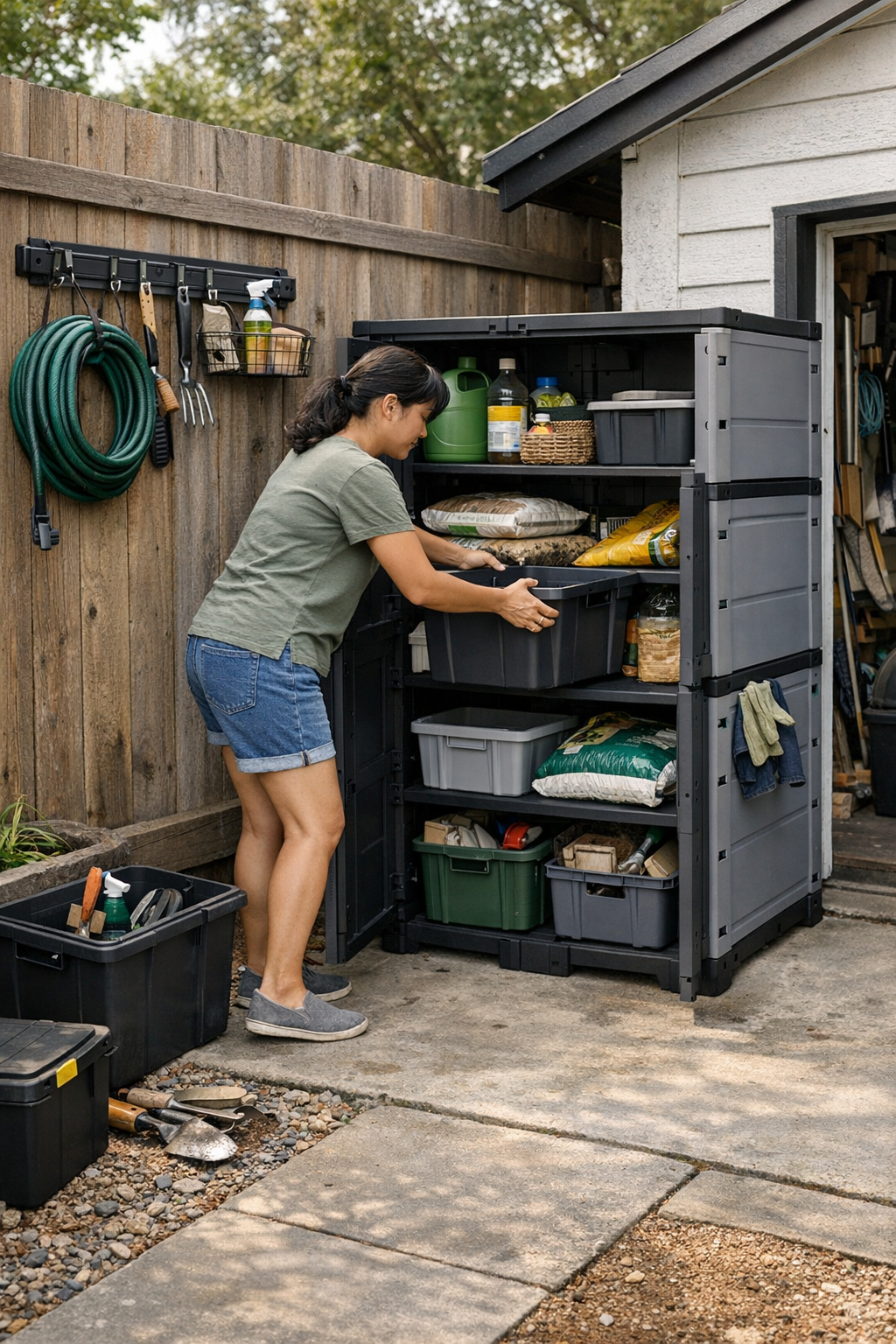
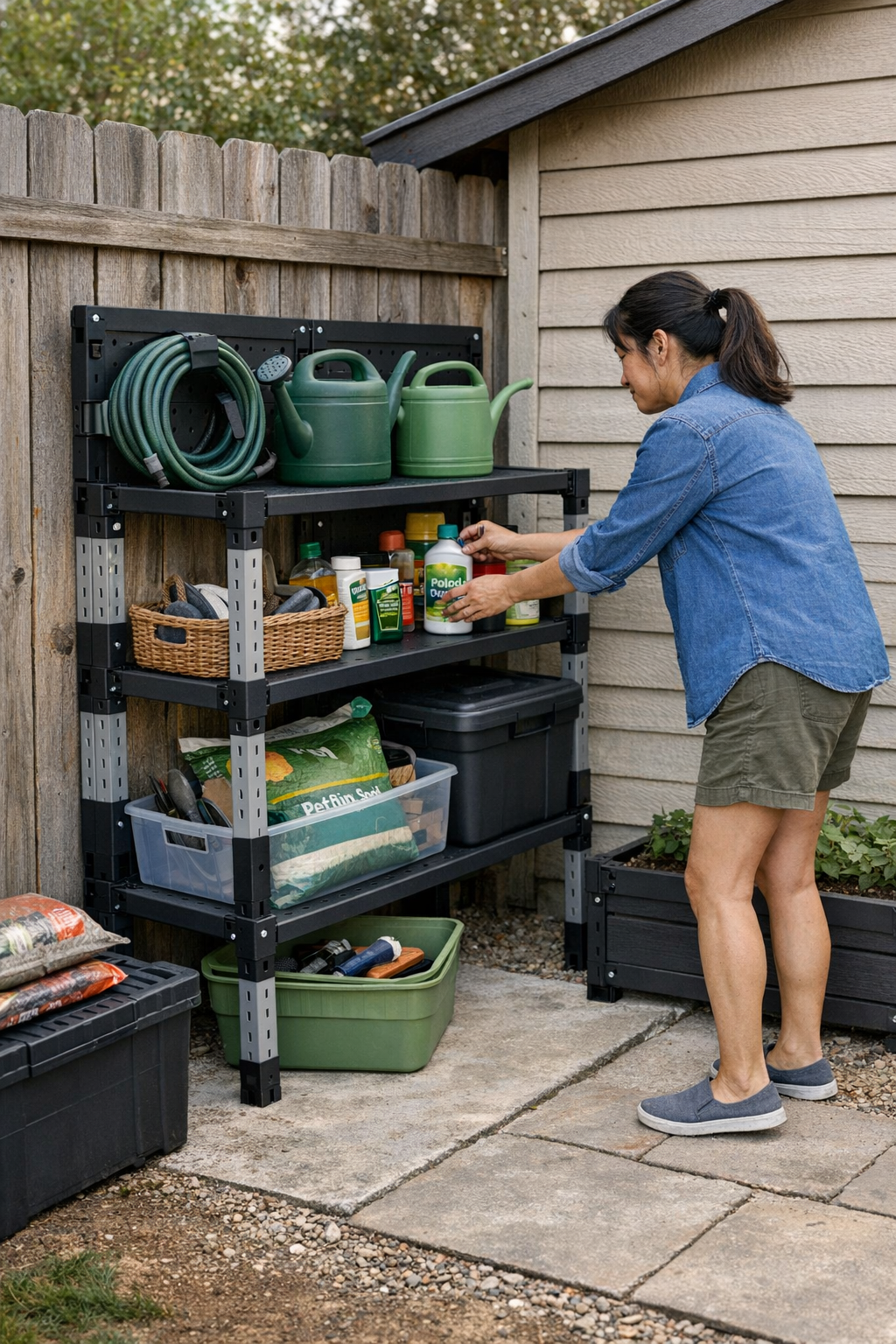
    No outdoor storage system hides its flaws for long. Give it six weeks. That neat shed, deck box, or wall rack that looked dialed-in at first? It becomes a maze of “just for now” drop-offs—folding chairs wedged in back corners, soccer balls rolling under benches, tools exiled to random spots when their hooks are buried. What seems organized on setup day gets crowded, clumsy, and unpredictable after a dozen returns and rushed cleanups. That’s when you notice: is this setup helping you move through the space, or is it quietly tripping you up again and again?

    Blocked Paths and Awkward Returns: Where Tidy Turns Tangled

    An outdoor storage system seems fine—until your normal routine starts to push its limits. Picture the back gate or side-yard squeeze: after using the hedge trimmer, you try to put it away but a ladder is now blocking the shed door, so you lean the trimmer behind a planter “just until tomorrow.” Or you grab a soccer net for Saturday practice, only to bump bikes and bags that migrated into the path. Each workaround leaves behind new clutter, shrinking walkways and stacking frustration, until the whole area feels like an obstacle course built one compromise at a time.

    How Storage Styles Play Out in Real Yard Traffic

    Wall Systems: The Vertical Trap

    Going vertical sounds like a clean fix—until real routines wear grooves in your system. Wall hooks and rails keep gear off the ground at first, but by midseason one hook ends up supporting a tangled hose, two rakes, and a sunhat nobody’s claimed. A kid’s backpack dangles where you need the loppers. Someone raises a row of hooks a few inches “to fit more,” making it just out of reach for everyone else. Getting one thing usually means shuffling three, and the zone closest to the door turns into a clutter magnet or, worse, a dead patch no one uses because the wall is too loaded to approach.

    Standalone Units: The Front-Row Pileup

    Deck boxes and petite sheds promise weatherproof organization, but their “easy access” masks a deeper friction. Soon, the most-used bats, spray bottles, and bike helmets migrate to the top and front. Want a shovel? First move the air pump, then a bag of mulch, then rescue the gloves buried at the bottom. Items used less often drop layers below or vanish to the back wall. The more you cram in, the less you want to reopen the lid—until a storm or party forces a total empty-and-reset session that never lasts as long as you hope.

    Modular and Mobile: Useful Until Everything Drifts

    Bins on wheels, lightweight racks, and stackable crates sound clever—until they lose their home. A rolling bin starts near the sandbox for toys, but by June it’s blocking the barbecue. Tool caddies end up halfway across the patio, waiting for someone to remember where they belong. Over time, mobile pieces blur their boundaries and become obstacles in their own right, snaring feet and collecting whatever doesn’t have a real spot. The “flexible” layout turns into a wandering scatter of storage that interrupts the very routines it was meant to support.

    The Slow Slide: When Clear Zones Turn Complicated

    Real clutter doesn’t appear with a bang—it creeps. A wall system gets overloaded, so someone leans a broom against a stair rail instead. The deck box can’t open all the way for weeks because a folding chair was wedged in fast after a rainstorm. You find yourself stepping around drop-offs that were definitely “temporary” three weekends ago. By the height of summer, what started as tidy zones and walkable paths morphs into a network of workarounds that no one wants to untangle after a long day.

    Is Your Yard Easy to Move Through—or Is It Closing In?

    Every outdoor space shows its true flow in the pinch points. Maybe it’s the skinny side path you use daily, the project corner where supplies build up, or the patio edge where bins and hoses compete for elbow room. How often does someone move something out of the way just to use the grill, mow the edge, or grab a ball? In setups where cleaning up is a constant, small resets keep chaos at bay. But most yards run on project-based resets—an afternoon of order, then a slow collapse as life happens and the system doesn’t absorb the routine. Overflow crowds back in, making tight areas tighter, until it feels easier to dodge the mess than to fix it.

    Real-World Fixes That Actually Help:

    • Respect the ‘front row’ effect: Place bins and boxes so doors and lids still work—even if the bikes migrate up front or bags drop in the way.
    • Anchor modular units: Choose a home base—mark it, edge it, or use ground cues—to stop rolling bins or racks from drifting into walkways.
    • Adjust wall setups for actual reach: Hooks too high or too crowded break flow. Make sure what’s used most often is what’s easiest to grab—without needing a stool.
    • Keep an eye on chronic pinch points: If one area always bottlenecks, rethink its role. Don’t add storage where it interrupts the natural pattern of movement.

    When Storage Units Turn into Barriers

    The real giveaway of a broken outdoor setup? Forced shuffling—moving a bin to open a door, untangling hoses for the hundredth time, or rerouting around gear with no home. Each awkward move cuts into your patience and willingness to keep the space in use. The system packs things away, but at the expense of turning your yard into a zone you avoid, reshuffling the same mess each week instead of moving easily through your day.

    What Works: Storing for Actual Life, Not Just for Show

    Forget showroom perfection—aim for setups that hold up to routines, not just first impressions. The winning systems let you put gear away without a complicated dance, even after a weekend’s worth of mess. They soak up patterns of use—overflow, tool swaps, kid returns—without pushing you into new bottlenecks or sidesteps. If you keep finding yourself half-stalling before you open the storage box or rearranging the same four things at the wall, it’s time to rethink the setup for movement, not just looks.

    See more backyard storage solutions at TidyYard.

  • How Designating a Parking Spot Transforms Mobile Cart Efficiency

    On the day you first roll in a mobile cart, the promise is vivid: flexible storage, instant access, a tool that moves in step with real projects—not just catalog photo shoots. But within a week, reality creeps in. In the garage after a Thursday cleanup, or the workshop in the middle of a project, that “flexible” cart is right there in your way—blocking your one open pathway to the shelf, wedged where you need to walk, or drifting up against the wall so nothing else fits. The upgrade becomes a hassle: a shape-shifting obstruction that follows you around, quietly collecting clutter instead of clearing it.

    Mobility: The Everyday Hassle Hiding in Plain Sight

    Every setup starts with good intentions. You find the perfect spot for the cart—lined up by the workbench, everything within easy reach. For a day or two, it even looks sharp. But then the small hassles pile up. You roll the cart “just for a second” to grab the extension cord, then again to get the cabinet open, then again because it’s blocking the outlet you rely on for chargers. Every move is a detour—one more tug, one more pivot. Suddenly, instead of smooth flow, you’re squeezing past a handle or navigating a tight bend that didn’t exist before the cart arrived.

    What looked modular and open turns into a puzzle with changing pieces. One day the cart blocks the bin where you keep seasonal supplies; the next day, it’s cluttering the only open space you use for large projects. The result? Floor gets crowded, wall space goes to waste, and every “quick reset” becomes a round of reshuffling—moving the cart from trouble spot to trouble spot, with no clear resting place.

    The Slow Creep of Cart Drift

    It’s rarely an obvious disaster. Instead, the problem builds through the week: The cart never quite returns to the “right” place after you use it. A few inches off one day, a bit further the next—before long, it’s stuck in a dead corner collecting drop cloths, cables, and loose hardware. The area behind the wheels turns into a drop zone for whatever you don’t want to deal with now. Wall hooks for your most-used tools? Suddenly harder to reach. Shelves meant to stay open are partially blocked. You reach awkwardly around the cart more and more, while the “flexible” storage quietly becomes the messiest part of your setup.

    Instead of solving clutter, the cart invites stuff to accumulate: a stack of project odds on the lower shelf, bags of parts you forget to put away, gloves draped over the handle. Movement through the area gets choppy. The more you try to “flex” the cart into new spots, the more the rest of your workspace suffers. What you gain in theoretical mobility, you lose in clear routes and functional access.

    Why Assigning a Cart “Home” Changes Everything

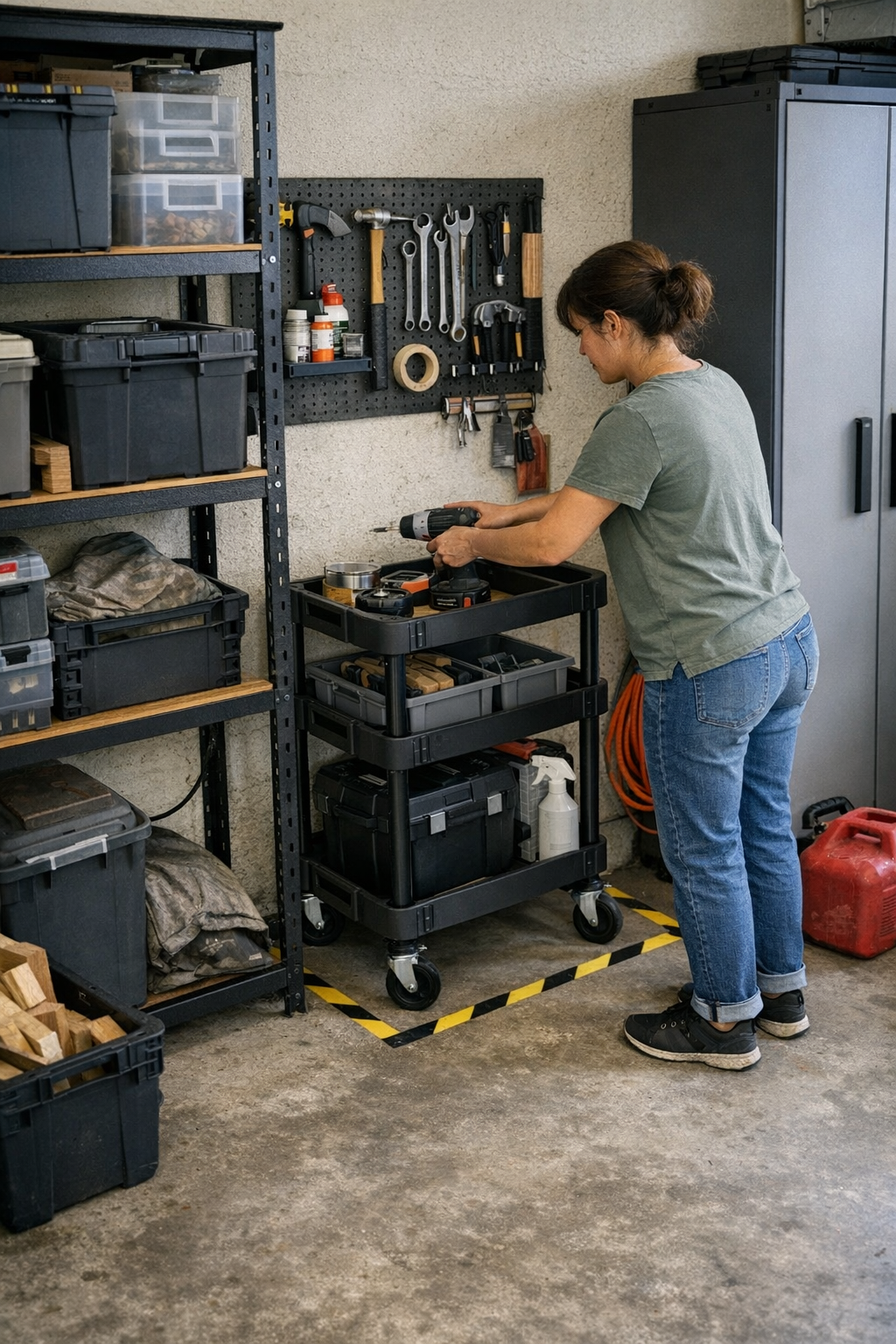
    More shelves or fancy organizers aren’t the answer. The real fix is simple: give the cart an unmistakable home base. In a busy garage, all it took was two strips of high-vis tape in a quiet corner near the main bench. From then on, the cart parked in the same spot every time—no wandering, no crowding, no “where does this go now?” One glance told anyone using the space exactly where to return the cart after grabbing tools, and the habit stuck after a few uses.

    With a visible, fixed dock, resets speed up. Roll the cart back to its taped rectangle, the walking path and cabinet doors stay clear. Power outlets aren’t blocked, and that critical zone behind the cart doesn’t turn into a new landing pad for overflow. You don’t have to think about where the cart belongs—the space tells you, and so the daily routine runs smoother. Even a subtle boundary holds back the chaos, anchoring movement and keeping wall and floor space as open as the layout actually needs.

    Inside a Real Reset: The Before and After

    Picture a weekend cleanup. You finish trimming hedges, stow supplies, wipe down tools. Without a set cart location, the final step is a vague round of musical chairs—push the cart here, then there, just trying not to block the door or scrape the car. By the time you’re done, it’s crammed into an awkward “good enough” niche, blocking one or two things you’ll need by Monday. Tools linger in the cart for days simply because returning them means maneuvering around a lopsided, out-of-place cart.

    Introduce a fixed parking zone, and the reset becomes almost automatic. The cart slides into its marked space—never blocking traffic, always giving you full use of walls and floor. Within a week, the routine is easier: park, unload, move on. No wasted minutes hunting for an open patch. No accidental buildup in corners. The space stays clear for spontaneous projects and the inevitable “I need this out, right now” moments.

    Small Adjustments That Actually Stick

    The beauty of a cart home is in how the benefit builds. It doesn’t require a perfect cart or a brand-new layout. What you’re preserving is not just order, but usable space: overflow drops off, cabinet handles are accessible, and the sense that your setup “almost works” gives way to routines that actually run cleanly. You spend more time working, less time shuffling, and fewer moments annoyed at what “should” be easy. And the fix is visible—a humble strip of tape is all it takes to reset the habit and keep your workspace working for you, not against you.

    The Payoff: Flow Returns, Cart Hassle Disappears

    After a month, trying to work with a wandering cart feels unimaginable. The open floor stays open. Tools come off the wall without an obstacle in the way. The cart is no longer a magnet for overflow or a giant trip hazard. Instead, it’s synced to your pattern: always where you expect, never in the way, always supporting—not sabotaging—your daily jobs. The routine gets easier not because you bought another storage solution, but because you anchored the one you have where it belongs.

    This isn’t a showroom transformation. It’s a real, repeatable improvement—the kind that makes everything else in your setup finally fit together.

    http://stacknest.myshopify.com

  • Why Cold Weather Drains Tool Batteries and Hurts Job Quality

    No part of winter work tests your patience like a cordless tool sputtering because its battery froze up before lunch. The weather shifts, and suddenly, a job you could fly through in September turns into a stubborn grind. It hits out of nowhere: your drill chews through the first few fasteners like normal, then starts to wheeze and stall out. The circular saw that gave you perfect lines all week now jerks and splinters across the plywood. Power isn’t just down—it’s unpredictable, ruining your momentum and, more quietly, chipping away at the quality you thought you could count on.

    Cold Brings Out the Weak Spots in Every “Good” Battery

    The moment that temperature drops below 5°C (41°F), batteries that felt strong on the bench start putting up a fight onsite. You can load up the van with fully charged packs, but by coffee break they feel sluggish—drivers hesitate, saws whine under load, and you’re subtly pushing harder just to keep pace. At first, the difference is nearly invisible: a little lag on the trigger, a bit more chatter at the start of a cut. Ignore it, and it compounds—suddenly, your 16th-foot cut is wandering, and the board’s edge refuses to close up crisp. The time you lose isn’t just swapping batteries; it’s fighting the material and tidying up every miss.

    The Real Reason: Tool Batteries Don’t Just Drain, They Shut Down

    Cold snaps don’t just sap battery runtime—they choke off current, reducing both voltage and torque. A pack that gave you half an hour of consistent drilling indoors barely lasts half as long outside, and by cut seven or eight you’re compensating for dull power, not dull blades. It’s the details that slip: screws set proud, bit tips drift off mark, finish passes with the sander leave patches of raised grain instead of smoothing things right. Once you start noticing uneven sawdust clumps, or sanding dust balling up instead of swirling away, you’re no longer in control—the tool is fighting against itself.

    How to Read the Warning Signs in the Middle of the Job

    Listen for that mechanical groan or sudden change in pitch. You’ll feel the drag on a saw ripping dense plywood, or a drill bit that sticks halfway through a ledger as if it hit buried steel. Cold batteries make familiar tools feel foreign: you push harder, wrist fatigue creeps in, and tools vibrate instead of gliding.

    What Slips Through the Cracks: Quality and Control Go First

    It’s easy to write off a battery change as a fix, but every time you swap in a cold spare, you quietly lower your standards:

    • Cut lines fray and jump. A cold saw battery wobbles on sheet goods, so you’re left sanding out bumps or pulling a cut line back with a hand saw.
    • Fastening turns into a fight. Instead of a clean set, screws stall halfway, or you end up burring heads instead of seating flush on the first pull.
    • Sanding becomes rework, not finish. You end up running extra passes—not for a smoother finish, but just to fix new roughness introduced by tired power.

    Real Jobsite Choices: Work Smarter or Waste Your Shift

    Anyone who’s run deck ledger holes in biting air knows the drill: the bit glides at first, then stutters. You reach for that backup pack—except it’s been riding in the open bed since dawn. Suddenly, every screw needs an extra beat, and instead of a satisfying seat, you’re stopping after every third fastener to draw the bit back out. No loud breakdown—just lost efficiency, shoulder ache, and mounting irritation.

    On another site, I kept two identical 18V packs—one spent the night thawed on the dash, the other slept in the back of a metal toolbox. For most of the morning, work ran smooth. But late shift, I reached for the toolbox pack: the driver lagged mid-sheet, the saw wanted two hands to push, and blade drift stepped in. Nothing failed outright, but every cut needed intervention, and the board edges fluffed instead of closing clean. By the time I noticed, my rework pile grew—more sanding blocks, more wasted plywood, and sore hands from correcting things twice.

    The Hidden Drain: Compounding Fatigue and Wasted Motion

    The worst part? You barely feel the change happening. Quality drops in increments: sanding here, touch up there, and those “quick” tool resets pile up. Tool fatigue isn’t just battery swaps—it’s you making up the difference, every single time power fades just enough to slow work but not trigger a full stop.

    Winter Habits That Actually Save Your Workday

    There’s no secret sauce, but disciplined routines make a world of difference. The top crews manage batteries with intention—warming spares in the cab, swapping them every dozen cuts or so, and never leaving a pack to die out in freezing metal. Simple moves, like insulated battery bags, can keep you cutting straight and driving home every fastener with confidence instead of hope.

    How much does it add up? Swapping in only warm batteries—no matter how minor the difference felt at first—halved the number of sanding passes and kept the job on pace during a two-week cold front. The proof wasn’t just battery run time. It was in better fit-ups, smoother assembly, and less cleanup per sheet or board. The job simply moved forward—without the creeping slowdown and frustration cold packs bring.

    The One Golden Rule: Warm Packs Before Charging

    If you remember nothing else: always warm up cold batteries before recharging them. Charging a frozen pack scars cell life, delivering less run time with every cycle and cutting months off your batteries’ lifespan. Even ten minutes in a heated cab before plugging in can save you rotations—and money—down the line.

    Measure Progress by Results, Not Just Power Icons

    Too many jobs go sideways because crews rely on battery gauges, not real cut and drill quality. Your project tells the truth: more kicked-up edges, off-center drives, or missed screw depths signal it’s time to rotate, not just recharge. Recognize the signs early. **Stay a step ahead of winter drag, and your tools will deliver the same sharp edges, tight seams, and smooth surfaces you demand in July.** It’s not about babying your kit—it’s about defending your workflow from invisible slowdowns that never make it on the time sheet but always show in the finish work.

    Visit Gumboll for real-world jobsite tools, batteries, and accessories that work as hard as you do.

  • How Smart Adapter Placement Transforms Your Desk Workflow

    An exposed adapter does more than look messy—it physically slows you down, crowds your desk, and turns each return into an unnecessary reset. If your workday starts by shoving aside power bricks just to make space for your laptop or untangling charger cables before you even type, you know the friction isn’t just cosmetic. Every morning minute spent tracing the right cord, brushing against a plugged-in adapter, or propping a notebook between plugs is a visible tax on focus and flow. Messy adapters erode desk real estate, interrupt momentum, and make “resetting” your workspace a repeated chore instead of a routine.

    Why hiding adapters works—until it doesn’t

    Pushing every charger out of sight—wedged under the desk, sealed in a drawer—looks tidy at a glance. That “staged” workspace helps only until actual work starts. Need to connect headphones before a call? You’re reaching deep under, searching by feel. Swapping from notebook to tablet? The neatly hidden charger now means pausing and fumbling through your setup. The trap is clear: what looks organized quickly collapses into slow, awkward movement when device needs shift by the hour.

    The desk that looks finished often falls apart under real demands. As soon as the first unexpected power warning pops up or a guest asks to plug in, you hit the downside of concealment: every change becomes a minor obstacle—more steps, awkward reach, less flow. The layout built for display slows you down in real time.

    Where cable management setups really show their strengths—and weaknesses

    Repeated use exposes where cable setups hold up—and where they fail. On a tight workstation, where the surface only barely fits your main devices, one rigid cord or misplaced charger can derail your workflow. Adapters tucked into a cable box or under-desk organizer seem invisible—until you’re crawling under for access, or pulling trays out just to swap a plug. The desk looks uncluttered, but the actual working routine feels clipped and indirect.

    You’ll spot the tension at these points:

    • Mid-meeting, reaching for a headset charger behind a monitor, breaking focus to fish for cables.
    • Trying to plug in a weirdly sized tablet brick, only to realize reaching it means shifting half your setup or pulling out a bin.
    • Clearing space for handwritten notes, but the last few inches are blocked by a loose adapter always slipping into your writing area.

    Each time you’re yanked out of flow—a cable snags your arm, a power brick bumps the edge of your notebook, or you need two hands just to reach a socket—it’s the “organized” cable fix getting in your way. Solutions meant for tidiness mutate into new interruptions.

    What changed my return-to-desk habit: A real-world tweak

    Switching from a wall-mounted power strip to a slim, under-desk cable box along the work edge did what no decorative tray or cord wrap managed. The practical gain: almost 16 centimeters of rear-edge desk space—enough for a full-sized notebook, not just a tangle-free visual. But the true upgrade was behavioral: cables routed through clean slots let me plug devices in blind. No shifting gear, no tracing through a cable maze. The power bricks hid in reach—not buried. A quick glance confirmed no dust trap building up, and end-of-session reset time dropped off. Not perfect, but infinitely less excuse for ignoring cable mess as cycles repeat.

    The thin line between access and order

    Pushing every cord and brick completely out of sight is a short path to awkward workflow. Storage boxes screwed shut under panels or tucked behind drawers achieve impressive invisibility—and almost guarantee frustration the first time you need a charger or have to help a visitor plug in. Rigid “tidy by hiding” setups drain speed from day-to-day use more quickly than they save visual peace.

    The only cable setups that last are built for change and reach—not just for appearances. Open trays, simple cable boxes, and covers you can shift without tools let you add or move chargers as gear requirements flex. That means a small shift in routine—new tablet, guest phone, device swap—doesn’t break the whole system or invite cable creep back across your workspace.

    Real-world FAQ: Common adapter placement questions

    Where should adapters go to keep the desk easy to use every day?

    Place them in a cable box or tray just behind or beneath your primary work edge—hidden from sight, but fast to reach from a seated position. Keep charging tails close to your main working area (where plugging in happens most), and stash less-used spares somewhere tidy but never so deep you forget them. The working zone and the charger zone should overlap just enough to avoid daily reacharounds.

    Is complete concealment worth the trouble?

    Full hideaways force you to break rhythm every time you need to charge or swap. If you cycle through devices—phone, mouse, tablet, headset—every day, prioritize open trays or easy-access boxes. Looks matter, but practical reach and swap speed matter more if equipment switches more than once a week.

    Why not just leave all adapters visible for convenience?

    Leaving bricks exposed adds dust, blocks your best writing or sketching zones, and quickly attracts visual noise. What starts empty at 8 a.m. clutters itself by midday, burying everything faster and making fast resets harder. “Convenience” is brief; entropy is relentless.

    How it all adds up at the end of a work day

    True workstation order isn’t about hiding every cable—it’s about coming back to a desk that’s ready for work, not for untangling or shuffling. If a setup forces the same annoying adjustment every cycle—plugging in, swapping, clearing free space, shifting position—it hasn’t solved the core problem. An “organized” system that slows basic actions is still costing you minutes and effort.

    The best cable structures—enough concealment to quiet the view, enough access to let you move—restore desk momentum, not just appearance. The work becomes simpler, not just neater. When interruptions fade, focus returns, and the difference is felt in every task—long before anyone sees it. The day ends with a desk that feels ready, not just reset.

    Explore the full WorkBasic collection

  • Maintaining Clear Visibility with Open Pantry Shelving Systems

    Pantry shelves look organized—right up until real use starts testing them. It’s one thing seeing every label lined up on day one. But a week later, that order quietly unravels. Instead of quick snack grabs and speedy dinner prep, you’re reaching past double-stacked cans, sliding items sideways, and losing track of backup staples behind a front row that never stays put. Visible order fades, not in a dramatic mess, but by turning simple retrieval into hunt-and-shuffle routine. The zone built for easy access now hides what you need and makes each return trip a little more awkward.

    The Trouble With Shelves That Seem Well-Sized—But Aren’t

    Extra-deep shelves sound efficient, but daily life exposes their weak spots fast. With every restock or hurried search, items drift into rows two and three—sometimes just for “later,” but they never move back. Cans migrate behind boxes, labels vanish, and long jars tilt sideways where you can’t spot them until supplies run low. The shelf looks full, but your actual workflow slows down. Nothing is ever truly at hand; every retrieval means nudging, shuffling, or emptying part of a row to see if you’re out of what you need.

    Real-World Scenes: Where Friction Sneaks In

    Reaching Once, Grabbing Twice

    You’re mid-recipe, digging for cumin—two jars in, you still haven’t found it. Or you check behind cereal for a backup box, only to knock over tea tins stacked “just for now.” Every extra reach interrupts your flow, and shared kitchens only magnify the chaos: one rushed return and categories blend, with heavy rotation between “easy to grab” and “out of sight, out of mind.” At that point, even a quick check turns into miniature inventory—one more step between you and what you actually need.

    The Overflow Trap: When Extra Space Works Against You

    Shelves without clear boundaries turn into landing pads for every homeless jar, bag, or odd grocery find. Morning order dissolves by evening, as backup rice, snack packs, and random condiments wedge against the end of each row. Overflow then blocks daily-use items, erasing any chance of a simple scan. Instead of shelves showing you what’s missing, they absorb excess—making finding, refilling, or even remembering pantry stock harder than organizing ever intended.

    Room to Walk—Or Not

    When shelves stretch deep or fill to the edge, foot traffic pays the price: cereal boxes edge out into the walkway, bulky sauces take over floor corners, and surplus bottles block base cabinets. Even standing in front of the pantry feels tighter—every restock or retrieval demands shuffling around obstacles that start as tidy overflow but end up as physical roadblocks. Over time, storage “capacity” becomes a slow-down, not a solution, turning a big pantry into a series of bottlenecks.

    Inside Shelves: The Difference Between Photo-Ready and Functional

    A calm, orderly shelf snaps well, but real use exposes every shortcut. Early on, it’s easy to promise rows and categories. After a week, the grab-and-go routine wins: tall bottles end up sideways, boxes migrate, and the quick restage rarely lasts more than a few days. The problem isn’t self-discipline, but how structure encourages (or blocks) better habits. If stacking and hiding solve the layout puzzle faster than maintaining one row, friction takes over and resets become obligatory—never automatic.

    How Fewer, Shallower Shelves Changed the Reset Routine

    Experience points to one hard-earned rule: no pantry shelf should be deeper than your single largest item. When every container fronts a single row—never behind, never under—labels stay visible and every product is truly reachable. Cutting shelf count to fit just what you use most at the right height prevents piles and keeps overflow from hijacking daily routine. A shelf that only fits one can per slot never invites a hidden backlog or jammed sideways jars: what you use leads, what’s backup waits out of the way, and resets take seconds, not rearrangements. If you keep moving things to reach an ingredient, the zone’s structure is nudging you to reset it the hard way. Simpler, forward-facing shelf lines survive family use and late-night returns—without losing track of anything in the back.

    Simple Tweaks for Sustainable Order

    • Match shelf depth to your biggest item: If you can’t see every label in one glance, your shelf is too deep for use, not too shallow for capacity.
    • Lose the “catch-all” zone: Carve out clear boundaries for each category—overflow zones invite clutter faster than you can sort it out.
    • Let workflow guide layout: Keep daily-use foods at eye level and within a single reach. High or low spaces? Save those for sealed bulk extras, not displaced crowd from layers that don’t fit real patterns.
    • Reset by scanning, not reshuffling: If a quick sweep of the shelf doesn’t instantly reveal what’s missing, tighten the plan. The need to reshuffle is a signal, not a solution.

    When Looks and Real Use Finally Line Up

    The best pantry shelves are built for use, not display. Rows, depths, and boundaries that match daily patterns keep storage calm—and keep you moving. Zones that resist drift and overflow support quick scans and faster resets. The payoff? Fewer missed spots, fewer retrieval games, and more time using your kitchen, not searching through it.

    Find more practical storage setups at Gridry.