
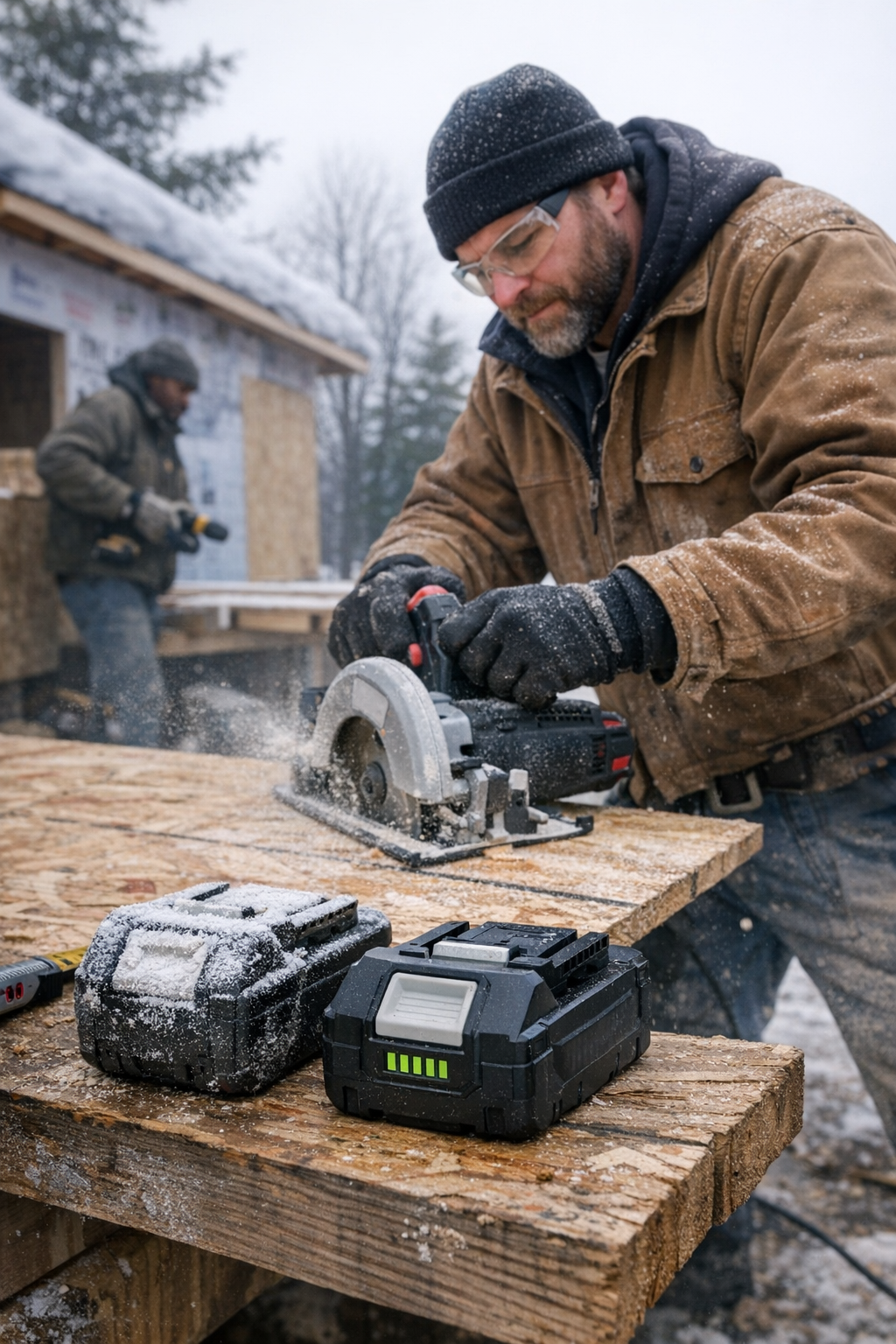
No part of winter work tests your patience like a cordless tool sputtering because its battery froze up before lunch. The weather shifts, and suddenly, a job you could fly through in September turns into a stubborn grind. It hits out of nowhere: your drill chews through the first few fasteners like normal, then starts to wheeze and stall out. The circular saw that gave you perfect lines all week now jerks and splinters across the plywood. Power isn’t just down—it’s unpredictable, ruining your momentum and, more quietly, chipping away at the quality you thought you could count on.
Cold Brings Out the Weak Spots in Every “Good” Battery
The moment that temperature drops below 5°C (41°F), batteries that felt strong on the bench start putting up a fight onsite. You can load up the van with fully charged packs, but by coffee break they feel sluggish—drivers hesitate, saws whine under load, and you’re subtly pushing harder just to keep pace. At first, the difference is nearly invisible: a little lag on the trigger, a bit more chatter at the start of a cut. Ignore it, and it compounds—suddenly, your 16th-foot cut is wandering, and the board’s edge refuses to close up crisp. The time you lose isn’t just swapping batteries; it’s fighting the material and tidying up every miss.
The Real Reason: Tool Batteries Don’t Just Drain, They Shut Down
Cold snaps don’t just sap battery runtime—they choke off current, reducing both voltage and torque. A pack that gave you half an hour of consistent drilling indoors barely lasts half as long outside, and by cut seven or eight you’re compensating for dull power, not dull blades. It’s the details that slip: screws set proud, bit tips drift off mark, finish passes with the sander leave patches of raised grain instead of smoothing things right. Once you start noticing uneven sawdust clumps, or sanding dust balling up instead of swirling away, you’re no longer in control—the tool is fighting against itself.
How to Read the Warning Signs in the Middle of the Job
Listen for that mechanical groan or sudden change in pitch. You’ll feel the drag on a saw ripping dense plywood, or a drill bit that sticks halfway through a ledger as if it hit buried steel. Cold batteries make familiar tools feel foreign: you push harder, wrist fatigue creeps in, and tools vibrate instead of gliding.
What Slips Through the Cracks: Quality and Control Go First
It’s easy to write off a battery change as a fix, but every time you swap in a cold spare, you quietly lower your standards:
- Cut lines fray and jump. A cold saw battery wobbles on sheet goods, so you’re left sanding out bumps or pulling a cut line back with a hand saw.
- Fastening turns into a fight. Instead of a clean set, screws stall halfway, or you end up burring heads instead of seating flush on the first pull.
- Sanding becomes rework, not finish. You end up running extra passes—not for a smoother finish, but just to fix new roughness introduced by tired power.
Real Jobsite Choices: Work Smarter or Waste Your Shift
Anyone who’s run deck ledger holes in biting air knows the drill: the bit glides at first, then stutters. You reach for that backup pack—except it’s been riding in the open bed since dawn. Suddenly, every screw needs an extra beat, and instead of a satisfying seat, you’re stopping after every third fastener to draw the bit back out. No loud breakdown—just lost efficiency, shoulder ache, and mounting irritation.
On another site, I kept two identical 18V packs—one spent the night thawed on the dash, the other slept in the back of a metal toolbox. For most of the morning, work ran smooth. But late shift, I reached for the toolbox pack: the driver lagged mid-sheet, the saw wanted two hands to push, and blade drift stepped in. Nothing failed outright, but every cut needed intervention, and the board edges fluffed instead of closing clean. By the time I noticed, my rework pile grew—more sanding blocks, more wasted plywood, and sore hands from correcting things twice.
The Hidden Drain: Compounding Fatigue and Wasted Motion
The worst part? You barely feel the change happening. Quality drops in increments: sanding here, touch up there, and those “quick” tool resets pile up. Tool fatigue isn’t just battery swaps—it’s you making up the difference, every single time power fades just enough to slow work but not trigger a full stop.
Winter Habits That Actually Save Your Workday
There’s no secret sauce, but disciplined routines make a world of difference. The top crews manage batteries with intention—warming spares in the cab, swapping them every dozen cuts or so, and never leaving a pack to die out in freezing metal. Simple moves, like insulated battery bags, can keep you cutting straight and driving home every fastener with confidence instead of hope.
How much does it add up? Swapping in only warm batteries—no matter how minor the difference felt at first—halved the number of sanding passes and kept the job on pace during a two-week cold front. The proof wasn’t just battery run time. It was in better fit-ups, smoother assembly, and less cleanup per sheet or board. The job simply moved forward—without the creeping slowdown and frustration cold packs bring.
The One Golden Rule: Warm Packs Before Charging
If you remember nothing else: always warm up cold batteries before recharging them. Charging a frozen pack scars cell life, delivering less run time with every cycle and cutting months off your batteries’ lifespan. Even ten minutes in a heated cab before plugging in can save you rotations—and money—down the line.
Measure Progress by Results, Not Just Power Icons
Too many jobs go sideways because crews rely on battery gauges, not real cut and drill quality. Your project tells the truth: more kicked-up edges, off-center drives, or missed screw depths signal it’s time to rotate, not just recharge. Recognize the signs early. **Stay a step ahead of winter drag, and your tools will deliver the same sharp edges, tight seams, and smooth surfaces you demand in July.** It’s not about babying your kit—it’s about defending your workflow from invisible slowdowns that never make it on the time sheet but always show in the finish work.
Visit Gumboll for real-world jobsite tools, batteries, and accessories that work as hard as you do.