
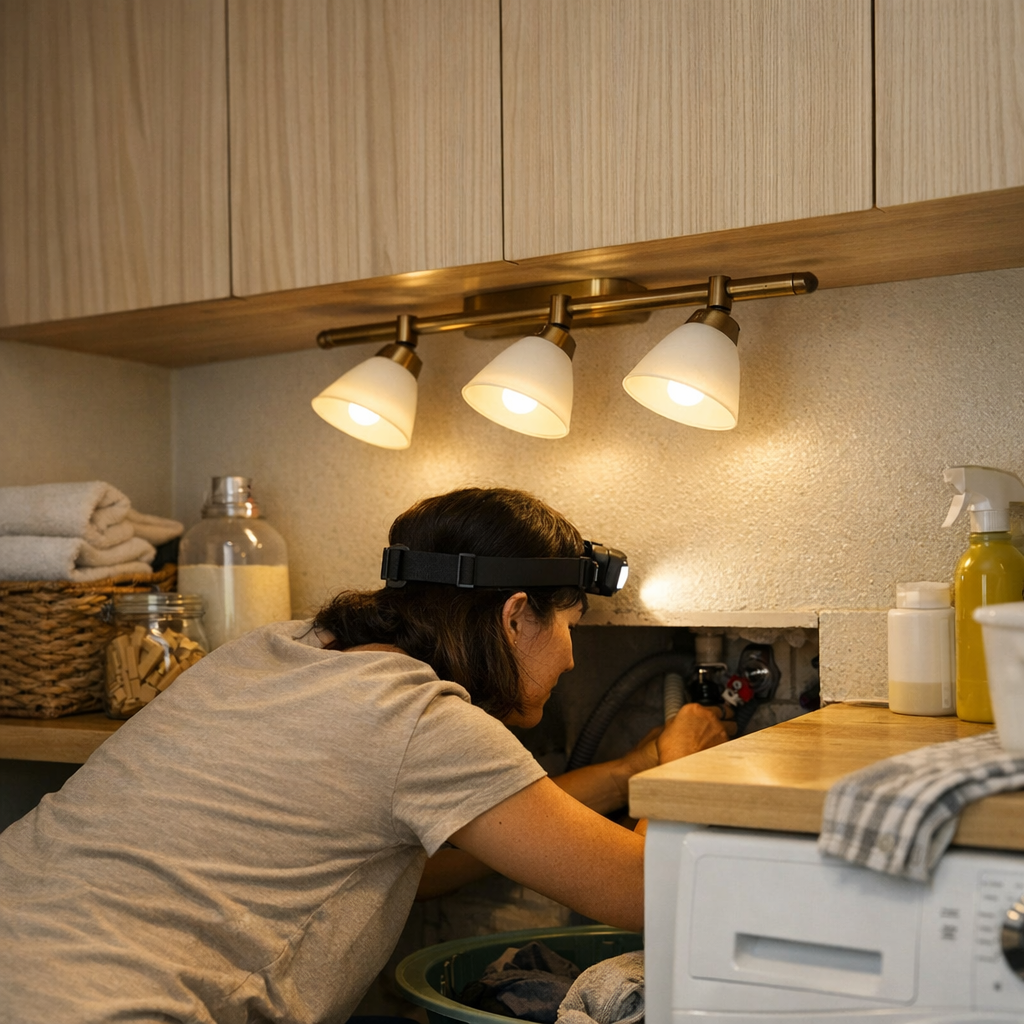
A room can look bright and still make every routine harder. Flush mount ceiling lights, semi-flush fixtures, and wall sconces all promise “full-room” illumination—until you’re hunting for a lost washer under the cabinet or fighting a shadowed corner at the end of the hallway. The real test isn’t how a fixture looks the first day; it’s whether you still need to drag your phone flashlight out after the third time a glare hits your eyes just as you lean over the work surface. That’s when the failings of ceiling-only setups and even new wall lights become obvious: glare kicks up near mirrors, corners stay dim, and a bright room still interrupts the flow of basic tasks.
When Everyday Tasks Reveal the Gap in “Even” Lighting
A routine week doesn’t test your fixtures when you’re standing in the middle of the room—it’s when you’re down low by the washing machine, tracing a pipe in a bathroom corner, or stretching across a kitchen run. The first day, a flush-mount ceiling panel looks like it covers every inch. But try wiping under a cabinet edge or fixing a bolt near the wall, and you’ll find yourself shifting for a better angle, only to be handed more shadows or sharp glare exactly where you need clarity. That’s when the showy spread of a ceiling fixture collapses into work-arresting guesswork and you start keeping a flashlight nearby just to finish what should be routine.
Shadowed Corners and Blocked Sightlines: The Quiet Culprits
Rooms rarely feel “too dark” overall—it’s the steady friction at the edges that wears you out. A kitchen looks brilliant standing at the doorway, but the counter’s front edge vanishes once you lean in with a cutting board. A bathroom vanity’s twin sconces balance the mirror…until you turn sideways and one cheek disappears into uneven shadow. Hallway lights spread outward but leave the moulding along the floor pale and the corners cold. Each time your body, a shelf, or a tool blocks the beam, you get a visible streak of uncertainty—a line between what’s merely lit and what’s actually usable when your routine moves off center.
The Reality of Repeated Use: Why Fixed Fixtures Hit a Wall
The trouble isn’t a single dark spot—it’s the way every small flaw stacks up. Sorting laundry under shallow cabinets exposes the same blind angle, week after week. Each shadow means a slower search, a missed stain, a pause to aim your phone light. Chores stall out mid-step not because you lack a fixture, but because the placement was designed for an empty room, not an occupied task. As soon as natural light drops or your hand breaks that fixed beam, you move from “looks bright” to “routine interrupted.” Few rooms feel balanced for both appearance and movement.
Movement Makes All the Difference
Static lights force you to fit their narrow conditions. Step toward the edge of a hallway or shift position at a vanity and the lighting changes beneath you: glare at eye-level, sudden shadow on the counter, the stair landing dropping into dimness right as you take the turn. The catch is always location—what’s lit for show is rarely aligned with your hands, your eyes, your next step. That’s why a bright-looking space can leave you redirecting, ducking, or hunting for better light rather than simply finishing the task.
How a Headlamp Breaks the Cycle of Frustration
Adding a headlamp solves what static fixtures cannot reach. Instead of flooding the whole room with more watts, a headlamp tracks your gaze, flipping the usual search for clear light: wherever you need focus—an appliance label, a jammed clamp, a stripe of grime on tile—the light arrives. Suddenly pointing, twisting, and tracing under a cabinet or around a corner stop involving acrobatics or extra gear. The best improvement isn’t cosmetic, but practical—wherever your vision goes, the light keeps pace, and the friction vanishes.
Real Impact in Real Spaces
No overhaul required: placing a headlamp by the laundry machines or on a shelf in the utility zone means usable, targeted light on demand. In repeated use, the differences aren’t about style, but flow and function:
- Instructions on appliances stayed readable, even as evening light failed.
- The back corner under the cabinet—once always missed—became visible through the entire cycle.
- Working with both hands free, tool tips didn’t disappear behind your arm or produce surprise glare.
In one laundry area, this simple fix eliminated the usual pattern: no more groping for dropped bits under a shelf, no more guesswork finding a misplaced stain. Tasks sped up not because the room seemed brighter, but because the old mistakes—missed dirt, lost screws—slipped away.
Why Mobility Matters in Task Lighting
Even “task” fixtures like under-cabinet strips or wall sconces only win if nothing gets in the way. Their impact drops fast if an arm, object, or shelf runs across the beam. That’s the real annoyance of fixed solutions: the angle you need is never quite lined up, and rerouting your routine slows progress. A headlamp breaks that trap by tying the beam to your movement. You get two free hands, zero shadow surprises, and the flexibility to shift without losing clarity—key differences when a job repeats over and over.
Useful Tip: Keep Lighting Tools Where the Friction Is
Place your lighting where frustration repeats. Store your headlamp on a hook inside the utility cabinet, clipped to a shelf by the washer, or right above the hallway kink where shadows ambush your eyes. Don’t bury the solution; put it at the heart of the problem zone, right where the edge of routine blurs into inconvenience.
The Practical Payoff: Fewer Mistakes, Smoother Routines
This is not just about adding brightness—it’s about clearing invisible obstacles that ceiling and wall setups leave behind. With mobile, targeted lighting, time spent readjusting, double-checking, or retracing steps drops fast. The basement corner and laundry cupboard may never glow like a catalog photo, but on a weeknight, the change is obvious in what goes right, not how things look. When friction drops, tasks actually finish, and the space finally keeps up with the pace you need.
For real solutions to the most persistent indoor lighting annoyances, see what works in actual homes at LightHelper.