Category: Yard & Utility

  • Why Cardboard Boxes Fail in Humid Entryways and What Works Instead

    Cardboard entryway bins look tidy on day one—but by the end of a wet week, their limits are impossible to miss. What seems like a quick, low-cost solution for shoes, jackets, and bags quickly breaks down once daily weather hits your threshold. Boxes soak up moisture, sag under the weight of real routines, and turn from “neat storage” to a slow-moving obstacle that makes coming and going harder. If your hallway starts each week looking decent but midweek finds you stepping around shoes and shoving a crumpled bin back into place, you’re seeing the true friction of a setup that looks organized but doesn’t survive repeat entry and exit.

    Why Cardboard Fails Where Weather Meets Routine

    Cardboard’s surface neatness hides its weakness in real use. Every time rain or snow soaks gear, that humidity seeps in—you won’t spot damage after the first day, but the breakdown adds up. By midweek, box sides are softening, corners curl, and the layout you reset on Sunday gets blurred as shoes start drifting outward, jackets bow the sides, and bag drops split the seams. Instead of holding the zone, the bin starts losing its shape, bleeding mess into the path. What begins as containment becomes a daily negotiation: dodge the shoes sliding out, rescue the bags slumped across the edge, and re-align jackets that no longer stand up. The cost isn’t just appearance—each shift steals time and adds hassle to every entry and exit.

    Reset Friction: The Slow Creep of Disorder

    No matter how you line things up after a weekend reset, a cardboard box can’t withstand the pace of real re-entry. One shaky landing—an armful of groceries dropped fast, a backpack slung on top—and the sides buckle again. Shoes you arranged in a tidy row spill wide as the box can’t hold a straight edge. Push a bag in too quickly, the bottom sags, and you’re forced to waste seconds every morning shuffling everything back, instead of just passing through. In busy homes—shared entryways, kids hustling to catch the bus, a pet weaving around legs—every uncontrolled drift adds up. The promise of a quick reset turns into a cycle of micro-repairs, as “just tidy up a bit” becomes the baseline, not the exception.

    Every arrival means shoving a box back from the walking lane, scooping up shoes that have spread out, or wrestling a jacket back from drooping sideways. Those seconds become expected. Instead of storage easing the route, it continually blocks and slows it—even small resets mean every crossing of the threshold feels heavier than it should.

    Thresholds Are Unforgiving: When Space Fights Back

    Entryways rarely give you room to relax—especially in narrow halls or household drop zones. When space tightens, even a modest cardboard bin that was “out of the way” turns into a hazard. Shoes that once fit inside spill toward the main path. Open the door with hands full and the softened box jams the swing, or you kick a boot into the next room. Overflow isn’t an aesthetic problem—it’s real lost time: pausing with a door propped open in the rain just to shovel stray gear back into the bin, or bumping a bent box every time you grab a coat. Instead of a clear return flow, you get trip hazards, slowdowns, and frustration at the moment you’re supposed to be moving forward.

    Picture it: three days of wet weather and evening routines run late. The storage that started the week as an island of order becomes a cluster of half-dropped gear straddling the bench and walkway. Cardboard is no match—once slumped, it never regains structure. Damp edges go soft, corners fray, and the “quick fix” becomes a reset you resent repeating. No matter how many times you sweep things back, the weak container keeps multiplying mess at the most-used threshold in your home.

    Real-World Improvement: How Durable Bins Change the Pattern

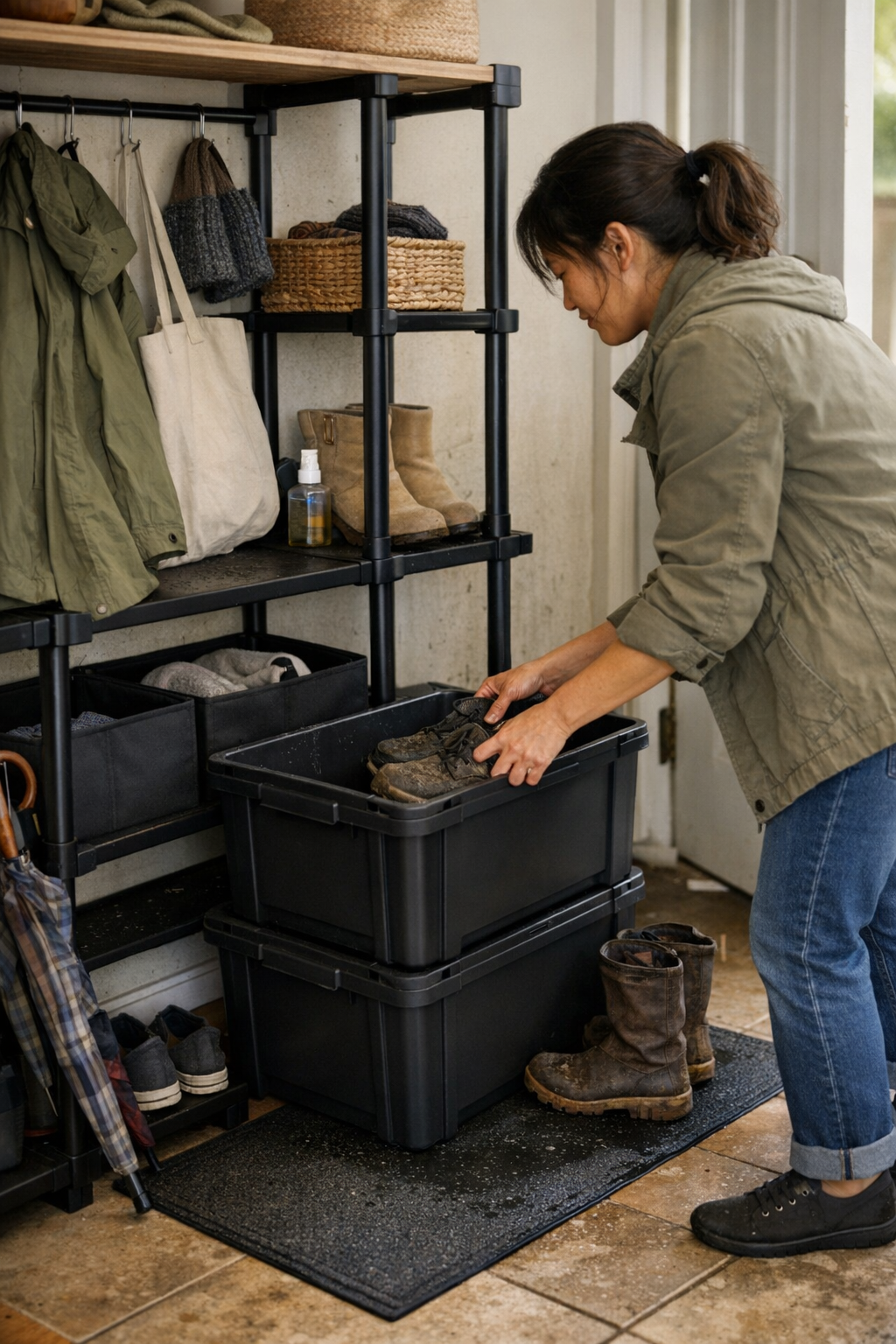
    Swap in a weather-resistant bin and the daily flow changes immediately. Instead of patching up the same softening box, you get a structure that stands up—literally. Drop muddy shoes, hang up a wet jacket, toss in a heavy bag; the container holds its form. The lid shuts with one motion, gear stays where you left it, and the path behind you clears. One hand is enough to move the bin, even after a busy day—no awkward reshuffling, no checking for leaks, no scanning for stray edges or puddles. The difference isn’t cosmetic: durable bins absorb the shock, block moisture from creeping into the rest of your storage, and never fold under the pressure of fast-moving routines.

    When a wet week ends, the only evidence is a quick wipe-down. Mud collects at the bottom, but never seeps through. Edges keep their right angle—no soft collapse, no trail of sloughed-off cardboard. The job of resetting shrinks to what it should be: one clear step, not a multi-part rescue mission. The transition zone holds, instead of demanding your attention at every crossing. Over time, you notice what no cardboard ever achieved—reset is a fast afterthought, not an ongoing obligation every evening.

    Visual Appeal Isn’t Enough: Why Cardboard Is Best Left “Upstairs”

    There’s a place for cardboard bins—out-of-season storage, top-shelf closets, or shallow stash zones where humidity never lingers and access is occasional, not constant. Use them to stack rarely worn hats or categorize light gear in dry bedrooms. At the door, though, cardboard fails the main test: resilience. It looks orderly at first, but can’t stop daily migration, can’t support the heavier stuff, and won’t keep overflow in check when routines speed up or weather turns. For transition spaces, surface neatness collapses under the stress of real movement and moisture—even the tidiest box at the season’s start will become unpredictable, shapeless, and in the way.

    Seeing the Early Warnings: Signals Your Setup Is Breaking Down

    Look for:

    • Box sides bowing out after the first rainstorm, exaggerating the shoe row spill
    • Sneakers tipping or sliding into the path, tightening walk space
    • Base of the box collapsing, making vertical organization impossible
    • Cardboard fibers breaking loose, leaving trails near the drop zone
    • Increasing reset time—more minutes lost each night to restoring minimal order

    Each sign is a flag that your setup is working against you—not with you. These aren’t minor annoyances; they add moments of forced attention at the very point in your day when you need movement, not management.

    The Real Difference: Function That Survives Repetition

    Moving from cardboard to a real weather-ready bin isn’t an upgrade for style—it’s a way to restore routine momentum. The difference is predictable, not just visible: resets become a single, sure movement; the threshold keeps its shape; overflow is contained rather than spread; the floor avoids puddles and trip points. Where you once tiptoed around semi-contained mess, now you move cleanly through the doorway, bags go down without risk, and gear lines up without escaping into the main living area. After weeks of uncooperative weather, the difference compounds: you stop expecting minor repairs every evening, and gain a front zone ready for whatever comes next.

    If you’re stuck in a routine of shuffling bins, squeezing past the drift, or patching up a system that just can’t keep up, you’re not being too picky. You’re noticing signals your entry zone isn’t built to survive actual use.

    See more transition-space storage solutions at Betweenry.
  • Optimizing Outdoor Storage for Small Yards to Keep Paths Clear

    The side yard is finally organized—for about three days. Then real life sets in: the kids drop shovels, the garden gloves never make it back onto hooks, and what started as a clean, clear path morphs into a daily shuffle around bins and tools that never quite land where they should. Small backyards, skinny strips between the house and the fence, that awkward wedge near the garage—these are the spaces that promise relief with each new storage solution, but end up tripping you up, literally, as the routines grind in.

    When Storage Looks Right—Until It Doesn’t

    If you’ve ever lined up storage along a four-foot passage or jammed a corner unit in behind the grill, you know the early rush: containers close, tools have a slot, yard gear finally has “a place.” But by Thursday night, reality bites. The closed bin blocks half the walk. Brooms go in, but boots and gloves multiply beneath. That open rack? You meant for grab-and-go, but now every armload means unjamming a tangle of stray gear piled in where it won’t fall out—until it does.

    The real test isn’t move-in day—it’s the twentieth time you try to return something one-handed while squeezing past someone carrying a planter. By then, the bins inch further from the fence. The rolling cart creeps until you’re side-stepping it every evening. Hooks once perfectly placed turn into unreachable tangles as tools migrate, or worse, just accumulate at floor level. Every return or retrieval means a shuffle, a pause, or a resigned sigh.

    Where “Order” Unravels: Friction in the Routine

    The smooth surface is an illusion. Each small inconvenience builds until the setup itself feels like work. A yard isn’t supposed to trap you in its own storage maze, but containers nudge into walkways, buckets become knee-high hazards, and even a simple task—like stashing the pruners before sunset—means awkward detours or picking your way over bags that were “put aside” days ago.

    Look closer at the usual evening scene: you’re racing dinner, trying to get the hedge trimmers put away. The storage bin, easy on day one, now floats a foot from the wall. The lower rack is crammed, heavy loppers dangle over a pile of soccer balls, and the only space for that stray trowel is already blocked. Squeeze past, nudge a crate, scatter a pile of seed. Tell yourself you’ll get it “reset”—again—but next week, the clogs are back, only a little worse.

    Zones of Flow—or Jam

    In these tight outdoor corners, every foot matters. When hooks are set for adult reach, kids skip them. If bins wiggle loose, they wander into the walk. Floor storage multiplies, collecting whatever anyone can’t deal with in the moment. Share the area with someone else—gardening one minute, fixing bikes the next—and chaos creeps in faster than any “before” photo can suggest.

    Letting these hiccups go means the area turns sloppy, piece by piece. The bucket left out on Saturday is still there a week later, now the default obstacle in an otherwise clear route. The floor space that looked “planned” collapses under hidden piles, and the original purpose—easy movement—gets buried with the mess.

    Real-World Fix: Going Vertical, Staying Mobile

    One side yard—a bare slice, less than four feet across—was a test case in miniature frustration. Floor bins anchored the setup, but the moment anyone needed to move fast or make room, those bins slid, stuck out, or got bypassed. Nothing actually made moving through easier.

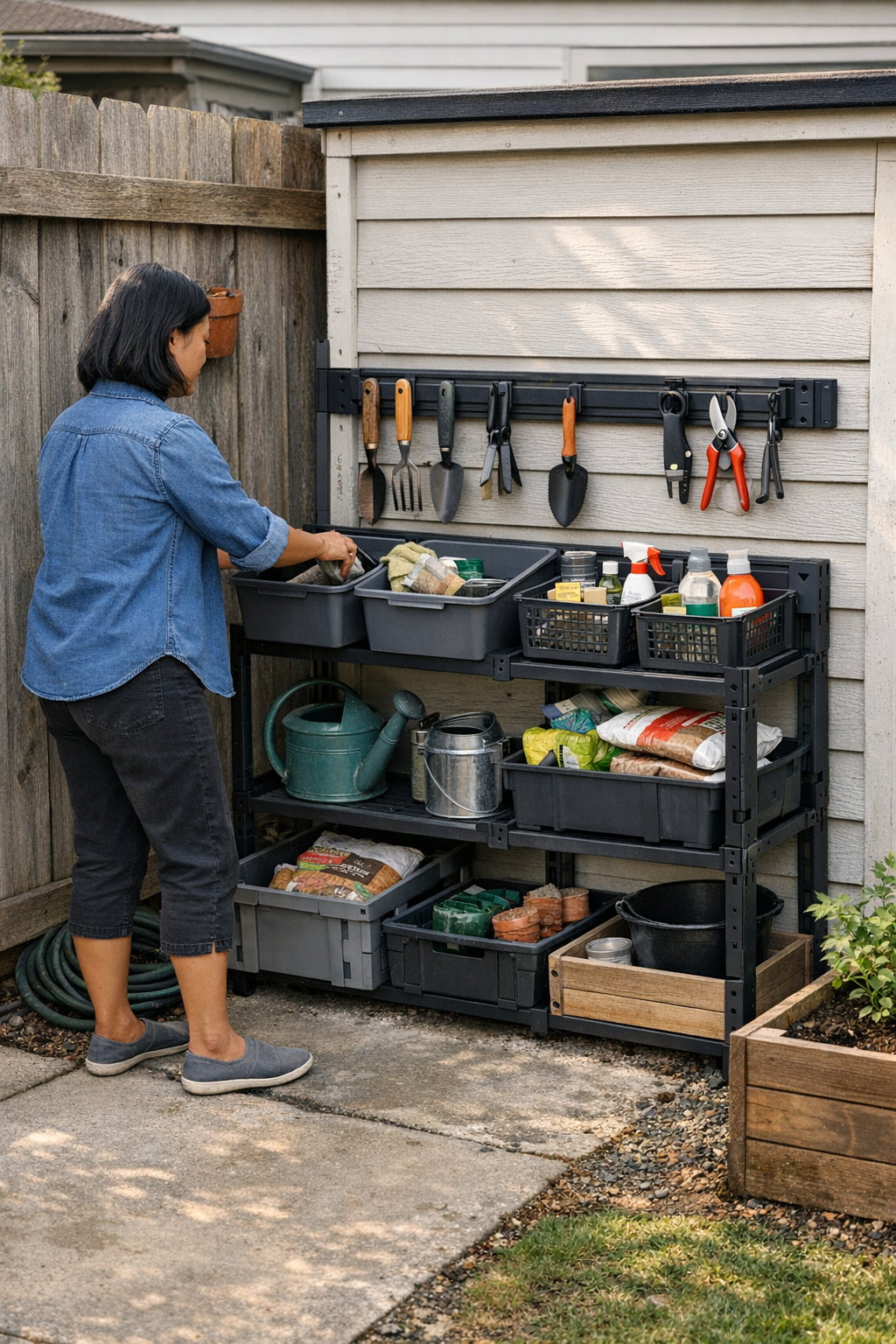
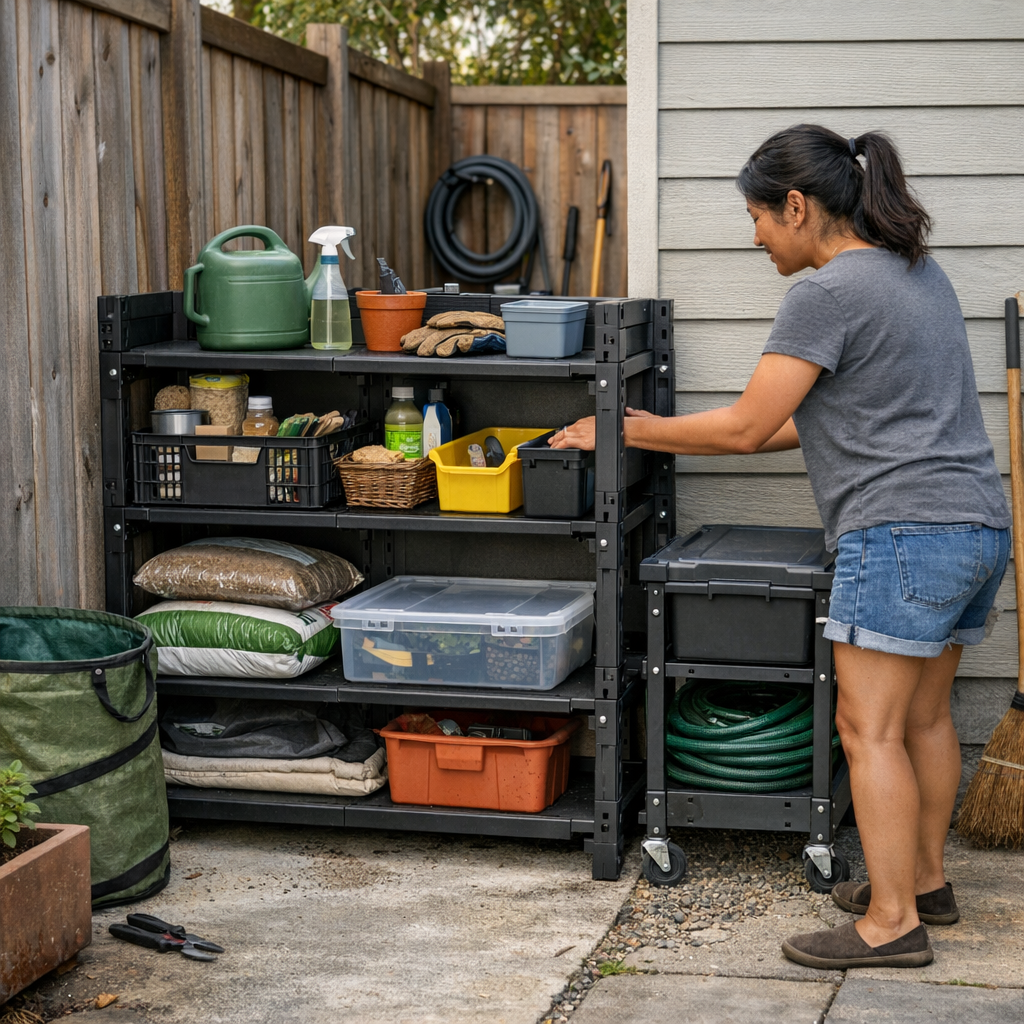
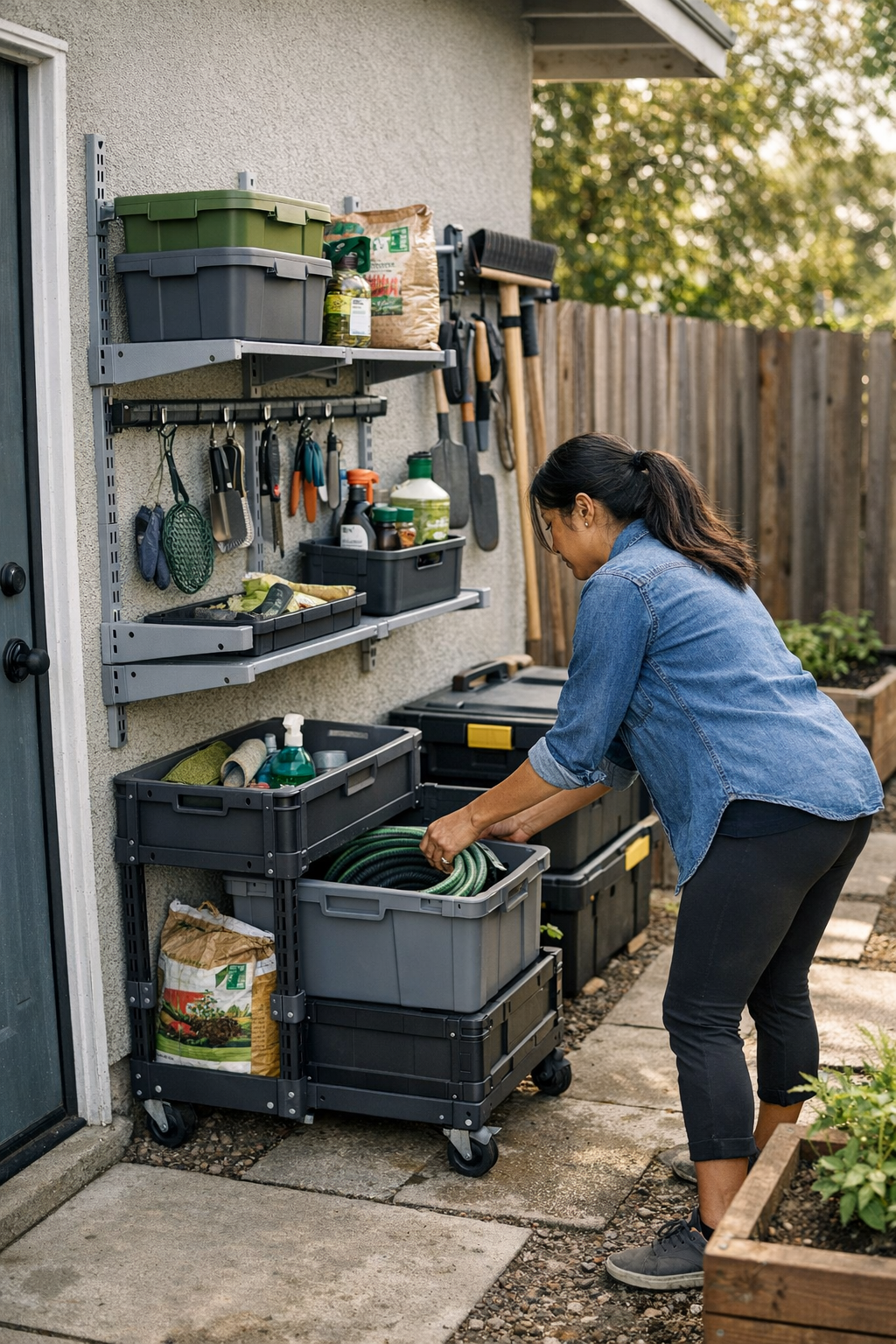
    A split approach worked: low, mobile bins for daily drop-and-grab gear, high, wall-mounted racks for the backup stuff. That cleared a visible running lane—never perfect, but always at least 28 inches wide, even after a surge of activity. You could drag a bin aside with your foot and keep walking. The wall hooks reserved for occasionally-used tools (hedge shears, snow shovels) stayed up and out of reach—still visible so they didn’t get forgotten, but not in the way. Routine resets weren’t heroic efforts; just a nudge here, a push there, and the path reappeared.

    Wall Storage with Actual Payoff

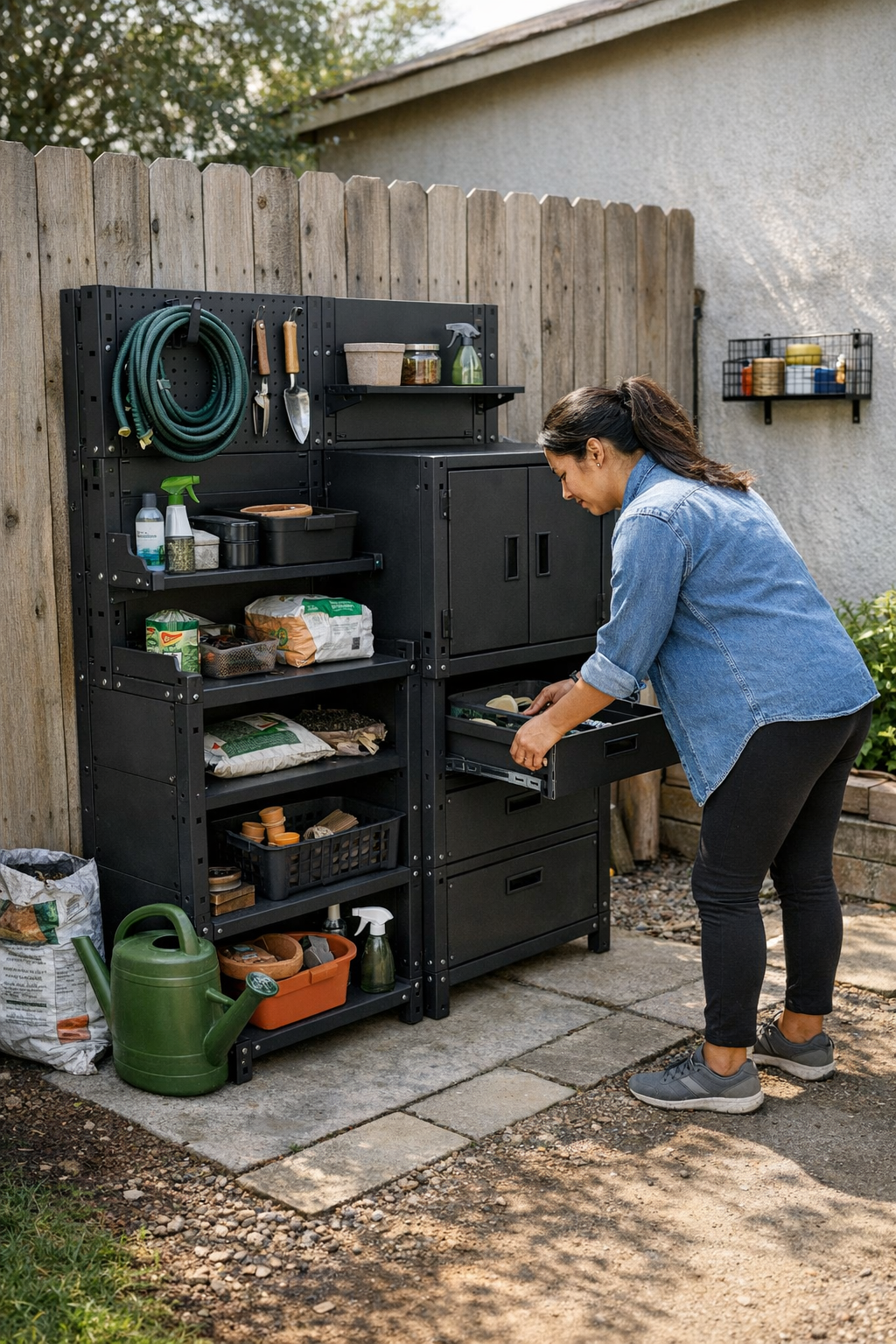
    It only works if the racks match real use. Too-high hooks turn into dead space for the kids; too-low, and adults trip. Long tools need vertical slots but shouldn’t scrape the floor or swing into foot traffic. Overflow often fills the path the moment rack space fills up, so it helps to dedicate a “swap” spot up high rather than let every new thing land wherever there’s a gap. Treating wall space as the traffic controller—rather than a dumping ground—keeps returns brisk and spillover visible.

    Mobile Bins: Simple, Effective, Annoyingly Necessary

    Rolling or modular bins don’t solve everything, but when gear multiplies—think sudden project, kids’ play, or storm cleanup—they let you clear or reshuffle without heavy lifting. On normal days, a marked boundary for each bin slows the silent drift across the walkway. The day’s debris gets scooped, rolled, and set back in place, not left to form the next blockage. That bit of discipline—slide back, check the edge—pays off the next time you’re rushing through with muddy boots or a cartful of plants.

    Keep Paths Open: On-the-Ground Adjustments that Work

    • One line of bins, one clear wall: Keep permanent floor units along a single side. The opposite wall, free from clutter, becomes the breathing room for daily in-and-outs.
    • Overflow in its own zone: A crate up high, or a marked “extra” rack, gets seasonal or oddball items off the ground but still in reach when needed. No more piles growing quietly behind the hose cart.
    • Regular micro-resets: Set a five-minute reset window midweek—slide bins flush, hook stray tools, sweep the “migration” back to the edges. Ignore it too long, and inch-by-inch drift eats half your route.

    Good Enough—Not Perfect—Means You Can Actually Use the Space

    There’s no final victory against outdoor clutter. Something will always roll out of place, a tool will land “just for now” in the path, and one corner will forever threaten to become a dumping zone. But real improvement shows when moving, grabbing, and returning gear stops feeling like an obstacle course. The setups that work—really work—aren’t the ones that look photo-ready on Sunday, but those where wall storage, obvious lanes, and mobile containers drop the hassle, not just the mess.

    It’s not about showroom order. It’s about whether, on a regular Tuesday, you can move through with an armful of returns, reset with a nudge, and keep overflow from taking over the whole strip. That’s the difference between an outdoor setup that fits the space and one that actually fits the way you live out there.

    See more practical outdoor storage solutions at TidyYard.

  • Designing Cabinets with Cord Access for Seamless Charging Stations

    The promise of a hidden charging cabinet—clear countertops, no more chargers scattered in the open—unravels fast under daily pressure. What starts off looking crisp behind a cabinet door usually turns into another slow spot in your routine: cords jumbled behind baskets, plugs fighting for space, and someone in a rush yanking a half-charged phone free while the door hangs open. Instead of clean-up, you get a new kind of clutter—this time locked inside a box that’s meant to simplify life, not complicate it. If your cabinet doesn’t match how your household actually plugs in and grabs gear on repeat, you’re not escaping mess—you’re just stashing it out of sight, only to find new frustrations behind the door.

    From Clear Counters to Hidden Complications

    The first days with a closed charging cabinet feel like an upgrade: no more cords trailing off the hallway table, no flashing LEDs at night. But as soon as you live with it—especially in a high-traffic spot—tiny flaws multiply. Every retrieval tests the design: is there enough space to reach in without dragging out everything at once? Is unhooking headphones a one-motion move, or does it mean untangling them from a sideways tablet and two charging cubes? Most cabinets allow at most a single cord port tucked at the back—fine for solo living, quickly overloaded in family use. Cables pile up, adaptors wedge each other into corners, and the process of plugging or grabbing turns into a slow shuffle. Suddenly, that “organized” shelf is jammed by baskets that don’t fit chargers, with cables forced through one crowded slot, so nothing returns smoothly to its zone.

    The original sense of order starts cracking almost as soon as you begin swapping out devices, juggling multiple chargers, or trying to reset the lineup for different users. Without a structure that matches how things are actually used, the cabinet just becomes the place where clutter hides until the next round of frustration.

    The Repeated Routines That Break a “Hidden” Station

    Daily access exposes every design shortcut in a charging cabinet that hides clutter but doesn’t organize it for real life. Picture after-school rush—phones, tablets, earbuds landing at once, but only enough plug-in spots for half of them. Now cords dangle at the edge, chargers double up at the outlet, and someone frustrated leaves a device half out, stretching a cable that prevents the door from closing. Soon, that cabinet door is propped open just to keep things charging—meant to be “just for now,” but quickly becoming the default, with devices left teetering on the ledge or sticking out into the walkway.

    This cycle repeats: doors won’t shut, plug-ins get interrupted, and instead of clutter disappearing, it resurfaces in a more chaotic, harder-to-fix form. The cabinet absorbs mess until a real reset is needed—usually involving emptying the shelf to untangle cables twisted behind baskets or crammed through a single adapter slot—proving that “out of sight” doesn’t equal “organized.”

    Why Most Cabinets Become Clutter Magnets

    Closing a cabinet door hides the chaos—for a day. By week’s end, the limits show: too few cord pathways, not enough shelf room, charging blocks stacked two deep, and mixed-up cables that require a miniature excavation just to unplug the right device. If you have to repack or rearrange after every retrieval, the hidden storage setup isn’t making life easier; it’s just delaying the effort. Two or more regular users means faster shelf crowding, slower returns, and constant low-grade tension as devices overlap and chargers cross wires.

    Even well-intentioned fixes, like trays or baskets, misfire if they block outlets or force cords into tangles around rigid dividers. One oversized cord hole does little but encourage every cord to fight for limited space, making unplugging a repeat struggle and increasing reset burden instead of preventing it. Instead of a system that absorbs household pressure, the cabinet quietly generates new work: extra time untangling cables or repeatedly shuffling devices just to close the door at night.

    Making a Cabinet Charging Station Actually Work

    The only way a charging cabinet works long-term is if it stands up to repeated, fast-paced use—retrieving in a rush, plugging in multiple types of devices, and resetting without effort after every cycle. A layout that solves this keeps access routines friction-free. Start with multiple cord routes—ideally, one for each device or shelf. It’s not about micromanaging storage, but matching cord travel to charging demands and the reality of regular movement.

    Trays or slim dividers built along the inside shelf give each cord a lane, stopping chargers from sprawling across and over each other. Labeling, color-coding, or even just loosely assigning shelf zones tells everyone where things go back, so return flow stays stable instead of descending into category drift. These adjustments turn a cabinet from a box of cables into a system that survives the real cycle of family evenings and morning departures. Nothing snags; the door shuts with everything inside; resets shift from chore to afterthought.

    Subtle Fixes That Ease Everyday Reset

    A few targeted changes—like drilling extra, well-sized cord holes (not one cramped slot)—give every device a direct path to the power strip and its own space to rest. Forcing thick charging cables through a single small opening isn’t just awkward—it can pinch cords, overheat power bricks, and block airflow, making resets messier and even less safe. Leave space for plugs and air; clear lines from shelf to outlet; and avoid layouts that double up device weight or trap cords behind immovable bins. Each device should move in and out without shoving everything else aside.

    The real test: before moving in for good, try plugging and unplugging every device, one at a time, to see where hangups and catches happen. Shift dividers, adjust zones, and keep tweaking until the reset feels effortless and nothing blocks a quick grab on the way out the door. The payoff isn’t just a neater look, but a setup that stops draining attention every day.

    When Hidden Storage Slows You Down

    A setup meant to streamline device charging shouldn’t force new workarounds—like popping the door open all evening just to accommodate a mess of dangling cords, or stacking phones on the nearest shelf because it’s faster than fighting for a plug in a crowded box. Warning signals: blocked hall traffic, partially closed doors, a hunt for the right adapter each morning, or a side shelf that starts collecting overflow as family members silently avoid the cabinet altogether.

    Hidden storage justifies itself by making routines invisible, not harder. If you keep nudging the door ajar, or workflows stall because you’re untangling the same set of cables on repeat, the setup is demanding more from you rather than fading into the background. In a system that works, return and retrieval happen with one action—devices drop in their lane, plug in, and disappear until needed, no recurring struggle or category confusion. If it keeps fighting you, it needs a rework—not more patience.

    The Lasting Calm of a Well-Planned Cabinet

    When hidden charging storage delivers, the difference is obvious on a busy night: no bottle-neck in the hallway, no pileup developing on the flop shelf, and no one freezing up in the doorway searching for the right plug. The right cabinet layout keeps the floor path open, clears visual clutter, and fits not just the footprint of your entryway or utility corner, but the real pulse of device use in your home. Each cord has its channel, every device returns to the same spot, and resets happen with barely a pause.

    Hiding devices is only half the work. The real goal is a cabinet system that absorbs all those surges and returns—the tug-of-war of family schedules, drop-offs, handoffs, and rushed plug-ins—without unraveling. Hallway, multi-use corner, or closet shelf, the inside plan makes the outside calm hold steady. The right storage habit isn’t just hidden—it stays quiet, obvious to no one because it simply works under pressure.

    Find more ways to make inside storage easy to use and simple to reset at Gridry.

  • How Dehumidifiers Transform Humid Laundry Rooms and Entryways Efficiently

    Humidity is the hidden sabotage in every entryway and laundry drop zone, quietly wrecking routines long before you notice a mess. Shoes that never quite dry, bags going musty overnight, towels clinging to dampness—these small failures pile up until every return trip across your threshold means pausing, rearranging, and settling for gear that feels halfway reset. Order on the surface hides a slow, sticky traffic jam underneath. One rainy week, and you realize: even when everything looks lined up—bins in place, bags stacked, floors swept—the zone still works against you. The difference between an entryway that helps and one that hinders usually begins here, in the buildup you can’t see but can feel every morning with a pair of clammy shoes or a bench that never quite loses its burden.

    Where Humidity Hides in Transition Spaces

    Most transition spaces—especially narrow entryways or those bordering laundry—become moisture traps, no matter how tidy they appear. Air stagnates just at bag-drop level, keeping shoes damp and slow-cooking the reset process. The real friction points? Open shoe racks hugging the floor soak up run-off from shoes and boots. Deep bins promise containment but gather every drop that drips off jackets and umbrellas. Under-bench stashes, though out of sight, trade clutter for a slow-cycling damp cycle, leaving shoes on the threshold between “almost dry” and “not quite ready.”

    Each night’s reset ends up half-finished. Morning means toeing into last week’s moisture and shuffling bags that seem to collect a humid undercurrent no matter how often you rotate them. The signals show up quietly—the swampy edge that never clears, or shoes that seem to trade places in search of real airflow. The things you set down keep a record, and the price is paid in daily inconvenience.

    Why Neat Isn’t Always Functional: The Clutter Lag

    Your entryway may look under control at first glance. But once humidity stakes its claim, small problems multiply:

    • Bags “dropped for a second” on the bench end up parked there for days, blocking both seat and reset path.
    • Shoes aligned neatly at night have migrated by morning, each pair chasing a drier corner along the floor or crowding the one spot that almost dries out.
    • Temporary drying racks inch outward, tightening the main walkway and demanding extra navigation for every trip in or out.

    Hidden friction always outlasts visible clutter. What looks organized in a photo feels stalled in use: each “grab and go” becomes a slow search for something not too wet to wear, with overflow starting to pulse out from under the bench or crowd the sides. True function is measured not by appearance, but by how little you have to think about resets or sidestep yesterday’s mistakes.

    Small Shifts, Noticeable Change: Elevation and Airflow

    Anyone who’s slogged through a stormy stretch knows how fast a neat entry slips into recovery mode—coats and shoes multiply, every reset takes longer, and what worked on a dry day starts falling apart. The fix isn’t aspirational—it’s practical: work with airflow, not against it.

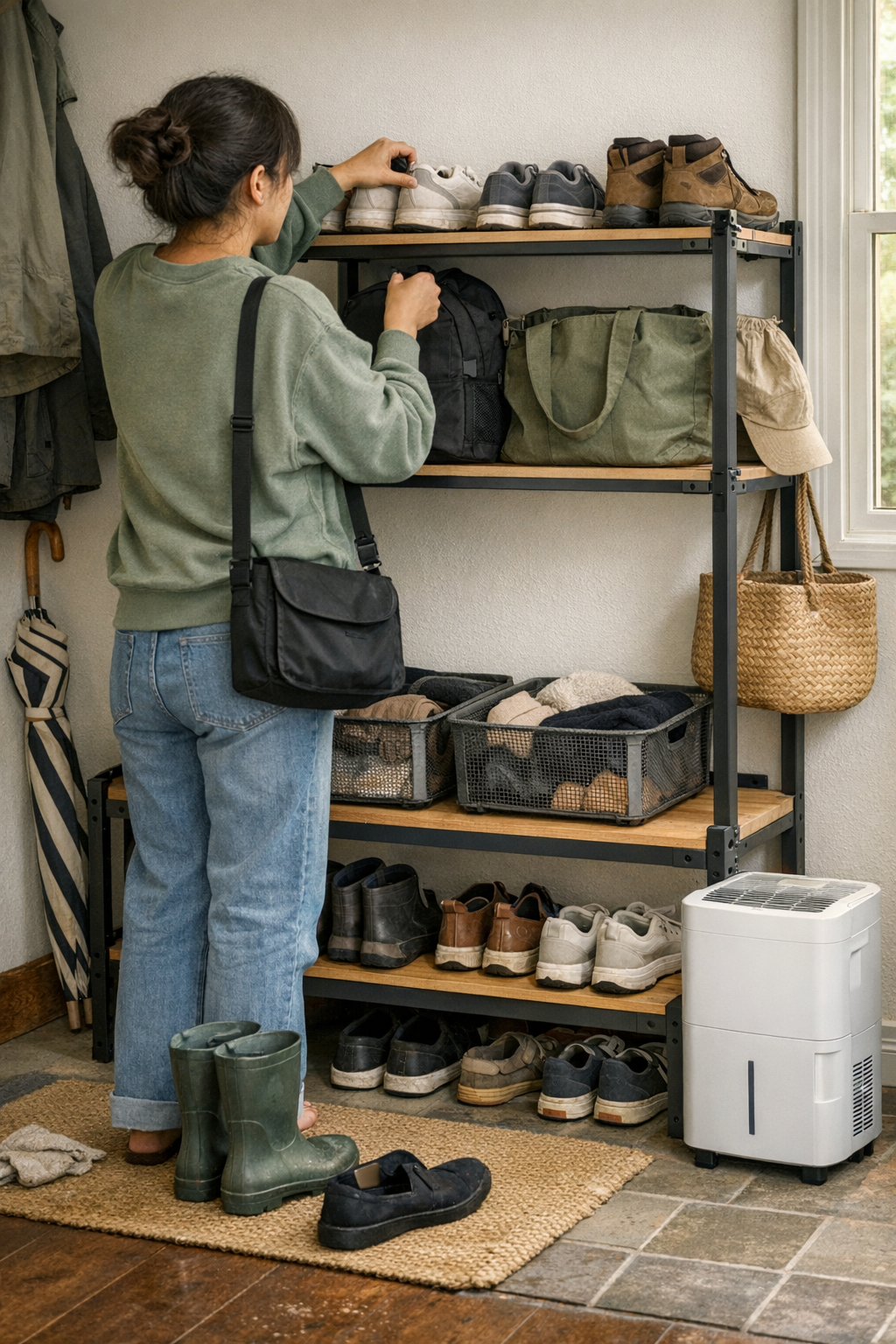
    What shifts the daily tide: Lift your storage. Raising shoe racks or bag cubbies at least 6-8 inches above the floor lets air reach the problem zones. Wall-mounted open-back units installed just above bench height multiply airflow, letting thick-soled shoes dry by morning instead of next week. Leave a two-inch gap between items, and suddenly, the dehumidifier can circulate air around everything—no more wet pockets building up behind the last row of boots.

    The results show up in small, repeatable wins:

    • Overnight resets actually complete—the morning check stops revealing “almost dry” excuses
    • Odors and mildew get cut off before they spread
    • Return routes clear up, and the threshold stops accumulating semi-permanent overflow

    This isn’t about an “organized” look, but a real shift: your entry stops being a workaround and starts supporting a routine that moves, dries, and resets on time—even when the forecast refuses to cooperate.

    Facing Real-World Constraints: When Space or Layout Won’t Cooperate

    But plenty of transition areas simply can’t fit deep shelving or a wide bench. In narrow halls or shared utility passageways, every inch counts, and compromise is constant. Clutter moves from visible piles into the tightest corners, and the real battle is against crowding your walking path, not just your storage plan.

    For these compressed scenarios, work with the space:

    • Slim, vertical racks—mobile or wall-mounted—lift gear off the ground without stealing floor space and can be shifted at night to chase dry air
    • Shelves set back from direct entry splashes or out of the cross-breeze prevent gear from languishing in a drip zone or permanent draft
    • A little extra space between pairs—even just a hand-width—beats stuffing every inch and guarantees dry outs actually happen between uses

    In these setups, blocked paths and collision points multiply fast. The more your storage lets gear breathe, the less time you’ll spend untangling a slow-motion jam at the doorway. Every step you don’t have to repeat is one that gives your entryway back some breathing room—literally.

    What About Storage Cabinets and Hidden Moisture?

    Cabinets can trick you: they hide visual clutter but trap every bit of humidity unless they vent or remain propped open. Even a dehumidifier can’t reach inside a sealed cabinet, turning those perfect-looking shelves into low-level swamps for shoes and gear. That’s why semi-open wall units, vented cubbies, or modular shelves always outperform closed boxes when the real test is daily drying, not just keeping up appearances.

    Quick Q&A: Entryway Dryness Essentials

    How do I keep shoe storage dry in a humid entryway?

    Lift racks or cubbies at least 6-8 inches above the floor, leave a small space between each item, and run a dehumidifier right where gear lands. Placement and spacing matter just as much—sometimes more—than the machine itself.

    Does a dehumidifier help closed cabinets?

    Not unless those cabinets can vent or stay partially open; otherwise, moisture just settles in, hidden until the next reset fails.

    What’s the best move if space is extra tight?

    Go vertical: use a skinny wall-mounted shelf or a small rolling rack you can pull out of the way at night. Even a little elevation buys hours of drying you otherwise lose to ground-level gloom.

    The Real Test: Reset Speed and Daily Movement

    Transition spaces fail quietly—not because they’re messy, but because the setup can’t keep up with real flow. If you’re moving yesterday’s bag to reach the bench, nudging wet shoes sideways, or starting every morning with a check for leftover damp, the zone is stalling. Raise, space, and ventilate your storage, and resets get easier, not just less cluttered or “prettier.”

    The entryway that works isn’t one frozen in order; it’s the one where your routine moves freely—shoes and bags dry overnight, paths stay clear, and each return doesn’t spark another rearrangement. That’s the threshold worth trusting, no matter the weather outside.

    http://www.betweenry.myshopify.com

  • How Smart Outdoor Storage Saves Time and Keeps Your Yard Tidy

    Most outdoor storage looks tidy—right up until your yard actually gets used by more than one person. It’s easy to nod at a wall of hooks or a row of bins and call it organized, but within a weekend of kids, housemates, or visiting relatives grabbing and returning tools, the friction sets in fast. A garden corner that starts efficient becomes jammed and unpredictable—a trowel lost under spades, a rake wedged sideways, a bin lid refusing to shut. The routine slows, the path clogs, and what was “storage” turns into a quiet mess with every round of use.

    Why Shared Tool Storage Breaks Down So Easily

    Disorder creeps in the moment people use the yard differently. A setup that handled solo use suddenly reveals blind spots: one person lifts a rake onto a top hook, someone else can’t reach and leans it in a corner, another just drops their tool at the nearest available spot. A small shovel blocks a broom’s handle; a tangle of gloves piles up behind bins. Every quick return becomes a rearranging act. By the end of the day, what should be a two-second task stretches into shuffling, tugging, and digging for what you actually need.

    The design of bins and racks promises clarity, but repeated use exposes their weak points. Bins designed for “overflow” rapidly swallow everything—handles tangled, trowels buried, smaller gear impossible to fish out without pulling half the contents onto the grass. Wall hooks, mounted too high or too tightly, become unreachable for some and ignored by others. Soon, tools are abandoned below, and the wall “storage” becomes mostly wall decoration. Pathways constrict. The reset each evening drags out, and the corner meant for quick storage becomes a bottleneck instead.

    Blocked Paths, Stalled Resets, and the Cost of Overflow

    Walk along any fence-line or side-yard utility zone that sees real use, and you’ll find the story: organized hooks for brooms and rakes, a mid-sized bin for hand tools, a space cleared for the wheelbarrow. By midweek, a familiar creep begins—a shovel propped against a bin because no hook fits, then another tool on top “just for today.” Bin fills up? The spillover lands on the ground, transforming a path into an obstacle course. By Saturday, getting the hose means moving a rake, three spades, and the lid of a bin that now serves as a makeshift shelf.

    The end of a work-heavy day doesn’t bring a quick reset. Instead, it’s a hunt through buried gear, sorting gloves from plant supports, undoing tight clusters of handles, or recovering a lost kid’s toy from the dead corner where overflow always piles up. The ten or fifteen minutes of “reset” rarely splits evenly; it falls to whoever is left cleaning up, again and again. Over weeks, frustration outweighs organization, and the rounds of effort just reinforce the trap.

    Crowded Floors and Wall Space That Doesn’t Help

    Grabbing another rack or bin feels like a solution, but the effect is usually more clutter—floor space gets choked, not cleared. Small tools slip beneath larger ones, and that extra bin for “miscellaneous” quickly fills with everything no one wants to put away properly. The wall may have five more hooks, but if they’re out of reach, too bunched, or tucked behind some plastic storage, they’re just decoration. Each return turns into a minor puzzle: where does this actually go? If you have to push things aside to make room, your system is already giving out.

    It shows in the daily patterns: a wheelbarrow blocking the path to the shed, a rake stuck against the gate, a rolling tangle at your feet every time you open the storage unit. The surface “tidy” only lasts until real movement happens. Every extra step—moving three tools just to return one—just slows things down and makes every task feel heavier.

    Small Adjustments That Actually Rescue Your Flow

    True improvement rarely means adding more storage—it means adjusting to your routines. After lowering the most-used tools to arm’s height, close to the entry, spontaneous pileups practically disappeared. Breaking up wall space by category—pruners here, digging tools there, handles with room to breathe—does more than look neat. Suddenly, anyone returning something can see what goes where, and nothing blocks another item’s spot.

    One change made a bigger difference than expected: marking a 60 cm “clear zone” near the wall—a strip where nothing is supposed to sit, ever. If that path gets blocked, it’s a fast sign the system failed, so it gets fixed right away, not left to stew. The result? Resets are faster, even when two or three people return tools at once. Instead of dodging piles, they actually use the space as intended.

    Real-World Fix: Assign and Adjust

    Hooks and racks only work when assigned—mixing everything together is a guaranteed mess. Specific assignments build real habits: pruning gear always on reachable hooks, heavier tools grouped tightly, less-used items tucked out of the path. Dumping “miscellaneous” into one giant bin creates a black hole for anything you want to find later. Every stray item is a sign to reconsider the routing, not make another pile.

    Imperfect Setups Are the Real Test

    No outdoor organization lasts pristine through storms, weekend projects, or a yard full of kids. The true win isn’t photo-perfect storage, but the way a setup resets under pressure. If every tool can return without shoving, stacking, or blocking the next movement, that’s the difference between a functional yard and another space eaten by frustration. Consistency matters more than perfection—systems that forgive messes and reset quickly actually survive real use week after week. That’s what keeps the path open, your time intact, and your corner of the yard shifting with the rhythm of real life instead of stalling out with every busy weekend.

    http://tidyyard.myshopify.com

  • Transform Your Bedroom with a Drawer First Habit to Reduce Clutter

    The dresser top looks like an easy win—a blank surface you can finally keep organized. But a few days into real use, signs of failure start to show: sunglasses stack with loose mail, tangled chargers edge out what actually matters, and even a newly placed tray ends up crowded with leftovers you meant to sort “soon.” What was clear space on Saturday becomes a weekday obstacle course, slowing you down when you need speed and routine. The problem isn’t visible mess alone. It’s the gradual loss of simple retrieval: “just resting here” turns into “where is it now?” as overflow and edge creep take hold. For anyone with limited surface area, the gap between looking tidy and actually functioning grows with every unsorted pile and delayed reset. In the world of storage and organization, this is the warning sign—a surface that collects overflow isn’t working, no matter how calm it seems after a clean-up.

    The Hidden Costs of Cluttered Surfaces

    Using your dresser top as open storage feels practical at first: headphones tossed on the tray, keys left by the lamp, books and chargers always in view. But each shortcut—each item left out—injects invisible friction into your morning and night. The pattern is easy to spot: by Monday, you’re shifting receipts to find your watch, lifting mail to reach a pill bottle, tracing a vague memory about where you left your earbuds. The surface stays deceptively “organized” until it quietly collapses under micro-delays. Every retrieval is that much slower, and the mental drag piles up until you either let the clutter rule or spend another chunk of time restoring order—again. When a storage zone can’t survive repeated, varied use, it’s not helping, it’s quietly getting in your way.

    Why “Drawer First” Changes the Routine, Not Just the Look

    Moving to a drawer-first strategy isn’t about hiding chaos; it’s about aligning storage with how you actually move and reach during rushed routines. Dressers with limited top surface are most vulnerable to category pile-up. Invisible overlap breeds active friction. The shift happens not in a single clean-up, but as you force the issue: headphones, prescriptions, spare change—all rehomed in actual zones, not lost to the next surface drift.

    This is habit more than philosophy. Everything but daily-use or genuinely display-worthy essentials moves under the surface. A clean top signals: “These are in daily motion.” The rest—vitamins, stray receipts, tech—finds its way into drawers chosen for reach, not just storage space. The reward comes on busy mornings, when your movements track cleanly and you’re not stalling out on a random backup charger or stray paperwork blocking the thing you need most.

    Routine Meets Resistance: A Real Day’s Friction

    Picture a real Wednesday: only a few minutes to get ready, and you’re still swiping aside old mail, hoping your keys aren’t under the newest pile. Even after purging, stuff returns: your charger tangled with receipts, headphones wedged beneath a paperback. Every grab takes two steps, not one. It isn’t chaos, but it’s not smooth. By week’s end, the surface demands another triage—resetting what drifted, sorting what lost its spot. This is the bottleneck most setups ignore: a system that can’t keep up with daily spillover or recover fast enough after a typical week never truly works.

    Making the Drawer Work: Practical Setup Choices

    The real advantage of drawer-first isn’t that mess disappears—it’s that you carve out a route for each item that matches your hand’s habitual path. Hidden storage only works if the flow matches routine. The win is in the reset: putting things away doesn’t stall you, and retrieval runs on autopilot, even in a rush. If your system forces extra steps, the surface will fill again because the path of least resistance always wins.

    This demands honesty about what earns surface access. A nightly book, a phone charger dock, one simple decor piece: the rest goes below. Drawers need structure—trays, bins, honest categories. Not magazine perfection, but true guides. Without this, “out of sight” just means “misplaced.” The key is obvious, reachable homes that slow down category drift and make end-of-day resets brief rather than burdensome.

    Dividers and Bins: Small Changes That Outlast Motivation

    Drawer breakdown isn’t about laziness—it’s about vagueness. Open trays for medication at the front. An in-drawer bin for all things tech: chargers, batteries. A pocket for go-to accessories. No need for micro-categorizing—just predictable, honest zones you can toss things toward in real time. If the system fits your reflexes, it survives Monday through Friday, not just Sunday night resets. The aim isn’t a one-time showroom: it’s a living grid that guides stuff back to its spot as easily as it leaves.

    When the drawer flow is right, end-of-day tidying is a scan and a toss—not an excavation. Retrieval is simple and the surface can stay clear without being “policed” into emptiness. The system works because it has guardrails, not because you suddenly became the world’s neatest person.

    Recognizing—and Respecting—Natural Limits

    No storage solution erases chaos forever. New stuff appears. Routines stretch and break. But a resilient drawer structure absorbs the inevitable: renegade items get a short-term home without derailing everything else, and the top surface stays usable instead of beckoning the next pile.

    The trick for oddball or temporary items: a labeled “active” tray inside the drawer—tickets, a short-course prescription, borrowed headphones. When the window is up, you clear the tray, not another stack on the counter. This one change turns a high-risk chaos zone into a buffer that flexes today and resets cleanly tomorrow.

    When Out of Sight Means Out of Mind (and How to Avoid It)

    Hidden storage can easily backfire if it doesn’t stream with your actual movements. Closet drawers, underbed bins, sideboard compartments—all valid, but only if the location fits the routine. When you must open three drawers to nab daily meds, or dig to the back for the chargers you use every day, stuff lingers outside longer. Category drift and lost items usually trace back to set-ups that ignore movement: if the return flow isn’t quick and retrieval isn’t nearly automatic, even the best-looking system will break down on a busy morning.

    The difference in a practical layout: routine items always land right where your hand reaches first—no hidden piles, no brainwork, no reshuffling. That’s the mark of order that survives repeated use, not just deep cleans. The result isn’t only in appearance, but in the actual loss of delays and excuses for letting the surface overflow again.

    When Looks Deceive: The Illusion of a Tidy Dresser

    Trays, dishes, a neat row of bottles—easy to stage, easy to lose. Within a few days, the pretty surface is a landing zone for whatever didn’t fit below. One glove, an extra charger, notes from last week, paperwork waiting for “later.” The illusion of order always gives way as overflow stacks up. Each time, the system needs rescue: more effort, another half-reset. Even attractive storage props are just shells if there’s no real structure underneath steering what returns where and at what pace. Surface tranquility is a fragile accomplishment once your actual routine resumes.

    The setups that perform for real recognize that visible order is temporary, but a structure beneath that matches your living patterns lets you recover in minutes, not hours—even when the week turns chaotic.

    Where Systems Work—and Where They Break Down

    Some hidden storage fails for practical reasons: deep drawers force stacking and slow retrieval, crowded zones blur categories, and too much micro-organizing kills speed. Over-dividing a drawer means extra friction returns—soon you’re back to daily piles because the “system” adds effort instead of easing it. Any setup that regularly triggers multiple drawers, floor piles, or reshuffling between zones is quietly generating work instead of saving it, especially in mixed-use or limited-space bedrooms.

    Drawer-first, when built around reach and honest categories, drops the reset cost and blocks clutter at the source. It frees floors, defends surfaces from overflow, and—most important—doesn’t stall out when you need to recover during the week, not just after deep cleans.

    Living with the System: Sustainable Order in Daily Life

    The look of a surface at its best is never the test; the measure is whether you can actually recover when real life hits. The right storage structure isn’t a style win—it’s a rescue plan. Every “where did I put—?” moment is shorter, every return easier, every slip reversed before it grows into a new mess. When your dresser stops dragging your routine or collecting friction, its low profile signals space is being used the way you need it now—and you won’t need a full reset just to see the top again. The change starts under the surface, but you feel it everywhere: clearer retrieval, fewer stalling points, and a repeatable way back to order, not just a cleaner look.

    If you’re ready to build a setup that stays out of your way and supports your routine—not just your Saturday tidying mood—find more practical storage solutions at

  • How a Drying Fan Transforms Entryway Routines After Rainy Days

    Wet weather exposes entryway setups fast. After just one rainy day, shoes cluster in uneven rows, umbrellas sprawl over every open edge, and the narrow space by the door blends into one damp, crowded zone that never quite recovers. Mats collect puddles, but that “quick reset” slips away: what begins as organized turns into a cycle of slow-drying gear, blocked movement, and a constant feeling that each return home leaves the entry less usable than before. The true breakdown doesn’t start with lack of bins or racks—it starts when drying speed falls behind real use, and every drop zone becomes a backlog instead of a buffer.

    When Storage Falls Behind: Showing the Limits in Repeated Use

    On paper, most setups look under control—a bench for sitting, a tray for mud, hooks for coats. But the routine under pressure tells a different story. Each return drops new gear in the mix: a wet bag lands on the last clear spot, shoes from yesterday are still clammy, and the bench ends up covered instead of cleared. By the third or fourth round of comings and goings, the original “neat” footprint shrinks: mud slides past the tray, corners pile up with abandoned gloves, and the only dry path narrows to a tight squeeze. Instead of a transition zone, the entry clogs up—a visible sign that even the most solid racks lose ground when recovery lags behind the real pace of life.

    Stationary storage doesn’t solve for repeat dampness. As humidity and weather compound, resets drag out. Shoes that looked dry hours ago feel cold underfoot. Water sneaks under mats. Temporary bags and coats turn into ongoing obstacles because nothing ever fully dries before it’s needed again. The entry isn’t messy, exactly—it’s stuck, outpaced by daily flow, and each pass through tightens the zone further.

    What Fails First: Not the Storage, But the Reset Cycle

    Hooks, trays, and racks control the outline, but when weather repeats, the real test is whether the zone is usable before the next arrival. If boots or coats are still wet when it’s time to leave again, the “fix” becomes improvisation: extra shoes drift into hallways, damp jackets migrate to bedroom doors for better airflow, and the bench—designed for sitting—ends up as a drying rack. Everyone starts sidestepping new piles, moving carefully to avoid slipping, or staging gear where it doesn’t belong, just to buy enough time for things to dry. The visible flaw isn’t clutter, it’s a return flow that gets slower and less predictable with every cycle.

    Repeated Friction You Can See and Feel

    • Bags dropped at the pathway’s edge, pinching the route from outdoors in
    • Shoe rows doubling back, spreading past the mat and pushing the “clean zone” deeper inside
    • Bench surfaces lost to overflow—wet coats, helmets, or sports gear where people should sit
    • Temporary “later” spots that become semi-permanent hangouts for towels, gloves, or gym bags
    • The repeated routine of shuffling soggy items toward bedrooms or laundry just to finish the drying that the entry can’t handle

    All signal the same core problem: storage keeps the structure, but slow reset leaves the space stuck—what looks orderly is actually stuck in a slow drift to less usable.

    Active Airflow: The Shift That Unlocks Real Reset Speed

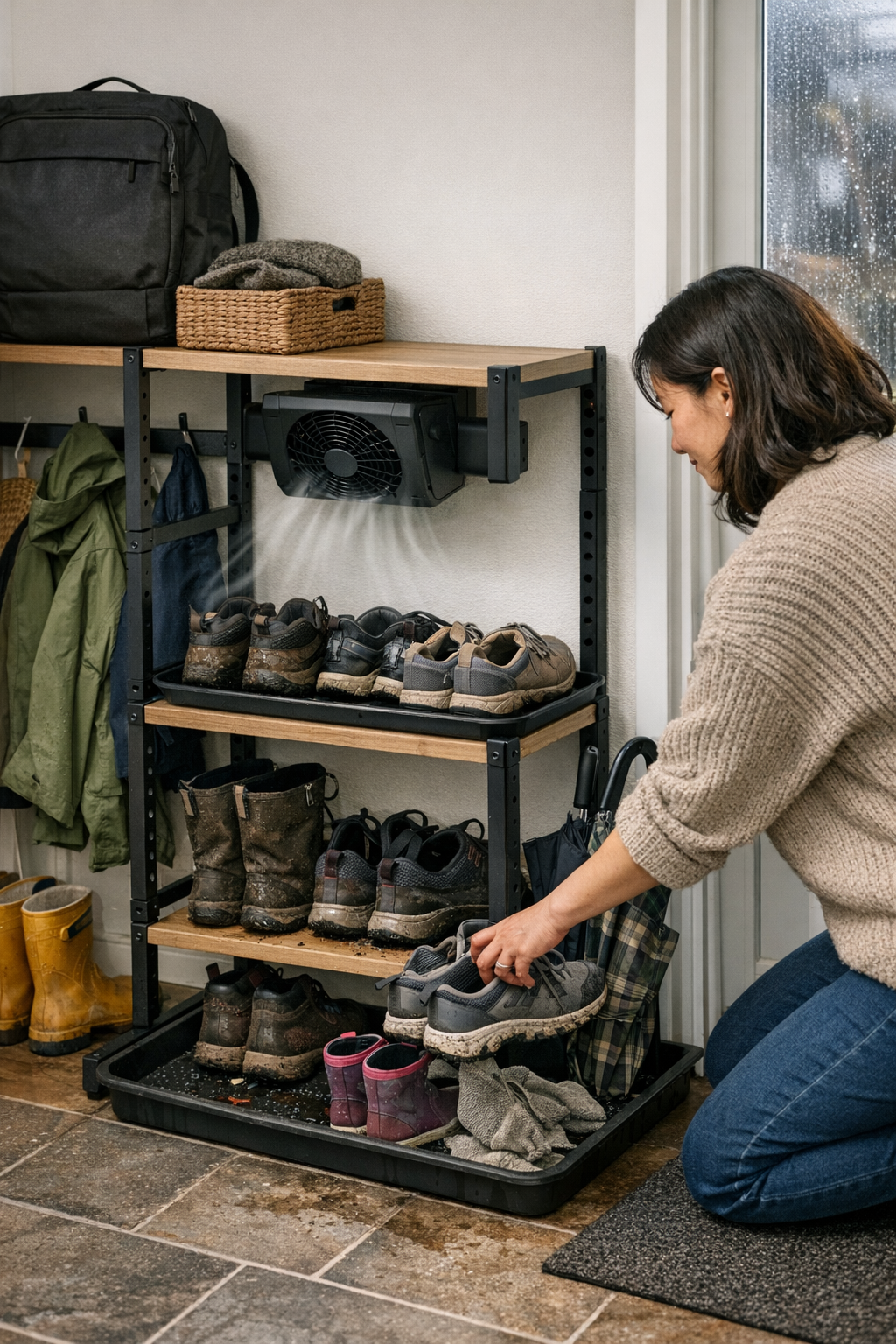
    Adding targeted airflow—a compact drying fan above the drop point or hidden in a slim storage column—does more than dry shoes. It breaks up logjams, turns hours-long resets into quick turnarounds, and stops the routine from slipping further behind with each wet arrival. Instead of waiting for damp shoes to air out, a well-placed fan pushes humidity out of the gear and the space, clearing puddles and prepping surfaces before the flow returns.

    With real airflow, the ritual resets: damp gear leaves sooner, so there’s no need to spread shoes or bags deeper into the house. The “walkable path” returns overnight instead of mid-morning. Benches return to seating instead of storage. Odors don’t settle in. The difference isn’t superficial—it’s in the pace: people return to an entry that’s ready, not lagging behind the routine.

    After the Switch: Entry Behavior Unclogged

    Picture it after a full week of rain. Three homecomings in half an hour: one person sheds running shoes dripping water, another drops a mud-streaked bag, and the last squeezes through with an umbrella and groceries. Before airflow, puddles claimed half the mat all night and the bench was just another place for damp heaps. With active drying always running, shoes actually dry and gear cycles back into use in a couple of hours—no more morning “where’s the driest pair?” maneuver, no overflow in the hallway, and, for once, somewhere to sit that isn’t half-covered in wet jackets. Every reset happens without having to think about workaround solutions in other rooms.

    Where It Works: Fitting Active Airflow into Tight or Busy Entryways

    Most entries are not built for endless gear or sprawling benches—they’re narrow, used from multiple sides, and often crowded on a regular morning. That’s why real-world airflow solutions stay compact and out of the way, focused on the bottleneck, not just the open wall. The effective placements are:

    • Mounted just above the drop area, blowing across the main “gear zone” without shooting air at doorways or faces.
    • Tucked inside a side storage element, angled to reach across two or three rows of shoes and bags without eating up floor space.
    • Kept clear below: no boxes, cables, or spillover shoes cluttering airflow where it counts most.

    Pair this with easily washable trays, mats, or racks: active drying can’t keep mud from landing, but it makes washing up less frequent, keeps surfaces ready, and stops grit from turning into permanent mess.

    Long-Term Use: Real Changes, Real Limits

    With repeated use, the split is clear. Shoes that once took all night can be ready in two or three hours. The bench stays available, so sitting down to tie laces isn’t a hassle. The “just for now” drop spots lose their hold, because gear genuinely resets in place. Yes, heavy mud and deep dirt still need occasional attention—no fan will erase the mess entirely. But the drag of dampness and slow build-up of odor no longer hangs around as a daily anchor. The threshold returns to function instead of friction, even through consecutive storms.

    No entryway solution erases every problem: airflow quickens recovery, but it can’t scrub scuff marks or replace floor mopping. Still, changing the pace of drying turns the entry from a weak link into a working threshold—a space on pace with daily movement, not always one reset behind.

    Day-in, Day-out: A Transition Zone That Keeps Up

    The result isn’t a showroom—no transition space ever is. It’s a front zone that keeps up: clutter detours shrink, the reset burden drops, and the cycle of overflow and drying backlog finally breaks. Active airflow isn’t decorative; it’s the quiet difference between a path you can use and one that always slows you down, between a bench as occasional seating and bench as permanent overflow.

    The improvement is in the details: a dry patch where you can finally step, shoes you can slip on without the squelch test, a bench that’s ready instead of buried. Active reset keeps the entry functional—real gear, real weather, and real repeated use, not just a tidy moment after the first setup.

    See more practical transition-space storage options at Betweenry.

  • How Smart Cabinet Placement Transforms Outdoor Storage Efficiency

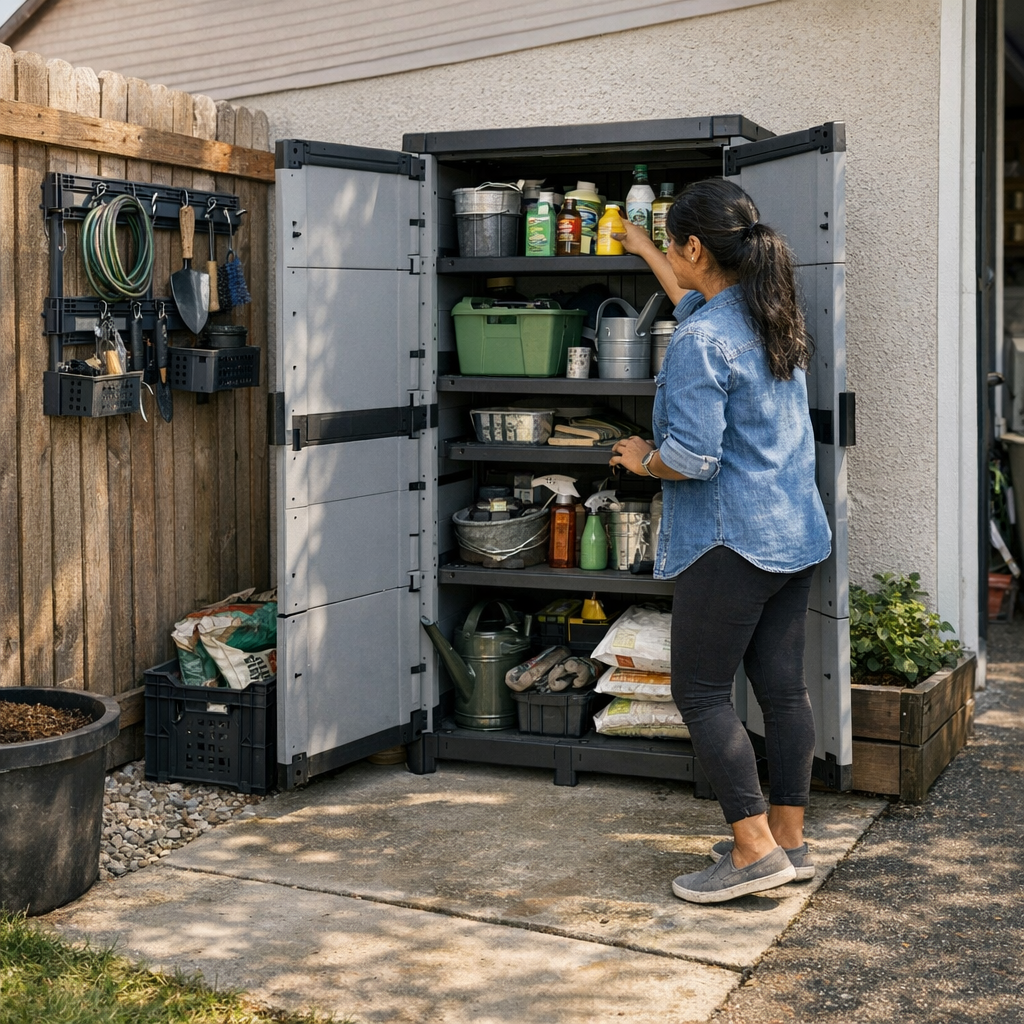
    Order in outdoor setups is easy to fake—but hard to keep. That first afternoon, a sleek storage cabinet or those fresh bins along the fence trick you into thinking you’ve finally conquered the clutter. By week two, reality resurfaces. That narrow side yard that once let you glide past is now a tripping hazard. The cabinet meant to hide tools quietly becomes a landing pad for overflow, while the footpath shrinks under the weight of one more “temporary” rake or bag. The promise of order fades fast when every reset demands more maneuvering—and the system that looked so organized on day one begins to undermine your actual routine.

    When Organization Breaks Down: The Realities of Outdoor Storage

    Outdoor friction doesn’t shout—it creeps until you can’t ignore it. It’s rarely about “too much stuff” all at once. It starts with the shovel sticking out at ankle level, or the watering can that never actually makes it back inside because the fit is just off. If a cabinet or wall system requires constant reshuffling, or pushes into your walking line, every “quick put away” becomes a hassle. Soon, the area that was supposed to tame the mess just creates new bottlenecks—and familiar shortcuts spawn clutter faster than you can reset it.

    The difference between functional and frustrating isn’t measured in cubic feet, but in daily movement. If a storage solution claims to “maximize space” but quietly traps a corner or forces you to double-handle gear, the overflow returns—and so does the friction. The real cost isn’t visible at first; it builds with every awkward reach or blocked door until you start leaving tools wherever you last used them.

    The Subtle Power of Cabinet Depth and Door Swing

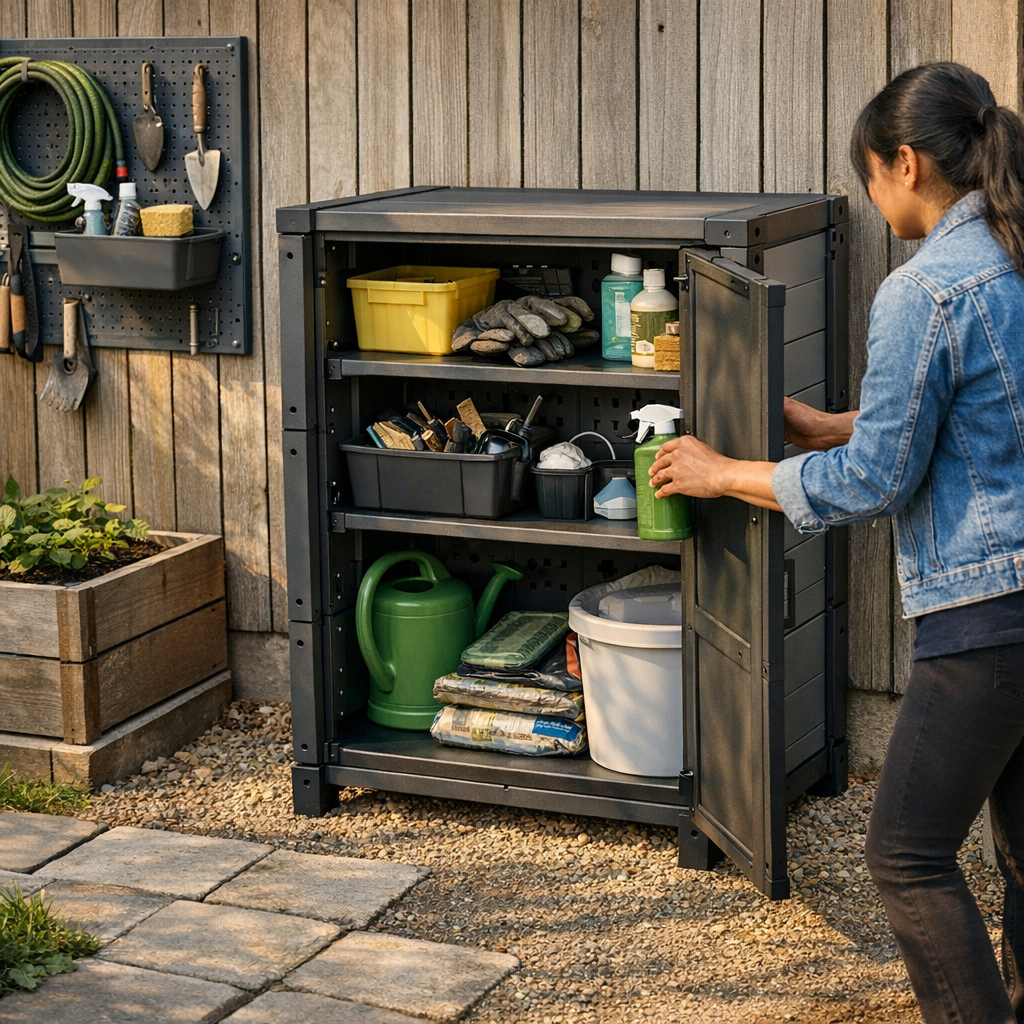
    Tiny mismatches can sabotage an otherwise good setup. Door swing is a repeat offender. Picture a side-yard cabinet: shelves are deep, the doors jam after a partial swing, and what should be an easy stash becomes a hips-and-elbows shuffle. Pruning shears in hand, you need to wedge yourself sideways just to get the door halfway open—so you drop the tool on top and tell yourself you’ll fix it later. One missed return leads to another, and soon gear is scattered across tables, fence posts, and anywhere else the routine breaks down. But remounting the cabinet for a few more inches of clearance—true, full door swing—can snap the whole routine back into place. Now, returns happen in one motion; nothing lingers outside “for now.” The impact is instant and obvious: less sidestepping, less gear piling up, and the reset starts to feel nearly automatic.

    I’ve seen a single change—like moving my garage-edge cabinet forward by a hand’s width at the hinge—erase months of irritation. Suddenly there’s no need to angle my body, slide the cabinet, or hold the door while juggling muddy gloves. The hand-in, hand-out flow is possible, no detours, no mental drag. That’s real outdoor performance you notice every day.

    Exposed Racks and Open Shelving: Easy on the Eyes, Tricky in Practice

    Wire racks and open shelves sharpen a backyard’s look for about a week. After that, they reveal their real bias: vertical stacks that demand reaching over, shifting bins, and constant mid-task rearranging. In a tight corner or along a narrow patio edge, this setup means every retrieval is a balancing act. Gloves behind a watering can? Prepare to unstack two pots and slide a hose to the side before you can even start. Even empty, the racks eat up wall and step space—every inch of “openness” comes straight out of your path. What once felt organized now clutters the very line you need to move through.

    The real question: does anything come and go without hassle? If the answer’s no, order breaks down with every shortcut you take. Storage isn’t working when you hesitate to stow gear or leave tools out—no matter how neat the surface looks. Return flow matters more than any first impression.

    Cabinet Width, Height, and the Trap of the “Corner Fix”

    “Use every inch” is a common trap. Tall cabinets jammed in corners keep the floor clear, but put real strain on resetting: you need a ladder to reach the top or end up piling rakes and shovels up front. Wide units along the fence give you more surface, sure—but every foot they claim squeezes the path tighter, until you’re shifting one pail just to reach another. Awkward heights and squeezed walkways mean heavy stuff migrates to wherever it’s easiest to drop—which is never back in the cabinet.

    Picture this: pruning’s done, you walk over with the garden hoe, and the door won’t swing open. A bucket is blocking the floor. So you move the bucket, open the door, and now you can’t fit the hoe until you restack two other tools. It’s a slow-motion clog that builds every session. Days later, gear is scattered—less because of messiness, more because the setup fights your routine.

    Overflow and Dead Corners: When the Setup Loses to Habit

    Overflow zones don’t announce themselves, but you feel their drain. If a wall system is tucked just out of reach, or a cabinet demands bending, backing out, or stepping awkwardly, you’ll “temporarily” stash things at the closest open spot. Dead corners—those odd gaps between the cabinet and the fence, or next to the shed—quietly become magnets for random pots, abandoned hand trowels, or whatever’s left after the main space clogs. The path narrows a little more every week until a clear zone turns into a balancing act.

    One practical test: Stand where you normally walk. Open the cabinet with one hand. Does any part of you twist, step sideways, or reach blind to put something away? If yes, the setup will keep tripping up your routine. Orientation matters as much as capacity—the best location is one that fits your body’s flow, not just the area on paper.

    The Real Test: What Happens After a Normal Week?

    The truth shows up on a Saturday morning. After a few evenings of planting, watering, and hurried cleanups, take a look: gloves droop over a fence rail, half-filled soil bags sag in the walkway, pruners take up permanent residence on the side table. It’s rarely the amount of storage that’s wrong—it’s the fit with your real habits. When the layout works with you, putting things away doesn’t feel like a separate job. Return flow is smooth and automatic. The dogleg path around the cabinet disappears, and “I’ll just leave it here for now” stops being the most common routine.

    Minor Adjustments, Major Impact

    Most fixes don’t require rebuilding—just rethinking the match between footprint and movement. Move a cabinet forward for better hinge clearance. Replace a deep bin with a shallower shelf to open the walkway. Real value comes from setups that reduce daily resistance—tiny corrections that add up to less effort, easier resets, and less spillover in your space.

    Perfect order isn’t the goal—reliable, friction-free resets are. Tweaks that respect your routine will pay you back with clearer zones, quicker cleanups, and more usable outdoor space—no heroic tidying required.

    For more ways to make your setup actually work for your yard, visit TidyYard.

  • How Light Floors Change Entryway Cleaning and Storage Dynamics

    A light entryway floor doesn’t hide the facts: every misstep, mud drop, and stray pebble shows immediately, turning the threshold into a daily challenge. The minute you cross the line, pale surfaces betray the pattern—grit clustered by the bench, thin tracks creeping along the door, yesterday’s soil left as proof of another rushed return. Even with steady cleaning, a bright entry never stays neutral. Everything you carry in writes itself across the floor, while salt marks—so obvious on dark flooring—quietly disappear here, only surfacing as ghosted streaks long after they’ve eaten into corners. The real obstacle isn’t aesthetics, but the way daily clutter quickly narrows the passage and forces you to reset the space before you can even pass through properly.

    Where Grit Gathers: The Immediate Reminder and the Hidden Fade

    On a light floor, shoe dirt shouts for attention as soon as it lands. Every scuff and new dust pile makes itself known, triggering a reaction—a quick brush, a vacuum pass, a sigh that the cycle repeats. This isn’t sentimental: the mess builds in real-time, and the bright tones offer no room to ignore it. Meanwhile, salt stains—so aggressive on a dark entryway—just become soft blurs, visible only later, often ignored until you move the shoe rack and see the accumulation. Your choice in storage—open bench, rack, sealed cabinet—only shifts which mess remains in view and which accumulates invisibly, making every reset feel like a different kind of battle with the same debris.

    Open Benches: Appearing Controlled, Drifting Out of Sight

    Open benches and neatly lined shoes promise visible order in theory, but lose ground fast when life accelerates. Stand-up rows don’t stay put: boots tilt out, sneakers inch forward, and kids’ shoes fill gaps with sideways placement until the whole edge is a zigzag instead of a line. Every piece of dirt left behind becomes a mark you can’t not see. Bags, dropped for “just a minute,” multiply at the bench edge and rarely return to their hooks—gradually shrinking your walk path. It’s a clean look that turns into high-maintenance pressure: you notice the drift every time you squeeze past, but tidying feels constant, never finished.

    Closed Cabinets: Cleaner Surface, Quieter Buildup

    Shutting shoes behind a cabinet door creates surface calm, but lays the groundwork for surprise resets. Out of sight, sand and stones slip off footwear and gather where you don’t see them: in hinge grooves, under trays, hidden at the kickboard. Without visual reminders, cleaning lags behind accumulation, so the gritty layer builds until one day you slide out a pair of boots and step straight into the mess you forgot you brought in. Bag hooks inside can help with overflow, but any item that enters while still wet or sandy will quietly shed debris till you eventually confront the heavier reset you were avoiding.

    Real-Life Drop Zone Drift: How Fast Things Get Blocked

    Across a standard week, clutter doesn’t space itself out—it snowballs across the entry threshold. It takes only a couple of overlapping returns—two people home at once, or bags from errands dropped together—for a manageable shoe tray to spill over, with boots nudging out and sneakers bypassing the intended drop zone. On a light floor, you notice every misplaced item and feel every extra step needed just to carve out room to sit or pass. After one harried morning, the bench turns from a seat to a backup surface, paths squeeze, and soon you’re sidestepping an improvised obstacle course instead of entering your own home smoothly.

    When “Out of the Way” Just Means “Building Up”

    Piling bags in corners or forcing shoes into tight rows doesn’t solve the pinch—it shifts the block from visible to physical. A lunch bag placed “for now” remains for days, and by midweek, a single tote morphs into a stack that monopolizes the bench end or narrows the passage down to a single, awkward lane. Attempts to “organize” by stacking higher or squeezing tighter reveal what the setup won’t handle: repeated use tests the real capacity of the zone, and every pass-through gets slower as items pile in, making resets feel like big chores instead of habits you can keep up with.

    Pairing Storage: Finding a Realistic Balance

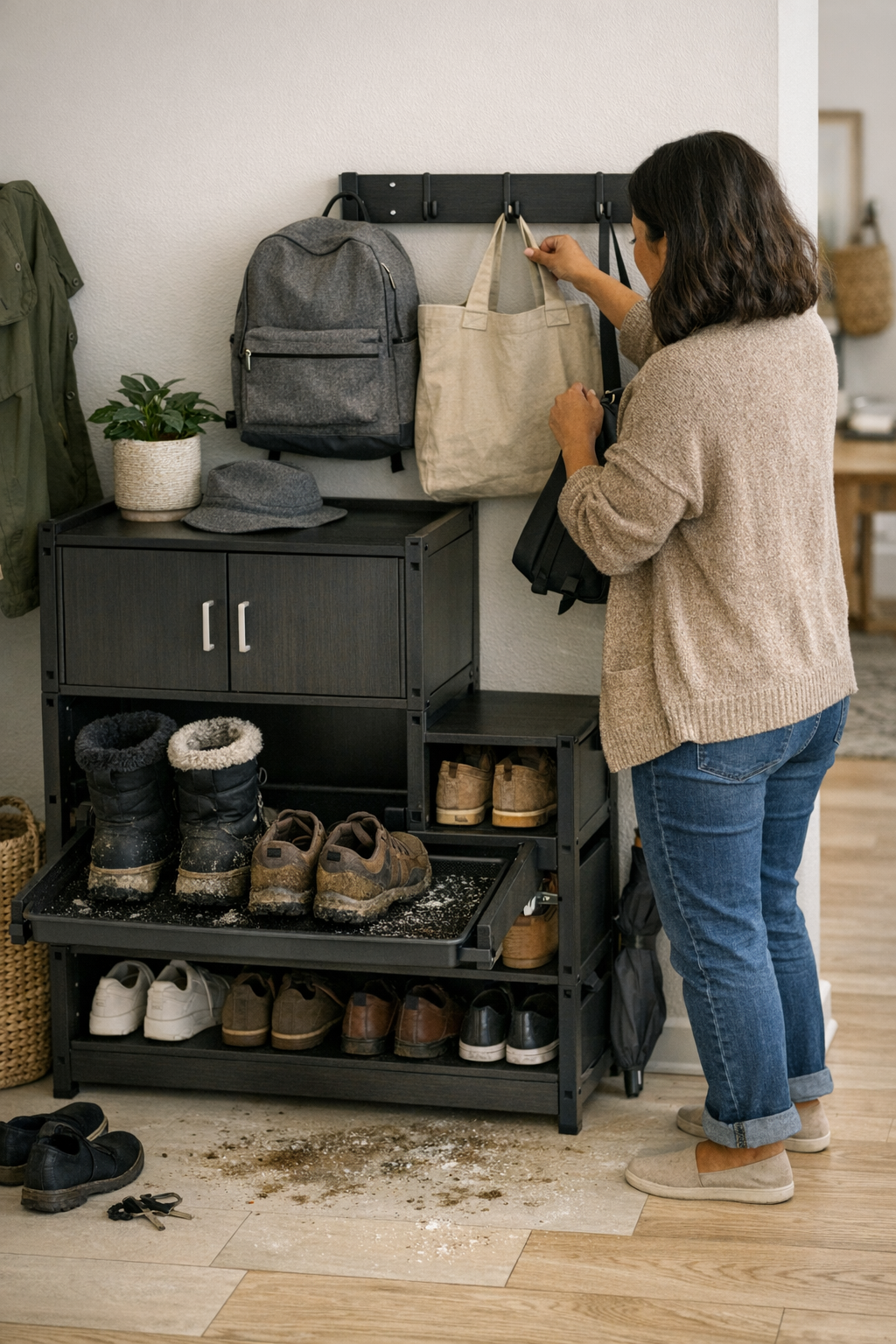
    Combining closed storage with targeted debris catch zones stops visible clutter from turning into invisible buildup. A mesh boot tray, set precisely at the drop point, pulls mud and grit off shoes before it can spread, shrinking the cleanup area immediately and cutting the urge for constant sweeping. Wall hooks set above or beside the bench prevent bag drift and free up floor space—the difference between a slow buildup and a pass-through that stays usable all week. This isn’t about pushing the mess out of view; it’s about rerouting the inevitable traces of return into points you can reset fast, with minimum effort and maximum reliability.

    The Ongoing Routine: What Stays, What Gets Stuck

    Light-floored entries require frequent, micro-cleanups—skip a few days, and you lose the zone. A quick brush or once-over with the vacuum is a daily ritual, not a deep weekend reset. For cabinets, treating the inside as a visible part of the floor and cleaning it once a week cuts down on surprise grit. Open benches make more sense when paired with a habit: every return, shift bags up onto their hooks and nudge shoes back into line before the mess multiplies. The point isn’t a perfect look, but a passage that doesn’t stall your day, no matter how many times you cross it.

    Smarter Storage = Smoother Returns (But Not Perfection)

    The strongest entryway setups for bright floors prioritize quick resets, clear path access, and flexible routines. Pairing trays and racks for visible, easy dirt containment with well-placed modular benches and wall hooks shrinks both scatter and slow buildup, side by side. The aim is not showroom perfection—it’s the difference between a daily reset you actually perform and a zone that slips back into full-block mode as soon as you look away. Entryway control is practical, always in motion, and only as smooth as the habits your storage quietly supports—not just the impression it makes when nobody’s at home.

    For practical entryway storage solutions that work with real routines, visit Betweenry.

  • How Reducing Shelf Items Creates Smoother Daily Storage Routines

    A shelf that looks “organized” from the hallway can quietly sabotage your daily routine. The lineup might appear efficient—books packed tight, baskets slotted in, every gap closed—but the real test comes at 7 p.m. when you try returning a library book or make room for incoming groceries. Suddenly, order breaks down: a line of books shoves back, pantry items balance on one another, the mail basket surges past its limit and starts swallowing car keys. The flaw isn’t always striking, but it’s constant: blocked return flows, awkward reshuffling, and edge spillover that slows everything from a quick exit to a tired evening reset. When “full” feels organized but actually jams daily use, you’re seeing a setup mistake that costs more time than visible mess ever does.

    When Shelving Gets Too Full for Daily Life

    A storage zone only works when it matches how things move in and out—not just how much it can display. The stress point appears when you try to put things back, not when you take them out. A jammed shelf means you’re wedging in folders, squeezing bowls behind jars, or hovering near a hallway stand debating whether it’s worth rearranging to fit a backpack. This isn’t dramatic, but it’s the reason a setup that seems sorted in the morning feels overloaded by night. Some clear examples:

    • A bookshelf crammed end to end—returning a single novel means tugging out a row or leaning books at unstable angles.
    • Pantry shelves packed to the edge—new groceries force you to juggle bags or push far-back containers deeper.
    • Entryway benches lined with bins—coats, mail, and random odds pile up until your keys disappear beneath the surface clutter.

    Each scenario is a repeated cost: the return flow stalls, every drop-off becomes a minor obstacle, and moments pile up as you move, wedge, or re-stack routine items. Shelving that’s technically organized transforms into a friction point that makes every reset feel like work.

    The Cost of Seeming Order: When Categories Blur and Routines Stall

    Visually neat shelves promise easy retrieval—but overfilled setups lose that edge quickly. The push to maximize space creates hidden choke points. Add a single oversized bowl or an extra batch of towels, and suddenly you’re shifting piles or shuffling stacks, sometimes just to make room for the next item. Over time, overflows creep to the front: pens land in key trays, socks drift onto linen shelves, and the “sorted” look slips as categories unravel.

    Category drift rarely explodes—it seeps in. The kitchen’s art drawer fills with paper scraps; “temporary” laundry ends up as a semi-permanent mound on a hallway bench. Sifting through random things to find what you actually need is the clearest sign that the system supports stuff, not you. The more categories blend, the more every grab-and-go turns into slow-motion rearranging.

    Active Zones, Repeated Tests: Why Shelf Breathing Room Makes a Difference

    You’ll spot the true cost of a packed shelf fastest in the busiest zones—where items cycle in and out multiple times daily:

    • Hallway bookshelves: Library books and mail compete for space; a single out-of-place binder sends the whole line drifting off axis, and the key dish slowly disappears beneath stray paper.
    • Kitchen storage: New groceries force quick Tetris—stacking, shifting, pushing containers out of easy reach—until food is forgotten at the back or jars tip when browsed.
    • Laundry setups: Detergent, baskets, cleaning supplies vie for shelf inches; laundry day begins with moving everything just to reach the basics—a routine that always adds steps.

    Each “reset” reveals whether a storage setup can handle a surge or if a single busy afternoon starts the domino effect of cleanup, rearrangement, and category drift. The more often you repeat the cycle, the more a shelf either supports or interrupts your real routine.

    Turning “Full” Into “Functional”: The Open Hand’s Width Rule

    The step from overstuffed to working shelving isn’t about becoming minimalist—it’s about creating buffer space. Clearing out just enough that every shelf has an open hand’s width toward the front transforms returns: items slide in without nudging neighbors, bags settle on pantry racks, mail slips easily into its tray on a busy morning. Usually, this means removing a third of densely packed contents—a reduction that feels almost wasteful but quickly proves its worth.

    Try this: pull out two platters you rarely use from a kitchen shelf. Suddenly, you can lift a pot on and off without causing a chain reaction of shifting pans. Whittle a hallway stand to just current school folders, and placing today’s mail no longer jams the space or knocks keys out of reach. The difference is tangible in every reset: you don’t need both hands free, extra balancing, or a “for now” pile that becomes next week’s clutter spot.

    Real-World Reset: Seeing the Benefits Over Time

    A shelf with visible breathing room might feel too bare on Monday. By Friday, it’s the setup that actually absorbs the week’s mess—books get moved, groceries cycle through, yet nothing requires major rearranging. Resetting—pushing items in line, shelving a pan after dinner—happens almost as a side effect, not a chore, because the structure allows recovery without making emptying or restacking a daily task. Category lines hold up longer, habits don’t slide, and minor disorder never turns into stalled routines.

    Buffer Space Isn’t Wasted—It’s What Makes Storage Work

    That open margin on a shelf feels wrong at first—especially if space is at a premium or you’re used to filling every inch. In use, though, that hand’s width is what rescues your routine on a busy morning, catches overflow before it blocks a path, and keeps the shelf from becoming a static storage trophy. Buffer space absorbs the unscheduled: sudden grocery runs, surprise stacks of paperwork, laundry that doesn’t happen until tomorrow. Rather than wasted territory, the margin is the flex point that allows repeated access without slowdowns, spillover, or reset fatigue.

    If you notice clutter seeping back, it’s rarely because the shelf is underused—it’s the cue that forgotten, misplaced, or out-of-category items have landed in the zone. The repair isn’t a full reset; it’s a rotation—pull a stray stack, send drifted items home, and reestablish the buffer. Storage works best when it mirrors how you actually use—and return—things in cycles, not how it looks during a one-time sort.

    Practical Tips for Reclaiming Shelf Performance

    • Remove items that don’t align with the shelf’s main job—the tray that never leaves the hallway, seasonal gear clogging a kitchen rack.
    • Each week, scan for items that have drifted in under “just for now” and move them out before they settle in permanently.
    • See open shelf space as functional, not wasted—a margin for tomorrow’s rush or next week’s unknown.
    • Spot places where you routinely stash things in transit; tweak the setup so those items have a better return point, or the layout naturally blocks long-term pile-up.

    The aim isn’t to make your shelves look empty, but to make them work—under pressure, across busy stretches, and through real-life cycles. It’s the shelf that stays easy to use, not just easy to photograph, that transforms daily order from a brief win into a lasting advantage.

    Explore practical storage that fits real routines at Gridry.