Category: Yard & Utility

  • Prevent Sticky Stains with a Drip Tray in Utility Cabinets

    A single missed drip in your entryway cabinet is all it takes for a clean zone to unravel fast. You’ve done the reset—the bottles are lined up, the shelf wiped down, everything looks ready to handle the daily shuffle. But entry and drop zones are built for repeated crossings, not just looking controlled after a big clean. Without a drip tray, every detergent bottle, spray, or muddy container leaves you playing catch-up: thin films, crusted residue, and sticky edges start spreading almost invisibly along the spots you touch and pass through the most. The setup might pass for organized, but under steady use, even a tight routine breaks down—one leaky cap or missed wipe is all it takes for the mess to mark a return path through your threshold space.

    A Hidden Mess That Builds Up Fast

    At a glance, the problem doesn’t even look like a problem. The shelf is spotless on Monday; by the next Saturday, after shoes grind past, bags jostle bottles, and someone tosses in gloves, a dull film quietly inches across the surface. Every time a bottle’s not capped straight, drips trail outward. Shoelaces snag at the edge, cuffs drag through unseen stickiness, and backpacks travel through the “clean” zone only to pick up a stripe of grit. The moment you sling a bag, hear it thud, and later notice it carried out the smear—that’s when you know the reset didn’t hold.

    When Resetting Becomes Real Chore Work

    Ignore the slow leaks, and cleanup turns from a quick swipe into real scrubbing—hardened lines that claw onto anything brushing past. The cabinet looks composed from a distance, but up close, every detail reminds you what got missed. Resetting stalls out as you pick at streaks and run down gray build-up, the original order fading far sooner than you planned. This isn’t a fix-and-forget zone; it’s a stress loop—mess returns because movement through the space never really stops.

    How a Simple Drip Tray Shifts the Routine

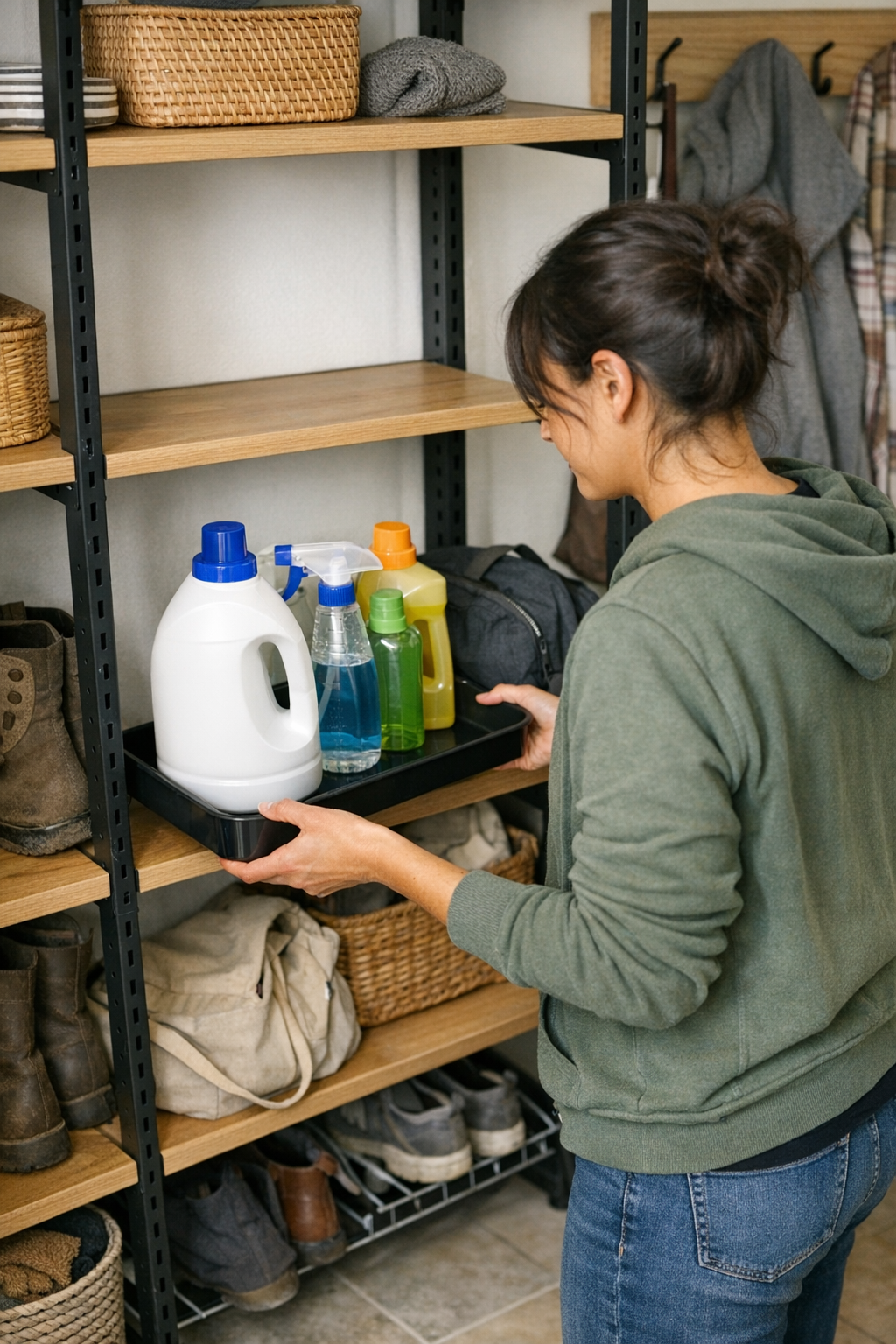
    Positioning a drip tray right under bottles and detergents forces the zone to behave differently. The tray doesn’t just catch big spills. It quietly absorbs those slow, creeping leaks that always seem to beat the wipe-down. Suddenly, after a week or two, the surface around your storage stays dry to the touch—no more sticky shelf edge, no more crusted smears at the seam. Cleanup resets shrink: grab the tray, rinse it, put it back. Instead of dragging out the reset, the process collapses into a simple lift-and-wash–no scouring along awkward seams or chasing stains under bottles that never really get moved in daily use.

    The Real-World Difference After Repeated Use

    Set two entry setups side by side: a tall cabinet clustering bottles low, or a bench drop spot crowded with wipes and gear. Both reset fine, but after a few days, the setup without a drip tray shows its weakness: sticky ridges fan outward, finger-width and hard to spot until a shoe edge finds them. Bottles set back crooked, containers jostled out of line—all it takes is normal movement to start mess creeping past the intended boundary. Neighbors get marked; gloves, bags, and sleeves show stripes you didn’t notice leaving. The tray version contains all that behind a single edge, holding back spread, and making the mess simple to intercept before it becomes routine cleanup drama.

    Entryway Scenes: How Mess Moves Without a Tray

    It’s raining, boots come off, coats pile on hooks, and someone tosses a half-closed cleaner bottle onto a shelf edge. By morning, a ghostly ring has formed—a visual cue right where you grab for the next item. The ring thickens as bags, sleeves, and hands graze it. The mess goes mobile: a bag corner absorbs the residue and carries it to the next room. That dirt isn’t just limited to the shelf—it spreads to the bag, the jacket, the hallway floor. Cleaning up now means extra steps, chasing tracks away from the entry instead of wrapping up at the source. Every missed intercept expands the reset chore past the transition space.

    Working Against the Daily Drift

    Transition zones either reinforce your routine or break it down. Without real containment, clutter and mess expand faster than you notice. Drop a glove, rush a bottle back at a slant, and the cycle begins again. In a high-use entryway without a tray, quick fixes pile up: extra mats that slide, wipes that bunch and clog, shelves doubled up and reshuffled until the original reset is buried under patches. None of these actually holds the line against the drift—they just delay the next full reset.

    Replacing Shelf Mats with a Shaped Drip Tray

    Mats seem practical, but flat mats migrate, fold, or bleed moisture over the very edges they’re meant to protect. Over time, drips sneak underneath or around, forcing you to clean what’s supposed to be covered. A real tray—shaped slightly wider than the bottles, with a subtle raised lip—blocks those leaks from ever getting to the wood or metal beneath. With enough room for a quick lift, you’re not wrestling the tray out or spilling its load back into the cabinet. Reset time drops from a tedious ten-minute wipe-and-scrape to a two-minute rinse—no hunting in corners, no old spots under forgotten bottles.

    What to Look for When Choosing a Tray

    For high-turnover storage, the ideal tray is shallow but firm, edged just enough for containment, and sized to slide in and out without pinching. Too deep, and you jam every reset; too shallow, and seepage wins. Most entry setups only need a weekly rinse—unless you’re deep in gardening season or cycling heavy outdoor gear, in which case, quick lifts catch the worst before it hardens. One everyday test: if grabbing the tray feels awkward or blocks item flow, it’s wrong for the spot. Fast resets and open movement matter as much as leak control.

    Beyond Bottles: Trays for Planters, Boots, and Mixed-Use Corners

    Drip trays aren’t only for cleaners. Under a watering can, beside sprays, or at the base of a bench where boots drip and plant gear rests, a fitted tray prevents pooling water or streaked soil from creeping outward. In zones meant for both indoor and outdoor traffic, anything set down wet or muddy becomes a candidate for containment. The trick is making the tray flush and free-moving—any delay or friction and the tray becomes a setup you avoid, which means the leaks return and the cycle restarts.

    From Stubborn Stains to Simple Resets

    Boil it down: a drip tray transforms the reset into a single action. No more scrubbing layered residue, no more guessing what’s growing under a bottle pushed to the side. The edge stays cleaner, clutter stops jumping zones, and your threshold isn’t a hidden mess waiting to appear next week. Not every drop-spot leaks equally, but the difference between an exposed shelf and a removable tray is felt after a few cycles. Each re-entry takes less effort, and the area works for your routine—instead of you working around its weak point.
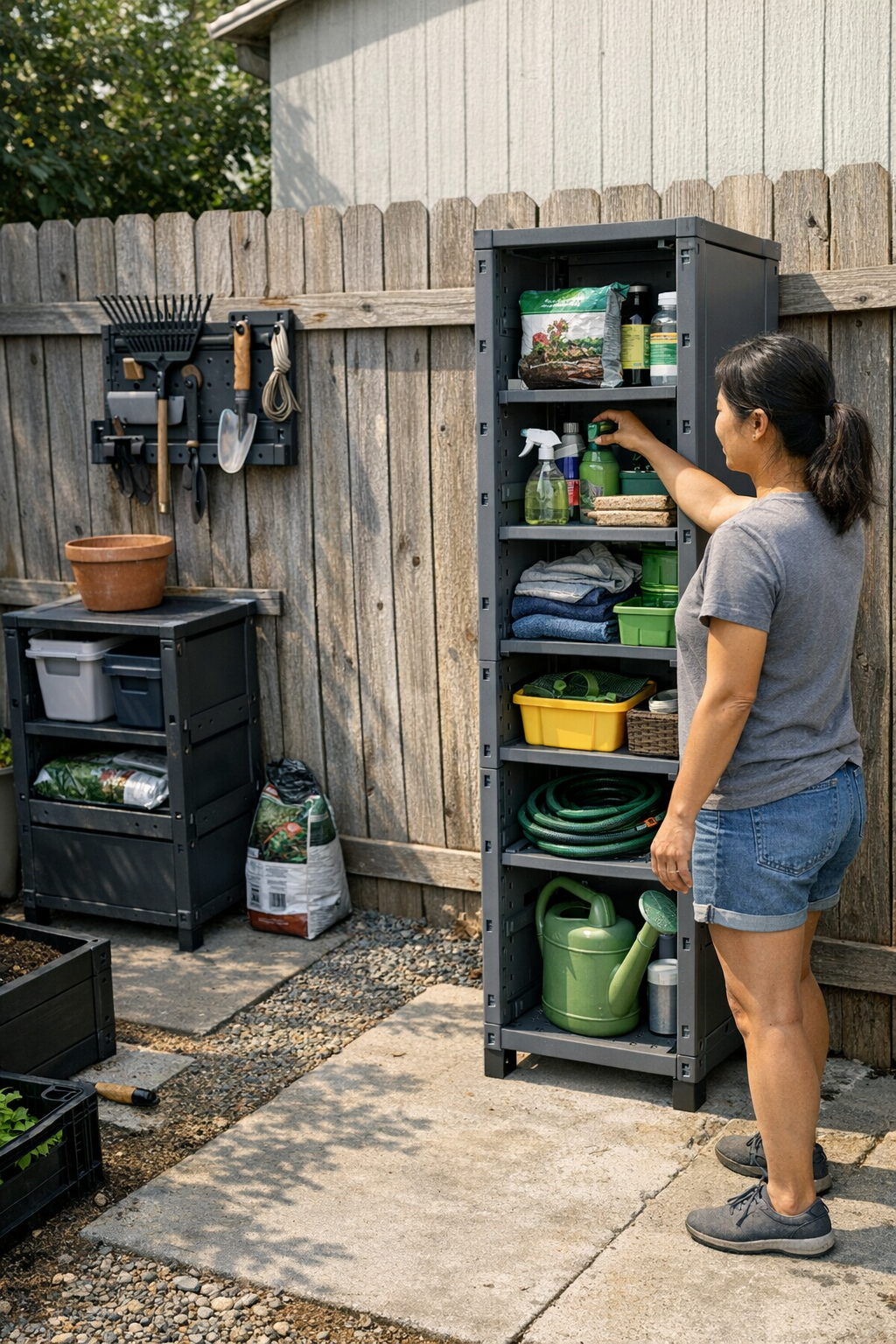
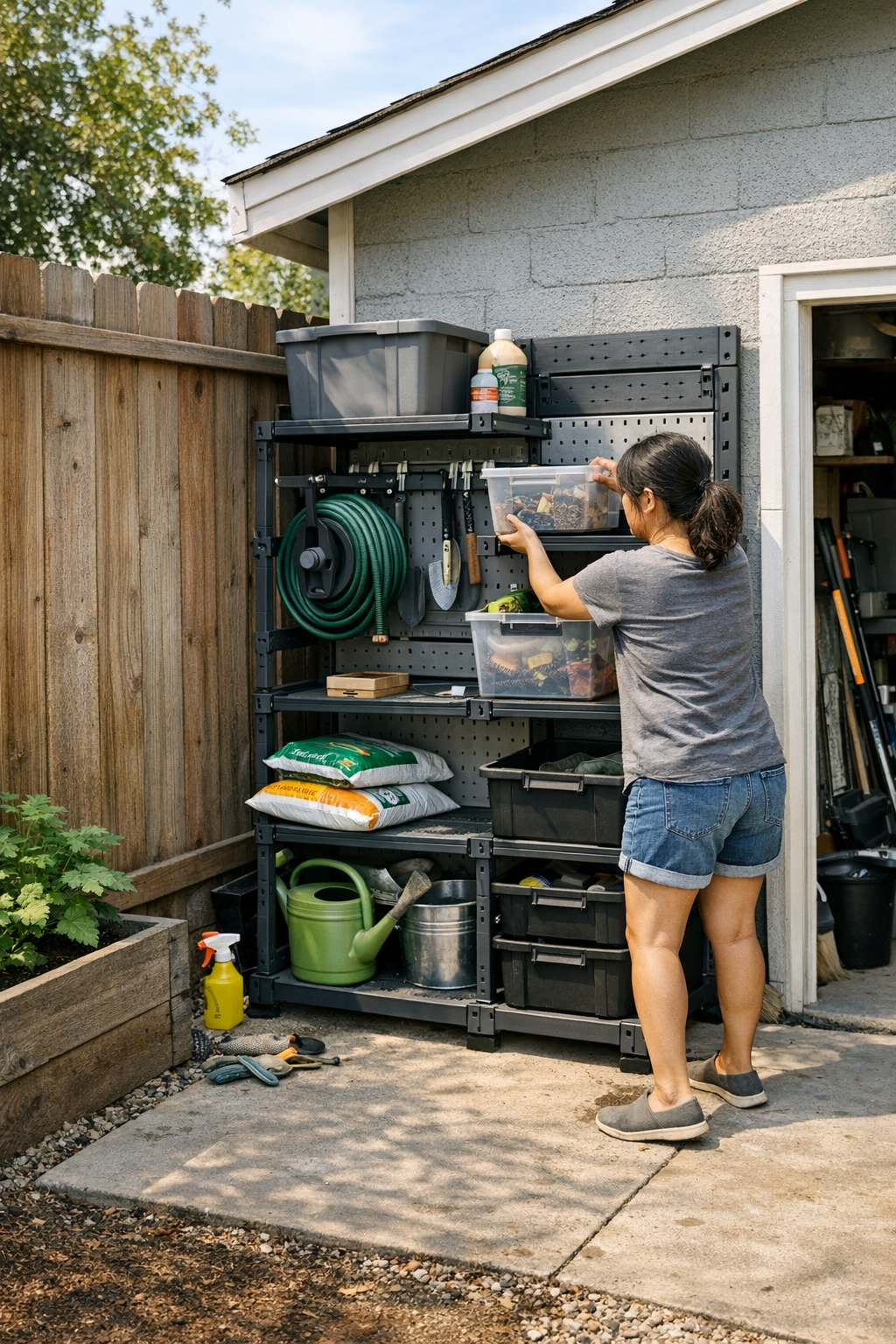
    Shop Betweenry transition-space storage solutions

  • Choosing Narrow Linen Cabinets That Simplify Small Bathroom Storage

    In a small bathroom, the difference between a space that works and one that wears you down shows up the moment someone reaches for a towel and comes away with a pile of clutter. A narrow linen cabinet might seem like a neat solution—until you live with the fallout: doors blocking the sink, shelves too deep to reach without removing half the front row, items drifting out of sight, and every quick grab turning into a slow shuffle. What looks orderly right after install can, within a week, become a zone that interrupts the actual flow: slow retrievals, doubled-up returns, categories blending, and a constant sense you’re resetting the same mess twice.

    Where the Trouble Starts: Crowded Corners and Blocked Moves

    The real trouble isn’t just fitting a slim cabinet in—it’s what happens every time you move through the space. Maybe you tucked spare towels and essentials into that vertical footprint, getting them off the counter or floor. But now, the door swings wide and collides with the edge of the sink. Your hand cranes around an obstacle just to return a bottle, and the next morning, someone brushing their teeth is in the line of your awkward reach. Each shelf return becomes a moment of either shoving or balancing, and every shared morning pushes the limits further: you wait for access, try to stow something mid-routine, bump elbows, give up, toss it back in, and the “organization” unravels faster than you expect.

    Shared bathrooms multiply this friction. One person wants the lower shelf while another needs sink access. You reach for your go-to moisturizer and get blocked by a sibling’s hair spray, which already migrated sideways. Every overlap is another layer of inconvenience, making small annoyances stack up until the zone actively slows everyone down—especially when routines collide at peak hours.

    Deep vs. Shallow: The Hidden Catchall Trap

    A tall, slender cabinet looks composed at first. But open those deep doors after real use and the system starts slipping: towels buried behind a front line of bottles, washcloths lost behind stray soaps, and basic items only reachable after moving what’s blocking them. This double-row trap happens almost automatically once shelf depth outpaces a comfortable forearm reach.

    The farther the shelf, the more each daily grab moves things forward—and overflow gets banished to the dark back. When your return flow is broken, a “sorted” system becomes a jumble: old products hide behind new, categories mix, and the time to locate basics increases every day. After even a short stretch, you’re not maintaining order—you’re excavating the same zone over and over, with every missed restock amplifying the mess. That’s not just a cosmetic issue; it’s a real block to fast, repeatable routines.

    Real World Example: The Shared-Bath Shuffle

    Picture stepping into the bathroom, late and on autopilot. The cabinet door nudges the sink, squeezing your arm as you reach. In grabbing a towel, your hand knocks over three travel bottles—someone else’s product slipped in from yesterday. The stack you organized on Sunday has already spread into a lopsided pile, with loose items filling gaps in ways that barely make sense. You dig, restack, and by the time you’ve found what you need, you’ve sabotaged tomorrow’s attempt at order. Multiply this for every person using that zone, and you get bottlenecks that slow down the entire morning shuffle.

    Function Over Footprint: Why Shallow Shelving Wins

    The best-performing linen cabinets usually don’t look complicated or “maximized.” Cabinets with shelves capped around easy arm’s reach—typically 12–14 inches—quietly outperform deeper setups in daily life. These shallow shelves force everything into one visible line. No blind search, no double-row traps; just a clear, nothing-hides design that speeds up retrievals and resets.

    After switching to shallow, category-sized shelves, resets shrink into simple checks: folded towels fit cleanly, bottles and small items stay up front, and you stop spending time excavating for basics. There’s less opportunity for spillover—everything has a slot, and nothing is forced behind something else. By midweek, the old pattern of category drift is gone: towels hold their pile, personal items aren’t exiled in random gaps, and the shelf stays ready without three rounds of digging.

    Quick Tip: Dedicate a Zone for Small Supplies

    If bottles and boxes keep slipping forward and creating chaos, drop a shallow basket or tray on the lowest shelf. There’s no need for a complicated system—this barrier keeps small items contained and stops them from breaking up stackable categories. The separation is simple but reliable, shaving time off every reset and reducing the temptation to stash random products in whatever gap is available.

    The Reset: Less Work, Real Flow

    The real payoff isn’t that the bathroom always looks perfect; it’s that order is easier to return to, even after a high-traffic day. With shallow, well-zoned shelves, putting things back doesn’t require guesswork or contortion. The improvement isn’t abstract—it’s right in the motion: you move, grab, and return without pausing to fix the system first. Order lasts longer, daily navigation is smoother, and small resets replace weekend overhaul sessions. You spend less time fighting the cabinet, and more time just using the space the way it’s meant to work.

    No design erases all friction, but with the right depth and shelf layout, a linen cabinet finally joins the routine as support—not an obstacle that needs constant workaround. The result isn’t showroom-perfect—it’s a zone that functions with you, not against you.

    Find more sensible bathroom and storage solutions at Gridry.

  • Why Flexible Zones Outperform Fixed Layouts in Small Outdoor Spaces

    The real test of an outdoor setup never happens on day one. A space that looks perfectly organized—patio edged with tidy shelves, a side strip freshly cleared—carries an invisible timer. Come back two weeks later, after rain, projects, and new gear, and the routine reveals what the setup can’t handle: a hose snaking across the walkway, tools wedged together, bins already overflowing into the best shortcut from gate to door.

    The Real-Life Test: When Storage Meets Real Use

    It’s simple to feel satisfied with a weekend’s work—wall units leveled, garden tools lined up, floor space opened at last. But as routines kick back in and the seasons change, the cracks widen. The trowel that barely fits now blocks the watering can. Bike helmets multiply on the rack meant for boots. Movement slows, and suddenly, what started as better flow is now a string of small obstacles: clattering handles, the stepladder lounging in front of the only outlet, plastic bins stacked high enough to tip when you pull the bottom one free. The daily act of returning or retrieving even a single item becomes a negotiation with the arrangement itself.

    Flexible Zones vs. Fixed Layouts: When “Looking Right” Isn’t Enough

    Anyone with a multipurpose outdoor strip—the patio edge doubling as tool storage, that narrow side-yard, or the classic garage threshold—knows the seduction of clean, fixed layouts: a wall grid, permanent shelves, a designated rack for everything. On setup day, it echoes a magazine spread. But new needs arrive relentlessly: a leftover paving stone, an umbrella that won’t stand, another bag of soil, last month’s forgotten plant stakes. Inevitably, one zone starts swelling with the overflow. Suddenly you’re pulling out three bins to reach what’s behind them, or doing a lopsided dance to drag the mower past something that never should’ve been in the way.

    Real scene: “The neat shed” in early spring is all intentions—a crisp path, tools on the wall, buckets nested. Fast forward six weekends: clutters start pooling. Garden hoses don’t fully rewind, soccer balls drift into the walkway, the wheelbarrow migration involves a brief tool-rescue operation every time. By summer, watering the border plants means weaving around a thicket of unsorted gear and side-stepping the permanent pile-up in that one awkward corner.

    Flexible Zones in Practice

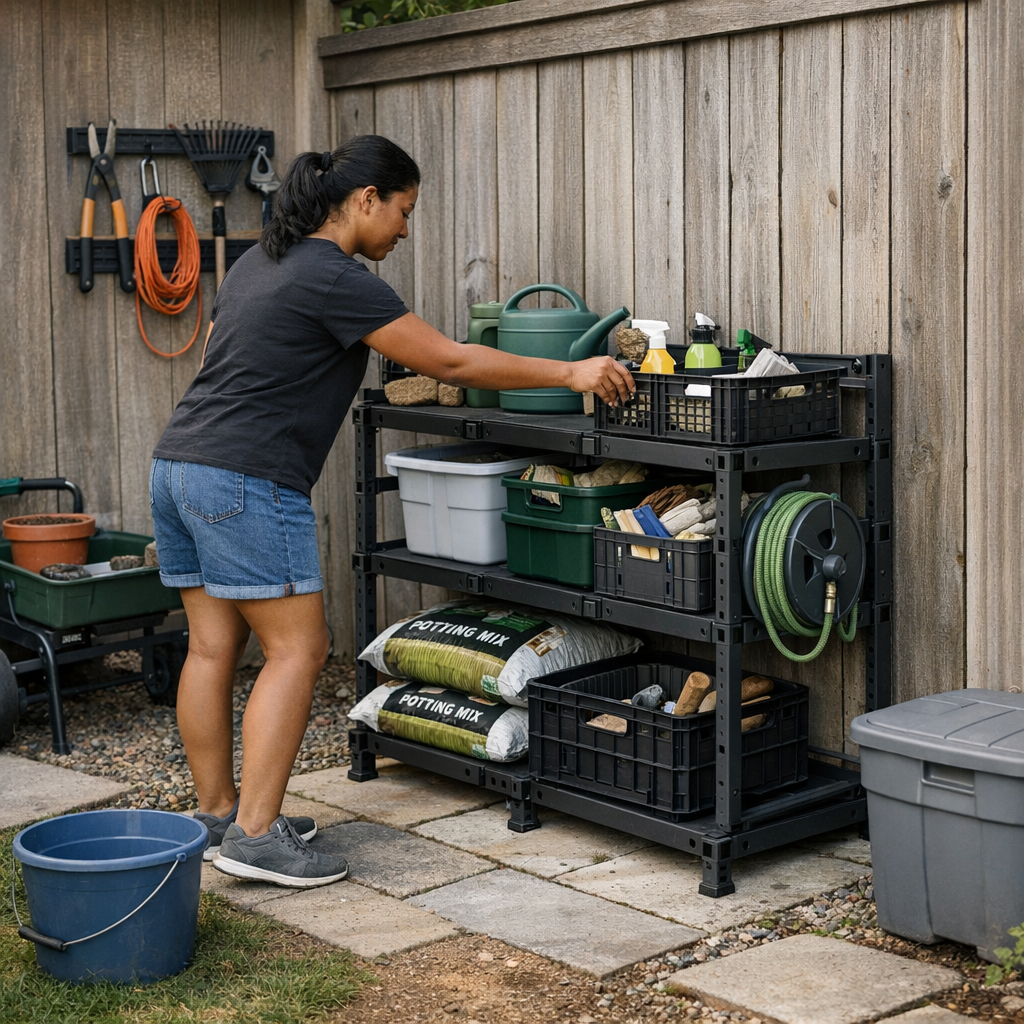
    Unlike rigid built-ins, modular racks, mobile carts, and stackable bins absorb real-life shifts. One extra tool? Add another bin, not another headache. Seasonal overflow? Slide out a rack, shuffle zones, keep paths open. Instead of being boxed in by the layout, you move the pieces—so minor changes don’t trigger a full re-organization and the return path to each item doesn’t keep getting longer.

    Why Clutter Creeps—And How Boundaries Snap Back

    The snag with flexibility: when nothing has a border, everything bleeds together. The gloves join the pool toys “just this once.” The overflow bin turns into a universal drop spot. One fuzzy weekend, you’ve gone from sorted to sprawled, with every clear surface up for grabs. Rather than a setup you can reset in seconds, you get scattered piles and an endless round of shifting things from zone to zone.

    Setting Boundaries That Actually Hold

    The flexible setup only works if each zone stays recognizable—tools here, sports gear there, seasonal overflows apart. Visual dividers, color-coded bins, open labels, even bold tape to mark walking paths—all help keep truly movable systems from melting into a single catch-all. When bins have clear fronts, carts are labeled, and the wall is functionally split between “weekly use” and “someday overflow,” clean-up is snappy, not daunting. Walking through, you know what lives where and quickly spot what doesn’t belong.

    Everyday Reset: Small Corrections, Not Total Overhauls

    A month in, the magic is this: the urge for the dreaded “big reset” fades. No more sinking feeling when you see a pile up. Instead, it’s tiny adjustments—slide the overflow bin back where it belongs, reverse a stray shovel, re-stack instead of dump. These 60-second resets clear space for tomorrow instead of becoming a weekend project. Friction isn’t gone, but it doesn’t snowball. You don’t need to fight the setup to keep it functional—just nudge it back when needed.

    Still, flexible zones have their own traps. The cart becomes a drop-off point you stop seeing, or an open bin swallows stray garden stakes until the season’s over. But now, correcting these is easy—move one thing, fix the flow, and the system works with you, not against you.

    Where Conventional Setups Fail: Dead Corners and Blocked Movement

    Weak setups announce themselves in quiet frustrations:

    • You return the garden fork—then realize the hose reel is now blocked until something else moves.
    • Every time you want the mower, you shuffle two bins out of a too-narrow path yet again.
    • That one back corner? Still a magnet for mystery objects, because it’s never gotten a real job in the zone.
    • The impressive wall rack turns boots and buckets into tripping hazards, because there’s no flow after a normal weekend cleanup.

    Fixed layouts turn small resets into big detours. They promise order but force you into roundabout routes or constant reshuffling. A setup can look sharp while still interrupting every routine. Flexible systems, when clearly divided, keep movement open—quick fix, go on with your day. The difference is every micro-adjustment is built in, not a breakage of the setup.

    Real-World Routines: Keep It Useable, Not Just Organized

    • Take one minute after any busy afternoon to put the mobile bin back or re-mark walkways. Small resets fight creep the whole season.
    • Give each flexible zone a visible identity—labels, color, or tape for “this is garden gear, this is toys, this is just overflow.” It matters more as the space gets tighter or more mixed-use.
    • Let overflow roll, not sprawl. The bin or cart on wheels takes the blow, then gets reset—instead of the whole path turning into a tripping maze.

    The Setup That Stays Useful—Not Just Tidy

    A practical outdoor system isn’t about perfect order. It’s about setups that bend with the routines, block out permanent pile-ups, and let you keep moving through—even after a rush, a project, or a storm. The difference between “organized” and “useable” isn’t how things look after setup; it’s how well the system handles all the imperfect, repetitive ways things actually get used—and returned—every week.

    The setups worth building don’t flatten every friction point, but make it easy to see what’s out of place, correct course with a quick move, and find a clear path after the next errand or chore. When the outdoor zone keeps working through the real-life mess, you spend less time shifting, less time searching, and more time just moving through. That’s how a backyard or utility strip stops being a silent frustration and starts making the rest of the home run smoother.

    Visit TidyYard for practical outdoor storage solutions

  • Optimize Entryway Cleanup with Strategic Paper Towel Placement

    How many times has a muddy shoe, dripping boot, or paw print made it straight past your entryway cleanup point before you even reach for a towel? Threshold zones are where the mess hits first—and too often, cleanup supplies get stranded just out of reach or buried behind overflow. Every extra step to fetch paper towels lets mud and water drift further, pressing the same pain point every week: the distance between real-world entry routines and where your cleanup tools actually land. If your entryway looks set up but falls apart by Wednesday, it’s not just clutter—it’s reset friction built in by placement that doesn’t match your real movement.

    Reset Friction: The Tug-of-War at Your Entry Door

    After a wet commute or a muddy walk, what actually happens by the door? Shoes get kicked off near the bench. Bags drop wherever there’s an inch to spare. Coats swing onto hooks or get draped across benches. Just one misplaced mop or hidden towel sets the stage for streaks that slide past the “drop zone.” You detour, dig behind bins, unearth a roll from inside a shoe pile—and by then, water has already crept under the rug. Every clumsy workaround—swapping hands between bags and boots, stretching over crowded benches—adds seconds and leaves the threshold losing the race against routine mess.

    More Than Visual Mess—It’s a Workflow Breakdown

    A towel holder mounted too high, squeezed behind bags, or left floating on a shelf doesn’t just look off—it interrupts cleanup where it counts. In practice, a towel drifted behind overflow or lost under a bench means you wipe up only after dirt spreads. Maybe the zone is sorted in the morning, but after a few rounds—school drop-off, dog walk, grocery haul—towels are out of the reset loop. Mess drags deeper into your space and resets slow to a crawl.

    What Actually Changes When Placement Matches Routine?

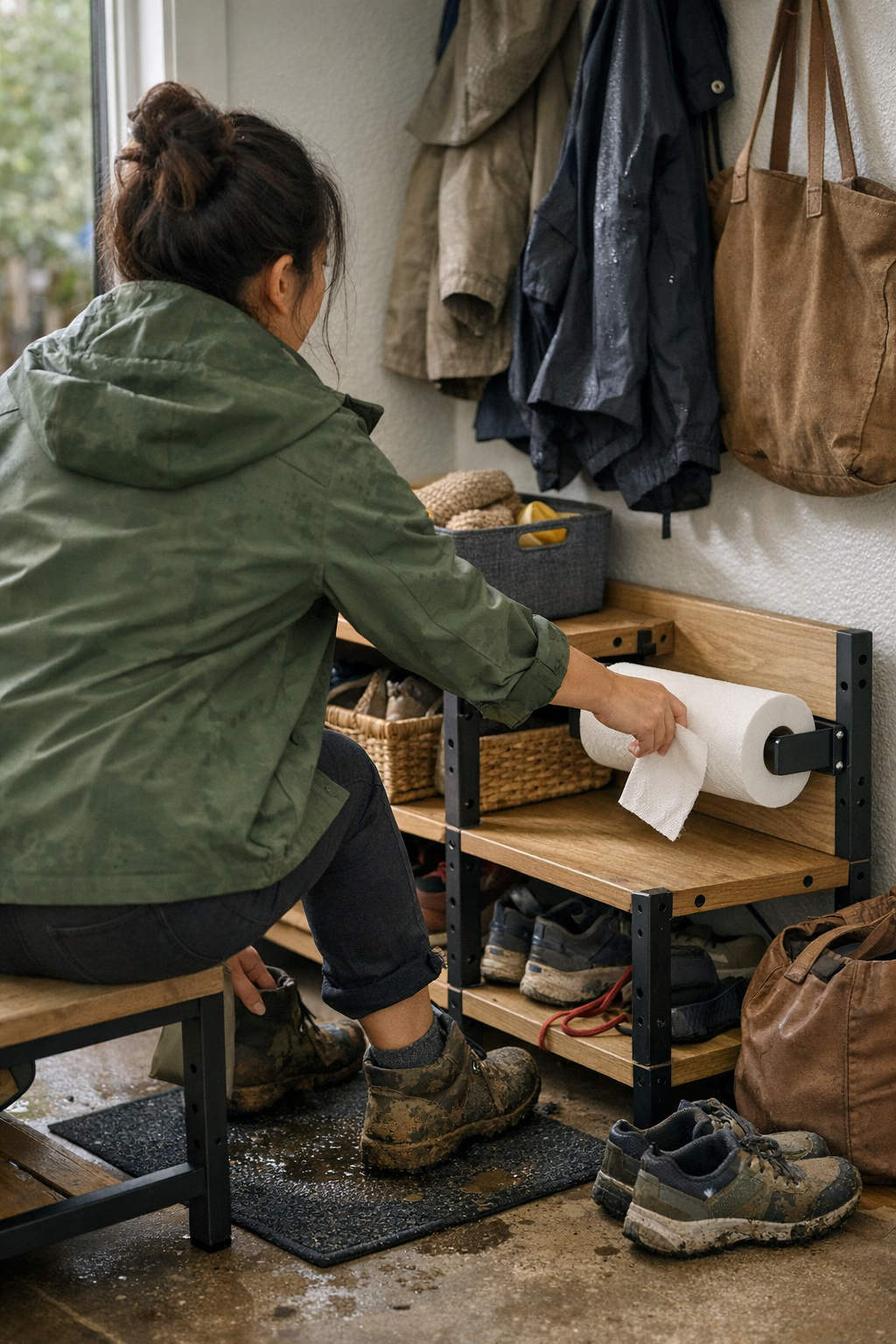
    Picture this: you walk in with soaked boots and heavy bags. Instead of zigzagging behind storage bins, a wall-mounted paper towel holder sits at bench height—right where you sit (or help a child) to unlace shoes. You pull a sheet mid-process, mop up the puddle before it chases your socks, and keep the flow moving. The difference is immediate: cleanup stops being a chore that lags behind and becomes part of the movement—no separate step, no “I’ll get to it later.”

    Why “Above the Bench Line” Solves for Repeated Use

    Bench-level mounting means towels are in reach as you sit or crouch for shoes, not perched where dirty hands have to stretch or double back. Go too low, and holders get blocked by boots and bags; too high, and you’re up and down, dripping water along the way. Every struggle—mud slipping by, paw prints racing across tile, water sneaking toward a living room rug—gets intercepted before it’s a reset crisis. Cleanup merges seamlessly with whatever task brings you through the door, not tacked on as an afterthought once the damage is done.

    “Good Enough” Entry Storage Rarely Survives the Week

    The temptation to use whatever shelf is free, toss in bins, or add a loose countertop roll is strong—until routine takes over. Most setups work for guests but collapse as soon as the traffic ramps up. If your towels and wipes aren’t anchored exactly where people land, daily use reveals the weak spots:

    • Back-and-forth laps around dropped shoes and bags, just to find cleanup supplies
    • Hands grabbing surfaces while searching, leaving extra smudges and streaks behind
    • Dirt sneaking past the line during a rain cycle, especially when resets fall behind

    By day three, shoes have overflowed, the paper towel roll is wedged behind the bench, and the threshold looks less like a managed drop zone and more like a spreading mess—again.

    Visible Difference When Entry Flow Is at Max Load

    The crunch shows up during high-traffic runs. Imagine three arrivals in 20 minutes: a rain-soaked kid, a dog that shakes off, groceries coming through while everyone fumbles for dry ground. When holders and towels are mounted right at the bench edge, every drip and splash gets handled on the spot—before a single footprint drags it deeper. Loose supplies, on the other hand, turn “just five minutes” of deferred cleaning into tracked-in grit and a shrinking window to reset before the next round. Quick laps turn into full cleanups—and everyone’s late.

    What’s Actually Different After a Placement Fix?

    Good entry setups aren’t just about less apparent clutter; they build in a rhythm. A well-placed wall holder at seated height trims out the most annoying steps: no searching with muddy hands, no trailing grime back over just-cleaned tile, no “reset round two” when someone else comes through. Instead, cleanup happens naturally during the process—more clarity, less mental drag, visible difference before you even think about it.

    How to Anchor Cleanup Where Action Actually Happens

    Stop letting towels, wipes, or rolls drift out of your real path. Mount at bench height, always within a simple seated arm’s reach—never up at shoulder level, never hidden behind bins, never as a loose accessory floating above the drop zone. Physically walk your door-to-bench route and see where your hand naturally lands as shoes come off or bags hit the ground. The difference between one smooth reset and a series of cleaning headaches usually comes down to these few feet—between what seems “away” and what’s actually in the line of movement.

    Practical Entryway Placement Tips That Actually Work

    • Keep the main walk lane wide and clear: mounting holders off to the side avoids blocking a fast path, even if centered storage looks neater.
    • Secure for actual use: wall-mounts that keep towels dry, off the floor, and reachable for both adults and kids outlast floating setups every time.
    • Pick slim profiles: wall- or side-mount holders that fit tight entrywalls and tuck within arm’s reach prevent spread, crowding, or new trip hazards in compact transitions.

    From “Looks Organized” to Works Every Time

    Entry setups that focus on visual order—stacked bins, matched baskets—often collapse when real life starts hitting the threshold at speed. The gap between a tidy zone and a functional transition point is usually where items are anchored. Move a towel holder to the right moment-of-action and you’re not just fighting clutter; you’re closing the slowest, most ignored leak in your whole reset routine.

    This isn’t about making mess disappear. Most of the gain isn’t even visible on a good day—it’s in the weeks when nothing else changes except fewer detours, fewer missed wipes, and faster resets when the weather turns or the schedule stacks up. Entry setups that keep up don’t just look under control—they feel lighter, less interrupted, and built for movement, not just for show.

    http://www.betweenry.myshopify.com

  • Why Storage Benches Fail Without Clear Separation and Fast Retrieval

    No one expects the storage bench by the door to become a source of delay—but within days, it often does. What began as a shortcut to a cleaner entryway becomes an obstacle: shoes jammed together, bags swallowed into the pile, and the lid hiding an ever-growing tangle. The promise of “grab and go” vanishes the first time you’re pawing through a box of everything, blocking the walkway you meant to clear in the first place. This is the shortfall of a storage bench: not in the basic idea, but in what fails once repeated routines, multiple users, and real-life limits hit at the same time.

    When the Storage Bench Becomes a Stumbling Block

    Most storage benches are designed to look like tidy solutions—a place to sit, a spot for bags, and a lid that hides scattered mess. But the truth is, a bench with a single open compartment becomes a friction point as soon as it absorbs more than one category of need. Without internal dividers or clear boundaries, shoes end up wedged under coats; stray headphones drift into the murk with yesterday’s beanie; school books and shopping totes press against each other until finding anything requires a rescue operation. Once the lid is down, everything drifts.

    Try opening a crowded bench after two weeks of real use: instead of “grab-and-go,” it’s “dig and scatter.” You reach for a glove, end up sifting through sneakers, and finally give up with contents spread across the hallway. What was meant to streamline your exit now blocks your way, and the simplest retrieval winds up as a five-minute sidetrack that leaves the area messier than before. Resetting the bench—putting everything away again—feels like starting from scratch each time, which usually means it doesn’t happen at all. The bench keeps absorbing overflow until it quietly becomes the new clutter zone, hidden behind its own lid.

    Shared Use Exposes Weaknesses Fast

    Put a single bench in the path of everyone who lives with you—and any invisible flaw shows up fast. In shared apartments, family homes, or companion-heavy hallways, the bench becomes a battle zone. During the weekday rush, you watch as three pairs of shoes tumble on top of someone’s lunch sack, last night’s umbrella tangles with headphones and a missing set of keys, and the rebuilding starts before anyone even gets out the door. Access slows for everyone: one missing item triggers a mass excavation, and whatever doesn’t fit in the scramble just gets dropped by the entryway. The flow stalls, and mess leaks onto the floor around the bench, closing off the shortcut and making movement through the space a chore.

    This isn’t just a matter of too little square footage—it’s a design disconnect. With every retrieval demanding a re-stack (or a full reset), forced workarounds like leaving shoes on the mat or bags along the wall become permanent. You start to notice: a storage zone only “works” if it moves at the speed of your actual routine, not just stays hidden for a photo. If it looks sorted but breaks down when touched, you’re just trading out one kind of clutter for another.

    The Hidden Cost of Visual Calm

    At first glance, closed benches give the illusion of calm—no loose bags, no shoes in sight. But underneath, chaos can churn unchecked. With no partitions or internal structure, the bench becomes a dumping ground where boundaries blur after one busy day. That flawless, closed-lid look is often a surface fix: what’s tidy for the eyes is a trap for your time. It isn’t until you need something in a hurry—a missing glove, gym shoes for pickup—that you realize the “organized” look has bought you extra minutes of digging instead of less stress.

    If you’ve found yourself in this spot, you know how a neat entryway flips instantly to frustration the moment you start emptying the bench, hoping this time the item you need hasn’t dropped behind or under something heavier. The cost is hidden until your routine speeds up and the inside can’t keep up—forcing you to choose between a room that looks still and time lost every hectic morning.

    Practical Scene: The Morning Rush Meets a Flimsy Setup

    Rushed weekday: two people, both hitting the entry bench at once. Person one lifts the lid for gym shoes and gets a scatter-shot of outerwear and a stray lunch bag. Person two needs gloves; both start to unpack the cavity in parallel. Shoes spill out, hats roll underfoot, headphones slide toward the back. The floor clogs, movement halts, and the whole promise of quick storage vanishes. Even the intention of putting things away turns into delay—resetting the bench costs precious time neither person budgeted for, and by noon the entry zone has become just as unpredictable as an open pile on the floor.

    Dividers: A Small Addition with a Big Impact

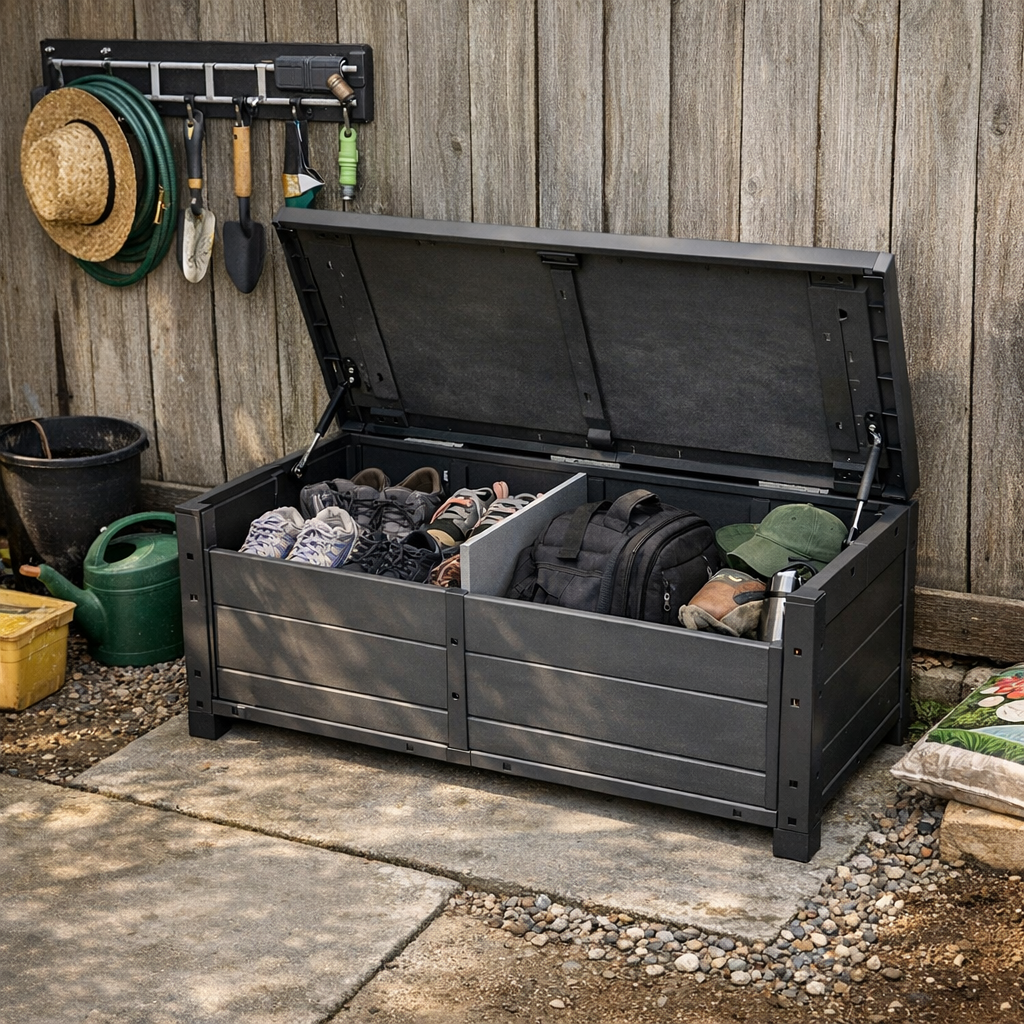
    The real shift comes from inside, not outside. Adding even a simple divider—one board, a couple of bins, a snapped-in partition—changes everything. Shoes stay left, hats right, small grab-and-go bits in a narrow bin: suddenly, each item has an expected path. Instead of blending into a single, shifting pile, categories hold their ground. Grab a pair of shoes and your keys without collapsing a pile of scarves; return them later, and the zone stays sorted until the next use. You stop excavating, start repeating a simple pattern: open, spot, grab, return. Each person adapts faster, and resets edge toward zero effort.

    This interior structure means the bench supports your routine, not just hides your stuff. Even one clear divider prevents category drift—and brings muscle memory into play. It’s not about chasing perfect neatness, but removing the everyday friction that leaves things dumped outside the bench after one too many failed retrievals.

    Assigning Roles and Building Reset Habits

    Once zones exist inside, it becomes natural to assign each its own job: one for shoes, one for bags, another for those elusive small items. With shared use, labeling or color-coding sections (or just using separate bins) gives each person a familiar territory to return to. Shoes don’t wander under coats, headphones don’t vanish under heels, and bags aren’t trapped by stray winter accessories. Resetting happens on the fly—often as a side effect of use—because the boundaries reinforce themselves.

    For persistent small-item drift, a dedicated basket for keys, earbuds, or gloves inside the bench breaks the cycle. Instead of hunting for loose objects or watching them slip behind the main piles, you contain retrieval and return flow to a reachable spot each time. The result: a bench that doesn’t need major overhauls by Sunday—and a routine that doesn’t fold at the first sign of real use.

    Open Versus Closed: What Suits Your Routine?

    Open benches work for quick-drop, high-frequency items—athletic shoes, boots that need drying, items everyone needs to see. But that speed comes at a cost: without containment, every item adds to a visible sprawl, and neatness only lasts until the second user passes through. Closed benches cut down visual clutter—but this only holds if the internal setup tracks with your real pace. Shut lids over undefined piles deliver instant calm and instant chaos, depending on what you need and how fast you move. The difference is simple: structure inside, not just coverage outside.

    If several people share your entry zone, or return flow is quick and repetitive, the need for separated interiors grows. For solo users or rare-access areas, uniform bins might be enough. But for the majority—families, roommates, shared mudrooms—a divided interior isn’t just a nice touch, it keeps the zone functional and the passage clear. If you skip this step, weeks of use slowly lock you into full resets and repeated workarounds, and movement through the space slows until the bench itself becomes just another hurdle.

    Why Setup Details Matter After the First Week

    The difference between a bench that only looks organized and one that stays easy to use turns up fast, but isn’t always obvious until routines settle in. Most breakdowns stem from small—often invisible—setup flaws: a missing divider, a skipped basket, a rushed initial setup that never matched real demand. Benches, bins, floor systems, or modular sections: the best-performing setups aren’t just “bigger” or “cleaner,” but better aligned to the repeated cycle of retrieve, return, re-use—regardless of how many hands reach in each morning. The right internal tweak keeps friction low and order visible long after the newness fades.

    If you keep reaching for the same missing item at the door or notice new piles forming at the bench edge, the fix is rarely adding space, but sharpening structure. The setups that last are those that adjust for your routine instead of fighting it. A bench, a divider, even a zone-rethinking swap—sometimes a small inside change is all it takes to keep an entry moving, not blocking.

    For practical storage systems, components, and benches designed to make real spaces work better—not just look better—visit Gridry.

  • Choosing Backyard Storage That Stands Up to Daily Use Challenges

    Most backyard storage setups look organized right after installation. The truth comes later, when the daily shuffle begins—wrestling a shovel back after a long day, wedging the mower past stacked tubs, or tracking down gloves with muddy hands only to find them buried again. What seemed like a perfect layout on paper quickly collides with the stubborn friction of everyday return flow, pinched walking space, and gear that drifts right back into your path.

    The Real Friction: Why Setups That Look Tidy Still Trip You Up

    Order hardly lasts in a backyard or side yard that gets real use. That spark of control—floors swept, bins lined up, tools perched on rails—vanishes the moment your routine collides with the setup. Swap out sports gear for garden tools? You pull two bins out and wedge them somewhere wet. Stash pruners before the rain? Now you’re shifting heavy bags just to clear an inch of shelf. If “putting things away” means playing storage Tetris or moving the same tub twice to walk the path, the obstacles multiply. Each quick fix becomes another slight reroute—until even small jobs drag out or get skipped.

    Most setups break down in the squeeze-points: side-yard strips that double as storage and walkway, patio corners hijacked by overflow, or fence zones you never intended to block. A container that looked reasonable for hoses and planters suddenly eats too much space when one late project means everything gets stacked, half open, right in front of what you need next. What passes for organized after a Saturday reset is often just the starting line for next week’s shuffling routine.

    Floor Units: A Catch-All That Eats Its Own Space

    Floor boxes have the same flaw: there’s always something in front of what you actually reach for. That big deck bin swallows loose gear easily—until you’re knee-deep pulling out garden shears and tangled hoses to get at the one trowel you want. Every season, new layers form: last year’s boots, sports cones, the garden sprayer you needed yesterday. The more you pile inside, the less likely anything returns to its original spot—so overflow clusters in front, then at the corners, until you’re circling the bin instead of moving through the yard.

    Awkward Footprints and Clogged Corners

    Storage units promise order but routinely create dead ends. The fence-side box turns into a magnet for quick drop-offs: a soccer ball, garden stakes, a bucket with tools that never quite dry out. Left for convenience, these extras block the main route from garage to garden. Soon your well-planned footprint becomes a slow detour, with growing piles forcing you to pick a new path every week.

    Wall Systems: Clear Floors That Quickly Fill and Blur

    Wall-mounted racks and hooks seem ideal for narrow yards—room to walk, tools on display. But practical reality is messier. Hooks fill in a week, rails get loaded with more than they’re meant to handle, and shelves become catch-alls for whatever needs to be hidden fast. The first month, you find the right shovel with a quick glance. By the third, you’re peering behind a row of tangled rakes and odds and ends, unhooking two things to get at one, or knocking a pail to the patio each time you reach for snips.

    When two people share a zone, the blur gets sharper. New items land wherever there’s empty space. What looked streamlined Saturday is a wall puzzle by Wednesday, with gloves wedged behind a bag of potting soil and clippers left hanging sideways, never making it to their “spot.” The wall stays “organized”—but every return gets harder, and the pile encroaches on your walk every time the weather turns fast and cleanup is rushed.

    Invisible Choke Points

    Wall systems usually fail at the interaction points: the most-used hooks get overloaded, the far corners collect the long-term clutter, while the spots you need in a hurry get buried first. Roll a wheelbarrow through a tight passage—another rake snags the handle. Try for a quick cleanup with muddy hands—stuff falls from the shelf or blocks the next shelf up. The appearance is neat from a distance, but the value drops with every layered return.

    Modular Systems: Flexible, Until Everything Moves at Once

    Modular bins and rolling carts feel like a solution for changing demands—until the flexibility backfires. Bins migrate from the patio to the fence; shelves overlap, half-full, purpose lost; carts slide into the main route because the side zones are blocked. In the confusion, basketballs end up in the yard bin, sharp tools drift into the kids’ cart, and you’re left with a system that needs a reset almost every weekend just to keep basic function available.

    When Adaptable Systems Become Slippery

    Sudden weather, guests, or a busy week shove mobile units out of sync faster than you imagine. That cart prepped for fertilizers finds a new home in the only open corner, now directly in the path from gate to garage. A single added item—boots, balls, garden ties—means the path is blocked until you find time for a full reshuffle. Modularity works in theory, but without strong zones and anchors, the setup drifts fast, and your daily routine is the first casualty.

    Spotting the Red Flags: Where Setups Break First

    If you’re regularly stepping over gloves at the patio edge or losing hand tools to a random bin, your storage is pushing back on your routine. The smallest neglected items—pruners, hose nozzles, even bags of bulbs—show where the system interrupts, not supports, your flow. Frequent pileups aren’t just mess—they’re evidence that return routes are blocked and your setup is missing critical access points.

    • Standard units: Overflow piles at the far edge; rarely used things block daily essentials; belongings creep outside the original footprint.
    • Wall rails: Hooks crowded out by frequent-use tools; fiddly gear stuck behind what won’t move; mental fatigue just locating what’s needed.
    • Modular zones: Bins re-sorting themselves by accident, with play gear and sharp implements sharing space for lack of a boundary.

    Resets take longer, pathways clog, and your “organized” setup is only a few days away from chaos—visible in every forced detour and gear pile you didn’t plan for. If you’re spending your weekend restoring order instead of working or relaxing outside, capacity is meaningless without functional return flow.

    Habits That Quietly Strengthen the Setup You Have

    • Designate an easy landing zone: An open bucket or tray at the most-used transition (patio-to-yard, garage-to-garden) for tossing gloves and hand tools. Shift these to their homes in one go, not every trip.
    • Re-label, color-code, or visually mark bins and shelves at each season change: Resetting small signals slows gear migration and keeps boundaries “live” before the system gets blurry.
    • Give mobile carts a marked home base: Chalk a patio corner, stake a side patch—the goal is to turn “wandering” storage into purposeful pivots, not obstacles mid-path.

    Monitor for repeat overflow. If every week the patio edge, side gate, or specific fence spot attracts stray piles, that’s your clue: the return flow isn’t working. Reroute, carve a shortcut, or adjust access. Don’t just tidy—rework the pinch point so you’re moving forward, not circling the same mess.

    The Real Test: Does the Setup Disappear Into Use?

    A functional outdoor setup earns its keep not by staying neat after one big reset, but by almost disappearing—everything flows naturally back to its spot, piles stay small, and walkways remain open week after week. Whenever you find yourself hesitating over a return, shifting three things to put away one, or dreading yet another mini-reset, that’s not inevitable—it’s feedback. Adapt the zones, not just the gear, until your storage matches the way you actually use your outdoor space.

    Setups that pass the real test don’t fight your routine. They shrink friction, dampen clutter, and leave room to move—so you reclaim the space for what you actually want to do, not just for managing the system. Let your own rhythms guide what and how you store, and expect the setup to evolve with your habits—not just with the seasons.

    http://tidyyard.myshopify.com

  • Why a Trash Bin Near Your Entryway Keeps Clutter Off Counters

    An entryway that looks controlled on Sunday can feel gridlocked by Wednesday—if clutter has nowhere to go the moment you walk in. Shoes may line up, bags might find a hook, and surfaces look inviting—for hours, not days. Then the first round of real-world debris—junk mail, crumpled wrappers, receipts, empty packaging—starts collecting wherever hands pause, especially if the nearest trash bin isn’t within grabbing distance. Without an instant hand-off spot, each pass-through presses temporary junk into permanent fixtures, tightening pathways, crowding benches, and making the next reset slower and less likely. Entryway order isn’t lost in a crash; it decays by increments—one overlooked wrapper, one stashed flyer, one coffee cup left “for later.” The threshold zone only works if daily friction has a landing pad. Without it, every organized setup is quietly undermined by the daily drop-off pattern.

    When Throwaways Turn Into Permanent Fixtures

    The visible difference between a functioning entryway and one slipstreaming into disarray doesn’t show up overnight. Monday starts fresh: bench clear, shoe tray aligned, mail sorted. But by midweek, friction builds—one grocery receipt perches on the bench, yesterday’s snack wrapper surfaces underfoot, a takeout cup edges into shoe storage territory. Every pass-through adds a fragment. Patterns form: the same person leaves keys and wrappers; the same edge hosts the “deal with later” pile. No single item demands a reset, so small debris go unchallenged. If a trash bin isn’t right by the incoming path, the delay is enough for clutter drift to establish itself—slowly swapping clean lines for catch-all corners.

    The Snowball of Reset Friction

    What starts as simple storage—shoes, mail, bags—begins doubling as a landfill for every item not instantly dealt with. Without disposal right at the threshold, surfaces abandon their real job as staging areas for ready use and instead become reluctant holding zones. Now, after the morning rush, the shoe rack gathers not just shoes but a halo of packaging. Reset doesn’t mean just lining things up; it means collecting scattered trash, shuffling piles, ferrying throwaways to another room, and often leaving “just one more thing” behind. Multiply by kids, roommates, or shared households, and each layer makes the space slower to reclaim. What felt organized last week now means dodging half-trash, losing seconds at every return, and facing a growing reset burden for a space meant to simplify—not delay—daily flow.

    Scenes of Cluttered Thresholds: Real-Life Habits

    The Bag-and-Bench Trap

    Grocery bags in one hand, junk mail and receipts in the other. No trash bin in sight so the “just for a minute” pile forms on the bench. Shoes arrive next to the heap. By day two, the bench is no longer a seat—it’s a backup bin, and clearing it starts to feel like a full project.

    Shoe Rows Breaking Down

    The row is tight in the morning, but by evening: stray wrappers, receipts at the tray’s edge, grit where shoes are meant to rest. Picking up a pair now means dodging debris or just giving up and stepping over the mess. Overflow isn’t dramatic, but it creeps until the tray becomes a dumping ground as much as a shoe organizer.

    The “I’ll Toss This Later” Experiment

    Multiple passes, different people, same story. Everyone has one small item they don’t want to carry—flyer, napkin, broken shoelace—which lands near the entry. No single offense seems worth a trip to another bin. They stack up, squeezing the clear path tighter every day. Actual resetting gets postponed, while the threshold feels more like a hurdle than a welcome mat.

    How Adding a Trash Bin Changes the Transition Flow

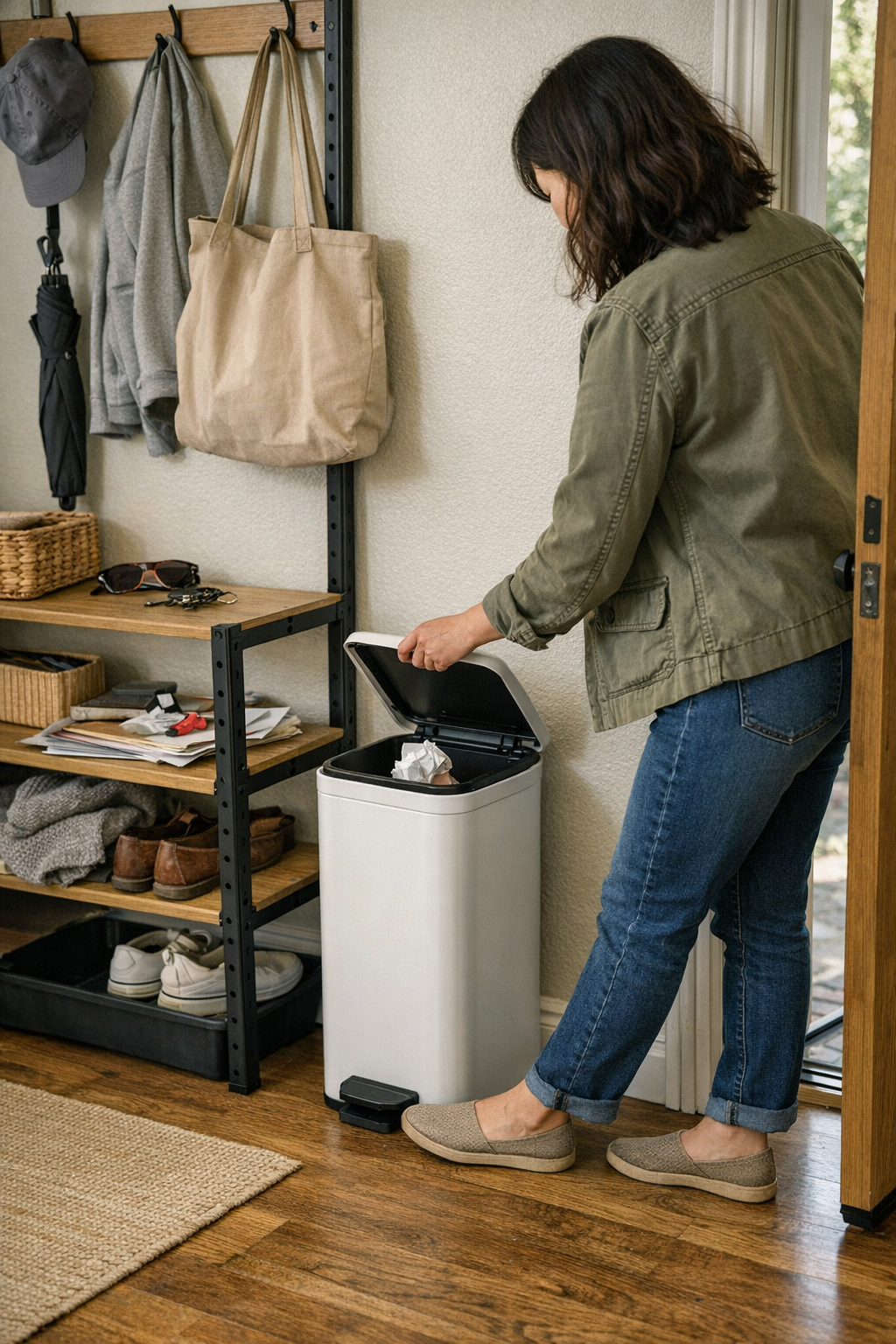
    Drop a slim, lidded trash bin with a foot pedal just off the natural entry path—right alongside, not in front of, the shoe zone. Suddenly the pattern breaks: wrappers disappear the moment you step inside; unwanted mail vanishes straight from hand to bin; and that sticky “I’ll get this later” habit fades because disposal happens automatically. Surfaces stay functional because debris gets intercepted—before it can scatter, stack, or sprawl.

    The difference is visible almost immediately. Within a few cycles of leaving and returning, the bin fills up—but benches stop serving as overflow, shoe racks remain for shoes, and mail organizers don’t double as trash organizers in disguise. The act of passing through the threshold now maintains order instead of undermining it, letting organization survive real-life use, not just the rare reset.

    Setup Details That Matter

    Entryways that resist clutter aren’t the biggest—they’re the best at intercepting junk in real time. A vertical, slim-profile bin consumes inches, not feet, preserving movement space while staying obvious enough for automatic use. Lidded designs shield against visible overflow. A foot pedal means you aren’t forced to set anything down before tossing it—vital for the “arms full, rushing in” scenario. None of that matters if the bin is tucked out of reach; the right placement means intercepting debris directly in the flow—never blocking routes, always inviting immediate use. The less extra motion reset takes, the less likely clutter advances past the drop zone in the first place.

    Placing the bin elsewhere—laundry, kitchen, or any “next stop”—just guarantees more buildup in the transition space. Make waste disposal part of the entry ritual itself. The right setup doesn’t require cleanup as a separate task; it makes the reset near-automatic every time you step inside. Small design choices actively determine whether the entry stays usable through a busy week—or quietly collapses by Thursday afternoon.

    The Real Difference: Entryways That Actually Keep Up

    Most entryways look “organized” immediately after cleaning, or for that first round of guests. But repeated use exposes shortcuts and breakdowns fast. Without a trash bin that’s truly integrated, clever shoe racks and wall organizers lose ground to daily drift: stray edge piles, mail backup, wrapper spread, reset steps multiplied. Order grows harder to maintain with each pass. The result is never disaster, just buildup—hidden in plain sight until movement stalls and the threshold turns into a bottleneck.

    Adding a trash bin is less about perfection, more about protection: protecting the function of each surface so bench, rack, and shelf remain what they’re meant to be—even in rush hour, bad weather, tight space, or full-family throughput. Clean lines don’t last by accident. A reset built into the walk-in routine is what keeps your entryway holding its ground, instead of constantly caving under daily debris.

    For storage solutions and real entryway setups that actually match the pressure and pace of transitional spaces, visit Betweenry.

  • Maximizing Bathroom Storage with Practical Over Toilet Shelving Solutions

    Over toilet shelving looks like an easy fix for crowded bathrooms: use the dead wall above the tank, unclutter the floor, and suddenly it’s “organized.” But in real, shared bathrooms, this promise slips fast. Shelves that fit cleanly on Sunday are cluttered by Wednesday, with daily routines snagged by the exact solutions meant to smooth them. Adding storage above the toilet isn’t just about stacking shelves—it’s about whether that setup survives real use: the morning rush, overlapping routines, and the silent drift from order to backup overflow that always collects in high-traffic corners.

    The Hidden Friction of Over Toilet Shelving

    At first, a new unit stands sharp: shelves empty, every item placed with intent, and floor space briefly clear. But actual use exposes a more difficult reality. The space fills with awkward mixes—everyday toothbrushes beside rarely used backup lotions, towels jammed behind cleaning sprays—and the “storage” you gained just means more to move, sort, and rescue when something tumbles out of reach. By midweek, the gap between having more storage and having usable storage is obvious: now, grabbing deodorant means lifting three bottles and reaching past a jumble of bins you didn’t plan for.

    The difference hits hardest during real routines. A too-shallow upper shelf sends dropper bottles skidding off the edge. A deep shelf buries everyday items behind low-priority backups—every trip for toilet paper or toothpaste becomes a search-and-retrieve mission, with at least one product falling between the tank and the wall. What looked streamlined starts to collect frustration, not just clutter.

    Morning Routines, Clutter Drift, and the Shared Bathroom Test

    Bathrooms with shared routines bring setup flaws into sharp relief. One person grabs face wash while another hunts for backup razors. Space gets pinched: towels slide, bottles topple forward, and no system survives the weekday overlap unscathed. When shelves wobble or spacing is off by even an inch, stress multiplies. Categories that started distinct blend together—extra toilet rolls disappear behind obscure bins and don’t resurface until someone finally clears the shelf end to end.

    If a shelf doesn’t fit live routines, it becomes a daily blockade. Instead of a one-handed grab, you’re holding a basket up with your chin while shuffling bottles around. Time saved evaporates in small resets: re-stacking washcloths, shifting shampoo so it doesn’t block the tank, searching for items that migrated out of reach, all before you’ve left the house.

    Wire vs. Solid Shelves: Real-World Pros and Cons

    Wire shelves offer a tradeoff: airflow keeps towels fresh, but small tubes slip through gaps or knock over and vanish behind the toilet. Retrieval isn’t just awkward—it’s gymnastic. Solid shelves prevent losing items entirely, but trap moisture underneath bottles and cluster dust around edges, turning quick wipe-downs into slow chores. By early afternoon, a bottle is already stuck at the back in a shallow puddle, and drying the surface becomes just another recurring chore.

    Nobody wins every trade. Wire works for bulkier, quick-grab items—towels, hairdryers—while solid shelves make sense for small, daily-use jars if you wipe them dry and don’t overload the surface. In high-use, shared baths, shelf material helps less than shelf positioning: seeing what you need at a glance predicts actual ease of use better than construction alone.

    Quick Adjustments That Sort (or Reveal) the Problem

    The smallest hardware tweaks often mark the line between upgrade and setback. Raising the bottom shelf just a couple of inches can prevent towels from jamming against the tank lid—a fix that stops the usual “snag and avalanche” every third retrieval. With a clearer retrieval path, movement changes: grab-and-go returns, and awkward shuffling drops to a minimum. When baskets can be pulled forward without dragging out backup sprays or snagging on shelf supports, the difference registers in seconds rather than after-the-fact regret.

    A change in shelf position is a shift in friction, not just airflow. If the zone below is open, it takes a quick straighten to reset—no more forced wrestling with baskets half buried behind containers, and no mystery puddles of leaked shampoo at the back. The importance of just a few more inches or repositioned supports is less about appearance and more about removing recurring obstacles from the reset cycle.

    Overloading: When Extra Storage Turns Against You

    The lure of maximizing space—another basket, a higher stack, more backup packs—turns on its owner fast. Overcrowd the shelving and every movement slows: the tank is blocked, the footprint widens, corners collect neglected bottles and dust, and daily essentials vanish under layers of “just in case” extras. Visual order breaks down by degrees, reset effort increases, and you’re suddenly working around the storage more than with it.

    Watch the edges: unused tubes gather near vertical supports, overflow baskets block the path to basics, and category control dissolves. Three backup tubes of toothpaste might wedge themselves out of sight, and rolls of toilet paper become stale after weeks at the back. Each additional bin that doesn’t fit the routine becomes a small retrieval delay tomorrow.

    Wall-Mounted vs. Freestanding: Matching Support to Real Loads

    Freestanding units might look sturdy, but when crowded with glass bottles or heavy cleaning supplies, most flex under the load or feel unstable when you reach high. Wall-mounted options, properly anchored, handle more weight and feel solid under strain, but demand a commitment—installing, checking alignment, and living with your initial spacing choice. An immovable bracket two inches too high or too low locks the whole setup into a routine mismatch until you break out the tools again.

    Basing your decision on lived needs—not just looks or ease of assembly—saves time and frustration down the line. Don’t gamble the top shelf on weight, and don’t trust “storage capacity” over the pattern of items you actually reach for most. Shelf spacing and support matter more than shelf count alone.

    Scene: A Real Reset After a Long Day

    End of the day: the bathroom’s absorbed a full round—multiple showers, kids’ toothbrush searches, the nightly toilet paper dash. You face the over toilet shelf: a towel sways off one end, a bottle’s half fallen, and a spare roll is wedged behind a too-large bin near the back. If shelf heights are right and main-use items are visible, reset is minimal—shuffle a few towels forward, slide a stray jar, and reclaim open space without sifting through overflow. If not, another round of digging, untangling, and re-sorting awaits before the area is ready for tomorrow’s rush.

    The only real test: Does your storage let you reset quickly when routines collide, or is it another slow fight every night? Function always outlasts first impressions.

    Making Over Toilet Shelving Fit Your Routine

    The best results don’t come from crowded shelves or catalog-perfect symmetry—they come from setups built for repeated use: raising key shelves, using wire only where it actually helps, dividing categories so return flow is predictable, and trimming overflow so the high-traffic path stays open. Watch for the edge cases: piles that encroach on access, containers that migrate, categories that drift instead of staying grouped.

    Above the toilet is a tricky zone—a real test of friction and flow, not just storage. When the setup reacts to real routines, retrieval takes seconds and resetting becomes a once-a-day pleasure, not a chore. This is the practical difference between “stored” and “usable”—an edge that matters whenever anyone in the house needs fast access, even after the system’s been lived with for weeks.

    See more practical inside-storage options at Gridry.

  • Why Keeping the Center Path Clear Beats Perfect Organization Every Time

    Most outdoor storage starts with hope: a strong shelf, a bin for boots, maybe a wall hook for the rogue shovel. But in real backyards, side-yard strips, and garage edges, the chaos always overruns the plan. You don’t curse at the shelf lines—you curse when you can’t make it three steps before tripping on what didn’t fit. If you’ve ever dragged a cart through a narrow path only to nudge aside bags of mulch or played hopscotch over boots swimming in puddles, you already know the truth: it’s the floor that fails first, and everything else just distracts you from it.

    Why Perimeter Order Can’t Save the Center

    It’s easy to get fooled by the edges—neatly lined bins tucked against the fence, precision racks along the garage, a system that flexes around the patio. Stack high, clear the way, and the space looks almost under control. Until real life walks through. One tool left 18 inches from its hook turns into a slalom obstacle. A bag that won’t fit because yesterday’s load never got sorted sits tight in the only gap left. Someone races in from the garden, drops muddy boots dead center, and the tidy edge becomes irrelevant—a setup that stores but stalls you every time you return.

    It’s rarely the unreachable corners or ceiling-level racks that cause the reset spiral. It’s the cluster of what can’t find a home, scattered at shin-level, collecting on the ground right where wheelbarrows, bikes, and people collide—all in the name of “maximizing” space.

    When Storage Backfires—Spillover Hits the Center

    Organization promises relief from chaos, but the transition point—the path itself—is usually where systems fail. The cycle is sharp and familiar: after a rainstorm or a DIY weekend, all containers and hooks max out, so boots and bags drift into the worn walkway. No one comes back to re-stack when their hands are full: the bike gets nudged through, the rake handle swings wide, a muddy trowel is dropped “temporarily” on the first dry slab. The overflow doesn’t go up, it goes down—right underfoot. The next trip means kicking things aside, nudging a bin that lost its corner, or detouring around one-too-many abandoned items. No shelf label helps when you can’t see the floor.

    “High-density” only works in diagrams. As soon as return traffic gets real, movement splinters. Wheelbarrows stick on stray garden shoes, bikes must be lifted sideways, and that one forgotten bucket becomes a landmine. You spend three times as long resetting, the routine turns into a scavenger hunt, and suddenly all that impressive storage makes the space harder—not easier—to use. The real performance test isn’t shelf capacity but whether traffic—even rushed, distracted, or dirty—flows clean through, not around or over.

    The Rapid Shrinking of Clear Zones

    Picture any narrow side-yard or the classic garage threshold: storage “lives” on each side, while the middle lane is sacred for movement… for maybe three dry days. Then the weather shifts. A kid’s bike is parked halfway in after a shortcut. Gardening stuff comes back muddy and is left to dry—right where you walk. By Tuesday, the red bin is jutting into the walkway, a rake is wedged under a pile, and the space intended for traffic morphs into a sorting zone. Moving a barbecue means first shifting shoes, bins, and whatever else snuck onto the floor.

    Anyone with a utility corner, patio edge, or garage supply zone has watched it happen: what’s stored on the edge stays unused, while the items everyone grabs get abandoned in whatever “neutral ground” remains. The true measure isn’t shelf height or container count—it’s how long the main route stays open without a reset war every week.

    Why Every Inch of Floor Matters Most

    The urge to line every wall and swallow every spare foot is strong. Convenient in theory, but every organizer shoved along the edge risks leeching just enough space to stall movement mid-project. The center lane—roughly 28 to 32 inches—becomes untouchable if you ever want more than single-file passage. Fill that with cube bins or mount hooks just low enough, and yardwork devolves into a sidestep puzzle. Tools get dropped mid-route, slowdowns happen, and your storage zone starts to feel tight, whether or not it passes a visual inspection.

    Even clever modular racks only improve things if they leave that middle strip sacred. The moment a shelf noses into open floor, it turns into a magnet for orphaned tools, so-called “temporary” drop-offs, and “it doesn’t fit” overflow. The “bonus” hook at arm’s reach? It’s fine for one shovel—until you have three muddy tools and a bucket trying to hang off it. All those small compromises add up fast, suffocating the main flow line.

    Fixing Footprint Friction—Not Just Adding More Storage

    Sometimes the breakthrough isn’t another shelf, but a shift in orientation. A real side-yard setup: one blocky storage cube—supposedly “out of the way”—ran perpendicular to the fence. On paper, nothing jutted into the walkway. In reality, it pinched the traffic enough to create a bottleneck. The fix: pulling the unit back by just 16 inches and resetting it parallel to the fence. Suddenly, trash carts rolled through without bumping, wet boots found a safe landing at the side, and the headache of “where do I put this?” vanished for both adults and kids. Resets dropped off; overflow items actually landed where they belonged instead of the path’s center stripe. Nobody had to stop and reshuffle after each use because the movement matched the routine.

    This isn’t some aspirational downsizing—just a clear rebalancing: keep every inch for flow, not just for storage numbers. A less crowded footprint looks lighter but ends up working twice as hard. Stress vanishes from the routine. The payoff is obvious after one busy week—less shuffling, less “just for now” clutter, and a space everyone actually wants to use again.

    Quick Tip: Carve out a “drop buffer” zone right past your main entry—an 18-inch patch that stays empty, even on messy days. That single chunk gives everyone a guilt-free bailout zone for boots or stray tools, so the center lane doesn’t get sacrificed in the name of speed or convenience.

    How Over-Organization Quietly Breaks the Flow

    The more obsessively you fill the margins, the faster the walkway turns into overflow parking. Every new cube “just to make it fit” is a bet against movement. In a shared yard, this gets brutal: your five-minute cleanup becomes someone else’s half-hour detour. The more steps it takes to access or return an item, the greater the odds it finds its way onto the traffic line, waiting for “later”—which usually means “never.”

    The real difference between a superficially organized but jammed area and a setup that survives weather, chaos, and family routines is always the same: not perfection against the wall, but unblocked space in the middle. Upgrade layouts with enough slack for real, repeat use—room for gear to travel in both directions without drama or resentment. Give up the last shelf or bin if you must, but never the clear path. After all, the only system that stands up to the everyday mess is one that keeps moving with you, not against you.

    Visit TidyYard for practical outdoor organization solutions

  • Why Drip Mats Outperform Rugs in High-Traffic Entryways

    Every busy entryway hits the same bottleneck fast: the drop zone that’s supposed to keep things tidy instead becomes a daily hazard—especially when rain, mud, or snow slice through your routine. The real issue isn’t pretty: wet footprints fan out, shoes dump grit and moisture, bags migrate closer to the path, and what started as a clear threshold turns into a slow reset spiral. In these lived-in transition spaces, details like what sits under the main shoe row or where bags actually land make or break how long it takes to reclaim order, or how often you just give up and step around the mess. Ignore the problem, and the “reset” goes from a thirty-second fix to an afterthought that never fully restores the zone.

    When Rugs Can’t Keep Up With the Mess

    Walk in after a storm: the shoe line immediately splinters, the bench is loaded with yesterday’s scarves, and bags land wherever there’s half a square foot left by the door. At first, a woven rug might look like it soaks up the worst—until water seeps under and the fibers hold onto every bit of grit and moisture. Edges curl. A dark stain radiates from where boots overlap. By lunchtime, everyone’s quietly stepping wide, the musty smell spreads, and nobody volunteers to deal with the rug that’s started working against you instead of for you.

    Every new trip in—drop-off, lunch run, school return—pushes the zone further out of control. Wet spots become navigational hazards. Shoes drift outward and the boundary between clean floor and soaked zone dissolves. Sit on the bench, and you feel the soggy edge under your feet. Instead of guiding routine, the rug demands more and more time, making every return a little slower and messier.

    Why the Drip Mat Makes the Difference

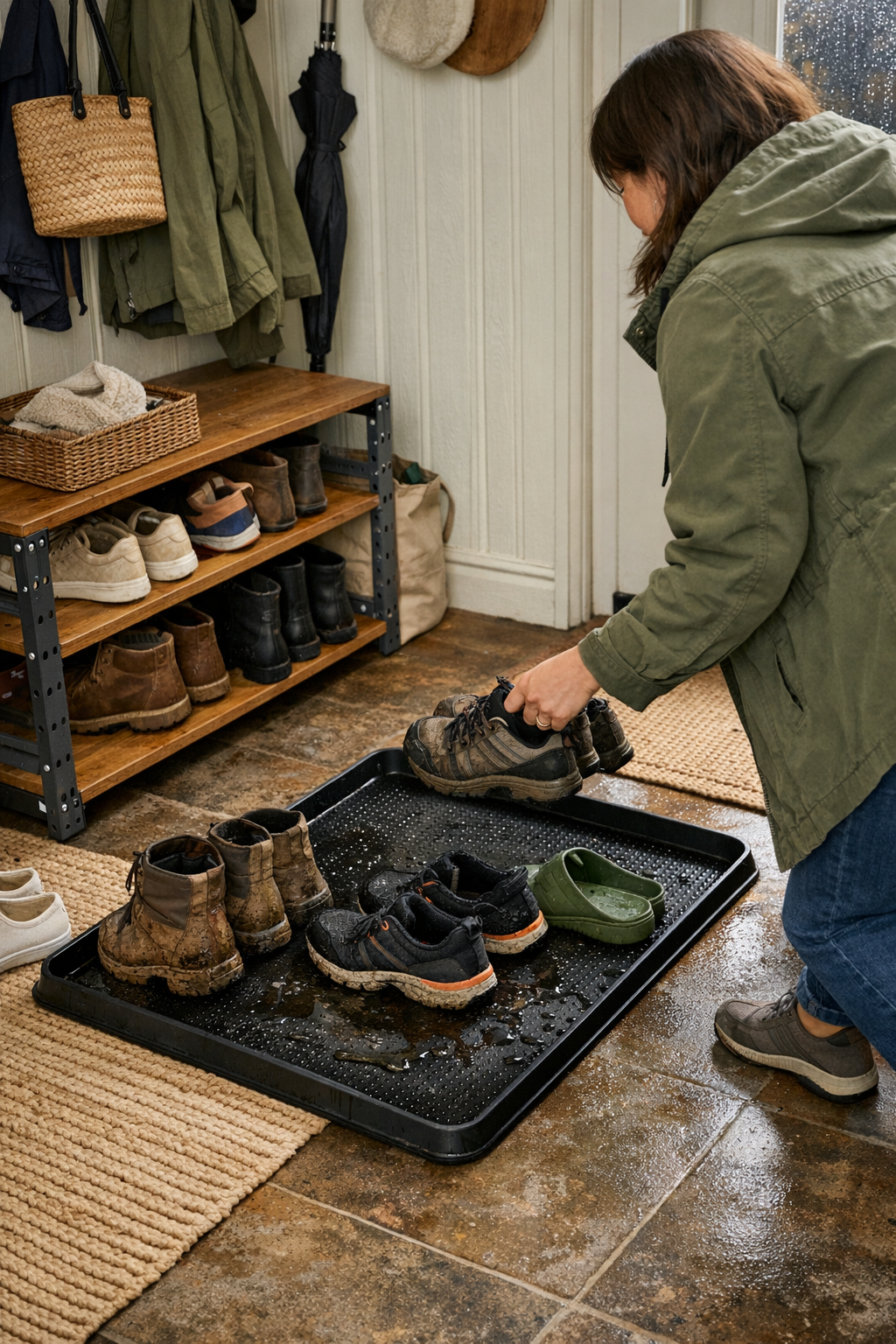
    Containment beats absorption, every time weather returns. A drip mat doesn’t pretend to clean; it just collects runoff, trapping moisture and grit until you’re ready to lift, dump, and reset. The value doesn’t show much on a dry day—but hit your second downpour or a week of unpredictable weather and a rug’s slow decay becomes obvious: creeping odor, spreading stains, unseen damage under benches. Meanwhile, with a drip mat, the repair cycle is clear—pick up the mat, dump the water, maybe swipe a towel. Back to zero, without mystery damp creeping out of sight or lingering under heavy rugs.

    The Cycle of “Quick Fix” That Makes More Work

    It happens without you planning it. By midweek, entry drift has taken over. Nobody actually deep-cleans a saturated rug; they push it aside or hope it dries. The zone’s wet edge spreads, stains slide under the bench or along the wall, and temporary drops become semi-permanent clutter as bags, shoes, and coats expand into every inch of passable floor. What’s meant to be a fast threshold turns into a tricky detour—one that slows everyone and multiplies the amount of “later” clean-up still coming.

    Real-World Reset: Scenes From Repeated Use

    Reset speed shows what works. After a heavy-use morning—three pairs of boots, extra bags, a last-minute coffee spill—the difference hits fast. With a drip mat, you scoop and dump; the floor clears itself. There’s no debate over who scrubs a rug this time or whether something is rotting under the bench. The mat leaves the zone dry within an hour. Shoes and clutter stay put, the routine risks less spillover, and you avoid stains building up week after week. Absorbent rugs get heavier, stickier, and more impossible to reset with every cycle; too many storms, and “fresh start” means shopping for another rug or even patching up the flooring underneath.

    If the day spins off-track—unexpected guests, muddy sports bags, a dog with soaked paws—the mat shrugs it off. The area doesn’t stall in catch-up mode. Old setups force you to tiptoe around cold wet patches and ignore slow, hidden damage that quietly raises the reset cost until you notice too late.

    Where Clutter Hides: Entry Zones That Drift

    Setup neatness never survives the week. Shoes edge apart and form a wider, unwieldy row. Bags inch into the threshold, blocking the main route. The bench mutates into an overflow parking spot. Without a visible split between wet and dry zones—a drip mat to corral water and a specific area for bags or overflow—moisture, clutter, and traffic collide into an indistinct zone. Movement gets tighter; resetting means first relocating the pile, then sorting out what’s damp and what’s drifting. Containment creates clarity. Without it, the entry becomes a slow-moving tangle of unpredictable drops and invisible damp that violates every planned order.

    Tip: Give Shoes and Bags Their Own Zones

    Doors invite drop-offs, but drawing a hard line helps. Keep the drip mat as a shoe and boot zone only; send bags and dry gear to a separate rug, cubby, or bench area. This keeps wet prints from spreading, makes moisture patterns easy to spot, and prevents overflow from claiming floor you need for a clear return. The small boundary sharpens retrieval when you’re in a rush and reduces the accidental migration of grime onto whatever bag or coat lands within reach.

    Why Resets Shouldn’t Take All Day

    Rugs trap everything—moisture, grit, slow stains that don’t dry out by morning. The heavier the use, the more the “clean-up” turns into a drawn-out, low-priority fight against soaking, must, and sticky grit. Drip mats don’t absorb; they contain, making the return to order an actual reset instead of a new maintenance problem baked into the entry’s routine. No rug rotation, no expensive replacement, no surprise damp lurking below the bench. The consequence is a shorter, more reliable fix each cycle—and a zone that actually recovers between rush hours.

    Setups That Actually Match the Routine

    The real test isn’t how symmetrical a setup looks—it’s whether movement stays fluid after days of real use. Shoe rows widen beyond intent. Bags and kids’ gear reclaim high-traffic corners. The bench doesn’t just seat; it collects overflow, testing the existing boundary every time schedules collide. Drop the wrong item in the wrong spot, and reset delays snowball. Containment strategies—a drip mat under foot-traffic, weather-resistant storage for repeated wet returns, a slim secondary rug for bags—create a threshold that bends with the routine instead of blocking it. Instead of stopping to sort out damp chaos, the area stays ready for the next rush and actually reflects how people move through day to day.

    For dependable transition-space storage and more resilient entry routines, see Betweenry.