
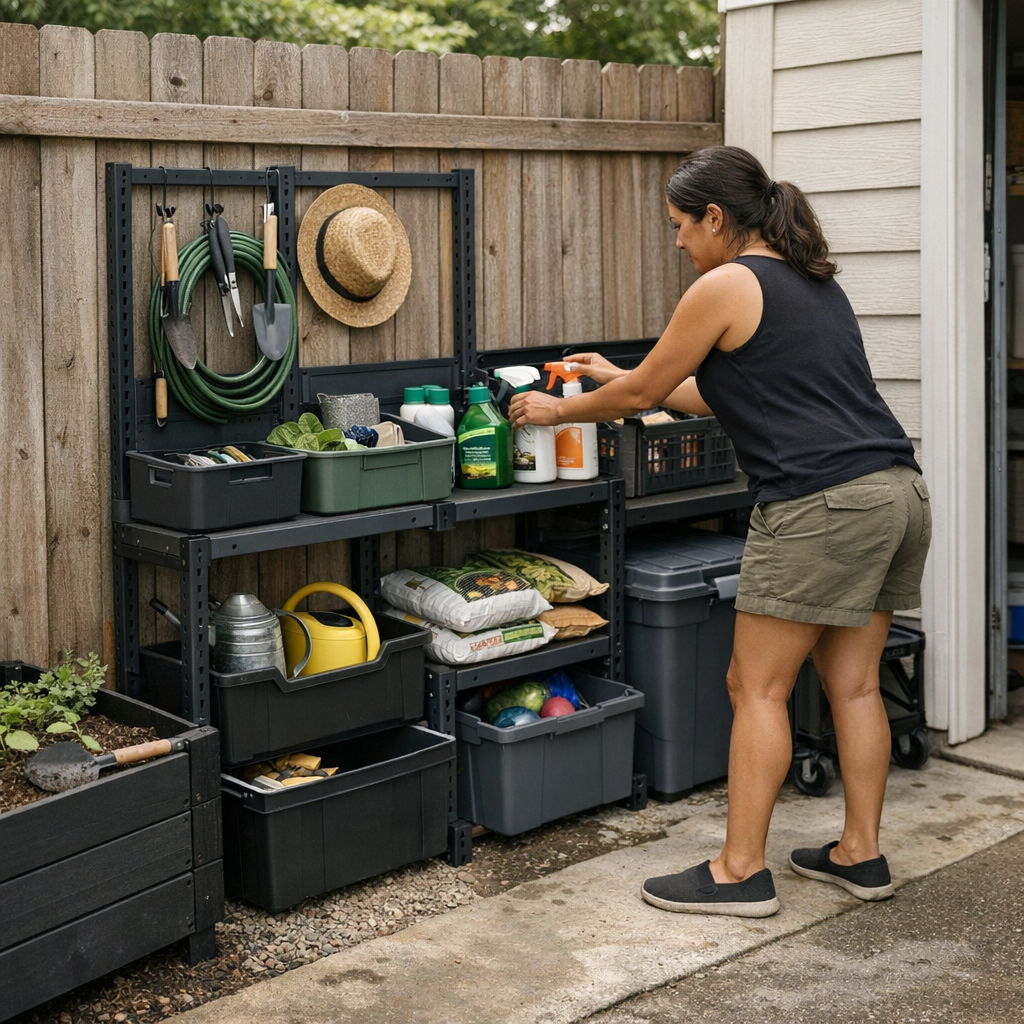
Here’s how outdoor organization usually promises to work: load up a new storage box, hang up some wall hooks, and finally clear your side yard or patio edge for good. But in any real setup—from a garage threshold packed with bins to the narrow strip running along your fence—order falls apart not when you run out of space, but when getting in and out feels like a dreaded reset. It’s never just about what you store. It’s how often you’re forced to lift, shift, or block everything else, just to grab a single tool, hose, or set of gloves—and how fast that “orderly” corner slides back into chaos despite your effort.
When “More Storage” Means More Steps
Add another chest, another rack, another tall wall unit—the corner looks conquered for maybe a week. Then daily reality resets the story: you reach for pruning shears and instead slide out half a stack to get to them, shifting a shovel just to reopen your exit. One misplaced tote means you’re balancing bins on the lawn, playing Tetris with garden tools, or shifting a folded chair that now blocks the hose. Suddenly walking a clear path means awkward sidesteps, ducking around handles, tripping over a loose soccer ball that never really had a home.
The real pressure isn’t overflow. It’s friction: storage that fills the space but turns every basic grab or return into a multi-step effort. Corners clog, access points get pinned by yesterday’s gear, and the walk you intended to make quick becomes another reorganization.
Why Access—and Not Just Capacity—Matters Most
Diagrams and storage calculators love to promise, “Look how much fits!” But outside, effort kills motivation faster than any lack of space. The difference is clear after a few uses: the “clean” setup that lets you move straight through, grab what you want, and reset without reshuffling will always outlast the lineup that packs every inch but slows you down. Take a side-yard wall with racks and chests packed tight—it looks sharp until you need something at the back, and that means pulling out everything up front, one by one. Or the garage-edge nook stacked two rows deep: you’re never just grabbing, you’re quietly undoing your own work, every single time.
Order that only works on paper crumbles in repeat use. As family routines collide—kids reaching for floats, you needing gloves, pool gear tangled with garden supplies—the neatly organized footprint becomes a daily blocker. What started as “maximum storage” quickly reads as “maximum reshuffling.”
Spotting Weak Return Flow and Hidden Problem Zones
Most setups crack under return flow—not because you’re lazy, but because the system asks too much just to put things back. Maybe the patio bench is always swallowing loose shoes and pool nets by the weekend. The garage wall hooks are full, but the snow shovel’s always unreachable, hiding behind off-season tools. Overflow doesn’t start as mess; it starts as work you quietly defer: “I’ll sort that later”—and every “later” lands in the same awkward corner or on the closest open step.
When just dropping something off is its own project, bottlenecks and clutter collect in your fastest-access spots. Over time, the most convenient edge of your setup quietly becomes the “spare pile”—a symptom your layout slows you down instead of backing you up.
Real Reset Scenes: Where Organization Breaks Down
The breaking point is almost always a reset moment. You come back after mowing or planting, hands full, and realize the only way to stow the gear is lifting out that tangled hose first—or repiling half a stack just to give the extra potting soil a home. Before a grill night, you’re sorting through buckets of chemicals and forgotten sand to reach tongs you meant to keep within arm’s reach. As soon as return flow stalls, the system unravels: bins stack in front of other bins, gear leans wherever there’s floor, and each “I’ll get to that later” sets up tomorrow’s block.
The longer the reset takes, the more you leave out. Lawn edges crowd with overflow, and back corners fill with “can’t quite reach” odds and ends. It’s not disorder—it’s the system quietly creating extra work instead of saving it.
One Real-World Shift: Moving the Wall, Splitting the Flow
Improvements rarely mean buying more. In one side yard, just shifting a wall organizer two feet forward and breaking it up at waist height changed everything: a clear separation for garden, grill, and kid gear, shelves left open between sections, a narrow strip of open floor in front. Suddenly there was no reason to stack or overlap—every return was one move, never two. Hose, trimmer, gloves, ball—their homes never blocked each other, resets stayed quick, and nothing migrated out to the walkway.
The fix wasn’t more capacity, but more natural movement and separation. With each project and return, the area soaked up change. Tools left out less often. Corners stayed open, not jammed. A tiny reconfiguration transformed the “always tidying” zone into a background that just worked.
Practical Tactics for Smoother Outdoor Organization
Leave Breathing Room—Even Just 18 Inches
Open floor trumps packed-in storage. If you can step, reach, and shift without hitting or moving another bin, your setup can breathe. Even a single narrow access path in front of wall units or along a fence makes blockages—and excuses—not stick. Double-stacked bins guarantee daily reshuffling: skip the overlap, or the routine will never last.
Divide Storage by Activity, Not Just by Category
Zones beat categories every time. Use open shelves for gardening, a distinct hook for grill tools, clear open space for kids’ gear. When every item has a destination tied to a use, “returning” isn’t just wherever you find a gap. That visible clarity is what gets even rushed resets really finished, not left half-done.
Watch for Recurring Overflow Zones
Does the same step, bench, or back corner always absorb random overflow? That’s your setup warning you: its placement, reach, or footprint is off. Sliding a unit out to create better access, switching a chest for open hooks, or reclaiming a blocked corner can shift enough pressure to keep clutter from settling—or returning right away after every use cycle.
The True Test: How Your Yard Moves With You
What marks a setup that actually works? Not that it stores more, but that it stays out of your way. The real test is flow: how often you have to move one thing to reach another, and how quickly resetting actually gets done. If it takes more steps to put things back than to use them, or your clean-up is slower than the project itself, your system is setting you up to fail.
The best arrangement is the kind you nearly forget: open enough to absorb use, tough enough to resist daily breakdown, and practical enough to keep the reset short—even when life gets busy and outdoor projects pile up.
For practical, tried-and-tested outdoor organization setups that actually handle daily use, visit TidyYard.