
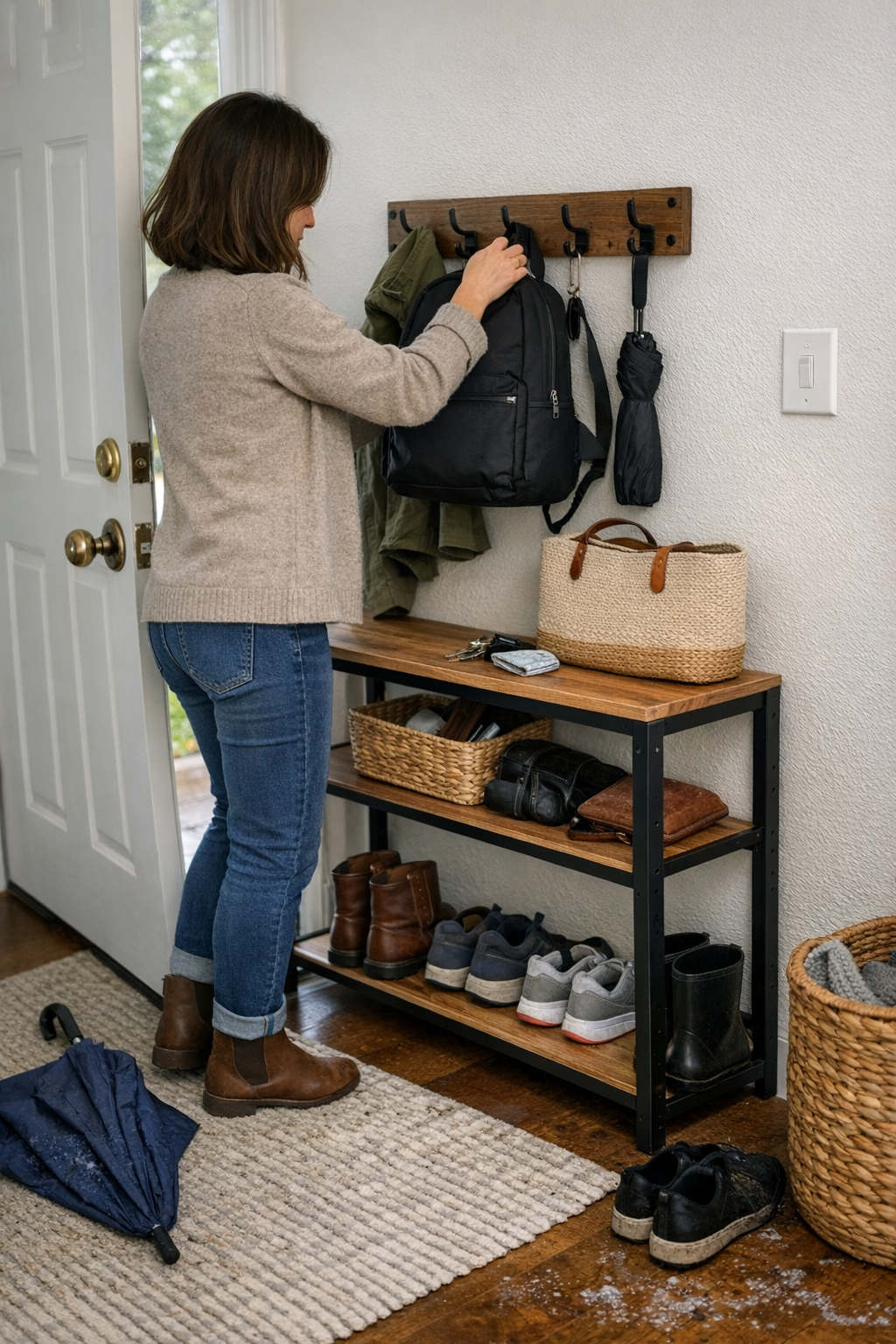
Every entryway exposes its setup the moment routines collide—especially when you’re carrying too much or everyone arrives at once. If you’ve ever tried slipping through a door and found yourself pinned between an inward swing and a row of shoes, you know the pain of a bad threshold. The problem isn’t just about clutter; it’s about movement. The first thirty inches inside your door become triage: drop your bag, hop over last night’s boots, realize the bench meant for order now pinches the pathway even tighter. Choose the wrong storage and you’re not organizing—you’re slowing yourself down, every single time you come and go.
The Hidden Cost of Deep Storage by the Door
The setup usually starts optimistically—a chunky bench or deep cabinet promising to finally contain the family’s pile. But in an everyday entry, extra depth cuts into exactly the zone you need clear: the patch where everyone turns, pauses, or passes each other. Each extra inch drags shoes, bags, and stray coats farther into your step path. Before long, the stuff you’re trying to tidy collects right in the landing zone. Dropping one item means blocking the next person. Resetting once turns into resetting three times a day, especially with overlap—two people crowding the doorway, a late bag tossed carelessly, or umbrellas dripping into the narrowest spot. Instead of relief, there’s friction—micro-jams and sidesteps pile up, and “deep storage” just means more to dig out of the way.
The “Slow Creep” of Clutter
Maybe you start with everything lined up. But as the days pile on—so do the shoes. Row edges drift diagonally. Bags meant for hooks slide down to bench level, then slide off entirely. The open lane narrows, unpredictably, until a single run for the mail turns into a clumsy shuffle. You notice it most with arms full: returning groceries after work, or coming back with muddy boots and a trailing pet. All it takes is one or two things left out of line, and suddenly, the clean reset from Monday morning feels lost by Tuesday night. Messy weather multiplies the problem—wet boots arrive in clusters, crowding out any order for the rest of the day.
Narrow Consoles—Why Less Depth Works Harder in a Real Entryway
Switching from deep to narrow isn’t just cosmetic—it directly preserves threshold space where you feel the squeeze most. A slim console, just 10–12 inches deep, creates a nearly invisible barrier; it lines the wall, hugs past the door’s swing, and minimizes overhang so nothing protrudes into the step path. It doesn’t promise to eat every pile, but it reliably protects movement. Shoes line up—parallel, not perpendicular. Bags perch above, not in the center of the floor. Even with simultaneous drop-offs, the walkway survives. Resetting is literally a matter of nudging a row straight, not excavating a hidden drift of gear. The difference isn’t storage capacity, but daily function—thresholds stay crossable, even when exits and arrivals stack up.
From Photo-Ready to Everyday-Ready
Magazine photos show wide benches basking in empty entryways. Real life comes at a rush: muddy boots scattered mid-floor, two bags half-falling, the raincoat you needed dumped audibly onto the nearest surface. Wide storage might look inviting uninhabited, but only slim setups hold up once routines start crowding the zone. Slim consoles keep shoe lines tight to the wall. Even when the system slips—everyone rushes in at once—overflow stays obvious and contained. You reset by straightening, not by starting from scratch. The pass-through rarely jams. If it does, it’s traceable: you see what drifted, you fix it in seconds, and you’re back to crossing cleanly.
Real-Life Scenes: How Entry Storage Plays Out Over a Week
Monday Morning: Rushing Out, Shoes on the Move
Morning rush, shoes off, door swings wide. If you’ve got a deep bench, displaced shoes pile up and wedge further into your only open lane. The door catches, you grunt, and the “organized” storage becomes new clutter blocking every escape. By midweek, the pile invades so much floor that walking through means weaving around your own stuff.
With a slim console, you step out and the line of shoes stays to the side. If the row grows, overflow spreads forward—clearly visible and easy to correct. Even on chaotic days, you aren’t pushing a pile out of the way just to get the door open. Quick resets mean a sideways nudge, not a five-minute dig-out. Routine chaos stays manageable; you can see which row needs discipline before it blocks the whole entry.
After Wet Weather: Entry Reset Under Pressure
Rain hits, the whole family barrels in, and suddenly the entry is flooded with wet boots, soggy socks, and dumped raincoats. Deep storage turns into a hidden stash—items migrate to the back until the front fills and the threshold jams solid. Now, the reset is heavy: you have to dig, sort out soaked layers, and haul everything back just to secure one clear spot to step through.
With a slim console, boots stack beneath where you see them, not in muddled layers. If the walkway narrows, it’s obvious; each extra pair signals its own removal. Overflow doesn’t disguise itself. You aren’t left wondering where things piled up—you’re prompted to address it in real time. No one steps over forgotten bags or week-old sports gear just to find the floor. The entry stays transparent about its limits, and you stay ahead of chaos by responding before it escalates.
Sizing the Console: Finding the Threshold That Fits
Check the swing of your door—does anything, even a shoe, jut into the arc? The true test isn’t the storage’s capacity but what it does to your passage. Saving even one inch can reopen a space that’s been pinched closed all season. A 12-inch-deep console is a discipline: enough to fit daily-use shoes and essentials, not enough for overflow to hide or stack up out of sight. This slim footprint pushes you up, not out—inviting wall hooks for bags, floating shelves for mail and keys, narrow trays for gloves. Whenever you claim wall space over threshold floor, you slow the creep of clutter and keep the entry clear at the moment you’re most likely to jam it.
Give Every Item a True Landing Spot
Where the narrow zone wins is in boundaries. Shoes get a true row, not a scatter. Bags go above, not ambiguously “nearby.” There’s no wishful, undefined drop zone—every item lands somewhere exact, or it signals overflow instantly. Even during failed resets or chaotic departures, a narrow setup means you’re never reshuffling the whole area—just nudging a few things back. Less time spent fixing means more space for just coming home, and the pain points stay small before they pile up.
Coping With Trade-offs: When Storage Is Too Deep, Function Fades
The urge to choose a deep cabinet for “just in case” storage rarely pays off in the real grind of arrivals and exits. Extra space behind closed doors fills with orphaned extras you don’t use—until eventually, the entry itself chokes on the backlog. Grab for a shoe in a hurry, and you’re blocked by a row of castoff pairs or a bag wedged in after a frantic morning. Every attempt to fix it becomes a mini-project; fast movements turn slow, and sudden needs derail the whole day.
If your threshold never stays clear more than a few days, even after a deep clean, the setup is probably working against you. The best clue isn’t how tidy things look after a reset, but how little you have to fuss with them before the next rush. Storage that works only for snapshots isn’t serving your routine—it’s creating new places for clutter to lurk.
Practical Tips for Lasting Threshold Clarity
- Trace your door’s full arc before adding anything. Even a single inch jutting past can jam movement when traffic picks up.
- Favor narrow, stable consoles that commit to the wall. Thickness is the enemy here—choose form factors that protect width over capacity.
- Use wall hooks or upper shelves to keep bags and accessories clear of shoe traffic. Don’t let “temporary” bag drops turn permanent.
- Limit shoes to a single parallel row. If more appears, rotate older pairs out before they sprawl and block flow.
- Reset fast, reset often. The right setup lets you straighten up in seconds, not force you into full reorganizations every weekend.
The Everyday Difference: Passing Through with Purpose
Entryway storage isn’t about perfect rows or magazine layouts—it’s about guaranteeing a clear path when day-to-day life hits max volume. A narrow console draws the real line: this is the crossing, this is where the gear stops. You can tell when overflow starts nudging back into your space, and you have leverage to fix it before the pile wins. Over time, less shoe-dodging, fewer missed steps,