Category: Pet Life

  • Streamline Cat Care by Storing Supplies Right Where You Need Them

    The difference between “running smoothly” and “wearing thin” in any indoor-cat routine usually starts with one small mistake: putting the essentials just out of reach. Grab the food bowl, and you’re suddenly making a side trip to the bathroom to hunt down the scoop. You’re topping off water from the kitchen while the refill jug sits hidden under the hall sink—just distant enough that you skip it until the next complaint. It doesn’t look like a problem at first, but by midweek, those indirect routes—fetching litter from a closet, tracking down wipes across two rooms, sliding back boxes—turn every reset into an interruption. Surfaces still appear calm, but underneath, each refill or cleanup brings back the hassle of split routines and missed steps. What passes for “organized” on day one quietly becomes a friction loop by Friday in any real home with a cat. StillWhisker setups are built to break that cycle early.

    Why Does Point-of-Use Storage Matter So Much for Cat Supplies?

    The drag on your time—and your patience—doesn’t show up in a single, glaring mess. It shows up in the disruptive pauses: standing in one room while realizing you need something stored two rooms away. Stashing supplies in closets keeps your place looking tidy for visitors, but as each detour stacks up—especially on repeat—you start working around your own setup, not with it. The real friction isn’t just the extra steps; it’s the routine losing all flow.

    • You reach for the kibble scoop, but it’s buried in a bag outside the room. Now your cat is persistent, and you’re sidestepping paws while searching drawers.
    • The plan was to wipe scattered food after breakfast, but the wipes aren’t here. By the time you return with them, crumbs have multiplied—and so has your annoyance.
    • Litter tracking appears at the doorway, but the handheld vacuum isn’t where it should be. The odds of leaving it “for later” climb sharply each time you need to dig for a tool.

    Each interruption seems minor, yet together they unravel any appearance of control. The cost isn’t just time lost—it’s the silent buildup of avoidable friction, dragging routines from automatic to laborious.

    The Hidden Tradeoff: Looking Clean vs. Working Smoothly

    We all want living spaces that look settled and calm—especially with pets around. But there’s a catch: hiding litter behind closet doors, stashing scoops in drawers, or relegating water jugs under utility sinks keeps rooms looking bare at the expense of function. When you separate supplies from where you actually need them, each routine picks up invisible baggage—a few extra steps, a few delayed resets, a little more “not now” every day.

    Here’s the pinch: the more attractive your hidden storage, the more likely your system quietly adds work on the back end. An organized closet feels neat until you’re detouring for something the moment you need it, while a caddy right beside the box or bowl looks slightly busier but keeps routines on track. What works better isn’t what hides more, but what shortens the distance from intent to action—without forcing yet another round of “I’ll tidy this up later.”

    Common Spots Where Supply Placement Breaks Down

    • Litter Storage: Litter bags shoved in a back closet force you into hauling refills at awkward moments—making last-minute top-ups and emergency resets feel like chores worth postponing.
    • Feeding Tools: The bowls might always be in place, but the right scoop or measuring cup often migrates out of arm’s reach, turning what should be a one-hand motion into a two-room expedition.
    • Water Refills: If the jug or pitcher isn’t right at the water station, bowls run low longer, and fresh water gets delayed—right up until the cat starts announcing the problem.
    • Wipes and Cleaning Supplies: When cleanup wipes or vacuums aren’t right near the scene, small messes linger or spread; you catch yourself crossing the house to fetch them and sometimes just let the spot wait, “just for now.”
    • Toys and Rest Mats: Toys and mats drift steadily toward high-traffic zones. If there’s no easy drop spot at hand, objects collect under furniture, triggering that familiar “search and rescue” routine every week.

    Real-Life Routine: How Small Gaps Add Up

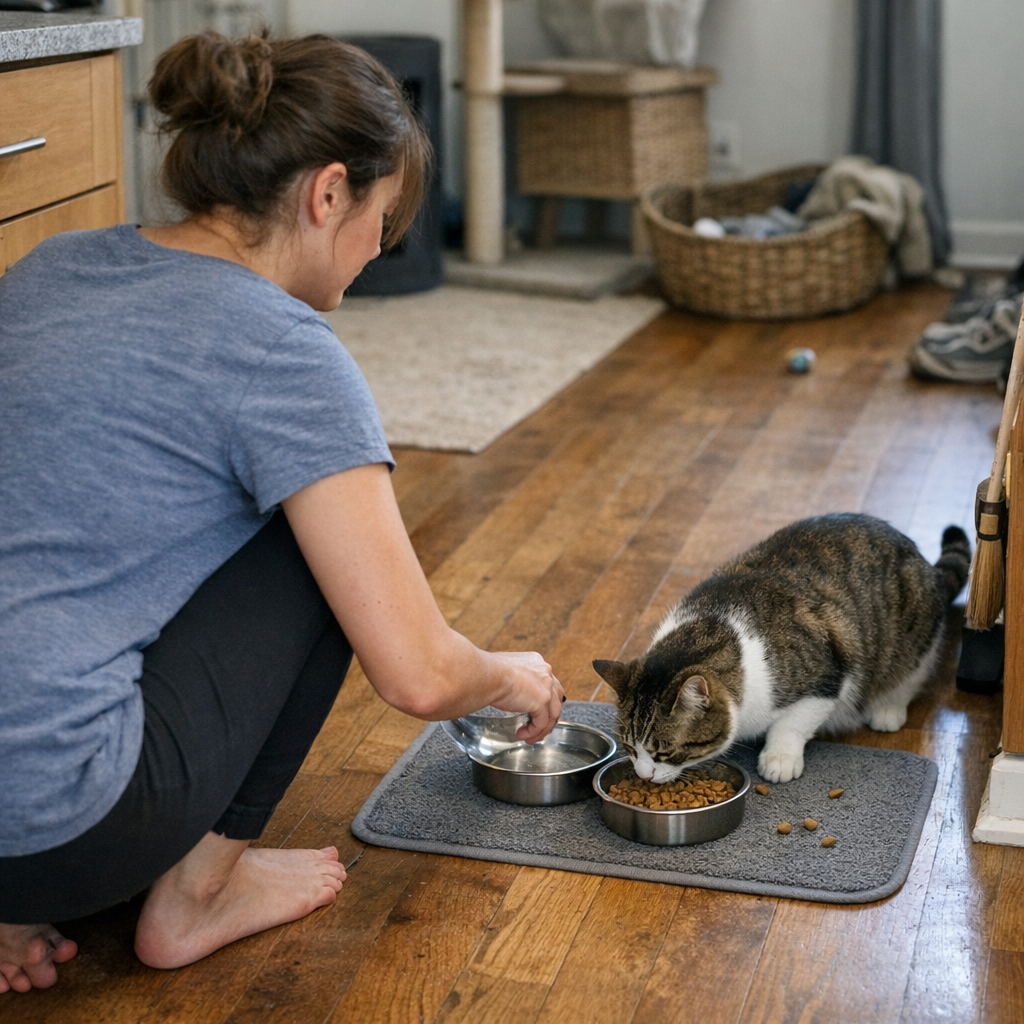
    Picture a standard morning: you reach for the food scoop but it’s with yesterday’s litter bag in the hallway. By the time food’s down, you spot kibble on the mat edge—except the wipes are deep in the bathroom. When you get back, your coffee is colder, and the scatter has made its way across the floor for a second lap, courtesy of impatient paws.

    A five-minute routine has turned into fifteen minutes of reshuffling, solely because supplies aren’t anchored where resets happen. None of this looks dramatic, but multiplied by days and weeks, it frays the line between “well-organized” and “always one step behind,” even if everything looks calm on the outside. Visually, the room reads clean; practically, it’s an obstacle course of micro-delays.

    Group Supplies by Task, Not Just Appearance

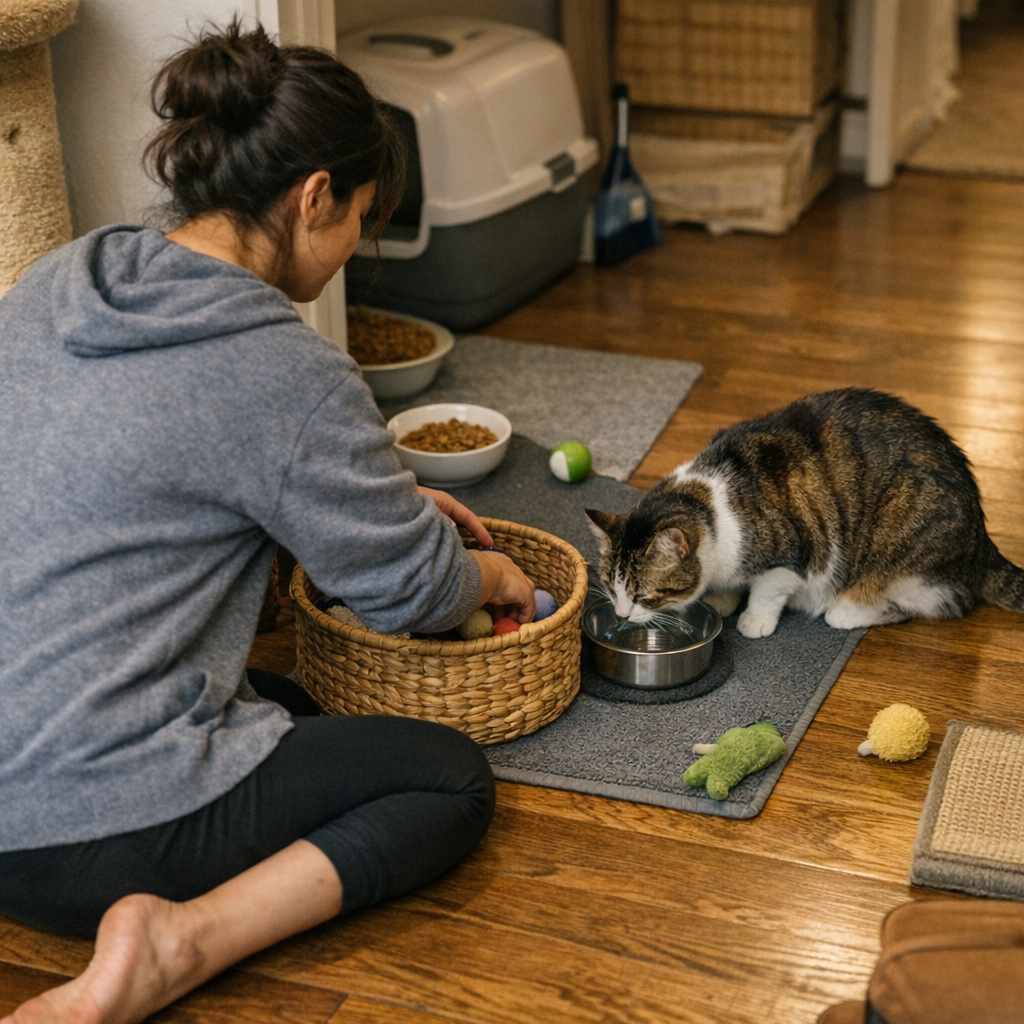
    Bare counters and hidden bins look organized, but only if you ignore the slowdowns. The setups that actually survive repeated use are built around where each task starts or finishes—not just what looks calm. Stash a sealed tub under the box, keep wipes and scoop together in a basket or caddy you can grab with one hand, and accept a little visible “clutter” in exchange for a routine that doesn’t drop you out of stride.

    • Litter, scoop, and wipes within arm’s reach of the litter box—preferably in a bin or caddy you can carry or clean out without scavenger hunts.
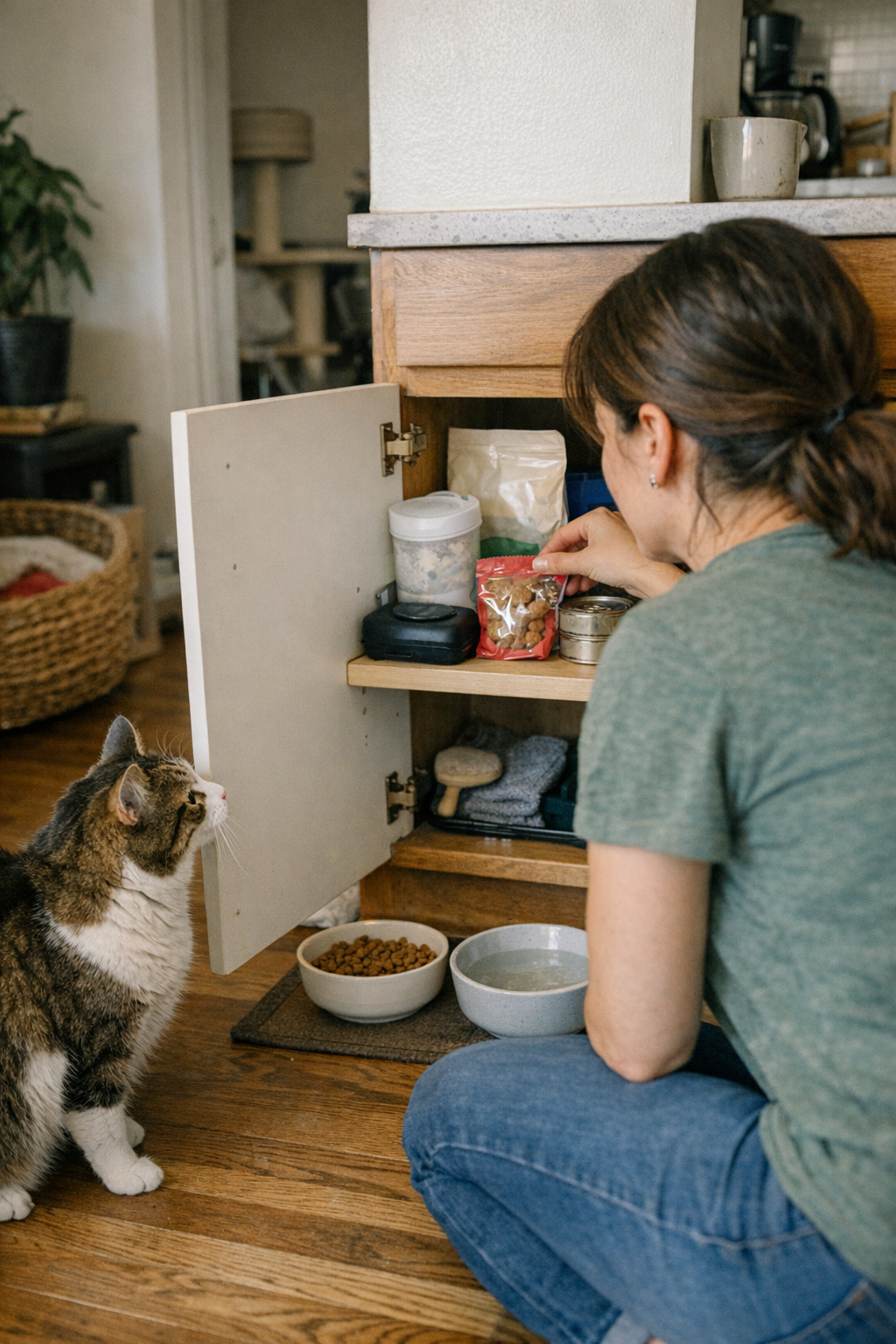
    • Feeding cup, spare food, and cleaner slotted right by the food station—a slim bin under a table wins in tight spaces.
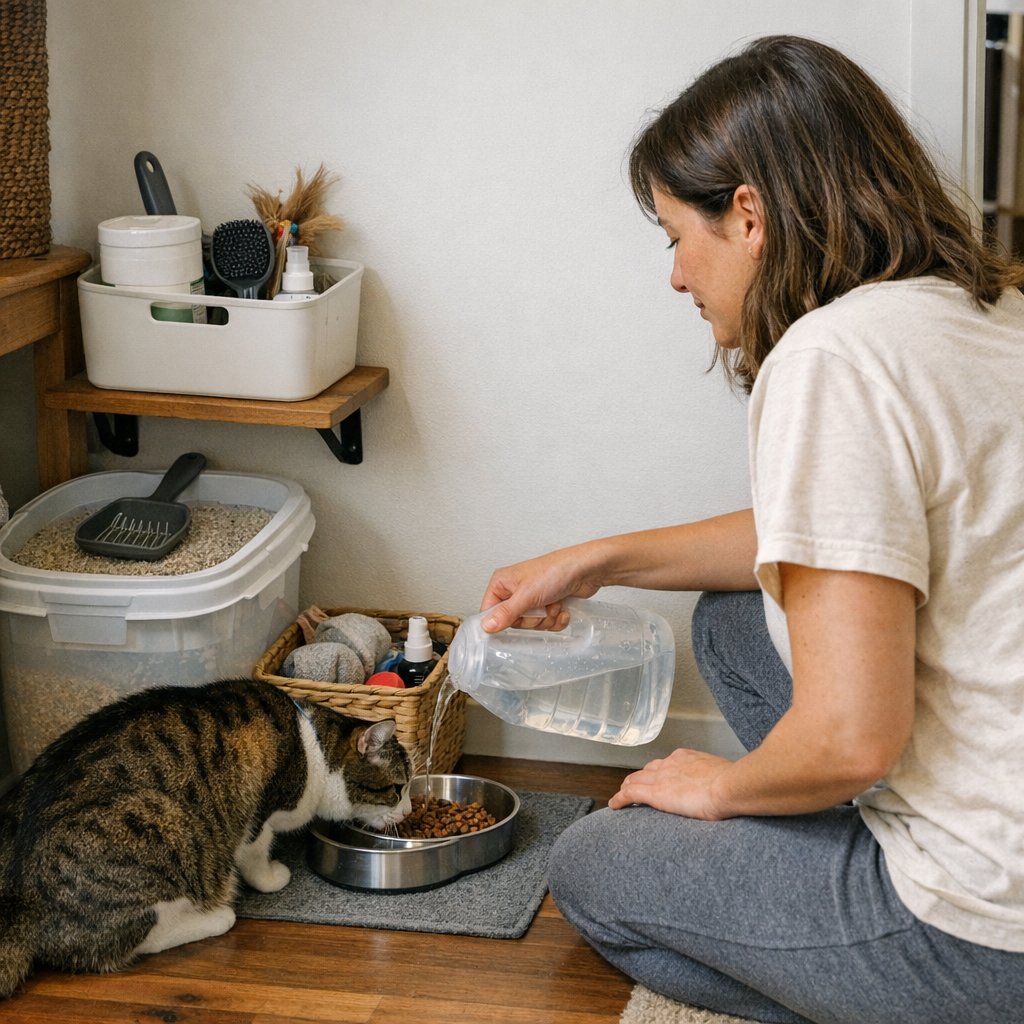
    • Water jugs belong next to or above the water bowls, not across the house. A closed basket or shelf neatly tucks it away while keeping it present enough you never skip a mid-day top-off.
    • Keep a tray or shallow basket near the main play area—grab-and-drop toy returns cut down on the spread and lessen the “where’s that ball?” spiral.

    The goal isn’t hiding every sign of pet life—it’s to make each reset quick enough that tomorrow’s mess never becomes an excuse to let today’s slide.

    Examples of Structure That Withstand Real-Life Use

    Practical storage doesn’t need to look custom-made. An airtight bin under the box saves you two-thirds the time of refilling from a closet down the hall. A lidded basket shelved above means wipes and bags are there at the instant you spot the mess, not fifteen minutes later. For feeding, a caddy tucked just under the feeding zone corrals scoops, spare mats, even brushes—so you stay on track instead of peeling off for missing tools at every step.

    One rule holds up: choose containers or baskets that open with one hand and can be closed without fighting the lid. Snap tops, slide-outs, or baskets that don’t jam are worth more than any fancy box—especially when a tail or paw has made you a little clumsier on the fly. Systems that stay easy in daily movement are the only ones that hold up when routines are repeated under pressure.

    Bumping Up Against Small-Space and Shared-Space Limits

    In apartments or tight homes, hiding supplies feels mandatory—until the first time you stall out mid-routine because a bin is out of reach or a lid needs a free second hand. A closed basket in open shelving near the box or food area holds the line between calm and clutter, but too much effort to access, and you’ll soon skip the process “just this once.” Those skipped steps always boomerang by week’s end.

    The best setups balance tidiness with single-step reach-in access: containers that don’t require untangling or clearing other items first. In shared rooms, restrict supplies to a dedicated bin or basket per major cat zone; otherwise, you’re chasing your own system from room to room in a daily shuffle. Order that asks for too much obedience won’t last.

    How to Spot the Early Warning Signs of Inefficiency

    • You keep interrupting your own day to chase supplies, or tidying messes that would have vanished if tools were closer.
    • Tools left for visual calm keep migrating back to the spot they’re used—clearly trying to fix the routine you won’t admit is broken.
    • Water bowls drop below “fresh” before you notice, and litter refills get delayed until the last possible moment, not because you forget—but because the storage location adds resistance.
    • Cleanups happen only after problems are visible, never as part of your natural reset rhythm—showing your structure is built
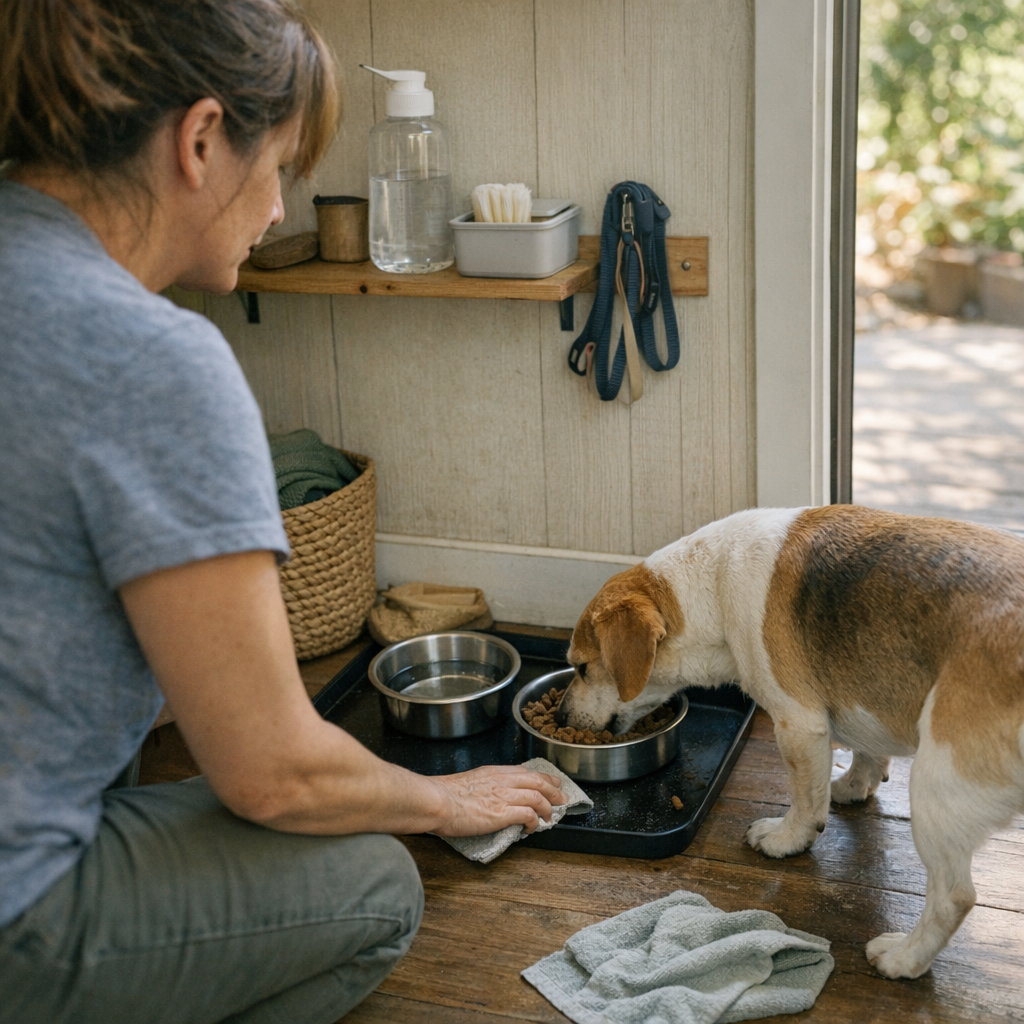
  • Streamline Your Pet Feeding Area with Single-Motion Reset Solutions

    Feeding, water refill, wipe-down—everyday routines with pets look simple, but a small flaw in your setup turns these moments into scattered work. When the bowl’s blocked behind random clutter or the refill bottle isn’t there when you reach for it, cleaning and resetting drag out, and what started orderly at breakfast feels messy again by dinner. The real problem isn’t a visible mess—it’s the missed reset, the one thing you can’t grab when you actually need it. CalmPetSupply’s world is built for these frictions, not just for “looking tidy,” but for setups that actually reset fast enough to keep up.

    Why “Looking Tidy” Isn’t Enough for Daily Pet Areas

    A pet feeding station might pass a quick inspection, but surface order hides deeper snags. Kibble collects behind the bowl just hours after cleaning. You’re ready to refill water—only to find the bottle stuck beneath a stack of unused supplies. These aren’t eye-catching disasters, but they slow you down every time. Most setups falter not from chaos, but from small design misses: the towel out of arm’s reach, or a grooming brush falling from a shelf each time you open the cabinet. Friction builds quietly until you’re dreading daily resets.

    Repeated Interruptions Slow Everything Down

    On any typical day, the signs appear: you go to feed your pet and must first move a cleaning spray left out after an earlier wipe-up. Then, the towel you depend on is missing in action, marooned on the far counter. No single hassle stalls your routine, but every detour adds seconds, and every search for a stray supply makes cleanup slower. By the end of the day, it’s no longer about cleanliness—it’s the sense that your space keeps falling just out of sync with how you use it.

    Resets Should Be One-Step, Not Multi-Step

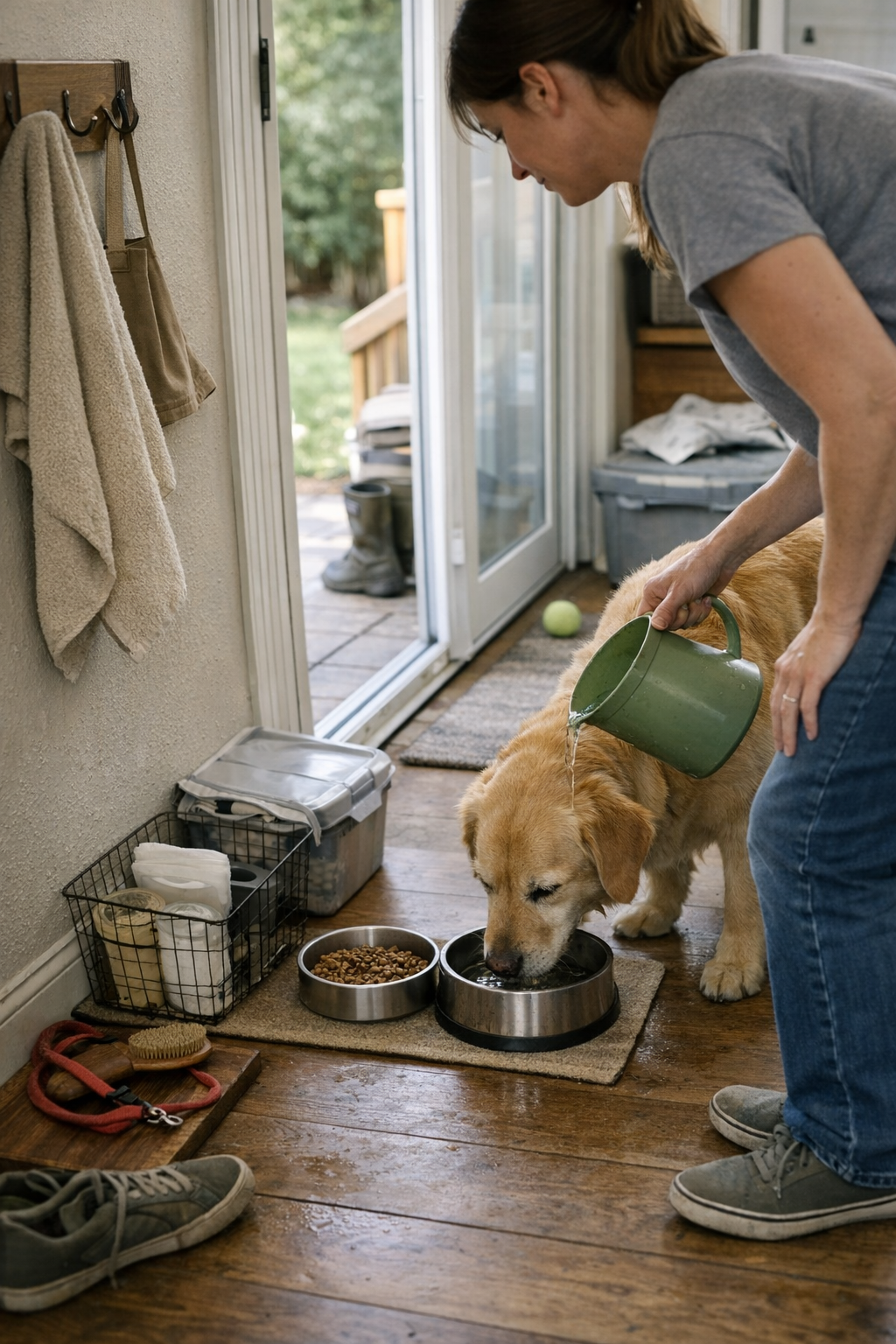
    In a friction-free corner, cleanup and reset happen in one move. Bowls live on a deep-edged tray that slides out with every crumb in tow—no chasing strays under the mat. A shelf above the station puts the water bottle and towel at hand, never hiding behind the stack of dry food or lost to the laundry. This layout means you don’t have to shuffle supplies or leave the job for later; you finish as soon as you start. Over time, the result is visible: fewer delays, less built-up clutter, and almost zero “I’ll get to it later” moments hiding in the routine.

    When Containment Makes a Real Difference

    The weak spots in most pet areas are always the same: drips under the bowl, scattered fur, or a ring of crumbs that keeps returning. Without a real containment tray, every meal means moving bowls and cleaning the floor underneath—often after you thought the job was done. Raised-edge trays localize the daily mess and end the endless cycle of mop-ups. Storing quick cleanup tools, like brushes and wipes, next to the main area avoids supply hunts and lets you deal with accidents immediately. When everything resets with a single action, repeated chores shrink, and the “just fed” look actually lasts.

    Real-Life Use: When “Ready” Doesn’t Last

    What breaks first isn’t always obvious. Maybe after a day’s worth of feedings, the space looks cluttered but you can’t say why. Each water refill means dragging a container out from the back of a packed cabinet, toppling a brush or scraping against other bottles. Supplies are technically “there,” but buried just enough to make skipping the quick cleanup a constant temptation. By evening, crumbs and water spots have piled up. The more steps it takes to return a space to ready, the faster small problems multiply—and with every skipped reset, the task ahead only grows.

    Smoother Routines: Practical Reset Tips

    To actually support your routines, set up for automatic resets. Choose a tray that traps spillover and wipes down in one motion. Arrange everyday tools—food, water, grooming wipes—within arm’s reach of the spot where they’re needed. Store towels and wipes in open bins instead of behind closed lids, so you’re never digging mid-task. After meals or walks, bundle all items together for an instant reset with no hidden steps. The more your system localizes mess and keeps basics at hand, the less your routine gets interrupted or delayed.

    The True Test: Less Visible Mess, Less Daily Drag

    The difference is visible by day’s end. If you’re still wiping up puddles at night or fetching supplies from across the room, your setup isn’t holding up: it’s just barely passing. Practical pet areas aren’t about fancy gadgets—they’re about flow. If resetting really can happen in one step every time, the routine stays light and interruptions shrink. Day after day, the right basics mean less lingering disorder and more silently maintained order, making pet care genuinely easier to live with.

    For more ideas on daily-ready setups, visit calmpetsupply.myshopify.com to explore practical solutions for containment and instant resets in pet spaces.

  • Recognizing and Resolving Restlessness in Your Dog’s Evening Routine

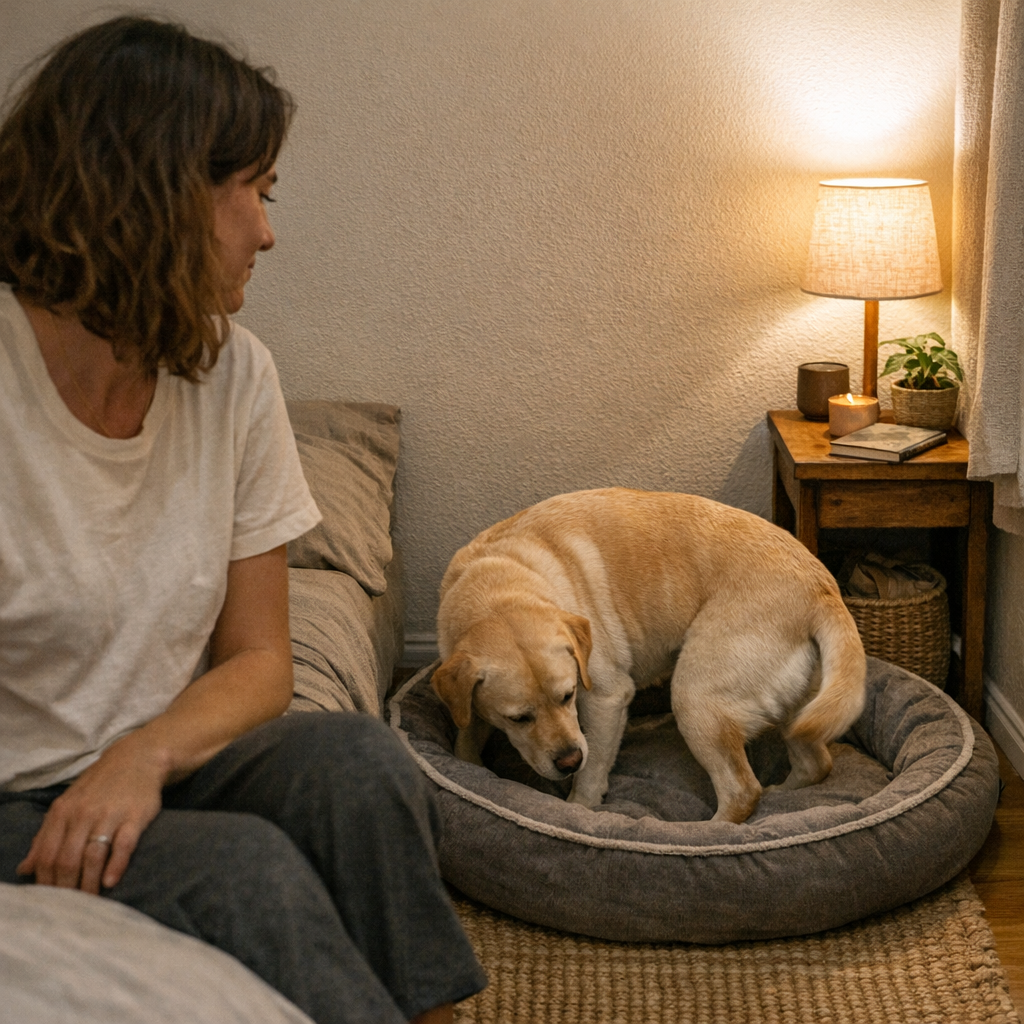
    Rest doesn’t break down with drama—it fails in small, repeated ways you barely notice at first. You set up your dog’s bed in a quiet corner, thinking you’ve solved comfort for the night. Yet, every evening slips into a familiar loop: circling, nudging, a quick hop up after settling, or pushing toys aside that keep spilling in. By the fifth interrupted bedtime, it’s clear—you’re not fixing a single quirk; you’re running laps around a friction point that looks neat but never delivers real calm. The setup says “ready,” but the routine keeps snagging.

    Everyday Friction: When Rest Feels Almost Right

    Most owners chalk up extra spins, fidgeting, or late-night rearranging as just “dog stuff.” But the real problem appears when a harmless routine morphs into nightly inconvenience. Circling doesn’t just waste a moment—it disrupts the flow, makes you pause mid-conversation, and turns a simple goodnight into a restless process you end up managing nightly. By the time you’re weaving around your dog’s feet or tiptoeing to not trigger another bout of shuffling, the cost quietly stacks up: sleep arrives slower, both for you and your dog.

    Unsettled routines aren’t isolated to the dog. Owners adapt without thinking—sidestepping paws in the dark, timing the last water check to avoid triggering more movement, or feeling the wait for quiet spill into your own wind-down. If silence feels thin and every “settle” seems temporary, friction has already moved from the background to the center of your night.

    Beyond the Obvious: What Restless Patterns Really Signal

    What looks like a momentary inconvenience—a fourth lap, a quick leave-and-return, or sniffing at every fold of the bed—doesn’t stay minor when it repeats. Over time, these interruptions tug at the whole house’s rhythm. Instead of drifting into rest, your dog keeps resetting: circling, scratching, reconsidering the spot. You feel it in your own routine—small, repeated starts and stops that push you out of the flow every evening.

    Real-world: you’re shutting down lights, expecting your dog to settle, but the next phase is a restless pacing, a stray toy blocking a smooth flop, a water bowl placed just close enough to disrupt. The actual problem isn’t the visible mess—it’s the setup exposing a weak spot night after night. When the fourth circle blends into a new attempt to settle, you know: this is no longer a quirk, it’s an embedded friction point.

    The Cost of Repeated Adjustment

    Disruption is rarely dramatic. It’s a chain: the dog paces, you wait, the routine gets fragmented, and the sense of rest becomes work. Ignoring it means bedtime turns into effort—managing paw shuffles, moving supplies out of the way, steering clear of a toy pile in the middle of your path. “Letting go” stops feeling automatic and becomes something both of you have to manage repeatedly.

    Invisible Triggers: The Setup Behind Restlessness

    Even a bed that looks soft and perfectly placed can sabotage routine if the structure doesn’t fit lived-in flow. The real enemy is invisible: too much cross-traffic, supplies tucked just out of reach, toys infiltrating the rest zone, or space that encourages your dog to try, leave, and try again instead of settling once.

    Examples from Real Evenings

    • Comfort at a cost: Bed is soft but right next to the main walkway, so every pass triggers another reset.
    • Storage invades comfort: Toys or blankets block smooth settling, forcing your dog to nudge items away or wait while you shuffle things mid-routine.
    • Looks neat, moves slow: Organized corners that pinch the path, so getting to water at night turns into a minor obstacle course.
    • Cleanup always out of place: Wipes and towels “present” but not actually reachable after a late walk, so you have to leave the dog to fetch cleanup, breaking the calm reset.
    • Bed becomes a project: Your dog spends more time adjusting bedding than using it, testing every position before giving up or leaving.

    Setup friction shows up as repeated experiments and aborted settling, not dramatic failure. A single smooth flop means the space is working. Persistent minor adjustments mean one constraint keeps resurfacing, even when everything looks “tidy enough.”

    How Repeated Restlessness Shapes the Routine for Everyone

    This restless energy isn’t just a bedtime glitch. A setup that doesn’t actually support rest bleeds into the next day: your dog brings fidget energy to every transition—waiting at the door, sitting through meals, or navigating crowded hallways. You deal with items spreading into your own path: toys creeping out, bowls blocking entrances, or crates wedged close enough that you both get stuck entering or leaving. The tension isn’t in the mess, but in repeated, low-level interruptions that make every routine less smooth than it should be.

    You’ll spot the pattern: neat bed, but always one last adjustment; routine feels “fine” until you’re rushing, then suddenly you’re wrestling the same slow-down at the worst moment. “Organized” setups can still block flow, forcing you to slow down, reroute, or reset what you already thought was solved. The difference is loudest during high-traffic moments—one setup gets out of your way; the other keeps putting small hurdles back in.

    Evening Interruptions, Morning Consequences

    Last-minute bedtime friction isn’t just a nighttime nuisance—it lingers into the start of the next day. The more effort required to achieve calm, the more likely tomorrow morning starts with another reset. You move slower, deal with another round of awkward reach or shifting paws, and the cycle sticks. Routine gets heavier before it gets faster, and neither of you feels fully reset when the day begins.

    Spotting the Pattern: Is It the Bed, the Placement, or the Flow?

    Restlessness anchors itself as the “new normal” when the setup quietly works against the routine. Placement is the usual culprit—bed against a draft, pressed by a shortcut path, tucked where foot traffic and distractions keep resetting the rhythm. But just as often, it’s storage and gear gradually crowding the zone: toys drift over; cleanup supplies are theoretically nearby but never at hand; the nice-looking layout pinches real movement every busy night.

    Signals your setup needs a reset:

    • Dog circles and steps away right after lying down
    • Leaves bed for mid-rest room checks, then restarts the process
    • Hyper-alert to marginal sounds—nearby creaks or movement snap them out of almost-sleep
    • Repeated “test” settling before committing, especially at busy transition spots

    Notice when you’re both “managing” instead of moving smoothly. The earlier you recognize repeated minor struggles, the faster you can tweak setup and reclaim a natural routine—without the false fix of a full overhaul.

    Real-World Reset: Adjust, Don’t Overhaul

    The answer is usually a shift, not a shopping trip. Small moves—moving the bed out of the main path, clearing out that persistent toy drift, parking cleanup supplies where you don’t have to cross the house to reach them—are what change the lived experience night after night.

    Example: A Small Move, a Big Shift

    One evening, the difference came from something simple: the bed shifted out of the hallway and pressed against a side wall. Suddenly, the circling ritual shrank to one loop, and late-night fetches for water or a towel stopped breaking the routine. With the bed out of the traffic zone, both dog and owner could settle. What read as background “quirks” vanished—bedtime became a finish line, not another lap around an organized, underperforming setup.

    The next morning, the payoff wasn’t just a neater corner—it was an easier wake-up, clearer routine, and less friction lingering from the night before. The win wasn’t a gadget or new product. It was a real reset—less background noise, fewer stops, more genuine rest gained back.

    Small Tweaks That Make a Difference

    • Move the bed out of main walking zones for uninterrupted settling
    • Remove toy and gear clutter from the edge of the rest area
    • Choose a spot where your dog can monitor the room but not the main entrance or high-distraction areas
    • Keep cleanup towels or wipes within arm’s reach instead of just being “in the room”
    • Stick with familiar bedding textures and avoid over-complicating the setup with optional extras

    The most reliable gains come from these minimal, targeted resets. Every tweak isn’t about chasing perfection—it’s about removing the same old friction, so rest returns as something both of you can trust nightly, not just occasionally.

    See how DogPile setups can help reinforce

  • How Labeling a Single Shelf Transforms Cat Care Organization at Home

    It’s easy to think your cat supplies are under control—until you actually move through your weekday. The shelf looks calm, the wipes upright, even the grooming comb perched where you left it. But try to grab the open food bag before work, and you’re stuck moving bulk supplies just to reach today’s basics. Dig for the wipes and they’re jammed behind snacks, blocked by backup litter, or missing until the mess has already spread. If you’ve suddenly restocked wipes only to discover the old (still sealed) pack, you’ve seen firsthand: what looks organized in the morning can break down under real cat care by the afternoon. Surface order never stands up to the churn of actual feeding resets, litter cleanup, or shared-household routines—and every week, this hidden friction eats up time, money, and patience.

    The Repeated Headache of the “Organized” Shelf

    Setup that looks under control almost never stays that way after a few rushed routines. You start with a shelf that’s technically neat: supplies lined up, no loose trash, a sense that anyone could step in and help. Fast-forward to a real weekday fluorescent-lit morning or a distracted evening reset, and the logic cracks. Supplies migrate out of sight. Only the backup food is easy to grab; the in-use bag gets buried. Wipes multiply in hidden corners, or the new pack blocks the half-finished one. The toy you fished out last night is back behind canned soup, ready to throw you off next feeding. Visual order turns out to mean little against the pressure of repeated, mixed-use routines.

    • Food reach stalls: Bulk bags drift forward, blocking what you actually need during daily feeding.
    • Wipe search eats up time: Old and new packs shuffle around, leaving you cleaning up with whatever’s least hidden—even if it’s not the right one.
    • Toy randomness: Last evening’s play toy winds up behind groceries, stalled for days until the next deep clean.

    Over days, the shelf becomes less a supply zone, more a reset trap: duplicates, partials, clutter hiding urgent messes, routines that start slower and finish less finished. The more the area “looks” okay, the likelier it is that something essential will be out of reach right when you don’t have extra time to spare.

    Why Supply Overlap Quietly Raises the Upkeep Load

    Mixing all cat supplies—daily, backup, specialty—onto a single shared shelf feels logical at first. In practice, overlapping categories quietly sabotage every quick grab and daily reset. The clutter is silent for a few days, then friction returns: food runs low without warning, wipes are always in the wrong spot, and every step involves moving something just to get what you need now.

    • Expiration confusion: It’s impossible to track which bag or treat is fresh versus nearly empty; reordering happens only when you’re already out.
    • Blocked movement: One misplaced can or seltzer ends up in front of cat grooming supplies mid-spill—slowing every cleanup.
    • Hidden money waste: Supplies get duplicated; you keep buying before you actually need to replace anything, just because nothing is clearly visible.

    The more you try to “stock ahead,” the more every refill, cleaning, or supply handoff takes twice as long—and the less any system holds up under the strain of repeated, real-life cat routines.

    Spotting the Weak Point: Not Just About Looks

    The real test isn’t whether you can make a corner look tidy. It’s whether your feeding resets, litter-area wipe-downs, or shared hand-offs run without hiccups. The breakdown always announces itself: the one item you need is hidden, blocked, or missing. The difference feels small at first, but repeat it during a change of schedule, a rushed morning, or a sitter’s visit, and you’ll see how quickly “organized” becomes “interrupted.”

    • Missed basics: No one can find what they need in ten seconds.
    • Extra time for handoffs: Anyone stepping in to help hesitates, checks twice, asks questions—or skips replacing an item because the right one isn’t obvious.
    • Routine slowdown: Even solo, you feel the drag: which bag? which pouch? where are wipes this time?

    Every attempted reset pulls up the same root flaw: a setup that looks neat falls apart under real, unscripted use—slowing everything and inviting clutter to rebuild.

    The Real Shift: One Precise, Labeled Daily Supply Shelf

    After too many sets of lost minutes (and wasted supplies), only a focused, labeled shelf made a practical difference. Label one shelf “daily cat only”—and mean it. Not a general pet zone, not another multi-use bin. Restrict this shelf to today’s open bag of dry food, active wipes pack, single-use grooming tool. No backups, no unopened packs, no “for next month,” no half-used extras drifting in during the week. Reset equals return to this shelf—never stash in a nearby drawer or blend with backups. Clarity is built in, not a hopeful result of a fresh reorganization.

    How a Label Changes the Routine Flow

    The shelf lands at waist height, directly above bowls or beside the feeding area. The label—bold, black marker or clear tape—serves as a stop sign for everything not in rotation today. Everyday use becomes a scan, not a search. If it’s not visible here, it’s not in play. Anyone in the house will know instantly: this is the zone for immediate use, not overflow. Decisions and handoffs shrink to seconds, not pauses or follow-up questions. Even under stress, the routine doesn’t unravel.

    What Actually Improves with a Labeled Shelf?

    • No more lost duplicates: The chance of a new pack obscuring an active one drops—waste and confusion fade with it.
    • Instant handoff clarity: A sitter, family, or guest sees exactly what’s meant for today. No more rooting through surplus or lining up packs “just in case.”
    • Inventory at a glance: If it isn’t present on the shelf, refill isn’t due. No more mystery restocks or last-minute panics.
    • Cleanup syncs to real room use: Essentials return here automatically. You’re not wandering the house during time-sensitive resets.

    The payoff is hidden at first. But in a week, you’ll notice less delay, fewer repeat purchases, and reset friction dropping—especially when routines stack or unexpected supply swaps become necessary midweek.

    Limiting Daily-Use Cat Supplies: The Tension and the Payoff

    Temptation never stops: a new treat pouch, backup wipes, bulk bags “just for now.” By Monday, two backups might be drifting back within reach—especially after a weekend mess or spontaneous cleaning burst. The shelf will always try to turn back into a catch-all unless you hold the line. But the daily payoff holds—so long as you keep those backups above or below, out of everyday reach.

    • Reserve labeled-shelf space for what is physically used today—if it’s not part of the feeding, cleaning, or grooming routine in the next 24 hours, it doesn’t make the cut.
    • The label is both a rule and a reminder, blocking “just for later” creep.
    • No more double-takes: A glance says what’s due for refill, what’s left, and what needs to go away—instantly, and without a mental shuffle or hallway dash.

    The trick isn’t perfection—it’s rebound. The shelf will get challenged, drift, or clutter again during long weeks. But every reset is faster and less guesswork, because the border is unmistakable. Costs—time, waste, hassle—reliably shrink when used as intended.

    Scenes from the Real Routine: Supply Drift and Reset Friction

    • Water bowl clear at daybreak, but a misplaced treat bag blocks it after the first refill sprint, stalling the next pass-through.
    • Wipes urgent after a messy litter cleanup, only now buried behind unrelated snacks or backup cans—one more step for every cleanup job.
    • Toys blend with bags and bowls, nudging into hallways or underfoot—until someone has to pause, reshuffle, or rescue the area just to keep moving.
    • Surface neatness collapses as almost-empty packs bury the main item, turning resets into scavenger hunts.

    Building just one daily-use shelf makes every reset, refill, and supply return line up with the real habit, not last month’s hopes. The rule is stubbornly simple: if you didn’t use it today, it doesn’t get a spot. The payoff is a quick scan, not a

  • How Small Sound Changes Can Improve Your Dog’s Rest and Routine

    If your dog can never quite settle—gets up halfway through a nap, paces the hallway after a walk, or jolts awake as you refill a bowl—it might not be bad luck or just high energy. For a lot of homes, the real reason is buried in setup friction: the daily rhythm keeps snapping, not from one dramatic noise but from a scatter of small, repeated interruptions. Bowls clatter when refilled, tags scrape tile when the leash tangles, a towel for muddy paws is always just out of reach, and the “tidy corner” for supplies blocks fast movement during cleanup. Each mini-interruption chips at your dog’s comfort, making rest shallow and transitions drag out. This isn’t about chasing silence—it’s about removing the routine friction that keeps breaking the flow of everyday dog life. That’s the premise behind DogPile: setups that cut down on the noise and awkwardness that block real calm, not just visual order.

    The Soundscape Behind the Restless Dog

    Most owners tune out the routine soundtrack: bowl scrape, chair leg drag, tags rattling when you reach for the leash. Dogs don’t. Watch closely during any ordinary hour—your dog hears a bowl touch tile and instantly lifts her head, tenses at the closet hinge before a walk, or freezes as you slide out a stool. None of these noises are catastrophic. But together, they become a string of micro-interruptions: tiny resets that keep your dog on edge long after the initial sound fades. Settling after a walk takes longer. Naps break up into short stints. Rest becomes effort instead of default.

    The build is slow but constant: Not one noise, but the unpredictability. A loud clang here, a jumbled pile of toys there. Instead of your home smoothing the rhythm of routines, small friction points jerk the process back to start, over and over.

    What Subtle Interruptions Look Like in Real Routines

    Take any busy evening. Your dog curls up beside the kitchen, hoping to rest, but jumps at the bowl being emptied in the next room. She moves to the hallway; a chair legs scrapes, and she’s up again. Another spot, but now a door latch snaps and her shoulders tense. Most owners see:

    • A head-turn every time someone passes through a doorway—never fully at rest
    • Ears bracing for the next sudden movement near the food or water area
    • Pause on the walk—tags banging the vent, leash twisting underfoot—interrupting smooth movement
    • Shoulders just off relaxed, like she’s in standby waiting for the next clatter

    It’s easy to read this as being alert or restless “by nature,” but most of these signals trace to setups that keep resetting calm: sounds and obstacles that force your dog to shuffle, hesitate, or give up resting spots that never stay peaceful for long.

    Small Frictions, Larger Patterns: When Flow Keeps Breaking

    It’s rarely one big mistake. It’s the everyday offenders:

    • An ultra-soft bed placed in the main footpath—great comfort, but your dog has to move every time someone crosses the room. The dog never sinks in; he’s up and down, watching feet.
    • Cleanup wipes on the counter: looks organized, but after muddy walks, the leash hand can’t reach without letting go—so paw prints streak through the hall before you can act.
    • Bowls lined up, tidy but metal-on-tile. Every refill or cleanup clang resets the nap zone.
    • Toys stored together, but the bin blocks morning traffic from the back door to the kitchen. Quick access is now a clumsy obstacle course.

    Each of these setups solves one problem but injects new friction. Calm is replaced by a routine cycle: partial reset, interrupted rest, a new trail of dropped toys or muddy tracks, and both dog and owner slightly more tense than before. When a system only looks organized but doesn’t lower repeated-use friction, it doesn’t actually help.

    The Real Cost: Interrupted Routines and Hidden Tension

    Why does it matter? Day by day, the stacking effect shows:

    • Your dog goes rigid and alert at every bowl move or wipe grab—instead of letting down between activities, she’s primed for the next interruption
    • Even the quietest hour doesn’t deliver full rest, because every meal prep or quick cleanup breaks the streak again
    • At night, shallow naps feed into restlessness all the way through bedtime. A smooth routine never comes together—reset and drag repeat every evening

    Left unchecked, these “small” frictions make the whole day more fragmented. You both lose out on the smoother, lower-pressure flow that should anchor routines post-walk, after feeding, or during quiet time.

    Recognizing the Early Signals: What to Watch For

    Rarely obvious. Usually small-but-steady: The dog that can’t quite settle often leaves a pattern:

    • Head snaps up with every clink or rattle—then lingers, waiting for calm that doesn’t last
    • Pacing or hovering, moving beds or changing corners when sounds spike or movement cuts across their space
    • Paused in doorways, torn between moving forward and waiting out another interruption
    • Shoulder tension or quick glances at ordinary noises, even in otherwise quiet rooms

    If you’re seeing these clusters—especially around high-traffic moments, after walks, or during feeding and cleanup—the culprit is often setup, not temperament. Clutter, blocked access, and noisy gear silently ramp up friction.

    Subtle Friction Points to Audit in Your Routine

    • Bowl material and spot: Metal bowls on tile near busy paths cause unnecessary clatter exactly when your dog needs calm. Opting for silicone or rubber-bottomed bowls in the right corner drops noise during refills by more than you’d expect.
    • Tags and collars: Loose tags or heavy dangles turn every leash grab into noise. Tighten up, use a silicone cover, or choose lighter hardware if your dog reacts to every shake.
    • Thresholds and hardware: Door latches, catches, sticky doorstops—these add up. A smoother hinge or quieter stop fixes more routine friction than most owners realize.
    • Furniture feet: Chairs moved during meals, stools near the rest area—sudden scraping snaps dogs out of pre-nap calm. Pads help, but so does choosing spots outside heavy traffic lanes.

    No fix needs to be perfect. The aim is to lower the impact of every repeat-offender zone—enough to stop the routine from always snapping back to tension.

    Shifting the Setup: Real Changes for Smoother Days

    For most homes, building a calmer routine doesn’t require silence. It means pinpointing and cutting the worst friction—so the day doesn’t keep resetting for the wrong reasons. What works isn’t more storage or stricter tidying, but changes that actually show up in how routines flow:

    Simple Switches That Actually Stick

    If your metal bowl is the main source of dog-and-owner agitation, try a silicone or rubber-bottom version. The difference isn’t about “being fancier”—it means meal preps, water top-ups, and fast cleanups happen without a jolt. In use, you get:

    • Dogs less likely to jolt awake as bowls move—head stays down after you finish in the corner
    • More stability in waiting routines—no repeated circling when you wipe paws or refill water in the same spot
    • Shorter hallway loitering: when background clatter drops, dogs follow the routine instead of waiting out the next sharp interruption

    Same principle: keep collar tags still, cover with a buffer, or streamline gear; slide pads under chair and stool legs that live near nap areas. If your door always triggers commotion, a quieter latch is often all it takes for your dog to treat thresholds as neutral instead of on alert. The point isn’t perfection, but a low-friction default—the kind that doesn’t feel remarkable, because routines don’t keep breaking down.

    The Pace of Real Improvement

    Visible change is never instant—the first day, everything feels the same. By the third or fourth, a new routine forms: your dog doesn’t jump up at every clink, nap stretches longer, cleanup and feeding stack without extra rounds of hallway resets. The measure isn’t how pretty the setup looks, but whether transitions make your day smoother and your dog’s rest deeper.

    Daily Routine, Less Drag: What a Smoother Soundscape Produces

    Rest isn’t just the absence of noise; it’s the absence of forced resets. A calmer home routine lets your dog move from walks to feeding to rest without tension at thresholds, blocked

  • Why Perfect Pet Care Setups Often Slow Down Your Daily Routine

    Why “Perfect” Pet-Care Stations Slow You Down

    The everyday reality of feeding your pet isn’t as simple as it looks online. A row of matching bowls, wipes hidden, perfectly stacked bins—this kind of setup feels organized until you start using it every day. A care area designed to “look right” quickly reveals hidden friction: bowls you can’t grab without emptying a cabinet, scoops buried out of reach, towels never where you need them, and extra steps added to almost every routine. The more pristine the station, the more you chase order instead of ease—until pet care means hunting for basics instead of a quick, calm reset.

    The Hidden Cost of Organized Appearances

    Setting up with labeled bins, bowls in neat lines, and wipes stashed away seems straightforward. But real routines break this facade fast. Each morning, the “put away” scoop means digging through a drawer or fending off a stuck cabinet door while your hungry dog or cat waits impatiently. Sparkling bowls? Only until that dried food edge blindsides you and sends you back to the sink, just as your pet’s paws start shifting closer.

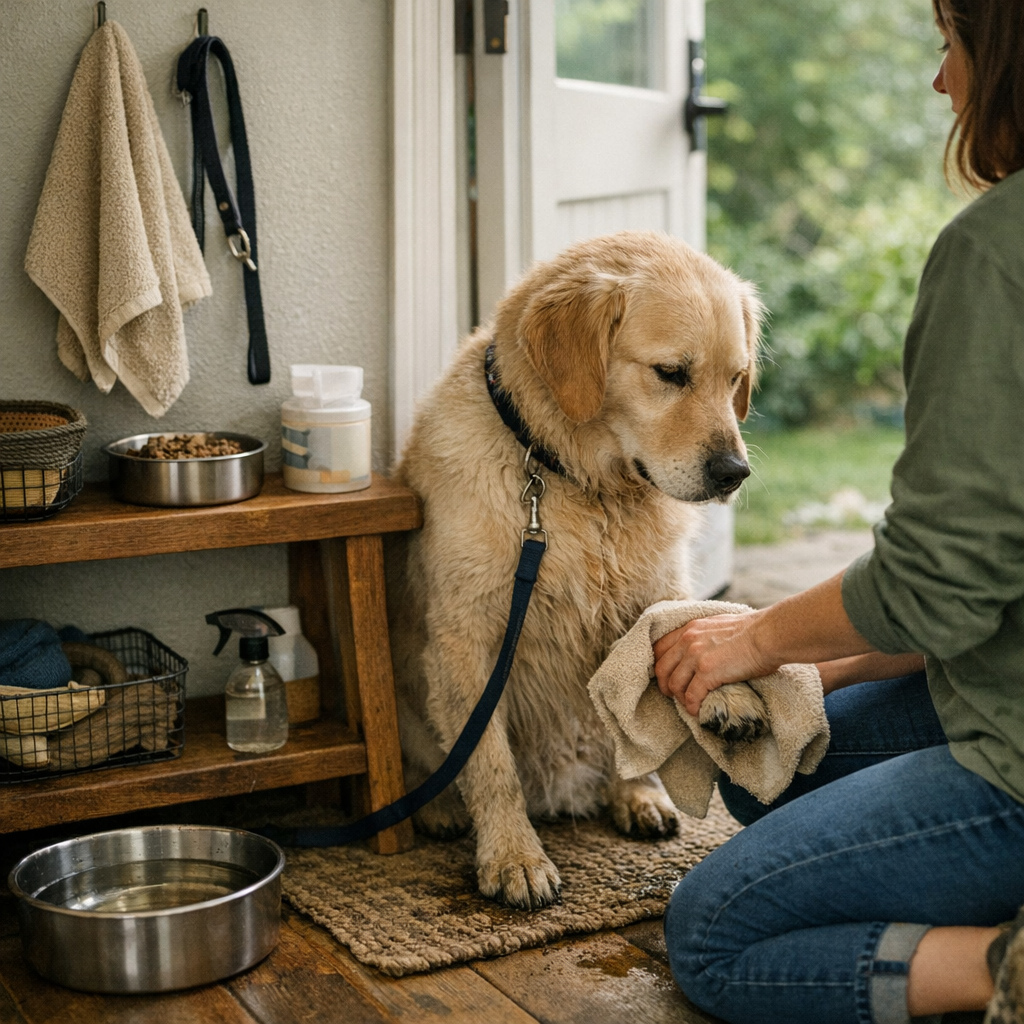
    Hooks by the laundry room look tidy on day one, but the towel is rarely where muddy paws cross the threshold after a walk. You hang it up once, but end up grabbing paper towels—knowing you’ll wipe the floor again later. Storage bins stack high, but the favorite toy always seems buried, making you empty the entire container just as playtime’s supposed to start. “Neat” setups work against you when the items you most need are always a step, hook, or lid away from where routines actually happen.

    When Everyday Routines Get Stuck

    Take a breakfast rush. The counters look spotless, but getting food down means sliding bowls out from under the countertop clutter, locating a scoop behind pantry cans, and spot-cleaning a crusty bowl rim on the fly. Your dog returns wet from a morning walk—the towel’s on the other side of the house, so you trail water across clean floors, improvise with napkins, and add one more thing to reset before work. The routine looks controlled, but every day, something is misplaced, blocked, or slow, and you’re left reshuffling just to keep pace.

    Hide pet mats to clear the living room, and they keep sliding back into high-traffic spaces—or the feeding area is missing its mat when spills hit. Bins meant to corral toys transform into obstacles, forcing the same evening cycle: dig out, scatter, re-stash, repeat. Every “orderly” move ends up adding steps nobody wants.

    Real-World Friction: When Looks Outweigh Function

    If you’re constantly doubling back for a scoop or skipping a cleanup because the wipes are never where messes happen, the setup is working against you. Rows of feeding bowls shine on the counter, but every refill stalls because the water pitcher is always somewhere else. Litter scoops tucked away mean frantic searching the one time you really need a quick clean. Neatness becomes a trap—prioritizing how things look over whether you can handle the next mess without losing momentum.

    The slowdowns don’t shout—they creep in. Over a week, those extra trips and missed wipes steal minutes you can’t get back. Chores drag, parts of the routine get skipped, and you start hesitating before each simple task. The mess wasn’t the problem; the “perfection” was.

    The Small Change That Transforms Routine

    Fixing it isn’t about buying more storage—it’s about shifting what’s already there. Hang the towel not in the laundry room, but by the main hallway, right at the spot where muddy paws and messy mouths land. Suddenly, wiping down water or mud takes one reach instead of three rooms. One simple move—putting care tools near the actual action—cuts out detours and repeated resets. That rough-looking towel next to the bowls wins the day; hidden storage never did.

    The takeaway: let the routine dictate where each tool belongs, not the appearance. Bowls stacked by the sink, a scoop left beside the kibble, wipes on the counter—none of it looks “finished,” but every piece is in play when you need it. Function beats photo-ready order every single feeding, clean up, and night check.

    Spotting the Weak Points in Your Routine

    Notice repeated stalls: are water bowls always empty later than you meant? Are wipes only handy after the mess dries? Does the scoop ever stay out, or do you dig for it every time? If one item always forces you to stop or retrace your steps, the setup is slowing you down, no matter how it looks. When “tidy” means constant resetting, you’re managing appearances, not routines.

    Choosing Daily Ease Over Perfect Order

    In pet care, saving steps is the difference between routine drag and actual calm. Move even one tool closer to where it’s needed, and feeding or cleanup speeds up with zero show. Trust a setup you can move through without thinking about what’s buried, what’s missing, or what gets in the way—from morning meals to late-night walk returns.

    An area that looks organized isn’t always easier to run. Choose routines that work at real speed, with tools within reach and cleanup that doesn’t wait. Bowls placed for the quickest grab, towels ready for actual paws, and wipes visible when the mess is fresh—these are the changes that show up in every daily round, not just in a photo.

    For more practical ways to support your daily pet-care flow, visit calmpetsupply.myshopify.com.

  • When Cat Clutter Is More About Routine Than Storage Solutions

    It always starts as something you can ignore—a bowl just out of reach, a mat “safely” out of the path, a corner for litter that looks invisible—until the friction piles up. Then one morning, you’re dodging a chunk of kibble with your foot again, brushing aside crumbs that reappear by lunch, and realizing what’s really off: the setup isn’t failing because it’s messy, but because it quietly fights your real daily routine. In most indoor-cat homes, the hidden cost isn’t chaos. It’s those seconds you lose, the unexpected pauses, and the energy spent resetting the same area over and over, all because the space isn’t made for how you actually live beside your cat. Welcome to the practical reality that StillWhisker was built for—where ordinary routines, not just containers or color schemes, determine what actually works.

    The Real Roots of Cat-Related Clutter: Not a Storage Problem

    The cycle is almost universal: bowls are brought back, litter trails appear again, and yesterday’s pile of toys works loose from the “tidy” bin before breakfast. If you feel like you’re constantly organizing, but the mess just slides back, here’s why: the hardest-to-fix chaos isn’t about storage or neatness—it’s about setups that break down as soon as real routines begin.

    When cleanup becomes a repeat loop—retrieving bowls stuck behind stools, squeezing past a too-close mat, wrestling wipes out from behind where you actually need them—you’re not seeing failure so much as the signs of a setup that’s physically in your way. It doesn’t look like a mess until the tenth time you stoop down for the same toy wedged under the couch. What looked organized on day one now needs constant micro-fixes just to keep pace with your day.

    When the Setup Looks Settled but Still Slows You Down

    Tidy, yes—but functional? That “hidden” litter box in the corner, the curated toy basket, the feeding dish aligned with the backsplash… these all promise visible calm. But open the door during a normal week and the illusion cracks. You spot the unspoken swap: the area photographs well, but you’re now fighting slippage—wiping a mat that drifts every time someone walks past, crouching for toys that sneak behind radiator fins, breaking stride to dig behind stacked supplies that once “decluttered” the room.

    The Daily Reset That’s Never Quite Done

    Picture this: Every night, you drop all toys in a deep bin. By noon, your cat’s chosen two are back in the middle of the floor. One has already found its way into the shadow gap beside the fridge. Now you’re down on your knees again, and that clean floor you admired last night is a memory—while the “storage” isn’t helping any ordinary routine. It’s a loop. Soon, you’re straightening the mat or nudging the bowl back into place and hearing yourself think, “Didn’t I fix this already?” The room looks fine in snapshots. The burden only shows up on repeat.

    This is why photo-ready order doesn’t always equal liveable ease. Sooner or later, constant resets start to feel like chores you shouldn’t have to do—but can’t quite skip without the system breaking down again.

    Invisible Interruptions: How Misaligned Setups Cause Everyday Delays

    It’s not always the sprawling mess; sometimes, it’s the tiny detour hiding in plain sight. Maybe the water bowl sits in a decorative alcove, but you have to break your morning flow to reach it—a few extra seconds each time, easy to dismiss, until a rushed morning means the refill gets skipped. Soon, there’s buildup or stray fur inside and that’s when the small inconvenience shows its teeth. Let enough minor frictions line up, and missed maintenance stops being rare—it becomes part of the week.

    Comfort vs. Convenience: When One Fix Creates Another Issue

    “Upgrades” sell the promise of improvement, but every change has a tradeoff. That stylized mat—now located “out of view”—keeps shifting, leaving a trail of crumbs extending past the spot you’re supposed to stand. Maybe you pick a soft cat bed that matches the room, but the cover refuses easy cleaning, so the comfy spot turns into another routine you grudgingly maintain. Design for cat comfort adds unseen labor for you, multiplying each time an easy solution means more crouching, more shaking out, even more hair to sweep up.

    Shared Spaces: Cat Gear That Keeps Sneaking Into Your Life

    Cats don’t respect defined zones; the nuisance is slow enough to ignore, until it builds up. Feeding mats edge closer to pathways, toys roll into hallways and under seats, even containers you picked to “hide the mess” begin to pile clutter just behind your reach. Need the broom? Now you’re moving a scatter of supplies stacked in your traffic lane. Carrying a cup of coffee? The kicker toy appears underfoot again. These are the micro-interruptions that erode convenience—unplanned, but felt just the same.

    The real sign a setup is off? Annoyance you can’t quite get rid of, no matter how much you tidy.

    Frequent Reset Points: Where the Routine Keeps Breaking Down

    The classic offender: the feeding zone that looks unobtrusive, but gets crumbs nudged with your foot every visit. Or a litter mat that never sits square, drifting until cleanup is an extra step just to access the essentials. Then there are caddies or wipes tucked “logically” out of sight, only to be out of reach in the one moment you’re managing a spill. Setup friction isn’t always a big mess. Sometimes, it’s surfaces needing wiping later than you meant, accidents that happen just out of your prep zone, and trays that remind you the system’s built for looks, not for repeat use.

    Spotting and Fixing Routine Friction in Real Cat Homes

    When small resets start to feel like real work, it’s not about getting lazier—it’s the setup missing your life’s tempo. Let a few minor misalignments persist and items fall behind: wipes never where you need them, food areas that slide out of “easy,” hair clustered in spots you never check until errands are underway. The promise of an organized space weakens; your routines slow under the extra handling the tidy look demands.

    Read the Repeats: When One Weak Point Keeps Returning

    Watch where your own frustration pools. If you’re always bending for the same toy, nudging the same bowl, or missing wipes by two steps, it’s not a discipline problem—it’s a warning about the structure. The solution isn’t prettier storage or another basket; it’s a reset that reflects actual use: what you reach for, where you pause, and whether you can grab essentials with a minimum of bending or searching. Real fixes mean aligning the setup’s rhythm with yours, not just your cat’s.

    Small Shifts, Big Results: A Feeding Zone That Actually Works

    Change doesn’t have to be major to be felt. After months of crumbs working loose under the kitchen rug and half-resets that didn’t stick, moving the main feeding bowl from its “out of the way” niche directly onto our morning walk-path reshaped the routine. Suddenly, the cleanup wasn’t a side task—it was natural, done while passing, no added step. Refilling the bowl stopped being a minor detour. The mat didn’t shift; the bowl didn’t wander. What changed wasn’t the look, but the fit: the setup began to live where daily life actually happens, making invisible effort visible—and then, lessened.

    No big re-design. Just one strategic move that cut down the repeat mess and stole back lost seconds. The setup didn’t only look more at home. It interrupted less, because it worked on the same loop as everything else.

    Testing Your Own Routine: Signs It’s Time to Rethink the Setup

    • Cleanup routines force you to detour, squat, or pause outside your normal path.
    • Wipes, scoops, or bags exist—but you always reach for them a few steps too late.
    • Surfaces stay dirty longer simply because essentials are slightly out of reach.
    • The same trouble spots demand your attention over and over, stealing your focus from anything else.
    • Resets start to feel heavier or leave you with minor regrets—even if everything looks organized.

    All point to one core problem: a setup chosen for how it looks or what’s familiar, not for the way you and your cat move, play, and reset inside your actual space. The solution rarely involves buying bigger storage. More often, it’s relocating or reflowing what’s already there to get ahead of what keeps breaking down.

    Practical Moves That Make Daily Resets Simpler

    Want a setup that works in real life, not just in photos? Start here:

    • Place feeding stations where your normal path brings you, not in a decorative or hidden spot. If you pass it
  • Ending Cat Play Early Reduces Mess and Simplifies Daily Care

    Finishing play with your indoor cat shouldn’t mean starting another cleanup sprint—but it does, unless your setup actually fits the rhythm of daily life. As cat toys roll straight into water mat edges, bowls block the path to the litter scoop, and shared corners turn into an obstacle course of crunched toys and tracked litter, one thing starts to show: routines that “look fine” break down fast under repeat use. That gap between a tidy layout and a functional one often appears after the second—or seventh—reset of the day.

    When Play, Essentials, and Everyday Life Collide

    Few homes separate cat play, feeding, and cleanup. Instead, a single stretch of floor becomes a shifting stage: breakfast at the edge of a walkway, lunchtime refills beside half-buried toys, late-afternoon play scattering foam balls over both resting mats and human traffic lanes. Cat gear drifts from zone to zone—one moment, the handled toy basket is close, the next it’s just out of reach when a runaway mouse wedges behind the water bowl. Cleanup bins look neat on the shelf, but always feel one step too far when wet prints or crumbs redraw the floor plan mid-routine.

    Overlapping space isn’t just a quirk—it’s your daily grind. A setup can make sense after a deep clean, but by day two, you’re nudging aside a kickoff ball just to pick up the food bowl, breaking your stride to mop a sticky paw route past yesterday’s “clean” mat, or reaching your full stretch for wipes because toys keep migrating into the corner where you meant to sit down. It’s not an accident—when play, feeding, and cleaning collide, convenience quietly evaporates unless your layout adapts under pressure.

    How Play Timing Affects the Hidden Workload

    Letting play surge until your cat goes full-pounce means the aftermath waits for you—scattered toys under appliances, water arcs just past every mat edge, and a rinse of litter across tiles you already cleaned. The reality: peak-excitement play never stops at “just fun.” Instead, it leaves the next play start slow (as you hunt for lost toys), blocks access (“can’t reach that bowl without moving three things”), and makes you retrace steps for a wipe-up that’s always a bit too late.

    The post-play mess isn’t background noise. Water that escapes the mat slows every crossing with a hidden slick. Toys jammed under furniture make each play session a crawl-fest. If you miss a corner during a sweep—because a ball darted out of sight—the problem circles back the next time you refill the bowl, always interrupting a different piece of your day.

    Spotting the Pinch Points in Your Own Routine

    The real challenge isn’t the grand “reset,” but the quiet fray between. Mats get realigned, toys are briefly binned, bowls rinsed—yet, in less than a full day cycle, the same trouble returns: balls returning to the kitchen, splash marks migrating across hallway tiles, and toys sneaking up against the rim of the litter mat just as you plan to relax.

    Here’s where the grind becomes visible, especially when:

    • Feeding, play, and scratch pads crowd the same square foot of space.
    • Play runs until the “zoomie” surge makes retrieval nearly pointless.
    • Cleanup supplies look organized but force a detour for every small fix.

    The impact isn’t only visual clutter—it’s routine drag: every refill slowed by toy rescue missions, every intended quick wipe becoming a scrub, every “clean” rest area now hiding the day’s third wet paw print. Not enough to warrant a full reset, but always enough to add friction.

    Ending Play Early: The Hidden Key to Less Cleanup

    One of the simplest—but least obvious—ways to cut repeat work is ending play a few minutes before chaos peaks. Stop when your cat’s interest shifts from darting to watching, not when the room looks like a toy tornado landed. This isn’t about curbing energy; it’s about making the aftermath manageable.

    If play runs to max speed in a shared zone, expect:

    • Toys hiding where you’ll forget until the next lost-item search
    • Splash marks tracking just beyond where the mat can shield
    • Litter drifting further with every energetic dash
    • Rest mats in need of a second, unplanned reset

    Pushing “stop” while your cat is still shifting gears gives you a window: toys are easy to scoop up, mats haven’t moved off course, and cleanup takes two minutes—not fifteen. Miss that window, and the next simple reset becomes a scavenger hunt. It’s not about controlling play, but choosing a stopping point that prevents the room from tipping over into disorder you’ll feel for hours.

    Toy, Water, and Feeding Mat Logistics: The Small Details That Shape the Day

    It’s the detail work that either saves or sinks your routine. If you gather toys as play slows and actually store supplies within reach—not just visible, but grabbable—retracing steps vanishes from your list. A handled basket parked near—but never in—the splash zone keeps balls from escaping under the fridge each afternoon. Water bowls, when kept clear of high-traffic play lanes, mean fewer slip hazards and fewer surprise wipes. And mats that don’t double as a highway keep their dry “reset” status hours longer than a layout where every chase ends with a bowl skidding out of place.

    Even a setup that looks photo-ready won’t last if every round of play means moving supplies back to where you should have left them—or if each feeding ends up tangled with leftover play gear. Without a real wind-down step, you’ll be repeating the same retrieval run, not because of chaos, but because the structure itself has no buffer.

    Real-World Snapshots

    You see it in scenes that don’t make the highlight reel:

    • The ball rediscovered under the fridge, again, three days running
    • The water bowl that never seems to stay dry past the first post-lunch chase
    • The handled storage you use—when you remember it, right before every stray toy vanishes out of reach
    • The mat that looks untouched after reset, but always needs a tug and shake because the chase veered off route
    • The wet paw print marking a human hallway, trailing right past the litter corner, no matter how well you cleaned last round

    The drag compounds. Suddenly, every water refill is delayed by a toy in the way. The sweep you meant to do “in a minute” now needs a trip to the closet, because the wipes you set out have migrated after the last tidy-up.

    The Difference: Looks Clean vs. Feels Easier

    Plenty of setups hold their shape at first glance—but break under daily realities. You tidy everything at 8am, but by noon, toys, water arcs, and scattered litter have already shaved minutes off every task. Order by sight isn’t order in use; most routines break down where the cleanup repeats, storage drifts, or access slows every small job.

    What actually improves day-to-day flow isn’t just storage or bigger mats—it’s the timing: quitting play when action fades, grabbing toys before they become missing-in-action, and placing essential storage within reach throughout the day, not just after a reset. That’s the shift that makes spaces less prone to “find and fix” drama in the middle of other routines.

    What Consistent Wind-Down Looks Like

    The aim isn’t to cut off fun, but to notice when play shifts: chasing turns to watchful pausing, paws drop into slow-motion, or your cat glances toward water or food. That’s the prime time to reclaim toys and slide your setup—not just back to tidy, but onto a path with fewer trip-ups, fewer wipes, and less repeated searching.

    After a few days, you’ll feel it: play ends before the chaos, toys stay in reach, and the ripple effect—pausing, wiping, retrieving, resettling—quietly fades. It’s not decorative, and rarely “finished,” but it’s immediately less disrupting. One less repeat trip. One less puzzle to solve mid-chore.

    Why It Matters for Your Setup—Beyond the Tidy Surface

    Even with spacious layouts and “smart” bins, the real test comes after multiple rounds: toys still migrate into walkways, small splashes linger, and what seemed like the right setup starts breaking your stride. The actual advantage shows up when, after a week, the space maintains its shape not because you’re tidying more, but because play, care, and cleanup don’t force repeat detours through your day.

    If you’ve shifted everything, tried bigger mats, or reorganized bins, but still find repeat friction—try this: end play a bit earlier, reclaim toys before the last surge, and keep supplies right where you’ll use them, not where they look best for photos. In the lived-in StillWhisker world, the difference isn’t in storage volume or mat

  • Why Practical Pet Care Routines Beat Perfect Setups Every Time

    Why Pet-Care Setups Fail Long Before They Look Messy

    Most daily pet setups don’t break down with a dramatic mess—they fail in quieter, repeated ways long before anything looks wrong. The water bowl you refill by habit is fine—until you’re stuck with an empty jug and one more unexpected trip because nothing is where you need it. The feeding station you called “organized” ends up slowing you down, again, when the scoop is tucked away or the towel for spills vanished somewhere else. If you find yourself making extra moves for basics, your system is quietly making life harder before it ever looks out of control. This is the zone where good routines go stale: not in disaster, but in small, missed details piling up, one friction at a time.

    Everyday pet care doesn’t crumble all at once—it drags out in moments when you’re wiping twice, doubling back, or moving clutter to reach the thing you came for. “Looks good enough” setups—easy resets, visible tools, direct access—beat any system demanding even one extra step too often. If you keep having to run for basics that should be right there, that’s the difference between a routine that survives daily use and one that quietly wears you down.

    The Real Test: Repeated, Real-World Use

    It doesn’t matter whether you’ve got a dog, a cat, or both—the actual test isn’t a tidy setup after you stage it, but how it holds up during the fourth refill-and-wipe, or late-night cleanup round. Take the wipes near the door: it sounds clever, until your muddy dog drags you inside on a leash and you’re left staring at an empty countertop because the wipes slipped behind something. Mud tracks in, not because you’re careless, but because the setup failed under pressure.

    Grooming tools are the same story. Leave the slicker brush “out of sight” for a cleaner counter, and suddenly you’re searching for it while the cat sheds on your shirt. Every step wasted or delayed turns one minute of care into five, looking for a basic that should have been within arm’s reach. Order is only real when it stands up to the chaos of repeated, unscheduled moments—not just how things look for a photo.

    Invisible Friction: Where Setups Go Wrong

    The gap between real-life pet care and “spotless” pet care is where most problems hide. Resetting an area to perfect after every use never lasts through back-to-back mornings, rushed nights, and interruptions. Towels migrate across the house. Bowls disappear just when you’re already carrying too much. Messes don’t wait for your routine—they show up before you’ve finished the last reset, and suddenly “just one more step” turns into repeated, silent stalling.

    During the evening scramble, the dog waits for that wipe-down, the cat circles again, and you’re chasing down a scoop or towel that isn’t where you remember. One tiny gap in the system—one item out of place—triggers a chain of skipped wipes, dishes piling up, and chores quietly postponed for “later.” The cost is hidden, but real: work stacks up faster than time to handle it.

    Scenes from Real Life: Small Breakdowns, Big Cumulative Cost

    • You reach for the food bowl, only to move aside yesterday’s mail or a stray shoe—again—before you can even get started.
    • It’s morning and you want to wipe down the water mat, but the only towel is missing or still damp from yesterday’s bath.
    • You have wipes in the cabinet, but getting them means risking a wiggly dog escaping, so you skip the wipe and dirt ends up on the carpet.
    • Toys and pet gear keep migrating across the living room, taking over your shared spaces and adding another mental reset you can’t ignore at the end of the day.
    • The grooming brush isn’t where you left it: now a “quick” touch-up takes minutes, and your next attempt gets delayed again by the missing item.

    These aren’t messes that blow up—they’re delays and detours that erode your energy until you’re always behind, spending more time shuffling and resetting than actually caring for your pet.

    Function Trumps Appearance: What Works Better

    The most reliable pet-care setup isn’t about matching baskets or hidden storage. It’s about speed and reliability—like a hand towel hooked right next to the bowl (not folded away), or a brush left by the back door so grooming happens the second you need it. Visible, ready-to-grab basics beat clever storage every time: less time spent rearranging, fewer skipped steps, less buildup from unfinished routines.

    If you can finish a reset in seconds, you’re less likely to skip it, and less likely to let problems pile up. The setups that look tidy but force you to hunt for an item, fetch supplies, or reorganize throughout the day will always break down at busy times. True function is about friction disappearing—appearance follows.

    How to Know Your Setup Works

    Ask yourself: Are the day-to-day basics (towel, scoop, brush, water jug) always in reach—even when your hands are full or the routine is interrupted? Is one item causing you to pause or double-back almost daily? Does the area seem tidy but still drag out your refill, wipe-down, or grooming routine? If the process flows without missing or delayed steps—even as life gets busier—that’s a setup built for actual use, not just “good enough for now.”

    Chronic mess is less about what you see, more about layered slowdowns. When every piece is ready for repeat action—no doubling back, no skipped resets—routine care stays simple, and daily friction drops. If you struggle to keep up, it’s usually not you: it’s a sign your setup still demands too much repeat work.

    Make Momentum Your Goal

    The strongest change in daily pet care is making momentum automatic. Put cleaning supplies and feeding basics where you can see and reach them—no more hiding the essentials in favor of clean lines or unused “storage ideas.” Skip any layout that creates extra trips or minor delays in your reset. If something keeps slowing you down, move it until it works: visible, grab-and-go tools shut down most friction before it starts.

    What really counts isn’t how your setup looks post-cleanup, but how invisible it feels as you go about your day—during the many resets, not just one. Streamlined towels, brushes always in reach, basics ready on the fly: that’s what turns care from a drag into a routine you barely notice. For more ideas that make daily pet care easier to manage, visit CalmPetSupply.

  • How Establishing a Clear Waiting Spot Transforms Your Dog’s Mealtime Routine

    Your dog’s pre-meal shuffle isn’t random excitement—it’s everyday routine turning awkward when the setup keeps getting in the way. You watch your dog pace, linger halfway between rest and the bowl, or hover at the edge of the kitchen, waiting for a signal that never quite comes. At first it seems harmless, maybe even funny. But in repeated use, these “quirks” start to create actual friction: you’re stepping over a waiting dog as you grab feeding gear, timing gets thrown off, and the moment that should run on autopilot keeps falling short. Suddenly, the difference between a smooth routine and daily drag shows up in every meal reset, every cluttered walkway, and every missed chance to keep things moving cleanly. This is where the right structure—the kind you actually wish for midway through the week—starts to matter. If your setup keeps asking for improvisation, DogPile’s everyday dog gear world makes that invisible drag visible.

    The Invisible Strain in Pre-Meal Routines

    Small signals pile up fast in real dog-life. If your dog repeats the same hesitant circling, vocal side-comments, or waits in the wrong spot before every meal, they’re not just restless—they’re bumping into a missing piece in routine. It’s easy to ignore at first, but you’ll catch the same off-beat pause right as you reach for the leash, or the shuffle in the doorway as you organize bowls. Even in so-called “easy cycles,” you wind up rerouting your movements, keeping the feeding area clear by moving bowls, wiping paws with supplies that aren’t where you need them, or navigating gear that drifts just out of reach. The friction isn’t dramatic, but it repeats until you can’t miss it: the routine is “working,” but it’s not smooth for anyone.

    Over time, these tiny slowdowns spread. Your dog’s rest is lighter, settling takes longer after meals, and ordinary tasks—scooping food, prepping a walk, or answering the door—spark the same restless site-hopping. It’s not the dog bowl’s fault; it’s the missing structure that leaves every transition up for grabs, never quite letting downtime or cleanup land the way it should.

    One Weak Point, Many Ripples

    An unsettled routine seeps into the rest of your day. When you notice your dog drifting—not quite committing to the kitchen, not comfortable in the bed, hovering just out of the way—the tension multiplies. Maybe she’s camped halfway onto the hallway mat, or he spins away from the bowl as if waiting for better instructions. The space looks organized, but each time you need quick access—say, grabbing a towel after wet walks or shifting bowls while carrying something else—whatever’s out of line breaks your stride. An unresolved waiting zone isn’t just a dog problem; it means extra steps, shuffled gear, and an efficiency tax you pay at every meal, walk, or cleanup pass. Even when the area looks tidy after cleanup, the workflow clogs at old sticking points. That tidy look can fool you, but the clunky rhythm doesn’t lie.

    It Looks Calm, But Feels Restless

    “Looks fine” routines aren’t always fine in use. You can have the dog’s bed aligned and the bowl in place, but if every transition brings a fresh round of minor decisions—where should the dog be now, can you make it to the counter without interruption, will cleanup involve another detour—then settling never quite happens. Both you and your dog get caught in a low-stakes tug-of-war, making small choices in real time because the setup failed to give clear direction. That’s not background noise. It erodes the sense of rest in ways you only really notice after the twentieth cycle, when both of you still feel “almost done” even with nothing left out of place.

    How “Harmless” Pauses Erode Daily Calm

    One moment it’s just circling before dinner. Weeks later, meal transitions turn into a guessing game: your dog waits here one day, there the next, half on his bed or wandering to check if food is ready. The instability builds friction, not calm: every unclear pause is another little drain, breaking the routine’s flow before it can even start. Each time you have to correct a hover, drag a bowl back into position, or maneuver around spilled-over gear, the reality gets clearer—routine isn’t just about organization; it’s about repeated use, and ambiguous zones keep costing attention in every cycle.

    • Rest gets thinner: The dog stirs more, takes longer to relax, and bedtime resets drag out.
    • Feeding drags on: Bowls migrate, gear scatters, the dog’s attention jumps, and suddenly mealtime stretches longer than planned.
    • Spaces blur: Dog items drift into walkways—the crate is partly blocked or cleanup gear piles up where you least want it.
    • Apparent order, hidden friction: The area still “looks good” after cleaning, but the same awkward steps and reacharounds keep returning.

    Recognizing the Pattern: Where Does the Waiting Break Down?

    Here’s what shows up in actual use: your dog hears you at the counter, bounds up, but stops short—unsure where to wait, hesitating in the kitchen threshold. One dog whines softly, another just stares, body tense in a “maybe now?” stance. The bowls sit ready, the space is clear, but flow is fractured because there’s nowhere specific for the dog to settle and wait out the prep. The same breakdown plays out at other friction points: leash by the wrong door, towels missing at crate return, grooming gear buried two rooms away. Each time a transition is undefined, the next cycle repeats the stall—quieter than a meltdown, but visible in the slower pace and repeated owner corrections.

    A Small but Crucial Setup Shift

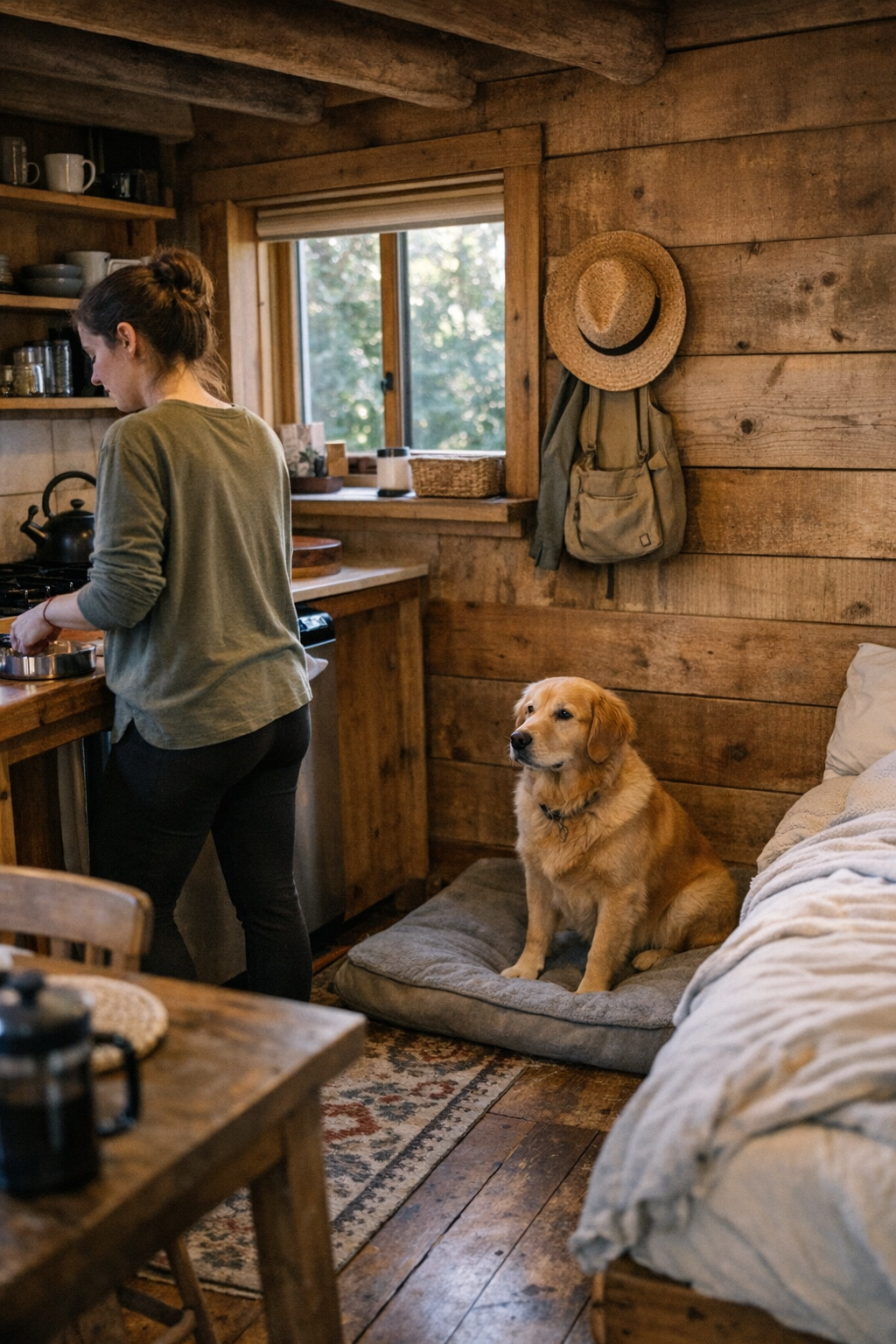
    The fix isn’t a total shakeup, just a real spot for waiting. Instead of letting your dog free-float between the kitchen and their bed during feeding prep, stake out a single location. In my house, the new anchor became a consistent spot on the bed—about five feet from the bowls, always just out of the walkway. The result is less negotiation: guide your dog there at the start of each meal, set a brief quiet wait, and only then prep the food. At first there’s hesitance; your dog might glance back at the bowl, test the boundary, look for permission. Two days in, the back-and-forth starts to fade. Suddenly, post-meal calm lingers longer. Mealtimes reset faster. And the old restless pattern doesn’t bleed into the rest of the daily routine.

    Making the Waiting Structure Work in Real Life

    Structure isn’t about making things strict—it lets routines settle sooner and recovery happen faster. With a fixed waiting spot, your dog knows what’s expected, and you skip the improvisation. You’re no longer nudging a dog out of your way as you move gear, and the routine picks up real momentum with every use instead of stalling for a mid-meal reset.

    • Bowl hover disappears: The dog’s at the wait zone, not underfoot. You reach for bowls and gear without sidestepping or pausing to direct your dog mid-action.
    • Less gear spillover: Feeding and waiting zones separate cleanly. Bowls, mats, and beds stop colliding or edging into each other’s space.
    • Reset gets cleaner: After eating, the dog returns to a clear spot—spilled food or crumbs are contained, and cleaning up doesn’t involve chasing the dog or moving items twice.
    • Calm routine endures: Patience during wait times doesn’t get burned up on anticipation, so bedtimes, wind-downs, and walk preparations all start to feel less frantic and more predictable.

    Making Changes Stick: Tips for Everyday Routines

    Select the right waiting spot. Keep it out of main walkways but close enough for the dog to see you working. If it’s too close, anticipation becomes pacing; too far and the dog may disconnect from the routine.

    Lead each time. Don’t wait to see where your dog settles today. Walk them to the spot before touching bowls or prepping food. That way, waiting becomes automatic, not a negotiation.

    Reward calm, not just presence. For dogs new to a fixed spot, start with brief sessions. Any quiet wait—no matter how short—gets a release and praise. Building consistency at the start is worth more than hitting a perfect wait time.

    Expect the friction to shift before it fades. Early days mean the new wait zone will inherit a little of the old uncertainty—extra shuffles, glances, even attempts to inch back toward the action. Hold steady. Let the routine, not just the boundary, provide the cue. The principle holds elsewhere too: a towel that’s easy to grab after muddy walks isn’t just convenience; it’s what breaks the pattern of messy delayed cleanup that keeps showing up once routines repeat.

    The Setup Test: Looks Neat, but