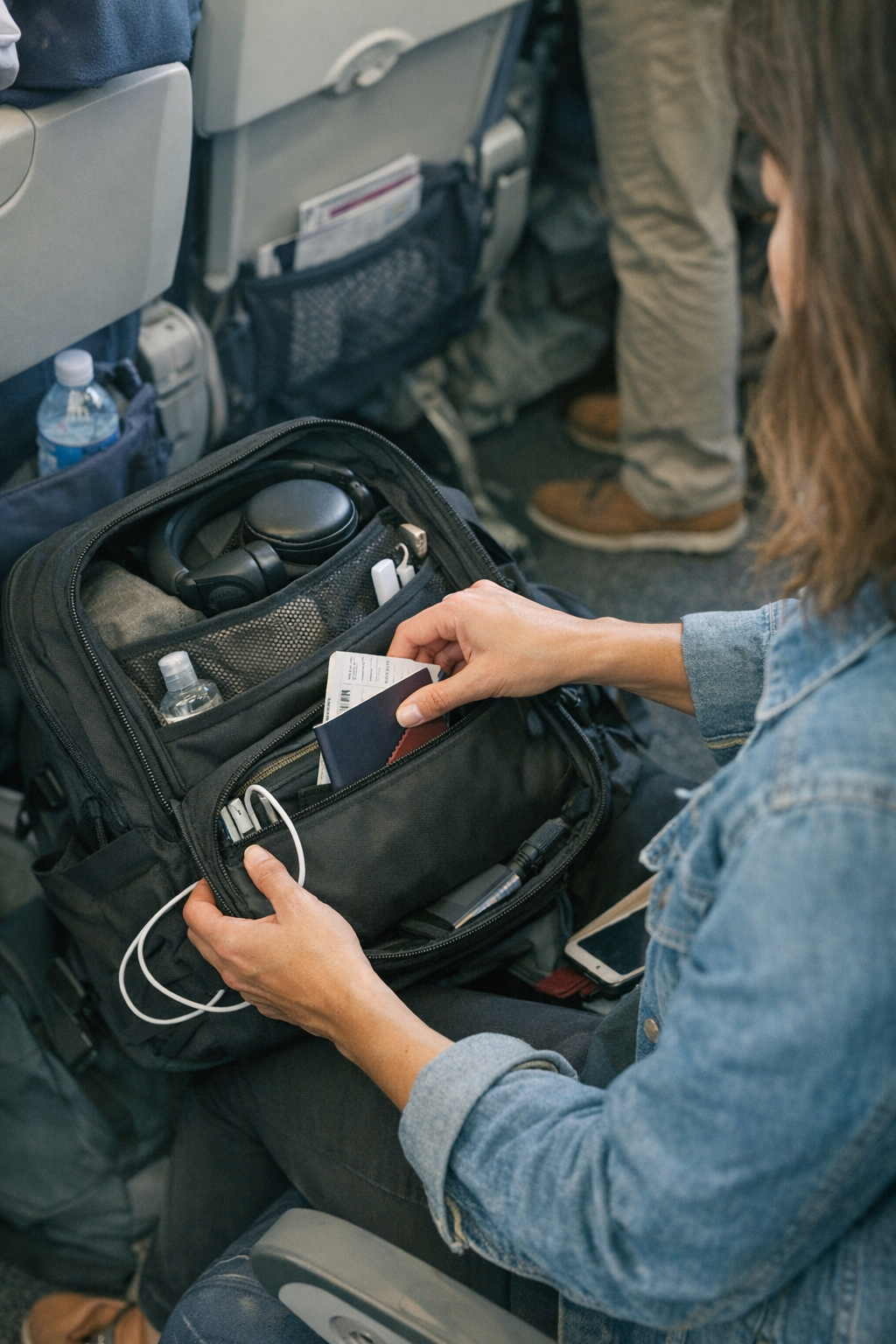
The gap between a “picture-perfect” carry-on and a carry-on that actually keeps up with you in an airport shows up harshly the first time you need something fast and everything you packed seems to block your hand. Neatly zipped pouches and carefully stacked organizers look controlled at home, but at the gate, one awkward retrieval can make your whole setup feel slow and resistant. The real weakness isn’t how “finished” the bag felt after packing—it’s how fast the order breaks down when you need quick, repeated access under pressure.
Where Order Fails: The Unseen Weak Points That Appear in Transit
Airport movement exposes problems that never appear when you’re packing at home. Layers that stayed put on the living room floor shift and migrate—pouches slip, compartments overlap, and outside pockets go from “easy-access” to clutter traps once you add boarding passes, receipts, or a last-minute charging cable. Crowds force your bag to tilt and compress, so now you’re struggling against your own setup. What felt logical now requires unstacking two zipped compartments just to find a document. Every time you reach in, the sequence gets messier, the retrieval gets slower, and each repack grows less predictable as your travel flow breaks down with ordinary use.
Real-World Carry-On Moments: Where the Friction Builds
The right setup holds up through real pressure points—not just the initial pack, but the repetitive moments that test a carry-on most:
1. Security Tray Surprises
That tech pouch you set “near the top” is buried after a jostled walk to security. Under the officer’s eye, you’re forced to dig through a tangle of toiletry bags and sliding sleeves to fish out your passport. Those seconds stall you while trays jam up behind you—every retrace costs more than planned.
2. Boarding Backups
Headphones needed before takeoff are now locked beneath two other pouches, each requiring a different zipper path. The line compresses, impatient eyes on your fumble. Suddenly, a detail that worked packed flat is failing with an audience and a cutoff to move forward.
3. Seat Entry Squeeze
A crowded row means you can barely wedge the bag between your legs. The outer pocket, once “quick access,” is now crammed tight with scattered boarding passes, tangled receipts, and stray pens. Your hand can’t slip inside—retrieving sanitizer or a cable becomes a frustrating mini-struggle, each time making you question your choice of pocket layout.
4. Overhead Bin Repack
When your essentials shift mid-flight, that neat pouch stack doesn’t return. Digging through a compressed main compartment to grab a medication or document now means a partial unpack in the aisle, while a line forms behind you and every second feels exposed. A structure that looked in control at home now asks for more from you each cycle.
The False Sense of Order: When “Looking Tidy” Isn’t Enough
A carry-on arranged for a photo doesn’t guarantee real-world performance. Lined-up organizers and squared-off pouches satisfy before the trip, but constant movement is where setups separate. Cosmetic order often conceals friction points—hidden paths, blocked essentials, or layers that “look clean” but add work each time you access them.
How Tidy Structures Break Down in Repeated Use
- Essentials buried: Items placed with care disappear behind bulk or zippers, requiring repeated shuffling for basics like a passport or phone.
- Nested pouch traps: Sub-organizers collapse into each other, making a simple retrieval unreasonably layered and slow.
- Slipped alignment: Every lift, tilt, or squeeze shifts your system—what was topmost now blocks or jams an access route you thought was clear.
- Zip-path blockades: The “tidy” pouch placement forces you to maneuver around your own setup, turning fast retrievals into repeated puzzles.
Repeated Access Is Where Most Setups Fail
Every fast access—at security, during boarding, after landing—tests your structure again. Each disruption on the way stacks up: more hesitation, more repacking, more mental drag. A carry-on that felt efficient on your first try starts slowing you down by the second or third round of reach-in-and-repack. By the time your trip is half over, what looked organized becomes a source of regret you can’t ignore every time you need something basic.
How Movement-First Structure Makes a Visible Difference
Real improvement comes from designing your structure for movement: minimizing overlap, reducing single-compartment stacking, and protecting a direct zone for top-use essentials. That means your passport, sanitizer, and main charger aren’t buried—they’re in one motion’s reach, even in a squeeze. CarryOnSupply layouts make this visible by making “one-handed access” possible in a crowded row or a moving line; retrievals feel lighter, and the repeated repacking spiral is cut off before it starts sapping your pace for the rest of your trip.
Why More Organizers Often Mean More Friction
Stacking on more pouches or clever containers rarely leads to better flow—it’s more to unzip, more layers to move past, more that can slip out of reach when you’re under pressure. Over-organization looks tidy on the floor but becomes a series of barriers in real travel. In repeated use, a single, shallow-access outer pocket outperforms a multi-layered system every time you move.
Building for Real Use: Reset Your Packing Priorities
Packing for the “moment of retrieval”—not just the packing photo—means training your structure to support fast, predictable access at each pinch point: security trays, gate checks, seat entry. Structure your carry-on by:
- Refusing deep stacks—keep quick-grab items always one reach away.
- Assigning one shallow outer pocket designed not to distort or create a dump zone.
- Making sure every everyday essential remains visible and reachable, even at odd angles or when the bag is upright and crammed.
- Using less—just the right organizers in the right places—so nothing gets blocked or lost mid-trip.
The Real Test Is in the Rhythm of Arrival and Repack
The only organization that matters is the one that holds up after you’ve reached, retrieved, and had to put it all back—quickly, repeatedly, and usually with someone waiting. The real question isn’t how tidy your carry-on looks at home, but how little it interrupts you every time you need something while moving. If every access doesn’t return your structure to order for the next round, small delays pile up.
Tune your setup for your actual travel rhythm: the tray pull, the seat squeeze, the overhead fumble. A carry-on that resets easily and keeps friction down—trip after trip—means fewer slowdowns and less time spent fixing order that didn’t survive the real world in the first place.