
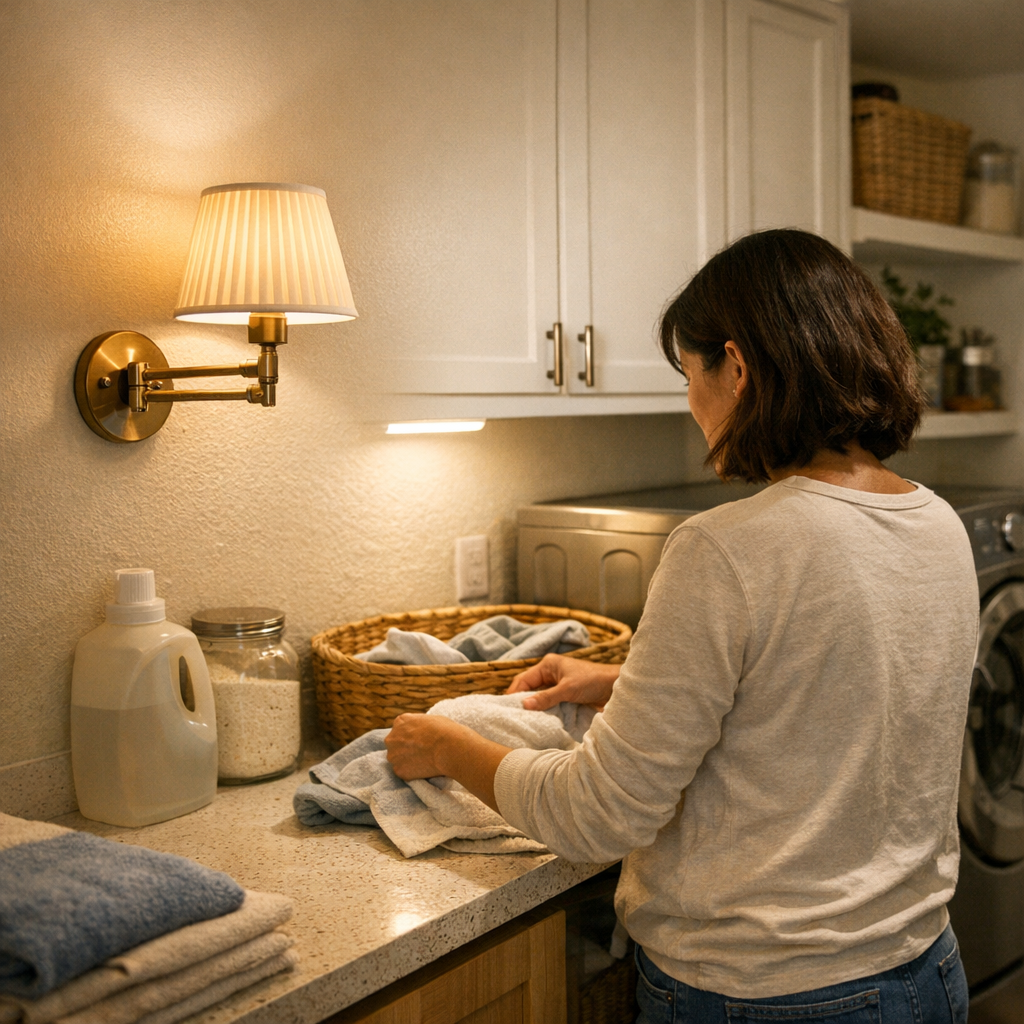
Poor lighting isn’t just an inconvenience—it’s a safety risk that shows up exactly where you need clarity most. If you’ve ever paused at a staircase landing, felt your eyes strain at a dim laundry counter, or dragged a lamp into a dull hallway to see what you’re reaching for, you’ve already noticed the problem. The wrong indoor lighting choices quietly turn simple routines—like sorting laundry, stepping downstairs, or reading a label—into awkward, stop-and-go tasks. Glare from overhead lights bounces harshly off shiny surfaces. Shadows collect along cabinet runs or at the edge of a stair, making movement uncertain and breaking up the smooth flow you’re supposed to have in your own space. What looks “bright enough” on paper leaves you compensating, time after time, in the places that matter.
Where Lighting Friction Actually Disrupts Your Routine
Bad lighting rarely shouts in the first few moments. Switch on the main light, and the room appears fine—until you’re actually working in it. You lean over the washing machine and notice the cabinet edge is lost in shadow. You start downstairs and feel your feet slow at a half-lit stair turn you can’t judge clearly. The bright ceiling fixture misses the counter where you’re pouring detergent, so you shift, bend, or grab a flashlight. Every workaround stacks up: the space supposedly checks the “well-lit” box, but you’re still forced to move awkwardly or second-guess every step.
The Stair Turn: Where Uncertainty Lingers
Picture a stairway lit by a centered ceiling fixture. The main run seems visible, but as you hit the landing or change direction, shadows thicken and the step edge blurs. At night, that pause isn’t just caution—it’s lost momentum, and sometimes, a risky misstep. Adding another fixture or a directional wall sconce near the turn changes the entire experience: suddenly the steps are clearly defined, movement feels automatic, and the mental friction of “will I miss the edge?” disappears. Lighting here isn’t about overpowering the space, but letting you see exactly where your routine turns vulnerable.
Laundry and Utility: The Shadow Trap
Walk into a laundry room brightened by a single flush-mount fixture and it feels fine—right up until you start the job. When you reach for socks in the basket, the zone behind the appliances stays murky. Measuring detergent means tilting the cup, chasing the angle, or leaning in uncomfortably just to see lines or colors. These aren’t just annoyances; they’re signs the lighting structure misses the work surfaces. It’s not that you need more brightness—the issue is lighting failing to reach where focus is needed, turning every ordinary task into a slow, stop-gap process.
Why “Bright Looking” Lighting Fails in Real Use
Room-wide brightness doesn’t guarantee safe, smooth function. Most flush-mount ceiling lights scatter light broadly but rarely address shadowed edges, glare streaking across shiny counters, or the dim under-cabinet zones where hands and eyes concentrate. The mismatch emerges at key friction points:
- Folding laundry at dusk: The overhead glows, but try sorting by color and you have to squint or drag clothes into the one well-lit corner.
- Night stair turn: Center lighting leaves a landing edge half-lit—enough to catch your eye, not enough to move confidently.
- Measuring on a reflective counter: Light glances off the surface, but the actual numbers disappear behind glare, pushing you to reposition the cup or switch sides.
Lighting that appears sufficient from a distance often breaks down under real-use pressure. Instead of supporting effortless, repeatable motion, every session becomes a hunt for the right angle or a compromise with unwanted shadow and distraction.
How to Make Fixtures Do the Actual Work
Brightening the same room with “more lumens” or a bigger overhead fixture rarely solves these nagging issues. The real fix involves the right light type in the right spot—targeting the specific shadow lines and friction points where daily life breaks down.
- Flush and semi-flush ceiling lights set up general brightness, but can leave side counters, stair turns, and cabinet bottoms under-illuminated.
- Linear or panel lights—especially damp-rated versions—run directly above or along the main work area to erase shadow bars and keep all working planes visible.
- Wall sconces, under-cabinet strips, or fixed wall lights bring the light forward and lower it to hand or eye level, directly addressing missed surfaces and ruining the old habit of leaning, squinting, or improvising with flashlights.
One Change That Breaks the Bad Pattern
Swapping out a lone ceiling bulb for a damp-rated wall fixture a foot above the counter can be enough to wipe out the chronic shadow that used to slow every task. Suddenly, you aren’t standing on tiptoe, moving a lamp, or stretching awkwardly to get basic visibility. The awkward, repetitive compensation stops. You get into the task flow and out again—nothing slowed, nothing fumbled, nothing hidden in the gloom where the light never used to reach. The cumulative frustration of “good enough” lighting finally gives way to an everyday setup that actually works for you, not against you.
Pinpoint the Trouble Spots: Smarter, Safer Lighting Moves
The worst lighting problems cluster in predictable spots. Spotting them in advance turns slow, awkward routines into safe, efficient ones.
- Cabinet and counter shadows: Ordinary ceiling fixtures rarely reach the front edge—use under-cabinet strips or wall lights to erase hidden gaps and keep every task zone visible without acrobatics.
- Stair landings and turns: Aim a fixture not just overhead but toward the landing or step path, ending the blind pause and clarifying movement at every direction change.
- Humid or moisture-prone rooms: Dry-rated fixtures in bathrooms or laundry areas lose performance and safety fast—use damp-rated lights to avoid flicker, corrosion, or early breakdown along the cabinets and appliances.
Pro tip: Two focused lights beat one generic “bright” fixture every time—split illumination prevents shadow traps and stops you from having to shift your position or fight for task visibility.
Good Lighting Structure Makes the Whole Room Work
Lighting isn’t about how a fixture looks as you enter—it’s about how the room supports every movement, every detail, every task, every time. When the structure fits the routine, motion feels automatic and surfaces stay reliably visible. Missed edges, foot hesitations, or workaround habits signal a deeper mismatch in fixture type and placement. The moment you flip the switch and every movement flows—no half-lit corners, no dangerous pauses, no daylight workarounds—you know you’ve solved what truly matters in day-to-day lighting.
Find dependable, practical indoor-lighting solutions for real daily use at LightHelper.