
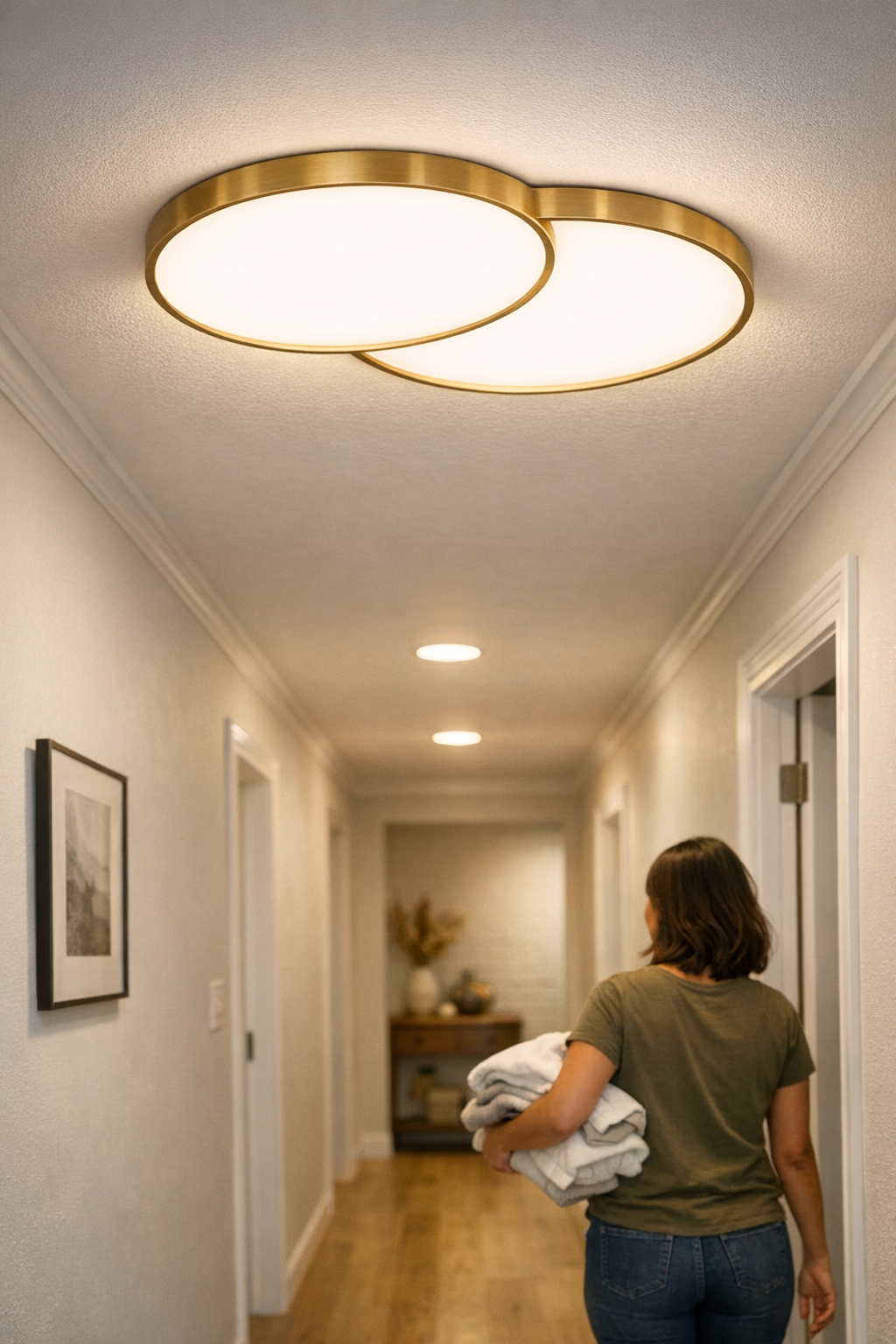
Most hallway lighting setups fail for a reason you notice only after repeated use: the path itself stays uneven, with shadow breaks at every threshold and corner. Take a week of late-night cross-room trips—arms full, zero spare hand for a switch—and you’ll realize a single ceiling fixture might look tidy, but it leaves gaps where you need light to work, not just appear. The surface underfoot picks up pools and edges of dimness, especially near doorways. Corners dull out, familiar objects get lost in low patches, and suddenly the “minimal” lighting choice feels like a source of daily drag instead of a solved problem. You can promise yourself you know the layout, but stepping blind over a misplaced cord or squinting for keys that fade into a shadow strip is friction you repeat, night after night. Hallway lighting reveals its quality not at a glance, but in every imperfect crossing after dusk—when you rely on clarity, not just brightness.
Recognizing Where Single Fixtures Fall Short—A Routine Test
A centered ceiling light is sold as the simplest answer, but actual movement reveals where it breaks down. As you pass from the fixture’s direct zone, shadow lines gather at walls and doorframes—the exact points you pause, step wide, or slow down to check a surface for clutter. You only need one awkward reach to spot whether the floor is hiding stray mail or a child’s shoe. Most schemes give the illusion of coverage, but only if you never leave the center of the beam.
This is really about usable reach, not total wattage. Coverage means you see the lines you walk, the zones where shoes collect, the thresholds you’re crossing, and don’t have to guess what fades away after dusk. Once daylight vanishes, any interruption—every missed spot or lingering patch—means wasted seconds, extra hesitations, or retracing steps for dropped items. It’s cumulative friction, not just a dark patch—something you only notice through repeated trips, not first impressions.
Linear and Panel Lights: Building Steady Corridor Coverage
Linear or low-profile panel ceiling lights disrupt the old pattern. Instead of spotlighting the middle and abandoning the edges, a run of panels pushes an even wash end-to-end, making the whole walk—from main room to far bedroom, through each doorway—a single readable path. There’s no broken sequence of bright/dim/bright, no need to track your own steps for safety. Placement, not just product, makes the difference.
Where it’s impossible to ignore: windowless or narrow halls, or older layouts where doors cluster unevenly. Even in new homes, a corridor used as storage or laundry pass-through will quickly show the weak spots. The tension isn’t over-lighting but removing invisible obstacles—making each movement predictable, letting you spot clutter or surface changes instantly, no matter the hour or traffic.
Where Most Setups Still Slip: The Gaps Between Fixtures
Too many solutions fail by spacing fixtures flush or too far apart—no overlap, just exposed seams between “zones.” Walk the same hall at night: you spot foot-wide stripes where light weakens, feel the drag as you slow for uncertain footing, or sense guests side-stepping a semi-lit step. It doesn’t matter how sleek the panels look; a single miscalculated gap turns a decorative upgrade into a patchwork of hesitation zones.
This isn’t subtle once you notice it. The so-called finished job still asks the same routine questions—should you watch for a trip hazard, should you flip another switch, should you grab your phone’s flashlight? The actual fix is measurable: intentionally overlap each panel’s coverage zone by 30 to 50 cm. This is what blends surface visibility and keeps the walk continuous. Ignore this, and the setup visually resolves but leaves daily use unresolved—a premium surface with low-grade results.
Everyday Consequences: What Repeated Use Actually Shows
Lighting that “looks good” often disguises weak surface logic. In a regular week:
- You keep shifting your walk to dodge a dim strip at the wall, even when you know the route is clear.
- You reach for dropped keys or check for shoes, only to have them slip into low-contrast shadow bands by the door.
- Visitors stall at the stair landing or darkened corners, unsure if the floor is safe past the last bit of light.
- Mail and bags linger unseen by the baseboard, missed until the whole main room fills with light.
Every time you slow, scan, or sidestep, minor lag piles up—especially with kids, older adults, or arms full of laundry after lights-out. Efficient movement exposes lighting’s true function: not looking resolved, but letting you navigate without question.
Not Just for Narrow Halls—But Especially Needed Where Light Doesn’t Reach
Wide or open corridors soften the difference, but long, narrow, or windowless runs betray every skipped detail. Unblended sections lose clarity exactly when routine needs it. Even a flawless ceiling line is empty credit if memory, not vision, is doing most of the work. If you find yourself assuming, not seeing, what’s in the next step, it’s a sign your lighting favors decorative order over functional safety.
For these problem zones, 30 to 50 cm overlap between panels is not theory—it’s an everyday defense against uncertainty. The best sign you’ve fixed it: you quit pausing, you never sidestep clutter, and guests move naturally through every doorway, at any hour. The moment hesitation disappears, you’ll know the coverage finally matches the corridor’s needs.
Making Small Adjustments That Fix Daily Friction
You rarely need a full overhaul. Often, swapping a single central fixture for two slim, overlapping panels right where you hesitate—at the busiest entry or underused corner—fixes months of unnoticed frustration. Post-adjustment, the entire length is readable, even after sundown. Missed piles by the wall, awkward threshold shadows, the quick “is anything there?” check—gone. This is clarity designed to match movement, not just appearance.
Targeted, practical corrections include:
- Mapping and lighting the precise transitions—putting panel overlap precisely where steps and sightlines stall, not just centering lights for symmetry.
- Verifying overlap rather than installing panels edge-to-edge—no blind seams or dim stripes left for routine to expose.
- Tracking the setup across a week: if you’re still pausing, if new shadows emerge, reconsider fixture position before declaring the job done.
- If support hardware—cables, brackets—spring into view or disrupt the ceiling line, refine the mounting choice, not just the fixture, so tidiness and usable light support each other.
Only repeated passage, not a single walkthrough, will confirm what works. Corridor setups that prioritize overlapping, real-use zones—over default placement or visual emptiness—quietly strip away hassle and expose whether the upgrade is actually working for everyday movement.
When Appearance Outweighs Use—And How to Spot the Difference
The drive for minimalism often blindsides actual function: a solitary fixture, an unbroken paint line, and the finished look that satisfies only until darkness multiplies your hesitations. With weeks of living, the test isn’t how seamless the ceiling seems—it’s how often you still slow, detour, or resort to your phone’s light. “Clean” ceilings that leave you compensating with extra switches or cautious movement are uncompromising in appearance but weak in routine use.
Real hallway lighting ends the guesswork and reroutes of daily life: no habitual sidestep, no double-check for each step, no invisible piles by the edge when moving at night. Achieving this doesn’t mean packing the ceiling with fixtures; it means recognizing which spots your habits keep exposing, then intentionally resolving those missing lines with practical coverage—not just presumed design simplicity.
Summary: Corridor Lighting Built for Routine, Not Just Show
Across weeks of use, the costs of incomplete lighting quietly accumulate—minor delays, missed items, and transitional slowdowns. Switching to continuous, intentionally overlapped panel or linear lights isn’t just about brightness—it’s about erasing the practical gaps that trip up daily movement and decision. A good corridor setup disappears in use: no forced pauses, no blind merges, just a well-lit, frictionless path at every hour. When overlap, distance, and finish all support real-world habits, hallway lighting finally solves more than it shows. For setups that actually handle repeated routines, not just empty rooms, clarity is the upgrade that matters.