Author: jaesoon_admin

  • Choosing Underbed Rolling Drawers That Keep Guest Linens Organized and Accessible

    An underbed drawer either saves your routine—or adds a new daily hassle you never thought about until the first week. The real struggle isn’t how much you can cram under the bed, but what actually happens each time you pull out those guest sheets or return fresh pillowcases. The first days with a rolling drawer can feel like an upgrade: the floor looks open, the linens are hidden, and everything appears tidy. But the first busy morning or midnight reset reveals the weak spots—jammed wheels on a rug, a drawer that veers off track, or extra effort just to reach the right set. Suddenly, “extra storage” means slow retrieval, blocked access, or a scramble each time you try to keep the bedroom presentable. These small points matter more the longer the setup stays in use, especially in a room that isn’t reimagined often.

    Recognizing the Difference: Looks Sorted vs. Stays Sorted

    It’s easy to mistake a cleared floor for lasting order. The reality sets in fast: what looks organized after move-in day can slip when life happens. Sliding a drawer under the bed might clear a stack of linens from the closet or the corner, but once guest routines start—quick bedding changes, post-visitor resets—the system faces its test. Flaws aren’t theoretical: they show up as you reach twice for the same pillowcase, kneel down to redirect a misaligned drawer, or run late after a supposedly “simple” switch.

    Invisible inefficiencies pile up fast. One drawer tugs sideways? Every access turns into a slow adjustment. Wheels that catch on a rug or a frame rail? Now there’s a two-handed shuffle just to open it, every single time. If one bin swallows everything in a mixed pile, finding what you need at night turns from routine to rummage. The system turns on you not because of storage space, but because of missed friction in daily—or nightly—use. The problem isn’t “volume,” it’s the slow drag of digging for the right item as clutter creeps in again.

    When Practical Details Make or Break the Flow

    How Fit and Movement Affect Everyday Access

    A drawer that fits the space in photos isn’t the same as a drawer that keeps up with repeated access. The differences reveal themselves fast: a poorly aligned unit scrapes the frame with each pull, an over-deep bin becomes a generic pit, and every quick swap ends with socks, towels, or off-season blankets getting mixed up in the guest set. Moments that should take seconds balloon into small obstacles—nothing dramatic, just enough to make staying organized a recurring job instead of an automatic result.

    • Wheels hitting carpet: A subtle jerk on the edge, waking up the household or making you tug back and forth in frustration.
    • One big bin, no boundaries: Sheets and pillowcases tangle; you dig at the bottom, reshuffling everything you just sorted last time.
    • Early overflow: One extra comforter and the logic of the whole drawer collapses—now you’re shuffling contents in multiple zones, not just under the bed.

    The cost shows up in repeated friction. What’s hidden isn’t truly gone—it’s just less clear, harder to keep in order, and slower to retrieve when you actually need it. A system isn’t working if rerouting or reshuffling happens every time you switch a set.

    The Subtle Creep of Hidden Clutter

    The fastest way to lose track of your setup is to let “just for now” items settle in: slippers, laundry waiting for a decision, out-of-season blankets. The underbed zone transforms from a spare sheet hideaway into a slow-motion junk drawer. Once this happens, retrieval becomes a scavenger hunt, slowing down the entire routine. Every guest turnover, you’re reminded that a hidden stash is only organized until daily life fills it with new overflow. Each delayed reset, each accidental mix of old and new linens, makes the next attempt at order slower and less likely to last.

    Why Drawer Structure and Divisions Matter

    Choosing the Right Double-Drawer Setup

    Jumping from one big bin to a pair of dedicated, narrower drawers isn’t about cramming in more—it’s about building real boundaries that keep the system running. Two drawers force clarity. Sheets in one, pillowcases in the other, with less chance to mix or forget what you’ve stored. This split also means you see problems faster: if something’s out of place, it’s obvious. No more fishing around under the bed for a single missing item or sorting through a compressed pile under pressure.

    • Clear division = faster access: Open one, grab what you need, close it—no cross-digging required.
    • Straight sliding: Narrow drawers avoid jams, especially on frames with side rails or uneven flooring. You’re not left wrestling with the whole unit.
    • Category drift is visible: When something winds up in the wrong drawer, you spot it and fix it—mistakes aren’t buried.

    The physical split reduces crawling under the bed or shifting the entire system just to get a pillowcase. In busy homes, or when visitors come and go, smaller, more manageable drawers reset quickly and don’t break down quietly over time. This isn’t a luxury; it’s a way to avoid slow-motion disorder that creeps up over months of “good enough” solutions.

    Small Adjustments: Making the System ‘Stick’

    Guarding Against Storage Creep

    Discipline in underbed zones is simple but relentless: each drawer gets just one category. Even a pair of slippers parked for a single night can signal the beginning of chaos. A fast routine—checking as you restock sheets, clearing stray items at each change—stops clutter before it costs you time later. Deep or over-wide drawers hide the beginning of breakdown, so paying attention to shape and sectioning is insurance, not aesthetic. Anything that can be ignored will be ignored, so keep divisions obvious and resets frequent.

    Thinking Beyond Bags and Baskets

    Fabric bags and bins sell the promise of flexible storage, but in the crunch of repeated use, they collapse or lose shape. Air pockets, crushed edges, and rummage-digs become the norm. Hard-sided rolling drawers don’t require fluffing, digging, or repositioning: you roll them out, grab what you need, and slide them back in a single action—even after the fifth swap in a busy month. Reliability in movement and shape saves time, especially when the drawer is opened far more often than expected.

    One crucial check: If your bed clearance is under 6 inches—including the wheel height—most units will jam or stick, especially over thick rugs, making quick access a struggle every single time. Clearance isn’t an afterthought; it’s a dealbreaker for usability.

    What Happens After the Switch?

    Months after moving to a split, purpose-built underbed drawer set, the difference is in rhythm, not just looks. Sheets and pillowcases actually stay findable—the reset routine shrinks from five minutes to one. Items that drift stand out immediately, making it possible to fix mistakes before they spread. Most telling: you stop bracing for lost time every time you swap linens. The payoff isn’t visual calm after a reset, but sustained, low-friction order in daily use—even when routines change or the room doubles as a storage catchall. Instead of working around your own fixes, the storage finally keeps pace with real life, not just the snapshot ideal.

    Find storage options that fit your space and routine at Gridry.
  • Centralizing Cat Essentials Cuts Morning Routine Time and Hassle

    The room looks right—until you actually have to use it. At first glance, everything appears settled: food bowls lined up by the kitchen, water tucked away, toys out of sight, litter gear stashed just far enough to feel separate. It’s calm for about five minutes. The moment your real cat-care routine begins, that “calm” setup flips—feeding means a back-and-forth path, water refill is always a detour, and cleanup is a multi-step scrabble through cabinets and corners. Organization that looks tidy on Sunday morning turns into a practical slog by Wednesday, when the scoop has migrated again, the toys have resurfaced in the walkway, and you’re piecing together a reset before the coffee’s even finished brewing. That tidy room? It slows you down, every time.

    When Neatness Backfires: The Real Cost of Scattering Cat Gear

    The more you spread out cat supplies for the sake of visible order, the more small hassles collect. One bowl by the fridge, water only reachable by threading around a table, litter tools hidden for “visual calm.” The room looks uncluttered, but your mornings fracture into pointless errands—find a scoop you can never seem to park in the same place, hunt the mat after it’s been nudged away, reroute just to grab a paper towel. With every task separated, the distance between what looks clean and what works in practice widens. Over a week, small annoyances pile up: crumbs trail past “clean” lines, toys creep back into footpaths, and every reset repeats the collection game.

    Instead of letting mess build, you’re letting effort spread. The space feels controlled but demands extra moves, every time routines repeat. It’s not chaos—it’s slow grind.

    The Cumulative Weight of Daily Detours

    No single disaster—just a pattern that wears you down. It’s taking three trips instead of one just to refill water and food, because the bowls and scoop belong to different corners. It’s trying to wipe up a spill only to realize the towel’s too far, so you leave it “for later.” Every piece has a home, but the homes are in the wrong places. What you gain in visual calm, you pay for in detours and micro-resets. When real routines stack up, the scattered setup gives itself away: care tasks start taking attention before you ever reach the cat.

    Smooth surfaces and open sightlines matter less if you’re doubling back for every step. Setup in theory organizes a space; setup in practice should keep you moving forward, not pausing for corrections.

    The Breaking Point: When Retrieval Overtakes Care

    You know it’s gone too far when “cat care” mostly means fixing the setup. Most of your time is spent searching for a scoop that never stays put, reaching behind the trash for that elusive toy, re-walking the room to assemble the basics. Feeding isn’t just a quick pour; it’s an obstacle route because each tool ends up elsewhere by the end of the day. Even a well-hidden water bowl becomes the reason you’re zig-zagging around the kitchen instead of making breakfast in one pass. A setup that looked reasonable or even “designed” eventually starts breaking down your routine instead of serving it.

    A Split Setup in Real Life

    Picture this: you step in, intent on feeding your cat while getting your own breakfast. Food’s on one side of the room, water stashed wide for “splash control,” toys migrated back into the middle of the shared space and under the sofa, litter scoop already missing from memory. The task list feels short, but real movement means piecing together what should be one step—now four. Not messy. Just slow, always a little off, every single day.

    Consolidation: Turning Cat Care into a Single Stop

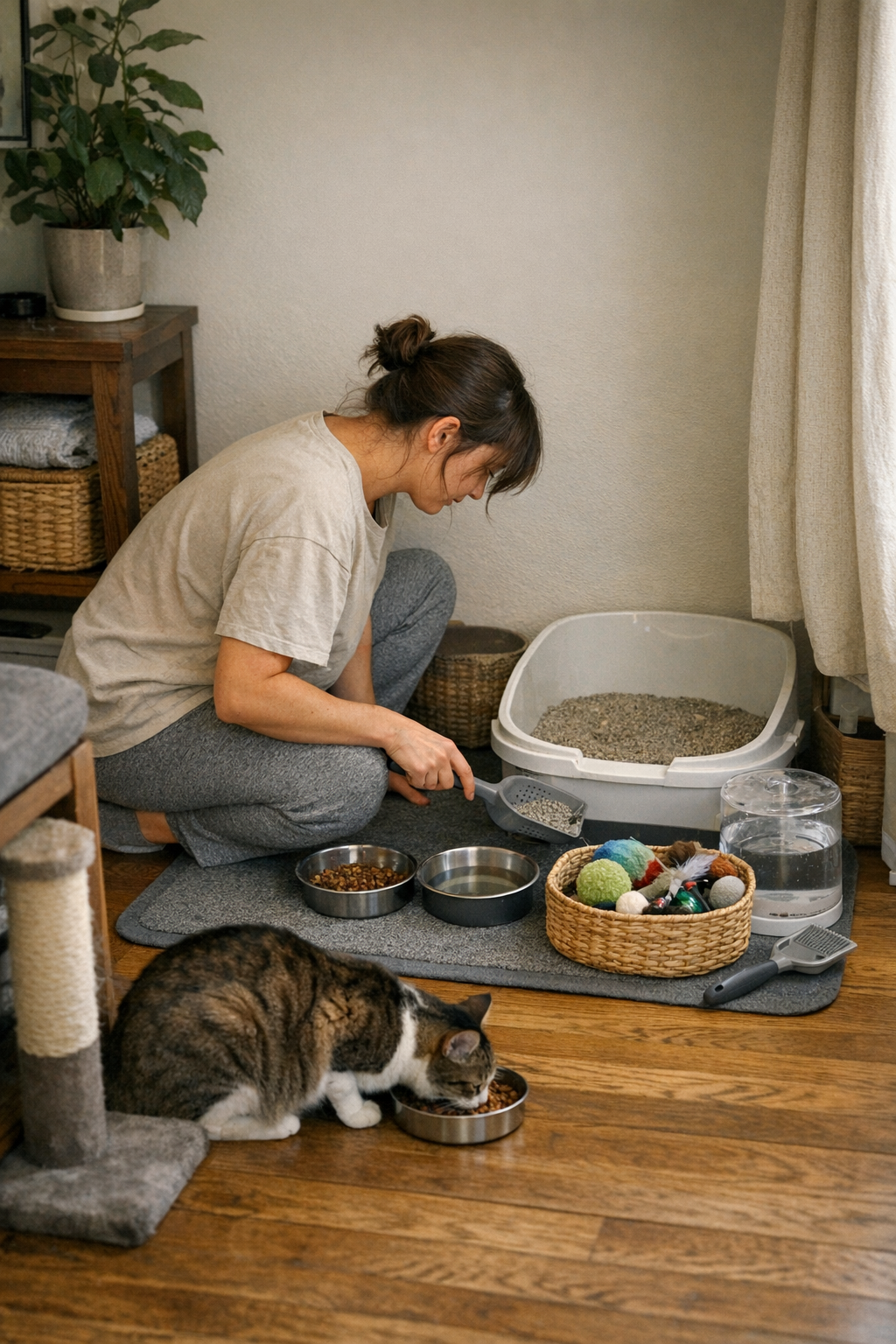
    The best fix isn’t a new gadget—it’s moving essential items closer together where you already walk. Group your high-frequency items: food, water, scoop, toy bin, even a small mat, and plant them along a route you already use. Instead of chasing each task into its own corner, everything’s a single stop. Mornings become a loop, not a hunt.

    Keep it simple: a basket under the sideboard, a low tray, or a bin that parks next to the main path. Feed and refill without shuttling between stations. Stash the scoop directly above the litter mat or right beside the main food bin. Toys drop in a basket instead of rolling back under furniture. Each reset gets handled along your normal walk, not in staged cleanup rounds.

    Containment over Separation

    Pooled gear actually makes cleanup easier. Crumbs, water drips, stray bits of litter and toys—when they land together, you sweep, wipe, or declutter one area, not three. Maintenance rides on actual use, not on a chore schedule. The space stays managed with less repeat work because you don’t need to track down what’s been put “out of sight.”

    How the Routine Actually Changes

    The change isn’t just visual—it’s the pressure points vanishing from your day:

    • Refills and resets become a single action, not an improvised route through the house.
    • Toys that escape are easy to return—no more crawling under furniture or crossing the room just for a plush mouse.
    • Splashes, crumbs, and scatter get wiped up as part of your main movement, not as surprise extra chores hours later.
    • Litter cleanup happens at the source, scoop always within reach—reset before spread.
    • Shared spaces stay more open, because cat gear doesn’t keep drifting into the paths you use most.

    The setup doesn’t erase signs of cat life—it just cuts the reset burden so routines don’t stall out. Real improvement shows up as effort dropping away, not just as an empty floor.

    Imperfect but Better: Small Annoyances Stay Contained

    No arrangement takes the mess out of the cat routine. Toys still get batted into odd corners, the mat sometimes bunches or holds a little more litter than it should, water finds a way to splash, and crumbs escape. But when the core gear is centralized, these annoyances hit one spot—not the whole house. You don’t have to start over to regain order; a quick sweep or restack resets most of the area. The difference is visible: single-step cleanup replaces recurring searches and workarounds, and the friction that used to wear down your mornings shrinks to a few quick motions.

    Perfect isn’t the point. Usable speed and less interruption are. The payoff isn’t in the photo but in the day-to-day flow: no more criss-crossing the room before you can even start the next task.

    Tips for Building a Setup That Stays Useful

    • Pick a spot on your regular path: Near the kitchen entry, next to the main living area, or at any point where you already move. The less you detour, the more likely the setup holds in daily use.
    • Contain with visibility: Use open bins or shallow baskets for instant access—closed boxes just slow you down and hide things you’ll need to chase later.
    • Design for easy resets: If you can’t clean up a scatter or stray with one motion, the layout needs fixing. Bins should be low enough to sweep around, and mats should let you reset bowls without fighting friction.
    • Watch shifting comfort: Some plush mats cushion spills but drag when you want to slide a bowl. Notice when comfort slows the reset, and adjust.
    • Troubleshoot runaways: If a scoop or toy keeps leaving the zone, use a corner stop or rethink the bin—it’s usually one weak link asking for a minor fix.

    Why Centralizing Cat Essentials Actually Works

    Centralizing isn’t about minimalism. It’s about function that fights routine burnout. When food, water, mat, cleanup supplies, and toy bins anchor a single area, you stop paying the daily penalty for a scattered structure. Fewer detours, quicker resets, less “where did I put that?” means upkeep drops behind the scenes. Split setups may look sleek but usually cost you calm in the long run—clean lines, slow routines. A workable structure lets you reset in one loop, handle messes where they start, and keep both home comfort and sanity intact.

    Find practical indoor-cat setup solutions and gear at StillWhisker.

  • How a Micro Loop Transforms Pet Travel by Reducing Friction

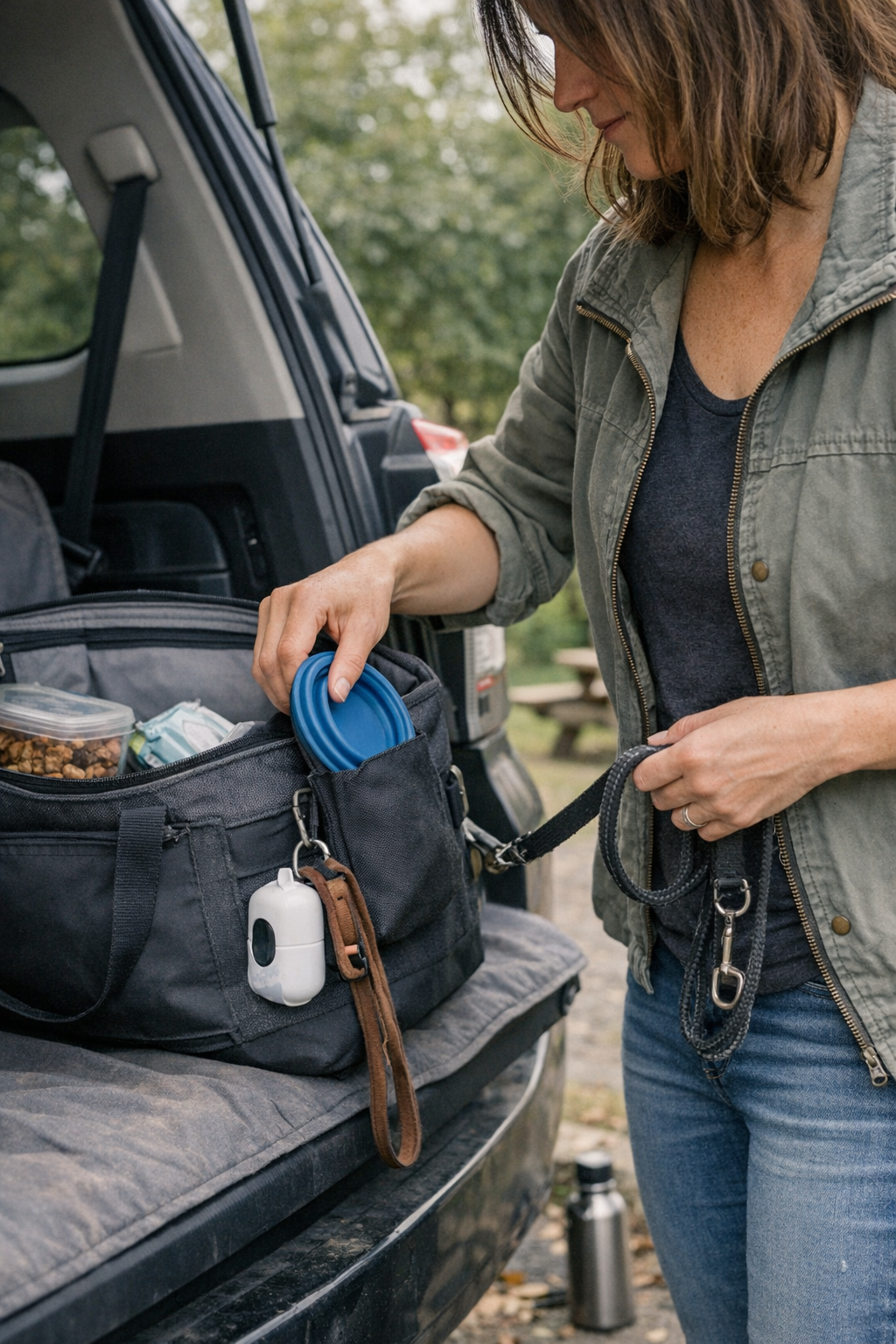
    Every pet owner recognizes the pattern: you leave home thinking your travel bag will keep the routine smooth—treats in one pouch, wipes in an outer sleeve, everything zipped and separated. But by the third stop, access clogs up where you least expect it. That outer wipes pouch now sags beneath treats you moved aside “just for a second.” A leash clip that worked on the first grab now dangles, tangled in a loop meant for cleanup bags. Each short stop—leash on at the curb, pause for cleanup, quick seat-side swap—scrambles your organization, until a bag that looked prepared becomes a slow-motion hassle: same tools, twice the struggle, every time you repeat the cycle. This is where PawGoTravel setups show their difference—not in looking organized, but in feeling simpler after five stops, not just one.

    The Real Wear and Tear: Where Organization Breaks Under Repetition

    Most pet travel bags can pass for “organized” when you load them at home or set them on the ground. The problem isn’t static order—it’s what happens in movement. Walk your dog on a short city loop, or run two errands with your pet in tow, and the first signal of trouble appears: gear that started separated blends into a pile, leash hooks clash with bowl loops, and quick-grab wipes are only quick the first time. Almost instantly, what looked like careful prep is undone by reaching, tugging, and juggling through stop after stop.

    Friction creeps in at every pause. A bag that opened with one pull in the parking lot takes three motions later. Each unnecessary fumble isn’t about lost minutes—it’s about breaking your flow, splitting your attention, and forcing you to work around the same structural weak points over and over. By the fourth or fifth stop, easy access is gone—replaced by the low-level grind of having to outsmart your own bag, while your dog grows more restless by the minute.

    What’s Actually Slowing You Down?

    Looks Ready, Feels Off

    The struggle isn’t missing gear; it’s items overlapping in the wrong pocket at the wrong moment. “Owner” stuff (keys, phone) and “pet” stuff (leash, bowl, wipes) drift into each other’s space after two or three uses, forcing awkward reach and reshuffling. Outer pouches vanish under loosely stuffed toys. Zippers that once closed neatly now resist after a quick, distracted grab. Most setups are built to look complete, but a clean photo doesn’t guarantee fast returns when you’re rushed, handling a distracted pet, and one wipe or treat has already slid out of its perfect spot.

    Quick-Access: Promised, But Rarely Delivered

    “Easy reach” pockets rarely match real movement. That quick-access slot for wipes? It slips under a shifting pile in the first ride or bump. Treat pouches get trapped behind comfort gear. With a leash in one hand and a dog tugging in the other, you wind up prodding, digging, or opening the wrong pocket first—while essentials hide just out of sight beneath a layer meant for another item. The setup didn’t fail; repeated use just revealed where it slows you, again and again.

    How Routine Friction Compounds with Each Stop

    Minor delays add up fast. A two-second fumble grabbing wipes at every pause? Multiply by eight quick stops: that’s the rhythm of your walk, not the rhythm of your pet. At the curb or park bench, you wrestle with the bag while the dog tugs, shifting gear left and right just to find the right pouch, never mind keeping your hands free enough for the actual cleanup. Once order is broken, the only reset is a full reorganization—usually rushed, incomplete, and ready to frustrate you again at the very next stop.

    This is the consequence most owners don’t notice at first. It’s not about whether you planned well or have enough pockets; it’s about how often you must repeat the same inefficient motion to recover gear. After three or four interruptions, the line between “organized” and “easy movement” shows up—clear as the leash running across your phone charger, or the wipes pouch collapsing back into the bag at the wrong moment.

    The Micro Loop: Solving the Most Repeated Small Movements

    There’s a reason seat-side “micro loops” and built-in quick return points are quietly transforming smart pet travel setups. Unlike deep zip pouches or fully lidded pockets, these let you re-stow a leash clip, drop in a used wipe, or return a treat pouch in a single, frictionless motion. Their value isn’t about keeping the bag photo-perfect. It’s about making repeated grabbing and returning—fifth, sixth, seventh stop—take zero mental effort. Owner items stay separate, pet essentials land right where your hand expects, and movement never stalls for more than a blink.

    Suddenly, the same gear just fits your rhythm. That leash clip? It finds a seat-edge loop instantly—no rooting, no double-back. Used wipes are corralled in a slip pocket, not left tumbling under snacks. Treats stay outside the main gear loop, ready to grab with a thumb and re-stash in a second. The more you repeat the cycle, the less you notice what you aren’t reaching for—and the less your dog has to wait while you untangle organization that failed one stop too soon.

    Why Structure Details Rule for “Every Stop” Essentials

    The biggest improvements don’t come from more pockets or a fancier design. They come from one well-placed loop by the seat, or a return spot that’s actually where your hand lands on re-entry. By the end of a real day—errands, back-and-forths, city walks—you notice what’s vanished: interruptions, multi-step resets, and missing essentials that would have turned into another restart. Instead of cleaning up your system after every pause, the flow just recovers itself. Collapsible bowls, leash clips, and wipes belong where movement is already paused for a second—no digging, no overlap, just one touch.

    Visual order looks good in a still photo. Functional order shows up when you need to start moving again, not managing a pile of gear. Valuables still belong zipped away—but most movement-dominant gear, like wipes and leashes, works best where friction is lowest and the reset is automatic.

    Practical Scenes: Where the Wrong Setup Slows You Down

    “Wasn’t That Just There?”

    You know you packed the wipes, but the last grab forced you to move the treat pouch—and now, at the messiest stop, the wipes are wedged under your own phone. Juggling a cleaning job with a twisting leash hand, you lose fifteen seconds and that crisp reset is gone. For a distracted or energetic pet, that’s the interruption that makes every curbside pause feel longer, messier, and less manageable.

    Seat-Side Shuffles and the Failed Quick Return

    Returning to your car isn’t the end of the juggling. The leash comes off, but now the clip has nowhere to go: do you stuff it in a side pocket, or just let it dangle off the handle? Without a true quick-return spot, you end up shuffling the bag, dropping treats, misplacing a spare toy or wipes. Every misplacement creates one more adjustment once you’re ready to move. What looked settled an hour ago now needs re-taming before your pet is ready for round two.

    The Real Value of a Well-Placed Micro Loop

    You’re not aiming for showpiece organization—you’re looking for the friction points that keep costing you time, resets, and missed beats in real travel. On days of errands, parks, or repeated stops, one visible change—an exterior loop replacing a fussy zipper—lets you reclaim all those seconds and all that attention lost during “little” shuffles. For any owner with a stop-and-go travel pattern, even a tiny structural upgrade means halving the cycle of annoyance that sneaks back with every repeat. It’s the low-profile fix that actually makes each outing feel easier, not just neater to pack.

    When Should You Rethink Your Setup?

    If you find yourself pausing to reshuffle at every quick stop, untangling a leash or forced into the same awkward pocket search between otherwise smooth transitions, you’re running straight into a common pet travel trap. Especially as your stops pile up or the routine gets tighter, the difference between “looks organized” and “actually moves with you” becomes impossible to ignore. Micro loops aren’t status upgrades—they’re the quiet structural corrections that finally drain the friction out of repeat use, turning the handoff from pet to owner back into a one-step reset, even after a string of ordinary interruptions.

    For those essentials that never stay packed away—leashes, wipes, a collapsible bowl—putting a one-second return exactly where you use it isn’t an add-on. It’s the missing core of travel that actually lets you move without carrying the old mess forward. That’s the difference that builds with every restart, and why so many practical upgrades are hiding in the smallest details nobody spots the first time around.

    Discover more practical travel solutions at April 3, 2026

  • How Soft-Close Drawers Transform Everyday Closet Organization and Efficiency

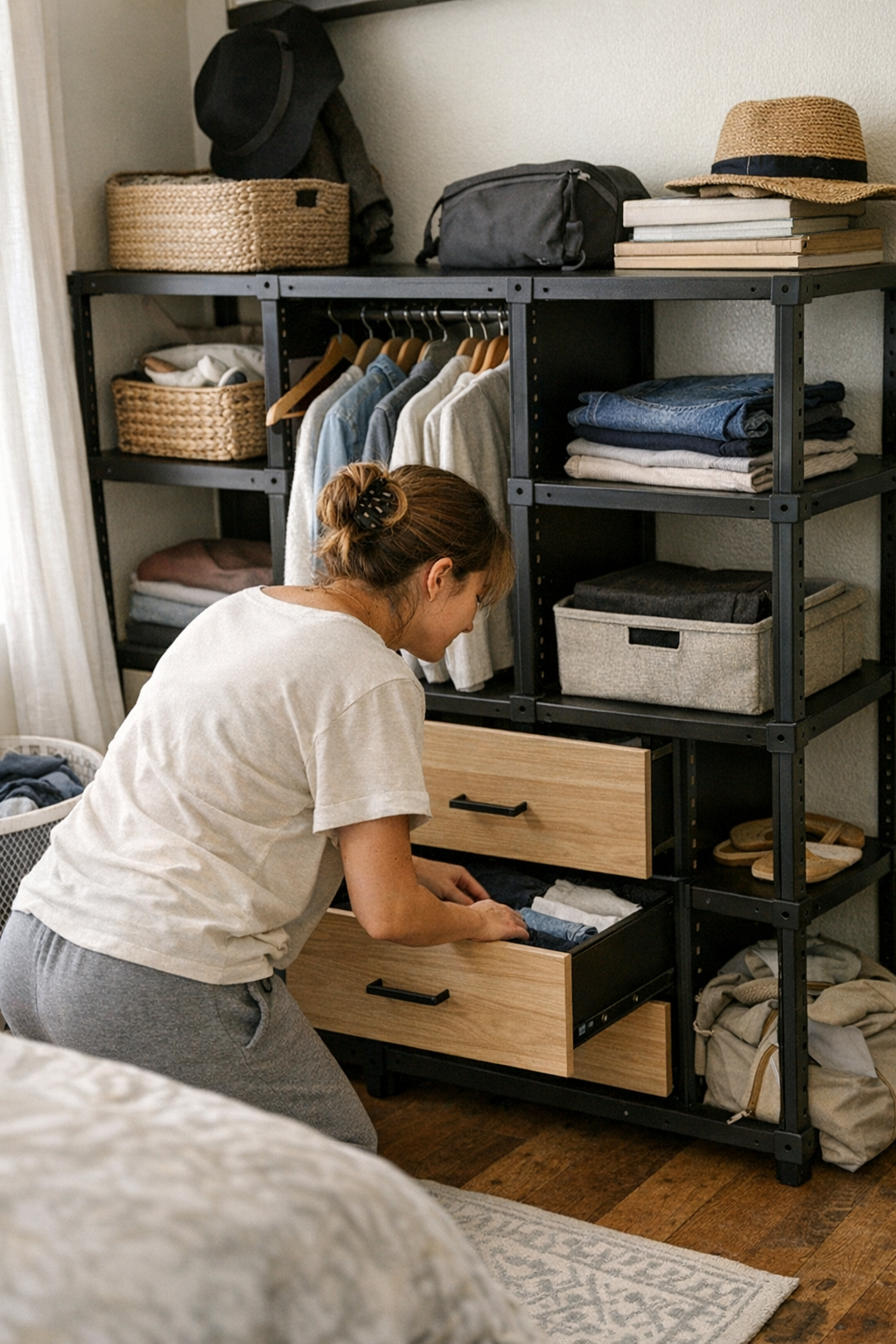
    It starts small—the first week after your so-called “closet reset,” everything looks perfect. But by day three, the familiar drift returns: stacks of shirts slide sideways, that sock you always reach for vanishes behind a pile of shorts, and closing a drawer requires an awkward double-push. The dull thud and screech become background noise, but the friction never really fades. Rushed mornings have you tugging at a stuck drawer, and at night, every bang feels twice as loud as you tiptoe past sleeping family. What seemed organized in the showroom starts feeling like a constant maintenance project at home. That’s when you notice what standard drawers truly miss—and where soft-close starts to matter.

    Daily Storage: Where “Organized” Starts to Fall Apart

    A closet can hide its frustration well. Doors close, surfaces align, and at a glance, you’re “together.” But reach for anything not on top—a shirt under a stack, socks from the back—and you get friction. With standard drawers, you live with:

    • Shirts slouching sideways from a single rough close
    • Underwear and socks migrating into corners, practically disappearing
    • Piles losing their shape by midweek, forcing a slow-motion re-stack
    • That nagging sense that one careless tug sets you back two days of tidying

    The cost is small but constant: pausing to realign piles, slow-gliding drawers to dodge noise, and quietly hoping nothing slides out of sight. Especially in a space shared with someone else, the energy you spend just keeping things “good enough” adds up—faster than you think.

    When Drawer Friction Becomes a Daily Grind

    Drawer mechanics might sound trivial until you live with the flaws. If you rely on quick, predictable access, clutter-free resets, and peace in shared spaces, weak drawers can be your worst enemy. Real-life storage struggles surface in moments like:

    • Morning chaos—digging under shuffled shirts for what you actually want, with stacks losing their hold
    • The late-night shuffle, tiptoeing as every drawer echoes through the house
    • Shared bedrooms, where one careless close shakes someone else’s sleep
    • Laundry day, watching newly folded piles collapse with the first use

    Soft-close drawers answer with control: a smooth, unhurried glide that ends in a gentle, silent close. No drama, no jolt—just a space that stays ready for next time.

    Why Standard Drawers Quickly Wear You Down

    Identical at a glance, worlds apart when stress-tested. Standard drawers age poorly—tracks wear grooves, drawers misalign, the rails start to drag, and gentle organization dissolves with every slam. It goes well beyond aesthetics:

    • Grinding rails sabotage any quiet-hour routine
    • Repeated force leads to tiny cracks, nicks, and long-term wobble
    • The same five shirts in rotation—because digging for the rest is too much frustration
    • Tidy bins quickly blend as items migrate, losing all order

    Multiply this friction across the week, and even a well-designed closet can feel like it’s working against you. Appearance fades fast when daily use means repeated resets and searching for lost basics.

    How Small Hassles Add Up—And Wear You Down

    The reality is constant: you open, tug, and the contents lurch; close the drawer, and feel everything shift. Even simple routines—like grabbing gym socks or finding a tee—turn into micro-battles. At night, you dread the crash that undoes your careful organizing; in the morning, you shuffle piles to make room for what should be an easy grab. The promise of “organized” fades into the grind of reshuffling every other day. The real dividing line is how the closet supports routine—not just how it looks after a Sunday reset.

    The Shift: Real-Life Joy of Soft-Close Drawers

    Upgrading isn’t about luxury—it’s about losing those daily setbacks. Soft-close brings small, repeatable wins: you pull, you find, you nudge, you move on. The quiet closing means:

    • You don’t inch the drawer shut to keep peace—just one push, every time
    • Stacks stay upright for days, making what you need instantly visible
    • Clutter can’t migrate to corners; what you set stays put
    • Even with multiple uses in a hectic morning, nothing falls out of order

    Across weeks, it’s real time and energy saved—no more constant re-sorting, no stealth tidying in the dark, no lost basics. It’s not showroom perfection, but now, your organization isn’t undone by a simple drawer close.

    The Realistic Payoff

    Be clear: soft-close drawers won’t prevent every stray sock or collapsing pile. But they do lift the daily baseline—less shifting, fewer resets, and a closet that’s easier to put back together, even if you occasionally slip. If you’re worn down by little battles, and the gap between “looks organized” and “actually is” drives you nuts, this one upgrade bridges that gap more than a new set of bins or another round of Sunday folding.

    What Real Closet Owners Ask

    Will soft-close actually help in a shared space? In bedrooms—especially with kids, partners, or roommates—soft-close drawers keep routines gentle. No more accidental wake-ups or apologetic noise.

    Can you add soft-close to what you already have? Sometimes. It depends on your hardware and the shape of your drawers—some cases call for new runners, others benefit more from a full swap. Check the drawer’s construction before making the call.

    Is the difference obvious from the start? Only after real use. The payoff surfaces after a week of rushes and resets—when you realize what hasn’t slipped, shifted, or vanished since laundry day. Long-term, the improvement is felt more than shown.

    Closet Storage That Stops Slipping Behind

    A closet isn’t just about initial order—it’s about how well it holds up on your busiest days. The divide between “full” and “functional” is defined by these details. Soft-close drawers won’t turn you into a minimalist, but they do keep energy focused on what matters—getting dressed, coming home, moving on—not fighting another round of silent closet triage. It’s one upgrade that works overtime, even when you don’t notice it—until you finally realize things are still where you left them.

    Shop ClosetWorks storage solutions

  • How Consistent Pet-Care Habits Simplify Your Daily Routine

    The Small Delays That Undermine Daily Pet Care

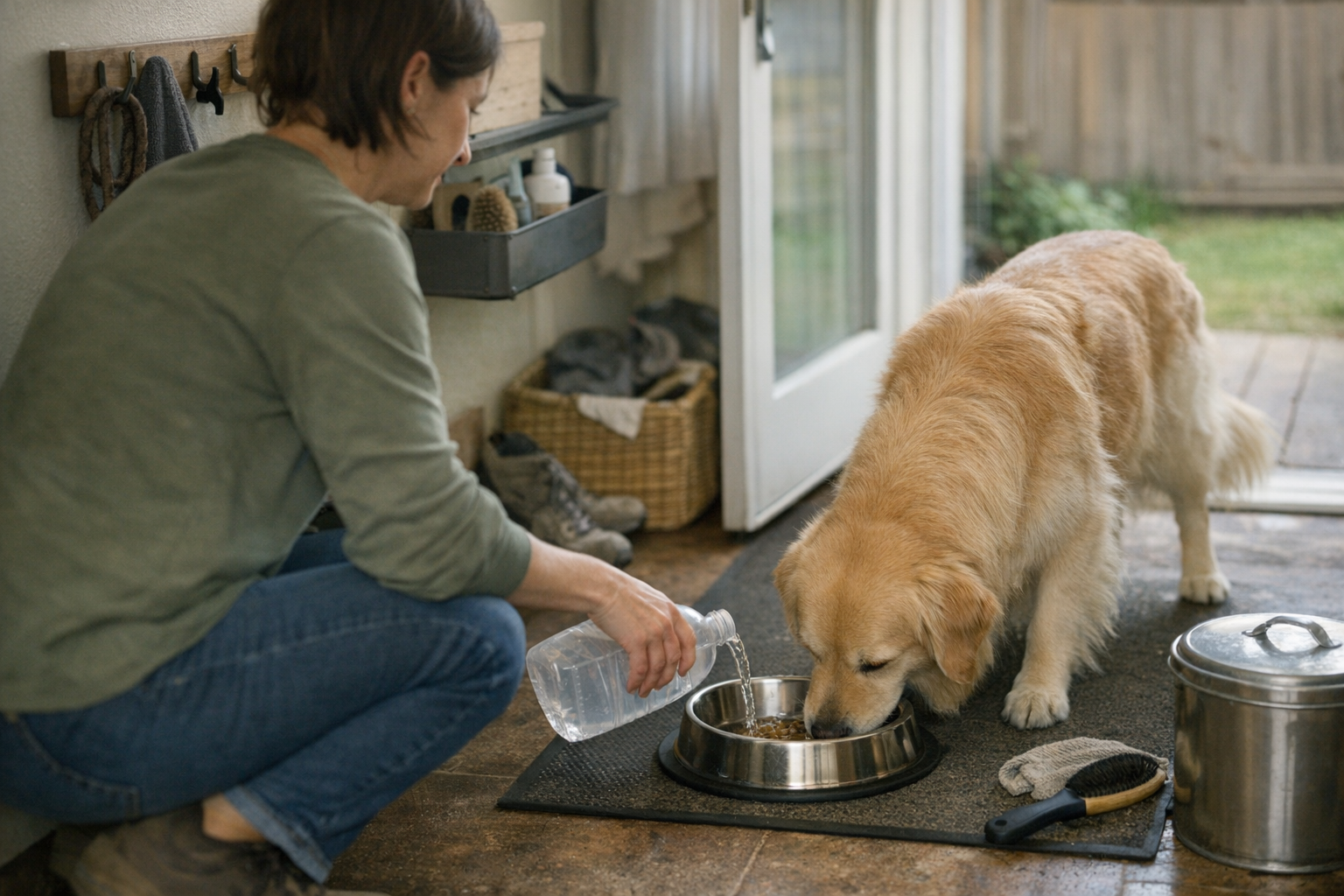
    Most pet care breakdowns start at the smallest level: a bowl not at arm’s reach, a towel draped over the wrong chair, the brush lost in a pile. Miss just one reset, and what should be automatic—feeding, water changes, wipe-downs—turns into a hunt or forced detour. Instead of a quick refill, you’re sidestepping clutter, moving stray mail, backtracking for the missing scoop, and trying to remember if the wipes are on the counter or buried in a bin. What breaks isn’t just tidiness—it’s the rhythm that keeps daily care low-effort. A routine that feels smooth for a week gets snagged on scattered essentials and minor blockages that keep coming back, no matter how clean the setup looks at first.

    Take a basic morning: you go to feed your pet, but the bowl isn’t under the counter. Instead, there’s a pile of yesterday’s opened mail in the way, so now you clear space before even opening the kibble. That towel you meant to rehang after last night’s walk? Still damp, still in the hallway, forcing another bump in your path. Each retrieval or reset is quick on its own, but repeat it across the day and the time loss—and the feeling of running behind—builds up. The routine designed to save time keeps getting chipped away by awkward reach and missing basics.

    Order That Lasts: Why Placement Matters

    Even with new supplies and good intentions, routines rarely stay tidy on their own. The first week’s neat setup—bowls, brush, bins all lined up—doesn’t survive late nights, missed resets, or surprise interruptions. You answer a call mid-cleanup, and the brush ends up on the coffee table. The scoop is left by the door. Wipes slide behind the laundry, out of instant reach. By noon, the system already demands extra steps to keep working.

    The friction isn’t a dramatic mess—it’s a slow stack of moments where you search or double back for what should be easy. One misplaced item means re-walking the same path, moving bottles to get to the cleaner, or kneeling to check under a chair for a missing toy. The space still looks okay, but the hidden disorder starts to slow every routine by afternoon.

    Real Use, Real Interruptions

    Midday is usually the stress test. Maybe you’re grabbing lunch at home and discover the water bowl is almost empty. The refill bottle isn’t under the sink—now you’re detouring to find it on a hallway shelf, breaking up a once-direct cycle. The grooming brush, left in the living room, goes missing just as your cat slips out of sight. Each skipped reset compounds until even simple tasks drag out.

    After walks, the block is immediate: muddy paw prints on the floors, and the towel you counted on is missing from the entrance. Cleanup tools exist but are just far enough away to make quick wipes feel like full tasks, so small messes wait and grow. Even an organized room isn’t immune—put essentials behind lidded bins or under decorative covers, and what looked not-messy becomes a daily roadblock.

    The Difference Between Looking Tidy and Functioning Smoothly

    A space that looks clean isn’t always set up for repeat use. Hiding gear in deep drawers or stacking supplies high to reduce visible clutter slows you down every time you reach for them. That scoop looks good out of sight, but when it’s under a towel or pushed behind other bottles, the extra seconds add up. The system feels “finished”—until you’re rerouted one too many times by little access blocks.

    The warning signs show in routine stretches: towels dumped on top of scoops, bottles you must move to reach others, toys left to interrupt a morning rush. Good intentions go unrewarded when every routine comes with an extra untangling step, and the calm appearance covers up the lingering hassle.

    How Repeated Reset Habits Hold It All Together

    The most effective fix: an immediate return habit. Every bowl, towel, brush, and scoop goes right back to its spot—not just “later.” If you refill the bowl, the bottle goes back on the shelf before anything else. Wipe the counter now, not after you’re halfway to the next thing. These habits, repeated, cut off small slowdowns before they pile up.

    This matters even more when routines are shared. If one person puts away the brush and someone else the towel, the next use doesn’t start with asking, hunting, or delayed tasks. Lapses in return habits mean confusion, not chaos, but every miss shows up as a broken rhythm later on.

    Grouping for Ready Access, Not Just Storage

    Core pet-care gear—bowls, towels, wipes, brushes—works best grouped where you use it, not just where it fits. Hooks for towels by the doorway. Shallow bins for brushes and scoops right at the feeding spot. If you can see and reach what you need with one hand, forgetfulness and mid-task searches drop sharply. Tidy, hidden storage looks calm but quickly costs you in extra retrievals during busy or tired moments.

    Specific Scenes: Practical Impact Across the Day

    The evidence for what works—and what doesn’t—shows up all day long:

    • Morning: The bowl’s gone, kitchen space crowded, everything slows until you reshuffle.
    • Water break: Need the refill bottle, but it’s out of sight; now you add an odd detour.
    • Cleanup: Wipes and towels tucked away, so small spills don’t get handled until hours later.
    • Evening: Toys and brushes migrate into the living room, turning “wind down” into an obstacle course.
    • Night: Rushing, you skip steps since nothing is in reach—then hope to reset tomorrow.

    The outcome isn’t outright clutter. It’s a slow drain—a pattern of micro-delays and half-done resets, where daily care turns into a series of obstacles and doubled-back steps.

    From Tidy-Looking Spaces to Truly Predictable Routines

    The only setups that hold up over time have three things: visible essentials close to where you use them, a habit of immediate resets, and grouping by function, not just for the sake of storage. This isn’t about perfection or strict tidiness—it’s about keeping care routines repeatable, straightforward, and ready to run smoothly whether it’s just you or a rotating cast of hands at home.

    When the right basics are at hand and the return habit holds, routines stay light and interruptions fade. Even if mess tries to creep back in, a simple, visible system helps you reset faster, skip the hunt, and keep daily care from turning into a grind. It’s not about looking organized—it’s about making sure the next step is always easy to start.

    Find setups that hold up to daily care at CalmPetSupply.

  • Small Adjustments That Smooth Out Daily Dog Care Routines

    Your daily dog routine might look “done”—leash hook set up by the door, food bowls lined up, towels stacked, floors mostly clear. But that’s not how real dog-life feels in use. It’s the grab for the leash only to snag on a bag handle, the feeding zone that’s neat but keeps causing your dog to stall just outside the kitchen, or the towel that’s technically nearby but never actually in reach as muddy paws hit the tile. Organizing isn’t the finish line; repeated routines keep exposing the weak point you thought you’d solved. The real cost shows up after dozens of cycles, when a predictable snag—too-small path, awkward bowl corner, leash blocked by clutter—keeps slowing you down without looking like a mess. That’s where frustration starts, and where the difference between “tidy” and “truly workable” becomes clear in daily, quiet friction. This is the actual landscape DogPile is built for: not just looking organized, but smooth, fast resets and real flow during the parts of your dog’s day that most often break down.

    The Invisible Slowdown: When Predictability Breeds Friction

    One seemingly minor snag, repeated endlessly, wears you down. Maybe every time you grab the leash, there’s a moment of scramble—your arm blocked by a backpack or umbrella hanging from the same hook. Maybe it’s your dog halfway across the threshold, pausing in the one spot where you both have to squeeze sideways. This isn’t a personality quirk; it’s a small hitch that drags at you because it happens in exactly the same place and way, day after day. The first few times you barely notice, but each extra pause adds up, making the routine feel quietly off.

    Watch what actually happens: bowl in hand, waiting as your dog stands outside the kitchen, visibly undecided. You toe aside a dropped shoe with your heel, stall at the door while the leash tangles, or pivot away from the water bowl just to clear space for clean-up towels. Each of these is a routine micro-interruption, invisible in a list of chores but deeply real in your morning patience. Over time, the energy cost is as noticeable as visible mess.

    Order Isn’t Ease: The Difference Between Tidy and Truly Smooth

    Why does a setup that looks fine keep interrupting the flow? The bowl is clean, the mat’s in place, toys are corralled, but you’re still negotiating awkward reaches or stops. Visual order hides functional stumbles. After enough cycles, you see the real points of failure aren’t about clutter—they’re about how the setup fits the actual motion of the day.

    • Bowl placement is “correct,” but a stray toy or shoe routinely blocks the only open lane during rushed mornings.
    • The leash hook is in sight, yet always has a tote or umbrella crowding it, leaving you fumbling with leash and keys as your dog sidesteps nearby.
    • The rest mat makes the floor look ready for naps, but its edge always catches your foot when you’re coming through with crates or groceries.

    These aren’t disasters. But they’re what erode a routine: friction that doesn’t show up on a checklist but keeps returning. Over time, you get faster at working around them—but never fast enough that it disappears.

    How Small Pauses Multiply: Real Scenes from Everyday Dog Life

    Big problems are rare. The real difference is made by repeated, small interruptions that slowly swamp your time and attention. These are the moments that push you into rushed problem-solving, or keep the routine wobbling just off balance.

    Caught at the Door: Walk Prep Gone Slow

    You want a quick, calm exit for a walk. Instead, you’re stuck: the leash is half-buried under a bag, your foot kicks a toy aside, and your dog waits awkwardly while you fumble and tug. The 10-second transition stretches into a scene of shuffling, blocked movement, and growing impatience—for both of you.

    Mealtime Stalls: The Awkward Bowl Approach

    Every meal is supposed to be a breeze, but your dog circles or waits just beyond the kitchen every single time. The bowl spot is visually neat, but off in the real world: maybe pushed back against a wall, or squeezed near a footpath. You hold the bowl, pause, and wait as your dog hesitates, breaking the flow every meal. It’s a harmless delay that never goes away—and makes you wonder what’s off about the setup.

    Cleanup That’s Never Quite On Time

    Back from a walk, you reach for towels or wipes, but the pile is just out of grab range—past a crate, over a blocked corner, or behind an easy-to-ignore stack of shoes. Your dog barrels forward, leaving a trail of muddy prints because the tools you “prepared” are never easy to seize in the moment. The rush to catch up means you clean in circles, fighting a losing reset after every walk.

    The Accumulation Effect: How Repeated Small Interruptions Change the Day

    One pause is nothing. But let it repeat—at the kitchen entry, at the doorway, by the crate—and your entire day gets nudged forward in small, costly increments. Maybe you rush feeding to make up lost minutes, delay walks to clean up, or keep calling your dog a little louder. The routine isn’t breaking, but it’s never relaxed. Even your dog starts to notice and adjust, sometimes with more hesitation, making the cycle self-perpetuating: friction in the setup leads to more hesitation, and more scrambling to keep up. The tidy look holds, but the living-with-it feels heavier, as if every chore runs just a beat behind where it should be.

    Spot the Patterns: Are You Compensating for the Same Weak Point?

    There’s a difference between the rare blip and a friction point that returns like clockwork. The real signals aren’t chaotic—they’re same-place, same-problem delays that reveal what your home isn’t lining up with your dog’s actual movement needs.

    • Dog hesitating, circling, or pausing at the exact same entry—especially into the kitchen or at the door for walks.
    • Indecision triggered only while you’re busy: arms full of grocery bags, bowl in hand, leash needed now and blocked by other stuff.
    • Cleanup tools technically “available,” but always in the wrong spot—wipes on a shelf, towels off to the side, just never where your hand naturally goes at the real reset moment.

    These patterns aren’t personality—they’re architectural. The way a bowl nestles into a corner, a toy box sneaks into the walking lane, or towels pile in a spot that feels “handy” but isn’t. Each teaches your dog to hesitate, or you to compensate—every time you both run up against the same weakness in the setup.

    When Setup Outweighs Training: Small Tweaks, Big Routine Wins

    It’s tempting to blame the dog (or yourself) and try “motivating” your way through routine stalls. But most often, the answer is a physical shift, not a personality fix. Real change starts at home-level, not behavior-level.

    Sliding a food bowl out from a tight corner, moving a mat a few inches to clear the path, or swapping where a leash hangs can change the whole vibe instantly. Suddenly, your dog approaches directly—no circling, no slow hovering—and you finish meal or walk prep without a detour. Nobody notices the difference until it’s missing: then the routine flows straight through, and the invisible resistance is gone, even if nothing looks much different on the surface.

    These wins aren’t about impressing anyone with neatness, but about stripping away the hidden shuffles and compromises that shave minutes and patience off every single day.

    The Practical Takeaway: What to Adjust (and What to Ignore)

    To move from a routine that looks okay to one that actually saves you time and friction, pay attention to the real-use signals:

    • Look for returning delay points: Where do you circle, pause, juggle, or squeeze through—especially at meal spots, walk prep, doorways, or crate time?
    • Question the “quirks”: If your dog stalls or circles at the same spot every day, it probably isn’t about them at all—it’s the home setup asking for a fix.
    • Reconfigure before redirecting: Try repositioning items before you try training a behavior away. The right setup adjustment can eliminate the pause instantly.
    • Organized, but not workable, isn’t enough: If you bend, shuffle, or detour every single use, rework the flow—not just the cleanup. Accessibility and ease should feel almost automatic as you move.

    Living the Difference: When Routines Finally Just Work

    True dog-home flow isn’t about a perfect-looking corner or always-impressively tidy bowls. It’s about quiet, practical ease—shaving away friction until routine transitions finally run on autopilot. The strongest sign isn’t a photo-ready space, but the moment you

  • How Carry-On Packing Choices Impact Your Daily Routine After Travel

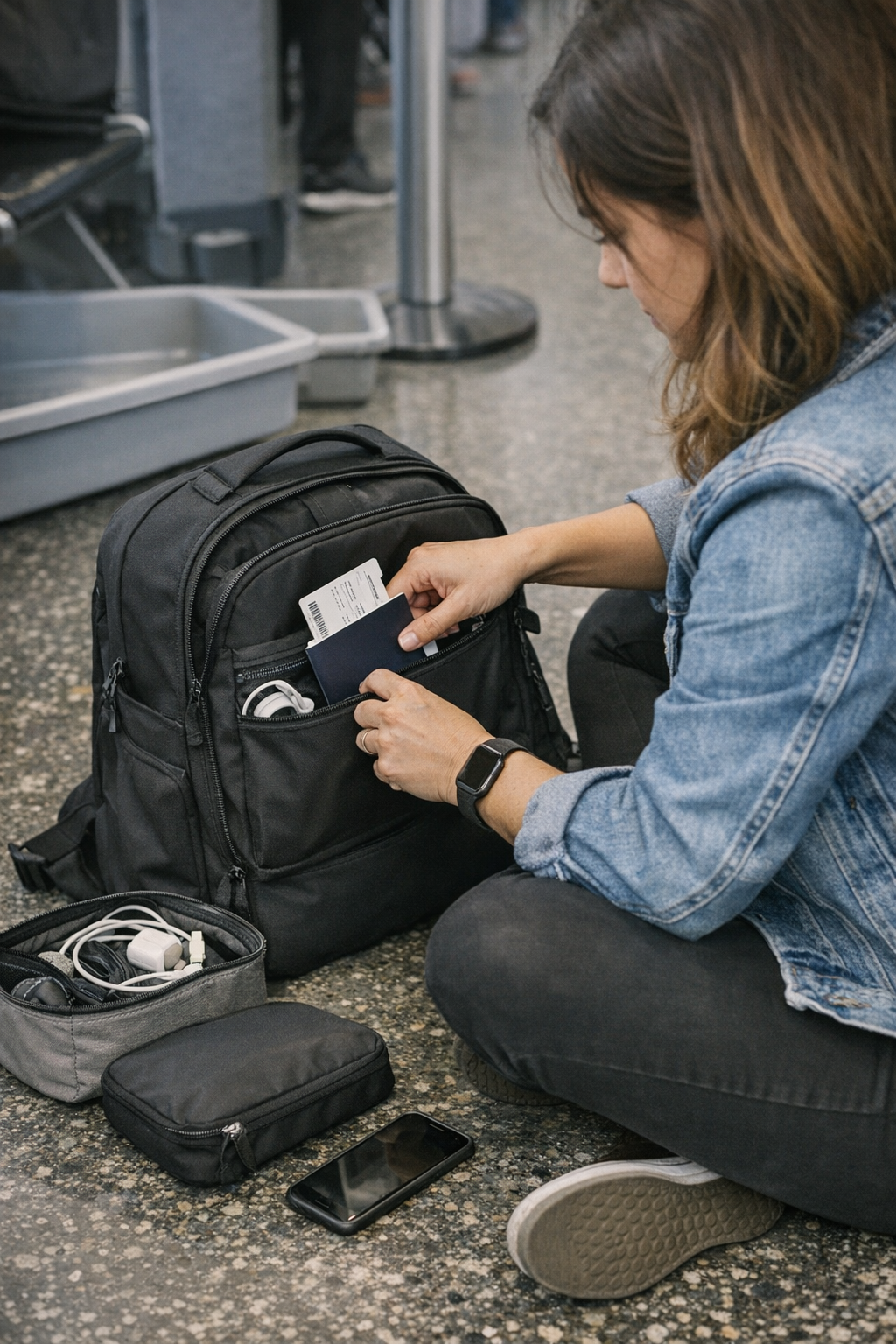
    A carry-on bag can look perfectly organized—zipped, stacked, everything in a labeled pouch—yet still slow you down the moment you enter airport mode. The real difference between a tidy setup and a truly effective one isn’t visible at home or photographed on a hotel floor. It shows up at check-in, security, and boarding, when you’re fumbling for a passport lost two layers deep or shuffling pouches just to reach a charger, and when repacking becomes a silent scramble. Physical order does not equal practical access: what works in static pictures often crumbles under repeated, rushed use.

    What Looks Organized Can Still Slow You Down

    Most travelers start with a sense of control: every item in a pouch, each pocket assigned, a cable kept in its case. On paper, it’s efficient; in action, the cracks show instantly. As soon as you need to produce your boarding pass or free your laptop for screening, the logic of “place for everything” buckles under the pressure of movement. Security trays come, bins stack up, and suddenly you’re juggling secondary bags—unzipping, digging, re-zipping—while the line behind you builds tension. Items meant to be “safe” slow you down, and what began as organized order leaves you mentally tracking three repacking moves just to restore your layout.

    The Layering Dilemma: Visual Order vs. Real Access

    A layered layout—pouches nested within pockets, tech zipped behind toiletries—promises predictability. But even the best system cracks under everyday travel friction:

    • Repeated retrievals: Needing headphones or a charger typically means unstacking higher-priority items, especially when cramped in aisle seats or digging under a seat mid-flight.
    • Overlapping compartments: A passport tucked behind two pouches feels secure at home, but during unplanned terminal checks, you pause, scanning pockets and stalling movement. Your “memory system” fails where real flow is needed.
    • Stacked tech pouches: Cables and adapters tend to migrate deeper into bags. Each time you reach in—boarding call, gate lounge, after landing—you face more tangled friction and wind up stuffing items wherever there’s open space, erasing the intended order.

    Even with a minimal, visually clean setup, friction re-emerges: cables hidden under pouches, flat items blending in front pockets, quick-access slots blocked by a single misplaced case. Every decision—outer pocket, deep pouch, stacked layer—trades off one friction for another, and you only learn which matters after the first few real interruptions.

    The Cost of Internal Friction, Trip After Trip

    The drag doesn’t end at the airport. Patterns you build while traveling seep straight into your workday or commute. If your carry-on is structured for perfect stowage rather than easy movement, every small retrieval—wallet, charger, ID—produces a momentary stall. The same setup that kept your bag neat on the plane leaves you double-checking pockets at home or halting a morning rush to repack something lost in the stack. What’s intended for the airport quietly slows down your daily rhythm, making “just-in-case” order a daily inconvenience.

    Real-World Scenarios: When Your Setup Gets in Your Way

    The Security Tray Pause

    As the line pushes ahead and trays clatter, you unzip your “organized” bag only to find your passport under a pouch and your laptop in yet another compartment. Each extra second—digging, shifting bags, unzipping layers—means pressure from behind and lost focus. The setup once meant for confidence becomes a liability at speed: security flow turns awkward as your layout breaks under actual timeline pressure.

    Boarding Line Tension

    Gate agents request another pass check. You haul your bag upright, reach past two organizers, and finally produce your document after a short visible scramble. Every missed quick-access moment turns you into a hold-up for the line, making retrieval a show instead of a smooth move.

    Seat Entry and On-the-Go Retrieval

    Sliding a bag under the seat: headphones are needed, but the outer pocket is blocked, so you reach deeper through an inner sleeve, past the book and tablet. Knees pressed, an aisle crowded—you recover headphones at the expense of spilling contents, prompting another round of repacking. The illusion of order collapses after just one real in-transit reach.

    Arrival Reset: The Repacking Burden

    Arriving at a hotel or home, you face the aftermath: half the bag emptied to reconnect the scattered pieces. “Organized at departure” now means unpacking to restore a simple order. The more complex your in-bag structure, the more noticeable the post-trip reset becomes—and the less eager you are to repeat it on the next round.

    Rethinking Carry-On Organization: A Shift to Predictable Access

    After trip after trip, it becomes clear: more compartments and deeper stacking don’t solve real movement needs. What works is predictable, immediate access for your most-used items—outer-front slot for documents, a middle zip for cables, single pouch up top for headphones. You structure for the next interruption, minimizing the number of steps between you and your essentials.

    This isn’t a promise of perfection. Even the best setup can slip after a tight layover. But when the items you reach for most often have a frictionless path—one move, one pouch, one spot—the sequence of daily travel turns smoother, not just visually tidier. You stop mentally mapping pouch layers and start moving in sync with the real airport routine.

    The effect isn’t instant magic—some items still migrate, and certain bags resist clean customization—but each direct-access solution trims away disruption. When your carry-on feels lighter at the moment of retrieval, not just at the scale, you’re on the right track.

    Making Your Next Trip Less Interruptive

    Traveling well isn’t about maxing out storage or styling the neatest flat lay. It’s about making sure your most-retrieved items don’t demand a pause, a shuffle, or a guess every time you move. Every extra layer between you and your essentials isn’t just a tiny hassle—it’s a multiplying frustration across the whole trip.

    Track where your movement stalls: repetitive delays at security, awkward reaches in crowded aisles, missing documents at boarding, reordering at arrival. Each issue signals a structural fix, not just a cosmetic one. Adjust your carry-on’s structure so that high-frequency items require a single, quick motion—not an unpack-and-reshuffle. Even a couple of tweaks—relocating your passport to a dedicated outer slot, or limiting tech to a single pouch—will dial back recurring disruptions and let both travel and daily routines run smoother.

    Explore carry-on solutions designed for real travel movement at CarryOnSupply.

  • Why Lowering Under-Cabinet Lighting Improves Everyday Visibility and Comfort

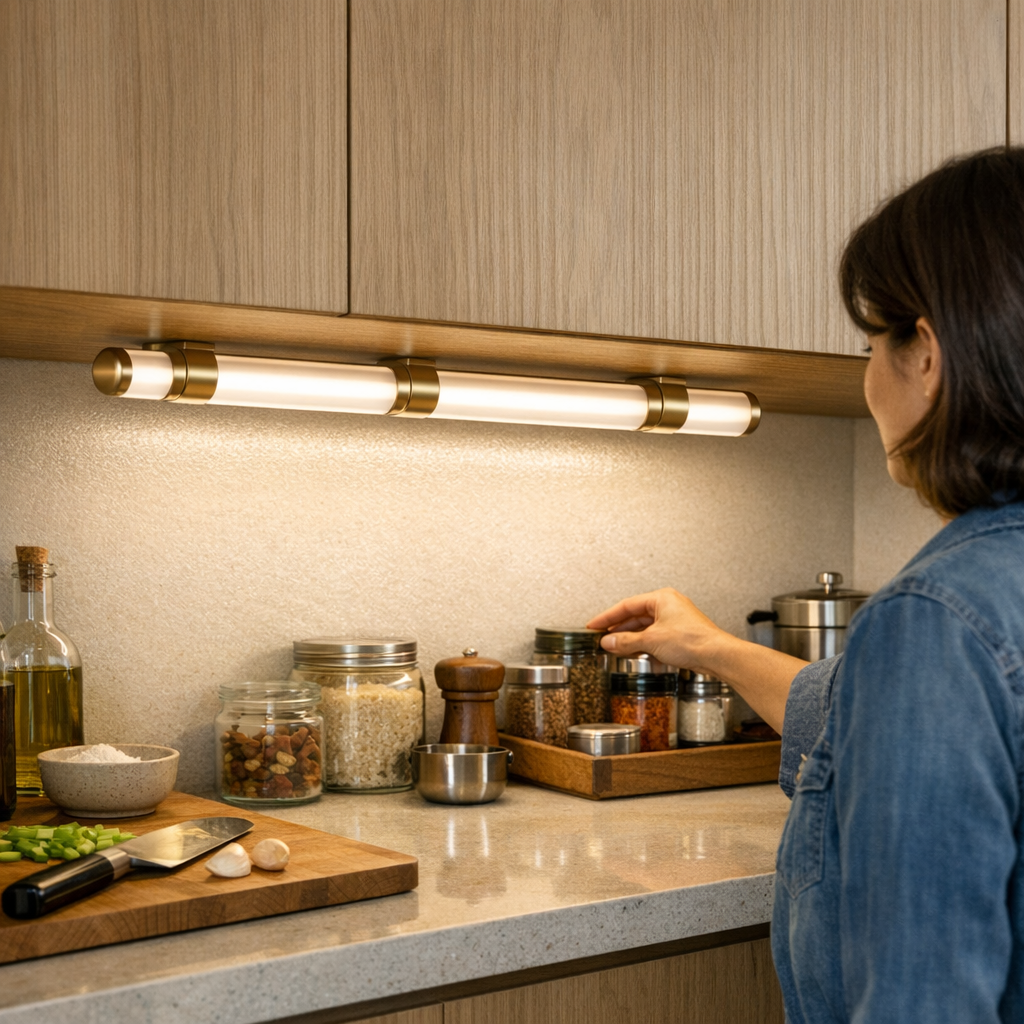
    The promise of a “clean” lighting setup rarely survives a week of real use. That crisply mounted under-cabinet or slim shelf light looks perfect the day the cables disappear and the fixture hides behind trim—but friction quickly returns. Every time you chop vegetables or reach for supplies along the rear edge, you’re chasing shadow lines, glaring at the cabinet face, or stretching awkwardly to catch what the lighting missed. The setup that seemed finished now interrupts your routine, and the surface that looked resolved by mid-afternoon snaps back to frustrating reality by nightfall.

    Why Clean Looks Don’t Always Translate to Clear Working Light

    Minimal lighting installs—tight under-cabinet strips, flush LED bars, slick linear fixtures—are sold for their vanishing act. Wires vanish. Brackets recede. The counter or shelf glows evenly—until you actually start using the surface. That’s when the real issues appear: glare thrown off shiny trims, shadows swallowing the back edge, and core work zones left frustratingly out of reach. The crucial strip of workspace—where you set down a mug, review a manual, or hunt for a missing part—fades into gray.

    Lighting fixed high and hidden solves visual clutter but creates new obstacles. Reach under a low cabinet or deep shelf, and the front half is overexposed while the far side recedes into shadow. A setup praised for its seamless look reveals its limits the first time you have to adjust your position just to read a box label or grab a tool without guessing.

    Shadow Lines and Dim Corners: Where Streamlined Installations Fall Short

    The problem shows up in the same way, every day: hands cast dense shadows onto the space you need most, while the well-lit foreground distracts from what’s actually missing. In a kitchen, the place you rest a spoon or line up spices never feels fully visible. On a workbench or shared desk, small hardware and paper piles blur into the dim rear, forcing repeated shifting and squinting. Lighting that scores on looks stumbles on use—especially where routines keep circling the rear corners, not just the clear center stripe.

    These are not one-time annoyances. A week in, you’re adjusting your angle, dragging in another lamp, or leaning closer against the cabinet edge—proof that a setup considered “minimal” doesn’t always keep up with real-world movement or reach. The discomfort isn’t glaring, but it’s persistent: a subtle design flaw that keeps inviting workaround after workaround.

    Lowering the Fixture: The Simple Adjustment That Brings Real Clarity

    There’s a small, specific fix: Lower the under-cabinet or shelf-mounted light just 4–5 centimeters below the surface lip. This one shift releases the beam’s reach, pushing the light field all the way to the back wall or inner shelf edge—filling the shadow zone where hands, labels, and tools actually land. Suddenly, detail returns where it matters. The contrast between front glare and rear murk fades; the space behind jars, bins, or devices emerges as naturally usable.

    This isn’t about amp-ing up brightness or flooding surfaces. It’s about beam direction—preventing a fixture designed for stealth from robbing the very clarity it’s meant to deliver. Lowering the light doesn’t sabotage neatness; it corrects the balance between invisible hardware and visible function. The difference is tangible from the first meal prep or project night—no more faked minimalism that quietly drains productivity.

    Real-World Scene: Where the Lighting Position Pays Off

    Picture this in use: By day three, you’re prepping dinner under a flush-mount strip. Each time you slide a tray or scan for a label, your wrist blocks the light, forcing mid-task reads and guesswork at the back. You start angling yourself sideways or switching on a phone light. Drop that strip a modest notch—and now the far row of bottles, the onion skin, and even scattered crumbs fall plainly into view. Labels are legible without head-tilts. There’s no more moving twice to finish one task. The light covers the job, not just the décor.

    Shared Desks and Work Surfaces: Where Minimal Looks Can Slow You Down

    Kitchens aren’t the only danger zone. On workshop shelves, classroom desks, or shared counters, the same tight-mount setups leave half the surface ambiguous. Lowering a fixture turns a row of shadowed bins or half-lit paperwork into a clearly visible workspace—the near edge ready for fast grabs, the rear edge free of lurking details. It also fixes the annoying problem of partners or colleagues repeatedly shifting the lamp or hunting for what they can’t quite see. The area now matches intention: work moves forward instead of circling lost in half-light, without the pause to chase every shadow with a flashlight.

    It’s easy to credit a surface for looking less cluttered. It’s more convincing to count how much less you have to adjust after a fixture drops into its effective zone—quiet measurable difference, not just visual promise.

    Slim LEDs and Cable Placement: Balancing Neatness and Performance

    Some setups resist adjustment out of fear of cable mess or “visible” lighting. But slim LED bars and smart cable routes make this concern smaller than the headaches of living with half-lit surfaces. Pin cables tight along seams and supports; they fade from awareness faster than the persistent strain of missing screws or misread labels. A fixture that sits slightly lower does become more physically present, but in daily use, what stands out is the absence of friction: no more leaning, no more compensating, no mental note to “fix the light someday.”

    A visually minimal bracket or cable that fails in routine use is less “clean” than a slightly visible support that keeps your workflow seamless. Practicality wins—within days, the truly invisible element is the annoyance you’re no longer working around.

    How Small Adjustments Turn Into Lasting Routine Improvements

    Lighting setups that look perfect at install often turn into silent routine traps by week’s end. The easiest fix—lowering a mount—turns a kitchen, study, or work zone from “picture-ready” to genuinely usable. Glare softens. Blind corners fill in. Cables, if routed correctly, recede alongside brackets into the room’s structure. The best lighting support helps not by staying unseen, but by putting every label, handle, and edge within easy reach—cutting the lag between setup and fluent everyday motion.

    Minimal never means invisible at the price of comfort. The small, visible shift—a light dropped to the right level, a cable tucked clean but not buried—changes the room without ever getting in your way again. Most routines don’t need perfection; they need light that moves with them. That’s the difference between “perfect look” and real support.

    Find more practical lighting and support solutions for real indoor routines at LightSupport.

  • Why Plastic Bins Outperform Cardboard for Durable Entryway Storage

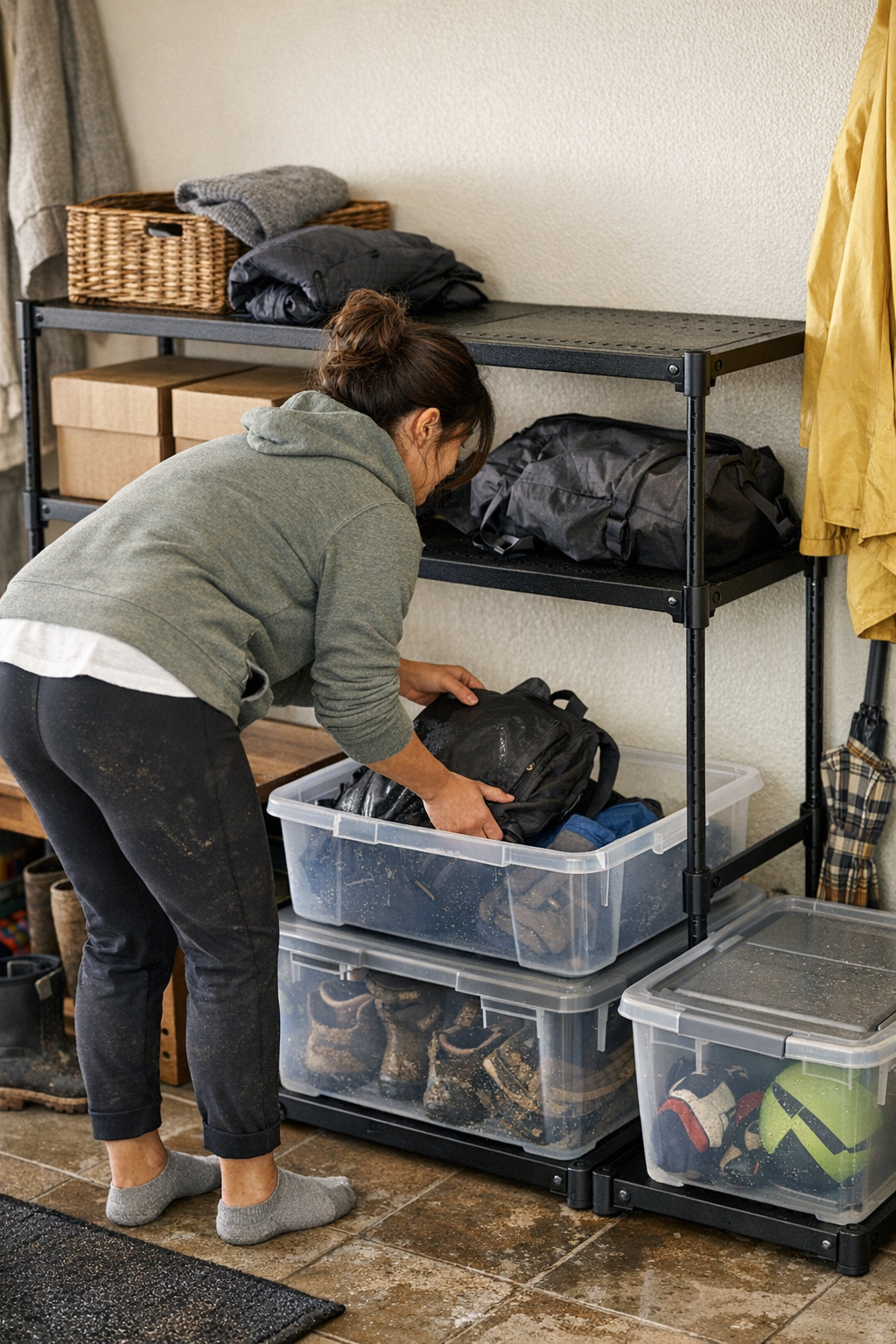
    Cardboard boxes and plastic bins are not interchangeable once your entryway enters real use. Stack a cardboard box under a bench or line a few up along a wall, and they look organized for maybe a day—until the first week of wet shoes, dripping coats, and off-schedule resets. Suddenly the edges of those boxes sag, corners slump, and what started as a tidy drop zone turns into a damp obstacle course. Instead of storing away clutter, you’re now sidestepping a soggy pile and prying stuck boxes off the floor just to keep the path open.

    When Cardboard Boxes Collapse under Repeated Entryway Pressure

    Cardboard seems fine at first—holds shape, fits shelves, takes labels. But entryways are not static rooms: shoes come in muddy, bags drop heavy, and one rainy Saturday is enough to warp what you thought could last a season. By the end of week two, lids don’t close, boxes lean and spread, and one damp base can glue two boxes together. What started as a reset-friendly system now slows you down. The bin meant to collect quick returns blocks the walkway; instead of quick drop-and-go, you’re forced to pause and untangle stuck storage on your way through.

    Every time a cardboard edge curls or a corner gives, movement through the space gets clumsier. Shoes that should stay contained slide out of a sagging box and start a slow creep along the wall. A routine—come in, drop gear, move on—gets punctuated with detours and hands-full recovery runs. The setup looks organized only until the first predictable failure point. After that, your storage becomes an extra obstacle in the threshold instead of keeping the path clear.

    What Entryway Friction Really Looks Like

    • Dropping a wet bag onto a box and feeling the whole stack shift or edges bow, making it harder to use next time.
    • Shoes that start in line, then slowly sprawl as sagging bins can’t hold a shape—turning a tidy row into a constant widening that blocks the bench.
    • Sitting down at the bench and setting something aside, only to realize there’s no clear space because a collapsed bin base has migrated inward.
    • Trying to return one item to its “spot,” but now that bin is half-folded, soggy, or fused to its neighbor, slowing access and pushing everything outward.

    Each of these failures doesn’t just make things look messier—they add seconds and slowdowns to every pass. Resets become rescue operations. Instead of supporting your routine, cardboard ends up giving you more work with every rainstorm or rushed morning.

    Plastic Bins: Rigid Boundaries and Reliable Flow

    Plastic bins hold up and hold boundaries when water, mud, and frequent shuffling hit your entryway. Where cardboard absorbs every drip and warp, plastic stays rigid. Floor-level bins see the worst—mud, snow, stray granules from shoes—but a good plastic bin shrugs it off. Slide it out, wipe it down, reset instantly. No warping, no edge collapse; one hand is enough to move, and you’re not worried about the bottom smearing across the tiles.

    The difference becomes obvious in three days of normal use:

    • Plastic slides and resets fast, never sticking or swelling shut.
    • Muddy shoes go in; the bin cleans up with a quick towel—no softened seams, no corner melt.
    • Bins keep a true inside/outside divide. What’s dropped stays contained, walkway stays clear.
    • Returning bulky gear is a repeat move, not a negotiation with torn sides or stuck bottoms.

    Structure Reshapes Reset—Not Just Storage

    Place cardboard too close to daily action—main floor, under the bench, or near the door—and it absorbs the consequences: runoff, constant movement, mixed-weight returns. As the sides give, categories blur and spill, making every reset another project. Plastic reestablishes the edge: even if shoes and coats rotate all season, the bin itself never becomes a variable. You don’t have to do a full re-sort every week; you just return items once, and the zone remains defined and usable.

    Clear Bins vs. Opaque: Finding Items in Motion

    Visibility is another friction point most people notice only after the third or fourth reset. Transparent plastic bins make it easy to spot what’s left behind—no more guessing which stack holds the missing glove or leash. If your drop zone serves a busy household, or you swap categories by season, the extra seconds saved add up. Opaque bins look tidier but often slow you down: you have to open, rummage, and relabel, especially when categories drift and multiple people use the space. Choose transparency to track change, or go opaque if you prioritize a calm, fixed look—just understand the real-world trade-off in retrieval and reset time.

    Right-Sizing: The Early Warning for Friction Creep

    Entryway bins should fit both the shelf depth and real-use pressure. Overstuffing a bin—one extra boot, one extra scarf—quickly turns order into friction. Lids won’t close, bins bulge outward, and just trying to push something in can jam the return flow for everyone. When bins bulge, the whole drop zone loses clarity, bumps against walkways, and requires twice as much correction with every pass-by. Stop loading before bins press against their own limits: that’s the boundary between support and slow breakdown.

    Transition Space Fixes That Actually Work

    • Place plastic bins at high-pressure points: Directly under benches or beside doors—where mud, drips, and returns collide most often. These absorb the worst and deliver the biggest payoff in function.
    • Pick clear bins when categories shift or entryway traffic is high: Faster resets, no guessing, fewer items lost in the shuffle.
    • Reset the base first: Fixing just the lowest, most-used bin sets a strong edge and instantly tightens up the rest of the space.

    From “Organized Once” to Consistently Usable—Across Real Use

    Every system works on day one, but transition spaces live and die by what happens during a downpour, after a week of rushes, or when the pile at the door doubles overnight. Cardboard’s orderly look collapses under repeated pressure, while structured plastic keeps daily clutter from becoming permanent blockage. Resets take seconds, not minutes. Categories hold. Drop zones remain open to use, not just open to look at—so coming home late or carrying a week’s worth of stuff doesn’t wreck your whole flow.

    If your entryway now feels like a semi-permanent pile—slow access, shut-down reset energy, drop zone boundaries failing at the floor—switching even just the main bins to rigid, moisture-proof plastic won’t make things perfect, but it will restore a clear, usable edge. Not a magic solution, but a practical, visible difference you’ll see every time the threshold pressure returns.

    betweenry.myshopify.com

  • How Structured Cable Routing Enhances Desk Usability and Workflow Efficiency

    The line between a desk that simply looks organized and one that actually holds up under real work pressure shows up the moment you need a cable fast. You reach for your charger—that’s when the “tidy” surface fails: the cable has already slipped to the floor or vanished behind a pile of folders, forcing you into awkward reaches or a full crawl under the desk. Repeated drops, tangled lines, and off-balance surfaces create small setbacks that chip away at your session. A loose charger is more than a minor mess—it’s a daily test of patience and an invisible drag on workflow.

    Recognizing the Cable Problem Before It Slows You Down

    A charger left to dangle is more than stray clutter; it’s an early alarm for routine breakdowns. Even after a morning reset—pens lined up, papers stacked, cables coiled—the illusion cracks by lunchtime. By day’s end, your hand goes searching for a vanished charger, first on the surface, then behind the monitor, maybe finally under the desk. Each time, the “simple” search interrupts your working flow, piling on seconds and low-grade irritation. What feels minor on Monday turns into a repeated roadblock by Thursday.

    The hidden cost: snapped focus, bent connectors, cables yanked by moving notebooks, the charger’s heavy smack as it hits the floor again. The setup looks clean but never feels ready.

    Why Quick Cable Fixes Rarely Hold Up

    Temporary fixes always tempt: loop the wire over a monitor arm, wedge it under a mousepad, let it rest just out of sight. For a day, it works. After that, gravity wins. A device swap or erase of a whiteboard drops the cable again. These “solutions” create their own mess: the charger ends up bent at odd angles, cables knot with each new item you move, and what was once at hand now requires a daily scavenger hunt. Routine work becomes an obstacle course of stops and resets.

    The trap is obvious in hindsight: saving steps now simply moves them later, multiplying small, distracting resets across every round of work.

    How a Small Change in Routing Produces a Big Return

    Real desk improvement rarely means buying bigger trays or hiding everything. The fastest difference comes from anchoring just what keeps causing friction. An adhesive cable clip, set a thumb’s width—about 4 centimeters—from the desk edge, locks the charger in place: it stays visible, always in reach, no matter how often you plug, unplug, or shift your notebook. You stop losing minutes to cable fishing and dragging wires back into place.

    Just this correction does the following:

    • Stops the charger from dropping each time you shift a device
    • Keeps the cable exactly where muscle memory expects it to be
    • Makes tidy resets between tasks almost instant—no searching, no untangling, no crawl under the chair or desk

    It’s not about perfect concealment; it’s about stable cable points that survive repeated transitions—writing, typing, plugging in, shifting back to your screen. Your desk looks less cluttered, but more importantly, it works without interruption.

    Where the Friction Usually Pops Up

    There’s a pattern to cable chaos: jotting notes with a charger loose, a single gesture shoves it beneath your folders; in the clutter of task switching, the charging head slips out of reach—again. Slide a notebook forward to make more space, only to drag the cable halfway off the desk. Even when longer lines get stashed in under-desk trays, short chargers become harder to grab if you’re unplugging multiple times per day. The point isn’t to hide every trace—it’s to have the charger always right where your workflow pivots, matching how—and how often—you use each device.

    Practical, Repeatable Desk Scenarios

    Picture a compact workstation: laptop in the center, external monitor pitched at an angle, a tablet parked on the right edge, keyboard sharing space with stacks of notes. You switch between typing and sketching, phone pings, you reach—cable falls, notebook catches, everything in your way for a task meant to take seconds. By early afternoon, the time lost to wrangling basics adds up.

    When you anchor the cable, the routine transforms quietly. Plug in, unplug, reset for a call, jot down an idea—no dropped wires, no rummaging. The right cable returns to hand every time not by accident, but because the desk reroutes your reach just enough that distraction never has time to build.

    What Actually Changes Across a Workweek?

    The upgrade isn’t dramatic and that’s its strength. The hassle leaks out of the week, little by little:

    • No more crawling under your chair for a charger after every device swap
    • Chargers stop bending or losing grip from being twisted behind the monitor
    • Folders and notes don’t push cords out of play during rapid task shifts
    • Surface resets become smooth, quick, and routine—delays drop away, and flow returns faster at every session’s restart

    You only notice how often you used to get interrupted by how quiet and frictionless the day becomes—the charger just works, and the problem vanishes into the background.

    FAQ: What Desk Users Keep Asking About Charger Cables

    How do I stop chargers from sliding off my desk?
    An adhesive clip or channel right at the desk’s working edge makes all the difference. Place it where your hand goes when reaching for the device you charge most often. Retrieval becomes automatic—you stop losing time and patience to repeat hunts for a fallen cable.

    Will hiding cables in a tray make it harder to plug and unplug devices?
    Yes, for short, frequently moved chargers, trays can get in the way. Under-desk trays work best for the cords you rarely touch. For daily chargers, surface-edge clips strike the balance—orderly, but never out of reach or a hassle to reset. Don’t hide what you need to grab on the fly.

    Does combining cable boxes, trays, and clips really help?
    It works if you separate constant-use from rarely used cables. Store heavy, long lines out of sight in trays or boxes; keep your main charger secured on the surface with a clip. Added systems are only helpful if they don’t force you back into slow workarounds during high-traffic device changes.

    The Real Win Is in the Routine, Not Perfection

    Locked-in cable routes aren’t about showroom looks or desk envy—they mean you stop thinking about the cable at all. Every structured touchpoint frees up your focus, removes tiny setbacks, and lets your desk flex with repeated switches, resets, and bursts of work. The real signal of improvement? Not how the surface looks at 9 AM, but how quickly it goes from chaos back to ready after every full cycle of use. The cable you use most isn’t buried, blocked, or halfway to the floor—it’s where you need it, session after session, mistake after mistake, reset after reset. Explore the full WorkBasic collection