
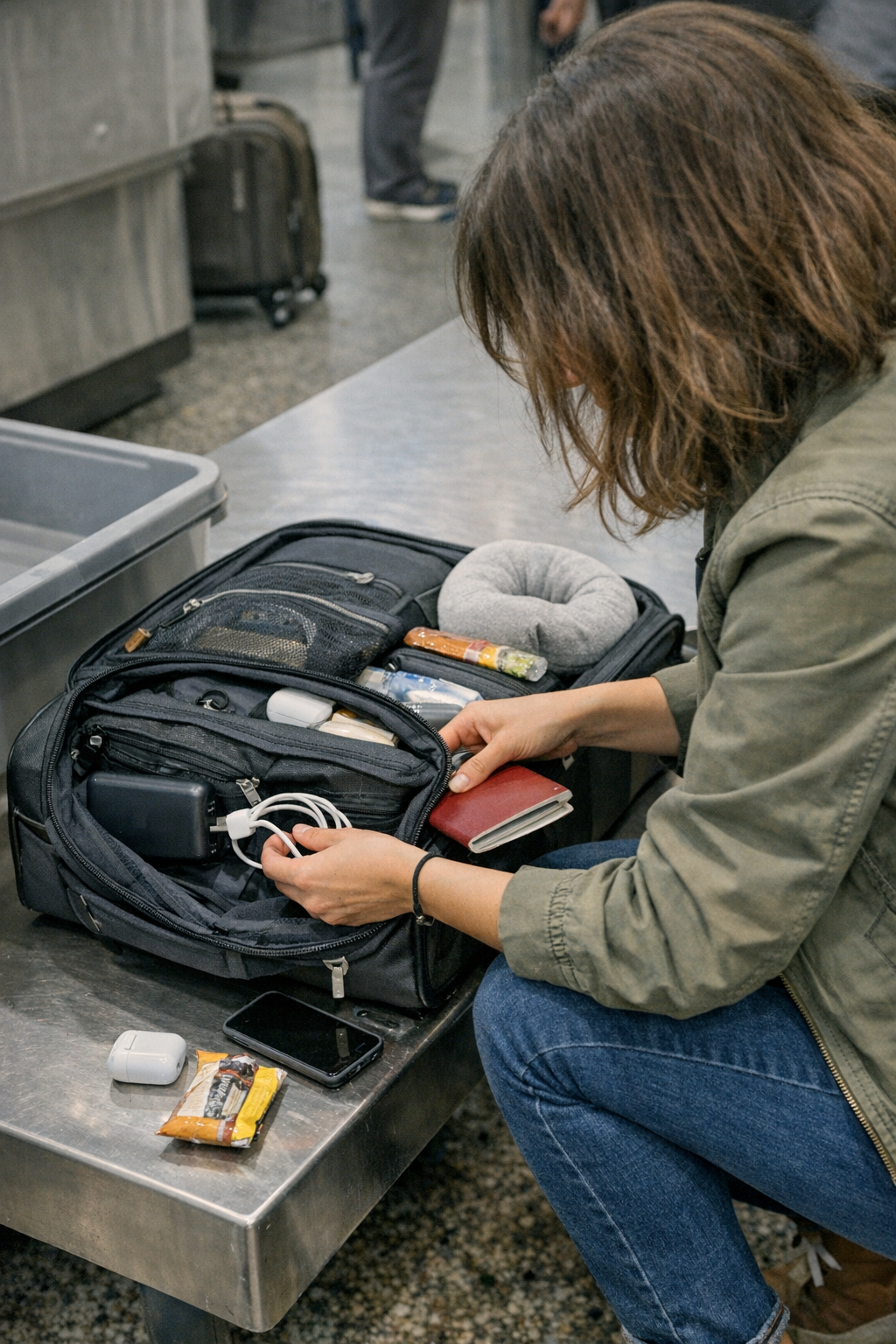
A carry-on can look perfectly restocked after a trip—until real airport movement shows you what’s still wrong. The cycle is familiar: you return home, drop your bag, and “reset” every item, snapping chargers into a pouch here, travel docs into a sleeve there, snacks lined up at the top. Visually, nothing’s out of place. But the next time you reach for your passport during security, you’re fumbling under a toiletry bag. The charger you need at the gate is, again, sandwiched behind a power bank and a half-zipped snack pack. Organized at home, tangled in use—the hidden cost becomes obvious as soon as airport flow takes over. Most carry-on setups only reveal their real strengths or failures under pressure: tray transfer, boarding rush, or the first repack at a busy terminal. This is where CarryOnSupply’s product world enters—centered on setups that hold up in motion, not just in the hallway.
When “Tidy” Still Trips You Up
The illusion of readiness is powerful: a neat bag promises an easy trip, but routine use exposes the same snags, trip after trip. Documents that always slip down one layer deeper, tech getting tangled with last-minute additions, snacks instantly out of reach just when you need them. Packing on autopilot—repeating the old home arrangement—means dragging yesterday’s hassles into every new airport line.
You notice it in the same places, every time:
- Outer pocket packed “for quick access,” but always needing to move wet wipes to grab your passport.
- Chargers that slip behind toothpaste, so you’re kneeling on the terminal floor, digging.
- Boarding pass you thought was up front now wedged flat under a power bank as the line surges forward.
The Gentle Reset: Rethinking Instead of Repeating
The fix isn’t just laying things out “like new”—it’s quietly tracking which spots caused a stumble last time. A real reset means unpacking far enough to spot what you actually grab first and what slows you down. Did the doc pouch get blocked at security? Was tech access awkward mid-boarding, or did you have to move three items for a snack? Each stall is the bag’s way of telling you something in the layout is breaking at speed—not just a random mishap, but a pattern waiting to trip you up again.
Spot the repeat interruptions:
- Two zipped pouches and one tray transfer just to find the charger you always use between gates.
- Fumbling into side pockets while managing boarding passes, jacket, and the nudge of thirty other travelers.
- Struggling with a stuck zipper at your seat—fastening your belt, only to realize your headphones are still out of reach.
True-to-Flow Packing vs. At-Home Precision
A bag that’s tidy on your bed may turn on you instantly at the terminal. Pouch-based, maximally “organized” setups break down when the essentials are layered, not sequenced by when and how you actually use them. Time after time, you see which sections break first under pressure—especially at points where the environment is moving faster than you are:
- Security: Toiletry case on top of documents looks sharp at home, blocks everything when the tray comes up.
- Boarding: Tech pouch hiding headphones behind snacks. Quick at home, slow when everyone’s shifting forward.
- Seat entry: Neatly packed pillow in front, but now you’re kneeling in the aisle nearly unloading the whole bag just to fish out an e-reader.
Static “order” doesn’t survive active transit. If you have to stop, juggle, or shuffle just to reach your go-to item, it’s not just a preference issue—it’s a breakdown waiting for your next busy airport.
Airport Moments Reveal What Home Packing Conceals
The real cost of a bad setup isn’t a lost item, but lost time and constant interruption from bad pocket and pouch sequencing—seconds that become a hassle in line or at your seat. These issues grow sharper and more visible the more times you move through a checkpoint or repack under pressure:
- Security trays: Passport under a loose battery equals an awkward pause and impatient glances from behind.
- Boarding lines: Forced pouch search with too many layers—just as the gap closes toward the gate.
- Overhead bins: Items layered the wrong way force last-second reshuffling, stranding you mid-aisle when all you needed was one quick grab.
After two or three travel legs—and just as many quick repacks—what felt like a small snag at home starts to stretch each transition. A clumsy charger pouch or doubled-up outer pocket can add grind with every checkpoint.
Real-World Fixes: Small Shifts, Big Relief
Every real improvement starts with observing where the sequence breaks down—not just what looks neat. I kept tripping over the same bottlenecks: passport, charger, travel snack. Rebuilding true first-grab access, not just front-pocket theory, cut out most in-motion delays. After one quick adjustment, my next security tray shift ran smooth, and boarding became less of a scramble—because nothing blocked those three key items anymore.
The trick wasn’t overfilling outer pockets or squeezing every pouch tight, but building in a little breathing room: just enough for a fingertip to reach and retrieve without shifting other items. That made “crowded” sections feel open and repeat grabs nearly automatic.
Spotting the Weak Links in Your Reset
A silent check after every trip: if you hesitated once—or double-checked a pocket more than needed—your bag is flagging a misfit between what’s visible and what’s workable. Pay attention to where your hand slows, curls awkwardly, or returns to the same spot after missing the item. Usually, one or two friction points can be fixed before the next trip without touching the whole setup.
A partial unpack beats a blind reset. If the snag keeps coming from tech or docs, start there. Sliding the power bank to the pouch edge, keeping snacks unblocked, or giving travel docs a solo slot—even if it breaks visual symmetry—can unclog the sequence for the whole trip. Often, switching the order of two or three high-traffic items transforms daily frustration into plain, frictionless access.
One Reset Doesn’t Solve Everything—But It Starts the Right Cycle
No “perfect” organization lasts more than a few trips. Each new travel leg stress-tests your choices. The real edge: build your setup for the way you’ll move through airport checkpoints, not just for home neatness. What matters is how access flows at speed, in real time, with real stakes—a carry-on that isn’t just reset, but re-sequenced for motion.
Carry-ons that work for you adapt after every checkpoint—refined by each pause and retrieval, not just packed for the start. If your bag works better each trip, not just looks better on your bed, you’re ahead of the cycle.
For practical organizers, travel pouches, and carry-on tools that help you set up for actual airport conditions, visit CarryOnSupply.