
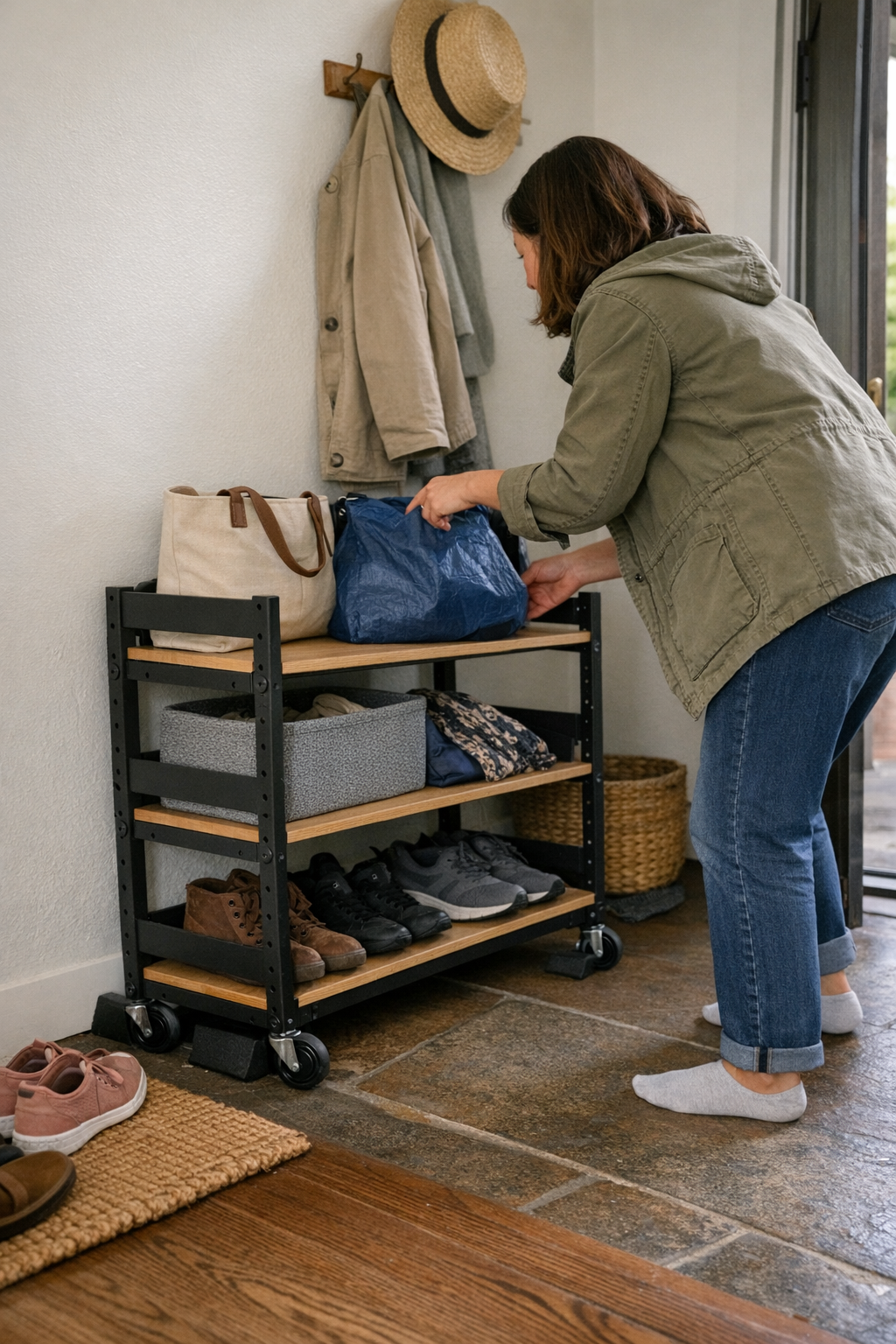
The sloped-floor factor: The moment a cart creeps out from where you left it, the illusion of a stable entryway disappears. Setting down a mobile storage cart feels logical—until a week later, when it’s nudged itself halfway into the passage, wheels angled from a barely perceptible slope. Even minor inclines turn “drop zones” into drift zones: shoes spread off the edge, bags lean toward the threshold, and the tidy line you set up on Saturday is gone by Tuesday. Instead of a buffer, the entry becomes a shifting obstacle course—every arrival demands another reset, and each return home means stepping around, over, or through storage that simply won’t stay put. If you’ve ever watched a shoe rack or cart slowly migrate into the walkway, you’ve seen the friction up close.
Carts on Sloped Floors: Inevitable Drift in Real Entryways
Mobile carts promise flexibility, especially when space feels tight or fixtures feel like a commitment. But on sloped or uneven floors—a common reality in older houses and many apartments—adaptability backfires fast. Unlock just one wheel, and all it takes is a pair of dropped boots or a tossed backpack for the cart to edge into the path. Suddenly, what was supposed to organize shoes and gear infiltrates the main flow: blocking a doorway, narrowing the pass-through, or stopping the door itself just when you’re juggling bags and wet jackets. Instead of separating gear from walking space, the cart turns into another walker to dodge—or a reset you can’t avoid.
The Breakup of Order—One Arrival at a Time
The problem is not one bad drop-off, but relentless drift that compounds with every use. First, it’s a wheel turned a few degrees outward. Then, a boot sticks out, a bag tips over, and by midweek, the cart is halfway into the zone meant to be clear. On busy mornings, somebody bumps the cart rolling shoes aside, or presses their knee against it, and it inches even farther. The original setup—neat on day one—collapses into awkward edge sprawl and path crowding by Friday. You find yourself not just rearranging, but negotiating the walk—even holding the dog back while squeezing through, unsure when the mess started but certain it won’t end unless you intervene.
Why Small Shifts Become Big Obstacles
No entryway is static during real-life routines. With every grocery haul, guest, or after-school drop, mobile storage on a slope slides closer to chaos. “Easy to move” becomes “impossible to keep straight.” You spend minutes every day nudging the cart, propping shoes, or nudging bags that have edged into the path—never quite restoring function, but always delaying the next slip. Eventually, the setup feels less like storage and more like an ongoing rescue operation. The subtle angle that escapes notice turns carts into persistent intruders, requiring fixes that do not last. Every micro-movement multiplies: the original promise of adaptability is buried under a growing pile of daily, unsatisfying manual resets.
Snapshot Scenes: How Slope Turns Storage Into Chore
The Packed-Afternoon Drop
One rainy weekday, three people come home one after another. Groceries set down beside the cart, then a backpack tossed that nudges a wheel, then hurried shoes kicked off and a cart shoved forward with a knee for balance. By evening, the cart isn’t where it started. It’s crept two inches into the walkway. Shoes have drifted underneath. The side that once let the door swing free now presses so close someone must squeeze through, stepping on an edge. The “temporary” drift becomes permanent, never quite letting the entry reset—just layers of small offsets that turn movement into an awkward shuffle.
Reset Routine: The Slow Creep of Temporary Solutions
Every evening, the predictable pattern returns: dragging the cart back, pushing the shoes into line, sighing at how order collapses in the face of one loose wheel and a sloped floor. Hacks appear—doorstops against wheels, baskets as wedges—but most stopgaps lose the battle after just a few days of use. The cycle of fixing and re-fixing isn’t really cleaning, it’s fighting physics. “Mobile” morphs into “constantly misplaced,” the solution needing as much daily attention as the mess it was meant to contain.
Why Mobile Isn’t Always the Answer in Entry Spaces
Rolling carts make sense on paper—flexible, unfixed, easy to clean around—but on sloped or uneven floors, their core advantage turns into a daily hassle. In places where you can’t (or shouldn’t) anchor permanent storage, a cart looks like order with options. Reality intrudes after a week of real foot traffic: wheels off-alignment, shoes pressed into traffic lanes, the cart edging closer to where people need to move. The friction accumulates, never dramatic but reliably persistent, adding seconds to every entry and quietly eroding the threshold’s sense of order. Your effort shifts from living with storage to living with its side effects.
Compare and Contrast: Cart vs. Bench vs. Wall Storage
You rarely appreciate how much a bench or wall-mounted rack holds its ground until you find yourself dragging a rolling cart back in place for the hundredth time. A bench absorbs bag drops and fast arrivals without budging. Wall racks capture the daily pile but don’t spill into walking paths. Stationary options handle chaos by staying immovable—even in tight layouts. Mobile storage, even with locking wheels or fancy arms, resists order only as long as the floor allows; on a slope, they become the first solution to collapse. Actual order depends on what doesn’t drift, tip, or require correction after every busy morning.
Grounding Mobile Storage: Simple Solutions for Daily Flow
Lock, Wedge, or Replace?
If rolling storage is mandatory—maybe the spot doubles as cleaning access, or wall mounting isn’t possible—a subtle fix does most of the work. Anchor the cart with a firm rubber stop behind at least one wheel. Even something as basic as a thick cord or hose wedged tight can make the difference. Don’t rely on locking wheels alone: most are too weak against the push-pull of real routines. A solid block or wedge provides the resistance missing from friction, stopping that slow, constant migration and keeping the walking zone reliably passable.
Everyday Benefits of a Stable Entry Zone
The daily difference isn’t about fitting more gear—it’s about not losing ten minutes every week to tiny resets. When the cart, bench, or rack stays in place, the path stays clear for everyone, whether the zone handles two arrivals or five. That means less daily improvisation and more time actually moving through the threshold, not fixing what casual use disturbs. A stable setup prevents the familiar morning scramble—no shoe avalanche, no knee-bumping into an off-angle cart, no last-minute backup before reaching the door. The benefit is not perfection, but reliable function: a buffer that works even when routines are messy and hands are full.
Match Structure to Real-World Use
Few entryways call for anchors in concrete, but every threshold benefits when the storage matches its actual daily flow. On an inclined floor, “movable” storage means tomorrow’s obstacle unless you ground it. Choose benches, wall units, or fixed racks where you can; wedge, block, or stabilize what must roll. Your setup’s real value appears on hectic, repeat-use days, not in staged calm. Small, invisible shifts become a big deal when they repeatedly break the zone’s purpose or slow everyone through the door. Whether swapping mobile for stationary or reinforcing what you have, lasting relief comes from setups that withstand repeated pressure and return the threshold to function, not frustration.
No fix eliminates the unpredictability of a lived-in entryway—especially on sloped or uneven ground—but shoring up your storage is a direct investment in visible, everyday calm. You’ll still drop bags or kick off shoes in a rush, but every arrival doesn’t have to unravel the whole zone. Control the drift, and the transition space feels like it’s working for you, not against you.
Shop Betweenry for practical entryway and transition-space storage solutions.