
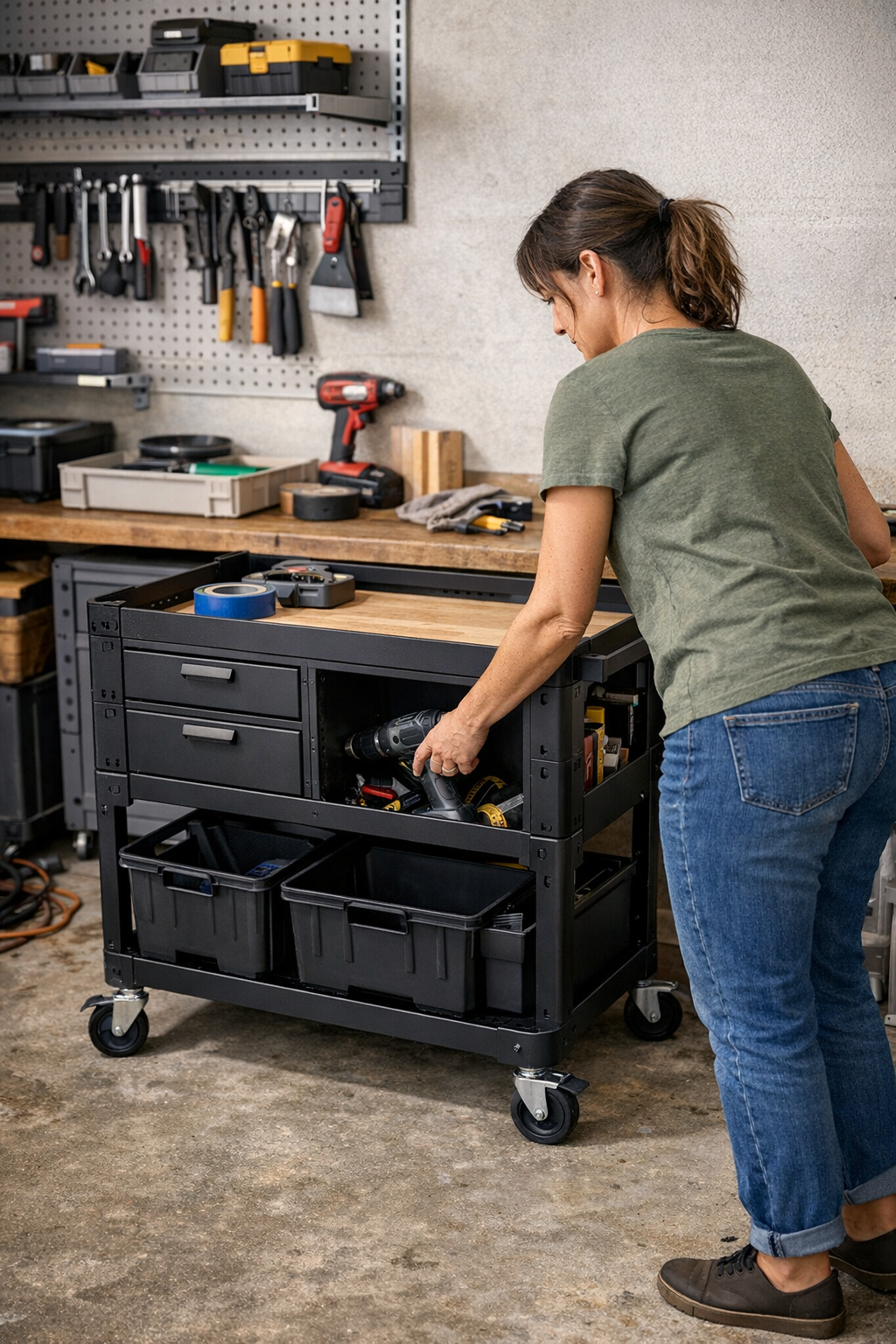
If you’ve ever shared a garage or workshop, you know the letdown after a fresh reset. The floor is wide open, shelves are flawless, tools line up like they’re posing. But the promise of order dissolves fast. Within days, the setup that once looked so right begins to slide under pressure: carts drift into new pathways, wall racks go ignored, and clutter zones emerge where the design left no margin. The hope for “once-and-done” organization butts heads with everyday habits—and by the second or third round of real work, the difference between a tidy Monday and a functional Friday is painful enough to slow you down.
Micro-Movements: Where Friction Hides
The real enemy isn’t just clutter—it’s wasted steps and awkward workarounds. Every scramble for a misplaced driver, every trip from bench to wall for the right wrench, costs a little time and a little patience. At first, wall-mounted rails seem like the gold standard: immaculate, visible, floor untouched. But if the wall isn’t at arm’s reach, those “few extra steps” multiply. By the middle of any busy week, benches sprout their own layer of tools. Repeated use exposes every weak link: unplanned footpaths, cart bottlenecks, dead corners overflowing with stuff that’s got nowhere to go.
Suddenly every routine reveals the cracks—nudging carts aside just to get through the aisle, grazing a cabinet door that never quite stays closed, or inching past corners where overflow piles up. Even when the space looks “organized,” daily movement gets pinched and the area loses its rhythm.
How Each Storage Setup Performs Under Real Pressure
Wall-Mounted Racks: Everything Shown, Nothing Truly Handy
Wall racks make it possible to see every tool—but rapidly expose weaknesses in real-world use. If they aren’t mounted within arm’s reach of your main work zone, they become another detour. Add more people to the mix and tools get waylaid: left on the bench “just for now,” only to stick there all week. The system relies on everyone’s memory of exactly where each item lives. After a few quick jobs, the wall display is out of sync with real needs, and suddenly there’s a drift—three hammers at the vise, empty prongs on the wall, and no one remembers who left what where.
Floor Cabinets: Out of Sight, Out of Flow
Floor cabinets hide mess but often slow things down. The lure of a closed door soon gives way to drawers packed unevenly and front shelves piled with whatever was in your hands at quitting time. Smaller gear migrates to whichever spot is easiest—not where it’s supposed to go. Soon enough, the thing you need is buried behind three other jobs’ leftovers. All that containment can turn into a time sink: quick resets get slower, and clutter just shifts from view to view.
Mobile Carts: Flexible Helpers, If You Keep Them Anchored
Rolling carts and tool trolleys offer flexibility—until they become wanderers. For the first project, bringing everything to the workstation feels efficient. But carts drift; someone wheels one out of the way, then leaves it blocking a key pathway or too close to a bench. Without a clear “home base,” the cart becomes a catch-all: loose bits, stray tape, tools waiting to go back but never quite making the trip. Instead of smoothing workflow, carts become speed bumps—footprints in the wrong spot, shelving that starts collecting overflow rather than helping clear it.
Breakdown Moments: Where the System Stalls
Most storage systems fail not in theory, but in the rhythms between projects. It’s the “just for now” moments—a tool left out during a fast fix, a shelf filled with half-done work, a cart hijacked for something else and never returned to its spot. If three people share the space, watch what piles up by Friday: hammers and drivers stacked on a bench, carts drifting from dock to dock, cabinets packed at odd angles. The intended order gets replaced by micro-stashes and drop zones, making every reset another round of hunting, stacking, and reshuffling.
These breakdowns aren’t dramatic. They’re silent—but they require constant small workarounds, and over time, the space simply doesn’t flow. You keep bumping the same cabinet edge every day, or slide a cart aside for the third time in one morning.
No More “Afterthought” Return Zones
The setups that hold together don’t just store tools; they make put-away frictionless. The quiet productivity hack: carve out a clear “return zone” near where work actually happens. Not permanent storage—just a short cart shelf or a marked bay for live returns. In one three-person shop, reserving even a foot of cart space for drop-offs changed the pace entirely: benches stayed usable, random piles shrank, and resets became second nature. The key is obviousness: you don’t have to think about where the just-used wrench goes. It’s easier to return it right away than to drop it just anywhere.
One Adjustment, Real Flow
Something as simple as parking the cart parallel to the main bench—never blocking the aisle, always close at hand—kept resets quick and eliminated the shuffle. Instead of stepping over wayward carts or dragging shelving back and forth, everyone stayed in motion. The layout stopped fighting your routine and started working for it.
Make Setup Fit the Work—Not Just the Room
The best system helps the space work the way people actually use it. Wall racks work only when the route to them is never a detour. Carts are assets when they’re anchored and always include a visible return bay. Cabinets, unless strictly managed, hide mess but slow you down and conceal overflow. The setups that survive real use don’t just store tools—they protect movement paths, prevent dead zones, and resist the slow creep of clutter into corners and aisles.
If your shop is constantly rerouting paths, losing track of small parts, or shifting the same cart again and again, it’s not the gear—it’s the way the storage collides with reality. The most effective tweaks are practical: keep benches clear, pathways open, and return zones where they’re actually used. The difference: by Friday, you’re still moving free—no ongoing rearrangement, no tool hunts, just a shop that holds up to the work, not just the first reset.
Find practical storage solutions for real-world use at StackNest.