
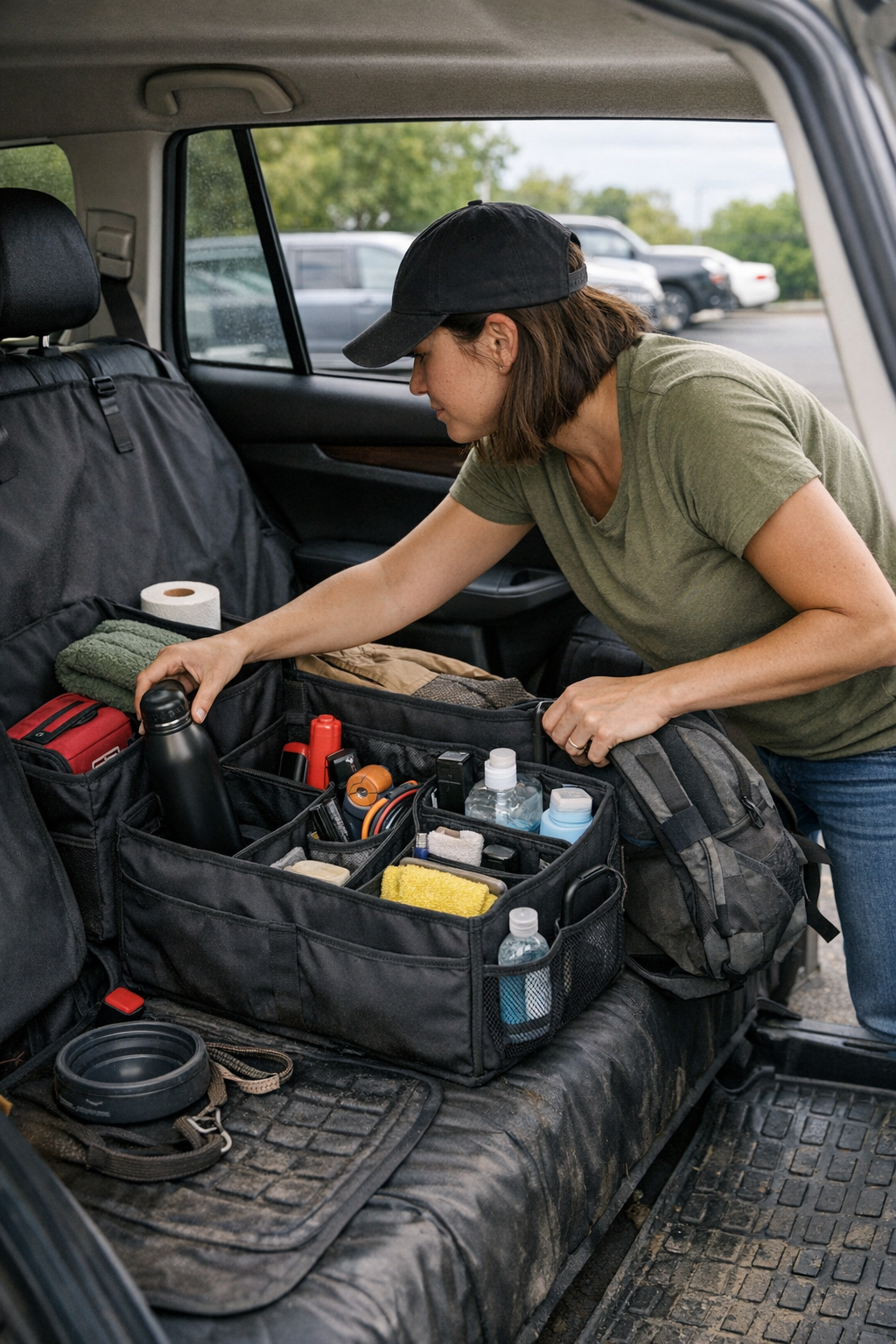
You know your car’s “clean” setup is failing the moment you reach for your charger, phone, or sanitizer—and your hand lands on empty plastic, tangled cords, or a bottle that’s somehow migrated away from its spot. The floor looks neat, but every grab becomes a small hassle. The real frustration of car organization isn’t a visible mess—it’s the seconds lost fumbling for essentials that should be ready at hand, especially when you’re in a rush to re-enter, load, or get moving again. On paper, your interior might show order. In daily use, those split-second delays multiply: the phone slides behind the seat after one corner, chargers coil around the cupholder, or keys drift under a footwell tote. Every extra second spent digging, tugging, or kneeling yanks you out of rhythm and saps the payoff of that “organized” look. If a setup can’t keep pace with repeated, rushed routines, “tidy” is just friction with a cover on it.
When Orderly Looks Still Mean Awkward Reach
Most car organization hacks focus on hiding things: stashing clutter in bins, threading cables through pockets, parking your gear in deep compartments. Visually, it works—until the first busy errand loop. You walk back after a quick stop, expecting flow: in, out, toss, grab, repeat. Instead, a bag has drifted into the console space, cables have twisted themselves out of reach, and your phone sits somewhere weirdly behind your seat instead of in its intended spot.
“Orderly” setups tend to fail in routine motion. After even a fast grocery stop, you’re fishing for your wallet in a sliding bag, or kneeling to recover a charger that slipped beneath the edge. The surface stays neat, but your access gets more awkward, posture shifts, focus breaks. Stack in school pickups or baggage shuffles, and every re-entry becomes a quick scan for where things have escaped to this time. The setup doesn’t collapse, but it never quite cooperates with your actual flow.
Hidden Friction in Repeated Use
Every “little” inconvenience—digging for your phone, untangling a cable, having to move a bag to reach sanitizer—might fade into the background on its own. But day after day, the cost builds up. A design that keeps your charger one drawer deeper for tidiness, or routes your cables under seats to banish clutter, soon reveals its weak points. You notice it most in:
- Back-to-back errands, where reaching for essentials means encountering something shifted or blocked nearly every time you park.
- Coming back after school, work, or a pet run—when sanitizer, sunglasses, and receipts have all found ways to pile into the same tight spot you need first.
- Quick departures, when what should be an instant grab becomes a five-second lunge because sanitizer is hidden behind another bag, or your cable’s suddenly gone limp and tangled.
After each trip, some items return to the wrong places. You end up spending more time than expected on repeated micro-cleanups—just to keep what should be “fixed” in place. An organizer that looked promising now asks for a daily reset just to maintain that controlled appearance. Visual calm, but practical drag.
The Loop of Fixing and Re-Fixing
You adjust: stash chargers deeper, corral loose gear in door pockets, coil wires, pack away the messy-looking lanyards. It removes surface clutter, but every access takes longer. The routine shifts from “grab and go” to “unwrap, uncoil, extract, reposition.” You end up crouched beside the seat fishing out sanitizer for the third day in a row, or tugging a cord around the seat base because it always escapes with motion. What hides mess now builds in more steps, turning each drive into a slow-motion fix-up—proof that surface neatness, without matching real access habits, bakes friction right back into your week.
Spotting the Clues: Your Setup is Slowing You Down
Look for these unmistakable signals:
- Repeat “search and rescue” grabs. If you move something else to reach the same item twice a week, your setup is collecting friction.
- Frequently used gear journeys out of reach. Phones, keys, sanitizer, or toll tags that shift after routine stops are clearly missing a fixed anchor or tray—and a bin won’t fix what keeps moving.
- Organizers look right—until used. Closed bins or hidden pockets stay neat only if you rarely touch them. If every school run or errand means opening, digging, or resetting, you’re losing time where it matters most: everyday access, not storage display.
These aren’t just tiny delays. They chip away at focus and add tension—turning driving into a repeating obstacle course of item retrieval and reorganization instead of straightforward motion.
Making Small Shifts for a Major Difference
The difference between a setup that actually works and one that just looks “done” is ruthless practicality. The best car layouts give essentials a fixed, fast-access point that stands up to repeated jostling and hurried routines. Example: Skip burying your charger in a closed console—use a shallow tray so cables take a simple, direct path, always in easy reach, never balled up or buried. Mount your phone where it’s stable and “findable” after rough braking or sharp turns—staying visible and ready, call after call, with zero drift.
Give sanitizer and keys permanent homes—a door tray, or a slim organizer locked between the seats—and quit rerouting your own reach dozens of times a week. Even moving a cable from a tangling gap to a fixed guide cuts down the invisible chore of repeated untangling. The point isn’t a sleeker look—it’s killing the cycle of small slowdowns so your routines finally fit your car instead of fighting it.
From “Looks Good” to “Works Every Time”
Success isn’t a pretty finish. It’s an interior you can actually use—single-motion reach, secure essentials, access that survives backseat chaos, fast parking, and real-world hurry. If every routine errand means slowing down to dig, open, reset, or rescue gear, your “order” is working against you. True improvement means open trays for frequent-grab gear, cable guides that keep reach instant, and organizers that stay stable—so car time is just drive and go, not constant management.
The visible difference: A setup aligned with real use—open organizers where you need them, cable anchors where reach doesn’t snag, trays that stay put—shrinks cleanup, restores habits, and lets your car work with you instead of demanding attention in every stop-and-go.
Want car organization that lasts beyond the first clean-out? See practical gear built for real driving routines at DriveWellSupply.