
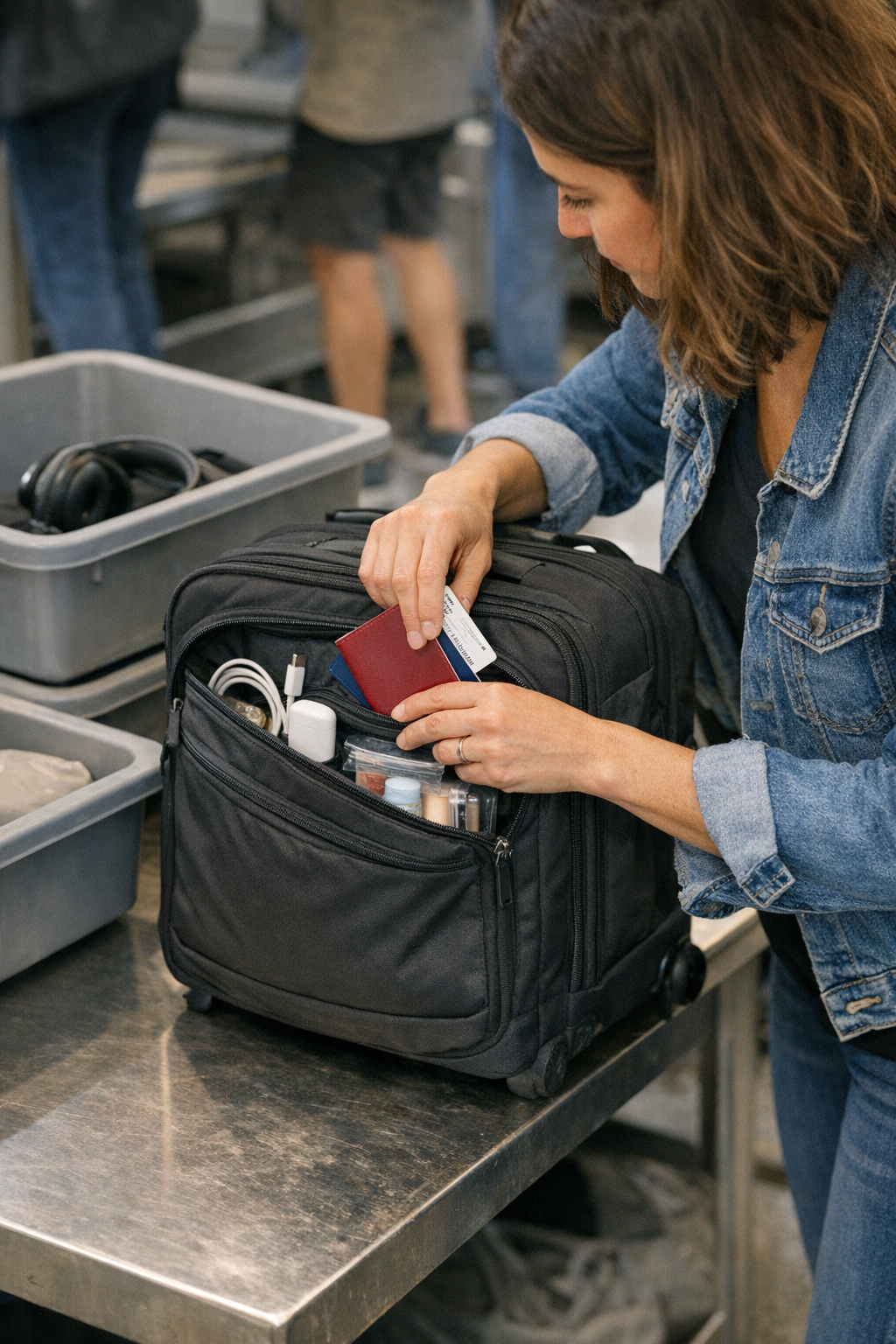
The “perfectly organized” carry-on can fail you at exactly the wrong time. At home or in your hotel room, every pocket and pouch seems ideal—everything zipped, visually quiet, feeling sorted. That illusion breaks within hours of real airport movement. The minute you rush for your boarding pass, headphones, or charger (the item you thought you made easy to find), you meet resistance: overlapping pouches, layered organizers, zip paths that jam when you’re in a hurry. What looked calm and controlled in private becomes a series of blocks as pressure builds. That’s the part that most neat-packing advice ignores.
When “neat” packing collides with real airport movement
A bag that looks excellent on a tidy floor can turn instantly frustrating in airport reality. You step into security—already in a line, bags nudging forward—and you need to pull devices and liquids fast. Suddenly, your “organized” tech pouch is under two other containers, and the single zip you’d visualized opening is now a chain reaction. Every retrieval or return means shifting a wallet, stacking a pen case somewhere, propping open a half-zipped section just to get that one cable out. Friction mounts fast, and by the time you grab what you need, your main compartment is a jumble, and people behind start shifting weight. The gap between packing pride and in-transit function is nowhere more obvious than at checkpoint trays.
The hidden cost of “too tidy” setups
Packing with layers—pouches, stacks, meticulously separated categories—promises control but rarely survives more than two or three flow interruptions. Imagine: security staff waves for “electronics out,” you go in for your charger, but it’s under toiletries, under a passport wallet. Remove, prop, balance, try not to drop anything. Moments later your earlier structure is gone; every item put back now feels less certain. Repeat this process for gate checks and sudden document verifications, and the “ideal” setup reveals itself as a slow-motion obstacle course.
Repeated tension at the wrong time
The first time it happens, you shrug it off. By the fourth, each small retrieval (passport, phone, earphones) is a hassle—awkwardly stacked in your palm, bag refusing to close, movement bottlenecked in the aisle. Every repetition is a micro delay that adds up over a long trip: slower through lines, more stressed during repack, always a nagging sense that your cool setup can’t keep up once you’re moving for real. Travel drag isn’t theoretical; it’s a slow erosion you feel in every repeated access moment.
The tipping point: When access beats aesthetics
Carry-on performance gets exposed in motion, not in the first satisfied glance after packing. A setup can look pristine, but if it blocks you in three separate steps every time you need something, it’s hurting you. The root friction? Organizer overload. Popular packing advice pushes stacking, nesting, maximizing every interior wall. But “perfect visual order” turns obsolete the minute you need speed, reach, or single-handed retrieval. When airport routines repeat, the difference stops being subtle—it’s what slows you down, or lets you move on.
Why repeated use exposes packing weaknesses
The decline sneaks up: a bag that survived the hotel lobby falls short at each checkpoint. Tightly nested pouches, deep dividers—smart at first—become a gridlock as you hunt for that same cable, document, or pill bottle over and over. Every time you set the bag down, the retrieval gets slower. The system that felt “done” at packing gets messier and less dependable with use, not more.
The most common friction point: essentials—documents, chargers, headphones—buried under layers instead of placed up front. The smoothness you expected at packing becomes repeated interruptions, just when your attention is split between lines, trays, and crowds. The difference isn’t minor. It’s the pinch you feel at the worst possible moment, reminding you that calm-looking doesn’t mean efficiently usable.
Security trays and boarding lines: The real-world test
No setup hides in a security line. Guards bark for electronics, trays fill, and now you’re juggling two pouches, a document holder, and a half-zipped main compartment—all on display, under a time crunch. Even a rationally-packed bag can fail here if essentials aren’t “grab and go” accessible; fighting with layers or blocked pockets creates drag for you and everyone within arm’s reach. The day’s pace gets defined not by how organized your bag looks, but by how unblocked (or blocked) your movement becomes in these pressured routines.
A setup that looks right, but works wrong
The room for error is real. Bag looks smart on the bed, then doesn’t cooperate when wedged beneath a seat or hoisted above into an overhead bin. Every time you fumble for tickets, cables, or IDs, you unspool the structure you started with. That’s the memory you take from the flight—not the initial neatness, but the repeated hassle of getting what you need without the bag fighting back.
Small changes, big impact: Resetting the pocket routine
The breakthrough pattern? Single-move front-pocket access. Field-tested: high-frequency items—passport, charger, headphones, pill bottle—move to one outer pocket, strictly reserved. No more unlocking three pouches or reopening the main lid every time security, boarding, or mid-aisle motion demands speed. A simple slide along the front zipper, and you have what’s needed—minimal disruption, no impromptu restacking sessions.
This isn’t anti-organization. It’s recognizing that over-layering trades future flow for first-glance calm. The most workable carry-on setups put fast-use items in “live zones”—not buried for symmetry, but staged for retrieval. It may look a touch less curated, but in the escalation of actual travel, having reliable access is everything. The payoff shows up the moment a security tray approaches unexpectedly or the plane boards out of sequence—you grab, reset, and move, not juggle and re-pack as everyone pushes past.
Real-life movement: The difference you feel
Try picturing an airport transfer: you close the overhead, race down the concourse, get flagged for a random ID check. With essentials staged up front, you don’t break your stride: one pocket, one motion, it’s done. Without that, you’re by the seating area, unzipping, unstacking, trying to keep inserts from dropping. The difference in stress and time is small per access—but becomes the key advantage the more cycles you repeat in three terminals, two checkpoints, and a return journey.
What to avoid: Packing traps in repeat use
- Too many nested pouches: Every extra pouch means another round of searching and shuffling—retrieval turns into a multi-step routine.
- Hiding essentials for appearance’s sake: When go-to items are placed deep for “clean lines,” finding them just creates more chaos when under pressure.
- Wasting outer pockets on overflow: Resist stuffing these with leftovers; reserve them for crucial, fastest-turnover gear and nothing else.
The urge to keep things visually flawless runs deep—but travel doesn’t reward it. The setups that survive repeated security and boarding aren’t the ones that hold their tidy look, but the ones that reduce the cycle time and stress for every new check, scan, or sudden repack. In the end, order that interrupts you is just another drag. Make your bag hand control back to you, not just give you a surface-level sense of calm.
Explore practical, tested carry-on tools and organizers designed for real travel movement at CarryOnSupply.