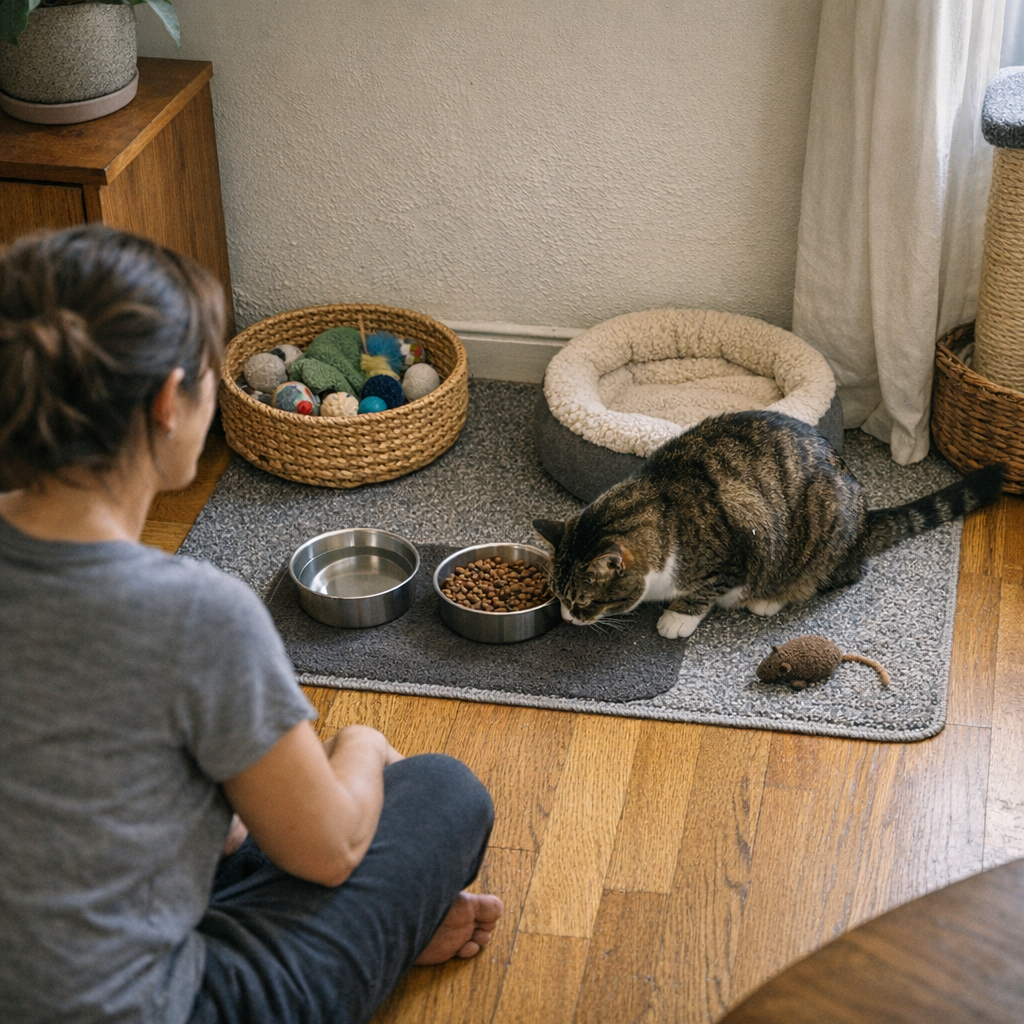
What actually slows down indoor-cat living isn’t cat hair or obvious mess—it’s the small shifts that keep breaking your routine. Reaching for the coffee maker, you find a tipped bowl edging into the kitchen, forcing a detour. Crossing the hall, a rest mat bunches against your ankle for the third time this week. Toys scatter past their bin, bedding drifts into walkways, and water puddles linger where you least expect. It’s not one big disaster—it’s a string of tiny slowdowns that never fully reset. The surface is clean, but the setup keeps undermining your day.
Where Cat Supplies Start—and How They End Up Everywhere
Setting up for an indoor cat usually means careful placement: bowls hugged to a corner, a mat neat underfoot, toys binned by the wall, maybe the bed tucked for easy napping. But order dissolves under real use. Water bowls wander, nudged off mats by a paw that doesn’t care about your boundaries. Toys break free, rolling behind chair legs you’ll curse later. Even bedding slides along the floor, blocking your path just when you’re balancing a full laundry basket. What looks tidy one hour becomes a reminder: the arrangement isn’t holding if every reset turns into another round of reshuffling, sweeping, and correcting what’s just slipped out of place.
This isn’t only about visible pet mess—it’s about how cat supplies creep into your everyday routine. Bowls, toys, and mats don’t respect the line between “cat zone” and “human walkway.” You find yourself nudging bowls aside to clean, stooping to fish toys from hard-to-reach corners, or detouring around bedding that’s encroached on your living space. Even effective-looking storage falls apart when items migrate across invisible borders, disrupting your day in dozens of micro-moments you rarely plan for, but always have to fix.
A Surface Tidy Isn’t Enough
Apparent order doesn’t last. By midday, the careful setup is visibly unraveling: food bowls inch off mats after each meal, water spills where a rug edge now curls, and toys form a widening arc between play space and walkway. “Cleanup” fixes the look, but not the flow. Even if you restack and reorganize, daily motion—yours and your cat’s—sends things adrift again, pushing you into an endless loop of minor resets that quietly add up to a bigger drain than the occasional deep clean.
The Repeated Reset Loop
The friction is everywhere. Grabbing the broom? There’s a toy jammed so deep in the bristles that you stop, dig it out, and lose your momentum. Refilling water? The bowl isn’t where you left it, and the mat has folded into the threshold, delaying a simple task. Night comes, and the bedding that started in the corner is now an obstacle between you and sleep. Even after weekend “overhauls,” these annoyances return—so the claimed tidy zone stays in constant flux, missing any sense of lasting fix.
The Hidden Cost: Disrupted Living Flow
Every overlap between cat setup and daily living costs something. Bowls edge into the food-prep zone, so you clear a path with one hand while managing ingredients with the other. Water dishes scoot ever closer to the fridge, leaving puddles exactly where you step out for coffee. Grooming supplies, optimistically stored beside bedding, inevitably wander, breaking up quick wipe-downs into a scavenger hunt. The result? Shared space boundaries fail, so routines jam up: reaching, readjusting, and negotiating with cat gear from breakfast rush to bedtime drag—all while never quite feeling at ease in your own space.
The breakdown shows up by late morning: toys gathered like obstacles under the coffee table, kibble scattered far from its intended zone, a mat wedged open in high-traffic walkway. The place isn’t a disaster, but friction lingers—resetting, bending, and checking that repeat annoyances haven’t spread further. No single cleanup handles it for long. Space that was meant to be “calm and ready” is always halfway undone.
The Core Fix: Establishing a Real Boundary
A physical boundary isn’t a decorating tip—it’s a practical shield. Marking a clear edge for cat items—whether you use a sturdy mat, a tray with a low lip, or a furniture-aligned corner—gives both you and your cat a visible, repeatable rule. “This side is for cat gear; nothing drifts beyond this line, no matter how the day goes.” Now, when something crosses, you spot it at a glance—no more wondering what’s off. The standard is automatic and binary, so regretful negotiation (should I fix it now or later?) fades for both sides.
Making Boundaries Work in Daily Use
Effective boundaries stop the creep. A weighted tray ensures bowls can’t skate across the floor. Mounting toy bins tight against a corner makes their reset location obvious and stable. Rest mats anchored to a seam or baseboard highlight immediately if bedding gets out of place—it’s visible and easily corrected during routine passes, not left for a “big fix” much later. Instead of letting hidden mess build up, a physical edge curbs it before it spreads, cutting down the number of moves, detours, and second glances you have to invest all day long.
Containment isn’t the full story—it’s about making the return loop frictionless. Visible boundaries mean you address out-of-bounds items now, not hours later. After meals, everything cycles back inside the edge, so spilled kibble doesn’t travel into walkways. Toy bins return to their anchored spot, so strays don’t linger out in open paths. Over time, this routine runs on autopilot: toys spotted instantly and returned, water bowls unshifted, bedding back in its zone before it interrupts a rush to the door.
The Difference After a Week—And Why It Stays That Way
Brief, direct resets preserve your space. Instead of fighting through scattered buildup every weekend, you reroute items as part of daily movements—after a meal, on the way to work, during an evening straightening. Setting the expectation with physical lines makes these adjustments automatic, taking seconds to handle and barely registering as separate chores. The result? Less time on hands-and-knees, less frustration in high-traffic moments, and a routine that stays tight without constant worry or hunting for missing pieces.
Real structure accepts that mats will flip or toys will escape—but every slip is now obvious and quick to remedy. Setup gets easier to maintain: bowls sit tight, bedding doesn’t block the hallway, and toys don’t become invisible tripping hazards. Instead of masking minor chaos, a clear boundary cuts down the time and stress needed to keep living spaces usable.
Scenes from an Ordinary Day: Where Setup Makes Life Easier (or Doesn’t)
Refill, Return, and Reset in Real Time
Morning feeding: The bowl is where you actually left it—anchored by the mat’s rim, not edging into open space. Refilling becomes a pause, not an obstacle course; there’s no mystery puddle to mop up before making your own breakfast.
Water change midafternoon: Because the water bowl sits firm inside a defined tray, the area’s dry and the mat lines up as expected. Any shift is visible, so a quick adjustment resets the whole setup, not just the bowl.
After-play wipe-down: Grooming tools, wipes, and small accessories stay grouped instead of scattering with every burst of activity. You reach once—no frantic scavenging through shifted piles or stray bedding—so cleanup finishes while the moment still matters.
Evening reset: Scan, correct, done. The visible boundary makes out-of-place supplies obvious, so nothing gets left until frustration forces action. Five seconds spent means one less annoyance tomorrow.
Small Frustrations Removed, Room by Room
Keeping boundaries visible changes shared space routines. The kitchen is for cooking, not hunting for rogue toys underfoot. Hallways become passable, not tangled with bedding. Litter-adjacent areas avoid the slow spread of tracked debris, since mats and trays contain what the cat brings out. You stop dreading the “what did I miss this time?” issue—spot checks actually work, instead of revealing new errands. Cats settle too, because predictable zones support their routines instead of forcing another nap interruption for a last-minute cleanup.
What Makes a Boundary Work—And When It Breaks Down
Not every boundary holds in real life. Mats that slide, loosely defined “cat areas,” and decorative solutions quickly blur or get overrun after days of normal cleaning and movement. When edges aren’t visible and tangible, you’re resetting again—and frustration seeps in unnoticed. Solutions that survive real use are those that stand out (visually and physically), hold their position, and leave little room for daily drift. It doesn’t take weeks to feel the shift: once boundaries are set, you spend less effort and reclaim your space—but the only way it sticks is by reinforcing, not hinting, at where things should—and shouldn’t—go.
Find the structures that fit your routine and hold up against daily cat logic—not