
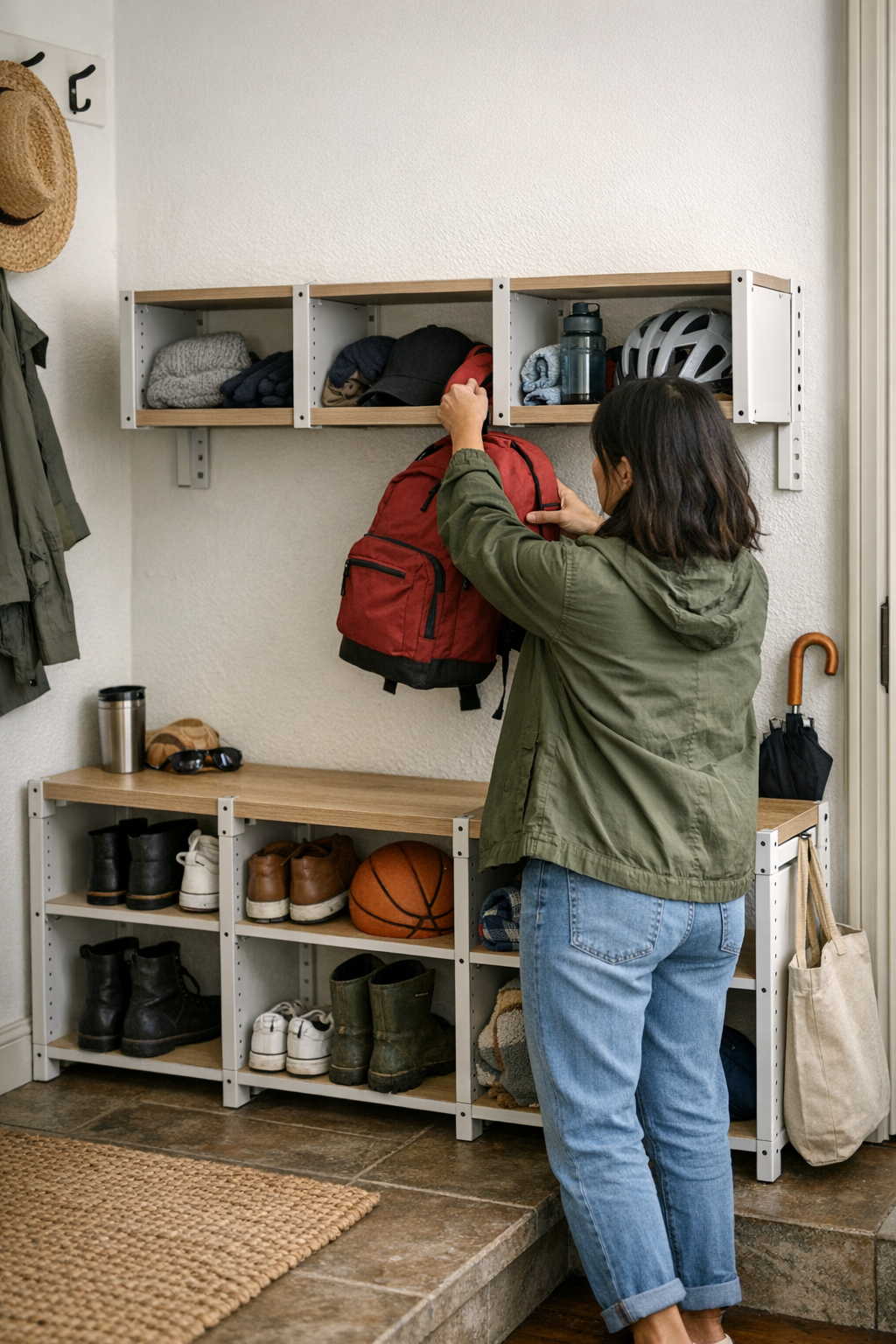
If your entryway looks organized in the morning but collapses by evening, you’re seeing the real cost of mismatched storage—not lack of effort. Shoes start aligned; backpacks and jackets disappear into bins, but by the end of the day, the edge of the zone sprawls with gear that’s slipped out of rotation. Pathways get narrower, temporary piles turn permanent, and what seemed like “good organization” becomes a slow-motion clog that resets itself every time daily life comes through the door. The problem isn’t just mess—it’s the gap between how people move and where storage actually fits along the threshold.
When Storage Slows You Down Instead of Speeding You Up
You try to kick off boots and drop bags when you come in—but actually using the arranged storage means bending, pulling out bins, or shifting yesterday’s pile just to reach what you need. The smallest logjam—mail dropped on the bench, gloves tossed by the door—blocks everyone else, and daily gear ends up shuttled to the nearest available surface. Resetting the space is no longer a five-second sweep; it’s a series of small obstacles that eat at routines. What looks tidy in a photo falls apart in use, especially during a busy re-entry with full hands or a family rush.
Blocked Flow: The Hidden Cost of Stack-Based Setups
Stacked bins and low cubbies look efficient only until people actually use them. Need something from the bottom of a stack, or sprint to return gear while others try to come in? The whole system seizes up—bins left unstacked, overflow dumped wherever there’s space, and by the third day of rain or after one after-school rush, the planned “places” are buried in layers of gear no one wants to sort. Temporary piles fill the bench, and storage on the floor becomes another obstacle to step around, not through.
The Real-World Impact: From Controlled Appearance to Daily Headache
Stack-based systems trade actual usability for theoretical capacity. They work on paper, but punish any household that creates regular churn—families, shared living, guests, routines with different start times. Actual warning signs are easy to spot:
- Bench buried under overflow: When getting into bins feels awkward, bags and hats collapse onto the nearest surface, turning the bench into off-limits storage instead of seating—until someone does a cleanup sprint that never seems to last.
- Shoe rows spill outward: With real shoes too hard to slot neatly, they cluster along the wall, stretching wider every day until the entry path squeezes to a single-person track.
- Resets drag out: Instead of a quick scan and tidy, you face mystery bins and partial stacks, each reset a puzzle where things moved and multiplied under their own steam.
- Drop zone gets hijacked: The threshold, meant for quick returns, becomes a permanent landing zone—muddy boots, backpacks, and mail sit in the last available space until you either trip on them or block the door.
Inaccessible Bins: The Clutter Multiplier
Storage that buries items might disguise clutter briefly, but can’t handle the speed or unpredictability of real-life entryways. During morning chaos, muddy drops, or guest arrivals, hidden bins slow everyone down—items stack up in new, unplanned places, and out-of-sight storage means today’s mittens get forgotten or last month’s umbrella lingers far past its use. Over time, the so-called “organized” area is just a bottleneck waiting to overflow.
Contrasting Approaches: Hidden Versus Reachable Storage
Compare two setups in actual use. One: a fortress of closed bins lined up along the wall, hiding everything but blocking access. Two: open shelf cubbies or wall-mounted compartments at the same height as the bench, each slot visible as you pass by. Both look calm before the first muddy day. The difference emerges when you try to live with them.
Scenario 1: Bin Stack Breakdown
After a rainy practice, a child tries shoving wet cleats into a bin at the bottom of the stack—can’t reach it, gives up, and leaves them leaning against the wall. A backpack slides out across the floor; to make space, you move yesterday’s pile onto the seat. Guests stepping in do a double-take, unsure where to put their things. By Sunday, the original bin system looks untouched except for the growing heap it can’t contain.
Scenario 2: Open Cubbies Make Returns Easy
Now, every bag and shoe has an open, named slot at arm’s reach. Kids can drop gear on their own; adults don’t have to hunt or unstack—one motion in, one out. Guests see the routine and follow it without instruction. The bench stays open for sitting, not as more overflow. End-of-day reset becomes a glance-and-swipe, not an archaeological dig.
Why Bench-Height Wall Storage Changes the Game
Wall-mounted storage at bench height matches how people move, not just where things go. Instead of crouching or unstacking when you’re in a hurry, you simply reach across and place or retrieve what’s needed. Each household member, even a guest, finds a spot in plain view—no blocked routes, no double handling. Wet gloves or bags don’t turn into slippery obstacles; hats have a home that isn’t the seat. The space feels less chore-bound, and clutter has fewer places to hide or gather by accident.
Less Bending, More Flow
Accessible wall units mean gear lands in its proper zone the first time. Even on hectic days, the bench stays free for sitting—a sign the overflow is under control. Tall, narrow cubbies keep gloves and headgear easy to spot but off the floor, while mobile baskets or vertical racks at the periphery stop the gradual creep of temporary piles. The entry stays clear for passing through, not negotiating bottlenecks or re-shuffling mixed bags and boots.
Tips for Making Threshold Storage Work—Not Just Look Good
- Watch the real movement flow. If bins are abandoned or resets stall, the storage isn’t fitting actual drop-and-go habits—try open slots or wall cubbies at hand level.
- Prioritize grab-and-return simplicity. Place daily shoes, bags, and jackets at standing or sitting height; deep or high bins should only hold off-season or rarely-used items.
- Optimize for five-second resets. If tidying up after normal traffic takes more than a glance and a push, reorganize to eliminate blockages and pinch points.
- Block pileups at the source. Wall-mounted compartments with dedicated slots stop “temporary” drops from sprawling across the floor and eating away at shared space.
From Clean Appearance to Working Entry: Noticing the Difference
A functional entryway isn’t measured by surface calm, but by whether daily gear lands where it should—instantly, and with minimal fuss. The right storage intercepts chaos before it spreads: shoes don’t invade the path, benches stay usable, and routines run on rails instead of resets. The real difference isn’t better hiding; it’s storage that tightly fits the way your household actually comes and goes, so clutter barely gets the chance to start.
For more practical transition-space storage options, visit Betweenry.