
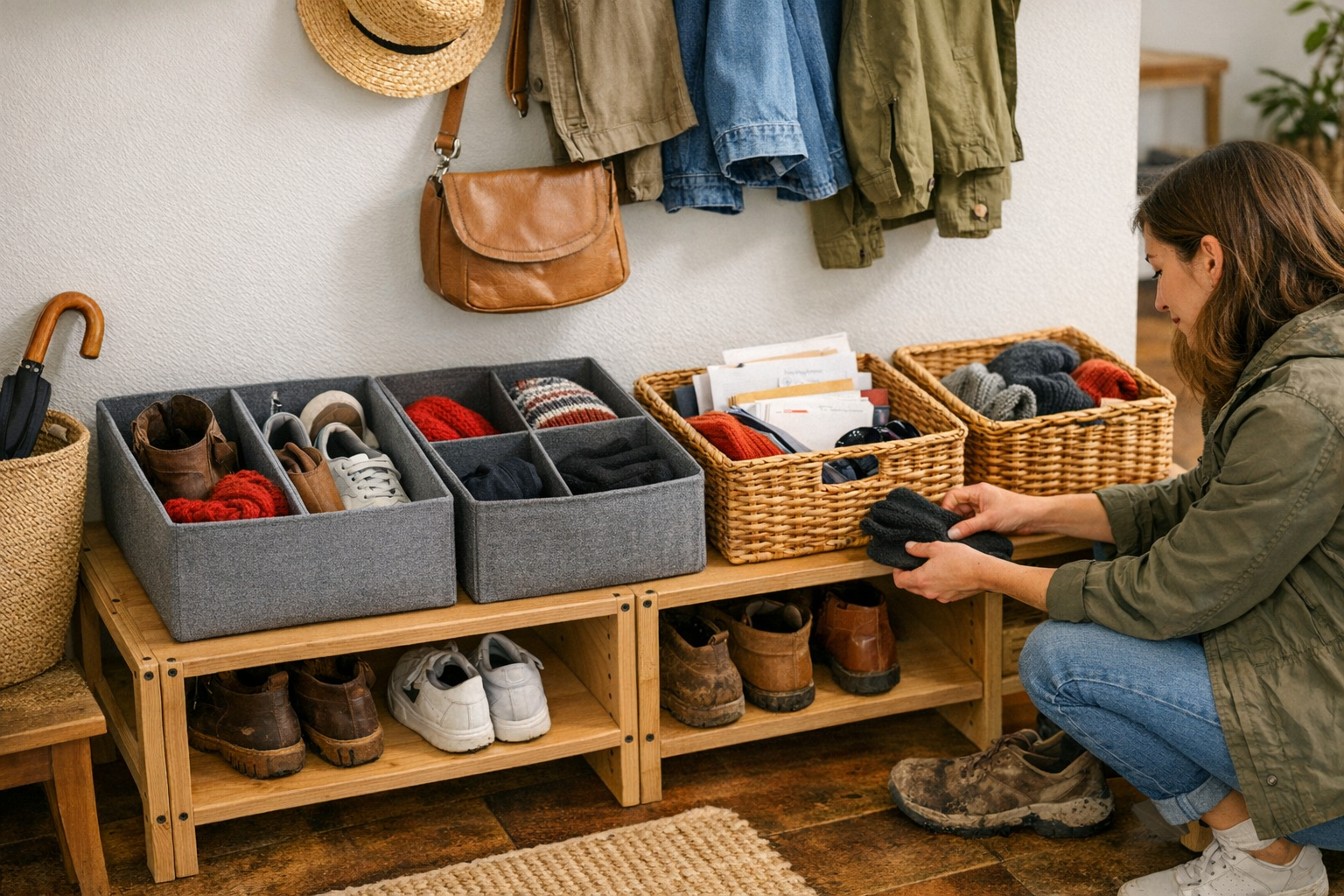
The truth about entryway storage: the right container is the difference between a reset that sticks and a system that collapses by Thursday. It’s tempting to think organization comes down to picking bins that match or baskets that look great in a photo. But step into most front halls at 6 p.m.—after the backpacks drop, the muddy sneakers scatter, keys go missing, and mail piles up—and it’s obvious: what you chose for those few feet inside the door decides whether you regain control or fight mess on repeat.
The Honeymoon Phase—And What Happens Next
Fresh bins or baskets give that satisfying “after” shot. The floor empties, gear vanishes, and the bin lids fit—at least until life reloads the entry. By day three, the system is already stressed: kids drop shoes on top of yesterday’s jacket, that hat you need tomorrow is buried two layers deep, and whatever’s in the bottom of each bin stays untouched (and possibly unseen) until you’re desperate enough to dig.
Baskets are friendlier for grabbing items on the go—but they also put clutter in full view. Scarves slip off stacks. Mail tumbles onto mittens. What began as an organized row turns into a jumble in plain sight. Bins keep chaos sealed up, but with every new “just for now” addition, visibility and order slip away. The difference between quick access and a chore comes down to what lives inside the container.
Where Organization Breaks Down
It’s not about hiding the mess. It’s about handling the mix that builds up day after day. Picture Friday morning after a busy week: you’re late, searching for your gloves. In a basket, yesterday’s bills and a tangle of headbands are in the way. In a bin, you’re fishing elbow-deep through shoes, a dog leash, and last season’s mask. Small items get swallowed by the pile—or worse, get put back anywhere space appears in the rush out the door. Each round of “fixing” ends up as shuffling, not sorting.
Most bins and baskets fail the second they become general storage. What started as a hat basket becomes home to homework packets, snack wrappers, and sunglasses. A deep bin meant for shoes ends up with lunchboxes on top, or a lone flip-flop pressed somewhere under winter boots. The result isn’t just slower access—it’s family members asking “where’s my stuff?” and putting things down one room too far from where they belong.
Why Category Separation Matters—Not Container Type
What actually works in the long run? It’s rarely the bin or basket itself, but the boundaries inside it. Dump too many unrelated items together, and you get a mixed bag whose contents only get messier with every grab. When containers separate roles—by category, family member, or routine—the system stays usable long after the initial clean-out.
Dividers change everything. Suddenly, there’s a narrow slot just for hats, a section for this season’s gloves, and a spot for each person’s shoes. One person’s muddy cleats can’t bury another’s ballet flats. No elaborate stacking or folding needed—just defined drop zones. Overstuffed bins become manageable again. In the chaos of daily comings and goings, a divider saves everyone from digging, guessing, or dumping out a pile to reset.
Real Tactics That Survive Real Life
Define Zones, Even in Small Spaces
Oversized bins and baskets lure you into one-size-fits-all thinking. But smaller, purpose-specific containers—one for hats, one for keys, a narrow one for gloves—force separation and discourage mixed piles. A bin holding “whatever’s loose” becomes unmanageable fast; containers with a focused purpose make clutter harder to hide, easier to control.
Use Dividers and Labels—even Makeshift Ones
You don’t need custom organizers. Cardboard or thin wood creates instant sections in a deep bin. A strip of tape and a black marker signal “this half is for shoes, that half for mittens.” Labels on the front of baskets or bins help everyone—from family to guests—get things back in the right spot and avoid the every-morning treasure hunt.
Don’t Settle for Out-of-Sight—Make Rules for What Goes In
Just hiding mess isn’t enough. Every bin and basket in the entryway needs a clear rule—and a limited set of roles. “One item type per container” is a real test: if you reach for a hat and pull out last week’s paperwork, the system needs tightening. When items are truly isolated, resets go fast and you spot problems before they spread into the next room.
Why Entryway Storage Decisions Echo Everywhere Else
A good storage system at the front door isn’t cosmetic. It shapes how clutter—or clarity—spreads through the entire house. If you spend every week re-sorting, backtracking for keys, or snapping at kids to find their own shoes, the likely culprit isn’t family effort—it’s a container failing to set boundaries and keep categories clear.
Switching to smaller bins, adding dividers, and labeling sections prevent constant reshuffling. Your entryway can survive changing seasons and active routines—without the rest of the house absorbing the overflow. Less time redoing the system means more hours where things stay found, and clutter actually remains at the door, not in the kitchen or living room.
Let Your Entryway Work as Hard as Your Routine
The right bins, dividers, and purposeful separation aren’t just organizing tools—they’re what keep that small square of floorspace from becoming a never-ending reset zone. Make each container earn its keep by making access simple, keeping roles clear, and isolating the mess before it multiplies. The reward isn’t a perfect photo, but a routine that moves forward, not backward, every time you open the door.
Find practical dividers, bins, and category-focused entryway storage at ClosetWorks.