
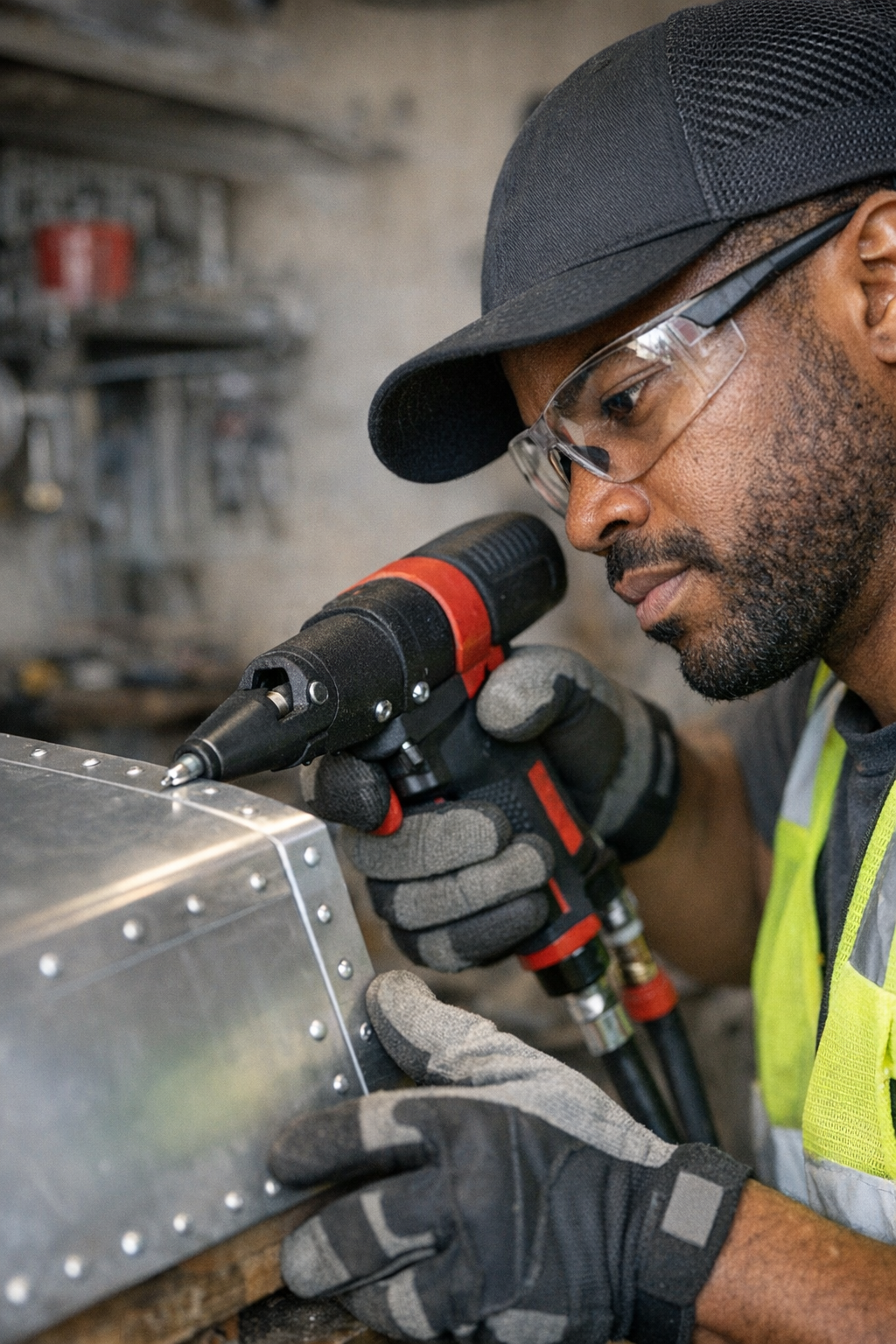
By the third row of rivets, that creeping frustration isn’t just in your forearm—it’s running along every seam you check. Misaligned rivet heads don’t scream for attention at first, but they build up fast, especially if your rivet gun is working against you instead of with you. In any real shop, getting into a flow with repetitive fastening feels effortless—at first. You’re focused, the placement looks tight, and each pop echoes progress. But as fatigue rolls in and sawdust settles on the bench lights, what starts as a small drift in alignment turns into a bigger, more stubborn mess. Suddenly, sanding and re-drilling replace forward motion. This isn’t just about putting in rivets; it’s about not having to clean up after your own tools.
How Minor Rivet Drift Turns Into Major Shop Friction
No one loses time on their first five rivets. The real trouble sneaks up over the next fifty. Back in a cluttered corner, working a long panel, you check your line and realize the seam is rough—full of bumps and tiny chips you’ll have to sand out later. Keep using a gun that hides your sightline or slips under repeated use, and you find the same story: crooked rows, uneven gaps, and unfinished business that drags out your shift. The costs aren’t just in materials—they’re in lost patience and extra runs with the sander when the job should be out the door.
Most alignment issues aren’t dramatic—they’re sneaky. The rivet head might be off by a hair, the seating just a touch crooked, that momentary wobble magnified when you’re holding a panel just-so. Hour by hour, what feels minor multiplies—until your “quick job” becomes a rework marathon.
Sightlines and Consistency: Why Some Guns Make the Grade and Others Fail the Shift
Spec sheets always promise ergonomic balance and heavy-duty credentials. But in the actual rhythm of drilling, fastening, and scrambling to finish overhead or sideways installs, it’s visibility and control that set the real winners apart. In the morning, it all feels under control—every hole lines up and every rivet sits flat. By late afternoon, your stance is off, your back aches, and the gun that seemed balanced now blocks your view just when you need clarity the most.
When the trigger sticks out too far or the nosepiece is bulky, you can’t see the rivet head seat. A glance turns into a squint. If you’re working between beams, or stretching one-handed to catch the last rivet behind a bracket, every blocked sightline adds risk of tilt or misfire. Quick fixes become new chores—undoing what should’ve taken five seconds each.
Ergonomics Aren’t Enough When the Job Gets Awkward
It’s not enough for a tool to “feel good” when you pick it up. After twenty round after round—shoulder high, upside down, in a cabinet corner—you notice whether a gun lets you see your target.That critical moment before the pop: Is the rivet flush, or is your hand guessing? Bad design blocks you at the worst second and turns a precise job into a guessing game. Less guessing means fewer ruined rivets, less dusting, and a faster move to the next phase—whether that means cutting, sanding, or loading out.
On the Floor: Small Misalignments That Dominate the Day
Mid-way through a sheet metal install, you swap between overhead and side panels. Non-dominant hand locks in a rail, main hand tries to steady the gun—but the nose is clunky, and you lose angle just as you squeeze the trigger. Six, seven placements in, and you check: several heads off mark by three, four millimeters. Now comes the extra sanding, reaming out mismatched holes, and sweeping debris into a pile that just grows as the hours pass. Every small drift feels bigger as your patience thins.
These aren’t rookie mistakes—they’re tool-induced. Each pause to correct alignment, each squat to clear metal shavings, steals momentum from the day. With the wrong gun, you don’t just lose a few seconds per rivet. You lose flow, rhythm, and the satisfaction of seeing clean rows run long and true.
The Value of Actually Seeing Every Rivet
After too many days chasing down subtle misalignments, swapping to a gun with a cutout around the die and a tapered, narrow nose changed everything. Suddenly, the seat was visible—even at weird angles, under lights, or with gloves in the way. Being able to confirm every rivet, before and after the pull, meant no more second-guessing or retracing. I adjusted my grip slightly forward for better tip control, and the drift dropped off. Seams looked crisp, jobs finished faster, and I wasn’t dragging the sander out nearly as often. Crucially, precision held steady deep into longer shifts, not just the first twenty minutes after lunch.
How Fatigue and Tool Drift Quietly Kill Productivity
All the high-torque numbers and “all metal” labels in the world don’t matter when, after three hours, your arms are tired and your line of sight is gone. That’s when rough edges, unwanted gaps, and accidental skews start piling up. If the rivet head is hard to see, or the tool vibrates with each cycle, you’ll end up fixing problems the tool created.
Patterns to watch for: Are your seams sloppier after lunch? Do errors pile up as you rush to the finish? Mistakes that multiply with fatigue are usually about visibility and control, not skill or supply. The tool is losing its edge right when you need it most.
Keeping Alignment Reliable: Practical Habits for Long Jobs
Over a long day, a few non-negotiables separate a rushed fix from a satisfying finish:
- Clear sightlines, always: Pick a slim, tapered nosepiece with enough cutaway to verify placement from your real working angle—nobody works straight-on for every rivet.
- Steady balance, all shift: A gun that resists vibration and stays balanced when you’re working flat, vertical, or at arms’ length preserves accuracy, even late in the day.
- Grip that adapts: When fatigue sets in or angles get awkward, edge your grip forward to manage tip drift and keep each pull controlled.
Don’t judge your fastening tools by the catalog spec or those first clean placements. Ask yourself: When I’m tired and rushing, how much can I actually see? How steady is my repeat motion after fifty pulls? Those details don’t just save time—they save the whole seam from extra sanding, touch-ups, and lost hours you’ll never get back.