
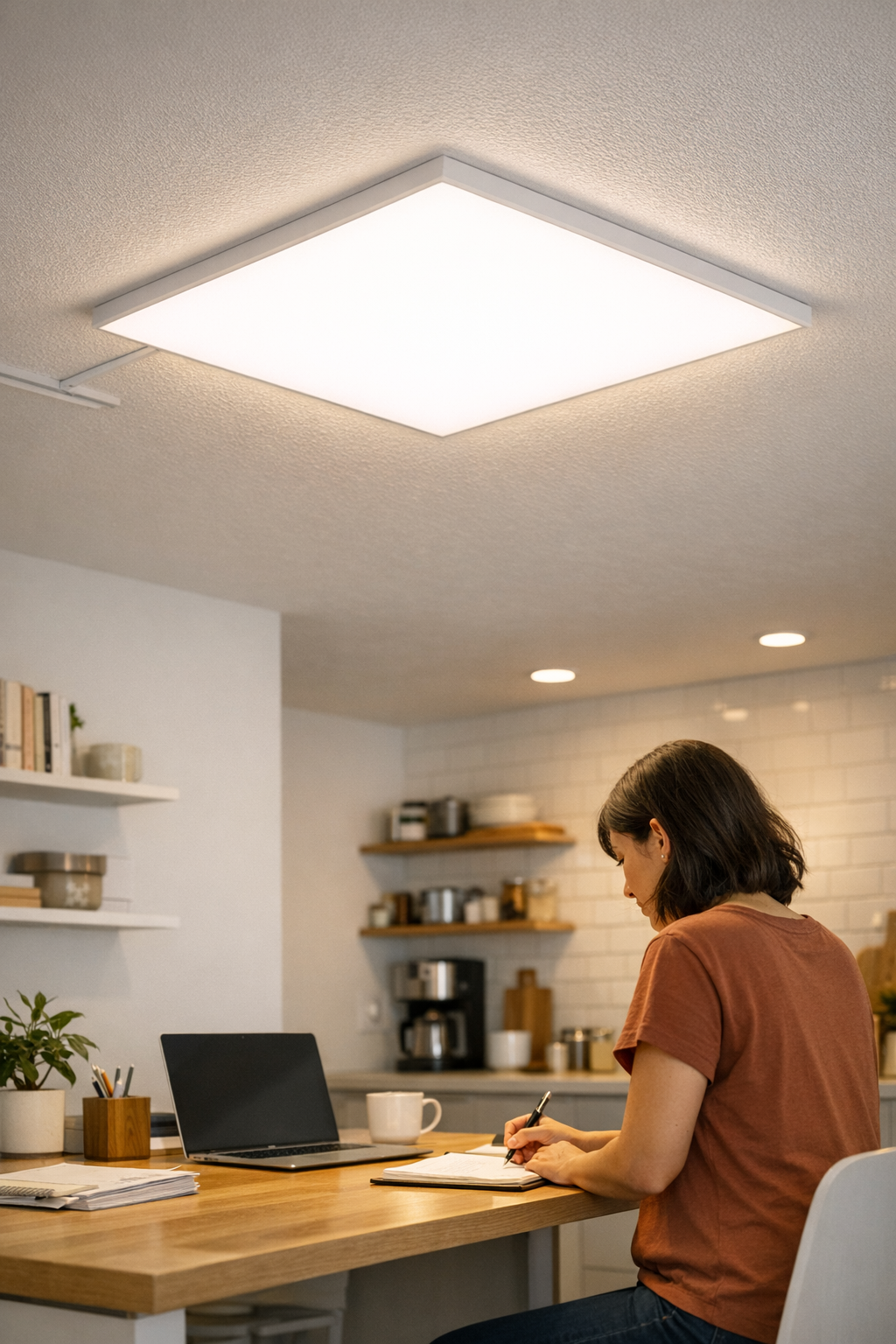
Swap out just one ceiling light above a busy desk or kitchen counter and you’ll see where the trouble starts—shadows sliding across your work, exposed cables cutting through the sightline, or an off-center bracket pushing light in the wrong direction. The real test for panel and linear ceiling lighting doesn’t start at installation; it starts after a week of real use, when small oversights become daily interruptions. If you’re deciding between a panel or linear fixture, or simply trying to anchor lighting that just won’t stay aimed where you work, surface coverage and mounting reveal their true cost fast—often at the exact spot you grab your pen, check your recipe, or nudge a laptop back into place.
Where Surface Coverage and Support Collide
Style and shape might draw your eye, but how a light actually performs above a work zone matters more after a dozen uses than it ever does in the box. Panel lights spread a broad, even flood—but the minute a cable run droops or a bracket slips, that “finished” look falls apart, and the distraction is impossible to ignore. A single missed cable clip or a low-tension mount lets gaps and wires claim attention, making the whole setup look half-resolved no matter the brightness.
Linear ceiling lights show a different flaw: they often throw crisp task light down the center, but leave the edges of desks and counters in the shadow. It’s the recurring routine—lay out a cutting board or shuffle papers, and notice the outer 20 centimeters missing usable light. Even after adjusting the lamp three times, there’s still a strip you can’t see clearly, pushing you to twist in your chair or cover the spot with your free hand.
The Experience After the First Week
The first few days, most setups pass as “done.” But over a week, true friction appears—support brackets quietly loosen and fixtures drift out of alignment, turning barely-noticed errors into new sources of glare or shadow. Cable runs that looked fine wrapped flush start sagging, dipping into view at odd angles. Shelves and work edges that seemed evenly covered now cast uneven lines, catching your focus with every reach or shift. Each adjustment feels minor until they stack up, especially if you start budgeting micro-fixes into your daily routine just to reclaim clear visibility across the whole surface.
Unpacking Real, Repeated Friction
Cable management is rarely anyone’s first concern—until it turns constant. From across the room, a fixture might look perfect. Up close, a wavy wire or a cable left exposed by a soft clip becomes the first thing you notice every time you sit down. Panel lighting is unforgiving here: even a small sag makes an otherwise clean ceiling into a restless visual obstacle course. You get intense brightness, but your attention flickers up—to cables, to slight bracket twists—not forward to the work you came to finish.
Linear lights flip the pain points. Install to avoid glare, and you’re likely to lose even coverage. Get the bracket mount off by a few centimeters and you start living with a permanent sliver of darkness along the desk edge or counter. The space is bright, but you keep repositioning your chair or shifting tools just to avoid working in half-shadow—a fix that’s physical one day, mental the next, and never really “solved.”
How Messy Details Surface in Shared Spaces
In shared or multi-use rooms, flaws get amplified. A bracket that feels rock-solid solo will rattle when someone pushes a chair away or sets a heavy bag on the table. The “minimalist” fixture transforms into another thing you monitor for droop or wobble. And every time guests comment on a visible wire or a drooped end, the intended effect—clean, functional lighting—feels undermined by one careless detail. What seemed subtle at install snowballs as routines repeat and the chores pile up.
The Small Fixes That Quiet Big Distractions
Fixing these problems rarely means starting over—it means tightening details that decide whether the setup helps or hinders. After months of rehanging a linear fixture hoping to squeeze usable light from a bad angle, the fix was simple: run the cable taut and flat inside a rigid ceiling channel the entire length, not just the final meter. With around 120 centimeters of cable redirected and clipped along a ceiling beam, the ceiling stopped drawing unwanted attention and the true working edge finally stayed lit—no rotation, no creeping shadow.
Solid bracket mounts are the other unsung hero—a small reinforcement stops the fixture from shifting with every bump or table nudge. Combined with an evenly-spread panel or a precision-aimed linear light, the setup finally works on autopilot. Quick tweaks to anchoring and cable discipline transform the light from “half-done project” to “silent partner”—there when you need it, gone from thought when you don’t.
One Useful, Underused Tip
If there’s one trick that fixes more issues than it should: “mock up” both cable lines and fixture placement with temporary tape or adjustable clips and use the area fully for several days before setting anything permanent. You’ll catch weak bracket points, unforgiving glare angles, and unavoidable cable distractions before holes go in the ceiling or anchors are set. Five minutes of fake-mounting can save five years of tiny, compounding annoyance—the kind nobody warns you about until it’s too late to move a bracket or tuck away a wire.
It’s the Routine That Reveals a Good Setup
The goal with ceiling and work lighting isn’t perfection—it’s silence. The best-mounting hardware and cable runs disappear into routine, instead of demanding attention after every homework session, kitchen rush, or shared-table project. When small weak points are ignored, gaps and cable clutter grow until they rule the space. But when those details are tuned—especially cable anchoring and bracket stability—the difference shows up every single time you sit down and realize you haven’t thought about the lighting once.
For more practical indoor-lighting solutions, mounting accessories, and support aids that survive real daily use, visit LightSupport.