
Every trade has a moment when a job stalls for one simple reason: the battery is dead. The tool’s still in your hand, the board half-cut, or your last anchor only halfway in the hole. In that half-minute pause, you realize—battery reliability isn’t just a background detail. It’s the line between a workday that flows and a morning spent scrambling for a fix.
You don’t notice battery habits when everything runs right—drill spinning clean, sander gliding smooth, drivers snapping home fastener after fastener. But months in, if runtime drops or tools choke halfway through a sheet of drywall, the real root cause usually traces back to quiet, daily lapses in charging discipline. One unthinking shortcut becomes the recurring headache that slows the whole crew.
The Hidden Cost of Bad Charging: When Power Fades Mid-Job
Battery decline creeps up. The early signs—overcharging packs, defaulting to fast charging “just this once,” or grabbing whichever charger’s closest—don’t show up on day one. It might take sixty or a hundred cycles before you see it. Suddenly your rotary hammer pulls up short on the third hole, your multi-tool sputters through only half a window cut, and swapping to your backup reveals both packs are limping.
The interruption isn’t subtle. Tools stall in the middle of drilling tapcons into concrete. The circular saw won’t finish a crosscut before bogging down. Fatigue sets in: you grip tighter, make slower passes, and fight for precision as voltage flags. Each unwanted stop means a walk back to the bench, a break in rhythm, or settling for a corded tool that puts you out of position—especially when you’re perched two stories up or buried deep in a crawlspace.
Workday Reality: Where Weak Charging Habits Show Up
Picture the scene: mid-morning in a gutted kitchen, wall cavities exposed, your compact drill chewing through studs with a fresh bit. You reach for an 18V battery that’s been left charging overnight—a habit almost everyone’s tried. It slides into place, still warm. Midway through installing boxes, power slumps. The tool loses its edge. By the next fastener, it’s dead weight in your palm—battery warm to the touch, charge evaporated.
Contrast that with a well-managed pack. You grab another battery—a pack never left to roast overnight, always unplugged at full. It’s cool, clicks home, and delivers a runtime that actually matches what the label promised on day one. Nothing awkward, no stops, just smooth drilling and cleaner holes—with less wrist fatigue fighting tool slowdown. That’s the day-to-day gap between mindless charging and small, daily attentiveness.
Smart Charging: What Actually Works on Real Jobs
It’s not complicated science—just habit. Always unplug lithium-ion batteries when they hit full. Save fast charging for emergencies, not your default. Stick with the charger that was made for your battery chemistry and voltage. That discipline—small, repeated, nearly invisible—means batteries stay cooler, deliver steadier power, and let you sand, cut, or fasten full stretches without losing control halfway through.
Shops running piles of drills, vacuums, and wood saws know how routine trumps intention. Let bad habits settle in, and even two “identical” batteries will start to drift—one suddenly struggling to hold a charge, the other still running close to spec. Heat and chronic overcharge leave lasting scars. That doesn’t just mean swapping batteries more. It means interruptions when accuracy and pace are what count most.
Timer Plugs: The Smallest Upgrade No One Regrets
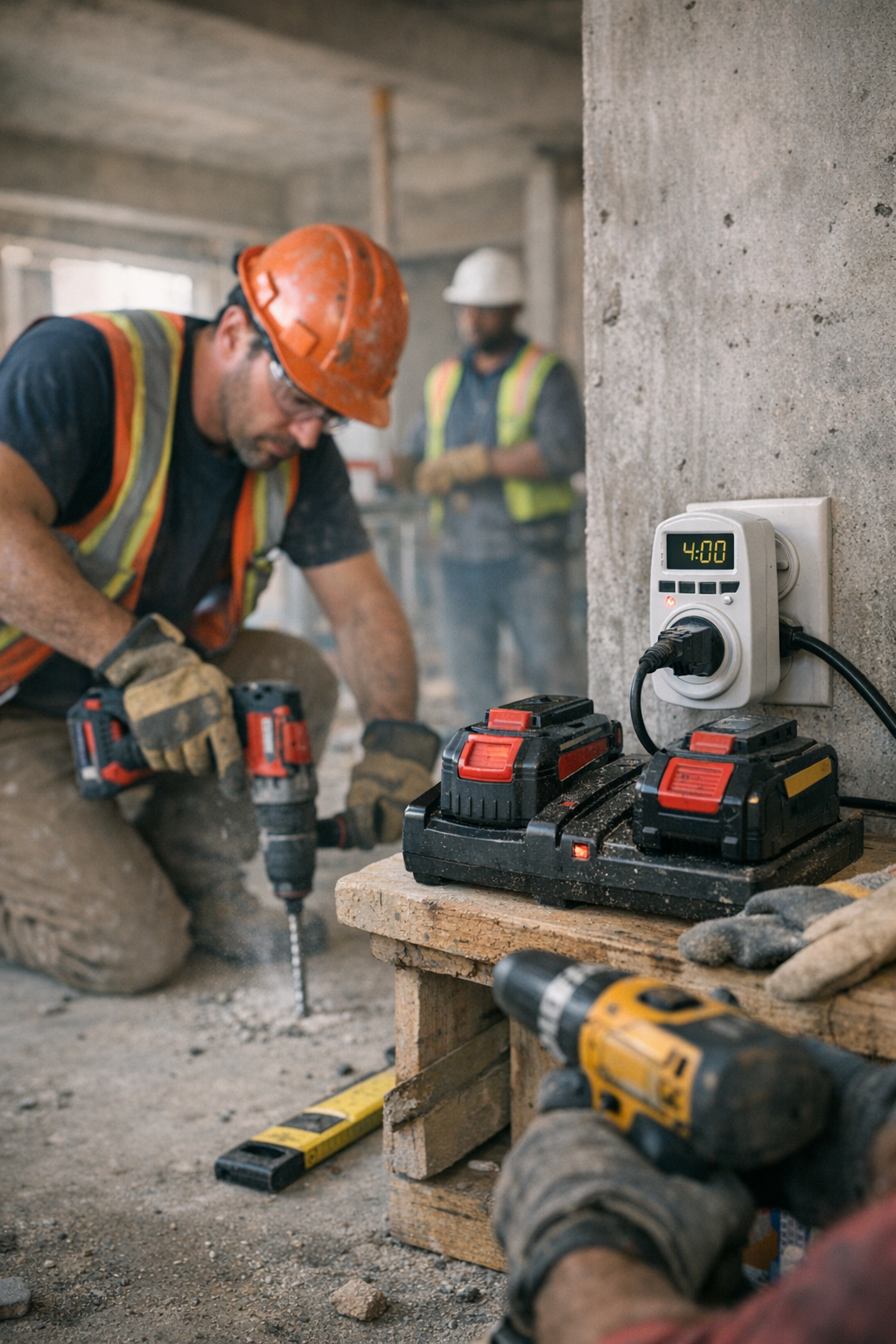
Here’s one change that sticks: plug your chargers into a timer and set it for four hours—a sweet spot for most lithium-ion tool packs. That’s how you prevent batteries from slow-cooking on charge through a weekend, or from sitting at max voltage all night after a late finish. The shift is instant: cooler packs, more predictable output, gear that goes end-to-end on most tasks without shuffling batteries or changing technique.
In our own workshop, this one tweak cut out the mid-cut “battery surprise” and meant less tool slowdown—especially on jobs where control and steady torque matter as much as speed.
Real Warning Signs: When Your Charging Routine Is Losing You Power
- Batteries overheating after charging or fading early—even through gloves—usually mean chronic overcharge or missed cool-downs.
- Unexpected tool cutouts right before the finish, or voltage sag when hammer drilling or plunge cutting, hint your packs aren’t holding up under stress.
- Job after job, runtime shrinking—particularly after leaving packs on charge all night—means your workflow is fighting itself.
- Packs swelling or no longer fitting flush are red flags of months of fast or careless charging cycles. At that point, there’s no getting the lost performance back.
No site escapes this completely. All it takes is watching one job get jammed up by dying batteries because “everyone does it this way” and the better habit starts making sense. Watch charging intervals, keep packs cool, and you’ll get more done with fewer breakdowns—not perfect, but enough to keep pace no matter where the next problem pops up.
Charging Discipline: The Invisible Edge
No battery lasts forever. But it’s the habits—how and when you charge, whether you break the cycle of convenience—that outlast the sticker on your tools. Pricey gear won’t save a careless routine. But a few disciplined charging habits outlast the tools themselves. You notice it in the quiet moments: when you’re able to complete a long rip cut in a single stretch, drill six anchor holes without voltage drop, or keep your sander running until the fine finish pass—less time scrambling, more time pushing the job ahead.
Smart charging isn’t dramatic. It’s the background work that lets you focus on skill, not just on swapping packs. That’s what keeps the real job moving—day after day, pack after pack.