
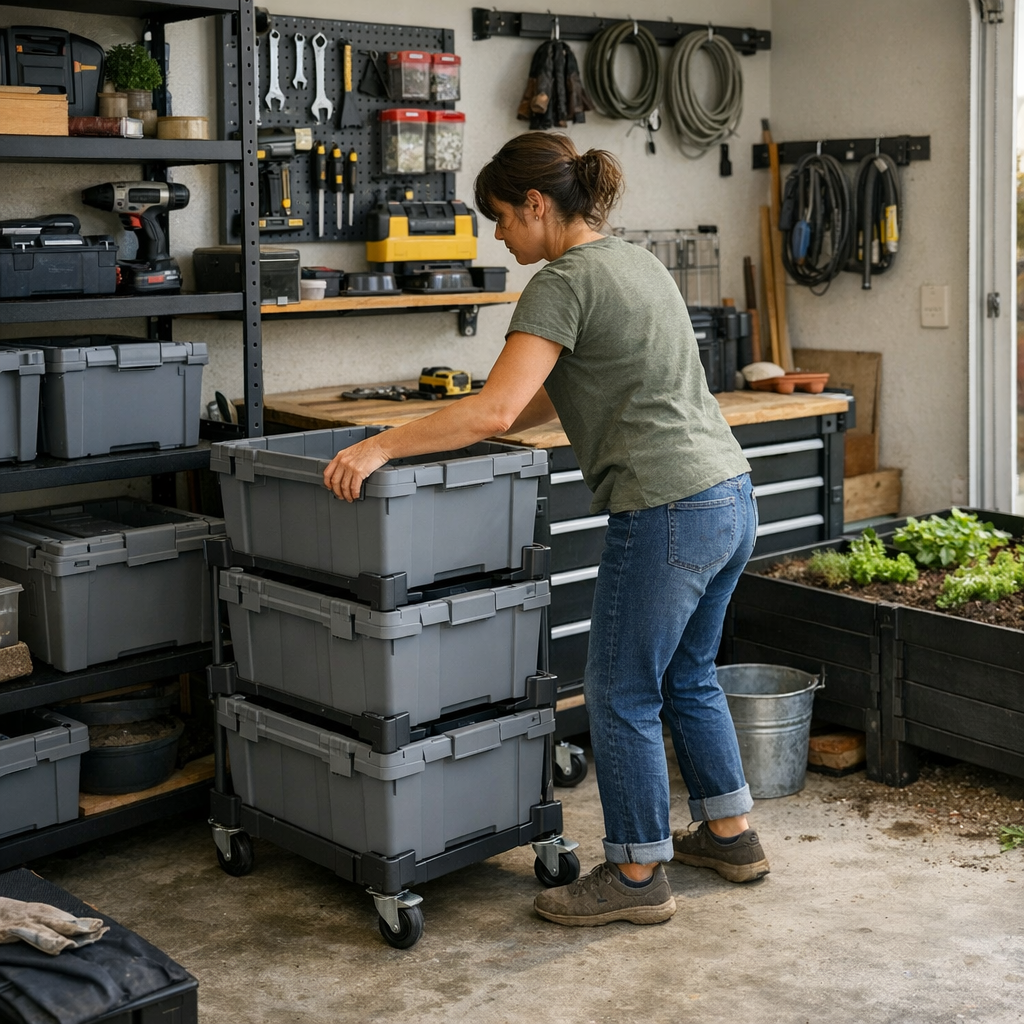
In every garage, workshop, or backyard work zone, there’s that moment of optimism: the shelves are up, bins are labeled, carts wheel smoothly, and for a day the space feels under control. But beneath the shine of a just-installed system lurks a subtle difference most people only notice over time—whether those bins, carts, and racks actually return to their spots, perfectly aligned, every single use. That’s the line between a setup you can trust to stay clear and a space that slides, week by week, back into chaos.
How “Almost Put Away” Becomes the Everyday Headache
The clutter starts quietly. At first, everything sits where it belongs—labels lined up, floors open, carts waiting for action. Then a weekend project hits. A bag of tools lands near but not quite in its slot. That rolling cart? It’s angled, not flush, so you squeeze past it each time you reach for the wall rack. A bin settles a few inches off home, trailing a small stack of overflow behind it. Doors don’t open cleanly, one corner morphs into a catch-all, and before you know it, an entire zone is devoted to whatever couldn’t quite find its way back.
True organization isn’t about the fresh, empty look on setup day. It’s about whether your system naturally resets—day after day—without you needing to think about it, even after the busiest weeks.
The Real-World Cost of Drifting Modules
Here’s what actually happens: Saturday morning brings a series of quick-fix projects. You roll a cart out, but have to nudge a poorly parked tote or edge around where the last toolbox landed. That “five-minute tidy” becomes twenty, filled with micro-adjustments. You shift carts so cabinets open, move a bin out of the walkway, dig through a pile that should have been sorted a week ago. Each module a little off from its mark means the next action is slower and less smooth. The space starts demanding attention for the wrong reasons: not the work at hand, but the blockages, the loose ends, the missing screwdriver that went wandering when its bin drifted from the wall.
The problem isn’t clutter—it’s the system quietly unraveling because nothing reliably snaps or docks in place. A return to order starts to feel less like a quick sweep and more like solving a puzzle that never stays solved.
A Docking Point: The Backbone of a Real-World System
It sounds almost trivial, but giving every cart, bin, and rack a precise physical “home”—a dock, a stop, a mark—radically changes how the area lives day to day. The difference is instant: carts always return flush to the bench edge, bins land at the same notch on the rail, shelves aren’t left guessing where baskets go. No creeping drift, no need to explain the system to anyone borrowing your tools. Resetting the workshop is quick and mindless; clutter can’t take root because everything has a clear endpoint.
This isn’t about looking neat for its own sake. When modules dock exactly, pathways are open; you don’t have to drag carts aside to get by. The route to every shelf is clean. Walls actually serve their storage function instead of hiding overflow in awkward dead zones. And most importantly—resets stay fast, so you’re back to working (or relaxing) with little effort spent on upkeep.
Simple Anchors with a Big Impact
You don’t need costly hardware. Sometimes a block screwed to the floor, a strip of tape to line up casters, a discreet label, or a shelf lip is all it takes. The key is repeatability—no matter who’s using the space, every module returns to the same spot. It’s this small but steady discipline that separates a system that holds together from one that melts into ad-hoc shuffling and improvised piles.
When Docking Becomes Routine—and the Space Stops Fighting Back
Suddenly, you’re not pushing a cart out of the way just to reach a drawer. The bench is open. No patchwork pile blocks the door. Nothing collects in the dead corners. The floor space is bigger—not because you added square feet, but because the system lets you use every inch as intended. And when you need a tool, it hasn’t wandered off on a rolling bin halfway across the shop. Order isn’t a constant battle; it becomes automatic, even when multiple people share the space.
Watch for the signals: bins that never dock the same way, tools going missing, movement slowing down, piles collecting in “temporary” spots that become permanent. That’s not just clutter—it’s your system warning you that return flow is broken.
A Real Tip: Make the Dock Spot Obvious
Physically mark every landing point—a strip of tape on the floor, a low-profile rail, or a labeled bump stop where each cart comes to rest. Even a small tactile feedback makes a massive difference. Over time, you’ll notice less clearing up is needed, and resetting the space feels like a simple routine, not a big project—even on your busiest days.
The Subtle, Enduring Advantage of Reliable Docking
The best setups are not just clean—they’re built to hold their shape under real, repeated use. When every bin, rack, and cart has a fixed dock, the space stays fluid, resets are quick, and storage supports your routine without becoming its own source of friction. If your current system is always one shuffle away from chaos, it’s not more gear or space you need—it’s a defined return. That’s the upgrade that lifts your workspace from maintenance mode to actual utility—predictable, usable, and peaceably organized, week in and week out.
Visit StackNest for storage systems designed for real spaces and real routines.