Category: Yard & Utility

  • Why Fixed Liners in Entryway Storage Complicate Cleaning Over Time

    Why “Organized” Entryways Don’t Stay That Way

    Day one, your entryway looks under control: shoes slotted under a bench, bags tucked inside neat storage, maybe a new liner or two. But by day three, the gap between organized appearance and actual routine blows wide open. Shoes multiply and drift into the walking path, bags teeter and spread at the bench, and that “easy-clean” setup now hides tracked-in grit, pet hair, and muddy streaks just below the surface. What looked manageable at first—especially in a high-traffic or family entry—gets quickly undermined by the logistics of real daily use. Resetting order isn’t just about tidiness but about friction: how much work it actually takes to reclaim usable space while traffic keeps flowing in and out.

    How Fixed Liners Create Hidden Cleaning Headaches

    On install day, a fixed liner in your bench or storage zone feels like a game changer: everything crisply in place, covering exposed edges, ready for real life. But give it a week of shoes coming and going—soccer cleats after rain, lunch bags that leak, dropped coats, the pattern of a dog’s fur swirl underfoot—and a hidden mess builds up fast. Fixed liners don’t move; neither does the dirt they absorb. Every time you stretch to vacuum under a bin or try to catch crumbs stuck deep in the seam, you realize there’s no straightforward way to reset the area. Cleaning turns into a contortion routine around obstacles, not a simple refresh. The bench edge becomes a collection zone for damp socks, shoes edge outward, and each pass worsens the embedded mess under your so-called “clean line.”

    The struggle isn’t laziness—it’s structural. Fixed liners block full access. You wipe and vacuum what you can reach, but dust and grit pool at the seams, just beyond your stretch. After a weekend with bad weather, hitting “reset” means emptying the whole setup just to address a mess that’s hidden by default. Most postpone it, and the cycle of ignored dirt and clutter gets locked in.

    When Daily Drops Turn a Reset Into a Project

    Look closer after a busy week: kids’ shoes angle wider until the row blocks the path, backpacks slide halfway off the bench, umbrellas drip by the cabinet. Fixed liners absorb the fallout, holding onto every granule and darkening into a layer of residue just out of sight. The visual order is lost at the edges: you start stepping around piles instead of through a clear zone. Each time you mean to “fix it later,” the mess compounds, requiring a full disassembly when you finally run out of runway. The threshold zone is no longer a reset point—it’s a semi-permanent traffic jam.

    Removable Liners: The Fast Track to Clean Slates

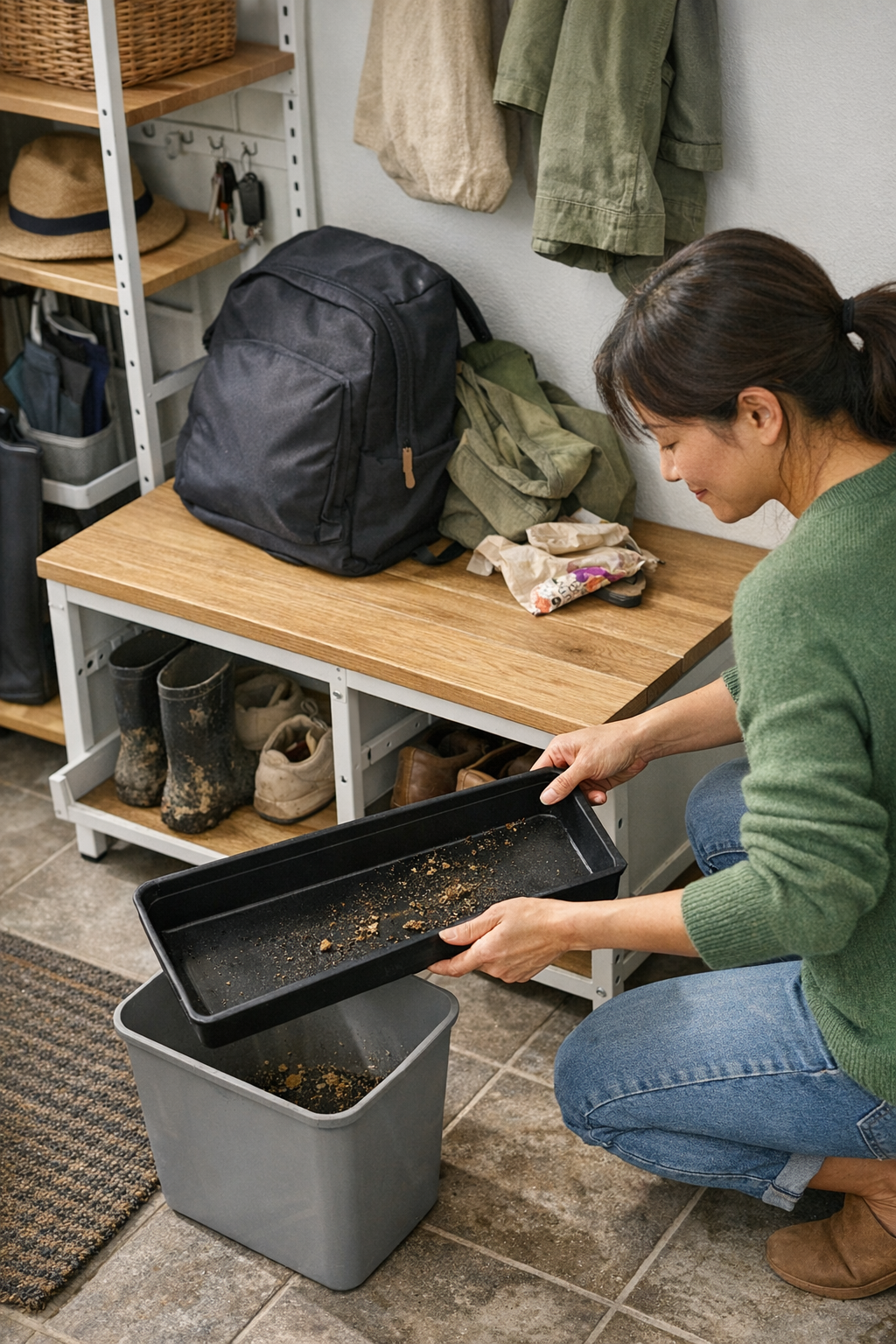
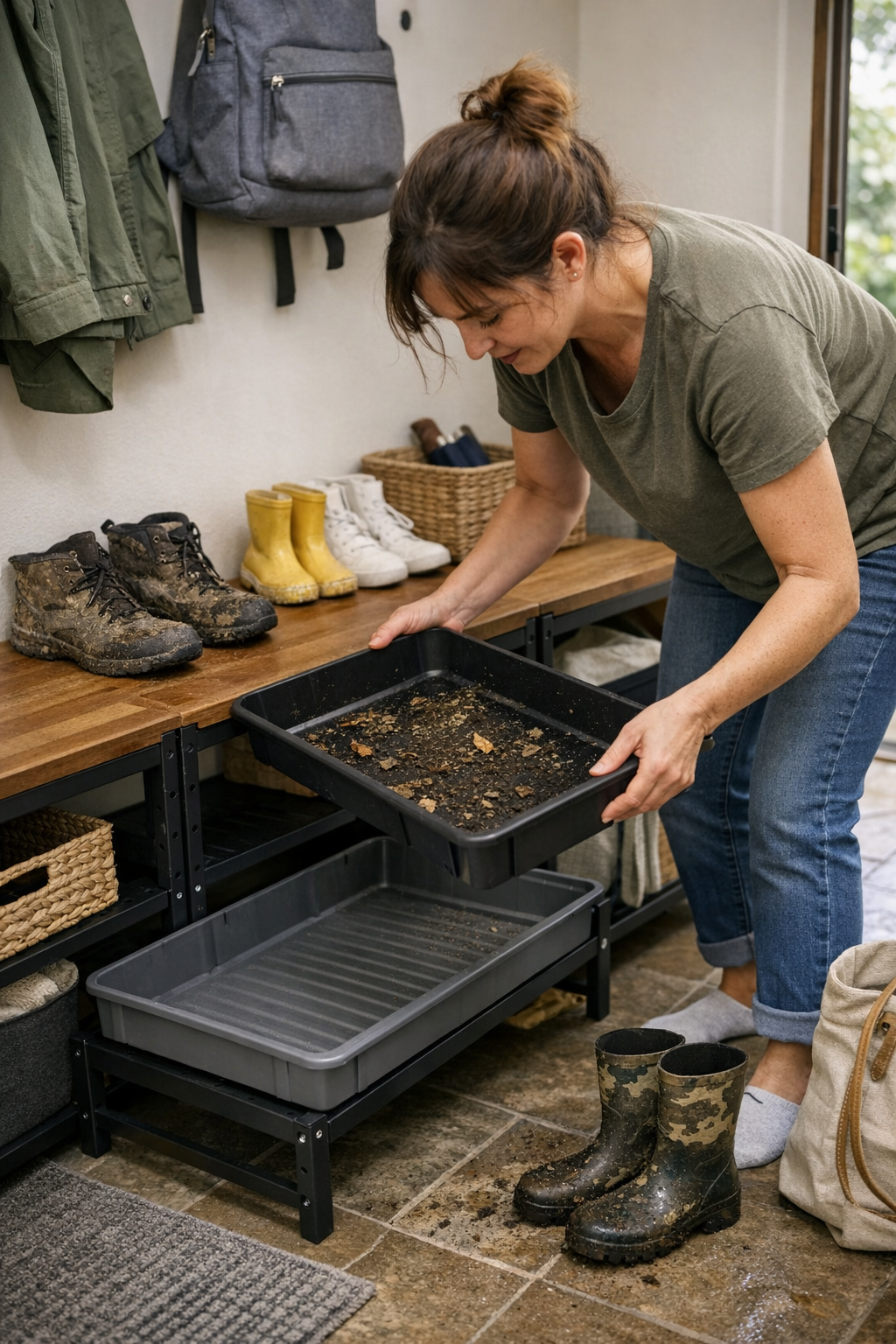
    The moment you swap in a removable tray or bin, you notice the difference isn’t about looks but speed of reset. Now, when soil or fur builds up, instead of wrestling with corners, you lift the tray or liner straight out, shake it off outside, and—if needed—quick rinse, back in. Suddenly, returning the entry to baseline becomes a two-minute break, not a looming project. Shoes can spread, traffic can spike, but the real bottleneck—awkward access—vanishes. Even one well-placed removable underlayer blocks the buildup cycle a fixed liner traps, keeping maintenance a reflex, not a chore.

    Repeated Use Beats Perfect Setups

    Display models and picture-perfect entry setups sell a promise: every shoe lined up, baskets flush, edges sharp. But once your routine kicks in—kids, pets, work gear, weekend mud—it’s the ease of reset that decides whether the area works. Removable liners match the churn of actual life. Shoe rows snake wider day by day, but cleanup doesn’t stall: snap out, shake, slot it back. No tools, no tilting heavy bins just to chase after one pebble. Restoring order becomes part of moving through the door, not an extra job left lurking until you can dedicate a whole afternoon. Reset speed and surface access become your real defense against permanent mess.

    Maintenance Gaps: Why the Wrong Setup Slows Everything Down

    Every threshold zone has a weak link—usually the spots you avoid cleaning because the setup gets in the way. Fixed liners form pockets where crumbs, leaves, and hair drift just out of reach, left to collect until the inevitable heavy reset. As shoes splay into the doorway and dropped gear claims the bench, surface cleaning barely touches what’s buried below or behind. Small inefficiencies—shuffling bags, stepping around blockers—mount up. With every skipped reset, the line between “transition space” and “overflow pile” gets harder to redraw. Real order isn’t about a one-time display but about how little effort it takes to return things to functional.

    The tell is what happens on week two: after a few storms, a couple rounds of visitors, and routine gear flow, does cleaning take seconds—or does it require moving everything and fighting the built-in barriers? Removable underlayers adapt; fixed liners make every reset harder.

    Making Fast Resets Part of the Routine

    The reality of a busy entryway is relentless: the surface cleans rarely keep up, and complicated setups just encourage delays. The only reset that actually happens regularly is the one built for shortest path—grab, lift, dump, return. Placing an extra removable tray under the outdoor boot row means you can catch heavy mud days without breaking your stride. Keeping a spare liner lets you swap when the first gets soaked—no waiting or scrubbing, just a quick exchange that keeps the space usable. With pets, a ribbed tray makes the bulk of fur a one-shake task. These aren’t tech upgrades; they’re structural concessions to how transition spaces are bombarded daily. The difference: reset doesn’t stall, and the zone stays part of the working routine instead of becoming background clutter.

    Choosing What Holds Up to Real Traffic

    If your entry sees steady flow—weather, gear, paws, and backpacks mixing at all hours—the choice between fixed and removable is really about reset friction, not just storage volume. Fixed liners deliver surface order on day one, then shift baseline maintenance into a spiral of delays and avoided chores. Removable bases break the buildup loop, restoring quick, full access so your home’s entry never has to become a permanent work zone.

    Ultimately, transition-space storage isn’t about perfection—it’s about whether you can return to clean in two steps, not ten. When reset is easy, order survives rain, soccer cleats, pet hair, and weekday rushes—making the threshold a passage, not a pileup point.
    http://www.betweenry.myshopify.com

  • Optimize Sports Gear Storage with Large Underbed Bins for Faster Retrieval

    Storing sports gear almost always looks “good enough”—until the second week of real use. You think the floor baskets or hallway hooks will hold it together, but what actually shows up is a pattern of interruptions: the missing left shoe behind a stack, the shin guard caught under a backpack, the stumble at the door as you sift through piles for gear that’s drifted away from its home. The problem isn’t just visual clutter—it’s how a weak retrieval path keeps hijacking your routine, turning what should be quick grab-and-go into repeated delays. Most setups break down not from one big mess but from five small frictions in a row.

    When “Organized” Still Slows You Down

    Shelves and baskets promise fast access at first, but gear’s natural drift takes over. Shoes stretch outside their zone. Glove pairs break up—one hiding behind a box or another family’s coat. Balls roll into corners you never intended to use, and so the “system” dissolves back into a full-room hunt. Every “reset” means rummaging through more layers, not less.

    Hooks get overloaded, baskets crowd out the walkway, and the routine grinds down: not because you don’t put things away, but because things refuse to stay sorted after just a few days of real activity. Each round gets a little slower, a little less predictable, until sorting feels pointless and retrieval always means retracing steps.

    Why Underbed Storage Changes the Routine

    A shift to underbed bins forces a real reset point, both physically and visually. Instead of open shelves absorbing new overflow and baskets turning into mini junk drawers, the bin creates a hidden but predictable zone: every piece goes back under one bed. Retrieval is single-location—either it’s there or it’s not. There’s no chase through three rooms or six drop baskets.

    That shift clears the floor for movement (and stops you tripping on a lost cleat), but the bigger win is time— you can check, reload, or return gear with one motion, not five. Still, this setup isn’t magic. If the bin fails in structure—flimsy, poorly sized—it simply hides the friction instead of removing it.

    The Common Pitfalls of Underbed Bins

    The wrong bin can sabotage the whole routine. Too shallow, and you end up shoving, folding, and compacting gear until it’s just a hidden tangle. Too deep, and the bin swallows smaller pieces—another version of the lost-item loop, only now less visible. A lid that doesn’t close means daily friction as pieces escape, and a featureless bin risks turning everything into a horizontal jumble. Instead of vertical stacks, you’re left with an endless sideways dig every time someone needs their sock or band. You still dig; now it’s just under a bed.

    Overflow Corners and the Case for Two Bins

    Overflow happens fastest with growing gear or shared family use. The “one big bin” approach invites cramming: socks vanishing under pads, balls wedged in corners, the lid always half-open as categories bleed into one another. Two bins cut the density: one for shoes and pads, the other for balls and small loose gear. Instead of emptying a giant jumble to find one mouthguard, you make one short check—and nothing rolls across the floor in the process. Dividing items also makes resets lighter and lets each bin take on a specific role, not a catch-all burden.

    Zone Dividers: Small Fix, Big Upgrade

    Internal structure inside the bin is what makes the routine stick. Even just a removable divider or soft section keeps items in place—shoes one side, pads and bands the other—so you don’t end up shaking out an unplanned mix each trip. After practice, everyone knows which pocket or section gets their gear. The scramble disappears: a five-second glance and grab replaces the ten-minute dump-and-search.

    The benefit isn’t perfection—it’s speed and fewer misses. Now you see immediately what’s missing (and what’s overdue a wash), without sitting down to upend a muddy heap. Kids can self-sort, duplicates don’t pile up, and practice starts with fewer “where is it?” moments.

    The Real Test: Can You Retrieve in Two Moves or Less?

    Storage setups reveal their value when you’re in a hurry. Can you pull and open—a single sequence—and get what you need, or do you still have to fish around for the last piece? Deep, undivided bins make it easy for pieces to vanish, especially if multiple people share the space. If categories mix, the reset cycle slows: you start seeing mix-ups, lost items, and a new round of shuffling just to cover basics.

    This isn’t just a “deep bin problem.” Oversized bins that don’t fit the underbed footprint can’t pull out cleanly. If you have to shift other furniture or lift half the bin to see inside, you lose the very gains the system should give. The right setup removes roadblocks—not just visually, but for your actual routine.

    What Works in Tight Spaces

    Rooms with low bed clearance or awkward legs typically don’t fit a one-size bin. Flexible, soft-sided options or using two slimmer, paired bins lets you split the space, avoid overfilling, and easily slide bins out even in the tightest setup. This stops bins turning into overflow zones out of necessity and keeps each return simple—no more dragging a heavy, half-stuck container out just to grab one item.

    Keeping Things Clear—Literally and Structurally

    Clear bins—or those with small windows—let you verify what’s inside immediately, breaking the “out of sight, out of mind” problem. Dividers (even color-coded, for kids) make the return flow automatic, not a guess. Instead of wondering where something was left, you see what’s missing before it becomes a crisis.

    One real-rule to prevent headaches: Dry everything fully before stashing—one damp sock in a sealed bin keeps the whole zone smelling bad for weeks, and washable liners only help so much.

    The Real Gain: Flow, Not Just Appearance

    Visual “order” can be a setup that looks good for a day but fails under pressure. The actual upgrade? A reset routine that resists breakdown over busy, unpredictable weeks. When a storage solution—divided, clear, sized to fit your room—lets you reset quickly, keeps stuff in predictable zones, and stops overflow from spreading, the space finally works with you instead of against you.

    A setup that survives five back-to-back practices and a muddy, rainwashed all-gear return is what proves itself—because any system can look calm in a photo, but daily friction is what tells you when it’s time for a change.

    Explore functional underbed storage and more at Gridry.

  • How Protecting Walkways Transforms Outdoor Storage Efficiency

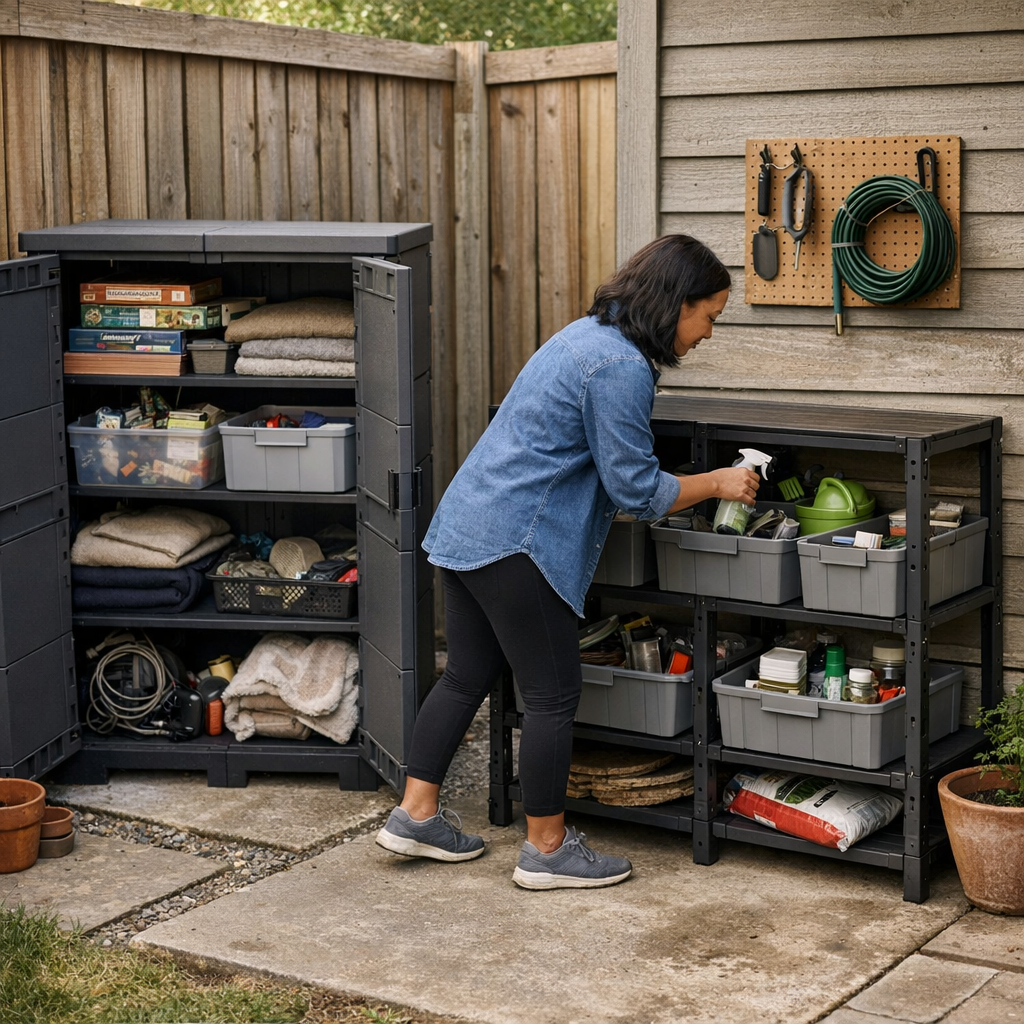
    Out in the yard, every storage decision shows up in how you move—not just how the space looks. Most outdoor storage setups start with hope: you install a trim shed, a tidy wall rack, or modular bins along the side fence, and for a moment, the disorder recedes. But then real life floods back in—garden work, trash runs, a weekend of bikes and bins—and the walk zone collapses. The route that felt “clear” on day one now demands a shoulder twist, a shuffle, or a full stop just to dodge a rake, a rogue pair of boots, or a storage unit edging too far into your path. The layout still reads as organized, but every pass through the area pulls you deeper into a slow-motion obstacle course. Eventually, the friction isn’t dramatic—it’s a buildup of hesitation, one minor interruption at a time.

    Why Footpath Space Is the First Thing to Guard

    The real trap of outdoor storage is the invisible squeeze: the path that looks wide enough until real use crowds it. All it takes is a shed edge, a freestanding shelf, or a rolling tote pushing eight inches into the walkway. Nobody grumbles at first, but soon retrieving the garden fork means skirting a hose, nudging past an awkward stack, or negotiating space with someone hauling bags behind you. What should be a one-step handoff becomes a sequence: slide this over, shift that back, step aside. It’s the same in side-yard strips and patio edges—tiny encroachments that, over several busy days, turn free movement into a slow dance of sidestepping and apologizing.

    The moment routines get even a little hectic, storage starts to leak into the path. You cut across the garage threshold during a project, drop gear in the first open spot, and by the end of the week, you’re unlocking a silent contest between what belongs in storage and what’s simply in the way. The “open” walkway dissolves into new clutter hotspots, faster than you’d expect.

    How “Organized” Storage Becomes a Bottleneck

    Even the cleanest-looking modular wall or perfectly matched bins can create trouble when they overreach the real boundaries of movement. Picture a fence lined with storage that looks streamlined—but pushes the circulation path just out of line. On a regular week, the cracks appear quickly: carry mulch sacks, steer the trash can, pass a second person with a shovel. That slim extra foot taken by storage means the main route kinks at a critical moment, so returns get messy. The rake you always reach for leans out to catch your sleeve. The wall holds your tools, but now the entry fills with scatter—seed packets, pruners, gloves—none of it in its place because the route is too tight to keep clear through daily use.

    Movement gets blocked not by lack of storage, but by the footprint that isn’t quite honest about how much passage it needs. The space looks fine on paper, but in reality the flow chokes off, and with every interrupted trip, frustrations multiply. By midweek, your “system” demands too much from anyone just trying to return a single item without causing a pileup.

    Stacking, Shifting, and the Sluggish Reset

    The stubborn giveaway of a broken setup is the quiet decay into pointless reshuffling: pausing to slide a hose so you can park the mower, wedging a bin sideways just to close the gate, or stacking gear in a clear spot thinking you’ll shift it later—which, let’s be honest, drags on for days. Wall space gets filled, but not helpfully; one awkward corner keeps pulling in overflow, becoming a “temporary” holding spot that never empties out. Even when the yard starts organized, returning things becomes fraught with minor negotiations, until suddenly reset isn’t a quick end-of-day habit but a dreaded overhaul.

    The Turning Point: Guarding Pathways Harder Than Storage Volume

    Everything changes when you treat the footpath as untouchable. Not more “decor,” not a wider cabinet, but a hard line: storage ends here. The best setups cut storage units to fit the true movement zone—wall systems pulled flush, rolling racks that can clear the line when activity ramps up, nothing crossing the path, not even “just for now.” That single rule keeps corners from becoming magnets for overflow and lets movement snap back to instinct. In real terms, this means no sidesteps with arms full, no hunting for clear floor, no losing energy to awkward shuffle routines. The storage becomes background, not a recurring part of the job.

    Even after a high-traffic weekend, the mood flips: you walk through hands-full, reset goes fast, and nobody ends up muttering about sorting out the side yard again. The difference isn’t pretty on a checklist—it’s a path that stays free without reminders, so the gear returns itself almost as quickly as it leaves.

    Visible Signs a Setup Is Working Against You

    • You have to move or tip something every time you want to step through the “clear” route.
    • Stray tools, boots, bags, or garden supplies show up in the main walk zone after each use—even though storage is “not full.”
    • Putting away one item forces you to reshuffle others or leave things half-stored just to clear space.
    • Corners accumulate extra gear for days—never truly reset, always waiting for a “later” that rarely comes.
    • Everything looks put away, but moving through the area feels slower with each passing week.

    Small Tweaks That Clear the Path for Good

    Protect the path first—even if it means scaling back storage units or narrowing a wall organizer by a few inches. In reality, a slightly smaller system that keeps every foot of walkway usable pays off daily, while spacious units that block movement will always create work. During planning, tape the path boundary and never let a unit cross it. Position rolling carts or bins so they can slip into dead space, not the main lane. After every busy stretch, walk the path: do your feet move straight through, or do you find little piles waiting for later? Adjust, clear, repeat—the goal is to make the uninterrupted walk automatic, not an exception you have to fight for.

    The easiest benchmark: if you can walk the route in the middle of the busiest week, arms full and focus elsewhere, without thinking about what you’ll have to move next, the storage is pulling its weight. That’s the difference between looking organized and living organized, and it’s where real outdoor setups finally start to hold up.

    For more practical ideas on making outdoor storage function better, visit TidyYard.

  • Effortless Removable Liners Keep Entryway Storage Clean and Organized

    Entryways show their true nature at the worst moment: when you have exactly one hand free and the threshold’s already crowded. Drop a bag at the door—watch the clear zone vanish. Line up shoes in the tray—see the row creep sideways, blocking the pull handle that’s supposed to make resets easy. The difference between an entry that bounces back daily and one that sags into mess isn’t about how pretty it looks on day one. It’s what happens on day ten, with two pairs of boots wedged deep, a tote slumped across the edge, and a liner you can’t reach without reshuffling the whole load. The real divide? Whether cleaning fits real-life movement—or becomes just another “reset” nobody wants to start.

    “Removable” in Name Only: The Hidden Hassles That Slow Down Resets

    Plenty of storage benches and drop-zone bins promise a “removable liner”—but that feature rarely survives daily routines unscathed. If pulling the liner means sliding out mud-caked shoes, prying up a wedged-in tray, or nudging aside a week’s worth of dropped bags, resets just don’t happen. Every pass-through adds another obstacle: an edge that catches, a shoe that blocks release, a drip of winter slush that dries before anyone bothers to clear it. By the third or fourth day, you’re not using the “removable” feature at all. What’s left is overflow, a clogged access lane, and a threshold that quietly fails to keep up.

    Everyday Choices That Turn Small Setups Into Big Obstacles

    Picture the after-school stack: backpacks thud down, snacks scatter, and boots overflow the liner’s intended area. It barely takes two days—one messy return, one extra delivery box wedged in—for access to get lost. That liner you meant to keep handy? Buried. The difference between a reset that takes five seconds and one that feels like a project is simple: Can you grab the liner edge, right now, without disturbing everything? A setup that lets you lift, tip, and replace with one hand actually gets used—while a buried or blocked liner lets grit collect until it becomes part of the furniture.

    The Fastest Test: What “Accessible” Really Looks Like

    If you can’t see where to pull, the liner may as well be fixed. Real access is practical, not theoretical. Look for a finger-width notch at the front, a built-in tab, or a lip that invites an easy grip—even when half the gear is still piled in. If the liner’s buried under a tightly-packed shoe row, or squeezed so tight you need two hands to free it, every reset becomes a reason to quit.

    Entryways aren’t static—activity pushes the limits every day. Shoes drift beyond the tray’s edge, wall hooks fill, and bags that were supposed to be “temporary” linger indefinitely. Once liner access is blocked for two days, new dirt lands outside the intended zone. Overflow turns the liner from a helpful feature to a neglected base plate, and you find yourself skirting the mess rather than resetting it.

    Movement, Not Perfection: What Actually Keeps the Threshold Calm

    Surface-level order at the entryway fades fast. Functional calm depends on whether reset moves fit naturally into passing routines—or pile up as irregular chores. If clearing the tray means arm-wrestling boots out of the way or shifting a bench that blocks half the door, that “reset” slides to the bottom of the weekend list. An accessible liner, pulled out in seconds, lets you slip daily dirt back outside the moment it appears—preventing slow buildup that always gets harder to undo.

    Recurring Pinch Points: What Slows Down the Entry Flow

    Wet arrivals, instant complications: Stepping inside with soaked shoes, the easy move is to drop them right at the door. But if the liner lifts smoothly, water and salt land on a surface you can empty in a swoop—no need to clear everything first. The right setup saves tomorrow’s threshold from last night’s delay.

    The bench that traps, not just seats: What looks like extra seating often doubles as a drop zone. If every new bag tossed in means covering the liner’s handle or wedging the tray in place, overflow follows fast. Soon, movement clogs; that storage solution starts creating the very bottleneck it claimed to solve.

    Shoe creep, the unrelenting spread: Today’s neat row means little tomorrow. If liner access is visible and stays open, returns are quick—grit stays in bounds, and the tray gets cleared before obstruction sets in. Hide the edge for too long, and shoes, grit, and daily spillover start attacking the rest of the entry, forcing everyone to sidestep the buildup just to get in or out.

    The Habit Hinge: When Small Features Change the Routine

    The switch isn’t dramatic—just a liner with a finger-width pull, always reachable. Suddenly, cleaning up grit is a two-second motion as you step in or out. That pull moves a reset into the time it takes to drop your bag—not the time nobody ever finds for a full entryway clear-out. In homes with staggered schedules and repeated comings-and-goings, this makes the critical difference: The threshold stays navigable, and resets never become intimidating.

    The Real Access Sweet Spot

    Perfect fit is a trap. If a liner rattles loose with every shift, it’s annoying; if it jams tight, it’s worse. You want a tray that anchors for normal use but slides free when you need it, even with ten pounds of mixed boots and stray gloves nearby. If every return home means contorting around a jammed tray or nudging a bag out of the way to find the handle, you’re not just living with minor annoyance—you’re building a routine that’s quietly unsustainable.

    Reset in Motion: Where Clean Zones Actually Last

    Entryway cleaning rotas are fiction for most households. What actually keeps a threshold under control are micro-resets every two or three days—or every time a mud wave sneaks in. An easy-access liner, visible and free to pull, means these quick clears become standard. The area stays ready for feet, bags, and short-notice guests—without the stress of a looming cleanup project hanging over every weekday. That built-in readiness means you aren’t paying back a week’s neglect in one go.

    The Real Difference: Accessibility Beats Aspirational Organization

    It isn’t about a liner that could be removed—it’s about whether you can remove it without effort, without clearing a path, and without breaking the flow of actual daily entry. The setups that work aren’t just clean; they let the threshold get dirty and cleared, again and again, before things pile into full-scale backlog. If your routine clashes with your entry storage instead of syncing with it, consider whether “removable” has become a feature in name only—and what a real upgrade might finally make possible.

    If you’re ready to make entry storage that actually fits daily life, Betweenry offers setups made for real movement—so your threshold stays clear, no matter what the day brings in.

  • Why Flat Underbed Storage Boxes Transform Gift Wrap Organization

    Every gift wrap closet promises order—until real use turns it upside down. Upright rolls might look sorted on day one, but repeated use brings mess fast: tubes topple, lighter wraps get wedged behind heavier ones, and “grab-and-go” becomes shuffle and dig. Each birthday, holiday, or last-minute rush chips away at that early neatness. Instead of quick access, you’re met by shifting stacks, loose ends underfoot, and bent paper every time you need to wrap. The tidy vertical lineup only stays tidy if you barely touch it—which defeats the point of dedicated storage in a busy home.

    Why Upright Bins Fail Under Real Pressure

    Upright bins give instant visual order. On a closet shelf, rows of tall tubes signal control—at first glance. But every retrieval destabilizes the lineup. Pull one roll and others sag into gaps or crash sideways. Return a tube, and lighter paper leans, slides, or sinks beneath heavier rolls. Within a month, straight edges degenerate into a jumble of crooked heights and pinched ends. One torn sheet signals the system’s weakness: upright bins can’t hold up to repeated rummaging and quick returns.

    Real use always pushes the limits. Need a roll from the back? You’re removing the front ones, risking scuffed edges or ripped designs along the way. Any rush—wrapping two gifts before heading out—means working against a shifting maze. You wouldn’t stack plates on edge and expect them to stay sorted. Yet upright bins expect paper tubes to behave as if they weren’t moved. Every session leaves the closet a little more scrambled, a little closer to a full reset. Even light use becomes friction: each return is an instant invitation to future clutter.

    Flat Underbed Storage: Eliminating Return Friction

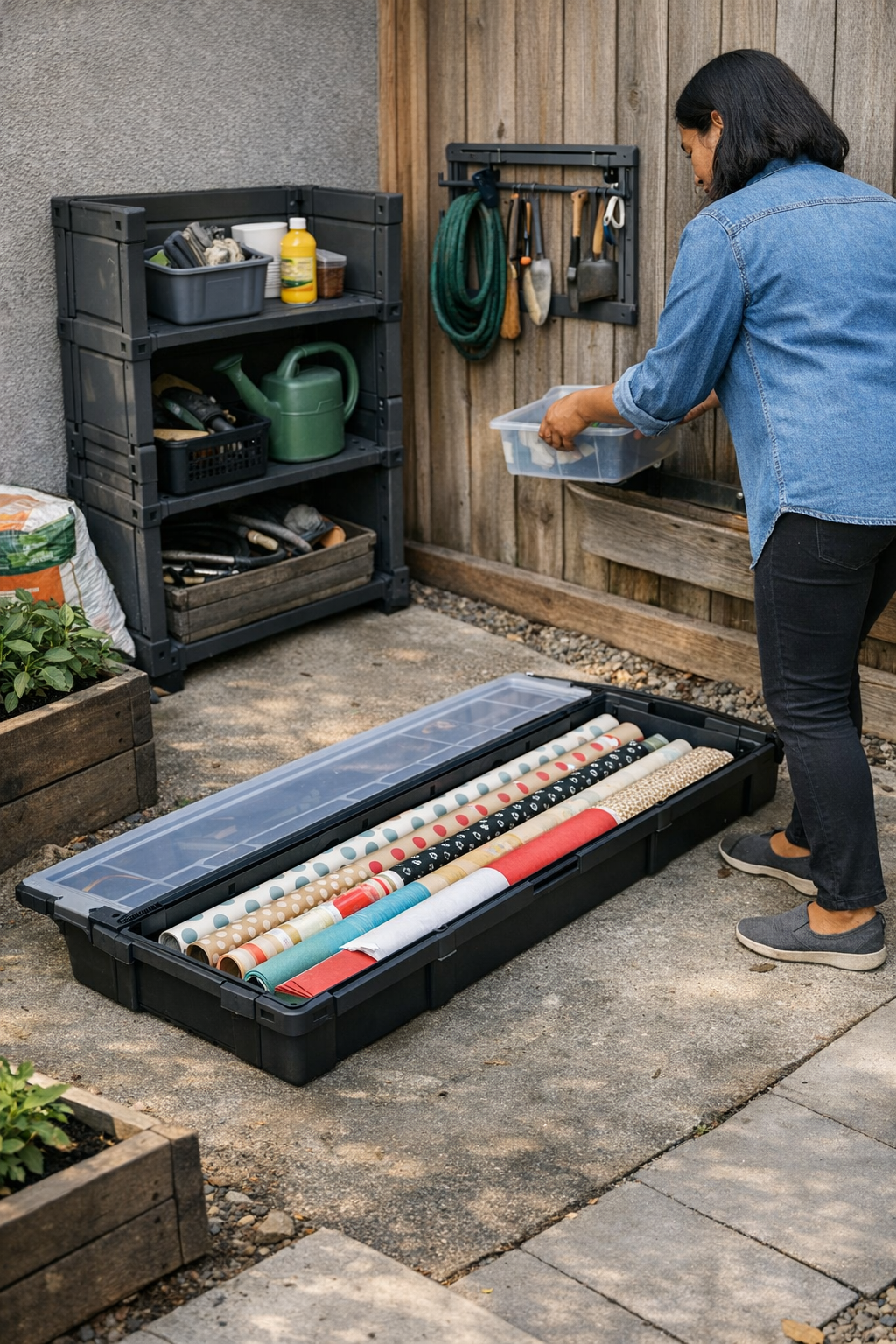
    Switching to a long, flat underbed box moves storage traffic laterally, not vertically. Instead of balancing rolls, you lay them side by side: easy viewing, zero tipping, and no weight fighting for prime position. Retrieval is direct—slide the box out, every design visible, nothing buried. There’s no forced reshuffling; rolls lie still, and paper survives unscathed. Access finally matches intention: quick, predictable, without resetting every single time.

    This setup also cuts silent waste. Edges stay crisp for months, not weeks, since the paper isn’t crammed or tugged past obstacles. You don’t have to restore order after every use. Even in holiday crunch time, the box holds its logic: grab what you need, lay it back, shut the container. Footprints stay contained under the bed instead of creeping into closet floor space or blocking walkways. Flat storage adapts to busy seasons without making “reset” its own chore category.

    Floor Space and Route Clearance

    The underbed solution comes with its own boundary: you need clear space beneath the bed, and a box that actually fits (most max out around 36 inches for wrap rolls). But the payoff is more valuable zones elsewhere. Closet shelves stay free from spills and rollovers; access paths open up. Zone discipline returns—not just visual order but real, ongoing usability for everyone in the household.

    The Real Test: Crises, Crowding, and Repeated Hands

    Nothing spotlights a system’s weakness like a rush job: reaching twice for a buried pattern, chasing a roll that rolled under shoes, pausing a busy morning to stand all the collapsed tubes upright—again. These aren’t isolated slip-ups but recurring failures baked into vertical setups. Minutes get lost smoothing bent edges or playing catch-up after each session. The breakdown becomes predictable: more users, more frequent wrapping, more mess to untangle each time.

    With a flat underbed box, the entire pattern shifts. A typical weekday: someone slides out the box, scans the lineup, picks a roll, and leaves everything else perfectly undisturbed. No domino effect, no emergency tidying. Reset happens by default. And when multiple family members share gift duty, the benefit grows: nobody has to decipher someone else’s attempts to restore vertical order. The system tolerates impatience without getting unsorted.

    Preserving Usability Amid Daily Cross-Traffic

    Left unchecked, every wrap station attracts category drift—bows tossed into the box, tape jammed between rolls, ribbons tangled with paper. If you mix everything, your “organized” solution dissolves into another bin to unload before use. Flat boxes support clarity only if you maintain category boundaries. Rolls get their box. Accessories go elsewhere: a shallow drawer, a shelf caddy, or even a tray on the wall. This split isn’t fussy; it’s structural. It makes presets possible: holiday wraps on one side, everyday patterns on another, all visible and retrievable without mixing.

    Small Adjustments for Real Storage Flow

    Prevent sideways drift with a few habits: set gift wrap sheets flat under the rolls and weigh them with cardboard so they don’t migrate. Use a quick divider—even a cut-down plastic folder—between delicate prints and heavy-duty paper. When the flat box starts to bulge, don’t squeeze in more: purge what you never reach for. The pressure of real use always shows up at the edge—so let that edge signal what belongs and what should exit.

    The Shift: From “Looks Organized” to “Refuses to Fall Apart”

    The biggest gap between upright bins and flat underbed storage isn’t just looks; it’s the difference between a system that survives being used and one that demands constant maintenance. Vertical bins present order once. In daily life, they slide toward disorder with every grab and return. Flat underbed setups focus on unbroken flow—you access, use, and reset without extra steps or secret clutter zones creeping in behind a neat facade. The box takes the hidden wear, not your schedule.

    Real improvements in storage aren’t about appearances; they’re about removing friction from the routine itself. If your system still interrupts you—forcing resets, bottlenecking access, or inviting clutter overflow—it’s camouflaging the real cost. Choose something that stays usable even when the pace picks up, family hands multiply, and the gift-giving season crowds your routine. The days of reconstructing order after each use are over—storage should solve problems, not simply delay them.

    Find more practical storage solutions for inside spaces at Gridry.

  • How Open Yard Storage Systems Prevent Clutter and Boost Usability

    It doesn’t take much to send even a “tidy” backyard sideways. One weekend of real use—rain, rushed gardening, the kids tearing outside for chalk or a soccer ball—and suddenly the clean lines of storage bins and deep cabinets start failing in small, persistent ways. The problem isn’t always the mess you came home to, but how the setup slows your return: pop a lid, dig for gloves, squeeze everything back mid-routine, realize the thing you need is behind two others. Frustration grows quietly. You pause with wet pruners at the garage step, arms full and nowhere obvious to toss them, so you drop them by the fence and tell yourself you’ll deal with it “later.” Three days and a few minor rearrangements later, that later pile is a slow-motion blockage—always in the way, never quite resolved, so next time you do the same. Setup friction wins.

    A Yard Only Works If the Flow Stays Open

    What looks organized after a once-a-season clean-out rarely holds up in daily use. Outdoor life is all about movement: returning clippers on your way in, grabbing a soccer ball as someone’s unloading groceries, dropping muddy boots without sidestepping two crates and a hose. If the system expects you to wrestle a stack just to put away a trowel, most people will default to “temporary” piles—at the garage threshold, along a fence line, wherever there’s space but not actual storage. Those corners quietly capture overflow. Walkways shrink as bins migrate outwards, and a dead zone forms where things never quite get returned, just shuffled to the edge until it’s time for another big reset.

    When “Organized” Means Unusable

    Deep cabinets and matching bins line the wall. On day one, it looks under control—everything hidden, plenty of capacity. Then, midweek, you need the rake from the bottom bin and end up hauling out two layers to get to it. That watering can you use twice a week stands in front of the cabinet, always blocking the door. Putting away garden clippers means a juggling act with three other muddied tools that landed wherever was easiest last time. The more steps between use and return, the more likely you’ll just bail out and drop things wherever you can—especially if you’re hurrying, or if someone else is squeezing down the same path. Over time, you can map the friction: the sticky corner by the patio, the bottleneck at the garage entrance, the forgotten zone behind the grill where “temporary” now means “semi-permanent.” The setup that looked right on paper now asks for too many maneuvers and delivers too little flow.

    Modular Outdoor Storage That Actually Keeps Up

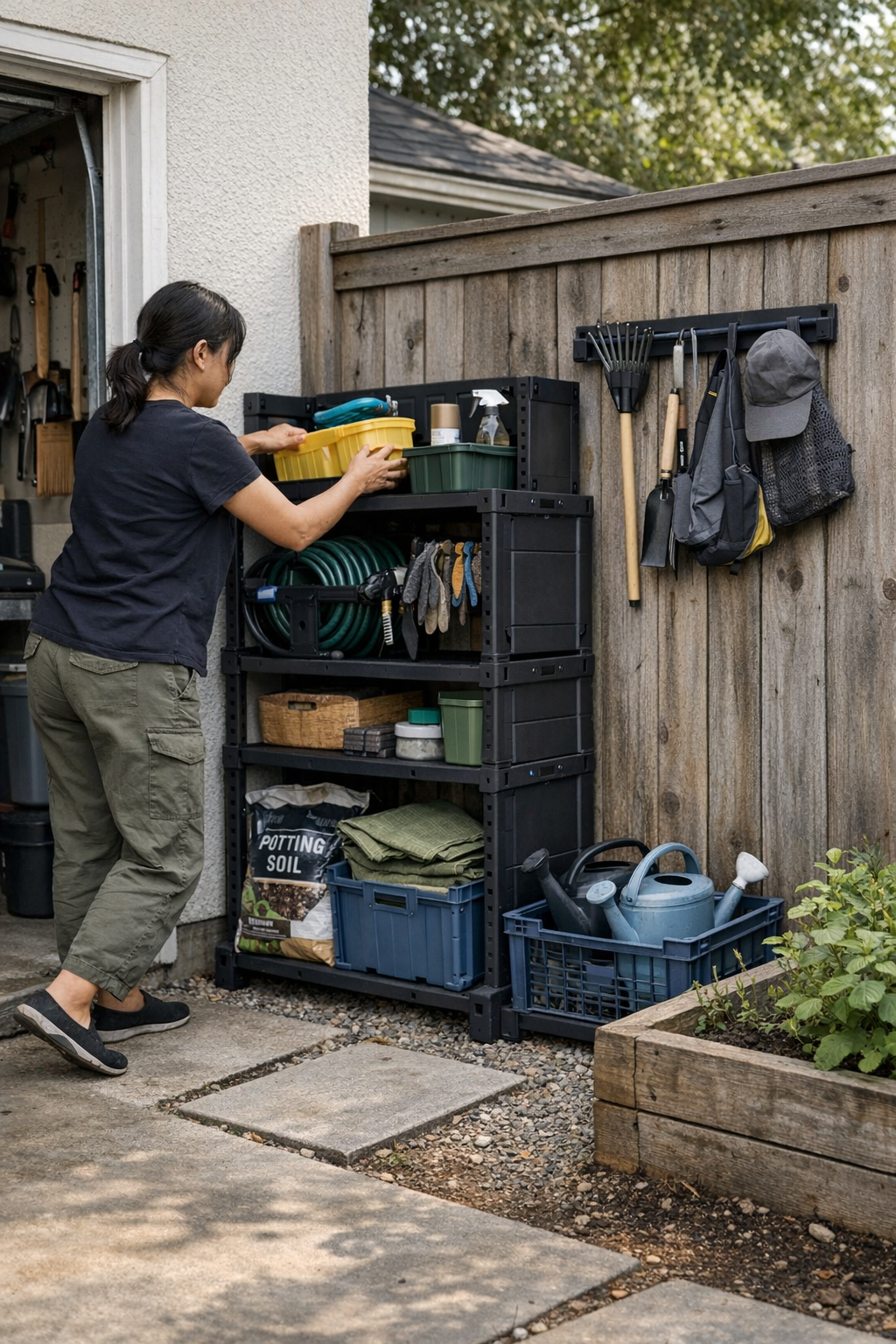
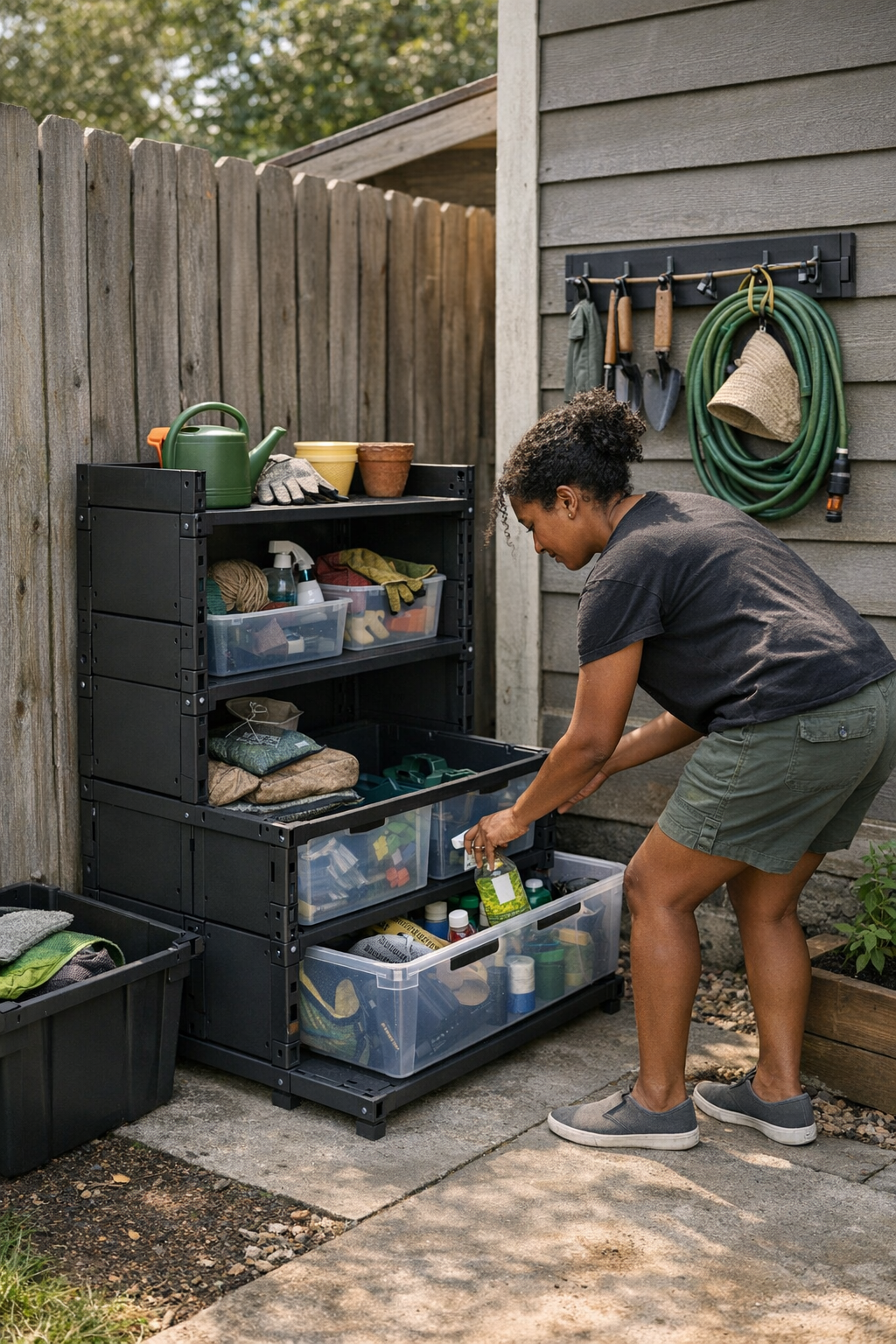
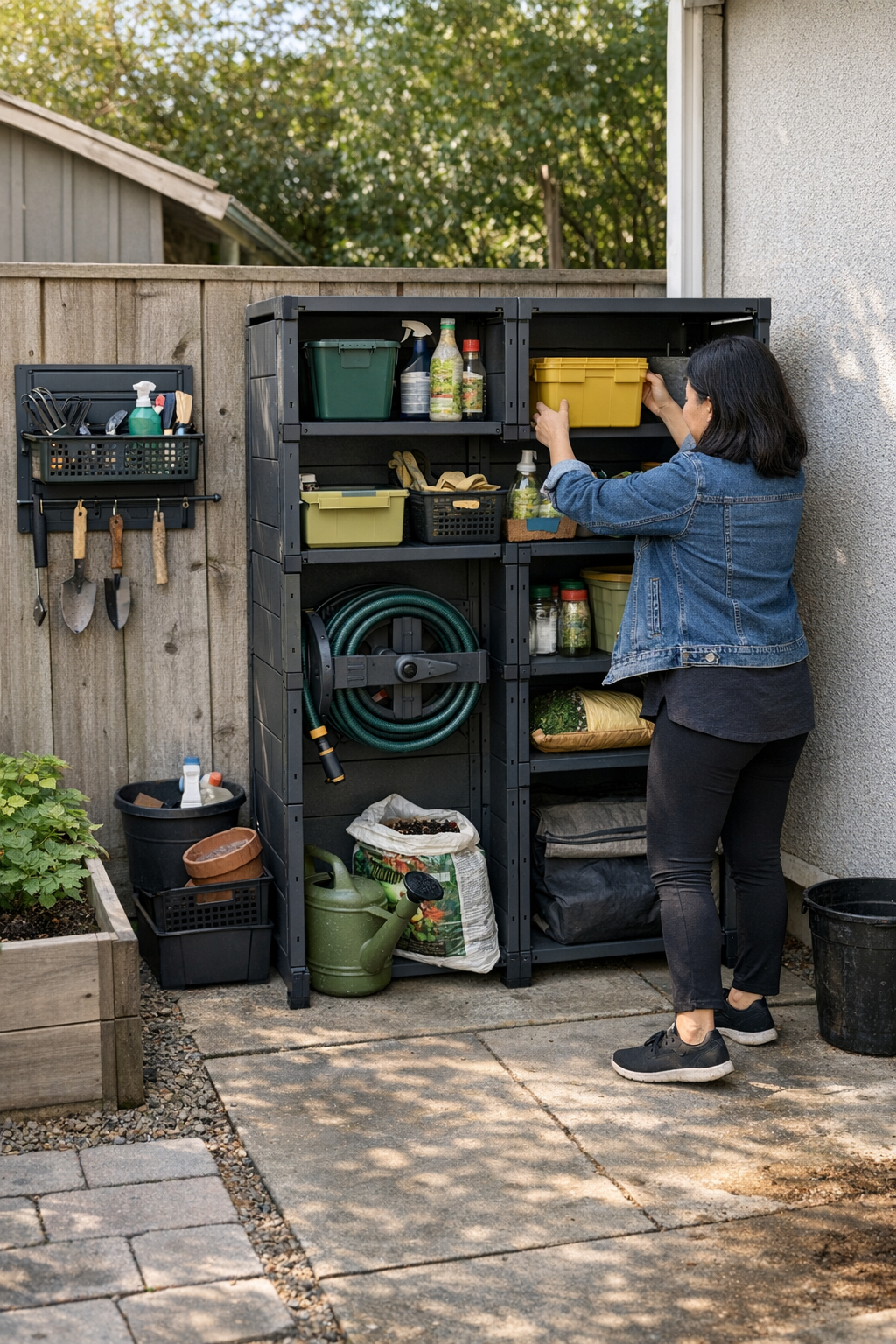
    What actually works isn’t more storage, but smarter, faster points of return. Open wall rails and shallow bins screwed up at eye level make it effortless to hang a spade or toss gardening gloves with one hand—no moving a crate out of the way, no fiddling with stuck lids. A side-yard strip, for instance: replacing those floor-stacked crates with a single open wire basket and a simple rail transformed the route from a bin-drag obstacle course into a smooth grab-and-store loop. No more shoving the mower over a half-blocked path; tools came off the wall and went right back after use, so nothing ever had a chance to pile up awkwardly. Overflow that once spread into the walkway now just… didn’t happen.

    It’s not about hiding things, but about creating snap-return zones along the real lines of travel—at hip height by the door for shoes, shoulder height for handled tools by the side gate, plus an open bin for kid stuff by the patio. When the system fits the route you actually walk, resetting takes seconds instead of a whole Saturday. The testing points are unmistakable: If you have to put something down to open storage, you probably won’t; if you block access for every other return, overflow starts—all over again.

    Scene: The Saturday Stress Test

    Picture a real yard in motion: two people trading off yard work, teenagers grabbing bikes, the dog chasing a ball, shoes dropped mid-commute, someone squeezing a folding chair through the narrowest part of the side path. Every missed return adds up. Wire racks and rail hooks make it possible to snap things back with one hand, without blocking the only walkway. Every time someone had to pop open a bin, a spillover pile formed at the edge. But once returns could be done mid-stride—hook a shovel, toss gloves, set plant ties in an open basket—the pattern of overflow stopped before it started. Corners that always filled up kept their airflow. Entryways stayed passable without a cleanup marathon first. The difference wasn’t cosmetic, it was just less drag on every return.

    Practical, lived tip: Put a no-lid, no-stack return point on every main route. Rail hooks or bins at areas of highest activity—the garage step, side gate, or near the fence—absorb real mess before it evolves into corner sprawl. The less decision it takes to put it back, the less reset you’ll need later.

    Change the Routine, Not Just the Look

    It doesn’t matter if a storage setup looks photo-perfect for five minutes after a deep clean. If it can’t absorb the constant shuffling of real life—tools used out of turn, gear dropped after dusk, overflow during family weekends—the mess cycles back faster than you want to admit. Every second saved on returns leaves more open space for next time. Flow feels natural, because even the busiest corners don’t get blocked or backlogged, and routines actually reset instead of repeat the same mistakes. Instead of navigating overflow, you see your yard as passable, usable, ready for immediate use—rather than “will be tidy after next weekend’s cleanup.”

    No system erases mess entirely. There’s always one glove left behind or the single extra stake tossed hastily. But when small resets are built into the flow, these hiccups stay isolated. You’re not facing a project every time the yard gets real use—just a loop around the path and it’s done. That’s what organization looks like when it actually works outside: less fighting the setup, more moving through it. Find more practical outdoor storage ideas at TidyYard.

  • Why Flat Entryway Trays Fail to Keep Wet Shoes Dry and Odor-Free

    Flat shoe trays look like entryway order—right up until real weather hits and the illusion crumbles by day three. Step inside after rain or mud and you’ll usually spot shoes neatly lined up on a shallow tray, paired with a quiet hope: that this time, grit, puddles, and mess will actually stay put. For a day, maybe two, the routine holds. But as shoes repeat their cycle—wet, then wetter, then overlapping in a row that spreads wider—the shortcomings show fast. Tray setups that promise control undercut it with every soggy arrival: shoes stay damp, muck layers build, and the “clean” zone quickly becomes another source of work, not relief.

    The Flat Tray Setup: Contained but Compounding

    Shoe trays are meant to bring calm by boxing in mess and keeping drips off the floor. They work briefly—mud is corralled, water collects, order appears. But repetition reveals the flaw: each cycle leaves behind new wetness, never enough drying. Under the surface, water accumulates and grit turns to sludge. By midweek, there’s no hiding it—open the door and the stale smell hovers, the tray’s thin order replaced by a damp, slow-building blockade where shoes rarely dry and clutter creeps outward.

    It’s not just that the damp lingers—it multiplies. If shoes aren’t cycled out fast, or if school runs and walks stack arrivals close together, the surface is always wet. Soaked sneakers and boots choke off evaporation, then extra pairs go on top, trapping everything in place. Odor barely fades before returning stronger. Instead of welcoming you home, the tray quietly signals, “Nobody’s taking care of this.”

    Where the Flat Tray Fails in Real Entryway Life

    Transition spaces run under constant pressure—boots drop, bags land, shoes migrate sideways, and within a day the organized tray turns into a bottleneck. The neat line bends outward, shoes start to overlap, and a “temporary” bag gets parked on top, soaking up the runoff. The system resets only with hands-on effort, which most avoid until things are clearly out of hand:

    • Shoes grow heavier and soggier with every cycle.
    • Sticky mud finds its way back inside, trailing past the tray.
    • What seemed like an easy helper starts feeling like another cleaning job waiting for you at the door.

    Lived movement also breaks down. If the tray blocks the natural path, each arrival slows—nobody wants to handle cold, wet footwear, and shoulders pinch as people avoid puddles. Shoes that should live on the tray spread to the edges: under the bench, clustered near the wall, or left at odd angles for quick escape. The tray contains less and less; the real zone for drop-offs and pick-ups compresses to wherever there’s still a dry spot, making even the act of entering feel awkwardly tight.

    The Hidden Friction of “Contained” Clutter

    The trap isn’t always visible. What looks like visual order is often just backed-up maintenance. The tray collects avoidance—nobody wants to reach into pooled water or touch other people’s half-dry shoes. Miss a cleaning cycle and the mud cements; the reset burden climbs. One skipped evening of cleanup and “contained” turns to “dodged.” Shoes start shifting to random corners, just to sidestep the puddles. Now the system isn’t just holding mess—it’s fueling it.

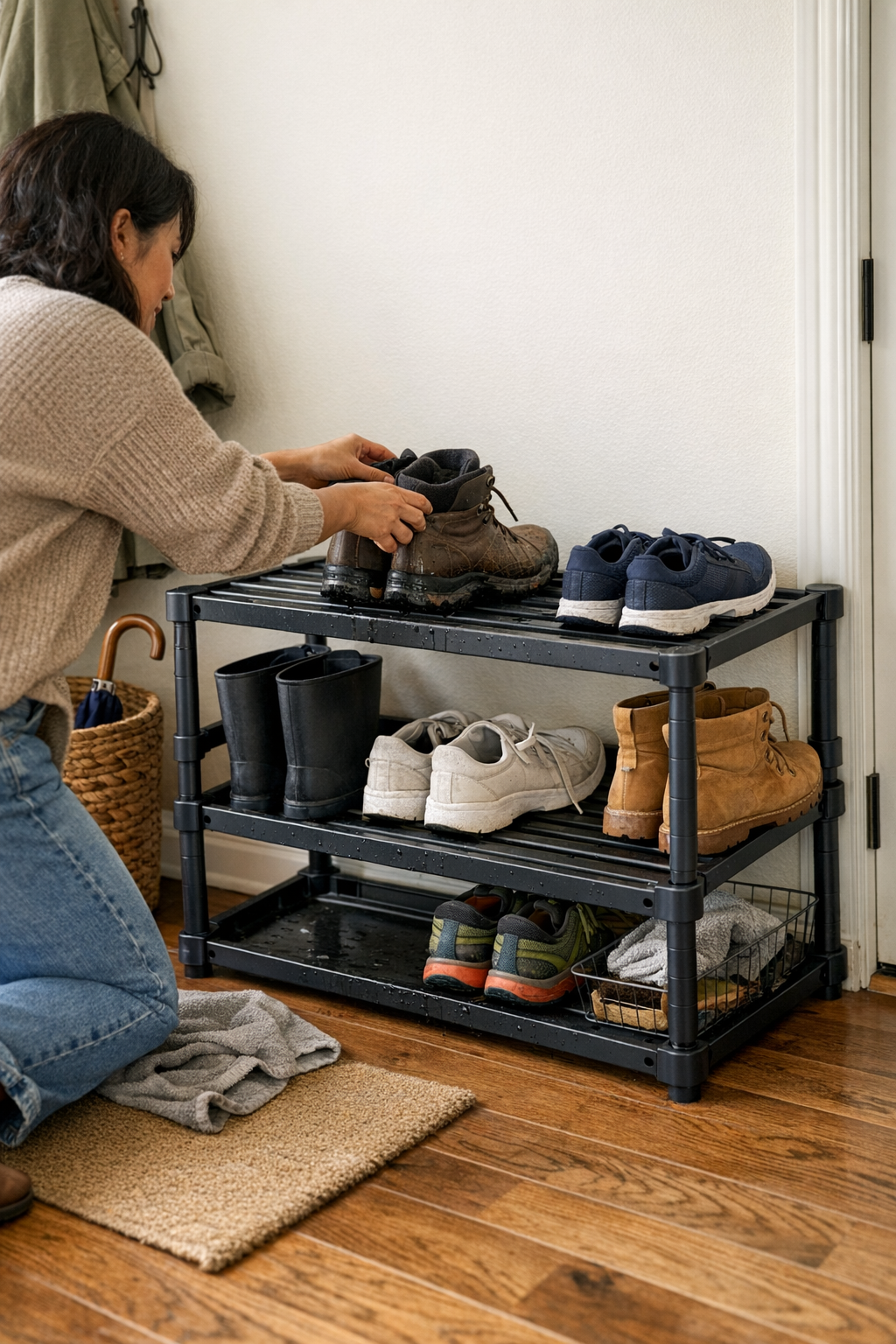
    Raise the structure even slightly—move from a flat tray to a slotted, ventilated rack—and the entire pattern shifts. No, it won’t hide every speck of dirt. But now shoes dry, water drains, air moves, and the daily reset means less direct handling of old puddles. What used to be a major cleanup drops to a quick swipe of a mat. The friction to putting things back is lower—people actually use the storage rather than working their way around it.

    Scene: Lost Shoezone, Blocked Flow

    Picture midweek: tray crowded, shoes still damp, your bag lands “just for now” on what was the one clear spot. Boots migrate to the bench edge; hats end up draped on the wall. Someone shuffles through, nudges a shoe, and spills a cold puddle down onto the floor. Suddenly the passage narrows, the “clean” zone vanishes, and the entry’s reset takes longer than you can spare.

    How Minor Elevation Shifts the Entire Experience

    Just a few inches higher, with slots or vents, and every drop-off changes:

    • Moisture drains away, so shoes are above yesterday’s puddle instead of in it.
    • Airflow underneath makes real drying possible by the next return.
    • Dirt falls below or clears off easily, turning kneeling “deep cleaning” into a simple sweep.
    • People don’t hesitate to put shoes away: the system invites rather than repels repeat use.

    Over time, these tweaks mean resetting the entryway is less of an event, and more of a step. The setup looks looser than a fully boxed-in tray, but operates far stronger—less funk, quicker recovery, and much less avoidance of the essential routine.

    Real-World Tip: Bridge the Wet and Dry With Layers

    In smaller entries where water always finds a way, layer your system: slot a vented rack above a removable mat. Shoes stay lifted, runoff drips below, and reset means pulling a mat rather than scrubbing a single deep basin. It’s the gap between perpetual wetness and a fast, one-move recovery—no more kneeling over half-dry trays just to keep up.

    When Setups Look Neat, But Don’t Work

    The risk isn’t messy shoes in plain sight—it’s setups that perform worse in daily rhythm than their design looks. Visual containment hides slow traffic, hidden odor, and the way you end up double-handling everything just to maintain the illusion. Each moment you hesitate or shuffle things again, the flaw in the system is exposed.

    Good entry storage responds every time something gets dropped, grabbed, slid, or put away—not just the first time you set it up. The difference between a flat tray and a low rack isn’t “looking a little tidier”; it’s whether returning home means one quick step or yet another reset you hope to put off. What traps mess on day one creates routine resistance by day ten.

    Small Adjustments, Noticeable Difference

    The goal isn’t a space that pretends to stay perfect, but one that actually adapts: shoes cycle in and out, airflow keeps up, and movement through the threshold doesn’t stall every time the weather turns. Over a season of repeated use, setups that let water drain and shoes dry will not only stay easier to manage—they keep the entryway a place you can reclaim, not a job you have to dread.

    Find transition storage options designed for repeated real use at Betweenry.

  • How Sideboards and Cabinets Maintain Calm in Busy Living Rooms

    No living room stays truly organized if the storage layout falls apart under daily use. Too often, what looks like tidy order on Sunday quietly unravels by Wednesday: you open a cabinet to grab the remote, but end up rooting past chargers, board games, crumpled mail, and tangled cords just to reach it. Storage that wins on style—or even feels generous at first—still fails if it can’t keep up with repeated retrievals, quick returns, or actual routines shared by everyone in the room. The moment you’re forced to set something “just for now” on top of an out-of-place pile, you know the system’s weak spot is exposed. Rarely is the problem visible at a glance. Instead, it builds underneath: hidden clutter, slow resets, and the creeping feeling that the storage is working against you, not for you.

    The Calm Room Test: Where Nice Storage Fails Under Pressure

    Nearly every living room hits a breaking point—usually not in a big mess, but through ordinary tasks. You reach for the backup remote and knock over two stacks inside a deep cabinet. You return a charger, but the right compartment is already crowded, so into the nearest empty space it goes. Each shuffling detour is minor but accumulates, revealing storage that’s not truly mapped to real use. A room can stay “for show” until routines hit friction: categories blending, items being left out, and “reset fatigue” building every time you delay tidying because putting things back has become uncertain, crowded, or tedious.

    Inside Storage: Why Structure Matters More Than Looks

    Cabinets and sideboards often promise calm just by hiding everything—until the doors open. Adjustable shelves, deep drawers, or broad surfaces become traps if their inside logic doesn’t match what actually needs to happen each day. Depth alone creates risk: a single shelf line turns into an unsorted pile, and every deep bin becomes a mixed catch-all by week’s end. Suddenly, you’re moving games just to reach mail, or unearthing last winter’s scarf just to return kitchen batteries. What matters isn’t the appearance, but whether the structure directs or diffuses daily flow. The real test always comes after several cycles: is retrieval still obvious and reset still quick? If not, tension builds and frustration replaces clarity.

    Sideboards vs. Cabinets: What Actually Endures Daily Use?

    Picture twin living rooms—same floor space, both with a sideboard and a storage cabinet. Surfaces shine on day one, but as routines cycle, differences emerge:

    • Cabinet reality: Deep shelves, fading categories. By midweek, off-season linens touch board game boxes, and searching for a game controller means moving placemats and balancing an odd pile of spare chargers. Open a door, and the bottom shelf’s contents threaten to spill or block movement. Retrieval slows. Items are often put back “later”—which then means never.
    • Sideboard reality: Clear, shallower compartments. Each zone is defined: tech gear here, daily mail there, board games above, backup chargers below. Someone grabs a charger: nothing else needs shifting, and the return path is obvious. Reset becomes quick, almost reflexive. Items left out find their way home because their zone is clear and accessible—no guesswork, no pile-up, no delay.

    To a visitor, both rooms still look tidy, but in actual use, the sideboard silently resists chaos. Surfaces stay open, walkways stay clear, and evenings end with fewer abandoned items on display. The cabinet might “contain” clutter, but only by hiding slowdowns behind its doors. Overlooked problems—like blocked access, slower routines, and missed sorting—all tell you the structure is losing the daily contest.

    The Pile-Up Pattern: How Category Drift Begins

    Most living rooms get messy not all at once, but as small mismatches build. A shelf becomes the “anything goes” zone. Someone stacks sketchbooks on chargers because the right spot is buried. A guest leaves remotes out because it isn’t clear where they belong. Suddenly, walking through the room means skirting overflows: you edge past a tightened walkway, nudge aside a side table that blocks a door, or leave one basket open because closing it means dealing with everything shifted inside. What began as a small pile turns into category drift—zones meant for one kind of item slowly absorbing every stray object within reach.

    The friction builds quietly: every time you shuffle more than one thing to return an item, the system is signaling trouble. More energy spent searching, more things abandoned “just for now,” and resets slow down. Eventually, surface clutter emerges and the setup that once looked calm becomes a daily obstacle course.

    Better Storage Logic: Dividers and Visual Cues That Actually Work

    Sometimes, a tiny structural nudge fixes what a full reorganization can’t. Add a shallow divider—or carve out fixed zones with trays or bins—inside a cabinet. Suddenly, the “dump drawer” nature dissolves. The whole mood of the room changes in under 10 minutes of work:

    • Chargers and remotes find their own zone, no longer crowding napkin storage or piling up in whatever cubby is empty.
    • Everyone in the room can return items correctly first time—even guests—because each compartment broadcasts its purpose in shape, not just intention.
    • Resets shrink: you reach for an item and replace it in one step, rather than digging around or rebalancing a precarious stack.

    But if within days you spot the same unrelated items wandering back, that’s your cue: the existing zones need further adjustment, not just another tidy-up session. Usually, a brief monthly review is enough—as long as compartments are visible and shallow, not deep and undifferentiated.

    Signs Your Storage Isn’t Working—And How to Fix It

    • You regularly shuffle three or more things just to reach one item.
    • Items languish on surfaces “just for now” but don’t make it back to their spot.
    • Overflow builds in the same zones—edges, tops, or floor clusters—even though cabinets or drawers have space.
    • Doors or drawers snag, walkways tighten, or you avoid opening a section because the footprint is too awkward.

    When these warning signs show up, don’t just declutter. Rethink the flow: often a new divider or a swap from cabinet to sideboard, or vice versa, solves more than endless re-sorting. The best setup fits the way you actually live—the rhythm of retrieval, the speed of resets, and the reality of shared, changing use—not just the “after” photo once you’ve tidied up.

    Calm Spaces Are Sustained by Everyday Compatibility

    Lasting order in a living room depends on storage that’s friction-proofed for repeat, shared use—not just organized once. A well-zoned sideboard or a restructured cabinet doesn’t just mask mess—it slows category drift, shrinks reset times, and lets anyone return items in seconds, not with second guesses. Next time you’re choosing between sideboard or cabinet, make your decision on the shape and logic inside—whether the structure fits the daily pressure points of your space. What settles the room is not the look but the logic under the surface, built for the way you’ll use it all week—not just the way it photographs on day one.

    Gridry: Storage for the way you actually live

  • Transform Your Shared Yard with Wall-Mounted Storage Solutions

    The problem isn’t getting organized—it’s staying organized through a real week in a tight outdoor zone. A new rack lands in a busy yard or along a narrow path, and for a moment, chaos seems conquered. But give it days of real use: foot traffic squeezing past, kids bringing out sports gear, quick gardening runs, someone forced to detour around boots or a heap of balls. The main route shrinks until every return trip means sidestepping another pile. This isn’t just clutter; it’s setup friction that never gets solved, just moved from spot to spot.

    When ‘Organized’ Starts Getting in the Way

    On the first day, bins in neat rows, a solid rack, or tall modular units give the backyard, garage edge, or side yard a brisk sense of order. But routines hit fast. One person grabs a trowel, another dumps muddy gloves, a soccer ball gets nudged under a shelf, boots wedge against the unit’s legs—soon every return involves shifting gear or asking, “Whose junk is blocking the walkway now?” The organization works for a week—sometimes less—until corners clog up and everyone starts calculating detours just to get through.

    This isn’t messiness; it’s a mismatch between storage footprint and lived movement. Floor racks and standalone cabinets always sound practical—until they quietly claim the strip of space the whole household depends on to move through. Once movement paths are narrowed, even the smallest item out of place becomes a daily hassle. “Easy access” turns into routine reshuffling.

    The Floor Storage Domino Effect

    Picture a Saturday: the first person drops a ball as they squeeze by. Next, a couple of boots clog the rack’s edge. Someone tosses garden gloves onto the lowest rail, aiming for “close enough.” Loose cones and balls creep beneath the shelves. What started as an organized compact footprint has swollen into a physical bottleneck, shrinking footpaths down to shoulder width. If you need the mower or have to haul bags past, you’re kicking aside clutter just to reopen the lane. Each trip out means more objects in the way and another band of awkward shuffling around the setup that was supposed to fix this.

    Wall-mounted hooks and rails flip the script. They don’t just free up floor—they patrol the margins of your movement zone. Lifted storage carves out a minimum air gap for feet, wheels, bags, and bins. It’s harder to “just drop” something in the way, and far easier to see and reclaim the path when spillover happens. Packed gear doesn’t creep silently into walkways: you notice, and you fix it, not because it looks messy, but because you actually need your route back.

    Modular Systems: Useful or in the Way?

    Modular storage seems clever—until it’s scattered in the wrong place. Snap-together units line up tidily on graphs and floor plans, but in reality, a single shelf jutting past the shortcut or edging into a garage threshold warps the whole outdoor flow. Space intended for storage chokes landing zones or turns a basic return trip into a slow-motion zigzag. Instead of sorting, everyone just piles—whatever doesn’t fit “right now” lands at the nearest open patch, and resets take longer each week. All it takes is one edge in the wrong spot, and the modular promise collapses into overflow and dead ends.

    Some corners absorb modular bins well, but nothing lasts when routines shift—kids bring friends, mornings get busier, or the gardening season ramps up. If a setup blocks a route, the rest is noise: style, bins, and labels can’t overcome an awkward footprint clogging what people actually use.

    How Raising Storage Breaks the Setup Stalemate

    Take one cramped yard: a freestanding rack clogs the middle, trips are lost to nudging boots out of the way, shoving gear off the path. Swapping in a wall-mounted rail—eight inches off the ground—reset the whole pattern overnight. Suddenly, there’s a real walkway again. Now a cart glides through, hands are free, and kicks underfoot are rare. Even when afternoons get messy and gear comes flooding back all at once, the main path holds. Those missing eight inches don’t just mean cleaner lines—they mean the area doesn’t collapse back into flood-level clutter after a typical Saturday rush.

    Some gear still lives by the back door, but now it makes visual sense: what doesn’t belong gets obvious sooner, tidying is quick and deliberate instead of a full reset ritual. The space doesn’t turn perfect, but resets become bearable and don’t kill momentum. The improvement isn’t spotless calm—it’s that putting gear away no longer needs an all-hands meeting or a warning sigh.

    Know When Your Storage Is Fighting You

    Gut check: if a normal trip to the shed or yard means sidestepping stray boots, rotating bins just to open the gate, or dragging a pile away from a choke point—your layout is fueling clutter, not containing it. Give it a month. Real use, multiple people, incomplete returns. If “reset” still means a full shuffle and you’re still blocked, your storage is just decoration for a problem that keeps coming back.

    See a healthier setup when most items find the same home, paths clear quickly after use—even if nothing’s photo-worthy. It’s not about perfection; it’s about bounce-back, how little time it takes to reclaim the basics after a run of sloppy returns.

    Wall Systems and Real Access (Not Wishful Thinking)

    Mounting storage clears floors fast, but only if everyone can use it. Got little kids? Shorten a rail, add reachable hooks, or stuff a shallow bin at kid-eye level. If even one family member can’t return their gear easily, boot piles become inevitable. Label the right zones or anchor a slip-resistant basket so stray boots don’t migrate. Real access beats uniform “tidiness” every time—and a few deliberate adjustments can mean the difference between quick resets and gear endlessly orbiting the floor perimeter.

    Don’t Plant Obstacles Where People Walk

    Classic mistake: tucking a modular rack, box, or bin where all return trips squeeze past. Even an inch or two, and spillover multiplies. Floors become catch-alls, reset dread grows. Blocked movement is a mess accelerator in any compact outdoor strip or garage threshold. Want a real test? Load your arms with garden gear or a ball bag and walk your layout. If you have to wiggle, slide, or shift something—start over. The path’s the priority. The rest is just organization theory until the lane works in practice.

    Quick Tweaks That Lower Setup Resistance

    Forget perfect. Real yards drift toward disorder; the goal is to slow the drift and make resets almost frictionless. If one wall section keeps jamming up, bump infrequently used hooks higher or make a “rush drop” zone near the door for overflow. If a single spot always collects debris, move high-use storage there instead of fighting the flow. Fixes here are rarely dramatic—but shaving seconds off resets or making one awkward pile disappear adds up to hours of less frustration across a month.

    Good Setup Feels Different—And Holds Up

    A storage system proves itself not by looking sharp on day one, but by surviving a month of missed returns, sudden weather, and everyone dumping gear in a hurry. The payoff isn’t just seeing fewer piles—it’s walking through the space and not having to shift your stride or negotiate a detour every time. Raising storage, even half a foot, often marks the line between a routine that flows and a routine that stops cold. In the end, reclaiming walkable space isn’t just an aesthetic upgrade—it’s the quiet return of sanity to busy outdoor routines.

    Visit TidyYard for more outdoor setup solutions.

  • How Wall-Mounted Storage Transforms Shared Outdoor Spaces Efficiently

    Every outdoor corner and backyard edge quietly exposes its storage flaws faster than most people admit. You organize tools, stash gloves, line up bins—then watch as every family habit and shortcut collides in the same cramped spot. It doesn’t take long: one evening of quick drop-offs, one rushed cleanup after mowing, and the so-called “system” hits gridlock. A pathway that looked clear Monday now bottlenecks with bikes and garden clutter, forcing anyone who needs the hose or trash bin to wade through yesterday’s compromises. This isn’t just about the stuff you buy—it’s whether your setup can handle real return flow with real people moving through real routines.

    When Floor Bins Fuel the Blockages

    The fix-it instinct kicks in. People buy bigger chests, add deeper bins, convinced that more storage will make the overflow disappear. In single-user worlds, maybe it helps. But with a small yard or shared side zone, deep bins just become another beacon for tomorrow’s pile. The lid clogs up with tangled extension cords and half-dry towels. By Wednesday, propping a shovel or leaning a bike nearby means blocking the front of the bin altogether. The more stuff you cram in, the harder it becomes to actually put away the next thing—until returning a broom or watering can means shoving, restacking, or simply tossing it in with a silent promise to “fix it later.”

    Every retrieval or return becomes slower, not simpler. The person who still cares finds themselves emptying the bin entirely to dig out gloves or ease the lid closed one more time. That “reset” doesn’t last. You know it’s inevitable: things will spill out, corners will collect stray tools, and that feeling of a fresh setup collapses under another ordinary week.

    Why Wall Panels Shift the Routine

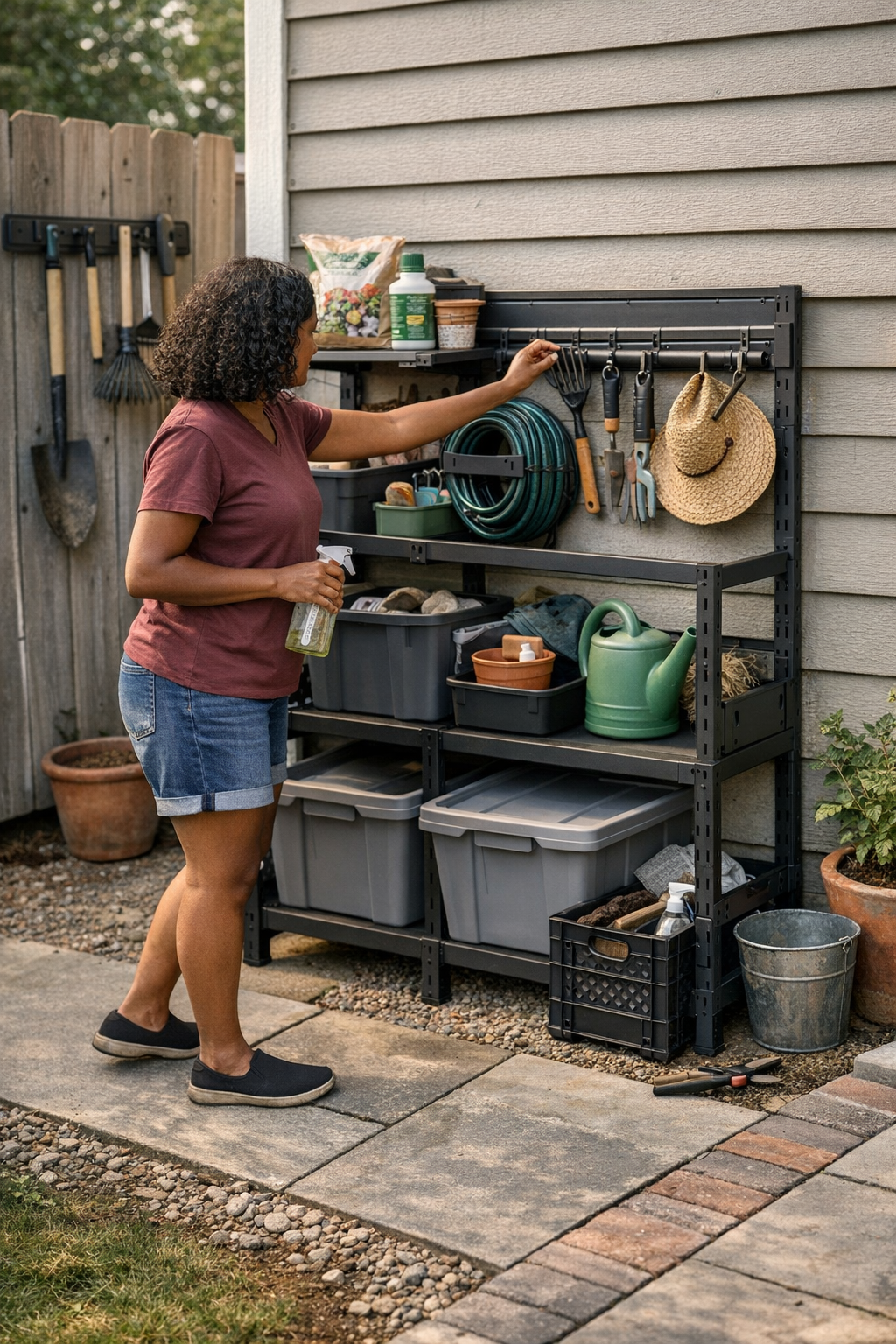
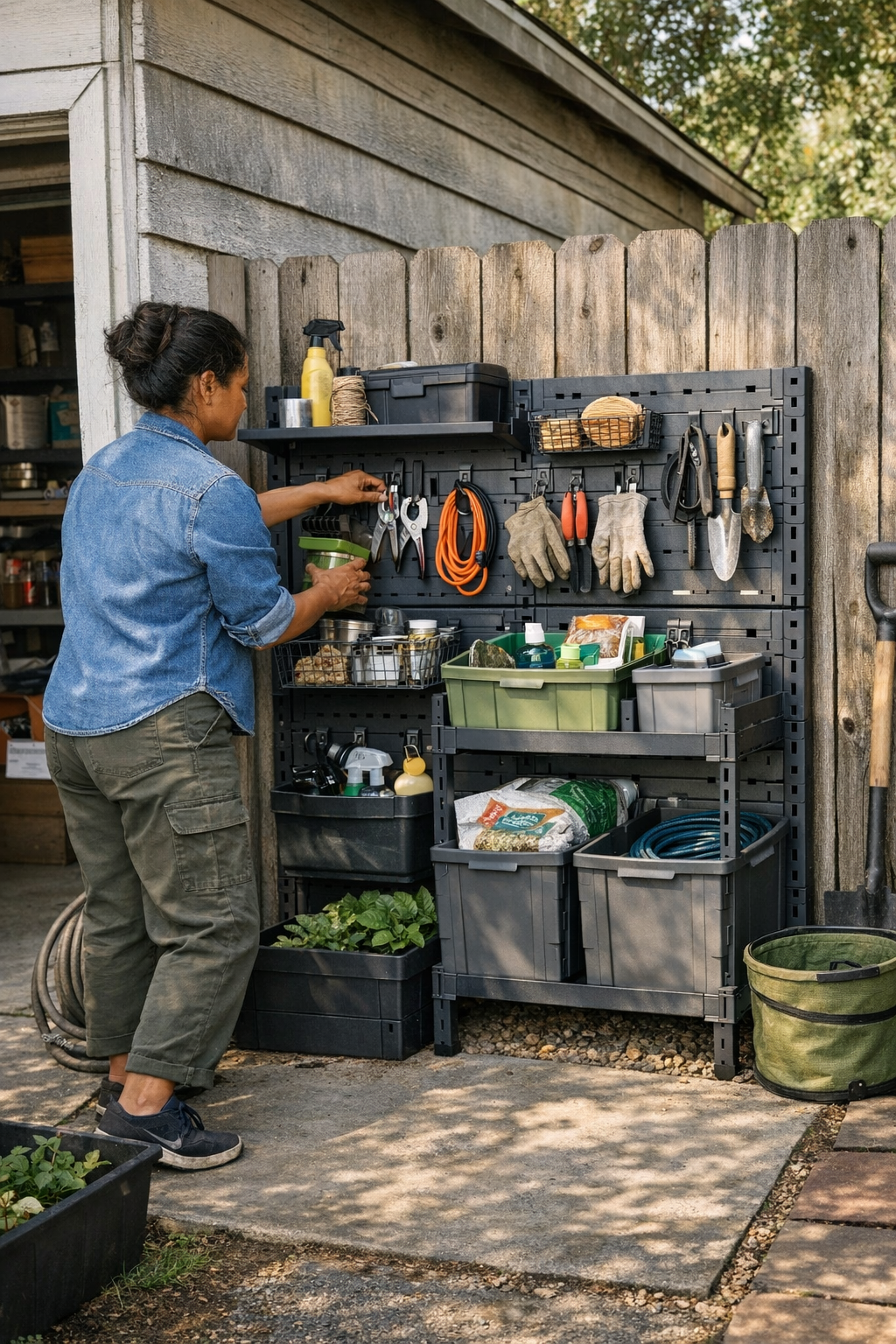
    The solution doesn’t come from squeezing more onto the floor. The real difference shows up when you intercept clutter before it lands. Modular wall panels—posted right along the fence, by the side door, or on a garage edge—become breakpoints in the return flow. Hooks catch loppers and bags on the way in, shallow trays snag those gloves that never seem to find a bin. Instead of asking people to move things twice, the system meets them where they drop gear. No wrestling lids, no reorganizing just to get through. The question of “now where?” disappears one item at a time, right at the point of use—not after everything’s in a heap.

    The best setups aren’t just mounted somewhere—they’re right in the slipstream of activity. Hooks where sweaty helmets come off, shelves at kid height, trays at the edge of the patio where those sunglasses actually get abandoned. Suddenly “putting something away” is less a negotiation and more a reflex. The payoff is immediate: fewer blockages, less finger-pointing, and the end-of-week cleanup shrinks to a slight reordering, not a full-on overhaul.

    A Typical Saturday: How Clutter Creeps In

    Picture three people doing yardwork late morning. Pruners dropped for lunch, gloves abandoned mid-project, a hockey stick mixed into the pile for “just a second.” Someone wedges the new compost bucket beside the chest, cutting off the path to the gate. By evening, anyone rolling a bin or walking through is forced into a sidestep shuffle, lifting bikes out of the way or bending over spilled tools just to cross. When finally asked to “reset the yard,” everyone feels stuck—where do these things even go, if the bin is buried and the last hook is at the far end of the fence?

    Now, swap that chaos for a fence-line panel with three hooks and a slim rail. Pruners snap onto a hook as soon as the job’s paused. Gloves get stashed at eye level—no lid lifting, no rooting through bags. The hockey stick? Visible, reachable, and neatly out of the pathway. Midday and evening, the main movement line stays open. Cleanup is a walk-and-hang, not a chore of riding herd on tumbled piles. Bit by bit, the setup fights the urge to “just drop it anywhere.”

    What Blockages Actually Show

    Almost every area feels “fixed” after a weekend tidy—until the routine restarts. Real warning signs appear fast:

    • Anytime you move one thing to put away another—or can’t return something without restacking.
    • Wall rails or hooks exist, but sit stranded in a corner, never collecting the actual overflow.
    • Certain spots always develop as the dumping ground: bucket, ball, broken trowel, last week’s forgotten shears.
    • Everyday routes kink up by Tuesday. One bin, one bike, and you’re blocked again.
    • Returning items feels tedious enough that the most-used path becomes a catchall zone within days.

    These are the pinch points that break the illusion of order. The system isn’t failing because you own the wrong products—it’s failing because it can’t keep up with how (and where) people actually interact with the space. If each routine makes the setup a little bit worse, resets never last. Frustration, not flow, becomes the real daily reality.

    Making Returns Almost Automatic

    Real improvement shows when returning something is the path of least resistance—not another step to dread. Modular wall panels and fence setups thrive because they shrink the mental gap: snap, set, done. With these right at exits and key routes, “cleanup” dissolves into dozens of tiny, almost automatic actions. Hang up a spade while stepping past. Drop a helmet at eye level while heading inside. Even messy housemates find these pathways hard to ignore.

    This isn’t about perfection—someone will always skip a step now and then. But these setups draw clear lines against the major resets. Floor space stays walkable. Bins and bikes stop blocking every project. The long arm of clutter has fewer places to take hold, and the need for three-hour weekend resets fades into the background.

    Smart Tweaks: Less Piling, Smoother Movement

    Small shifts make a visible difference: move away from deep bins and increase visible, accessible wall storage near your busiest entryways. Hooks at multiple heights make options obvious for both adults and kids. A shallow shelf or mini bin on a panel snags the sunglasses and garden gloves that usually get drowned in larger containers. Each returned item becomes a streamlined action, not an excavation through stacked clutter.

    • Mix and match hook types—long, short, angled—so nothing sits awkward and untouchable.
    • Rethink wall space as traffic space: are the exits actually clear, or is visibility just hiding deeper reset problems?

    The good kind of setup doesn’t just “look neat.” It keeps corner drift in check and gives random items a default destination before they become someone else’s headache. Movement opens up, resets last longer, and the outdoor zone stops functioning as storage limbo.

    Past the Illusion: “Organized” Isn’t Always Functional

    A chest under the eaves. Baskets lined in a row. The obligatory rack by the shed. From a distance, every space seems workable. But if the system crumbles the first time routines collide, the only result is a cycle of shuffling and stale arguments about whose turn it is to “finally put away the mess.” Outdoor organization that matters isn’t about visual calm—it’s about setups surviving the real week, not just the reset. The difference shows in the spaces that stay open, the pathways people use without thinking, and the clutter that never gets a chance to settle.

    Visit TidyYard to explore practical storage options that support real outdoor spaces.