If organizing your carry-on only works until you hit the first airport line, you’re not alone. Most “packed neat” setups break down fast: the passport you stacked up front ends up under a layer of cables; the tidy pouch system translates to extra zippers to open at the tray; and what looked efficient at home turns into delays with every document check, repacking motion, and in-flight grab. When a bag’s order slows you down just as pressure builds—security, boarding, seat entry—you start noticing the gap between what looks organized and what actually runs smooth.
When “Packed Neat” Isn’t “Ready to Use”
A carry-on can look flawless on your bed—document sleeve placed “just so,” chargers wound tight, and all the right pockets zipped. But travel isn’t a static scene. The moment you start moving—bumping through a terminal, rerouting at security, switching trays—your carefully built order starts to get in your way. You unzip one pocket for your passport, but it’s wedged under your headphones. You grab a charger, but you drag out paperwork and coins with it. That top layer you planned for “quick access” quickly becomes a mixed jumble. Each layer means another pause—a fast process in theory, a slower one every time you repeat it under a deadline.
The friction isn’t in visible clutter—it’s in reach and reset speed. Layering your ID under a pouch or letting travel docs share space with cables creates a hunt-and-peck routine. Each required item triggers a mini-scramble, and every “convenient outer pocket” turns unpredictable as soon as one access resets the order you thought you built.
Real Carry-On Friction: Scenes That Repeat Themselves
The Airport Security Stall
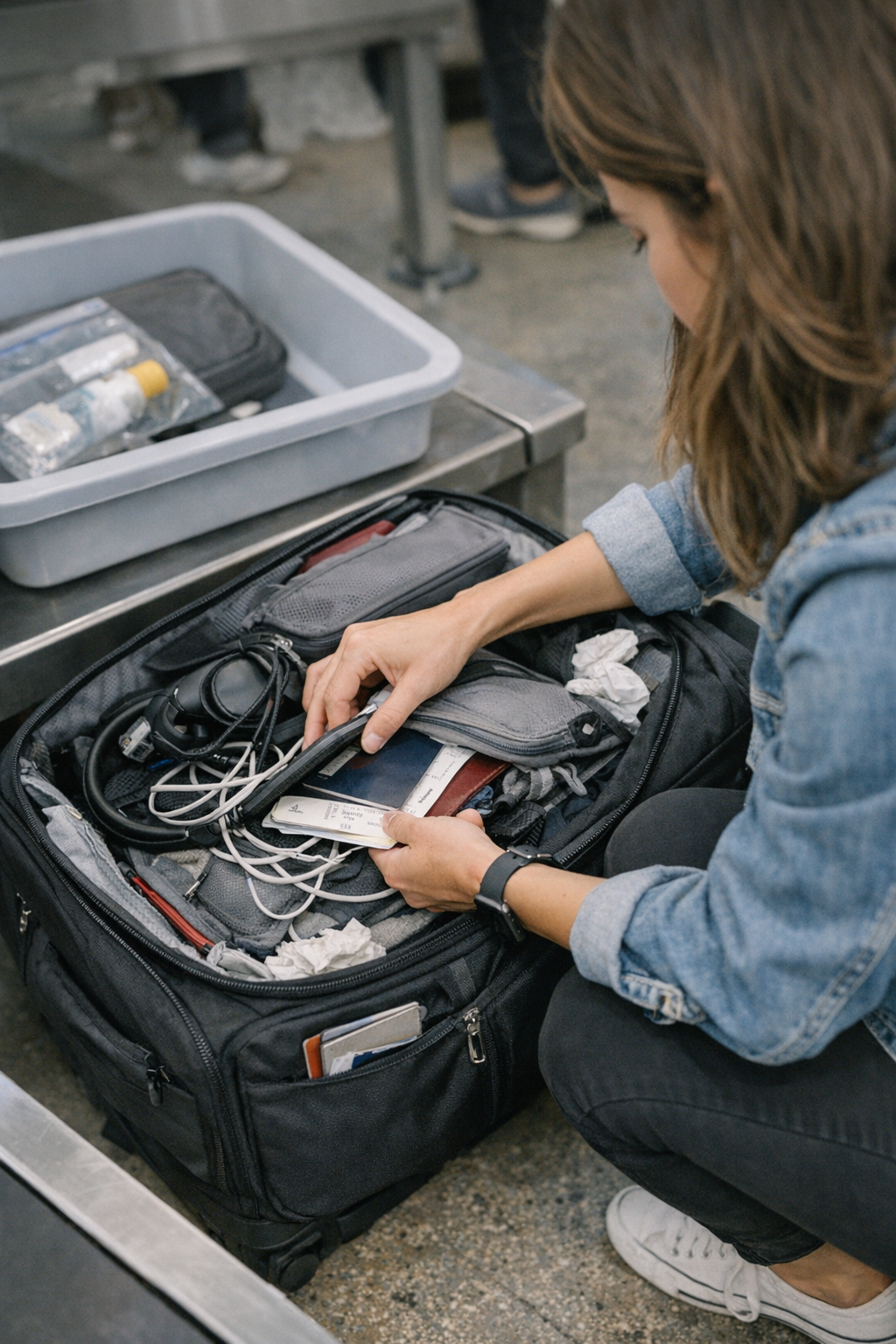
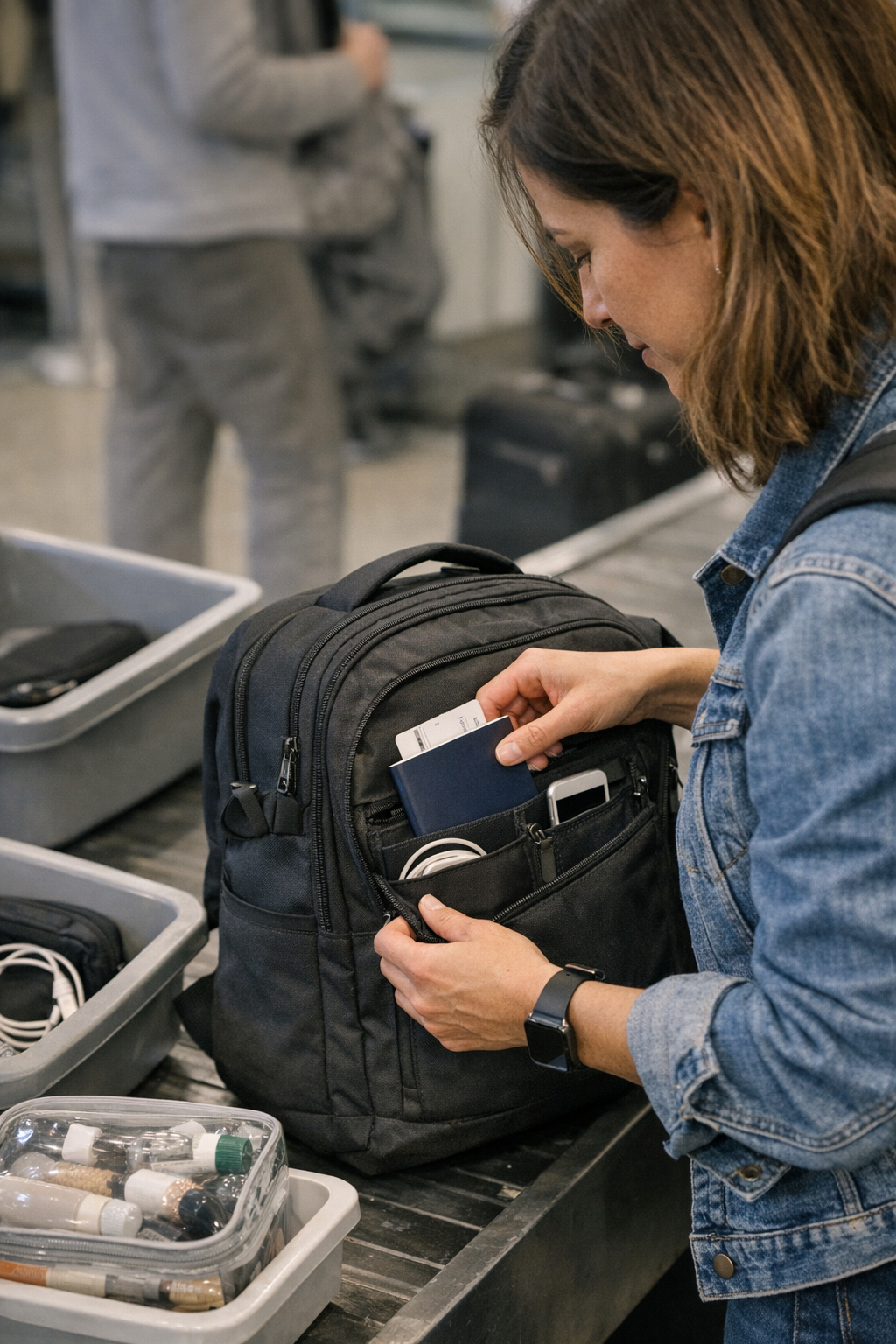
Security is a display of just how fast an organized carry-on can come undone. You’re next in line, sure you left your passport right on top—until your hand closes on a charger first, and a charger tangle brings the whole contents closer to spilling into the tray. The zipper barely closes. Toiletries, meant for the top, have slipped toward the middle. That “system” that looked ready at home now exposes you at the checkpoint—retrieval isn’t instant, and behind you, the shuffle builds. The more you try to move fast, the more items migrate under pressure.
The Boarding Lane Shuffle
Boarding time. Your compartment for documents now hosts sanitizer, receipts, and a power cable that wasn’t there five minutes ago. Instead of a quick reach, you fumble—hand half-blocking the aisle, bag half-open, aware of the line waiting for you to finish. Even if nothing spills, you sense the layout just got messier. The next access will be slower unless you reset everything on the spot—or live with the growing backlog.
Crammed Overhead and Compounding Repack
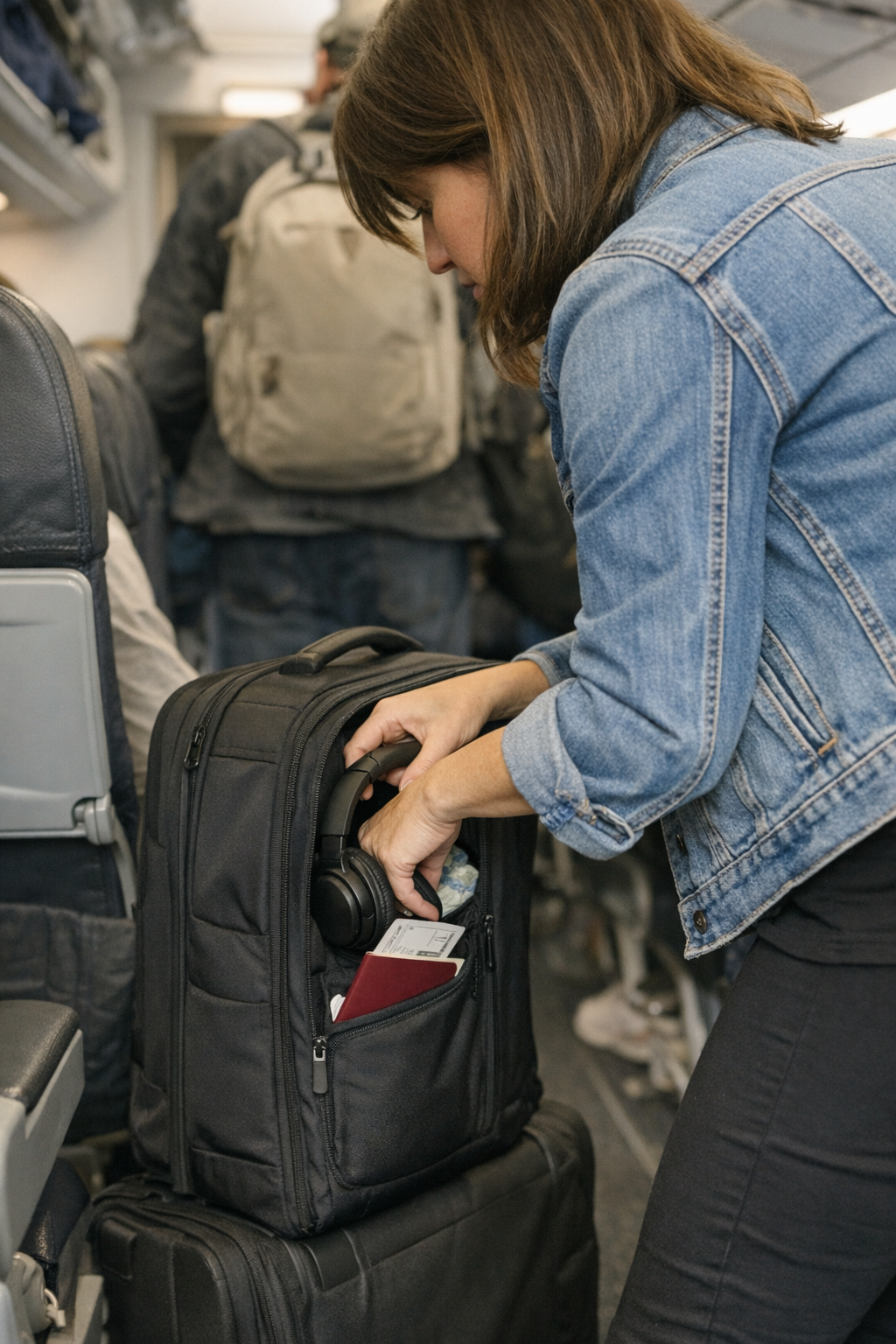
Now at your seat, juggling overhead space, you face a choice: overstuff your “grab zone” pocket so everything is close (but jammed and friction-prone), or risk stashing crucial items out of reach—guaranteeing you’ll have to stand and retrieve, then repack, mid-cabin. Grabbing one item shifts the rest, making the compartment a puzzle to close again. The packed-tight strategy that saved space is the same one that multiplies annoyance every time you repack during connections, takeoff, or arrival. By day’s end, the structure returns visually, but function lags with every small reset. The bag looks in order but feels slower with use.
The Subtle Slowdown of Overlapping Setups
Most travel friction isn’t a disaster; it’s a sequence of access delays that pile up, raising the drag of every routine move:
- Pouches drift and bury your travel wallet under bulkier items.
- A “top-level” document pouch now sits wedged below headphones or became wedged sideways in the shuffle.
- Cables slide out of designated slots, trailing from “overflow” sections every time you reach.
- You pause, trying to reconstruct which zip pocket got your phone this time.
Each of these slowdowns feels minor, but the weight is cumulative. You end up shouldering not just your bag, but the mental load of re-sorting, remembering, and correcting. The common theme: travel smoothness gets blocked because overlap and multi-purpose pockets pull your setup apart in pieces with every use.
Outsmarting Slow Access: Small Tweaks That Change Flow
The answer isn’t just repacking tighter or stacking more things together; it’s about separating the actions that matter most. Assign each high-frequency item—passport, boarding pass, phone, charger—its own outside-facing pocket or pouch, with zero overlap. No doubling-up with snacks or coins, no cross-function pockets. What looks less engineered for symmetry suddenly works for speed.
For example, a slim outer zip holds only travel documents—nothing that moves, nothing with a cable. The charger sits in its own mini sleeve inside a side pocket, not shared with pens or chewing gum. Security becomes a direct move: passport out, tray done, passport back before the next shuffle. Boarding is a single quick reach, not a rearrange-the-bag event. The crucial point—each retrieval resets only what you touched, instead of shuffling the whole pack. Stress is cut not by discipline, but by structure.
Why “Easy to Reset” Beats “Perfectly Packed”
It won’t win for appearance—outer pockets and minor bulges might look unstyled—but ease of reset pays off again and again. Every layout that avoids overlap keeps you from returning to square one at each checkpoint. Less fixing, less remembering, more flow. One concrete sign: you no longer second-guess where things are as you roll between gates or re-board the train. The travel guesswork vanishes because the bag interior stops moving around on you.
Signs Your Carry-On Needs a Reset
If any of these show up in your routine, your carry-on setup is exposing its real limit:
- You wonder what will tumble out before you unzip a front pocket.
- The same cable slips, tangles, and reappears where you don’t expect it.
- Your documents hide behind new obstacles every time, even though you “put them on top.”
- Each minor repack pushes must-have items deeper until you lose the order entirely.
- The boarding line stalls behind you—and the problem isn’t slow hands, but layout-induced scramble.
The difference after one structural change: Partition each must-reach item into its own consistently returned pocket or pouch, and regular airport routines stop grinding. No repeated unzipping, no search-and-recover, no multiplying “just a second” apologies with every move.
Practical Setup: What Works Repeatedly
The setups that hold up through actual travel are the ones designed for repetition, not just for first-glance order. That usually means outer pockets that only ever hold travel documents and are cleared of everything else; quick-reach pouches that never double as cable bins; tech and chargers kept distinct from paperwork and receipts. The point isn’t perfection—it’s an arrangement you don’t have to rethink each time you pass through a terminal, switch seats, or stand up for another gate change.
The real payoff is mid-trip, not pre-departure: fewer micro-fixes, less escalating drag, and a bag that gives you the same easy access at your connecting gate as it did at your first. You won’t banish every travel delay, but you will avoid compounding the slowdown—and in airport terms, that’s the kind of order that keeps you moving.
See practical carry-on tools, pouches, and travel access accessories at CarryOnSupply.