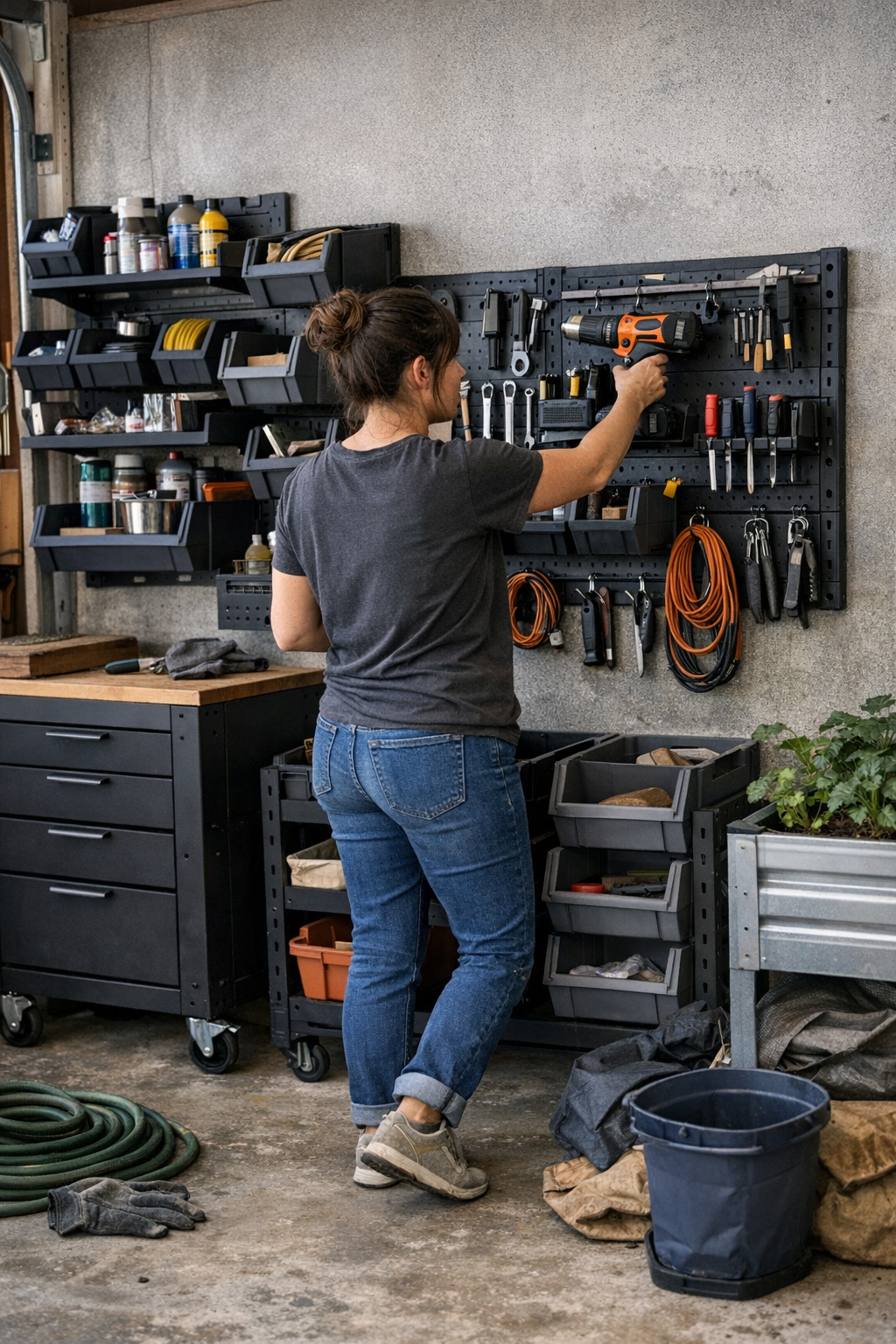
The real test of any wall storage system isn’t how sharp it looks on install day. It’s what happens a month later—when the order promised by neatly lined panels, hooks, and bins collides with real, messy routines. In a garage, a corner workshop, even a crowded back room, you start with a blank slate: tools aligned, floor space visible, everything with a label or a rail. Then your habits take over. You’re rolling carts in and out, setting jobs down “just for a minute,” clawing past the edge of a cabinet you thought you’d finally placed out of the way. Suddenly, that well-ordered wall is just another background—yesterday’s gear pushed to the side, the prime strip near the bench jammed with overflow, and simple reset routines quietly dragging you down.
Where Setup on Paper Slips in Daily Use
Panels and rails rarely fail. But layouts often do—because they ignore the kinds of movement that actually happen. It’s not the hardware; it’s the habits and shortcuts that follow. Right after you hang the last hammer, everything fits. But fast-forward through a few projects and your resets get longer. The recurring friction piles up:
- You edge a rolling cart, just to squeeze through—until every trip across the floor means bumping bins that stick out a few extra inches.
- One patch of wall turns into the “catch-all”—the spot where nothing really belongs but everything lands after the rush of a job.
- Putting things back isn’t automatic. It’s a jigsaw: if you hang up a wrench, two other tools are in the way—reshuffle, repeat.
Two spaces with the same panels and the same instructions diverge fast. One, you move through cleanly. The other? You sidestep old projects, reach around the same awkward beam, and wonder why the path always manages to tighten up right when you need to move the most.
Diagnosing Hidden Friction Before It Spreads
Clutter rarely explodes overnight. It gathers in slow, subtle drifts—signals you notice only when routines stall:
- A “clear” wall section never stays clear; something always migrates to that easy-to-reach spot, reappearing the next day no matter how many times you move it.
- Your cart won’t settle where it used to—the path narrows, the angle’s wrong, that one bin keeps sticking out just enough to nick your hip.
- The bin marked for ‘electrical’ ends up swallowing in-practice junk: pruners, work gloves, packs of screws temporarily abandoned for days.
It’s tempting to blame too many tools, but the real problem is a setup that makes it too easy for categories to blur and blocks to build up. Labels only help when the flow of daily use agrees with them. Otherwise the overflow keeps creeping closer to the heart of your space.
The Real World Isn’t a Showroom—Movement Beats Looks
Wall systems win points in staged photos. But when you’re making repeated trips—hauling gear from the bench, parking a mower, zigzagging around drawers—the real question is simple: Are you moving through your space, or moving things out of the way? Each small interruption—a bin that’s inching into your path, a shelf that always needs another tweak, a dead corner swallowing “extra” gear—piles up.
Take the classic problem: a rail below waist height near your bench. Seems ideal for those last-second grabs. In practice, it morphs into a drop point for whatever doesn’t belong anywhere else. Over days, that section clogs, blocks the cart’s spot, and forces you to adjust your route on autopilot. Leave it unsolved, and soon your “reset” is half an hour of sorting what should have never stacked up.
Life in a Crowded Setup: A Day’s Evidence
Picture the routine: the sun’s down, the garage door is half-up, and you’re racing to wrap up a bike repair before dinner. You reach for the essentials—but now a tangle of jumper cables and a borrowed drill crowd your most convenient bin. You try to step through the main aisle, but a floor jack wedges you against a shelf. To finish, you have to reshuffle lesser-used tools just to hang up the wrench. What should be a quick reset stretches—minutes lost fighting layout, not finishing the work.
Overflow: The Silent Slowdown
The offender isn’t always obvious—it’s the invisible “just for now” habit. Overflow builds up in the space that’s easiest to drop things: the busiest, most central strip of your storage wall. Bins and hooks get buried. The strongest hardware won’t save you if a key tool is always blocked, or if your favorite bin becomes a dumping ground. When main routes fill, every reset takes longer—and what started as a clutter fix now eats into your limited time and space.
The Small Rules That Rescue Flow
Making a setup work isn’t about adding more hooks—it’s about enforcing subtle boundaries:
- Keep your main paths clear—no exceptions. The route from the bench to the door, or across your main zone, can’t shrink. If a bin overflows, move it now—not once you’re tripping on it every weekend.
- Nip corner creep in the bud. Corners are magnets for clutter. Don’t let gear “rest there for a minute”—that moment becomes a month fast.
- Honor your natural reach zone. Panels only help if your daily tools are where you grab them without a stretch. Put infrequent stuff high or low—keep core gear within waist to shoulder height.
Real maintenance sometimes means sacrificing the illusion of maximum storage. For instance, committing to a clear 70cm slice of wall in your main walkway felt at first like a loss—until you noticed not having to fight for space on each pass-through. A clipped elbow isn’t just a bruise; it’s a warning your layout is crowding back in on you.
Everyday Tweaks That Keep Systems Working
Empty main zones on purpose. When you first see stray overflow in a walkway, move it before it sets in. Don’t settle for adapting to an annoying change—reverse it as soon as you catch it.
Let reach guide your real estate. If a daily-use tool isn’t instantly at hand, don’t accept the inconvenience. Change the location or the panel height; you’ll notice the difference every session.
Make overflow zones deliberate. Need a “parking lot” for project leftovers? That’s fine—just keep it out of your traffic lanes and clear it out often. If a hook or bin turns into a black hole, it’s time for a label or a hard reset, not a routine apology.
Organization That Gets Out of the Way
The most functional wall system fades into the background. It lets your projects set the pace—not the location of your screwdriver or the maze on your floor. The first hint of friction—the need to move things twice, the creeping block in the pathway—is your cue to intervene. Don’t wait until the system quietly becomes the obstacle it was supposed to solve.
True storage control isn’t about a tidy surface for its own sake. It’s about having a space where movement stays fluid, resets stay short, and creativity isn’t choked by invisible slowdowns. That’s a setup that stays genuinely usable—session after session, not just for that first, “perfect” day.