Author: jaesoon_admin

  • Why Small Storage Choices Make or Break Your Pet Care Routine

    You set up your pet’s area—bowls lined up, supplies tucked out of sight, everything looks calm. But day two of real use, friction creeps in. The brush you need is missing again. A damp towel sits folded and never dries. The food bowl is dirty right as your pet starts pacing for breakfast. What looks orderly rarely holds up once daily care kicks in. The smallest slip—one item not back in place, one tool out of reach—shifts the whole routine from smooth to a string of stalled moments. A setup that looks calm doesn’t always mean your next refill, wipe, or grooming session won’t get blocked by the leftovers of yesterday’s pattern. The CalmPetSupply world isn’t about a perfect reset—it’s about setups that actually survive repeat use without turning care into a scavenger hunt.

    Order Versus Real Readiness

    There’s a difference between tidy surfaces and daily function. It’s easy to stack bins or close drawers, but if the scoop you reach for is trapped under a row of treat jars, the order is just blocking the routine. Every round of daily care exposes what doesn’t work: the brush that’s slid behind cleaning supplies, wipes stored under a sink instead of within arm’s reach, or towels that never dry because they’re out of airflow. What first felt “organized” quickly trips you up when you’re moving fast and one core item is buried or just plain missing.

    Morning rush: you’re ready for a quick water refill, but last weekend’s new “system” means the jug is boxed in behind neat but totally impractical treat jars. Meal time: you need wipes for a quick spill, except now the container is under the bathroom sink instead of shelf-side. These aren’t emergencies, but the routine drag grows bigger with each search, each detour, each delay—making pet care heavier with invisible friction.

    How Small Delays Multiply in Daily Pet Care

    Delay one cleanup, and you notice it keeps coming back worse. Crumbs and water spots that could have been wiped down in seconds start caking into real mess, making next time slower. That towel you meant to dry? If it stays folded on a shelf, it’s clammy and nearly useless after the next walk. Each misplaced or hidden item adds at least one awkward step: hunting for the brush, detouring for the scoop, or running to get a dry towel when your hands are already full.

    Even after a reset, friction creeps back. By day three, the brush is back on the coffee table, wipes drift to the hallway, food scoops buried by other bags. The dog leash is easy to see, but the cleanup mitts are stored two rooms away. The space might look neat at a glance, but every part of your care routine slows down. Clean resets don’t fix setups that can’t keep tools at the edge of reach.

    Real-World Interruptions: A Day in Use

    Actual routines don’t run on one deep clean. You finish up at night—bowls washed, things stowed—but morning means new problems: a half-dried bowl, a towel missing, supplies not where you need them. Your pet’s eager for breakfast, but you’re stuck sorting gear before the real task.

    After a walk, your dog heads into the house, but the towel for paws is balled up in the laundry basket. You make do with a paper towel, sapping time and missing spots. Paw prints trail further because your plan for quick cleanup failed at the starting line. When care tools aren’t truly ready, interruptions don’t stay contained—they spread into shared spaces and throw off the flow for everyone in the home.

    Setup Weak Points: Repeated Corrections, Hidden Friction

    Real clutter is rarely obvious chaos—it’s subtle, steady friction. Calm-looking spaces hide tools trapped behind bins, wipes shuffled out of sight, spray bottles buried after the last cleanup. These hidden bottlenecks never quite leave; they just trade places. Organization feels satisfying until the routine calls for that one tool—nowhere to be found, or blocked by nicer-looking storage.

    Certain weak points always resurface. Maybe your wipe bin keeps sliding off the counter and vanishing, or your go-to groomer is constantly traveling between rooms. You reorganize, but next week you’re still catching yourself improvising a fix. Improved “storage” solves nothing unless the items that matter most reliably land within easy reach where they’re actually used. When convenience fails, every routine adds another restart.

    Designing for Daily Reach, Not Just Visual Calm

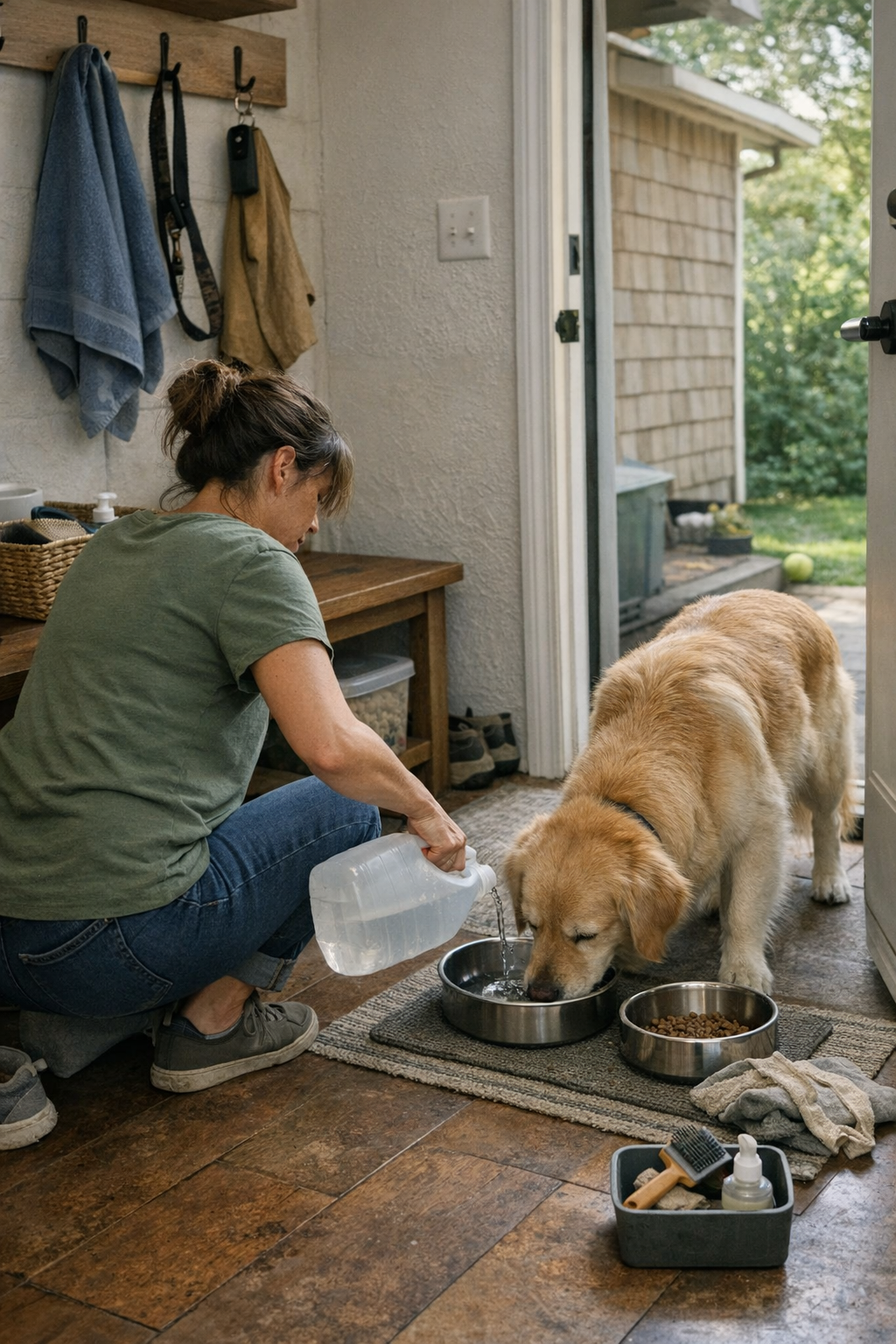
    Function trumps the fresh-start feeling. Instead of constant resets, fix items where you use them: a towel always on the same hook near the door, a wipe bin anchored to the feeding shelf, the water jug left beside the sink. These habits cut down tool drift, and every return lands right where tomorrow will need it—sidestepping fresh friction before it starts.

    Hang the drying towel by the exit, every single use. Keep the food scoop in a cup at the bin edge, not hidden under “neat” stacks. After a week, you notice you’re searching less, stalling less, and spending less time backtracking. The visual difference is subtle; the functional difference is real—fewer delayed cleanups, fewer chores festering overnight.

    Reducing Friction: Habits Over Surface Order

    Practical calm follows one rule: put each essential back in its single, reachable spot. Skip the tidy shuffle—make visibility and grab-ability the priority. Wipes by the bowls, brushes at arm’s reach, towels where paws actually enter the door. It’s the everyday returns, not the once-a-week deep clean, that actually reduce cleanup delays and keep messes contained.

    If you find yourself repeatedly “fixing” a setup—rewinding your steps after feeding, retracing for a missing tool, or dreading the late-night reset—pause. Look for what’s consistently out of reach or always migrating away from the action. Strong setups aren’t just tidy after hours of cleaning; they survive the randomness of daily care because the essentials never wander far.

    True calm isn’t about spotless surfaces—it’s when routines tackle most of themselves, and the real work stays minor day after day.

    See setups that prioritize daily reach and routine flow at CalmPetSupply.
  • Managing Indoor Cat Toys: Balancing Play and Clutter in Shared Spaces

    If you keep tripping over cat toys in the hallway or fishing a wand from behind the fridge just before bed, you’re not alone. Managing toys for indoor cats quietly shapes your day in ways you notice most during the worst moments: a crinkle ball wedged right in front of the food bowl when you’re just trying to refill water, or a pile of plush mice left in the walkway after a late-night cleaning sprint. These aren’t dramatic crises, but tiny friction points—a morning derailed by cleanup, a hidden toy blocking your fast sweep, a play zone that leaks into every other corner you need uncluttered. Over weeks, routine upsets like these add up, and what started as a small mess becomes a repeated hassle. Every cat owner reaches a point where keeping enough toys out for play turns into keeping themselves caught in a cycle of endless retrieval, stray clutter, and routines that never quite stay set.

    The Slow Creep: How Toy Setups Turn Into Traps

    Letting toys roam free feels simple—at first. One open basket, a few favorites scattered around, and for a few days, it almost works. Then the patterns settle in:

    • The same stuffed fish slides behind the couch after every play session—and pulling it out means moving the sofa again.
    • Plastic balls collect under the radiator, out of reach unless you’re willing to crawl or tip furniture.
    • A wand toy is always just far enough under a chair leg to demand an awkward crouch—not a disaster, just a slow drain.

    Individually, none of these is much. But stack them on top of 6 a.m. routines, unplanned guest visits, or a mad dash to tidy before dinner, and each misplaced toy becomes a fresh interruption. Tidy in theory is not tidy in practice—especially after a week of cat-life cycles.

    Why Less Isn’t Always Less—And More Isn’t Always More

    Your cat finds favorites: a certain wand, a small plush, the feather that somehow becomes territory. But the more toys stay out, the faster they migrate to exactly the wrong places. The problem isn’t just what you see; it’s what you keep having to move:

    • Cat toys in feeding, water, or litter areas turn a fast reset into a multi-step process—now you move a ball before you can refill a bowl or sweep up the litter scatter.
    • Toys end up crowding rest spots, transforming what should be a quiet nap space into a messy catchall—so a cat’s comfort zone becomes part play-pen, part obstacle course.
    • Worst of all, you stop noticing until you step on one at night, or grab a broom only to find the floor blocked—again.

    The invisible pattern: left unchecked, open-access toys quietly undermine your routine, bleeding play clutter into every shared home zone. And unlike litter tracked onto a mat or a water spill under the bowl (handled once and gone), stray toys return day after day.

    Rotation vs. Open Access: Does a Predictable System Help?

    All-in vs. steady rotation isn’t about preference—it’s about what eventually breaks down and what keeps you going. If every toy is out all the time, resets get slower, and cleaning sidetracks multiply. By deliberately limiting toys in circulation and swapping them on a schedule, the chaos doesn’t just look smaller—it actually feels lighter. Here’s where it shows:

    • Open Access: At first, tidying up means tossing everything in the basket. But every week, strays reappear, and each cleaning takes longer than last time.
    • Rotation: Two or three toys out, swapped every few days means less to trip over, less to retrieve from under furniture, and cleanup that becomes predictable rather than urgent.

    Your floorplan dictates some of this. In a small apartment, the difference between a scatter zone and a set zone is immediate; even larger homes develop blind spots where toys pile up until the next full sweep. Either way, the weak point is revealed when you’re forced to clean in a hurry—or when an unexpected guest makes the disorder impossible to ignore.

    Recognizing Trouble: Signals You’re Due for a Change

    Repeated friction sends warnings, even if routine makes them easy to miss. These are the common signals that your toy handling isn’t working:

    • You can’t swap water bowls or pick up litter without moving stray toys out of the way.
    • Ball toys sneak against window ledges, interfering with the one jump path your cat uses every morning.
    • Cleanup takes twice as long—not from actual dirt, but because toys have to be relocated before wiping or vacuuming can start.
    • Toys migrate into storage areas meant for grooming gear, or under laundry baskets—sparking those inconvenient scavenger hunts during already busy routines.

    If you keep pausing to move a toy out of reach or rearrange play items in the middle of ordinary chores, the system isn’t helping—it’s quietly sabotaging your routine.

    Containment Doesn’t Mean Banishment: Resetting Without Losing Play

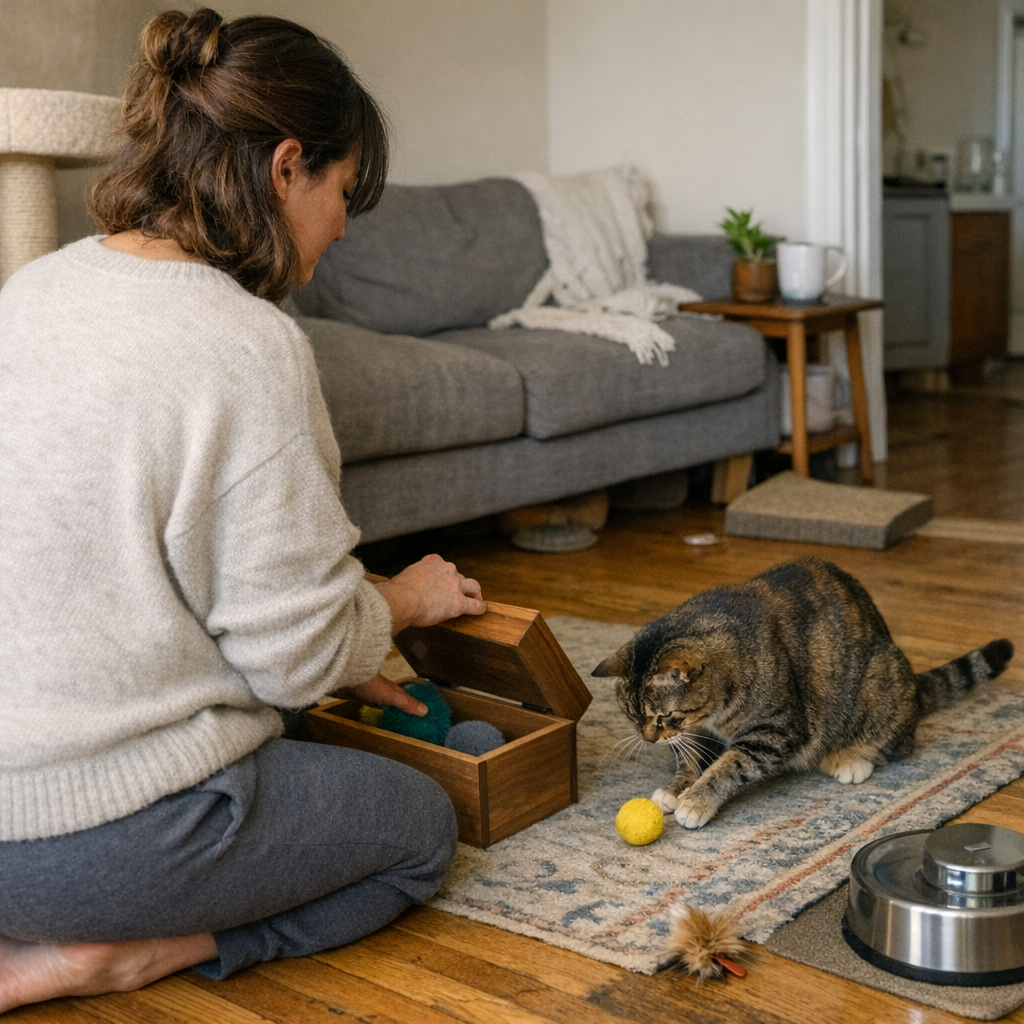
    What’s worked for other frustrated cat owners? Move from an open basket to a closed bin or box, limiting access to two or three toys at a time and rotating the rest in every three to seven days. This structure:

    • Keeps play interesting by letting toys regain novelty on reentry.
    • Makes resets predictable—what’s out, what’s away, where stray toys belong at the end of the day.
    • Means “lost” toys (under tables, behind chairs) crop up less and, if they do, require far less effort to keep in check.

    The visible order is only half the effect. The deeper improvement is the shift in your daily minutes—retrievals drop, interruptions shrink, and you can actually finish your routine without surprise kneeling or sudden detours. Toy management isn’t about making things look perfect; it’s about not letting play create new friction in every routine reset.

    A Measurable Difference: One Real-World Detail

    Take the felt ball that always settles beneath the dining set. Previously, you’d be on your knees prying it out almost every day—a pause, a reach, an awkward head bump. Once you limit toys in circulation and start rotations, that same ball needs rescuing maybe every few days, sometimes only once per week. The surface looks a little better, but your day feels much lighter—because you’ve taken out a repeat burden without losing play value.

    Pacing the Rotation: How Often To Swap Toys

    Rotating toys every three to seven days gives most indoor cats a balance between novelty and comfort. It’s enough time for a toy to feel familiar and for your cat to miss it by the time it reemerges.

    • If your cat ignores a toy, tuck it away for a week or two before bringing it back—cycling prevents toys from becoming invisible clutter.
    • Skip the urge to buy new toys every time interest dips—familiar favorites resurface as novel during the next routine swap.

    This cuts urgent cleanup moments and reduces the pressure to constantly expand the toy collection. Most cats build favorites through repeated exposure, not constant novelty.

    Finding the Balance in Shared Spaces

    In rooms that get double use—where your cat’s “zone” shares space with your eating, working, or passing through—the cost of toy overflow goes up fast. Too many toys in a small space clog paths, overlap with feeding and litter routines, and increase unexpected, recurring cleanup. The fix isn’t less play; it’s more structured containment: closed boxes, fewer toys visible, reliable rotations, and clear zone boundaries.

    Watch for silent creep: a favored resting mat drifting into food prep area, a pile of toys blocking the hallway, or a cat ball always under your desk chair. Each signals cleanup pressure and demand a system fix, not just another quick tidy.

    When Setups Seem Fixed But Trouble Returns

    The tidy basket solution is seductive, but often short-lived. You clean, sort, and for a day or two—maybe even a week—everything appears in place. Then routines crack: old retrievals return, stray toys slip back into weak spots, and you’re kneeling on the hard floor for the third time before breakfast. This gap between “organized” and “repeat-proof” reveals why most setups falter under steady home use, even when they look fine at a glance.

    Every routine exposes the real structure—especially with indoor cats who test every edge and return clutter to the same high-friction spots. The right containment can’t banish play, but it can shave hidden minutes off the places where your patience and your floor plan keep colliding.

    If your routines keep circling back to the same toy traps, it’s time to upgrade your system—for less retrieval, less cleanup drag, and smoother resets. See real-world

  • Understanding Dog Walk Pauses to Restore Calm and Flow in Routines

    The problem isn’t the drama you expect—a yanked leash, a sudden dog detour. It’s the grind of small frictions stacked into every walk. You grab the leash expecting a reset, but end up bumping into the same old hang-ups: leash knotted around the treat pouch, cleanup bags lost under the keys, the towel just out of reach right after muddy paws hit the floor. These aren’t one-off annoyances—they’re repeated signals your setup isn’t working as well as it looks. And if you walk often, those signals don’t fade. They accumulate, turning “routine” into another source of tension, with each misstep reminding you nothing is as ready-to-use as it should be in a DogPile day.

    The Everyday Walk: Where Routine Runs Into Micro-Issues

    No walk is ever truly effortless. The plan: leash, bag, door, done. Reality: you clip the leash but the roll of bags is jammed tight, the treat pouch dangles and catches, the dog tries to bolt before you’re set. That first confident step gets jammed up when the same corner always triggers a stop, the curb generates another delay, or a side-street patch of grass becomes non-negotiable territory. If you’re rushing before work, these routine stalls cost real minutes and patience—especially when the point of the walk was to make the morning flow smoother, not slower.

    The frustration isn’t a single stall but a loop—each pause triggering a series of tiny corrections: leash goes taut, you tug, the dog hesitates harder, your stride falls out of rhythm. It’s almost never dramatic. But the low-level disconnect grows walk after walk, and you get back inside tenser than when you left. Even a short outing leaves traces: your dog acts restless, takes too long to settle, cues you for help instead of resting, and suddenly the door isn’t the end of the walk friction—it’s where it morphs into indoor interruption.

    Noticing the First Signs: Glances, Pauses, and Stubborn Spots

    Every owner sees it eventually. The slow turn of the head, the loiter at a familiar gate, the set of paws at the edge of a sidewalk slab. It happens in the same place, again and again—a kind of waypoint your dog almost dares you to ignore. The easy reflex is to dismiss it as stalling, tighten the leash, and try to push through. But every micro-correction creates its own cycle: nudge, stall, pull, repeat. The walk, in practice, turns into a string of friction points—a negotiation that leaves both of you less settled than before you left.

    Overlook enough of these “minor” signals and you’re not just dealing with dawdling—you’re stuck in a loop. The leash is tense, your pockets are reorganized mid-walk, and neither you nor your dog gets the smooth return to normal you wanted. If the same weak spot shows up every block or two, it’s not just habit—it’s structure calling out for a tweak.

    Scene from a Real Walk

    Early morning, leash in hand, you set off with the best of intentions. But midway down the street, your dog brakes at the same yard edge, sniffs, drags feet. You’re tight on time, so you pull gently, hoping to move along. The dog resists, then finally follows, but the rhythm is broken. Now you’re watching for the next slow zone—and finding your mind rehearsing the same correction steps before each corner. By the time you’re back, instead of being ready for what’s next, you’re retracing the sticky parts of the walk and prepping for more friction at the next transition—wiping paws with the misplaced towel, moving bowls so you don’t trip, regrouping for another try tomorrow.

    The Ripple Effect: How Minor Friction Multiplies

    One chopped-up walk isn’t the problem. The real cost comes when micro-friction follows you inside. Your dog circles the water bowl, delays settling, re-charges with more energy instead of winding down. What should be the calm reset after a walk flares up into more routines—clean up, settle, re-cue—that strain the rest of your morning.

    The invisible thread: a missed leash adjustment at the curb leads to fumbled entry, then to a tangle in the hallway, then to a messy water bowl zone. You feel the tension accumulate in every after-walk move, not just during the outing. When a walk is choppy, everything downstream tends to get sticky—resetting takes more effort, and the day keeps echoing with tiny interruptions you didn’t sign up for.

    Stalled or Sticky? Recognizing When Your Walk Structure Needs a Tweak

    The test isn’t whether your stuff looks organized. It’s whether you can get what you need—leash, wipes, towels, treats, bags—exactly when you need them, setup after setup, even as routines change. When the leash is blocked by a forgotten jacket, when wipes vanish after muddy paws streak in, when you reach for a bowl and have to push toys aside, you know your dog-life structure is all display and no real function. Even a neat-looking area trips you up if a single item is never truly at hand, or if every new day exposes the same old routine drag.

    Patterns matter more than appearances. Bowls lined by the door but blocking access, toys neatly stacked right where you need to pass, a rest corner that looks inviting but sits in a high-traffic splice between rooms—these choices seem smart until you actually run through the dog’s routine more than once. If it slows you, interrupts you, or makes you reshuffle every day, it’s not working—no matter how “organized” it seemed at first glance.

    What “Working” Looks Like—and Where Setup Fails

    Most routines stall in the split-second an item isn’t where you need it. Maybe you fix one thing—hang the leash by the door—but the towel is still in the wrong room, or the treats migrate under the table. A setup that looks under control on Sunday night collapses by Wednesday afternoon. You’re faced with small, repeat failures: stretching for a cleanup towel that’s never close, tripping over a water bowl in the doorway, pulling a leash only to find it tangled or blocked by a crate edge. The surface says ‘ready’, but the friction is constant—and always shows up when you’re least able to deal with it cleanly.

    Small Adjustments, Noticeable Results: Changing the Walk Flow

    A good dog routine doesn’t fix itself with repetition. It changes the moment you notice which friction point drives you up the wall and do one thing about it. See your dog pause at a known slow zone? Give an extra leash’s slack for just a moment. Instead of pushing, wait out a few seconds—often a small shift settles the tension before it grows, and the next patch actually flows. The difference is easy to spot over a few outings: less tug-of-war, lighter steps, fewer “do I have everything?” scrambles.

    No, it won’t rewrite your whole week. You’ll still face a frantic morning or a botched handoff when routines collide. But you’ll spot the snag earlier, cut off the correction cycles before they tangle into a full standstill. Over days, these mini-fixes add up—fewer arm yanks, steadier leash, easier re-entry, less pacing after the walk. The shift isn’t just physical; it’s the end of wasted energy on hidden stress points that keep coming back unless addressed where they start.

    Real-World Benefits—But Not Perfection

    Expect setbacks. Some days, the old weak spot returns—the wrong corner, the blocked entry, the towel missing again. But the friction is new: it stands out, it’s easier to spot and interrupt, and it stops dominating the whole routine. You spend more time resetting, less time correcting, and the cost of ignoring a setup flaw becomes impossible to shrug off. One practiced adjustment means the week doesn’t get away from you with the same slow flow of repeated mistakes.

    The Walk’s Impact on the Entire Routine

    Every setup you use—leash at the door, towels in the entryway, water in reach—is multiplied in dog-life. A smooth walk transition means easier paws to wipe, calmer bowl time, straighter path to rest, and less time hunting for missing supplies in the middle of a jammed flow. When essentials are ready, and hesitations are met with quick access rather than tension, the after-walk routine finally gets easier instead of trickier. But when weak points repeat, they bleed across your whole schedule—the difference between a streamlined flow and a low-level drag that never quite clears no matter how hard you try.

    The fix isn’t a top-to-bottom overhaul. You don’t have to move every bin, add more gear, or retrain every slow spot. It’s about targeting the one friction point that keeps showing up—reaching for a leash that’s always tangled, scrambling for a towel in the wrong room, shuffling bowls you can’t step past, or tripping over toys at the threshold. The best tweaks are almost always small, structural, and low-drama—a cleanup pouch where you actually need it, supplies by the door for real, not just for show. Every step that becomes frictionless under repeated use pays off all day long.

  • How Pet Movement Reveals Hidden Flaws in Travel Organizers

    Even the most carefully packed pet-travel bag—pockets filled, zippers zipped, leash clipped and bowls nested—rarely survives the first real-world trip without trouble. What starts as an organized, seat-side setup crumbles fast when a dog lunges to see out the window or a cat shifts to curl up. Suddenly, the “ready” bag blocks the one thing you actually need: wipes jammed behind the carrier, treats buried under a twisted strap, or the leash tangled just as you reach for it. Functional in theory doesn’t mean reachable in motion—and the difference becomes impossible to ignore in the first few stops.

    The Surprise Friction of a “Prepared” Pet-Travel Bag

    Most pet owners have played out the same routine: load supplies, tuck the bag near the seat, drive off feeling ahead of the mess. But after one or two quick stops, cracks show. The neat loops and sections blur—leash clips not only tangle with bowl handles, but the bowl slides and lodges awkwardly against another pouch. Cleanup wipes, easy to spot when parked, get lost behind shifting carriers or blocked by a comfort blanket that slid out of position. What looked accessible suddenly requires a stretch, an awkward reach, or a partial unload just to fish out a single item.

    This isn’t about mess alone. It’s about seat-side decision flow: can you, one hand on the pet, snatch the right wipe or treat while half-turned out of the car, or does every small movement spiral into a search-and-reset? If your cleanup or comfort item takes more than a few seconds to locate after a stop, interruption becomes the baseline. That’s real friction—when ordinary moments, like letting your dog glance at traffic, lock you into a routine-slowing scramble.

    What Looks Neat at First, Stalls in Real Time

    Pet travel exposes hidden weak points quickly. You pop the bag for a leash—only to find it snarled with treat pouches, or shoved under a blanket now blocking the opening. Bowls wedge against the corner with every red light. Cleanup bags positioned “within easy reach” slide down to the seat edge, now blocked by the carrier’s bulk. In practice, every time you shift attention to your pet, items slip and stack. You waste seconds on the wrong pouch, miss the wipe you saw earlier, or knock items loose in a quick grab. By the third short stop, these wasted beats—not visible mess—add up to real irritation and longer cleanup chores. Suddenly, the whole setup feels like it’s working against you, not for you.

    The real breakdown isn’t visible clutter. It’s stalled access—when reaching for one item means shuffling through two others, or working around a handle stuck in the zipper seam, just because the pet or the road made your bag shift in place.

    Allow Your Pet Freedom—But Expose Weak Points Early

    Locking a pet in one spot can make travel easier for the bag, but not for the animal. Most setups break down exactly when you grant your pet normal freedom: letting a dog turn to watch a passing cyclist or a cat circle to get comfortable. Flexibility is good for the pet—and brutal on bad bag setups. Repeated test: every time your pet moves, does a clip, loop, or bulked-up corner suddenly block the tool or treat you always need at stops?

    • Leash clips twist into bowl handles each time your pet shifts direction.
    • Bowls slide beneath pouches or into the seat crack after a sharp turn or stop.
    • Handles snag cleanup-bag zippers, or catch the seatbelt anchor, so nothing opens smoothly when you’re in a hurry.

    Over time, the “almost organized” kit becomes a stubborn obstacle course. Fumbling for wipes takes longer, soothing items clash with access, and the tiniest misalignments after a single pet movement snowball into real, repeated slowdowns.

    Why Shared Access Zones Cause Ongoing Trouble

    Shared zones—where everything converges near bag openings or seat edges—are where most travel kits break down. If wipes, bowls, leashes, and baggies compete for one grab-spot, friction is guaranteed. Organized still photos mean little if, in motion, a bowl handle blocks the treat pocket, or a leash ring jams the main zipper. Each overlap isn’t just a nuisance; it’s a multiplying frustration during the only moments when fast, single-handed access is critical.

    The real pain shows at restarts: returning to the car, trying to settle your pet, reach a wipe, or reclaim a leash. Instead, you’re hit with a hard block—a bowl wedged over the opening, a pouch caught on the seat edge, or a stiff handle pressing against the door. Resetting the bag creeps from quick routine to a multi-minute chore. Visual tidiness hides the fact that every “easy-reach” now sits behind another object, and the confidence from that neat packing is gone.

    Adapting Your Setup for Flow—Not Just Order

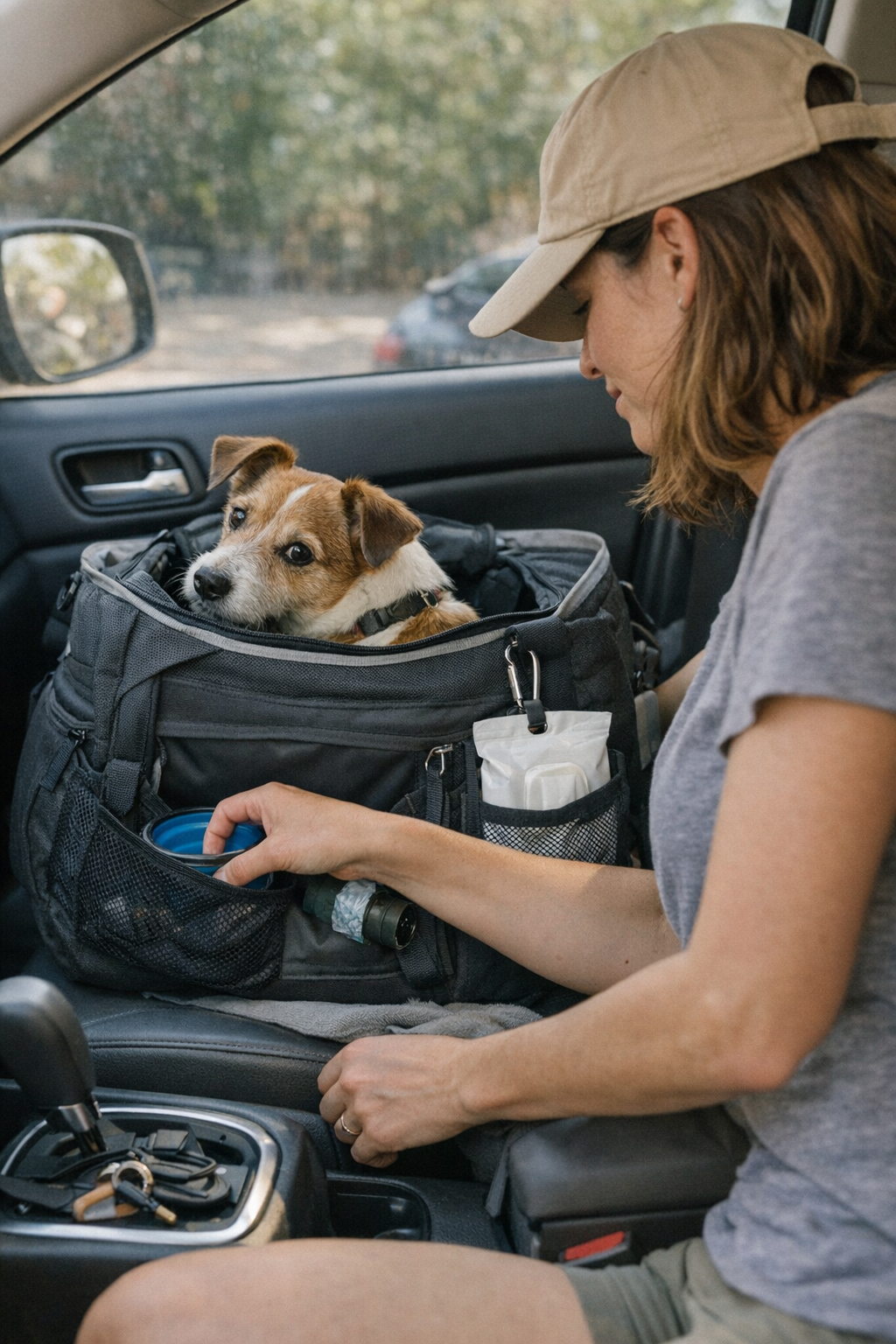
    After enough clumsy stop-and-go cycles, most pet travelers make real changes. For me, that meant yanking bowls from inside to a mesh side pocket, hanging wipes to a seat-side anchor where I could grab them with eyes never leaving the pet, and stripping the carrier entry to the single leash anchor. The actual difference didn’t show in photos—it showed in how quickly I could grab the needed item after my dog shifted for the third time in twenty minutes.

    When wipes aren’t buried, you reach and go—no stall, no second-guessing the pouch. If bowls live outside the main zipper, no more accidental blockages from sliding handles. Cleanup zones get their own side, leash clips never cross over with comfort pouches. The end result isn’t a prettier bag, but a travel kit that returns to ready after every stop, not just the first one.

    Practical Signs Your Pet-Travel Setup Needs Reworking

    • You start by opening one section but end up finding what you actually need elsewhere.
    • Cleanup wipes and bags are present, but never in reach at the most urgent moments.
    • A calming blanket or comfort item causes jams or clogs the route to quick access items.
    • Pet and owner supplies blend—with water bottles, keys, or phones slowing your ability to restart after stops.
    • The bag looks more organized than last trip, but you’re still forced to reshuffle or pause at every stop.

    How to Organize for Real-World Movement

    On the road, function exposes flaws that packed photos don’t. The strongest setups keep job-specific “lanes” open: wipes fastened where you find them blind, bowls stowed away from entrance points, leashes anchored out of the main traffic zone. Exterior loops, side-mounted pockets, and segmented carriers aren’t just decoration—they mark the difference between a three-minute reset and another frustrating seat-side search. Every repeated use spotlights the “choke points” in your kit—if you’re slowed by the same overlap twice, it’s clear packing order doesn’t equal actual travel flow. Watch for which tool actually holds up under repeated movement, and rework the layout to suit stops, not just departures.

    Find practical, field-tested solutions at PawGoTravel.

  • Why Carry-On Organization Often Fails During Flight Landings

    Every regular traveler recognizes the moment: crew announces descent, and your carry-on’s “organized” look evaporates into friction. What was a squared-away bag in the overhead now feels slow and clumsy under pressure—passport out of reach, charger knotted under layers, customs form buried deeper than you thought. Neat sorting at packing-time doesn’t protect you from the mess of actual travel: when retrieval means disturbing half your setup, organization isn’t working where it matters most—in the seat, in line, and on repeat.

    The Calm of Packing Versus the Rush of Landing

    Laying out pouches and cubes on a hotel bed feels precise—every item nested, zipped, decided. But the environment flips as soon as descent begins: trays up, elbows in, documents and devices due for stowage. Suddenly, you’re stuck balancing on a cramped seat, digging for the one item now needed first. Precision dissolves into a sequence of blocked zipper paths and awkward arm reaches. The “system” that looked impressive at rest jams under the real-time pressure of boarding announcements and tightening seatbelts.

    This is where most packing logic collapses. A bag made to look sorted doesn’t translate to fast, one-handed access squeezed by neighbors and crew. If a passport is two layers down or a pen requires dislodging two pouches, your ideal setup is in the way. Organization that only works lying flat on a bed fails the test of in-transit reach, especially when the clock and aisle keep moving.

    When Neat Packing Becomes Unusable Mid-Flight

    On the outside, a carry-on stacked with cubes and pouches signals readiness. But repeat flights expose what actually breaks: essentials shuffled under low-priority gear, zippers that snag, or the creeping realization you’re spending too many seconds on a single retrieval. Patterns emerge: the same stress at each landing, documents misplaced, muscle-memory plans forgotten mid-air. Mystery pockets become wasted time as tactile shortcuts vanish in a pressurized cabin.

    • Blocked Zippers: Overlapping or swollen pouches make smooth, single-handed pulls nearly impossible; you’re left twisting and tugging with little space.
    • Buried Essentials: Each new addition pushes urgent items—boarding passes, cables—down the pile, demanding partial unpacking for every check.
    • Partial Unpacking: A rush for a pen or form means extracting layers, balancing pouches on your knees, and hoping turbulence or a neighbor’s elbow doesn’t reset your whole stack.
    • Confused Retrieval: Long flights bluff memory; labeling fails, and you open two, three, sometimes four pouches before finding the right slip of paper or charging cord.

    These aren’t “bad luck.” They’re the result of setups built for visual order, not repeated, stressful access under movement and noise.

    The Stress Loop: How Access Delays Multiply

    Every snag inside a crowded aisle or during a customs line turns seconds into stress. Drop a form or tangle a charging cable, and you’re not just late; you’re holding up an impatient queue, re-packing with one eye on the clearing row, maybe nudging someone else’s bag to keep your own gear from spilling further. What looked like a minor hassle at the gate becomes a drag on your whole airport routine—especially after a long haul or tight connection, when even small interruptions compound into a habit of panicked checking and rushed repacking.

    • One passport slip under stuffed organizers can mean your entire bag threatens collapse as you grope for the right pouch, risking an avalanche of gear on a stranger’s foot.
    • Needing a single item urgently but finding it packed “for later” forces repeat overhead-bin lifts, crowding the aisle and spiking frustration on both sides.
    • Returning a cable or form turns into a pouch shuffle that will have to be repeated again at the next security checkpoint.

    Each struggle injects friction into your movements, turning orderly packing into a travel routine interrupted by its own design. The more steps each retrieval requires, the more likely the next one will be slower, messier, and more public.

    Look Organized, Function Slow: Where Visual Order Fails

    A setup that looks ready on Instagram often resists you in-flight. Stacked cubes and layered pouches keep a bag photo-tidy, but when the need for speed arrives, they block motion and stall quick checks. The gear praised for “order” often causes the slowest reach for the very items used most on planes: travel docs, pens, boarding passes, small tech.

    As retrieval slows, repacking gets sloppier: the careful system breaks down, turning order into surface resemblance only. Missed items, lost pens, or scrambled forms become more likely with each rushed moment—especially in boarding and deplaning shuffles. The cycle is visible: packing order returns visually, but flow decays. The neat look intensifies the underlying dysfunction every time you need to move fast.

    How Small Layout Tweaks Change the Landing Routine

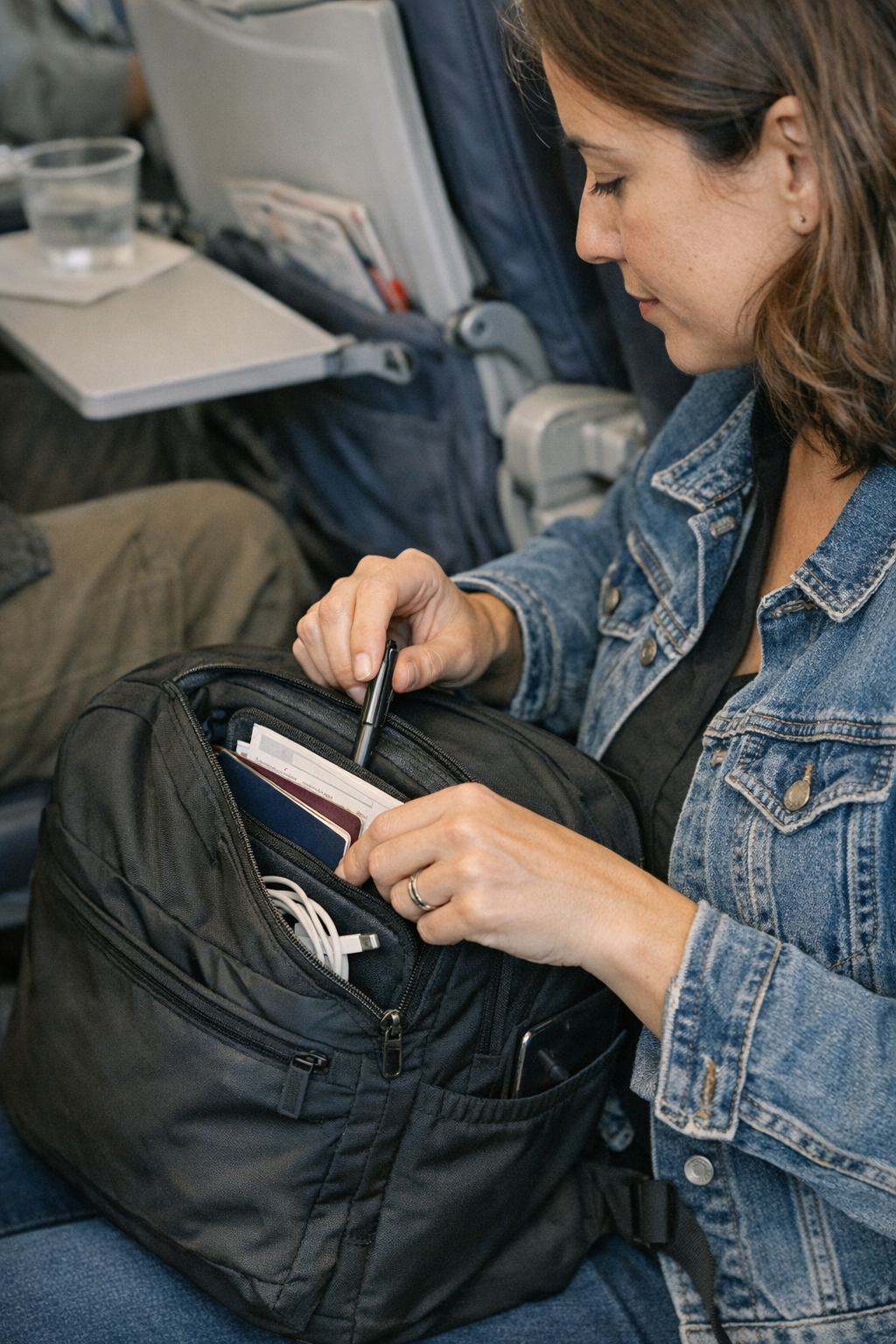
    One fix shifts everything: keep travel essentials in a slim, always-accessible outer pouch. Don’t store high-priority items (passport, pen, forms, quick-access cable) under deeper organizers. Instead, create a pocket—external, seatback-ready, or just outside the main compartment—so you never unpack for a routine check or crew request.

    • Passport and travel documents should be reachable without disturbing anything else.
    • Keep a pen visible and untangled.
    • Place customs forms or medical cards where they slide out instantly with one hand.
    • A single short cable or charger should be as accessible as a boarding pass, not layered inside gear cubes.

    This adjustment removes forced unpacking and layered searches from boarding to arrival. The essentials pouch stands between you and a spiral of unpacking; it can hang in the seatback or ride the outer zip for easy, one-move retrieval—usually in 30 seconds or less. Old patterns—unlayering, digging, frenzied repacking—fall to the side, replaced by a sequence you actually control even when tired, crammed, or pressed by announcements.

    Real-World Impact: The Difference After Dozens of Flights

    No setup kills friction for good, but this structural change cuts out most of the repeated drag. Essentials in a slim, outermost pouch enable:

    • Stowing devices, prepping customs forms, or flashing ID without turmoil, delays, or upending your packing.
    • Moving smoothly through the aisle or staying clear of seat neighbors when demand for space spikes.
    • Fewer missed items, abandoned pens, or customs delays even after brutal overnight legs or last-minute reboarding.

    The biggest difference isn’t perfection—it’s in clearing away the interruptions that used to define the whole landing sequence. Instead of juggling or restarting every thirty minutes, you maintain a flow that keeps its shape across real-world travel. What once looked “organized” now acts organized, with less repeated stress and less time lost in every transition.

    The Practical Takeaway: Movement Over Appearance

    Most carry-on friction repeats because the wrong things are made easy and the right things are left buried. The best system isn’t necessarily the best-looking; it’s the one that lets you move, check, and stash with no forced resets in crowded, moving environments. Shifting high-frequency items into a quick-access zone does more to lower cumulative stress than any number of labeled cubes or extra pockets. Organization isn’t a goal for its own sake—it’s a tool for faster, smoother travel between security, seat, and arrival. If your bag keeps interrupting your movement, it’s showing you exactly where the next layout tweak should land.

    See more practical carry-on solutions at CarryOnSupply.

  • Ensuring Reliable Bathroom Lighting That Withstands Daily Steam Exposure

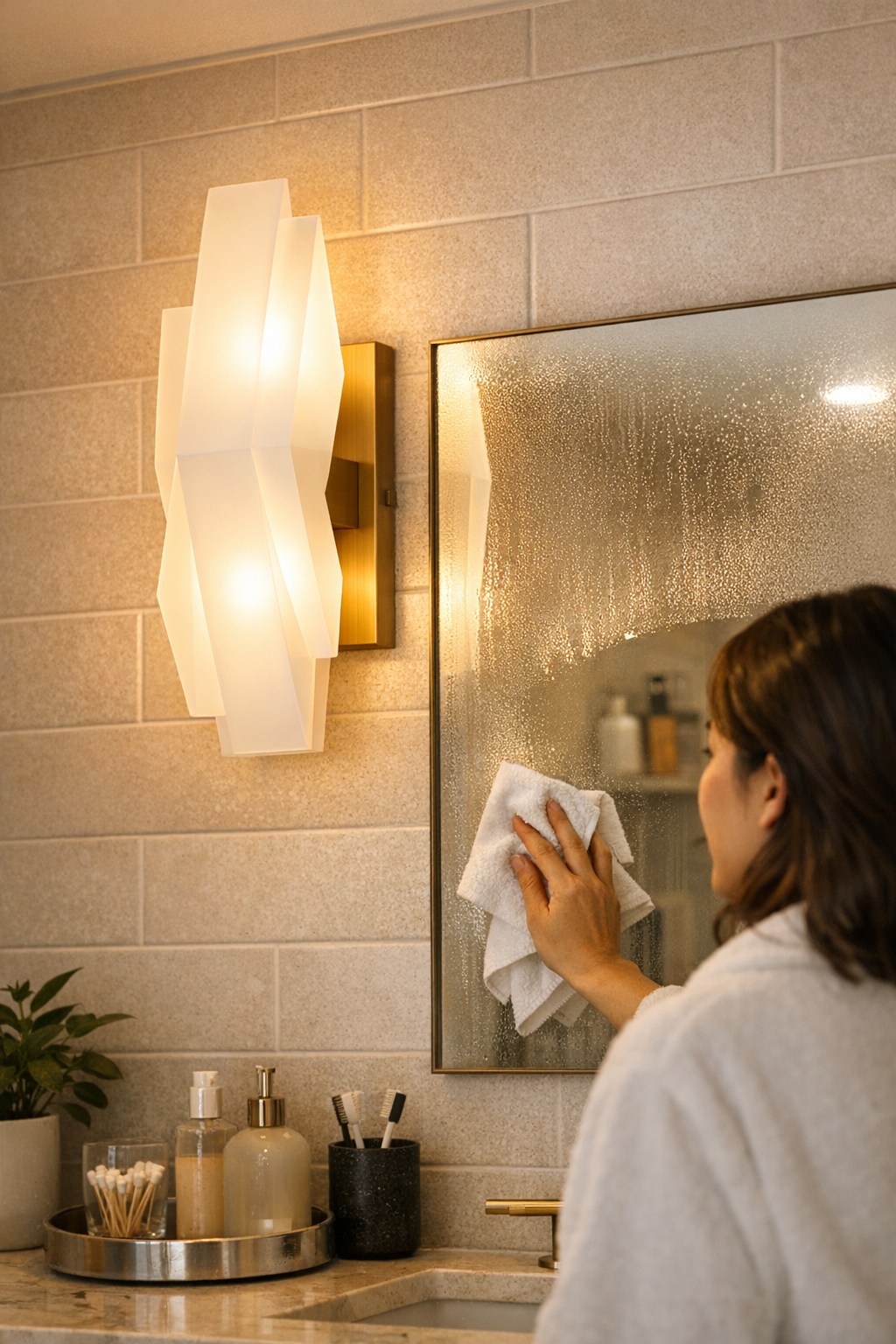
    Every “damp rated” bathroom fixture looks like a solution—until daily steam routines expose the missed details. The mirror’s edge blurs, the lens fogs from beneath, and corners lose definition right where you’re trying to shave or read. The box claimed reliability, but the real test isn’t the first week—it’s the fifteenth morning you’re wiping water from a supposed upgrade and still hunting for clarity at the edges.

    When “Damp Rated” Isn’t Enough in the Real World

    Most “bathroom approved” lights carry an implied promise: install once, forget the problem. But as steam finds its way along every seam and bracket, the compromise becomes obvious. Forget the catalog-perfect center glare—the friction lives at the fog-prone edge, the dim patch above the sink, or the silent drip where a cable meets tile. If normal routines now involve extra wiping, squinting to catch detail, or missing the quick clean hit of light across the mirror, then the setup isn’t holding up under real use.

    Everyday Frustrations That Signal a Deeper Issue

    Small irritations stack fast: fog creeps behind the lens, an edge flickers on a rushed morning, or you catch the first sign of corrosion at a half-covered cable entry. A fixture that looked “right” on paper turns into a repeated nuisance—forcing you to adjust your routine, shift for task light, and wish you’d checked for better mounting. These aren’t style imperfections; they become daily penalties for missing the right support logic.

    How Real-World Steam Cycles Expose Weaknesses

    Steam skips past labels. A bracket that seemed flush now shows a thin fog track by the mounting plate. Cable runs that sat tight on day one become moisture channels. Light that once spread evenly now draws shadows at the mirror edge or a dull haze on shelves. The core question isn’t “is it damp-rated” but “does it actually block steam from reaching the wiring and seams after weeks of routines?” A fixture failing this test leaves you with missed corners, inconsistent brightness, and visible weaknesses right at peak routine hour.

    Real bathroom lighting support isn’t defined by claims. It’s measured by whether visibility stays sharp after daily hot showers—and whether you find yourself reaching for a stronger bulb or just wishing for steadier light along the walls and glass.

    The Telltale Signs of a Setup That’s Failing

    • Mirror fogging and blurred details even after the fan clears the air
    • Moisture streaks or haze visible inside a lens—sometimes trapped for days
    • Corners and shelf edges that remain dull, making details disappear
    • Pitting or rust at cable inlets, bracket seams, or wall interfaces

    Each is a signal that cable paths, bracket coverage, or mounting logic let real-world humidity win out over “approved” sticker comfort.

    What Actually Works: Tight Mounting, Sealed Cable Routes, Real-World Ratings

    Lasting improvement starts with setups made for steam’s persistence. High-performing bathroom fixtures aren’t just sealed—they physically close off gaps at every stress point:

    • Gasketed backplates block moisture where the fixture touches the wall, so steam never crosses into wiring.
    • Brackets that set completely flush prevent subtle sag or mounting flex—so cables and seams don’t open up after repeated cycles.
    • Fully routed and covered cable entry keeps each cable run tight to the wall groove, leaving no exposed track for drift or condensation.

    From Clean Appearance to Lasting Clarity

    The visible difference doesn’t show on install day but after daily routines. After a run of showers, the right setup means no more mirror haze, no need to wipe down the lens, and—crucially—no dimming at the edges or shelving out of reach for light. Instead of increasing the wattage to fight fog, the support hardware keeps the coverage stable, the edges lit, and the hassle out of your routine. The true advantage isn’t more output, but fewer weak points—and the confidence that your setup won’t let small annoyances stack up over time.

    Real Bathroom Routines: Where Good Lighting Holds Up

    In a real hallway bathroom, it only takes a long weekend for weaknesses to show. A fixture mounted without full sealing leaves the vanity dimmed at the corners, storage shelves receding into indistinct shadow. Moisture routes through any open bracket slit or missed gasket slot, undermining the promise of the “right” label. Every attempt to compensate—angling for a clearer view, bumping up to a harsher bulb—shows another subtle flaw in the support logic.

    Set that against a bathroom where mounting, gasket, and cable choices seal out the steam: visibility holds, mirror edges stay crisp, routines move without fidgeting, and there’s no slow buildup of irritations. There’s no need to twist for brightness or track down water intrusion. The entire setup remains as even and usable as the day it was installed, because the structure keeps holding up—not just the style.

    Small Tips for Immediate Improvement

    • Check cable paths closely before installation: even a millimeter gap can turn into a constant fog point within weeks.
    • Mount brackets with no give; align flush with wall or tile so that steam has nowhere to enter and expand inside.
    • Select fixtures with full gasket coverage—don’t trust an “approved” label if you can see an open seam or entry slot.

    Seeing Past the Stickers: Choosing What Lasts

    Every fixture looks convincing on day one—but bathroom steam will call out every shortcut before week’s end. What matters is beneath the surface: whether mounting hardware, cable routing, and true sealing logic defend against the real-world cycles that test every bathroom. Lasting lighting isn’t about passing inspection; it’s about functional, repetitive comfort—corners that stay clear, edges that don’t haze, and surfaces that never need extra wiping just to stay usable.

    http://www.lightsupport.myshopify.com

  • How Light Floors Change Entryway Cleaning and Storage Dynamics

    A light entryway floor doesn’t hide the facts: every misstep, mud drop, and stray pebble shows immediately, turning the threshold into a daily challenge. The minute you cross the line, pale surfaces betray the pattern—grit clustered by the bench, thin tracks creeping along the door, yesterday’s soil left as proof of another rushed return. Even with steady cleaning, a bright entry never stays neutral. Everything you carry in writes itself across the floor, while salt marks—so obvious on dark flooring—quietly disappear here, only surfacing as ghosted streaks long after they’ve eaten into corners. The real obstacle isn’t aesthetics, but the way daily clutter quickly narrows the passage and forces you to reset the space before you can even pass through properly.

    Where Grit Gathers: The Immediate Reminder and the Hidden Fade

    On a light floor, shoe dirt shouts for attention as soon as it lands. Every scuff and new dust pile makes itself known, triggering a reaction—a quick brush, a vacuum pass, a sigh that the cycle repeats. This isn’t sentimental: the mess builds in real-time, and the bright tones offer no room to ignore it. Meanwhile, salt stains—so aggressive on a dark entryway—just become soft blurs, visible only later, often ignored until you move the shoe rack and see the accumulation. Your choice in storage—open bench, rack, sealed cabinet—only shifts which mess remains in view and which accumulates invisibly, making every reset feel like a different kind of battle with the same debris.

    Open Benches: Appearing Controlled, Drifting Out of Sight

    Open benches and neatly lined shoes promise visible order in theory, but lose ground fast when life accelerates. Stand-up rows don’t stay put: boots tilt out, sneakers inch forward, and kids’ shoes fill gaps with sideways placement until the whole edge is a zigzag instead of a line. Every piece of dirt left behind becomes a mark you can’t not see. Bags, dropped for “just a minute,” multiply at the bench edge and rarely return to their hooks—gradually shrinking your walk path. It’s a clean look that turns into high-maintenance pressure: you notice the drift every time you squeeze past, but tidying feels constant, never finished.

    Closed Cabinets: Cleaner Surface, Quieter Buildup

    Shutting shoes behind a cabinet door creates surface calm, but lays the groundwork for surprise resets. Out of sight, sand and stones slip off footwear and gather where you don’t see them: in hinge grooves, under trays, hidden at the kickboard. Without visual reminders, cleaning lags behind accumulation, so the gritty layer builds until one day you slide out a pair of boots and step straight into the mess you forgot you brought in. Bag hooks inside can help with overflow, but any item that enters while still wet or sandy will quietly shed debris till you eventually confront the heavier reset you were avoiding.

    Real-Life Drop Zone Drift: How Fast Things Get Blocked

    Across a standard week, clutter doesn’t space itself out—it snowballs across the entry threshold. It takes only a couple of overlapping returns—two people home at once, or bags from errands dropped together—for a manageable shoe tray to spill over, with boots nudging out and sneakers bypassing the intended drop zone. On a light floor, you notice every misplaced item and feel every extra step needed just to carve out room to sit or pass. After one harried morning, the bench turns from a seat to a backup surface, paths squeeze, and soon you’re sidestepping an improvised obstacle course instead of entering your own home smoothly.

    When “Out of the Way” Just Means “Building Up”

    Piling bags in corners or forcing shoes into tight rows doesn’t solve the pinch—it shifts the block from visible to physical. A lunch bag placed “for now” remains for days, and by midweek, a single tote morphs into a stack that monopolizes the bench end or narrows the passage down to a single, awkward lane. Attempts to “organize” by stacking higher or squeezing tighter reveal what the setup won’t handle: repeated use tests the real capacity of the zone, and every pass-through gets slower as items pile in, making resets feel like big chores instead of habits you can keep up with.

    Pairing Storage: Finding a Realistic Balance

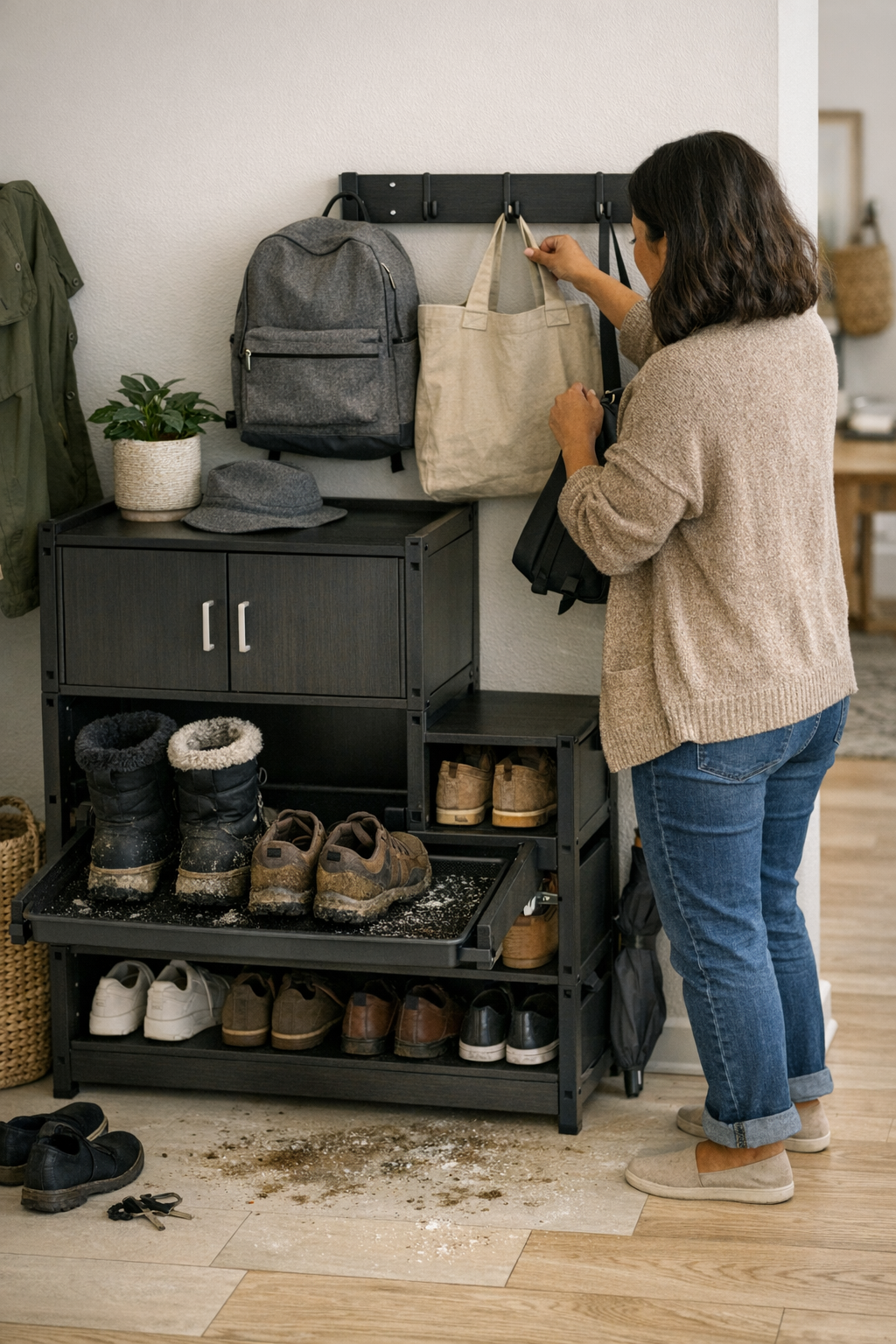
    Combining closed storage with targeted debris catch zones stops visible clutter from turning into invisible buildup. A mesh boot tray, set precisely at the drop point, pulls mud and grit off shoes before it can spread, shrinking the cleanup area immediately and cutting the urge for constant sweeping. Wall hooks set above or beside the bench prevent bag drift and free up floor space—the difference between a slow buildup and a pass-through that stays usable all week. This isn’t about pushing the mess out of view; it’s about rerouting the inevitable traces of return into points you can reset fast, with minimum effort and maximum reliability.

    The Ongoing Routine: What Stays, What Gets Stuck

    Light-floored entries require frequent, micro-cleanups—skip a few days, and you lose the zone. A quick brush or once-over with the vacuum is a daily ritual, not a deep weekend reset. For cabinets, treating the inside as a visible part of the floor and cleaning it once a week cuts down on surprise grit. Open benches make more sense when paired with a habit: every return, shift bags up onto their hooks and nudge shoes back into line before the mess multiplies. The point isn’t a perfect look, but a passage that doesn’t stall your day, no matter how many times you cross it.

    Smarter Storage = Smoother Returns (But Not Perfection)

    The strongest entryway setups for bright floors prioritize quick resets, clear path access, and flexible routines. Pairing trays and racks for visible, easy dirt containment with well-placed modular benches and wall hooks shrinks both scatter and slow buildup, side by side. The aim is not showroom perfection—it’s the difference between a daily reset you actually perform and a zone that slips back into full-block mode as soon as you look away. Entryway control is practical, always in motion, and only as smooth as the habits your storage quietly supports—not just the impression it makes when nobody’s at home.

    For practical entryway storage solutions that work with real routines, visit Betweenry.

  • How Reducing Shelf Items Creates Smoother Daily Storage Routines

    A shelf that looks “organized” from the hallway can quietly sabotage your daily routine. The lineup might appear efficient—books packed tight, baskets slotted in, every gap closed—but the real test comes at 7 p.m. when you try returning a library book or make room for incoming groceries. Suddenly, order breaks down: a line of books shoves back, pantry items balance on one another, the mail basket surges past its limit and starts swallowing car keys. The flaw isn’t always striking, but it’s constant: blocked return flows, awkward reshuffling, and edge spillover that slows everything from a quick exit to a tired evening reset. When “full” feels organized but actually jams daily use, you’re seeing a setup mistake that costs more time than visible mess ever does.

    When Shelving Gets Too Full for Daily Life

    A storage zone only works when it matches how things move in and out—not just how much it can display. The stress point appears when you try to put things back, not when you take them out. A jammed shelf means you’re wedging in folders, squeezing bowls behind jars, or hovering near a hallway stand debating whether it’s worth rearranging to fit a backpack. This isn’t dramatic, but it’s the reason a setup that seems sorted in the morning feels overloaded by night. Some clear examples:

    • A bookshelf crammed end to end—returning a single novel means tugging out a row or leaning books at unstable angles.
    • Pantry shelves packed to the edge—new groceries force you to juggle bags or push far-back containers deeper.
    • Entryway benches lined with bins—coats, mail, and random odds pile up until your keys disappear beneath the surface clutter.

    Each scenario is a repeated cost: the return flow stalls, every drop-off becomes a minor obstacle, and moments pile up as you move, wedge, or re-stack routine items. Shelving that’s technically organized transforms into a friction point that makes every reset feel like work.

    The Cost of Seeming Order: When Categories Blur and Routines Stall

    Visually neat shelves promise easy retrieval—but overfilled setups lose that edge quickly. The push to maximize space creates hidden choke points. Add a single oversized bowl or an extra batch of towels, and suddenly you’re shifting piles or shuffling stacks, sometimes just to make room for the next item. Over time, overflows creep to the front: pens land in key trays, socks drift onto linen shelves, and the “sorted” look slips as categories unravel.

    Category drift rarely explodes—it seeps in. The kitchen’s art drawer fills with paper scraps; “temporary” laundry ends up as a semi-permanent mound on a hallway bench. Sifting through random things to find what you actually need is the clearest sign that the system supports stuff, not you. The more categories blend, the more every grab-and-go turns into slow-motion rearranging.

    Active Zones, Repeated Tests: Why Shelf Breathing Room Makes a Difference

    You’ll spot the true cost of a packed shelf fastest in the busiest zones—where items cycle in and out multiple times daily:

    • Hallway bookshelves: Library books and mail compete for space; a single out-of-place binder sends the whole line drifting off axis, and the key dish slowly disappears beneath stray paper.
    • Kitchen storage: New groceries force quick Tetris—stacking, shifting, pushing containers out of easy reach—until food is forgotten at the back or jars tip when browsed.
    • Laundry setups: Detergent, baskets, cleaning supplies vie for shelf inches; laundry day begins with moving everything just to reach the basics—a routine that always adds steps.

    Each “reset” reveals whether a storage setup can handle a surge or if a single busy afternoon starts the domino effect of cleanup, rearrangement, and category drift. The more often you repeat the cycle, the more a shelf either supports or interrupts your real routine.

    Turning “Full” Into “Functional”: The Open Hand’s Width Rule

    The step from overstuffed to working shelving isn’t about becoming minimalist—it’s about creating buffer space. Clearing out just enough that every shelf has an open hand’s width toward the front transforms returns: items slide in without nudging neighbors, bags settle on pantry racks, mail slips easily into its tray on a busy morning. Usually, this means removing a third of densely packed contents—a reduction that feels almost wasteful but quickly proves its worth.

    Try this: pull out two platters you rarely use from a kitchen shelf. Suddenly, you can lift a pot on and off without causing a chain reaction of shifting pans. Whittle a hallway stand to just current school folders, and placing today’s mail no longer jams the space or knocks keys out of reach. The difference is tangible in every reset: you don’t need both hands free, extra balancing, or a “for now” pile that becomes next week’s clutter spot.

    Real-World Reset: Seeing the Benefits Over Time

    A shelf with visible breathing room might feel too bare on Monday. By Friday, it’s the setup that actually absorbs the week’s mess—books get moved, groceries cycle through, yet nothing requires major rearranging. Resetting—pushing items in line, shelving a pan after dinner—happens almost as a side effect, not a chore, because the structure allows recovery without making emptying or restacking a daily task. Category lines hold up longer, habits don’t slide, and minor disorder never turns into stalled routines.

    Buffer Space Isn’t Wasted—It’s What Makes Storage Work

    That open margin on a shelf feels wrong at first—especially if space is at a premium or you’re used to filling every inch. In use, though, that hand’s width is what rescues your routine on a busy morning, catches overflow before it blocks a path, and keeps the shelf from becoming a static storage trophy. Buffer space absorbs the unscheduled: sudden grocery runs, surprise stacks of paperwork, laundry that doesn’t happen until tomorrow. Rather than wasted territory, the margin is the flex point that allows repeated access without slowdowns, spillover, or reset fatigue.

    If you notice clutter seeping back, it’s rarely because the shelf is underused—it’s the cue that forgotten, misplaced, or out-of-category items have landed in the zone. The repair isn’t a full reset; it’s a rotation—pull a stray stack, send drifted items home, and reestablish the buffer. Storage works best when it mirrors how you actually use—and return—things in cycles, not how it looks during a one-time sort.

    Practical Tips for Reclaiming Shelf Performance

    • Remove items that don’t align with the shelf’s main job—the tray that never leaves the hallway, seasonal gear clogging a kitchen rack.
    • Each week, scan for items that have drifted in under “just for now” and move them out before they settle in permanently.
    • See open shelf space as functional, not wasted—a margin for tomorrow’s rush or next week’s unknown.
    • Spot places where you routinely stash things in transit; tweak the setup so those items have a better return point, or the layout naturally blocks long-term pile-up.

    The aim isn’t to make your shelves look empty, but to make them work—under pressure, across busy stretches, and through real-life cycles. It’s the shelf that stays easy to use, not just easy to photograph, that transforms daily order from a brief win into a lasting advantage.

    Explore practical storage that fits real routines at Gridry.

  • Why Flexible Cable Routing Improves Workflow and Reduces Desk Clutter

    If you’re starting every morning by dragging a power cord back onto the desk or untangling the same cluster of wires near your feet, it’s not just “clutter”—it’s an obstacle that keeps coming back. A desk might look spotless after a careful cable arrangement, but by Wednesday the friction wins: charger sliding out of reach, headset cable caught on the edge, plugs buried under a tray that’s supposed to tidy everything up. On a small desk, even one misplaced cable can push your keyboard forward, eat into notetaking space, or block your mouse. The setup might pass as organized, but every phone charge, device swap, or late-afternoon monitor shift exposes the gap between “looks fine” and “actually functions.” In real work, workstation order is constantly tested—not by mess, but by the simple motions that keep getting interrupted.

    Where “clean” cable setups break down in real work

    That chasing-after-perfect order breaks the moment you work for real. Hiding every cable in a box or squeezing all wires through a single tight sleeve promises a calm surface—but using the desk quickly reveals the trap. Unplug a laptop, add a monitor, or swap devices on the fly, and suddenly you’re fishing through a packed tray, undoing zip ties, or crawling under the desk to free a stuck cable. What should take seconds—plugging in a drive, using a backup charger—turns into a hassle, especially if your routine swaps between setups for meetings, notes, or calls. Cable order that hides everything quickly becomes cable order that blocks everything.

    Relying on a “bare surface” look, you only notice resistance after sitting for a full session: cables tug as you move the mouse, headphone cords won’t reach the right side, and that neat box at the rear means stretching behind your monitor for every basic connection. Each reset, each adjustment starts to reveal just how fragile surface order really is.

    The friction that creeps back by midweek

    Real cable management fails or succeeds on repetition—not on day one. By midweek, the weak points stack up. Plug in a second device and suddenly half the bundle shifts, unseating another cable from the power strip. Slide your chair for a quick call and accidentally catch your heel on a wire running to a too-tight tray. The sleek setup that hid cables now requires both hands and a shoulder against the desk edge while you wrangle a lost plug—often with five minutes before your next deadline. These aren’t isolated annoyances: every rigid zip tie or tangle in a hidden box steals a few more moments, slows the reset, and chips away at focus.

    On compact desks, even a little extra cable slack steals keyboard or mouse space—or forces your notebook off the usable area. Tiny flow breaks—having to push a charger back, drag a monitor cord free, shift papers squeezed by a stray power cable—build into routines that sap energy and time, even if the desk still “looks” controlled to someone passing by.

    Why over-organized cables can drag down workflow

    Surface order often comes at the cost of movement. Stuffing every cable into a single tray, or binding everything tightly, leaves no flexibility for quick changes. Standing up for a different posture, sliding the chair for a team huddle, or running a second device for a short project should take seconds—not a careful unthreading of knots beneath the desk. The desk stops adapting and starts demanding: unfasten that tie, release the stuck cable, undo what yesterday kept tidy. Visual peace turns into a recurring job.

    Sacrifice flexibility, and you pay in effort for every reset. For anyone who adjusts setups daily—switching from writing to design, moving between devices, seating, or standing—the “perfect” concealment proves unsustainable. The time cost isn’t just in the initial install; it’s in every minute spent tracing a cord’s path or untangling after a simple device change. A desk can look calm but stay slow, every reset slightly grinding down your pace.

    A small shift: modular routing over rigid bundling

    Repeated resets finally push a change: more cable-boxes or tighter ties just don’t improve flexibility. The smallest real-world fix is usually spacing out modular cable clips at specific points—a few at the desk’s back edge, one or two along the nearest leg to an outlet. With each main cable—monitor, laptop, phone charger—anchored but not trapped, movement and reach return. Now, swap out the charger or shift a monitor and the motion stays local: nothing else tangles or pulls free.

    The benefit is instant but deepens over time. What used to involve tugging at one cable and disturbing three others shrinks to a single, visible move. The morning reset—grabbing a sliding charger or freeing a cord caught under the desk—becomes a matter of seconds, not a chore. The desk holds its organized look if you want it, but starts behaving properly: quick, frictionless device changes without a chain reaction of disorder.

    Scenario: A mid-afternoon device swap without the usual pause

    Late in the day, shifting from a laptop to a tablet for sketching highlights the impact. With all cables stiffly bundled, reaching the right charging cord means fighting the tray, disturbing the whole setup, and often re-adjusting your keyboard’s position. With spaced-out modular clips, you just lift the tablet cord from its clip, move it to the other side, and plug in—no forced shuffling, no accidental disconnections, no loss of surface order. The friction fades out, and you don’t lose your flow just for switching tools.

    Recognizing real cable friction in your setup

    Spot the signals before they build up:

    • Cables tangle near your feet or hook the chair as you move during longer sessions.
    • Charging cords drop behind the desk, turning every meeting into a cable hunt.
    • Adding a device means crawling under the surface or navigating a packed, hidden tray.
    • Resetting between tasks still feels awkward or slow, even with a tidy-looking setup.

    If you keep working around cable routing instead of through it, your setup is built for a diagram, not for daily work changes.

    Choosing cable tools that fit both order and daily fluidity

    Total cable concealment might win a photo, but real desk life rewards flexibility. Adhesive cable clips, open under-desk trays, and wisely spaced anchors give every cable a path and enough room to stay useful. You get visibility—quickly spot the right plug—with enough restraint to keep things from sliding everywhere. The main trick: never batch every cable just for tidiness. Modular spacing lets you swap or move gear without triggering a reboot of your whole setup, and keeps each disruption contained to a single cable.

    For anyone who shifts tasks often, stands part of the day, or rearranges devices depending on focus, modular cable control is the difference between a setup that quietly adapts and one that drains you with invisible interruptions. Shrinking those minor moments of wrestling with your desk pays off—not by erasing every wire, but by making every move easier and every reset less tiring, week after week.

    When cable order supports, and when it interrupts

    The make-or-break difference isn’t neatness—it’s whether the system actually keeps up. The desk that truly supports you is the one where every routine change—a charger grab before a call, switching screens late in the day, a batch-connect for several devices at once—happens without extra moves. The right route for each cable isn’t hidden away forever, but settles quietly into the background, never so rigid that one tweak brings down the rest of the system.

    Order only matters if it speeds up your work, not just sanitizes the look. Modular cable paths make visible clutter vanish—but also keep the physical friction off your mind. When resetting is quick, device swaps don’t mean chasing wires, and the desk feels responsive to your week (not just the morning), you notice: the real cost of messy or over-tight cable setups isn’t visual, it’s in every silent little battle lost to wasted effort. That’s the real case for better routing.

    Explore the full WorkBasic collection

  • Why Grounded Shoe Storage Improves Entryway Flow and Reduces Clutter

    Every garage entry or mudroom starts out with the promise of order—shoes off the floor, traffic flowing, everything in its place. By day three, that promise is already cracking. You’re sidestepping bins to wedge the door open, pausing to shove a runaway boot out of the walkway, looping around a storage rack that seemed “space-saving” on paper but shrinks your path in real life. Look closely, and it’s the difference between a setup that photographs as organized and one that actually lets a family move, pause, and repeat—all week, not just on a tidy Sunday.

    Where Storage Collides with Everyday Movement

    Shoe storage fails aren’t about clutter—they’re about collision. That rack near the door: does it quietly disappear, or are you bumping it every time you walk through with groceries? Does a bin keep shoes contained, or does it create a pile you have to shuffle just to pull out your bag? The issues surface fast: a wall bin hogs elbow room near the key hooks, a floor rack eats up the landing zone, or an “organizer” turns one easy trip into a circuit of interruptions and awkward pivots.

    It’s the repeated, barely-noticed obstacles that build up frustration. Those nudges to keep shoes aligned, the bending to re-catch a pair kicked aside, and the shoulder-turn to squeeze past—these are the signs your storage clashes with your routine, not fits it. And the longer a setup requires manual resets, the less it’s actually working.

    Wall-Mounted Storage: Out of Sight, In Your Flow

    Wall-mounted racks look neat until you live with them. Suspend the shoes: yes, less on the floor. But every inch they protrude matters when space is short. In reality, a “slim” rack can belly out into vital walkway. It stubs carts, snags bags, and narrows the spot where two people would otherwise pass side-by-side. Over time, marks and bumps appear exactly where you grip the doorframe or fumble for a tote.

    And when you’re under pressure—school rush, arms full—one stray pair topples right into the crossing. Storms just move the mess upward: now drips and mud drop directly into the stretch you want to keep clean. “Off the floor” is no help if it’s always in the line of fire.

    Floor Racks and Bins: Control or Clog?

    Set storage on the floor and you dodge some pitfalls, but you invite others. Bins that bulge just past the corner slow every pass. A big “catchall” tub looks clean on Monday and turns messy by Wednesday, shoes layered and spilling because nothing guides them back. Walkways shrink as overflow piles up until someone’s tripping, or—worse—skipping the bin entirely to toss shoes anywhere the path is clear.

    Here’s how setups reveal themselves: the area stops resetting itself. Pairs linger off to the side, left halfway in the bin or banked at weird angles. Cleaning gets skipped because of another step—moving the whole container, untangling laces, clearing mud from a traffic path now twice as dirty. If you’re ducking around the same obstacle more than once a day, the system has started to work against you.

    What Lasts: Layouts for Real-Life Use

    The setups that make it through a week mostly unscathed aren’t the showpieces—they’re the ones you barely notice. They create invisible lanes that accommodate the real choreography: carrying bags in, pushing the stroller out, getting multiple people past each other without stops or sidesteps.

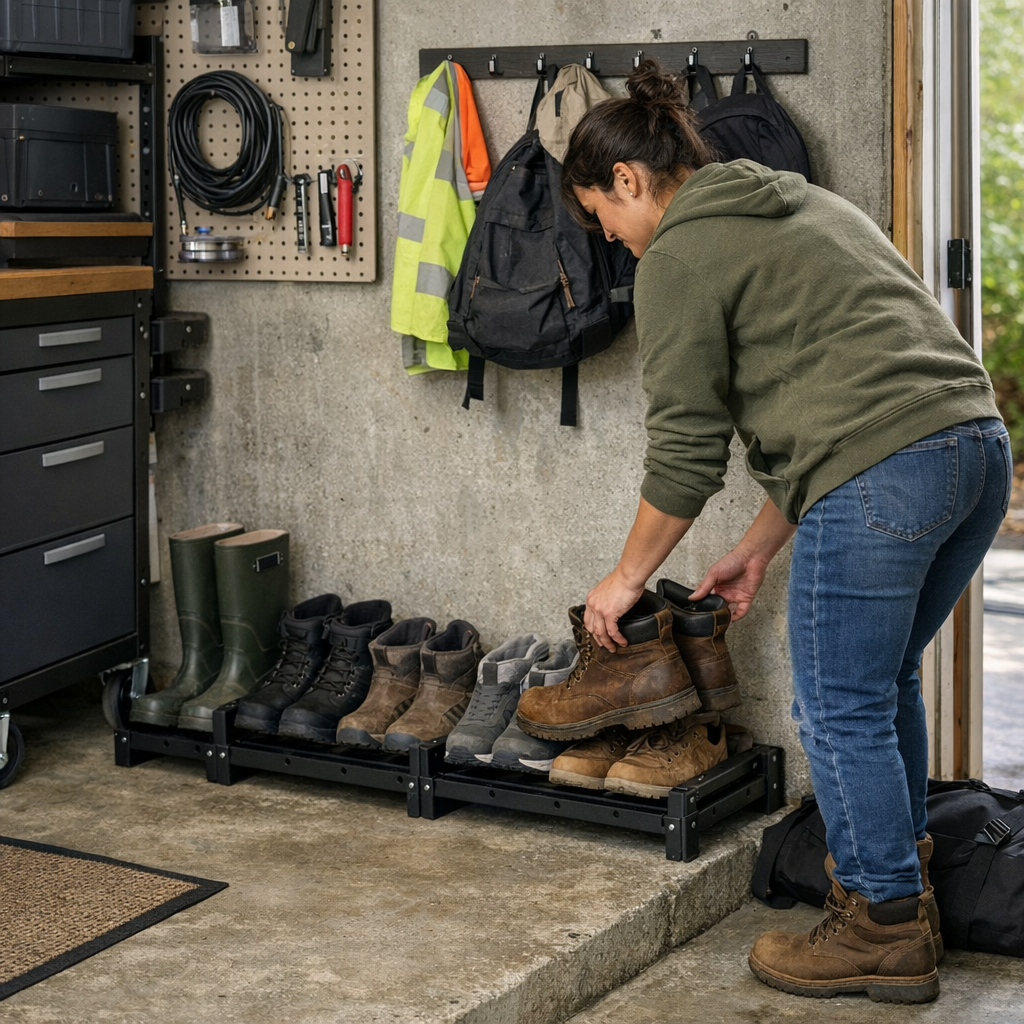
    Take a floor rack dropped parallel against the wall, set back far enough—not right up at the door, not jutting into the cold zone. In one honest test, switching from a wall unit to a slanted, low rack granted a full 22-inch clear lane. That’s not a number for a product tag; it’s enough for two kids to run by or to carry a week’s worth of groceries without a hip bump or a second glance. That angle meant shoes lined up on their own again, not stacked or turned awkwardly. Mud collected on the mat, not on the bags, and re-entry meant shoes landed where they belonged—no extra cleanup loop.

    Small Shifts, Real Impact

    It’s rarely a complete overhaul. Sometimes just pulling a unit four inches away from the bottleneck lets the zone breathe. Splitting one oversized bin into two shorter rows brings a sense of order—everyone finds their own spot, overflows stop, and the “always-in-the-way” area becomes a footnote instead of a daily headache. The best layouts don’t max out capacity at the cost of simplicity. With nothing blocking the obvious through-line, shoes move in and out naturally, and traffic no longer staggers or doubles back.

    Good Storage Lets Good Habits Settle

    Choke points spawn mess and apologies. Wall pegs stick out right where the sports bag hangs; a bin blocks the spot you pause to tie laces. These collection spots are magnets for unfinished resets, and the more often you have to apologize (“I’ll move this in a second”), the more the system is failing the routine. What works? Floor solutions so discreet they’re almost invisible—low, zone-conscious, never crowding the critical inches that make one space passable for all sizes and speeds.

    Quick Real-World Fixes

    • Do a real-life walkthrough: Carry laundry, wheel a cart, move through with kids or groceries. If a setup slows you down more than once, reposition or resize it.
    • Stop building upward: Tall bins and high racks encourage overstuffing and block sightlines. Priority is always width and clear access, never more vertical stacking.
    • Guard a clear lane (20–24 inches minimum): Never let racks or bins intrude here. This path isn’t for shoes—it’s for movement. Defend it, and even the smallest entry stays workable.

    The real win isn’t just a tidy floor—it’s frictionless movement. Shoe storage that respects the natural ways people move will always quietly outperform any system that only looks good in a product shot. The right setup isn’t what organizes the most—it’s what disappears from your daily routine almost entirely, every time you walk in or out.

    http://stacknest.myshopify.com