
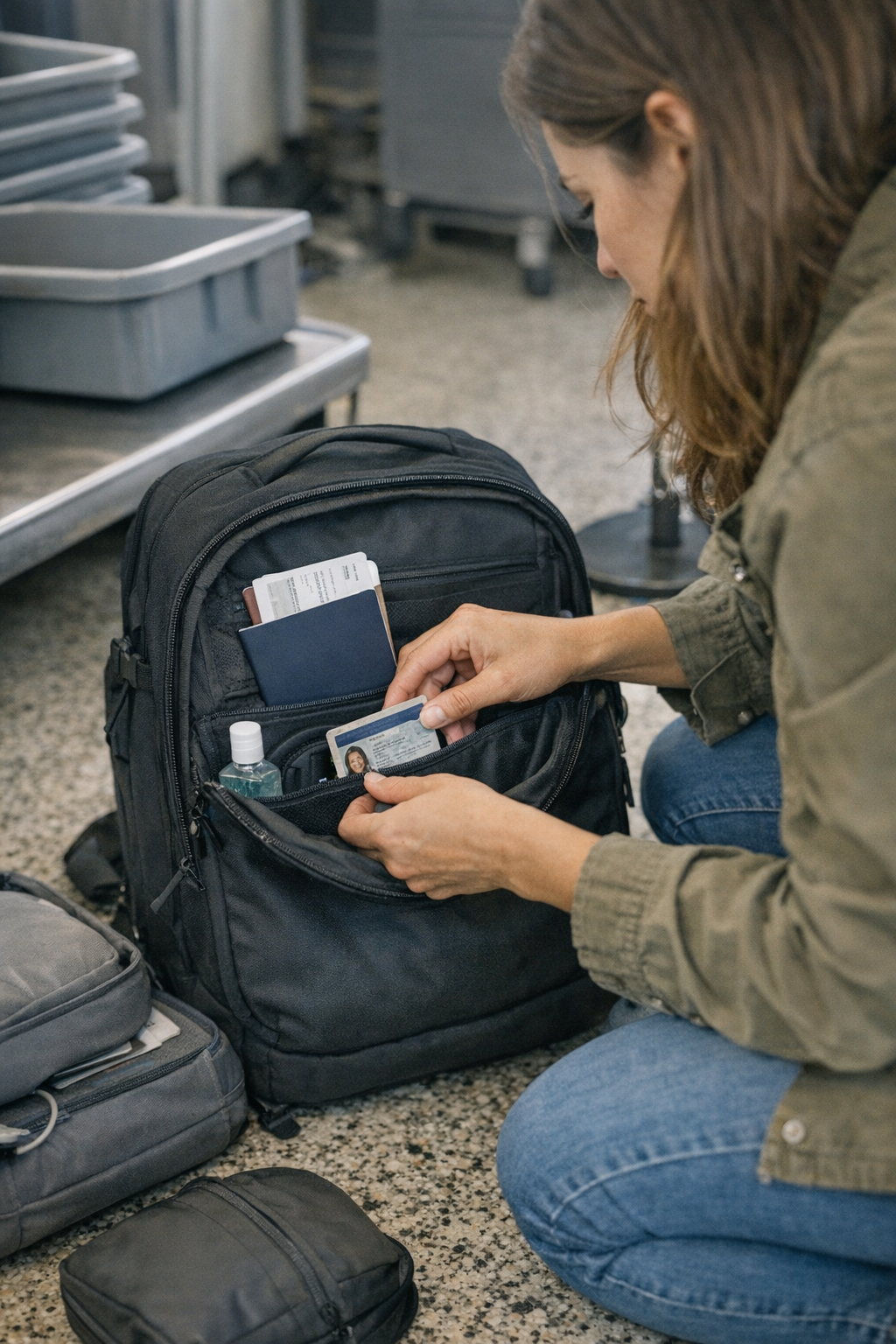
The first time your carry-on setup gets dragged through airport reality, its true strengths—and weaknesses—show up fast. At home, everything looks disciplined: pouches stacked neatly, chargers coiled, documents slotted for easy reach. But that tidy order almost never survives real airport movement. The minute you hit the security queue, watch as “organized” turns into a slow-motion scramble—repeated digging for documents, shifting pouches, re-zipping. What looked efficient becomes friction you can feel: a bag that feels less accessible every time you reach for the same item again.
When “Neat” Isn’t Fast: Travel Turns Order into Obstacles
Real friction surfaces the moment you’re pressed by lines. You’re in security, blocking the lane as you fish out your ID. Suddenly, your passport is hiding below the charger pouch, sanitizer is wedged under headphones, and the quick zip you relied on at home now catches on something you stashed “just for this trip.” Each delay multiplies: five seconds lost retrieving a document, another ten spent repacking after everything shifts. Organized at first glance, but in real use, every reach exposes a new snag.
These aren’t one-offs; they stack up. The first fumble is just a hiccup. By the third, your rhythm’s broken and your sense of control fades. You start noticing you’re the one holding up the queue or rushing to close zippers before boarding is called. A “well-packed” carry-on that turns against you drains more than time—it draws your focus away from what actually matters in transit.
Spotting Friction in Your Setup: What Hidden Slowdowns Cost
The difference isn’t about how pretty your bag looks when fully zipped. It’s whether you can actually get to what you need, when you need it—without disrupting the whole system. Pouch categories that made sense on your bed become dead weight at the gate if items get buried under layers. Most travelers don’t spot the weak link until they’re forced to reach past two barriers just to get a boarding pass. On a day with three security stops, that slow crawl becomes a visible liability: each time, digging deeper, pulling out what you already packed away once, and quietly losing a beat in the flow of everyone around you.
Quick Example: When Minor Setup Gaps Go Major
Picture this real sequence: first checkpoint, you’re delayed as your card’s trapped at the bottom of an “organized” sleeve. Next round, your headphones pouch blocks access to your pouch with liquids—forcing you to unpack mid-line. By the third stop, your quick-access system has turned into a repacking routine, with every reach inside a reminder that the neat layout at home doesn’t match the order you need under pressure.
This isn’t just an airport thing. Friction follows you: reaching for headphones at takeoff, sliding a bag into the overhead but catching on a misplaced strap, or stopping in a crowded aisle to hunt for sanitizer. Each event is a direct result of overlooked setup weaknesses.
Visual Order vs. Movement-Ready: Judging Setups That Don’t Keep Up
Looks don’t tell the story. A flawless grid of gear inside your carry-on is only as good as its ability to serve you on repeat. Most initial packing systems curb visible mess without accounting for live movement—how you’ll actually need to grab, repack, and retrieve in quick succession. If your layout requires a “hunt” each time you want your passport or headphones, it’s just another form of friction wearing on your progress.
Too many setups focus on compartmentalized organization—three pouches for three categories, all zipped and stowed. On the ground, this can mean dumping out half of what you organized just to grab hand sanitizer as people flow around you. Moments like swapping boarding passes or re-upping on comfort items don’t wait for you to decode your own layout.
The Value of Effortless Pauses: How True Organization Feels
Real order is found in the split-second pauses between movement. When you stop at a gate or ease into a seat and don’t need to scramble through layers, your setup proves its worth. The simplest setups put repeated-use items—travel docs, sanitizer, comfort gear—within a single, direct path. If your bag lets these small tasks happen smoothly, stress fades and the airport rhythm changes; if not, the “pause” is lost to another repacking session.
Real Travel Example: Shifting from Buried to Immediate Access
Notice the change when you assign all high-frequency items to one external pocket or easy-grab path. The improvement is visible: quick retrieval at security, no more unzipping three sections for ID checks, faster seat entry. Instead of navigating a padded pouch maze, you run your hand along a known zipper track and move on—no mental inventory required. Movement isn’t frictionless, but interruptions now pass as flickers instead of full stops.
The real difference: your carry-on goes from being a delicate puzzle to a reliable tool under pressure. The moment you stop hovering over your layout and simply move, you’ve found the structure that works for repeated use.
Finding Hidden Friction: Are Repeated Stops Draining Value?
Start tracking how often you pause for the same reason: fishing under pouches, spinning your bag to reach a pocket, or hesitating while someone waits behind you. If entry into your seat means a shuffle to clear blocked zippers or if you find your documents stuck behind “more secure” organizers, your setup is quietly costing you time and energy with every cycle. Strong carry-on systems leave almost nothing to multi-layer hunts, especially under streaming travel conditions.
The signal isn’t frequency of travel—it’s the feedback of each retrieval. If grabbing a passport creates hesitation, or if headphones require a full unpack, your organization isn’t tuned for movement—it’s tuned for static display. The best setups beat repetition by working with, not against, airport patterns and in-flight routines.
Adjusting for Real Use: Practical Fixes That Actually Change Flow
Start by mapping your must-grab items—passport, ID, sanitizer, headphones—into the zone you can access with one smooth motion, even when your bag is upright or squeezed between seats. With every movement (security, boarding, aisle slide), notice the moments your hand lingers or reverses step. If the new layout cuts the drag and drops your retrieval time, you’ll feel the difference immediately.
Tested over a couple of trips, these changes reveal where good intentions bottleneck in real use. Rethink what you pack where—switch pockets, reduce pouch depth, use travel-specific organizers built for repetition—and let repeated exposure, not just initial order, shape each upgrade.
Luggage Structure That Keeps Up: Moving Past One-Time Display
Effective carry-on structure survives real travel interruptions: repeated document checks, tray handoffs, boarding-lane bottlenecks, or aisle-seat shuffles. When things get tight, the highest value comes not from how the bag looks under your bed, but from how it responds to rapid retrieval and repack routines. The carry-on that’s movement-ready shrinks every point of friction from “small delay” to “barely noticed pause.”
Every setup has its limits, but shrinking each friction point keeps you moving forward. If your carry-on is shaped for movement—not just neatness—real organization means the bag adapts to your pace, not the other way around. That’s how structure becomes support, not a subtle drag you only find out about after your third security line.
Find gear designed for repeated-use ease at CarryOnSupply.