
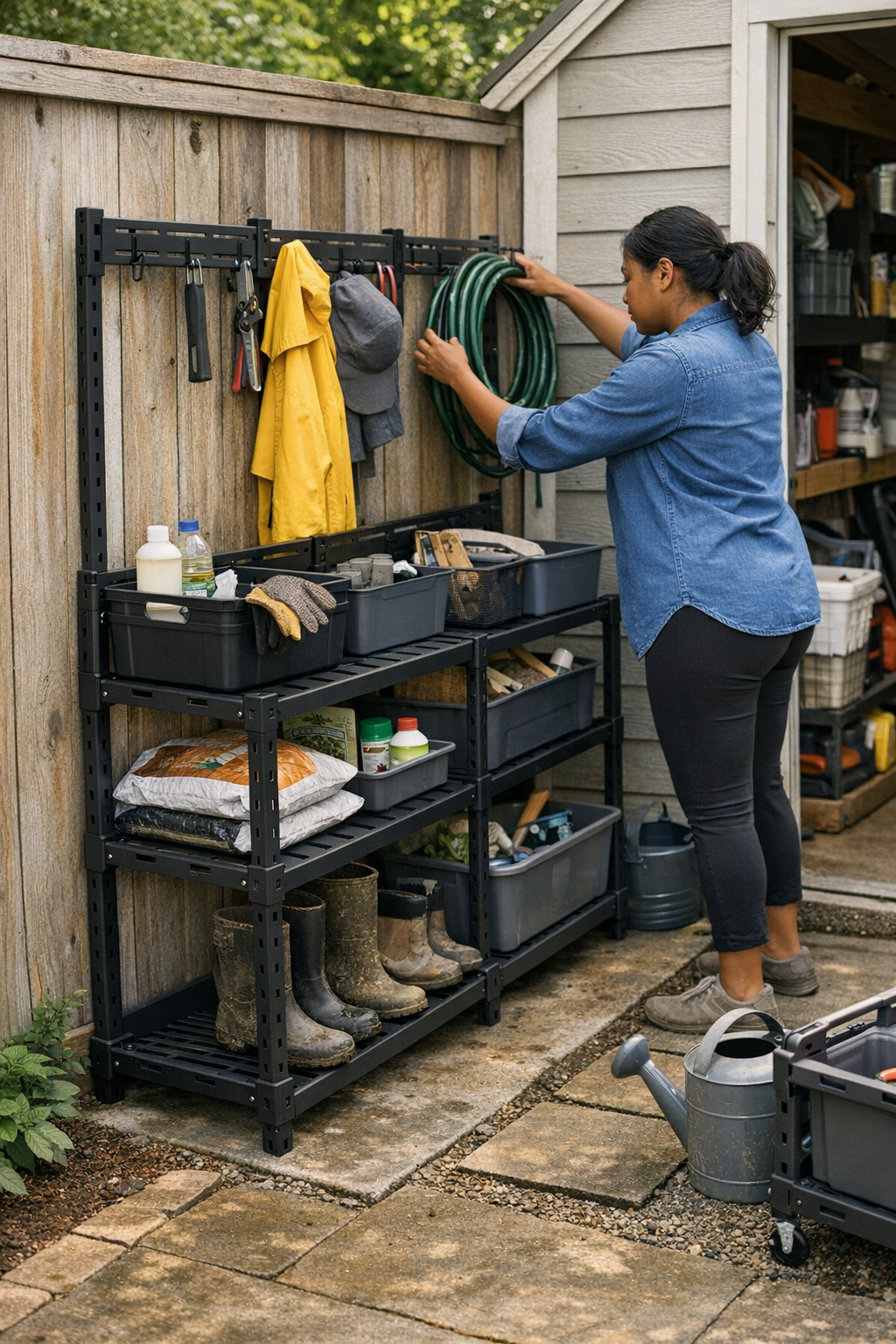
Wet boots in a side-yard, dripping jackets tossed at the garage threshold, mud tracks slicing across the path—most outdoor entry setups are built to appear tidy, but real routines tear through that illusion fast. You set down a boot tray by the door or line up bins along the fence, and for one day it looks like a solution. Then rain comes, everyone barrels in at once, and suddenly the nice layout turns into a repeating shuffle: trays overflow, bins block your only clear route, and squeezing past the mess gets added to your to-do list. In these pocket-sized utility zones—backyard corners, narrow strip entries, garage entries—the friction is subtle at first but compounds with every step and every wet day.
When “Organized” Storage Blocks Your Actual Routine
Wall racks, bench trays, modular bins—they promise “reset and forget” ease. But the gap between a neat install and a setup you can use daily lives in the overlooked details: a wall rack that practically grazes your shoulder as you squeeze by, a shelf situated right where you plant your foot after stepping inside. Visual order snaps the moment you actually move through the space. You spot muddy footprints scattered where you just cleaned, gear that creeps back into your path, and the constant drag of returning the zone to “clean” after every use.
True-to-life moments from real setups: Try to hang a jacket and instantly realize there’s no spot left that won’t leave it brushing against a soggy sleeve. A once-roomy tray fills after two pairs of boots and a backpack, water sloshing to the edge before anyone else arrives. Floor bins meant for “overflow” become permanent fixtures, slowly shortening your walking line until the reset means not just organizing gear, but physically rerouting your way in or out. Every attempt to clear up creates its own micro-blockage somewhere else.
Order That Lasts: Prioritizing Open Movement
The best outdoor storage setups aren’t about having more places to stash gear—they’re about making sure movement stays free and obvious, even when the weather’s making things messy. Open rails, spaced wall units, or raised shelves change daily use in a way closed bins can’t: boots and gear can dry without pooling or blocking, and you’re not forced to do a dance around a mountain of wet stuff every time you pass through. Slotted or suspended storage drains away runoff, so you’re not stepping in surprise puddles—or worse, splashing yesterday’s drips onto today’s dry shoes. Most importantly, the space resists letting gear crawl back into traffic lines, no matter how many pairs come through or how chaotic the week gets.
The Trouble with “Contained” Storage
Flood the main entry with bins or trays and it’ll look controlled until the first downpour or crowded afternoon. Containment falls apart fast: stacked trays hit capacity, a wall rack fills, and suddenly you’re stacking boots on boots, hesitating before dropping anything for fear of tipping the balance. The easy “drop and go” becomes a careful rearrangement—instead of one quick task, you’re sorting wet from dry, lifting gear to rescue what’s underneath, and hoping you haven’t just traded one annoyance for three new ones.
Everyday Friction: Blocked Flow, Tense Resets
When racks hug the walkway or bins hover right at the edge of where you step, the whole routine gets pinched. Returning home turns into a sidestep past saturated coats, a lurch around trays that have crept into the route, or moving bins just to free up the door swing. It’s not an exception—it’s how most setups break down on any busy or wet day. At first, you notice only little delays. Over time, those delays wear on you: slower resets, muddier footprints, and a sense that you’re forever fighting the layout you thought would help.
What “Fixing” the Zone Actually Looks Like
In most outdoor corners, fixing the friction means simplifying, not adding. In one backyard side strip, moving the boot zone just a few steps off the central walk—then trading a braced rack for an open rail—changed everything. Suddenly, boots had a real “home” away from the direct walkway. The shelf at shin-height—finally left clear—became the landing pad for anything wet. No more tiny dances through puddles, no more blocking the door just to shuffle someone else’s gear. Now, the routine reset was a five-minute sweep, not a session of lifting, draining, and reorganizing the whole zone.
Reality check: As soon as the storage zone stayed more open, gear stopped drifting into the route everyone used. Wet boots actually stayed in their own line, and clearing after a rainstorm shrank from an ordeal to a quick last check—no more overflow, no more resets bleeding into the next use.
Where Outdoor Order Fails (and How to Spot It)
- Binning the entry path: Tray or bin close to the main line? All it does is collect splashes, missteps, and sidestepping bodies, not just boots.
- Wall racks in the walkway: If hanging gear sits right where you need your knees or feet, drips collect underfoot, making every “quick entry” a detour.
- Dead end corners = accumulation zones: Any “empty” nook too far from the routine gets stuffed with overflow, turning into a slow-growing blockade as routines change or guests pile in.
- Assuming lines and bins equal flow: Just because something’s divided doesn’t keep movement fast—watch if you’re stepping around, lifting, or resetting even with all the supposed organization in place.
Small Corrections with Real Impact
Shift main gear storage out of the direct line of movement. Even moving bins or shelves half a meter away from the main door path is enough to keep the worst splash and mess outside your “in/out” route. Use quick brackets or folding rails to create separation, keeping run-off and gear from drifting where you need to step.
Prioritize open rails and shelves for anything wet. They won’t trap water, they dry faster, and cleanup after heavy use takes minutes, not hours. Closed bins look tight but one thunderstorm proves the difference—pooling at the bottom, moisture lingering, and a reset that gets stickier as the week goes on.
When Setup Finally Matches Real Use
The right outdoor layout isn’t a matter of adding the flashiest wall system—it’s in making the zone adjust as people, moisture, and routines change. One change in shelf placement can keep your main path wide open, and an open rail can stop drips before they soak the floor where you walk. You’ll find yourself resetting less, cleaning less, and finally feeling like your space is working for you—not forcing you to work around it. A setup that makes the worst days less frustrating is worth holding onto. When the design fits the routine, every reset gets easier—and you stop resenting the small, muddy jobs the outdoors brings in.