
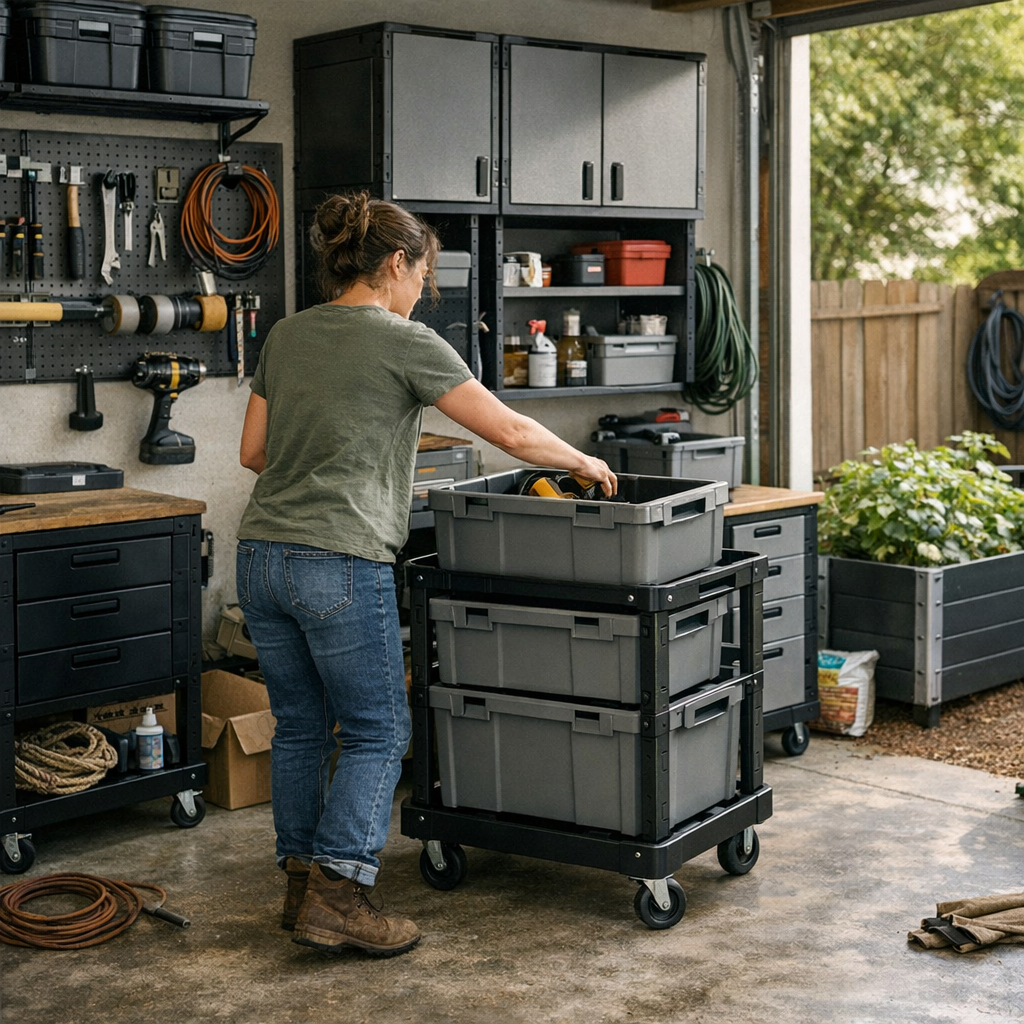
The promise of a clean, organized garage or workshop is always seductive: lined-up cabinets, a rolling tool cart, maybe a new wall rack or modular bench. On install day, everything slots together—bins fit, floors show off their shine, wall space gets busy without feeling claustrophobic. It feels like, finally, chaos will stay banished. And for a few days, it almost does.
But as soon as the routine kicks in—tools in, tools out, surprise repairs, hurried project pivots—those gleaming setups start revealing their cracks. A space that once looked like the solution starts tripping you up, demanding sidesteps, awkward reaches, and endless mini-resets. What happens to “order” when the space actually gets used, day after day?
The Trap of Looking Organized
It’s easy to fall for a setup that photographs well. Cabinets shut smoothly, bins match, nothing spills out. But for most workshops and garages, order shouldn’t end at the surface. Closely parked carts and dense racks create the appearance of storage—but when you’re mid-task and need to swap tools fast, that “neat” arrangement starts to fight back.
The friction is subtle at first: A drawer that blocks the walkway unless you nudge a cart out of the way. A tool chest whose side handle catches your pocket every time you pass. Wheels that settle in the most convenient, rather than correct, place. All those tiny interruptions add up until you’ve stopped putting things back, “temporary” piles materialize, and walking space—the thing you counted on—shrinks one stray bin at a time.
When the Routine Breaks the Setup
Visit any single-car garage on a Monday morning. The weekend’s order has started to erode. You go to put away a big saw; the rolling cart that holds its blades is boxed in by the recycling bin, which itself is squeezed between the mower and the wall. To return a set of drill bits, you have to half-twist around the open cabinet door because there’s barely enough room for your knee. The supposed “system” now costs you double steps and bent shoulders just to do the basics.
The flow becomes an obstacle course. Maybe a corded tool lives near a cable reel mounted slightly too close to a shelving edge, turning every crossing into a cautious sidestep and slow shuffle. Soon, open surfaces start capturing the overflow—screwdrivers here, tape rolls there. The floor becomes a last resort, even if wall space is technically unused, simply because the right path is never quite clear enough.
How Overflow Finds Its Hiding Spots
Every small workaround—“just set the cart here for a sec,” “I’ll come back for that part”—quietly rewires your routine. One corner gradually becomes a dumping ground for leftover fasteners, spent batteries, or tool accessories no one wants to walk back. Each reset turns into its own spatial puzzle: moving bins, shifting carts, detouring just to reclaim space. Productivity dips, and every extra obstacle invites not just frustration but tripping hazards and wasted setup time.
Why “Everything Fits” Isn’t Enough
Squeezing gear in does not equal smooth working space. Stackable containers might technically maximize every vertical inch, but if what you need is always under two more boxes, you’ll start leaving tools out, “just for now.” Cabinet runs that looked perfect at first gloss struggle when carts can’t return to their spot or wide bins block each other under actual use. The system captures stuff, but doesn’t serve the real flow of daily work.
Even wall racks that start tidy lose their touch if daily use nudges them just out of ideal position. And soon, matching modules become rivals—mobile chests drift, bins pile into traffic lanes, and the work zone divides itself against you.
Every Tiny Delay Matters
Spend a few hours in a real, active shop, and the inefficiencies pop: sidestepping for swinging cabinet doors, shifting a rolling cart for the fifth time just to clear a lane, stopping to reshuffle so you can cross from bench to rack. The more these moments stack up, the more work slows, and the less natural the whole setup feels. The line between useful order and new inconvenience blurs fast—especially when every “quick” fix costs one more move.
Tiny Adjustments, Tangible Results
This isn’t about ripping everything out and starting from scratch. Real improvement often comes from smaller, sharper moves: shifting a cabinet by the width of your favorite bin to open a needed path, or closing the gap between shelves and racks to just wide enough for a confident grip—but narrow enough to avoid dead-space clutter. These changes open actual return lanes and make it possible to reset the space fast, not just make it look okay at a glance.
The most effective tweak? Assign every cart—every mobile bin—a specific “parking spot.” Give each wheeled unit a home that is never in the working lane, never tucked “wherever it fits.” Suddenly, rolling storage stops blocking key stretches, and mid-task shuffles all but disappear. You’ll know it’s working when you reach for a tool and don’t have to push anything aside first.
Wall Storage vs. Mobile Units: The Everyday Reality
Wall-mounted solutions promise open floors and less clutter, especially in dense garages or small backyard shops. Often, they deliver—if, and only if, hooks aren’t stacked too close and shelves aren’t overloaded. Misplaced mounts or overly long tool arms can turn “efficient storage” into an awkward reach or an elbow hazard. For wall space to help, it needs to respect the natural motion of regular work, not just look tidy for a snapshot.
Mobile units are lifesavers for evolving projects—but their very flexibility is the hazard. Without a return lane and a non-negotiable home base, they clog up the heart of a space with just a day or two of drifting. What starts as an adaptable layout quickly becomes a game of leapfrog every time you need to cross from one end to the other.
Reset Speed Beats Picture-Perfect Order
The real test comes not when the day ends, but when it restarts. Can you move, retrieve, and put away gear without detours, obstacles, or extra steps—even when you’re tired or distracted? A good setup works in silence: tools drift naturally back home, corners don’t attract clutter, and you spend almost no time shuffling or hunting. Sessions begin with immediate focus, not five minutes of cleanup, and you remember how your space feels more than how it looks in a still photo.
If you’re stuck, shifting the same cart for the third time, zigzagging around the same stubborn handle, or parking in a walkway “just until later,” it’s your setup—not your habits—asking for a smarter adjustment.
Want storage that fits the way you actually use your space? See setups that put real flow first at StackNest.