
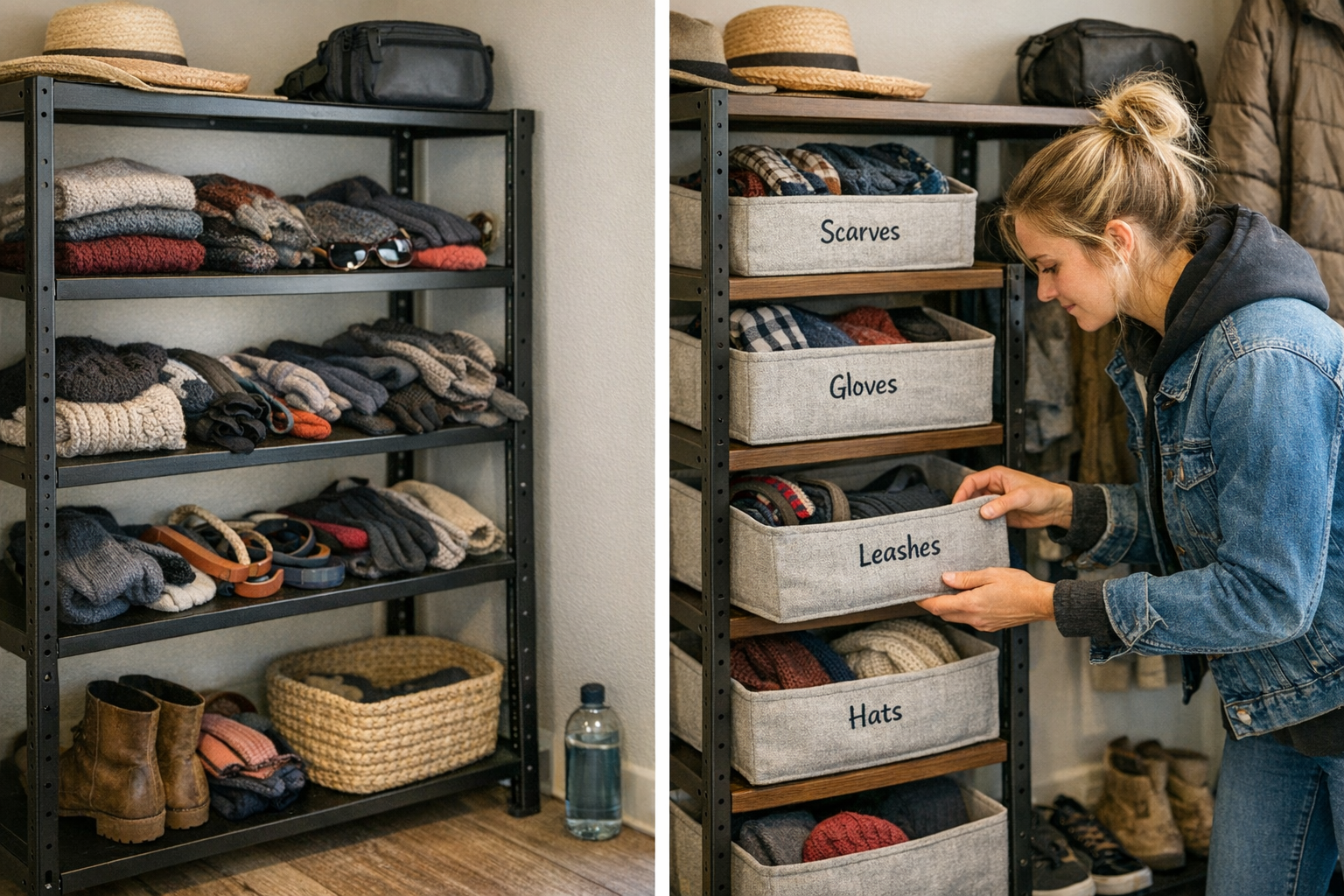
Every closet looks promising on day one—rows of folded clothes, empty shelves, everything in its place. But real life quickly unravels that tidy promise. What begins as crisp organization meets the chaos of daily routines: piles get jostled, socks disappear into the back, stray scarves migrate, and the clean divide between gym gear and work bags blurs with every hurried grab. That “system” you thought would last all year? It’s fighting against your mornings—and losing.
Open Shelves: From Orderly Display to Daily Shuffle
Open shelves feel like a fix-all when you move in. Every item is visible—sweaters lined up, accessories stacked in neat piles. But the reality of getting dressed knocks that order off balance. You reach for a t-shirt in the middle and disrupt every shirt above it. Grab a gym towel for a last-minute workout, and half the pile sags out of formation. Scarves slide off their perch when you pull out just one.
This is where friction builds: Socks drift behind sweatshirts, a stack of tees loses its shape, and the ends of every shelf quietly gather random items—yesterday’s belt, a pair of headphones, winter gloves no one bothered to return. The space between categories vanishes; soon, “sports gear” is covering “work layers” and “everyday basics.” Your shelf isn’t a stage anymore—it’s a battleground for daily negotiations.
Hidden Costs: The Re-Stack Ritual
By day three, organization is mostly an illusion. You spend precious minutes re-stacking the same piles just to grab what you actually wear. Need that navy sweater at the bottom? Everything on top comes out for a temporary relocation—often spilling over to other stacks. The quick grab always turns into a reshuffle, and the put-away routine becomes a balancing act: press and hope the stack holds, knowing it rarely does.
Baskets: Containment with a Catch
When open shelves lose the battle, baskets look like relief. Instead of fighting every item back into a pile, you drop gloves, beanies, or charging cords into a basket and let the sides corral the chaos. For soft, slippery, or oddly shaped belongings—especially those that migrate daily—baskets give you the boundaries shelves never can.
Instant containment means: No more scarves sliding into shirt stacks, no more loose gym towels taking over a whole shelf. The front of your shelves stays open and usable. After a busy week, the “reset” is a matter of tossing things into their baskets—not a full-scale resorting mission. The uprising of clutter pauses right at the basket edges instead of spilling across your closet floor.
The New Hassle: What’s Out of Sight Gets Lost
Baskets come with their own pitfall: Searching blind. Overfilled, unlabeled bins turn into a guessing game—did you leave your hat in the “winter” basket or “sports”? Is the other glove at the very bottom? In busy moments, searching means hauling out three containers, digging to the base, then reassembling what you just scattered. Visibility trades places with containment—organization stops looking chaotic but begins feeling slower.
Labeling isn’t optional—it’s your map. Masking tape with big marker letters beats a pretty label you have to squint at. The real secret: one category per basket. “Miscellaneous” bins become unsorted junk drawers within days; the narrower the category, the faster you find (and return) what you need.
The Telltale Signs Your System Isn’t Working
How do you know your storage setup is failing? The signs show up almost overnight: shelves look crowded even when half-full, you’re reshuffling the same piles every few days, and the front of every shelf is clogged with things that should have a home. Entryway closets are a perfect storm—gloves, dog leashes, hats, and keys multiply and spread, especially after a weather change.
These stress points aren’t always about too little space—they’re about role confusion. Baskets rescue the categories that refuse to fold, won’t stack, or travel from room to room. Shelves still shine for what’s boxy, sturdy, and doesn’t need constant reshuffling. The closet that feels easiest to maintain is usually the one that mixes both, dividing by what survives the daily grab-and-go cycle and what needs a border to stay contained.
Minimal Tweaks, Noticeable Results
Test this in your own routine: Move just one category—say, unruly accessories or scattered tech gear—from a shelf into a basket. After a week, notice the small wins: shelves that finally stay neat, less sprawl on flat surfaces, and quicker resets at the end of the day. Suddenly, you’re not fighting your storage—you’re making it work with you, not against you. The space feels organized because it actually functions that way.
Smart, Real-World Storage Fixes
- Shallow baskets beat deep bins. Low, wide baskets mean everything is within reach, not buried at the bottom. Grabbing what you need never becomes a dig.
- Labels must be bold and obvious. Fast retrieval beats pretty aesthetics. A strip of masking tape and a black marker can save daily minutes over designer tags.
- Keep “misc” out of your system. If a shelf or basket always attracts out-of-place items, reassign its job. Change the function—don’t let clutter set the rules.
- Leave breathing room. Shelves and baskets filled to maximum are the first to unravel. Keeping them 20% empty turns “resetting” into a light touch instead of a chore.
A Closet That Holds Up Under Real Pressure
No closet survives untouched. Between rushed mornings, seasonal gear shuffles, and everyone’s habit of dropping things wherever, the work is never truly “done.” Open shelves display, but demand discipline. Baskets contain, but obscure. The real win isn’t perfection—it’s reliability under stress. When the things you reach for most spill into baskets, and what needs visibility stays on shelves, the routine feels lighter. Your closet functions not just for a photo, but for how you actually live—less time reorganizing, more time using what you have.
Find practical storage solutions and more everyday tips at ClosetWorks.