
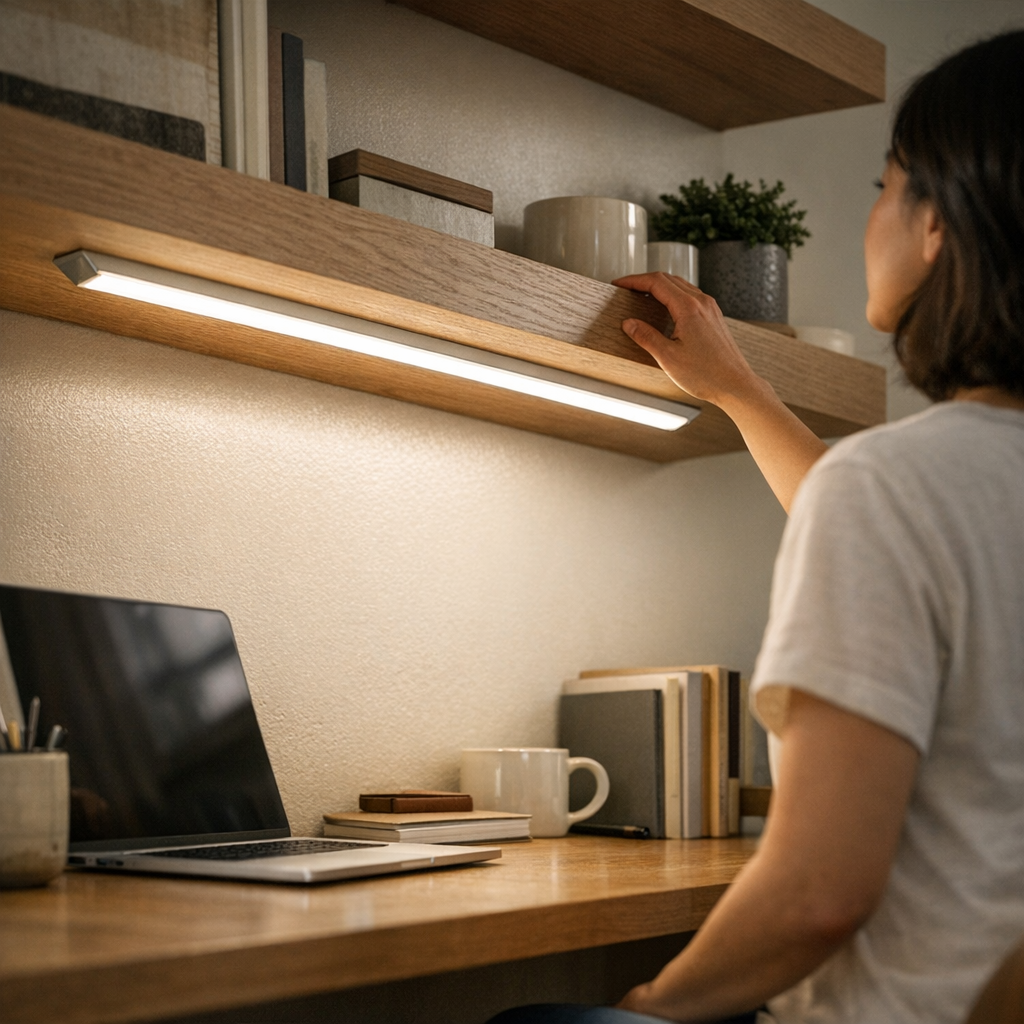
Cluttered desks and tangled cords aren’t just side effects—they’re a warning signal your lighting setup isn’t actually working for you. After a week, the friction becomes impossible to ignore: light brackets eat into shelf space, cables hang into reach every time you plug or unplug, and surfaces designed for work become navigation puzzles. An area that looked organized on move-in day turns into a hands-on obstacle course—lighting intended to help now interrupts the simplest tasks, from cleaning to opening a notebook to sliding your chair.
When Clutter Creeps In: The Hidden Cost of Bulky Fixtures
Most people buy lighting once, but use it a hundred times—rarely pausing to picture how much elbow room will remain after cords and brackets take over. Opt for a thick, hardware-heavy fixture and open space quickly disappears: cable coils find permanent residence at the desk edge, tall arms shadow books or snag bags, and every “quick clean” means dodging supports and wiping around clamps. Over days, the clutter isn’t just visible—it’s physically in the way. You fumble past a bracket to charge a laptop, shift a lamp just to wipe dust, then add “fix lighting mess” to your mental to-do list.
The disruption is practical, not just visual. Let cables run across active spots or block shelf edges, and every equipment adjustment becomes an awkward workaround—built for a static showroom, not situations where seats shift, routines change, or you just want to clear a surface fast.
Slim and Low Profile: Practical Lighting that Stays Out of the Way
The difference only becomes obvious after repeated use: fixtures that look minimal don’t always behave that way, especially in tight quarters. Slim lights and low-profile bars don’t just clear up photos—they free up real working edge. Daily impact changes fast:
- No visible cables forming new “corners” in your line of sight
- No support arms eating into vertical reach or casting excess shadow
- No hidden dust magnets or new snag points for sleeves and cables
You know your lighting is overdue for an upgrade the moment you keep shoving cords aside to spread out papers, or notice guests pausing before sitting to see where the lamp arm can swing. Even minimal-looking hardware often turns annoying when used by more than one person or when the setup needs to shift for a new task. Routine motions—moving a charger, turning to get something, or simply cleaning—expose what bulky setups hide at first glance.
Repeated Use Reveals What a Setup Really Feels Like
The true test hits by the first week of use. A swing-arm lamp with a clean look seems fine until the shade blocks an outlet, or a bracket means you have to reach awkwardly for a book. Cleaning becomes an exercise in working around fixed hardware and dodging cords that stick out just enough to catch a cloth or a sleeve.
Switch to a low-profile LED bar under a shelf or along the back edge of the desk and the relationship with the surface changes. The light stays out of the way, reach is open from edge to edge, and even after a week’s mix of projects, repositioning, and cleaning, nothing interrupts. There’s a visible absence—no sudden tangle, no makeshift adjustments, no clearing gear just to use the area you set up as “organized.”
Shared Spaces Show the Difference Faster
Shared desks put setup friction on display. A clamp-arm lamp that works for one user leaves the next with a tangle of cable and a bracket blocking a comfortable position. Over a few days, the sequence is predictable: people start shifting chairs sideways, stacking items away from the arm, or leaving the lamp unplugged to avoid the extra step. Surface clutter increases and everyone adapts to the light—rather than the light adapting to the room.
With a low-profile strip mounted under a shelf or along a wall edge, these problems recede. No one has to negotiate for cord space. There are no bulky arms to inch around or brackets dictating where the work zone ends. The clean feel remains, because the light works invisibly—everyone can sit, read, or charge devices without dodging hardware or tracing cable paths.
Desk Transformation: Small Shifts, Big Results
Swapping a heavy swing-arm for a slim LED bar immediately changed how the entire back edge of a desk could be used. Suddenly:
- Devices, notebooks—even things as irregular as a water bottle—could move anywhere along the surface without colliding with hardware or tugging a cord loose
- Light was evenly spread, no sharp glare where you’d normally rest your hands
- Cleanup went from a five-minute maneuver around brackets to a single wipe—no unplugging, no careful dusting
What changed wasn’t just tidiness, but the daily mechanics. No more yanking a lamp aside to reach a power strip, no more pausing to detangle a cable after shifting work materials. That practical clarity—you never need to remind yourself to “fix the lighting situation”—signals a structural improvement, not a passing clean look.
Shelves, Cabinets, and the Reality of Limited Space
On shelves or inside cabinets, even a small bracket or stray wire quickly turns usable inches into lost space. Install a thick fixture, and soon you’re stacking books in front of a mount or brushing past a cord to get to supplies. With slim under-shelf LED bars, every front edge stays accessible—for hands, cleaning, and light itself. The fixture disappears into the background, yet coverage reliably reaches to the visible edge, with no bump risk and no tangle when shifting stored items.
If you choose a large accent piece for style or maximum output, expect the tradeoff: cable management becomes critical, and surface area shrinks by the width of every bracket, cable, and connector. These are choices imposed by hardware—not just aesthetics.
Cable Management: Don’t Treat It as Optional
Even a minimal fixture can lose all practical benefit if its cable becomes the next visual nuisance. A thin wire over a desk, left unmanaged, turns into a line you see—and catch—every time you plug in a device or tidy up. “Looking simple” at installation fades fast if a week later, there’s a loop draping down a wall or crossing the field of view at an awkward angle.
The obvious fix: adhesive cable channels or discrete clips to guide cords along surfaces and out of the action zone. This doesn’t just clean up the look; it eliminates daily cable snags, accidental tugs, and visual clutter, freeing up attention and workspace for what actually matters.
Brightness, Placement, and Actual Task Visibility
The fear with slim fixtures is losing usable light. But brightness means nothing if the light falls in the wrong place. Most modern low-profile LED bars far outshine their bulk, easily lighting desk runs or shelf edges. What actually fails most often? Poor placement. A bright light, misaligned, leaves a dim work area or glints directly off screens; too far back, and the front edge of your work disappears in a dim zone that negates the extra lumens entirely.
Choosing fit and placement over arbitrary output transforms the space. A slim bar installed where you actually reach and write—rather than where it “looks best”—results in clear, usable surfaces and even task illumination, not just a pretty wash.
Living with Lighting: The Difference Shows Over Time
The warning signs are immediate but often ignored: a shelf edge catches cable twice in a day, a lamp blocks a simple reach, a “finished” desk setup still requires routine workarounds. These small frustrations add up: lost momentum, uneven work zones, constant mental notes to fix, move, or clean when the hardware never really fit the tasks it’s supposed to support.
The real upgrade isn’t visible on installation day—it’s what stays unbroken after a dozen different routines. Slim, low-profile lighting reduces interruptions, reserves space for new needs, and lets every adjustment happen smoothly, without hardware holding the room back.
Day after day, small frictions vanish—and you start noticing your work, not your lighting. LightSupport